1765: Andrew Oliver lynched in effigy to the Liberty Tree

On this date in 1765, Boston patriots lynched the merchant designated as the imperial taxman. They only did so in effigy, but the “execution” scared him permanently off the job while also making a gallows-tree into one of the earliest symbols of American independence.

One of the key pre-revolution irritants for the future United States, the 1765 Stamp Act imposed taxes in the form of stamp duties on a variety of printed products, for the purpose of funding the British army deployed to North America. It was a levy long familiar to London lawmakers but it sent the colonies right around the bend, and since the colonies sat no Member of Parliament who could flip an official wig it also popularized the classic revolutionary slogan about “taxation without representation.”*

Enacted in the spring of 1765 and due to take effect in November, the Stamp Act drew immediate outrage in the colonies and especially in that hotbed of subversion, Boston.

There, Andrew Oliver, scion of a shipping magnate clan, was tapped to collect the levy. It figured to be just the latest in a series of lucrative state appointments. How was he to know in advance that this particular legislation would unleash the crazies? Perhaps he should have given more heed to the publication of ominous warnings over the roster of tax collector names.


Boston Post-Boy, August 5, 1765

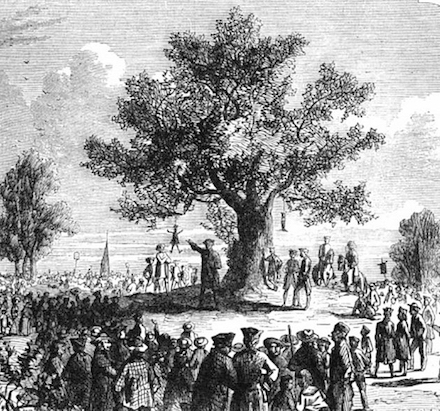
On the morning of Wednesday, August 14, a crowd of irate Bostonians mobbed the corner of Essex Street and Orange Street (present-day Washington Street) and upon a large elm tree strung up an effigy of Oliver alongside a boot — the footwear comprising a second, punny, effigy of the Stamp Act’s sponsor the Earl of Bute.

“What greater Joy can NEW-ENGLAND see,” ran the menacing note pinned to the mannequin, “Than STAMPMEN hanging on a Tree!” As is clear from the following newspaper account, versions of which circulated widely in New England, these were no mere theatrics but a very proximate physical threat; even the elm’s property owner dared not take down the provocative display for fear that the crowd would pull down his house. Likewise taking the better part of valor, Oliver pledged to anti-tax colonists that he would not take the office, and he kept his word.**


Providence Gazette, August 24, 1765

After this triumphant debut, the elm in question became a common rallying-point for the hotheaded set, a frequent stage for speechifying, rabble-rousing, and fresh instances of popular justice all further to the patriot cause until, as Nathaniel Hawthorne put it, “after a while, it seemed as if the liberty of the country was connected with Liberty Tree.” Of course, it’s all a question of whose liberty; a Tory gloss on this deciduous republican made it “an Idol for the Mob to Worship; it was properly the Tree ordeal, where those, whom the Rioters pitched upon as State delinquents, were carried to for Trial, or brought to as the Test of political Orthodoxy.” When besieged in Boston in 1775-1776, British Tories cut the damned thing down, so for subsequent generations it was only the Liberty Stump.


“The Colonists Under Liberty Tree,” illustration from Cassell’s Illustrated History of England, Volume 5, page 109 (1865)

The Liberty Tree is commemorated today at its former site, and forever in verse by revolutionary firebrand Thomas Paine.

In a chariot of light from the regions of day,
The Goddess of Liberty came;
Ten thousand celestials directed the way,
And hither conducted the dame.

A fair budding branch from the gardens above,
Where millions with millions agree,
She brought in her hand as a pledge of her love,
And the plant she named Liberty Tree.

The celestial exotic struck deep in the ground,
Like a native it flourished and bore;
The fame of its fruit drew the nations around,
To seek out this peaceable shore.

Unmindful of names or distinctions they came,
For freemen like brothers agree;
With one spirit endued, they one friendship pursued,
And their temple was Liberty Tree.

Beneath this fair tree, like the patriarchs of old,
Their bread in contentment they ate
Unvexed with the troubles of silver and gold,
The cares of the grand and the great.

With timber and tar they Old England supplied,
And supported her power on the sea;
Her battles they fought, without getting a groat,
For the honor of Liberty Tree.

But hear, O ye swains, ’tis a tale most profane,
How all the tyrannical powers,
Kings, Commons and Lords, are uniting amain,
To cut down this guardian of ours;

From the east to the west blow the trumpet to arms,
Through the land let the sound of it flee,
Let the far and the near, all unite with a cheer,
In defence of our Liberty Tree.

* Visitors to the U.S. capital of Washington D.C., whose 700,000 residents cast no votes in the Congress they live cheek by jowl with, can find this familiar grievance right on the city’s license plates.

** How far this surly bunch was prepared to go on August 14, 1765, one can only guess at; however, in later years, there would be several instances of Bostonians tarring and feathering various tax collectors. These guys did not do civility politics.

On this day..

1875: Joseph Le Brun, the last public hanging

Joseph Le Brun starred in the U.K.’sthe British Crown Dependencies’ last public execution on this date in 1875.

Although capital punishment had been moved behind prison walls in Great Britain several years earlier, the relevant statute did not apply to Crown dependencies like the Channel Islands. And it is upon one of these rocks, Jersey to be precise, that Joseph Le Brun allegedly killed his sister. The names in this post are Gallic, as was much of the Channel Islands populace.

The milestone case was a strange and unsatisfying one. It entered the view of the judiciary on the evening of December 15, 1874, when a neighbor of Nancy’s reported to the police that Nancy had been murdered and her brother-in-law Philip Laurens wounded in a shooting. The unmarried Le Brun was a frequent dinner companion of this couple as he had been on this night as well, and there was no hatred known to exist among the trio. According to a True Crime Library summary, police

asked Laurens, who had face injuries and an arm wound, who had attacked him, and he replied: ‘My brother-in-law Joseph shot me.’ They found the body of Nancy covered in blood sitting on a sofa. There was a shawl covering her face and her stockinged feet were in a bucket of water.

They arrested Le Brun, who was in bed, and took him to the house where Laurens was awaiting a doctor. Laurens called Le Brun a ‘hangdog,’ and asked, ‘Why did you fire at me?’ Le Brun replied, ‘It wasn’t me.’

At the inquest on Nancy, Philip Laurens said that when he opened his front door on returning home Le Brun pointed a gun at him and shot him in the face. I said to him, ‘What have you done? You have shot me.’ He made no answer.

This evidence of Philip Laurens’s cinched the hemp for Joseph Le Brun. Certainly Philip did know his brother-in-law well. But on the other hand, well, the guy cracked open his front door, in the dark, and immediately got the business end of a rifle in his face. These are circumstances not conducive to the orderly cognitive processes that you’d prefer in a witness.

There was the suggestion that Le Brun might have contemplated such a crime to rob his sister of 28 quid she had recently come into; however, “there was no blood on his clothes, no powder on his hands, and only small change in his pockets” … besides which Nancy was a drunkard who could have been easily relieved of her windfall without the need for homicide. In fact, all three of the principals involved were known to get into their cups.

The crown prosecutor was openly discomfited by the prospect of executing Le Brun on this evidence and the jury likewise. It returned a guilty verdict for the non-fatal shooting of Laurens, but could not come to a unanimous decision about Nancy — the murder charge that would demand the prisoner’s hanging. It was only because Jersey permitted majority verdicts that Le Brun went to the scaffold after the court polled the 24-man panel. Even so, jurors joined the island’s public sentiment and wrote the Home Secretary begging in vain for a reprieve.

Le Brun too maintained his innocence all the way to the end. On the eve of his death, his brother-in-law paid a visit to the man his evidence had doomed, and their queer exchange only deepened the mystery.

Laurens: Joe, I’m sorry to see you here.

Le Brun: And you still wish to say that it was I who did it?

Laurens: Yes, I repeat, you murdered my wife, as you wished to murder me, and no one else but you did it.

Le Brun: You have proof of that?

Laurens: I did not come here to argue with you. I forgive you, but I say that you committed the crime. Adieu!

(Source)

On this day..

1718: Purry Moll and Elizabeth Cave

Tyburn on this date three hundred years ago saw the hanging of two women, both transgressors of the booming capital’s purported sexual mores.

The Ordinary of Newgate Paul Lorrain favored Mary Price (alias Purry Moll) and Elizabeth Cave for the occasion with “A Dehortation from living after the Flesh, that is, after the carnal Desires and sinful Lusts of our Corrupt Nature, which brings forth Death, even Eternal Death.”

Purry Moll‘s sinful Lusts didn’t really have that much to do with her crime; it’s just that she and her husband had walked away from an unedifying union after the banns of marriage were already published. It seems that her post-hubby lover upon putting out to sea had left her a tobacco box as a mark of his affection but — and this gets a little tangled — her mother‘s lover had snatched the box. Moll, clearly in a domestic passion which the scarce words on file at the Old Bailey hardly even attempt to convey, strangled to death a three-year-old girl who was the daughter of mom’s lover. (But not by mom.)

So grief-stricken was she that she insisted on pleading guilty despite the court’s repeated admonition that “if she confess’d it she must be hang’d: To which she replied, if she did confess it, she confess’d nothing but the Truth.”

With her was a woman “about 40 Years of age” of whom the Ordinary noticed — and his narrative is unfortunately truncated by a missing page — “her Face to be extreamly disfigur’d, even to that degree as to have her Nose and Lips eaten up (as it were) with the foul Disease.” Ms. Cave confirmed that “she had been a very lewd Woman, debauch’d.”

She was, in fact, a whore, as would be obvious to any 18th century cad by the cursory narration of her trial: a fellow named Sampson Barret “depos’d, that going through Drury Lane at about 11 o’Clock at Night, there was 6 or 7 Women kind standing together, who divided and made a Lane for him to go through them” whereupon Elizabeth Cave followed him and picked his pocket.

Now, with apologies to the children’s rhyme, there’s really only one reason a guy would be traversing Drury Lane at 11 o’clock at night and that he’d bump into six or seven women on his way … and baked goods weren’t the reason.

This street was a hub of London’s vigorous sex trade. Pronging off “the great thoroughfare running east from the Royal Exchange, along Fleet Street, to St. James’s Park, linking the financial and trade centre of the City with the political power base of aristocratic West London,”* Drury Lane channeled into the far less reputable Covent Garden and from the 17th century had developed into the heart of the red light district that earned this zone the sobriquet “great square of Venus.”

Here, tarts offered their wares amid the bustle of theaters and taverns, often pursuing their profession under the guise of a nominally legitimate street-hawking occupation such as flower-selling.** But little pretense was necessary: from the mid-18th century there was even an annual catalogue of area working girls, Harris’s List of Covent Garden Ladies which by the end of its run in the 1790s was selling 8,000 copies per year. So great a boon was sex work to the economy that a German visitor half-joked that if suppressed, “London would soon be depopulated; the fine arts would be frightened away; one half of the inhabitants would be deprived of subsistence.”


In the “Morning” plate of William Hogarth‘s Four Times of the Day cycle (above), men rendezvous with prostitutes outside a notorious Covent Garden dive, Moll and Tom King’s Coffee House.

We catch an interior glimpse of this same environment in plate three of Hogarth’s A Rake’s Progress, wherein said rake frolics at a Covent Garden brothel (below).

Unsurprisingly, venereal diseases such as that suffered by Elizabeth Cave were quite common among the more proletarian pros to be found at an hour to midnight on Drury Lane; nevertheless, they had no shortage of customers.

If Cave did indeed rob this passing john, it was unfortunate for her that she took currency. In order to save small-time criminals from the gallows, juries routinely applied “pious perjury” to downrate the value of stolen objects below the absurdly low one-shilling (12-pence) threshold for felony larceny; such maneuvers were obviously impossible when it was actual shillings that had been pilfered.

* The trade spilled aggressively out upon that same august thoroughfare, which was the route Defoe alluded to when complaining in the 1720s of “being in full Speed upon important Business, [and] have every now and then been put to the Halt; sometimes by the full Encounter of an audacious Harlot whose impudent Leer shewd she only stopp’d my Passage in order to draw my Observations to her; at other times by Twitches on the Sleeve. Lewd and ogling Salutations; and not infrequently by the more profligate Impudence of some Jades, who boldly dare to seize a Man by the Elbow and make insolent Demands of Wine and Treats before they let him go.” (Source)

** “Flower girl” consequently developed into a euphemism for a tramp. One literary artifact of this history is Eliza Doolittle of the G.B. Shaw play Pygmalion and its musical adaptation My Fair Lady: it’s never overtly stated in the text, but because Eliza begins as a Covent Garden flower girl her virtue is implicitly suspect … hence her repeated insistence, “I’m a good girl I am!”

On this day..

1540: The Botolph Plotters of Calais, the last English Carthusian, and Thomas More’s son-in-law

The 4. of August, Thomas Empson sometime a monke of Westminster, which had beene prisoner in Newgate more than three yeares, was brought before the Justices of goale deliverie at Newgate, and for that he would not aske the king pardon for denying his supremacie, nor be sworne thereto, his monkes cowle was plucked from his backe, and his body repried till the king were informed of his obstinacie. The same 4. of August were brawen to Tiborne 6. persons, and one led betwixt twaine, to wit, Laurence Cooke, prior of Dancaster, William Horne a lay brother of the Charterhouse of London, Giles Horne gentleman, Clement Phillip gentleman of Caleis, and servant to the lord Lisle, Edmond Bromholme priest, chaplaine to the said lord Lisley, Darby Gening, Robert Bird, all hanged and quartered, and had beene attainted by parliament, for deniall of the kings supremacie.

–John Stow, Annals of England to 1603 (see page 977 of this archive.org version)*

Tyburn hosted a mass execution on this date mingling several different offenders with a Catholic bent from Henrician England’s religion/politics bloodsport.

The most politically intriguing are Clement Phillip (or Philpott) and Edmund Brindholme, two members of the retinue of the Viscount Lisle. Lord Lisle governed Calais, Henry VIII’s vital French bridgehead.

Phillip and Brindholme were part of the “Botolph Plot”, so named for a fellow-servant called Gregory Botolf or Botolph.

Botolph was an energetic conspirator and/or trumped-up con man who represented to his mates that he was shuttling mash notes with the exiled Cardinal Reginald Pole, Henry VIII’s once-loved, now-despised nemesis noted for his noisy denunciations of the king’s break with Rome. Botolph’s declared objective was to “get the towne of Calais into the hands of the Pope and Cardynal Pole; this was the matter that I went to Rome for; and I have consulted with the Holy Father the Pope and with the Reverent Father Cardynall Pole.”

The implausibility of these fanciful pretensions — one chronicle calls this guy “Gregory Sweetlips” which gives you an idea of his credibility — stood in inverse relationship to the damage such a plot’s execution would inflict: Calais was a commercially and strategically important port that had been in English hands for nearly 200 years; for a dynasty perpetually nervous of its prestige, fumbling it away could have proven catastrophic.** So once a plan to betray it from the very governor’s household was exposed, the crown prosecuted it ferociously, although as best I can determine Botolph himself appears to have successfully escaped the royal vengeance.

Lord Lisle himself was also clapped in the Tower† for his servants’ misbehavior but no attainder was ever proceeded upon. In 1542, Henry cut him a break and released him; Lisle would already have been near or past the age of 70 by this point, which we mention as context in reporting that news of his intended release caused the poor ex-governor to keel over dead of a heart attack. “Henry VIII’s Mercy was as fatal as his Judgments,” one waggish historian would later remark.‡

Things might have gone less mercifully for Lisle had not his situation happened to overlap with the fall of Thomas Cromwell, which unfolded that same summer of 1540.

Cromwell was beheaded on July 28, significantly upstaging this August 4 coterie, and events in Calais might have played a part in that unhappy end. Politically weakened by his authorship of the failed Anne of Cleves marriage, Cromwell’s defeat is sometimes read in the light of excessive reformation zeal unleashed in Calais. (Like most theses about Tudor England, the Calais-reformers line has its detractors.) One possible way to read the Botolph Plot stuff is as one of Cromwell’s very last, desperate gambits: threatened by the conservative Duke of Norfolk, who had the whip hand during this brief interval thanks to his kinship to incoming queen Catherine Howard, Cromwell struck back against his persecutors “with the concentrated energy of a desperate gambler” (Source) … by going hard after the papist plot in Calais and implicating in the treason Howard’s ally, the aforementioned Lisle.


In William Horn(e) the crown completed the destruction of the Carthusian order, which had been violently suppressed several years previous — with 18 executions into the bargain. Eleven more Carthusians had avoided the scaffold only to be consigned to the dungeons where pestilence and neglect took their toll, until only Horn survived.

Nobody seems quite able to put a finger on why Horn was kept alive all that time: was he just hardier or “luckier” than the rest, or was he being intentionally saved as an accent upon an occasion such as this? With him went Friar Lawrence Cook, the last Carmelite executed in the king’s suppression of that order: he hailed from Yorkshire and had once countenanced that region’s subversive (in Henry’s eyes) Pilgrimage of Grace.

In a similar vein, we also find among this batch Giles Heron, a son-in-law of the first name in Catholic obstinacy, Sir/Saint Thomas More. Heron had kept his head about him and even sat on the Middlesex grand jury that recommended proceedings against Anne Boleyn, which is the sort of thing a Thomas More client wouldn’t mind doing at all.

Alas, he was in the judgment of a contemporary “wise in words, but foolish in deeds” during such dangerous times. Comfortably situated as a rentier landlord, Heron appears to have fallen into a ferocious tiff with a tenant who revenged an eviction by informing to Cromwell’s spies about Heron’s divergences from the new orthodoxy. The evidence of this tenant, one Lyons, eventually led Parliament to attaint Heron. The confiscated estates would be restored to Heron descendants under Queen Mary.

Darby Gynnyng — to use a more Gaelic rendering of his name — was a bit more forceful about his dissidence, for he came “late of Dublin,” where he “has maintained divers of the King’s enemies in Ireland, especially Fitz Garrard whom he succoured and accompanied.”

* A somewhat different roster for the same date is supplied by Wriothesley’s Chronicle (p. 121 of this archive.org version) which might be double-counting his “six persons more” to suggest so many as 13.

This yeare, the fowerth daie of Awgust, were drawen from the Tower of London to Tiburne, Giles Heron, gentleman, Clement Philpott, gentleman, late of Callis, and servant to the Lord Lile, Darbie Gynning, Edmonde Bryndholme, priest, William Horn, late a lay brother of the Charter Howse of London, and another, with six persons more, were there hanged drawn, and quartered, and one Charles Carow, gentleman, was that daie hanged for robbing of my Ladie Carowe, all which persons were attaynted by the whole Parliament for treason.

** The Tudors actually did lose Calais to French siege in 1558. These were the last months of the ailing Queen Mary’s rule; she’s reported to have wailed on her deathbed that “When I am dead and cut open, they will find Philip [her husband] and Calais inscribed on my heart.”

† Seized upon Lord Lisle’s arrest were seven years of correspondence comprising more than 3,000 distinct documents. This trove has survived to present times and become an invaluable resource for historians’ exploration of Tudor life. It’s known as the Lisle Papers; there are published collections and commentaries on them available by the late Muriel St. Clare Byrne.

‡ Still, this was a better fate than that enjoyed by the next Viscount Lisle, John Dudley, who briefly exercised de facto rulership of England only to have his head cut off after the fall of Lady Jane Grey.

On this day..

1940: Udham Singh, Jallianwala Bagh massacre avenger

A national revenge drama 21 years in the making culminated on the gallows of Pentonville Prison on this date in 1940.

The story of Udham Singh‘s hanging begins long before and far away in the British Raj.

There, a crowd of 20,000-25,000 protesting for independence in the restive Punjab city of Amritsar were wantonly fired upon by Raj authorities — an atrocity remembered as the Jallianwala Bagh massacre. British authorities acknowledged a staggering 379 dead; Indian accounts run much higher than that.

The massacre’s principal immediate author was the army commander Reginald Dyer, who fired on the crowd without warning and with so much premeditation as to bar exits from the Jallianwala Bagh garden for maximum bloodshed — his acknowledged intent “not to disperse the meeting but to punish the Indians for disobedience.” but Punjab Lieutenant Governor Michael O’Dwyer, for many years a noted rough hand in the suppression of national militancy on the subcontinent, had his back. “Your action correct,” read an O’Dwyer-to-Dyer telegram on the morrow of the bloodbath. “Lieutenant Governor approves.”

British opinion was not quite so approving; indeed, many Britons were outraged and both Dyer and O’Dwyer ended up sacked. But as is usual for a horror perpetrated under the flag they also never faced any sort of punishment.

Until Udham Singh, avenger, entered the scene.

A survivor of that horrific day — when he’d been dispatched from the orphanage that raised him to serve drinks to the protesters — Singh had unsurprisingly thrilled to the revolutionary cause. A Sikh by birth, the name he adopted, Ram Mohammed Singh Azad, gestures to his movement’s now-remote spirit of unity across sect and nation.

Come 1934 Singh had made his way to London, where he worked as an engineer and quietly plotted revenge against O’Dwyer, pursuant to a vow he had taken many years before. (Dyer escaped justice in this world by dying in 1927.) And on March 13, 1940, he had it when the retired colonial hand addressed a joint meeting of the East India Association and the Royal Central Asian Society at Caxton Hall. As proceedings concluded, Singh produced a concealed pistol and fired six shots at the hated O’Dwyer, killing him on the spot.

Like many (not all) of his countrymen, Singh gloried in his long-awaited triumph in the few weeks remaining him.

I did it because I had a grudge against him. He deserved it. He was the real culprit. He wanted to crush the spirit of my people, so I have crushed him. For full 21 years, I have been trying to seek vengeance. I am happy that I have done the job. I am not scared of death. I am dying for my country. I have seen my people starving in India under the British rule. I have protested against this, it was my duty. What greater honour could be bestowed on me than death for the sake of my motherland?

Many countrymen shared his exultation, even if those in respectable leadership positions had to disapprove of assassination. Nevertheless, a few years after the subcontinent’s Union Jacks came down for the last time, PakistanIndia independence leader-turned-president Jawaharlal Nehru publicly “salute[d] Shaheed-i-Azam Udham Singh with reverence who had kissed the noose so that we may be free.”

On this day..

1566: Agnes Waterhouse, the first witchcraft execution in England

On this date in 1556, Agnes Waterhouse became the first known woman executed for witchcraft in England.

“Mother Waterhouse” came accused as the matriarch of a whole clan of hags in the Essex village of Hatfield Peverel. Our record for events, a pamphlet titled The Examination and confession of certaine wytches at Chensforde [Chelmsford] in the countie of Essex: before the Quenes Maiesties judges, the xxvi daye of July, anno 1566.,* gives us Mother Waterhouse accused a sorceress along with her daughter, Joan (eventually acquitted), as well as Agnes’s sister, Elizabeth Francis. By accounts they had come by their necromancies via the guidance of a “hyr grand­mother whose nam was mother Eue of Hatfyelde Peue­rell.”

Tudor England had thus far been spared the witch persecutions that were multiplying on the continent, and even here the accusations ultimately invoked the supernatural as the means for actual material injuries: to sicken and kill both livestock and people.

Both Agnes Waterhouse and Elizabeth Francis confessed to a wide array of crimes, facilitated by a feline familiar unsubtly christened “Sathan”; a neighboring child gave evidence against Agnes. Elizabeth Francis would not be executed as a result of this trial — she faced new charges that would hang her in 1579 — but she directly copped to doing murders via the cat. We excerpt below from the “Examination and confession” pamphlet but as rendered into easier-on-the-eyes modern spellings, found here:

she desired to have one Andrew Byles to her husband, which was a man of some wealth, and the cat did promise she should, but that he said she must first consent that this Andrew could abuse her, and so she did.

And after when this Andrew had thus abused her he would not marry her, wherefore she willed Satan to waste his goods, which he forthwith did, and yet not being contented with this, she willed him to touch his body, which he forthwith did wherefore he died.

Item that every time that he did anything for her, she said that he required a drop of blood, which she gave him by pricking herself, sometime in one place and then in another, and where she pricked herself there remained a red spot, which was still to be seen.

Item when this Andrew was dead, she doubting [fearing] herself with child with Satan to destroy it, and he had her take a certain herb and drink which she did, and destroyed the child forthwith.

Item when she desired another husband, he promised her another, naming this Francis whom she now hath, but said he is not so rich as the other, willing her to consent unto that Francis in fornication which she did, and thereof conceived a daughter that was born within a quarter of a year after they were married.

After they were married they lived not so quietly as she desired, being stirred (as she said) to much unquietness and moved to swearing and cursing, wherefore she willed Satan her Cat to kill the child, being about the age of half a year old and he did so, and when she yet found not the quietness that she desired, she willed it to lay a lameness in the leg of this Francis her husband, and it did in this manner. It came in a morning to this Francis’ shoe, lying in it like a toad, and when he perceived it putting on his shoe, and had touched it with his foot, he being suddenly amazed asked her of what it was, and she bade him kill it, and he was forthwith taken with a lameness whereof he cannot healed.

After “fifteen or sixteen years” she traded the little agent of chaos to her sister for some cakes, and afterwards the cat did Agnes’s will instead.

when she had received him she (to try him what he could do) willed him to kill a hog of her own which he did, and she gave him for his labor a chicken, which he first required of her and a drop of her blood. And this she gave him at all times when he did anything for her, by pricking her hand or face and putting the blood to his mouth which he sucked, and forthwith would lie down in his pot again, wherein she kept him, the spots of all the which pricks are yet to be seen in her skin.

Also she sayeth that another time being offended with one father Kersey she took her cat Satan in her lap and put him in the wood before her door, and willed him to kill three of this Father Kersey’s hogs, which he did, and returning again told her so, and she rewarded him as before with a chicken and a drop of her blood, which chicken he ate up clean as he did all the rest, and she could find remaining neither bones nor feathers.

Also she confessed that falling out with one Widow Gooday she willed Satan to drown her cow and he did so, and she rewarded him as before.

Also she falling out with another of her neighbors, she killed her three geese in the same manner.

Item, she confessed that because she could have no rest (which she required) she caused Satan to destroy the brewing at that time.

Also being denied butter of another, she caused her to lose the curds two or three days after.

Item falling out with another of her neighbors and his wife, she willed Satan to kill him with a bloody slice, whereof he died, and she rewarded him as before.

Likewise she confessed that because she lived somewhat unquietly with her husband she caused Satan to kill him, and he did so about nine years past, since which time she hath lived a widow.

Also she said that when she would will him to do anything for her, she would say her Pater noster in Latin.

Latin! And here perhaps we find a hint — for details on the background and specific context of this prosecution are not to be found — that the shocks of the Reformation were one root of events. As Kate Dumycz observes

Mother Eve perhaps started practising her “craft” in the second half of the fifteenth century … a time when, although the existence of witchcraft was acknowledged and people consulted cunning men and women, there was no witchcraft act on the Statute books … this family would have lived through great upheaval that affected all parts of England because of the Reformation. Christopher Marsh comments that many rituals of the Catholic Church (such as charms, sorcery, enchantments) were banned in 1559 and this ruling was a “broader campaign to destroy the credibility of traditional religion by exposing its alleged superstition”. Rosen remarks “Bitterness, resentment and pain that can no longer be discharged through familiar religious channels will almost inevitably be turned upon others; and in their delusions, such women were aided by the learned and by the religious terms in which they continued to think.”

Agnes Waterhouse leaves us a tantalising clue about contemporary attitudes towards religion and those who practised outside the State dictated religion “she was demanded what praier she saide, she aunswered the Lordes prayer, the Aue Maria, and the belefe, & then they demaunded whether in laten or in englyshe, and shee sayde in laten, and they demaunded why she saide it not in engly[sh]e but in laten”. [note: this interrogation occurred during Agnes Waterhouse’s repentant gallows speech, not during the trial -ed.] So, Agnes Waterhouse at least, practised some of the “old ways” and perhaps had not converted to Protestantism and therefore operated outside the beliefs and “norms” of her society. Rosen comments that between 1534 and the time of this trial “there had been eight major religious changes requiring oaths from teachers, ministers and public officials with four total reversals of religious practice enforced by law and death sentence”. … Agnes Waterhouse’s ability to say her prayers in Latin would have been compulsory during Mary’s reign and yet a few years later this factor was used against her as an indication that she was practising witchcraft and thus, as a witch, was unable to say her prayers correctly in English.

Whilst it has long been established by modern day historians such as Keith Thomas that “in England witchcraft was prosecuted primarily as an anti-social crime, rather than as a heresy” Agnes Waterhouse’s case shows that religion must have played a small but significant part in her neighbours’ belief that she was a witch although she was executed as a murderer rather than a heretic.

Agnes Waterhouse, Joan Waterhouse, and Elizabeth Francis were the first of nine women (plus one man) from Hatfield Peverel prosecuted as witches between 1566 and 1589.

On this day..

1714: Eleven at Tyburn, amid recidivism

On this date in 1714, the Tyburn gallows groaned with eleven felons … luckless small-timers, most of them (as we shall see) repeat offenders, whom Executed Today retrieves here in its repeatedly offending eleventh year.

As we sometimes do, we’ll be channeling the words of the Newgate Ordinary, friend of the site Paul Lorrain. His “ACCOUNT OF The Behaviour, Confessions, and Last Speeches of the Malefactors that were Executed at Tyburn, on Friday the 16th of July, 1714” can be enjoyed in full here.

Lorrain begins by noting that “Nineteen Persons, viz. Fifteen Men, and Four Women,” caught death sentences at the most recent sitting of the grim blackrobes, but “Seven of the Men, and One of the Women, having obtain’d HER MAJESTY‘s Reprieve (which I pray GOD they may have Grace duly to improve) Eleven of ’em are now order’d for Execution.”

Those fortunate eight, consider ’em the reserve army for future hangmen. Many of the remaining eleven had in their own time been recipients of such a reprieve and had failed to duly improve, as Lorrain notes repeatedly in his summations below (we’ve linked their antecedent crimes where we could find them in the invaluable Old Bailey Online.)

1. Ann Edwards, condemn’d for two Burglaries; viz. First, for breaking open and robbing the Lodgings of Mr. James Moody; and, Secondly, for doing the like in those of Mr. Emmanuel Francisco; taking out of the former a Pewter Dish, and 3 Plates; and out of the latter several Goods of Value; both which Facts she committed at the same time, and in the same House, on the 30th of May last. She said, she was 36 Years of Age, born at Preston in Lancashire; That she had, for these 15 Years past, liv’d in the Parish of St. James Westminster, and other Neighbouring Parishes, and there serv’d in the Capacity of a Cook (and sometimes in that of a House-keeper) in several good Families; That (besides the Facts she was now condemn’d for) she had done many ill things in her Life-time, and was about two Years ago burnt in the Hand, and order’d to the Work-house, where she remain’d a Twelvemonth, according to the Order of the Court; and being afterwards Discharg’d, but not Reform’d, she soon return’d to her former evil Course, and thereby brought her self to this Untimely and Shameful Death. She said, she heartily repented of all the Sins she ever committed, and desir’d me to pray to GOD for her poor Soul, overwhelm’d with Grief. This I promis’d her I would do, and withal instructed her to pray for her self, and pacify the Wrath of GOD, and obtain His Mercy; which (upon her true Repentance) she would certainly find, through the Merits and Mediation of the Saviour of all Men, especially of them that believe, as the Apostle tells us, 1 Tim. 4.10.

2. William Dyer, who pleaded to a Pardon at the Old-baily on the 12th of August, 1713, was now brought again under Condemnation for two new Facts by him committed, viz. First, for breaking open the House of Mr. John Palmer of Edmonton in Middlesex, taking thence a Gown and Petticoat, with other Goods, on the 13th of June last; and, Secondly, for doing the like in the House of Mr. John Blunt of the same Place, on the 23d of the same Month. He said, he was born in that Parish of Edmonton, and had been a Domestick Servant in several good Families thereabouts, and in London. He confess’d, he had robb’d some of his Masters, both while he liv’d with them, and afterwards; and that particularly since he had obtain’d his Pardon, instead of answering the easy Condition of it, which was, That he should transport himself out of the QUEEN’s Dominions in Europe,* within 6 Months after (which he had 2 or 3 times fair Opportunity to have done) he return’d to his wicked Practice of robbing Houses in his Neighbourhood, and elsewhere; so that, tho’ he pretended he would honestly apply himself to his Business of Carpentry (a Trade he had formerly serv’d part of his Apprentiship to) yet his chief Employment, ever since his Discharge out of Newgate in August last, had been Robbing and Stealing, and doing suchlike Mischiefs, to the great Prejudice of the Publick: And herein his Wickedness and Impiety advanc’d so far, as not to spare even the Curate of his own Parish, whose House he broke open and robb’d in January last, about which time also, he said, he stole a black Mare out of the Grounds of Mr. John Allen in that Parish, for which One William Huggins was try’d at the Old-baily in February following. This William Dyer could read well, and had been carefully instructed in the Principles of the Christian Religion, by those worthy Persons he had serv’d; but yet, for all that, he prov’d desperately Wicked, and was like to have committed Murder, in attempting to shoot the Man that apprehended him. He seem’d, in all his Carriage under this Condemnation, to be unsincere and obstinate; and I must needs say this of him, That he gave me very little Signs of true Repentance for a great while; for when I examin’d him in private, he refus’d to make a free Confession of the many ill things he had done, the discovery whereof might have been of Use and Satisfaction to those honest Persons he had so basely wrong’d; but instead of clearing his Conscience by such a Confession; he said, He had declar’d too much already, and would say no more. Being ask’d how Old he was, he answer’d me, That he could not exactly tell, but thought he might be about 28 Years of Age. As I was discoursing him in private, shewing him the Necessity of doing what I advis’d him to, in order to avoid the severe and terrible Judgments of GOD, and obtain his Mercy, and the Pardon of his Sins, I observ’d him to fleer and snigger, mixing Tears and Laughter together; wherein (as indeed in his whole Deportment) he discover’d both a great Weakness, and Indisposition of Mind; but at last his Confession to me seem’d to be sincere, and Repentance true.

NB. That the Facts for which this William Dyer was formerly condemn’d were, viz. the breaking open and robbing the House of Mrs. Elizabeth Wiser, taking thence a Silver Mugg, and a Spoon, on the 15th of February, 1711-12: And likewise for stealing Ribbons and other Goods out of the House of Mr. Charles King, on the 27th of June, 1712. Of both which Facts he was convicted at the Sessions held at the Old-baily in July following.

3. Margaret Stevenson alias Sarah Williams, alias Susan Rogers, alias Susan Lambeth, which last was her right Name; Condemn’d for Stealing a Piece of green Persian Silk of the value of 3 l. out of the Shop of Mr. John Johnson, on the 25th of May last. She said, she was near 28 Years of age, born at Hamersmith in Middlesex; That she coming to London young, was bound to a Seamstress in Chick-lane, with whom she serv’d the full time of her Apprentiship, viz. 7 years; That she afterwards work’d for her self, and for a great while together liv’d an honest Life; but at last falling into bad Company, was thereby corrupted, and enticed into the commission of several Things, which at first were very much against her Conscience, tho’ (thro’ Custom) became easie to it at last; but she now found by her woful Experience, that, soon or late, Sin brings always along with it unspeakable Sorrow and Misery. She own’d that she was justly condemn’d; and, that she had been so before, and receiv’d Mercy (which, to her great Grief now, she had taken no care to make good use of); for, she having formerly obtain’d the QUEEN’s Free Pardon, which she pleaded at the Old baily on the 12th of August last, under the Name of Sarah Williams, she did soon after return to her evil Course of Life, changing her Name indeed, but not her Manners. NB. The Fact for which she was formerly Condemn’d and Pardon’d, was, the Stealing 60 Yards of Persian Silk out of the Shop of Mr. William Ball, on the 8th of June, 1713.

4. Robert Cook, alias Hedgley, which was his right Name, Condemn’d for Breaking the House of Mrs. Mary Mellers, and stealing thence 8 Pewter-Dishes, 40 Plates, and other Goods, on the 13th of May last. He said, he was about 24 Years of age, born at Hoddesdon in Hartfordshire; and, That while in the Country, he was employ’d in Husbandry: Afterwards he came to London, and being prest to Sea, serv’d above 7 Years on board the Lenox, the Boyne, the Monmouth, and other Men of War. He confess’d, he had been a great Offender; That in May last was Twelve-month he was whipt for a Felony he had committed about that time; and, That the Sentence now pass’d upon him was very just, and he readily submitted to it, praying GOD to fit him for his great Change. He likewise confess’d, That he committed a Robbery in a House at Islington, about 9 months ago, taking thence some Pewter, a Coat, a Hat, &c.

5. Thomas Davis, Condemn’d for being concern’d in the same Fact with Robert Cook, last mention’d. He said, he was 23 Years of age, born at Shrewsbury: That he came up to London about 8 Years ago, and was bound Apprentice to a Waterman for 7 Years, which Time he serv’d faithfully; and being out of it about 6 months since, ply’d for himself. He confess’d the Fact for which he was condemn’d, but said it was his first; and I could not disprove it, but told him, ‘Twas pity he ever enter’d upon such a Course as this, which seldom fails of ending in Destruction.

6. George Horn, Condemn’d for a Robbery committed jointly by him and Thomas Perkins, on the Person of Mr. Thomas Gamball, from whom they took a Coat, a Hat, and a Shirt, with 11 s. and other Goods, upon the QUEEN’ Highway, between Clerkenwell and Islington, on the 25th of May last. He said, he was 23 Years of age, born in the Parish of Allhallows in Thames-street, London; and by his Trade was a Lighterman, that us’d to carry Corn, Wood, &c. He confess’d, That once he was burnt in the Hand for a Felony which he committed about 2 Years ago, and afterwards went to Sea , where he serv’d sometimes on board several Men of War, and at other times in Merchantmen. I found him of a very harden’d Disposition, that could not be brought, but with much difficulty, to a sense of his great Duty and Spiritual Interest, being at first regardless of his present miserable state, and of the Means of preventing his falling into that which is infinitely worse, viz. the State of the Damned. I did what I could to rouze him up to a due Consideration of the Danger he was in; to awaken in him a just Fear, and excite him to a sincere Love of GOD.

7. Thomas Perkins just before-mention’d, as being concern’d with the said George Horn in the Robbery committed on Mr. Gamball. He said, he was about 20 Years of Age, born in the Parish of St. James Clerkenwell: That he went to Sea, and was a Servant to a Commander of one of HER MAJESTY’s Men of War; and afterwards returning home, was bound for 7 years Apprentice to his own Father, a Smith; That his Father dying when he had but three Years to serve, he left off that Occupation, and went to Sea again; and there being employ’d for about 2 Years, he at last return’d to his Trade of Smithery, working Journey-work with One that had formerly serv’d his Father: That falling into bad Company, he (when in Drink) was perswaded to assist George Horn in the Commission of this Robbery he is now to die for: And tho’ he confest he had been an ill Liver, yet he said, he never was Guilty of any such Fact before.

8. James Powell, alias Ashwood, alias Bowen, alias Neale, which last was his right Name. This Malefactor had formerly receiv’d Sentence of Death, being then try’d by the Name of James Ashwood, and obtain’d a Pardon on condition he should (which he did not) transport himself out of the QUEEN’s Dominions in Europe, and pleaded to it accordingly on the 12th of August, 1713; and now was Condemn’d again for a Burglary, viz. for breaking open the House of Mr. Tho. Hulls, and taking from thence Two Guinea’s, and Thirty Shillings in Silver, on the 15th of May last. He said, he was about 20 Years of Age, born in the Parish of St. Martin in the Fields, and was bound Apprentice to a Perriwig-maker in that Parish; but his Master dying, and so being left to himself, presently fell into ill Courses, which he was now sensible he could not well have left off (so far he was engag’d in them) if this Death had not put a stop to his wicked Career.

9. Charles Goodall, alias Goodale. This Malefactor likewise had formerly receiv’d Sentence of Death, for stealing a Silver Cup and other Goods out of the House of Mr. John Beale, on the 6th of November, 1711, and obtain’d a Pardon on condition he should (but like the abovesaid James Powell did not) transport himself out of the QUEEN’s Dominions in Europe: Which Pardon he pleaded on the 6th of June, 1712; as he did to another (and that a Free one) on the 12th of August, 1713; and now was Condemn’d again for breaking open the House of Mr. Albion Thompson, and taking thence a Coat, and several other Goods of Value, on the 17th of May, 1714. He said, he was about 19 Years of Age, born in the Parish of St. Giles in the Fields; but, when very young, his Parents remov’d to that of St. Clement-Danes, and there he liv’d with them, and by them was brought up to School very carefully; but did not improve his Time as he might have done; for he betook himself to ill Courses, and so Corrupt he was, that tho’ after his Pardon he had resolv’d to lead a better Life, (which for a time he did, at his Father’s House) yet it was not long before he return’d again to his wicked Ways, that brought him to this his Untimely End: A Matter which, upon reflection, was a great Grief to him, and ought to be an effectual Warning to other loose Livers, as he had (and confest himself to have) been; for which he earnestly implor’d GOD’s Mercy, and the Pardon of all whom he had any ways offended.

10. Mary Billingsby, alias Brown, Condemn’d for trepanning Judith Favero, an Infant, into a By-place near Hoxton, and there stripping her, and putting her in fear of her Life. She said, she was about 18 Years of Age, born at Norwich, and had liv’d 3 Years in George-yard in Shoreditch, and was there imploy’d in Doubling of Worsted . At first she deny’d the Fact, but afterwards confest it, saying, That Poverty had driven her to it: Upon which I told her, This was a very bad Excuse; and, That if she had been an honest and diligent Person, she might have supply’d her Wants otherwise than by such unlawful Means, and such too as were most base and cruel. I found her very ignorant, not being able so much as to Read, nor give an Account of any Thoughts she had of the World to come, and what would become of her there; till she was taught, That by the Merits of CHRIST, embrac’d by Faith and Repentance, (which I particularly explain’d to her) she might be sav’d.

11. Robert Porter, alias Sandey, Condemn’d for breaking open the House of Mr. James Deluce, and taking thence a Wastcoat, two Wigs, and three lac’d Hats, on the 2d instant. He said, he was 16 Years of Age, born in the Parish of Stepney, and for some small time serv’d a Weaver there; but leaving his Master’s Service, went a pilfering. I found him very obstinate and untractable, unwilling to confess any ill thing he had done; yet when I told him, That he had formerly been convicted of a Felony, and for it order’d to the Work-house, out of which he made his Escape, he own’d all this to be true, but would say no more; nor at first receive such proper Instructions and Admonitions, as were given him, in order to bring him to Repentance and Salvation: But at last finding himself in the Death-Warrant, and so having no further Hope of Life here, he appear’d more concern’d for his Soul than before: I was not wanting in making Use of this Opportunity to bring him (if possible) to a thorough Sence of his past sinful Life, his present sad Condition, and his future Eternal State, from which he was not far off, and which would be a State either of Happiness or Misery to him, according as he did or did not sincerely repent of his Sins. This (with several pressing Exhortations I us’d to this purpose) seem’d to make some kind of Impression upon his obdurate Heart: But whether they melted it indeed into that true Repentance, which alone is available to Salvation, I shall not take it upon me here to determine: but advise them, who walk in the same wicked Paths, to repent sooner and better.

As was his wont (except perhaps with Catholic convicts who tended to give him a cold shoulder) the chaplain exercised his office all the way to Tyburn

to which they were this Day carried from Newgate in 4 Carts, [where] I attended them for the last time, and endeavour’d to perswade them throughly to clear their Consciences, and strive more and more to obtain GOD’s Grace, that they might make a good End in this World, and be receiv’d into that State of Bliss and Glory in the next, which shall have no End. To this purpose I earnestly spoke to them, and pray’d for them: Then I made them rehearse the Apostles Creed, and sing some Penitential Psalms; and finally recommending their Souls to the boundless Mercy of our Good and Gracious GOD, I withdrew from them, leaving them to their private Devotions, for which (and for their speaking to the People to take Warning by them) they had some little Time allow’d them: After this the Cart drew away, and they were turn’d off, calling all the while upon GOD, to have Mercy on their departing Souls.

Note, That William Dyer did particularly confess, That he had committed the following Robberies, viz. 1st, he robb’d a House and a Shop at Tottenham, 2dly, the Reverend Mr. Butto’s House; 3dly, Mr. Allen of a Mare at Edmonton in Middlesex; 4thly, Mr. Coward’s House at Waltham-stow; 5thly, Mr. Huvet’s House; and 6thly, Mr. King’s in the Parish of Greenstead; 7thly & lastly, the House of Mr. Reynolds at Stanford-rivers in Essex. These he said, were (as far as he could remember) all the Houses he had broken and robb’d, &c. (besides those he stood Condemn’d for) since his Discharge out of Newgate in August last; and, That he never robb’d on the Highways, nor ever committed Murder.

This is all the Account I here can give of these Malefactors; Four of of whom, together with Five others mention’d in my former Papers, make up Nine out of Fifty-four that pleaded the QUEEN’s Pardon in August last, who (by new-repeated Offences) brought themselves to this shameful End: Which I pray GOD may be such a Warning to those that remain, that they never return again to their Sins and Follies, but lead such a Course of Life as may be comfortable to them in this World, and (through Mercy) advance them to unspeakable Joys and Comforts in the World to come.

PAUL LORRAIN, Ordinary .

Friday, July 16. 1714.

* At the time, this was still a generic sentence of exile (note that the onus is on the prisoner to “transport himself” out of Great Britain). Our hanging-date, however, arrives barely three years distant from the opening of organized mass convict transportation to the Americas, which would continue until the American Revolution. This era is covered in detail by Early American Crime author and occasional Executed Today guest-blogger Anthony Vaver, author of Bound with an Iron Chain: The Untold Story of How the British Transported 50,000 Convicts to Colonial America.

On this day..

1758: Not Florence Hensey, Seven Years’ War spy

The French spy Florence Hensey was due to die at Tyburn on this date in 1758. As it happened, the only violence done there was to the spectators.

A well-traveled Irish Catholic, Hensey had a prosperous London medical practice when he made an offer to a former colleague in France to share intelligence on war preparations at the outset of the England-vs.-France Seven Years’ War (1756-1763).

Upon being accepted into the ranks of salaried moles, Hensey set his industry to forming acquaintances at establishments where parliamentarians and their clerks met and gossiped, transmitting the resulting nuggets to France by way of Germany in lemon juice ink concealed within letters bearing nothing but everyday pleasantries. Eventually clerks suspicious at the volume of such superficially trivial exchanges being imposed upon the international post got nosy and found out the real story.

Hensey’s treachery was obvious, ongoing, and in the midst of wartime. He should have died for it, but on that very morning he was spared that miserable fate. The Newgate calendar professes “much surprise at the extension of royal mercy” considering numerous other precedents to the contrary.

De la Motte, the particulars of whose case we shall hereafter give, was “hanged, drawn, and quartered,” for the same kind of offence which Hensey committed; and in still more recent times, numbers have suffered death for similar treason; and yet we have to observe, without finding any especial reason for it, that Doctor Hensey was pardoned. If granted from political motives, it must have been in fear of Spain; an unworthy impulse of the ministers of a far greater and more powerful nation.

Indeed, the Spanish connection appears to be the best explanation for Hensey’s unexpected reprieve: he had a brother in the retinue of a Spanish ambassador who was able to exercise his empire’s diplomatic channels in the doctor’s service. (Spain was on the sidelines at this moment, and Britain keen to keep her there; the Spanish finally joined the war on France’s side very late in the game, in 1762.)

This gambit, however, came as quite a nasty surprise to the ample and bloodthirsty crowd that had turned up at Tyburn.

The awful procession to Tyburn, intended to impress the multitude with sentiments of reverence for the laws of their country, produced a very contrary effect; and the eager and detestable curiosity of the populace, to witness executions, became a source of considerable emolument to certain miscreants, who were in the habit of erecting scaffolds for spectators; many of these scaffolds were substantial wooden buildings, and erected at every point from whence a glimpse of the execution could be obtained; the prices for seats varied according to the turpitude or quality of the criminal: — Dr. Hensey was to have been executed for High Treason in 1758, the prices of seats for that exhibition amounted to 2s. and 2s. 6d.; but, in the midst of general expectation, the Doctor was most provokingly reprieved.

As the mob descended from their stations with unwilling steps, it occurred to them, that, as they had been deprived of the intended entertainment, the proprietors of the seats ought to return the admission-money; which they demanded in terms vociferous, and with blows offensive, and in short, exercised their happy talent for rioting with unbounded success. On this occasion a vast number of these erections were destroyed.

Hensey spent a couple more years in Newgate, then was released into obscurity; presumably he left the realm to his brother’s custody.

On this day..

1941: George Johnson Armstrong, under the Treachery Act

Marine engineer George Johnson Armstrong on this date in 1941 was hanged at Wandsworth Prison … attaining an unenviable distinction as the first of five Britons executed under the Treachery Act of 1940.

One of the very first laws enacted by the incoming wartime government of Winston Churchill as the Wehrmacht overran France, the Treachery Act anticipated two potential difficulties in punishing various forms of aid that folk might thereafter attempt to extend to the Third Reich.

We’ll let all about those difficulties:

if we rely upon the Treason Act — the main Act, as I have said, is an Act of great antiquity — and other Acts which establish special procedure and special formalities, we shall have a much more complicated and cumbrous procedure than may, in existing circumstances, be justified.

There is also this further point. The law of treason in this country applies, of course, to every British subject wherever that British subject is living, because every British subject owes allegiance to the King. The law of treason also applies to aliens in so far as they owe to the King local allegiance — that is to say, as long as they are resident in this country and enjoying the protection of its laws. It is a very doubtful question indeed whether under the existing law of treason you could proceed against an alien who has come here suddenly, surreptitiously by air or otherwise, for the purposes of wreaking clandestine destruction or doing other acts against the safety of the real. In as much as treason is a crime committed by someone who owes allegiance, it might be well argued that such a person does not owe allegiance to the British Crown.

This act was handy indeed against enemy spies like Josef Jakobs, but it was also employed against five British citizens during and immediately following the war. (We’ve previously met a couple of them in these very pages: Theodore Schurch and Duncan Scott-Ford.) Johnson’s particular offense was to communicate an offer to a German consulate in the United States to help keep the then-still-neutral U.S. out of the war.

A full list of those executed for wartime treachery can be found at CapitalPunishmehtUK.org.

On this day..

1828: William Rice but not John Montgomery, who cheated the hangman with prussic acid

(Thanks to Meaghan Good of the Charley Project for the guest post. -ed.)

Just before 6:00 a.m. on July 4, 1828, prison officers arrived at the cell of disgraced ensign John Burgh Montgomery in Newgate Prison‘s condemned hold.

They were there to escort Montgomery to his hanging. The 33­-year-­old would have been one of the last in England executed for for the crime of uttering forged notes — except that his wardens instead found him lying stone dead. With the aid of prussic acid, the counterfeiter had cheated the hangman of half his day’s prey, leaving his prospective gallows partner, thief William Rice, to face the hemp alone.

Although his guards had confiscated his razor and penknife as a routine precaution against suicide, no one had expected Montgomery to take his own life. He had pleaded guilty before the court and seemed resigned to his fate. In custody he was a model prisoner, spent his last days writing to his loved ones, and “addressed himself with great anxiety to his religious offices.”

Nobody was able to figure out how the condemned man came by enough poison to kill thirty people and how he kept it hidden, given that he and his cell were regularly searched.

The Irish-­born Montgomery, Nicola Sly records in her book Goodbye, Cruel World… A Compendium of Suicide,

was said to be a very respectable, well­-educated man, who had once held a commission in the Army. However, after inheriting a considerable fortune, he frittered it away and resorted to passing phony banknotes to support his rather dissipated lifestyle. Given his pleasing looks, gentlemanly appearance and good manners, he was very successful, since nobody thought him capable of any wrongdoing. However, he was caught after becoming careless and making the mistake of committing frequent repeated offense in a small geographical area of London.

Montgomery left behind several letters, marked by expansive tragic romanticism but no hint of suicidal intent. One letter was for the prison surgeon, asking that his body be used for dissection. He said that by this he wanted to provide some positive contribution to the public to make up for his crimes. He asked that his heart be preserved in spirits and given to his girlfriend.

To the girlfriend he wrote,

My dear idolized L.,

One more last farewell, one more last adieu to a being so much attached to the unhappy Montgomery. Oh, my dearest girl. If it had been in the power of anyone to avert my dreadful doom, your kind exertions would have been attended with such success. Oh, God, so poor Montgomery is to die on the scaffold. Oh, how dreadful have been my hours of reflection, whilst in this dreary cell.

Oh, how tottering were all my hopes; the bitterness of my reflection is bitter in the extreme. This will be forwarded to you by my kind friend Mrs. D. I should wish you to possess my writing portmanteau. Oh, I wished to have disappointed the horrid multitude who will be assembled to witness my ignominious exit. Farewell forever,

P.S. Here I kiss fervently.

The jury on the inquest into Montgomery’s death recorded a verdict of felo de se, meaning that Montgomery had willfully and knowingly taken his own life whilst of sound mind. As such, his body was buried in the graveyard of St. Sepulchre­-without-Newgate at night, and without any memorial service.

On this day..