1734: John Ormesby and Matthew Cushing

If the attached A Few Lines upon the Awful Execution of John Ormesby & Matthew Cushing intrigues, get to know America’s “first celebrity burglar” via a profile from friend of the site Anthony Vaver (author of Bound with an Iron Chain and Early American Criminals).

On this day..

1752: William Jillet, Daniel Johnson, and David Smith

From the New-York Mercury, Nov. 27, 1752:

Newbern, in North-Carolina, August 28.

About a Fortnight ago, was committed to Goal in this Town, four Men, viz. Patrick Moore, a Taylor by Trade, Daniel Johnson, alias Dixon, a Chymist or Doctor, William Jillet, a Blacksmith, and Peter Matthews, for making bad Money: They were taken by the Sheriff of this County at Peter Matthews’s House, about 30 Miles from this Town, near to which, in a great Swamp, they had erected a Forge, and prepared Moulds and other Materials for making Doubloons, Pistoles, Pieces of Eight and half Pistereens: There were some of the Doubloons a Pistole, Pieces of Eight, and half Pistereens found upon them, but so badly done as not to be easily imposed upon any Body; which may be owing to the timely Discovery of the Plot, which prevented their finishing them in the Manner they intended; for the Similitude as to Size, is very exact, only they are much wanting in Colour, which perhaps was to have been the finishing Stroke.

Patrick Moore, who upon his Examination, seems to give the clearest Evidence, says, That he lived in Virginia, and work’d at this Trade, at the House of one Richard Booker, in Glocester [sic] County, where the said Daniel Johnson, alias Dillon, and William Jillet, resorted; that the said Booker gave him the said Moore, a small Boat, with Provisions sufficient, to bring the said Johnson, alias Dixon, and William Jillet, with their Bellows, Hammer, Moulds, and other Materials for making Money, into this Province; which he accordingly did about two Months since, and landed them up Neuse River, from whence they travelled to the House of the said Peter Matthews, as above, set up their Forge, and were proceeding to the good Work; and would, in all Probability, have plyed us plentifully with Doubloons, Pistoles, and Pieces of Eight, had not the Plot been timely discovered.

From the Pennsylvania Gazette, Nov. 23, 1752:

Newbern, in North-Carolina, October 6.

On Tuesday last ended the General Court here, when three Persons were capitally convicted, and received Sentence of Death, viz. William Jillet, and Daniel Johnston, alias Dixon, for Coining; and David Smith, alias Griffith, for Felony, in Robbing a Store in Johnson County, about four Years ago.

Patrick Moore, who was concerned with the Coiners, turn’d Evidence against them; and Peter Matthews, at whose House they were taken, and who was thought to have been concern’d with them, was acquitted.

October 20. On Monday last was executed at the Gallows near this Town, pursuant to their Sentence, Daniel Johnston, alias Dixon, William Jillet, and David Smith, alias Griffith. They were attended to the Gallows by the Rev. Mr. Lopierre, who also attended them while in Goal. They all appeared very penitent, and expressed much Sorrow and Contrition for their Crimes, which they confessed; and Jillet and Johnston declared Patrick Moore to have been the sole Contriver and Promoter of the wretched Scheme, for which they suffered, and which would have been so destructive to the Community had it succeeded. Johnston died a stanch Roman Catholick, and was very earnest and pathetick in his Prayers for the Friends and Followers of Lord Lovat, Kilmarnock, Balmerino, and all the Rebels that suffer’d in the late Rebellion, and heartily pray’d for a Continuance of that noble Spirit which he hop’d was yet alive in Scotland among the Well-wishers of the Pretender.

They made several Attempts, while in Goal, to escape, but were prevented by the Sheriff, who kept a Watch round the Prison every Night; and indeed it has been intirely owing to his great Vigilance and Industry, that these Pests of Society were first apprehended, and preserv’d safe in a Goal (which has hitherto been remarkable for letting Prisoners escape) till they received the Reward due to their Crimes.

On this day..

1660: John Carew, regicide

This morning Mr. Carew was hanged and quartered at Charing Cross; but his quarters, by a great favour, are not to be hanged up.

–Diary of Samuel Pepys, October 15, 1660

John Carew, one of the 59 Parliamentarians to sign the death warrant of King Charles I, was executed on this date in 1660 for regicide. He was the second regicide upon the gallows in a week of bloodshed, following the October 13 butchery of Major General Thomas Harrison.

According to the Memoirs of Edmund Ludlow, Carew

was a gentleman of an ancient family in the county of Cornwall, educated in one of the universities, and at the inns of court. He had a plentiful estate, and being chosen to serve in the great parliament, he was elected into the council of state, and employed in many important affairs; in which he shewed great ability. He found the same usage from the court as major-general Harrison had done, being frequently interrupted, and counsel denied, though earnestly desired by him, in that point of law touching the authority by which he had acted: when he saw that all he could say was to no purpose, he frankly acknowledged, that he sat in the high court of justice, and had signed two warrants, one for summoning the court in order to the king’s trial, and another for his execution. Upon this, the court, who were well acquainted with the disposition of the jury, permitting him to speak, he said, That in the year 1640, a parliament was called according to the laws and constitution of this nation: That some differences arising between the king and that parliament, the king withdrew his person from them; upon which the lords and commons declared — Here the court being conscious, that their cobweb coverings were not sufficient to keep the light of those truths he was going to produce, contrary to the liberty they had promised, interrupted him, under colour that what he was about to say, tended not only to justify the action for which he was accused, but to cast a ball of division among those who were present. But Mr. Carew going on to say, The lords and commons by their declaration — Judge Foster interrupted him again, and told him, he endeavoured to revive those differences which he hoped were laid asleep, and that he did so to blow the trumpet of sedition; demanding, if he had ever heard, or could produce an act of parliament made by the commons alone? To this he would have answered, but was not permitted to finish what he began to say, or hardly any one thing he endeaoured to speak in his defence during the whole trial; Mr. Arthur Annesley particularly charging him with the exclusion of the members in the year 1648, of which number he had been one; to which he only replied, That it seemed strange to find a man who sat as a judge on the bench, to give evidence as a witness in the court. These irregular proceedings, unbecoming a court of judicature, obliged Mr. Carew to address himself to the jury, leaving them to judge of the legality of his trial; and appealing to their consciences, whether he had been permitted to make his defence. But they, who were not to be diverted from the resolutions they had taken, without any regard to the manner of his trial, declared him guilty as he was accused.

On this day..

1762: James Collins, James Whem, and John Kello

Three men hanged at Tyburn on this date in 1762.

Although in these pages we most typically notice the details of the crime, our surviving account from Newgate Prison’s Ordinary draws our attention instead to the spiritual struggle of the condemned … or perhaps better to say, of the condemned’s minister.

James Collins and James Whem were two of the hanged men: they were off-duty soldiers caught red-handed after committing a violent mugging in a field near King’s Road.

Sarah West was knocked down by COLLINS with his fist while he held a drawn sword in the other hand, with which he threatened her life if she made a noise; mean time another of them robbed Mr Sykes, and a third [Collins and Whem had a third accomplice who was not captured -ed.] robbed Mr. Halm, of their money and watches; the former being knocked down, was dangerously wounded with a sword, in the forehead, and the latter was also knocked down.

When the Ordinary went to minister to them he found them amenable to his approaches: “Collins lamented that he could not read; Whem said he was a presbyterian; we had some conversation on the principles common to christians, to which he agreed; after which he never refused to join with us, but came constantly to chapel, which was made ready in some sort by next day, where by the help of some directions and daily instructions, each of them behaved tollerably well.”

John Kello,* by contrast, was condemned for forging a thousand-quid note. He scrupulously fought the charge, to no avail; in his turn, he would also fight the Ordinary’s scruples.

Unlike his ruffian brethren in the condemned hold, the mannered and educated Kello felt himself too good for the Ordinary’s devices.

After conviction, when he was applied to, as he lay in bed in his cell, with some words of condolence and exhortation, he answered coldly: “Your advice is very good, and becoming your office to give, but I have some particular opinions of my own” to which it was replied, you will I hope attend the chapel, and give me an opportunity of conferring with you on those opinions, perhaps we may be able to remove and change them for the better: he answered, with an air of superior knowledge and resolution, that “his opinions were not to be changed.” But if they have misled you into your present sad situation, is not this a proof of the unsoundness of them; and that it is high time to quit and renounce them, and take up such as may relieve and support you in this hour of distress and anguish?

he answered, “he never should quit his present sentiments either in this life or after it.” But how if they prove contrary to the received and well-tried opinions of wise and good men? This he denied they were. Being asked if he would permit me to pray with him and the other convicts in his cell, he desired to be excused. He was again asked whether he would come to chapel when called upon at any time hereafter? this he also refused and kept to his resolution next morning and so forward, till a message from Mr. A—n (without any application of mine) by some of the runners made him think proper to attend. Before this visit ended, it was added, I came to offer you the best assistance in my power, if you refuse it, the blame and consequence will fall on your own head. He answered in some slighting manner, as if he set light by this and all such threats, as a mere bugbear, and engine of my office.

The Ordinary found this attitude in a 26-year-old condemned felon quite unsuitable and did not shy from complaining about the haughty youth to his audience.

his behaviour and language was that of a stranger to the oracles of God, and a despiser of them — of a diligent dabler in those dear-bought books which scatter the seeds of scepticism and immorality, of doubt and misbelief, in those weed-bearing soils that are prepared for, and most susceptible of them; which God in his anger suffers to take root and grow in the soul of the sluggard, who is indisposed either to seek, to find, or to follow the ways of found wisdom and instruction. This reminded me of an observation and precept of a celebrated poet.

A little learning is a dangerous thing;
Drink deep, or taste not the pierian spring.
For shallow draughts intoxicate the brain,
But drinking deeply sobers us again.

Take that, you brat.

The Headsman is not clergy but might have conceived from the pews that as the reverend was the character proffering wisdom, experience, and perspective, and moreover was the one who was not slated for hanging, it did not well become him to confide to typeface every distinct shade of his scorn for the other man’s resistance.

John Kello consented to come up to chapel, and by way of apology for his past behaviour, said he was bred a dissenter. A Dissenter in deed! But don’t you believe the Bible to be of divine authority? to this he would give no answer, but pretended to be acquainted with all Religions, as well if he had studied the dictionary on that subject; and yet when asked a few questions, seemed quite ignorant of the first principles both of natural and revealed religion. His notions of the obligations to truth and justice, were so imperfect and loose, that he still boldly declared himself innocent of the crime he stood convicted of, and that if he were to die this day he was prepared to answer before his great judge, to whom he referred himself for the truth of his plea.

AND WOULD YOU BELIEVE THIS, GENTLE READER?

For the present, concerning the duty of confession of sins; to whom? and in what cases to be made, the introductory sentences of holy writ prefixed to the daily service of the church, with the confession and absolution founded thereon, were explained to him; together with a general scheme of the tenour, meaning and rationality of the other parts of the service of the church England. These he was warned not to come to hear, as a spy or a scoffer, but rather, as best befitted his circumstances, as an humble penitent. Notwithstanding this, he rather heard the service, than joined in it, for he refused to make responses, or kneel, being in his opinion a matter of indifference, and no reason or authority could convince him to the contrary. This was the less excuseable in him, as he boasted himself free from the errors of education. When after prayers I offered him the use of some good tracts, among which was that excellent, clear and rational view of the sum and substance of Christian faith and practice, the late Bishop of Sodor and Man’s Instruction for the Indians, he first objected to it, as being merely practical; he then said he had met with it abroad in Virginia, and had seen that subject treated in a more masterly manner. He was answered, that the clearness, ease, and condescension of the stile to every capacity, as well as the practical manner in which it is handled, are proofs of the masterly performance. He then said he was a sufficient guide to himself, from what he had within him, and would accept of none of my books.

And on top of everything, he continued to insist upon his innocence, to the fury (and verbose rebuttal) of the tilted vicar.

Our man kept at it, picking out choice Biblical passages for obstinacy, and diligently logging for posterity their (usually ineffectual) impressions. Kello even blew off the help of an outside minister who hewed more to his “dissenting” milieu.

Kello never did submit so far as to favor the Ordinary with a confession, nor did he ever fully participate in a Church of England service. But on the fatal morning, they came to some sort of accord, or at least a sense of mutual exhaustion. Having got Kello to affirm that he was indeed a Christian, and not one of those horrid deists, the Ordinary “contented myself with advising him at least to join in the Litany and other prayers, and to be present at the administration; to this he complied, and behaved himself with attention (and perhaps mental devotion also) while the other prisoners prayed and communicated with some other serious persons who joined with us.” And they found a way to comport themselves to each other’s satisfaction at the gallows.

They were all three carried out in one cart about nine, and brought to the place of execution about ten; where a numerous mixt multitude were met to see them suffer. Being tied up they were again applied to, to declare if they had any thing to confess. Mr. Kello now at last declared his sorrow for all his offences against God: he was reminded to add, for every injury done to his neighbour, which he assented to. The two others continued to say they had nothing more to confess; nor did any of them think proper to speak a word of warning to others, against the fatal steps which brought them to this sad lot; but they desired the people to join in prayers for them, which they did. At a proper pause, Kello was asked whether he would join in confessing and repeating the creed? to this he agreed; but as he did not speak out, either in this or in the prayers, his joining could only be internal. He was further asked whether he was not grieved for not being admitted to the holy communion? he answered, that he had joined with us in his heart, and spirit, as far as he could. This gave me good hope of some better dispositions within him, now at last, than we could hitherto discover by his outward behaviour. He was again desired to declare he forgave his brother; he answered, that his brother knew his sentiments in that respect, by his behaviour and conduct towards him, refering to some secrets between themselves. He added, “As far as humanity can, I forgive him;” to which I subjoined, “may the grace of God help all your human infirmities;” he thanked me for this, and other offices of the like kind. About this time, finding his hands loose, he called to the executioner to tie them; but first he took out of his pocket four small letters folded but not sealed, which he humbly desired I would forward, giving me a direction to one gentleman to whom three of them were to be inclosed and sent by the pennypost. As these letters were a deposit, and have no connection with the crime for which he suffered, nor can give any satisfaction as to his guilt or repentance, the publick, it is hoped, will not desire nor expect to see them.

But in deference to the publick, this much may be said, That they speak the language and thoughts of a man anxious in his last hours to do particular acts of justice and good offices, where due, to the utmost of his power; and that expressed in a stile and turn of sentiments, such as would make one heartily wish the writer had deserved a better fate.

The two soldiers, we hope, enjoyed a compensation in the hereafter for their pious submission that they did not receive in the form of column-inches. Nevertheless, the Ordinary leaves the last word to their case, a noble principle that in truth is but rarely observed in the breach.

Collins having a small book of devotions in his hand desired it to be given to one of his brother Soldiers, whom he call’d by name out of the croud, and who came and received it: a considerable number of the foot-guards being present, behaved decently, were much affected, and some wept. May these examples of justice be a warning to them all to avoid every act and degree of violence to his Majesty’s subjects, whom it is their duty to protect and defend against injuries of every kind. May they ever remember that they are paid and maintained for that purpose; and therefore, that injuries offer’d by their hands are highly aggravated, and can rarely, if ever, hope for, or admit of mercy from the sovereign protector of his people.

* Our white collar whippersnapper is not to be confused with a more renowned denizen of the executioners annals, John Kello, the Parson of Spott

On this day..

1685: Rebecca Fowler, Chesapeake witch

From The Penguin Book of Witches concerning the milestone execution of the rare Maryland “witch” Rebecca Fowler on this date in 1685; italicized text is the modern writer’s commentary.


One of the rare Chesapeake witches, Fowler was accused of being led by the Devil to injure a man named Francis Sandsbury using witchcraft and sorcery. She was hanged. Usually Chesapeake witchcraft cases were milder than their New England equivalents, often limited to bad-mouthing and rumor. Accused witches in the South were fewer in number and were usually acquitted. Fowler is thought to be the only witch executed in the Maryland colony, though a man named John Cowman was accused of witchcraft, condemned, and then begged a stay of execution.

Court Records of Rebecca Fowler

At a meeting of the provincial court on the 29th day of September, 1685, Rebecca Fowler was indicted by a grand jury.

For that she, the said Rebecca Fowler, the last day of August in the year of our Lord, 1685, and at diverse other days and times, as well before and after, having not the fear of God before her eyes, but being led by the instigation of the Devil certain evil and diabolical arts, called witchcrafts, enchantments, charms, and sorceries, then wickedly, devilishly, and feloniously, at Mount Calvert Hundred and several other places in Calvert County of her malice forethought feloniously did use, practice, and exercise, in, upon, and against one Francis Sandsbury, late of Calvert County aforesaid, laborer, and several other persons of the said county, whereby the said Francis Sandsbury and several others, as aforesaid, the last day of August, in the year aforesaid and several other days and times as well before as after, at Mount Calvert Hundred and several other places in the said county, in his and their bodies were very much the worse, consumed, pined, and lamed again the peace, et cetera, and against the form of the statute in this case made and provided.

To this indictment Rebecca pleaded not guilty. She was tried before a jury who rendered the following verdict:

We find that Rebecca Fowler is guilty of the matters of fact charge din the indictment against her and if the court finds the matters contained in the indictment make her guilty of witchcraft, charms, and sorceries, et cetera, then they find her guilty. And if the court finds those matters contained in the indictment do not make her guilty of witchcraft, charms, sorceries, et cetera, then they find her not guilty.

In view of this finding of the jury, judgment was “respited” until the court had time to further consider the case. After the court reconvened a few days later, Rebecca was again brought to the bar and the judges having “advised themselves of and upon the premises, it is considered by the court that the said Rebecca Fowler be hanged by the neck until she be dead, which was performed the ninth day of October aforesaid.”

On this day..

1697: Three at Tyburn, multiply sinning

An account by the Ordinary of Newgate Samuel Smith … in fact,

A True Account of the Behaviour, Confessions, and last Dying Speeches of the Condemned Criminals, that were Executed at Tyburn on Wednesday the 15th of this Instant Sep. 1697.

On the Lords-Day, after the Condemnation of the Condemned Criminals, a Sermon was Preached on this Text, Reve. 2. 21. I gave her a Space for Repentance; yet she Repented not.

In these Words are three Observations

  1. THE Lord gives the worst of Sinners a suffficient Time for Repentance. I gave her, even Jesabel who seduced others to commit Spiritual Fornication, in grose Idoaitry.
  2. The Lord doth not only afford a sufficient Time for Repentance, but adds many advantageous Opportunities, and the assistance of his Spirit to compleat it.
  3. To Sin against all the advantageous Encouragements, which might promote Repentance, by persisting in Impenitency, deeply aggrevates the Sinners Condemnation.

The necessary Ingredients which constitute and compleat the nature of Repentance; without which it cannot be available to Salvation, in.

1st. A strict search into the frame of the Heart; to find out the mistery of Iniquity in our most secret and indulged Lusts. There must be a deep Humiliation for the universal Corruption of the Sinners nature, and the peculiar Sins of every Age of his Life.

2ly. An universal hatred of the least Sin, because it offends God, as contrary to his Holy Nature; and for Ingratitude against all the endearing Obligations of divine Mercies, which should soften the Sinners Heart; yet usually these extinguish all good resolutions of Amendment, and the flood of Afflictions more inflame and irritate Men’s Lusts.

3ly. Sincere Repentance includes not only an universal forsaking every evil Way, but also a watchful Circumspection and fixt Resolution to avoid all the occasions of Sinning.

4ly. A turning to God with the whole Heart, in the constant practice of all those Christian Duties which the Lord requires of us.

The second Query.

What are the fittest and most advantageous Opportunities, wherein to promote the work of Repentance?

1st. Whilst clear and strong Convictions are imprest upon the Conscience, before these be stifled or made ineffectual by the Sinners Corrupting or bribing the sentiments of right Reason; yet many Sinners strive to wear out the Convictions of their Consciences, so that they do no execution on their Lusts.

2ly. When the fond Love of the World is imbittered by sharp Afflictions, now turn the Stream of this Worldly sorrow into the Channel of Sincere Repentance: I affirm that a gracious Person prefers the sharpest and longest Afflictions Sanctify’d, in impressing the divine nature deeper on the Heart, than if the Lord should heap the confluence of worldly injoyments, which usually are abused to Pride, Wantonness, or Slothfulness in his Duty.

3ly. When by an Eye of Faith we behold our Redeemer Crucify’d a fresh in the Sacrament of the Lord’s Supper, as a memorial of his dying Love, to make Sin more bitter to us; now let thine Heart be contrite with Godly sorrow, and pour out the blood of every Lust at the foot of the Altar, as an acceptable Sacrifice to the mortifying Spirit of Christ.

4ly. Comply with the Lord’s design, when he sets out other Sinners as the Monuments and Examples of his severity: The Lord will take this very ill when he writes our Duty in the blood and Destruction of other Sinners Less peccant. and yet such who are spared, have no Impression of an Holy Ingenuity to learn Righteousness in the amendment of their Lives.

5ly. When the Lord makes deep Wounds in thine own Conscience, do not presume to heal them by a few slight Formalities in Relenting, neither let the fountanel of Godly sorrow dry up, which should drain out the malignant Humors of thy defiled Heart.

6ly. When thou undertakest any great Service for God, attended with difficulties and discouragements, now is a Time to renew Godly Sorrow, for offending a gracious Lord who puts an eminent Honour on thee, in that he will employ thee in his Service.
Also when thou desirest success in entring upon any new state of Life, thou can’st not expect any blessing from God unless thou cleanse thy self from all filthiness of Flesh and Spirit, contracted before in any part of thy Conversation.

7ly. When thou observest the wickedness of other Men, mourn by a sad Reflection on thine own corrupt Nature: This is alike if the Lord had not renewed it by his Regenerating Spirit: Mourn that you have not been faithful in reproving Sinners; because hereby you have Adopted their Sins to become your own.

8ly. When good Resolutions are formed up within us in any Duty of Religion, let us step presently into the Pool of Repentance, for our former not Compliance with the blessed motions of God’s Spirit.

Here a Case may offer it self to be stated. It is thus.

Considering that God gives a fit space of time to the worst of Sinners, to accommodate their Repentance; What Time is requisit for the Magistrate to afford Condemned Criminals to prepare them for their Death?

This cannot be stated Absolutely, so as to limit the Power of the Magistrate in this Case. Neither ought any Minister to repine or grudg at the length of Time, as being sparing of his utmost endeavours to save Souls: Yet some think that a compleat Weeks time at least is fit to be granted, if Criminals do not abuse it by being ungovernable, in attempting to break Prison. But much longer Time may make Condemned Persons more secure in presuming that they shall be Pardoned: Hereupon the means of Grace work not so effectually upon them: For when they have no hopes of Respiting their Death, their Convictions are usually the more strengthned, their Prayers more fervent, and their Resolutions to Repent the more settled and confirmed. It is an honourable remark of Piety, and Clemency in the Magistrates of England, that they allow a convenient Time for Reconciling the Souls of Condemned Persons unto God. Yet how strange and deplorable is this, that tho’ a sufficient respiting the execution of the Sentence be indulged; Criminals draw on themselves deeper security in Sinning; a stroke far worse than Death, because not felt.

Hopes of Life, Dead praying, and Men’s promises of Improving the Space for Repentance, are blown away, when the fears of Death are abated. Impenitent Sinners abuse God’s sparing Mercy; and as I have observed, are not so fit to dye upon a long Reprieve: They are more Solicitous in employing their Friends to make intercession for their Pardon, than themselves are careful to set forward their Repentance thereby, to be Reconciled to God, by whose Smiles or Frownes Men’s Souls are disposed of in Happiness or Misery, throw all the Ages of Eternity.

The conclusion was thus Directed to the Condemned.

You have heard discrib’d unto you the fittest and most advantageous Opportunities to set Repentance on Work, that it may be compleated unto Salvation; also the dreadful pernicious Effects of willful Impenitency. Yet you have Presumptuously adventured to multiply Sinning, tho’ this hath sharpned stinging reflections in your guilty Consciences. Your Ears have been very attentive to the Councils of ungodly Associates: But you have out done the deaf Adder, in stoping your Ears against all God’s counter-charmings of your sensual Lusts, by the instructions of Heavenly Wisdom. Do not dare any longer to elude or frustrate the main design of God, in exhibiting the offers of Salvation. How durst any of you cast your Repentance into your last Accounts, which ought to have been the first and choicest Work of your whole Life.

Oh! That you would duly consider that all Supernatural Probationary Acts of Grace, such as Repentance, and the severity of mortifying your corrupt Nature, ought to be swiftest toward the end of your Lives, because it is not possible, and cannot be Available to renew them after Death in the rectifying, of any mistake. Consider that there is great difference ‘twixt a Conscience legally wounded for the dreadful Shameful Punishments of Sinning, and a Conscience Evangelically contrite, out of an Holy ingenuity for offending a gracious God, who hath long waited to overcome the Sinners Stubornness with his Clemency. Fear, least after some short Anguish in your Consciences, you should perish in your delay to compleat Repentance.

Consider the Spiritual benefits which sweeten the difficulties, and austerities of sincere Repentance: Tho’ sensual Sinners despise a contrite Heart, as effeminacy and baseness of Spirit; yet it is the best Demonstration of love to God, and a genuine fear of his long suffering; not to Sin against it by vile ingratitude. It doth not dispirit Men’s Courage in dying, but contemn Life when it cannot be prolonged with the safety of the the Souls integrity and loyalty to Christ’s Laws; it casts forth the oppressing load of sensual Surfeits, which defiled the Souls heavenly Purity. In the midst of National amazing Confusions, penitential Converts to God shall be as safe as Salvation it self can make them: Yet consider how difficult it will be to unravel the Web of Sinning, when Men never Communed with their own Hearts, to search out those Iniquities which are confirmed by a long Custom in Sinning. Familiarize therefore to your selves the severities of sincere Repentance: Justify God in his sharpest Corrections of you, to reduce you from wandring in the Bewildring devices of Sinning, and condemn your selves for the minutest Errors of your Lives. Be not slow and slight in so solemn a work; your whole Life ought to have been a continual exercise of Repentance, and of mortifying your Lusts, as a meet disposition for Eternal Life.

Take heed of dying in an obstinate contempt of God and Godliness, least the Lord harden his Heart against you, so that when you cry for Mercy, under the anguish of your Consciences, the least glance of it should be denied you.

I proceed to give an Account of the Behaviour and Confessions of the Condemned Criminals.

I. John Dewin, Condemned for Counterfeiting the Coin of this Kingdom: Aged thirty four Years. He was born in Norfolk: Was Prentice to a Shoemaker in the Northern parts. He kept Shop four or five Years; but left that Employment to deal in Cheese and Bacon at Waltham-Abby. He confest that tho’ he had not wronged any Man in his Trading; yet, that he had not led a Religious Life towards God: For he neglected the Duty of Praying to him; kept the Sabbath very slightly; that he was guilty of Swearing; but seldom Drunk in excess. He wept and said, That it now grieves him that he hath in many things sinned against the Holy Trinity: And yet that he doth not Repent as he ought, for his being so negligent of his Duty to God. But he begs of him earnestly to change his Heart, and not only to pardon his Sins; and hopes that if he might be spared he should never return to any Customary provoking his most holy Creator, but become a reformed Man.

II. Isaac Blount, Condemned for Stealing a Gelding: Aged twenty three Years. He was born in Gray’s-Inn-lane. He was an Hackny Coach-man , and drove as a Journy-man for some time, till he wrought for himself. He confest that he had many ways offended God, in prophaning the Lord’s Day; in omitting often the Duty of praying that he might be kept from bad Company; that he had kept Company with bad Women, but not lately; that he was not addicted to Swearing nor Drunkenness, yet had at times committed these Sins. He said, that he now is sensible of his evil Courses, and mourns for offending God by them, and hopes that he will so soften his Heart, that the Convictions which are in his Conscience may work to a thorough Repentance.

III. John Chamberlain, Condemned for Felony and Robbery: Aged twenty six Years: Born in Herefordshire. He was Journyman to a Butcher. He left that Employment about three Weeks since; but was joyned to bad Company before. He denied not the Crime. He confest that he did not performe the Duties of the Lord’s Sabbath, but walkt in the Fields with idle and vain Persons; that he was no much given to Swearing, and had somtimes been overcome with excessive drinking; yet he hopes that being now penitent for all his Sins, that God will pardon them. I stated for several days the nature of true and false sorrow for Sinning, also the nature of true saving Faith; wherein it differs from a presumptuous reliance on God’s Mercy and Christ’s Merits, and the danger of Sinning in hopes of future Repentance; so that they desired me to pray for them, that they might not deceive themselves with false hopes of Heaven.

IV. Mary Taylor, Condemned for a Burglary. She was born in Chancery-Lane. Was a Servant for eight Years to several Persons of Quality. She said, That altho’ she knew her Duty to God, yet she had Sinned against the Convictions of her Conscience; whereby she had much wounded it. She confest that she had not taken former warning, altho’ she had been punished for an evil practice, and that therefore God had justly inflicted this dreadful Scourge upon her, to bring her as she hoped to Repentance. She said, That now the chief trouble of her mind is for offending God her Creator and great Redeemer. She said, That she heartily desires that she may be cleansed with the Blood of Christ. O how merciful said she, is God! that he thus Corrects me, and moderates his Justice toward me, in this, that I am Respited from dying, for the space of six Months, till I am delivered of the Child I am quick with; hereby I have time to Repent of my Sins of Presumption, for I knew God’s Will, but obeyed it not; such deserve a more terrible Condemnation.

The other Women Condemned, were also found with Child, as the Jury of Women affirmed; therefore they are reserved for a longer time before they suffer. I am sorry that they make so ill an use of it, that they grow secure; yea, obstinate, in refusing to come on the last Lord’s Day, and at other times to receive Instruction, in order to bring them to a sensibleness of their evil Courses. Callow especially was obstinate, who is Condemned on two Indictments, for picking of Pockets.

On Wednesday the 15th of September, 1697. John Dewin, John Chamberlain, and Isaac Blunt, were convey’d to Tyburn; the first on a Sledge, and the other two in a Cart. But Flora alias Flower, he died in Prison the 12th of September. The Prisoners being brought to the Tree, were tied up. Dewin would not own his Crime, but desired all good People to take warning by him, how they led their Lives, least by their sinful Courses they should come to such untimely ends. Isaac Blunt would not own his Crime, but said, he had been guilty of divers such Crimes; he did not shew any outward appearance of Repentance. John Chamberlain said, That he was a great Sinner, and had been drawn in by evil Company to do the Fact for which he now suffers; he desired all good Christian People to pray for him, and to take warning by him, and eschew evil Company, and have regard to the Sabbath; he said, That he was bred a labouring Man, and one that did use to work hard for his living; but forgetting God and following Idleness brought him to this untimely end. The Ordinary prayed with them for some considerable Time, and sung a Penitential Psalme. And afterwards they were turned off.

This is all the Account that I can give of this Sessions.

Dated Sept. 15.

Sam. Smith, Ordinary .

LONDON, Printed for E. Mallet, in Nevil’s-Court in Fetter-lane, 1697

On this day..

1961: Henryk Niemasz, the last hanged at Wandsworth

Wandsworth Prison hosted its 135th and final hanging on this date in 1961.

The star of the show was Henryk Niemasz, who became infatuated with a married woman and shot her dead when she refused to break up her marriage for him. Niemasz was also married himself, to a wife who surely deserved better given that Grypa Niemasz was willing to give her husband a fake alibi for the time he was off shotgunning his paramour.

The death penalty departed English shores in the 1960s, but the Wandsworth gallows was kept in working order until 1993, just in case. (It would have been in case of treason, which was the only remaining capital statute by then.)

The prison itself, which dates to 1851, remains in operation to this day. According to friend of the blog Another Nickel in the Machine, Wandsworth’s former condemned cell “is now used as a television room for prison officers.”

On this day..

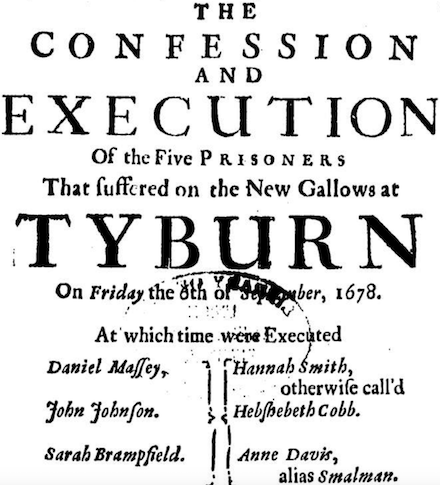
1678: Five at Tyburn

Three men and two women hanged at Tyburn on this date in 1678.

Our text here is one of the earliest of the Ordinary’s Accounts, a far shorter and less ostentatious affair than examples of the genre even a few years later from the hand of a clergyman who has scarcely begun to grasp his true calling, moving copy.


THE CONFESSION AND EXECUTION Of the Five PRISONERS That suffered on the New Gallows at TYBURN On Friday the 6th of September 1678.

At which time were Executed

Daniel Massey. John Johnson. Sarah Brampfield. Hannah Smith, otherwise call'd Hebshebeth Cobb. Anne Davis, alias Smalman.

With Brief Notes of Two SERMONS Preached before them after Condemnation, their Carriage in Prison, and last Speeches at the place of Execution.

The Confession & Execution of the several Prisoners that suffered on the New Gallows at Tyburn, on Friday the 6th of September 1678.

AT the last Sessions there were in all Ten persons Condemned to die; Four menf or Robberies on the Highway, and Six women for Felonies here in Town, either Lifting (as they call it) of Goods out of Shops, or else Robbing those whom they pretended to serve: both which wicked Practises are become so common, and more than once followed by these incorrigible Prisoners, that it was highly necessary to make them Exemplary. Two of the before-mentioned men, viz. those concerned in that barbarous Assault and Robbery, whereof a particular Narrative hath been made publick by the unexpected Mediation of some generous Friends; and the women whose Crimes had not been so great and obstinately continued in as the others, obtained his Majesties gracious Reprieve: and another woman, immediately after she stood attainted, was reprieved by the Court, in reguard she was found by a Female Jury to be quick with Childe.

The Rest came this day to suffer, being charitably indulged in pity to their Souls, so long time to sit and prepare themselves for their great and terrible Change. In order to which, on the Lords-day before, there were two Sermons on most suitable Texts preached before them in the Chappel of Newgate. That in the Forenoon on the fifth verse of the 38 Psalm — My wounds stink and are corrupt, because of my foolishness: Wherein the Minister very pathetically laid open the deplorable Condition such sinners are in by Nature, wallowing not onely in their original Depravity and Corruption, but in continued actual Transgressions against the holy Laws of God; whereby they become abominable, and as a loathsome stench in the Nostrils of that pure Majesty and all good men; and all this occasioned by their own foolishness, that is, their wilful rebellion and obstinacy against all the dictates of Reason, offers of Grace, and impulses of the Holy Spirit upon their Consciences. Which having, like a true Bonaerges, hereby endeavoured to awaken, and put them into a serious sense and apprehension of their lost, undone, and perishing Estate, without speedy and sincere Repentance.

In the Afternoon, as a Son of Consolation, from the 147 Psalm, vers. 3. He healeth the broken in heart, and bindeth up their wounds, he came to shew them the infinite Mercies of God, and Love of Jesus Christ, if they would come in and accept of Pardon and Salvation upon Gospel-terms. That although they had made their wounds to fester and rankle by their foolishness, and had Souls all over bespread with a filthy Leprosie, yet there was Balm in Gilead, an Almighty Physician, both able and willing to heal them, if they would submit to his Prescriptions. In order to which, he gave them divers most necessary and excellent Directions; Not to deceive themselves with a false and palliated Cure, but to close with Christ on his own Terms, and in all his Offices, as their King to Rule them, and their Prophet to Guide them, as well as their Priest to Intercede and make Atonement for them. To hate Sin more, because it was displeasing to God, than because it brought upon them temporal or eternal Punishments. To be as desirous to be Holy as to be Happy; because none can be justified until they are sanctified, Etc.

During the whole time of Religious Worship, and the Sermons, they behaved themselves very Reverently and Attentively; nor was the Minister wanting afterwards, daily to visit them, with pressing Exhortations, and necessary directions to sit them for their last end; especially charging them to disburthen their Consciences, and give glory to God by a free and hearty Confession of their Sins; which had so good an effect, as to bring them to an Acknowledgment; not only in general term, but particularly bewailing the Ill Courses of their past Lives; in neglect of the publick Divine Worship, Violation of the Lords day, Drunkenness, Swearing, and continual practises of Lascivious Debauchery; Two of them above the rest abounding in expressions of Penitence, and endeavouring to improve those few moments of their Lives, to work out their Salvation, and make their peace with God; begging heartily forgiveness from his most holy Majesty, for their Rebellion against his Precepts, and of all those whom they had wronged, by violent taking away their Temporal Goods.

Some of the Women had been Condemned before, and would often bewail the wickedness of their Hearts, that would take no warning thereby: the Men alleadged, they were ignorantly drawn in to that ill Fact, for which they suffer’d, being their first of that kind, and rather by the unhappy operation of too much Drink, than any premeditated design; yet confessed, they had more than once deserved to Dye, and freely acknowledged the justice of the punishment they were to suffer.

At the place of Execution they said little, besides those common, but too much neglected Exhortations, desiring all present to take Warning by them, and remember their Creator in the days of their youth; Not to suffer themselves to be seduced by Ill Company, or sensual pleasures, which had been the means of their destruction, and would be so of all, that did not continually keep a reverent fear of God, and his Worship and Laws in their Hearts.

Thus heartily praying to God for Forgiveness, and to receive their Souls for the alone Merits of his blessed Son; and desiring all good people to joyn with them and for them in those Supplications, they submitted to the Sentence, and taking their leave of all things in this world, were wasted into the unfathomable Regions of Eternity.

FINIS.

On this day..

1650: Four condemned and one reprieved on appeal from the Wiltshire Assizes

From the Journals of the House of Commons

Die Mercurii, 21 Augusti, 1650

PRAYERS.

A LETTER from Henry Roll, Lord Chief Justice, and Robert Nicholas, one of the Justices of the Upper Bench, from Taunton, of the Fourteenth of August 1650; and a Certificate from them of the whole State of the Matter, and Cause of Condemning of Nicholas Westwood, Samuel Cowdry, and Walter Goff, at the last Assizes, in the County of Wiltes, were this Day read; viz.

In Obedience to the Vote of the honourable Parliament, on Thursday the Twenty-fifth of July last; whereby we were required to certify the whole State of the Matter concerning the Condemning of Nicolas Westwood, Samuel Cowdry, and Walter Goffe, at the last Assizes held in the County of Wiltes, for the Murdering of one Joel Swettingham (a very honest Man, and had been a Soldier and Drummer in the Service of the Parliament), at the Town of the Devises, in the said County of Wiltes, and continued faithful unto the Parliament until his Death;

We humbly certify, that the Evidence appeared before us to be thus:

That the said Westwood, Cowdry, and Goff, amonst divers other Soldiers, and new-raised Men, for Ireland, were quartered at Cannyngs, some Two Miles from the Devises: And some of the said Soldiers coming to the Devises, some Three Days before the said Murder committed, and offering some Incivilities unto the People of the Town, they were questioned for it by the Constable and Officers of the said Town; and were detained in Custody for some time; but were the same Day released; and so went back to their Quarters at Cannyngs; and from thence, within a Day or two after, the said Soldiers removed their Quarters to Bromham, about Two Miles likewise distant from the said Town of the Devizes: And, the next Day, being the Day when the Murder was committed, the said Westwood, Cowdry, and Goff, amonst divers other Soldiers, came to the said Town of the Devises, and expressed some Dislike against the said Townsmen, for Imprisoning of some of their Company, the Day or Two before: And the said Goff, coming into the Mayor’s Shop of the Devises, and talking with John Imber his Apprentice, cast out some Words of Dislie concerning the Imprisoning of the Soldiers a Day or Two before; and then asked of the said Apprentice, whether there were not a fat Constable in the Town; meaning one Fitzell, a very honest Man and who had been ever faithful to the Parliament: And the said Goff expressed himself to be much discontented with the said Constable, for Imprisoning of the Soldiers some Two Days before: Then, saying, That he would be revenged to the Death of the said Constable, calling the said Constable Rogue: And, shortly after, the same Day, the said Goff, meeting with one Thomas Street, a Youth of the Devises, asked the way to some Place in the Town: The said Street told him, He might go which way he would: And the said Goff presently drew his Sword, and run the said Street into the Thigh: Whereupon the said Street’s Brother took the said Goff’s Sword, and endeavoured to break it; but, could not: Yet he bended it very muh: Whereupon the said Goff run after the said Street’s Brother, with his Sword in his Hand: And, the said Street’s Foot slipping, he fell: And the said Goff laid on the said Street with his Sword very much: Which some of the Townsmen seeing, came to rescue the said Street from Goff: Whereupon the said Goff, Westwood, and Cowdry, and Two or Three Soldiers more unknown, fell on the said Swettingham, who had nothing to do with them, being then Gathering up of Monies for the Rent of the Butcher’s Shambles; and, having only a wooden Hilt of a Hatchet in his Hand, defended himself as well as he could; but, in short Space, he was run into the Groin by the said Goffe; and received another Wound in the Buttock, by the said Cowdry: And, feeling himself so wounded, run away very feebly, from them, into a House: And they all Three followed him: And there the said Westwood gave the said Swettingham a great Wound on the Shoulder: But Swettingham got into the House, and shut the Door, to keep out the said Westwood, Goff and Cowdry; for that they thrust very hard at the Door, to come in after him: But the said Swettingham, and some others, which were in the House, kept the Door fast, and kept them out: But the said Swettingham was so mortally wounded by them, that, within a short Time after, the same Night, he died. Upon which Evidence the Jury found them all guilty of the Murder: Upon which, Sentence of Death was given on all Three, in regard they were all Three present and Actors in the said Murder.

All which we humbly submit to the Consideration of the Honourable Parliament.

Taunton, 14 Augusti 1650.
Hon. Rolle, Robert Nicholas

Resolved, by the Parliament, That the Sheriff of the County of Wiltes be, and is hereby, required to proceed to the Execution of Nicholas Westwood, Samuel Cowdry, and Walter Goff, according to Law; notwithstanding the Order of Parliament of the Twenty-fifth of July last, for respiting their Execution.

A Certificate from Henry Rolle, Lord Chief Justice, and Robert Nicholas, one of the Justices of the Upper Bench, of the whole State of the Matter, and Cause of Condemning of Thomas Dirdo, at the Assizes for the County of Wiltes, was this Day read; viz.

In Obedience to the Vote of the Honourable Parliament, dated the Twenty-fifth of July last; whereby we were required to certify the whole State of the Matter concerning the Condemning of one Thomas Dirdo, at the last Assizes held in the County of Wiltes;

We humbly certify, that the Evidence appeared to be thus:

That the said Dyrdo, with some other Persons, came to the House of one John Pitt, an Innkeeper in Wiltes, somewhat late in the Night: and desired Entertainment; and, having set up their Horses, and prepared something for their Suppers, finding most Part of the People gone to Bed, set on the rest of the People of the House, and bound them: And then the said Dirdo, as the said Pitt affirmed, on his Oath, to be one of the said Robbers, took, of the Goods of the said Pitt, a Sack and Three Shillings Eight-pence in Money: And the said Pitt affirmed further, That the said Dyrdoe, and the rest of the Company, went into a Chamber in the said House, where one Matthew Kynton, a Carrier then lay, with their Swords drawn; and demanded of the said Kynton his Money: And thereupon the said Kynton delivered them a Bag of Money, wherein, he said, was Ten Pounds: And then the said Dirdoe, and the rest of the said Company, cut the Packs of the said Carrier, and took thence certain Broad Cloths; a Part of which said Cloth one Coombes sold to one Blake, who shewed the said Cloth, in a Suit on his Back, at the Tryal of the said Dirdoe, and the said Coombe, and one Hussey; and also took his oath, That the said Coombes affirmed he had the said Cloth, at the time of the said Robbery: And he also affirmed, on his Oath, That the said Coombes and Hussey told him, That they did the said Robbery: Upon which Evidence, the Jury found them all Three guilty of the said Robbery: And thereupon, Sentence of Death was given against the said Dirdoe and the said Coombes and Hussey: And we further certify, That we were credibly informed, That the said Dirdoe was burnt in the Hand, at the Sessions at Newgate, for a Felony by one Levendon Blisse and him committed.

All which we humbly submit to the Consideration of the Honourable Parliament.

Taunton, 14 Augusti 1650.
Hon. Rolle, Robert Nicholas

Resolved, That the Sheriff of the County of Wiltes be, and is hereby, required to proceed to the Execution of Thomas Dirdo, according to Law, notwithstanding the Order of Parliament of the Twenty-fifth of July last, for respiting his Execution.

The humble Petition of Edward Hussey, now a condemned Prisoner in the Gaol at Sarum, lately a Soldier in the Service of the Parliament, was this Day read.

The Certificate from the Justices of Assizes, upon the former Order, touching Thomas Dirdo, was again read.

Resolved, that Edward Hussey, who stands condemned at the Assizes for the County of Wiltes, be reprieved, until the Parliament take further Order: And that Mr. Speaker do issue a Warrant to the Sheriff for that Purpose.

Ordered, that the Judges of Assizes for the County of Wiltes be required and enjoined to make Certificate to the Parliament of the whole State of the Matter of Fact touching Edward Hussey, who was condemned at the last Assizes in the County of Wiltes.

On this day..

1786: Five men at York Castle, under the “Bloody Code”

(Thanks to Meaghan Good of the Charley Project for the guest post. -ed.)

On this date in 1786, five young men were hanged together before a large crowd in front of York Castle. They were William Nicholson, John Charlesworth, James Braithwaite, William Sharp and William Bamford.

William Knipe’s Criminal chronology of York castle; with a register of criminals capitally convicted and executed at the County assizes, commencing March 1st, 1379, to the present time records,

The above were all executed at Tyburn without Micklegate Bar.

Nicholson, aged 27, labourer, for stealing two geldings, the property of Robert Athorpe Esq., of Dinnington. Thomas Whitfield, Mr. Athorpe’s man, was the principal witness against him.

John Charlesworth, of Liversedge, clothier, for breaking into the house of Susan Lister, of Little Gomersal, single woman, and stealing various articles of trifling value; also further charged with stopping William Hemmingway, of Mirfield, clothier, and robbing him of three guineas and a half and some silver and copper. He was 21 years of age.

Braithwaite, for breaking into the dwelling-house of Thomas Paxton, of Long Preston, innkeeper, and stealing various article therefrom. He was a hawker and a pedlar, and 30 years of age.

William Sharp, labourer, aged 26, and William Bamford, labourer, aged 28, for robbing Duncan M’Donald, of Sheffield, button-maker, by breaking into his house, and carrying away a number of horn combs, a silver threepenny-piece, and fourpence in copper. Sharp was a native of Conisbro’, and Bamford, a native of Clifton.

It was noted that Nicholson, Charlesworth, Sharp and Bamford all left a widow and children behind, but Braithwaite had “two wives and three children by his lawful one, and two by the other, to whom he gave £70, and appeared most attached to her, as he would not permit the former to take leave of him.”

This British Library article on crime and punishment in Georgian Britain explains why these individuals were punished so severely for what, to modern eyes, look like relatively minor offenses:

The 18th-century criminal justice system relied heavily on the existence of the ‘bloody code’. This was a list of the many crimes that were punishable by death—by 1800 this included well over 200 separate capital offences. Guilty verdicts in cases of murder, rape and treason — even lesser offences such as poaching, burglary and criminal damage — could all possibly end in a trip to the gallows. Though many people charged with capital crimes were either let off or received a lesser sentence, the hangman’s noose nevertheless loomed large.

On this day..