1741: Cuffee and Quack, “chained to a stake, and burnt to death”

This date in 1741 marked the first official execution for the alleged New York slave conspiracy of 1741.

Nineteen days before, two slaves named Caesar and Prince had hanged, nominally for theft but believed by the populace (and the court) primary instigators of a staggering plot to put New York to the torch, murder the city’s whites, and reign as kings on the ashes of their masters’ city.

Cuffee was, alongside those already-executed Caesar and Prince, part of a trio of slaves known to hang about together at the house of barkeep and fence John Hughson. Already notorious about town for a gin-robbing incident that had seen all three publicly whipped in 1738, they had again burgled a linen store that February. (That’s the crime for which Caesar and Prince were executed.)

The evidentiary chain linking these commonplace prowlers to a spate of fires whose intent must be the annihilation of the city leaves quite a bit to be desired, but the burning spring of 1741 helped solder them together in part thanks to a white New Yorker spying Cuffee in what he thought was a suspicious position during a fire and raising the alarm. Cuffee fled, back to the home of Adolph Philipse — his owner, and also the uncle of one of the judges who would eventually condemn him — where a crowd of incited freemen chased him down and hauled him to gaol, “borne upon the People’s Shoulders.” His skulking seemed to confirm a widening suspicion, spiced by the mother country’s going war against dusky Spaniards, that the city’s Negroes must surely lurk behind a fortnight’s infernos. From this point on it appears as if New Yorkers — or at least the city’s elites — determined by consensus that they “must necessarily conclude, that [the fires] were occasioned and set on Foot by some villainous Confederacy of latent Enemies amongst us.”

Now, this appearance of consensus is an impression nearly three centuries distant, and is heavily shaped by the circumstance that there’s one predominant voice surviving the ravages of years to document for us the official proceedings: Daniel Horsmanden, who both judged and investigated the case and is thus heavily invested in its outcome. His A Journal of the Proceedings in the Detection of the Conspiracy Formed by Some White People, in Conjunction With Negro and Other Slaves, for Burning the City of New-York in America and Murdering the Inhabitants is Horsmanden’s record of how the plot or “plot” was uncovered; it was assembled in 1742 and presents trial and deposition records curated by Horsmanden with a view to persuading “such as have a Disposition to be convinc’d, and have in Reality doubted, whether any particular Convicts had Justice done them or not” — for by this time such doubts were dogging Horsmanden’s court, having hounded 30-odd people to death on evidence that was already viewed as highly impeachable.

There had been some wanton, wrong-headed Persons amongst us, who took the Liberty to arraign the Justice of the Proceedings, and set up their private Opinions in Superiority to the Court and Grand Jury; tho’ God knows (and all Men of Sense know) they could not be Judges of such Matters; but nevertheless, they declared with no small Assurance (notwithstanding what we saw with our Eyes, and heard with our Ears, and every one might have judg’d of by his Intellects, that had any) That there was no Plot at all!

Whether the entire slave conspiracy to burn New York was a phantom, or whether it did indeed reflect in whatever distorted way a some real mode of resistance, is a factual question that is permanently unanswerable.* But the cases certainly took on a witch hunt quality, and they bore many hallmarks of wrongful conviction that are familiar even today.

Our first two hangings, Caesar and Prince, were doomed by the decision of John Hughson’s teenage serving-girl to turn state’s evidence and denounce them. As Cuffee and Quack would be the first people formally tried for the arson wave, her evidence was buttressed in this case by another common prosecutor’s cheat: the prison snitch.

A (white) petty thief named Arthur Price, who was being held in New York’s dungeon along with the growing ranks of suspected terrorists, helpfully began informing on the people around him. It’s likely he was a longstanding underclass crony of the purported plotters.

At any rate, the civic-minded Price, “having been found by experience to be very adroit at pumping out the Secrets of the Conspirators … was ordered to put Cuffee (Mr. PHILIPSE’s Negro) into the same Cell with him, and to give them a Tankard of Punch now and then, in order to chear up their Spirits, and make them more sociable.” What do you know but the next morning, Price was ready to report that his inebriated cellmate had admitted the conspiracy to him, and had implicated Quack as the man who actually fired the fort.

Quack was promptly arrested. Arthur Price would give evidence against both at their trial, but having made himself an obvious stool pigeon his use as an informant was at an end since nobody would go near him any longer.

More key information against Cuffee and Quack came from two other slaves, whose “Negro evidence” — a distinct class of (significantly derogated) proof in New York courts — would also have been controversial. The crown’s attorney prosecuting the case felt obliged to go out of his way to justify to the jury the unsworn testimony of “Pagan Negroes” on the grounds that without such, “the greatest Villanies would often pass with Impunity.” But pagan or no, both Sandy (a minor) and Fortune were also men who were suspect in the plot. Perhaps as black slaves their king’s evidence could not be as strong as that of the white servant Mary Burton — but it might still be strong enough to save their lives. Sandy spent a week in the dungeon amid his alleged confederates, after which he was hauled before the grand jury and leaned upon until he cracked.

They told him, if he would speak the Truth, the Governor would pardon him, though he had been concerned in them; and this was the Time for him to save his Life by making a free and ingenuous Confession; or in Words to this Purpose. He answered, That the Time before after that the Negroes told all they knew, then the white People hanged them. The Grand Jury assured him, that it was false; for that the Negroes which confessed the Truth and made a Discovery, were certainly pardoned, and shipped off: [which was the Truth] And upon this Assurance he began to open, and gave the following Evidence.

Quack, Sandy said, had solicited Sandy to help him burn down Fort George — and Cuffee “said, D–m him, that hang him or burn him, he would set fire to the Town.” Fortune was among the numerous other names he named — whose “Design was to kill all the Gentlemen, and take their Wives, and that Quack and Cuffee were particular Persons that talked so.”

Strangely, before they suffered at the stake Cuffee and Quack were suffered to conduct a hopeless defense of their own — “indulged with the same Kind of Trial as is due to Freemen, though they might have been proceeded against in a more summary and less favourable Way,” in the crown’s summing-up. This was more than they were entitled to as slaves, and they used the court’s liberality to summon ten witnesses in an attempt to establish good character and alibi; notably, Quack’s owner John Roosevelt avowed that “Quack was employed most Part of that Morning the Fort was fired, from the Time they got up, in cutting away the Ice out of the Yard; that he was hardly ever out of their Sight all that Morning, but a small Time while they were at Breakfast; and that they could not think he could that Morning have been [from] their House so far as the Fort.” But even from a white property owner, these words were far too little against a consensus that had been shaped seemingly from the belly of the conspiracy — from Mary Burton’s evidence and Arthur Price’s evidence and Sandy’s and Fortune’s evidence: that Quack’s were the hands that set the most damaging fire in the arson campaign, and that Cuffee’s, along with Caesar’s and Prince’s, were the hands that directed him.

Their condemnation was a mere formality, albeit one whose rhetorical opportunities the court did not mean to neglect.

You both now stand convicted of one of the most horrid and detestable pieces of villainy, that ever satan instilled into the heart of human creatures to put in practice; ye, and the rest of your colour, though you are called slaves in this country; yet you are all far, very far, from the condition of other slaves in other countries; nay, your lot is superior to that of thousands of white people. You are furnished with all the necessaries of life, meat, drink, and clothing, without care, in a much better manner than you could provide for yourselves, were you at liberty; as the miserable condition of many free people here of your complexion might abundantly convince you. What then could prompt you to undertake so vile, so wicked, so monstrous, so execrable and hellish a scheme, as to murder and destroy your own masters and benefactors? nay, to destroy root and branch, all the white people of this place, and to lay the whole town in ashes.

I know not which is the more astonishing, the extreme folly, or wickedness, of so base and shocking a conspiracy; for as to any view of liberty or government you could propose to yourselves, upon the success of burning the city, robbing, butchering, and destroying the inhabitants; what could it be expected to end in, in the account of any rational and considerate person among you, but your own destruction? And as the wickedness of it, you might well have reflected, you that have sense, that there is a God above, who has always a clear view of all your actions, who sees into the utmost recesses of the heart, and knoweth all your thoughts; shall he not, do ye think, for all this bring you into judgment, at that final and great day of account, the day of judgment, when the most secret treachery will be disclosed, and laid open to the view, and everyone will be rewarded according to their deeds, and their use of that degree of reason which God Almighty has entrusted them with.

Ye that were for destroying us without mercy, ye abject wretches, the outcasts of the nations of the earth, are treated here with tenderness and humanity; and, I wish I could not say, with too great indulgence also; for you have grown wanton with excess of liberty, and your idleness has proved your ruin, having given you the opportunities of forming this villainous and detestable conspiracy; a scheme compounded of the blackest and foulest vices, treachery, blood-thirstiness, and ingratitude. But be not deceived, God Almighty only can and will proportion punishments to men’s offences; ye that have shewn no mercy here, and have been for destroying all about ye, and involving them in one general massacre and ruin, what hopes can ye have of mercy in the other world? For shall not the judge of all the earth do right? Let me in compassion advise ye then; there are but a few moments between ye and eternity; ye ought therefore seriously to lay to heart these things; earnestly and sorrowfully to bewail your monstrous and crying sins, in this your extremity; and if ye would reasonably entertain any hopes of mercy at the hands of God, ye must shew mercy here yourselves, and make what amends ye can before ye leave us, for the mischief you have already done, by preventing any more being done. Do not flatter yourselves, for the same measure which you give us here, will be measured to you again in the other world; ye must confess your whole guilt, as to the offences of which ye stand convicted, and for which ye will presently receive judgment; ye must discover the whole scene of iniquity which has been contrived in this monstrous confederacy, the chief authors and actors, and all and every the parties concerned, aiding and assisting therein, that by your means a full stop may be put to this horrible and devilish undertaking. And these are the only means left ye to shew mercy; and the only rea­sonable ground ye can go upon, to entertain any hopes of mercy at the hands of God, before whose judgment seat ye are so soon to appear.

Ye cannot be so stupid, surely, as to imagine, that when ye leave this world, when your souls put off these bodies of clay, ye shall become like the beasts that perish, that your spirits shall only vanish into the soft air and cease to be. No, your souls are immortal, they will live forever, either to be eternally happy, or eternally miserable in the other world, where you are now going.

If ye sincerely and in earnest repent you of your abominable sins, and implore the divine assistance at this critical juncture, in working out the great and momentous article of the salvation of your souls; upon your making all the amends, and giving all the satisfaction which is in each of your powers, by a full and complete discovery of the conspiracy, and of the several persons concerned in it, as I have observed to ye before, then and only upon these conditions can ye reasonably expect mercy at the hands of God Almighty for your poor, wretched and miserable souls.

Here ye must have justice, for the justice of human laws has at length overtaken ye, and we ought to be very thankful, and esteem it a most merciful and wondrous act of Providence, that your treacheries and villainies have been discovered; that your plot and contrivances, your hidden works of darkness have been brought to light, and stopped in their career; that in the same net which you have hid so privly for others your own feet are taken: that the same mischief which you have contrived for others, and have in part executed, is at length fallen upon your own pates, whereby the sentence which I am now to pronounce will be justified against ye; which is,

That you and each of you be carried from hence to the place from whence you came, and from thence to the place of execution, where you and each of you shall be chained to a stake, and burnt to death; and the lord have mercy upon your poor, wretched souls.

That sentence came down on May 29.

It was implemented the very next day, amid a mob scene.

With Quack and Cuffee staked to their pyres, they were harried to admit the plot with the promise of a reprieve from their horrible sentence. Even if mercy would only amount to moderating death by burning into death by hanging, it would be well worth having — and the frightened slaves grasped at the small succor left them.

The spectators at this execution were very numerous; about three o’clock the criminals were brought to the stake, surrounded with piles of wood ready for setting fire to, which the people were very impatient to have done, their resentment being raised to the utmost pitch against them, and no wonder. The criminals shewed great terror in their countenances, and looked as if they would gladly have discovered all they knew of this accursed scheme, could they have had any encouragement to hope for a reprieve. But as the case was, they might flatter themselves with hopes: they both seemed inclinable to make some confession; the only difficulty between them at last being, who should speak first. Mr. Moore, the deputy secretary, undertook singly to examine them both, endeavoring to persuade them to confess their guilt, and all they knew of the matter, without effect; till at length Mr. Roosevelt [Quack’s owner, who testified for his alibi -ed.] came up to him, and said he would undertake Quack, whilst Mr. Moore examined Cuffee; but before they could proceed to the purpose, each of them was obliged to flatter his respective criminal that his fellow sufferer had begun, which stratagem prevailed: Mr. Roosevelt stuck to Quack altogether, and Mr. Moore took Cuff’s confession, and sometimes also minutes of what each said; and afterwards upon drawing up their confessions in form from their minutes, they therefore intermixed what came from each.

Thus induced by prevaricating confessors amid a mob baying for their blood, both Quack and Cuffee implicated Hughson as the originator of the plot, and themselves as early principals, and named a good many others besides. (Quack also at last claimed responsibility for firing Fort George, as the court had found.)

But the quid for their quo was not the promised abatement of their sufferings. As Sandy had worried to the grand jury in a different context, white men’s reassurances to slave rebels whom they meant to destroy could prove … unreliable.

After the confessions were minuted down (which were taken in the midst of great noise and confusion) Mr. Moore desired the sheriff to delay the execution until the governor be acquainted therewith, and his pleasure known touching their reprieve; which, could it have been effected, it was thought might have been means of producing great discoveries; but from the disposition observed in the spectators, it was much to be apprehended, there would have been great difficulty, if not danger in an attempt to take the criminals back. All this was represented to his honour; and before Mr. Moore could return from him to the place of execution, he met the sheriff upon the common, who declared his opinion, that the carrying the negroes back would be impracticable; and if that was his honour’s order it could not be attempted without a strong guard, which could not be got time enough; and his honour’s directions for the reprieve being conditional and discretionary, for these reasons the execution proceeded.

* For contrasting perspectives, Peter Linebaugh and Marcus Rediker present this as a real instance of working-class rebellion in The Many-Headed Hydra, while Jill LePore’s New York Burning approaches it as mostly a concoction.

On this day..

1691: Mark Baggot, Jacobite spy

On May 20, 1691, Captain Mark Baggot was hanged as a spy in Dublin.

Baggot had maintained loyalty to King James II when that sovereign was deposed in the 1688 Glorious Revolution that elevated William of Orange to the English throne.

Though deeply unpopular in England, the Catholic James — still to this day England’s last Catholic monarch — had sympathetic subjects to flee to in Ireland. Apart from the religious sympatico, the Irish were still smarting from ravages dating back to Cromwell and before, authored in the main by factions who were direct ancestors of the Whigs, King James’s staunchest domestic foes.

In 1689, James landed in Ireland backed by the French and kicked off the Williamite-Jacobite War between the rival kings. This war was so nasty it even survived the flight of King James himself in 1690:* William refused to guarantee amnesty for a wide swath of the Jacobite leadership, who consequently saw no odds in laying down their weapons.

The latter months of 1690 and the early months of 1691 had the now-outnumbered Jacobites girding the defenses of the cities they held against the coming Williamite attacks that were sure to come. Intelligence was critical under such conditions, and here our man Mark Baggot enters the stage.

Baggot was dispatched from the Jacobite stronghold of Limerick to Williamite-held Dublin to scout the enemy, but there had the embarrassment of being captured trying to escape notice in women’s clothes.** (You may be certain that the Williamite press included this emasculating detail on every available occasion.)

A court-martial condemned Baggot to hang the very next day, March 25.†

But the secret agent bought himself two months’ respite by cooperating with his captors — making the whole mission a clear intelligence win for the Williamites, especially since they still got to hang their spy in the end.

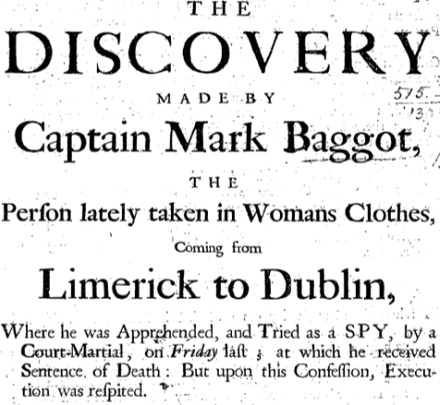
The resulting document has copy nearly as long as its unwieldy title …

The Discovery Made by Captain Mark Baggot, the Person Lately Taken in Womans Clothes, Coming from Limerick to Dublin, where He was Apprehended, and Tried as a Spy, by a Court-Martial ... at which He Received Sentence of Death: But Upon this Confession, Execution was Respited.

That the Irish army consists of forty thousand men of all sorts; that Tyrconnel was reducing them to thirty thousand; but SarsfieldSir Richard Nagle are pensioners of France.

That there is no good understanding between Tyrconnel and Sarsfield, having great jealousies of one another.

That King James has correspondence with, and intelligence from some persons in considerable places of trust here in England every ten days.

That the French fleet is hourly expected with thirty pieces of cannon, ammunition, provisions and arms; a French general, some marine men, but none of the army; they resolve to maintain their greatest force against the confederates in Flanders next campaign.

That the Irish army intends to move towards the frontiers, their greatest design being against Cork more than ny other place; what is left of the suburbs they intend to burn; they expect a great many deserters at their approach to the town. The commanders of the parties for this service are Colonel Dorrington and Colonel Clifford.

A spy, taken at Limerick, was hang’d here [Dublin], and confess’d that Major Corket was in particular favour, and held correspondence with the English, who was carried prisoner to Limerick, and suppos’d to have suffer’d death.

That the contributions paid to the new Irish are one peck of wheat or meal, 12 pound of butter every fortnight out of each plow lands.

That there is express order that no guns be removed from Limerick; that the English deserters are only paid and encouraged, but no pay given to the Irish.

That they are still fortifying Limerick.

That Ballyclough and Castletown, with some other places, were to be made garrisons by the Irish; that Sir Michael Creagh’s regiment of foot, under command of Colonel Lacy, are at Ballyclough, which places they are fortifying; that Strabane’s regiment of horse are at Charleveel and Buttifant, &c.

Baggot’s less than flattering report of the Jacobite forces’ condition proved bang-on: that July, the Williamites dealt a fatal blow to the Jacobite cause at the Battle of Aughrim — thanks to forcing a defile that the dug-in Jacobites ought to have held but for want of ammunition.‡ Shortly thereafter, Limerick capitulated to Williamite siege — its last Jacobite garrison escaping into exile, never to stir in Ireland again.

* He’s remembered in Ireland as “James the Shit” (Seamus a Chaca) because he ditched his supporters mid-war.

** Not the only Jacobite with a cross-dressing escapade to his name.

† London Gazette, March 26-30, 1691, which calls the spy Baggot “a Person very well known.”

The Baggot(t)s (Bagods, Baggetts) were an English family that could trace lineage back to the age of William the Conqueror, with a very longstanding branch in Ireland. (Dublin still has streets that bear that name.) The 17th century Irish Baggots took it on the chin for their loyalty to the Stuarts, several dying in that service or being dispossessed. The family’s Baggotstown Castle in County Limerick was seized and razed by the Williamites months after the events in this post.

The date of Baggot’s execution is reported in the Gazette for May 25-28, 1691.

‡ “All the day, though he was sincking in his center and on his left, [the Williamites] yett durst not once, for his relief, attempt to traverse the cawsway, till despayr at the end compelled him to trye that experiment at all hazards … they confidently ventured to goe through, notwithstanding the fire from the castle on their right, which fire was insignificant; for it slew but a few in the passage. The reason of it was given, because the men had French pieces, the bore of which was small, and had English ball, which was too large. Here is a new miscarriage thro’ heedlessness. Why was not this foreseen and the dammage prevented?” (Source)

On this day..

1558: Three reformers at Norwich

From the 16th century tome of Protestant martyrology, Foxe’s Book of Martyrs — with evocative original Early Modern English from the 1570 edition.

The Martyrdome of William Seaman, Thomas Carman, and Thomas Hudson, put to death by the persecuting papistes at Norwich in the county of Norfolke.

Immediatly after William Nicole, succeded in that honorable and glorious vocation of Martyrdome three constant godly me[n] at Norwich in Norfolke, who were cruelly and tyrannically put to death for thee true testimony of Iesus Christ, the 19. of May an. 1558. Whose names be these.

William Seaman.
Thomas Carman.
Thomas Hudson.

The sayd William Seaman was an husbandman, of the age of xxvj. yeares, dwelling in Mendlesham in the county of Suffolke, who was sought for sundry tymes by the commaundement of Syr Iohn Tirrell Knight, and at last hee hym selfe in the night searched hys house and other places for hym: notwithstanding, hee somewhat mist of his purpose, God be thanked. Then he gaue charge to his seruantes, Robert Baulding, and Iames Clarke with others, to seeke for hym. Who hauing no officer, went in the euening to hys house, where he beyng at home, they tooke hym and caryed hym to their master Syr Iohn Tirrell. This Baulding beyng Seamans nigh neighbour, and whom the sayd Seaman greatly trusted as a speciall frend, notwithstandyng to do his Master a pleasure, now became enemy to his chief frend, and was one of the busiest in the takyng of him. Now as they were goyng to cary him to their Master Syr Iohn Tyrrel in the night, it is credibly reported that there fell a light betwene them out of the element and parted them. This Bauldyng beyng in company with the rest whe[n] the light fell, albeit he was then in hys best age, yet after that tyme neuer enioyed good day, but pined away euen vnto the death.

Well, for all that straunge sight (as I sayd) they caried hym to their master. Who when he came, asked hym why he would not go to masse, and receaue the sacrament, and so to worship it? Vnto which William Seaman aunswered, denying it to be a sacrament, but sayde it was an Idoll, and therefore would not receaue it. After which wordes spoken, Syr Iohn Tirrell shortly sent hym to Norwich to Hopton then Byshop, and there, after conference and examination had with him, the Byshop red hys bloudy sentence of condemnation against hym, and afterward deliuered hym to the secular power, who kept hym vnto the day of Martyrdome.

Thys sayd William Seaman left behind him when he dyed, a wife and three children very yonge: and with the sayd younge children, hys wife was persecuted out of the sayd towne also of Mendlesham, because that she would not go to heare Masse, and all her corne & goods seased and taken away by master Christopher Coles officers, he beyng Lord of the sayd towne.

Thomas Carman (who, as is said, pledged Richard Crashfield at hys burning, and thereupon was apprehended) beyng in prison in Norwich, was about one tyme with the rest examined & brought before the sayd Byshop, who aunswered no lesse in hys masters cause then the other, and therefore had the like reward that the other had, which was the Byshops bloudy blessing of condemnation, and deliuered also to the secular power, who kept him with the other vntill the day of slaughter, which hasted on and was not long after.

Thomas Hudson was of Ailesham in Norfolke, by his occupatio[n] a Glouer, a very honest poore ma[n], hauing a wyfe and three children, and laboured alwayes truely and diligently in his vocation, being of thirty yeares of age, and bearing so good a will to the Gospell, that he in the dayes of king Edward thee sixt, two yeares before Queene Maryes raigne, learned to read Englishe of Anthony and Thomas Norgate of the same Towne, wherein he greatly profited about the tyme of alteration of religion. For when Queene Mary came to raigne, and had chaunged the seruice in the church, putting in for wheate, draffe and darnyll, and for good preaching, blasphemous crying out agaynst truth and godlines, he then auoyding all their beggerly Ceremonies of superstition, absented him selfe from his house, and went into Suffolke a long tyme, and there remayned, traueling from one place to an other, as occasion was offered. At the last, he returned backe agayne to Norfolke, to his house at Ailesham, to comfort his wife & hys childre[n], being heauy & troubled with his absence.

Now when he came home, and perceaued his continuaunce there would be daungerous, he and his wife deuised to make hym a place among hys fagots to hyde himselfe in, where he remained all the day (in stede of hys chamber) reading and praying continually, for the space of halfe a yeare, and hys wife like an honest woman being carefull for hym, vsed her self faythfully and diligently towardes him.

In the meane tyme came the Vicar of the towne, named Berry (who was one of the Byshops Commissaryes, a very euill man) and inquired of thys sayd Thomas Hudsons wife for her husband. Vnto whom she aunswered, as not knowing were he was. Then the sayd Berry rated her, & threatned to burne her, for that she would not bewray her husband where he was.

After that, when Hudson vnderstoode it, he waxed euery day more zealous then other, and continually red and sang Psalmes, to the wonder of many, the people openly resorting to hym to heare his exhortations and vehement prayers.

At the last he walked abroad for certayne dayes openly in the Towne, crying out continually agaynst the Masse and all their trompery, and in the end, commyng home in his house, he sat him downe vppon hys knees, hauyng his booke by him, readyng and singyng Psalmes continually without ceassing. for. iij. dayes and iij. nightes together, refusing meate & other talke, to the great wonder of many.

The one Iohn Crouch his next neighbour, went to the Constables Robert Marsham and Robert Lawes in the night, to certifie them therof: for Berry comaunded openly to watch for hym: and þe Constables vnderstadyng the same, went cruelly to catch him in the breake of the day, the., xxij. of the moneth of Aprill. an. 1558.

Now when Hudson saw the come in, he sayd: Now mine houre is come. Welcome frendes welcome: you be they that shall lead me to lyfe in Christ, I thanke God therfore, and the Lord enhable me thereto for his mercies sake. For his desire was, and euer he prayed (if it were the Lordes wil) that he might suffer for the Gospell of Christ. Then they tooke hym, and lead hym to Berry the Commissary, which was Vicare of the Towne, and the sayd Berry asked hym first, where he kept his Church for iiij. yeares before. To the which the sayd Hudson aunswered thus: where soeuer he was, there was the Church.

Doest thou not beleue, saith Berry, in the Sacrame[n]t of the altar? What is it?

Hudson. It is wormes meate: my beliefe (saith he) is in Christ crucified.

Berry. Doest thou not beleue the Masse to put away sinnes?

Hudson. No, God forbid: it is a patched monstre, and a disguised Puppet, more longer a pecing then euer was Salomons temple.

At which wordes Berry stamped, fumed, and shewed him selfe as a mad man, and sayd: well thou villayne, thou: I will write to the byshop my good Lord, and trust vnto it, thou shalt be handled according to thy desertes. Oh syr, sayd Hudson: there is no Lorde but God, though there bee many Lordes and many Gods. With that, Berry thrust him backe with hys hand. And one Richard Cliffar standing by, sayd: I pray you syr, be good to the poore man. At which wordes Berry was more mad then before, and would haue had Cliffar bound in a recognisance of 40. poundes for his good abearing, both in worde and deede: which hys desire tooke no effecte. Then he asked the sayd Hudson whether he would recant or no. Vnto which wordes Hudson sayd: the Lord forbid: I had rather dye many deathes, then to doo so.

Then after long talke, the sayd Berry seing it booted not to perswade with him, tooke his pen and yncke, and wrote letters to the byshop therof, and sent thys Hudson to Norwich bound like a theefe to hym, which was viij. miles from thence, who with ioye and singing chere went thether, as mery as euer he was at any time before. In prison he was a moneth, where he did continually read and inuocate the name of God.


Original illustration via JohnFoxe.org, which notes that depictions of several triple burnings attest to the certainty that the printer had no block to illustrate three men in a fire.

These three christians and constant Martyrs, William Seaman, Thomas Carman, and Tho. Hudson, after they were (as ye haue heard) condemned, the xix. day of May. 1558. were caryed out of prison to þe place where they should suffer, which was without Bishops gate at Norwich, called Lollards pit.

And being all there, they made theyr humble prayers vnto the Lord. That being done, they rose and went to the stake, and standing all there with chaynes about them, immediately thys sayd Thomas Hudson commeth fourth from them vnder the chayne, to the great wonder of many: wherby diuers feared and greatly doubted of him. For some thought he would haue recanted: other iudged rather that hee went to aske a further day, and to desire conference: and some thought he came forth to aske some of hys parentes blessing: So some thought one thing and some an other: but hys two companions at the stake cryed out to hym to comforte hym what they could, exhorting hym in the bowels of Christ to be of good chere. &c. But thys sweete Hudson, felt more in his hart and conscience, then they could conceaue in hym. For (alas good soule) he was compassed (God knoweth) with great dolour and griefe of mind, not for his death, but for lacke of feeling of hys Christ, and therfore beyng very carefull he humbly fell downe vppon his knees, and prayed vehemently and earnestly vnto the Lord, who at the last, according to hys olde mercyes, sent hym comfort, and then rose he with great ioy, as a man new chaunged euen from death to life, and sayd:

Now I thanke God I am strong, and passe not what man can doo vnto me.

So going to the stake to his fellowes agayne, in the end they all suffered most ioyfully, constantly, and manfully the death together, and were consumed in fire, to the terror of the wicked, the comforte of Gods Children, & the magnifiing of the Lords name, who be praysed therfore for euer, Amen.

After thys, the fore named Commissary Berry, made great styrre about other which were suspected within the sayd towne of Aylesham, and caused two hundred to creepe to the Crosse at Penticost, besides other punishmentes which they susteyned.

On a time this Berry gaue a poore man of his parish of Marsham, a blow with the swingell of a flayle, for a word speaking, that presently theron he dyed, and the sayd Berry (as is sayd) held vp his hand at the barre therefore.

Then, after that in his parish of Aylesham also, an. 1557. there was one Alice Oxes came to his house, and going into the Hall, he meting her (being before moued) smote her with his fist, whereby she was fayne to be caryed home, and the next day was found dead in her chamber.

To write how many concubines & whores he had, none would beleue it, but such as knewe him in the countrey he dwelt in. He was rich and of great autoritie, a great swearer, altogether geuen to wemen, and persecuting of the Gospell, & compelling men to idolatry.

One Iohn Norgate a man learned, godly, and zealous, who would not go to theyr trash, but rather dye, being sore hunted by the sayd Berry, prayed hartely to God, and the Lord shortly after in a consumption deliuered hym. Notwithstanding, the rage of this wicked man waxed more fiercer and fiercer. He troubled sundry men, burnt all good bookes that he could get, and diuorsed many men and wemen for religion.

When he heard say that Queene Mary was dead, and the glory of theyr triumph quailed, the sonday after, being the xx. of Nouember, an. 1558. he made a great feast, and had one of his concubines there, with whom he was in his chamber after diner vntill Euensong. Then went he to church, where he had ministred baptisme, and in going from church homeward, after Euensong, betwene the churchyarde and hys house, being but a litle space (as it were a churchyard bredeth asunder) he fell downe sodeinly to the ground with a heauy grone, & neuer stirred after, neither shewed any one token of repentance. This hapned hys neyghbors being by, to the example of all other. The Lord graunt we may obserue his iudgementes.

And those that had his great riches, since his death haue so consumed with them, that they be poorer now then they were before they had his goodes, such iudgement hath the Lord executed to the eyes of all men.

On this day..

1649: Three Banbury mutineers at Burford church

On this date in 1649, Oliver Cromwell had three leaders of his army’s working-class Levellers movement shot against the walls of Burford church.

The revolutionary army with which Cromwell had overthrown King Charles I came to a crisis in 1649 as the interests of senior officers and the class of landowners and merchants they hailed from clashed against those of the common soldiery.

This democratic and class-conscious Leveller movement has invited the sympathy of later radicals, and it would be hard to flatly call that attention anachronistic; Leveller William Walyn even anticipated Marx’s language in dismissing the Magna Carta as “that mess of pottage.”* This is an England whose capitalist shape is coming clearly into view.

Flint struck steel when the army’s Grandees laid a nasty Sophie’s choice on troops whose pay was deep in arrears: leave the army (forfeiting the back pay) or leave the country (to invade Ireland). Both options redounded to the advantage of the state and its moneyed interests, at the expense of the lower orders.

Army mutinies commenced immediately and the massive London procession that carried the executed Leveller Robert Lockyer to his grave proved the depth and danger of the public sentiment.

In early May of 1649, Colonel Scrope’s horse regiment — another of those offered the “opportunity” of serving in Ireland — followed suit, seizing the regimental colors, re-electing its own officers and marching out from Banbury across Salisbury plain to rendezvous with other discontented soldiers. In the words of one survivor,

the whole fabric of the Commonwealth fell into the grossest and vilest tyranny that ever Englishmen groaned under … which, with the considerations of the particular, most insufferable abuses and dissatisfactions put upon us, moved us to an unanimous refusal to go … till full satisfaction and security was given to us as Soldiers and Commoners, by a Council of our own free election.

Cromwell had a different satisfaction in mind.

Aided by an envoy sent to stall the rebels with a diversionary negotiation, Cromwell and Thomas Fairfax were able to surprise the 1,500 Levellers camped at Burford with a midnight attack the night of May 13-14. By morning, 340 soldiers were locked in Burford’s church as prisoners.

The tragic denouement of this Banbury mutiny was the execution of three soldiers, Cornet Thompson, Corporal Perkins, and Private Church. A plaque at the site still commemorates the event.

On month’s end, Cromwell was certifying to Parliament that mutinous Levellers had all been pacified … and come August, he was ravaging Ireland as planned.

The Saturday nearest May 17th is marked each year in Burford as Levellers Day. (The next one as of this writing is Saturday, 20 May 2017.)

* The Biblical allusion was current in the culture; Cromwell invoked the same phrase a few years later when he dismissed the Rump Parliament.

On this day..

1815: William Sawyer, guns and roses

William Sawyer hanged on this date in 1815* at London’s Newgate Gaol for a murder he committed while in Portugal.

Dispatched to Iberia during the 1814 mopping-up stages of the Peninsular War, Sawyer preferred to make time with a young Englishwoman named Harriet Gaskett who was supposed to be there as the mistress of Sawyer’s friend and fellow-officer. (Both of the men in question had wives back in Blighty.)

When this third wheel discovered their liaison,** Sawyer and Gaskett fell into that death-seeking tragic mooning that lovers do and after dinner one night in April they wandered off to the garden. Other guests soon heard three pistol shots crack the evening air. The reports proved to correlate with a dead Harriet, and a severely (but not mortally) wounded William.

After he was cleaned up — and after he once more failed to kill himself by slashing his own throat — his friends solicited a forthright confession.

Having laid violent hands upon myself, in consequence of the death of Harriet, I think it but justice to mankind and the world, being of sound mind, solemnly to attest that her death was occasioned by her having taken part of a phial of laudanum and my discharging a pistol at her head, provided for the occasion. I took the residue of the laudanum myself, and discharged two pistols at my head. They failing in their effect, I then retired to the house and endeavoured to put an end to my life, leaving myself the unfortunate object you now behold me.

William Sawyer

Besides doing the tragic lover thing, Sawyer was obviously intent on doing the officer-and-a-gentleman thing. His friends did very well believe the convenient-sounding version of events that he presented, such was his rectitude and lovesickness.

But under any construction of motive and circumstance, this narrative of “discharging a pistol at her head” amounted to confession to a hanging crime and Sawyer was convicted with ease.

Sympathetic to a fault, the Lord Chief Justice Ellenborough who personally tried the case reserved judgment as to the penalty pending a review by a panel of the king’s judges of several technical legal points. These were all defeated as entirely as was Sawyer’s wife’s attempt to see him in prison.

Despite his avoiding such an awkward interview Sawyer went to the gallows “very dejected,” in the words of the Newgate Calendar.

During the ceremony a profound silence prevailed throughout the populace. He died under evident symptoms of paroxysm, and a quantity of blood gushed from his mouth, from the cut in his throat. At nine o’clock the body was taken to Bartholomew’s Hospital in a cart, attended by the under-sheriff and officers. He was dressed in a suit of black, and [it] was not ironed.

* The Newgate Calendar, whose command of detail is often unreliable, mistakenly gives May 22 as the execution date — a week later than the true event.

** Intent on layering on the melodrama, Sawyer’s story was that the friend had actually given the two lovebirds leave to go live together. Great! Except Gaskell was convinced the permission was insincere and that he meant on killing himself once they did so and “although she had promised not to live with me, she had not promised not to die with me.” Anything for love.

On this day..

1741: Caesar and Prince, leaders of a plot to burn New York?

The first executions for New York’s 1741 fires took place on this date in 1741, several weeks before any others. They were two slaves of regal name: Caesar, the property of a baker named John Vaarck, and Prince, who was owned by the merchant John Auboyneau.

The first thing to know about these two men is that they were arrested in the first days of March … more than two weeks before fire consumed Fort George and initiated Gotham’s burning season. Though Prince was out on bail (as were the tavern owners John and Sarah Hughson, also arrested at the same time), Caesar and his white lover Peggy Kerry had been under lock and key throughout the supposed arson spree, awaiting trial for burglary.

Days prior to their arrest, they had contrived to unlock a window and steal coins plus £60 of linen merchandise from the shop of Rebecca Hogg. These men were indeed thieves, and they had a reputation in a town still intimately small (12,000 or so). Back in 1738, Caesar and Prince — along with Cuffee, who in 1741 would again be esteemed their third triumvir — had been carted shirtless through a Manhattan winter’s day, “attended by a Number of Spectators of all Degrees Ages and Sizes, and were continually complimented with Snow Balls and Dirt, and at every Corner had five Lashes with a Cowskin well laid on each of their naked black Backs.” (New York Gazette) The reason was that, in a celebratory mood, the three had broken into a pub and stolen its gin, thereafter toasting themselves the Geneva Club in celebration. They used the liquor as part of a mock initiation ceremony, travestying for their own fraternity the outlandish rites of New York’s white Freemasons. This in turn had led to them christening themselves as Black Masons.

As Jill Lepore notes in New York Burning: Liberty, Slavery, and Conspiracy in Eighteenth-Century Manhattan, the existence of this mock secret society would be conflated for the prosecutors of the 1741 burnings with a three-year plot to destroy New York.

This alliance of minor crooks was so obvious a target that the bailed-out Prince was re-arrested two days after Fort George burned, at the order of New York’s mayor. Round up the usual suspects!

They are also, collectively, the Patient Zero for that city’s epidemic of incendiary accusations. We can even date the first onset: April 22, 1741. That’s the day the Hughsons’ servant Mary Burton provided to Daniel Horsmanden‘s grand jury the crucial testimony that would cast their society as not merely deviant, but menacing. After making a great show of refusing to give evidence, Burton sang when threatened with the prospect of joining Caesar, Prince, Peggy Kerry, and the Hughsons in city hall’s cellar jail. Mary was no fool: far better the star witness in court than the undercard attraction at the gallows.

And when she started talking, she had a shocking story to tell them — one that would firmly fix upon the accused the city’s rampant rumors and speculations about a black plot.

Accordingly, she being sworn, came before the grand jury; but as they were proceeding to her examination, and before they asked her any questions, she told them she would acquaint them with what she knew relating to the goods stolen from Mr. Hogg’s, but would say nothing about the fires.

This expression thus, as it were providentially, slipping from the evidence, much alarmed the grand jury; for, as they naturally concluded, it did by construction amount to an affirmative, that she could give an account of the occasion of the several fires; and therefore, as it highly became those gentlemen in the discharge of their trust, they determined to use their utmost diligence to sift out the discovery, but still she remained inflexible, till at length, having recourse to religious topics, representing to her the heinousness of the crime which she would be guilty of, if she was privy to, and could discover so wicked a design, as the firing houses about our ears; whereby not only people’s estates would be destroyed, but many persons might lose their lives in the flames: this she would have to answer for at the day of judgment, as much as any person immediately concerned, because she might have prevented this destruction, and would not; so that a most damnable sin would lie at her door; and what need she fear from her divulging it; she was sure of the protection of the magistrates? or the grand jury expressed themselves in words to the same purpose; which arguments at last prevailed, and she gave the following evidence, which however, notwithstanding what had been said, came from her, as if still under some terrible apprehensions or restraints.

Deposition, No. 1. — Mary Burton, being sworn, deposeth,

1. “That Prince and Caesar brought the things of which they had robbed Mr. Hogg, to her master, John Hughson’s house, and that they were handed in through the window, Hughson, his wife, and Peggy receiving them, about two or three o’clock on a Sunday morning.

2. “That Caesar, Prince, and Mr. Philipse’s* negro man (Cuffee) used to meet frequently at her master’s house, and that she had heard them (the negroes) talk frequently of burning the fort; and that they would go down to the fly and burn the whole town; and that her master and mistress said, they would aid and assist them as much as they could.

3. “That in their common conversation they used to say, that when all this was done, Caesar should be governor, and Hughson, her master, should be king.

4. “That Cuffee used to say, that a great many people had too much, and others too little; that his old master had a great deal of money, but that, in a short time, he should have less, and that he (Cuffee) should have more.

5. “That at the same time when the things of which Mr. Hogg was robbed, were brought to her master’s house, they brought some indigo and bees wax, which was likewise received by her master and mistress.

6. “That at the meetings of the three aforesaid negroes, Caesar, Prince, and Cuffee, at her master’s house, they used to say, in their conversations, that when they set fire to the town, they would do it in the night, and as the white people came to extinguish it, they would kill and destroy them.

7. “That she has known at times, seven or eight guns in her master’s house, and some swords, and that she has seen twenty or thirty negroes at one time in her master’s house; and that at such large meetings, the three aforesaid negroes, Cuffee, Prince, and Caesar, were generally present, and most active, and that they used to say, that the other negroes durst not refuse to do what they commanded them, and they were sure that they had a number sufficient to stand by them.

8. “That Hughson (her master) and her mistress used to threaten, that if she, the deponent, ever made mention of the goods stolen from Mr. Hogg, they would poison her; and the negroes swore, if ever she published, or discovered the design of burning the town, they would burn her whenever they met her.

9. “That she never saw any white person in company when they talked of burning the town, but her master, her mistress, and Peggy.”

This evidence of a conspiracy, not only to burn the city, but also destroy and murder the people, was most astonishing to the grand jury, and that any white people should become so abandoned as to confederate with slaves in such an execrable and detestable purpose, could not but be very amazing to everyone that heard it; what could scarce be credited; but that the several fires had been occasioned by some combination of villains, was, at the time of them, naturally to be collected from the manner and circumstances attending them.

By the summer, Mary Burton’s credibility was shot. But for months before her fall from public confidence, the town fence’s 16-year-old servant sent many slaves and some whites too scrambling to protect themselves, unfolding a warren of defensive silences, opportunistic denials, and pay-it-forward name-naming that would flesh out the “twenty or thirty negroes” and more.

Caesar and Prince were just the low-hanging fruit. Languishing in jail and already charged with a theft that could be constructed as a capital crime, their now-certain doom became the leverage used against their white co-accused. Before they died, they would see Caesar’s lover Peggy Kerry, the mother of his son,** “admit” the plot — desperate gambit that would not in the end save her, either.

The court did not bother to keep them around for the arson trials that would come, but it was clear at Caesar and Prince’s sentencing (May 8, 1741) that it wasn’t the stolen linens that were on Judge Philipse’s mind.

I have great reason to believe, that the crimes you now stand convicted of, are not the least of those you have been concerned in; for by your general characters you have been very wicked fellows, hardened sinners, and ripe, as well as ready, for the most enormous and daring enterprises especially you, Caesar: and as the time you have yet to live is to be but very short, I earnestly advise and exhort both of you to employ it in the most diligent and best manner you can, by confessing your sins, repenting sincerely of them, and praying God of his infinite goodness to have mercy on your souls: and as God knows the secrets of your hearts, and cannot be cheated or imposed upon, so you must shortly give an account to him, and answer for all your actions; and depend upon it, if you do not truly repent before you die, there is a hell to punish the wicked eternally.

And as it is not in your powers to make full restitution for the many injuries you have done the public; so I advise both of you to do all that in you is, to prevent further mischief’s, by discovering such persons as have been concerned with you, in designing or endeavouring to burn this city, and to destroy its inhabitants. This I am fully persuaded is in your power to do if you will; if so, and you do not make such discovery, be assured God Almighty will punish you for it, though we do not:† therefore I advise you to consider this well, and I hope both of you will tell the truth.

The condemned slaves did not gratify their persecutors with any such discoveries.

MONDAY, MAY 11

Caesar and Prince were executed this day at the gallows, according to sentence. They died very stubbornly, without confessing any thing about the conspiracy; and denied they knew any thing of it to the last. The body of Caesar was accordingly hung in chains.

These two negroes bore the characters of very wicked idle fellows; had before been detected in some robberies, for which they had been publicly chastised at the whipping-post, and were persons of most obstinate and untractable tempers; so that there was no expectation of drawing any thing from them which would make for the discovery of the conspiracy, though there seemed good reason to conclude, as well from their characters as what had been charged upon them by information from others, that they were two principal ringleaders in it amongst the blacks. It was thought proper to execute them for the robbery, and not wait for the bringing them to a trial for the conspiracy, though the proof against them was strong and clear concerning their guilt as to that also; and it was imagined, that as stealing and plundering was a principal part of the he1lish scheme in agitation, amongst the inferior sort of these infernal confederates, this earnest of example and punishment might break the knot, and induce some of them to unfold this mystery of iniquity, in hopes thereby to recommend themselves to mercy, and it is probable, that with some it had this effect.

* Frederick Philipse, also one of the judges in this case. As already noted, the city was intimately small.

** An infant at the time events unfold here, the child presumably died as it disappears from the record about the time Peggy Kerry was arrested.

† Many other slaves burned for the purported conspiracy instead of “merely” hanging; this surely would have been the fate of Caesar and Prince had they been formally convicted of leading a plot to fire the city. But it’s still not quite the case that they weren’t punished for the fires: slaves being valuable property, it’s rather doubtful that they would have been executed for the linen thefts absent the subsequent security panic.

Part of the set Corpses Strewn: New York’s Slave Conspiracy of 1741.

On this day..

1756: Owen Syllavan

Colonial counterfeiter Owen Syllavan (Sullivan) was executed in New York on this date in 1756.

An Irish runaway, Syllavan followed an indenture to the North American colonies and wound up enlisted in the army during the French and Indian War. As a militia armorer, he picked up the smithing skills with which he would later turn out plates to to clone the colonies’ bills of exchange.

Anthony Vaver, author of Bound With An Iron Chain: The Untold Story of How the British Transported 50,000 Convicts to Colonial America, tells the charming crook’s story on Vaver’s blog Early American Crime; click onward to find out whether Syllavan’s gallows appeal for his 29 confederates to get out of the currency fraud game saved their necks.*

* Anthony Vaver has also guest-blogged for Executed Today.

On this day..

1945: Pvt. George Edward Smith, on VE Day

(Thanks to Robert Walsh for the guest post. Mr. Walsh’s home page has a trove of articles about historical executions, including another American serviceman hanged at Shepton Mallet. -ed.)

VE (Victory in Europe) marked the official end of hostilities in the European theatre of operations and quite possibly the largest and most joyous celebration in human history.

Unless, of course, you happened to be former US Army Air Forces Private George Edward Smith.

While most of the rest of the world basked in the joy of victory and the relief of the European war being over, Private Smith had a rather more pressing engagement to think about. The rest of the population might be about to enter a brave new world, but Smith was about to depart rather suddenly from the old one.

It was his execution day.

Smith, previously serving at RAF Attlebridge in Norfolk with the US Air Force’s 784th Bombardment Squadron, wouldn’t be celebrating the end of the European war. He’d be watching the clock tick relentlessly down to 1 a.m. when he’d be escorted from the Condemned Cell at Her Majesty’s Prison, Shepton Mallet, Somerset (loaned to the US military for the duration of the war). He’d be sat near the gallows pondering a past that was about to cost him his life while hoping for a reprieve that wouldn’t arrive and a future that was already lost.

While most of the world celebrated, George Edward Smith was going to die.

Smith’s guilt wasn’t in any doubt. Near RAF Attlebridge lay the sleepy Norfolk town of Honingham and the stately home named Honingham Hall (demolished in the 1960s).

Honingham Hall and the adjoining land were home to distinguished diplomat Sir Eric Teichmann, a long-serving figure vastly experienced in the Far East and serving as advisor to the British Embassy at Chungking. He’d noticed, as so many country gentlemen do, that he had a problem with poachers. December 3, 1944 would be the last time he had a problem with anything. It was in the small hours of the morning that he met George Edward Smith.

Smith and his accomplice Private Wijpacha had ‘borrowed’ a pair of M1 carbines from the base armoury and decided to do a spot of illicit hunting. Teichmann, familiar with the fact that poachers aren’t usually violent offenders and will usually run if challenged, heard gunshots from nearby woodland and went out to investigate. He went out unarmed, challenged Smith and Wijpacha — and Smith promptly shot him once through the head with his M1. Both men fled hurriedly back to their base, hoping that their absence wouldn’t be noticed.

Of course, a senior British diplomat lying murdered in the woodland was noticed.

Before long both men were arrested and questioned, during which Smith confessed, a confession he later retracted claiming that it was made under duress. That, not surprisingly, cut no ice whatsoever with either the American military or the British authorities. Smith and Wijpacha were court-martialled at RAF Attlebridge and Wijpacha (who hadn’t fired a shot) received a lengthy prison sentence. Smith, the triggerman, drew the death penalty.

Under the Visiting Forces Act, 1942 the Americans were free to try, imprison and condemn their own criminals independent of the British system of justice, not that it would have made any difference to Smith’s case. Murder was then a capital crime in Britain regardless of the criminal’s nationality. If Smith hadn’t been condemned by an American court-martial then a British trial would have seen the judge don the legendary ‘Black Cap’ and pass what British reporters once called ‘the dread sentence’ especially given the status of the victim.

Smith was promptly shipped to the prison at Shepton Mallet in the county of Somerset to await a mandatory review of his case and, if clemency was refused, execution.

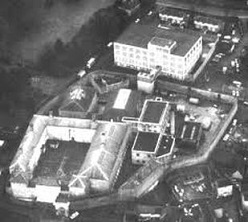
View of Shepton Mallet (left) and its execution shed (right)

Shepton Mallet had been a civilian prison for centuries before being turned over to the British military, who then lent it to the Americans as part of the Visiting Forces Act. Until its final closure a few years ago Shepton Mallet remained the oldest prison in the UK still operational, a dubious distinction now belonging to Dartmoor. There were, however, a few difficulties with the arrangement.

The Americans carried out 18 executions at Shepton Mallet during their tenure between mid-1942 and September, 1945. Two (Alex Miranda and Benjamin Pyegate) were by firing squad, upsetting local people, who knew very well what it meant to live next to a military prison and hear a single rifle volley at 8 a.m. The American military also preferred hanging common criminals to allowing them to be shot like soldiers.

The problems were simple. The locals didn’t like firing squads made no secret of it. Not surprisingly, there were complaints. The US military felt being shot was too good for most of its condemned and the British didn’t like the methods and equipment used by American hangmen, who had acquired a nasty and thoroughly-deserved reputation for using badly-designed scaffolds, the wrong type of rope and the antiquated standard drop instead of a drop length scientifically calculated by the prisoner’s weight.

The British also regarded American hanging equipment as outdated, while American military hangmen John Woods and Joseph Malta were entirely unfamiliar with the British kit. And British hangmen had evolved hanging to almost an art, needing mere seconds to complete the procedure.

Another problem was that the gallows at Shepton Mallet hadn’t been used since March, 1926. By 1942 it was considered unfit for service and needed replacing. A compromise had to be reached, and was.

The Americans could continue executions at Shepton Mallet, but the vast majority (16 out of 18) were performed by British hangmen using a British gallows in an extension built onto the end of one of the cellblocks. The Americans were permitted their usual practice of having the condemned stand strapped, noosed and hooded on the gallows while their death warrant and charge sheet were read out and then being asked for any last words. This caused executioner Albert Pierrepoint, master of the speedy hanging, to complain at what seemed to him a cruel, unnecessary delay in ending the prisoner’s misery.

Pierrepoint also complained about overcrowding in the gallows room during executions. At a British hanging there would be the prisoner, the hangman, his assistant, the prison Governor, the Chief Warder, the doctor, the Chaplain and two or four prison officers. At an American military hanging there were usually twenty or so people clustered around the trapdoors and lever. He felt a hanging should be both quick and perfect and that a crowded gallows room invited disaster.

Hangman Thomas Pierrepoint.

By VE Day the arrangement was well-established. Thomas Pierrepoint, uncle of Albert and brother of Henry (both of whom were also hangmen) performed 13 of the 16 hangings at Shepton Mallet while Albert performed the remaining three when he wasn’t busy elsewhere.

Their assistants were Steve Wade, Herbert Morris and Alexander Riley. Tom Pierrepoint had performed the last hanging at Shepton Mallet in 1926 (that of murderer John Lincoln) assisted by Lionel Mann. While the two firing squads were performed at 8 a.m., the hangings would be carried out at 1 a.m. which was discreet enough not to arouse neighbors’ ire.

Smith’s case was reviewed. Not surprisingly, his appeal was denied as were other requests including (most generously, under the circumstances) one from Lady Teichmann, widow of his victim. His date was set for 1 a.m. on what turned out to be the very day Europe’s guns fell silent. Tom Pierrepoint would do the job assisted by Herbert Morris. Smith was transferred to the Condemned Cell a few days prior to the execution date where he was granted free access to the military Chaplain.

When the time came, while the rest of the population celebrated the arrival of a new world and Smith contemplated his departure from the old one, it went as smoothly as could be expected. Smith was taken from his cell wearing standard military uniform, from which any badges or flashes marking him as a soldier were deliberately removed. Paperwork was completed signifying his dishonourable discharge from the US military as a common criminal and the US military were determined that he should die like one.

Given the delays caused by the reading of the charge sheet and death warrant and Smith being asked for his last words (he apparently had none) it took 22 minutes between Smith being taken from his cell and being certified dead by the prison doctor. Compare this with a standard British execution (minus the bureaucracy and speechifying) where 22 seconds would have been considered twice as long as was needed to do the job. Smith’s punishment, however, wasn’t done yet. Executed American servicemen were initially buried at Brookwood cemetery, but then moved to the notorious ‘Plot E’ of the Oisne-Aisne Military Cemetery in France. Plot E is deliberately hidden from the rest of that cemetery. Its residents have no names on their graves, only numbers. They have no headstones or crosses, only flat stone markers. No American flag hangs in their plot. It doesn’t appear on the plan of the cemetery even today and the markers are placed facing away from the graves of other Americans. Visits to Plot E are still discouraged and it wasn’t until a Freedom of Information request in 2009 that the names of those buried there were released.


A view of the “Dishonored Dead” in Plot E, Oise-Aisne American Cemetery. (cc) image by Stranger20824.

Whatever they may have done, and some committed truly dreadful crimes, it seems distasteful to virtually deny their existence and shame them even after death. It also denied their families and friends the chance to visit and grieve, despite the fact that they themselves had committed no crime.

That said, it’s no different to the routine imposed on condemned British criminals. In fact, the British death sentence expressly demanded that inmates be buried in unmarked graves within the prison walls inflicting the same suffering on their friends and relatives. The British hanged were officially designated ‘Property of the Crown,’ many of whom were not properly reburied until after abolition. At many British prisons they still remain in unmarked graves according to the following sentence:

Prisoner at the Bar, it is the sentence of this Court that you be taken from this place to a lawful prison and thence to a place of execution where you shall be hanged by the neck until you are dead, and that your body be afterwards cut down and buried within the precincts of the prison in which you were last confined before execution. And may the Lord have mercy upon your soul.

Remove the prisoner …

On this day..

1770: King David Hartley, Yorkshire coiner

On this date in 1770, the King of Yorkshire counterfeiters hanged (along with one of his subjects) at York’s Tyburn gallows.

Hartley was the chief of a band of currency manipulators who achieved surprising success and longevity operating from the haunting moors of England’s north.* Known (in order of least to greatest geographical specificity) as the Yorkshire, or West Riding, or Cragg Vale coiners, their operation was a straightforward shaving precious metal from coins but found its edge — so to speak — in their lair’s remoteness from the capital.


Illustration of the coining tools for Portuguese money seized from King David’s band, from The Yorkshire Coiners, 1767-1783. (Portuguese coins, a Cragg Vale specialty, were in active and legal circulation in England at this time, along with other continental coinage.)

According to this public domain volume about the criminals, the first recognition of their activities by law enforcement occurred in 1767, when a coin-clipper named Greenwood “confessed who learnt him the art of clipping in your neighbourhood” — which makes it sound like those artists were already both numerous and practiced. The next year, a man named Joseph Stell hanged for the crime, but the Leeds Intelligencer editorialized in 1769 against “the number of Sweaters and Filers of Gold coin [who] still continue to infest the Western part of this County with impunity” because “if they are suffered to go on a few years in this public and daring manner, it is supposed the current gold coin of the nation in general will be reduced a fifth part.” (A parliamentary inquiry in 1773 found that the overall weight of the country’s coinage came up a full 9% short of its face value: certainly not entirely the work of Cragg Vale, but an alarming state of affairs.)

The business had an undeniable appeal despite the occupational hazard of the gallows. With England awash in the whole world’s specie as the dominant mercantile power, the West Riding became a veritable Silicon Valley for currency entrepreneurs. It’s thought their number might have ranged into the hundreds.

Gold Coin, which has heretofore been so scarce among us as to command a large Premium against Bills of Exchange, flows in upon us with great Rapidity from all parts of the Island; and by the Hocus Pocus Touch of a Number of experimental Philosophers and Chymists (not by an addition to its weight, but by an ingenious Multiplication of its Numbers) is so greatly increased, that all Payments in Paper will soon be at an end … [they] are in a fair Way of drawing Half the Gold in the two Kingdoms into this happy Country … If you wish to be rich, and can sacrifice a few nonsensical Scruples to that Deity, make haste hither, and you may soon be instructed in these Mysteries, which, (with great Ease and Pleasure) will enable you to convert a thousand of your old-fashioned Guineas into Twelve Hundred, and, with a moderate Industry, to repeat the Process every Week.

-Letter from Halifax, July 14, 1769

This letter reflects an alarming situation: not merely the extent of the operation but the degree to which it had become normalized, winked-at, and even integrated into Yorkshire’s economic circuits. “It had become a common practice of the moneyed people — the merchant and manufacturers of the Parish of Halifax — and of those by which that Parish was surrounded, comprising a large portion of the West Riding of the County of York, to carry on a somewhat lucrative business with the Coiners,” one observer wrote. “The central body, if such it may be called, with, for a time, ‘King David’ at its head, was constituted into a kind of Banking Company, with whom certain capitalists deposited large amounts in the shape of guineas.” After all, this bank could offer steady guarantees of investment return.

But bubbles are blown for the bursting, and however many Yorkshiremen had been looking the other way while chymists multiplied guineas, it was about this time that officers of the law started putting the screws to the Yorkshire coiners. (Needless to say, the illicit bank’s merchant customers weren’t handled quite the same way.)

Confrontation came into the open with the 1769 arrests of our man David Hartley (nicknamed “King” for self-evident reasons) and at least a half-dozen others. York Castle’s bowels began to fill up with coiners and collaborators, courtesy of a crown excise officer named William Dighton (or Deighton). Dighton bgan rolling up the gang in a very modern way: starting with bribes to obtain informants and then using their information to smash through the cells.

But so vaunting were the Yorkshire coiners that David Hartley’s brother Isaac put up a £100 reward for the murder of William Dighton — and two guys duly ambushed him in a dark lane in Halifax in November 1769 and shot Dighton dead. This gambit by Isaac was much more loyal than it was wise, for the effrontery to murder an agent of the state invited a ferocious counterattack. (It also didn’t help David Hartley in the least: there was no plan to break him out, only vindictiveness against his persecutor.) The Marquess of Rockingham — the once (1765-66) and future (1782) Prime Minister — was dispatched to the scene to avenge the murdered Dighton, and had 30 coiners in custody by Christmas.

The coiners were done shooting back by this point, and the remaining tales form a tissue of outlaw desperation — flight from manhunts, maneuvering to mitigate death sentences, informing on one another. (Its particulars, and the evidence marshaled against various coiners, can be read in detail at the public domain history already cited.) David Hartley was brought up on capital charges at the next assizes;** his former comrades, including the assassins of Dighton, were hunted to ground. Soon, such counterfeiters as might still be found were reduced to their customary posture, in hidey-holes leaching a few dank groats from the neglected plumbing under the economy, rather than as retail concerns with banking ledgers and armed toughs.

But they left countless others besides — passive co-conspirators, whose wealth their shaving and filing had enlarged and who like King Charles‘s regicides could never fully be brought to book. And they’re not done to this very day: a coiners’ museum is reportedly in the works to capture a few tourist dollars, too.

* Wuthering Heights takes place in Yorkshire, and the Cragg Vale outside of Halifax is within a tormented moonlight ramble of the real locations that inspired its settings.

** Death sentences came down liberally at the assizes, but were (almost) as liberally reprieved — including, for the instance at hand, all of the following: “Thomas Harrison and Benjamin Smith, for Burglary; Benjamin Parkinson, for returning from Transportation; Richard Whitfield, for stealing Linen Cloth from a Bleaching Field; William Dalby, and Robert Moor, alias William Moor, for Horse-stealing; William Owen, George Carr, and John Tunningly, for Cow-stealing; and Robert Allerton, for Sheep-stealing.” (London Public Advertiser, April 13, 1770.)

On this day..

1803: Michael Ely, personator

On this date in 1803, Michael Ely hanged at Newgate Prison for feigning a bit of glory in the ongoing Napoleonic Wars.

The crime was no stolen valor stuff, but “personation” — fraudulently presenting oneself as a different person, in this case with a plain pecuniary objective.

After the HMS Audacious returned from campaigning against Napoleon in the Mediterranean, where she had the honor to capture the 74-gun French man-of-war Genereux near Malta, Audacious crew members were entitled to shares of a royal prize bounty for their acquisition. (Genereux thereafter flew the Union Jack until the ship was broken up in 1816.)

Ely presented himself to the crown’s prize agent as the Audacious seaman Murty Ryan to collect Ryan’s jackpot of one pound, 12 shillings.

One problem: Francis Sawyer was actually acquainted with the crook personally and (so he testified later) “I told him I knew his name was not Murty Ryan.” Ely countered by alleging that he had changed his name to avoid punishment after deserting a previous impressment — a phenomenon that Sawyer agreed was “quite common” and a good enough excuse that Sawyer paid him out, albeit suspiciously. But once the real Murty Ryan showed up looking for his share, Audacious crew members were able to verify that whatever his name might be, that first guy had never been aboard their ship.

On this day..