1558: Cuthbert Simson

On this date in 1558, Protestant Cuthbert Simson or Simpson was burned at Smithfield — having withstood harrowing torture in the Tower of London.

As deacon of a secret congregation during the reign of the Catholic Queen Mary, Simson bore the dangerous responsibility of keeping membership rolls. When he was arrested as a heretic and a traitor, he was subjected to “enhanced interrogation” in an effort to obtain the identities of the whole coterie.

He resisted.

Protestant hagiographer John Foxe recorded an alleged last letter that Simson sent to his friends from captivity (updated to present-day English from the glorious original), describing what happened after he, Simson, refused interrogators’ demand that he begin naming names.

I was set in an engine of iron, for the space of three hours as I judged. After that, they asked me if I would tell them. I answered as before. Then I was loosed, and carried to my lodging again. On the Sunday after, I was brought into the same place again before the lieutenant, being also constable, and the recorder of London, and they examined me. As before I had said I answered. Then the lieutenant sware by God, I should tell. Then did they bind my two forefingers together, and put a small arrow betwixt them, and drew it through so fast that the blood followed, and the arrow brake.


1563 woodcut of Cuthbert Simson’s torture. (Source)

Then they racked me twice. After that was I carried to my lodging again; and ten days after, the lieutenant asked me if I would not confess that which before they had asked me. I said I had said as much as I would. Then five weeks after, he sent me unto the high priest, where I was greatly assaulted; and at whose hand I received the pope’s curse, for bearing witness of the resurrection of Jesus Christ.

And thus I commend you unto God, and to the word of His grace with all them that unfeignedly call upon the name of Jesus; desiring God, or His endless mercy, through the merits of His dear Son Jesus Christ, to bring us all to His everylasting kingdom. Amen. I praise God for His great mercy shewed upon us. Sing Hosanna unto the Highest, with me Cuthbert Simson. God forgive me my sins. I ask all the world forgiveness, and I do forgive all the world; and thus I leave this world, in hope of a joyful resurrection.

Two associates, Hugh Fox and John Davenish, suffered at Smithfield with Simson.

On this day..

1894: Walter Smith

(Thanks to Meaghan Good of the Charley Project for the guest post. -ed.)

On this date in 1894, Walter Smith was hanged at the Nottingham Gaol by executioner James Billington, for the murder of Liverpool nurse Catherine Cross.

Smith invited Cross to the lace factory where he worked so he could show her a piece of equipment he had designed. He was anxious to impress her and, while they were looking at the lace-making machine, he pulled out a gun, waved it around and shouted, seemingly in jest, “Your money or your life!” The gun went off; Catherine was hit. Smith shot her two more times, then fled the scene.

She survived for another few days, and told the police what had occurred.


Tough Sell: from the Derby Mercury, March 14, 1894

The shooter’s best defense angle was to claim an accident, citing an absence of motive, an argument that is more easily made when one has not pulled the trigger repeatedly … of the gun that one has only just bought the day before. Trial testimony indicated that Smith might have had a romantic interest in Cross and it was inferred that he killed her out of jealousy because she was already engaged to marry someone else, but the victim herself seemed perplexed as to what had occurred, and why.

Alison Bruce, writing of the case in her biography Billington: Victorian Executioner, says,

Smith’s trial lasted for three days; his defence that the gun had gone off accidentally was accepted for the first shot but unsurprisingly rejected for the following two.

Billington performed the execution without an assistant and death was instantaneous.

It had been twenty-six years since England’s last public execution, but interest in even the refraction of death’s spectacle was still sufficient at this point to jam the roads near Bagthorpe Jail (today, Nottingham Prison) with a reported 6,000 spectators whose only reward was to see the gaol hoist its black flag signifying completion of the deed.

From the Nottingham Evening Post‘s same-day coverage of the hanging:

The morning mists had not yet risen when the first portions of the crowd that assembled outside the gaol to witness the raising of the black flag took up their position near the entrance gates, but the sun was shining brightly, shining over as beautiful bit of landscape as is ot be found in the immediate neighbourhood of Nottingham. By slow degrees those mists lifted, and the scene without was fresh and cheerful, the songs of the birds adding to the charm … As time wore on the thoroughfares leading to the place became lively with people hurrying to the scene. At half-past seven crowds began to roll up in larger numbers. Some thousands had now arrived, and their general behaviour was not such as to call for very unfavourable comment. It is not too much to say that had the execution been a public one their numbers would have been multiplied a hundred or a thousand fold. It was a holiday morning. If they could not actually see the hanging they could at least witness te sign which assured them that he had paid the penalty of his crime. The elevated embankments at the four crossroads were thickly lined with sight-seers. From these coigns of vantage they could command a good view of the front of the gaol, on the top of which rested the flag-pole. Away in the distance knots of people foregathered, and hundreds climbed the stone wall in the road near the building in spite of the fact that the top had been freshly tarred to prevent mischief to quick hedges above … It was exactly at a quarter to eight when the prison bell first knelled the doom of the unhappy man, and there was an evident increase of excitement. As the last knell sounded the black flag was hoisted, signifying that the exxecution had taken place, and the crowd quickly dispersed.

On this day..

1785: Three at Shrewsbury, in depraved times

The assize model we’ve been featuring this week surely underscores during the Bloody Code days the law as a wholesale instrument.

For a site like this which prefers to zero in on a story for the day, the phenomenon is most discomfiting. But even if executions in the Anglo world have for the past century or two mostly unfolded as individual tragic stories arcing from beginning through middle and end, they have still merely sat atop a legal machine that grinds up lives by thousands.

The specter of the noose perhaps highlights the trend in a way that “mere” terms of years does not quite dramatize for us. Even so, now as then, no small number of convicts prefer the hemp to the life-destroying “mercy” of a lengthy prison sentence or penal transportation overseas.

All of this is mere commentary for today’s hanging trio, who are criminals of no consequence with misdeeds but scantily attested; their trials, like most in that period, would have spanned only minutes or at most a couple of hours, and been determined by gentlemen already looking ahead to the next case. “The hungry judges soon the sentence sign, and wretches hang that jurymen may dine”: Alexander Pope had set that line down in The Rape of the Lock more than 70 years before.

“The capital convictions of the late Lent assizes, exhibit a most melancholy picture of the depravity of the times,” lamented the Leeds Intelligencer taking stock on April 5, 1785 of that season’s legal bulletins. “The following short list will prove it; — at Shrewsbury 11, York 7, Derby 6, Lincoln 9 (executed), Gloucester 11, Nottingham 4, (executed) Stafford 3, (executed) and Dorchester 5. There were 112 tried at Gloucester.”

Shrewsbury split its sentences, five for the scaffold and six for reprieve; the last three of the doomed lost their lives on this date in 1785 for various property crimes. These few words on the Salopean assizes were printed in several newspapers, and are quoted here from The British Chronicle, or, Pugh’s Hereford Journal, March 31, 1785:

At the assizes for Shropshire, which ended at Shrewsbury on Wednesday night last, John Green, for the wilful murder of his wife Elizabeth Green, by shooting her through the head, in a cellar in his own house, at Bromfield near Ludlows, and Ann Hancock, for the wilful murder of her male bastard child, at her lodgings in the Castle-foregate, in Shrewsbury, being fully convicted, received sentence of death, and were on Friday [March 18, 1785] executed at the Old Heath, pursuant thereto, and their bodies were delivered to the surgeons to be anatomized. At the place of execution Ann Hancock comfessed the fact for which she suffered, but Green did not.

Here the Shropshire narrative breaks, consigning the remaining death sentences to the newspaper’s dregs.

Image: 'For the Remainder of these Pests, see the last Page.'

… where we find:

The nine following persons were also capitally convicted, and received sentence of death, viz. William Williams, for burglariously stealing 130l. and upwards, the property of Mr. Edw. Jeffreys; Edward Edwards, for burglariously stealing a considerable sum of money, the property of Robert Pemberton, Esq; Sarah Davies, for housebreaking; William Griffiths, for stealing a black mare; Mary Davies, Rich. Pyfield, Mary Boulton, alias Bolton, William Evans, and William Hotchkins, for burglaries. The six latter were reprieved; and William Williams, Edward Edwards, and Sarah Davies, left for execution.

The hangings took place on March 26.

Part of the Themed Set: Shropshire.

On this day..

1775: Joseph Skidmore, carrier

From the London General Evening Post, Dec. 15-17, 1774

Extract of a letter from Birmingham, Dec. 15.

On Sunday morning last Ann Mansfield, the widow of a soldier, and lately a servant to Mr. Richard Wilson of this town, on her return to her father, who lives at Cradley, near Stourbridge, was found on the road, about half a mile beyond Hales-Owen, barbarously murdered. It is supposed, from the circumstances under which she was found, that she had been also ravished: her hair was dishevelled, her handkerchief and cap torn off, and her under petticoat lay by her side.

When she set out from hence, she had a small bundle, containing a new pair of stuff shoes, one pair of pattens, a black silk handkerchief, with lace to trim it, and sundry other things of small value; a new black silk hat pinned to her side, and wore a black and a white cloak, over both of which she pinned a white hat; which were all taken away.

A strong suspicion prevails against the S———- carrier (behind whom she rode through Hales-Owen the night before) who not only that night delivered a woodcock and some light parcels in S———-, but sent on Sunday morning her two cloaks to her father by two chimney-sweepers, who were both stopped, in order to undergo an examination. — The carrier is also taken up.

This “letter” was printed in several English newspapers; sometimes abridged for space needs, in time it appears to have evolved with the progress of available facts and suppositions.

Here it is in the Leeds Intelligencer for Dec. 27:

On Saturday evening last, Ann Mansfield having left the service of Mr. Richard Wilson, was returning to her father, who lives at Cradley, near Stourbridge, and for that purpose had sent part of her things by the carrier, and intended to have accompanied him herself; but calling on her sister, who lives with Mrs. Horton, in Mount-Pleasant, was detained till near dark, when the mistress very humanely begged her to stay all night, as it was impossible for her to overtake the carrier; but neither Mrs. Horton’s kindness nor her sister’s persuasions could prevail, for she unhappily persisted in her design of going home; and what is very remarkable, on leaving the house complained (to make use of her own expression) or a sinking at her heart.

She had with her a small bundle, containing a new pair of stuff shoes, one pair of pattens, a black silk handkerchief, with lace to trim it, and sundry other things of small value; a new black silk hat pinned to her side, and one black and one white cloak, both of which she wore, and a white hat pinned over them.

Some time yesterday morning she was found murdered near the spot where the Darbys are now hanging. — She is supposed from the situation she was found in to be ravished, and that the villains who perpetrated the horrid fact stuffed something in her mouth to prevent her alarming the neighbours with her cries, as no wounds of consequence enough to cause her death appeared outwardly, but the skin is forced off her hands and fingers, as supposed by struggling.

When found, she had her hair dishevelled, her handkerchief and cap torn off, and every thing of value taken away. — She had only four-pence in her pocket, which she intended to give the carrier. She was carried to Hales-Owen church.

Two fellows are taken up on suspicion of committing the horrid crime, one of whom had a white cloak in his pocket, supposed to belong to the unfortunate young woman, and they are sent this morning for examination. It appears that the carrier before-mentioned waited for this poor young creature and took her behind him, and was met by many people; which getting wind the carrier was taken up, and it is feared is too justly suspected, as he greatly prevaricates.

However much embroidery affects this story, we have a sense of the event — and of the dangers of an unlit nighttime road.

That this attack was (quite deservedly) recognized as the most egregious crime handled at Shrewsbury’s Lent 1775 assizes can be seen in the disposition of the sentences. This from Say’s Weekly Journal of April 1, 1775:

At Shrewbury assizes the following persons received sentence of death, viz. John Parry, and William Roberts, capitally convicted last assize, for plundering a wreck; Joseph Skidmore, for the murder of Ann Chandler, in a lane near Hales-Owen; Edward Stol, for horse stealing; Jane Aston, for stealing household goods; Samuel Thomas and Philip Jones, for horse-stealing; and Jemima Asplin, for breaking out of gaol, after having received sentence of transportation at last county sessions. — A respite during his Majesty’s pleasure was received for Roberts on Thursday; Aston, Thomas, Jones, and Asplin were reprieved; and Parry, Stol, and Skidmore, left for execution, the latter of whom suffered on Saturday last.

Just why the victim has become “Ann Chandler” instead of “Ann Mansfield” nor which a historian ought to prefer I cannot determine. But after Skidmore’s March 25 hanging, and the April 1 execution of Parry, all the others condemned at the 1775 assizes were reprieved their death sentences.

Part of the Themed Set: Shropshire.

On this day..

1823: John Newton, violent spouse

(Thanks to Meaghan Good of the Charley Project for the guest post. -ed.)

On this date in 1823, 40-year-old farmer John Newton was hanged for the murder of Sarah, his wife, who was heavily pregnant with their fifth child.

What happened is this: George Edwards, a local man, stopped by the Newton house and asked John for repayment of three shillings owed him for a lamp he’d sold the couple. In response, John flew into a rage, saying he had already given Sarah the money to settle the debt. This wasn’t the first time she’d done this, he told Edwards, and she had to be taught a lesson. He called Sarah into the room and threatened to thrash her.

Edwards was aghast and begged John not to hurt his wife, saying he’d rather forget about the three shillings altogether than have John do something so stupid. The three of them sat down and shared several jugs of weak beer — Edwards refusing to depart until John promised he would not hurt Sarah. As he left, he warned John that if he abused his wife, he, Edwards, would never speak to him again.

In the early hours of the next morning, John showed up at Edwards’s house and asked him for directions to the doctor’s, saying Sarah was suffering from pregnancy-related complications and “a bad job has happened.” When the doctor came, however, he found this wasn’t the case at all. Sarah had, in fact, been brutally beaten. Although she was given medical attention, she died at around midnight.

In Nicola Sly’s book Shropshire Murders, she notes,

The medical witnesses all agreed that Sarah Newton had died as a result of blood loss and, since the newspapers of the time seemed strangely reluctant to detail her injuries, it can probably be assumed that she had a miscarriage, caused by the beating and kicking she had been given by her husband.

Newton’s defense was three-pronged: first, he pointed out that Sarah had previously hemorrhaged after giving birth. Second, he claimed she had attacked him and he had hit her only in self-defense and only a few times with an open hand. Third, he presented various witnesses to suggest he had been insane at the time.

None of these arguments impressed: the jury deliberated all of two or three minutes before finding him guilty of willful murder. John said, incredulously, “I have lost my life for three shillings.”

John Newton wasn’t the only person to face trial in connection with his wife Sarah’s death, however. After John’s execution, the coroner who handled Sarah’s death inquest was brought up on charges of malpractice.

The coroner, a man named Whitcombe, had dismissed half the jury before the case was over because he considered the investigation to be “trifling.” He tried to persuade the rest of the jury members that Sarah had died “by visitation of God” before settling for an open verdict. He had Sarah’s body dissected before the inquest jury could examine it, and his own inspection of the body was judged to be perfunctory. Whitcombe had also failed to call George Edwards to the stand during the inquest, even though he was an important witness; Whitcombe also had an improper private interview with the defendant.

Whitcombe’s jury judged him culpable of “gross violation of his duty,” but in view of the fact that he had retired from his post in the meantime, he was not punished.


From the Caledonian Mercury, April 7, 1823

EXECUTION OF JOHN NEWTON, FOR THE MURDER OF HIS WIFE.

After this unfortunate man had been conveyed from the place of trial to the jail, on Saturday evening, he continued for many hours in a state of great agitation and mental distress.

On Sunday he attended divine service in the chapel of the prison, where he conducted himself with propriety. On the more near approach of the hour of dissolution his feelings again became more agitated.

At about a quarter after 12, on Monday, he was brought towards the scaffold, exclaiming, as he passed along, “I have lost my life for three shillings.” Having ascended the lodge of the jail, where he passed a few minutes in prayer with the chaplain, and some fellow prisoners, he was conducted to the scaffold; when, looking towards the immense multitude assembled, he exclaimed in a very loud tone, several times, “John Bolton!” “John Bolton, of The Hem!”

A voice appeared to answer from the crowd; and the prisoner then exclaimed, “John Edwards, are you come from Severn Hall?”

While on the scaffold, he said to the crowd, “This is a sad death to die, my lads, for a young man lie me; God bless you all.”

“I would give all the world it had not happened.”

He exclaimed two or three times, “Don’t hang me.” “I hope, gentlemen, you’ll not hang me yet.”

Occasionally he ejaculated, “Lord have mercy on me!”

Previous to being turned off, he put off his shoes (which he wore slipperways) from his feet; and when the drop fell he died instantly, and apparently without a struggle.

The unhappy man occupied a farm of about 170 acres, had been married about ten years, and has left four children. He told a gentleman who visited him, he had been a very bad husband at all times; that when he committed the fatal act, he struck and kicked his wife several times; and that, but for the interposition of Providence, he should, under the influence of his ungoverned feelings, at the same time have sacrificed the life of the child who interposed its cries in behalf of its mother: this addition to his crimes was happily prevented by the poor child outrunning and escaping from him. The unhappy criminal was a large and very muscular man. -Salopean Journal

Part of the Themed Set: Shropshire.

On this day..

1812: John Griffiths, crummy friend

Chester Chronicle, Feb. 14, 1812:

On the morning of Saturday the 1st inst. William Bailey, collier, of Old Park Iron Works, near Shifnal, Shropshire, was found robbed and murdered in an iron-stone work, at Red-lake, in the parish of Wellington, having his throat cut and skull fractured in several places.

Suspicion immediately attached the crime to John Griffiths, a cooper, who resided about two hundred yards off, (and that from his bad character, he having been twice convicted of felony, as well as its being known that he had recently much importuned the deceased for the loan of cash,) and he was accordingly taken into custody in the [fear?] of absconding.

Notwithstanding there had been much rain during the preceding day, and the roads dirty in consequence, yet the shoes of Bailey were perfectly clean when his body was found; and it was conjectured that he had been murdered in some building and his remains carried to where they then lay.

The search was in consequence directed to a house lately erected by Griffiths about one hundred yards off, and the attention of those who entered it was attracted by stains of blood on the wall, and a quantity of sand which appeared to have been recently laid on a part of the floor. The latter was immediately ripped up, and underneath it was found a vault about eight feet long, four feet wide, and five deep, to which there was no communication but by removing the boards of the floor.

The boards were much stained with blood, and a considerable quantity in a coagulated state, which had evidently run down between them, was found in the bottom of the vault. A shirt, marked with the initials of Bailey’s name, was found hid under some coals in the cellar, and which has been sworn to as his property. A cooper’s bloody adze, exactly corresponding with the fractures in Bailey’s skull, was found on the floor; and a large horse pistol secreted in the brick work.

No part of Griffith’s working apparel, or dirty linen, could be found; but it appeared his wife had been washing the major part of the preceding night. A woman that lives nearly opposite the end of Griffith’s new house, and about twenty yards off, swore that on the night of the murder, at about half past nine o’clock, she saw (from her window) Griffiths come out of his house, and reconnoitre the road both ways, and seeing no one in sight, drag out a bag containing some weighty matter, and haul it round the end of his house in the direction to where the body of Bailey was found.

A bag was found in Griffith’s house containing a quantity of coagulated blood at the bottom of it.

Bailey’s house at Old Park, was robbed of every thing valuable on the night of the murder, and, no doubt, by the murderer or his associates; from his person was stolen an old silver watch, maker’s name, “C. Harrison, Limerick, No. 76.” Bailey was in the 64th year of his age, and of the Methodist persuasion; Griffith is about 28, and pretended to be of the same profession; he was at the meeting the same evening immediately after the murder. They were in the habit of praying together in private.

Coroner’s verdict, wilful murder against John Griffith. He is now in Shrewsbury gaol to take his trial at the next assizes. He denies all knowledge of the murder, and says if he should be found guilty, he is determined not to be publicly hanged. Griffith is a native of Wellington.


Original caption: “The above is a plan of the premises: — a. — The road to Potter’s Bank. — b. — Griffith’s dwelling house. — c. — Red Lake. — d. — The house, from whence the woman saw Griffith in the act of hauling the bag out of his new house. — e. — Road to Old Park Iron Works. — f. — Griffith’s New House. — g. — Iron Stone Work. — h. — Here Bailey’s body was found. — i. To Ketley Iron Works.”

Salisbury and Winchester Journal, April 6, 1812

At Shrewsbury Assizes, on Friday se’nnight, John Griffiths was tried for the wilful murder of Mr. W. Bailey, of Ketley, near Wellington, on the evening of the 31st of January last.

The deceased and the prisoner lived near each other, and were in habits of intimacy, the latter having experienced many acts of friendship from the former, whom he at length resolved to murder, in order to get possession of some cash bills which he understood he had about him.

The prisoner was a cooper by trade, and was carrying on his business in a house he had newly built, but to which he had not wholly removed. He was seen on the evening stated dragging something from his new house round the old one, to the spot where the body of the deceased was found, the skull beat in with a hammer part of a cooper’s adze, and Griffiths’s adze was found bloody on the hammer part, which exactly fitted the wounds.

Blood was found on the floor of a room in his new house, and had run through to the cellar; the walls were sprinkled with it, and attempts had evidently been made to scrape it off, and to clean it from the floor. A train of circumstances, related by different witnesses, brought the fact so close home to the prisoner, that the Jury had no hesitation in pronouncing him Guilty.

He was hanged on Monday last, and his body given to the surgeons for dissection. He had previously made a full confession of his guilt.

Part of the Themed Set: Shropshire.

On this day..

1824: Richard Overfield, wicked stepfather

(Thanks to Meaghan Good of the Charley Project for the guest post. -ed.)

On this date in 1824, only three days after his indictment, Richard Overfield was hanged in Shrewsbury, England for the murder of his three-month-old stepson, Richard Jr.

The child died on September 21 the previous year. Overfield’s wife, Anne, rushed to the doctor’s after finding her little son in apparent agony. When she kissed the baby, she noticed his lips were white-colored and blistered and tasted bitter.

Little Richard Jr. died later that day in spite of the doctor’s attempts to save him.

“Overfield, it turns out,” notes Samantha Lyon in her book A Grim Almanac of Shropshire,

worked in a carpet factory and so had access to sulphuric acid. This he stole to administer to the baby. The already terrible picture this forms is made all the more grotesque when you know how sulphuric acid kills: the acid is so corrosive that it burns the mouth, throat, esophagus and stomach when ingested. It can, and often does, cause the sufferer to experience severe thirst and to have difficulty breathing.

The motive came out during the trial: Overfield knew when he got married that Anne was pregnant with another man’s child. This was, in fact, why he married her in the first place.

The parish didn’t want to pay out welfare for yet another illegitimate baby, so they offered Overfield a lump sum of money to marry its mother. Any baby born more than a month after marriage would be considered legitimate and its purported father would have to support it.

Overfield accepted the parish’s offer, but although the baby bore his name, he told Anne he would never accept her son as his own. And since he already had the lump-sum payment, well …

“There seems to have been absolutely no step-paternal feelings on the elder Richard’s part,” notes David J. Cox’s book Foul Deeds and Suspicious Deaths in Shrewsbury and Around Shropshire:

[He] was heard to frequently express a hatred for the infant and on several occasions was reported as stating that he would not support his wife or her ‘bastard child.’

Matters came to a tragic head …

At his trial Overfield tried to blame the family cat: he’d seen it lying on top of the baby’s face, he said, and shooed it away, and little Richard started choking shortly thereafter.

Beyond that, he had little to say for himself. The jury showed its contempt for his so-called defense by convicting him after only five minutes’ deliberation.

Overfield made a full confession and expressed public repentance for his crime. He calmly accepted his fate.

Part of the Themed Set: Shropshire.

On this day..

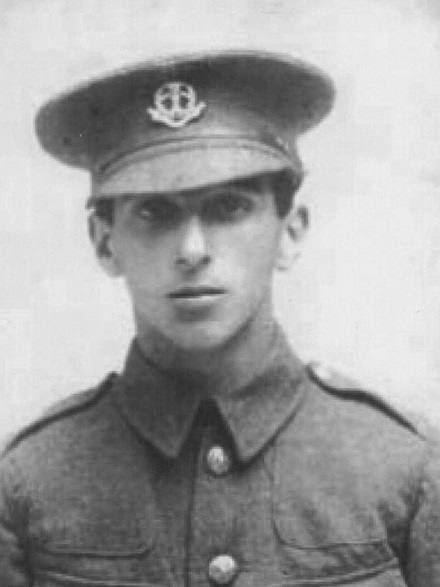
1916: Abraham Bevistein, child soldier

One century ago today, a Polish Jew from east London named Aby Bevistein was shot for cowardice in Calais — four weeks shy of his 18th birthday.

Abraham Bevistein was among an estimated quarter-million Brits who bore arms as minors in World War I. Fired by patriotism, these boys dodged the military’s 18-year-old minimum by … telling their recruiters they were 18. No documentation necessary.

Bevistein, whose family had moved to London from Warsaw when he was a small child, was British through and through enough to surge into the army with the first wave of pie-eyed volunteers in September 1914. He had 16 years and four months, and if he was like many of his new comrades in arms he probably reckoned on being back home by 17 — a bonny hero of a speedy war.

Instead, he spent most of 1915 navigating the labyrinth of trenches in France, and all their attendant horrors. He was wounded in December of that year but soon passed fit for duty again. On February 12-13, 1916, shellshocked and deafened by German grenades, he again sought medical help but was directed back to the lines by a harried medical officer. Instead, Bevistein wandered away to the rear, and took temporary refuge at a French farm.*

“We were in the trenches and I was ill so I went out,” he wrote to his mother by way of all-too-nonchalant explanation. “They’ve taken me to prison and I’m in a bit of trouble now.”

Anti-war suffragette Sylvia Pankhurst took up Bevistein’s cause when she learned about his execution, prominently publishing a sympathetic feature story in her newspaper, Women’s Dreadnought. Like 305 other British and Commonwealth soldiers shot at dawn during the Great War, Bevistein was posthumously pardoned and added to war memorials in the 21st century.

* The farm owner’s later testimony to Bevistein’s court-martial that the young tommy had expressed an intent to return to England sealed his fate as a deserter.

On this day..

1808: Thomas Simmons

(From contemporary newspaper accounts, principally The Bury and Norwich Post, Wednesday, March 09, 1808)

Thomas Simmons was indicted, for that he, at Broxbourn, on the 20th of October last, did make an assault on Sarah Hummerstonne, and wilfully gave her a mortal wound in the neck with a knife, of which she instantly died. [This is the case of the inhuman wretch who murdered the two unfortunate women at Hoddesdon, and the Court was crowded at an early hour in the morning to hear the trial. It did not last long, as the facts lay in a very narrow compass.]

Mr. Pooley, as Counsel for the prosecution, intreated the jury to dismiss from their minds all that they had heard elsewhere, and attend only to the evidence which would be laid before them. He then stated the facts as below detailed, and called the following witnesses:

Samuel James, a surgeon at Hoddesdon, deposed, that on the 20th of October, he went to the house of Mr. Boreham, at Hoddesdon. On going to the house, he saw Mrs. Hummerstone leaning against the paling near the door; she was then alive, but died in three minutes after, of a wound in the neck, near the spine.

Sarah Harris, servant of Mr. Boreham, said she had lived four years with him: Simmons, the prisoner, had lived there three years, and quitted at last Michaelmas: the prisoner wished to marry her, but her mistress disapproved of it; they had quarreled before he quitted the service, on which occasion he beat her; and when he had done he said he did not care if he had killed her. He had often said he would make away with her, because she would not marry him. About half past eight in the evening of the 20th of October, he came to the house; she was in the kitchen, and heard him coming along the yard; he was swearing violently. He came up to the window, and struck at her through the lattice, and swore he would do for them all. She desired him not to make a noise, as they had company: he said he did not care for the company, he would do for them all. Mrs. Hummerstone, hearing the noise, opened the room-door, and came to the yard. She told him to go away. He gave her a blow on the head, which knocked off her bonnet; she ran into the house, and he immediately followed her. The witness immediately heard the shrieks of murder, but did not know from whom. All the family were in the room, viz. the three young ladies; Mr. Boreham’s daughter, Mrs. Warner, the married daughter; Mr. Boreham and his wife, and Mrs. Hummerstone. In a very short time, the prisoner came to the wash-house to her: she shut the door, and cried out murder. The witness ran into the sitting-room. She there saw some one lying under the window — she ran from thence down a passage — the prisoner followed her. She there met her master with the poker in his hand; in running hastily, her master, who is a very old and feeble man, was knocked down. The prisoner caught her, and threw her down, and drew a knife on her. He threw her across Mrs. Warner, who was lying dead, as she believed. He drew a knife across her throat, but she guarded it with her hand, which was cut. He made a second blow, when she wrested the knife out of his hand. He immediately ran away, and she saw no more of him.

Sarah Cakebury said, she lived near Mr. Boreham, and heard the cry of murder. She passed Mrs. Hummerstone, and went into the house; she saw Mrs. Warner lying dead under the window.

Thomas Copperwheat went in search of the murderer. He discovered Simmons concealed under some straw in a crib in the farm-yard; he had on him a smock frock, very bloody; the place where he was found was about 100 yards from the house.

Benjamin Rook, Coroner, said, when the evidence of Harris was read to the prisoner, he said it ws very true, he had murdered them, and no one else. He added, that he did not intend to have murdered Mrs. Hummerstone, but he went with the intention of murdering Mrs. Boreham, Mrs. Warner, and Harris, the maid-servant.

The Constable who carried him to prison, deposed to the same effect. The prisoner also told him, that when he had got Betsy down, he heard something fluttering over his shoulders, which made him get up and run away.

The prisoner being called upon to know if he had any thing to say, answered in a careless tone — No!

Mr. Justice Heath told the Jury, the case was so very clear, that it must be unnecessary for him to address any observations to them; the prisoner, as they had heard, had more than once voluntarily confessed his guilt.

The Jury found him Guilty; and the learned Judge immediately pronounced the sentence of the law — that he should be hanged on Monday next, and his body anatomized.

This unhappy wretch has a very young look, and a good countenance, being rather a well-looking young man than otherwise. He heard the sentence of death with great indifference, and walked very coolly from the bar. The young girl, whom he attempted to murder, was in great agitation, and was obliged to be supported while she ws in Court.

Simmons ws convicted through the exertions of Mr. W. White, Mr. B. Fairfax, of the Bull Inn, Hoddesdon, and Mr. J. Brown, the church warden of that place, the Quakers refusing to come forward as prosecutors.


Execution — Simmons was executed on Monday, pursuant to his sentence, at half past eleven o’clock in the forenoon, between Hertford and Ware. He behaved with that air of indifference which marked his conduct during his trial. He shook hands with three persons who accompanied him to the scaffold, and whispered a few words to the gaoler beffore he was turned off.

On this day..

1619: The Witches of Belvoir

The family of the Earl of Rutland enjoyed closure on this date in 1619* when two daughters of a notorious local sorceress were hanged at Lincoln Castle for bewitching the Rutland heirs to death.

Hotheaded enough in his youth to have joined Robert Devereux‘s ridiculous rebellion, Francis Manners had matured into a solid pillar of James I’s court by 1612 when he succeeded to the Earldom upon the passing of his brother.

Taking up his proper residence at the estate’s noble Belvoir Castle, lord and lady Manners had two noble sons and the consequent prospect of a robust progeniture to carry on the Rutland title, father to manful son onward into trackless posterity.

But witchery (as Shakespeare documented) went boldly abroad in those days. To the Rutlands’ grief it set its fell eye against the prosperity of their house.

Belvoir Castle was then “a continuall Pallace of entertainment, and a daily receptacle for all sorts both rich and poore, especially such auncient people as neighboured the same,” noted a pamphlet of the time.** “Amongst whom one Ioane [Joan] Flower, with her Daughters Margaret and Philip were not onely relieved at the first from thence, but quickly entertained as Char-women, and Margaret admitted as a continuall dweller in the Castle, looking both to the poultrey abroad and the wash-house within dores.”

Someone having detected this clan of hags pilfering from His Lordship, the Flower family was soon dismissed: a reckless show of rectitude by parents who would soon have cause to regret it.

Joan Flower, the mother, “was a monstrous malicious woman, full of oathes, curses, and imprecations irreligious … her eyes were fiery and hollow, her speech fell and envious, her demeanour strange and exotic.” Folk who knew her had come to understand — how could they not? — that her curses had the power to bend infernal servants to her spiteful will; her daughters were likewise suspected of necromantic potency all their own.

Together, they were formidable enemies when roused — and they promptly avenged their dismissal by enchanting the Rutland heir Henry, who fell ill and died in September 1613. (The rest of his family got sick on this occasion, too.) Five years later, they enspelled Henry’s younger brother Francis and sent him to an early grave too.

Under such compelling affliction, the family could not long remain ignorant of the Flowers sorceresses’ enmity, and denounced them to authorities. They were arrested around Christmas of 1618.

The mother-witch soon died in prison under God’s own torture, for she

called for Bread and Butter, and wished it might never goe through her if she were guilty of that whereupon shee was examined; so mumbling it in her mouth, never spake more wordes after that, but fell downe and dyed as shee was carryed to Lincolne Gaole, with a horrible excruciation of soule and body.

As though more evidence were needed, both of Joan’s daughters also admitted turning their occult powers against the little heirs, part of a horrific pattern of infernal connivance:

  • that the late mother kept a feline familiar named Rutterkin, and Joan malevolently stroked the cat with a glove stolen from Henry while uttering incantations that the boy might never thrive
  • that similar treatment was meted out using Rutterkin and a glove discarded by Francis
  • that Margaret kept two evil familiars whom she profanely suckled — “the white sucked under her left breast, and the blacke spotted within the inward parts of her secrets”
  • that Philip “heard her mother often curse the Earle and his Lady, and thereupon would boyle feathers and blood together, using many Devillish speeches and strange gestures”
  • that Margaret “saith, That her mother, and shee, and her sister agreed together to bewitch the Earle and his Lady, that they might have no more children”

While the mother was beyond the reach of the law, both daughters were duly condemned for murder on the evidence of their own confessions, and “executed accordingly, about the 11 of March, to the terror of all the beholders, and example of such dissolute and abominable Creatures.”

Even so, their horrid magic outlived them. The Earl and the Duchess were never again able to conceive; their only surviving child was a daughter, Katherine, who would carry the rich inheritance that should have been her brothers’ into a marriage with King James’s favorite.†


“Two sons, both which dyed in their infancy by wicked practise & sorcerye”: Inscription on a Manners family memorial at Bottesford. (cc) image by J. Hannan-Briggs.

* 1618 by the local reckoning, since the new year at this time began on March 25. It’s 1619 as we would see it retrospectively in view of a January 1 calendar rollover.

** The wonderful discoverie of the witchcrafts of Margaret and Phillip Flower, daughters of Ioan Flower neere Bever Castle: executed at Lincolne, March 11, 1618

† Some scurrilous wags of the present day have suggested that said favorite cunningly poisoned off the brothers himself so that he could get his hands on Katherine’s huge tracts of land.

On this day..