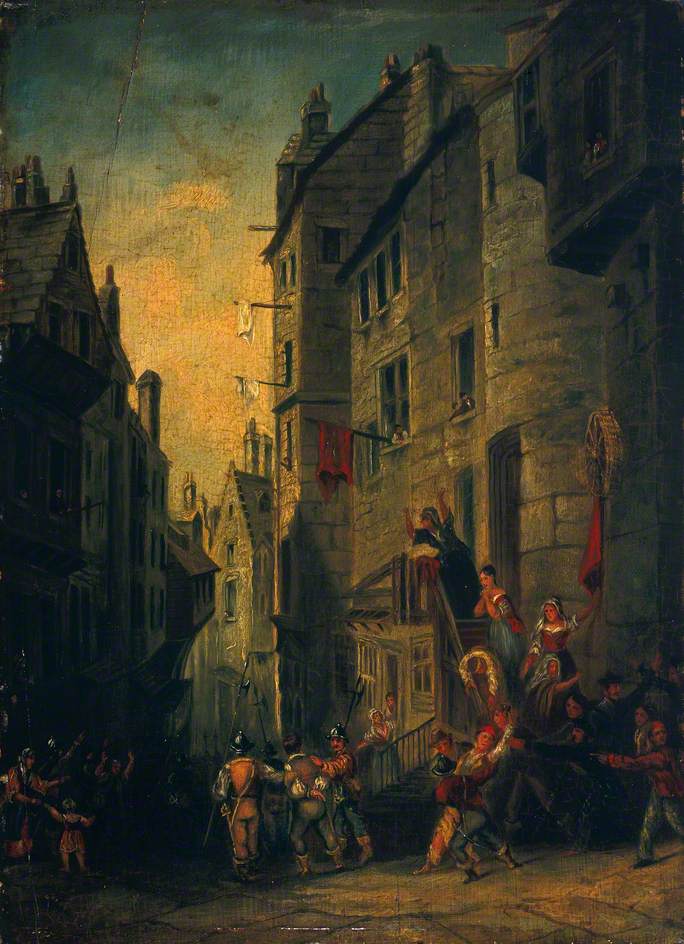
1734: Judith Defour, in the Gin Craze

In every civilized society, in every society where the distinction of ranks has once been completely established, there have been always two different schemes or systems of morality current at the same time; of which the one may be called the strict or austere; the other the liberal, or, if you will, the loose system. … The vices of levity are always ruinous to the common people, and a single week’s thoughtlessness and dissipation is often sufficient to undo a poor workman for ever, and to drive him, through despair, upon committing the most enormous crimes. … The disorder and extravagance of several years, on the contrary, will not always ruin a man of fashion; and people of that rank are very apt to consider the power of indulging in some degree of excess, as one of the advantages of their fortune; and the liberty of doing so without censure or reproach, as one of the privileges which belong to their station.

-Adam Smith, The Wealth of Nations

On this date in 1734, Judith Defour (or Dufour; she was also known as Judith Leeford) was hanged at Tyburn, and afterwards anatomized.

Defour’s four companions in death were (male) robbers, highwaymen and housebreakers, feared but commonplace scourges of London’s propertied. Defour was a different type of terror to panic the moral sense of a metropolis that daily outgrew its denizens’ comprehensions: she throttled her two-year-old daughter “and sold the Coat and Stay for a Shilling, and the Petticoat and Stockings for a Groat. We parted the Money, and join’d for a Quartern of Gin.”


Maternal care has gone by the wayside in this detail view (click for the full image) of William Hogarth‘s 1751 print “Gin Lane”, a shocking figure who might allude to Judith Defour. This is not Hogarth’s only comment on the gin craze; in his “The Idle Prentice Executed at Tyburn” there appears to be commerce in Madame Geneva taking place in the cart to the right hand side of the frame.

Gin — short for Geneva, a corruption of the Dutch word jenever which denoted not a city in Switzerland but the potent elixir’s juniper flavoring — boomed in popularity as production advances sank its price in the early 1700s. “Cheap, widely available, and several times stronger than the traditional alcoholic beverages of the English working classes, gin was the first modern drug,” writes Jessica Warner in Craze: Gin and Debauchery in an Age of Reason.* And per-capita consumption of it increased nearly eightfold over the first half of the 18th century.

The specter of rampant alcoholism within the financial means of the working-class terrified the respectable.

“There is that predominant bewitching of naughtiness in these fiery liquors, as strongly and impetuously carries men on to their certain destruction … To recover him from this condition, he must be, as it were, forced into his liberty and rescued in some measure from his own depraved desires: he must be dealt with like a madman and be bound down to keep him from destroying himself,” wrote the Anglican clergyman and scientist Stephen Hales around the same time as Defour suffered. His earnest leap from moral shock to questionable social science inference — and even a proto-eugenics appeal — could have sprung word by word from the pen of a present-day drug warrior.

How many does it reduce to suffer the hardships of the extremest poverty, not only by wasting their substance by the continual drain to satisfy a false, vitiated appetite, but also by so enfeebling and disabling them that they have neither will nor power to labor for an honest livelihood; which is a principal reason of the great increase of the poor in this nation, as also of the much greater number of robberies that are committed of late years than were in former ages …

It is evident that in proportion as the contagion spreads farther and farther among mankind, so must the breed of human species be proportionably more and more depraved, and will accordingly degenerate more and more from the more manly and robust constitution of preceding generations. (Source)

Gin projected existential threats more imminent than the potential mongrelization of the species.

From the standpoint of Great Britain’s national output, gin’s production devoured a growing share of the grain harvest, with the perverse result that distillers keen to reassure lawmakers that their product posed no threat to the bread supply made pains to insist that they brewed their potion using only the lowest-quality crap not fit for consumption. On a more microeconomic level, gin was slated with sapping its adherent’s aptitude for the strictures of gainful employment while siphoning his revenues from more reputable tradesmen of whom, addled by alcoholic thirst, the drukard no longer cared to purchase even the barest essentials.** And the gin-houses, “some thousands of such, more than was ever known before” that popped up all over London came to be viewed as scofflaw cesspools — where the iniquitous planned their next larcenies or disposed of the proceeds from the last.

Cause and effect make a jumble, but as the Gin Craze unfolded every form of disorder, criminality, and social breakdown seemed but a link or two distant from the influence of Geneva.

We don’t know when this dark moon first threw a shadow over Judith Defour — only that she would transform her into a beast.

The daughter of poor and honest French-descended Spitalfields weavers, she was about 30 years old when she hanged. To reconstruct a timetable of her life from the scanty biographical details available us, she went to work by the time she was 10 or 12 years old as the silk winder for another weaver; she worked 11 years for that weaver, a woman, and then four more for a male weaver at which point the Newgate Ordinary says that “she fell into bad Company, and had a Bastard-Child, which died; and then she had another, the unfortunate Child lately murder’d by her.” Reading between the lines, she we might infer that her out-of-wedlock pregnancy was the cause of her dismissal. She had no education, and was not among the weaving industry’s skilled artisans. Hers was a perilous situation.

Did she fall into life’s waiting snares because of gin, or the other way around? The record gives us no indication — only that as she approaches Tyburn’s pall three or four years after her dismissal she is far along in dissipation and her employment prospects appear fleeting and piecemeal. Maybe she was already begging, thieving, or whoring, ills commonly imputed to Gin Lane. Judith’s mother would tell the court that “she never was in her right Mind, but was always roving,” although she was trying to save her daughter’s life when she said this.

In any event, Judith was shuttling her young daughter in and out of a workhouse at this point. On January 29, barely five weeks before her execution, Judith picked up little Mary from the workhouse as was her wont (forging a release order from the church), and brought her along as she went out boozing with a friend named Sukey† — “one of the most vilest of Creatures in or about the Town.”

The girl had been new-clothed at the workhouse, and as day wore on to evening and the gin ran dry, Sukey convinced Judith “to sell the Child’s Clothes, and carry it into the Fields and leave it there.” Maybe the kid would be taken in by some passing stranger, or returned to the workhouse; maybe Judith could retrieve her from the field later that night. Nasty, brutish, and short was this life and the only thing that mattered at that moment was the next drink. But in the attempt to silence the whimpering toddler they “ty’d a linen Rag very hard about the Child’s Neck, to prevent its crying out, which strangled her.” Then they walked away and sold those clothes for drink.

[S]he said, she was very sorry for what was done, that she never was at Peace since it happened, that she scarce desired to live; and therefore she made a voluntary Confession she had been always of a very surly Disposition, and untractable Creature, a Despiser of Religion, negligent in her Duty to God and Man, and would take no good Advice of her Friends, nor of any good or sober People. She drank and swore much, and was averse to Virtue and Sobriety, delighting in the vilest Companies, and ready to Practice the worst of Actions. She acknowledged the Justice of her Sentence, and died in Peace with all Mankind.

-The Ordinary of Newgate

The always-recommended BBC In Our Time podcast covers the Gin Craze here.

* We have previously featured Jessica Warner in connection with another of her books, about hanged American Revolution terrorist John the Painter.

** “Those that keep large numbers of cows near the town will tell you, that they have not had near the demand for their milk, and have been forced to sell off some part of their stock; which they attribute to mothers and nurses giving their children gin.” -Reformer Thomas Wilson, quoted in Patrick Dillon’s Gin: The Much-Lamented Death of Madame Geneva.

† Short for Susanna. This period also gives us the Beggar’s Opera and the most famous literary character of that name, Sukey Tawdry.

On this day..

1748: William Whurrier, War of Austrian Succession veteran

From the Newgate Calendar:


WILLIAM WHURRIER
Executed at Tyburn for murder, March 7, 1748, and his body hung in chains on Finchley common. (A Hard Case.)

We cannot so clearly see by the report of this trial, as the jury might have done by the evidence adduced, the malice propense necessary to constitute the conviction of murder. But, though we are by no means disposed to question a verdict of the country, yet we cannot avoid saying, that the case added to the services which the unfortunate man had rendered the king, should have proved a strong recommendation to royal mercy.

This soldier was a native of Morpeth, in Northumberland, and brought up as a husbandman; but having inlisted in General Cope‘s regiment, he served five years and a half in Flanders; when, some horses being wanted for the use of the army, he and another man were sent to England to purchase them.


General Cope is most famous today as the subject of a Scottish folk song commemorating a rout the Jacobites inflicted at the Battle of Prestonpans.

On the 11th of February, 1748, as Whurrier and his companion were walking over Finchley Common towards Barnet, the latter, being wearied, agreed with a post-boy, who went by with a led horse, to permit him to ride to Barnet, leaving Whurrier at an alehouse on the road. Whurrier having drank freely, met with a woman who appeared to be his country-woman, and with her he continued drinking till both of them were intoxicated, when they proceeded together towards Barnet; but they were followed by some sailors, one of whom insulted Whurrier, telling him that he had no business with the woman.

Whurrier suspecting there was a design to injure him, asked the woman if she had any connection with those men. She said she had not: but in the meantime the other Sailors coming up, said they came to rescue the woman; on which Whurrier drew his sword; but returned it into the scabbard without annoying any one.

A soldier riding by at this instant, Whurrier told him that the sailors had ill-treated him, and begged his assistance, on which the soldier getting off his horse, the sailors ran away, and Whurrier pursuing them, overtook the first that had assaulted him, and drawing his sword, cut him in such a manner that he was carried in a hopeless condition to a house in the neighbourhood, where he languished till the Sunday following, and then died.

the skull … was divided, as if a butcher had taken a chopper and divided the skull, so that the brains lay open.

… I judged the wound to be mortal; and upon his head being shaved, there appeared six other wounds upon the head, which went through the skin, but not into the skull; but the bone was bare, and I dressed them all. Then I made an inspection into the arm, and I found as many wounds there, from the wrist to the scapula, as I did upon the head. Upon the back part, what we call the scapula or shoulder bone, there were two wounds more … the bone of the arm was fractured by the incision, as if it had been done by a sword.

… I believe there were fifteen [wounds], and they were all at that distance from one another, that they must all have been made by separate strokes, and from these wounds the man must be in a very weak and languishing condition, and I found him so.

–Surgeon’s testimony at Whurrier’s trial

It appeared by the testimony of a surgeon that the deceased had received a cut across the skull, as if done with a butcher’s chopper; so that the brains lay open; besides a variety of other wounds.

Whurrier being taken into custody for the commission of this murder, was brought to trial at the next sessions at the Old Bailey and being capitally convicted on the clearest, evidence, was sentenced to die.

After conviction he said he thought there was a combination between the woman he had met with and the sailors; and a day or two before he suffered, he procured the following paper to be published, which he called, “Whurrier’s Declaration.”

This is to let the world know that I have lived in good credit, and have served his Majesty eight years and two months. In the time of my service, I have stood six campaigns, and always obeyed all lawful commands: I have been in three battles, and at Bergen-op-zoom, during the time it was besieged. The first battle was at Dettingen, June, 1743, when his Majesty headed his army: the second was in the year 1745, April 30, at Fontenoy; the third was at Luckland, by siege; besides several skirmishes, and other great dangers.

I had rather it had been my fate to have died in the field of battle, where I have seen many thousand wallowing in their blood, than to come to such disgrace: but, alas! I have escaped all these dangers to come to this unhappy fate, to suffer at Tyburn, and afterwards to hang in chains on a gibbet, which last is the nearest concern to me; and I cannot help expressing, that it would be more beneficial to the public to employ blacksmiths to make breast-plates for the soldiers, than irons to inclose their bodies to be exposed to the fowls of the air.

I have been a true subject and faithful servant, as is well known to the officers of the regiment to which I belonged. If I had been a pick-pocket, or a thief, I should have suffered much more deservedly, in my own opinion, than I now do; for what I did was in my own defence: I was upon the king’s duty, and was assaulted by the men in sailors’ habits, who gave me so many hard blows, as well as so much bad language, that I could no longer bear it, and was obliged to draw my sword in my own defence; and being in too great a passion, as well as too much in liquor, I own I struck without mercy; as thinking my life in danger, surrounded by four men, who I thought designed to murder me; who, or what they were the Lord knows; it is plain they had a false pass, as it was proved: and that they had travelled but seven miles in nine days; but I forgive them, as I hope forgiveness: and the Lord have mercy on My soul, and the poor man’s whom I killed.

   W. WHURRIER.


Whurrier was executed at Tyburn in a group comprising six souls all told: the others were Robert Scott and Samuel Chilvers, smugglers; William Stevens and Francis Hill, housebreakers; and John Parkes, forger. Stevens was only 17 years old: “young, and entirely unacquainted with the Nature of the World,” in the words of the Newgate Ordinary who prepared the boy’s soul for its ordeal.

On this day..

1903: Edgar Edwards, sash weight killer

On this date in 1903, Edgar Edwards was hanged in Wandsworth Prison for a minor-league* triple murder.

Of course, the killing was anything but trivial to its victims, a Camberwell grocer and his wife along with their infant daughter. The couple put their business up for sale: Edwards answered the ad but had a different transaction in mind. Contriving to separate man and wife in the course of the interview, he bashed Beatrice Darby to death and strangled the infant child. Evidently he had some proficiency wielding a five-pound sash weight. The reader may perceive that this weapon, albeit improvised, is a crueler device than its accessorizing name might suggest.

Having done with the wife, he lured unwitting husband John to his makeshift abattoir and murdered him in the same horrid fashion.

That occurred way back in November, but it wasn’t until Edwards tried the same ploy using the same type of bludgeon** against a London businessman a month later that the earlier homicide unraveled. As the investigation led back to Leyton (thanks in part to Edwards’s foolish possession off John Darby’s business cards) the neighbors all started remembering that he’d been awfully keen about burying something in the garden a few weeks back. Rear Window this ain’t.

The motive for all this was just to take possession of the stock and sell it quietly for ready cash. Edwards had little recourse when captured but to try to draw out a family history of insanity, a ploy could not have impressed jurors much in view off the crime’s calculated ferocity.

* A century and God knows how many murders onward, this crime may be an imperceptible drop in the sea; in its day, however, it earned Edwards wax statuary at Madame Tussaud’s.

** The humble sash weight has its niche in the crime annals; it was also the weapon used by Double Indemnity inspirations Ruth Snyder and Judd Gray.

On this day..

1823: William North, prostrated homosexual

From the Morning Chronicle of Feb. 25, 1823, via Rictor Norton. (Spaces added for readability.)

EXECUTION. — Yesterday morning, at an early hour, considerable numbers of spectators assembled before the Debtors’ door at Newgate, to witness the execution of William North, convicted in september Sessions of an unnatural crime.

The wretched culprit was 54 years of age, and had a wife living.

On his trial, he appeared a fine, stout, robust man, and strongly denied his guilt. On his being brought before the Sheriffs yesterday morning, he appeared to have grown at least ten years older, during the five months he has been in a condemned cell, with the horrid prospect before him of dying a violent death. His body had wasted to the mere anatomy of a man, his cheeks had sunk, his eyes had become hollow, and such was his weakness, that he could scarcely stand without support.

Though the consolations of religion were frequently offered to him, yet he could not sufficiently calm his mind to listen, or participate in them, even to the moment of his death. Sunday night he could not sleep, his mouth was parched with a burning fever; he occasionaqlly ejaculated “Oh God!” and “I’m lost;” and at other times he appeared quite childish; his imbecility of mind seemed to correspond with the weakness of his body. He exclaimed on one occasion “I have suffered sufficient punishment in this prison to atone for the crimes I have committed;” and when the Rev. Dr. Cotton and Mr. Baker, who attended him, asked him if he believed in Christ, and felt that he was a sinner? He replied “I pray, but cannot feel.”

The Sacrament of the Lord’s Supper was not administered to him, probably on account of his occasional delirium, and the generally disordered state of his mental faculties.

At five minutes before eight yesterday morning he was pinioned by the executioner in the press room, in the presence of the sheriffs and officers of the goal. As St. Sepulchre’s church clock struck eight, the culprit, carrying the rope, attended by the executioner, and clergyman, moved in procession with the sheriffs, &c. on to the scaffold.

On arriving at the third station, the prison bell tolled, and Dr. Cotton commenced at the same moment reading the funeral service “I am the resurrection and the life,” &c. of which the wretched man seemed to be totally regardless. On his being assisted up the steps of the scaffold, reason returned; he became aware of the dreadful death to which he was about to be consigned; his looks of terror were frightful; his expression of horror, when the rope was being placed round his neck, made every spectator shudder.

It was one of the most trying scenes to the clergymen they ever witnessed — never appeared a man so unprepared, so unresigned to his fate. — The signal being given the drop fell, and the criminal expired in less than a minute. He never struggled after he fell.

The body hung an hour, and was then cut down for interment. — The six unhappy men who are doomed to suffer on to-morrow morning, appear to be perfectly resigned to their fate.

On this day..

1554: Henry Grey, Duke of Suffolk

On this date in 1554, Tudor nobleman Henry Grey — who for nine days had been the father of the queen — was beheaded at Queen Mary’s command.

He was one of the inveterate schemers who grappled to secure his family’s foot upon the throne during the uncertain years when Edward VI succeeded Henry VIII. Frail and underaged, Edward’s foreseeable early death without issue created a situation where the cream of the aristocracy could plausibly dream themselves the namesakes of the next great English dynasty. Heck, the late royal monster was himself just the son of the guy who had taken the throne in battle by offing the previous dynasty, an event still knocking about in a few living, wizened memories.

So for the late 1540s into the early 1550s the court’s nigh-incestuous parlor game of consanguinary bedroom alliances was played for the highest stakes.

Queens were wild at this table. Henry VIII’s will had queued up the succession after Edward with his two half-sisters, Mary and Elizabeth, followed next the three daughters of our man Henry Grey — because Henry Grey was married to King Henry’s niece. (That niece got cut out of the succession herself, however.) It was Henry’s fond hope, but not his kingdom’s destiny, that Edward would have grown up to sire a male heir who would render academic the ladies’ pecking-order.

But until that time the order mattered, and Henry Grey — let’s just call him Suffolk for simplicity’s sake even though he doesn’t obtain that title until 1551; he’d previously been Marquess of Dorset — started angling to jump the queue by cuddling up to King Edward.

There was a concoction with Thomas Seymour in the 1540s to orchestrate the marriage of Suffolk’s oldest daughter Jane Grey to Edward, where the Grey family could do the heir-siring directly; but, Edward’s other guardians discovered and scotched the plan. Yet even though young Edward didn’t put a ring on it, he so favored this family — and, a staunch Protestant, he so feared the potential succession of his Catholic sister Mary — that Edward when dying drew up his own will designating this same Jane Grey as his heir while declaring Mary and Elizabeth illegitimate.*

This was actually a coup not so much for Suffolk as for the realm’s de facto executive, John Dudley, Duke of Northumberland — who had been the one to secure Jane Grey’s hand in marriage to Dudley’s own son, Lord Guildford Dudley. Both were teenagers: it was Northumberland who meant, through them, to rule. It need hardly be added that Suffolk was pleased enough in 1553 to tie his family’s fortunes to the big man on campus.

The plan’s speedy and total failure is well-known but that is not the same as saying it was foreordained. England had to this point never submitted to a female sovereign ruling in her own right; Mary, an on-again off-again bastard during the wild realignments of Tudor dynastic politics, was a Catholic who had remained nearly cloistered on her estates for the past several years, rarely seen at court. How much “legitimacy” would she command when the chips were down, against Northumberland who already had the apparatus of state in his hand? For the chance to make the Tudors just the overture to the glorious era of Dudley England it was surely worth a roll of the bones.

At any rate, Edward died on July 6, 1553 and Lady Jane Grey was duly pronounced queen on July 10 — the “Nine Days’ Queen” for the span of her reign before Mary supplanted her. On that very same July day a letter from Mary, gathering her adherents in Dudley-hostile East Anglia, arrived to the realm’s ruling clique demanding her own prompt recognition. Even as Northumberland marched out to fight for Jane’s rights (and his own) English grandees were going over to Mary’s claim in a landslide. That’s legitimacy for you: when you’ve got it, you’ve got it.

It was Dudley who caught the brunt of Mary’s wrath in this instance; the kids (quite rightly) were understood as his pawns and stored away in the Tower, heads firmly attached to shoulders but under a dangling treason conviction with which Mary could destroy them at her whim. That time would not be long in coming: as many monarchs have found before and since, a living rival claimant, however submissive, poses a grave danger just by breathing in and out.

Suffolk made sure of it — and doomed his daughter in the process.

Although he already owed his life and his liberty to Mary’s clemency to the onetime friends of Northumberland,** Suffolk wagered both desperately as one of the chief conspirators in Thomas Wyatt‘s January 1554 Protestant rising. This attempted restoration of Protestant power in the kingdom brought fighting to the walls of London and gave the shaken Queen Mary cause to close one security gap by having the Nine Days’ Queen beheaded on February 12, 1554 — while, to far fewer tears, avenging another more self-evident treason by executing Jane’s father as a rebel, too.

* King Edward didn’t have a beef with the Protestant Elizabeth; it’s just that as a legal matter she was either in or out on the line of succession by the same logic that Mary would be in or out. The point was to disinherit Mary.

** Suffolk’s wife, the one whom Henry VIII cut out of the female succession scramble, was friendly with Mary and got hubby released from the Tower post-Northumberland with a slap on the wrist.

On this day..

1864: The pirates of the Flowery Land

On this date in 1864, four Philippines Spaniards and a Greek Ottoman who once numbered among the crew of the Flowery Land hanged together in London as mutineers and murderers.

The July preceding, that 400-ton merchant barque had set sail from London to Singapore with a cargo of wine. Outfitted for economy,* her crew numbered only 19 souls.**

This floating hamlet manifested in motley miniature Britain’s sun-never-sets empire. Its chief was a Scotsman with the solid name of John Smith; also on board as a passenger was a 20th man, Smith’s brother George.

The skipper’s seconds were two more British mates, names of Carswell (or Karswell) and Taffer (Taffir, Taffar).

Aboard the Flowery Land — aptly named for this metaphor — the Brits had mastery of a mixed-blood crew from many quarters of the globe. It is apparent from the testimony recorded at the Old Bailey that the men had no one lingua franca among them, but got by as can with ad hoc translation and the pidgin cant of the sea. Spanish was frequently heard among the crew: no surprise considering its composition. (The captain was also described as a capable Spanish speaker.)

The accounts identifying the Flowery Land‘s human cargo give perplexing and partial selections, with varying reports of nationalities. The flexible spelling accorded to proper names of the day, a multitude of aliases, and the infelicity most of these men had with English surely contributes to the confusion. But after the captain, the captain’s brother, and the two mates, the ship’s complement appears to have consisted of the following:

  • Six Spanish/Filipino sailors from Manila: John Leone or Lyons, Francisco Blanco, Mauricio Duranno, Basilio de Los Santos, Marcelino Santa Lacroix, and Miguel Lopez aka Joseph Chancis
  • A Levantine Turkish subject of Greek ancestry, Marcus Vartos (called “Watter” in the Old Bailey records)
  • George Carlos, a Greek from Greece
  • Two Spaniards, Jose Williams and Frank Paul or Powell
  • Michael Andersen, a Norwegian
  • Frank Candereau, a Frenchman
  • Frank Early, a 17-year-old English cabin boy
  • A Malay steward, a Chinese cook, and a Chinese lamp-trimmer boy, sometimes described together as “three Chinamen”

According to the evidence, much of it given via translators, during the dark hours before dawn on September 10, several of the Manila crew members surprised first mate Carswell while he was walking a routine nightwatch, beat him wickedly, and pitched him into the sea. The disturbance roused the captain and as he emerged he too was beaten and stabbed to death, as was his brother the passenger.


Are they coming for your daughter next? Cover illustration for the “penny dreadful” Police Crimes.

Having disposed of both the ranking mariners, the mutineers approached Taffer with a classic offer one can’t refuse: as the last capable navigator aboard, he would guide the ship to the Rio de la Plata.

After a three-week journey that was surely very frightening for Taffer, they reached the mouth of that river dividing Argentina from Uruguay and there scuttled the Flowery Land and put ashore in skiffs. Or at least, most of them did so. Ordered off the boat, the Malay steward refused until the Manila conspirators pelted him with champagne bottles from the ship’s store of cargo, finally driving him into the waves where he drowned; John Lyons remarked on some private grievance that must have been shared by his fellows. The Chinese cook and boy apparently suffered a like fate, being left to go down with the sinking ship … or at least that is what the survivors later deposed wish to have understood. Two little boats made landfall from the ill-starred hulk and each boat’s party reports not having the Chinese aboard or seeing what became of them. There is racism, sure — Taffer doesn’t even know the cook’s name — but it seems bizarre and sinister that two people among they this tiny group of seaborne intimates die completely offstage and the rest barely even think to wonder about them. (“I then missed the cook and the lamp-trimmer,” Taffer deposed pre-trial. “Lyons said they had gone down in the ship.” (Glasgow Herald, Jan. 15, 1864)) Be that as it may, the fate of these unfortunates was very far down the list of injuries done by the mutineers to the British Empire and nobody appears to have been inclined to inquire too closely.

So we take them for dead. Strangely, having slain six people, the mutineers did not make Taffer the seventh — a clemency that Taffer did not anticipate, and with which he would soon punish them. Once the remaining crew had made landfall, Taffer well understood how his dangerous position stood in this party and contrived to escape it at the first opportunity.

Once away, he made for Montevideo and presented himself and his shocking story to British authorities. His 13 former mates, many of whom were pretending to have escaped the wreck of an American guano freighter with an eye to hitching on with some other crew and vanishing into the circuits of imperial trade, were soon recognized or rounded up. By December, all 14 survivors were en route to England.

The inexact process of dividing mutineer from bystander had already begun by now, closely tracking racial proximity. The two British subjects, Taffer and Early, shipped home not as pirates but as witnesses, as did the Norwegian and the Frenchmen. The other ten returned in manacles.

Upon inquiry back in London, it was decided that the two Spaniards (the two from Spain, not Manila) could not be shown to have joined or supported the mutiny, only to have gone along with it when it was a fait accompli. They were set at their liberty.

The remaining eight men — the six from Manila plus the Greek from Turkey and the Greek from Greece — faced trial. All but John Carlos were convicted and condemned to death; Carlos, acquitted of the murder of Captain Smith, was vengefully re-indicted that same day for property destruction committed by scuttling the Flowery Land, and caught a 10-year sentence for that.

The why of the mutiny is frustratingly — or conveniently — elided in the testimony that crew members gave the court, and we are perhaps meant to understand broadly, as does this author, that “such a ‘dago’ crew” is ever prone to becoming “saucy” and imperiling all order.

As we query beyond a colonial power’s heart of darkness we quickly enter territory that the original documents did not bother to chart. With any mutiny one’s mind flies to that ancient maritime grievance, “bad usage”. The record gives us only guarded indications, but it touches on poor rations and brutal corporal punishments, albeit isolated ones† (e.g., Michael Andersen: “I have seen the captain strike some of the crew … he struck Watter with his flat hand at the side of the head — I did not see that more than once.”)

Those prosecuted, strangers in a foreign land, do not appear to have made any declaration explaining their own conduct even after sentence was secured though the London Times (Feb. 23, 1864) said that they had communicated to their gaolers that they had been driven to desperation by a mean water ration in the tropical swelter. One British newsman reporting the hanging also marked the omission in a voice that, however tinged with racial condescension, empathizes surprisingly with the hanged.

Nothing can extenuate the ferocity of the group of murders they committed, for the lowest savage is bound to observe the instincts of humanity. But God judges provocations, and weighs the frenzy of ignorant men, goaded to crime, in a finer balance than any earthly one. He knows what secrets are gone down with the Flowery Land, and the dead bodies of her captain and mate; knows whether these five men — now also dead — were treated as it is the custom to treat such poor sweepings of maritime places. The evidence hinted strongly at something of the kind — foul water to drink, and little of it under the tropics, insufficient food, and anger and blows; because, having shipped his crew from Babel, the captain and officers could not understand them or be understood … with decent management this kind of tragedy is next to impossible. Had the crowd at the execution been of the same color and vocation as themselves, sympathy would not have been wanting. It would have been believed — justly or not — from the experience of a hundred miserable voyages, that, knowing no Spanish, their officers had made kicks and cuffs interpret for them, as is the case in many a vessel. If it was so in theirs, how could they explain it? Our language, our courts, our long delays between crime and its penalty, were to them all one mystery. They are of a race that prefers to die and be done with it, rather than to fret and fuss too much against the will of Fate; and though we believe that none of the five were guiltless, we have an uncomfortable suspicion that, had they been English, some different facts would have been brought out at the trial … let us not be suspected of pitying a dusky murderer while we have no compassion for his victims of our own color if we demand that the moral of this offensive sight should be drawn in Manillese as well as English — that captains should learn to treat their lascar like a human being, if they would not have his thick Oriental blood boil into the fury of the brute which they have helped to make him.

The prospect of favoring the London mob with a the group hanging of seven “dusky murderers” — a quantity not seen at Newgate or anywhere else in England in decades — excited quite a lot of fretful commentary both moral and logistical. In the event, Basilio de Los Santos and Marcelino Santa Lacroix both received royal mercy on the strength of a petition, supported by the Spanish consulate and by some of the jurors, claiming diminished responsibility for the maritime coup.

That still left five to swing, which promised a remarkable novelty. There had been hangings of six, seven, and even eight on single occasions at Newgate in the 1800s up until the 1820s. The last such event was a septuple hanging on July 22, 1829. But by the 1840s and 1850s hangings had become solo affairs almost all the time; as of 1864, Londoners had not set eyes on a double execution — to say nothing of larger crops — in full 12 years.

Liberal-minded British elites and especially Fleet Street gasbags were already at this point in high dudgeon at the uncouth behavior of the rabble that flocked to public hangings. They approached this spectacle, whose victims had been hissed by the throngs who hemmed the Old Bailey when they arrived for their trial, pre-outraged, as it were — certain that their countrymen and (what is worse) women would soon set a-gnash all the teeth of the right-thinking.

Under the pious headline “Morality, as taught by Professor Calcraft” — that is, the notorious public executioner — the Newcastle Daily Journal of February 17, 1864 wrote (prior to the reduction of two of the seven sentences):

Next Monday morning, at eight o’clock, the gentle successor of Mr. John Ketch, “assisted” by some twenty thousand blood-thirsty ruffians of every grade and station, — ruffians with “handles to their names” from Belgravia, and ruffians with a score of aliases rom the Seven Dials, — will have the gratification of butchering seven of his immortal fellow-creatures, in the name of Justice and with the sanction of the Gospel — as represented by the Rev. John Davis, Ordinary of Newgate. What a thrill of delight will run through his veins as he draws the bolt and offers up this seven-fold sacrifice! How intensely pleasing must be the effect produced upon the spectators by the sight of seven dying men writhing in the agonies of the last struggle at the self-same moment! And what a grand sensation picture will the whole affair form for the pen of Monsieur Assolant, or any other French critic on English manners who may chance to be present!

…

[W]e are compelled to inquire whether something cannot be done to put a stop to those public exhibitions, so brutal in themselves, and so demoralising in their results, of which we are on Monday next to have so terrible a specimen. Public opinion may, for many years to come, sanction the punishment of death, but it cannot much longer permit the most awful of all spectacles to be made a show for the gratification of the vilest of either sex.

Only those whose misfortune it is to have been compelled to attend public executions, can form any conception of their unspeakable horrors, or of the injurious influence they exercise upon the mob who witness them. Let our readers thank God that it has never been their awful duty to … stand upon the scaffold whilst one of God’s creatures, made in His own image, is thrust into Eternity amid shrieks and blasphemies so appalling that the infernal world itselff could scarcely equal them. And let them on no account imagine that this is an over-drawn picture. It was such a spectacle as this that a few heart-sickened men were compelled to witness, less than twelve months since, in this very town of Newcastle, as they gathered round George Vass in his cell and on the scaffold; and those who heard the yells of positive exultation, the screams of delight with which the victim of the law was hailed on that occasion when he appeared before the herd of brutes assembled to see him die, and who afterwards heard the conversation which filled every tavern in the neighbourhood, must have had all preconceived notions with respect to the beneficial influence of capital punishments upon the public forevver dispelled … it is only gross ignorance or hardened sin that can venture to maintain that a public execution is other than a public lesson in blasphemy, murder, and infidelity.

Certainly execution day turned out the city in quantity. Following the funereal procession from within prison walls, the Times of London (Feb. 23, 1864) heard “the shouts and cries and uproar of the mob” as “a loud indistinct noise like the roar of the angry sea.” This sea swelled 20,000 strong or 25 or 30, and adjacent apartments with suitable sightlines reportedly renting for 75 guineas. As he zoomed upon the end of his life in the insane eye of such a spectacle, one of the mutineers, Duranno, swooned in vertigo and sagged against the already-attached noose until warders could retrieve a stool to prop him up while his fellows were marched out in turn.

Was it wise, just, and conducive to moral hygiene to expose such scenes to the general public? Even if the tide was turning against that classic tableau, and would before the 1860s were out be resolved to the permanent detriment of public executions, many still rose to defend their propriety. The exceptional character of the Flowery Land case made it a sure candidate for the respective partisans in that argument who wished — to appropriate a latter-day shibboleth — to control narrative. Each found on the Newgate gallows what they wished and expected to see; indeed, found with suspect familiarity.

The Feb. 23 Daily Telegraph, which supplies us the humane remarks on treating lascars like human beings extensively excerpted above, was full aghast.

The five pirates have died that horrible death by which it is still believed evil natures are terrified from crime, and society edified as to the sacredness of human life. We wish that we could think so in view of that surging, blasphemous, excited crowd that treated the occasion as a drama of the liveliest sensational kind — with nothing to pay for a place — and homicide, not fictitious, but natural and authentic, perpetrated before their eyes. In grimy, haggard thousands, the thieves and prostitutes of London and the suburbs gathered about the foot of the big gallows, jamming and crushing each other for a share of the spectacle. … The accounts of the demeanor of the crowd answer the question, whether it is good to gather for such a sight the scum and dregs of a vast city. Coarse, heartless, bestial, and brutalised by the official manslaughter which they had witnessed, the drabs and pickpockets made a “finish” of it in the public-houses, canvassing the skill of Jack Ketch and the “gameness” of each of his swarthy patients. The hideous roar that went up at the various stages of the sight was not the expression of gratified justice: it was the howl of the circus at the smell of blood — the grunt of what is hog-like in our nature at suffering we do not share. … Let us dismiss this devilish carousal of agony on one side, and eager excitement on the other, with its accompaniment of brutality and disorder ten times aggravated, and ask whether such a sight was wisely furnished, since we cannot call in question its jutice, so long as blood is purged with blood and a Mosaic law governs a Christian nation?

Whew!

The Times for its part had no use for the fainting-couch routine, insisting that reverent “deep silence” had reigned among the rude multitude once the moment of execution arrived, broken only as “the gibbet creaked audibly.” Opposite the detailed report of its delegate to Newgate, it presented a pseudoymous letter quite at odds with the Telegraph:

Sir, — I am not ashamed to avow that I went this morning to the hanging of the five pirates at the Old Bailey, and I am concerned to state my impressions at this public spectacle, because they were so utterly different from all which I have heard or read, or which it is the current fashion or folly to express at such exhibitions.

It was to me the most solemn sight I ever witnessed — an instance of the punishment which awaits a bloody crime, where mercy is not prostituted or justice defrauded by the mitigation, without reason, of a salutary doom.

As I watched from a commanding position an enormous crowd of spectators, which I should not hesitate to compute at as many as 20,000 or 25,000, chiefly men, and surveyed the sea of faces at the fatal instant when the drop fell and their expression was generalized by a sudden and common emotion, I should say that the pervading feeling was a cordial acceptance of the act then transacted before them, and a complete recognition that it was just and inevitable.

I am convinced that there were few present who could have escaped this emotion and conviction, from the sudden silence and entranced interest of this multitude of men; and if there had been previously some levity on the part of the lowest who had waited for this catastrophe, I am satisfied that at the last moment the better nature of all responded in concert to the terrible appeal, and that the sum total was a public good.

This is so different from the effect which others ascribe to such scenes that I ask to state my own conviction, and to subscribe myself

Yours faithfully,
VIGIL

Neither the dignified decorum nor the raucous carousing of the crowd under the Newgate gallows prevented the infamous crime from doing a sharp trade in the mass entertainment ventures of the day, from disposable true-crime pulp to Allsop’s Waxwork Exhibition. Sir Arthur Conan Doyle, a boy still shy of his fifth birthday at the moment the traps opened, surely absorbed some of this cultural ejecta in his growing-up years; he eventually dramatized “The True Story of the Tragedy of Flowery Land” in a short story.

* Since barques could be handled by a small crew, they had carved out a large slice of the world’s shipping lanes in the Golden Age of Sail … right before steam power showed up and relegated them to the sideline.

** Compare to the likes of the HMS Bounty, with a complement of 46 — requiring a numerically wider network of plotters. This vulnerability a minimalistic crew had to a mere handful of malcontents appears again a decade later with the mutiny of the Lennie (crew: 16).

† One possible way to interpret the evidence is that the first mate Carswell was the brutal overseer. In a deposition that Taffer only passingly alludes to during his Old Bailey testimony, he described how Carswell thrashed John Carlos when the latter, citing sickness, refused to take his turn at the watch, and even lashed Carlos to the mast. The captain arrived a few minutes later and had Carlos untied and sent back to berth, with medicine. The mate is also the man to whom Taffer attributes some “corrective” beatings with ropes.

One can at a stretch imagine what occurred on September 10 as an attempt “only” to murder Carswell, perhaps then to attribute his absence come morning to some mysterious nighttime accident overboard — but that the personal settling of scores mushroomed into a full-blown mutiny when the captain presented himself and the logic of the situation required his destruction, too. Taffer said that the mutineers had to confer among themselves where to make him steer the ship they had taken possession of, perhaps corroborating a more improvised series of events. This, however, is an entirely speculative reading; there is plenty of other evidence to suggest intentional coordination.

On this day..

1688: James Renwick, to end the Killing Time

Though none of the crowd that thronged Edinburgh’s Grassmarket this day in 1688 could know it, that date’s execution of minister James Renwick would make an end to the Killing Time, the great 1680s persecutions that scattered martyrs’ bones across Highland and Lowland.

Renwick, at any rate, was the last of many Covenanters who submitted to the public executioner; only a few months yet remained when officers in the field were empowered to force an oath of abjuration upon suspected dissidents, on pain of summary death in the field. By year’s end, the absolutist Catholic King James II — with whose brother and predecessor the movement had such a tortured history — fled to exile as the Glorious Revolution brought the Protestant William of Orange to power: royal recognition of Scottish Presbyterianism ensued.*


Monument to Renwick at his native Moniaive. (cc) image by Scott Hill.

The son of a village weaver, Renwick manifested a martyr’s uncommon zeal for the faith early in life and matriculated at the University of Edinburgh. There in 1681 he witnessed the hanging of Covenanter preacher Donald Cargill. Here, muses the hagiography, “the mantle of Elijah fell upon young Elisha.”

After studying — and ordination — abroad in the Netherlands Renwick returned to his native soil in 1683. He managed some five years of secret ministering in hidden homes and conventicles, and all the while the law sought him ever closer. By the time it finally hunted him to ground in 1688, so many of the faith’s august champions had already taken their martyrs’ crowns that at age 25** Renwick was among the biggest game remaining.

How often cowled on ghostly moors by torchlight had the young reverend rehearsed the steadfast refusal he might one day deliver to his persecutors? Had he prayed that the weakness of flesh would not betray his spirit with an unbecoming attachment to his own life? “I cannot own this usurper as the lawful king, seeing both by the word of God such an one is incapable to bear rule, and likewise by the ancient laws of the kingdom which admit none to the crown of Scotland until he swear to defend the Protestant religion, which a man of his profession cannot do,” he declared to his captors when pressed for the formula of abjuration.

Renwick passed this test but little could even he have imagined how speedily would be fulfilled his gallows prayer:

Lord, I die in the faith that Thou wilt not leave Scotland, but that Thou wilt make the blood of Thy witnesses the seed of Thy church, and return again and be glorious in our land. And now, Lord, I am ready.


Condemned Covenanters on Their Way to Execution in the West Bow, Edinburgh. Artist unknown. (Source)

James Renwick has enjoyed tender biographical treatment from posterity; see here and here for some longer-form examples.

* While good news for the Presbyterians, this put many an Episcopal and Catholic in a tight spot of their own, setting up decades of bloody tragedy for Jacobite loyalists … but this is a subject for other posts.

** The captain who finally caught Renwick is supposed to have exclaimed at seeing his youth, “Is this the boy Renwick that the nation has been so much troubled with?” The outlaw minister turned 26 two days before his execution.

On this day..

1854: John Tapner, the last hanged on Guernsey

(Thanks to guest writer Victor Hugo, who having haunted these pages in many a post kindly permits us to republish the open letter he wrote on February 11, 1854 to Home Secretary (and future Prime Minister) Lord Palmerston. This is the English version as published by London’s Daily News on February 17 of that year; here is a French version of the same. Hugo at the time was living as an exile from the French Empire in the British-controlled Channel Island of Jersey; the case concerned was the highly controversial hanging of John Tapner on the nearby island of Guernsey for the murder of an aged Frenchwoman. Nobody ever hanged again on Guernsey after this possible wrongful execution.

The footnote appears in the original. -ed.)

Sir, —

I lay before you a series of facts which have transpired in Jersey within the last few years:

Fifteen years ago Caliot, a murderer, was condemned to death, and pardoned. Eight years ago Thomas Nicolle, a murderer, was condemned to death, and pardoned. Three years ago, in 1851, Jacques Fouquet, a murderer, was condemned to death, and pardoned.* In each of these cases the penalty of death was commuted for transportation.

In each case, to obtain a commutation of the sentence, a petition signed by the inhabitants of the island was sufficient.

In 1851 transportation was thought a sufficient punishment for Edward Carlton, who murdered his wife under circumstances of the most horrible description.

All this has taken place within fifteen years in the island from which I now address you.

Let us shift the scene from Jersey to Guernsey.

Tapner, a murderer, an incendiary, and a robber, is condemned to death.

At present, and the facts above stated prove the truth of the assertion, the penalty of death is virtually abolished in the opinion of every sane, well thinking man.

No sooner is Tapner condemned than a cry is heard, petitions are multiplied; one, energetically establishing itself on the principle of the inviolability of human life, was signed by 600 of the most enlightened of the inhabitants of the island.

And it is worthy of notice that not one minister of any Christian sect has deigned to affix his signature to either of these petitions. These men are probably ignorant that the cross is a gallows. — The people cried: “Mercy!” The priest cried: “Death!” — Let us pity the priest and resume our subject.

These petitions have been forwarded to you — a repsite has been granted. In similar cases a respite was equal to a commutation of the sentence — the island draws breath — the gallows is not to be erected — cruel error! the gallows is erected — Tapner is hung! and this after mature consideration.

Why?

Why should Guernsey be refused that which has been so often granted to Jersey?

Why deal to one concession and to the other affront? — Why should pardon be sent here and the executioner there?

Why this difference where all things else are equal? — What use was the respite but to aggravate the torture? — Was some mystery involved? To what purpose has been consideration?

Things are whispered, sir, to which I dare not listen. No! it cannot be true. What! a voice, and that of the most obscure, if it be the voice of an exile, cannot ask pardon from an insignificant corner of Europe for a man about to die without being heard by M. Bonaparte, without M. Bonaparte’s interference. What, M. Bonaparte, who has the guillotine of Bellay, the guillotine of Draguignan and the guillotine of Montpellier, not satisfied with all these! Has he still an appetite left for a gallows in Guernsey.

What — in such a case could you have refused justice to the proscribed for fear of giving umbrage to the proscriber. If so, the man was hung to accommodate, and the gallows erected as an act of courtesy, and could you have done all this to strengthen your alliance. No, no; I do not, I cannot believe it. I cannot even admit the idea, although I shudder at it.

Before the great and generous English nation can your Queen have the right of pardon, and M. Bonaparte that of a veto. At the same time that there is an omnipotent in heaven, can there be an omnipotent on earth? No.

I merely say that it was not possible for the French journals to speak of Tapner. I state the fact, but I draw no conclusion from it. However this may be, you have determined to use the terms of the despatch, that justice should take its course, and all is over.

However this may be, Tapner, after having been three times respited, and had his case three times under consideration, was hung yesterday, the 10th of February, and if there be any truth in the conjectures, which for myself I utterly reject, I present you, sir, with the bulletin of the day. you may, if such be the case, transmit it to the Tuileries. These details cannot be offensive to the Empire of the 2nd of December. The Eagle will hover with delight over the field of this victory! He is a gallows Eagle!

A garden joined the prison. In this garden the scaffold was erected. A breach was made in the wall for the prisoner to pass through. At 8 o’clock in the morning the neighbouring streets were crowded with spectators, of whom 200 of the privileged were admitted into the garden. The man appeared in the breach. He walked erect and with a firm step; he was pale, the red circle caused by anxious wakefulness surrounded his eyes.

The month just passed had added twenty years to his age — a man thirty years of age appeared fifty.

“A cotton night-cap was drawn over his head and turned up in front (says an eye-witness); he was dressed in a brown coat, which he wore during the trial, and an old pair of slippers.”

He walked partly round the garden, in a walk gravelled expressly for the occasion. The javelin men, the sheriff, the under-sheriff, and the Queen’s solicitor surrounded him. His hands were tied loosely, as we shall presently see.

According to English custom, while the hands were crossed upon the breast, a cord bound the elbows behind the back.

Behind him, the chaplains, who had refused to sign the petition for mercy, followed weeping.

The gravel walk led to the ladder — the cord was swinging — Tapner ascended the ladder — the executioner trembled: inferior executioners are at times susceptible of pity. Tapner placed himself under the noose, and pressed it over his head, and his hands not being firmly tied, he desired the executioner, who seemed quite confused, to arrange the rope. Then, “as if he had had a presentiment of what was to follow,” says the same eye-witness, “he said, ‘Tie my hands tighter.’ ‘That is unnecessary,’ replied the executioner.” Tapner standing thus with the rope round his neck, and his feet on the trap, the executioner drew the night-cap over his eyes, and nothing more could be seen of that pale face but the mouth moving as in prayer.

After some moments, the man destined to this high office pressed a spring — the drop fell, and the body fell abruptly through — the cord tightened, the body turned, and the man was considered dead.

“It was thought (says the eye-witness) that Tapner was killed at once by the rupture of the spinal marrow, he having fallen 4 feet,” but the witness further adds, “the relief of our oppressed hearts did not last two minutes.” Suddenly the man not yet a corpse, but already a spectre, moved.

The legs were thrown convulsively about, as if seeking some stay in the empty space; what could be discovered of the face was horribly disfigured; and the hands, which had become loose, were clasped and relaxed, as if to implore assistance. The cord around the elbows had snapped in the fall. Amidst these convulsions the rope began to swing, the elbows of the poor wretch came in contact with the edge of the trap, he clung to it with his hands, rested his right knee upon it, raised his body, and seemed to lean towards the crowd. Again he fell; and twice, says the eye witness, was the same scene repeated. He then raised his cap, and the crowd gained a sight of his face. This, it seemed, was too much. It was necessary to close the scene. The executioner reascended the scaffold, and caused the sufferer (I still quote the eyewitness) to let go his hold. The executioner and the victim struggled for a moment; the executioner triumphed. Then this wretch, himself like one condemned, threw himself into the aperture where Tapner was hanging, straightened his knees, and hung to his feet. The rope oscillated for a moment, bearing the victim and the executioner, the crime and the law. At last the executioner himself relaxed his hold; all was over; the man was dead.


Also a prolific drawer, Victor Hugo produced this Ecce in 1854, and several other depictions of the gallows in the ensuing years — possibly inspired by his horror at Tapner’s fate. Ecce is also known as John Brown, although that American slavery abolitionist was not executed until 1859.

You see, sir, how things were managed; the effect was completed; for the town, being built as an amphitheatre, everything was seen from the windows, all eyes were fixed on the garden. If it were the object to excite a feeling of horror, it was done: the crowd cried “Shame, shame,” and several females fainted.

During this time, Fouquet, who had been pardoned in 1851, is repeating. The executioner has converted Tapner into a corpse; Mercy, Fouquet into a man!

Between the time when Tapner fell into the trap, and that in which the executioner, no longer perceiving any motion, let go his feet, 12 minutes elapsed. Twelve minutes! Let that time be calculated, if any one knows by what clock to number the moments of suffering. Such, sir, was the mode of Tapner’s death.

The theory of example is satisfied; the philosopher alone mourns, and asks himself if this be what is called allowing justice to take its course? We must believe the philosopher to be wrong. The punishment has been frightful, but the crime was hideous. Must not society be defended? What will become of us if, &c. &c. The audacity of criminals would meet with no restraint. There would be nothing but atrocities and murders. A check is absolutely necessary. At least, it seems your opinion, Sir, that Tapners should be hung unless they be emperors. Let the will of statesmen be done!

Theorists, dreamers, those visionary spirits who have formed some notion of good and evil, cannot sound, without difficulty, certain depths of the problem of destiny.

Had Tapner, instead of killing one woman, destroyed 300, adding to the heap some hundreds of old men and children — had he instead of breaking a door, violated an oath — had he, instead of purloining a few shillings, stolen 25 millions — had he, instead of burning the house Saujon, overawed Paris by force of arms, he would have an ambassador at London.

It might, however, be as well to define a little more precisely the point at which Tapner ceases to be a robber, and Schinderhannes commences politician. Sir, this is horrible! We are members, you and I, of the infinitely small. I am only a refugee, you are only a minister — I am ashes, you are dust — Atom may surely speak freely to atom — where each is nothing, truth may be spoken. Well then, be assured, whatever may be the actual success of your policy, however glorious the alliance of M. Bonaparte, however honourable it may be for you to act in strict union with him, however far famed and magnificently may be your common triumph in Turkish affairs, this rope, which was fastened round a human sack, the trap which opened under his feet, the hope that, in falling, he would break his spine, the face become livid beneath the deep shadow of the gallows, the bloodshot eyes bursting from their sockets, the tongue lolling from the throat, that groan of anguish only stifled by the knot, the terrified soul which still clings to its tenement, the convulsed knees which seek some support, those bound hands mutely clasped and asking help — and that other man, that man of darkness, who throws himself upon these last struggles, who clings to the knees of the dying wretch, and himself hangs upon the hanging — Sir, these things are frightful!


Victor Hugo, The Hanged Man, c. 1855-1860.

And if haply the conjectures which I disavow be true, if the man who hung to the feet of Tapner were indeed M. Bonaparte, it would be monstrous. But, I repeat, I do not believe this. You have yielded to no influence; you simply said — let justice take its course; you gave this order, as you would have done any other, the prolonged discussions concerning capital punishment do not interest you. To hang a man, and to drink a glass of water are the same things in your estimation — you did not comprehend the importance of the act; it was the oversight of a statesman, nothing more. Sir, keep your blinders for earth, and do not offer them to eternity! Do not trifle with such deep interests, mix nothing of your own with them; it would be impudent. I can see more deeply into those interests than you — Beware! Exul sicul mortuus. I speak as from the tomb.

Bah! what matters it? A man is hung; and what more? a coil of rope to be wound up; some timber work to be taken to pieces a corpse to be buried. Certainly these are great matters! We will fire the cannon, a little smoke in the East, and all will be over. A microscope will be required to detect Guernsey and Tapner. Gentlemen, this rope, this beam, this corpse, this dreadful though invisible gallows, this suffering, carry us into immensity. They involve the social question, which is more important than the political; they do more — they carry us beyond earth. That, which is of little consequence, is your cannon, your politics, and your smoke. The assassin who to-morrow becomes the victim, as a soul which takes its flight holding the end of the gallows-rope — it is this which is frightful. Statesmen, who between two protocols, two dinners, and two smiles, carelessly press with white-gloved hand the spring of the gibbet, and the trap falls under the feet of the victim. Know you what you do? The infinite appears; the unfathomable and the unknown; the mighty shade which rises suddenly and terribly beneath your littleness.

Proceed! Let us observe the men of the old world at their work. Since the past still struggles let us examine it. Let us observe its successive phases.

At Tunis it is impaling; with the Czar the knout; with the Pope it is the garrot; in France the guillotine; in England the gallows; in Asia and America the slave market. All this will be swept away. We, the anarchists, the demagogues, the blood-drinkers, tell you, the protectors and saviours of the world, that human liberty is to be respected, human intelligence is holy, human life is sacred, and the human soul divine. Now go on hanging! But beware! The future opens. You think that living which is dead, and that dead which is living. The ancient form of society, but it is dead. You are deceived. You have stretched out your hand to the spectre of darkness, and chosen her for your bride. You turn your back upon life: it will soon arise behind you. When we pronounce the words Progress, Revolution, Liberty, Humanity, you smile, unhappy man, and point to the darkness in which we both are involved. Do you indeed know what that night is? Learn the truth; ere long the ideas will burst forth in all their strength and glory. Democracy yesterday took the name of France; to-morrow it will take that of Europe. The eclipse does but conceal the increasing magnitude of the star.

I am, sir, your obedient servant,

VICTOR HUGO.
Marine-terrace, Feb. 11

* We read in the Jersey newspapers, of January 7, 1851:

James Fouquet — We are informed that James Fouquet, condemned to death by our Royal Court, for the murder of Derbyshire, and whose punishment was commuted by her Majesty into transportation for life, was removed, about six months ago, from the prison at Milbank, where he had hitherto remained, to Dartmoor. He is nearly cured of the wound in his neck, and his conduct has been such, while at Millbank, that the governor of that prison thinks it extremely possible, there will be a further commutation of his sentence into banishment from the English territories.

On this day..

1721: William Spigget, after peine forte et dure

English courts during the Bloody Code were strewn with all manner of weird pre-modern juridical relics, among which one must surely number the peine forte et dure — the “hard and forceful penalty” applied by courts against a defendant who refused to submit a plea.

The jurisdiction of criminal courts that we take for granted today initially emerged opposite potentially rival legal mechanisms for dispute resolution: ecclesiastical courts, weregild, even trial by combat. In principle, a defendant entering a plea at the bar was submitting himself to the specific jurisdiction of the court … a submission that, in principle, he could decline.

The march from that point to the present — when refusing to plead means the court simply enters an automatic “not guilty” plea on your behalf — consisted of gradually making the principle impossible in practice by dint of physical violence to force open the prisoner’s lips. It doesn’t matter if you lift a finger to defend yourself at trial, Mack, but we need you to say “guilty” or “not guilty” first.

The French term itself dates to a statute of Edward I in 1275, under the heading “The Punishment of Felons refusing lawful Trial” — one of those situations where the existence of the legislation proves the existence of the phenomenon. “Notorious Felons, and which openly be of evil Name,” the text complains, “will not put themselves in Enquests of Felonies, that Men shall charge them with before the Justices at the King’s Suit, shall have strong and hard Imprisonment (la prisone forte et dure), as they which refuse to stand to the Common Law of the Land.”

The text’s language suggests close confinement, fetters and guards, crummy rat-gnawed rations in the dumpiest hole of the dungeon: probably the king who introduced hanging, drawing, and quartering could make “hard imprisonment” quite persuasively uncomfortable.

But by the time of Queen Elizabeth, the state saw the need to narrow this potential refuge from the law down to the size of a pinprick. From the 16th century, we find that a special form of torturing to death is designed for prisoners refusing to plead:

the Prisoner is laid in a low dark Room in the Prison, all naked but his Privy Members, his Back upon the bare Ground his Arms and Legs stretched with Cords, and fastned to the several Quarters of the Room. This done, he has a great Weight of Iron and Stone laid upon him. His Diet, till he dies, is of three Morsels of Barley bread without Drink the next Day.*

“Which grievous death some resolute Offenders have chosen,” we understand, “to save their Estates to their Children.” Even this potential pecuniary loophole — the one once sought by Salem witch trials victim Giles Corey when he preferred pressing to death to the certainty of condemnation as a warlock — had vanished, for “in case of High Treason, the Criminal’s Estate is forfeited to the Sovereign, as in all capital Crimes, notwithstanding his being pressed to Death.”

The crown was trying to open an impassable gap between theory and practice, and it was accomplishing that end: this stuff happened once in a blue moon.

People threatened to withhold their plea, sure. What would follow is that a judge would read out in chilling detail everything that was about to befall the fellow (it was usually a fellow, though not always), then a bailiff would seize him and painfully tie his thumbs together right there in court, then march him off to the staking-out room to get things ready. Just showing the instruments of torture was the first rung on the torture-ladder, and usually somewhere in this whole process the defendant — be he ever so hardened — would chicken out and agree to make a plea before the first weight was ever loaded onto his torso.

Usually.

A Tyburn hanging is the focus of this post: it’s a mass execution of seven souls on the 8th of February in 1721. So the peine forte et dure did indeed do its job, force its plea, and noose its man.

But even though William Spigget/Spiggot died at the end of a rope, he was the rare soul who did go so far as to force the awful pressing torture, and to endure it for a little while.

Spigget led a robber gang of eight or so men preying on the roads out of London; one of those men, Thomas Phillips aka Thomas Cross, hanged alongside his boss. They had been caught only days before their eventual trial on January 13, and Spigget bravely, stubbornly, or foolishly refused to submit his plea. (Cross at first refused too, but he was in the chicken-out camp.)

The Ordinary of Newgate, plainly struck by the experience (and not a little aware of its potential to move copy), dwelt at greater length on Spigget’s 30 minutes under the stones than he did on the whole lives of some of the other February 8 hang-day compatriots.

Before he was Put into the Press, I went to Him, and endeavour’d to dissuade him, from being the Author and Occasion of his own Death; and from cutting Himself off from that Space and Time which the Law allowed Him, to repent in, for his vicious Course of Life: He then told me, that if I came to take Care of his Soul, he would regard Me, but if I came about his Body, he desired to be excused, he could not hear one Word. After a while, I left him, and when I saw him again, it was in the Vault, upon the bare Ground, with the Weights (viz. 350 pounds) upon his Breast. I there pray’d by him; and at Times ask’d him, why he would destroy his Soul as well as Body, by such an obstinate Kind of Self-Murder:** All his Answer was, Pray for Me; Pray for Me! In the Midst of his Groans, he sometimes lay silent, as if Insensible of Pain; then would fetch his Breath very quick and fast. Two or three Times, he complained that they had laid a cruel Weight on his Face; tho’ nothing was upon his Face, but a thin Cloth; That was however remov’d and laid more light and hollow; but he still complain’d of the prodigious Weight they had laid upon his Face; which might be occasion’d by the Blood being flush’d and forc’d up into his Face, and pressing as violently against the Veins and small Tendrills there, as if the Pressure upon them had been externally on his Face. When he had continu’d about half an Hour in the Torture, and 50 pound more of Weight had been laid on his Breast, he told the Justice of Peace who committed him, and myself, That he would Plead.

Having thus been awed by 400 pounds of the law’s majesty — and restored to something like sensibility with a splash of brandy, and several days’ rest during which Spigget’s post-ordeal health at times turned so precarious that he besought the last sacrament — both the apex robber and his henchman were easily convicted of several specific robberies upon the roads. One victim was able to identify the two as his assailants; in other cases, specific victims’ stolen goods were recovered from Spigget’s own lodgings, like Neal Sheldon’s valuable wig. Any one of these crimes would have been good enough to hang them.

Showing honor among thieves, the two men concentrated their few remarks on clearing a third confederate tried with them: the evidence against William Heater being circumstantial, and Spigget and Cross insisting that he was more incidental flunky than accomplice, his neck went un-stretched.

So why endure the hard and forceful penalty at all? By all appearances Spigget’s reason in the end resolved to pride: a violently exaggerated performance of the same criminal bravado that led so many of his peers to make a show of dying game at the gallows. “The Reasons, as far as I could learn from Him,” the Ordinary reported,

were, That he might preserve his Effects, for the use of his Family; That it might not be urged to his Children, that their Father was hanged; and that — Linsey should not tryumph over him, by saying he had sent him to Tyburn.

(Joseph Lin(d)sey was a former fellow-robber who saved his own life by turning crown’s evidence against his former mates. Spigget, we are told, was particularly galled by this betrayal “because Spigget had once rescued him [Lindsey] when he was nigh being taken, and in the defending him was wounded, and in danger of his Life.”)

As we have noted, Blighty’s seizure laws had already made the first objective a nonstarter, which leaves our man aspiring to a desperate exertion of masculine defiance. The Spigget of his own mind’s eye was a knight of the road so scornful of death that he would even let them slowly crush him to death. He fell short on that score, but dared much more than anyone had done in years, and no wonder: even the moments he endured as if hours might have been enough to shorten his years had he received an unlikely reprieve.

Sometimes he would say, that he wish’d he had dy’d in the Pressing, For that all sence of Pain was by the Pain taken from him, and he was fallen into a kind of Slumber. At other Times he express’d himself, that he was glad he did not cut himself off, by his Obstinacy, from that space the Law had allow’d him, for his Repentance, for the Sins of his whole Life.

On Monday, February 6, before the Execution, he receiv’d the Sacrament; and said that he desir’d not to Live, for he could be only a weak and unhealthy Man; and added that he could raise his Breath only in the lower Part of his Stomach

* This is not statutory language but that of a contemporary observer.

** The Ordinary really fixated on the suicide angle, just as if entering the trial were not an equally suicidal choice; the whole lot of the condemned got to hear as part of his sermon

That it was a False-Courage, for Malefactors assured that they shall dye, to lay violent Hands upon Themselves, to prevent the effects of the Law; and that if it was an Action fit for Socrates and Cato, and the greatest Heathens; it was yet too mean and indecent for the lowest Christian; as there is something Cowardly and Base, in cutting off our Lives, for fear of Pain and Shame. Nor would Sampson perhaps have obtain’d Licence from God, to Murder Himself, but that in his Person the Name of his God was mocked and ridiculed, and made a Jest for Dagon.

On this day..

1557: Martin Bucer and Paulus Phagius, already in their coffins

On this date in 1557,* the long-dead bones of the Protestant theologians Martin Bucer and Paulus Phagius (Fagius) were sent to the stake during the Tudor era’s brief Catholic recrudescence under Mary I.


18th century engraving (via the British Museum) shows a procession through the streets of Cambridge, with a separate scene depicting men burning both books and the two scholars in their coffins.

Both were Rhenish eminences of the reform movement, such early adopters that they embarked on their heresies from personally attending one of Luther’s earliest disputations, before his doctrines were officially excommunicate.

Bucer was a leading figure in the 1530s and 1540s struggle to keep unity among the competing strains of German Protestantism, and maintained an active correspondence with both Luther and Zwingli. The price of disunity was starkly underscored by the military rollback the Church achieved in the Schmalkaldic War of the late 1540s — and under growing pressure, both men accepted the invitations of Thomas Cranmer to cross the sea and reform the English liturgy.

Their labors there were but brief.** Each appointed to the Cambridge faculty, Phagius promptly died of the plague in 1549; Bucer outlived him, but he was in his late fifties and his health was failing. Before he too died in February of 1551, he produced a treatise to the young king Edward VI on government both ecclesiastical and secular, as well as recommended liturgical revisions that helped shape Cranmer’s 1552 version of the Book of Common Prayer.

If Bucer was fortunate to predecease Edward VI, his bones and Phagius’s would not be spared the Catholics’ wrath. In 1556, heresy proceedings (recounted at admiring length in Foxe’s Book of Martyrs) were opened against them by a deputation sent to cleanse Cambridge of its theological novelties. The Bishop of Chester conceived it a merciful example to be made:

If we had desired revengement, we might have showed cruelty upon them that are alive: of the which (alas! more the pity,) there are too many that embrace this doctrine. If we thirsted for blood, it was not so to be sought in withered carcases and dry bones. Therefore ye may well perceive, it was no part of our wills that we now came hither … but especially for the care and regard we have of your health and salvation, which we covet by all means to preserve. For you yourselves are the cause of this business; you gave occasion of this confession, among whom this day ought to be a notable example, to remain as a memorial to them that shall come after …

[I]f God, as he is slow to wrath and vengeance, will wink at it for a time, yet notwithstanding if we, upon whom the charge of the Lord’s flock leaneth, should permit so execrable crimes to escape unpunished, we should not live in quiet one hour.

Their condemnation was reversed a few years later, when Mary’s Protestant half-sister Elizabeth I succeeded the throne.

* 1557 by our present reckoning; England at the time recognized the new year in March, so it was 1556 to contemporaries.

** Though they hardly had time to make the impact on the English Reformation that they might have aspired to, Bucer had already influenced it in an important way: tracts of Bucer’s from years prior supporting more liberal divorce options, which had made Luther think the man a sybarite, had been fixed upon in the young Cranmer’s effort to construct a respectable theological framework for Henry VIII’s pursuit of Anne Boleyn.

On this day..