1920: Triple lynching in Duluth, Minnesota

On this date in 1920, a white mob perhaps 10,000 strong swarmed into the Duluth, Minn. jail and extracted three young African-American circus workers accused of gang-raping a white woman. Elias Clayton, Elmer Jackson and Isaac McGhie stood an immediate drumhead trial, then were lynched in the heart of Duluth as they vainly protested their innocence.

The self-congratulatory posed photograph of mob members with the bodies was made into a horrifying postcard, a frequent practice in lynch law America.


“What this looks like is the kind of photo you would see at a hunting lodge, where the guys had been out shooting bear, and they came back and they said, ‘We got three.’ You can see people on tip-toe. They’ve crowded into this shot. These are not people who are ashamed to be seen here. This is, ‘I want to be in this picture.'”

Michael Fedo, author of The Lynchings in Duluth

Nineteen-year-old Irene Tusker and her boyfriend James Sullivan had attended the one-day circus the evening before. What transpired that night remains unknown to this day: Irene eventually took the streetcar home without incident. Hours later, James Sullivan’s father claimed that the couple had been held at gunpoint by black carnies as Irene was gang-raped.

By the evening of the 15th, a vengeful mob had surrounded the police station/local lockup. Officers were ordered not to use deadly force against the townsfolk, so the battle to push into the premises was waged with brickbats against firehoses, and eventually with ineffectual pleas to let the law take its course.*

The incident drew nationwide reaction — usually condemnation (with a couple of exceptions). Occurring as it did in one of the continental states’ northernmost towns, it also underscored lynching as a nationwide problem rather than “merely” a southern one.

“Duluth has disgraced herself and has, by reason of her geographical position, disgraced the north,” the Cleveland Plain Dealer editorialized (June 17, 1920) — just one of innumerable newspaper editorials in the days following the Duluth outrage. “A city that has no more backbone than to submit to the rule of riot cannot be held blameless. But it will be surprising if Duluth and the state of Minnesota do not take steps to punish the murderers. The method of procedure was so deliberate and so brazenly open that identification and conviction of the ringleaders should be an easy matter.”

Brace for a surprise: according to the Minnesota Historical Society’s excellent site on the Duluth lynchings, only three whites served prison time (a shade over one year apiece) for rioting. Nobody was ever convicted for murdering Clayton, Jackson, or McGhie.

One black man, Max Mason, caught a long prison sentence for the supposed rape. He was paroled after five years on condition that he leave Minnesota for good.

“I was just short of nineteen the night that the bodies of McGhie, Jackson, and Clayton swung from a light pole in Duluth. I read the stories in the newspapers and put them down feeling sick, scared, and angry all at the same time. This was Minnesota, not Mississippi, but every Negro in the John Robinson Show had been suspect in the eyes of the police and guilty in the eyes of the mob … I found myself thinking of black people as a very vulnerable us — and white people as an unpredictable, violent them.”

-Minnesota-raised Roy Wilkins, the eventual director of the NAACP, in his autobiography (via)

The great-grandson of one of the lynch mob’s members wrote this book about the hangings’ legacy

The lynching was practically written out of the official state history most white children consumed at school in the middle part of the 20th century,** though the nine-year-old Lithuanian Jewish boy Abram Zimmerman who lived nearby the execution site later told his son all about it. Young Robert Allen Zimmerman tapped his father’s lynching stories under his subsequent nom de troubadour of Bob Dylan, and the Duluth atrocity is alluded to in Dylan’s “Desolation Row”.†

Latter-day Duluth has, to its credit, tried to manage something a little bit more overt.

In 2003, a monument commemorating Duluth’s moment of infamy was dedicated opposite the place where the young men were strung up and photographed. Minnesota Public Radio produced a series on the lynching during the construction of this monument which is still available online.


All images (cc) ArtStuffMatters. The photographer has a thoughtful recent blog post on the [dearth of] public lynch memorials in the United States.

* The law in Minnesota had no death penalty on the books, and still has none today.

** To be fair to the state, its immediate response did include passing anti-lynching legislation in 1921.

† “They’re selling postcards of the hanging/They’re painting the passports brown/The beauty parlor is filled with sailors/The circus is in town.”

On this day..

1887: Ellen Thomson and John Harrison, lovers

Ellen Thomson, the only woman ever executed in Queensland, was hanged this date in 1887, along with her lover John Harrison — both condemned for murdering Ellen’s husband William.

Ellen arrived at Port Douglas in the late 1870s, already a widowed mother.

She became a housekeeper for William Thomson, a man almost twice her age.

Unsurprisingly, they ended up in matrimony.

Unsurprisingly, that May-December match ended in grief.

Ellen’s relationship with the younger marine John Harrison brought the conflict to a head; the husband was murdered in October of 1886. On the eve of the hanging, Harrison attempted to protect his paramour by claiming sole responsibility for the crime … but it was too little, too late. Both were hanged at Boggo Road Gaol.

Port Douglas’s Court House Museum still maintains an exhibit on this milestone case.

On this day..

1835: Captain Pedro Gilbert and the Spanish Pirates

On this date in 1835, four Spanish pirates — it was supposed to be more — were put to death at Boston.

Their captain, the Catalan Pedro Gilbert, was chief among them in death as he was in life. Three years previous, he had commanded the buccaneer schooner with the deceptively cuddly name Panda out of Havana. It’s for Gilbert that “Gilbert’s Bar” is named, a historic sandbar off Stuart, Florida where the man reputedly liked to lure ships aground.*

Gilbert and his crew of forty or so souls — Spaniards, Portuguese, South Americans, half-castes, and at least one west African — waylaid the Salem, Mass. brig Mexican.

After hours ransacking the ship, relieving it of $20,000 in silver, the raiders locked the crew of their prize below decks and put the Mexican to the torch. After the Panda departed, those imprisoned unfortunates managed to break out of the death trap in time to control the blaze and return to port.

The incident thereby reported, the Panda would in due time be cornered off the African coast and sunk by a British ship. A dozen of the salty brigands fished out of the sea were eventually extradited to the U.S. for an eventful fourteen-day trial.


One of the crew of the Mexican, called upon to identify a member of the pirate crew who tried to drown him in a burning ship, strikes the accused corsair.

A defense lawyer laboring mightily in a half-lost cause managed to procure not-guilty verdicts for five of the crew on grounds of superior orders. The cabin boy (15 at the time of the raid) and the aforementioned west African were among these men spared.

The four who hanged today — Pedro Gilbert, Juan Montenegro, Manuel Castillo, and Angel Garcia — were meant to have been seven. Two of the seven received stays of execution; we’ll return to them in a moment.

The other man in the condemned party, Manuel Boyga, cheated his executioner, kind of, by exploiting a guard’s momentary inattentiveness to slash open his own carotid artery with a sharp bit of tin. He bled out too quickly for his executioners to “help” him, but because this efficient (near-?)suicide occurred immediately before the hanging, Boyga’s unconscious form was still borne in a chair to the scaffold and hung along with his four quick mates, just to make sure. Boyga might well have been dead already; if not, the hanging only hastened his demise by moments.

As to the other two: the ship’s carpenter Francisco Ruiz, it was thought, might have been crazy. But the Spanish-speaking physicians who eventually examined him would pronounce his ravings a simulation; he was accordingly hanged in a follow-up execution on September 12, 1835.

The last man was Bernardo de Soto, the first mate and the owner of the Panda.

De Soto’s pretty black-eyed wife back home caught wind of her man’s fate and made the Atlantic crossing to comfort her husband in prison … and to prostrate herself before the U.S. president Andrew Jackson who had the final say for clemency in this federal case. Duly smitten by this pleasing romantic flourish, Jackson did better than merely sparing de Soto’s life: he gave the condemned pirate a free pardon on July 6, 1835.

* Gilbert’s Bar today has the last remaining “House of Refuge”, once one of several standing 19th century encampments built to shelter any wayfarer who shipwrecked in the vicinity.

On this day..

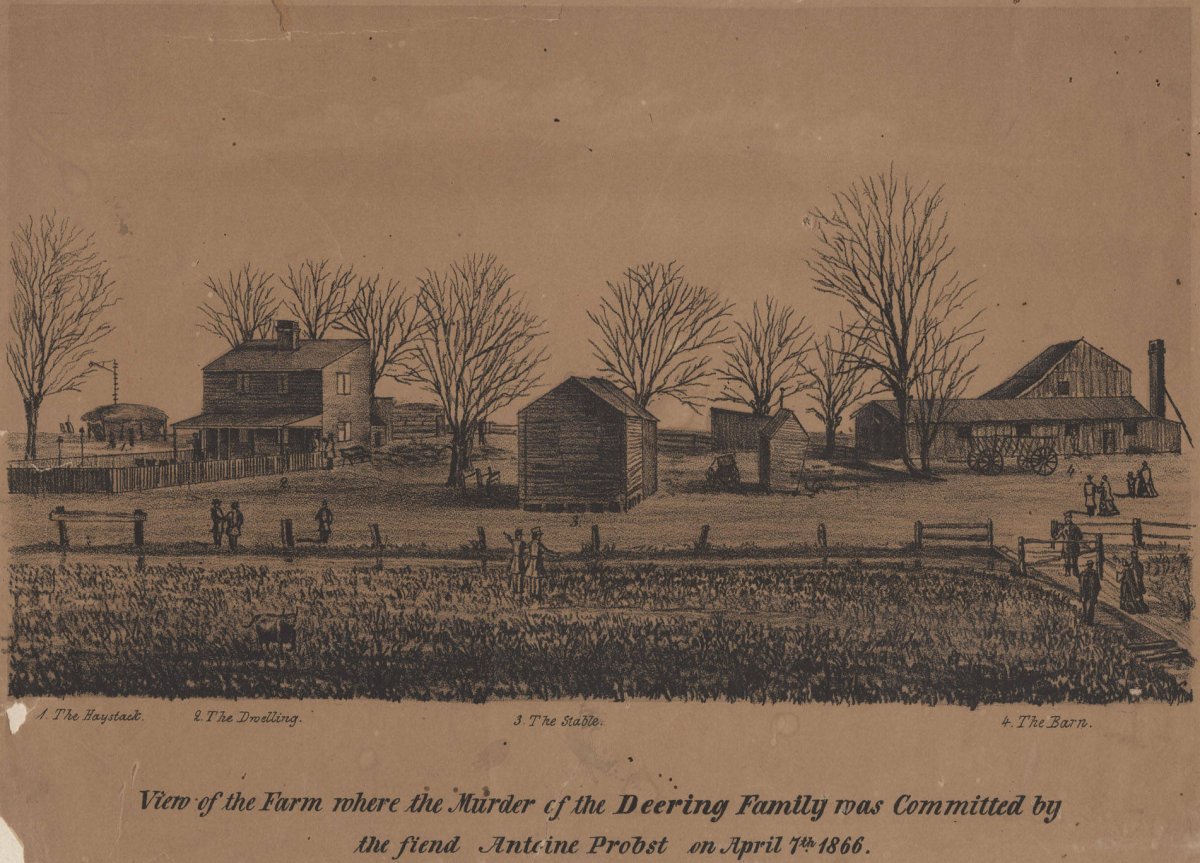
1866: Anton Probst, “I only wanted the money”

(Thanks to Meaghan Good of the Charley Project for the guest post. -ed.)

On this date in 1866, mass murderer Anton Probst (sometimes called “Antoine”) was hanged in Philadelphia, Pennsylvania. He made national headlines in its time, but today he is forgotten except among serious students of violent crime.

Probst was a native of Germany, the son of a carpenter. He later claimed he had a normal childhood and “never did anything wrong” until after he had left his home country.

He moved to the United States in 1863, in the middle of the Civil War, and became a professional “bounty jumper”: he would join up with a Union Army regiment, collect the $300 enlistment bonus, desert as soon as he could, then enlist with another regiment and start the cycle over again. He made a tidy living for himself this way until 1865, when he accidentally shot his thumb off and was discharged from the military for good.

Probst squandered his enlistment bounties on liquor and and rapidly fell into post-discharge penury. This was why, in the fall of 1865, he hired himself out as a farmhand to Christopher Deering, an Irish immigrant who lived in a rural part of Philadelphia with his wife and five children.

Deering offered Probst a salary of $15 a month plus room and board. Probst quit after only a few weeks, though, not being accustomed to honest labor.

He soon fell ill and, without a source of income, wound up in the workhouse. In dire straits, he returned to the Deering farm on February 2, 1866 and begged for his job back. And, although Probst’s behavior from before had given Christopher’s wife the creeps, the farmer took pity on him and re-hired old Thumbless.

Things went well for the next two months. But unbeknownst to his employer, Probst had thought of another way to get money.

Christopher’s nearest neighbor, Abraham Everett, lived a quarter of a mile away. Everett subscribed to several local weekly newspapers and, every weekend, Christopher would send his son to borrow the previous week’s editions.

One Saturday, the boy never showed up.

Nor did he arrive on Sunday.

Or for the next several days after.

By Wednesday, Everett was getting worried and decided to go to the Deering place and see if they were all right. He found the farm deserted and the horses inside the barn, nearly dead of thirst and starvation. After giving food and water to the distressed animals, he went and looked through the window into the Deering family’s house and saw it had been ransacked.

Seriously alarmed now, Everett forced the window open and climbed inside, and found every room in the house in a state of disarray. In the bedrooms, the beds had been torn and flipped upside down, dresser drawers had been rifled through and clothes were scattered everywhere. There was not a soul to be seen.

At this point, Abraham Everett went off to get help, summoning another neighbor and then the police. Inside the barn they found something Everett had missed while he was helping the horses: Christopher Deering’s body, partially covered in hay, alongside the body of a cousin visiting from New Jersey.

“His head,” crime historian Harold Schechter reports in his book Psycho USA: Famous American Killers You Never Heard Of, “was crushed to pieces, almost to powdered bone, and his throat was cut … from ear to ear.” Christopher’s cousin had similar injuries. A search of the barn turned up the bodies of Christopher’s wife, Julia, and four of the couple’s five children, stacked in the corncrib.

All of them had their throats cut and their skulls bashed in.

The only survivor in the family was the oldest child, ten-year-old William Deering, who had been staying with his grandparents at the time of the murders. And so the family line did not die out: according to this Philadelphia Inquirer article, William has 60 descendants.

The murder weapons were lying around bloodstained and in plain sight on the property: a hammer, a small hatchet and a full-sized ax. Hours later, the police found the last body hidden in a haystack a few hundred yards from the barn: seventeen-year-old Cornelius Carey, one of the Deerings’ farmhands.

The other farmhand was missing and, under the circumstances, had to be viewed as the prime suspect in this massacre. Nobody knew much about him, but the neighbors recalled that missing right thumb, spoke poor English with an accent, and was called something like “Anthony.”

Fortunately, he would not prove hard to find. “It might be supposed,” Harold Schechter says,

that a man who had methodically slaughtered eight people, including three prepubescent children and a fourteen-month-old infant, would lose no time in putting as much distance between himself and the crime scene as possible. For all his low cunning, however, Anton Probst was incapable of prudent calculation. Indeed, from all available evidence, he thought of nothing beyond the gratification of his immediate physical needs.

Hours after the murders, Probst was no further away than a house of ill repute on Front Street in Philadelphia, where he spent the night with a $3 prostitute. For the next few days he hung around his favorite bars drinking, making occasional excursions to pawn items he’d stolen from the Deering farm. He was in no hurry to leave.

Only the day after Probst’s grisly crimes were discovered, a police officer named James Dorsey spotted him strolling around near Market Street. Something about his bearing, and the way his hat was pulled low over his eyes, made the lawman suspicious. He walked up to him and noticed the stranger’s right thumb was missing.

Dorsey pulled Probst’s hat off to have a look at his face and said, “Good evening.” Probst mumbled a reply and Dorsey, noting the accent, said, “You’re a Dutchman?”

“No,” Probst answered. “Me a Frenchman.”

“You are, are you? Take a walk with me.” Dorsey grabbed the murderer’s arm and hauled him off to the nearest station house. There the police searched him and determined he was wearing Christopher Deering’s clothes, and carrying the farmer’s snuffbox and pistol. Probst had left Elizabeth Dolan’s carpetbag at a tavern earlier that day; it contained a number of small items, including cheap children’s toys, all of which were from the Deering farm.

The police had to transfer Probst from the Philadelphia City Jail to Moyamensing State Prison for his own safety, after a would-be lynch mob stormed the jail. Probst claimed he had only killed Cornelius Carey and tried to blame the other murders on an imaginary accomplice; at his trial (which began on April 25, less than three weeks after the murders) his lawyers argued that the case against him was strictly circumstantial and not proved beyond a reasonable doubt. But the trial’s outcome was clear from the beginning. The jury deliberated for only twenty minutes before convicting.

Death row agreed with Probst; he seemed at ease and actually gained twelve pounds in the five weeks between his trial and execution. On the morning of May 7, exactly one month after the murders, he finally confessed that his accomplice didn’t exist and he’d acted alone. He was “quiet, undemonstrative, cool and unembarrassed” as he told his story, “without the least trace of shame or remorse.”

You can read it all here in his very own words, or below, in mine. At first his intention had just been to rob the family of everything they had, then flee. But he found himself unable to accomplish this because there were always too many people around.

About a week before the murders, it occurred to Probst that perhaps murder might be necessary to facilitate the robbery. At first he thought he could just kill Christopher Deering, but as he mulled the matter over he decided the rest of the household would have to die as well.

First to go was Cornelius Carey as they were working together in the field. Then Probst went into the barn and lured the others in one by one, killing them as they each came inside: eight-year-old John Deering, then the mother, Julia, then the rest of the children: six-year-old Thomas, then four-year-old Annie, and finally the baby, Emma. Probst estimated that it all took about half an hour.

Christopher Deering was off picking up that visiting cousin from the ferry, and they didn’t arrive back at the farm until the afternoon. Probst was waiting for them. While the guest Elizabeth Dolan went into the house, Probst told Christopher one of the animals was sick and he had to go inside the barn. There he killed him like the others, then called Miss Dolan to the stable. She was the last one to die.

If we are to believe the killer’s account, the victims all died quickly and quietly, and did not suffer. None of them, he said, so much as cried out after the first blow.

Once finished, Probst tore the house upside down looking for things to steal, washed, shaved, changed out of his bloody clothes and put on some of Christopher’s, and had himself a snack of bread and butter. At sunset he headed off to town.

Schechter records:

When asked by Chief Franklin why on earth he had perpetrated such an atrocity, Probst gave a little shrug. “I only wanted the money,” he said. “I killed the boy Cornelius first so that he could not tell on me. I killed the two oldest children so they would not afterwards identify me. I killed the two youngest as I did not wish to leave them in the house alone without someone to care for them. I had no ill feeling to anyone in the family. They always treated me well.”

Probst submitted meekly to his execution, which went off without a hitch. The public understandably rejoiced at his death and the New York Times, in its report of how Probst “shuffled off his mortal and disreputable coil,” called him “the greatest criminal of the nineteenth century.”

Probst was permitted to write to his family in Germany. He told them of “the terrible fate which has befallen me,” admitted to the eight slayings, and blamed his bad behavior on his experiences in the Union Army, where he “heard nothing but cursing and swearing, and soon became a sharer in every wickedness.”

Whatever, Anton.

After his death, Probst’s body was handed over to the physicians at Jefferson Medical College, who subjected it to a series of bizarre experiments with electricity. When they finished with their fun they performed an autopsy. Probst’s brain turned out to be unusually small, almost a full pound lighter than average. What, if anything, this has to do with his apparent psychopathy is anyone’s guess. His head and arm were later displayed in the Jefferson Medical College museum.

On this day..

1921: William Mitchell, Black and Tan

On this date in 1921, Great Britain hanged one of its own paramilitaries in Ireland. William Mitchell was, in fact, the only member of the reviled Black and Tans executed during the Irish War of Independence.*

This long-obscure case has been brought back to light by author D.J. Kelly, whose just-published Running With Crows: The Life and Death of a Black and Tan is a fact-based novel about William Mitchell’s execution.

Was Mitchell hanged for political expediency? Did he even commit the murder for which he stood condemned?

Kelly was kind enough to talk with Executed Today about exhuming a dead soul.

ET: What led you to take an interest in this hanging?

DJK: A third cousin of mine, who shares my interest in family history research, asked me to help her verify her late father’s claim that they were related to a Black and Tan who had been hanged for murder.

I knew that the ‘Tans’ were temporary policemen recruited in England from ex-combatants of The Great War and sent to Ireland to bolster the ranks of the beleaguered Royal Irish Constabulary during the Irish War of Independence. It took me no time at all to discovered that only one Black and Tan — indeed only one member of the entire British Crown Forces — had been executed during that conflict, and that indeed he shared a surname with my cousin.

However, I could find only the briefest of mentions of him in any accounts of that bitter struggle for Ireland’s freedom. It took me and my cousin two years to track down the elusive official case papers, to establish exactly who Mitchell was, and to tell his hitherto untold story. To date however, we still have not established a firm link with my cousin’s family.

The Black and Tans are of course still notorious in Ireland and elsewhere. In this book you’re complicating their story quite a bit, making at least this one Tan a sympathetic character. What sort of audience reception has Running with Crows had? Do you find there’s a lot of resistance to the story you have to tell? For that matter, did you have any misgivings to overcome in writing it?

You are right about their notoriety. The ‘Tans’ were bored, drunk and indisciplined during the short period of their service in Ireland. They were also poorly managed and allowed to run amok, robbing and assaulting the Irish population. There is no evidence however to support the popular myth that they included a greater number of criminals than has any police force before or since. They were disillusioned and battle-hardened men who were unable to find employment back in the ‘land fit for heroes’.

Book CoverIronically, one lone reviewer of my book has accused me of not making Mitchell sympathetic enough. It was not my intention though to create sympathy for this flawed and tragic man or to turn him into a folk hero. However, whilst I do not think he was the most honourable of men, I am not persuaded he deserved to hang.

I was indeed wary of uncovering this controversial case, especially as folks in Ireland, my own relatives included, are still sensitive and emotional about the events of the 1920s. The accepted view is that the old IRA were the heroes and the ‘Tans’ were the baddies. Few people realise however that at least a quarter of the Black and Tans were Irishmen, as indeed was Mitchell. However, I am delighted to have received highly positive reviews, from ‘both sides of the divide’, that is from an IRA re-enactment group as well as from supporters and historians of the Royal Irish Constabulary. Moreover, a theatrical production company, based in the town where the murder took place, and where people still remember and sympathise with the murdered magistrate’s family, has adapted my book to a stage play, which will debut there on 15 June at the Dunlavin Arts Festival. They have also kindly invited me to hold an author talk at the festival on the 16th June.

William Mitchell was hanged for killing a magistrate named Robert Dixon. Who was Robert Dixon and why was he a target during the war?

Robert Gilbert Dixon was an Anglo-Irish gentleman; a gentleman farmer who acted as an auctioneer at the local livestock auctions and who served as a district magistrate on the local circuit. He and his wife were descended from noble and philanthropic English forebears, and indeed Robert Dixon was respected in his community for his generosity shown both to his neighbours and to the police.

During the conflict though, both magistrates and police were viewed by the Nationalists as instruments of the occupying power (the British) and as such were prime targets for assassination by the IRA. Dixon’s murder was not a political killing however. He was shot dead, and his war hero son seriously wounded, during the course of a robbery at his home.

This post-war era saw the erosion of the class system and marked the beginning of the end for ‘the old order’. Socialism was gaining popularity and the working classes were shrugging off the idea that they should ‘know their place’. The awful loss of life, mainly through mis-management of the war, meant that many had lost respect for, and indeed were resentful of, the privileged classes. A truce was now imminent in Ireland and so the ‘Tans’, who were being paid per day what the regular Irish constables earned in a week, saw their lucrative employment coming to an end, and meanwhile, in Dunlavin, the Dixon family were conspicuously wealthy …

Coming at last to the main character here, who was William Mitchell? Why was he serving in the Black and Tans, and why did he end up at the end of a noose?

Contrary to what some commentators on the conflict have written, Mitchell was not English but Irish. He was a Dublin-born former professional soldier, who had served King and Empire, both in India and in the trenches of the Western Front. He was the son of Joseph Mitchell, a London-born soldier; a respectable man who had fought in the Boer War and who had married a Dublin Protestant girl.

Another myth, that of the privileged position of those in the ‘Protestant ascendancy’ in Ireland, is dispelled by William Mitchell’s impoverished upbringing in Dublin’s Monto district, which was not only Ireland’s, but indeed Europe’s, biggest slum and red-light district. William Mitchell was a man who did not respect authority — some might say, with good reason. When two masked intruders forced their way into the Dixon household and killed the magistrate during a bungled robbery, and when one of the ‘Tans’ shot himself dead at the local barracks the following day, it was believed the dead ‘Tan’ was the shooter, and so Mitchell was then arrested as his accomplice.

This hanging occurred just as London was determining to wind things down in Ireland; later that June, Prime Minister Lloyd George proposed peace talks. As a political sop, how important domestically within Ireland was William Mitchell’s execution in June 1921? Did it even register? Had he been spared, would that have affected at all the progress towards a truce?

Ah, you have put your finger on the nub of the issue.

As ill-disciplined and unruly as the temporary constables were, there was another arm of the Black and Tans which was far more undisciplined. The Auxiliaries were demobilised officers who had been engaged ostensibly to act as an officer cadre for the temporary constables but who had instead formed themselves into hit squads and set about abducting, torturing and killing suspects without due process of law. It was the Auxiliaries who were identified with some of the worst atrocities of the conflict, including the destruction of whole villages and towns and even of the murder of the mayor of Cork.

Several Auxiliaries had been tried for murder but acquitted, usually because crucial prosecution witnesses had ‘disappeared’. One indicted auxiliary, who was a decorated war hero, but most likely also a psychopath, and was head of the self-designated ‘murder squad’ based in Dublin Castle, was facing his second murder trial. By April 1921, the world’s press were united in condemning the British administration in Ireland for letting loose this uncontrolled ‘pseudo gendarmerie’ upon the Irish population. The number of Republicans who would be executed would run to two dozen, yet thus far, no member of the British Crown Forces had been convicted for any atrocity.

The Americans and the heads of the Commonwealth nations were demanding fair play. The British public were revolted by the way the conflict was being managed and now no less a personage than King George V stepped into the arena and demanded that Lloyd George‘s government show even handedness in the way it dealt with both rebel and law enforcer. Another acquittal was fully expected in the trial of the twice-tried Auxiliary, who had carried out his grisly and murderous duty on behalf of his government, but then along came the hapless Constable Mitchell, a ‘difficult’ Irishman who had allegedly killed, not an Irish rebel, but a magistrate; an Englishman and a representative of the establishment.

The outcome in the April trial of the Auxiliary, whose defence costs (equating in today’s values to £17,600) were met from the personal funds of Hamar Greenwood, Chief Secretary for Ireland, was an acquittal, as expected.

Mitchell’s swift trial a couple of days later, by court martial (so no right of appeal) attracted little publicity. He went stoically to the scaffold, leaving behind him a 23-year-old widow and a seven-week-old baby daughter.

Political events moved fairly swiftly thereafter, so it is hard to judge whether his execution had much effect on the progress of Ireland’s achieving independence. The focus of public attention was taken up next with the internal struggles leading up to the Civil War. It seems Mitchell’s execution had little effect in the grand scheme of things.

So, did Mitchell kill the magistrate? Was he even present at the crime scene or was he a sacrificial lamb, slaughtered to offset criticism of Lloyd George’s administration in Ireland? I have presented all there is to know of this man’s life and death, as found in his military and police records, trial transcripts etcetera, and whether or not he killed the magistrate for whose murder he was hanged, or whether this was an awful miscarriage of justice, I leave for the reader to judge.

What happened to Mitchell’s family afterwards? And all these years later, what do the descendants think about their ancestor’s execution, and about the work you did with it?

I felt I could not let Mitchell’s story end with his execution. Since this is a novel closely based on a true and tragic story, I felt the reader would want to know what happened next. I know I certainly did, so I continued my research, and my narrative, to recount what had happened to many of the players in the story, and this may be found in the book’s epilogue.

Mitchell’s baby daughter lived into her nineties, always believing her father had died a hero in the course of his police service. Her respectable and courageous widowed mother did not want her little girl to grow up with any sort of stigma. Other family members knew of Mitchell’s fate however. When I tracked down his living descendants, I was cautious of the sensitivities surrounding my exposing Mitchell’s history. However, the family were keen for the full story to come out, and moreover they provided me with photographs of Mitchell, for which I am most grateful, as they enabled me to put a face to a man who hitherto had been simply a statistic.

This is not the end of the Mitchell story, however. His mortal remains (which are amongst the few still buried within the precincts of Dublin’s Mountjoy Gaol) will one day be exhumed when planned re-development of the gaol is commenced. When that day comes, my cousin and I will press for his re-interment in a local cemetery. Mitchell may not warrant the hero’s funeral accorded the Republicans who have all be disinterred from Mountjoy, but I believe he deserves at least a Christian burial.

* Still also known as the “Black and Tan War”.

On this day..

1573: Meister Frantz Schmidt’s first execution

On this date in 1573, 19-year-old Frantz Schmidt — heretofore only an apprentice to his father’s craft — conducted his first solo hanging. As the body of the thief hung there, his father or perhaps another established Scharfrichter stepped forward and ritually slapped the teenage hangman three times, announcing his successful passage into the ranks of Germany’s master executioners.

“Leinhardt Russ of Zeyern, a thief. Executed with the rope at the city of Steinach. Was my first execution.” Those words begin Meister Frantz’s remarkable diary* of 361 hangings, beheadings, breakings-on-the-wheel, drownings, and burnings — as well as many other sub-capital punishments, primarily as the executioner of Nuremberg from 1578 to 1617.

Nuremberg executioner Frantz Schmidt at work in 1584.

Executioners occupied a strange outcast social niche, with charge not only of death sentences but of other dishonorable public tasks. Either as cause or consequence of this, the profession carried its own stigma for underworld less-than-respectable behavior; it was not unheard-of for a shady executioner to wind up climbing the scaffold as patient rather than hangman.

But in his 45-year career, the sober Meister Frantz operated with ahead-of-his-time dignity and sobriety, so much so that Schmidt was granted citizenship in Nuremberg and eventually had his civic honor officially restored. He freed himself and his heirs from the social pollution inherent to his life’s work.

Joel Harrington of Vanderbilt has authored a new book titled The Faithful Executioner: Life and Death, Honor and Shame in the Turbulent Sixteenth Century, a fascinating account not only of Frantz Schmidt’s life but the world he inhabited. Dr. Harrington was good enough to chat with Executed Today.**


Book CoverET: Your book is built around a sort of life’s mission by Frantz Schmidt to return himself and his family to respectable-ness. Certainly he accomplished this marvelously in the end, but I’m curious how firm do you feel is the inference that this was his specific intent from the start?

JH: I have no doubts that as a child, Frantz Schmidt was repeatedly told the tale of his family’s fall from grace, especially since he can still remember so many details even as an old man. We also know from his own words in his appeal to the emperor to restore that lost honor that his grandfather, father, and his own children all felt the sting of this stigma. Finally, the late-in-life struggles to assert that regain honor — against the challenges of his bitter successor — further underscore the centrality of this mission in Frantz Schmidt’s life.

Executioners often had a family trade at this point, but the Schmidts — specifically the father, Heinrich Schmidt — had a bizarre path into this business via the German nobility’s old prerogatives. Could you explicate the “ancient custom” that allowed Albrecht Alcibiades to force Frantz’s father Heinrich, who was not an executioner, to become one? And for that matter, the social customs that then led Heinrich’s neighbors in Hof to treat him as a dishonored untouchable after he was forced to carry out these three executions — rather than viewing him, as we might today, as himself a victim who ought to be helped to get back to his real life?

Most European laws in the early sixteenth century were customary and highly localized. Legal codification throughout jurisdictions was just getting underway. This meant that two villages only a few miles apart might have very different traditions regarding something like execution. In the larger cities, such as Nuremberg, and well organized territorial states, such as the prince-bishopric of Bamberg, standing executioners on salary were the norm. But in many of the hundreds of tiny German states during this period, execution by the victim’s oldest male relative or by another local male was still practiced.

In the case of Hof, the margrave intentionally invoked an ancient and outdated tradition because he was in a hurry to get the job done. The stigma around the job of executioner in general was, by contrast, nearly universal. There seems to have been a little less hostility in southern German states but nobody would have openly socialized with an executioner or his family. As I describe in the book, the severity of this stigma — like all social prejudices — would depend on the individual or occasion in question. So, while some people clearly had sympathy for Meister Frantz, there were still stark boundaries of propriety as to how they might express that sympathy.

Executioners had charge of a variety of disreputable tasks and spheres of civil live: refuse, prostitutes, lepers, torture, and so forth. I’m struck by the importance of Schmidt’s Nuremberg assistant, “the Lion”, in allowing the faithful executioner to (somewhat) separate some of the most visibly dishonorable tasks from Schmdit’s direct purview. Just as a realistic matter, could Frantz Schmidt have reached respectability had he himself had to handle everything personally?

You’re right, the Lion played a key role in this respect. The broader evolution of the job was also significant, from a kind of catch-all for various unpleasant tasks to a civic professional focused on interrogation and punishment. You can also see this in the clothing that executioners start to wear in the sixteenth and seventeenth centuries, usually either colorful bourgeois outfits or military garb.

Frantz Schmidt’s later entries have a great deal of detail, and you use that to tease out the executioner’s psychology, and the way he thinks about crime, sin, choice, and misfortune in his mature adulthood. It’s quite intriguing. Why, however, did Schmidt begin his journal in the first place? Is there something his shorter, earlier entries tell us about the younger man and the evolution of his views of the “poor sinners” he handled?

After a long time — and especially after I found the oldest version of the journal — I figured out that he started the journal upon his 1578 appointment in Nuremberg. This means that he reconstructed the executions of the previous five years from memory (and without dates).

Why then? The timing strongly suggested to me that he was already thinking about using the journal as a supporting document in his eventual appeal to have his honor restored.

As for changes over time, the most obvious ones are that his passages become much longer, more detailed, and more concerned with motivations and explanations than the earlier, bare-bones accounts. The main evolution in his thinking about poor sinners shows both harsher judgments of those who squandered countless chances to reform and greater pity for those who simply make a bad decision in the heat of the moment.

You have a fascinating chapter devoted to Schmidt’s sidelight as a healer, and to the important ways this practice intersected with executioners’ expertise in [harming] the body. I was amazed that Frantz Schmidt himself also took part in the era’s dissection trend. If one were a regular Nuremberger at this time, would one have any compunctions about a medical consultation with the executioner, a man one might otherwise shun? If a non-executioner physician were available too, would there be any intrinsic preference for the physician as a more respectable figure?

Yes, it’s quite a paradox. You would think that most people would be squeamish or embarrassed about consulting an executioner on medical matters, but by his own estimate Frantz Schmidt saw 15,000 patients over the course of 45 years — fifty times the number of individuals he executed. So he must have been doing something right.

This journal was (re-)discovered at an interesting point, at the beginning of the 19th century when public executions are ending but romantic German nationalism is beginning. How has “Frantz Schmidt” the present-day cultural figure been used and misused by we moderns? What’s the most important misapprehension that reading his diary ought to dispel for us?

This is really the focus of my epilogue, which discusses how “medieval” executioners have been used for the purposes of “enlightened” penal reform, nineteenth-century gothic fantasies, and in modern tourism to elicit disgust, amusement, or even the glorification of pain and suffering. My chief goal in writing the book was to get closer to understanding one such man in his own terms and in the context of his own society. To the degree that the book succeeds, parts of his world will look bizarre and alien, while other aspects (especially how people treat each other) will be strikingly familiar.

* Print-on-demand editions of Schmidt’s original diary are on the market. Although these derive from what I believe to be public domain translations, I have not been able to locate a free English copy online; German speakers can read it here.

** Also recommended: this podcast interview with Dr. Harrington.

On this day..

1936: Arnold Sodeman, Schoolgirl Strangler

(Thanks to Meaghan Good of the Charley Project for the guest post. -ed.)

On this date in 1936, Australia’s Arnold Karl Sodeman was hanged at Pentridge Prison in Coburg, Victoria.

The “Schoolgirl Strangler” used the same modus operandi on all of his four victims: strangled, gagged with their own clothing, the arms and legs tied after death, and their bodies dumped with little effort at concealment.

Born in 1899, Sodeman was raised in an unhappy home with a violently abusive father. He ran away at the first chance he got.

He went on to get in trouble with the law, for theft-related offenses and prison escape, and the authorities deemed him an “incorrigible rogue” — which was less charming than it sounds.

By his late twenties, Sodeman seemed to have settled down. He worked various laboring jobs, married in 1926 and had a daughter two years later. When sober he was a mild enough man, but under the influence of drink — which was often — he changed into a different person altogether.

However, his marriage was loving and happy, and he adored his little girl and his dog. Whatever else Sodeman might have done, he never mistreated his family.

His law-abiding life, however, didn’t last.

His first victim was twelve-year-old Mena Alexandra Griffiths, whom Sodeman kidnapped, raped and strangled on November 9, 1930. Her body wasn’t found for two days. She was the only victim who was sexually assaulted.

A month later the police arrested a suspect, a truck driver named Robert McMahon. Mena’s younger sister identified him, and he was committed for trial. Ultimately, after two and a half months in custody, he was released for lack of evidence.

But on January 10, 1931, while McMahon was still in jail, Sodeman struck again, abducting and strangling Hazel Wilson, a sixteen-year-old who suffered from tuberculosis. Hazel was last seen standing near her home, smoking a cigarette and horsing around with an unidentified young man. Her body turned up in a nearby vacant lot the next day.

The police put out appeals for the young man to come forward and “assist with their inquiries,” and even offered a reward for information leading to his identification, but their efforts came to nothing.

Hazel’s father, who reportedly had a violent temper, was looked at as a possible suspect in his daughter’s death, but he was cleared.

Although the police recognized the similarities in the Griffiths and Wilson crimes and realized it was probably the same perp in both cases, they had nothing concrete to go on. Both homicide investigations stagnated.

On January 1, 1935, after a four-year dry spell, Sodeman abducted Ethel Belshaw while she was out buying ice cream, and strangled her. She was twelve. He was her next-door neighbor and sometimes had tea with her family.

Sodeman was actually questioned by the police and admitted he had spoken to Ethel on the day she disappeared, but he said he’d left her alive, and nobody pressed him about it.

Instead, investigators focused on a teenage boy who had given contradictory statements about his movements on the day of the murder. He was arrested and charged with killing Ethel, but there was no evidence against him and the case was dismissed after a couple of days.

Left to right: Mena Griffiths, Ethel Belshaw, and June Rushmer. (Not pictured: Hazel Wilson.)

Exactly eleven months later, on December 1, he killed his last and youngest victim, six-year-old June Rushmer.

This victim he also knew slightly: she was a co-worker’s daughter, and Sodeman took it in his mind to kill her after she asked him for a ride on his bicycle.

(The Belshaws and the Rushmers couldn’t afford tombstones for their daughters. It wasn’t until more than seventy-five years later that the Australian Funeral Directors Association donated bronze plaques to mark their graves.)

It should be noted that Sodeman was drunk at the time of all four murders. “When in this state,” he reflected later, “thoughts would go through my mind concerning men, women and children whom I disliked … I would feel the desire to even it up, not caring what happened to them, but I would shake it off. As soon as the liquor wore off I could reason properly and would wipe it all off.”

At the time of the Rushmer homicide, Sodeman was part of a laboring crew repairing roadways.

Shortly after June’s murder, one of his coworkers joked that he’d seen Sodeman near the crime scene. Sodeman became so angry and defensive that the others got suspicious and went to the police. The cops hauled him away from his work site for questioning.

This time the police had finally got the right man. After twelve hours of interrogation, Sodeman confessed to everything in great detail, describing how he would link his thumbs together to get a better grip on the throats of his victims. He correctly identified the exact type of candy he’d used to lure the girls. He also admitted to the attempted murders of two other children.

At trial, Sodeman’s attorney had little choice but to go with an insanity defense. Sodeman certainly had the genetic background for it:

  • His great-grandfather died of “inflammation of the brain.”
  • His grandfather died in a mental hospital.
  • So did his father.
  • Annnnnd his mother suffered from serious short-term memory loss.

Sodeman himself had bouts of depression throughout his life, and he sustained a serious brain injury years before the murders started when he fell off a horse.

According to author Ivan Chapman, at Sodeman’s trial,

Three doctors — two of them Government medical officers — examined Sodeman and gave their individual opinions. One thought he had a brain disorder that flared when he drank alcohol; another decided he was neither conscious of, nor understood, what he was doing; the third believed Sodeman was not responsible for what he did. All three doctors backed down, however, when Sodeman’s confession was produced in court. They agreed that if it accurately described the facts of the crime, then Sodeman must have appreciated the nature and quality of his acts; none of them was prepared to declare him certifiably insane.

The verdict was, inevitably, sane and guilty as charged.

Although he did appeal his conviction, that went nowhere and Sodeman himself seems to have welcomed death. He said he felt it was necessary for him to die, because if he lived he believed he would kill again.

Sodeman spent the last afternoon of his life playing draughts with another condemned man, then slept soundly during the night. On the scaffold the next morning, when asked if he had anything to say for himself, Sodeman replied simply, “No, sir.” He died without any fuss.

His widow reverted to her maiden name after his death, hoping to escape the notoriety, and raised their daughter alone. She never remarried, and died in the 1980s.

The autopsy did uncover something interesting: it turned out Sodeman had suffered from leptomeningitis, a degenerative disease of the brain. When a person with this condition abuses alcohol, their brain can become seriously inflamed, which can cause irrational behavior among other symptoms.

Needless to say, the finding casts serious doubts on Sodeman’s ability to control his actions at the time of the murders. In fact, according to one criminal psychologist, Sodeman wouldn’t have even been found fit to stand trial if his crimes had occurred today.

But it was too late to do anything about it.

On this day..

1793: Ezra Mead, “in one of these fits of insanity”

The July 13, 1793 Wyndham (Conn.) Herald quotes the last dying words of Ezra Mead, hanged May 31 at Poughkeepsie, N.Y.

I, Ezra Mead, aged forty years, was born at Stamford in the State of Connecticut, of honest and credible parents, with whom I lived until I was about ten years of age; when I was bound as an apprentice to learn the Cooper’s trade. After having served the time of my apprenticeship, I went to Fish Kill and married my wife Catherine Rogers; since which time I have been in several parts of the World working at my trade, in order to get something in an honest way by my industry for the support of my wife and children, who resided in the town of Fish Kill. Having returned to my family, I resided with them, but being afflicted by a certain neighbor of mine, in words and actions, was driven by turns to drinking to excess; and in one of these fits of insanity, I committed the crime for which I suffer. But I declare to the world, that I was not willfully guilty of the crime aforesaid; at that present moment I might have suspected he had injured me, but not being master of my reason, have been guilty of what I never intended to have done, as appeared in the course of my trial. And I do further declare that I never have been guilty of any other crime deserving such punishment, as has been represented or reported by many evil minded persons since my imprisonment. And that I forgive all mankind, and hope the Lord and they will forgive me, and that they will take warning by my untimely end. Farewell. Ezra Mead.

On this day..

1868: Joseph Brown, for arson, murder, and money

On this date in 1868, Joseph Brown hanged in Hudson, N.Y..

He and his wife Josephine had recently moved to the hamlet of Canaan just this side of the Massachusetts border. With them was a twelve-year-old daughter.

On the night of December 5, 1867, they left little Angie in their basement rental and called on neighbors for the evening — and the house went up in flames. Neighbors rushing to the emergency had to force their way through the doors to extinguish the blaze, and discovered the Angie’s scorched remains amid several bushels of suspiciously flammable rubbish. Some neighbors thought the Browns had not hurried to the scene as they ought, and found their expressions of grief unconvincing.

These dubious circumstances could hardly help but lift an eyebrow, but in the end there was little for it and a coroner ruled the death accidental, perhaps caused by the unattended child attempting to fill a lighted kerosene lamp.

However, the fate of “poor little Angie” took on a decidedly more sinister cast when the Browns turned around and filed for a $5,000 life insurance benefit on Angie’s bones — a short-term, three-month policy due to expire in two weeks. A suspiciously dead child was one thing, but now there was money at stake. Travelers Insurance — the present-day corporate conglomerate then in its infancy, carving out its titular niche with innovative policies insuring against once-dangerous rail travel — put some real investigative muscle into the situation before it paid up.

The facts as developed by Travelers made a damning circumstantial case against the couple that was soon taken over by the criminal authorities: “a reflected glow of guilt,” in the summing-up of the state’s attorney who prosecuted Joseph.

Angie turned out not to be the couple’s own child at all, but a loaner from a woman in their hometown of Dayton, Ohio. She had given permission for her daughter to accompany the couple on a trip to Connecticut. (A weird arrangement in which the child was to call them “mother” and “father”, but one made innocently by the victim’s natural mother so far as anyone could determine.)

En route, Joe and Jo insured the life of this child who was not their own. And by the time they got to Canaan, Joseph had indiscreetly negotiated to purchase some property, intimating an ability in no way justified by his pre-fire resources to pay several thousand dollars cash on the nail.

To cinch Joseph’s conviction, physicians hired by Travelers testified that Angie had not inhaled smoke … meaning that she was dead before the fire started at all.

“I have told the insurance company that I would give them the policy if they would let me go,” a desperate Joseph at one point said in a police interview. He should have thought of that sooner.

But he was, as he said on the scaffold, “not an accomplished man” and he could only complain confusedly about minor points of the trial he considered prejudicial while maintaining a general insistence upon his innocence that persuaded nobody.

At the time of this hanging, Josephine Brown still lay in the Columbia County jail awaiting her turn at the bar in the same affair. But despite the sense among many participants in the case that it was she who instigated her cloddish husband to the lucrative homicide, the prosecution couldn’t assemble a satisfactory case and dropped charges later that year.

On this day..

1818: Abraham Casler, marital woes

On this date in 1818, Abraham Casler was hanged in Schoharie, N.Y. for escaping an ill-advised marriage by means of an illicit powder.

Casler had got young Catherine (Caty) Sprecker pregnant and was only induced to change her name in 1812 by threat of prosecution. Even at the wedding he told the bride’s own brother that he didn’t intend to live with the poor girl.

Casler immediately regretted committing himself to wedlock in any form whatsoever (his alternative would have been to pay a fine, much the bargain as compared to an unpromising marriage — particularly so in those benighted days before no-fault divorce). So he promptly enlisted in the army then fighting the War of 1812 so as “not to live with his wife that he wished … was out of the land of the living,” as he said to another recruit.

Well.

If wishes were fishes, they’d have arsenic inside. (n.b.: they do!)

When he finally had to return, Casler preferred to spend his time paying court to a widowed Albany innkeeper, and generally had a manifestly unhappy time of it with Caty. The latter’s epileptic fits probably only exacerbated the unwilling husband’s ire.

At last, while traveling, Caty Casler took ill with “a burning heat at her stomach & breast … cold chills by spells accompanied with sweat.” She “said her whole body was in pain; she was alernately [sic] cold and hot; would throw off the bed clothes, and then cover herself again.” After a couple of miserable bedridden days, all the while being personally treated by an attentive Abraham Casler who also shooed away attempts by other guests to assist or to summon medical aid,* Caty Casler succumbed, and “looked blue round the mouth and eyes” and “her hair came out.”

Doctors who conducted the post-mortem found what they were certain was arsenic and opium in Caty’s stomach. The trial record features a number of these medical men describing the exact tests they used to establish the presence of this deadly mineral; for instance, a Dr. James W. Miller described finding “particles … of a vitrious appearance” in the stomach.

Some of those particles were placed on a heated iron; a dense white fume arose from their combustion. Some of them were likewise placed between two plates of polished copper prepared for the purpose; those coppers were bound by an iron wire and placed into the fire until they were brought to red heat; they were then removed and after they were cold they were separated, the interior of the plates were whitened towards the edges of the plate in the form of a circle.

Last, taking two teaspoons of stomach fluid containing these suspicious particles,

He diluted it with a pint of water, then took the nitrate of silver and dissolved it and put into a separate glass; took pure ammonia into another glass; then took two glass rods, wet the end of one of them in the solution of the nitrate of silver, and dipped the end of the other in the pure ammonia, then brought the two ends of the rods in contact on the surface of the water in the vessel containing the contents of the stomach, and passed them down into the fluid; there was a precipitate from the point of contact, that precipitate was of an orange colour. He repeated that experiment several times, and also with arsenic dissolved in water. The results of the experiment were similar; the same precipitate in the one as in the other, tho’ it was more distinct in the solution made of arsenic, that being coulourless.

There was, in Dr. Miller’s opinion, “arsenic in the stomach; [he] has no doubt of it; considers the test made by him infallible; does not know that any thing except arsenic, will produce the same effect on copper, as was produced by those particles in the experiment.”

The court record merely summarizes the testimony witness by witness rather than providing a literal transcription, but one gets a sense of the thing merely leafing through it: it has 16 pages of prosecution testimony, from Casler’s Albany crush and family members catching him in suspicious circumstances, plus six different physicians, one of whom was a Professor of Chemistry at Fairfield Medical Academy.

The defense has one-half of one page, consisting of a flat denial by Casler and the observations of one former boarder with nothing useful to say.

The jury took two hours to convict.

After Casler hanged at the eponymous seat of Schoharie County (admitting his guilt on the scaffold), the gallows were left standing “as a solemn admonition of the penalty such crimes demand.”

That admonition had to be repeated: less than a year later, the crossbeam that had once supported Casler’s dying throes was tested again to dispatch a farmer from Sharon Springs who had bludgeoned a deputy sheriff to death.

* “It would only make a bill of expense,” Casler said of the prospect of summoning a physician for his wife. This was also the same disquieting answer he gave when asked if he would be taking the body to bury with her family; instead, he unsentimentally buried it at the nearest available spot, where it was soon exhumed by suspicious locals. The guy hung himself with skinflintedness.

On this day..