1683: James Smith and John Wharry, Covenanter bystanders

Inscription on a marker on the road from Kirkintilloch to Kilsyth* in Scotland:

In this field lies the corpse of John Wharry and James Smith, who suffered in Glasgow, 13 June 1683, for their adherence to the Word of God, and Scotland’s Covenanted Work of Reformation: ‘And they overcame them by the blood of the Lamb, and by the word of their testimony; and they loved not their lives unto the death'” (Rev. xii. 11)

Halt, courteous passenger, and look on
Our bodies dead, & lying under this stone.
Altho’ we did commit no deed,** nor fact
That was against the Bridegroom’s contract,
Yet we to Glasgow were as prisoners brought,
And against us false witness they sought.
Their sentence cruel and unjust they past,
And then our corps on scaffold they did cast.
There we our lives and right hands also lost.
From Glasgow we were brought unto this place
In chains of iron hung up for certain space.
Then taken down interred here we ly–
From ‘neath this stone our blood to heaven doth cry.
Had foreign foes, Turks, or Mahometans,
Had Scythians, Tartars, Arabian Caravans,
Had cruel Spaniards, the Pope’s blood seed,
Commenced the same, less strange had been the deed;
But Protestants, profest our Covenants to,
Our countrymen, this bloody deed could do.
Yet notwithstanding of their hellish rage
The noble Wharry stepping on the stage
With courage bold and with a heart not faint,
Exclaims, This blood now seals our covenant–
Ending, They who would follow Christ should take
Their cross upon their back, the world forsake.


Image (c) Maria ‘Mia’ Gaellman | http://www.mariaphoto.co.uk/

The epitaph above is from this Victorian text, which further observes:

The probability is, that what is called on the new stone “the old tombstone” is not much older than this [the 19th] century, and that it is the successor of an older one on which may have been inscribed the following epitaph:

Halt, passenger, read here upon this stone
A tragedy, our bodies done upon.
At Glasgow Cross we lost both our right hands,
To fright beholders, th’ enemy so commands;
Then put to death, and that most cruelly.
Yet where we’re slain, even there we must not lie,
From Glasgow town we’re brought unto this place,
On Gallow tree hung up for certain space.
Yet thence ta’en down, interred here we lie
Beneath this stone; our blood to heaven doth cry.
Had foreign foes, Turks or Mahometans,
Had Scythian Tartars, Arabian caravans,
Had cruel Spaniards, the Pope’s bloody seed,
Commenc’d the same, had been less strange their deed.
But Protestants, once Covenanters too,
Our countrymen, this cruel deed could do:
Yet, notwithstanding this, their hellish rage,
The noble Wharrie leapt upon the stage.
With courage bold, he said, and heart not faint,
‘This blood shall now seal up our covenant,’
Ending, ‘they who would follow Christ, should take
‘Their cross upon their back, the world forsake.'”

* Kilsyth lays claim to be the birthplace of curling.

** Smith and Wharrie, apparently uninvolved civilians, were seized as the nearest available guys to punish after a Covenanter guerrilla attack near Inchbelly Bridge.

On this day..

1981: Botak Chin, gangster

(Thanks to Sarah Chan for the guest post, originally published last year as part of a longer article in Klue, 5 Most Infamous Pudu Jail Inmates. -ed.)

Botak Chin, real name Wong Swee Chin, was one of Malaysia’s most wanted criminals.

His first taste of the underworld was when he joined Gang 306, participating in his first armed robbery in April 19, 1969. He was caught once and sentenced to seven years in jail after committing eight robberies.

When he got out, he did try to make a decent living as a vegetable trader but found the earnings to be pitiful. He eventually went on to form his own gang with Ng Cheng Wong, Beh Kok Chin and Teh Bok Lay — robbing banks, running illegal gambling dens and initiating gang wars (with the Lima Jari Gunung gang).

It all went downhill for Botak Chin when they tried to assassinate assistant police commissioner S. Kulasingam, and failed. His attempt spurred the formation of The Dirty Dozen: 12 policemen who established a force to specifically capture Botak Chin. This lead to his arrest in February 1976 after a shoot-out where he was shot six times but survived.

Thrown into Pudu Jail under the Internal Security Act, he attempted escape in 1981 but failed. He was finally hung to death on 11 June 1981.

A movie on his life was in production, directed by Dain Said (who also directed Dukun, about Mona Fandey). No updates on how that’s going …

On this day..

1692: Bridget Bishop, the first Salem witch hanging

On this date in 1692, the pious folk of Salem, Mass., hanged their first witch.

Local bawd Bridget Bishop, pushing 60 and onto her third husband, was a natural target for the emergent civic insanity.

She liked living it up down at the tavern with a red bodice and the occasional game of shuffleboard. When she entered the courtroom, all the little brats with the sorcery stories (strangers to the accused before all this started) fell down and howled. When the Salem goodwives were tasked with groping her for bodily disfigurements that might be a witches’ mark, they

discovered a preternathurall Excresence of flesh between the pudendum and Anus much like to Tetts & not usuall in women

Bishop was obstinate in repelling the charges against her, even uppity enough to question her persecutors’ categorical assumptions.

I am innocent I know nothing of it I am no witch I know not what a witch is.

(Both the above excerpts can be found in the proceedings against Bishop — and other witchcraft defendants — lodged here.)

The local respectable citizens certainly weren’t about to entertain any wisecracking about the whole “witch” construct from the likes of Bishop. (She’d already been accused once before, in 1680.) In Puritan Bible-basher Cotton Mather’s embarrassing 1693 defense of the proceedings, he’s got Bishop’s WMDsdaemonic influences confidently sussed out.

There was little Occasion to prove the Witchcraft, it being Evident and Notorious to all Beholders. Now to fix the Witchcraft on the Prisoner at the Bar, the first thing used, was the Testimony of the Bewitched; whereof several Testify’d, That the Shape of the Prisoner did oftentimes very grievously pinch them, choak them, Bite them, and Afflict them; urging them to write their Names in a Book, which the said Spectre called, Ours. One of them did further Testify, that it was the Shape of this Prisoner, with another, which one Day took her from her Wheel, and carrying her to the River side, threatned there to Drown her, if she did not Sign to the Book mentioned: which yet she refused. Others of them did also Testify, that the said Shape did in her Threats brag to them that she had been the Death of sundry persons, then by her Named; that she had Ridden a man then likewise Named. Another Testify’d the Apparition of Ghosts unto the Spectre of Bishop, crying out, You Murdered us! About the Truth whereof, there was in the matter of Fact but too much Suspicion.

With this kind of slam-dunk evidence, Puritan New England wasn’t the sort of place to suffer a condemned enchantress a lot of dilatory appeals. Victims demanded closure, and two days after Bridget Bishop heard her sentence, she was strung up at Salem’s aptly named Gallows Hill.

There is at this point in the timeline of the Salem hysteria a slight pause in the proceedings as, having crossed the Rubicon and actually begun stretching necks, colonial elites consulted one another as regards the unfolding tragedy (and in the case of one of the judges, resigned).

The remainder finding themselves still committed to the crazy, Salem fired up its witch trials in earnest at the end of the month and greased the hanging rope for 18 more noosings, plus the nasty pressing to death of Giles Corey, over the months ahead.

On this day..

1896: Bill Gay, prospector

This date in 1896 saw the Helena, Mont., hanging of frontiersman Bill Gay.


A ticket to Bill Gay’s hanging in December 1895 — which was, obviously, postponed.

As a prospector a generation earlier, Bill Gay had actually struck gold in the Black Hills, not far from Deadwood, S.D. The settlement that grew up around his claim, Gayville, was briefly in contention to be a key entrepot in the covered-wagon trade stripping Sioux land of precious metals.

Alas, Gayville burned down and became a ghost town, just like its founder became a ghost.

Maybe it was Bill Gay’s candle burning at both ends that caused the conflagration. The temporarily wealthy Gay (sporting furniture imported from the east coast!) had the pull to marry a dance-hall hottie … just, not so much pull that he had total impunity to ice a younger rival for his wife’s affections. After serving a turn in the clink for that murder — an abbreviated turn; the guy was rich, after all — Gay was back to square one as a prospecting plainsman, and moved on to Montana.

In Castle, Mont., where he settled (another mining camp later turned ghost town; see Ghost Towns of Montana), Gay fell into a mighty feud with local newspaperman John Benson.

When Benson’s establishment “mysteriously” burned down, a posse was detailed to bring in Gay, along with Gay’s brother-in-law. They killed a couple of deputies in the process of (successfully) blowing town; the in-law, Harry Gross, was never caught, but Gay was apprehended in California and returned to face the music.

Despite the Herculean efforts of his daughter, Maud — the wire report of the hanging (this one printed in the next day’s Omaha Morning World-Herald) complained that “never in the history of Montana have more efforts been made to save a criminal a neck” — he hanged this morning, still protesting that old Harry Gross had been the dead-eyed triggerman.

There’s a nice exposition of Bill Gay’s life from Wild West magazine reprinted at HistoryNet.com.

Bill Gay has no known connection to New York City piano lounge Bill’s Gay Nineties, which is an obvious oversight on someone’s part.

On this day..

1723: Margaret Fleck, with a fresh dempster

On this date in 1723, Margaret Fleck was hanged in Glasgow for murdering her infant child.

According to “The Last Speech and Confession of Margaret fleck who was Executed at the Howgate-Head of Glasgow on the 5th of June for the Murdering of her Own Child”* (it does what it says on the tin):

I am brought this day, and that justly, to suffer for the murder of my own child, and I doubt not but that it will be expected, and I think it most proper and my indispensable duty, that as I have sinned so heinously against God, so I should glorify him by repenting my unnatural, atrocious and bloody fact — the murder of mine own child … For which crime, and all my other sins I desire heartily to mourn, and to fly to the fountain that is opened to the House of David and the Inhabitants of Jerusalem for sin and uncleanness; and I desire to take shame and confusion of face to my self for my sins and iniquities, especially for the bad entertainment I gave to the gospel of Christ.

At the time, death sentences in Scotland had to be pronounced not only by the judges but by the dempster, a juridical office responsible for the actual execution.

Major League Baseball pitcher Ryan Dempster: would he hang Margaret Fleck?

In this case, dempster Thomas Cochran refused to join the sentence, evidently partaking in a popular discomfort with Fleck’s hanging. Nothing daunted,

their Lordships having desired the Sheriff Depute to provide another Dempster instantly, or else to do it himself, he craved their lordships might delay the same till the next day, against which time he should have one provided. Which being condescended to by their Lordships, they continued pronouncing of sentence against the said Margaret Fleck till to-morrow at nyne o’clock; with certification that if the Sheriff Depute did not provide a Dempster against that time, they would oblige him to do it himself …

The Sheriff Depute wriggled off the hook when a guy named Robert Yeats stepped up and did the Dempstering.

* As cited by Anne-Marie Kilday in “‘Monsters of the Vilest Kind’: Infanticidal Women and Attitudes to their Criminality in Eighteenth-Century Scotland,” Family & Community History, Nov. 2008.

Kilday observes that “pamphlet material relating to deviant behaviour … became popular sooner [in Scotland than in England], with publications beginning in earnest in and around 1702, nearly three quarters of a century ahead of publishers south of the Tweed. In addition, it was unquestionably infanticide (and latterly child killing in general), more than any other crime, which became the focus for the pamphlet literature produced.”

On this day..

1999: Dole Chadee, crime lord

On this date in 1999, crime lord Dole Chadee hanged at the prison in Port of Spain, capital of Trinidad and Tobago … to be swiftly followed by two members of his narco-trafficking syndicate, with six more of their number set to die over the succeeding 72 hours.

A big-time mover of cocaine and therefore a big man in the former British colony, Chadee — “Nankissoon Boodram” to his parents — was recognizable for a generation for his slick coiffure, mirrored shades, and greased-palm untouchability.

He greased plenty of people, too.

Maybe it was only consequence of losing the traffic’s underground turf war that made the fatal crimes politically possible to prosecute. Whatever it was, the murder outraged of a small-time cog in his network — and the cog’s sister — and their parents — outraged a public weary of rampant drug violence.

So most of his countrymen were pleased to see Chadee swing, and little wonder: this hombre was bad enough to get the chief witness against him assassinated while behind prison walls.

In fact, Chadee led an active life in the criminal underworld from the shadow of the gallows. Chadee’s own brother was kidnapped for ransom in a gangland tit-for-tat episode while the boss awaited the rope. Dole Chadee refused to have it paid, and the brother was murdered.

And there was family drama on the other side of the legal briefs, too.

The hangings were secured by the aggressive action of Attorney General — and former anti-death penalty lawyer — Ramesh Maharaj. During the very time he was getting the noose around Dole Chadee’s neck, Maharaj’s own brother was on death row in Florida (the sentence has since been reduced to life imprisonment).

There were fears (or hopes!) that the Caribbean island’s breakthrough executions could open the floodgates for “hundreds” held up by legal rigmarole and the picky oversight (pdf) of the British Privy Council. Another hanging followed that of Chadee’s gang a few weeks later. But since then … nothing.

On this day..

1948: The condemned from the Doctors’ Trial

On this date in 1948, seven SS men were hanged at Germany’s Landsberg Prison, condemned for war crimes and crimes against humanity in the so-called Doctors Trial.

Four of the hanged were doctors; three were non-physicians who assisted them. Their trial (which included 16 others, variously acquitted or sentenced to prison terms) by an American military tribunal was a conscious attempt to establish criminal responsibility among the medical profession.

As prosecutor Telford Taylor* said in his opening statement.

To kill, to maim, and to torture is criminal under all modern systems of law. These defendants did not kill in hot blood, nor for personal enrichment. Some of them may be sadists who killed and tortured for sport, but they are not all perverts. They are not ignorant men. Most of them are trained physicians and some of them are distinguished scientists. Yet these defendants, all of whom were fully able to comprehend the nature of their acts, and most of whom were exceptionally qualified to form a moral and professional judgment in this respect, are responsible for wholesale murder and unspeakably cruel tortures.

It is our deep obligation to all peoples of the world to show why and how these things happened. It is incumbent upon us to set forth with conspicuous clarity the ideas and motives which moved these defendants to treat their fellow men as less than beasts.

One of several war crimes trials after the big Nuremberg Tribunal (and held in the same courtroom), the Doctors Trial dealt with the Third Reich’s Frankenstein lab of medical experimentation.

Some of this was combat-related. How long can a downed pilot survive in the North Sea? Throw a POW into freezing water and find out.

Some was more conventional medical advancement, shorn of any ethical sense. How can we treat malaria? Inject some untermenschen and start testing.

And some of it was straight from the Nazis’ racial purification theology: euthanizing the disabled, castrating and murdering Jews and Gypsies, that sort of thing. It’s all a rich tapestry.

The doctors hanged this date included

  • Karl Brandt, Hitler’s personal physician and the co-director of the Aktion T4 euthanasia program**
  • SS hygienist Joachim Mrugowsky, for experiments with concentration camp prisoners
  • SS surgeon and German Red Cross head Karl Gebhart, who enjoyed experimenting with operations on unanaesthetized prisoners
  • Waldemar Hoven, chief doctor at Buchenwald

They kept company with three others who didn’t see the “patients” but pushed around the paper for those who did.

Many of this day’s scaffold clientele died unrepentant; Karl Brandt harangued at such length that the hood was put over his head mid-sentence to move proceedings along.

Landsberg Prison was a fitting site for their expiation. As the New York Times reported (June 3, 1948)

The men died on two black gallows erected in the courtyard of the prison where Hitler wrote “Mein Kampf” while confined after his 1923 Munich putsch.

* In 1970, Telford wrote Nuremberg and Vietnam: An American Tragedy, arguing that American officials had committed war crimes in Vietnam because “we failed ourselves to learn the lessons we undertook to teach at Nuremberg.”

Telford died in 1998, so his commentary on the accountability-free torture of the modern war machine is unavailable.

** Karl Brandt was actually condemned to death by a Nazi court in the closing days of the war and only narrowly avoided execution. His crime? Moving his family out of Berlin so that they could surrender to the Americans instead of the Russians.

On this day..

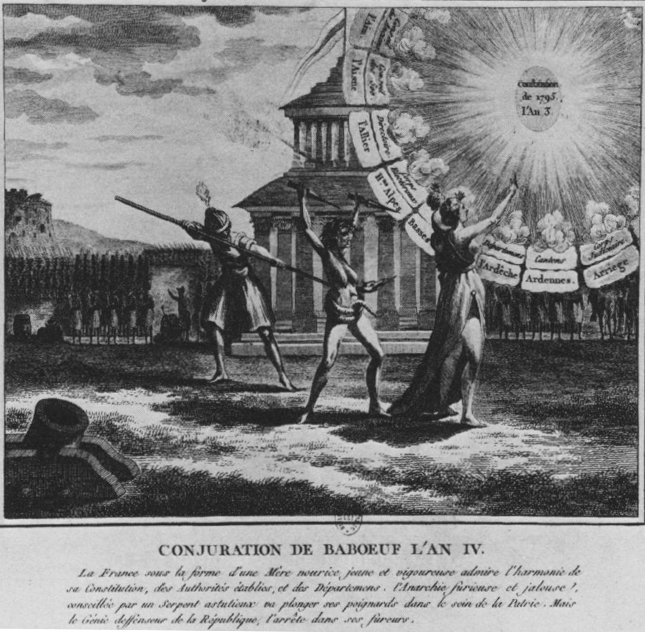
1797: Gracchus Babeuf, for the Conspiracy of Equals

If the “revolutionary extremist” exists at all as an identifiable type, he exists in purest incarnation in Gracchus Babeuf. No revolutionary better fits the description “narrowminded to the point of genius”; few have defined their heaven more clearly or crusaded so fanatically, ascetically, so religiously to bring it to earth.

Gracchus Babeuf: The First Revolutionary Communist

On this date in 1797, Francois-Noel Babeuf lost his head for the Conspiracy of Equals — the last Jacobin upheaval of the French Revolution, or the first Communist upheaval of post-Revolution modernity.

Francois-Noel — he styled himself “Gracchus” after the populist Roman tribunes — was a young man of Desmoulins‘ generation but from a considerably more hardscrabble background. Like the starry-eyed Dantonist scribbler, Babeuf discovered himself a brilliant journalist and pamphleteer with the onset of the Revolution; he did several prison stints during various revolutionary phases of the early 1790s for his too-radical-for-school opinions.

He did another in 1795 under the French Directory for his firebreathing rag Le Tribun du Peuple, which was particularly unfashionable stuff during the post-Robespierre Thermidorian regime.

Nothing daunted, Babeuf emerged from prison the leading apostle of the Parisian proletariat which had by then been decisively separated from power.

The order of the day was class consolidation with the spoils of the aristocracy apportioned among a new oligarchy of wealth. As France rushed headlong towards Bonaparte and Bourbon restoration, Babeuf was the man left to rally “the party which desires the reign of pure equality.”

The French Revolution was nothing but a precursor of another revolution, one that will be bigger, more solemn, and which will be the last.

The people marched over the bodies of kings and priests who were in league against it: it will do the same to the new tyrants, the new political Tartuffes seated in the place of the old.

Manifesto of the Equals, 1796

One can see why later revolutionaries — Marx included; Babeuf makes a cameo in the Communist Manifesto — would adopt this sort of thing as a harbinger of the next century’s revolutions.

And if the Directory had known who Nicholas II would be, it would have had no intention of going the way of his family.

Instead, it shut him down in February, 1796: Napoleon Bonaparte personally carried out the operation, just days before he wed Josephine.


The Babeuf Conspiracy. Anonymous French print.

Babeuf’s party comes down to us as a “conspiracy,” under which word the state would charge him and which his follower Philippe Buonarroti would later rebrand the “Conspiracy of Equals”. It was not so much a grassy-knoll type of conspiracy as it was an underground organization.

When its adherents placarded Paris with the seditious “Analysis of the Doctrine of Babeuf” as the city endured a potentially dangerous economic crisis in April 1796, the government was put to a test of its strength.

It passed.

Having infiltrated Babeuf’s network, it arrested the principals on the eve of the Conspiracy’s intended insurrection. They were hailed out of Paris (a safeguard against sympathetic risings) to the commune of Vendome and there put on trial.* Babeuf and his associate Augustin Alexandre Darthe were condemned to death on May 26th and guillotined the very next day.

The last gasp of the French Revolution dropped with their heads into the basket.

Revolutionary Babeuvism, however, had scarcely just begun.

I don’t know what will become of the republicans, their families, and even the babies still at their mothers’ breasts, in the midst of the royalist fury that the counter-revolution will bring. O my friends! How heart-rending these thoughts are in my final moments! … To die for the fatherland, to leave a family, children, a beloved wife, all would be bearable if at the end of this I didn’t see liberty lost and all that belongs to sincere republicans wrapped in a horrible proscription.

-Babeuf’s last letter to his family

* The trial of Babeuf was itself a jurisprudential milestone: it was the first French trial to be transcribed verbatim.

What might look today like a nifty little advance for efficient judicature was bitterly controversial in 1797. The French Revolution had overturned an ancien regime practice of professional magistrates accepting legal testimony by written deposition and deciding matters behind closed doors. The liberte, egalite, fraternite way would instead demand that testimony be given live in the courtroom where citizen jurors could weigh its credibility.

Babeuf’s lawyer, Pierre-Francois Real, protested against the court stenographers, arguing that “The law insists that the system of written depositions not be restored in any way. That system will undoubtedly return if any means are used to save testimony given orally.”

There’s a fascinating disquisition on the curious and contradictory development of this issue and the way it “violates … common assumptions about the advance of textuality in the West” during the French Revolution in Laura Mason, “The ‘Bosom of Proof’: Criminal Justice and the Renewal of Oral Culture during the French Revolution” The Journal of Modern History, March 2004.

On this day..

1725: Jonathan Wild, Thief-Taker General and Receiver of Stolen Goods

(Thanks to Anthony Vaver, author and publisher of EarlyAmericanCrime.com for the guest post. Vaver is the author of Bound With An Iron Chain: The Untold Story of How the British Transported 50,000 Convicts to Colonial America. -ed.)

A buzz filled the air as people stood on their toes and filled every window in an attempt to get a glimpse of the great Jonathan Wild as he was paraded through the London streets on Monday, May 24, 1725. Despite the festive atmosphere surrounding the procession, Wild appeared to be unmoved by the shouts of the crowd, his attention focused instead on the Bible held open in his hands. After traveling about a third of the way to his destination, the procession stopped at the Griffin Tavern, so that Wild could drink a glass of wine.

Not long after leaving the Griffin Tavern, a rock thrown from a window hit Wild in the head, and blood began to pour down his face. The crowd roared with approval and people started to hurl insults at him, along with more stones and dirt. The cart stopped twice more before reaching its final destination: first at the White Lion, where Wild drank another glass of wine, and once again at the Oxford Arms, home of the bare-knuckle boxing champion James Figg, where Wild drank a tankard of beer and even more wine. His next and final stop was Tyburn Hill, where he was scheduled to be executed.

Convicts often stopped for drinks at various taverns during their march from Newgate Prison to Tyburn to be executed, so the fact that Wild stopped at three along the way to his execution was not unusual. What was unusual, however, was the fact that he was able to hold down his liquor, given that the previous night at two in the morning he had tried to kill himself in his jail cell by drinking a large dose of laudanum, a concoction of opium dissolved in alcohol. Wild was already in a half-stupefied state before his slow journey to the gallows and his wine drinking had even begun.

Wild’s dramatic execution marked a precipitous fall for a man who was perhaps the most influential person in England’s criminal justice system, even though he never held an official government position. As the self proclaimed “Thief-Taker General of Great Britain and Ireland,” Wild was instrumental in capturing and bringing to justice scores of petty thieves that plagued the London streets. He consulted the government on the passage of laws intended to encourage the capture of criminals. He also oversaw a vast criminal empire, the likes of which has never been duplicated.

Wild ran an Office for the Recovery of Lost and Stolen Property where people could apply to him for help in recovering their possessions for a fee that fell below what it would cost them to replace the objects. Wild would then use his connections in the criminal underworld to recover the goods and return them to the owner. His business proved to be extremely popular.

In addition to recovering lost and stolen property, Wild was particularly adept at catching and prosecuting criminals, a public service that enhanced his general reputation and gained the approval of the authorities. In the absence of a true police force, the government relied on rewards to encourage people to police the streets themselves. Anyone who could capture a thief and convict him or her with evidence received a reward of £40, far more than what most people in England could earn in a year. Wild benefited from this policy by collecting a fee every time he was able to prosecute a criminal. His office, then, essentially served as the de facto “Scotland Yard” of the day.

Wild’s knack for catching criminals brought him great renown. He often appeared at trials to give evidence against the criminals he helped to capture. He got to know the bailiffs of the prisons and could be seen socializing in the local taverns with Justices of the Peace. He entertained government officials in his house.

The public remained blissfully unaware that there was another, more sinister, side to Wild.

In point of fact, the man supposedly responsible for clearing the streets of criminals was also the head of a vast criminal empire and a well-oiled criminal machine. Wild’s Lost Property Office turned out to be a clearinghouse for stolen goods that members of his own organized gang had themselves acquired. The thieves he apprehended, supposedly for the good of the community, were fall guys; they either belonged to rival gangs, or were members of his own gang who tried to double-cross him, quit his business, or had ceased to be more valuable than the £40 reward given by the government for capturing and convicting a criminal. Wild sent many of these criminals to the gallows by appearing in court to give evidence — real or otherwise — against them. The unofficial head of crime prevention was in actuality the foremost perpetrator of crime and organizer of criminals in London and throughout Great Britain.

Wild’s downfall began when he helped prosecute the thief and burglar Jack Sheppard, whose daring and dramatic escapes from the notorious Newgate Prison turned him into a folk hero. Public opinion soured on the “Thief-Taker General” and his involvement with Sheppard’s execution … and when details of Wild’s criminal operation emerged after his arrest for receiving stolen goods, the public was furious.

When Wild finally reached the gallows at Tyburn, the noise from the crowd was so loud that the Ordinary of Newgate found it almost impossible to say his prayers with Wild and the three other criminals scheduled to die. The hangman, Richard Arnet, who years before had been a guest at Wild’s wedding, tried to give Wild as much time as he needed before preparing him for execution. The crowd, however, grew restless and threatened to tear Arnet to pieces if he did not proceed in carrying out his duties immediately. Reluctantly, Arnet placed a noose around Wild’s neck.

A great shout went up from the crowd as the cart drove away leaving the convicts dangling from the ropes tied around their necks. After the drop, Wild desperately grabbed onto Robert Harpham, who was being executed for coining, in an attempt to lift himself up and slacken the rope connected to his neck. Arnet intervened and separated the two, and after a few minutes, the life of Jonathan Wild came to an end at the age of about 42.

Almost as soon as Wild’s body was cut down, a rumor began to circulate that it was being carried off to the Surgeon’s Hall for dissection. The bodies of executed criminals were often used for such a medical purpose, but the practice usually led to a struggle between the surgeons, who were trying to take the body of the criminal away, and the disapproving crowd. In this case, Jonathan’s wife, Mary Wild, had arranged to circulate the rumor that he had been turned over to the surgeons as a ruse, so that his body could be properly buried without interference. Her plan didn’t work. Three or four days after it was buried Wild’s body was dug up from the St. Pancras churchyard by the surgeons.

Today, Jonathan Wild’s skeleton can be seen on display at the Hunterian Museum at the Royal College of Surgeons in Lincoln’s Inn Fields.


The skeleton of Jonathan Wild at the Hunterian Museum at the Royal College of Surgeons in Lincoln’s Inn Fields.

On this day..

1906: Ivan Kalyayev, moralistic assassin

On this date* in 1906, Ivan Kalyayev (also transliterated Kaliayev, or Kaliaev) was hanged by his own assent for assassinating Grand Duke Sergei Alexandrovich in Moscow.

The Warsaw-born Kalyayev tread the usual path of student radicals — expulsion, arrest, internal exile — into the camp of the Socialist-Revolutionary Party and the trendy propaganda-of-the-deed philosophy.

He was the very epitome there of what Chaliand and Blin call “the moralistic approach to terrorism”; he would slay, of course, from a profound sense of moral outrage, but contextualized that terrible act with a no less dramatic sense of personal moral responsibility.

Revolutionary fellow-traveler Boris Savinkov remembered** of our day’s principal that he

loved the revolution with the tender, profound love felt for it only by those who have made it an offering of the whole of their lives.

Kalyayev voluntarily aborted his first attempt to murder the Grand Duke when he beheld his target’s wife and child riding along in the carriage where he meant to toss his bomb. Upon successfully carrying out the hit two days later, he made no attempt to flee, and at trial requested the death sentence for himself.†

In this behavior, Kalyayev presents the fascinating specter of a terrorist whose certainty of the justice of his crime does not excuse himself from moral responsibility for the crime.

For Kalyayev, the murder itself and its mortal expiation completed its own redemptive cycle. As the murderer wrote to his mother,

I am happy to know I acted in obedience to the call of my duty … It would be ridiculous to think of saving my life now, when my end makes me so happy. I refused to sign the petition for pardon, and you know why. It was not because I have spent all my physical and mental powers; on the contrary, I have preserved all that life gave me for my last triumph in death … I could not accept pardon because it is against my convictions.

This striking attitude recommended him to Camus, who featured it in Les Justes (The Just Assassins), a 1949 play exploring the morality of terrorism.

The second act of the play features Kalyayev’s revolutionary cell disputing his decision not to follow through on his first opportunity to kill the Grand Duke. Ignacio Gotz describes our killer’s posture as, “kill only when absolutely necessary and then accept your own death as proof that murder is not permitted.”

That’s what love is — giving everything, sacrificing everything, without any hope of it being returned.

-The character Ivan Kalyayev, in Les Justes

This was not the only ethos competing for purchase on the story and the soul of Ivan Kalyayev.

The widowed Grand Duchess Elizabeth Fyodorovna visited her husband’s assassin in prison and unavailingly attempted to convert him to Orthodox Christianity. (The Grand Duchess would take her own solace in a religious life, ultimately being martyred by the Bolsheviks during the Russian Civil War; she has since been canonized.)

The Russian paper Novaya Gazeta published a fairly lengthy Russian-language biography of Kalyayev on the centennial of his entry into the executioner’s annals.

* May 23 was the Gregorian date of the execution; it was May 10 by the Julian calendar still in use in Russia at the time.

** Cited in The History of Terrorism: From Antiquity to Al Qaeda.

† With the requisite grandstanding, of course — a moral indictment given added depth by Kalyayev’s personal conduct.

We are separated by mountains of corpses, by hundreds of thousands of broken lives, by an ocean of tears and blood that is flooding the entire country in a torrent of outrage and horror. You have declared war on the people. We have taken up the challenge … You are prepared to say that there are two moralities, one for mere mortals, stating, “Thou shalt not kill; thou shalt not steal,” and another, political, morality for the rulers, for whom it permits everything.

On this day..