1885: Mose Caton, beastly husband

On this date in 1885, a vast concourse crowded into Morganfield, Ky. for the satisfaction of seeing the hated Mose Caton hang.

Caton was a Union County, Ky., farmer and cooper who married a widow to secure some land. And he seems like a catch! “Mose Caton seemed to be of the opinion that he had absolute power over the lives of his family,” this contemporaneous chronicler recorded. “The ethics of most people at the present day would prompt them to interfere if his treatment of his family should be practiced toward ordinary domestic animals.”

The poor widow Hester took to her new hubby’s thrashings like the Stanford prison experiment inmates and soon became a beaten, broken soul. Out in the boondocks, Caton had a free hand.

Disheveled and too frightened to speak, she ate in the corner, sat on a box separate from the rest of the family, slept on a filthy feather bed and absorbed any humiliation Mose cared to inflict on her … up to and including actually having Mose move his mistress right into the house, and having the mistress physically whip the wife. When Mose built a new house he gave the abused Hester the loft, into which household fire-boxes (rather than fireplaces) emptied their smoke. The woman lived in hell itself.

But she didn’t live there very long.

She died on Sunday, February 22.

As neighbors helped the next day to dress the body for burial, they saw written in the bruised flesh the terrible treatment Hester had endured … including a dreadful abrasion about the neck that looked for all the world like the mark of a cord about her neck.

Though the corpse was buried, reports of its condition soon led to its disinterment — bruised, oozing blood, visibly murdered.

“Mose Caton’s face was the most notable feature of the man. It might well be styled Mongolian in its principal characteristics. The rather scant chin whisker and mustache was the first requisite to this effect. Then the prominent cheek-bones; eyebrows, highest at the outside ends; and a deep sinister wrinkle, starting at the sides of the nostrils, and dropping down past the mustache, heightened the effect. His eyes, more yellow than grey, were not capable of shame, and yet they were not firm and steadfast. He could keep his eyes upon your face, but he could not look steadily into your eyes. His eyes would wander to your forehead, chin, cheeks, back to your eyes, and then away again all over your face.

“His forehead was high, but rather narrow, and retreated from the eyebrows back. The hair was black and slightly tinged with grey. He parted his hair on both sides, and a lock fell down the center of his forehead, not unlike the one commonly seen in the pictures of old Father Time. The ends of the rather long hair was tucked under like Secretary Lamar wears his hair. His clothing was of ordinary woolen goods. He wore a white shirt, and a celluloid turn down collar that was too small for him. He supplemented its length with a red ribbon, which ran through the front button-hole of his shirt collar and tied the ends of his celluloid collar together with the loose ends of the ribbon.” (Source)

“Have him at all hazards,” someone said, voicing the shocked sentiment of all present.

A posse of 25 somewhat fearful men — for Caton had a forbiddingly malevolent public reputation quite apart from the treatment of his spouse — was formed to arrest the tyrannical husband, along with the mistress and the boys. The Catons battened down the hatches and started firing. Their daughter Annie absorbed a breast- and bowel-ful of buckshot in the crossfire, a mortal injury. Only when the posse threatened to burn the house down did the besieged clan give up.

Even then, their trip to the lockup “was interrupted many times by bands of men on foot, emerging from the cypress forests in the icy wilderness, and demanding that the prisoners should be hung then and there.”

Authorities managed to keep the lynching sentiment at bay, but only just. Outraged locals were understood to stand ready to take matters into their own hands at any hint of excess delicacy or dawdling on the part of the judiciary. There were even rumors that an artillery piece had been procured to make certain matters should the need arise to assault the jail, and that the courthouse audience itself had several ropes in hand should it be called upon to issue its summary verdict.

When the jury announced that this would not be necessary, the onlookers bayed in bloodthirsty satisfaction at the sentence. Caton had scarcely a month yet to live, and this was not enough time to dissipate the hatred he had earned of his neighbors: there was an intent to hang Caton privately, but thousands of people pouring into Morganfield, Ky., made it clearly understood that they would riot and pull down the barrier if they were balked of their sight.

On this day..

1829: Richard Johnson and Catharine Cashiere, the last public hangings in New York City

New York Evening Post, Nov. 21, 1828

[O]n his return from Rochester, [Richard] Johnson brought with him a little girl, apparently about three years old.

This child he declared to be his by Mrs. [Ursula] Newman, and repeatedly demanded of her to acknowledge it, which she as often refused to do.

On Thursday afternoon he came into the dining room, the windows of which are in the rear of the house, and having locked the door by which he entered, and put the key in his pocket, again made the above mentioned demand. Another female was in the room, and heard the conversation which took place between them.

Mrs. Newman, perceiving that Johnson was more than usually excited, said to him “Good God, Johnson what are you going to do.” He replied “I am going to shew you that I am a man, you have imposed upon me too long.”

Mrs. Newman then called to the other female to open the door, which she could not do as Johnson had the key in his pocket.

Becoming frightened at his violence, Mrs. Newman opened one of the windows and sprang into the yard — from that went into a small room in the rear of the stair-case.

He followed her, threatening that if she did not acknowledge the child he would shoot her, and shortly after he discharged the pistol at her. She had the child hanging upon her left arm, in such a manner that Johnson could not take a fatal aim without wounding the child. He put one hand to the child, moved it out of the way, and with the other, clapping the pistol to her breast, discharged it.

Finding that the wound was not fatal, he ran up stairs, loaded the pistol again with several slugs, and returned.

At the first discharge a number of persons had rushed into the house; but on his returning, and declaring his intention of taking her life, and that if one shot did not do the work another should, they all took to flight.

The family however remained.

Johnson then made several attempts to take aim at Mrs. Newman, but was prevented by the resolution of her daughter, a girl of about eighteen years of age, who repeatedly thrust aside the pistol and prevented him.

After several attempts he discharged the pistol, but the daughter in pushing the weapon aside prevented the shot from taking the fatal effect intended, and the slugs were lodged in her mother’s arm.

The pistol burst in the discharge, shattering Johnson’s right hand and wounding the hand of the girl considerably. Since this tragical affair the daughter has not left her mother’s bedside, but has continued ever since to watch over her and to pay her every possible attention, notwithstanding the painful wound she has received. [she died that Saturday, two days after being shot -ed.]

At noon today Mrs. Newman was still alive, and in perfect possession of her senses, tho’ in extreme pain. The physicians think there is little hope of her recovery. The fatal wound was inflicted by the first discharge of the pistol. The ball passed through her body and lodged in the back, near the spine.

New York Evening Post, Feb. 7, 1829

Murder. — Susannah Anthony, a colored woman, was killed last night at about seven o’clock by Catharine Cashiere. The deceased gave a card party at the corner of Centre and Anthony street, at which there were 30 or 40 persons, all colored, and mostly penitentiary birds.

During the evening an agreement was made between Maria Collet and Catharine Cashiere, that they would have a quarrel with the deceased. They went into the room where she was and began some loud and abusive language, the deceased endeavoured to prevail on them to go away, and put her hands gently upon Cashiere to enforce her request, the latter thereupon drew a jack-knife, cut off deceased neck-handkerchief, & made two stabs at her.

The first wounded her hand with which she attempted to defend herself, and the second entered the chest and penetrated the heart. The blood spouted from the wound against the opposite wall, and the wounded woman fell and instantly expired. The murdress was secured and lodged in Bridewell.

A Coroner’s Inquest was held this morning at the house where the horrible deed was committed, and the verdict of the jury was, that the deceased came to her death by the wound of a knife, inflicted by the hand of Catharine Cashiere.


Hampshire Gazette, March 25, 1829

About half past ten, Richard Johnson and Catherine Cashiere were borught over from the Bridewell and placed near the fire place in the N.W. part of the room.

Johnson was immediately surrounded by several officers, with whom he appeared to converse in the most unrestrained manner. He seemed broken, but not contrite in spirit; and while anguish of mind was apparent, it was not seemingly of that character which is the beginning of true repentance.

The woman, however, was just the reverse in her deportment and appearance, and as soon as she was brought into court, she appeared considerably distressed and wept with great apparent emotion. But her tears were dried before the court came in; and she listened to her sentence with perfect composure though with due solemnity. She is a good looking young woman, with but a shade of the olive complexion, dark lustrous eyes, and rather an agreeable expression of countenance.

The sentence of Johnson was pronounced first. — On the usual question being put, “If he had any thing to say why sentence of death should not be pronounced according to law?” he addressed the Court as follows:

If your Honors please — I am asked, “what I have to say, why judgment of death should not be pronounced upon me?”

To this, I reply, to the judgment of the law, nothing.

A jury of my country has pronounced me Guilty; and there remains no discretion with the court, but to pronounce upon me the sentence of the law. But to the judgment of the world, I have much to say. I have been convicted of a crime, the bare recital of which causes humanity to shudder; — and it is a duty I owe to myself, while living, and to my memory when dead, that the circumstances of my offence should be fully explained.

Before entering into this detail, I must take this public opportunity, in the name of that Omniscient and All Merciful Being, who will hereafter pronounce His judgment, alike upon my judges and myself, of disclaiming any knowledge of the transaction of that fatal 20th of November.

I do not mean to impugn the decision of the jury; — the movements of the mind were beyond their power to penetrate; and hard as is my fate, I humbly bow to their verdict.

I cannot here enter fully into the details of my intimacy with the unfortunate cause of my own present awful situation. Duped and betrayed as I have been, into sorrow, despair, and lastly involuntary crime, I am unwilling, while living, to indulge in unavailing reproaches.

In life the deceased was the object of my tenderest affection, — an affection that her own unkind conduct seemed but to inflame, and that, baffled in its honorable purposes — expelled reason from her throne — and in its absence, led to the commission of the offence for which I am now to satisfy the offended community, by my own life.

Was I conscious of any moral guilt, at this result I should not repine. Accustomed throughout my life to respect the law, I have not now to learn that the blood of the murdered is alike a propitiatory sacrifice to the laws of God and man.

Convicted of the legal crime, I know my fate. For the moral offence, I have to answer to my conscience and my God; and that innate monitor tells me, that I stand before this Court and this community a legal, but not a moral murderer.

To my counsel, who have so ably, though vainly managed my defence, I tender my warmest thanks.

Of the Court I have but one request to make — that the period allowed me, to prepare for my impending fate, may be, as long as the law will permit.

His manner was firm and collected; his articulation deliberate and distinct; and he delivered himself with a studied oratorical air.

His Honor Judge Irving then pronounced his sentence as follows:

Richard Johnson, you have been found guilty by a jury of your country, of one of the greatest crimes a human being can perpetrate.

Instigated by evil passions, you have suddenly and with premeditated violence taken the life of a fellow being. Ursula Newman, the victim of your unbridled passions, was but shortly before the commission of this offence, the object of your strong attachment.

Yet that attachment not being based upon virtuous affection, has enkindled those furious passions, which have plunged you into guilt and have terminated in your destruction.

You stand a melancholy proof how speedy can be the transition from one licentious passion to another, and that vice is so all-absorbing in its nature that he who gives himself to its indulgence will eventually be led on to deeds of the greatest depravity.

The object for several years of your improper pursuit has at last perished by your hand. She has been hurried by you out of existence, without time allowed to her for preparation. Her children, some of whom are of very tender years, and who were entirely dependent upon her, have been deprived by you of their earthly support, and are now cast upon the world orphans and destitute.

I mention not these painful circumstances to harass your feelings, deeply as I trust they must be afflicted by these consequences of your crime. I dwell upon them for a better purpose. I would awaken your mind to a scene of its situation, with the hope of leading you to contrition. It is one of the most consoling principles of our religion, that however great are our offences, forgiveness will await the contrite, and that our Maker is as merciful as he is just.

The character which was testified of you on your trial, was that of being industrious in your habits, upright in your dealings, and kind in your general deportment — that you had been brought up to a reputable business, and which you was [sic] diligently pursuing for a livelihood. Young in life, had you only kept a vigilant guard upon your conduct, you had every think [sic] to hope.

The indulgence in one vice has blasted these expectations — has hurried you into the commission of an enormous crime, and has left you miserable and desolate.

While we pity you, public justice requires that you be held up an example and a warning to others. We would enjoin you not to be misled by the hope of escaping the fate which must so soon await you. The yielding to such hope, will only beguile your mind from that serious reflection which your present situation most solemnly requires.

What is left to you of life, is too short to be passed otherwise than in humble preparation for your future state. Let your thoughts be anxiously devoted to your religious duties; and while every thing is failing you here, let your reliance in penitence and humility of soul, be placed upon Him, who, in the deepest extremity, is able to console and to sustain you.

The sentence of the Court is, that you, Richard Johnson, be taken hence to the prison from which you last came, and from thence on Thursday, the seventh day of May next, to the place of execution, and there there, between the hours of seven in the forenoon and twelve at noon, you be hung by the neck till you are dead. May God prepare you for that awful event, and have mercy on your sou.

Catharine Cashiere, the colored girl, was then requested to stand up, and the Clerk put the usual question. She replied faintly, that she had nothing to say. The sentence of the court was then pronounced by Judge Edwards, as follows:

Catharine Cashiere — As you have been already informed, you are now arraigned at this bar for the purpose of receiving sentence of death.

Upon this solemn occasion it is proper that something should be said in vindication of the justice of the country, and with a view to awaken you to a realizing sense of your situation.

After a patient investigation of your case — after being zealously and ably defended by your counsel, a jury of your country have found you guilty of the crime of murder. In the circumstances attending the transaction, I can discover nothing to palliate your offence.

It is true that you were in a state of intoxication, but this in the eye of the law is no excuse. A contrary doctrine would be tantamoun to a letter of license to drunkards to depredate upon society with impunity.

Susan Anthony now lies in her cold and silent grave, bereft of life and all its enjoyments by your hands; and you must soon follow her to the silent mansions of the dead. By the laws of our country, by the laws of all countries, civilized as well as barbarous, the crime of murder is punished with death. As life is precious above all things, it is the bounden duty of those to whom is committed the safety of society, to take the most effectual measures for its protection.

Your situation is indeed an awful one.

At the early age of twenty-one, your existence will be brought to a sudden and violent end, a victim to the violated justice of the country. With earth and all its enjoyments, your connexion will soon cease forever, and you must go away, with all your imperfections upon your head, into the presence of your Maker.

Let me beseech you to devote the small remnant of your existence in preparing for this change.

Remember, and never let it be absent from your thoughts, that as you are indebted to him for your existence and all you have enjoyed here, so you must look to him for all you can hope for hereafter.

Before I proceed to sentence the prisoner, I conceive it to be my duty to address some remarks to this numerous audience, which most forcibly pressed themselves upon my attention during and since her trial.

Upon a former occasion, I expressed, from this bench, my sentiments upon the subject of the deplorable consequences attendant upon the facilities afforded in this city, for the vending of ardent spirits.

We were then called upon to sentence seven young men to the state prison, for killing one of our fellow citizens in a wanton and unprovoked manner, in the public streets. It appeared that prior to sallying out they had each been helped to seven or eight glasses of spirituous liquors by one of our licensed retailers; and that the crime was committed under the influence of the delirium necessarily consequent thereon.

During the present court we have been called to pass upon two cases of homicide, in one of which, both the prisoner and the deceased were at the time the offence was alledged to have been committed, in a state of beastly intoxication. And in the other, the case of the miserable being who is now arraigned at this bar, it was also proved by one of our licensed retailers, that he sold her on the night of the murder three or four glasses, although at the time she came into the store, she was so intoxicated that she staggered.

Thus prepared, in a state of mind thus phrenzied, this crime was committed.

If, as we are taught to believe, it is a crime to tempt as well as to be tempted, how can those hope to escape moral retribution, who hold forth lures to intemperance and by assisting to overthrow the reason of the vicious prepare them for the work of iniquity?

It is undeniably true, that a very large proportion of the crimes which are committed, are traceable either directly or indirectly to the influence of spirituous liquors; and I will add, that the poverty and wretchedness which prevails in society are to be ascribed more to this than all other causes united.

These facts are matters of notoriety, and yet the evil continues, spreading and extending a baneful influence.

In probing the sources of this evil we are met with the appaling fact that there [are] at this moment three thousand persons in this city, who are licensed to retail spirituous liquors. Licensed to pursue a calling the direct tendency and necesary consequences of which, is to ruin the health and deprave the morals of thousands of our fellow beings.

While such facilities are afforded for depraving morals and dethroning reason, is it matter of surprise, that “blood stained murder” stalks abroad among us. If the power of applying a correction was not in the hands of the people, if the government under which we live was independent of any superior to the will of the people, “if an enemy had done this thing,” there might be some excuse for us.

But as all power is either mediately or immediately derived from them, and is in their hands, as it is but necessary for them to will that a correction should be applied, and it will be done, how can we stand acuqitted in neglecting to apply a remedy.

In our ardent and headlong career through this world, in the pursuit of property or honor, let us pause for a moment to consider the cause of suffering humanity; let us devise the most judicious measures for the correction of this evil, and by a firm, united and determined concert of action, carry those measures into effect.

It is the cause of public justice, of public morals, and of suffering humanity, which demands our aid. Vain are all the expectations which are formed, of its being in the power of the ministers of justice to restrain the workers of iniquity — to stay the hand of violence, until this evil is corrected. Fifty are corrupted by ardent spirits, to where one is corrected by the law.

I will now proceed to the discharge of the last and most painful duty of the court.

Catharine Cashiere — Listen to your sentence. It is, that you be taken hence to the prison whence you last came, and that you be taken from thence on Thursday the seventh day of May next to the place of execution, and that between the hours of seven in the morning and twelve at noon of that day you be there hanged by the neck until you are dead. And may God have mercy on your soul.

There was no visible increase of emotion on the part of either of the prisoners, either during the time the Judges were speaking, or at the close of the concluding and awful sentence.


Both prisoners appealed to Enos Throop, the then-interim governor weeks after Martin Van Buren had resigned the post to serve in the cabinet of the newly-inaugurated President Andrew Jackson. Gov. Throop rejected both in separate letters directed to the sheriff imploring the prisoners’ jailers not to burden Johnson or Cashiere with any fanciful hopes of reprieve.

Executive Department
Albany, April 25, 1829

Sir, — I have received a petition for pardon, in behalf of Richard Johnson, in your custody, under sentence of death for murder, and have bestowed upon the case that attention which the importance and painful interest of the subject demand.

The killing was in the presence of witnesses, and the manner in which it was perpetrated is not a matter of doubt or dispute. It was done deliberately. The pistol was put in order and prepared for the occasion; it was twice discharged; and its contents were, each time, lodged in the body of the deceased.

The tragic deed was the result of a previous misunderstanding between the parties, of several days continuance; and the proximate cause, a personal struggle, commenced with angry feelings, and carried on with a sufficient interval before its fatal termination to accomplish the death of the miserable victim of his violence.

During several preceding days he exhibited those appearances of gloom, abstraction of mind, and depression of spirits, which indicate a bosom deeply agitated with violent passion, and a mind occupied with absorbing subjects.

It is urged in his favor, that his mind was deranged when the deed was done, — and that he had before sustained a good character, and was of an amiable and benevolent disposition.

The question of insanity was a matter in issue on the trial; and the jury, after hearing all the testimony, decided against him. — I see nothing in the evidence to induce me to doubt the correctness of their verdict in that respect.

His supposed amiable character, while it is evidence, in a doubtful case, to be duly weighed by the jury in pronouncing upon the intent, and appeals to our sympathy, does not afford a sufficient reason for arresting the course of Justice. It is in proof, however, upon this point, that he had lived in a licentious intercourse with this woman for several years, and their intimacy has, in the ordinary process of vice, terminated in the highest misdeeds.

The laws have pronounced his doom, and declared him a fit object of exemplary punishment; and I do not feel justified in interposing the Executive arm to defeat their politic ends.

I must therefore request you, to communicate to the wretched convict my decision, without delay, that he may prepare himself to meet his fate, and make his peace with his offended God.

I am respectfully, your’s [sic], &c.
E.T. Throop

Executive Department
Albany, May 4th, 1829

Sir — My attention has been recently called to the case of Catharine Cashiere, a coloured woman in your custody, under the sentence of death for the murder of Susan Anthony, also a colored woman.

On receiving a report of the trial from the presiding Judge, accompanied by affidavits, I at a former day attentively examined the case: but the respectability of the petition, which has been forwarded to me, through the praise worthy exertions of humane persons, in behalf of a friendless individual, has induced me to re-examine the case, and look, with scrupulous care, at the conclusion to which my mind has arrived.

All punishments are prescribed by the wisdom of our lawgives, for purposes of public good, and should not be dispensed with for light causes. It is a maxim drawn from experience, and sanctioned by sound reason, that laws restrain crime, not by the severity of their enactments, but by the certainty of their being enforced.

It was not intended by the framers of the Constitution to erect in the Executive a tribunal which shall arbitrarily dispense with those judgments of our courts, which are pronounced in strict conformity to the design of wise and prudent laws; but one which shall discreetly exercise its powers to favor the designs of the Legislature in tempering undesigned severities with the administration of justice.

With these views I have examined the case of Catharine Cashiere.

The facts as reported shew: That the convict came to the house of the deceased by invitation, and soon began to use indecent and profane language. She was requested by the deceased to go out, and did so. She returned again in a few minutes, resumed her ill conduct, and was again mildly requested to go out. — She refused to go, and used language shewing her determination not to go.

The deceased then gently laid her hand upon her, when the convict made three attempts to stab her with a knife, which she drew from under her apron. The two first attempts were ineffectual, but the last was made with much force and preparation, and the knife reached the heart of her victim.

It further appears that while she was absent from the room after the commencement of the affray, she was seen in a grocery kept in another part of the same house, with a knife in her hand. Whether she procured the knife then, or had it before, is not in proof, but the testimony affords good reason to believe that she there opened it and hid it under her apron, and returned to the room for the purpose of renewing the quarrel, and contemplating the dreadful catastrophe which ensued. — Here was positive proof of malice propense.

Although the design of murder was conceived after the quarrel was begun, yet the wrong was altogether on the part of the convict, and the interval of absence from the room was sufficient and was employed in deliberately contriving the execution of the bloody deed.

Independent of the common law doctrines of murder, stabbing is so odious that special statutory provisions exist, declaring designed stabbing which produced death to be murder without proof of malice.

It is declared by statute, “that if any person or persons shall stab or thrust any person or persons that hath not then any weapon drawn, or that hath not then first stricken, the party who shall so stab or thrust so as the person so stabbed or thrust shall thereof die within the space of six months then next following, although it cannot be proved that the same was done of malice aforethought, every such unlawful killing shall be adjudged, taken and deemed wilful murder.” Her case comes directly within this statute.

It is urged that she was insane, and that she was intoxicated. Drunkenness afford no excuse for crime. If it should, every species of crime, from arson and murder down to the smallest larcenies, would be perpetrated under that pretence. The facts in regard to her drinking were before the jury.

It is said that when she is intoxicated she is deranged: that is the natural effect of intoxication: but the law says, with great justice, that voluntary derangement shall not excuse crime.

Affidavits are presented to shew that when she was a child she received a hurt in her head which impaired the strength of her mind, and that when she is intoxicated she exhibits insanity which is supposed to result from the hurt in her head, and that the fact of the hurt was not proved on the trial. It is not satisfactorily proved that she ever manifested symptoms of insanity, except when she was under the influence of liquor.

Her conduct during the quarrel, from its commencement until its fatal termination, shews no evidence of insanity, nor that prostration of mind by liquor which totally extinguishes reason; but, on the contrary, it evinced a capacity to plan and execute her projects of revenge.

I therefore feel it a duty which I owe to the state, the execution of whose laws are entrusted to me, to deny the pardon solicited. You will therefore make known to the miserable culprit my determination, so that if she has cherished any hope from Executive clemency, she may dismiss it, and prepare her mind to appear before that high tribunal where there is no error in judgment and from which there is no appeal.

Your obedient servant,
E.T. Throop


Baltimore Patriot, May 9, 1829

From the New York Post of Thursday.

EXECUTIONS. — Richard Johnson and Catherine Cashiere, under sentence of death for murder, were this forenoon executed on Blackwell’s Island.

They were taken from the Bridewell a little after 8 o’clock, and conveyed to the gallows, accompanied by the Sheriff and a troop of horse, and followed by an assemblage of several thousands of men, women and boys, eager to witness the dying struggles of two of their fellow beings.

Early in the morning Broadway, opposite the Bridewell, was blocked up with spectators, so much so as to make it difficult for carriages to pass: and for a short time before the procession moved every avenue leading to the prison was completely closed.

We hope it will be the last time a similar opportunity will be afforded to gratify the idle curiosity of the populace of this large city. The revised laws provide that after the year 1829, all executions for capital crimes shall be performed in the yard of the prison where the convict is confined, in the presence of the proper officers.

We have just learned that the poor unfortunate wretches were turned off between 10 and 11 o’clock, from a gallows erected for the purpose on Blackwell’s Island, and that a great part of the procession were disappointed in witnessing the spectacle, not being able to procure boats to convey them across the river to the Island; and this perhaps was a fortunate circumstance, for we have heard that one of the few boats which were put in requisition, with twelve persons in it, was upset and before assistance could be rendered several were drowned.


It was indeed the last public hanging in New York City.

On this day..

1685: John Nevison, speed demon

It might have been this date in 1685* that the famously speedy highwayman John Nevison (or William Nevison) was hauled to York’s gallows on the Knavesmire and launched into eternity.

The 1660s and 1670s were his time, when the ex-soldier Nevison made the coachmen of the Great North Road stand and their their passengers deliver from York to Huntingdon. “In all his pranks he was very favourable to the female sex, who generally gave him the character of a civil obliging robber,” the Newgate Calendar would later memorialize. “He was charitable also to the poor, relieving them out of the spoils which he took from them that could better spare it; and being a true Royalist, he never attempted anything against that party.”

Not all that much is really known of Nevison, but he earned his place in outlaw lore with a reputed 1676 escapade. After the pre-dawn robbery of a traveler in Kent, in the southeast of Britain, Nevison hopped on a rocket horse and spurred it north all the way to York. Google Maps makes that 350+ km trip a nearly four-hour drive today, by the A1. Nevison miraculously made it on horseback by sundown, then cleaned himself up and strolled out to the bowling green to lay a friendly, and alibi-establishing, wager with the Lord Mayor.

Unfortunately for Nevison, Harrison Ainsworth appropriated the legend of the bandit’s impossibly fast ride for a later outlaw, Dick Turpin — who in Ainsworth’s Rookwood rides his famous mare Black Bess to death in a wholly fictitious sprint from London to York.

To be completely fair to that fickle muse Clio, it has been postulated that Nevison’s own legend was appropriated from yet another highwayman, Samuel Nicks, which would account for the nickname “Swift Nick” or “Swiftnicks” won by this feat of horsemanship. Nicks and Nevison might be one and the same man, but they might very well be two different humans whose legends were already conflated before Ainsworth was even a twinkle in his father’s eye.** If there was a distinct “Swiftnicks”, Nevison has the considerable advantage over him for our purposes of having some identifiable biography and an identifiable hanging-date. But it is to this other fellow, Nicks, that Defoe attributed the gallop in his A Tour Thro’ the Whole Island of Great Britain, available online here:

it was about four a clock in the morning when a gentleman was robb’d by one Nicks on a bay mare, just on the declining part of the hill [Gad’s Hill, Kent -ed.], on the west-side, for he swore to the spot and to the man; Mr. Nicks who robb’d him, came away to Gravesend, immediately ferry’d over, and, as he said, was stopp’d by the difficulty of the boat, and of the passage, near an hour; which was a great discouragement to him, but was a kind of bait to his horse: From thence he rode cross the county of Essex, thro’ Tilbury, Homden, and Bilerecay to Chelmsford: Here he stopp’d about half an hour to refresh his horse, and gave him some balls; from thence to Braintre, Bocking, Wethersfield; then over the downs to Cambridge, and from thence keeping still the cross roads, he went by Fenny Stanton to Godmanchester, and Huntington, where he baited himself and his mare about an hour; and, as he said himself, slept about half an hour, then holding on the North Road, and keeping a full larger gallop most of the way, he came to York the same afternoon, put off his boots and riding doaths, and went dress’d as if he had been an inhabitant of the place, not a traveller, to the bowling-green, where, among other gentlemen, was the lord mayor of the city; he singling out his lordship, study’d to do something particular that the mayor might remember him by, and accordingly lays some odd bett with him concerning the bowls then running, which should cause the mayor to remember it the more particularly; and then takes occasion to ask his lordship what a clock it was; who, pulling out his watch, told him the hour, which was a quarter before, or a quarter after eight at night.

The public gallows, nicknamed “York Tyburn”, was torn down in the early 19th century. A worn stone labeled simply “Tyburn” today marks the former site of the fatal tree.

* May 4, 1685 is one of several execution dates suggested for Nevison; all appear to lack recourse to any definitive primary document. The Ballads and Songs of Yorkshire, Transcribed from Private Manuscripts, Rare Broadsides, and Scarce Publications is our source here; it attributes its dating to Macaulay, although I have not found it in the latter’s History of England. Other possibilities include May 8, or March 15, in either 1684 or 1685.

** This site suggests that Nicks might also be the same as, or conflated with, yet another highwayman, Captain Richard Dudley.

On this day..

1864: Thomas Dawson, manhood sealed

(Thanks to Robert Elder of Last Words of the Executed — the blog, and the book — for the guest post. This post originally appeared on the Last Words blog here. Fans of this here site are highly likely to enjoy following Elder’s own pithy, almanac-style collection of last words on the scaffold. -ed.)

“You may break my neck, but you won’t break the seal of manhood.”

-Thomas R. Dawson, convicted of desertion and rape, hanging, Virginia.
Executed April 25, 1864

An Englishman who had served in the Crimean War, Dawson was already the recipient of both the Victoria Cross and the Cross of Honor. [but see this post’s comments -ed.] He had been serving in Company H, Twentieth Massachusetts Infantry, when he was convicted. “He was an excellent soldier,” according to the infantry record, “intelligent and obedient.” On the gallows, a misjudgment of rope length caused Dawson to hit the ground standing when he fell through the trapdoor.

Panicking, the executioner grabbed the end of the rope “and jerked the prisoner upwards until death slowly came.”

On this day..

1815: George Lyon, career thief and possible poltergeist

Two hundred years ago today, Lancaster Castle hosted a quintuple hanging, starring career thief George Lyon.

At age 54, Lyon could be considered a throwback: he openly styled himself “The King of Robbers”, inspiring a sarcastic hack “to congratulate the inhabitants of Wigan and the neighbourhood, and indeed the country at large, on the conviction of George Lyon.” (This notice ran in a number of publications at the time.) He was basically a well-known crook and authorities were thrilled to get one of his fellows to turn Crown’s Evidence on him and make a charge stick.

He had eleven indictments including a stickup of the Liverpool mail, and on this basis has been described as the last highwayman executed at Lancaster — but in the main his methods less romantic and more straightforward. The crime that hanged them — for Lyon died along with two confederates, plus two other unconnected men — was taking advantage of the access a house-painting hire afforded them to just loot the joint.

Lyon did make sure to class it up for his hang-day, however, in a natty black suit and jockey boots to be on point for some 5,000 Lancastrians who reportedly crowded the banks of the castle moat to gawp.

Lyon’s wife arranged to take the body — saving the old footpad from a posthumous anatomization — and buried it in Upholland in the grave of their daughter, Nanny Lyon. (The stone can still be seen to this date: it does not mention George.) It’s been alleged that his spirit has been spooking the place in the 200 years since, including at the venerable White Lion Pub, adjacent to Nanny and George’s final resting place.


Lancaster Gazette and General Advertiser, April 29, 1815

On this day..

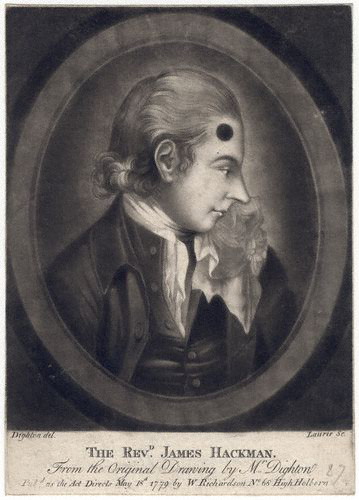
1779: James Hackman, sandwich wrecker

On this date in 1779, Londoners crowded Tyburn to witness the hanging of James Hackman for a sensational high-society murder.

Just twelve days before his date with the hemp, Hackman had walked up to Martha Ray at the Royal Opera and shot her in the head with a single-shot pistol. Then, he turned a second weapon on himself in a vain attempt to commit suicide.

The reader is not mistaken to detect here the mania of unrequited passion. Several years before the young Hackman was a handsome lieutenant introduced to Martha Ray’s social circle. She was a successful soprano on the London stage and though unmarried lived with the Earl of Sandwich as his wife in all but the illustrious name.


(cc image) from Molly Elliott.

Yes, this is the very Earl of Sandwich who pioneered the eating of things stuck between bread slices.* Sandwich — John Montagu to his parents — had other interests besides the munchies; he was the capable First Lord of the Admiralty throughout the 1770s. (As a result, Captain Cook, whose seafaring explorations were occurring at that time, kept naming islands for the Earl of Sandwich).

Domestic life for the Earl and his legal Countess — not “Earless”; that’s a different thing — wasn’t quite as satisfying. Dorothy Montagu, going gradually insane, separated from Sandwich. The lord plucked 17-year-old commoner Martha Ray — a quarter-century Sandwich’s junior — in 1759 and she lived as his mistress from there on out.*

Despite their age difference and never-formalized status they had a comfortable arrangement; Ray bore Sandwich five children** and the two appeared in public as a couple. The Earl sponsored Martha Ray’s opera career and education.

James Hackman met the Earl’s mistress around 1775 and the two formed an intimacy. Just how intimate they might have been has never been firmly established but is clear that as time passed the infatuation increasingly ran in only one direction. Hackman sold his commission in the 68th Regiment of Foot to become a Church of England deacon, perhaps angling by this expedient to woo Martha Ray away from Sandwich to a wholly respectable union.
She understandably demurred on this “opportunity” — leading the greenhorn Reverend to his blackguard act.

Hackman’s pointless waste of Martha Ray’s life and his own plucked his contemporaries’ sentimental heartstrings like nothing else. “All ranks of people … pitied the murderer’s fate,” remarks the Newgate Calendar. One newspaper report of the death sentence noted that “all present were greatly affected” at Hackman’s agitations “and however we may detest the crime, a tear of pity will fall from every humane eye on the fate of the unhappy criminal.” (General Advertiser and Morning Intelligencer, Apr. 17, 1779)

James Boswell was fascinated by the crime; he attended the trial and spilled many public and private words on its subject.

Boswell empathized with Hackman: in a report of the trial for the St. James’s Chronicle (Apr. 15-17, 1779) he opined that the “natural Effect of disappointed Love, however, shocking it may appear, is to excite the most horrid Resentment against his Object, at least to make us prefer the Destruction of our Mistress, to seeing her possessed by a Rival.” Not that Boswell condoned the murder, but “I would say to all that are conscious that their Passions are violent, Think ye that htis unfortunate Gentleman’s general Character is … worse than yours? No, it is not.”

While Human Justice is to be satisfied, let us consider that his Crime was neither premeditated‡ Cruelty, nor base Greediness. He is therefore an Object neither of Abhorrence nor of Contempt … Let us unite our fervent Prayers to the Throne of Heaven, that this our Brother may obtain Forgiveness through Jesus Christ, and be admitted in another State of Being to everlasting Happiness.

The kinship so many Londoners felt for this homicidal stalker moved print copy high and low, before Martha’s body had gone quite cold. Its most notable product was the 1780 Love and Madness, an epistolary novel of tragic passion presented via the (fictitious) letters exchanged by the supposed lovers. So heavily did this understanding of events by Hackman’s contemporaries color its subsequent remembrance that Love and Madness is also the title or subtitle of two 21st century nonfiction considerations of the affair. (1, 2 | Review of both)

Hackman for his part carried off the requisite public posture of resigned tragic nobility in the few days before he satisfied human justice. The General Evening Post, April 17-20 1779 described the execution:

This unfortunate gentleman received the sacrament in the morning with all the fervency and devotion of a sincere repenting criminal: — he repeated that affecting acknowledgment of his guilt, which on his trial drew tears from the audience, and seemed in a state of composure, unruffled with the idea of punishment, which, he said, was no more than he deserved.

At nine o’clock he came into the press-yard, where a great crowd of persons assembled to gratify their curiosity. That all might have an equal share of the sight, a lane was formed by the multitude on each side, through which Mr. Hackman passed, dressed in black, leaning on the arm of his friend the Rev. Mr. Porter, whose hand he squeezed as he muttered the solemn invocation to Heaven, not to forsake a sinner of so enormous a degree, in the trying hour of death.

Mr. Hackman was conveyed from Newgate in a mourning coach, attended by the Rev. Mr. Porter Mr. Villette, the ordinary of Newgate, and Mr. Leapingwell, a Sheriff’s officer.

He reached Tyburn about a quarter before eleven o’clock. When he arrived at the fatal tree, a cart lined with black was under the gallows ready to receive him. Mr. Porter and Mr. Villette ascended it by a pair of steps, and he followed them unsupported. As soon as he had got into it he walked forward, and fell on his knees, (a position seldom used by persons in his circumstances at Tyburn, as they always pray standing) and the Clergymen did the like, one on each side of him, where they remained praying for about fifteen minutes, then got up, when the rope was put about his neck, and tied to the gallows.

In this manner he remained praying between the two Divines for ten minutes more, when the Rev. Mr. Porter embraced him, and Mr. Villette took his leave, and both left the cart. The convict[‘]s cap being pulled over his face, he told the executioner to leave him to himself for a few minutes, and he would drop his handkerchief as a signal when he was ready, which he did after a few minutes pause, and was thereupon launched into eternity.

His whole behaviour was manly, but not bold: his mind seemed to be quite calm, from a firm belief in the mercies of his Saviour.

He wore not hat, not any bandage on his face where he gave himself the wound, that the public curiosity might not be interrupted in looking at him; saying, “that he wished to be made a public spectacle of, and hoped his death might be of service to mankind.”

He was no ways convulsed, nor was their [sic] any motion of the body that tended to shew it experienced any pain. Nothing more was to be seen than what proceeded from the jerk on quitting the cart.

The mob was more numerous than on any other occasion since the death of Dr. Dodd. It was expected Mr. Hackman would suffer at Covent-garden, and preparations were made by some speculating carpenters, who met with a mortifying disappointment.

After hanging the usual time, his body was put into a hearse, and taken to Surgeons-hall in the Old Bailey, where it was prepared for the inspection of the public.

Mr. Harkman expressed a wish to his friends, that the ceremony of anatomizing his body might be dispensed with; and that his corpse might be treated in the same manner as that of Lord Ferrers.

Mr. Hackman intimated to a particular friend, that if his remains could be deposited near those of Miss Ray he should feel inexpressible happiness in the hour of death.

A man who was standing near a dray in Oxford-street to see Mr. Hackman pass, was thrown down under one of the horses by the crowd; the horse being frightened, stamped on the man, and beat out his brains.

* Allegedly so that the Earl wouldn’t have to leave his beloved gambling table to dine.

** There is a wonderful bon mot that has enlivened compendia of anecdotes through the years, consisting of more or less the following exchange:

First speaker: You will either die on the gallows or of some social disease.

Second speaker: That depends upon whether I embrace your principles or your mistress.

Though it’s been variously attributed, it appears that the retort was originally delivered by the comic Samuel Foote to Lord Sandwich — about Martha Ray.

† Notable among the five children of Sandwich and Martha Ray: jurist Basil Montagu.

Sandwich’s wife also bore him a legitimate son, who eventually succeeded to the father’s Earldom; the title still exists today.

‡ Hackman had to be talked off simply pleading guilty but in the end he hung his trial hopes on arguing that he intended to kill himself, in Martha’s presence, and was overwhelmed by a momentary “phrensy”. A letter in his pocket meant to be delivered posthumously to his brother-in-law supported this claim; the fact that he brought two guns to meet her rebutted it.

Trial judge William Blackstone pointed out to Hackman’s jurors that the composure of the accused before and after the crime did not suggest a madman and that accepting Hackman’s claim of only an instant’s insanity could present a very slippery slope indeed for future murder prosecutions.

On this day..

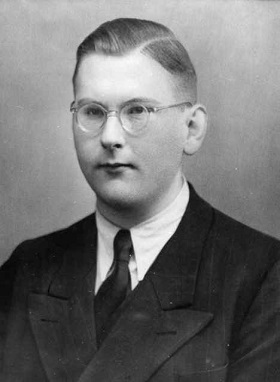
1945: Robert Limpert, Ansbach antifascist

The ferocious commitment of the Third Reich to fight to the last man even when World War II was long past hope of German victory provided the occasion (or the pretext) for many of that bloody conflict’s most poignant and pointless deaths.

In these execution-focused pages we have seen the death penalty meted out to ideological enemies whom the Nazis hastened to dispose of in their last hours; almost infinitely more numerous were everyday people who by Berlin’s Götterdämmerung were made so much meat for the ordnance of the advancing Allies.

On this date in 1945, Robert Limpert’s effort to avoid the latter fate for his native Ansbach caused him to suffer the pangs of an entirely gratuitous execution.

Only 19 years old, Limpert had been disqualified from even desperate war’s-end military conscription by a severe heart problem.

He had made little secret of his antiwar views in the earlier years of the war. Even so, it was a deep shock while he was studying at the University of Wurzburg to see that ancient city devastated by a March 16 bombing raid that claimed 5,000 lives and destroyed most of its historic center.

He wandered back to Ansbach horrified, and sure that this city ought not share Wurzburg’s ordeal.

By April 18, American troops were just a few kilometers from the town. Limpert had spent the night before surreptitiously distributing pamphlets calling for a bloodless surrender, as he had on several earlier days. (Sample rhetoric: “Death to the Nazi hangmen.”)

According to Stephen Fritz, who describes this story in detail in his Endkampf: Soldiers, Civilians, and the Death of the Third Reich, Ansbach was in a state of near-collapse that Wednesday. Party officials were discreetly discarding their soon-to-be-incriminating insignia, and crowds jostled each other to loot canned goods for the prospective months of want ahead.

Though the Ansbach populace was violently hostile to the idea of inviting bombardment by fighting the Americans, word was that the rigorous commandant, Col. Ernst Meyer, did indeed mean to do so. Trying to prevent a disaster from befalling his city, Limpert that morning cut the telephone wires from the Col. Meyer’s command post to the nearby troops at the front — an act observed and reported by two diligent Hitler Youth.

What followed was a cruel exertion of a military machine aggrieved by Limpert’s entirely well-founded lese-majeste. The cut wire didn’t matter at all because the command post had already been abandoned. But it was reported, and policemen and bureaucrats began mindlessly following procedures. “In the chaos, nothing would have been easier than to drop the matter quietly and let Limpert go,” Fritz observes.

Meyer was frenetically trying to organize defenses that did not want to be organized and by the time he caught wind of of the Limpert investigation he was fit to be tied.

“For me,” he said later, “there was no doubt that I had found the man who had already engaged in treason for the past eight days [pamphleting against the war] … While forward in the front lines … brave soldiers risked their lives to defend the homeland, a coward attacked them in the back. I now had to act. I said, ‘Gentlemen, we’ll now immediately form a court-martial …’ Silence everywhere. I had the impression of a certain helplessness.” (Fritz, again)

Meyer’s aides were reluctant to speak. It was obvious that the Americans would occupy Ansbach with hours, but also obvious that an insufficiency of zeal could have any one of them shot on the spot. One or two of them hesitatingly suggested further investigation — an overtly correct notion that would be tantamount to dropping the case under the circumstances.

Meyer brusquely announced, “I sentence Limpert to death by hanging; the sentence will be carried out immediately.” According to Zippold [a constable], Meyer also declared that the entire Limpert family would be executed, whereupon both policem[e]n rushed to their defense. Unwilling to press the issue, Meyer said curtly, “We don’t have any time, let’s get going.”

In NS-Offizier war ich nicht, Col. Meyer’s daughter, Ute Althaus, grapples with his perspective on Limpert’s hanging — which Meyer always felt was justified.

It was past 1 in the afternoon when Meyer stalked out to the entrance of the city hall to conduct the execution personally. While all of Ansbach, all of the western front, sabotaged his frenzied defense of the Reich, Meyer had this boy at his mercy. The colonel poured all of his rectitude and despair into taking away at least this one life.

Nevertheless, Meyer was not an executioner. Nothing was ready for his improvised hanging, and while the colonel tied up the nearest rope he could get someone to fetch him, Robert Limpert twisted away and escaped. He made it maybe 100 yards: no bystander dared to answer his pleas for help as he was tackled, kicked, and dragged back to his gallows.

The story has it that Meyer, after hanging Limpert twice — the noose broke the first time — pinned some of the treasonable pamphlets to the body, then immediately hopped on a bicycle and fled directly out of town. Maybe the folklore has become a bit exaggerated on that point … but he can’t have stayed much longer. The Americans were there by supper time to cut Robert Limpert’s body down.

Today, several plaques in Ansbach honor Limpert.

On this day..

1635: Elizabeth Evans, “Canonbury Besse”

On this date in 1635, Elizabeth Evans (known as “Canonbury Besse”) was hanged for murder.

Sometimes characterized as one of early modern Europe’s pioneer serial killers, Evans was not driven to slaughter by compulsion — merely by its emoluments. Using an early version of the timeless “Lonely Hearts killer” scheme familiar to a later era of classified adverts and Craigslist postings,* Evans and her beau Tom Sherwood committed at least five homicides via the expedient of Canonbury Besse’s allures.

Once the prospect had been enticed to a private rendezvous, Sherwood — “Country Tom” — would jump him, and the couple would rob the body. A straightforward enterprise, with a straightforward consequence. (Sherwood had already gone to the gallows on April 14th.)

The ballad “Murder Upon Murder” blames Evans for seducing Sherwood, “a man of honest parentage”, both bodily and spiritually:

she sotted so his minde,
That unto any villany,
fierce Sherwood was inclind,
His coyne all spent he must have more,
For to content his filthy (Whoore).

So shocking was the spree these lovebirds carried out — as reflected in nicknames that denote a degree of celebrity — that they were doomed to posthumous terrors as well.

Sherwood was hung in chains near St. Pancras Church where he so notably failed to deter crime that a later group of thieves, frustrated at finding their mark penniless, contempuously lashed him naked to Country Tom’s gibbet.

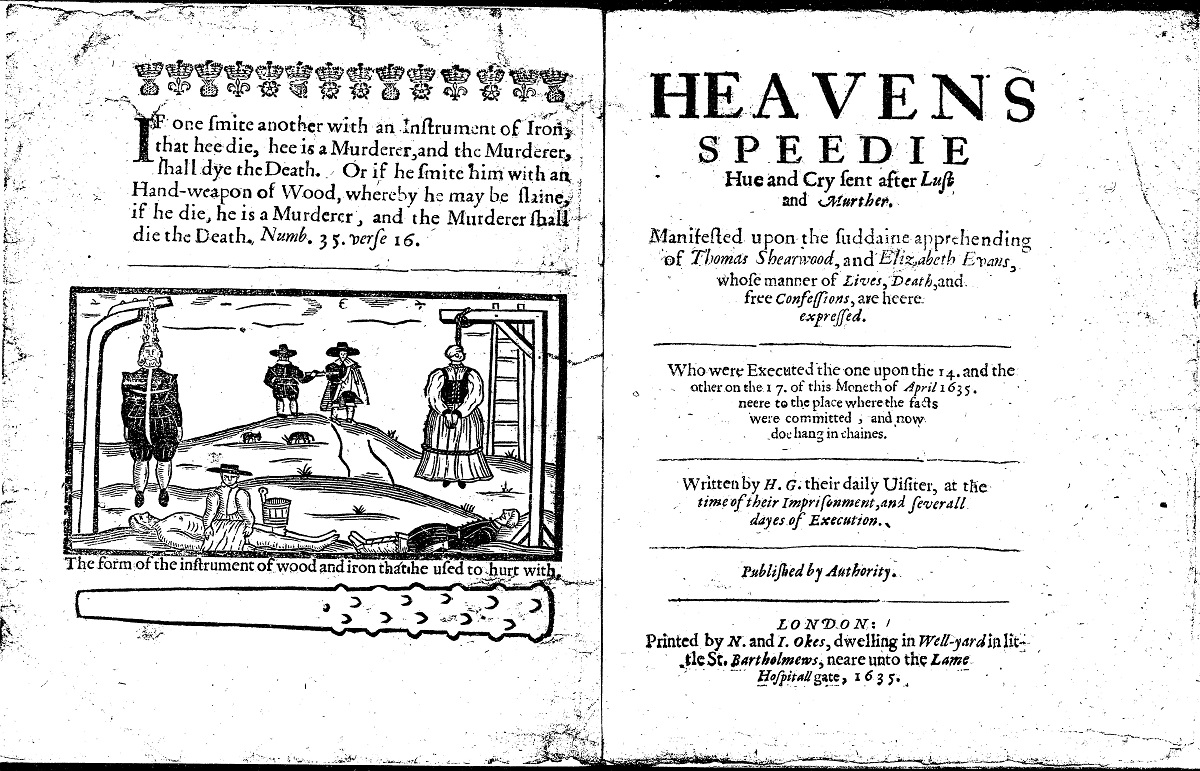
“Oh pity! Still running on to more mischief, having such a fearful spectacle before their eyes as Country Tom, which should rather have frightened and hindered them from doing this bold and insolent act,” laments Henry Goodcole in Heaven’s Speedie Hue and Cry, a narrative pamphlet trading on that same “fearful spectacle.”


Detail view (click for the full image) of Heaven’s Speedie Hue and Cry, a pamphlet narrating the crimes of Sherwood and Evans.

Canonbury Besse was bound over to the surgeons for anatomizing — well before this particular terror became a common extension of murder sentences. According to The Body Emblazoned: Dissection and the Human Body in Renaissance Culture, both Sherwood’s and Evans’s skeletons would ultimately became ornaments on permanent display at Inigo Jones‘s 1636 London anatomy theater,** and could be seen there as late as 1784.

* Consider, for instance, America’s Lonely Hearts Killers, Raymond Fernandez and Martha Beck — or Henri Landru, French predator of World War I widows.

** Diarist Samuel Pepys described a visit to this theater in 1663.

On this day..

1355: Filippo Calendario and Bertuccio Isarello, Doge stooges

This date in 1355 was the morning after the failed coup of Venetian Doge Marino Faliero. And it was the first date that vengeance began to fall upon the plotters.

Faliero, voted power by the fellow-noblemen who bossed the Serene Republic, intended to displace the patrician class with commoner support. The scheme called for Faliero’s supporters secretly to mobilize hundreds of men who on April 15 would gather at the Piazza San Marco and mount their surprise takeover. But the plot sank like a stone on the big day, with anticipated adherents turning out sparsely or flatly declining and word soon reaching aristocratic ears of trouble afoot. The would-be masters of Venice were soon rounded up without resistance by the real masters of Venice.

In this misfired drama, Faliero’s henchmen — the men upon whom fell the task of orchestrating the cells who would summon the traitor militia — were Filippo Calendario and Bertuccio Isarello. And on this, the following day, they were tried, sentenced, and by evening hung from upper windows of the Ducal Palace. Both men were gagged: one last precaution against the sort of popular exhortation that they had not managed when it counted.

“The earth was set in motion,” one chronicler recorded of the Venetian establishment’s reaction to the menace. (Source) Faliero would die the next day; in all, eleven gibbeted corpses festooned the palace as a warning against the next aspirant.

Isarello was the captain of a Venetian galley who had been appointed by Faliero — controversially bypassing the usual noble prerogatives — and had rewarded his prince by expertly harrying Genoese merchantmen.

Calendario (English Wikipedia entry | the more detailed German), Isarello’s father-in-law, was a stonemason, sculptor and architect who actually worked on the very palace he was hanged from.


Column capital of Drunken Noah dating from the period of Calendario’s work on the Venetian Ducal Palace. (cc) image from Honza Beran.

On this day..

1322: Bartholomew de Badlesmere

On this date in 1322, Bartholomew de Badlesmere, the first (of only two) Baron Badlesmere, lost his head.

The barons in the dangerous age of Edward II were marked by where they made their political allegiances between the king and his rival the Earl of Lancaster.

Badlesmere? He … evolved.

The man could tack to the wind with the very best of them, or the very worst; he was reviled as the Benedict Arnold of 14th century England for chickenheartedly failing to protect the Earl of Gloucester when the latter impetuously charged to his death at Bannockburn. As a bard of the time put it,

This is the traitorous man Bartholomew, whom in all victories may God confound, because he has been to his master as changeable as a pharisee. Hence, as the representative of Judas, he shall be condemned to death … because he refused to come to his master’s support this traitor has deserved to be put to the rack … deserved to suffer judgment of decapitation.

As the 1320s began, he was a stalwart of what has been termed the “Middle Party”, whose position vis-a-vis Edward and Lancaster was what you would expect from the name.

Badlesmere badly misplayed a strong hand by defecting in the so-called “Despenser War” to the anti-Edwardian party, even though Lancaster pretty much hated his guts — and now the king did, too,* dissipating any mutual goodwill that might have been earned a few years before when the king’s favorite (and the war’s namesake) Hugh Despenser went and rescued Badlesmere’s wife from an attack.

And unlike at Bannockburn, Badlesmere here stepped into the trap rather than out of it.

Lancaster’s party was decisively defeated on March 16, 1322 at the Battle of Boroughbridge.

Days after the battle, Badlesmere was caught skulking in a glade by the Earl of Mar and shipped to Canterbury for trial. He was condemned to death on this date, and sent directly from court to a hurdle dragged by a horse to Blean three miles away, where he was hanged and beheaded. He was one of 20 or so lords and knights Edward had put to death.

Lancaster himself was another — although a “Contrariant” whom he didn’t execute, Roger Mortimer, would make Edward regret his clemency by overthrowing the king four years later.

* In an affair that Edward II biographer Kathryn Warner thinks was neatly contrived by the king, his Queen Isabella called on Badlesmere’s wife when the latter held Leeds Castle sans husband. Lady Badlesmere refused to admit the queen, giving Edward a welcome excuse for besieging a fortress holding out against its sovereign.

On this day..