1805: Mary Morgan, anomalously

On this date in 1805, servant Mary Morgan, age 17, was hanged at Presteigne for murdering her bastard child.

An undercook in M.P. Walter Wilkins‘s Maesllwch Castle, Morgan had that achingly typical infanticide story: an unwed youth down the servants’ quarters desperately concealing the pregnancy until her coworkers sniffed her out, barged into the room where she had locked herself up to surreptitiously give birth, and discovered the newborn, “cutt open, deep sunk in the Feathers with the Child’s head nearly divided from the Body” by the efficient hand of a young under-cook who had often used that same pen-knife to slaughter chickens.

“I determined, therefore, to kill it, poor thing!” she would later confess of the (unnamed) father’s refusing her any aid. “Out of the way, being perfectly sure that I could not provide for it myself.”

That was in September of 1804. She would remain imprisoned until she could be tried at the Radnorshire assizes the following April.

Morgan expected lenient treatment — more on that in a moment — and must have been shocked to have the death sentence pronounced on April 11, with no more than two days to prepare herself for the ordeal. She was reportedly in a state of near-collapse when hanged at Gallows Lane.


Mary Morgan’s grave marker in St. Andrew’s parish church. A much longer and more sanctimonious stone, erected by a friend of the judge, also stands in the same cemetery.

We have seen elsewhere in these pages that executing women for infanticide was becoming distinctly uncomfortable for Europeans at this period, and Great Britain was no exception.

The most recent executions for infanticide at this point in London appears to be those of Jane Cornforth in 1774 and Sarah Reynolds in 1775. According to Anne-Marie Kilday’s A History of Infanticide in Britain, c. 1600 to the Present, hanging Welsh infanticides was practically ancient history at this point: the last such execution ordered by the Court of Great Sessions in Wales had been way back in 1739 — and the court would not order another one before its 1830 abolition.

During those many decades, close to 200 infanticide cases came to its bar. Hardly any of the accused women were even convicted, never mind condemned.* All the more surprising, then, that the one and only prisoner to merit a death sentence was a 17-year-old. Why did Mary Morgan hang when other Welsh infanticides walked?

The (presumably unobtainable) answer has occasioned a good deal of modern-day speculation.

One possible reason was a cruel judgment on Mary’s unbecoming nonchalance in the court. The presiding judge, George Hardinge,** wrote in private correspondence to the Bishop of St. Asaph that young Miss Morgan “took it for granted that she would be acquitted; had ordered gay apparel to attest the event of her deliverance; and supposed the young gentleman (who I well knew) would save her by a letter to me.” Judges like to see a little cowering.

The young gentleman Hardinge alludes to is another person of interest with respect to Mary Morgan’s surprising fate: Walter Wilkins, Jr. — the heir in the household where Mary served. This man seduced Mary but was not — so said both Mary and Walter — the father of the unfortunate child. In an egregious conflict of interest, Wilkins served on the grand jury that found his lover guilty. Was he playing a double game, posing as a potential intercessor even while keen to eliminate the evidence of his misdeeds?

Kilday suspects that in the end it was nothing but the calculated caprice of Judge Hardinge — who, although he often acquitted accused infanticides, was also alarmed by the prevalence of the practice and wanted to stake out at least one deterrent instance of truly exemplary punishment. As he said in his sentencing address to Mary Morgan, “many other girls (thoughtless and light as you have been) would have been encouraged by your escape to commit your crime, with hopes of impunity; the merciful turn of your example will save them.”

Hardinge himself might not have been fully at home with this rationale. He’s reported to have visited the grave of his “thoughtless and light” defendant several times, even composing a verse “On Seeing the Tomb of Mary Morgan”:

Flow the tear that Pity loves,
Upon Mary’s hapless fate:
It’s a tear that God approves;
He can strike, but cannot hate.
Read in time, oh beauteous Maid!
Shun the Lover’s poisoning art!
Mary was by Love betray’d,
And a viper stung the heart.
Love the constant and the good!
Wed the Husband of your choice,
Blest is then your Children’s food,
Sweet the little Cherub’s voice.
Had Religion glanc’d its beam
On the Mourner’s frantic bed,
Mute had been the tablet’s theme,
Nor would Mary’s child have bled.
She for an example fell,
But is Man from censure free?
Thine Seducer, is the knell,
It’s a Messenger to thee.

* Kilday makes it 149 indictments from 1730 to 1804, with seven convictions and two executions — Jane Humphries in 1734 and Elinor Hadley in 1739; and, after Mary Morgan, another 46 indictments up until 1830 without a single conviction.

** Look for Judge Hardinge in Lord Byron’s Don Juan:

There was the waggish Welsh Judge, Jefferies Hardsman,
In his grave office so completely skill’d,
That when a culprit came for condemnation,
He had his judge’s joke for consolation.

On this day..

1945: Pvt. Benjamin Hopper

(Thanks to Meaghan Good of the Charley Project for the guest post. -ed.)

On this day in 1945, mere weeks before Germany’s surrender, U.S. Private Benjamin F. Hopper of the 3170th Quartermaster Service Company was judicially hanged for murder.

“The case was straightforward,” notes French L. MacLean in his book The Fifth Field: The Story of the 96 American Soldiers Sentenced to Death and Executed in Europe and North Africa in World War II. He describes it as “an excellent example of stupid situations that soldiers could get themselves into, if they had been drinking and did not consider the consequences of their actions.”

Quite so.

On the night of the crime, Hopper and four other soldiers were hanging out in a cafe in the town of Welkenraedt, Belgium, just outside of Liege. Just after midnight, Hopper got into an argument with one of his companions, Private Randolph Jackson Jr.

The two men argued frequently and the other three in the group were used to it, and didn’t take them seriously when they started threatening to shoot each other. Finally Private Jackson handed Hopper his gun, presumably daring him to shoot. Hopper shot him dead, then told the witnesses, “You didn’t see nothing.”

At his court-martial, he did not testify and there was no defense. Hopper protested about this later, saying he didn’t get a fair trial: “My Defense Counsel said he was going to tell them. Told me to stay silent. So, he got up and told them I wasn’t guilty. He didn’t say much else.”

Unlike many military men sentenced to death during World War II, Hopper showed remorse for what he had done. Still he asked for leniency and penned a letter to General Eisenhower beginning:

Gen. Eisenhower

Dear Sir, I was tried for mudder and the court find me guilty and sences me to be hong Sir. And Sir I am asking you to please Sir look in to this mader close Sir for me because I have made a great mucstake Sir and wont you give me another chanch in the armey.

Hopper’s IQ tested at 50, putting him in the moderately mentally retarded range, and a psychiatrist who evaluated him stated he had a mental age of about nine, “bordering on mental deficiency.” Someone with that degree of mental disability would not be permitted to be executed today.

Some people argued that the death sentence should be commuted to life in prison, citing Hopper’s intellectual impairment and the lack of premeditation. Weighing against that was his prior recorded offenses of going AWOL and being in Liege without an official pass. The Brigadier General who reviewed the case recommended that the death sentence stand, and Eisenhower agreed.

Hopper died on a clear, warm morning in Le Mans, France. At 11:00 a.m., his hands and ankles were bound and he said his last words to the chaplain: “Father, I would like you to write to my mother.” The trap sprung at 11:01 and Hopper was pronounced dead at 11:24.

On this day..

1879: John Phair

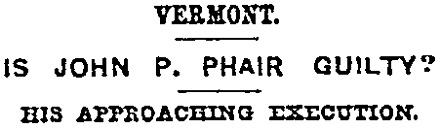
On this date in 1879, a circuitous four-year journey to the gibbet — quite Odyssean by 1870s standards — concluded when John P. Phair was hanged in St. Albans, Vt., still protesting his innocence.

Phair was convicted on circumstantial evidence of the murder of his former companion, Ann Freese: that circumstance was his pawning the late widow’s watch in Boston.
Though police had the exact serial number of the timepiece, Phair staunchly insisted that the man who sold it was not he — damning the Jewish pawnbrokers who identified him as the seller:

Their business is that of pawnbroking — a life of fraud. Their race bears the curse of God, because they crucified his Son eighteen centuries ago … They don’t regard an oath administered in the Christian form.

That salty quote is courtesy of the case file in the excellent historical crime blog Murder by Gaslight, which tracks the strange subsequent progress of John Phair to the gallows in 1877.

On that occasion, two years nearly to the day before his eventual execution, Phair had been due to die — but his supporters had also roused considerable skepticism on the justice of the sentence. For instance, the murderer had apparently covered his tracks by torching the place, and Freese’s remains were discovered badly burnt after the fire was put out. But this fire was detected at 7 a.m., three hours after the departure of the train Phair would have taken to Boston. And Phair produced a quasi-alibi in the form a train passenger who tentatively corroborated Phair’s claim to have merely switched trains in Boston without stopping long enough to fence a watch. So …

Is John P. Phair Guilty?
Boston Evening Journal, April 4, 1877

Wherever the judicial system proposes to situate the threshold for conviction and condemnation, some subset of messy real-life cases will always smudge the brightest of lines. Phair’s contemporaries simply could not satisfy themselves that they really had the right man. But neither were they convinced of Phair’s repeated denials. In the absence of moral certainty, legal process takes the reins. A dramatic eleventh-hour reprieve from the governor saved Phair in 1877. But as Murder by Gaslight notes:

The problem for Phair now was that by Vermont law he could not ask for a new trial if more than two years had passed since the original verdict. The governor granted him another reprieve until the first Friday of April, 1879 while the legislature debated changing the law.

Phair won this battle — the legislature empowered judges to refer such a case to the Supreme Court — but lost the war. In February 1879, Vermont’s high court considered, and then quickly rejected, Phair’s appeal. Past this point, exertions for the condemned man became the longest of shots, but this is not to say that they did not continue. The man’s exhaustive last-ditch efforts, some by his own hand and some mounted by his friends, have a whiff of the familiar present-day spectacle to them. (The Cleveland Plain Dealer sarcastically titled its after-action report “Hanged At Last”)

Phair won a six-day reprieve from a scheduled April 4 execution; on the eve of the hanging, two judges were taking Phair’s last appeal for a fresh trial; and on the morning of the execution the state’s governor was obliged to reject Phair’s supporters’ plea for a delay to allow the legislature to intervene yet again. (Phair didn’t even know this last one was occurring.)

The man himself was reported calm in the last hours, even as he persisted with his denials. Guilty or not, he finally fell through the long-awaited gallows trap murmuring “Lord, remember me!” at 2:11 p.m. on this date in 1879.

On this day..

1980: Muhammad Baqir al-Sadr, Muqtada al-Sadr’s father-in-law

Iraqi cleric Muhammad Baqir al-Sadr was hanged on this date in 1980 in Saddam Hussein’s Iraq.

One of the greatest Shia scholars of the 20th century, Sadr laid the groundwork for modern Islamic banking. During the ascendancy of Arab nationalism, Sadr wrote sharp critiques of the rival Cold War systems and helped to found the Islamic Dawa Party.*

As a Shia religious party, Al-Dawa stood starkly at odds with the Sunni-based and secular Ba’ath dictatorship — and Sadr faced state harassment throughout the 1970s. Following the 1979 Iranian Revolution, whose leadership explicitly took inspiration from Sadr, Baghdad eliminated Sadr fearing he might lead a similar uprising in Iraq’s Shia south. (Sadr’s sister Amina al-Sadr — known as Bint al-Huda — was also arrested and executed around the same time.)

And Saddam Hussein may have been quite right to fear this. The name Sadr, of course, will be familiar to any observer of contemporary Iraq — for Muhammad Baqir al-Sadr’s son-in-law Muqtada al-Sadr today holds sway in the south and in Baghdad’s Shia stronghold, Sadr City.

* Iraq’s president from 2006 to 2014, Nouri al-Maliki, represented the Dawa Party. He was known to show off to guests the ring Muhammad Baqir al-Sadr wore when he attained his martyrdom.

On this day..

1859: Baltimore’s Plug Uglies

This date in 1859 saw the joint hanging of youths from a notorious Baltimore gang, and in honor of the occasion thousands upon thousands of curiosity-seekers packed Charm City from “all parts of the State, the District of Columbia, Virginia and Pennsylvania, and even New York city and Buffalo” to throng the hills and high points overlooking the Baltimore City Jail, where a fine view could be had of the nominally private gallows.

“The housetops, windows, trees and all other places from whence a more enlarged view could be obtained, were crowded with human beings,” reported the Baltimore Sun (Apr. 9, 1859). “A sea of faces met the eye far and near — men, women and children — old age and infancy — white and black — swelled up the vast multitude, drawn to witness the horrible spectacle.”

The doomed quartet were four men named Henry Gambrill, Marion Crop, Peter Corrie, and John Cryphus. Cryphus was a black man condemned for a knife murder committed under the name John Stephens, and he vainly protested all the way to the gallows that Stephens was not he.

The other three who hanged with him — our principal focus today — were entirely unconnected to him. Gambrill, Crop, and Corrie were all stalwarts of the “Plug Uglies”, who were at once a street gang and a political goon squad, involved (with several similar entities) in a number of election day poll riots in the 1850s. Baltimore was at this point America’s third-largest city, having boomed to 200,000 souls rather faster than its civic institutions could cope.

The city veered near to mob rule (for which it earned the sobriquet “Mobtown”): rival gangs of toughs like the Plug Uglies regularly fought deadly street battles involving hundreds of participants — especially around municipal elections which they shamelessly rigged with armed bullying and prodigious vote-stuffing.* The anti-Know Nothing mayoral candidate in 1858 simply conceded the election rather than invite “loss of life and the general disorder of the city.”


Plug Ugly ruffians boss a ward. (Via)

Affiliated with the nativist, anti-Catholic “Know-Nothing” movement,** the Plug Uglies’ nickname underscores the brutal tenor of their times:

[Baltimore’s gangs] carried pugnacious and frequently obscene banners and often brandished weapons. The awl was seen as a workingman’s weapon, and many were made and handed out at rallies. They were used to “plug” Democrats “ugly” and to prevent them from voting. (Source)

Not long before that peacekeeping 1858 mayoral concession, alliterative policemen Benjamin Benton and Robert Rigdon had arrested a Plug Ugly crony for disorderly conduct, when Henry Gambrill raced up to the grappling trio and shot Officer Benton in the head.

Officer Rigdon, who knew Gambrill well, testified against the goon in the resulting murder trial. So incensed were Gambrill’s pals that they contrived to assassinate Officer Rigdon in revenge: covered by a lookout, Marion Crop in the dark of night shot Rigdon through a window as the cop stood at his mantelpiece chatting with his wife. Both Crop and the lookout, Peter Corrie, were chased down and condemned for first degree murder at separate, and sensational, trials in January 1859.

Despite the power of the Know-Nothings, this outrage proved to fall well outside the range of the Plug Uglies’ impunity. If they could do this, then what institutional pillar of the city would remain standing?

No small sentiment went abroad to skip the assassins’ trials and proceed directly to the hanging — perhaps a problematic means by which to stave off anarchy. In a more promising vein, the affair catalyzed some long-sought political reform measures from the legislature to rein in political violence. And on a chilly, overcast morning in April, Marion Crop stood on the gallows and belted out a hymn for the nation’s gawkers, joined with varying enthusiasms by the other three doomed men.

Former friends, we now must leave you
All our earthly hopes are o’er
But in heaven we hope to greet you
There to meet to part no more.

When a few more moments wasted
And this dying scene is o’er
When this last dread grief we’ve tasted
We shall rise to fall no more.

Fast our sun of life’s declining
Soon it will set in endless night
But our hopes pure and reviving
Rise to fairer worlds of light.

Cease this mourning, trembling, sighing,
Death shall burst this sudden gloom
Then our spirits fluttering, flying
Shall be borne beyond the tomb.

Corrie and Crop were buried privately. Gambrill enjoyed a solem public funeral with a procession of a hundred or so carriages through the center of town. An estimated eight to ten thousand Know-Nothing sympathizers attended it.

* Full marks for period color to the gangs of that time, which included the Rip Raps, Black Snakes, Blood Tub, Regulators, Rough Skins, Double Pumps, and Calithumpians. The successful Plug Uglies, who spread to other cities than Baltimore, were the ones destined to give their name to the language as a synonym for a an urban rowdy. (It’s also the name of some bars.)

** Shortly after the events in this post, Baltimore would be distinguished by a massive, and deadly, riot against a column of federal troops being dispatched to Virginia in the immediate aftermath of Fort Sumter. Since the Battle of Fort Sumter itself had not resulted in any combat fatalities, it was this riot that laid in the ground the first bodies of America’s bloody Civil War.

† While the Know-Nothings’ national impact was limited, they essentially took over Maryland’s political apparatus in the 1850s and made it the party bastion. Know-Nothing nominee (and former U.S. President) Millard Fillmore carried only one state in the 1856 presidential election won by James Buchanan: Maryland.

On this day..

1764: John Nelson, Liverpool robber

From the Gazetteer and London Daily Advertiser, Feb. 15, 1764:

Extract of a letter from a gentleman at Liverpool, dated Feb. 2.

On Monday night was apprehended John Nelson (who has been frequently advertised in public papers) and for some time past has been a principal leader of a gang of highway robbers, and house-breakers. A Bailiff at Prescott has lately seen Nelson in a private lodging house in that town, and promised a handsome gratuity to the woman of the house, if she would give him the earliest intelligence when Nelson came again.

Accordingly on Monday evening, they acquainted him that Nelson was then in the house in bed; the Bailiff, upon this, engaged a Constable and three other men to accompany him to the house, and entering into it with as little noise as possible, they instantly went up stairs, and rushed into the room where Nelson lay; being thus surprised, and overpowered by numbers, he was at length obliged to submit, though not till after he had made a great resistance, and had struggled hard to get possession of his clothes, which lay at some distance from the bed; but the Bailiff stunned him by two blows on his head, and several upon his arm, with a large stick.

As soon as Nelson was secured, he offered the Bailiff a Johannes, and two other pieces of gold, and promised to send him fifty more in the morning, if he would leave him to drink a cup of ale with the other four men, but the Bailiff honestly rejected the profferred bribe. Upon examining his pockets, there were found two loaded pistols, which primed themselves, a powder-horn containing about two ounces of gunpowder, a tinder-horn, fifteen balls, a piece of crape, a case of launcets, a belt of a particular form to carry pistols in, and two silver meat spoons, without any mark.

He confessed, upon his examination before the Magistrates of this town, to all the robberies lately committed in this place, except one; to several highway robberies; and also impeached seven accomplices, two of whom are since taken and confined in the town gaol, two are gone to sea, and a pursuit is out in quest of the other three. Nelson formerly went to sea, and served an apprentice to a gentleman of this town; he is remarkably strong and robust, and of a daring and intrepid spirit. On the Sunday morning following, Nelson, with two of his confederates, attempted to make their escape, having got off their irons, and made a considerable progress under ground, but was prevented by the timely assistance of the guard, and properly secured; and on Tuesday they were conducted under a strong guard to Lancaster castle together with a woman, convicted of assisting the prisoners with saws and files, to make their escape. We hear Nelson has made several useful discoveries, by which means the gang of house-breakers and street robbers are expected to be brought to justice.


From the London Chronicle, Apr. 7-10, 1764:

At the assizes at Lancaster, the three following received sentence of death, viz. John Nelson, for entering the house of Mr. Richardson, of Liverpool, and stealing silver plate, &c. Thomas Naden, for pulling down and destroying Heaton-Mill, the property of Mr. George Bramall; and Francis Windle, for breaking into the house of Mr. Scarisbrick, of Widness, and stealing a sum of money. The judge, before he left the town, reprieved Windle, and ordered Nelson and Naden to be executed on Saturday the 7th instant.

On this day..

1772: Mary Hilton

On this date in 1772, Mary Hilton was burned at the stake in Lancaster for “petty treason”: poisoning with arsenic her husband, John, a blacksmith.

She was drawn on a sledge to the execution site, hanged to death as a mercy, and her body burnt to ashes.

On this day..

1766: William Whittle

William Whittle, a Catholic, was executed at Lancaster on this date in 1766 for murdering his Protestant wife and their children in a religious frenzy.

For whatever reason, several years into his union, Whittle took deeply to heart a priestly warning that he was liable to damnation for marrying a heretic. He accordingly ended the marriage by “cleaving his Wife’s Head with an Axe, and ripping her Belly open, and afterwards cutting off the Heads of the two Children, one of whom he also ripped open and took out its Heart.” (St. James’s Chronicle, April 5, 1766)

(The children, Whittle said, had been imperiled in soul by their mother’s taking them to an Episcopal church; in murdering them their loving father had sent them to purgatory en route to heaven, saving them from eternal hellfire.)

Whittle was condemned to be hung in chains for the shocking crime, a demonstration that Catholics understood as aimed pointedly at them. At least of their number replied with like menace in an anonymous letter to the Rev. Mr. Oliver of Preston, the magistrate who committed Whittle to prison.

Sir, I make bold to acquaint you, that your house and every clergyman’s that is in the town, or any black son of a bitch like you, for you are nothing but hereticks and damned fouls. If William Whittle, that worthy man, hangs up ten days, you may fully expect to be blown to damnation. I have nothing more material, but I desire that you will make interest for him to be cut down, or else you may fully expect it at ten days end. My name is S.M. and W.G.

(Letter as quoted in the Leeds Intelligencer, April 22, 1766 — also the source of the newspaper screenshot above)

Mainstream suspicion of Catholics at this time — which was within living memory of the last great Jacobite restoration attempt — was quite deeply ingrained; as one can see from the riposte above, the sentiment was mutual. After all, these were matters of eternal salvation even if Whittle himself “appeared to be a stupid, bigotted, ignorant fellow.”

The shocking family butchery evoked a minor wave of fretting over insidious Catholic-Protestant intermarriages. I think the present-day reader will not have much difficulty recognizing contemporary analogues to this thrust of resulting commentary:

I am likewise persuaded that there are many lay-papists in the kingdom who abhor this fact of Whittle as much as any protestant can do. But if their religion does not give countenance to such doctrines as this alledged by this miserable man, why do they not by some public act disavow their approbation of them? why do they leave suspicions upon themselves and their religion by their silence, when such occasions call upon them so pressingly to explain themselves, and particularly when they are complaining of the severity of the penal laws[?]

On this day..

1843: A bunch from Heage hanged

The Derbyshire village of Heage achieved a bit of lasting notoriety with the triple hanging on this date in 1843 of three of its felonious sons: Samuel Bonsall, William Bland, and John Hulme.

“They hang ’em in bunches in Heage” and “You can tell a man from Heage by the rope mark on his neck” are a couple of the ungenerous quips attached to the trio’s native soil on account of their villainy.


Heage. (cc) image from Stephen Jones.

Bland, at 39 the senior member of the group, gave a confession admitting that the three had invaded a home outside Derby occupied by a 72-year-old spinster named Martha Goddard and her sister Sally.

It should have been a simple burglary. Clobbering Sally and chasing Martha upstairs, they set about ransacking the place. Since only Bland bothered even to defend himself, and his defense was that he was only there to steal and not to kill, it’s a bit difficult to grasp exactly what happened that led the party to beat her dead. Bland said that he heard from a different room Martha Goddard shriek out for her sister.

Cellmates of Bonsall’s — a source that we do not ordinarily consider to be presumptively credible — said that Bonsall saw Hulme facing Goddard in her bedroom when she begged of him, “Man, man, what a man you are; I have given you my money; tell me what else you want, and I will give it to you; but spare my life.”

Hulme, they testified at third hand, snapped back, “You old bitch, I want some of your five-pound notes” — and smashed her with an iron crowbar. For his part, Hulme gave a confession fingering Bonsall as the murderer.

They had only a week from conviction to contemplate the state of their case and their soul. In the end, the three “made no confession that could be relied on, each endeavouring to fix the guilt of the murder upon the other.” (Aris’s Birmingham Gazette, April 3, 1843) They were hanged at Derby gaol.

On this day..

1884: Tombstone hangs five

The frontier town Tombstone, Arizona saw its first legal hanging on this date in 1884 — and its second, third, fourth, and fifth besides.

On the 8th of December ult., Daniel “Big Dan” Dowd, Comer W. “Red” Sample, Daniel “York” Kelly, William “Billy” Delaney and James “Tex” Howard rode into the nearby town of Bisbee in an attempt to seize the $7,000 payroll for the Copper Queen Mine.

Sadly the bandits mistimed the arrival of the boodle. Having already committed to the raid, they improvised a plunder of the general store and the valuables of any nearby customers they could lay the sight of their sixguns upon. And then on the way out, villainous mustaches a-twirl, the gangsters shot up the town and slew four good residents of Bisbee.

The survivors telegraphed the sheriff of Tombstone, the seat of Cochise County.*

This Bisbee Massacre was just two years on from Tombstone’s signature moment, the Gunfight at the O.K. Corral — and it had a similar whiff of the lawless frontier.

Arrayed against Wyatt Earp and Doc Holliday at the O.K. Corral** had been the so-called “cowboys”, a network of desperadoes who found this last vanishing enclave of the lawless frontier a congenial environment for opportunistic outlawry: livestock rustling, smuggling, stagecoach robbery, and the like.

The line between legitimate businessman and criminal element was as permeable as the nearby Mexican border. As Tombstone’s posses hunted down the five Bisbee shooters over the ensuing weeks, interrogations would reveal that Bisbee saloon-keeper John Heath — an Ohio native of shady reputation who could be found during the gunfight cowering behind his own bar — was actually the moving spirit behind the raid. He would later testify in a piece of hairsplitting vainglory that of course it was he who conceived it all, as his henchmen were too stupid for such a plan … but the part where they started shooting people was none of John Heath’s idea.

Heath was smart enough to get his own trial separate from his goons, and smart enough to work a jail sentence where his cronies were set up for execution.

Folk in Tombstone were incensed at this leniency and on February 22 they reversed it by extracting Heath from his irons and lynching him to a telegraph pole at First and Toughnut.

The Alfred Henry Lewis Wolfville books (available in the public domain) dramatize a fictitious western town loosely based on Tombstone … complete with vigilance committee and a strong female character named Nell.

It was fairly clear under the circumstances that the five toughs awaiting their March 28 hanging date had no need to entertain any hope of mercy.

Nonetheless, legendary frontierswoman Nellie Cashman — later to be inducted into the Alaska Mining Hall of Fame for her exertions in that arctic gold rush — was at this time resident in the silver boom town of Tombstone.

So appalled was the Irishwoman at the highly improper festive civic atmosphere prevailing in Tombstone as the executions approached that she organized a gang of her own: a team that on the eve of the hangings secretly dismantled a grandstands some ghoulish entrepreneur had erected in order to at least permit the event to go off with some modicum of solemnity.

* Cochise County, Arizona, was named for the great Apache warrior.

** Actually, the shootout was neither in nor abutting the O.K. Corral.

On this day..