1425: Parisina Malatesta and Ugo d’Este, for incest

On this date in 1425, the Marquess of Ferrara had his wife and son beheaded for an incestuous affair, along with a courtier who had kept their secret.

The “incest” was social rather than sanguinary: the lovers were not related. Like many a Renaissance despot, Niccolò III d’Este produced a multitudinous assortment of illegitimate children and underaged dynastic wives. Small wonder, one might think, that the 14-year-old (at her marriage) Parisina Malatesta (the link is to her Italian Wikipedia page) should come to prefer the attentions of the Duke’s eldest bastard Ugo (one year her junior) to those of a spouse more than twenty years older.
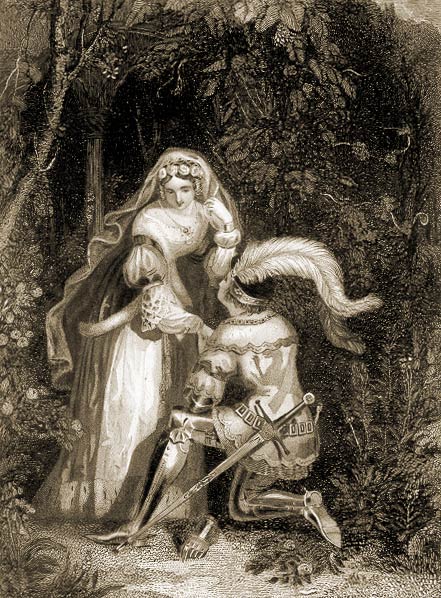
Awww.

Still, the affair has its curious aspect, apart from the obvious. The Duke was on that timeless monarchical quest for legitimate male issue; Parisina Malatesta would bear him two surviving daughters and a son who died in infancy during her teenage years.

One can hardly fail to think of that more renowned decapitated queen of the next century Anne Boleyn. Like Anne, Parisina lost her head to an incest allegation after a few years’ failure to give her husband an heir.

The need for specifically legitimate succession, however, was somewhat less pressing in tightly run Ferrara than early Tudor England. As the oldest illegitimate son, Ugo himself had a chance to succeed by his father’s appointment — in fact, the second illegitimate son Leonello ultimately did just that. For this reason, Ugo and Parisina — the latter threatening to supplant the former with a legitimate child of her own — might have been natural rivals, and there is some hint of initial enmity between the two. One wonders if there might not have been a twist of obscured courtly skullduggery about this day’s bloody climax.

In any event, interlocutors have preferred the personal aspect, and little wonder. The Marquess played his part by being stricken with anguish and remorse for his ruthless treatment of a favored son, possibly aided by a general reaction of horror among most contemporaries.*

Retold in later years as scandal (though never with much sympathy for the marquess**) its Byronic potential as tragic love story was eventually seized by, well, Lord Byron. His “Parisina” gives us two true hearts in the flower of youth crushed by the cruel weight of their unjust world … although he found it more apt to conclude with only the boy losing his head while the wail of his lover signals a more ambiguous fate.

With all the consciousness that he
Had only passed a just decree;
That they had wrought their doom of ill;
Yet Azo’s† age was wretched still.
The tainted branches of the tree,
If lopped with care, a strength may give,
By which the rest shall bloom and live
All greenly fresh and wildly free:
But if the lightning, in its wrath,
The waving boughs with fury scathe,
The massy trunk the ruin feels,
And never more a leaf reveals.

Mascagni also adapted it for the opera in 1913 — a legendarily tiresome four-hour affair. One review’s famous recommendation (apt enough for the subject as well as the performance) was “Cut, cut, cut!”

* The Marquess was less troubled about his wife, and promulgated a decree imposing like punishment for any other wife guilty of such a crime. The sentence was actually carried out upon a magistrate’s wife.

** Gibbon tut-tutted the affair, simultaneously helping circulate it anew:

Under the reign of Nicholas III, Ferrara was polluted with a domestic tragedy. By the testimony of a maid, and his own observation, the Marquis of Este discovered the incestuous loves of his wife Parisina, and Hugo his bastard son, a beautiful and valiant youth. They were beheaded in the castle by the sentence of a father and husband, who published his shame, and survived their execution. He was unfortunate, if they were guilty: if they were innocent, he was still more unfortunate; nor is there any possible situation in which I can sincerely approve the last act of the justice of a parent.

† Niccolo is “Azo” in the poem, for metric convenience. The House of Este had produced a number of lords named Azzo over the preceding centuries.

On this day..

1820: Karl Ludwig Sand, a curious strand of German history

Alexandre Dumas recognized the name of Karl Ludwig Sand, who lost his head on this date in 1820 in Mannheim, Germany, for the murder of the dramatist and humorist August von Kotzebue.

The assassination of von Kotzebue* worried the Prussian monarchy — then headed by Friederich Wilhelm III — and precipitated a series of proclamations, reforms, and internal struggles that finally led to a full-scale rebellion 30 years later.

A print showing Sand stabbing August von Koetzebue. Sand is reported to have shouted, “Here, you traitor to the fatherland!”

Sand was a member of a Burschenschaft,** a liberal student fraternity organization which appealed to nationalist Germans seeking a unified German nation-state, and he and others in his group regarded von Kotzebue as a plague on their cause. Von Kotzebue was then Councillor of the Russian Legation, the culmination of over a decade in the Russian civil service, and a spinmeister for the Russian regime. In 1816, while Sand was in college, von Kotzebue was tasked with managing the flow of information into the Prussian state in an effort to increase the monarch’s popularity in Germany.

At the very least, then, von Kotzebue had no love for the Burschenshaft movement from the start, which originated in the university town of Jena, and he did not hold back his criticisms in his weekly literature newpaper Literatische Wochenblatt. He casually disparaged the Burschenschaften, as this stab in the review of a novel in one of the earlier editions evidences:

Longing and love in the work is described in a way which, in the judgment of the Jenaer Recensenten, resembles a light Spring rain that is at least refreshing. That is more than one can say of the Jenaer Literature-Zeitung, which roughly resembles an autumnal rain that simply makes one wet without refreshing at all.

But the student organizations were on the rise during Sand’s time at university as a theology student, and the turbulent events in France during his final days in school were having ripple effects across the German populace. It was in this climate that a young man who was “distinguished at once by the gifts of the mind and the faculties of the soul” (as his Gymnasium rector put it) and who sought to become a pastor was drawn to the nationalistic movement. Sand’s opposition to the imperial rule of Prussia became increasingly more urgent after his studies, and he was determined to make a statement through action, eschewing what he called “simply writing and talking.” On March 23, 1819, the 22-year old found von Kotzebue in his house and stabbed him in front of several witnesses. Sand was quickly arrested and sentenced to death.†

A print depicting the Wartburg Festival of 1817, Burschenschaft colors prominently displayed. (Click for larger image.)

As a result of von Kotzebue’s murder, Prince Klemens Wenzel von Metternich set down a series of decrees, known as the Karlsbad Decrees, which sought to quell any thoughts of rebellion before they could fully ferment. The decrees limited both university activity and press activity, constraining the actions of university employees and setting down harsh restrictions on anyone who might dare question the monarch’s authority.

Sand’s contemporaries outside of Germany were hardly pleased with the death of von Kotzebue, which they saw as the precursor to a greater turmoil, and two decades of removal from the event proved a powerful force. By the time Dumas visited the site of Sand’s beheading and penned his own biography of the man, a thorough rendering of Sand’s brief life — much of it reconstructed from Sand’s writings and the memories of those who knew him — the rebellion of the Burschenschaften was once again afoot, this time with permanent consequences for the German people.

In the end, nationalism and constitutionalism were not the panaceas Sand and other Burschenschaefter may have liked. While Sand would hardly have counted as a Nazi (his Puritanical theology would have fallen on deaf ears in that regime), he would have recognized that group’s near-religious fervor of the public book burnings anti pro-German sentiments as a distant echo of the Burschenschaft’s Wartburg Festival.†† Indeed, the so-called Third Reich could never have existed without the Second Reich, whose seeds Sand and his fellow nationalists were sowing a half century early when his fateful date with the axe arrived.

* The name is also spelled “Kozebue” by some sources.

** The Burschenschaften were roughly based on the Lützow Free Corps, an academic paramilitary group which fought during the Napoleonic Wars. During their height of popularity, the Burschenschaften adopted the black-red-gold flag that was reclaimed by the Frankfurt Parliament in 1949 to be the official German flag.

† In the end, Sand and von Kotzebue were buried at the same cemetery.

†† The Wartburg Festival, held in 1817, was a celebration of Martin Luther’s proclamation against the church. An interesting discussion of the appeal of such festivals to the students of the day is given in The Course of German Nationalism: From Frederick the Great to Bismarck.

On this day..

1536: Anne Boleyn

On this date in 1536, Anne Boleyn lost her head.

Any queen decapitated by her king would of course rate an entry in these grim pages. But this does not quite explain Anne Boleyn‘s enduring appeal, relevance and recognizability for the most casual of modern observers, and her concomitant footprint in popular culture, even with the “Greek tragedy” quality of her life.

Anne stands at the fulcrum of England’s epochal leap into modernity. Whether she was that fulcrum might depend on the reader’s sympathy for the Great Man theory of history, but little more do we injure our headless queen to regard her as the woman for her time and place — the accidental hero (or villain) raised up and thrown down by the tectonic forces of her milieu.

Through Anne was born — for reasons of momentary political arrangements of long-forgotten dynasts, which seems a shockingly parochial proximate cause — the English Reformation, and through the Reformation was born the crown’s decisive triumph over the nobility, the broad middle class nurtured on the spoils of Catholic monasteries, the rising Britannia fit to rule. Most would take as an epitaph historical accidents of such magnitude.

Of course, by those same accidents, Anne was the instrument of thousands of deaths herself, and little did she appear troubled in life by the corpses upon which she ascended the throne.

Her own family maps the change wrought on England. An ancestor was beheaded in the Wars of the Roses, medieval England’s last great breakdown; her uncle Thomas Howard was one of the throwback scheming Dukes, mastered by his sovereign to the extent of issuing Anne’s capital sentence from his own lips;* the beheaded woman’s daughter, Queen Elizabeth I, set a recognizably centralized English state on the path of empire.

Fitting tribute that, from the Tower where she met her end** to lands undreamt-of in her time, people still, like Henry, find her captivating.

[audio:http://www.bl.uk/whatson/podcasts/podcast95533.mp3]

* Anne’s father also declared for her guilt. Unprincipled as these men undoubtedly were, it cannot have been a pleasant responsibility; the question of whether she was actually guilty of adultery-cum-treason, the fatal charge extracted from a supposed lover by torture, has been hotly and inconclusively disputed by posterity.

** With a solemn speech submissive to Henry but not admitting any guilt — in an earlier moment of levity, she had famously remarked of the French swordsman hired to do the job, “I heard say the executioner was very good, and I have a little neck.”

On this day..

1941: Maurice Bavaud, who couldn’t get a shot off

Early this morning in 1941, a Swiss theology student had his head cut off at Berlin’s Plotzensee Prison for plotting to kill Adolph Hitler.

Maurice Bavaud, 25 at his execution, cuts one of the more quixotic (the link is French) of the many figures who schemed Hitler’s death — and also one of the more affecting, for at this early date he might have spared Europe most of the great war’s horror.

But Bavaud was also, fundamentally, a poor assassin.

Apparently motivated by pique at Germany’s repression of Catholicism — he’s most commonly cast as a lone gunmen, although there are also theories that he was affiliated with a wider network of students — Bavaud slipped into Germany in 1938 and spent the ensuing weeks knocking around Bavaria looking for a chance to do the thing.

That November, the chancellor turned up for the 15th anniversary of the Beer Hall Putsch* … to which Bavaud secured VIP seating. The aspiring assassin had only a low-caliber pistol, but as the Fuhrer passed his vicinity, a copse of saluting arms from the spectators around him obstructed any chance to shoot. November 9, 1938 instead became famous for other reasons.

One can appreciate at this juncture the young man’s discouragement and desire to leave Germany. One can understand that, penniless, he felt obliged to sneak aboard a passenger train. But one will strain very hard to imagine why even the most desperate straits should impel a man to do either of these things while still carrying the incriminating pistol and notes revealing his plans. When he was nabbed for skipping the fare, his situation quickly became catastrophic, with the help of Gestapo torturers. (One can see, in Bavaud’s own hand, a 1940 letter to his family informing them of his sentence here.)

Switzerland essentially exerted no diplomatic effort on behalf of their subject, and this fact informed the Swiss courts which, years after the war, posthumously reduced Bavaud’s sentence. Germany eventually paid reparations to the family of the man who tried to off their head of state.

Update: Maurice Bavaud has been officially rehabilitated by Switzerland.

* He wasn’t even the best failed Hitler assassin in the Bürgerbräukeller that day.

On this day..

Unspecified Year: Faust’s Gretchen

In Goethe’s Faust (original German | English), the title character’s lover on this date spurns his rescue and is put to death for killing their illegitimate child.

In the text, Faust and Mephistopheles celebrate Walpurgisnacht. The next day — “dreary day,” Goethe has it — the hero realizes his Faustian bargain is coming due, to the indifference of his infernal patron. (This is the work’s only scene in prose.)

FAUST

In misery! In despair! Long wretchedly astray on the face of the earth, and now imprisoned! That gracious, ill-starred creature shut in a dungeon as a criminal, and given up to fearful torments! To this has it come! to this!—Treacherous, contemptible spirit, and thou hast concealed it from me!—Stand, then,—stand! Roll the devilish eyes wrathfully in thy head! Stand and defy me with thine intolerable presence! Imprisoned! In irretrievable misery! Delivered up to evil spirits, and to condemning, unfeeling Man! And thou hast lulled me, meanwhile, with the most insipid dissipations, hast concealed from me her increasing wretchedness, and suffered her to go helplessly to ruin!

MEPHISTOPHELES

She is not the first.

Faust nevertheless browbeats the devil into infiltrating him that night into the prison where Gretchen (a German nickname for Margaret, Margarethe, or Marguerite), terrified, mistakes him at first for the executioner who will come for her in a few hours:

Risen at Dawn, Gretchen Discovering Faust’s Jewels — a scene from Gretchen’s seduction by Pre-Raphaelite painter Dante Gabriel Rossetti.

GRETCHEN (on her knees)

Who, headsman! unto thee such power
Over me could give?
Thou’rt come for me at midnight-hour:
Have mercy on me, let me live!
Is’t not soon enough when morning chime has run?

(She rises.)

And I am yet so young, so young!
And now Death comes, and ruin!
I, too, was fair, and that was my undoing.
My love was near, but now he’s far;
Torn lies the wreath, scattered the blossoms are.
Seize me not thus so violently!
Spare me! What have I done to thee?
Let me not vainly entreat thee!
I never chanced, in all my days, to meet thee!

Yet she refuses to flee with him — sensing the change in his character, fearful of living as a fugitive, resigned to a death incurred by her own culpability.

Day? Yes, the day comes,—the last day breaks for me!
My wedding-day it was to be!
Tell no one thou has been with Gretchen!
Woe for my garland! The chances
Are over—’tis all in vain!
We shall meet once again,
But not at the dances!
The crowd is thronging, no word is spoken:
The square below
And the streets overflow:
The death-bell tolls, the wand is broken.
I am seized, and bound, and delivered—
Shoved to the block—they give the sign!
Now over each neck has quivered
The blade that is quivering over mine.
Dumb lies the world like the grave!

Faust has had innumerable interpretations in performance, typically omitting the intervening “dreary day” scene, which makes the prison sequence appear to take place at the conclusion of Walpurgisnacht. The prison confrontation, for instance, caps a Gounod opera:

In F.W. Murnau‘s masterful 1926 silent adaptation, the sentence is carried out by burning rather than beheading. This film is in the public domain and available in its entirety free online:

On this day..

1461: James Butler, War of the Roses casualty

It is thought that on this date in 1461, weeks after the bloodiest battle on English soil, the Lancastrian noble James Butler was beheaded at Newcastle.

Once associated with Butler’s relative Thomas Boleyn, this picture has been identified as James Butler by Eric Ives. (H/t to Lara at Tudor History.)

Surviving the Battle of Towton, where some 1% of the era’s English population is thought to have perished in a savage fight, was trick enough for Butler, the Earl of Ormonde (or simply Ormond) and Earl of Wiltshire, and Lord-Lieutenant of Ireland.

Since both sides’ battlefield policy that day was to grant no quarter, the prisoner rolls were not extensive.

A bit of someone’s personal correspondence from the time indicates that, at least in this instance, it was a no more desirable fate:

[T]he Erle of Wylchir is hed is sette on London Brigge. (Source)

Like many a noble who rates little but a face in the crowd for us today, Butler linked a chain of some illustriousness. The Ormonde estate’s ancestry reached back to the family of Edward II; its succession fell to James’ younger brother Thomas, who was great-grandfather to Anne Boleyn. (Anne’s father Thomas Boleyn was the 8th Earl of Ormonde.)

On this day..

1792: Nicolas Pelletier, Madame Guillotine’s first kiss

On this date in 1792 — a surprisingly late date, just nine months before the king himself would die under its blade — debuted the iconic symbol of the French Revolution, the guillotine.

Today, it turned a thief and killer named Nicolas Pelletier from thug to trivia. Much more illustrious names would follow, and anon.

Though predecessors of the grim machine had been used centuries before in Scotland, Italy and Switzerland, the guillotine ushered in a distinctly modern era of technological application to capital punishment informed by egalitarianism — prior to the French Revolution, nobles and commoners had different modes of execution — and by legal and medical expertise aimed at minimizing pain.*

In fact, the device’s namesake, physician Joseph-Ignace Guillotin, opposed the death penalty altogether; he approved scientific and “painless” execution as a stopgap measure.**

For his troubles, the humane doctor’s name became synonymous with terror, enough so that his descendants changed their handle. One wonders how the doctor judged his own legacy; certainly better for any condemned person to die on the guillotine than the breaking wheel, but the mechanical efficiency of the “French razor” and the depersonalization of the condemned in relation to the headsman and the witnesses also made possible the mass executions the French Revolution is known for.

Singular Guillotin, respectable practitioner: doomed by a satiric destiny to the strangest immortal glory that ever kept obscure mortal from his resting-place, the bosom of oblivion! … “With my machine, Messieurs, I whisk off your head (vous fais sauter la tete) in a twinkling, and you have no pain;”–whereat they all laugh. (Moniteur Newspaper, of December 1st, 1789 (in Histoire Parlementaire).) Unfortunate Doctor! For two-and-twenty years he, unguillotined, shall near nothing but guillotine, see nothing but guillotine; then dying, shall through long centuries wander, as it were, a disconsolate ghost, on the wrong side of Styx and Lethe; his name like to outlive Caesar’s.

–Carlye

Whither the ethical role of the physician dedicated to life in the protocol of dishing out death? It’s a strikingly current dilemma.

Want to know more about how the guillotine was built? Want to build your own?

* Pain reduction was distinctly not the order of the day under the ancien regime. Often, quite the opposite.

** It was still another physician, Antoine Louis, who actually designed the decapitation machine; for a time, it was known as the Louisette. The working model was built from Louis’ design by a piano maker — and it may be more than coincidence that the science of constructing this mechanically complex musical instrument was also bursting with creativity on the cusp of the Industrial Revolution.

On this day..

1794: Lucile Duplessis and Marie Hebert, friends at the end

On this date in 1794, two women whose husbands had been deadly enemies in the French Revolution followed them to the guillotine.

The radical Jacques Hebert had been beheaded on March 24; Camille Desmoulins, the acerbic Dantonist journalist who had often savaged Hebert, followed him on April 5. Between the two, Robespierre had destroyed the principle remaining factions to his left and his right, respectively.

In Desmoulins’ last days, a supposed plot involving his wife formed part of the charge against him, and he became frantic that a bride he loved tenderly (he died clutching a lock of her hair) would follow him to the scaffold. It was barely a week later that it came to pass, when Lucile shared a tumbril with an unlikely friend: the widow of Hebert.

In this postcard, Desmoulins (dandling his son) and Lucile are warned of their danger, while Lucile’s doting mother looks on. (Source)

Their fate was nothing to the Revolution, but it remains an affecting personal portrait amid the tempest of factional massacres. Here is their end, sketched by the (markedly anti-Revolutionary) Paris in the Terror:

As Camille Desmoulins had foreseen, his wife soon followed his footsteps to the guillotine … Lucile was arrested immediately after Camille’s execution. It suited the Committee [of Public Safety] to support St. Just’s story of a “dangerous conspiracy in the prisons.” Along with having been seen in the vicinity of the Luxembourg (carrying the baby Horace in her arms in the hope that Camille might catch a glimpse of him),* Lucile had gone to Robespierre’s house and tried to gain admittance in order to plead with the Incorruptible on her husband’s behalf. No man was less accessible to the pleas of wailing women than Robespierre, and his door remained adamantly closed. Such manifestations of despair conveniently lent themselves to St. Just’s contention that revolt was afoot, and Lucile was accordingly arrested.

…

(Robespierre, in fact, had been the chief witness at Camille’s wedding and was actually godfather of little Horace.)

…

Lucile was condemned to death on April 13, along with eighteen other victims. She accepted her sentence with serenity. “In a few hours I shall see my Camille again,” she declared to her judges. “I am therefore less to be pitied than you, for at your death, which will be infamous, you will be haunted by remorse for what you have done.” At the same trial, the widow of Hebert was also condemned. The two women whose husbands had so bitterly hated each other struck up a friendship in the last few days of their life. “You are lucky,” Mme. Hebert said to Lucile as they departed for the scaffold. “Nobody speaks ill of you. There is no shadow upon your character. You are leaving life by the grand staircase.”

…

Upon hearing the news of her daughter’s sentence [Lucile’s mother] sent a frantic letter to Robespierre. “It is not enough for you to have murdered your best friend [Camille],” she cried. “You must have his wife’s blood as well. Your monster Fouquier-Tinville has just ordered Lucile to be taken to the scaffold. In less than two hours’ time she will be dead. If you aren’t a human tiger, if Camille’s blood hasn’t driven you mad, if you are still able to remember the happy evenings you once spent before our fire fondling our Horace, spare an innocent victim. If not — then hurry and take us all, Horace, myself and my other daughter Adele. Hurry and tear us apart with your claws that still drip with Camille’s blood … hurry, hurry so that we can all sleep in the same grave!”

* This particular of strolling outside the prison in hopes of giving the doomed man a glimpse is echoed by Dickens in A Tale of Two Cities in the person of Charles Darnay‘s wife — Lucie:

“[T]here is an upper window in the prison, to which Charles can sometimes gain access at three in the afternoon. When he can get to it — which depends on many uncertainties and incidents — he might see you in the street, he thinks, if you stood in a certain place that I can show you.”

…

In all weathers, in the snow and frost of winter, in the bitter winds of spring, in the hot sunshine of summer, in the rains of autumn, and again in the snow and frost of winter, Lucie passed two hours of every day at this place; and every day on leaving it, she kissed the prison wall.

On this day..

1794: Georges Danton and his followers

At twilight this date in 1794, the most magnetic and perhaps most statesmanlike politician of the French Revolution mounted the scaffold at the Place de la Revolution in the revolution — as described by the poet Arnault:

In the dying light of day the great leader seemed to be rising out of his tomb as much as preparing to descend into it. Never was anything more bold than that great athlete’s countenance, never anything more formidable than the look of that profile which seemed to defy the knife. That great head, even as it was about to fall, appeared to be in the act of dictating laws.

The famously ugly revolutionary had been the moving spirit overthrowing the monarchy of Louis XVI in 1792; as the firmest public minister holding up against the ensuing military collapse he was for a few weeks something close to the head of the government.

Some credit him with saving Paris from military rout or internal anarchy during this time; some implicate him in the horrific September Massacres — and it may well be that neither view is mistaken.

He was destroyed by his sometime ally Robespierre — Danton had returned from semi-retirement on his farm late in 1793 to engage this losing power struggle — and the two are easily, albeit simplistically, read as yin and yang in the Revolution.

Danton’s earthy, all-too-human joie de vivre — his carnality, profanity, arrogance, venality — opposed to cold-blooded, sexless Robespierre, “the Incorruptible”; Danton’s (arguable) far-seeing vision of Revolutionary France’s place in the wider world opposed to Robespierre’s bloodthirsty peccadilloes of “virtue”. For most observers, though by no means all, the comparison profits Danton. (Just see if France ever names a warship for Robespierre.)

“We must dare, and again dare, and forever dare.”

Like many before him, most especially the Girondins who had (fatally to both parties) scorned an alliance with the Dantonists, Danton sought to arrest the revolution where he stood. The confrontation that finished him was precipitated by Danton’s attempt — with the assistance of his longtime confederate Camille Desmoulins, the most notable of the other men to lose their heads this day — to apply the brake to the excesses of Robespierre’s Committee of Public Safety, that lethal organ he himself established as a pillar of order for a time of peril now abated. With the worst of the very real dangers to the Revolution checked, Danton in the Convention and Desmoulins in his fiery journalistic writings proposed to rein in the bloodbath and overturn the power of the sans-culottes.

The time was not yet ripe for the former, although the far-left Hebertist party preceded Danton to the guillotine by a few weeks. In this clip from the 1983 film Danton (review | another | still another (pdf)), Robespierre — who had long resisted denouncing Danton, but did it with characteristic gusto once he committed to the course — turns the terrified Convention against the title character:

Danton’s action in those last days seems vacillating, uncertain; fate devours him. For Georg Buchner in Danton’s Death (here it is free in the original German), he’s paralyzed by the contradictions and uncertainties of an unknown new world in its birth pangs, despairing as all his good-natured philosophies drench themselves in gore.

He roused himself one last time for a ferocious and hopeless defense before the Revolutionary Tribunal, coming near enough to swinging the mob in his favor that the Convention felt obliged to vote a measure to gag him.*

He went to his death this day in full character, making the most of his last turn on that stage — strutting, jesting,** boastful to the very end, prophesying (accurately) Robespierre’s imminent demise. He was the last to lose his head, having seen Desmoulins and his fellows die before him, “with such coolness as does not belong to man,” the headsman Sanson recalled. His last words were an instruction to the executioner: “Show my head to the people. It will be worth it.”

* Later codified into a regulation preventing any prisoner mounting a defense, the law would boomerang against its authors when Robespierre’s cadre was hailed before the Tribunal and condemned without a hearing.

** Another in the doomed party, Fabre d’Eglantine, was a writer who on the day of the execution complained of the loss of his verses, vers, a French word also meaning “worms.” Danton observed that he’d soon be making plenty more vers.

On this day..

1689: Kazimierz Lyszczynski, the first Polish atheist

On this date in 1689, in a Warsaw marketplace, Kazimierz Lyszczynski had his tongue torn out, his head struck off and his body burned to ashes which were shot from a cannon — all for scratching a few words with the whiff of atheism.

Lyszczynski — less dauntingly rendered “Cazimir Liszinski” — was convicted of holding such heretical doctrines as:

God is not the creator of man; but man is the creator of a God gathered together from nothing.

His actual writings are not known directly — his books were burned along with his flesh — but only from the transcripts of his rather hysterical trial, so it’s uncertain what he actually believed; for that matter, he vigorously (albeit unsuccessfully) abjured atheism. Some sources say that he was nailed for as little as irreverent marginal notations in a theological tract he found unconvincing; others report that he actually wrote a heretical text.

According to Valerian Krasinski’s Historical Sketch Of The Rise, Progress And Decline Of The Reformation In Poland V1 (available free from Google books)

Cazimir Lyszczynski, a noble and landowner of Lithuania, a man of a very respectable character, was perusing a book entitled Theologia Naturalis, by Henry Aldsted, a Protestant divine, and finding that the arguments which the author employed in order to prove the existence of divinity, were so confused that it was possible to deduce from them quite contrary consequences, he added on the margin the following words — “ergo non est Deus,” evidently ridiculing the arguments of the author. This circumstance was found out by Brzoska, nuncio of Brest in Lithuania, a debtor of Lyszczynski, who denouned him as an atheist, delivering, as evidence of his accusation, a copy of the work with the above-mentioned annotation to Witwicki, bishop of Posnania, who took up this affair with the greatest violence … nothing could shelter the unfortunate man against the fanatical rage of the clergy … On the simple accusation of his debtor, supported by the bishops, the affair was brought before the diet of 1689, before which the clergy, and particularly the bishop Zaluski, accused Lyszczynski of having denied the existence of God, and uttered blasphemies against the blessed Virgin and the saints. The unfortunate victim, terrified by his perilous situation, acknowledged all that was imputed to him, made a full recantation of all he might have said and written against the doctrine of the Roman Catholic church, and declared his entire submission to its authority. This was, however, of no avail to him, and his accusers were even scandalized that the diet permitted him to make a defence, and granted the term of three days for collecting evidence of his innocence, as the accusation of the clergy ought, in their judgment, to be sufficient evidence on which to condemn the culprit.

Pope Innocent XI at least salvaged the performance of the Catholic hierarchy in the affair by condemning, rather than promoting, the ambitious bishops.

Whatever the doomed man’s actual doctrines and writings, it is likely not coincidence that one finds this atrocious affair during at the moment of his country’s political collapse. The heretical knight’s 55 years corresponded to Poland’s fall from central Europe’s dominant power into the plaything of neighboring hegemons. The Polish-Lithuanian Empire stood at its maximum extent at his birth; during Lyszczynski’s boyhood, the Zaporozhian Cossacks broke free of Warsaw; as a young man, he saw the Swedes, the Russians, and Poland’s former vassal Prussia strip the empire of peoples and land.

By the time of Lyszczynski’s misfortunate death, Poland was a second-rate power on the brink of irrelevance — an abyss into which it would plunge in the century to come. Corwin’s Political History of Poland (another Google Books freebie) lays the scene:

The constant internal dissensions caused and nourished by foreign intrigues were in no mean measure responsible for the King’s failures in his final campaigns and in his diplomacy. They resulted in the loss of territory and the decline of Poland’s position as a great European power. French and Austrian money supported Polish anarchy. Diets were constantly torn up some even before the presiding officer could be elected. No law could be enacted. Corruption was rampant. Several attempts were made to depose the King. Religious intolerance became intensified and the first and last auto da fe in Poland was executed in 1689, on one Casimir Lyszczynski for his atheistic proclivities. The country became a theatre of constant strife between the various magnate families. At times the clashes resulted in formal civil wars.

It might be small consolation for having one’s head chopped off, but Lyszczynski’s reputation has far outrun his persecutors’, and in the lands of the old Polish-Lithuanian Empire, he cuts a pathbreaking figure for secularists and freethinkers.

There’s a substantial article about Lyszczynski on a Polish freethinkers’ site. As his hometown Brest lies in modern Belarus, he also enjoys a monumental biography on a Belarussian atheism site (and even favorite-son treatment on the city of Brest’s own page).

Lyszczynski’s gravestone — image (c) Irina Shvets and used with permission. The inscription reads, “Oh, travelers! Do not pass these stones. You will not stumble upon them if you don’t stumble upon the truth. Recognize the truth: for even those who know that it is the truth teach that it is a lie. The teachings of the wise are bound by deceit.”

On this day..