1796: Mastro Titta’s first execution of many

A Catholic man with the name Giovanni Battiste (“John the Baptist”) Bugatti could hardly have had a more ironic role in church history than the man who, on this date in 1796, dispatched his first victim as official executioner of the Papal State. Nicholas Gentilucci was hanged for killing a clergyman and his coachman, then robbing two friars while on the lam; Gentilucci’s corpse was subsequently quartered.

Little is known about Gentilucci, but much is known of his then-17-year-old executioner, for Bugatti, who would become known simply as Mastro Titta, turned out to be the most individually prolific taker of life in turn-of-the-19th century Rome.

Bugatti was born in Rome in 1779 and, even while putting criminals of the state to death, lived and worked on the west side of the Tiber River as an umbrella painter. Executions were a side job, and these ghastly deeds were recognized as such by the church, which compensated him a paltry three cents of a Roman lira for each body.

“Minister of Justice”
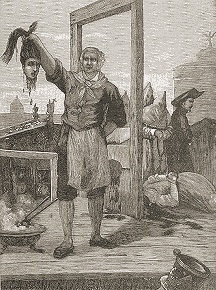
Mastro Titta brandishes an executed woman’s head.

The original Mastro Titta — the titular corruption of the “Minister of Justice” — took responsibility for each of his “patients” (as he called them, and as they were notoriously referred to by others), dutifully noting each of the 516 in his memoir. He stood for 69 years as the primary administrator of the death penalty in papal Rome, killing variously by beheading, hanging, and use of the mallet. Some were charged with murder, others with conspiracy, others with more petty crimes, but all were found guilty by the court of judges chosen by the Church’s bishops and cardinals.

The Minister’s performances were not without an (increasingly practiced) flair, heavy on the religious symbolism. Bugatti’s residence on the west side of the river meant that, when he was to carry out a punishment, he had first to cross the river.

Initially, the executions were carried out in the Piazza del Popolo, but that location was retired in the 1820’s; it’s not clear how consistent the location was after this, but at least one later execution occurred near San Giovanni decollato, home to the group of monks dedicated to comforting the condemned even when the final blow didn’t occur at its doorstep. Regardless of the locale, a spectacle soon arose surrounding that crossing and the parade which followed, as documented by Italian dialect poet G.G. Belli in 1835 (presumably for the execution of Giovanni Orioli di Lugo on July 11 of that year):

The Dilettante at the Bridge

They approach: Attention: the ceremony is brief.
Behold the condemned, neck bare and stretched.
He is the first man of the opera, the Patient,
The Ace of Spades, lord of the fesitval.

And behold the professor that will soon be
The surgeon acting for the people
For three pence, the community,
He will cure the ills of their pained head!

But not the man on the left: the other, to the right.
He in the second place is the Assistant.
The proceedings wait for Mastro Titta.

Do you want the usual from me, who takes the head?
I who never miss it: I am consistent;
And I know him as well as I know the Pope.

The translation is largely mine, with help on some difficult sections from a well-written and complete description of Mastro Titta’s life and work here and here.

Just a Job
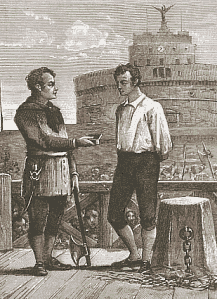
A pinch of snuff before I snuff you?

Bugatti was known for playing the role of executioner in a manner which left no doubt as to his feelings towards the act: it was his job, his service to the Church itself, undisturbed by any personal animus towards the condemned — particularly early in his career.

He often offered snuff to his victims and spoke briefly and quietly with them prior to the execution, likely ploys to ease the victim into his role in the spectacle. Dickens viewed one of Mastro Titta’s beheadings on 8 March 1845*, and, in his Pictures From Italy, he remarked on the callousness of the event.

In keeping with this attitude, most of the entries in Mastro Titta’s memoir are fewer than 20 words. They reflect a man who seeks to distance himself from the crowd’s bloodlust. A selection:

  • “Tommaso Tintori, guilty of homicide, 28 February 1810″ (The first using the “new edifice for beheading from the French government” — that is, the guillotine)
  • “Pecorari Angel, of Poli, aged 29. Peasant guilty of premeditated homicide of one woman, condemned to «death as an example» in Poland on 21 January 1847.” (There were a number of prisoners sentenced in other Catholic parts of Europe sent to Rome for Titta’s ministrations.)
  • “Sabbatino Proietti, aged 25, «decapitated» in Rieti for petty theft and highway robbery and murder on 20 August 1853, died converted, executed through administration of justice at the public square at the Bridge.”
  • “Angelo Lisi di Alatri, found guilty of premeditated highway robbery and murder in Frosinone, «dead» on 30 April 1862.”

An Anomalous Man

Bugatti was born just seven years prior to the Grand Duchy of Tuscany becoming the first of the Italian states to abolish the death penalty. There, Leopold II barred torture and punishment of death, a decision heavily influenced by Cesare Beccaria’s On Crimes and Punishments and a desire to distance his nation from Rome.

In the neighboring Papal State, however, the practice continued, the embodiment of the church’s power over its people in matters earthly and spiritual. Executions of the time performed for various reasons, but with a handful of exceptions, they were almost exclusively performed on persons in the lower class. Many relied on the use of torture or testimony from confessionals. Papal executions were carried out until the 1870s and only declared unnecessary (though not banned by the Church) by Pope John Paul II in the 1990s.

A complete discussion of the role of executions in the Catholic Church is too much for this space,** but a man like Bugatti serves usefully to exemplify the absurdity endowed in these killings by the Catholic Church. Where the half-dozen popes who served over Bugatti thought such executions to be necessary for the control of the masses, they had no such ideas about nobles who committed crimes.

The execution itself consisted of a parade with masked priests, banners, scriptural readings, and sermonizing, culminating in the death of the condemned. John L Allen of the National Catholic Reporter described the treatment of these executions in that day as “a liturgy”, and descriptions from writers such as Lord Byron show a scene which could only be described as a mix of Catholic Mass and town festival.

Such ritualized killing came to contrast starkly with the Italian celebration of an anti-death penalty position, and the two stood at odds for over a century. In 1909, the topic was hot enough that a plaque glorifying two Italians executed by Bugatti in 1825 was erected; a dozen years later, its contents were concealed out of deference to Rome until after the Second Vatican Council. The commemorated, Angiolo Targhini and Leonida Montanari (here’s their Italian Wikipedia page), were convicted essentially of riling the people, and they were summarily beheaded; their story was the inspiration for Luigi Magni’s 1969 classic Nell’anno del Signore:

“So ends the long list of Bugatti.”

Mastro Titta was given an official residence, and at the end of his term, he was handsomely rewarded with a pension for his service — 30 scudi per year. His final executions were carried out on 17 August 1864, wearing his traditional red cloak (now on display at the Criminology Museum of Rome): Antonio Olietti of Rome and Domenico Antonio Demartini were beheaded for homicide.

The Minister of Justice was 85, four and some years from the end of his life, and the final line in his memoir reads, “So ends the long list of Bugatti. May that of his successor be shorter.”

Indeed it was.

The final executions in Rome occurred on 24 November 1868 at the hands of Antonio Balducci, Bugatti’s long-time apprentice; the event was marked by Pope Pius IX famously intoning in response to calls for a stay, “I can’t, and I don’t want to.” The last execution in the Papal State was of Agatino Bellomo on 9 July 1870, in Palestrina, shortly before the nascent unified Italy absorbed Rome.

Mastro Titta is still known in Italy,† but, adrift amid a particularly violent period of revolution, his legacy as papal executioner is largely lost to the rest of the world.

* The day’s guillotinee was Giovanni Vagnarelli, 26, from Augustine; he killed Bavarian Anna Cotten and robbed her, and her wife’s statement at confessional was used to convict Vagnarelli. Such confessional convictions were not uncommon, as Bugatti’s own memoir confirms.

** There’s surprisingly little reading out there about this topic, though it would seem ripe for a book or two. Here’s what I can find:

  • “Fear and Loathing in Bologna and Rome: The Papal Police in Perspective”, Steven Hughes, Journal of Social History, 1987.
  • “Capital Punishment: The Curious History of its Privileged Place in Christendom”, James J. Megivern, Proceedings of the American Philosophical Society, 2003.
  • For a discussion of current discourse in Catholic teachings, this is rather interesting: “To Kill or Not to Kill: The Catholic Church and the Problem of the Death Penalty”, lecture by E. Christian Brugger, Asst. Prof. of Ethics, Dept. of Religious Studies, Loyola University, 2001.

† A half dozen kilometers from the bridge that Mastro Titta crossed on his way to carry out Papal justice now stands the Mastro Titta Pub. It is reportedly “tastefully done” and serves mostly Belgian beers.

On this day..

1600: Linköping Bloodbath, the dawn of Sweden’s glory

On this date in 1600, five former supporters of King Sigismund were beheaded at Linköping, as Sweden broke free of Poland and of Catholicism.

Eighty years before, the Swedish Vasa dynasty had established itself by surviving one bloodbath. Now, it would set its greatest scion in line for the throne by inflicting another.

Sigismund was Sweden’s legitimate heir; he was also a characteristic product of dynastic intermarriage whose loyalties were splintered between fiefdoms. But most crucially of all, he had been raised Catholic in a realm turning decisively towards Protestantism.

Born of a Polish-Italian mother, he had secured the Polish-Lithuanian throne by election in 1589; when succession added suzerainty of Sweden, his realm was a personal union stretching across central Europe from the Arctic Circle to the Black Sea.

Which looked better on paper than it would work in practice.

The persecutory stage of the Catholic counter-reformation had been in full throat this past half-century, and the accession of a Catholic prince raised a Scandinavian alarm.

Busy governing Poland, Sigismund left his Protestant uncle Duke Charles to administer Sweden; within five years, civil war had erupted between the two and in short order the victorious soon-to-be King Charles IX had occasion to make example of the nobles who had backed Sigismund’s cause.

Charles himself would be a transitional figure in Sweden, but what a transition: his victory made possible the the subsequent scintillating reign of his son, Gustavus Adolphus — the able commander who would raise Sweden into a true European power.*

There would be an interesting coda in that reign to this day’s doings. Gustavus’ greatest general, Johan Banér, was the son of one of those put to death in Linköping. In another time, between other men, that one fellow’s father had seen the other fellow’s butchered might have put a blood feud between them. But as young men — the king was just 18 months his senior — they formed a permanent friendship, upon which they founded the military collaboration that shook northern Europe.

“My dad beheaded your dad”
“Let’s play!”

* Among Gustavus Adolphus’ numerous exploits was war with his father’s old rival — that is, with his cousin Sigismund — in the 1620s. Foreign relations between Sweden and Poland had turned understandably frosty, with Sigismund spending the rest of his long life eyeballing the lost crown.

On this day..

1457: László Hunyadi, the death before Hungary’s rebirth

On this date in 1457, Hungary lost a young prospective statesman and gained a national martyr.

A tale of noble bloodshed begins as so many do with a contested succession, this one amid the confusing feudal geometry of central Europe in the shadow of the rising Ottoman Empire. The untimely (albeit unsurprising) death in battle of warlike Albert II of Germany put the crown in the hands of a son born four months after his demise — the memorably named Ladislaus the Posthumous.

Effective government, needless to say, was in the hands of more senior gentlemen: the ambitious Slovenian-Croatian count Ulrich II and the able Hungarian commander John Hunyadi.* With two strapping Hunyadi boys who were contemporaries with the nominal king, it was only a matter of time before someone wound up dead.

Hunyadi pere saw it all coming. On his deathbed in 1456, he warned his children never to find themselves both together with Ladislaus.

Events moved fast after John Hunyadi’s passing. The Posthumous, now a teenager, set Hunyadi’s longtime rival up against the boys’ claim, but Laszlo, the elder brother, killed Ulrich. Ladislaus — answering the exigencies of the moment but possibly also sincerely relieved to be rid of his overbearing uncle — immediately pardoned the killer and offered to have him over to court.

Dad would have said, “I told you so.”

Upon arrival, Laszlo was seized, sentenced to death by a kangaroo court, and summarily beheaded. The most melodramatic version has the beheading botched three times and Laszlo demanding a reprieve on the grounds that heaven had attested his innocence by preserving him. Ladislaus had his guys keep at it until heaven threw in the towel.

The Buried Lead

So, hard going for some noble tit in the borderlands 551 years ago. What’s the relevance? Why, when Hungarian artists of the 19th century groped for an expression of national identity did they hark back to unlucky Laszlo on canvas …

The Mourning of Laszlo Hunyadi (1859) by Viktor Madarász shows the pallid-faced mother and bride of the prince bewailing his body, the fatal wound unmistakably suggested while remaining artfully concealed. Painted in Paris, it won a French state medal. (Source)

… and in opera?

The answer is less to do with Laszlo’s own qualities, courageous though they may have been.

A few months after having the young man put to death, Ladislaus himself died suddenly. Contemporaries suspected poison; others thought cosmic justice punished him for breaking faith. Modern science — vulture, whose wings are dull realities! — fingers something as unromantic as a medical condition.

One way or another, Ladislaus really was Posthumous, and into the empty throne stepped Laszlo’s 15-year-old brother Matthias — who had been more judicious about his head than his brother. Matthias would reign for 32 years and enter Hungarian folklore as “Matthias the Just”.

The long and adroit span of Matthias’ career and his father’s combined to immortalize the Hunyadi name (which fell extinct after Matthias’ passing before it could produce any buzzkilling scions of more doubtful abilities) as synonymous with Hungary’s golden age.

Laszlo’s reputation mostly just comes along for the ride — had, say, Ladislaus enjoyed Matthias’ run, the elimination of a boyhood rival would have been chalked down to the regrettable griminess of the day’s political reality; had some other claimant followed him to the throne, the Hunyadi name would never have had the luster to make him an attractive operatic subject.

A Symbol of National Rebirth

But they’re called “counterfactuals” for a reason: it may have happened by chance, but it did happen that Laszlo Hunyadi’s martyrology, in the victim’s very name, conveniently totes to the present day a pleasing theme of national redemption and greatness.

As described in this (.pdf) introduction to the opera (part of an extensive collection of information about Ferenc Erkel‘s operas, including a translated libretto of Hunyadi Laszlo):

In the national mythology the Hunyadi family’s descent into the underworld is symbolized by the fate of Laszlo Hunyadi, the firstborn of Janos Hunyadi who was 10 years Matyas’s senior. His life and death were preserved in the collective memory of the nation not as an independent legend but as the middle part of an imaginary trilogy about the Hunyadis. Laszlo Negyessy wrote that the opera Hunyadi Laszlo “has an air of incompleteness because the story is suspended at a point where all our senses appeal for continuation. However, this continuation and poetic justice is served in our national memory.”

Here is Erkel’s celebrated funeral march (“Gyaszindulo”) rendering the victim’s journey to his scaffold this day — the non-choral prelude to his mother’s dramatic plea for his life in the video above, and one of the signature compositions of Hungarian music**:

[audio:Hunyadi_Laszlo_funeral_march.mp3]

* John (Janos) Hunyadi wasn’t above meddling with the neighbors himself. Hungary figures as a bully of the kingdom of Wallachia (modern Romania) at this time; John Hunyadi deposed the father of, then (in the course of political alignment) helped raise to Wallachia’s throne, Vlad the Impaler, the sort-of historical model (and apparent historical namesake) for the vampire Dracula. When Vlad Dracula was deposed in turn, he fled to the protection of Matthias Hunyadi.

** Erkel also wrote the Hungarian national anthem.

On this day..

1289: Demetre II the Self-Sacrificer

On this date in 1289, Georgia’s King Demetre II, beholden to the Mongol regional ruler Arghun Khan, earned the name “Self-Sacrificer” (tavdadebuli) by giving himself up for execution in a bid to spare his nation the ruins which befell other resistors of Mongolian rule. He was tortured and beheaded for allegedly participating in a plot to overthrow the khan. The Georgian Orthodox church canonized Demetre a martyr and saint.

Demetre sat on the Georgian throne in tumultuous days, when its influence spanned only the eastern half of present-day Georgia. His nation’s position in the Caucuses Mountains between the Black Sea and Caspian Sea placed it at the center of action during the Dark Ages, crushed between European Crusades from the west, Mongolian military expansion from the north and east, and Turkish and Iranian influence from the south.

This left the so-called Caucasian isthmus a political boiler room from the 9th to 18th centuries, during which its dominion waxed several times, and waned even more spectacularly twice as often (a rather complete description is given by Ronald Grigor Suny in The Making of the Georgian Nation).

The Christian polygamist was a fifth-generation descendant of “golden age” Georgian ruler King David II, III, or IV (depends on who you ask), who earned the only name he would need as Georgian ruler for refusing to cede power to Byzantium and expelling the Seljuk Turks — considered the dreaded Muslim invaders — from Georgia, northern Armenia, and some of present-day Azerbaijan. King David the Builder united these nearby Transcaucasian cultures under a single banner shortly after 1100. A century later, in 1204, after the inception of the Byzantine Empire of Trebizond (now in western neighbor Turkey), Georgia reached its zenith under the reign of Queen T(h)amar the Great: from the ruins of Constantinople after the fourth Crusade, in the Eastern center of Orthodox Christianity, the dynastic Kingdom of Georgia entered its glory days.

Georgia at its height under Queen Tamar.

But such days did not last. T(h)amar’s son had no children when he fell fatally ill after a defeat in support of the persistent Crusaders. Within six decades, the Mongols would conquer Georgia at least twice, demanding gold in tribute to protect the once mighty kingdom from the Turks, and eventually other Mongolian factions. The nation’s religious heart felt more threatened by the Muslim onslaught than by the prospect of Mongolian overlords, and residents frequently took up arms alongside the Mongols to repel the southern invaders. Which is not to suggest that rebellion against the region’s ruler, the Mongolian Ilkhanate, was unknown.

Indeed, Demetre II was sired during just such a time and held the dubious distinction of taking power immediately after David VII (David Ulu, “the Senior”), whose efforts at revolt resulted in a three-way carving of Georgia. In 1262, David Ulu and his cousin David VI (David Narin, “the Junior”) ended their largely unsuccessful attempt to pry away the Mongol thumb after being forced to hole up in Kutaisi, the birth city of David the Builder. Ulu and Narin made peace with the Mongols and ruled the eastern and western partitions, respectively.

Their surrender was precipitated largely by the kidnapping of large portions of their families at the invaders’ hands, but it was a year too late to save Demetre’s mother. Three years after the surrender, in a show of pure subjugation, David Ulu agreed to aid the local Ilkahn — himself a subordinate to the Mongolian khan — in battle against the Golden Horde in the neighboring northern Azerbaijani region of Shirvan. Still attempting to exert his own pressure over the kingdom, David Ulu watched his domain shrink further as the southern province of Samtskhe broke away to submit more immediately to the Ilkahnate.

Coins dating to the reign of Demetre II. (From the National Bank of Georgia)

In 1270, David Ulu died, and his 11-year old son ascended to the throne, regency passing to Demetre’s uncle Sadun Mankaberdeli while Demetre was schooled at the court of the khan. At 18, Demetre took control. He had stood side-by-side under Mongol Buddhist-maybe-turned-Christian Abaqa Khan with his Armenian brethren (under the rule of Leon II [or III, depending on the counter]) in four years of service. He distinguished himself in a losing march on Syria at the Second Battle of Homs (1281), yet another Ilkhanate attempt at opening the Crusade routes. This curious cast at a connection with Europe — mirrored through the dispatch of the likes of ambassador Rabban Bar Sauma to the West — ended poorly for both sides: the Mongolians saw their influence diminish even further in the southern Caucases, but the subjugated, Christian Georgia still needed their services. Demetre maintained a relationship with the Mongols, the only way to retain a semblance of power in a time of flux in the region.

Demetre was a prolific breeder in his day, likely managing to produce more subsequent Georgian kings than any other ruler while earning the ire of the church thanks to a trio of wives. His polygamy was decried by another Georgian saint, Basil Ratishvili, who predicted the ruin of the nation from these ungodly acts. It started with a classic merger of adjoining empires through a marriage to a daughter of Manuel I of Trebizond, which by that time was on the rise as a political center (it would become a stop on Marco Polo’s famous wander in the years immediately prior to its moment in the sun at the start of the 14th century); two of their children shared the title of King of Georgia, David VIII taking the half formerly claimed by David Narin, Vakhtang III acquiring Tbilisi and the western side.

Demetre’s second wife was Solghar, a Mongol princess who produced a son and two daughters — including one who married Trebizond’s most dominant ruler, Alexius III. His third marriage yielded a two-time leader in King Giorgi [George] V, who was brought up at his grandfather’s court after Demetre’s execution; his ascent to the throne in 1299 was a brief affair, but when he returned to power in 1314, his campaigns rid Transcaucasia of all Mongolian traces, united the previous factions, eliminated opposing nobles, secured access to Georgian Orthodox sites in the Holy Land, connected Georgia with Egypt and the Byzantine Empire as well as the Republics of Genoa and Venice, introduced the precursor to the modern Georgian flag, and resulted in his informal titles “Giorgi the Brilliant”, “Giorgi the Magnificent”, and “Giorgi the Illustrious.”

For Demetre II, Demetre the Devoted, Demetre the Self-Sacrificer, none of those achievements would be known, thanks to Solghar, daughter of Bugha Chingsang. Chingsang served as prime minister under Arghun Khan, who seized power in 1285 from his uncle after accusing the latter of poisoning Arghun’s father, Abaqa. Bugha’s attempted ouster of the new Khan ended with a resounding defeat, and Bugha and several co-conspirators were beheaded on January 17, 1289. Immediately, the Khan called on Demetre, who was advised by many that an ill fate awaited him if he complied. It is questionable whether Demetre was in any way complicit in the plot, but it is not questionable that Demetre knew what would happen at the court of Arghun Khan. The regional patriarch/bishop Catholicos Abraam reportedly offered the only support:

If you sacrifice your own life for your nation, we, the bishops of this land, will bear your sins, and will pray to God that you be numbered among the holy martyrs. For the Lord Himself said, Greater love hath no man than this, that a man lay down his life for his friends (John 15:13). And if it is good for a man to lay down his life for just one neighbor, how profitable is it for a man to die for the sake of many?

Demetre agreed, taking Abraam, the priest Mose, his sons David (later VIII) and Giorgi (later V), and several other members of his court. The Georgian Orthodox church officially presents the events thusly:

At the ordu [the Khan’s camp in Azerbaijan] the Mongols could find no fault in the young Georgian king, but they imprisoned him nevertheless. Then a group of Georgian faithful forced their way into the prison to see him and offered to help him escape. The king was deeply moved by their compassion, but nevertheless he told them, “I knew from the beginning the death I would suffer, and I offered my life for this nation. If I escape now, the nation will be destroyed. For what shall it profit a man, if he shall gain the whole world, and lose his own soul? (Mark 8:36).”

The khan ordered his execution. Fully prepared to meet death, King Demetre prayed fervently, received the Holy Gifts, and gave up his soul to the Lord. Those present witnessed a divine miracle: the sun grew dark and an ominous gloom enshrouded the whole city.

The holy relics of the Royal Martyr Demetre were guarded until the catholicos and the priest Mose secretly retrieved the body and, with the help of a group of Tbilisi fishermen, returned the king to his homeland. He was buried in Mtskheta, in the burial vault of his forefathers at Svetitskhoveli Cathedral.

O Holy Demetre, martyr and king, pray to God that our souls may be saved!

Whether the souls of those who pray to the doomed Demetre II are saved or not, the Georgian Orthodox saint lives on largely through his efforts to revive his nation’s church and restore its places of worship. One of his more enduring acts as sovereign was to order the building of the Metekhi Church in Tbilisi on the site of an extant 5th-century church; its transformation from church to jail to theater and back to church as the fortunes of Georgia swayed may be one of the more apt reflections of the nation itself, if not the most flattering.

On this day..

1845: An Italian highwayman, as witnessed by Dickens

On this date in 1845, Charles Dickens witnessed a man beheaded in Rome for robbery and murder.

At 33, Dickens was well-established in his field; he already had to his credit The Pickwick Papers, Oliver Twist, Nicholas Nickleby and others.

Dickens spent a good part of the mid-1840’s abroad, with extended stays in North America, Italy and Switzerland, although without much abating his prodigious output. He intended the travelogue Pictures From Italy to help finance his journeys; it met an unenthusiastic reception and rates distinctly among Dickens’ minor works.

This day’s events took place during the latter stages of Dickens’ stay in Italy and — as the distinctly proscriptive last paragraphs of this excerpt indicate — touch a social theme very pressing to the author, one to which he would soon return again. Years later, the utterly unedifying scene of the public guillotine would be fodder for Dickens’ A Tale of Two Cities, whose tragic protagonist has already appeared in these pages.

Of note also is Dickens’ implication — though he doesn’t quite state it outright — that the criminal was uncovered by a secret revealed under the seal of confession, a touchy point for the priesthood as any viewer of television crime dramas will certainly be aware. We have to allow a considerable latitude for a misapprehension on the traveler’s part here, especially given that Pictures as a whole caught considerable heat from the moment of its publication for its relentless anti-Catholicism. (Update: More on the use of confessionals in Papal Rome in this post about the Vatican’s headsman.)

Here’s the scene in its entirety:

On one Saturday morning (the eighth of March), a man was beheaded here. Nine or ten months before, he had waylaid a Bavarian countess, travelling as a pilgrim to Rome – alone and on foot, of course – and performing, it is said, that act of piety for the fourth time. He saw her change a piece of gold at Viterbo, where he lived; followed her; bore her company on her journey for some forty miles or more, on the treacherous pretext of protecting her; attacked her, in the fulfilment of his unrelenting purpose, on the Campagna, within a very short distance of Rome, near to what is called (but what is not) the Tomb of Nero; robbed her; and beat her to death with her own pilgrim’s staff. He was newly married, and gave some of her apparel to his wife: saying that he had bought it at a fair. She, however, who had seen the pilgrim-countess passing through their town, recognised some trifle as having belonged to her. Her husband then told her what he had done. She, in confession, told a priest; and the man was taken, within four days after the commission of the murder.

There are no fixed times for the administration of justice, or its execution, in this unaccountable country; and he had been in prison ever since. On the Friday, as he was dining with the other prisoners, they came and told him he was to be beheaded next morning, and took him away. It is very unusual to execute in Lent; but his crime being a very bad one, it was deemed advisable to make an example of him at that time, when great numbers of pilgrims were coming towards Rome, from all parts, for the Holy Week. I heard of this on the Friday evening, and saw the bills up at the churches, calling on the people to pray for the criminal’s soul. So, I determined to go, and see him executed.

The beheading was appointed for fourteen and a-half o’clock, Roman time: or a quarter before nine in the forenoon. I had two friends with me; and as we did not know but that the crowd might be very great, we were on the spot by half-past seven. The place of execution was near the church of San Giovanni decolláto (a doubtful compliment to Saint John the Baptist) in one of the impassable back streets without any footway, of which a great part of Rome is composed – a street of rotten houses, which do not seem to belong to anybody, and do not seem to have ever been inhabited, and certainly were never built on any plan, or for any particular purpose, and have no window-sashes, and are a little like deserted breweries, and might be warehouses but for having nothing in them. Opposite to one of these, a white house, the scaffold was built. An untidy, unpainted, uncouth, crazy-looking thing of course: some seven feet high, perhaps: with a tall, gallows-shaped frame rising above it, in which was the knife, charged with a ponderous mass of iron, all ready to descend, and glittering brightly in the morning sun, whenever it looked out, now and then, from behind a cloud.

There were not many people lingering about; and these were kept at a considerable distance from the scaffold, by parties of the Pope’s dragoons. Two or three hundred foot-soldiers were under arms, standing at ease in clusters here and there; and the officers were walking up and down in twos and threes, chatting together, and smoking cigars.

At the end of the street, was an open space, where there would be a dust-heap, and piles of broken crockery, and mounds of vegetable refuse, but for such things being thrown anywhere and everywhere in Rome, and favouring no particular sort of locality. We got into a kind of wash-house, belonging to a dwelling-house on this spot; and standing there in an old cart, and on a heap of cartwheels piled against the wall, looked, through a large grated window, at the scaffold, and straight down the street beyond it until, in consequence of its turning off abruptly to the left, our perspective was brought to a sudden termination, and had a corpulent officer, in a cocked hat, for its crowning feature.

Nine o’clock struck, and ten o’clock struck, and nothing happened. All the bells of all the churches rang as usual. A little parliament of dogs assembled in the open space, and chased each other, in and out among the soldiers. Fierce-looking Romans of the lowest class, in blue cloaks, russet cloaks, and rags uncloaked, came and went, and talked together. Women and children fluttered, on the skirts of the scanty crowd. One large muddy spot was left quite bare, like a bald place on a man’s head. A cigar-merchant, with an earthen pot of charcoal ashes in one hand, went up and down, crying his wares. A pastry-merchant divided his attention between the scaffold and his customers. Boys tried to climb up walls, and tumbled down again. Priests and monks elbowed a passage for themselves among the people, and stood on tiptoe for a sight of the knife: then went away. Artists, in inconceivable hats of the middle-ages, and beards (thank Heaven!) of no age at all, flashed picturesque scowls about them from their stations in the throng. One gentleman (connected with the fine arts, I presume) went up and down in a pair of Hessian-boots, with a red beard hanging down on his breast, and his long and bright red hair, plaited into two tails, one on either side of his head, which fell over his shoulders in front of him, very nearly to his waist, and were carefully entwined and braided!

Eleven o’clock struck and still nothing happened. A rumour got about, among the crowd, that the criminal would not confess; in which case, the priests would keep him until the Ave Maria (sunset); for it is their merciful custom never finally to turn the crucifix away from a man at that pass, as one refusing to be shriven, and consequently a sinner abandoned of the Saviour, until then. People began to drop off. The officers shrugged their shoulders and looked doubtful. The dragoons, who came riding up below our window, every now and then, to order an unlucky hackney-coach or cart away, as soon as it had comfortably established itself, and was covered with exulting people (but never before), became imperious, and quick-tempered. The bald place hadn’t a straggling hair upon it; and the corpulent officer, crowning the perspective, took a world of snuff.

Suddenly, there was a noise of trumpets. ‘Attention!’ was among the foot-soldiers instantly. They were marched up to the scaffold and formed round it. The dragoons galloped to their nearer stations too. The guillotine became the centre of a wood of bristling bayonets and shining sabres. The people closed round nearer, on the flank of the soldiery. A long straggling stream of men and boys, who had accompanied the procession from the prison, came pouring into the open space. The bald spot was scarcely distinguishable from the rest. The cigar and pastry-merchants resigned all thoughts of business, for the moment, and abandoning themselves wholly to pleasure, got good situations in the crowd. The perspective ended, now, in a troop of dragoons. And the corpulent officer, sword in hand, looked hard at a church close to him, which he could see, but we, the crowd, could not.

After a short delay, some monks were seen approaching to the scaffold from this church; and above their heads, coming on slowly and gloomily, the effigy of Christ upon the cross, canopied with black. This was carried round the foot of the scaffold, to the front, and turned towards the criminal, that he might see it to the last. It was hardly in its place, when he appeared on the platform, bare-footed; his hands bound; and with the collar and neck of his shirt cut away, almost to the shoulder. A young man — six-and-twenty — vigorously made, and well-shaped. Face pale; small dark moustache; and dark brown hair.

He had refused to confess, it seemed, without first having his wife brought to see him; and they had sent an escort for her, which had occasioned the delay.

He immediately kneeled down, below the knife. His neck fitting into a hole, made for the purpose, in a cross plank, was shut down, by another plank above; exactly like the pillory. Immediately below him was a leathern bag. And into it his head rolled instantly.

The executioner was holding it by the hair, and walking with it round the scaffold, showing it to the people, before one quite knew that the knife had fallen heavily, and with a rattling sound.

When it had travelled round the four sides of the scaffold, it was set upon a pole in front — a little patch of black and white, for the long street to stare at, and the flies to settle on. The eyes were turned upward, as if he had avoided the sight of the leathern bag, and looked to the crucifix. Every tinge and hue of life had left it in that instant. It was dull, cold, livid, wax. The body also.

There was a great deal of blood. When we left the window, and went close up to the scaffold, it was very dirty; one of the two men who were throwing water over it, turning to help the other lift the body into a shell, picked his way as through mire. A strange appearance was the apparent annihilation of the neck. The head was taken off so close, that it seemed as if the knife had narrowly escaped crushing the jaw, or shaving off the ear; and the body looked as if there were nothing left above the shoulder.

Nobody cared, or was at all affected. There was no manifestation of disgust, or pity, or indignation, or sorrow. My empty pockets were tried, several times, in the crowd immediately below the scaffold, as the corpse was being put into its coffin. It was an ugly, filthy, careless, sickening spectacle; meaning nothing but butchery beyond the momentary interest, to the one wretched actor. Yes! Such a sight has one meaning and one warning. Let me not forget it. The speculators in the lottery, station themselves at favourable points for counting the gouts of blood that spirt out, here or there; and buy that number. It is pretty sure to have a run upon it.

The body was carted away in due time, the knife cleansed, the scaffold taken down, and all the hideous apparatus removed. The executioner: an outlaw ex officio (what a satire on the Punishment!) who dare not, for his life, cross the Bridge of St. Angelo but to do his work: retreated to his lair, and the show was over.

Pictures from Italy is available free online from Project Gutenberg.

The date and description would indicate that Dickens witnessed the death of 26-year-old Giovanni Vagnarelli. (See this list of the Holy See’s executions.)

Part of the Themed Set: The Written Word.

On this day..

1644: Ferrante Pallavicino, more caustic than elusive

On this date in 1644, Italian satirist Ferrante Pallavicino was beheaded by the papacy at Avignon for apostasy for his witty attacks on the Roman curia.

Pallavicino, himself a cleric, was a notable producer of pasquinades, the politically-charged mockeries named for one of the “talking statues” in Rome to which they were often affixed.* Pallavicino’s expertise at this art found something affixed to him: a bounty, which a Frenchman earned by luring him from the safety of Venice to papal territory in France and betraying him.

The pontiff upon whom Pallavicino poured his execrations, Urban VIII, only survived the beheaded man by a few months. There were more than Pallavicino found distasteful his decidedly terrestrial politics — he fought wars of conquest (the last pope to do so), practiced rampant nepotism, and buried the Church in debt. Urban’s family was forced to leave Rome after he passed.

A minor figure — his body of work was truncated in its springtime, of course — Pallavicino is rather better covered in Italian than in English; this biography page, for instance, expands somewhat upon his career.

* A number of Pallavicino’s works had posthumous printings elsewhere in Europe. One of them, La retorica delle puttane is available online in an English interpretation (it’s a bit more intervention than a mere translation) of the equivalent title, The Whores Rhetorick.

Part of the Themed Set: The Written Word.

On this day..

1388: Thomas Usk, leaving “The Testament of Love”

On this date in 1388, royal retainer Thomas Usk was convicted in a one-day trial of treason and immediately drawn, hanged and beheaded at Tyburn.

The man’s end was savage: cut down alive to savor his beheading, which took nearly 30 strokes of the sword. And by all odds, this minor character’s demise would have had scant legacy as one more drop in the ocean of Albion’s blood long-ago spilt.

It was Usk’s misfortune to enter the political arena during a violently evolving political crisis in the 1380’s, when the boy-king Richard II and the English nobility struggled for power. A self-taught scrivener, Usk comes to posterity’s notice in the train of London mayor John Northampton. He was arrested for this association, and having no aspiration to become “a stinking martyr,” obligingly switched to the king’s side and informed on his former master.

This act of faithlessness made Usk (among many others) a marked man when the nobles’ faction gained a decisive upper hand after the Battle of Radcot Bridge and sat in what history records as the Merciless Parliament. Many were executed or forced into exile.

Usk would number among the victims, but before being launched into eternity — as the euphemism went — with the rope, he touched eternity from his prison cell by writing The Testament of Love (several versions linked here).

Long attributed wrongly to Usk’s contemporary Geoffrey Chaucer, the Testament — regrettably not available in anything like its original form — consists of the imprisoned author’s dialogue with Love, who descends as a spirit into his dungeon to counsel him as he pines for the affection of the (presumably) symbolic woman “Margaret”. The work is reminiscent in its dialectal style of that produced by another client of the executioner — Boethius‘ Consolation of Philosophy.

ALAS! Fortune! alas! I that som-tyme in delicious houres was wont to enjoye blisful stoundes, am now drive by unhappy hevinesse to bewaile my sondry yvels in tene! … witless, thoughtful, sightles lokinge, I endure my penaunce in this derke prison, caitived fro frendshippe and acquaintaunce, and forsaken of al that any word dare speke.

Part of the Themed Set: The Written Word.

On this day..

1838: Andrea Rondola but not Peppino

On this date in 1838, in The Count of Monte Cristo, the title character witnesses two men brought to the scaffold for public execution in Rome.

In Alexandre Dumas‘ classic, the count is really Edmond Dantes, wrongly imprisoned years before, who has escaped and enriched himself with a discovered treasure, purchasing thereafter his ennoblement. This date’s execution occurs shortly after Dantes has surfaced publicly as the count. He witnesses it with two young friends — goading one of the reluctant youths by remarking, “when you travel, it is to see everything. Think what a figure you will make when you are asked, ‘How do they execute at Rome?’ and you reply, ‘I do not know’!” — and the naked brutality with which the Count greets a scene horrifying to his more genteel companions prefigures the pitiless revenge he will soon visit on his onetime persecutors.

The scene is laid on the first day of Carnival — the concealed identities among the crowd and the tension between its celebratory state of mind and the public butchery played out before it both serving the novel’s themes.

The prisoners are: a murderer, executed by the unique (and error-prone) Roman method of mazzolatura, in which the prisoner is incapacitated with a blow from a mallet before being finished off with a knife; and, a young man wrongly condemned to the guillotine for banditry, who will be reprieved thanks to the protagonist’s intervention further to the latter’s designs of vengeance.

It was the first time Franz had ever seen a guillotine, — we say guillotine, because the Roman mandaia is formed on almost the same model as the French instrument. The knife, which is shaped like a crescent, that cuts with the convex side, falls from a less height, and that is all the difference. Two men, seated on the movable plank on which the victim is laid, were eating their breakfasts, while waiting for the criminal. Their repast consisted apparently of bread and sausages. One of them lifted the plank, took out a flask of wine, drank some, and then passed it to his companion. These two men were the executioner’s assistants. At this sight Franz felt the perspiration start forth upon his brow. The prisoners, transported the previous evening from the Carcere Nuovo to the little church of Santa Maria del Popolo, had passed the night, each accompanied by two priests, in a chapel closed by a grating, before which were two sentinels, who were relieved at intervals. A double line of carbineers, placed on each side of the door of the church, reached to the scaffold, and formed a circle around it, leaving a path about ten feet wide, and around the guillotine a space of nearly a hundred feet. All the rest of the square was paved with heads. Many women held their infants on their shoulders, and thus the children had the best view. The Monte Pincio seemed a vast amphitheatre filled with spectators; the balconies of the two churches at the corner of the Via del Babuino and the Via di Ripetta were crammed; the steps even seemed a parti-colored sea, that was impelled towards the portico; every niche in the wall held its living statue. What the count said was true — the most curious spectacle in life is that of death. And yet, instead of the silence and the solemnity demanded by the occasion, laughter and jests arose from the crowd. It was evident that the execution was, in the eyes of the people, only the commencement of the Carnival. Suddenly the tumult ceased, as if by magic, and the doors of the church opened. A brotherhood of penitents, clothed from head to foot in robes of gray sackcloth, with holes for the eyes, and holding in their hands lighted tapers, appeared first; the chief marched at the head. Behind the penitents came a man of vast stature and proportions. He was naked, with the exception of cloth drawers at the left side of which hung a large knife in a sheath, and he bore on his right shoulder a heavy iron sledge-hammer. This man was the executioner. He had, moreover, sandals bound on his feet by cords. Behind the executioner came, in the order in which they were to die, first Peppino and then Andrea. Each was accompanied by two priests. Neither had his eyes bandaged. Peppino walked with a firm step, doubtless aware of what awaited him. [i.e., a pardon] Andrea was supported by two priests. Each of them, from time to time, kissed the crucifix a confessor held out to them. At this sight alone Franz felt his legs tremble under him. He looked at Albert — he was as white as his shirt, and mechanically cast away his cigar, although he had not half smoked it. The count alone seemed unmoved — nay, more, a slight color seemed striving to rise in his pale cheeks. His nostrils dilated like those of a wild beast that scents its prey, and his lips, half opened, disclosed his white teeth, small and sharp like those of a jackal. And yet his features wore an expression of smiling tenderness, such as Franz had never before witnessed in them; his black eyes especially were full of kindness and pity. However, the two culprits advanced, and as they approached their faces became visible. Peppino was a handsome young man of four or five and twenty, bronzed by the sun; he carried his head erect, and seemed on the watch to see on which side his liberator would appear. Andrea was short and fat; his visage, marked with brutal cruelty, did not indicate age; he might be thirty. In prison he had suffered his beard to grow; his head fell on his shoulder, his legs bent beneath him, and his movements were apparently automatic and unconscious.

“I thought,” said Franz to the count, “that you told me there would be but one execution.”

“I told you true,” replied he coldly.

“And yet here are two culprits.”

“Yes; but only one of these two is about to die; the other has many years to live.”

“If the pardon is to come, there is no time to lose.”

“And see, here it is,” said the count. At the moment when Peppino reached the foot of the mandaia, a priest arrived in some haste, forced his way through the soldiers, and, advancing to the chief of the brotherhood, gave him a folded paper. The piercing eye of Peppino had noticed all. The chief took the paper, unfolded it, and, raising his hand, “Heaven be praised, and his holiness also,” said he in a loud voice; “here is a pardon for one of the prisoners!”

“A pardon!” cried the people with one voice — “a pardon!” At this cry Andrea raised his head. “Pardon for whom?” cried he.

Peppino remained breathless. “A pardon for Peppino, called Rocca Priori,” said the principal friar. And he passed the paper to the officer commanding the carbineers, who read and returned it to him.

“For Peppino!” cried Andrea, who seemed roused from the torpor in which he had been plunged. “Why for him and not for me? We ought to die together. I was promised he should die with me. You have no right to put me to death alone. I will not die alone — I will not!” And he broke from the priests struggling and raving like a wild beast, and striving desperately to break the cords that bound his hands. The executioner made a sign, and his two assistants leaped from the scaffold and seized him. “What is going on?” asked Franz of the count; for, as all the talk was in the Roman dialect, he had not perfectly understood it. “Do you not see?” returned the count, “that this human creature who is about to die is furious that his fellow-sufferer does not perish with him? and, were he able, he would rather tear him to pieces with his teeth and nails than let him enjoy the life he himself is about to be deprived of. Oh, man, man — race of crocodiles,” cried the count, extending his clinched hands towards the crowd, “how well do I recognize you there, and that at all times you are worthy of yourselves!” Meanwhile Andrea and the two executioners were struggling on the ground, and he kept exclaiming, “He ought to die! — he shall die! — I will not die alone!”

“Look, look,” cried the count, seizing the young men’s hands — “look, for on my soul it is curious. Here is a man who had resigned himself to his fate, who was going to the scaffold to die — like a coward, it is true, but he was about to die without resistance. Do you know what gave him strength? — do you know what consoled him? It was, that another partook of his punishment — that another partook of his anguish — that another was to die before him. Lead two sheep to the butcher’s, two oxen to the slaughterhouse, and make one of them understand that his companion will not die; the sheep will bleat for pleasure, the ox will bellow with joy. But man — man, whom God created in his own image — man, upon whom God has laid his first, his sole commandment, to love his neighbor — man, to whom God has given a voice to express his thoughts — what is his first cry when he hears his fellow-man is saved? A blasphemy. Honor to man, this masterpiece of nature, this king of the creation!” And the count burst into a laugh; a terrible laugh, that showed he must have suffered horribly to be able thus to laugh. However, the struggle still continued, and it was dreadful to witness. The people all took part against Andrea, and twenty thousand voices cried, “Put him to death! put him to death!” Franz sprang back, but the count seized his arm, and held him before the window. “What are you doing?” said he. “Do you pity him? If you heard the cry of `Mad dog!’ you would take your gun — you would unhesitatingly shoot the poor beast, who, after all, was only guilty of having been bitten by another dog. And yet you pity a man who, without being bitten by one of his race, has yet murdered his benefactor; and who, now unable to kill any one, because his hands are bound, wishes to see his companion in captivity perish. No, no — look, look!”

The command was needless. Franz was fascinated by the horrible spectacle. The two assistants had borne Andrea to the scaffold, and there, in spite of his struggles, his bites, and his cries, had forced him to his knees. During this time the executioner* had raised his mace, and signed to them to get out of the way; the criminal strove to rise, but, ere he had time, the mace fell on his left temple. A dull and heavy sound was heard, and the man dropped like an ox on his face, and then turned over on his back. The executioner let fall his mace, drew his knife, and with one stroke opened his throat, and mounting on his stomach, stamped violently on it with his feet. At every stroke a jet of blood sprang from the wound.

This time Franz could contain himself no longer, but sank, half fainting, into a seat. Albert, with his eyes closed, was standing grasping the window-curtains. The count was erect and triumphant, like the Avenging Angel!

The Count of Monte Cristo is available free at Project Gutenberg. This day’s scene occurs in chapter 35. (An announcement in chapter 34 establishes the date.)

* The executioner plays no part in the novel, but presumably it would be the prolific Mastro Titta.

On this day..

1803: Edward Marcus Despard, a patriot without a nation

On this date in 1803, during an era ruled by an Empire’s rough assertion of security against instability abroad, Britain hung its liberal-minded former governor of Belize — along with six others — for treason.

Book CoverThis ought-to-be-memorable occasion lies half-lost in time’s shifting sands, retrieved in part only by the oddity of being the last sentence of drawing and quartering handed down in Britain. (The sentence was moderated to simple hanging and posthumous beheading.)

But there was much more to be said about Despard than his sentence. Today, Executed Today is pleased to feature Col. Edward Marcus Despard as remembered by his biographer, Mike Jay.

Guest-posted here with permission is the prologue to his The Unfortunate Colonel Despard. (A chapter on Despard’s remarkable marriage to a black woman is also available on MikeJay.net.) Following the prologue is an Executed Today interview with the author.


The day Colonel Edward Marcus Despard was executed was one of the most dramatic, and strangely forgotten, in British history. In this, as in much else, his death mirrored his life.

He was to be publicly hung, drawn and quartered for high treason, a punishment which had barely been carried out in London within living memory. Its most vivid associations were still with the Jacobite rebellions over fifty years before: the days when the British state’s greatest fear had been that a Catholic monarch might seize the throne. Those days were now long gone and, many thought, the old ceremony with them; Despard, as it turned out, would be the last person on whom the sentence would ever be passed. As specified by the Lord Chief Justice, the Colonel and his six confederates were ‘to be drawn on a hurdle to the place of execution, there to be hanged by the neck, but not until you are quite dead, then to be cut down and your bowels taken out and cast into the fire before your faces; your heads to be taken off and your bodies quartered’.

Intimations of the drama had already begun to transform the city the day before: Sunday 20 February 1803. At first light, carpenters had begun to assemble scaffold and gallows, large enough to accommodate the seven men, on the roof of Surrey County Jail in Horsemonger Lane, just south of the Thames in Southwark. The jail was a plain barracks-style building, recently constructed to replace the old prison which had been torn down in the Gordon Riots some twenty years before. The roof had been built flat for precisely this purpose, and this was the first occasion for its use. The main gates of the jail opened to admit seven plain wooden coffins.

According to contemporary witnesses, even as the preparations began, ‘vast multitudes of people immediately began to assemble’. It was noted that the throng consisted ‘chiefly of the lowest of the vulgar’, but that, unusually for a public execution, ‘a considerable number of persons of genteel appearance were observable’. The forces of law and order, too, were out in unprecedented force. Every single member of the Bow Street police patrol, the other London patrols at Queen Street, Marlborough Street and Hatton Gardens, and a ‘numerous tribe’ of petty constables from the outlying London boroughs, were placed on duty. The jail and its surrounds were emphatically staked out, surrounded by a cordon two officers deep. All ‘the public houses and other places of resort for the disaffected’ bristled with police. A detachment of mounted Horse-Guard cavalry clopped into Horsemonger Lane; all the infantry regiments in the city, at the Tower of London and Knightsbridge Barracks, were placed on the highest alert. The head keeper of the jail was issued with six sky rockets, each containing a pound of explosives, ‘to be let off as a signal to the military, in case of any disturbance’. London’s entire martial forces were instructed not to leave their posts until the danger was past.

The impending execution had dominated the news all week. The Times had led its news pages with testy dismissals of the rumours which were spreading around the city: that Despard and his confederates were being cruelly chained together, that they were being tortured for their confessions, that a last-minute reprieve was in the air. It was beginning to dawn on the authorities that the graphic medieval ritual they had scheduled might be counterproductive, inflammatory and unpredictably dangerous. The Police Magistrate of Southwark had expressed grave concerns, pointing out that the question which had been on the common people’s lips during the week was ‘When are these poor men to be murdered?’. It had been hard, apparently, even to find labourers prepared to erect the scaffold. When the warrant for the execution was issued on the morning of 20 February, it became clear that these anxieties had led to a change in the sentence. Exercising their statutory discretion, the magistrates announced: ‘we have thought fit to remit part of the sentence, viz. the taking out and burning their bowels before their faces, and dividing the body severally into four parts’. Despard would now be drawn –- to the place of execution on a carriage without wheels –- hung until dead, and then beheaded. The Observer commented with relief that ‘the cutting out of the heart of the malefactor, quartering &c is very humanely and properly to be dispensed with’.

On the day of the execution, 21 February 1803, the pace quickened long before dawn. ‘A vast number of police officers’ were soon massively outnumbered by the spectators streaming through the bitter cold and darkness. Southwark was a hard area to police at the best of times, a hinterland to the city of London proper dominated by the unedifying activities which were prohibited across the Thames. A warren of timber shacks among the marshy waste ground and garbage landfills, it had long been a teeming red light district; in recent times it had become dominated by malodorous and insanitary industries — distilleries, tanneries and vinegar mills — which were forced south of the river by City of London edicts. It also had a long history of insurrection. In 1381, Wat Tyler had led the Peasant’s Revolt through the same streets; in 1450, Jack Cade had set up camp here with his Kentish rebel army. Despard’s sentence of high treason had more powerful resonances with this period than it did with the freshly-minted nineteenth century. Most of the crowd had never seen a treason execution; now, jostling to witness one, they were passing shops selling roller-skates, umbrellas, toothbrushes, matches, alarm clocks, condoms, Twining’s Tea and Pears’ Soap. Part of the appeal of the spectacle must have been this lurid collision of the old and the new; part, also, the uncertainty on all sides as to whether the crowd had really assembled only to stand and watch. It was widely rumoured that the execution would not take place as scheduled — or, if it did, that the main event would turn out to be an entirely unscheduled one. The people of London had rioted countless times over much less — and, given the nature of Despard’s alleged crime, there were an unknown number among the crowd who might attempt to turn a riot into a full-scale revolution.

The character of execution crowds seems, as with most crowds, to have been largely in the eye of the beholder. For many, they were simply the scum of society: crude, vulgar, leering, gawping, sadistic. For others, though, they were the salt of the earth, good men and true come to witness and legitimise the exercise of state power. Despite the rough spectacle that they presented, they were often visibly civic-minded: rescuing stranded children, or crying ‘shame’ if one of their number insulted a woman. The beholder’s view of such crowds tended to reflect their attitude to public execution itself, as the most graphic and visceral demonstration of the ultimate power of the state. There were many who were already campaigning for its abolition on the grounds, as one put it, that ‘the real effect of these scenes is to torture the compassionate and harden the obdurate’. There were many more, though, who thronged to such occasions in high spirits. Their hilarity and ribaldry –- the proverbial ‘gallows humour’ – may have been heartless mockery, but it may also have been a response to the unspoken but unmissable tension between the pomp and solemnity of the occasion and ghastly reality of the act.

This tension reached its high water mark with Despard’s execution. There had been a long observed trend in Britain towards public disrespect at hangings: the victim cheered, the executioner and officials booed and mocked. But the crime of high treason placed an unprecedented focus on the legitimacy of the act a focus sharpened still further by the fact that the majority of the onlookers believed Despard to be innocent of it. He had been accused and convicted of a shocking, cold-blooded plot to overthrow the state, an accusation which he had consistently and calmly denied. Now, at the moment of the state’s cold-blooded retribution, he had a final chance to speak the case for his defence. Part of the unique appeal of executions was always that the victims, in the moments before their death, might say anything; it was often the only time that the unspeakable could be spoken in public. But if Despard chose to speak the unspeakable, it would be more than a howl of rage, a fruity obscenity or a cheeky quip. The danger he posed might yet be far from over.

The bell of St.George’s Church began tolling at five, and continued for about an hour. By the time it finished, every conceivable vantage point was packed solid. It was estimated that there were twenty thousand people jammed into the carriageway of Horsemonger Lane and spilling onto every nearby roof and patch of open ground ‘that afforded the least prospect’. It was evident, too, that this was no ordinary gallows crowd, just as it was no ordinary hanging. The packed observers were almost completely silent: ‘no tumult, no disorder appeared among the multitude … all was stillness and expectation of the approaching event’. For the massed guards and officers, this must have been considerably more unnerving than the unruly mob which they had feared. It might be an expression of uncertainty, of a crowd unsure of the tone of the event, and too diffident to break the silence. But it could equally, and perhaps more plausibly, be read as a mute but chilling sign of pre-arranged intent.

Inside Surrey County Jail, as the prison bell struck seven, Despard was invited into the chapel for a service of last rites. He politely refused the invitation, and remained in his cell. At seven thirty, his arms were bound with ropes and he was led out into the walled and enclosed prison yard. He was still a colonel, and still entitled to wear the uniform of his rank, but he appeared instead in his favourite dark greatcoat and boots, bare-headed, without wig or powder. His solicitor was waiting for him outside his cell and, manoeuvering around his ropes, he shook hands with him ‘very cordially’.

Awaiting Despard in the prison yard was a very strange sight indeed. Two horses were harnessed to a small cart which contained two trusses of clean straw, and whose floor rested directly on the ground. Behind the cart stood the Sheriff of Surrey; behind him a fully-robed priest, and behind the priest the head keeper of the jail, Mr.Ives, solemnly holding a white wand. Behind Ives stood a line of high constables, and behind them a line of duty policemen. Bringing up the rear was the executioner, holding up a drawn sword.

The quartering and dismembering had been waived, but there had never been an execution for high treason without the victim first being drawn through the streets to the scaffold. It was integral to the ceremony, but today it was out of the question. The ritual was intended to allow the people to vent their feelings towards the traitor, to abuse him and spit on him; today, though, no-one was minded to test how the ominously silent crowd outside would react if Despard was paraded among them. Apart from anything else, the packed streets made it logistically impossible. It had hastily been decided to switch the ritual to the privacy of the prison yard.

Outside the yard, the traditional gallows humour may have been conspicuously absent, but Despard himself was unable to keep a straight face at the display of furtive pomp that confronted him. ‘Ha! ha!’, he laughed, ‘what nonsensical mummery is this?’ The solemn procession was not programmed to respond. Despard was ushered into the cart, seated backwards on the straw bales and, as the dawn spread grey over the prison walls, bumped around the cobbled yard until it was deemed that the drawing had been completed. There was to be no thwarting of justice, but neither would the ancient ritual of drawing a traitor survive that morning’s embarrassment and ridicule. Despard, though powerless against it, had nevertheless passed a sentence of death on the sentence itself.

(Click to continue reading on page 2).

On this day..

270: St. Valentine

(Every February 14, Abe Bonowitz at the U.S.-based Citizens United for Alternatives to the Death Penalty sends out this history of St. Valentine as a death penalty victim. Thanks to Abe for allowing us to republish it here.)

Lupercalia: A “Feverish” Festival

We may owe our observance of Valentine’s Day to the Roman celebration of Lupercalia, a festival of eroticism that honored Juno Februata, the goddess of “feverish” (febris) love. Annually, on the ides of February, love notes or “billets” would be drawn to partner men and women for feasting and sexual game playing.

From Sinful to Saintly?

Early Christians, clearly a dour bunch, frowned on these lascivious goings-on. In an attempt to curb the erotic festivities, the Christian clergy encouraged celebrants to substitute the names of saints. Then, for the next twelve months, participants were to emulate the ideals represented by the particular saint they’d chosen. Not too surprisingly, this prudish version of Lupercalia proved unpopular, and died a quick death.

Easier to Do: Substitute Romance for Eroticism

But the early Christians were anything but quitters, so it was on to Plan B: modulate the overtly sexual nature of Lupercalia by turning this “feast of the flesh” into a “ritual for romance!” This time, the Church selected a single saint to do battle with the pagan goddess Juno — St. Valentine (Valentinus). And since Valentinus had been martyred on February 14, the Church could also preempt the annual celebration of Lupercalia. The only fly in the ointment was Valentinus himself: he was a chaste man, unschooled in the art of love.

Putting the Right “Spin” on St. Valentine

To make the chaste St. Valentine more appealing to lovers, the Church may have “embellished” his life story a little bit. Since it happened so long ago, records no longer exist. But even if it didn’t happen this way, it certainly makes for a better story …

According to one legend, Valentinus ignored an imperial decree that forbade all marriages and betrothals. Caught in the act, Valentinus was imprisoned and sentenced to death for secretly conducting several wedding ceremonies. While imprisoned, the future Saint cured a girl (the jailer’s daughter) of her blindness. The poor girl fell madly in love with Valentinus, but could not save him.

On the eve of his execution, Valentinus managed to slip a parting message to the girl. The note, of course, was signed “From your Valentine.”

Another version:

In Rome in C.E. 270, Valentine enraged the emperor Claudius II,* who had issued an edict forbidding marriage. Claudius felt that married men made poor soldiers, because they would not want to leave their families for battle. The empire needed soldiers, so Claudius abolished marriage.

Valentine, bishop of Interamna, invited young couples to come to him in secret, where he joined them in the sacrament of matrimony. Claudius learned of this “friend of lovers,” and had the bishop brought to the palace. The emperor, impressed with the young priest’s dignity and conviction, attempted to convert him to the roman gods, to save him from certain execution. Valentine refused to renounce Christianity and boldly attempted to convert the emperor.

History also claims that while Valentine was in prison awaiting his fate, he fell in love with the blind daughter of the jailer, Asterius. Through his faith he miraculously restored her sight. He then signed a farewell message to her “From Your Valentine,” a phrase that would live long after its author.

Valentine was clubbed to death, then beheaded, on February 14 around 270 C.E. during a Christian persecution. In a way, it could be said he died for love and it may be for this that his feast day, named in 496 C.E. by Pope Gelasius, has become associated with romance.

Here’s an official Catholic version.

* Unfairly accused?

On this day..