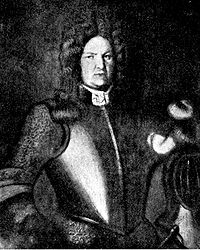
1673: The effigy of Charles Alexis dit Dessessards

According to this registry of events in French Quebec before the English conquest, one Charles Alexis dit Dessessards was ordered broken on the wheel by Quebec’s high executioner on this date in 1673.

He had been convicted of murdering a fur-trapping buddy named Herme, and plundering his pelts.

In the terrifying words of the sentence, he was at 3 p.m. to have “arms and legs broken with four blows, then be strangled and thrown on a wheel to remain there until seven o’clock in the evening. His body will then be brought to the gallows, there to remain until entirely consumed” by the elements. On top of everything, he had a 200-livre fine to pay.

There was just one bit of good news for the murderer Charles Alexis dit Dessessards:

“Until the said Charles Alexis is apprehended, the aforesaid sentence will be executed upon his effigy.”

MARS

Le 6. — “Charles Alexis dit Dessessards, convaincu d avoir tué de guet-à-pens le nommé Herme, son camarade de voyage, et d’avoir volé ses hardes et pelleteries, sera conduit sur la grande place de cette vile (Québec), par l;exécuteur de la haute justice, un lundi, à trois heures après-midi, et là, sur un échafaud qui y sera dressé à cet effet, y aura les bras et les jambes rompues de quatre coups qu’il recevra vif; sera ensuite étranglé et jeté sur une roue pour y demeurer jusqu’à sept heures du soir. Son corps sera porté sur les fourches patibulaires pour y demeurer jusqu’à parfaite consommation. Condamne en outre à deux cents livres d’amende envers le Roy, à la restitution des choses volées et le surplus de ses biens confisqué. Et en attendant que le dit Charles Alexis soit appréhendé, sera exécuté en effigie aux fourches patibulaires, un lundi, à l’heure que dessus.

On this day..

1761: Jacinto Canek, Mayan revolutionary

On this date in 1761, King Canek Chan Montezuma was torn apart in the main square of Merida.

This august regnal name was asserted by a shaman previously known as Jacinto Uc de los Santos (English Wikipedia entry | Spanish). “Canek” echoed the history of the Mayan Itza kings, but it was Jacinto in using it for a single month’s insurrection that fixed its immortality.

“Memory is not just a tool of the spirit for calling up the past. Rather it is a skill which allows us in a moment to see what is in its essence outside of time. Memory allows us to rise to a state, not available to the mind alone, where everything is present.”

Jacinto Canek’s life followed by just a few decades Spain’s final conquest of the last independent Mayan peoples, the Itza, in the 1690s, complete with the usual religious assimilation, political control, and enslavement.

Canek, a commoner (perhaps an orphan) with some education, mounted in November 1761 a surprise revolt at the village of Cisteil (or Quisteil). There he deposed the parish priest and preached from the Catholic pulpit in the Mayan tongue:

My beloved children, I know you yearn to throw off the heavy yoke you have labored under since the Spanish subjugation … Spanish rule [brings] nothing but suffering servility.

About this same time, a Spanish merchant on his routine business rolled into town, blithely unaware of the gathering rebellion. Canek found the interloper insolent, and had him killed.

Crowned the new Mayan king and asserting semi-divine powers, Canek rapidly gained the support of neighboring towns. Within a week, he fielded 1,500 Mayan soldiers to defend Cisteil against a Spanish force sent to suppress them. Hundreds died in a bitter hand-to-hand battle on November 26, 1761, and Cisteil burned … but the Spanish won, and Canek, following a short flight, was captured with his remaining followers.

The Spanish governor of Yucatan, Jose Crespo (Spanish link), ordered Canek to a tortuous execution: tortured, broken, burned, and his ashes scattered. Many of his other followers were also put to death in various ways around the same time.


Mural of Jacinto Canek’s torture by Fernando Castro Pacheco at the Palacio de Gobierno in Yucatan, Mexico. (cc) image from Yodigo.

The Spanish hadn’t heard the end of this.

In the next century, Canek’s name was on the lips of Mayan descendants and mixed-blood Mestizos when they revolted again in the long-running (1847-1901, or even later: Quintana Roo maintained itself semi-autonomous until the 1910s) Caste War against domination by the European-identifying peoples of what was now the independent state of Mexico.

For decades, large areas of the Mayan Yucatan remained deadly to enter for any white-skinned outsider.

Today, it’s safe to check out the monumental tribute to Jacinto Canek on the Merida boulevard that bears his name.

On this day..

1721: Jean-Pierre Balagny, Cartouche lieutenant

On this day in 1721, Jean-Pierre Balagny, alias Capuchin, was broken on the wheel in Paris. He was one of the lieutenants and boon companions of legendary French outlaws Cartouche.

We have noted that that renowned bandit crowned his fame at the last by enduring all tortures, only to voluntarily give up the names of his companions as he approached the scaffold and perceived that they had failed to arrange a rescue.

“Capuchin”, who was with Cartouche when he was captured and subject to much the same interrogation, proved as good as his captain. He, too, endured the boot without breaking. And he, with two companions, likewise reached the scaffold and only there coughed it up.

They gave information as to their accomplices, and made, at the foot of the scaffold, confessions which torture had failed to elicit from them.

They implicated so many persons, that another series of trials began, which lasted as long as the declarations of convicted prisoners compromised other persons, and threw new light on the immense ramifications of an association of miscreants which had for many years defied the police. More than sixty persons were under lock and key at the time of the execution of Cartouche and Balagny. This number increased every day in consequence of the confession of those who hoped to save their lives by denouncing their accomplices, and in June of the following year it rose to one hundred and fifty … all this blood, instead of washing the affair away, seemed rather to make it more serious. Every day brought to light some new discovery; and this shows how profoundly mistaken were those who denied that Cartouche, the centre and wire-puller of this horrible association, possessed the organising spirit without which he could not have extended this immense net over the Parisian society.

One is left to infer from this entry in the memoirs of the Parisian hereditary executioner-family Sanson that Balagny likewise did in his friends over some ornate notion of honor … although if the anecdote is true, one could as easily suppose any number of less “creditable” reasons.

At any rate, Balagny’s evidence added to that of Cartouche’s snowballed into a bloody cycle of tortures and executions and fresh denunciations over the year to come.

Of course, getting rid of all the criminals did not get rid of crime.

“In spite of the executions at La Greve, there are more thieves than ever in Paris,” lamented one observer (quoted here). “Cartouche has died on the wheel; but his name and memory engender robbers.”

On this day..

1788: Not Jean Louschart, rescued by the crowd

On this date in 1788, France’s last attempt at an execution by breaking-wheel was thwarted by a vast crowd sympathetic to the condemned … which stormed the scaffold in Versailles and liberated the victim.

As neat a parable as one might like to find of the entire revolutionary storm then rising on France’s horizons, Jean Louschart’s tale begins with a conflict at home between the young man Jean — neck-deep in Voltaire, Rousseau, and the rest of Enlightenment thought — and his father, a respected and conservative smith not to keen on the boy’s books. Then add to this, that the Louschart family took on one Madame Verdier as a boarder, and Jean grew smitten with that woman’s daughter Helen, to the chagrin of Madame Verdier … who wanted to marry that girl off to Jean’s own father.

So Mathurin Louschart eventually got into it with his son Jean over the boy’s subversive reading. When Mathurin ordered Jean to be silent, the young man just feeling his oats retorted that this was a novel way of settling the dispute. This jab at the elder’s native prerogatives led Mathurin to drive Jean from the house full stop.

That might have been all there was to it if not for the pull of Helen. The Greeks would have understood.

Jean eventually snuck back intending to elope with the willing Helen and salvage her from her father’s hand, but Helen’s mother sniffed out the plan … and the boy entered his former domicile to find Helen being soundly thrashed by Madame. This led Jean to try to protect her, which led Mathurin to intervene, which led to a dramatic bout of father-son violence in which Mathurin was fatally struck with a smithy hammer. Madame Verdier would accuse the young man of willful murder; Jean’s supporters insisted that he had merely tossed the hammer back into the house as he fled it (having overpowered the father’s own murderous rampage), accidentally causing the father’s death. Jean himself kept mum at trial, certain that he could never convince the judges of this version of events and content to suffer for having shed his father’s blood.

We’ll take it here from the Memoirs of the Sansons. The voice here is the grandson of the venerable French Revolution executioner Charles Henri Sanson, who was before that the venerable executioner of the ancien regime. (The mob addresses him familiarly as “Charlot” here.) Fathers and sons had this much in common at least.

the court sentenced [Jean Louschart] to die on the wheel. The prisoner, however, was not condemned to amende honorable, which included the amputation of the hand; and the judges added a retentum to their sentence by which Jean Louschart was to be secretly strangled before his limbs were crushed.

Now public opinion, in Versailles, had already settled that Jean was innocent, and the news of his forthcoming execution caused general excitement. The execution was appointed to take place on August 3. On the morning of the 2nd, Charles Henri Sanson sent from Paris two carts containing the instruments of torture, and beams and boards for the erection of the scaffold. He himself went to Versailles in the afternoon. The emotion caused by Jean Louschart’s impending fate was limited to Versailles; and my grandfather was so thoroughly convinced that he had to deal with a vulgar criminal that he was greatly surprised when he found the whole town in a fever. The Place Saint-Louis was covered with so great a multitude that the assistants and carpenters could hardly go on with their work. No hostility was manifested, however; the crowd was noisy, but its mood was gay; the name of Jean was scarcely pronounced; and the workmen who were erecting the platform were merely jeered. One of the carpenters having, however, struck an urchin who was throwing stones at him, cries of ‘Death!’ were uttered; in an instant all the mocking faces became dark and threatening ; the assistants and carpenters were attacked, and their lives were in great danger. But a body of a hundred men, who could easily be identified as smiths by their athletic proportions and brawny faces, interfered, and partly by strength, partly by persuasion, they induced the crowd to retreat.

My grandfather had not bestowed much attention on this popular demonstration, but he became more attentive when the interference of the smiths took place. He felt convinced that the crowd was obeying a by-word, and that if it had retreated it was merely because it preferred to wait for a more favourable time for action. He directed his assistants to finish the erection of the scaffold as quickly as possible, and returned to Paris, where he lost no time in acquainting the proper authorities with his apprehensions.

Political emotion had already given rise to many storms in the provinces. Normandy, Bretagne, Bear n had risen on behalf of their parliaments, attacked in their privileges. Dauphine had taken a decisive step; after a long series of riots, the representatives of the three orders, nobility, clergy, and tiers-tiat, had assembled, and proclaimed their provincial independence. Paris, however, had heard with indifference of the arrest of two members of the Parliament d’Espremenil and Monsabert; and the authorities had no idea that a struggle between the Government and the people could take place in the very town inhabited by the King and his Court, so that only a few soldiers were sent to Versailles.

The multitude which had thronged the Place Saint-Louis retired during the night; only a few young men remaining to watch what took place around the scaffold. It was rumoured that Helen Verdier had thrown herself at the Queen’s feet, imploring the reprieve of the culprit, and that Marie Antoinette had prevailed on the King to grant it. The news had doubtless led to the dispersion of the crowd.

Charles Henri Sanson made the most of the circumstance. He caused a strong paling to be erected around the scaffold; and, on their side, the executive magistrates took upon themselves to advance the hour of execution.

It was two o’clock in the morning when my grandfather left the Place Saint-Louis for the prison, and he remarked that the men who were still in the place dispersed in different directions as he went away. Jean Louschart was stretched on his pallet when he entered his cell. The doomed man rose and calmly surveyed him. The clerk of the parliament read aloud the sentence, to which he listened with much attention. He then murmured a few words, among which only those of ‘ Poor father!’ were heard, and he added in a loud voice:

‘In two hours I shall justify myself before him.’ On being told that it was time to depart for the scaffold, he turned to the executioner, saying, ‘You can be in no greater hurry than I am, sir.’

At half-past four o’clock the cart moved in the direction of the Place Saint-Louis. The executive magistrates were in hopes that, owing to the retentum, everything could be finished before the population awoke. But they soon perceived their mistake. The streets were swarming with people. The whole of the population was astir. Deafening clamours burst from the crowd as the cart appeared, and it was with the greatest difficulty that it made its way. The prisoner did not even seem to suspect that all this movement was caused by the sympathy people felt for him. At the corner of the Rue de Satory a piercing cry was heard, and a girl was seen waving her handkerchief. Jean Louschart looked up, and rising to his feet, he tried to smile, and exclaimed, ‘Farewell, Helen, farewell!’ At that moment a smith of high stature and herculean proportions, who was walking near the cart, cried in a thundering voice: ‘It is an revoir you should say, Jean. Are good fellows like you to be broken on the wheel?’

A horseman drove him back, but applause and cheers came from every quarter. It was obvious, by the pale faces of the clerk, the policemen, and the soldiers who surrounded the cart, that the agents of the law were anything but confident. The scaffold, however, was reached without accident. The crowd was thickly packed on the Place Saint-Louis. As the cart stopped Jean Louschart addressed a question to the priest who was sitting near him, and my grandfather heard the latter answer, ‘To save you.’ ‘No, father,’ said the doomed man in a feverish voice and with some impatience; ‘if I am innocent of the intention of committing the crime, my hands are nevertheless stained with blood. I must die, and I wish to die.—Be quick, sir,’ he added, turning to my grandfather.

‘Sir,’ answered Charles Henri, pointing to the infuriated masses that were already breaking through the paling, ‘if there is a man here who is in danger of death it is not you.’

Hardly were the words out of his mouth than a tempest of groans and screams burst forth. The paling was broken and trodden under foot, and hundreds of men rushed on the scaffold. The smith who had already spoken to Louschart was among the foremost. He seized the prisoner in his muscular arms, cut his bonds, and prepared to carry him off in triumph. An extraordinary scene now took place; Jean Louschart struggled violently against his saviours, turned towards the executioner and begged for death with the earnestness usually displayed by other culprits in asking for mercy. But his friends surrounded him, and at length succeeded in carrying him away.

My grandfather’s position was perilous in the extreme. Separated from his assistants, alone amidst a crowd that knew him but too well, he really thought that his last hour was at hand. His countenance probably betrayed his thoughts, for the tall smith came up to him, and seized his arm: ‘Fear nothing, Charlot,’ he cried; ‘we don’t want to harm you, but your tools. Henceforth, Charlot, you must kill your customers without making them suffer.’ And speaking to the crowd: ‘Let him pass, and take care he is not hurt.’

This harangue calmed the crowd, and my grandfather was allowed to withdraw. In less time than it takes to write this account the scaffold and all its accessories were broken into pieces, which were thrown on the pile prepared for the burning of the prisoner’s body; and the terrible wheel was placed on the summit as a kind of crown. Fire was set to the heap, and men and women, holding each other by the hand, formed an immense ring and danced around the crackling pile until it was reduced to ashes.

Louis XVI pardoned the unwillingly liberated Jean Louschart, and abolished the breaking-wheel.

Part of the Themed Set: Scary Escapes.

On this day..

1739: Michael Blodorn, “selvmordsmord”

On this date in 1739, Michael Blödorn was stretched out on a scaffold at Copenhagen’s beautiful Kongens Nytorv (King’s Square), where an executioner set about smashing his limbs with heavy wagon wheels.


A 1727 illustration of Danish prisoners broken on the wheel.

Scholar Tyge Krogh’s new book titled (and about) The Lutheran Plague of suicide-murder.

As he lay suffering, Blödorn sang vigorously — a joyful hymn to lift his soul to heaven.

That, indeed, was why he was being broken on the wheel in the first place.

Blödorn was part of an alarming trend in Lutheran countries that waxed especially strong in Denmark: a homicide-to-heaven loophole apparently licensed by the Reformation theology.

Crudely put, the scam is this: you have a sure ticket to salvation if you die with no un-repented sin on your soul. But the only real way to know when you’re going to die is to kill yourself … and since that’s a mortal sin, that’s even worse than risking the everyday mischance of life.

But do like Mike and kill a random stranger to incur a death sentence, and you get to check out pure as the driven snow: assured last-minute repentance with no suicidal downside. Everybody wins!

Um.

Actually carrying out this plan required what you might call a deep commitment to your theology: in an effort to discourage the practice without backing off the death penalty for murder, penalties for apparent suicide-by-executioner cases had been ramped up into an archaic bloody theater. Blödorn, a soldier, had already been suffering weekly floggings leading up to the execution. Civilian murderers could look forward to having the flesh ripped with red-hot tongs.


Ouch. A 1727 illustration of judicial penalties that might attend a suicide-murder: tearing with hot tongs, the breaking-wheel, and severed hands.

Still, selvmordsmord persisted (Danish link: or, here’s the same story in Norwegian).

At last in 1767, the Danes reversed course abandoned capital punishment for “melancholy and other dismal persons [who committed murder] for the exclusive purpose of losing their lives,” implementing instead sentences of humiliating hard labor: a punishment to fit the crime and also meet the larger society’s need for deterrence.

“This made Denmark a pioneer when it came to abolishing the death penalty,” said Danish academic Tyghe Kroghe, author of a new book about the suicide-murder phenomenon. “But it was not something they did proudly. The decision violated the religious understanding of the criminal system.”

Here’s Kroghe discussing his research … in Danish.

Crazy, right?

Executions of men and women who not only decline to fight their sentences, but even commit their capital crimes with the intent to engineer their own executions, are hardly confined to the foreign country that is the past.

Maybe you wouldn’t point the finger at Martin Luther any longer, but Denmark’s very last civil execution was of an arsonist so insistent about attempting murder that the authorities finally gave him the peace of the grave that he desired. We’ve seen in these pages the headsman courted by people motivated by depression and by romantic love.

And numerous more modern criminals right into the 21st century look every bit like selvmordsmord cases. For example:

  • Christopher Newton, who killed his cellmate to draw a death sentence and was executed in Ohio in 2007;
  • Daniel Colwell, who gunned down a couple randomly to “win” a death sentence in Georgia in 2003 but died before reaching execution;
  • Mamoru Takuma, the mentally disturbed author of Japan’s notorious Osaka school massacre, who committed the crime with no intent to escape and immediately demanded a death sentence (carried out in 2004).

On this day..

1686: A man and a woman broken on the wheel in Hamburg

The New York Times of Dec. 30, 1900 provides this date’s entry, featuring the unusual scene of a woman being broken on the wheel.


In the diary of that remarkable man, Gen. Patrick Gordon, who left Scotland in 1651 a poor, unfriended wanderer, and, when he died, in 1699, had his eyes closed by the affectionate hands of his sorrowing master, the Czar Peter the Great, the following entry is to be found, under date Hamburg, March 22, 1686:

This day, a man and a woman, a burgher of the towne being the womans master, for murthering, were carted from the prisone to the house where the murder was committed; and there before this house, with hotte pinsers, the flesh was torren out of their armes, and from thence were carted to the place of justice without the towne, and there broken and layed on wheeles.


Executions by breaking wheel: early 18th century engraving. (Source: Wikipedia).

On this day..

1762: Jean Calas, intolerably

(Thanks to Mary O’Grady for the guest post. -ed.)

In the 1760s, Toulouse was no place for a Huguenot, not even for an affable, prosperous paterfamilias like Jean Calas. The whole southwestern region of France barely tolerated Protestants.

The Calas household included two adult sons, Louis, who had converted to Roman Catholicism, and Marc-Antoine, their sisters, as well as their parents, Jean Calas and his wife, and a longtime maid who was Catholic. Monsieur and Madame Calas and their daughters were Protestant, as was Marc-Antoine. Friends and associates described the ménage as placid, except for occasional outbursts of misbehavior by elder son Marc-Antoine.

Jean Calas was a textile dealer. On October 13, 1761, young Marc-Antoine Calas was found hanged in his father’s shop. Wishing to spare the family’s reputation from the stigma of suicide as well as his son’s corpse from the mutilation which was customary for suicides, Jean Calas at first claimed to the authorities that an intruder killed his son.

An ugly rumor swept Toulouse: Marc-Antoine was murdered by his own parents, because he planned to convert to Catholicism. (Never mind that Jean Calas kept his Catholic son Louis in the bosom of his family and employed a Catholic servant.) Jean Calas was arrested and subjected to a trial that was anything but fair; by this time, he had admitted, too late, that his son had hanged himself, probably over gambling debts.

No dice. The appellate court of Toulouse condemned Jean Calas to death on March 9, 1762. The execution was set for the following day.

Murder of a family member was held to be a particularly hideous crime, and hideous was the penalty: breaking on the wheel. Jean Calas was tied to a cartwheel in the main square of Toulouse. His limbs were broken with iron rods. He proclaimed his innocence until the executioner finally strangled him to death.

L’affaire Calas inspired Voltaire to new vigor in his fight for religious toleration. In 1763 he published A Treatise on Tolerance, a landmark document which remains well-read today.

O different worshippers of a peaceful God! if you have a cruel heart, if, while you adore he whose whole law consists of these few words, “Love God and your neighbor,” you have burdened that pure and holy law with false and unintelligible disputes, if you have lighted the flames of discord sometimes for a new word, and sometimes for a single letter of the alphabet; if you have attached eternal punishment to the omission of a few words, or of certain ceremonies which other people cannot comprehend, I must say to you with tears of compassion for mankind: “Transport yourselves with me to the day on which all men will be judged and on which God will do unto each according to his works.

“I see all the dead of past ages and of our own appearing in his presence. Are you very sure that our Creator and Father will say to the wise and virtuous Confucius, to the legislator Solon, to Pythagoras, Zaleucus, Socrates, Plato, the divine Antonins, the good Trajan, to Titus, the delights of mankind, to Epictetus, and to many others, models of men: Go, monsters, go and suffer torments that are infinite in intensity and duration. Let your punishment be eternal as I am. But you, my beloved ones, Jean Châtel, Ravaillac, Damiens, Cartouche, etc. who have died according to the prescribed rules, sit forever at my right hand and share my empire and my felicity.”

May all men remember that they are brothers! May they hold in horror tyranny exerted over souls, just as they do the violence which forcibly seizes the products of peaceful industry! And if the scourge of war is inevitable, let us not hate one another, let us not destroy one another in the midst of peace, and let us use the moment of our existence to bless, in a thousand different languages, from Siam to California, [God’s] goodness which has given us this moment.

-Voltaire, A Treatise on Tolerance

As a result of Voltaire’s efforts, 50 French judges were appointed to a panel to review Jean Calas’s case. Their charge was to decide whether anti-Huguenot prejudice had cost Jean Calas his life. They reversed Calas’s conviction on March 9, 1765, the third anniversary of the poor man’s condemnation.

A few French books about Jean Calas

On this day..

1721: Cartouche, French bandit

On this date in 1721, the French outlaw Cartouche was broken on the wheel in Paris.

Your basic superstar robber during that archetype’s golden age, Louis Dominique Garthausen, aka Bourguignon, aka Cartouche was the son of a German mercenary-turned-French wineseller.

Little Cartouche — his nickname came from a Francophone corruption of his German surname — distinguished himself from childhood as the most charismatically intrepid of the local hooligans, and by adolescence was already the leader of a troupe of rascally thieves.

By his twenties, after a detour through the army, Cartouche and his merry men (the Cours des Miracles gang, after the slum they operated out of) were raiding the lucrative Versailles-Paris route, plundering the virtue of marchionesses, distributing stolen booty the poor, maintaining perfect courtesy in the society of gentlemen, and generally becoming the heroes of that species of literature that revels in bodice-busting sybaritic rakes who play by their own rules but have a heart of gold. (Sample escapade: walking a carnival parade with a cart full of police effigies — whipping them all the way, to the glee of the crowd. Thackeray celebrates more Cartouche folklore here, like the time he robbed as part of a threesome, talked one accomplice into murdering the other in order that the two survivors should have greater shares of the spoils to divide — only to round self-righteously on the killer once his pistols were safely discharged and gun him down in turn with the words “Learn, monster, not to be so greedy of gold, and perish, the victim of thy disloyalty and avarice!” That’s a pretty good one, whether it really happened or not.)

The flesh-and-blood police started to roll up this group around 1719, turning arrestees into informants and hunting ringleaders to ground. True to character, Cartouche defied with his liberty the growing price on his head, deftly giving gendarmes the slip until a confederate betrayed him into his enemies’ hands literally while his pants were down.


18th century engraving of the arrest of Cartouche.

The guy very nearly broke out of prison — tunneling out of a dungeon of the Chatelet into a neighboring basement, only to have the clank of his chains rouse the family dog into a woofing frenzy that betrayed him before he could vanish out the front door. But even back in the clink,

came a period of splendid notoriety: he held his court, he gave an easy rein to his wit, he received duchesses and princes with an air of amiable patronage … His portrait hung in every house, and his thin, hard face, his dry, small features were at last familiar to the whole of France. M. Grandval made him the hero of an Epic — “le Vice Puni.”

Cartouche was doomed to breaking on the wheel after a morning suffering the tortures of the boot in an unavailing effort to extract further incriminations from the rogue.*

Cartouche seems to have fully expected his troupe to reciprocate this heroism by rising to the dramatic occasion of a rescue from the very scaffold. But as the prisoner arrived at the Place de Greve, he perceived at last that like Christ he had been abandoned at the critical hour by the men who had sworn oaths with him. The great desperado’s final act was to retaliate upon these faithless friends (and family!) by taking aside his prosecutors and detailing his every accessory in crime, even his lovers. What the worst extremities of medieval torture could not procure from him, the compelling incentive of revenge instantly conjured.

Our hero went to his death this day but his revenant spirit stalked France for many months thereafter as dozens succumbed (pdf) to Cartouche’s scaffold indictment. One diarist recorded the following July,

Nothing but hangings and breakings on the wheel! Every day some Cartouchian executed.

* Available sources are flatly contradictory between the story that Cartouche was to die on the 27th and his confessions stalled things until the 28th, or was to die on the 28th all along, or was to die and did so on the 27th.

On this day..

1707: Johann Patkul, schemer

On ths date (N.S.) in 1707, Livonian nobleman Johann Patkul was broken on the wheel at Kazimierz Biskupi, Poland for a decade’s treasonable scheming against the Swedish crown.

Livonia — essentially present-day Latvia, plus a chunk of Estonia — was at this time a part of the Swedish Empire in the latter’s twilight as a world power.

Financially pinched after the protracted and bloody but indecisive Scanian War, the Swedish king Charles XI imposed his great reduction — a heavy tax on the landed aristocracy allowing the crown to reclaim as its own any property that it had held formerly and granted out. There was a lot of such land mortgaged out generations before to raise capital for the Thirty Years War. War giveth, war taketh away. Hands up everyone who feels bad for the nobility.

Of course, all the 17th century nobles felt bad for the nobility.

Johann Patkul was the young — maybe too young — man deputized by Livonian bluebloods to go complain about it to Charles. When sharp but respectful eloquence predictably failed to obtain his ends, he dropped the “respectful” part — and for this lese majeste had to bug out of Sweden with an in absentia death sentence at his heels.

Having failed to obtain pardon from the offended monarch or from his heir Charles XII, Patkul just decided to change teams full stop. You could call this treachery (Charles XII did) but this is an age before nationalism. What was the Swedish royal house to a Latvian noble if he could get a better deal elsewhere?

“Elsewhere” for Johann Patkul meant Polish-Lithuanian king Augustus the Strong, and/or Russian tsar Peter the Great. Our refugee aristocrat spent the 1700s conducting vigorous behind-the-scenes shuttle diplomacy to engineer an alliance against his former masters and carve their respective pounds of flesh out of Sweden. Patkul himself, of course, would get a healthy bite from Livonia for his trouble.

In this campaign Patkul was merely an “unhappy instrument” (as a British correspondent quoted here put it): the antagonists in question had ample reason of their own for this statecraft; had they not, some itinerant conspirator pining for a lost manor could scarcely have conjured it.

But Patkul was a useful instrument: energetic, discreet, willful, and so he could surely claim some ownership of the product. Think of him as the convenient enabler — the Ahmed Chalabi of the Great Northern War that tore apart the Baltic environs for the first two decades of the 18th century.

It was rather fitting, then, that Patkul was devoured by his offspring when Sweden forced a peace upon Poland that resulted in Patkul’s being handed over to the Swedish authorities. The man’s extradition was specified by name in the treaty.

Patkul’s brutal execution inflamed some outside opinion against the Swedes (which presumably mattered not a whit to the progress of hostilities); a purported account of his execution-eve conversation with his confessor is given in this extremely sympathetic English pamphlet.

Though it’s safe to say that Patkul didn’t get what he wanted — let’s guess that the public shattering of his bones prior to a protracted death by exposure was towards the “worst case scenario” end of the calculus — the Great Northern War did indeed loose Livonia from the Swedish yoke … in favor, instead, of the Russian. Peter the Great accepted Livonia’s capitulation in 1710.

Mission accomplished.

Patkul is not to be confused with Baron Peikel/Pykul, a different fellow who was also executed for disobedience to Sweden in 1707.

On this day..

1714: Various rebel slaves in the Cape Colony

This site has previously noticed a milestone 1714 execution in the Dutch Cape Colony of South Africa.

That execution of a black slave and his white lover was exceptional — and, of course, the chronicles of the Cape are replete with less exceptional fare, the humdrum penal brutality of an 18th century colony disposed of in a sentence of two between reports of smallpox outbreaks, price fluctuations, the transit of slave ships, and all the other business of frontier life.

A slave condemned to be burnt alive for arson; another to be hanged for theft … Two white men hanged for desertion, sheep-stealing, and attempt to murder … A Javanese “Guru” sentenced to death for instigating slaves to run away, harbouring and arming them … Matthys of Ternate punished for running away and cattle theft, &c. Sentenced to be hanged … A slave hanged for breaking into the house of Lieutenant Captain Slotsboo … Five slaves sentenced to be broken, and a female slave to be scourged … Two soldiers sentenced to run the gantlope …

And so on.

This date marks a number of such executions for a minor slave revolt (incidents of slave insubordination also pepper the Colony records). At three full entries in the chronicle, 16 implicated slaves, and some spectacularly savage punishments, it must have been one of the more noteworthy of its day; what the colonial register leaves us is just enough to suggest the forgotten suffering and resistance of the half-nameless chattel of yesteryear.

1714.

January 7 — Some 16 fugitive slaves who had conspired, armed themselves, and did much mischief. They resisted the officers of justice, shot a soldier, and murdered a Hottentot woman. They were now brought up for examination.

February 7 — The sentences passed on the fugitive slaves, and the whole history of the case. “Tromp” to be empaled alive, and to remain in that position till he dies. “Cupido” to be put on a cross, his right hand to be cut off, and with “Neptunus” to be broken on the wheel, and then to be left on a hurdle until dead. “Titus” to be broken with the coup de grace. Jeroon and Thomas to be hanged; three others to be scourged and have their right heels cut off. The eleventh prisoner is merely to look on, and afterwards to be sent home; paying the costs however.

February 8 — The empaled convict found strangled in the morning. He had received some linen from a kind friend during the night for the purpose. He would otherwise have been still alive.

On this day..