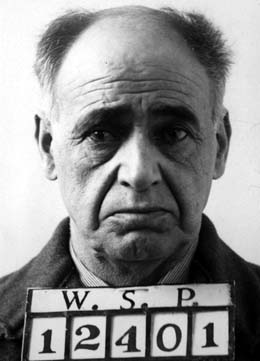
1975: Pierre Galopin, hostage of Hissene Habre

On this date in 1975, French Major Pierre Galopin was executed by Chad rebel Hissène Habré.

Galopin (English Wikipedia entry | French) had been dispatched to the former French colony to negotiate the release of two French nationals* seized as hostages by Habre’s Command Council of the Armed Forces of the North (CCFAN).

You’ll never guess it: CCFAN also took Galopin hostage.**

CCFAN tried to leverage its new captive into an arms trade. When France dragged its feet, the Chadians terminated the negotiation by having Galopin condemned by a “revolutionary tribunal” and hanged to a roadside tree.

Habre would eventually take power as President of Chad in 1982, and was subsequently welcomed on state visits to the former mother country — much to the disgust of those who remembered the Frenchman sacrificed to his ambitions. Galopin was hardly the last man to be so distinguished: as of this writing, Habre is serving an eternal prison sentence in neighboring Senegal for crimes against humanity committed during his eight years ruling Chad.

* Archaeologist Françoise Claustre and development worker Marc Combe. (A third hostage, West German doctor Christoph Staewen, had also been taken, but had quickly been ransomed by his government.) Combe escaped in 1975. Claustre was not released until 1977.

** CCFAN was also riven by a major internal division that by 1976 would split the movement into two rival organs. It has long been murky (French-language pdf here) just whose interest within CCFAN was best served by the hostile course of events.

On this day..

1828: William Dyon and John Dyon, all in the family

(Thanks to Meaghan Good of the Charley Project for the guest post. -ed.)

On this date in 1828, William Dyon, 45, and his son, John, 23, were hanged for the murder of William’s brother, who was also named John.

The brothers had fallen out over their father’s inheritance; William Dyon Sr. had favored John’s family over William Jr.’s. Writing dramatically of the case in his book Foul Deeds and Suspicious Deaths in Doncaster, Stephen Wade described the brothers as

sons of a Lincolnshire farmer, and the two boys were so different that this tale almost attains a biblical resonance, with jealousy, brooding and resentment, and finally a deathly hatred that led one brother to a bloody death; and the other to the scaffold. It is a Cain and Abel story, but with more than one layer of evil: William Dyon was joined by his son, John, in the murder.

According to contemporary account, from his youth William was “of a Wild disposition, and addicted to low sports; in his youth, a frequenter of cocking matches [and] bull baits.” While William joined “scenes of riot and dissipation,” John was a much steadier sort and very helpful to his father on the farm. Dyon Sr. was wealthy and he rewarded his more filial son with 63 acres of land, followed by cash gifts amounting to £300 sterling, while giving William nothing.

When he drafted his will he also favored John, virtually ignoring his other son.

William and his son planned out the murder more than a week in advance, enlisting the help of another man named John White who had known both brothers for years. John Dyon was walking through the front gate of his farm, 800 yards from his house, when he was ambushed by his brother and nephew and shot to death on the evening of February 16, 1828. His family didn’t find him until morning.

The victim was lying in the grass by the gate, stiff and cold, shot in the chest. He was carrying about £40 and an expensive watch, so robbery was ruled out as a motive for his death.

The inquest that followed returned a verdict of “willful murder by person or persons unknown,” but suspicion had already fallen on the embittered relatives.

Both Dyon pere and fils had been seen loitering near the farm with guns; they claimed to be hunting, but it wasn’t the right time of year for that. They had also asked people what time the victim normally returned home from the Doncaster market.

Their enmity towards the victim was well­known in the area and many witnesses remembered hearing William threaten his brother and even say outright that he planned to murder him. After John’s death he was seen boasting about his crime in the local pub.

The investigating magistrate actually performed some CSI work: he noticed a pair of boot tracks at the site of the murder and saw that the wearer had walked with their feet turned outward. William Dyon walked in that way.

Furthermore, the prints were from a left boot and a right boot; not many shoes were made left­ and right­footed during that time period, but William owned a pair that was.

The two suspects produced an alibi, initially confirmed by William’s brother­in­law and his servant: they were at home at the time of the murder. But this collapsed when both witnesses recanted. Then their accomplice, White, came forward with his evidence.

Lincoln, Rutland, and Stamford Mercury, April 11, 1828

By the time of the trial, there wasn’t much of a defense left to offer. The jury deliberated five minutes before voting guilty for both defendants.

On the scaffold under 10,000 eyes, John acknowledged the justice of his sentence. William, who had been caught passing notes to his son in gaol enjoining him to keep his silence, merely announced that “the Lord will pardon my sins.” A friend of the victim wanted to buy the execution ropes, but he was turned away.

“The bodies,” Wade wrote, “were dissected by the anatomists and their skins tanned.”

On this day..

1832: James Lea and Joseph Grindley, arsonists

The London Times of April 7, 1832 brings us this arson double hanging evidencing the extension of the rural Swing Riots labor rebellion from its southern heartland up to the West Midlands.

CONFESSION OF LEA AND GRINDLEY.

(From the Salopian Journal.)

After their trial and condemnation Lea evinced much anxiety, and expressed a wish to disburden his mind by stating all that he knew of the transactions in which he had been so deeply implicated; and he observed that he would freely do so, but that he had acted under the encouragement of certain abettors, who had bound him under the obligation of a horrible oath not to divulge the counsels and purposes in which they had engaged his assistance.

However, on Wednesday last, having, from the instruction and advice to which he was submitted, in preparation for that state to which he was so shortly to remove, satisfied himself that no compact such as we have described could be binding upon him, but, on the contrary, was in itself most iniquitous, he made a full and complete confession as to all the parties implicated in the atrocious conspiracy to which he had been a ready instrument, and in furtherance of which, it appeared, his department was to set Grindley at work under the instructions that he himself received from the prime members of the conspiracy.

Who the parties implicated are, and what Lea stated, cannot of course be here more particularly alluded to; it is, however, a striking circumstance that he again affirmed the truth of Wednesday’s confession just previous to his ascending the scaffold.

The sacrament having been administered to the unhappy men in the chapel of the jail, they were pinioned and at 12 o’clock the procession commenced moving from the chapel to the lodge, where the convicts spent a few minutes in prayer with the Chaplain, and were then conducted to the platform.

Grindley ascended first, and the rope, &c., having been adjusted, he continued to pray to Heaven for mercy until the fatal bolt was drawn. Lea ascended the steps of the scaffold apparently with more difficulty than Grindley, though both met their fate with much firmness, and with a demeanor becoming their awful situation.

Richard Whitfield, convicted at our late Assizes for writing threatening letters, and now under sentence of transportation for life, was among the convicts brought out into the yard to witness the execution; and as soon as the culprits ascended the scaffold a striking and most ominous change was apparent in his countenance. His intimate connexion with these wretched men, as already known to the public, would of itself be sufficient to account for this, if no other circumstances were within the knowledge of himself and those whose awful exit he was fated to witness; but, if the statement made on Wednesday by Lea be correct, not only Richard Whitfield, but several other parties not in custody, have an account to give, either in this world or the next, the very recollection of which might well make a man of the stoutest nerves tremble.

(An 1830s publication on the fires in Shropshire, which also summarizes the trials Lea, Grindley, and Whitfield, can be read here. -ed.)

On this day..

1702: Not Nicholas Bayard, anti-Leislerian

March 30, 1702 was the date colonial New York spared Col. Nicholas Bayard from undergoing a hanging scheduled later that same day.

A “puzzling affair, made so by frustratingly incomplete documentation,” in the estimate of Adrian Howe, whose William and Mary Quarterly article (January 1990) “The Bayard Treason Trial: Dramatizing Anglo-Dutch Politics in Early Eighteenth-Century New York City” is a key source for this post: it was certainly blowback for the execution a decade earlier of the Dutch merchant Jacob Leisler who seized control of New York in a populist rising to cement its adherence to the Glorious Revolution. Bayard, a colonial elite related to Peter Stuyvesant himself, was Leisler’s superior in the militia but abhorred the Leislerian intervention on behalf of the usurping Dutch king William III.

Bayard got his by helping to manage Leisler’s prosecution all the way to the gallows, even reputedly hosting the new royal governor at his own house while his party plied him with alcohol in a (successful) bid to overcome his reluctance to sign Leisler’s death warrant — a triumph Bayard celebrated by gaily hanging a flag from his window on the day Leisler hanged.

Unchastened by having found it necessary to flee the city for his own safety during Leisler’s hour, Bayard did not refrain from provoking a foe that grew to hate him. Anglican clergyman John Miller surveyed the city during the intervening years and noticed that team Leisler “have vowed revenge & Some Say want but an opportunity to effect their purpose.”

As the 18th century dawned, the Leislerian party — think artisans, against the magnates — was back in control of the New York’s Provincial Council, and could finally see a way to that purpose. It seized on an intemperate petition that Bayard had drawn up against the late, pro-Leislerian governor Bellomont* and turned a 1691 anti-Leisler law-and-order statue against it.

The resulting eight-day trial in early March was a nakedly political operation although New York’s Dutchmen fell a bit short of the Robespierrian standard: it’s not clear whether they really meant to hound Bayard all the way to death or whether the last-minute pardon was the plan from day one. To get it, Bayard had to submit himself as far a very grudging apology for the offense — “which by the said sentence he finds and is convinced he has committed.” Apparently this sullen abasement was enough to satisfy Team Leisler, who cut here a picture of moderation and restraint that would do their countrymen’s latter-day stereotypes proud; when a new governor arrived, Bayard’s condemnation was fully reversed and expunged, “as if no such trial had been.”

This escape and restoration left Leisler to publish a pamphlet against his treatment, An Account of the illegal prosecution and tryal of Coll. Nicholas Bayard, in the province of New-York, for supposed high-treason, in the year 1701.

* Among other things in his venturesome life, Bellomont sponsored William Kidd when he was a somewhat legitimate privateer, but eventually orchestrated Kidd’s capture as a pirate.

On this day..

1929: Luther Baker, moonshine bootlegger

On this date in 1929, Washington state hanged bootlegger Luther Baker for murdering Clark County Sheriff Lester Wood during a Prohibition moonshine raid.

The rare Democrat office-holder in heavily Republican Clark County — which faces Portland, Ore., across the Columbia River — Sheriff Wood favored his dry constituents with “a ruthless war on liquor violators.” (Oregonian, May 23, 1927)

On May 22, 1927, Wood and two deputies found and destroyed an illegal 125-gallon still operated by Baker and his brothers “in the roughest and wildest part of Clark County,” Dole Valley — when the Bakers, alert to the lawmen’s presence, ambushed them. Wood was the only fatality of the wilderness shootout. Well, Wood and Luther Baker.

Luther, aged around 59, was arrested for this along with his brother Ellis and Ellis’s 21-year-old son Ted. Young Ted’s life sentence would be overturned on appeal, but Ellis spent 30 years locked up at Walla Walla and for 28 of those years he had to bear the memory of his older brother’s walk to the gallows* — for, according to the Seattle Daily Times same-day report of the morning hanging, Ellis “was awake in his cell” just “a few yards from the gallows” during the execution and seemed “more shaken than the man who climbed the thirteen steps.”**

* And the fact that Ted, despite his exoneration, succumbed to tuberculosis a few months after Luther Baker hanged. I haven’t been able to establish whether the condition related to his stint in prison.

** Luther and Ellis were allowed a half-hour together during Luther’s last night on earth.

On this day..

1741: Henry Smith, cad

On this date in 1741 ended at Dorchester “a young Man of great Hope, who was of a proper Stature, and of a handsome Personage, of a gentle and winning Disposition, chearful in his Temper, of a noble Nature, a kind and benevolent Mind; he had a pleasant Wit, speaking very gracefully and pertinently that made him pleasant to all Company; of an Industry in Business not to be tired; and what is remarkable, tho’ he spent his Youth among Seafaring People, yet he seldom drank any Thing else but Water of Small Beer, he abhorr’d Drunkenness in others, and could not endure any light or prophane Words, with whatever Sharpness of Wit it was cover’d; in his Engagements in Trade he was regular; in his Promises punctual; to his Servants he was kind; to his Wife very loving, and so courteous and affable to all Men, that he had many Friends, and few Enemies; he preserved a Reputation in his Neighbourhood, and was esteem’d and beloved through the Circle of his Acquaintance.”

Seems like a pretty great guy, except for the part where, concealing his marriage, he debauched and impregnated a serving-girl with the unrealizable promise of wedlock — a promise poor Jane Mew was disabused of by accidentally meeting his wife.

What occurred next is only to be inferred, for the very respectable Smith (or Smythee, as the pamphlet attached to this post has it) denied the circumstantial case against him to the last. Smith directed his lover to a lying-in place to give birth in secret but Jane Mew turned up in a field with her throat slashed en route. Perhaps Smith would have stood a better chance of convincing people that she had fallen as prey to some random highway robber or a desperate suicide had he not taken flight upon the discovery of her incriminating corpse.

On this day..

1634: John Bartendale survives hanging and burial

(Thanks to Sabine Baring-Gould for (another) guest post. This report in Baring-Gould’s Yorkshire Oddities, Incidents and Strange Events glosses a rhyming Latin squib of Richard Brathwait‘s Drunken Barnaby’s Four Journeys to the North of England, several versions of which survive.)

JOHN BARTENDALE,
The Piper.

In the reign of King Charles I a strolling musician, a poor piper, named John Bartendale, was brought, in 1634, before the Assizes, and was convicted of felony.

He received sentence, and on March 27th was hung on the gallows, outside Micklegate Bar, York. There were no houses there at that time — it was open country. After he had remained swinging for three-quarters of an hour, and was to all appearance dead, he was cut down, and buried near the place of execution. The officers of justice had accomplished their work carelessly in both particulars, as it afterwards transpired, for he had been neither properly hung nor properly buried.

Earth has a peculiarly invigorating and restorative effect, as has been recently discovered; and patients suffering from debility are by some medical men now-a-days placed in earth baths with the most salutary effects. In the case of gangrened wounds a little earth has been found efficacious in promoting healthy action of the skin. John Bartendale was now to experience the advantages of an earth-bath.

That same day, in the afternoon, a gentleman, one of the Vavasours of Hazlewood, was riding by, when he observed the earth moving in a certain place. He ordered his servant to alight; he himself descended from his horse; and together they threw off the mould, and discovered the unfortunate piper alive. He opened his eyes, sat up, and asked where he was, and how he came there. Mr. Vavasour and his servant helped him out of his grave, and seated him on the side. The man was sent for water and other restoratives, and before long the news had spread about down Micklegate that the poor piper was come to life again. A swarm of wondering and sympathising people poured out to congratulate John the Piper on his resurrection, and to offer their assistance. A conveyance was obtained, and as soon as Bartendale was in a sufficient condition to be moved he was placed in it covered with Mr. Vavasour’s cloak, — for he had been stripped by the executioner before he was laid in the earth — and was removed again to York Castle.

It was rather hard that the poor fellow, after he had obtained his release, should have been returned to his prison; but there was no help for it. The resurrection of the piper was no secret; otherwise Mr. Vavasour would doubtless have removed him privately to a place of security till he was recovered, and then have sent him into another part of the country.

At the following Assizes, Bartendale was brought up again. It was a nice point of law whether the man could be sentenced to execution again after the Sheriff had signed his affidavit that the man had been hung till he was dead. Mr. Vavasour was naturally reluctant to supply the one link in the chain of evidence which established the identity of the prisoner with the piper who had been hung and buried for felony; he made earnest intercession that the poor fellow might be reprieved, popular sympathy was on his side, the judge was disposed to mercy, and Bartendale was accorded a full and free pardon; the judge remarking that the case was one in which the Almighty seemed to have interfered in mercy to frustrate the ends of human justice, and that therefore he was not disposed to reverse the decree of Providence according to the piper a prolongation of his days on earth.

Drunken Barnaby in his “Book of Travels” alludes to Bartendale, when he stops at York:

Here a piper apprehended,
Was found guilty and suspended;
Being led to t’fatal gallows,
Boys did cry, “Where is thy bellows?
Ever must thou cease thy tuning,”
Answered he, “For all your cunning,
You may fail in your prediction.”
Which did happen without fiction;
For cut down, and quick interred,
Earth rejected what was buried;
Half alive or dead he rises,
Got a pardon next Assizes,
And in York continued blowing —
Yet a sense of goodness showing.

After his wonderful deliverance the poor fellow turned hostler, and lived very honestly afterwards.

When asked to describe his sensations on being hung, he said that when he was turned off, flashes of fire seemed to dart before his eyes, and were succeeded by darkness and a state of insensibility.

On this day..

1437: Walter Stewart, Earl of Atholl

On this date in 1437, the Earl of Atholl finally reached the end of a three-day carnival of public tortures and lost bowels, heart, and head for assassinating the King of Scotland.

When Atholl’s grandson Robert exploited the family’s familiar proximity to the king to admit a team of assassins on the night of Feb. 20-21 1437, it ended a strange run for James I.* James had been melodramatically kidnapped by pirates at age 12 and sold to the English — who held the Scottish king** for ransom for 18 years.

By the time James returned to native soil in 1424, he had had quite enough of being some other lord’s shuttlecock and irritated Scotch magnates — who had formerly enjoyed the run of the place and therefore dragged their feet when it came to repatriating their hostage king — by his overweening grabs at land, money, and power. One prime example that would come back to haunt him in the events of this post was the 1425 destruction of the Albany Stewarts, which netted the crown the forfeiture of three earldoms. Clients of the Albany Stewarts, like Sir Robert Graham, delivered a fair fraction of the 28 stab wounds that shuffled King James off this mortal coil.

But even James’s allies had to look sharp when it came to any demesnes not nailed down.

Our principal for today’s post, Walter Stewart by name, was one of these. James’s uncle and supporter, and the son of King Robert II, Stewart/Atholl had pushed for the magnates to ransom James.

Putatively seen as the king’s ally, Atholl’s complicity in regicide made him a byword for treachery to outraged Scottish chroniclers; the apparent grab for the throne led his captors to put a “corone of papir … upon his hed, the which was all abowte depaynetid with jubettes, and for the more dispite and shame to hym was writyne with thes wordes, TRAITOUR, TRAITOUR, TRAITOUR,” according to The Dethe and False Murdure of James Stewarde, Kyng of Scotys.

In a 1992 article on events† historian Michael Brown noted that what Atholl had added to his holdings through his nephew the king was the earldom of Strathearn, and it was but tentatively held: granted for Walter Stewart’s lifetime only, it would revert to the king with the septaugenarian’s death, leaving his heirs no better off than Walter’s own efforts had made them circa 30 years before.

Brown depicts the aging lord as a savvy operator who “would increasingly have despaired of keeping the earldom of Strathearn in his family … [as] a consequence of James’s general opportunism when it came to increasing the revenues of the crown.” A couple of specific adverse interventions that trimmed Atholl’s estates might have presaged — in the earl’s mind, at least — a potential royal move against his position, a move that Atholl would be best advised to check preemptively or never at all. Who could say in February of 1437 whether the Stewarts would by March or April still be royal confidantes in any position to have “left the Kynges chamburs doore opyne; and … brussed and blundird the lokes of hem, yn such wise that no man myght shute hem”?

If we’re not sure of exactly why they did it, we do know very clearly that the plot failed as a coup attempt. Both the queen and the six-year-old heir James II survived that evil night, and James’s violent deposition met not support, but horror. Within weeks the conspirators were hunted to ground. Atholl, for his part, protested his innocence of the regicide all the way to the end, a protest that neither contemporaries nor historians have much credited.

And his death declar’d that there is nothing more popular than justice, for they who were wont to detract from him whilst he was alive, now he as dead had most flagrant desires after him, insomuch that the Nobles, as soon as they heard he was murder’d, came in of their own accord from their respective countries and before a tryal was appointed they voluntarily sent out into all parts to apprehend the murderers and bring them to justice.

Very many of them were taken. The principal of them was put to new and exquisite kinds of death. The rest were hang’d. The chief heads in perpetrating the wickedness were reckon’d to be Walter Earl of Athole, Robert his nephew by his son, and their kinsman Robert Graham.

The punishment of Walter (because he was the chief author and instigator of the whole plot) was divided into three days suffering. In the 1st he was put on a cart wherein a stork-like swipe [crane] or engine was erected, and by ropes let through pullies was hoisted up on high and then, the ropes being suddainly loos’d, he was let down again almost to the ground with grievous pains by reason of the luxation [stretching] of the joints of his body. Then he was set on a pillory that all might see him, and a red-hot iron crown set on his head with this inscription, that he should be called King of all Traitors. They say the cause of this punishment was that Walter had been sometimes told by some female witches (as Athole was always noted to have such) that he should be crown’d king in a mighty concourse of people. For by this means that prophecy was either fulfill’d or eluded, as indeed such kind of predictions do commonly meet with no other events. The day after, he was bound upon a hurdle and drawn at an horse-tail thro’ the greatest street in Edinburgh. The 3rd day he was laid along upon a plank in a conspicuous place and his bowels were cut out whilst he was alive, cast into the fire, and burnt before his face. Afterwards his heart was pulled out and cast into the same fire. Then his head was cut off and expos’d to the view of all, being set upon a poll in the highest place of the city. His body was divided into four quarters and sent to be hang’d up in the most noted places of the best cities of the kingdom.

After him, his nephew was brought forth to suffer, but because of his age they would not put him to so much pain; and besides, he was not the author, but only an accomplice in another man’s wicked design, as having obey’d his grandfather therein, so that he was only hang’d and quarter’d.

But Robert Graham, who did the deed with his own hand, was carried in a cart thro’ the city, and his right hand was nail’d to a gallows which was set up in the cart, and then came executioners which did continually run red-hot iron spikes into his thighs, shoulders, and those parts of his body which were most remote from the vitals, and then he was quarter’d, as the former. After this manner was the death of James vindicated.

‘Tis true, ’twas a cruel one, but ’twas reveng’d by punishments so cruel that they seem’d to exceed the very bounds of humanity. For such extreme kinds of punishment do not so much restrain the minds of the vulgar by the severity as they do make them wild to do or suffer any thing; neither do they so much deter wicked men from committing offences by their acerbity as they lessen their terror by often beholding them, especially if the spirits of the criminals be so hardened that they flinch not at their punishment. For among the unskilful vulgar a stubborn confidence is sometimes prais’d for a firm and stable constancy.

Rerum Scoticarum Historia (1582)

* James’s successors handed down the throne, father James to son James, right down into the Stuart dynasty that came to rule England as well. This makes our James I an ancestor of such scaffold worthies as Mary Queen of Scots and Charles I.

** James was kidnapped in March 1406. His father Robert III died in April of the same year.

† “‘That Old Serpent and Ancient of Evil Days’: Walter, Earl of Atholl and the Death of James I,” The Scottish Historical Review, Vol. 71, No. 191/192, Parts 1 & 2 (Apr. – Oct., 1992).

On this day..

1823: John Newton, wife-beater

From the Hampshire Telegraph and Sussex Chronicle, March 31, 1823.

SHOCKING MURDER — At Shrewsbury Assizes, on Saturday, John Newton, a Farmer, living at Severn-Hall, near Bridgenorth, was tried for the Wilful Murder of his wife, Sarah Newton, by violently beating and striking her, by throwing her down on a sledge, and by kicking her, (she being five months gone with child), in consequence of which she languished three hours and then expired.

The provocation on her part was — having misapplied the trifling sum of three shillings.

Her children stood by at the time (the eldest not more than eight years of age) and exclaimed — “O dear! do not dad!”

The evidence clearly proved the initial act of the prisoner.

Mr. Justice Best, in passing sentence, spoke to the following effect: —

John Newton, you have been convicted, upon the clearest and most satisfactory evidence, of the dreadful crime of murder — a crime upon which Heaven has imposed a sentence. It was recorded in Holy Writ, that, “Whosoever shed a man’s blood, by man his blood should be shed.” You have deprived of life one whom it was your duty to protect and cherish: and for what cause? Why, because your wife had misapplied the trifling sum of three shillings.

Your humane and kind-hearted creditor had endeavoured to prevent you exercising your brutal chastisement upon your wife, and he told you he would rather lose this trifling sum than you should punish your wife. You promised him that you would not beat her. Notwithstanding this promise, notwithstanding she was in a state that not even a monster would have laid violent hands upon her, the dreadful threat you had uttered four hours before was put into execution.

You beat her to the ground; you kicked her on a part of her body which might almost in all cases have caused death, but especially in the state she was in. You acted as a most inhuman father, destroying that life which owed its origin to you; and you killed your wife at a time when it might be thought that the most savage, the most ferocious of mankind would be disarmed.

When she was lying in an alarming state from the bruises she had received at your hands, you refused to send for medical advice, and when she was lying on the floor you abused her in addition to your cruel conduct.

After thirty years’ experience in Courts of Justice, I confess I have never witnessed such savage conduct as yours. I hope to God you will obtain that mercy you were not disposed to show here. May you apply to him with a contrite and repentant heart, who is the distributor of all mercy, during the very short time you have to live; for no mercy can you obtain on this side the grave. You will have the assistance of a clergyman, who is better qualified than I am to teach you true repentance: and may God of his infinite mercy, so dispose your heart that it may be better fitted for another world.

There now remains for me only the painful duty of passing the sentence of the law — which is, that you be taken hence to the place whence you came, and thence to the place of execution, on Monday next, where you shall be hanged by the neck until you are dead, and your body shall then be given to the surgeons for dissection, and may God have mercy on your soul!

The prisoner, who is a robust-looking man of forty, showed little emotion during the trial, or when the verdict was given: but while the Judge was addressing him he seemed bewildered — looking wildly about him — moved, as if involuntarily, up and down as sick and once or twice attempted to turn away. He once put his handkerchief to his face, but did not want to shed tears.

On this day..

1768: James Gibson and Benjamin Payne, impressing James Boswell

(Thanks to James Boswell for the guest post. The Dr. Johnson biographer was a ravenous gallows-haunt whom we have encountered repeatedly in these pages; even in his guise as a barrister, Boswell personally lost a client to the hangman. No fool when it came to content repurposing, Boswell in 1768 wrote the Publick Advertiser about the March 23, 1768 double hanging of John Gibson and Benjamin Payne; then, in 1783, he recycled the entirety of this bygone letter to extend his musings on the spectacle of public executions, for the occasion of Tyburn’s abolition. We reprint here the 1783 article, a comment within a comment, within the very comment that is this dreary site. -ed.)

LONDON MAGAZINE,
FOR MAY, 1783.
THE HYPOCHONDRIACK. No. LXVIII.
Mitiores Poena nobis semper placuere. Justinian., 
'We have always preferred mild punishments.'

THE question, Whether society has a right to punish individuals, especially to the extent of death, which is well denominated in Latin “ultimum supplicium — the last or utmost punishment,” has been treated with great attention and ingenuity by a number of casuists in law and in morals. And of late it has been discussed with elegant ability by the Marquis di Marco, an Italian nobleman of Mantua, whose performance well becomes that celebrated city, while it shews that in modern times the descendants of those whom we are taught from our early years to admire, are yet worthy of admiration. So that we may quote from Addison‘s beautiful letter from Italy,

And still I seem to tread on classick ground.

It is indeed a question which resolves into the powerful and irresistible plea of necessity; since we are sure society could not exist without such a right. But the exercise of it, no doubt, admits of much modification, in which the wisdom and humanity of legislators has a wide field. Another Italian nobleman has done himself great honour by his admirable work “Delle de litte e delle pene,” which Voltaire has illuminated with some additional rays; and I can with pleasure mention, to the credit of our own nation, Mr. Eden‘s Principles of Penal Law.

These cursory remarks are only meant to serve the purpose of introducing into the collection of my Hypochondriack Essays, another of my former writings, which is, I think, well suited to my present title.

April 25, 1768.

To the Printer of the Publick Advertiser

Sir,

THAT the people of England possess that quality called good-nature, will not be denied by any man whose mind is not fretted by some real ills, or clouded by some fanciful ones. But it must also be acknowledged that the people of England are, of all nations in the world, the most desirous of feeing spectacles of cruelty. Bull-baiting, cock-fighting, and even throwing at cocks, were for many and many a year the delight of the English; and it is not long since assemblies of good-natured people were deliberately held to see their fellow-creatures beat, bruise, and sometimes actually kill each other.

Though the desire of seeing spectacles of cruelty has peculiarly prevailed in England, it has more or less been the passion of mankind in all ages and countries. Hence the various satires against it by poets; hence the various attempts to account for it by philosophers. Lucretius, who was both a poet and a philosopher, refers it to self-love, as we may see from that celebrated passage,

Suave mari magno turbantibus aequora ventis.

He thinks that men love to behold scenes of distress, that they may hug themselves in security, and relish more their own safety and ease, by comparing themselves with those who are suffering. Though I, as well as every rational and virtuous man, must think that Lucretius is in general a very false and a very hurtful writer; yet I must candidly own that he is often ingenious and just in his observations. In the present case he certainly has a great deal of merit; though I would be for compounding his system with that of the Abbe du Bos, who accounts for our desire of seeing spectacles of cruelty from the universal wish that we all have to be moved; that is, to have our souls agitated; for to be sure there is nothing so irksome to a man of lively sensations, as to have his faculties thrown into a kind of torpor, so that in Shakespeare’s words,

They cream and mantle like a standing pool

This will more fully account for what I am endeavouring to explains and will make human nature appear not so grossly selfish as Lucretius paints it.

Of all publick spectacles, that of a capital execution draws the greatest number of spectators. And I must confess that I myself am never absent from any of them. Nor can I accuse myself of being more hard-hearted than other people. On the contrary, I am persuaded that nobody feels more sincerely for the distresses of his fellow-creatures than I do, yor would do more to relieve them. When I first attended executions, I was shocked to the greatest degree. I was in a manner convulsed with pity and terror, and for several days, but especially nights after, I was in a very dismal situation. Still, however, I persisted in attending them, and by degrees my sensibility abated; so that I can now see one with great composure, and my mind is not afterwards haunted with frightful thoughts: though for a while a certain degree of gloom remains upon it. I can account for this curiosity in a philosophical manner, when I consider that death is the most aweful object before every man, who ever directs his thoughts seriously towards futurity; and that it is very natural that we should be anxious to see people in that situation which affects us so much. It is true indeed that none of us, who go to see an execution have any idea that we are to be executed, and few of us need be under any apprehension whatever of meeting with that fate. But dying publickly at Tyburn, and dying privately in one’s bed, are only different modes of the fame thing. They are both death; they are both that wonderous, that alarming scene of quitting all that we have ever seen, heard, or known, and at once passing into a state of being totally unknown, to us, and in which we cannot tell what may be our situation. Therefore it is that I feel an irresistible impulse to be present at every execution, as I there behold, the various effects of the near approach of death, according to the various tempers of the unhappy sufferers, and by studying them I learn to quiet and fortify my own mind.

I shall never forget the last execution I saw at Tyburn, when Mr. Gibson, the attorney, for forgery, and Benjamin Payne, for an highway robbery, were executed. Poor Payne was a thin young lad of twenty, in a mean dress, and a red night-cap, with nothing to discriminate him from the many miserable beings who are penitent and half dead with fear. But Mr. Gibson was indeed an extraordinary man. He came from Newgate in a coach, with some friends attending him. I met the mournful procession in Oxford-road; and I declare that if I had not been told it, I should not have known which was Mr. Gibson. He was drawn backwards, and looked as calm and easy as ever I saw a man in my life. He was dressed in a full suit of black, wore his own hair round and in a natural curl, and a hat. When he came to the place of execution he was allowed to remain a little in the coach. A signal was then given him that it was time to approach the fatal tree. He took leave of his friends, stepped out of the coach, and walked firmly to the cart. He was helped up upon it, as he was pinioned and had not the free use of his arms. When he was upon the cart, he gave his hat to the executioner, who immediately took off Mr. Gibson’s cravat, unloosed his shirt neck, and fixed the rope. Mr. Gibson never once altered his countenance. He refreshed his mouth by sucking a sweet orange. He shewed no stupid insensibility; nor did he affect to brave it out like those hardened wretches who boast that they die hard. He appeared to all the spectators a man of sense and reflexion, of a mind naturally sedate and placid. He submitted with a manly and decent resolution to what he knew to be the just punishment of the law. Mr. Moore, the Ordinary of Newgate, discharged his duty with much earnestness, and a fervour for which I and all around me esteemed and loved him. Mr. Moore seems worthy of his office, which, when justly considered, is a very important one, if administering divine comfort to multitudes of miserable beings, be important. Poor Payne seemed to rely on that mercy which I trust has not been refused him — Mr. Gibson seemed truely devout; and, in short, from first to last, his behaviour was the most perfect that I ever saw, or indeed could conceive of one in his unhappy circumstances. — I wish, Sir, I may not have detained you too long with a letter on subjects of a serious but I will not fay of a gloomy cast, because from my manner of viewing them I do say that they become matters of curious speculation, and are relieved of their dreary ideas. I am, Sir,

Your constant reader,
MORTALIS.

After an interval of fifteen years, I have little to add to this occasional essay. But I cannot but mention in justification of myself, from a charge of cruelty in having gone so much formerly to see executions, that the curiosity which impels people to be present at such affecting scenes, is certainly a proof of sensibility not of callousness. For it is observed, that the greatest proportion of the spectators is composed of women; and I do not apprehend that my readers will impute a barbarous severity to the fair sex, though it is common for lovers to represent them as metaphorically cruel. But in the one case they are cruel to others to be kind to themselves, by avoiding what is disagreeable to them. Whereas in the other case the pleasure must be from the sufferings of others independent of any such reference. That there, however, is such a pleasure I am afraid is true; and in support of my opinion, I bring no less authority than Edmund Burke, who maintains it in his Treatise on the Sublime and Beautiful. Yet let it not be supposed that this pleasure arising from agitation, prevents the finest feelings and effects of compassion; I am sure it does not.

As the great Justinian nobly expressed himself, I should wish that as mild punishments as are consistent with terrour were always inflicted. It is indeed astonishing how men have been found willing and able to execute some of the horrible sentences which have been put in execution upon some criminals. One shudders to think of them; and I shall not wound the minds of my readers by reciting particulars. They who wish to be shocked, or to gratify a monstrous curiosity, may read the tortures of Ravaillac or Damiens. A mode of death which strikes terrour into spectators, without excruciating the unfortunate objects of legal vengeance, seems to be the most eligible. I, therefore, think that the faces of those who are hanged should not be covered, as in Britain, but exposed, as is the custom upon the continent, that the distortions may be seen, which covered or uncovered must take place. I also think that the punishment of throwing criminals from the Tarpeian rock in ancient Rome was a very judicious one. But the best I have ever discovered is one practised in Modern Rome, which is called Macellare — to butcher.” The criminal is placed upon a scaffold, and the executioner knocks him on the head with a great iron hammer, then cuts his throat with a large knife, and lastly, hews him in pieces with an ax; in short, treats him exactly like an ox in the shambles. The spectators are struck with prodigious terrour; yet the poor wretch who is stunned into insensibility by the blow, does not actually suffer much.

But, indeed, death, simple death, when slowly and solemnly inflicted, will be fully sufficient to answer the purposes of publick punishment, as is very well demonstrated by Dr. Mandeville, in An Essay upon the Increase of Robberies, in which he has written with a very different spirit from that which prompted his very shrewd, lively, and entertaining, but dangerous Fable of the Bees.

On this day..