1919: Frank Ezell and Brown Ezell, “Atticus Finch” clients

From the Monroeville (Ala.) Monroe Journal reported on Christmas Day 1925:

For the second time within a period of forty years, Monroe County has had a legal execution for the commission of crime. Frank Ezell and Brown Ezell, father and son, on Friday, December 19, expiated on the gallows under the sentence of the court the murder of Mr. William H. Northrup.

Morbid curiosity drew a large crowd to town on the fateful day, but few were admitted within the prison walls, while those outside could catch but an occasional word that fell from the lips of the accused men and realize only in imagination the gruesome task that fell to the lot of Sheriff Russell and his assistants.

Both negroes made statements on the gallows, the older man protesting his innocence of any complicity in the crime. The younger made full confession, asserting that he alone was responsible and that his punishment was just. The Journal spares its readers the frightful details of the execution. Let us hope that there may never again be occasion for a similar sentence of law.

This story arrives to us via Kerry Madden’s Harper Lee: Up Close, a biography of the reclusive author of To Kill a Mockingbird … and it is noteworthy in that context because Frank Ezell and Brown Ezell, father and son, were defended in this case by 29-year-old lawyer A.C. Lee: Harper Lee‘s father.

The future author would not be born until 1926, but this traumatizing event still troubled her father years later: it was his first criminal case, and his last. As another biographer, Charles Shields, remarked, “[T]his was fairly typical of the time. This method of doing business in the courts was informally called ‘Negro Law,’ which means that you get a young, inexperienced white attorney to practice on some hapless black client. Some of those trials took as little as half an hour.”

The family memory of the father’s futile defense, combined with Harper Lee’s own firsthand experience of a troubling miscarriage of justice, were influences that she channeled into To Kill a Mockingbird, modeling the heroic defense attorney Atticus Finch on her own father.

“Simply because we were licked a hundred years before we started is no reason for us not to try to win.”

-Atticus Finch

On this day..

1707: Jack (Sam) Hall, chimney sweep and robber

Jack Hall, chimney sweep turned robber turned folk song antihero, hanged at Tyburn on this date in 1707, along with five other men.

Two of those others, Richard Low and Stephen Bunch, were Hall’s accomplices and co-defendants for burgling the home of a Captain John Guyon on a dark November night. They took “a blue Cloth Wastcoat, a pair of Cloth Breeches, 3 Suits of Lac’d Head-cloaths, four Yards of yellow Ribbon, four Yards of green Ribbon, two Silver Spoons, and a Dram Cup.”

It was only the latest in a string of raids that must have earned them some kind of reputation, for at their execution the Ordinary of Newgate, Paul Lorrain, pressed Hall “Whether (as ’twas reported by some) he had made a Contract with the Prince of Darkness, for a set time to act his Villanies in; he answer’d, He never did, nor said any such thing.”

The devil paid dividends into the afterlife by giving surprisingly long legs to a tributary folk ballad* which survives into the present as “Sam Hall”. Some (not all) of this song’s many latter-day versions reference Jack/Sam’s first legitimate occupation, chimney-sweeping: as a boy, Hall had been sold into a indenture as a “climbing boy”.**

* This song’s passage from its source of tunes dating to the 16th century English church into a delta of variant versions in the 19th and 20th century is traced by Bertrand H. Bronson in “Samuel Hall’s Family Tree” (California Folklore Quarterly, Jan. 1942).

** The horrifying use of small children to shimmy, near-naked, up asphyxiating chimneys a-soot scrubbing persisted deep into the 19th century. William Blake paid heartbreaking poetic tribute to chimney-climbing boys, and in Dickens’ Oliver Twist, young Oliver is nearly given as an apprentice to a vicious chimney sweep named Mr. Gamfield — the avoidance of which “was the critical moment of Oliver’s fate.”

On this day..

1946: Sulaiman Murshid, Alawite prophet

On this date in 1946, Alawite prophet Sulaiman Murshid (German Wikipedia) was hanged by the newly independent state of Syria as a traitor and a blasphemer.

In the mid-1920s, this shepherd turned demigod* on the coast of French Mandate Syria began reporting mystical visions, and soon gathered a following — and then, a larger and larger following.

Shia Alawites are a small minority in Syria, maybe 12% of the present-day population, so it might have been key to Murshid’s success that he so happened to begin his mission in a short-lived Alawite State created within the French Mandate. (Neither keen on his movement nor inspired to arrest it, the colonial French dismissed him as la Thaumaturge de Jobet Burghal.) It was a cradle in which a peasant obscurity grew into a political as well as a prophetic power — a tribal chief who could command armed men and rents.

Come 1936, the Alawite State folded into the Syrian Republic, and by that time Murshid’s adherents were so numerous that they promptly elected him to parliament.

Although this arrangement offered Murshid new vectors of ascent, the environment turned speedily hostile after France withdrew and Syria gained independence in 1946. Murshid’s entity was intrinsically inimical to a centralizing nation-state, and his lowly origins, suspect ethnicity, and half-heretical messianism all tended to set him at odds with Damascus. He was arrested for subversion by Syria’s nationalist first president Shukri al-Quwatli and hanged on Merdsche Square.

Murshid’s sons carried on the movement, whose followers, the al-Murshidun, were persecuted in the years after his death until fellow Alawite Hafez al-Assad ascended to the presidency in 1970. Today their sect numbers in the six figures.

* For more on Murshid’s background and the initial growth of his movement, see “Suleiman al-Murshid: Beginnings of an Alawi Leader” by Gitta Yaffe and Uriel Dann in Middle Eastern Studies, Vol. 29, No. 4 (Oct., 1993).

On this day..

1882: Myles Joyce, Maamtrasna murder miscarriage

Thanks to James Joyce for the guest post on “the ancient tribe of the Joyces”, originally published as “Ireland at the Bar” on September 16, 1907 during Joyce’s Italian exile for nationalist newspaper Il Piccolo della Sera of Austrian-dominated Trieste. As the reader will see, James Joyce is interested here in this case as symbolic,* but readers curious about the particulars of the murders and this still-notorious miscarriage of justice might want to tune into the Irish History Podcast’s three-part series on the case or follow the various links for more. -ed.

The definitive 1992 book on this trial, Maamtrasna: The Murders and the Mystery, is out of print but not difficult to find on the used book market. An earlier volume, The Maamtrasna Massacre: Impeachment of the Trials, is in the public domain.

Several years ago a sensational trial was held in Ireland. In a lonely place in a western province, called Maamtrasna, a murder was committed. Four or five townsmen, all belonging to the ancient tribe of the Joyces, were arrested. The oldest of them, the seventy year old Myles Joyce, was the prime suspect. Public opinion at the time thought him innocent and today considers him a martyr. Neither the old man nor the others accused knew English. The court had to resort to the services of an interpreter. The questioning, conducted through the interpreter, was at times comic and at times tragic. On one side was the excessively ceremonious interpreter, on the other the patriarch of a miserable tribe unused to civilized customs, who seemed stupefied by all the judicial ceremony. The magistrate said:

‘Ask the accused if he saw the lady that night.’

The question was referred to him in Irish, and the old man broke out into an involved explanation, gesticulating, appealing to the others accused and to heaven. Then he quieted down, worn out by his effort, and the interpreter turned to the magistrate and said:

‘He says no, your worship.’

‘Ask him if he was in that neighbourhood at that hour.’

The old man again began to talk, to protest, to shout, almost beside himself with the anguish of being unable to understand or to make himself understood, weeping in anger and terror. And the interpreter, again, dryly:

‘He says no, your worship.’

When the questioning was over, the guilt of the poor old man was declared proved, and he was remanded to a superior court which condemned him to the noose. On the day the sentence was executed, the square in front of the prison was jammed full of kneeling people shouting prayers in Irish for the repose of Myles Joyce’s soul. The story was told that the executioner, unable to make the victim understand him, kicked at the miserable man’s head in anger to shove it into the noose. [The hanging was botched -ed.]

The figure of this dumbfounded old man, a remnant of a civilization not ours, deaf and dumb before his judge, is a symbol of the Irish nation at the bar of public opinion. Like him, she is unable to appeal to the modern conscience of England and other countries. The English journalists act as interpreters between Ireland and the English electorate, which gives them ear from time to time and ends up being vexed by the endless complaints of the Nationalist representatives who have entered her House, as she believes, to disrupt its order and extort money.

Abroad there is no talk of Ireland except when uprisings break out, like those which made the telegraph office hop these last few days. Skimming over the dispatches from London (which, though they lack pungency, have something of the laconic quality of the interpreter mentioned above), the public conceives of the Irish as highwaymen with distorted faces, roaming the night with the object of taking the hide of every Unionist. And by the real sovereign of Ireland, the Pope, such news is received like so many dogs in church. Already weakened by their long journey, the cries are nearly spent when they arrive at the bronze door. The messengers of the people who never in the past have renounced the Holy See, the only Catholic people to whom faith also means the exercise of faith, are rejected in favour of messengers of a monarch, descended from apostates, who solemnly apostasized himself on the day of his coronation, declaring in the presence of his nobles and commons that the rites of the Roman Catholic Church are ‘superstition and idolatry’.


Myles Joyce (leftmost) along with Patrick Joyce (center) and Patrick Casey (right). All three hanged together.

There are twenty million Irishmen scattered all over the world. The Emerald Isle contains only a small part of them. But, reflecting that, while England makes the Irish question the centre of all her internal politics she proceeds with a wealth of good judgment in quickly disposing of the more complex questions of colonial politics, the observer can do no less than ask himself why St. George’s Channel makes an abyss deeper than the ocean between Ireland and her proud dominator. In fact, the Irish question is not solved even today, after six centuries of armed occupation and more than a hundred years of English legislation, which has reduced the population of the unhappy island from eight to four million, quadrupled the taxes, and twisted the agrarian problem into many more knots.

In truth there is no problem more snarled than this one. The Irish themselves understand little about it, the English even less. For other people it is a black plague. But on the other hand the Irish know that it is the cause of all their sufferings, and therefore they often adopt violent methods of solution. For example, twenty-eight years ago, seeing themselves reduced to misery by the brutalities of the large landholders, they refused to pay their land rents and obtained from Gladstone remedies and reforms. Today, seeing pastures full of well fed cattle while an eighth of the population lacks means of subsistence, they drive the cattle from the farms. In irritation, the Liberal government arranges to refurbish the coercive tactics of the Conservatives, and for several weeks the London press dedicates innumerable articles to the agrarian crisis, which, it says, is very serious. It publishes alarming news of agrarian revolts, which is then reproduced by journalists abroad.

I do not propose to make an exegesis of the Irish agrarian question nor to relate what goes on behind the scene in the two faced politics of the government. But I think it useful to make a modest correction of facts. Anyone who has read the telegrams launched from London is sure that Ireland is undergoing a period of unusual crime. An erroneous judgment, very erroneous. There is less crime in Ireland than in any other country in Europe. In Ireland there is no organized underworld. When one of those events which the Parisian journalists, with atrocious irony, call ‘red idylls’ occurs, the whole country is shaken by it. It is true that in recent months there were two violent deaths in Ireland, but at the hands of British troops in Belfast, where the soldiers fired without warning on an unarmed crowd and killed a man and woman. There were attacks on cattle; but not even these were in Ireland, where the crowd was content to open the stalls and chase the cattle through several miles of streets, but at Great Wyrley in England, where for six years bestial, maddened criminals have ravaged the cattle to such an extent that the English companies will no longer insure them. Five years ago an innocent man, now at liberty, was condemned to forced labour to appease public indignation. But even while he was in prison the crimes continued. And last week two horses were found dead with the usual slashes in their lower abdomen and their bowels scattered in the grass.

* Even, Christine O’Neill-Bernhard argues in “Symbol of the Irish Nation, or of a Foulfamed Potheen District: James Joyce on Myles Joyce” (James Joyce Quarterly, Spring-Summer 1995) to the point of indulging “highly tendentious” polemical misrepresentations, such as inflating the middle-aged Myles Joyce into a 70-year-old patriarch. In James Joyce’s defense, his expatriate apartments on the Adriatic did not comprise a strong fact-checking position with regard to Irish criminal annals, and he might have been working entirely from memory.

On this day..

1924: A day in the death penalty around the U.S.

From the New Orleans Times-Picayune, Dec. 13, 1924:

Shreveport, La., Dec. 12 — Alfred Sharpe, about 25 years old, a negro, was hanged here today at 12:16 p.m. for the murder of Tom Askew, a white man, veteran of the World war and manager of a plantation near Keithville, which occurred last September 9.

Sharpe, in a statement just before going to the gallows blamed liquor for his trouble. He admitted since his captured two days after the killing that he was guilty.

The negro, who was unable to read or write, and did noot know his exact age, said as he mounted the scaffld: “I know I violated the law and that the law must be fulfilled.”

From the Cleveland Plain Dealer, Dec. 11, 1924:

COUMBUS, O., Dec. 11. — Alexander Kuszik, 20, of Akron, must die in the electric chair at the state penitentiary shortly after 1 a.m. tomorrow for the murder of his thirteen-year-old cousin, Elizabeth Nagy, who spurned his proffered love.

Gov. A.V. Donahey late today denied a last minute appeal by Kuszi’s counsel that the death sentence be commuted to life imprisonment. This plea, supplemented by the testimony of three alienists [psychologists — ed.] to the effect that Kuszik was not mentally responsible for his acts at the time of the crime’s commission, failed to convince the governor, however, that he should exercise his powers to extend clemency

Even Kuszik’s counsel, C.G. Roetzel, former prosecutor of Summit county, admitted the crime for which Kuszik was convicted was one of the most brutal on record, and made no claim the prisoner was insane. Roetzel based his plea for clemency on the theory, supported by alienists, that Kuszik was mentally irresponsible although he did know the difference between right and wrong.

Theory of Alienists.

The alienists advancing this theory were Dr. J.C. Hassall, superintendent of Fair aks sanitorium, Cuyahoga Falls; Dr. Arthur G. Hyde, superintendent of the Massillon State hospital, and Dr. D.H. Morgan of Akron.

Drs. Hassall and Hyde had made their observations of Kuszik within twenty-four hours after the crime had been committed. Dr. Morgan made his observations about a month later.

These specialists made their examinations at the request of Prosecutor Arthur W. Doyle, but their testimny was not used at the time of the trial, Dr. Doyle explained, because he reached his own conclusion that Kuszik was responsible for his acts.

Countering the views of this group of alienists was the testimony of three others who, after making an examination of Kuszik at the governor’s request, reported that the youth not only was not insane but that he was mentally responsible.

Mentality Subnormal.

These alienists were Dr. Charles F. Clark, superintendent of the Lima State hospital; Dr. H.H. Pritchard, superintendent of the Columbus State hospital, and Dr. Guy Williams, superintendent of the Cleveland State hospital. They all said Kuszik had no mental disorders. All the alienists had agreed that Kuszik’s mentality was sub-normal — that it represented the mentality of a child of about 11.

Prosecutor Doyle told the governor that, in his opinion, so long as the state recognizes capital punishment Kuszik’s case was one in which it should be used.

Kuszik exhibited no concern when told his appeal had been denied and that he was to die.

In complete control of his faculties, he walked even jauntily to the death cell to spend his few remaining hours.

“The youth has shown more spirit today than at any time since confined,” Warden P.E. Thomas said.

Two consecutive stories from the Portland (Ore.) Oregonian, Dec. 13, 1924:

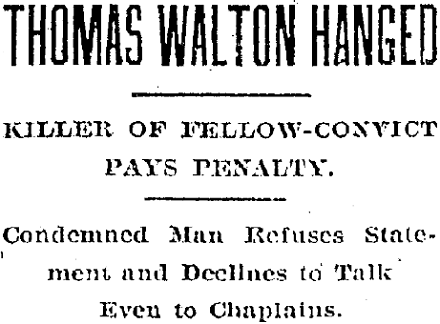
WALLA WALLA, Wash., Dec. 12. — Thomas Walton, convicted of the murder of S.P. Burt, a fellow convict, in the state penitentiary here October 7, 1923, was hanged at the penitentiary this morning. The trap was sprung at 5:06 A.M. and the prison physicians pronounced him dead 10 minutes later.

Walking to his death with the same fearlessness that he has displayed since the beginning of his prison career, Walton refused to make any final statement and even declined to talk with Rev. A.R. Liverett, prison chaplain, or Father Buckley, Catholic priest, in his cell prior to the execution.

His body will be sent to relatives in Montague, Cal.

Although Walton paid the penalty for killing Burt, he has of official record killed two other men. The first was in 1915 in California, for which he was sentenced to life imprisonment in San Quentin prison. The other was that of George McDonald, cellmate of Burt, whom he stabbed following his attack on Burt.

Walton and Burt were life termers in San Quentin and made their escape together in a prison automobile in January, 1923.

FOLSOM, Cal., Dec. 12 — Robert Matthews, negro, convicted of the murder of Coleman Stone, a grocer near Los Angeles, was hanged at the state prison here this morning. [Joe] Sinuel will be hanged next Friday.

On this day..

1915: Cordella Stevenson lynched

(Thanks to Meaghan Good of the Charley Project for the guest post. -ed.)

On this date in 1915, a mob visited Cordella Stevenson’s cabin, dragged her out, and lynched her.

The good citizens of Columbus, Mississippi, found her body the next day, hanging from a tree limb. The site of her lynching was only 50 yards north of the Mobile and Ohio Railroad, and rail passengers who came in and out of the city that day saw her corpse thus displayed. She had been “maltreated” (that is, raped) and stripped naked before being strung up.

Several months before, Gabe Frank, a local white man, lost his barn to fire. Although there was no direct evidence to implicate him and he had not been seen in the area for months prior to the fire, Cordella and Arch Stevenson’s son came under suspicion of arson.

The parents were respectable people who had worked for the same white employer for over a decade, but the son had a “worthless” reputation. Frank tried tracking the young man with bloodhounds, but was unsuccessful. The local police arrested Cordella and kept her locked up for several days, hoping she might know something of her son’s whereabouts, but they eventually released her without charge.

The Stevensons thought or hoped that would be the end of the matter.

Arch and Cordella had already gone to bed that Wednesday night in December when, at about 10:00 p.m., they heard someone pounding on their door. Before they could get to the door to answer it, the vigilantes had broken it down. They seized Cordella, pointed their rifles at Arch, and threatened to shoot him if he moved. At some point he managed to flee, bullets whizzing miraculously past him in the dark, and he ran to town for help. Arch knew what was good for him; after reporting what happened to the authorities, he fled the area for parts unknown. Meanwhile, somewhere out there in the night, the mob fell on his wife.

Kerry Segrave recorded in his book Lynching of Women in the United States: Recorded Cases, 1851-1946:

Sheriff Bell telephoned to Justice of the Peace McKellar to hold an inquest. He was out of town and did not return until Thursday night. As a result, the naked body was left hanging in view of the “morbid” crowd that came to see it until Friday morning when it was cut down and the inquest was held. That inquest jury returned a verdict that Cordella Stevenson came to her death at the hands of persons unknown.

The Chicago Defender, a (still-extant) black newspaper noted for its accurate reporting of Jim Crow era violence, bitterly editorialized, “This these southern culprits did. No law below the Mason and Dixon line that would cause them to fear. No officer in the police department that would dare to do his duty. No man in the government circles in Washington that has enough backbone to enforce the Constitution of the United States. This mob knew and they went on with their ghastly work.”

A century later, Cordella Stevenson’s ghastly death has still not been forgotten. In 2013, a poem for her, titled “What the Dark Said”, was published in the collection Ain’t No Grave, by Tennessee poet TJ Jarrett.

On this day..

1884: Howard Sullivan, ravisher and murderer

From the New York Times, Dec. 3, 1884:

SALEM, N.J., Dec. 2. — The hanging of Howard Sullivan, the negro, which took place at the county jail this morning, was the closing act of a tragedy that has never been equaled in Salem and rarely in any other county in the State of New-Jersey. Ella Watson, on the night of Aug. 18, while proceeding to her home over a lonely road near Yorktown, a thrifty little village, nine miles north of this place, was waylaid, robbed, ravished, and murdered, and her body concealed in some bushes near by, where it was discovered a few days later.

For a time the murder was enveloped in mystery, but the vigilance of two or three detectives, among them a colored man, who exhibited remarkable skill in working up the case, soon unraveled it, and Sullivan was charged with the murder.

He had not been long in jail before a confession was wormed from him,* and when placed on trial before a Supreme Court and three lay Judges, in the Court of Oyer and Terminer, he pleaded guilty and was sentenced to be hanged. Sullivan stood the prison life bravely, and not once did he display the slightest emotion.

Sullivan did not go to bed until after midnight last night. A great part of the time he spent in singing and praying, and when not engaged in this he was conversing with his death-watchers.

Confined in a cell on the third floor, the one he formerly occupied, and from which he attempted to escape,** is a colored woman named Sallie Fisher, convicted of the larceny of a watch chain, and sentenced to imprisonment in the county jail for 90 days. Nearly all last night she prayed and wept aloud for Sullivan. Her voice could be heard for a long distance from the jail, and her cries were piteous in the extreme. Sullivan’s mother called to see him and remained with him for some time. The scene between them was an affecting one.

The morning opened clear and pleasant, and Sullivan arose at exactly 7:05 A.M., when he was awakened by the Warden. He left his breakfast untouched, saying he would eat “after a while.” When asked if he wished to make any statement for the public, he said: “There is nothing more that I care to say about the case. I have got no complaint at all to make about my trial or my treatment. I have had all I want to eat and Sheriff Kelty and ex-Sheriff Coles have been very kind to me. I hope to go to a better world, and I believe my sins will be forgiven.”

Sullivan added that he had slept quite as well as usual during the night. After making this statement he ate the breakfast that had been prepared for him. His manner was calm, and when talking to his companions he was almost cheerful.

At 9 o’clock the gallows was tested and found to be in good working order. A few minutes later the condemned man’s fater and mother called to see him, and while they were with him in the cell all others, except his spiritual adviser, were excluded. The father is a bright, honest looking man, 65 years of age, though his appearance does not indicate it.

The meeting between Sullivan and his father and mother, together with the Rev. Richard Miles, Pastor of the Mount Pisgah Methodist Episcopal (colored) Church, of this city, one of his spiritual advisers, was a quiet one. They all sat around a stove in an outer room and chatted pleasantly for a few minutes. Sullivan said to his parents: “If you cry I will want to cry, but if you control yourselves I will.” This was all he said regarding his feelings.

While his family were still with him the Rev. William S. Zane, Pastor of the Walnut-Street Church, and the Rev. W.V. Louderbough, Pastor of the First Presbyterian Church, called on him and uttered a few consoling words. They have been regular visitors for some time, but took no part in the execution. The Rev. Wilson Peterson, Pastor of the African Church of Bushtown, also called while Sullivan’s parents were with him, and before taking their final leave all joined in singing “Take the Name of Jesus with you.”

Finally, the prisoner’s sisters entered the jail, and his parting with them was distressing.

His sister Emeline fell in a fainting fit and had to be carried out. This sight proved too much for his mother’s nerves, and, weeping and wailing, she was led into another room. When Emeline was taken to the street, on her way to the railroad station, she again fell in a fainting fit, and was actually dragged to the train. Mrs. Sullivan kept up long enough to reach the house of a friend, where she remained until her departure for Yorktown at noon.

After Sullivan’s cell was cleared of all except his spiritual adviser a final prayer in the jail was offered by the Rev. Mr. Peterson, after which, at 10:20 A.M., Sheriff Kelty, in the presence of Prosecutor Slape, read the death warrant. Sullivan was the coolest man in the party.

At 11:18 the jury appointed by the court filed down stairs to the basement and thence to the yard.

Sullivan, preceded by the two spiritual advisers, and accompanied by his friend, ex-Sheriff Coles, followed immediately after. He was dressed in a neat-fitting black diagonal suit, and wore black cloth gloves.

At the scaffold the Rev. Mr. Miles offered a prayer. Then the prisoner’s ankles were pinioned and his hands were fastened behind him with handcuffs

Ex-Sheriff Coles asked him if he desired to say anything, and he replied: “I hope the Lord will bless you all, and I hope to meet you all in heaven. Good-bye. When I fall from here I will fall into the arms of Jesus. It is a warning for all. It is very sad for my mother, my father, for Mr. Kelty, and for every one, but it is not sad for me. It is a marriage ceremony with me, and I want to be there in time for the feast with all those good men that have gone before me. I want all you gentlemen who have sons to take heed and learn them. Good-bye all.”

As the black cap was being adjusted Sullivan bade his friend Coles good-bye. There was just the slightest tremor in his voice as he spoke.

At exactly 11:29 the drop fell. There was a twitching of the body for a minute, and then it hung withut motion. In three minutes Sullivan was pronounced dead; his neck had been broken. The body was allowed to hang for half an hour, when it was cut down and placed in the coffin. It was buried at Bushtown in the afternoon.

* By a Pinkerton detective infiltrated into his cell for the purpose. According to the Chicago Tribune report of the trial, relating that detective’s gloss on Sullivan’s alleged jailhouse confession,

Sullivan said he sneaked up behind Ella Watson unperceived and struck her three or four terrible blows with a cane had had picked up in the woods. She fell to the ground, and, grasping the prostrate form, he dragged it across the road into the bushes, where he attempted to commit a dastardly assault upon the dying girl. She resisted his attempts, but he accomplished his design. Then the girl raised her head and exclaimed, “O, I know you!” “Then,” said Sullivan, “I clutched her by the throat and choked her with all my might. That killed her. I didn’t stop choking her until a shudder ran through her and I knew she was dead.”

** One important moral of this story is that when you have the opportunity to break out of death row, don’t dawdle.


Philadelphia Inquirer, Dec. 1, 1884

On this day..

1944: Charlie Kerins, IRA Chief of Staff

On this date in 1944, the Irish Free State hanged Irish Republican Army Chief of Staff Charlie Kerins.

The IRA had been sorely pressed in these war years by the Special Branch, and the inroads of counterintelligence help explain why Kerins himself took such a prominent position in the IRA at the tender age of 24.

And it also explains how he ended up on the gallows at Mountjoy Prison.

Key to the Special Branch’s campaign was the recruitment of Irish republicans — men like Denis O’Brien, a veteran of the Civil War turned police spy whom Kerins and two mates ambushed and shot to death in his driveway on the morning of September 9, 1942.

As one might expect, this incendiary assassination redoubled state pressure against the IRA. Living on the run under assumed names, Kerins managed to dodge arrest until June 1944. But when captured, he knew how to comport himself from implacable precedent of forerunners like Kevin Barry.

Kerins refused to recognize with a defense the legitimacy of the court that tried him; indeed, so reluctant were the authorities to make a martyr of Kerins that they paused proceedings for six hours with his conviction cinched to give Kerins the opportunity to save his neck by applying to submit to mercy. Kerins wasn’t the submitting type.

“You could have adjourned for six years as far as I am concerned,” Kerins sneered when the session reconvened. “My attitude to this court will always be the same.”

In the words of a verse he wrote to a friend just before his hanging —

What, said Cathal Brugha, if our last man’s on the ground.
When he hears the ringing challenge if his enemies ring him round.
If he’d reached his final cartridge — if he fired his final shot.
Will you come into the empire? He would answer, I will not.

On this day..

1759: William Andrew Horne, long-ago incest

On this date in 1759,* a man hanged at Nottingham for destroying the bastard infant of an incestuous affair … and for his belligerence decades afterwards.

William Andrew Horne, a sybaritic and well-off “bumpkin squire” in the estimation of the Newgate Calendar, had his way with the Nottingham ladies in the early 18th century including two servants of his mother’s and a local farmer’s daughter who we are informed thereafter “died in consequence of her grief.”

Even kin were not immune to the charms of such a ladykiller, and Horne had an affair with his sister that produced a child born in February 1724. Days later, Horne and his brother Charles took the tot out for a midnight ride and abandoned it in a haystack at a country estate. Many years later, Horne would claim that he intended the child be rescued there as a foundling; what actually occurred was that the boy died of exposure from being abandoned in the middle of a winter’s night.

Neither Horne nor Hornier breathed word of the affair thereafter but it seems that the other Horne — that brother Charles — was shocked enough to tell some others, like his father. Practical-minded dad ordered Charles to keep his big mouth shut, as did a local magistrate Charles blabbed to years later — who “said I had better be quiet, as it was of long Standing, and might hang half the Family.” (That’s via this 18th century pamphlet on the case.) But his conscience and an obvious sibling resentment** vis-a-vis brother Bill needled Charles. Over time, the reluctant accomplice revealed the secret rather promiscuously to folks including “John Kessell … Mr. Cook, of Derby … one Septimus Riley, a Tenant of my Brother’s … Mr. John Cooper, of Ripley, as I came back from Derby” and finally, when he feared he might be on his deathbed, to “Mr. John White, of Ripley.”

Though most of these were at a loss to urge action about Charles, all this whispering to the reeds successfully put the rumor abroad — and at long last the story returned to William’s ears, and neck.

In 1758, 34 years and who knows how many brokenhearted lovers after his midnight ride with the family’s shame, William Horne as a crotchety codger of 72 fell into a barroom row over game-hunting with a fellow by the name of Samuel Roe. Roe called Horne “an incestuous old dog,” and the combative Horne retaliated against this public calumniation by taking Roe to court and winning a judgment against him even though Roe’s description was precisely correct.

Roe in his fury tracked the infanticide rumor back to Charles and finally persuaded the vacillator to swear out a warrant. He wasn’t one to let a sleeping incestuous old dog lie.

* The date is frustrating here because I have not been able to locate an original news or trial document that definitively establishes a November 30 execution. I’m going ultimately with the date on the thorough and highly reliable Capital Punishment UK site; the careful reader will have noticed that this post cites a primary document which contradicts it: A genuine account of the life and trial of William Andrew Horne, of Butterly-Hall, in the County of Derby; who was convicted at Nottingham Assizes, August 10, 1759, for the murder of a child in the year 1724, and executed there on the 11th of December, 1759 … (This is also the date that the Newgate Calendar adheres to.)

Two things: first, this account situates the trial on Saturday, August 10 — but August 10 was not a Saturday in 1759. We have credibility issues right out of the gate.

Second, it is noted both in this document and elsewhere that our man got the name William Andrew in honor of his birth on the Feast of St. Andrew, which is Nov. 30. The prisoner “mentioned several Times” that he was to be hanged on his birthday.

This hanging occurred just seven years after England finally switched to the Gregorian calendar, entailing at the time a leap eleven days forward. As one side effect, this leap also created a stratum of “old” feast days that also shifted eleven days to maintain a 365-day distance from their former occasion. The case for December 11 would entail supposing that Horne from 1752 began treating December 11 as his actual birthdate, the “old St. Andrew’s Day”. Did Horne in fact do this? The documents I have seen are far less interested than some guy with an almanac blog would like them to be.

Someone with access to an 18th century database of Nottingham newspapers could probably clear this right up.

** As the oldest son, William inherited all the real estate: that is part of Charles’s pique. Another part is that William was “universally feared and hated” in the words of Edmund Burke’s Annual Register, acted the asshole towards everybody including Charles, and even “though he knew [Charles] was master of such an important secret, would not give the least assistance to him, nor a morsel of bread to his hungry children begging at their uncle’s door.” (William called several witnesses who testified that Charles often complained about his miserly sibling and publicly mused about swearing William’s life away.) It’s a wonder it took Charles so long to find someone to give him the thumbs-up on turning Judas against this lout.

Part of the Themed Set: Sexual Deviance.

On this day..

1740: Edward Shuel, for a Catholic-Protestant marriage

For today’s post, we’re revisiting one of our favorite troves, James Kelly’s Gallows Speeches From Eighteenth-Century Ireland — for the remarkable story of the minister executed for secretly marrying a Catholic to a Protestant. (We don’t usually think of tragic romance as being tragic for the officiant.)

Though it was hardly commonly enforced in this way — and it’s obvious from these pamphlets that it was the political pull of the groom’s family that doomed our Edward Shuel or Sewell — Ireland indeed had a real Marriage Act that made it a capital crime to officiate an interconfessional wedding, an act that persisted into the 19th century. It was the product of a campaign by to “de-Catholicize” Ireland that also included a wide variety of other encumbrances upon Catholics, and likewise upon Protestants who failed to shun them — such as disenfranchising Protestants with Catholic wives.

This case, scandalous in its own time, inspired Dublin’s rival broadside publishers to churn out multiple scandal sheets to service the appetite of a voracious public.

Edward Shuel, in “his own” words:


The Genuine Declaration of Edward Shuel

a degraded Clergyman of the Church of Ireland, who is to be Executed near St. Stephens Green, this present Saturday being the 29th of this Instant November 1740. For celebrating the Clandestine Marriage of one Mr. Walker a Protestant, to Margaret Talbot a suppos’d Catholick, on Sunday the 16th of August last, at the World’s End near Dublin.

Good Christians,

I might reasonably have expected my Life wou’d have been saved, having obtain’d a Reprieve; but there being a Point of —– Policy strongly against me, to fulfill which I must Resign this Life sooner than Nature or Accident might have otherwise taken it. I must confess tho’ I strove to bear my Sentence with the utmost Resignation and Christian Patience; yet the imbitter’d Reports of my having two Wives tingeing my Character, affected me in some Measure; and in order to clear such infamous and malicious Aspertions which my Enemies (whom the Origin of Heaven and Earth forgive) which I heartily pray for.

To be Concise, I was Born in the North of Ireland, and bred up in the University of Dublin, where I pursued my Studies, and behav’d as became a Student: Having received Orders, I officiated in the Curacy of Carlingford, St. Michans, Christ Church Dublin, and several others Places; where I behav’d as a Gentleman, and suitable to my Function; untill most unfortunately a vile Woman prostituted herself, and seduced me to her dire Embraces; upon which she Reported that I Married my self to her, which is utterly false; and in Order to acquit my self of that Calumny, of Marrying her my self, and fully to extirpate the publick Notion of my having two Wives, I went to Georges Church near Dublin, and there received the Eucharist that I never was Married or Contracted to any Woman under Heaven, but to the Woman now my unhappy Wife, by whom I have two innocent but unfortunate Babes, of which I got a Certificate from the Minister of said Church, which I gave to his Grace _____ which must be acknowledg’d.

The Nature of the Crime for which I am to undergo this most Publick and scandalous Death, is notorious in this Kingdom. The Manner in which I now a poor and unhappy Sufferer was precipitately led into it is, that on the 16th of August last, one Richard Walker came in Disguise in a poor Habit, under the fictitious Name of Wilson, with one Margaret Talbot and another Woman in Company, who intreated me to Marry them: After I had examined them, and swearing them on the Book, who swore they were Protestants; and I believing Richard Wilson as he called himself, to be a Tradesman of no Fortune or Birth, and in his own Power, and I wanting of Support; my Children having not even Bread to Eat that Night, I unfortunately married them ’tis true, for which I received from Wilson Six Shillings and Six Pence.

But had I surmised he had been the Son of the Man he was, or any other Person of Credits Son, I would not for any Consideration have perform’d the Ceremoney, [sic] Nay, I would have sent to the Parents or next Relation and detected him, and at the same time given up the Woman, to the just resentment of the injur’d Parents.

‘Tis true I was degraded and by that Means render’d incapable of supporting an helpless Family; nor was it in my Power to get a Livelihood by Teaching School, for any attempts I made that way which prov’d Abortive, Work either Mechanical or otherwise I was ignorant of; and by my infirmities render’d if capable not to follow it, to beg publickly I was a shame’d, and very well knew the Amount of Charities to Street Beggars, privately I did beg by Petitions to many Persons whose Grants were small, and that but from a very few; and e’en those few wou’d not a second time assist the Wretched, this was my Case; what I then follow’d to support my Family was the Trade as its so call’d of Marrying; but always took care to examine strictly their Religion, Birth, and parentage, avoiding as much as possible to keep out of Disesteen of Families of Credit, so that it might not lie in their Powers to punish me, or to be griev’d at the undoing of their Children.

Yet all this Precaution has not hinder’d my unhappy Exit, which I hope this Calamity of mine, may be a perpetual Bar to others who are after me, who may be drove to the pressing Wants which I have often struggled with, but may God Support them.

O Lord Strengthen me to bear my Misfortunes, bless my Children and be to them a Father, and give them thy Grace, Comfort my Wife, and be to her a Husband, protect my Friends, and forgive my Enemies, and receive me into thy glorious Abode, and that I may this ‘Day sing Praises and Thanksgiving unto thy holy Name, ad infinitum, Amen.

Edward Shuel.

Note. The above was deliv’d to the Printer hereof, in the Presence of Mr. Nelson and several others, in his own Hand Writing, and Word of Mouth.

Dublin: Printed in Montrath-Street, by Chr. Goulding Book-Seller.


The Last and True Speech of Mr. Sewell

a degraded Clergyman, who was executed last Saturday the 29th of November 1740, at St. Stephen’s-Green, for a clandestine Marriage
delivered by him at the Place of Execution

Countrymen and Christians,

It may be thought, perhaps, that the Length of Time given me by the Clemency of the Lords Justice might turn my Thoughts to poor Transitory, Worldly Affairs, I hope thro’ the Merits of Christ I have not been affected so foolishly, for I will not boast, but will humbly hope, I have so numbered my Days as to apply my Heart unto Wisdom, for the Love of the Lord is the Beginning of it. I return to the Chief Governors of Ireland, the only Return I can make, my Thanks and Prayers for their Benignity in extending my shortning Length of Days to the present, in this World unhappy, but in the World, thro’ Christ, in the future, a Blessed Consummation. — Praise be to God on High Peace and Good Will amongst Men.

I am brought forth this Day, as a Precedent and Example to the Marriage Act, as a Sacrifice to its Rigor, the first, and I hope through the Almighty, the last of the kind that shall hereafter be read of in the Annals of the Holy Catholick and Reform’d Protestant Church; nor is it the smallest Pang that I feel in this solemn Anguish of my Spirit that my Memory shall reflect some Disgrace upon my Reverend, Learned and Pious surviving and future Brethern [sic] of the Ministry. Could Worldly Things now amuse or disturb my Mind, I might also be touch’d with a Sense of the Triumph, my unhappy Catastrophe, must give to the Enemies of the Establish’d Religion; but in this, as in all Things else in Heaven and Earth, the Will of the All Powerful and Eternal Father be done, yet let them consider that the Man, the poor weak Man transgress’d and not the Function; let them think that the Transgressor suffer’d, and with his Blood wash’d away Polution [sic] from the Sanctuary. The blessed Twelve should not be blamed for their fallen Member, nor should the Body of the Clergy be reproached for one wretched, sinful, misguided, but thro’ Grace repentant Brother.

Speeches and Declarations are a Custom I know observed by People in my wretched Circumstances; but this has no Influence on me, I only promulgate these few Lines to prevent many gross and ignorant Pieces of Print which may be ascribed to me, when I am past the Power of contradicting such Falshoods. [sic] I am, bless’d be my Saviour, in universal Charity with the World, and therefore neither Bitterness nor Untruth shall fall from me: I am convinced, as my Condition is particular and my self remarkable, the World will be desirous to know what I may say either in defence of myself, or Attenuation of the Crime for which I die; I will therefore briefly go thorough the Heads of my Accusation and Conviction.

I confess that I did solemnize a Marriage between Walker and Talbot, but at the same Time I declare I did not suspect that he was any other than an ordinary working young Man, and not the Son of one of so much Consequence in the City. I had their Oath of Secrecy and an Assurance of their both being of the Protestant Religion, but he appear’d as an Evidence against me; Heaven forgive him and me, and for this Crime I lay down my Life. Were it worth a Moment of my little remaining Time, I might here controvert Margaret Talbot’s Marriage not within the Act, a Point of Law which I did but faintly Urge upon my Tryal: I might have pleaded the Inefficacy of my Degradation, the Indelibility of the Clerical Character, Validity of a Sentence pass’d by a Layman on a Person Canonical, and have spoken to an Appeal which I always apprehended was lodg’d in order to the Subversion of the Sentence of Degredation; [sic] but alas! they are Things below my Notice, for my Mind is above, and perhaps were I to illustrate on these Particulars, it may be construed either Indiscretion or Malice in a Dying Clergyman, and in my last Moments, what ever my past Life may be, I would not give Scandal to the Divine Function.

I acknowledge that I have been a frail weak Man, and that my Transgressions are numberless, and that I have done several unwarrantable and idle Things, inconsistant [sic] with the Character of a Gentleman, a Scholar, and a Divine, but let Man deal with me as I hope to be dealt with by my Heavenly Father, who will thro’ the Merits of Christ cast a Veil over my Sins, and blot out my Transgressions for ever.

I would Recommend to all Parents, with my dying Breath, a Resolution of never forcing the Dispositions of their Children, or thrusting them into a College with a View of the Pulpit, till they, if they are capable, or some Person of sound Judgment shall thoroughly examine if they have such Qualities, and Propensions as may fit them for such Office. On this Rock many Split, too many, and after some Years of Study, they come forth either contemptible for their Ignorance, or abhorr’d for their Vice. But, suppose them never so well endowed for the Ministry, the miserable Provision made for the Inferior Clergy, still more miserable by their Number, and their generally ill-judg’d Early Marriages throws them upon things which after endanger their Bread, and sometimes their Lives, of which I am a wretched Instance.

I beg that my wretched Family may not be Reproached with the Ignominy of my Death, to which I submit with Meekness, Resignation, and Resolution, hopeing [sic] that my Sufferings shall be Sanctified to me, and thro’ this Gulf of Darkness a Passage to Eternal light and Joy thro’ the Merits and Mediations of Jesus Christ my Saviour, to whom, with the Father and Holy Ghost be given all Praise and Worship now and ever more. Amen.

An Hymn
Compos’d by the Reverend Mr. Sewell, while under Sentence in Newgate, and sung by him in the Coach as he went to Execution.

Oh Fountain of Eternal Light!
Oh glorious Lord of Host!
With Mercy view my wretched Plight,
Oh spare me or I’m lost.

Grim Death in all it’s [sic] Horrors dress’d
Is ever in my View,
Where is my Hope, now I’m oppress’d?
My only Hope is You.

Injutious Man has laid the Snare,
I’m fallen, alas, I’m caught,
Man drink my Blood, but Father spare
The Soul thy Son has bought.

And suffer not my Blood to reign
O’er his Posterity,
Oh God wash out the Scarlet Stain
And cleanse both him and me.

From Vengeance turn thy gracious Eye,
And see my throbbing Heart,
That melts at thy Divinity,
And feels and heavenly Smart.

And thou, O Son, who didst sustain
A Cross and shameful Death,
Who suffering more than mortal Pain
Groan’d out thy dying Breath.

Sustain me in the Hour of Death,
In the disgraceful Cart,
And when the Halter stops my Breath,
Save my Immortal Part.

Thou dost not judge like wretched Man,
For shoudst thou be severe
And all the Faults of Mortals scan,
Who cou’d thy Judgments bear.

Receive me Blessed Trinity,
Receive my Soul in Grace,
And in thy Kingdom let me be
When Times and Worlds shall cease.

DUBLIN, Printed by Edward Jones in Dirty-lane.

Part of the Themed Set: Sexual Deviance.

On this day..