John Dand hanged at Manchester’s Strangeways Prison on this date in 1951 — because of spat over £3.
Dand and his victim, 72-year-old Walter Wyld, lived near one another in York. When Wyld was found stabbed to death with no sign of forced entry late the night of January 27, 1951, correspondence in his home indicated that he’d been expecting a visit from John Dand, the son of a former neighbor who owed him the sum in question. The equivalent present-day value of that sum is a bit under £100.
Dand had bloodstained trousers, a fake alibi, and no capacity to keep to a story under interrogation. It wasn’t long before he admitted the murder, which he then tried to un-admit. As the the Capital Punishment UK Facebook page notes,
Dand withdrew his confession and pleaded not guilty at his trial at Leeds before Mr. Justice Gorman on 23rd to the 26th of April. His defence was that he was not physically capable of killing Mr. Wyld, who although much older, was a very fit ex Rugby League player. Unsurprisingly the jury were not impressed with this argument as Dand was 5′ 9″ tall and of average build.
The hanging was carried out by Albert Pierrepoint and Harry Allen. Prisoner 10117, Dand, weighed 147 lbs. and was given a drop of 7′ 7″. The LPC4 form records that there were no physical peculiarities that would affect the drop, but that it was given at the “discretion of the executioner”.
Charles Souvay in “The French Papal States during the Revolution” (The Catholic Historical Review, January 1923) describes the violent reunion to the French nation of the Papal States enclave around Avignon where popes had formerly reigned. This June 11 lynching was as nothing for mob violence compared to the Massacres of La Glacière later in 1790.
In 1789 the French Papal possessions included the two Counties respectively called in Roman Chancery style the Comitatus Avennicinus, or High County, the principal city of which was Carpentras, and the Comitatus Avenionensis, or Low County, named after its capital Avignon; both together having in all an area of less than a thousand square miles. Since 1274, by donation of King Philip III to Pope Gregory X, they belonged to the Popes; and even though several times (1663, 1688 and 1768) the French kings attempted to wrest them from their legitimate sovereign, there was, in 1789, no question of disputing the Papacy’s rights. A Legate administered the two Counties, continuing in the old Papal Castle the moral presence of the popes who had resided there from 1309 to 1378.
The Counties were comparatively an earthly paradise: taxes insignificant; no imposts; living wonderfully cheap — “for one or two sous one could hve a meal of bread, meat and wine”; no militia, scarcely any privileges of nobility; no restrictions on fishing and hunting and to cap it all a miniature representative Assembly. However, the rank and file of the population had a bad name, and it deserved it. In the course of time the country had become the secure haven of all the scoundrels of France, Italy and Genoa: smugglers, fences, vagabonds, swindlers, crooks, convicts escaped from the galleys of Toulon and Marseilles, all flocked there and soon fraternized in debauchery and crime.
Such ingredients constituted a soil admirably adapted for the rapid growth of the revolutionary seed. No wonder, therefore, that towards the end of 1789 rebellion broke out in Avignon, where minds were easily wrought up. Before long it spread beyond the ramparts of the City of the Popes. The high County, however, remained loyal; hence timid: fear of the violence of the demagogues — a fear but too well founded — increased the numbers of the anti-papal faction; and soon the noise they raised was such that the Pope had to intervene. He did it in a fatherly way, promised all the reforms deemed opportune (Briefs of February and April 1790) and sent a Commissary with the charge of trying every possible way to restore order and peace. At Carpentras the pontifical Commissary was shown he was unwelcome; at Avignon he was positively refused admittance.
Then in the papal city Jacobinism, preached by ranting advocates like Tournal, Rovere, the twoDuprats, the two Mainvielles, Lecuyer, multiplied its proselytes and stopped at no violence. Within a short while seven or eight riots broke out. On June 10, 1790, at the instigation of the leaders, all the rabble of the city and the suburbs, churls adverse to excise, rapscallions adverse to order, stevedores and longshoremen, armed with scythes, pikes and cudgels, rose up tumultuously, served on the Vice-Legate Casoni notice to quit, turned out of the city the Archbishop Giovio, ousted the Italian officials, obliged the Consuls to resign, hanged the officers of the National Guard and the principal loyalists (June 11)* and possessed themselves of the town hall. For efficiency trust the preachers of the revolutionary gospel.
* Seven men were murdered that day; some were nobles, others priests and others artisans.
On this date in 1996, a Chinese Mongol with the singular name of Huugjilt was executed by gunshot for rape and murder at Hohhot. With benefit of hindsight, it’s come to be viewed as “one of the most notorious cases of judicial injustice in China.”
Huugjilt discovered the body of a woman named Yang in a public toilet at a factory, on April 9, 1996 — just 62 days before the execution. She’d been raped and strangled, and that official tunnel vision common to wrongful conviction scenarios immediately zeroed in on Huugjilt himself. With conviction quotas to fulfill, authorities abused Huugjilt into a confession and an overhasty conclusion.
“It has not been rare for higher authorities to exert pressure on local public security departments and judiciary to crack serious murder cases,” China Daily editorialized. “Nor has it been rare for the police to extort confessions through torture. And suspects have been sentenced without solid evidence except for extorted confessions.”
This conviction unraveled in 2005 when a serial sex predator named Zhao Zhihong admitted the murder. (He was charged with many similar crimes besides.) The belated investigations ensuing from the resulting uproar cleared Huugjilt, even to the extent of holding a formal posthumous retrial that overturned the original verdict.
On 9 June 1980, the Soviet-supported government of Afghanistan’s Babrak Karmalexecuted ten supporters and aides of the late president, Hafizullah Amin. Among the number were Amin’s brother and nephew. Also executed at the same time was rebel leader Abdul Majid Kalakhani.
Everyone else in Afghanistan lived happily ever after.
On this date in 1967, during the Six-Day War between Israel and Egypt, Israeli warplanes and torpedo boats assailed the USS Liberty, an allied American communications (read: espionage) vessel — not an execution by any stretch, but perhaps occasioned by other executions?
On a sunlit afternoon in the Mediterranean the Liberty, about 13 miles off the coast of Gaza which Israel was then engaged in prying from Egypt’s hands, sunbathing American seamen found themselves suddenly being bombed by Israeli planes, and even found their lifeboats strafed by those same planes — clearly intent upon sinking the Liberty with no survivors. A torpedo hit amidships ripped open the ship at the waterline.
The Liberty was the only large ship anywhere in the vicinity and recordings of the Israeli fighter pilots’ communications with their control tower confirm that her prominent U.S. markings were observed by her assailants.
Only by dint of some heroic and lucky jury-rigging was the ship’s communications tower coaxed to send out a life-saving SOS to the U.S. Sixth Fleet, maneuvering hundreds of miles distant. In all, 34 Americans lost their lives in what Wikipedia delicately calls the USS Liberty Incident; another 170-plus were injured, while the Liberty herself limped back to Malta for repairs. She’d be decommissioned in 1968.
This shock bloodbath between two countries who have proven firm and ever firmer allies in the half-century since has long been shrouded in mystery and speculation.
Sure, maybe the U.S. prized its statecraft enough to wave the whole thing off as an accident. But what compelling motivation drove Israel to attack the Liberty — at the risk of jeopardizing its relationship its superpower partner?
Many far wiser than a humble headsman have had a go at this question. In his history of the National Security Agency, Body of Secrets, James Bamford suggests that the Liberty‘s offense in Israeli eyes resided in its proximity to a number of war crimes that she would be able to document — including mass executions of Egyptian POWs at the north Sinai town of El Arish in the aftermath of a nearby battle.
Although no one on the ship knew it at the time, the Liberty had suddenly trespassed into a private horror. At that very moment, near the minaret at El Arish, Israeli forces were engaged in a criminal slaughter.
…
By June 8, three days after Israel launched the war, Egyptian prisoners in the Sinai had become nuisances. There was no place to house them, not enough Israelis to watch them, and few vehicles to transport them to prison camps. But there was another way to deal with them.
As the Liberty sat within eyeshot of El Arish, eavesdropping on surrounding communications, Israeli soldiers turned the town into a slaughterhouse, systematically butchering their prisoners. In the shadow of the El Arish mosque, they lined up about sixty unarmed Egyptian prisoners, hands tied behind their backs, and then opened fire with machine guns until the pale desert sand turned red. Then they forced other prisoners to bury the victims in mass graves. “I saw a line of prisoners, civilians and military,” said Abdelsalam Moussa, one of those who dug the graves, “and they opened fire at them all at once. When they were dead, they told us to buiy them.” Nearby, another group of Israelis gunned down thirty more prisoners and then ordered some Bedouins to cover them with sand.
In still another incident at El Arish, the Israeli journalist Gabi Bron saw about 150 Egyptian POWs sitting on the ground, crowded together with their hands held at the backs of their necks. “The Egyptian prisoners of war were ordered to dig pits and then army police shot them to death,” Bron said. “I witnessed the executions with my own eyes on the morning of June eighth, in the airport area of El Arish.”
The Israeli military historian Aryeh Yitzhaki, who worked in the army’s history department after the war, said he and other officers collected testimony from dozens of soldiers who admitted killing POWs. According to Yitzhaki, Israeli troops killed, in cold blood, as many as 1,000 Egyptian prisoners in the Sinai, including some 400 in the sand dunes of El Arish.
Above interpretation suffices as a hook for this here executions blog but its explanatory force feels far less than sufficient.
The facts alleged here against Israel have been contested; one of the sources quoted above, Gabi Bron, has said that only five (not 150) prisoners were executed at El-Arish, and that the dead there were overwhelmingly legitimate battle casualties. But let an intentional massacre number not merely hundreds but thousands upon millions and still we would sit very far from dampening the ardor for any policy that has been decided in Washington or Langley. Surely it is unnecessary to dwell upon what these same statesmen were simultaneously doing in Southeast Asia.
Where that leaves the matter is a still-going debate. Was it a false flag attack meant to be laid to Israel’s Arab enemies? Did the spy ship need to be blinded to hide Israel’s forthcoming (June 9-10) incursion into the Golan Heights? Do war atrocities reveal more than this writer supposes? Or are we really to take seriously the thought-it-was-an-Egyptian-ship official line?
A batch of Nazi war criminals highlighted by four condemned at the Einsatzgruppen trial hanged at Germany’s Landsberg Prison on this date in 1951.
Formed initially to decapitate Polish intelligentsia when Germany invaded that country in 1939, these notorious paramilitaries were deployed by Reinhard Heydrich behind the advancing German line of battle to pacify occupied territory. “Pacify” in the event meant slaying Communists, partisans, and of course, the Reich’s innumerable racial inferiors. Einsatzgruppen authored many mass executions like the massacre of Jews at Babi Yar outside Kiev, each local atrocity a self-conscious contribution to the wholesale genocide. All told these units might have killed upwards of 2 million human beings; they were also used to gather Eastern European Jews into urban ghettos, which subsequently became the staging points for deportations to the camps.
Postwar, the big Nuremberg war crimes tribunal against the major names in the German hierarchy unfolded from late 1945 in a multinational courtroom: American, British, French, and Russian judges and prosecutors working jointly.
But the emerging superpower rivalry soon narrowed the window for similar cooperation in successor trials, leading the rival powers to try cases on their own.* Accordingly, United States military tribunals unfolded 12 additional mass trials, known as the subsequent Nuremberg trials — each exploring particular nodes of the Nazi project — such as the Doctors’ trial and the IG Farben trial.
The Einsatzgruppen trial was one of these — 24 Einsatzgruppen officers prosecuted at the Palace of Justice from September 29, 1947 to April 10, 1948.
Twenty-two of the 24 were convicted of war crimes and crimes against humanity, and 14 sentenced to death. However, ten of the fourteen prospective hangings were commuted, and all surviving prisoners had been released by 1958. The four who actually went to the gallows at Landsburg Prison on June 7, 1951 were:
Out of the total number of the persons designated for the execution, 15 men were led in each case to the brink of the mass grave where they had to kneel down, their faces turned toward the grave. At that time, clothes and valuables were not yet collected. Later on this was changed …
When the men were ready for the execution one of my leaders who was in charge of this execution squad gave the order to shoot. Since they were kneeling on the brink of the mass grave, the victims fell, as a rule, at once into the mass grave.
I have always used rather large execution squads, since I declined to use men who were specialists for shots in the neck (Genickschusspezialisten). Each squad shot for about one hour and was then replaced. The persons which still had to be shot were assembled near the place of execution, and were guarded by members of those squads, which at that moment did not take part in the executions.
-Paul Blobel on his mass-execution process
Otto Ohlendorf, an economist tapped as commander of Einsatzgruppe D (educated and ideologically reliable administrator were intentionally sought for leadership positions in these gangs). Together with Ukrainian and Romanian auxiliaries, this unit killed 90,000 people in southern Ukraine and Crimea which the good functionary strove to render “military in character and humane under the circumstances.”
Werner Braune, a former Gestapo man who became chief of one of Einsatzgruppe D’s units, called Einsatzkommando 11b.
Erich Naumann, a former brownshirt turned commander of Einsatzgruppe B who frankly acknowledged to the tribunal that “I was ordered to Heydrich and I received clear orders from him for Russia. Now, first of all, I received the Fuehrer-Order concerning the killing of Jews, Gypsies and Soviet officials” and “considered the decree to be right because it was part of our aim of the war and, therefore, it was necessary.”
Paul Blobel, a World War I veteran become architect who was into his late forties when he helped organize the Babi Yar massacre. Afterwards, he had charge of Sonderaktion 1005, a 1942-1944 project to destroy evidence of such massacres by, e.g., digging up mass graves to pulverize and dynamite the remains into unrecognizability. “The mission was constituted after it first became apparent that Germany would not be able to hold all the territory occupied in the East and it was considered necessary to remove all traces of the criminal executions that had been committed,” according to Adolf Eichmann aide Dieter Wisliceny. Blobel “gave a lecture before Eichmann’s staff of specialists on the Jewish question from the occupied territories. He spoke of the special incinerators he had personally constructed for use in the work of Kommando 1005. It was their particular assignment to open the graves and remove and cremate the bodies of persons who had been previously executed. Kommando 1005 operated in Russia, Poland and through the Baltic area.”
In a concession to efficiency or spectacle, they were joined by the three other condemned men from other installments of the Nuremberg trials, the , against the directorate that ran Germany’s concentration camps.
Oswald Pohl, the head of he directorate that ran Germany’s concentration camps. He was the only person executed from his own particular installment of the war crimes trials, called thePohl trialGeorg Schallermair, an SS sergeant convicted for murders he’d personally committed at Dachau.
Hans Schmidt, the former adjutant of the Buchenwald concentration camp who carried his implausible insistence of ignorance as to the camp’s deaths all the way to the end. Schmidt’s name in the news might have inspired an American wrestling promoter to assign it in 1951, along with a boffo Nazi persona, to one of pro wrestling’s great heels.
“I was here at the last execution, as free as any one of you, and little thought of this my unhappy fate. God grant you all more grace than I have had.”
-Last words of burglar John Ives, hanged with six other felons at Tyburn on June 6, 1764.
This upstart victory at the Battle of Gravia Inn might have been decisive in saving the independence bid from being destroyed in its cradle. In its day it established Androutsos as one of the major commanders of the revolution, good enough for unprincipled English rogue and Lord Byron crony Edward John Trelawny to fall in with long enough to marry Androutsos’s sister.**
According to the Scottish historian George Finlay — another British interloper in this war — many of the warlords who prosecuted Greek’s revolution are best viewed in the perspective of klephts or hajduks: an archetype combining anti-Ottoman insurgent and opportunistic brigand, making for themselves on treacherous terrain. “Odysseus never attached any importance to political independence and national liberty,” Finlay opines. “His conduct from the commencement of the Revolution testified that he had no confidence in its ultimate success. He viewed it as a temporary revolt, which might be rendered conducive to his own interests.”
Installed in eastern Greece, it was only natural that such a figure would consider cutting deals with the Ottomans. Androutsos’s brief and little-harmful defection was prosecuted as treason by his comrades — his execution on Athens’s Acropolis conducted by his former second-in-commannd, Yannis Gouras — but countrymen down the years have been quite a bit more understanding. The Greek government reconsidered its malediction and in 1865 reburied Androutsos with honors; his grave is never since to be found without the garlands of admiring posterity.
* June 5 is the Julian date, an exception from our normal Gregorian preference in the 19th century because, well, it’s a national hero of an Orthodox polity. Nevertheless, the Gregorian June 17 can be found mentioned here and there, including even on Androutsos’s cemetery stele.
** Trelawny dumped her when his Greek holiday had run its course, and he returned to England a bachelor.
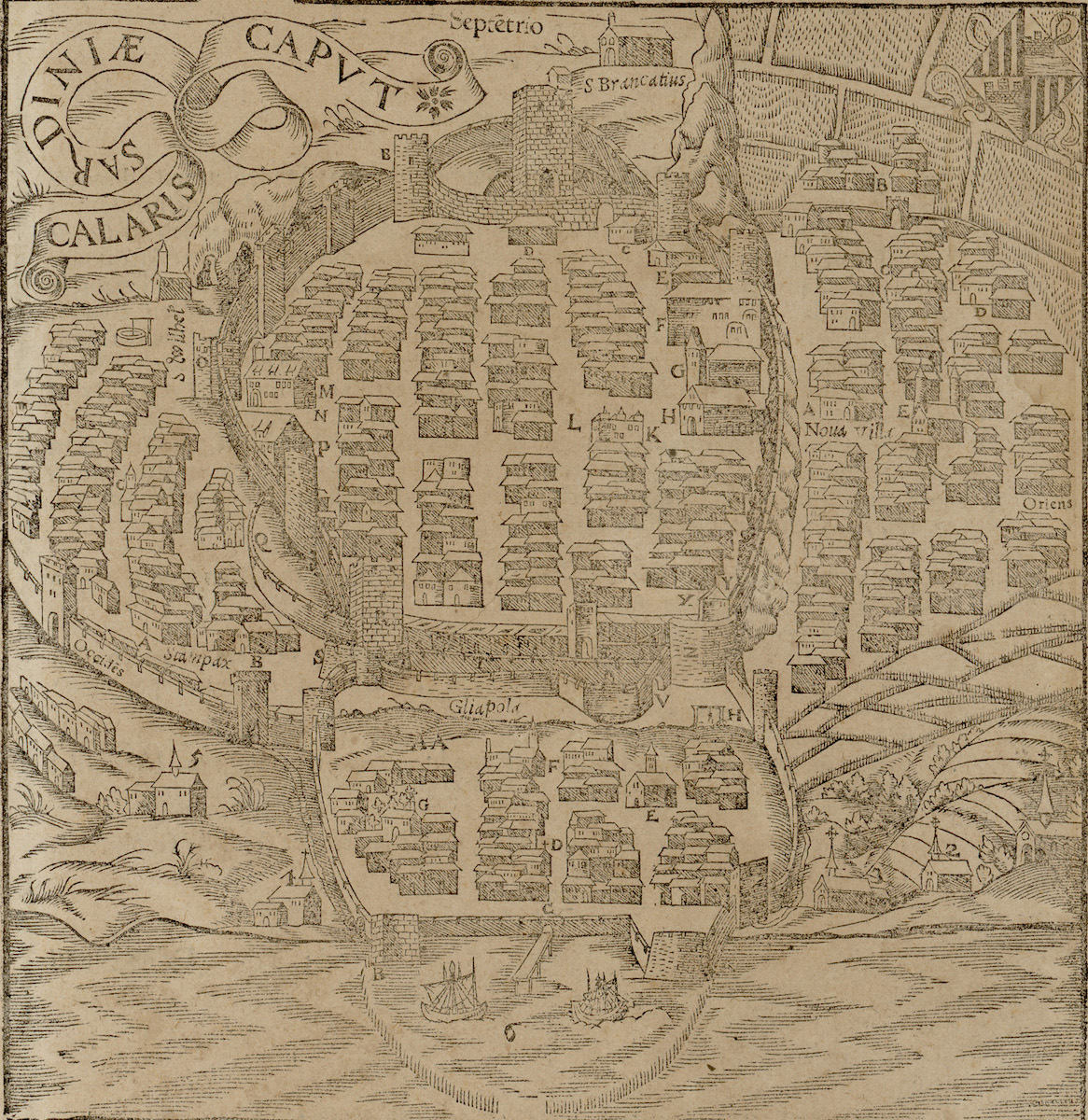
Sardinian scholar Sigismondo Arquer was burned at the stake in Toledo, Spain, on this date in 1571.
Born in the capital of Spanish-governed Sardinia, this gentleman had a hereditary imperial knighthood but also an interest in humanism and religious heterodoxy well-calculated to annoy in Counter-Reformation Spain.
Arquer’s map of his native city of Cagliari, for the Cosmographia universalis, for which compendium he also composed an entry on “dark Sardinia” that “in its blend of ancient sources, personal observations and original narrative structure … played a critical role, even when not explicitly acknowledged, in the development of the image of Sardinia in European culture.” (Source) Today, one of the streets in this very historical core the man once sketched is called Via Sigismondo Arquer.
Exploiting Arquer’s associations with Swiss Protestants as well as his talent for making powerful enemies — skewering clergy in the Cosmographia, nettlesome lawsuits against Spanish oligarchs — the Inquisition bagged him for heresy in 1563. He was 33.
In between bouts of interrogation, Arquer used his long confinement to knock out a Passion in Catalan, heavy with personal resonance. The Christ parallels ran all the way to the Plaza de Zocodover, where a soldier — motivated by anger at the heretic or pity for the sufferer, only God can say — speared him through the side during his death throes.
A wealthy Greek merchant who’d been circulating on the highest plane of Byzantine statecraft, Notaras is famous for his purported quip, “I would rather see a Turkish turban in the midst of the City [Orthodox Constantinople] than the Latin mitre.” The quote is probably apocryphal, but it sticks because he got the wish when Mehmed conquered Constantinople.
His end made a canvas congenial to moralizing brushwork. The victorious sultan spared him initially only to reverse course a few days later. By hostile Christian repute this was when Notaras was commanded to deliver his youngest son for perverse usage in the harem; a hostile-to-Greeks version has the wily old courtier immediately falling into his habitual scheming.
This post drawing on the work of the French scholar Thierry Ganchou suggests a less sensational compounding of reactions that ensued upon the sultan’s demand for Notaras’s youngest son, Jacob — not as a sex slave but as a court hostage, which was a normal practice in this period to keep potentially rivalrous elites onside. Notaras reacted badly, viewing the demand as an arbitrary humiliation and fearing the boy’s potential conversion to Islam and matters spiraled from there.
“Inhuman half-breed dog, skilled in flattery and deceit! You possessed all this wealth and denied it to your lord the emperor and to the City, your homeland? … Why were you unwilling to assist the emperor and your homeland with your immense wealth?” (Source)

 Huugjilt discovered the body of a woman named Yang in a public toilet at a factory, on April 9, 1996 — just 62 days before the execution. She’d been raped and strangled, and that official tunnel vision common to wrongful conviction scenarios immediately zeroed in on Huugjilt himself. With conviction quotas to fulfill, authorities
  Fruit of