1683: John Nisbet the Younger


Marker located at the entrance to the Burns Mall from Kilmarnock Cross. (cc) image from @mafleen.

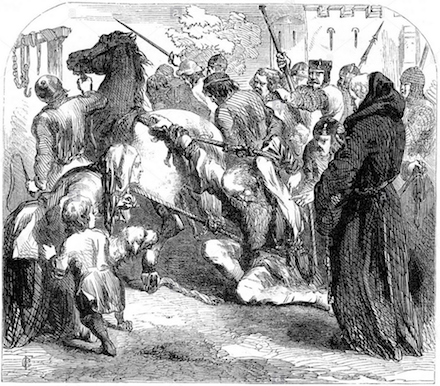
John Nisbet was hanged on this date in 1683 for having participated four years prior in the Battle of Bothwell Bridge that shattered the Covenanter rebellion.

“Here lies John Nisbet, who was taken by Major Balfour’s party, and suffered at Kilmarnock, 14th April, 1683, for adhering to the word of God and our Covenants,” reads his grave.

Come, reader, see here pleasant Nisbet lies,
His blood doth pierce the high and lofty skies;
Kilmarnock did his latter hour perceive,
And Christ his soul to heaven did receive.
Yet bloody Torrence did his body raise,
And buried it in another place;
Saying, ‘Shall rebels lye in graves with me?
We’ll bury him where evil-doers be.’

Nisbet, we learn from Robert Wodrow, “sang the 16th Psalm, from the 5th verse to the close, with a great deal of affection and joy; and then read the 8th chapter to the Romans, and prayed again.”

When he had delivered his bible to his uncle, he made himself ready for the executioner, not expecting to get leave to say any thing to the specattors; but essaying to speak, and not being interrupted, he continued a good while in an extemporary discourse, pressing them to godliness, and recommending religion to them, from his own feeling and experience. He notices, that this is the first execution of this kind at that place, and is of the opinion, it is not like to be the last; he tells them, death is before them all, and if it were staring them in the face, as nearly as it was him at present, he doubts not there would be many awakened consciences among them; but as for himself, though death be naturally terrible, and a violent death yet more terrible, yet the sting of it is taken away, and he can say, he reckons every step of the ladder to be a step nearer heaven.

He’s not to be confused with his more famous uncle, John Nisbet of Hardhill, who suffered as a Covenanter martyr in 1685. (He surely cannot be the uncle referenced by Wodrow.) The Nesbitt Nisbet Society has more on this family’s role in the Covenanter movement.

On this day..

2011: Mao Ran, young drug lord

Mao Ran, a 25-year-old export/import employee with a heroin trafficking empire dating back to her university days, was executed in Xiamen on this date in 2011.

Not to be confused with manga assassin Ran Mao

According to Chinese reports, Mao Ran “began to get involved in drug trafficking after knowing her foreign boyfriend, OBI, who was also a drug lord and later ordered her to organize others to conduct illegal drug trafficking.”

Two women she recruited as couriers were seized by customs in separate 2008 and 2009 busts that netted over 3 kg of product between them.

Alarmed by the arrests, Mao ran (sorry) but was captured by police soon after.

On this day..

1726: Edward Burnworth and his gang, London Lives

Edward Burnworth and his gang — a group of villains who “seem to have risen to notoriety on the downfall of [Jonathan] Wild” by the estimation of the Newgate Calendar — were executed on this date in 1726, and thereafter hung in chains.

We endorse a bio of this coterie of thieves turned murderers on LondonLives.org. This wonderful site “makes available, in a fully digitised and searchable form, a wide range of primary sources about eighteenth-century London, with a particular focus on plebeian Londoners”; it’s in the same spirit as the oft-cited-by-Executed Today site Old Bailey Online site, and involves some of the very same principal authors.*

Their zoom-in on Burnworth et al finds the gang slaying one Thomas Hall, a gin shop owner who was attempting to set up as a thief-taker in the vacuum created by the hanging of the aforementioned Jonathan Wild — previously London’s preeminent thief-taker and (simultaneously) crime lord. Burnworth, William Blewitt, Thomas Berry, John Legee, John Higgs, and Emanuel Dickenson all suffered together and were gibbeted in chains thereafter, two apiece at St. George’s Fields, Putney Common and Kennington Common, although the last of these was given over to his friends for burial after just one day of exposure in consideration of his father’s honorable military service.

(Burnworth unsuccessfully attempted to exonerate of theft a man bound for the gallows a month before him, by confessing to the crime.)

* Tim Hitchcock, a historian now at the University of Sussex and a director instrumental to both sites, has previously provided some commentary directly to Executed Today as well, weighing in for example on the controversial identity of “Smugglerius” as well as OldBaileyOnline.org digitization practices. There are several other related “history from below” sites in his orbit: Locating London’s Past, Connected Histories, and The Digital Panopticon: The Global Impact of London Punishments, 1780-1925.

On this day..

1827: Sarah Jones, firm infanticide

From the Bristol Mercury of April 16, 1827:

EXECUTION OF SARAH JONES.

This unfortunate victim to seduction was 26 years of age, and lived with her father and mother, Thomas and Mary Jones, who resided in a small cottage, forming one of a row of houses, situated on the side of the Sirhowy tram-road, called Pye-corner, in the parish of Bassalleg, in the county of Monmouth.

On Tuesday morning she took a farewell leave of her wretched parents, which she bore with considerable firmness, being the least affected of the three. — A neighbor, who spoke to her character, was, at her desire, permitted to see her the same morning, and speak to her in the Welsh language. She was particularly communicative; detailing the circumstances most minutely, which led to her present situation. She said it was not her intention to have destroyed the hapless infant, until three months before her confinement, when she discovered her seducer, Flook, had married another woman; she then formed the diabolical plan of having her revenge in the murder of his infant.

On Monday, the 23d of October, at breakfast, she found herself ill, and went up stairs; about ten or eleven her mother came up, disturbed by her voice; she sent her down for some fresh linen; and whilst the mother was going down stairs, the child was born: — she immediately seized one of two pen-knives which were in her pocket by her bedside, and in a minute or two after the birth, gave it two gashes in the throat; the mother coming up with the linen, she hid the body between the sacking and the bed, on some straw lying between, and lay on it until the Friday night. On that night Flook came to see her, — she was then down stairs in the chair (her father asleep) — he immediately noticed the alteration in her size, on which she told him of the horrid deed she had committed, and entreated him to assist her, by burying the body; — he consented; and, having sewed it up in some spare sacking, she gave it him through the window.

She positively declares her father knew nothing of the transaction, till Potter, the game-keeper, brought the body to the house; that she had concealed her situation from her mother, denying her pregnancy, even the Sunday evening before her confinement; and that the mother believed the child to have been still-born, up to the time of the coroner’s inquisition.

Sarah Burley, a fellow prisoner, under sentence of imprisonment, for stealing money, at Newport, slept with her during the night; — she slept remarkably sound, being only disturbed by supposing she saw her coffin lying by her bedside: she asserts, she has felt ever since her sentence, the sensation of having a rope round her neck, and that she often lifted her hand to remove it. She spoke in the most flattering manner of the attentions of the keeper, Mr. T. Phillips, to whose humanity and instructions she was indebted for her firmness of mind; — she took a prison farewell of the friend to whom she revealed her mind, without tears, and viewed the prospect of the near approach of her death with the greatest resignation.

Additional Particulars. — This unfortunate woman was of short stature, stout made, with nothing in her countenance indicative of ferociousness, she stood during her trial without any perceptible emotion, but on receiving sentence was obliged to be supported by one of the officers in attendance, and was carried from the bar to the chaise which conducted her to the gaol; she has asserted that even then, she was as collected as she ever was in her life, and was only exhausted from the joy she felt that her mother was acquitted. She had made up her mind for the worst on first entering the gaol, and her whole anxiety was, lest her poor mother should be found guilty, and she should be thus accessory to another death.

She slept soundly the last night, awaking about 6 o’clock, and on viewing the fatal spot observed that every thing was ready and she was so herself. After divine service she received the sacrament with several other criminals, and was from thence ushered to the drop, walking with a steady step, on arriving at the lodge she took a last farewell of several around her, expressing her confidence of being in a few minutes happy, she then ascended the place where the executioner awaited her, in the performance of his painful duty, the only observation she made, was not to draw the rope too tight, and having kissed those around her, begged the cap might be then pulled over her face, she then stept on the platform with firmness, on the rope being adjusted, she begged the executioner to draw her clothes tight around her, which he did by tying a handkerchief, having retired, the drop fell, and in about a minute vitality ceased.

After hanging an hour her body was delivered to her friends, for interment in Bassalleg churchyard; on its being made known that the part of her sentence relating to her dissection was remitted, she felt much gratified and hoped they would let her body remain one night at her father’s house. Thus died this unhappy woman in her 26th year, her fate has excited much commiseration and miserable must be the recollections of her seducer; her resignation was praiseworthy, her repentance contrite, and her conduct firm and decided beyond precedent under such circumstances; endued with great strength and presence of mind, she only wanted the advantages of education, and to have been under the moral restrictions of the Christian code to have been an useful character in society, may her end be (in the impressive language of the Learned Judge who tried her) a warning to the unguarded of her age, and to those wretches unworthy the name of men who have, or who may seduce females to a similar state of degradation; throughout the trial the humanity of the Learned Sergeant was apparent, and the feeling manner in which he pronounced the dreadful fiat of the law drew tears from the eyes of a majority of the largest assemblage of spectators within that court. The crowd assembled at her execution was unusually large, and, as is customary, but no ways creditable to them, two thirds were females.

On this day..

1945: Hendrik Nicolaas Werkman

On this date in 1945, during the last weeks of World War II, Dutch print artist Hendrik Nicolaas Werkman was shot by the Gestapo in the forest near Bakkeveen for his resistance activities.

Werkman’s 1938 self-portrait (source)

Werkman English Wikipedia entry | Dutch) grew up and worked in the city of Groningen and participated in an artists’ collective there called De Ploeg (The Plough) but he was

Werkman ran printing and publishing shops in Groningen that commanded most of his attention; he traveled abroad only once, in 1929. Nevertheless, he experimented through the 1920s and 1930s with creative use, largely self-taught, of typography and printing (he tried his hand at verse, too).

For a time he circulated his own English-titled magazine The Next Call, which he exchanged for work by other artists and designers to keep abreast of the era’s artistic ferment. He was noted for his druksels — “a word impossible to translate, a suffix joined to the word for typographic impression which adds to it a sense of modesty as well as affectionate irony. Perhaps it can best be rendered by ‘printlet’ rather than by ‘booklet’,” in the words of this British Library explainer.

These druksels could be quite independent of any text, or they could complement and enrich words to which they related. The technique used to make them — by means of letter types or other pieces from the type case stamped on to the paper by hand, of impressions of colour from stencils or their addition with the ink-roller held evenly or at varying angles — needed much time in preliminary design work, in proof impressions, and finally in the most careful and laborious execution. The most complex druksels might have needed up to fifty different handlings in and out of the press and allowed no more than one or at the most two or three copies to be made … they are considered works of art in their own right and have become very expensive collectors’ items.

With the German occupation, his became work and art in resistance. He rolled the presses for an underground publishing house called De Blauwe Schuit, but got arrested in a sweep of suspected subversives on March 13, 1945. Four weeks later, he was one of ten prisoners shot just three days ahead of Groningen’s liberation; “there had not even been a semblance of charges or trial,” continues the British Library bio, and “the pretence for his arrest had been the incomprehensible, decadent nature, as his captors saw it, of his art, his obvious Jewish sympathies and the suspected unauthorized use of paper.”


From left to right: Composition with letters ‘X’, Paul Robeson Sings, and one of his wartime renderings of various Hasidic Legends. Behold more works by Mr. Werkman at Wikimedia or Artnet. The best place to see his output in the flesh is surely Amsterdam’s Stedelijk Museum, which acquired an ample Werkman collection in the late 1930s thanks to the fortuitous notice of its curator.

On this day..

1858: Alexander Anderson and Henry Richards

The story behind this stunning photograph of Alexander Anderson and Henry Richards on their Lancaster, Pa., gallows on April 9, 1858 we’re going to outsource to our friend (and occasional guest-blogger) Robert Wilhelm at Murder by Gaslight.

The only official witnesses were the twenty-four jurymen who convicted them, the sheriff, two deputies, two clergymen and state senator Cobb — a proponent of the death penalty who attended all Pennsylvania hangings.

Outside the prison walls, the public found other ways to witness the execution. People in surrounding houses could see inside the prison yard from their roofs. One entrepreneur erected a scaffolding on a hill outside the prison and charged a dollar a seat. Those without a view stood outside the prison walls waiting to cheer when the execution was confirmed.

Why were these men so hated? Read the whole thing at Murder by Gaslight.

On this day..

1818: Josiah Francis and Homathlemico, false flagged

On this date in 1818, Andrew Jackson had two Creek leaders summarily hanged in Florida.

The Creek in the American Southeast were a longtime thorn in the side of the young United States, and Andrew Jackson personally; Old Hickory was one of the chief American commanders in the Creek War several years before, a sort of subplot of the War of 1812 with Creek throughout the Gulf Coast aligning themselves with the British against American colonists.

One source of inspiration: the mighty Tecumseh, who assembled an ambitious native Confederacy to check Europeans’ advance. Although centered in the Great Lakes area, Tecumseh’s defeated vision was very broad, and he made a diplomatic visit to the American South seeking to bring the major tribes of that region into his alliance. Some Creeks saw a lot to like about Tecumseh’s line; they would become known as Red Sticks, for they raised the symbolic “red stick of war” against the whites, and announced it by massacring the entire population (about 500 souls) of Fort Mims, in Alabama.

Further south, in Florida, the Creek prophet Josiah Francis* was likewise stirred by Tecumseh; two days after Fort Mims, he led an attack on Fort Sinquefield that saw a dozen women and children killed and scalped. General Jackson suppressed that rising, forcing upon the Creek a victor’s peace that pushed that nation off 23 million acres in an L-shaped swath comprising much of Alabama and southern Georgia.** Jackson earned his nickname “Old Hickory” in this campaign, by conquering the Creek Hickory Ground.

Josiah Francis was among the many Red Sticks who took refuge in Spanish Florida after this defeat, but they could read a map like anyone else and understood that their respite from settlers would not last long here. Francis made a fascinating sojourn to England in 1815 where he vainly sought crown recognition of the Creek as British subjects, as a deterrent against Yankee aggression. Unsuccessful in his primary objective, Red Sticks returned carrying a ceremonial commission as a brigadier general. (The British Museum still has some of his kit in its possession to this day.) He did not have long to wait before tensions between whites and Creeks ignited the First Seminole War.†

As the clinching maneuver of this conflict — an act that would ultimately force Spain to cede Florida to the United States — the future U.S. president grossly exceeded the authority granted him by Washington to up and invade the Florida Panhandle with 3,000 men. They arrived at Fort St. Mark’s on April 6, there capturing two British subjects whom Jackson designated for an illegal court martial that would eventually hang them. But even this much due process was more than Creeks could expect.

An American warship had sauntered up to St. Mark’s ahead of its conflict, disguising its purpose by flying the British Union Jack and successfully extending the bluff to a Spanish officer who rowed out to greet them. Josiah Francis and another chieftain named Homathlemico or Homollimico, lurking in the bush nearby the conquered settlement, grabbed a canoe and rowed themselves out to these fortuitous allies only to find himself instantly made a prisoner. Jackson exulted in the duplicitous capture in an April 8 note to his wife: “Capt McKeever who coperated [sic] with me, was fortunate enough to capture on board his flotilla, the noted Francis the prophet, and Homollimicko, who visited him from St marks as a British vessell [sic] the Capt having the British colours flying, they supposed him part of Woodbines Fleet from new providence coming to their aid, these were hung this morning.”


An 1818 print depicts the captured natives.

* As he was known to whites. Hillis Hadjo (“crazy-brave medicine”) was his Creek name.

** And freeing Jackson to pivot to the defense of New Orleans.

† During this war, Josiah Francis’s daughter, Milly Francis, became famous throughout the continent as the “Creek Pocahontas” — literally doing what Pocahontas had done, talking her people off executing a captured white man named Duncan McCrimmon. Francis declined McCrimmon’s grateful offer of marriage, but let it not be said that an American soldier does not know how to return a boon: it was McCrimmon who set up the pivotal events of this post by tipping General Jackson to the presence somewhere nearby of his benefactress’s father. Milly presumably witnessed her father’s execution; she wound up deported to Oklahoma like much of the region’s Native American populace.

On this day..

1595: Henry Walpole, martyred at York

Jesuit priest Henry Walpole died a traitor’s death outside York on this date in 1595.

The Cambridge-educated Walpole was a recusant Catholic of about 23 years and seemingly no more than moderate religious commitment when he witnessed the scaffold martyrdom of Edmund Campion.

After beholding such a sight — and, it is said, the spatter of the saint’s very blood upon his garments — a now-radicalized Walpole published a verse eulogy for Campion* and fled for the continent to take up holy orders. He spent a decade in studies and ministry in Italy, France, Spain, and the Low Countries.

But he never managed a spell as an underground priest on native soil, for when putting ashore in Yorkshire in December 1593 he was instantly betrayed and arrested, and passed the remainder of his days in various dungeons, and upon various racks. As a former lawyer, Walpole found a clever line of argument in his case, noting that the law required priests landing in England to surrender themselves to authorities within three days, and he had not violated it since he had been captured within hours.

The crown had an even better reply, in the form of the invitation to swear the Oath of Supremacy admitting Queen Elizabeth the head of the English church, the demand upon which so many priests founded their martyrdom. Walpole refused as he ought and, together with another priest named Alexander Rawlins, went to his death at the “York Tyburn” gallows in Knavesmire, his heart perhaps fortified by remembrance of the words with which he had once celebrated Campion.

Can dreary death, then, daunt our faith, or pain?
Is’t lingering life we fear to loose, or ease?
No, no, such death procureth life again.
‘Tis only God we tremble to displease,
Who kills but once, and ever since we die
Whose whole revenge torments eternally.

We cannot fear a mortal torment, we.
These martyrs’ blood hath moistened all our hearts:
Whose parted quarters when we chance to see
We learn to play the constant Christian parts.
His head doth speak, and heavenly precepts give
How we that look should frame ourselves to live.

His youth instructs us how to spend our days;
His flying bids us learn to banish sin;
His straight profession shows the narrow ways
Which they must walk that look to enter in;
His home return by danger and distress
Emboldeneth us our conscience to profess.

His hurdle draws us with him to the cross;
His speeches there provoke us for to die;
His death doth say, this life is but a loss;
His martyr’d blood from heaven to us doth cry;
His first and last and all conspire in this,
To shew the way that leadeth us to bliss.

Blessed be God, which lent him so much grace;
Thanked by Christ, which blest his martyr so;
Happy is he which seeth his Master’s face;
Cursed all they that thought to work him woe;
Bounden be we to give eternal praise
To Jesus’ name, which such a man did raise.

Although condemned to hanging, drawing, and quartering, both Rawlins and Walpole were graciously suffered to die at the end of the rope before the horrors of disemboweling and quartering were inflicted on their lifeless corpses.

* The publisher of this poem was fined £100 and sentenced to have his ears cropped … but he did not attempt to mitigate his pains by exposing the identity of the author.

On this day..

1196: William FitzOsbert, medieval rebel

On this date in 1196, William FitzOsbert was torn from church sanctuary and hanged for one of medieval London’s most famous rebellions.

The setting is an England of King Richard I, meaning an England with an absentee king levying heavy taxes on his putative home realm to bankroll his foreign adventures. In reviewing the period’s Pipe Rolls, Doris Stenton remarked that they “give the impression of a country taxed to the limit.” Certainly the laboring classes believed themselves squeezed past dry, for “more frequently than usual,” in the words of the contemporary chronicler Roger of Hoveden, “aids to no small amount were imposed upon them, and the rich men, sparing their own purses, wanted the poor to pay everything.”

Our man FitzOsbert (or Fitz Osbert) was an educated lawyer who had been on Crusade with the occulted king, a fellow distinguished in appearance by his facial hair — “Longbeard” was his nickname — and in his manner by an evident grant of charisma. A later historian judges him “sharp of wit and some deal lettered; a bold man of speech, and sad of his countenance, and took upon him greater deeds than he could wield.”

As this interesting article on FitzOsbert notes, tax collection was a communal endeavor organized in local neighborhoods and wards, where neighbors assessed one another’s means: they naturally invited class friction. Longbeard apparently had a talent for catalyzing it; according to William of Newburgh — another contemporary, and a far more hostile witness than Roger of Hoveden —

At length, by his secret labors and poisoned whispers, he revealed, in its blackest colors to the common people, the insolence of the rich men and nobles by whom they were unworthily treated; for he inflamed the needy and moderately wealthy with a desire for unbounded liberty and happiness, and allured the many, and held them fascinated, as it were, by certain delusions, so closely bound to his cause, that they depended in all things upon his will, and were prepared unhesitatingly to obey him as their director in all things whatsoever he should command.

A powerful conspiracy was therefore organized in London, by the envy of the poor against the insolence of the powerful, The number of citizens engaged in this plot is reported to have been fifty-two thousand — the names of each being, as it afterwards appeared, written down and in the possession of the originator of this nefarious scheme. A large number of iron tools, for the purpose of breaking the more strongly defended houses, lay stored up in his possession, which being afterwards discovered, furnished proofs of a most malignant conspiracy. Relying on the large number who were implicated by zeal for the poorer classes of the people, while he still kept up the plea of studying the king’s profit, he began to beard the nobles in every public assembly, alleging with powerful eloquence that much loss was occasioned to the revenue through their dishonest practices …

this man, bent upon his object, and surrounded by his rabble, pompously held on his way, convoking public meetings by his own authority, in which he arrogantly proclaimed himself the king or savior of the poor, and in lofty phrase thundered out his intention of speedily curbing the perfidy of the traitors.

The pride of his discourses is plainly shown by what I have learned of a trustworthy man, who asserted that he himself had some days before been present at a meeting convened by him, and had heard him address the people. Having taken his text or theme from the Holy Scriptures, he thus began: “With joy shall ye draw water out of the wells of salvation” [Isaiah 12:3] — and applying this to himself, he continued, “I am the savior of the poor. Do ye, oh, poor! who have experienced the heaviness of rich men’s hands, drink from my wells the waters of the doctrine of salvation, and ye may do this joyfully; for the time of your visitation is at hand. For I will divide the waters from the waters. The people are the waters. I will divide the humble from the haughty and treacherous. I will separate the elect from the reprobate, as light from darkness.”

As FitzOsbert gained a wide following among commoners, the authorities — in this case led by the Archbishop of Canterbury/Crown Justiciar (same guy) Hubert Walter, since the vagabond king had returned to the continent and his beloved wars — feared an outbreak of civil war and moved to suppress the emerging rebel. When Hubert’s men attempted to arrest FitzOsbert, he escaped with his closest followers to St. Mary-le-Bow church. Fearing the consequences of a prolonged standoff that would permit this tribune of the people to rally an insurrectionary defense, the Archbishop gave no regard to sanctuary and “attacked with fire and smoke” this house of god until FitzOsbert was forced from its precincts. (And the steeple destroyed by fire.)

Yet even his death at Smithfield on April 6th — dragged “through the centre of the city to the elms, his flesh was demolished and spread all over the pavement and, fettered with a chain, he was hanged that same day on the elms with his associates and died” — was not his end, for the popular militant immediately ascended to the ranks of folk sainthood. William of Newburgh, again:

The extent to which this man had by his daring and mighty projects attached the minds of the wicked to himself, and how straitly he had bound the people to his interests as the pious and watchful champion of their cause, appeared even after his demise. For whereas they should have wiped out the disgrace of the conspiracy by the legal punishment of the conspirator, whom they stigmatized as impious and approved of his condemners, they sought by art to obtain for him the name and glory of a martyr. It is reported that a certain priest, his relative, had laid the chain by which be had been bound upon the person of one sick of a fever, and feigned with impudent vanity that a cure was the immediate result. This being spread abroad, the witless multitude believed that the man who had deservedly suffered had in reality died for the cause of justice and piety, and began to reverence him as a martyr: the gibbet upon which he had been hung was furtively removed by night from the place of punishment, in order that it might be honored in secret while the earth beneath it, as if consecrated by the blood of the executed man, was scraped away in handfuls by these infatuated creatures, as something consecrated to healing purposes, to the extent of a tolerably large ditch. And now the fame of this being circulated far and wide, large bands of fools, “whose number,” says Solomon, “is infinite,” and curious persons flocked to the place, to whom, doubtless, were added those who had come up out of the various provinces of England on their own proper business to London.

The idiot rabble, therefore, kept constant watch and ward over the spot; and the more honor they paid to the dead man, so much the greater crime did they impute to him by whom he had been put to death.

Hubert Walter was eventually obliged to set guards at this shrine to chase away its pilgrims and forcibly suppress the emerging cult.

On this day..

1919: The Pinsk Massacre

A century ago today, a Polish army major had 35 Jews executed in Pinsk.

After the devastation of World War I, Poland and now-Soviet Russia fell into war in early 1919 over the oft-trod lands between them.

In late March of that year — still the opening weeks of the conflict — the Polish 34th Infantry Regiment commanded by Major Aleksander Narbut-Luczynski captured the town of Pinsk which today lies just on the Belarus side of the Belarus-Ukraine border. This town had seen occupying armies cross it to and fro during the recent bloody years: Germany captured it from Russia in 1915; the Soviets recaptured it shortly after World War I; now, the Poles expelled the Red Army.

They weren’t exactly greeted as liberators. Town and occupiers alike were on edge when Major Narbut-Luczynski caught word of about 75 Jews holding a meeting. Believing them to be Bolshevik agitators, he had the lot arrested and — according to a subsequent report on events by former U.S. ambassador Henry Morgenthau, Sr.

conducted to the market place and lined up against the wall of the cathedral. With no lights except the lamps of a military automobile, the six women in the crowd and about twenty-five men were separated from the mass, and the remainder, thirty-five in number, were shot with scant deliberation and no trial whatever. Early the next morning three wounded victims were shot in cold blood as soon as life revealed itself in them.

The women and other reprieved prisoners were confined in the city jail until the following Thursday. The women were stripped and beaten by the prison guards so severely that several of them were bedridden for weeks after, and the men were subjected to similar maltreatment.

Morgenthau’s and history’s verdict on the Pinsk Massacre was that the town’s Jews were meeting legally to discuss distribution of relief packages received from the American Jewish Joint Distribution Committee. “Incredibly brutal,” Morgenthau wrote of Major Narbut-Luczynski in his memoirs. “And even more incredibly stupid.”

The still-extant kibbutz Gvat in northern Israel was founded by settlers from Pinsk — and dedicated to the victims of this massacre.

On this day..