(There’s a BBC page preserving a good deal of the original coverage here.)
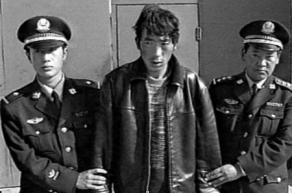
Loyak, one of those executed Oct. 20, 2009.
The two most prominent prisoners — in fact, the only two confirmed in some of the first media reports — were Lhasa residents Lobsang Gyaltsen and Loyak. A court spokesperson said both had been “given death penalties had committed extremely serious crimes and have to be executed to assuage the people’s anger.”
Specifically, both had been convicted of torching shops during the Lhasa riots, which arsons both led to deaths.
The other two executed, a woman named Penki (also for arson) and an unnamed man, received less comment, although they might have been executed despite having been condemned only to a “suspended” death sentence, which for China is generally no death sentence at all.
Executions in Tibet turn out to be relatively rare; these were the first known Tibetan executions since early 2003. Widely condemned abroad, this date’s events were barely or not at all reported internally by Chinese state media.
In honor of this impressive anniversary, we travel back in time and into the twilit frontier between fact and legend to another century’s intervention in that Graveyard of Empires — the Second Anglo-Afghan War, 1878-1880. Dr. Watson was there; maybe even his literary compatriot Sherlock Holmes, too.
It’s too bad we don’t have the services of those excellent detectives in this matter. We can’t date this particular method, or attribute any specific victim to it, or even substantiate the actuality of the practice to our liking (though there are several books by British soldiers of that war which traffick in the report). Frankly, everything about it smells. But we think you’ll agree that execution by urophagia is a story that needs to be told.
The following is an account from a biography of English officer and novelist John Masters. We’ll label it Mature Content both for what it describes and the manner of its description, just to make you really want to savor every word.
War for the Pathans [Pashtuns] was an honourable, exciting and manly exercise, in which each succeeding generation needed to prove itself, but war was also ruthless; no mercy was shown and none was expected. Neither side aimed to take prisoners. The Pathans customarily mutilated and then beheaded any wounded or dead who fell into their hands. Women often carried out these operations. A well-known torture was called the Thousand Cuts, whereby flesh woulds were newly made and grass and thorns pushed into them so that they would hurt horribly. A prisoner might be pegged out on the ground and his jaw forcibly opened with a stick so that he could not swallow, then women would urinate in his mouth until he drowned.Frank Baines, who served on the North-West Frontier and later with Masters in Burma, put it more crudely:* ‘If you got captured, you were not only killed in a lively and imaginative manner, you were carved up and quartered and had your cock cut off and stuffed in your mouth for good measure.’
The Partisans were Tito’s Communist guerrilla movement against the Nazi occupation and while they were up against it at this early date, they would in due time wind up on the winning side and help birth the postwar government.
Their legacy remains in every European sports page as the namesake of the Belgrade sports association Partizan founded immediately after the war. It’s the umbrella entity for the frequent Serbian football and basketball champions as well as a variety of other sports. (Current world tennis no. 1 Novak Djokovic played for Partizan, for instance.)
On this date last year, the Taliban carried out the public stoning of an adulterous couple who had attempted to elope in northern Afghanistan.
“Even family members were involved,” the New York Times reported, “both in the stoning and in tricking the couple into returning after they had fled.”
as a Taliban mullah prepared to read the judgment of a religious court, the lovers, a 25-year-old man named Khayyam and a 19-year-old woman named Siddiqa, defiantly confessed in public to their relationship. “They said, ‘We love each other no matter what happens,'” [local farmer Nadir] Khan said.
The executions were the latest in a series of cases where the Taliban have imposed their harsh version of Shariah law for social crimes, reminiscent of their behavior during their decade of ruling the country. In recent years, Taliban officials have sought to play down their bloody punishments of the past, as they concentrated on building up popular support.
“We see it as a sign of a new confidence on the part of the Taliban in the application of their rules, like they did in the ’90s,” said Nader Nadery, a senior commissioner on the Afghanistan Independent Human Rights Commission. “We do see it as a trend. They’re showing more strength in recent months, not just in attacks, but including their own way of implementing laws, arbitrary and extrajudicial killings.”
We have received from Constantinople the following further particulars of the revolt of the Janissaries: —
“June 16, 3 o’clock p.m.
“The Sultan was at his summer palace of Bschektash. The Aga Pacha, and the Pacha commanding on the Asiatic bank of the Bosphorus, repaired to Constantinople with their troops: 8,000 topschis, or artillery, also went thither. At length, his Sublimity being resolved to quell the rebellion, caused the standard of the Prophet to be displayed, and proclamations to be made in all the quarters of the city, that all men of honour — that is to say, true believers — had immediately to rally round this standard. The Ulemas met in the Seraglio. The appearance of the Snadgiak Sherif caused some hesitation among the rebels; their numbers were reduced by desertion, while, on the other hand, all the people hastened to assemble round the sacred standard. The energy of the Aga Pacha did the rest; he has crushed the rebles with grape-shot, burnt their barracks in the Ahnudan, and pursued them without mercy.
“The Grand Vizier is in the Court of the Mosque of Sultan Achmet, in the Hippodrome, with the Sandgiak Sherif still displayed; the chiefs of the corps of the Ulemas are met there in council; the Sultan is at the Seraglio, with the great men of the empire. Every moment persons are brought into the Hippodrome, and executed on the spot. Above 100 Oustas have already suffered this fate. This morning all the gates of Constantinople, except one, are shut or guarded by topschis and citizens. The remainder of the rebels have taken refuge in some khans built of stone, where they are invested, and where, to all appearance, famine will soon deliver them to the mercy of the Aga Pacha.
–London Times, July 15, 1826 (translating July 11 reports published in the French papers)
This date in 1826 finds Constantinople in the midst of what history will remember as the Auspicious Incident — an attempted revolt by the Ottoman Empire’s elite Janissary corps that was not at all auspicious for the Janissaries.
Jealous of their material privileges and political prerogatives even as the dawn of industry and conscript armies undermined their combat utility, the Janissaries had become much more trouble than they were worth.†
They had “begun to present a serious threat to the Empire,” wrote Lord Kinross in Ottoman Centuries. “On the battlefield they were gaining a reputation among the modern foreign armies for ineptitude and even cowardice under arms … In the capital … they came to be a dominant power and a focus of sedition.”
Kinross wrote that about the Janissaries of the early 17th century, in the reign of Osman II. (Osman tried to curtail the troop’s power, and was executed by his bodyguards for his trouble.)
A couple of centuries on from that moment, and the Janissaries are still skulking about the Seraglio, still keeping their supposed masters in mortal terror, still arbitrating the succession.
For a generation, Mahmud had waited and readied himself for the opportunity to sweep this piece off the chessboard. This would be a most Auspicious Incident indeed.
Kinross and many other historians suspect that Mahmud intentionally baited the Janissaries to revolt in 1826, but whether or not that is so, they did revolt — in response to a decree reorganizing the corps.
Mahmud was ready for them. He repelled the Janissary mutiny on June 15, and as described by our third-hand correspondent above, proceeded to slaughter them without mercy: under artillery barrage in the barracks they retreated to, or by the summary execution of all who surrendered — not just on this date, but throughout the Incident and extending to the further reaches of the empire where Mahmud’s agents carried his decree abolishing the Janissaries forever.
* Culled from children taken from non-Muslim families and raised as Islamic converts.
† There’s a competing historiography contending (pdf) that, contrary to the corrupt-backwards-military-caste story, it was the Janissaries’ economic and social links that brought on their destruction: they became the entity representing the autonomous Ottoman classes, such as artisans and guilds, who had the most to lose from the elites’ state modernization project.
Another execution of a similar nature took place on the 13th of June, at Ferozepore. All the available troops and public establishments were convened to witness the scene. Some of the mutineers were to be hung, and around the gallows, erected during the night previous, the soldiers were drawn up. The mutineers were then brought into the centre, and the proceedings of the general Court-Martial was read. Upon being informed that if they would become Queen’s evidence they would be reprieved, twelve of the criminals accepted the offer and were marched to the rear. Two were taken to the gallows. They ascended the ladder with firm steps, and to the last moment betrayed no emotion of fear.
The remaining ten were now led away to the artillery guns, and while their irons were being struck off some cried, “Do not sacrifice the innocent for the guilty!” Two others rejoined, “Hold your sniveling: die men and not cowards — you defended your religion, why then do you crave your lives? Sahibs! they are not Sahibs, they are dogs!” Others then began to upbraid their commanding officer. The wretched beings were quickly fastened to the muzzles of ten guns, charged with blank cartridge.
The commanding officer directed port-fires to be lit. “Ready!” “Fire!” and the drama was played out. An eye-witness says: “The scene and stench were overpowering. I felt myself terribly convulsed, and could observe that the numerous native spectators were awe-stricken — that they not only trembled like aspen-leaves, but also changed into unnatural hues. Precaution was not taken to remove the sponge-and-load men from the muzzles of the guns; the consequence was that they were greatly bespattered with blood, and one man in particular received a stunning blow from a shivered arm!“
A lengthier account, no less riveting and we suppose more accurate on account of its primary sourcing, is to be found in this memoir or the British campaign against the Sepoy rebellion.
June 13 The morning of June 13 was fixed upon for the execution. A gallows was erected on the plain to the north side of the fort, facing the native bazaars, and at a distance of some 300 yards. On this two sepoys were to be hanged, and at the same time their comrades in mutiny were to be blown away from guns.
We paraded at daylight every man off duty, and, with the band playing, marched to the place of execution, and drew up in line near the gallows and opposite the native quarter.
Shortly after our arrival the European Light Field Battery, of six guns, appeared on the scene, forming up on our left flank, and about twenty yards in front of the Light Company.
The morning was close and sultry, not a cloud in the sky, and not a breath of wind stirring; and I confess I felt sick with a suffocating sense of horror when I reflected on the terrible sight I was about to witness.
Soon the fourteen mutineers, under a strong escort of our men with fixed bayonets, were seen moving from the fort. They advanced over the plain at our rear, and drew up to the left front of, and at right angles to, the battery of artillery.
I was standing at the extreme right of the line with the Grenadier Company, and some distance from the guns; but I had provided myself with a pair of strong glasses, and therefore saw all that followed clearly and distinctly.
There was no unnecessary delay in the accomplishment of the tragedy. Two of the wretched creatures were marched off to the gallows, and placed with ropes round their necks on a raised platform under the beam.
The order was given for the guns to be loaded, and quick as thought the European artillerymen placed a quarter charge of powder in each piece. The guns were 9-pounders, the muzzles standing about 3 feet from the ground.
During these awful preparations, I watched at intervals the faces of the condemned men, but could detect no traces of fear or agitation in their demeanour. The twelve stood two deep, six in front and six in the rear, calm and undismayed, without uttering a word.
An officer came forward, and, by the Brigadier’s order, read the sentence of the court-martial, and at its conclusion the six men in front, under escort, walked towards the battery.
There was a death-like silence over the scene at this time, and, overcome with horror, my heart seemed almost to cease beating.
Arrived at the guns, the culprits were handed over to the artillerymen, who, ready prepared with strong ropes in their hands, seized their victims. Each of these, standing erect, was bound to a cannon and tightly secured, with the small of the back covering the muzzle. And then all at once the silence which reigned around was broken by the oaths and yells of those about to die. These sounds were not uttered by men afraid of death, for they showed the most stoical indifference, but were the long-suppressed utterances of dying souls, who, in the bitterness of their hearts, cursed those who had been instrumental in condemning them to this shameful end. They one and all poured out maledictions on our heads; and in their language, one most rich in expletives, they exhausted the whole vocabulary.
Meanwhile the gunners stood with lighted port-fires, waiting for the
word of command to fire the guns and launch the sepoys into eternity.
These were still yelling and raining abuse, some even looking over their shoulders and watching without emotion the port-fires, about to be applied to the touch-holes, when the word “Fire!” sounded from the officer in command, and part of the tragedy was at an end.
A thick cloud of smoke issued from the muzzles of the cannons, through which were distinctly seen by several of us the black heads of the victims, thrown many feet into the air.
While this tragic drama was enacting, the two sepoys to be hanged were turned off the platform.
The artillerymen again loaded the guns, the six remaining prisoners, cursing like their comrades, were bound to them, another discharge, and then an execution, the like of which I hope never to see again, was completed.
All this time a sickening, offensive smell pervaded the air, a stench which only those who have been present at scenes such as these can realize — the pungent odour of burnt human flesh.
The artillerymen had neglected putting up back-boards to their guns, so that, horrible to relate, at each discharge the recoil threw back pieces of burning flesh, bespattering the men and covering them with blood and calcined remains.
A large concourse of natives from the bazaars and city had assembled in front of the houses, facing the guns at a distance, as I said before, of some 300 yards, to watch the execution. At the second discharge of the cannon, and on looking before me, I noticed the ground torn up and earth thrown a slight distance into the air more than 200 paces away. Almost at the same time there was a commotion among the throng in front, some running to and fro, while others ran off in the direction of the houses. I called the attention of an officer who was standing by my side to this strange and unaccountable phenomenon, and said, half joking: “Surely the scattered limbs of the sepoys have not been carried so far?”
He agreed with me that such was impossible; but how to account for the sight we had seen was quite beyond our comprehension.
The drama came to an end about six o’clock, and as is usual, even after a funeral or a military execution, the band struck up an air, and we marched back to barracks, hoping soon to drive from our minds the recollection of the awful scenes we had witnessed.
Two or three hours after our return news arrived that one native had been killed and two wounded among the crowd which had stood in our front, spectators of the recent execution. How this happened has never been explained. At this time a “cantonment guard” was mounted, consisting of a company of European infantry, half a troop of the 10th Light Cavalry, and four guns, and two of these guns loaded with grape were kept ready during the night, the horses being harnessed, etc. Half the cavalry also was held in readiness, saddled; in fact, every precaution was taken to meet an attack.
As far as I can recollect, there were but two executions by blowing away from guns on any large scale by us during the Mutiny; one of them that at Ferozepore.
That Columbus, on his first voyage, took his departure from Gomera indicates the importance assumed by the Canaries in the development of trade with the New World and this, conjoined with their productiveness, as they became settled and cultivated, rendered them a centre of commerce frequented by the ships of all maritime nations, as well as an object of buccaneering raids, in an age when trade and piracy were sometimes indistinguishable. Their proximity to Morocco and the Guinea coast moreover exposed them to attacks from the Moors and gave them an opportunity of accumulating Moorish and negro slaves, whom the piety of the age sought to convert to Christians by the water of baptism. In various ways, therefore, there came to be abundant material for inquisitorial activity, although the JudaizingNew Christians, who furnished the Spanish tribunals with their principal business, appear to have been singularly few.
There was no haste in extending the Spanish Inquisition to the Canaries … It is not until the time of Diego de Muros [Spanish link], who was consecrated in 1496, that we have any evidence of such action … [and even then] every act, from the preliminary arrest to the final decision, was regulated from Seville …
Irregular and imperfect as may have been the organization of the tribunal, it yet managed to accomplish some convictions. In 1510 there was held an auto de fe in which there were three reconciliations for Judaism and one, of a Moorish slave, for reincidence in Mahometan error, while a fifth culprit was penanced for Judaism. Then in 1513 occurred the first relaxation, that of Alonso Fatima, a native Morisco, who had fled to Barbary. This was always deemed sufficient evidence of relapse to former errors, and he was duly burned in effigy. It was probably also to 1516* that may be attributed the first relaxation in person — that of Juan de Xeres of Seville, for Judaism. It shows that the tribunal was indifferently equipped that, when he was sentenced to torture, the physician whose presence was obligatory on such occasions, Doctor Juan Meneses de Gallegas, was required personally to administer it. It was exceedingly severe, extending to eleven jars of water; the accused was unable to endure it; he confessed his faith, was sentenced to relaxation as a relapsed and for fictitious confession, and was executed on Wednesday, June 4th. …
on June 4, 1530, another oblation was offered to God, in an auto celebrated with the same ostentation as the previous one [in 1526, with seven executions]. This time there were no relaxations in person, but there were six effigies burnt of as many Moorish slaves, who had escaped and were drowned in their infidelity while on their way to Africa and liberty. There were also the effigy and bones of Juan de Tarifa, the husband of the Ynes de Tarifa who had denounced herself in 1524; he was of Converso descent and had committed suicide in prison, which was equivalent to self-condemnation. There were three reconciliations, of which two were for Judaism and one for Islam and five penitents for minor offences.
This use of religious terror in service of slavery — the burning of those effigies who had been “drowned in their infidelity on their way to Africa and liberty” — was an overt policy of the tribunal.
Pious zeal for the salvation of these poor savages led to their baptism after capture; they could not be intelligent converts or throw off their native superstitions, and no one seemed able to realize the grim absurdity of adding the terrors of the Inquisition to the horrors of their enslaved existence. When a negro slave-girl was bemoaning her condition, she was kindly consoled with the assurance that baptism preserved her and her children from hell, to which she innocently replied that doing evil and not lack of baptism led to hell. This was heresy, for which she was duly prosecuted.
Under the inquisitorial code the attempt to escape from slavery thus was apostasy, punishable as such if unsuccessful, and expiated if successful by concremation in effigy. This is illustrated in an auto, held by Zayas and Funez, June 24, 1576, in which among sixteen effigies of absentees were those of eight slaves, seven negroes and one Moor. They had undergone baptism, had been bougt by Dona Catalina de la Cuevas and were worked on her sugar plantation. They seized a boat at Orotava and escaped to Morocco, for which they were duly prosecuted as apostates and their effigies were delivered to the flames — a ghastly mockery which does not seem to have produced the desired impression in preventing other misguided beings from flying from their salvation.
* A footnote in the text of our source notes that “in the record concerning Juan de Xeres, the year is omitted, but as Wednesday fell on June 4 in 1511, 1516, 1533 and 1539, the probable date is 1516.”
State media reported that 14 were shot in Tripoli, and four more in Benghazi, in unspecified cases that Amnesty International “fear[ed] … fail to satisfy international standards for fair trial.”
Among them were nationals of Nigeria, Chad, and Egypt who, particularly in the first case, might have been condemned at a tribunal entirely conducted in a language they could not understand.
Qaddafi’s Libya has always been opaque about its practice of capital punishment; if it met the international outcry for more information about these 18, this site is not aware of it.
On or about this day in 1941, a twenty-two-year-old woman known only as Mirjam Sara P. was executed/murdered by means unknown, probably gassing.
The notice of her death was postmarked “Cholm Insane Asylum.” However, as psychiatrist Robert Jay Lifton notes in his book The Nazi Doctors: Medical Killing and the Psychology of Genocide, there was no such place: “As far as can be determined, the Cholm Insane Asylum was a fiction.”
Yes, Mirjam was Jewish. This certainly could not have helped her case, but she was actually killed as part of another genocide: the T4 program, the Nazi policy of involuntary euthanasia on people suffering from deformities, incurable illness, mental illness or anything else that made them into “useless eaters.”
Begun in 1939 with the killing of five-month-old Gerhard Kretschmar, who’d been born blind and missing two or three limbs, the T4 program would end the lives of over 200,000 people, about two-thirds of them after the program officially ended in 1941.
T4 had six death institutions, called “state nursing homes,” which were equipped with gas chambers. The operation was supposed to be a secret, but it was too big to be concealed and before long the German people thought they had a pretty good idea what was happening to their disabled loved ones.
Opencriticism of a fascist government is not advisable if you like your life, so the families were limited to publishing heavy hints in their relatives’ newspaper obituaries.
Perhaps the saddest part of Mirjam’s story is that she should have survived. Of course, none of the T4 victims should have been killed, but Mirjam had excellent odds of surviving the Nazi era … until a particularly boneheaded decision by Child Welfare Services and the immigration authorities in Palestine in October 1936.
What’s Palestine got to do with it, you ask? Mirjam P.’s story is told in Tom Lampert’s documentary history, One Life, and it begins in 1933:
This Adolf Hitler guy made Mirjam’s mother uneasy, and she decided to get her family to safety as soon as possible. Mirjam, fifteen years old, long considered a “difficult child,” had been staying in a juvenile reformatory school and sanitorium for the past eighteen months when her mother called her home. She had been sent there after she stole money from her mother and ran away from home.
Mirjam, her mother and her stepfather emigrated to the city of Tel Aviv in Palestine in September 1933, nine months after Hitler was sworn in as chancellor of Germany.
Palestine didn’t agree with Mirjam; she hated the weather and had trouble learning Hebrew and Arabic. A year after her arrival, she went to live with her father in Haifa. She left after only a couple of days, however, returned to Tel Aviv and embarked on a spree of petty crimes. Her mother asked for help from Child and Welfare Services, who had two doctors examine Mirjam.
The first doctor pronounced that Mirjam had
… an advanced case of severe psychopathy with pronounced ethical defects. She lies, incurs debts, and has stolen repeatedly from her mother and her friends. She has run away from home multiple times … She roams the streets and is in danger of becoming morally depraved as a result of her strong sexual drives. In order to avoid further violations of the law, she must be admitted to a mental institution as quickly as possible. Since such an institution does not exist here, it is absolutely essential that she be sent back to Germany immediately.
The second doctor agreed:
P. is a psychopath with severe ethical defects and insufficiently developed powers of judgement. She tends to thievery and vagabonding, incurs debts, and has already developed the traits of a swindler … In order to avoid the threat of moral depravity, it is urgent that she be admitted to a remedial educational home … I know that no such institution exists in Palestine or in the neighboring countries. Therefore, it is absolutely necessary that the patient be sent back to Europe without delay …
Child Welfare Services provided a private tutor for Mirjam, then sent her to a group home for girls, but she didn’t fit in there and was sent back to her mother. Very quickly she fell back into her old habits. She was arrested and put on probation, but she just got arrested again. In a remarkably stupid move by the authorities, she was expelled from the country and sent back to Germany in October 1936. Perhaps Palestine thought they’d given her enough chances.
Back to Germany.
The same country she had fled from to escape Hitler. The same country where by now, under Hitler’s regime, Jews had been banned from public high schools, universities, the civil service, the army and the medical field, where Jews had been deprived of their citizenship and the rights that went with it, where Jewish-owned businesses were boycotted, where things showed every sign of becoming worse and did.
To Germany Mirjam had been sent, to prevent “serious damage to … herself, to her family, and to society as a whole.” She was eighteen years old.
Mirjam spent a few weeks with her grandmother in Berlin, but she left because she was afraid (justifiably so) that the Nazis would put her in an “education camp.”
For the next several weeks she traveled around Europe, going to Luxembourg, Belgium, the Netherlands and Switzerland. She tried to find a job but she lacked the necessary papers. In March 1937, she was arrested in Zurich for borrowing money under false pretenses and not repaying it. After twelve days in jail, the Swiss dropped her off at the German border.
Back at square one, Mirjam got into trouble again for petty crimes and served eight months in prison. Then she confessed to having sex with a German boyfriend, in violation of the Law for the Protection of German Blood and Honor. Mirjam’s boyfriend was prosecuted and claimed he hadn’t known she was Jewish; Mirjam stated she had told him shortly after she met him. He was acquitted in December 1937.
After her release from jail, Mirjam was admitted to the Heckscher Psychiatric Hospital and Research Institute in Munich. She had her intelligence tested and performed poorly. Nurses at the hospital stated Mirjam was a demanding patient, she was lazy, she left her room a mess, she would not take responsibility for her mistakes, and she didn’t have realistic expectations for the future.
After three weeks there, the hospital sent a report to the Jewish welfare office in Munich, which indicated she hadn’t changed much since she was evaluated in Palestine:
In our judgment, P. is a mediocre but normally endowed, weak-willed, unrestrained, and asocial psychopath. Predominant are her physical urges, her limited powers of judgment and insight, and above all her lack of ethical and moral inhibitions. She is incapable of leading a responsible and purposeful life … External compulsion might gradually teach her the value of regular, long-term work and an orderly, honest life.
The evaluator suggested Mirjam be sent to the work unit of the State Mental Institution and Nursing Home.
A 21st-century reading of these evaluations suggests Mirjam was suffering first from Conduct Disorder and then its adult equivalent, Antisocial Personality Disorder. Conduct Disorder is noted “by a pattern of repetitive behavior wherein the rights of others or social norms are violated. Symptoms include verbal and physical aggression, cruel behavior toward people and pets, destructive behavior, lying, truancy, vandalism, and stealing.”
Antisocial Personality Disorder is diagnosed only in adults and is defined as “a pervasive pattern of disregard for, and violation of, the rights of others that begins in childhood or early adolescence and continues into adulthood.”
Both disorders are marked by impulsivity, recurring trouble with the law, persistent stealing and lying, and lack of empathy for other people, all traits Mirjam had. These conditions, while serious, would not by themselves merit inpatient psychiatric treatment today — although, in these days of managed care, almost nothing does.
In April 1938, Mirjam escaped from the psychiatric hospital and quickly found herself in jail — petty theft again. Writing from jail during her pretrial detention in May, she asked to be expelled from Germany so she could go live with her father in Palestine, because “as a Jew it is impossible for me to amount to anything here.”
Instead she was sentenced to fourteen months in prison. After her release, in mid-June 1939, the court committed her to the Philippshospital in Goddelau. It was her next-to-last stop on the road
On February 1, 1941, the Charitable Ambulance Service (a tool of T4) picked up 29 Jewish patients from Philippshospital. On February 4, 67 Jews, including the 29 Philippshospital patients, were registered in the logbook at the T4 death institution Hadamar.
Their names were not recorded, but chances are Mirjam was among the group. At Hadamar,
Up to 100 victims arrived in post buses every day. They were falsely told to disrobe for a medical examination. Sent before a physician, instead of examining them he assigned one of a list of 60 fatal diseases to every victim, then marked them with different-colored band-aids for one of three categories: Kill; kill and remove brain for research; kill and break out gold teeth.
Ten thousand people would die there before the end of the war, through gassing, starvation and deliberate drug overdoses.
The district attorney’s office inquired as to her whereabouts and received a death notice from Cholm Insane Asylum: “We wish to inform you that the patient Mirjam Sara P. died here on May 27, 1941. Heil Hitler!”
In fact, she was probably killed earlier than this; the death dates of T4 patients were often pushed forward so the institutions could continue to charge fees for their care.
On this day in 1943, a retired transport worker known only as Wilhelm H. was executed for high treason. He was seventy-four years old and had no prior criminal history.
His crime? Writing messages in a public toilet. The story of the events that lead to his death is recorded in Tom Lampert’s work of documentary history, One Life, which is the sole source for this account. Unfortunately Mr. Lampert did not disclose Wilhelm’s last name.
The story begins in August 1942, when Wilhelm wrote the following inscription in a public toilet in Berlin:
Hitler, you mass murderer, you must be murdered, then the war will be over.
Good citizens who saw the graffito promptly reported it to the authorities and it was erased. However, the exact same message appeared in the same location twice more over the next eight weeks.
On October 28, 1942, a local resident finally caught Wilhelm H. red-handed writing the subversive message on the wall, and made a citizen’s arrest.
Wilhelm initially denied having written anything and the police couldn’t find any writing implement on his person, so they were forced to let him go for lack of evidence. Two weeks later, however, when questioned again by authorities, Wilhelm admitted he had written the message. When asked why, he replied that wartime inflation had reduced his pension to a pittance. He and his wife got only 78.80 reichsmarks a month and had to pay 34.05 of that in rent.
Wilhelm held Adolf Hitler responsible for the war and hence his own privations, and as he felt incapable of action himself he resolved to call other people to rise against the Führer. He said he believed things would be better if the Führer wasn’t there anymore.
The senior district attorney turned his case over to the People’s Court, saying, “Even if the seventy-three-year-old accused does not otherwise appear to have ever engaged in harmful political activities, the suspicion that a crime has been committed here according to paragraphs 80ff. of the Penal Code [conspiracy to commit high treason] cannot be dismissed.”
During the pretrial investigation it waslearned that Wilhelm was born in Klein-Reitz in 1869. He had an elementary school education and worked as a farm laborer until the age of twenty, after which he did military service for three years. Once his term of service ended he moved to Berlin and worked for the next thirty-five years as a transport laborer. He retired on a disability pension. He had never been politically active and his neighbors described him as quiet and reclusive.
In January 1943, Wilhelm was indicted on three counts:
calling for the Fuhrer to be killed;
treasonously attempting to alter the constitution of the German Reich through violence, whereby the crime was aimed at influencing the masses by means of the written word; and,
aiding and abetting the enemy during a war against the Reich and harming the military powers of the Reich.
A physician at the Plötzensee Prison certified that Wilhelm was mentally and medically fit for trial. The trial itself, on March 8, 1943, lasted only an hour. Wilhelm was convicted of all charges and sentenced to death. The court stated:
The wording of the inscription … is clear. There is nothing about the sentence or its meaning to quibble over. Given H.’s selection of a public location, the inscription must be regarded as a call on the populace to kill the Führer of the German Reich. Nor can there be any doubt about the seriousness of H.’s intentions here … as his repeated writing on the inscription demonstrates beyond any doubt.
Since H. wrote his demand quite legibly in crayon on the wall, it could be read by all German comrades visiting the toilets, and this in a neighborhood made up primarily of manual laborers. In addition, the designation of the Führer as a mass murderer and the claim that the war would be over if the Führer were dead both created the appearance of oppositional movements in the Reich and stirred up visitors of the public toilets against the Führer and his Nazi regime, inciting them to acts of violence…
And all of this because H. desired greater buying power for his pension and because he himself wanted to lead an “adequate and contented” life. H.’s old Marxist views — evident in his past votes for the Social Democratic Party — resurfaced at the moment when he believed National Socialism didn’t offer him enough for his personal needs. He has placed the life of the Führer and the fate of the entire German people at risk in a reckless and wanton manner, and all this merely for his own personal well-being. In so doing, H. has expelled himself from the community of German people, who share a common destiny, and thus passed sentence on himself. He deserves to die … The People’s Court has thus sentenced H. to death, a punishment which, given the heinousness of the crime, also takes into account popular German sentiment.
Joseph Goebbels himself, Germany’s Minister of Propaganda, voiced his support for the death sentence. Wilhelm H. was calm and did not resist when he was taken to the guillotine on May 20, 1943.