1720: A deserter, by fellow-deserters

The sentence of death was often pronounced by courts-martial and not unfrequently carried out, a deserter convicted for the third time rarely escaping with his life. Many a man was shot in Hyde Park during the twenty years of peace, and no opportunity was lost to enhance the terror of the penalty, the firing party sometimes consisting solely of fellow-deserters, who were spared in consideration of the warning given by the ghastly body which their own bullets had pierced

John Fortescue, A History of the British Army, vol. 2

Fortescue’s notes on this passage draw attention to the following account in the May 7, 1720 Weekly Journal.

On Thursday Morning the four Men, sentenced by a Court-Martial for Desertion, were brought hand-cuff’d to the Tilt-Yard Guard, from whence they marched with the Grenadiers at the Head of the Detachment to Hyde-Park; at the Place of Execution they were met by the Chaplain of the second Regiment of Guards, who prayed with them for a while; then three of the Prisoners, having before received the King’s Pardon, were restored to the Regiment, and ordered immediately to load their Pieces, and fire at their Comrade, which they obey’d; the Man was observed to give a little Spring after the Discharge of their Pieces, and a Corporal, who was kept, as usual, in Reserve, shot him through the Head; the other three Shot were lodged in his Breast. This is the third Time of his deserting.

On this day..

1655: Massacre of Waldensians

On this date in 1655, Catholic forces under the Duke of Savoy carried out a notorious massacre of Waldensians* in the Piedmont.

This interesting, excommunicate sect had persisted for centuries in those hard-to-reach places in Alpine foothills, intermittently ignored and hunted. After Martin Luther, many Protestants inclined to see them as a proto-Reformation movement, or even a counter-papal apostolic succession reaching back to ancient Christianity.

At any rate, they sure weren’t Catholic.

And our friend the Duke decided — perhaps piqued by the murder of a missionary Catholic priest, or for whatever other reason — to mount one of those heresy-extirpating sorties and make them Catholic in 1655.

On April 17, the Marquis of Pianezza appeared with an overwhelming force of mixed Piedmontese, French, and Irish** troops. They conducted a few skirmishes, then made nice with the Waldensian civic leaders and induced them to quartering their troops temporarily further to some expedient pretext.

Alas! alas! these poor people were undone. They had received under their roof the executioners of themselves and their families. The first two days, the 22d and 23d of April, passed in peace, the soldiers sitting at the same table, sleeping under the same roof, and conversing freely with their destined victims …

At last the blow fell like a thunderbolt. At four of the clock on the morning of the 24th April the signal was given from the Castle of La Torre. But who shall describe the scenes that followed? On the instant a thousand assassins began the work of death …

Little children were torn from the arms of their mothers, and dashed against the rocks; or, more horrible still, they were held betwixt two soldiers, who, unmoved by their piteous cries and the sight of their quivering limbs, tore them up into two halves. Their bodies were then thrown on the highways and the fields. Sick persons and old people, men and women, were burned alive in their own houses; some were hacked in pieces; some were bound up in the form of a ball, and precipitated over the rocks or rolled down the mountains … Some were slowly dismembered, and fire applied to the wounds to staunch the bleeding and prolong their sufferings; some were flayed alive; some roasted alive; others were disembowelled; some were horribly and shamefully mutilated, and of others the flesh and brains were boiled and actually eaten by these cannibals.

Source, whose atrocity accounts channel those in this French tome

Without doubting the capacity of man’s inhumanity to man, the cannibalism charge reminds that we’re dealing with propaganda alongside historiography. And what great propaganda — like, babies-torn-from-incubators great.

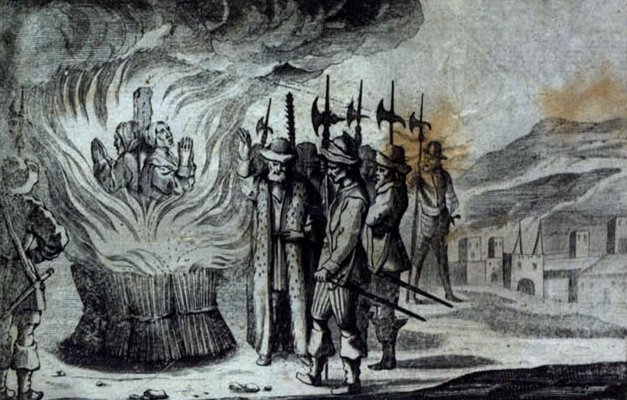
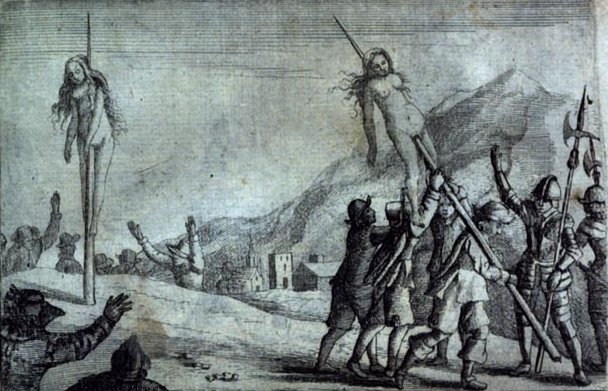
Thumbnails (click for a larger, disturbing view) of selected images of this date’s atrocities from Samuel Morland’s The History of the Evangelical Churches of the Valleys of Piedmont

And there’s little doubt as to the overall savagery of the affair, which could well have become the opening salvo in a full-scale sectarian cleansing campaign. (A later addendum to Foxe’s Book of Martyrs narrates the ensuing Piedmontese armed struggle, petering out before any definitive resolution in the field.)

Outrage at this hecatomb spread in Protestant Europe — which would also refer to the day’s doings as the “Bloody Easter,” since it corresponded with the eve of that celebration as reckoned by the Julian Calendar (source).

It was felt especially in Protectorate England, which intervened diplomatically.

A “day of solemn fasting and humiliation” was promulgated in Albion, along with collections for the relief of the survivors. Oliver Cromwell personally put £2,000 into the kitty.

More importantly, he dispatched diplomat Samuel Morland† to force the House of Savoy to lay off the persecution; in fact, he threatened to disrupt high statecraft between England and France unless the French twisted arms on behalf of the Waldensians.

Written correspondence for Morland’s diplomatic tour addressed to Louis XIV of France and various other continental potentates, as well as a fiery bit of oratory that Morland delivered to Savoy, all seem to have originated from the pen of Republican scribbler John Milton — the future author of Paradise Lost.‡

Milton, for whom the whole thing was more than just a day job, was further moved to put his umbrage at the slaughter into sonnet form:

Avenge O Lord thy slaughter’d Saints, whose bones
Lie scatter’d on the Alpine mountains cold,
Ev’n them who kept thy truth so pure of old
When all our Fathers worship’t Stocks and Stones,

Forget not: in thy book record their groanes
Who were thy Sheep and in their antient Fold
Slayn by the bloody Piemontese that roll’d
Mother with Infant down the Rocks. Their moans

The Vales redoubl’d to the Hills, and they
To Heav’n. Their martyr’d blood and ashes sow
O’re all th’ Italian fields where still doth sway

The triple Tyrant: that from these may grow
A hunder’d-fold, who having learnt thy way
Early may fly the Babylonian wo.

* The Waldensians in question here are interchangeably known as the Vaudois for their geographic region, actually above the Piedmont and abutting the Swiss region also known as Vaud. (These pages have visited the latter.)

** Fresh from being on the receiving end of another infamous massacre.

† Morland is more regarded for his post-Restoration labors as an inventor; he created an early calculator and internal combustion engine.

‡ The speech in particular is not definitively attributed; see Robert Fallon, “Milton in Government: Denmark and Savoy,” Milton Quarterly, May 1989.

On this day..

1457: The Wallachian boyars

This date was Easter Sunday in 1457, which would make it the date associated with one of the more memorable displays of theatrical brutality by Wallachian proto-vampire Vlad Tepes, aka Vlad Dracula or Vlad the Impaler.

Having only just ascended the less-than-secure throne of Wallachia, a frontier principality pinched between the Hungarian and Ottoman Empires, the 25-ish prince and onetime Ottoman hostage had a bone-chilling inauguration plan to shore up his security both internal and external.

He threw a big party in Targoviste for the nobles of the realm … and had a little surprise waiting for them. It wasn’t an Easter egg hunt.

He asked the assembled noblemen:
“How many princes have you known?”
The latter answered
Each as much as he knew best.
One believed that there had been thirty,
Another twenty.
Even the youngest thought there had been seven.
After having answered this question
As I have just sung it,
Dracula said: “Tell me,
How do you explain the fact
That you have had so many princes
In your land?
The guilt is entirely due to your shameful intrigues.”

With ample proof of the boyars’ deceit and treacherous intents, Dracula decided it was timely to inflict upon them an exemplary punishment … mass impalement …

The oldest Romanian historical chronicle records the event two centuries later. It had taken place in the spring of 1457, during the Easter celebrations that the boyars were attending at the palace … “when Eastern Day came, while all the citizens were feasting and the young ones were dancing he [Dracula] surrounded them [the boyars] … led them together with their wives and children, just as they were dressed up for Easter, to Poenari, where they were put to work until their clothes were torn and they were left naked.” In actual fact, this episode, which is also recalled by the Greek historian Chalcondyles and firmly anchored in popular folklore, involved some two hundred boyars and their wives, as well as leading citizens of Tirgoviste … They were seized by Dracula’s men as they were finishing their meal in the main banqueting hall of the palace, following the elaborate Easter ritual at the Paraclete Chapel. In Dracula’s ingenious mind, one aspect of the punishment had a utilitarian purpose: the reconstruction of the famous castle high up on the Arges … On the way out of the chapel the old boyars and their wives were apprehended by Dracula’s henchmen and impaled beyond the city walls. The young and able-bodied were manacled and chained to each other and then marched northward under the vigilant eye of Dracula’s men.

This was revenge a decade in the making for the boyar class having toppled Vlad’s father and murdered Vlad’s elder brother in 1447.

But personal score-settling aside, Vlad’s sanguinary housekeeping had a statecraft dimension as well. It enabled him to centralize power in his own person, and had the happy side effect of speeding creation of a secure mountain fastness — Poenari Castle, which is one of several structures answering to the lucrative name of Castle Dracula.

While Vlad is (in)famous for his iron fist (and well-oiled spikes), it’s perhaps harder to say with confidence how much good this slaughter did him. Wallachia’s security situation was fundamentally defined by its neighbors no matter how cruel Vlad Tepes might be.

Vlad got some more impaling under his belt defending his country from Ottoman invaders (you’ll be shocked to learn that many boyars were more than happy to help the sultan get rid of this tyrant), but he was clapped in prison by the Hungarian ruler Matthias Hunyadi in 1462, lived most of the rest of his life in exile, and then died in battle attempting a Wallachian comeback in 1476. So basically, he got a few good years in … plus that whole latter-day afterlife he enjoys as tourist magnet, alleged literary inspiration, and nationalist icon.

And that’s more than one can say for most of the 15th century rulers who weren’t impaling their boyars.

On this day..

1868: The native prisoners of Emperor Tewodros II

On this date in 1868, on the eve of his rout at the hands of a British expeditionary force, the frustrated Emperor Tewodros II had hundreds of prisoners executed en masse.

Our setting is the 1868 British Expedition to Abyssinia, “one of the most expensive affairs of honour in history.” And it all got started from a bad experience with technical support.

Tewodros — generally known to the Europeans as Theodore — had risen from a humble station to the throne of Abyssinia, but by the 1860s held it but tenuously against various rival warlords. Tewodros lodged appeals for aid with a number of European powers, including the British, who evidently took the emperor’s letter for Queen Victoria and stuck it indefinitely in a file called “Pending”.

After two years without an answer, Tewodros took hostage the British consul Charles Duncan Cameron, a missionary named Henry Stern (whose unflattering report of Tewodros’s mean origins particularly enraged the monarch), and other Europeans.


Illustration of the hostages from Henry Stern’s The Captive Missionary.

And then he took hostage the Ethiopian sent to negotiate their release.

He wasn’t “Pending” any longer.

Gaze not into Abyssinia

Tewodros, perhaps, had depended on the notoriously treacherous Ethiopian highlands to protect him from any effective reprisal. But when the Brits decided in 1867 to let men with guns resolve the dispute, they spared no expense at all.

Months of planning and millions of pounds were poured into the operation, which landed 13,000 soldiers and 40,000 animals organized by the Bombay Army.

“For a total cost of about £9,000,000,” writes Harold Marcus in a biography of another former Tewodros hostage, the future Emperor Menelik II, “Napier set out to defeat a man who could muster only a few thousand troops and had long ago ceased to be Ethiopia’s leader in anything but title.”

The forces converged on Tewodros’s last stronghold, Magdala, with the mercurial king refusing repeated demands of the invader to release his European captives.

Angrily refusing, at least according to the accounts of the hostages who were the subject of all this … and whose accounts have just enough consciousness of the privilege their own skin has given them as they witness these bloodlettings.

On April 8, the king put to death seven of the native prisoners in his train. These prisoners comprised generally people on the political outs with Tewodros, adherents of once-rebellious chiefs and the families of those adherents. It was no mean thing to slaughter a few of them arbitrarily.

But much worse was to come the following day, when the hunted emperor espied the British advance guard reconnoitering his position.

According to a report by European hostage W.F. Prideaux in the May 21, 1868 London Times, the Emperor

had seen the British troops descending the Bashilo, and had remarked among them four elephants and some white animals, which we surmised to be Berbera sheep. A short time afterwards a friend of ours (for we had a few friends at Magdala) … implored us to keep within our tents, for the King was in a fearful passion, and was then issuing an order to kill all his native prisoners, who were confined in a few houses a couple of hundred yards off. The repeated discharge of firearms, which we heard soon afterwards, confirmed the sad story, and it was with many misgivings that we asked ourselves, “What next?” At dusk, however, the King returned, and we returned to our tents comparatively at our ease. From what I have heard it appears that the King rushed down mad with rage and arackee, and calling out one of the prisoners hacked him to pieces with his own sword. Another speedily met the same fate. The third was a boy about ten years of age. His youth and innocence (for it was his father who had been the offender) were no protection. He was mangled in the same way as the two others. The cutting and slashing went on in this manner for some time, when the King, finding this mode of execution too slow for his impatient spirit, ordered out the musketeers. The remainder were then quickly shot down, and thrown over the low cliff, the force of the shock in several cases opening the chains of the wretched victims. Those whose quivering limbs showed any signs of life were fired on from above till the murderous work was completed.

The account of the Rev. Stern:

[W]e were suddenly startled by the sound of an intermittent musketry. … The rattle of musketry blended with the yells of despair, and the shouts of rage fell, however, with an ominous and appalling horror on our ears. “What is the matter?” I inquired of my neighbour. “Hist,” was the response, “the king is killing all the prisoners.” These terrible words diffused an aguish chill through my very heart. … The sun had already disappeared from the horizon, and twilight spread a dismal, dusky hue over the scene around, and still the firing continued unabated. With night it gradually diminished, and then only isolated shots reverberated across the panic-stricken camp.

The slaughter lasted about three hours, and during that interval three hundred and seven human beings* were, unwarned, and perhaps unprepared, hurled into eternity. Some of the prisoners did not unresistingly yield to their woeful doom. One, Immer Ali, a native of Ferga, near the Tzana Lake, formerly a chief of consideration in his province, in spite of hand and foot chains, with a convulsive grasp dragged his executioner towards the precipice over which he was to be hurled. The hangman, who dreaded the doom which he intended to inflict on his fellow man, shouted for help. On hearing the cry the tyrant, tiger-like, sprang forward and with his gory sword literally hacked the man to pieces.

And to hear Stern tell it, it was by dint of nothing but great fortune — or in his view, divine providence — that saved the British hostages from joining them.

One victim after another lay writhing and quivering in the last pangs at the foot of the dizzy precipice, and still the tyrant’s rage was un-appeased. “Bring the white men, and let their blood flow, mingled with that of my own subjects,” was the order that fell from his lips. Already, we were informed, whole bands of ruffians stood prepared to seize the intended prey, when several chiefs, no friends of the foreign captives, stepped forward, and requested that our execution might be deferred till next day. “Your Majesty,” they respectfully remarked, “the white men do not deserve the easy death of the sword and bullet; no, keep them till to-morrow, and then let the slow torture of a flaming hut put an end to their existence.” “You are right,” was the response.

Since the next day was Good Friday, the Christian Tewodros, “though a perfect fiend and coarse blasphemer, repaired, from a superstitious impulse, at a very early hour to church,” Stern says. The decisive British attack began later that day, and would end with the un-executed hostages liberated, and Tewodros taking his own life rather than fall captive.

Among the spoils of war was the crown of the dead emperor, which in 1925 King George V would personally present to Haile Selassie.

* The provenance of the very precise figure of 307 is not apparent in Stern’s account; presumably, he knew through his friendly contacts (of from relieving the boredom of captivity in recreational head-counting) the overall number of prisoners beforehand.

On this day..

1244: Two hundred-plus Cathars at Montsegur

On this date in 1244, over two hundred Cathar heretics submitted themselves to the stake rather than submit to the Catholic church.

Though not literally the last of the Cathars, that outlawed dualistic sect in the south of France whose extirpation occupied the papacy for much of the 13th century, this date was the last great stand and the signature massacre of the Albigensian Crusade. Afterwards, only minor outposts and isolated individuals would remain available for mop-up duty.

Heretical holdouts, fleeing a malevolent Inquisition established in the Languedoc by victorious Catholic armies, holed up at a few Cathar strongholds of which the most impressive was the mountain citadel of Montsegur.


The spectacular attraction of Montsegur tourists see today is not the legendary Cathar castle — which was razed by its conquerors — but a subsequent rebuild. (cc) image from SarahLouiseHathaway

Finally in 1243-1244, a massive Catholic army invested Montsegur; one can’t help but compare this hopeless confederation of fearless zealouts ranged against the mighty temporal powers to the Jews at Masada — and as with Masada, it were death to succumb to the besiegers.

When Montsegur finally surrendered, two hundred-some — the reported counts differ slightly — were burned at the stake for refusing to renounce their faith; many of them had actually taken sacred vows in the days before Montsegur fell.

They were Nazis, Dude?

The National Socialists’ weird quest to outrace Indiana Jones for mystical artifacts also brought the swastika to Montsegur, under the direction of the occult medievalist Otto Rahn.

Rahn thought the Holy Grail may have been secreted at Montsegur under Cathar protection, a half-literal, half-metaphorical secret goblet carrying the heretics’ forbidden gnostic wisdom from the day of Mani.

(Other Nazis, allegedly including Heinrich Himmler himself, favored the similar-sounding Spanish fortress of Montserrat. Dan Brown prefers the Knights Templar, who could have laid their gauntlets on the cup of Christ when a few Cathars allegedly slipped through Montsegur’s encirclement carrying some unidentified mysterious secret.)

On this day..

2009: Four Iranians

If not for China, Iran’s hundreds of annual executions would put it in a class all its own for capital punishment.

The legions of hanged in Iran are more than this site will ever manage with the biographical care that their friends might demand for their lives: we are doomed to know only a few, and often what we “know” is little more than a name and what an authority figure has accused him of. Ever it is thus: the kings and potentates, the star-crossed lovers and epic villains, make the history books. But most of the headsman’s clients are, like he himself, obscurities.

From Iran Human Rights, March 14, 2009.

March 14: Four people were executed by hanging in the Adelabad prison of Shiraz, reported the Iranian daily newspaper Etemaad today.

According to the report the men were identified as:

  • Abolhassan (age not given), convicted of a murder in 1981
  • 26 years old man (name not given), convicted of murder
  • Young man (name and age not given), convicted of murder
  • 23 years old man (name and age at the time of committing the offence not given), convicted of raping two boys.

    According to our sources, there are several minor offenders on death row in the Adelabad prison of Shiraz.

    In 2008, at least two minor offenders were executed in the Adelabad prison of Shiraz.

On this day..

1916: Three in the Mexican Revolution

On an uncertain date — approximated only to “about the time of the Columbus affair,” which was Pancho Villa‘s famous (and otherwise unrelated) raid on Columbus, N.M. March 8-9, 1916 — a triple execution took place in Juarez, Mexico.

The who, why, and wherefore appear to be completely lost. Only the image remains:

These images were captured by C. Tucker Barrett, a lawyer and amateur photographer serving with the U.S. Army’s 16th Infantry Regiment then stationed right across the border from Juarez, in El Paso, Texas. (This regiment would be detailed for a punitive expedition into Mexico, which Barrett also photographed.)

The Mexican Revolution may be ancient history, but Juarez and extrajudicial executions are still very much in the news.

On this day..

1714: Various rebel slaves in the Cape Colony

This site has previously noticed a milestone 1714 execution in the Dutch Cape Colony of South Africa.

That execution of a black slave and his white lover was exceptional — and, of course, the chronicles of the Cape are replete with less exceptional fare, the humdrum penal brutality of an 18th century colony disposed of in a sentence of two between reports of smallpox outbreaks, price fluctuations, the transit of slave ships, and all the other business of frontier life.

A slave condemned to be burnt alive for arson; another to be hanged for theft … Two white men hanged for desertion, sheep-stealing, and attempt to murder … A Javanese “Guru” sentenced to death for instigating slaves to run away, harbouring and arming them … Matthys of Ternate punished for running away and cattle theft, &c. Sentenced to be hanged … A slave hanged for breaking into the house of Lieutenant Captain Slotsboo … Five slaves sentenced to be broken, and a female slave to be scourged … Two soldiers sentenced to run the gantlope …

And so on.

This date marks a number of such executions for a minor slave revolt (incidents of slave insubordination also pepper the Colony records). At three full entries in the chronicle, 16 implicated slaves, and some spectacularly savage punishments, it must have been one of the more noteworthy of its day; what the colonial register leaves us is just enough to suggest the forgotten suffering and resistance of the half-nameless chattel of yesteryear.

1714.

January 7 — Some 16 fugitive slaves who had conspired, armed themselves, and did much mischief. They resisted the officers of justice, shot a soldier, and murdered a Hottentot woman. They were now brought up for examination.

February 7 — The sentences passed on the fugitive slaves, and the whole history of the case. “Tromp” to be empaled alive, and to remain in that position till he dies. “Cupido” to be put on a cross, his right hand to be cut off, and with “Neptunus” to be broken on the wheel, and then to be left on a hurdle until dead. “Titus” to be broken with the coup de grace. Jeroon and Thomas to be hanged; three others to be scourged and have their right heels cut off. The eleventh prisoner is merely to look on, and afterwards to be sent home; paying the costs however.

February 8 — The empaled convict found strangled in the morning. He had received some linen from a kind friend during the night for the purpose. He would otherwise have been still alive.

On this day..

1474: Not the Archer of Meudon

On an uncertain date in January 1474, a condemned archer* escaped the noose by volunteering to endure an experimental living vivisection for kidney stones.

The authority for this incident is a single medieval chronicle with just enough context to tantalize:

In January, 1474, an archer of Meudon was condemned for many robberies, and especially for robbing the church at Meudon, to be hanged at Paris. He appealed to the Parlement which confirmed the sentence. Then the physicians and surgeons of the city represented to the king that many and divers persons were grievously molested and tormented by stone, colic, and pains in the side, with which the said archer was also much troubled, and that Monseigneur du Bouchaige (a favourite courtier mentioned by Comines) was sorely afflicted by the said maladies, and that it would be very useful to see the places where these maladies are concreted, and that this could be best done by vivisecting a human being, which could be well effected on the person of the said archer, who was also about to suffer death. Which opening and incision was accordingly done on the body of the said archer, and the place of the said maladies having been sought out and examined, his bowels were replaced and he was sewn up again. And by the king’s command the wound was well dressed, so that he was perfectly healed within a fortnight, and he received a free pardon, and some money was given him as well.

-translation from William J. Bishop’s The Early History of Surgery

Pretty cool, and possibly the earliest semi-convincingly documented case of human vivisection in Europe.

Assuming it did really go down, it seems to have made little immediate impression on contemporaries, but it was gradually recovered in centuries later — and the medical achievement really improved in retrospect.

These few lines inflated into a story, a myth of French medicine: in the first place, the unspecified ailment became identified with kidney stones; a heroic and brilliant Italian-trained French physician named Germain Colot (or Collot)** was fabricated as the genius behind the procedure; even Louis XI turns up personally to observe.


Antoine Rivoulon’s 1851 lithograph valorizes the mythical 19th century version of the Archer of Meudon’s surgery as the first kidney stone operation, undertaken by legendary surgeon Germain Colot, and in the very presence of the sovereign. The archer looks pretty chill himself, given his situation.

“Why this story has disappeared from view is almost as baffling as its origin,” observe Vivian and Christine Nutton in their fascinating survey† of the archer’s historiography. “”Patriotic’ history … has not entirely fallen out of favour.”

One major reason is not to be sought in a library but in the operating theater. Until the middle of the nineteenth century, this story could be seen as having a practical value: it provided proof that this or that procedure, whether to remove a stone from the bladder or the kidney, could be followed safely and effectively. A modern operation could thus be given historical support, which might tip the balance in deciding which of a number of competing possible courses should be followed. John Douglas’s reprinting of the relevant sections in Rousset was an avowed attempt to secure backing for his new and controversial operation for the stone. But with the advent of anesthesia and aseptic surgery, the priorities of surgeons themselves changed in choosing how to operate … There was no need to scrutinize the historical record to establish the most effective way to proceed.

* We digress to notice that the francs-archers to which our offender belonged were a peasant militia established by Charles VII: archers received tax abatements in exchange for regular practice with the bow.

Charles’s best-known military innovation was elevating raving teenager Joan of Arc to battlefield command. Since God helps those best who help themselves, Charles also evidently was cagey enough to take a warning from rival England’s devastating use of the longbow during the Hundred Years’ War. Nice idea, but by this point the archers were “havens for tax exemption … units of ill-disciplined men” — much like our marauding, but fortuitously afflicted, patient.

They were used rarely and ineffectively, and soon after making their mark in the annals of surgery, replaced entirely by foreign mercenaries.

** “Germain Colot” connected a lineage to French lithotomy by way of the historically verifiable 16th century doctor Laurent Colot. As of this writing, Laurent’s Wikipedia page still asserts the existence of this phantom ancestor.

† Nutton, Vivian and Nutton, Christine, “The Archer of Meudon: A Curious Absence of Continuity in the History of Medicine,” Journal of the History of Medicine and Allied Sciences, Volume 58, Number 4, October 2003, pp. 401-427

On this day..

1869: Chauncey W. Millard, candy man

On this date in 1869, Chauncey W. Millard was shot in Provo, Utah, for a stagecoach murder and robbery.

Despite the trust fund moniker, Chauncey Millard was an underbelly character, a youth of uncertain age (18 or 19, went the estimate) who had drifted west from an abusive apprenticeship. His complete backstory — not even his name* — was never fully assayed, and the Utah authorities did not keep his acquaintance more than a few weeks before they shot him. “It was snowing like this when I done it,” he remarked on his execution day: frontier justice had not allowed even a single season to elapse.

Though slightly different configurations of his backstory are to be found, all recognize him as a youth barely grown from out of that vast and indistinct vagabondage of lumpen marginalia consigned to the shadowlands to scrap for their bread. He wanted any education save a self-made career of small-time savagery. His life was nasty, brutish, and short.

The San Francisco Daily Evening Bulletin of Jan. 5, 1869, presents a representative summation, channeling a wire story from the scene:

DREADFUL DEPRAVITY — The Salt Lake Reporter of December 24th has the following:

The young man now in the county jail, for the murder of Swett, certainly comes as near being a complete reprobate as any we have met. He tells the story of the murder, and the unsuccessful attempt on Mayfield, with great circumstantiality of detail, adding in conclusion: “Well, Mayfield needn’t be afraid of ever being killed by a pistol, for it can’t be done. His life is insured. I shot at him four times, fair as ever a man did, and with good aim too, and never hurt him.” After the killing, he fled across a ridge, and the next day hired to a Bishop there to herd sheep. As he relates the story, the Bishop spoke of his intention to buy a beef, upon which the young man asked: “Have you got money enough to buy a beef?” “No,” said the Bishop, “but I think I can trade for it.” The prisoner adds very complacently: “I think he was a little scared, but if he had money enough to buy a beef, I thought I would pop him over, take what he had, and light out!” When arrested he merely said: “I suppose you’ll string me up to the first good limb you come to, but I’ll take a nap first.” Upon which he lay down in the wagon and snored quite lustily for four hours.

On awaking he expressed some surprise at not being hanged at once, and was told in this country every man could have a trial and a choice between being hanged or shot. To which he made reply: “By —, that’s bully, I’ll take shooting all the time.” He first gave his name as Chauncey Millard, stating that he had no recollection of his father; but soon after spoke of his mother’s maiden name being Millard, to his paternity is rather doubtful. He was born in the South;** early neglected and abused, and taught nothing worth knowing, his hand was against every man and a good many hands against him. The man to whom he was apprenticed mistreated him, and his first crime was destroying his master’s property for revenge. This was at the age of 13; not long after that he became a bushwhacker, and with a few companions robbed or murdered rebel or Union soldiers indifferently. With the return of peace he came West, and relates several crimes and attempts committed in this Territory.

He expresses a willingness to die, saying he has tried to make money by crime and made a failure. Strangely enough the young man has what phrenologists would call “rather a good head,” and presents an interesting but terrible case of “perverted moral instinct.” He is 18 or 19 years of age, not above the latter, though he is not certain of his age. He presents a curious case of the youthful criminal, made so by the utter neglect of moral cultivation.

Calling him, as one source does, “Utah’s version of Billy the Kid” would probably be more corrective of William Bonney’s inflated legend than of Millard’s utter obscurity.

The tawdry particular of his death: having no kin, and no care, he heedlessly made the Faustian bargain to salvage some last juvenile diversion in this world in exchange for the mortified flesh he was about to take leave of.

The execution proved what a human fiend Millard was. Selling his body to Doctor Roberts of Provo for a pound of candy, he calmly ate the sweets while sitting in the executioner’s chair awaiting the fatal shot.

It’s as pronounced an example as one might ask of the disreputable anatomy trade preying on poverty.

* Chauncey Millard was the name he gave the lawmen, at least; his real identity was never clearly established, though the Salt Lake City News reported shortly before “Millard’s” hanging that guards found a tattoo reading “C.E. Otoway” on his arm and hypothesized that to be his real name. Did 19th century drifters usually tattoo their own names on their bodies?

** Other versions have him a New York delinquent.

On this day..