1696: Thomas Randal, obstinate

On this date in 1696, Thomas Randal was executed and hanged in chains for the robbery-murder of a Quaker named Roger Levens or Leavens.

Despite what the broadsheet below would have you believe, Randal never acknowledged the crime and begged forgiveness, at least not outside the confines of his own soul. The Ordinary of Newgate devotes a considerable portion of his 29th January 1696 account to his thorough but unavailing work on Randal’s conscience.

“On Wednesday in the Afternoon I took him aside,” he recounts — seemingly referring to a conversation a week prior to the hanging, which took place on Wednesday the 29th.

and for a considerable time endeavour’d to perswade him, no longer Athiestically [sic] to deny the Crime; but he stood out in the denial of it, whereupon I read to him, what was sworn against him at his Tryal, and that the Jury was fully convinced in their Consciences that he was guilty. Which they declared, when they gave their Verdict. He reply’d, That he did not matter that, being clear in his own Conscience. Then I told him, that he obstructed any Rational Hopes of his Salvation, and that all Persons who read the Book of Tryals, whom I met with, believ’d him to be guilty.

I pray’d, that God would work him to a free and full acknowledgment of his Crime, and grant him Repentance for it. Yet he deny’d it, and said, That he was resolved to to so at the time of his Death. I told him of a Person who Murther’d his Wife, and deny’d it several times at the place of Execution, wishing Damnation on himself, if he knew any thing of it. After I had pray’d thrice, that God would perswade him to declare the Truth; I told him, If I went out of the Cart any more, he would be presently Executed, and then he could not be Saved, dying in his Atheistical Impenitency. At last he call’d me back and said, I Murthered my Wife with a Pistol, and shot her in the Head; but let not the People know it. I said, your self shall declare, that you Murthered her. Then he said, All you that behold me pray for me, that God would Pardon my great Provocation of him denying my Crime against my Conscience; for had I died with a Lye in my Mouth, I had been damned. This Account somewhat startled Randal, and altred his Countenance; then I pray’d again, that God would not leave him to dye in so barbarous a Crime, but to confess it, and to Repent of his former Obstinacy. After this he said not any word by way of reply: Then I told him, that he ought to consider of whatsoever I had said, and I hoped that he would confess the Crime before he dy’d. He said, that he had lived in much Sinning, but would not acknowledge any particular.

Breaking down the obstinance of the doomed was one of the Ordinary’s core competencies but he never managed to add Randal’s soul to his ranks of sheep stealers made saints: the man went to the gallows with the same story on his lips.

On Wednesday the 29 January, Thomas Randal who killed Roger Levens the Quaker, was put into a Cart and conveyed by the Deceased’s Door at White-Chappel, and from thence to the Place of his Execution at Stone-bridge by Kingsland, where he is to hang in Irons, on a Gibbet, till his Body be consumed. He did confess that he was at the Marshalsea with Lock and Green but denied that he never spoke any such Words, that he did kill the Quaker: he acknowledged that he did say to the Serjeant when he was Taken, that he was a Dead Man, and that he had been a very wicked Sinner, and had been Guilty of all manner of Sins in general; (except that of Murder) He owned a Burglary that he committed at Linton, near Saffron Walden in Essex; but would not confess any of his Accomplices. He said that Hunt and he had been in many Robberies. The Worthy Sheriffs did exhort him with Spiritual Council, that he should make an Ingenious Confession, and not to perfist in his Obstinacy, and Dye with a Lye in his Mouth, but to have regard to his precious soul; it wrought nothing upon him, his Heart being so hardened, he would not discover any thing of the Murder; nor any of the Persons that was with him at the time; but hoped that he had done his Work with God-Almighty. Then Mr. Ordinary pressed him, and told him that Confession was the first step to Repentance; and without that he could hardly make his Peace with God; but it did avail nothing with him, he still persisting in the same, till the Cart Drew away; He was turned off.

On this day..

1591: Agnes Sampson, North Berwick witch

On this date in 1591, Agnes Sampson, the “Wise Wife of Keith”, went to the stake at Edinburgh during the North Berwick Witch Trials.

Perhaps Scotland’s most notorious witch hunt, the 1590-1591 sweep caught up something approaching 70 supposed sorcerers thanks to the king’s security panic after dangerous North Sea storms had beset the sea voyages uniting King James VI of Scotland and his new wife Queen Anne of Denmark. An inquisition in Denmark had made witches the culprit, and the young James — amusingly described by one commenter as “a superstitious and distrustful poltroon”* — opened an inquiry of his own as soon as he returned to native heather. His subsequent obsession with witchcraft is one of the signal characteristics of his reign, immortalized in literature via Shakespeare’s Macbeth.

James turned 24 in the summer of 1590, his short life already buffeted by fratricidal court politics (his mother, Mary Queen of Scots, lost her head; the regents who subsequently jostled over control of James had a frightening tendency to violent death). However misplaced upon magicians, his fear was well-founded; James’s cousin Lord Bothwell, himself escaped from arrest during the North Berwick scare, openly plotted against James throughout the early 1590s — one occasion coming “with fire to the king’s door, with hammers to the queen’s door” and on another surprising him in a vulnerable position during his morning toilet, causing the king to exclaim, “Came they to seek his life? let them take it — they would not get his soul.”

Peril to life and soul everywhere stretched into James’s world from the world beyond. “Our enemie is over craftie, and we over weake,” James would write in his remarkable 1597 disquisition on black magic, Daemonologie: Satan’s earthly minions so mighty that “They can rayse stormes and tempestes in the aire, either upon Sea or land.”


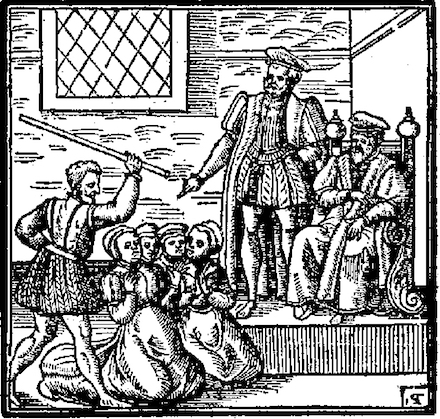
In an illustration from Daemonologie, James personally interrogates witches.

A woman named Geillis Duncan, maid to the deputy mayor of a small town near Edinburgh, was the fountainhead of the the North Berwick trials, when her suspicious master tortured her into admitting to witchcraft. King James personally joined the ensuing interrogations which saw her denounce several dozen Edinburghers as fellow necromancers, among them our day’s principal — a matronly widow named Agnes Sampson, who was a respected “wise woman” and folk healer much in demand among Edinburgh’s elites.

In Duncan’s involuntary narration, this woman “was the elder Witch” and when she “stood stiffely in the deniall of all that was laide to her charge” they dragged her to prison and put her to torture, also shaving her hairless in search of the inevitable small disfigurement that would be prejudicially construed her witches’ mark — “and forasmuch as by due examination of witchcraft and witches in Scotland, it hath latelye beene found that the Deuill dooth generallye marke them with a priuie marke, by reason the Witches haue confessed themselues, that the Diuell dooth lick them with his tung in some priuy part of their bodie, before hee dooth receiue them to be his seruants, which marke commonly is giuen them vnder the haire in some part of their bodye.”

We’re quoting here the 1591 pamphlet Newes from Scotland, one of the key primary sources (and justifications) of the witch trials which was issued from a pen very near to the king’s own hand. Having endured the cruel torture of having her hair wrenched (“thrawn”) by ropes for an hour, Newes from Scotland reports, Sampson broke down when an incriminating wart was discovered upon her bared pudenda.

the said Agnis Tompson confessed that the Divell being then at North Barrick Kerke attending their comming in the habit or likenes of a man, and seeing that they tarried over long, he at their comming enjoyned them all to a pennance, which was, that they should kisse his Buttockes, in signe of duetye to him: which being put over the Pulpit barre, everye one did as he had enjoyned them: and having made his ungodly exhortations, wherein he did greatlye enveighe against the King of Scotland, he received their oathes for their good and true service towards him, and departed: which doone, they returned to Sea, and so home againe.

At which time the witches demaunded of the Divel why he did beare such hatred to the King, who answered, by reason the King is the greatest enemy he hath in the worlde: all which their confessions and depositions are still extant upon record.

Item, the saide Agnis Sampson confessed before the Kings Majestie sundrye thinges which were so miraculous and strange, as that his Maiestie saide they were all extreame lyars, wherat she answered, she would not wishe his Maiestie to suppose her woords to be false, but rather to beleeve them, in that she would discover such matter unto him as his majestie should not any way doubt off.

And therupon taking his Majestie a little aside, she declared unto him the verye woordes which passed betweene the Kings Majestie and his Queene at Upslo in Norway the first night of their mariage, with their answere eache to other: whereat the Kinges Majestie wondered greatlye, and swore by the living God, that he beleeved that all the Divels in hell could not have discovered the same: acknowledging her woords to be most true, and therefore gave the more credit to the rest which is before declared.

One can see the work this tract — circulated as its title implies in England, where James was already being set up to inherit rule from the aging Queen Elizabeth — effects as propaganda: James as “the greatest enemy [the Devil] hath in the worlde”; James as the savvy and thorough interrogator too worldly to be taken by Agnes Sampson’s crazy stories until she proved them with a conveniently unfalsifiable private conference. Definitely no superstitious poltroon! Why, it was only by his superlative faith that James earned the divine favor required to overcome his adversaries’ weather machinations.

She confessed that she tooke a blacke Toade, and did hang the same up by the heeles, three daies, and collected and gathered the venome as it dropped and fell from it in an Oister shell, and kept the same venome close covered, untill she should obtaine any parte or peece of foule linnen cloth, that had appertained to the Kings Majestie, as shirt, handkercher, napkin or any other thing which she practised to obtaine by meanes of one John Kers, who being attendant in his Majesties Chamber, desired him for olde acquaintance betweene them, to helpe her to one or a peece of such a cloth as is aforesaide, which thing the said John Kers denyed to helpe her too, saying he could not help her too it.

And the said Agnis Tompson** by her depositions since her apprehension saith, that if she had obtained any one peece of linnen cloth which the King had worne and fouled, she had bewitched him to death, and put him to such extraordinary paines, as if he had beene lying upon sharp thornes and endes of Needles.

Moreover she confessed that at the time when his Majestie was in Denmarke, she being accompanied with the parties before specially named, tooke a Cat and christened it, and afterward bound to each parte of that Cat, the cheefest partes of a dead man, and severall joynts of his bodie, and that in the night following the saide Cat was conveied into the midst of the sea by all these witches sayling in their riddles or Cities as is aforesaide, and so left the saide Cat right before the Towne of Lieth in Scotland: this doone, there did arise such a tempest in the Sea, as a greater hath not beene scene: which tempest was the cause of the perrishing of a Boate or vessell comming over from the towne of Brunt Iland to the towne of Lieth, wherein was sundrye Jewelles and riche giftes, which should have been presented to the now Queen of Scotland, at her Majesties comming to Lieth.

Againe it is confessed, that the said christened Cat was the cause that the Kinges Majesties Ship at his comming foorth of Denmarke, had a contrary winde to the rest of his Ships, then being in his companye, which thing was most strange and true, as the Kings Majestie acknowledgeth, for when the rest of the Shippes had a faire and good winde, then was the winde contrarye and altogither against his Majestie: and further the saide witche declared, that his Majestie had never come safelye from the Sea, if his faith had not prevailed above their ententions.

Moreouer the said Witches being demaunded how the Divell would use them when he was in their company, they confessed that when the Divell did receive them for his servants, and that they had vowed themselues unto him, then he would Carnallye use them, albeit to their little pleasure, in respect of his colde nature: and would doo the like at sundry other times.

The History of Witchcraft podcast does a deep dive on the North Berwick trials in episode 9 which indulges detail (from about 25:40) on the logistics of witch-burning executions. This episode is part of a whole series on witchy King James that also compasses episodes 7, 8, and 10.

* Ray Defalque and A.J Wright, “In the Name of God: Why Agnes Sampson and Eufame McCalyean were burned at the stake” in Bulletin of Anesthesia History, July 2004. The interest in the case from this unusual-to-Executed Today source is that the charges against Sampson included those of witcherous midwifery, to wit, “remov[ing] Lady Hirmestone’s pain and sickness the night of her labor” and doing the same for Eufame McCalyean. As a result, “several authors have suggested that obstetrical analgesia started in Edinburgh in 1591,” an interpretation that Defalque and Wright, both anesthesiologists, reject.

** Newes from Scotland puts this part of the confession into the mouth of a more historically elusive woman called “Agnis Thompson”: many scholars believe that Sampson and Thompson are the same person.

On this day..

1725: James Casady, aged beggar

Original Dublin broadsheet via James Kelly’s Gallows Speeches: From Eighteenth-Century Ireland:


THE LAST SPEECH AND DYING WORDS OF
JAMES CASADY

Beggar Man who was Executed this Day, being the 27th of this Instant January, 1724-5* at Kilmainham, for Robbing on the High-Road.

Good People,

I was Born in Artlow in the County of Wicklow, and had very honest Parents, who gave me good Edication.

When I came to my Tryal before the Judge at Kilmianham, one Margaret Nowland and Owna Callahan, Swore I was a Robber these thirty Years past, and they also said that I was concern’d in Robbing the Bishop of Dublin, for which I was Try’d and Clar’d; the above Witness also Swore that I was concerned in a Robbery of a Gentlemans House in Great Britain Street, about three Years ago; The said Owna also Swore that I, one O’Neil, and a Piper was concern’d the last Robbery, and that she was one of their Comrades then, and watch’d in the Street while the said Robbery was doing.

They also swore that I had plates and Dishes in my Custody; which I brought out of the sd. House, Also that the above Margaret swore that when she heard the great dogg bark, that she came down stairs, and seeing me and agove 3 Men coming out of Capt. Gratons House, she heard the sd. Casady speak to the rest of his Comrades to Murder her, to which the said Ona Cry’d out and spoke to ’em, and begg’d that there should be no murder, Committed where she was, this is what the above Per-[sons?] swore against me at the Sessions-House in Kilmainham.

Now I do hereby Declare before God, the sheriff, and all the rest of my Spectators, that as I am here to suffer this untimely Death; tho’ I cou’d not live much longer, for I am about 80 years of Age.

As for what Money I had by me, it was very honestly got, and I design’d it for my Son, but having an extravagant Wife, was the reason that I always carried the sd. money always with me, wherever I went a begging, or to work any where, which I am sure that the sd. money is the cause of this my untimely end.

I James Cassedy do further declare at this my Dying Minute, that I do not know any of these my Prosecutors, and on the Dying Words of one who expects Salvation I know nothing of the matter that I am Charg’d with.

I do not blame the Judge nor Jury, and I forgive all the World, I would die a Roman Catholick, and the Lord have Mercy on my poor Soul.

He was buried under the Gallows in his Cloaths.

* 1725 by our present-day reckoning; because England’s new year at this time did not officially occur until March 25, it was still legally 1724. Many documents of this period write dates in this manner (“1724-5”) for clarity, since it was a potential confusion to contemporaries as well. Calendars are aggravating sometimes.

On this day..

2015: A man in al-Shaddadah, “I won’t forgive you”

On this date in 2015, Islamic State militants occupying the Syrian oil city of al-Shaddadah or al-Shaddadi horrifically beheaded a man on a public square.

Just what action was compassed in his alleged offense of “insulting Allah” is not known; neither so far as I can find was his name. But he fought his killers furiously, and four men were required to wrestle him into the dust and immobilize him for the executioner’s sword. “I won’t forgive you, I am not the one who did it but you did Arabs and civilians of al-Shadadi,” he cried out to townspeople unwilling or unable to lift a finger on his behalf against the butchers.

Al-Shaddadah was recaptured from ISIS in February 2016.

On this day..

1830: Benito de Soto, a pirate hanged at Gibraltar

On this date in 1830, the Galician or Portuguese pirate Benito de Soto was hanged at Gibraltar.

One of the very last of the dying breed of high-seas pirates, de Soto mutinied aboard an Argentine slave smuggler in 1827, re-christened her Burla Negra (“Black Joke”), and ran up the black flag.*

The pirates now entered freely into their villianous [sic] pursuit, and plundered many vessels; amongst others was an American brig, the treatment of which forms the chef d’oeuvre of their atrocity. Having taken out of this brig all the valuables they could find, they hatched down all hands to the hold, except a black man, who was allowed to remain on deck, for the special purpose of affording in his torture an amusing exhibition to Soto and his gang. They set fire to the brig, then lay to, to observe the progress of the flames; and as the miserable African bounded from rope to rope, now climbing to the mast head — now clinging to the shrouds — now leaping to one part of the vessel, and now to another, — their enjoyment seemed raised to its highest pitch. At length the hatches opened to the devouring element, the tortured victim of their fiendish cruelty fell exhausted into the flames, and the horrid and revolting scene closed amidst the shouts of the miscreants who had caused it.

Of their other exploits, that which ranks next in turpitude, and which led to their overthrow, was the piracy of the Morning Star. They fell in with that vessel near the Island Ascension, in the year 1828, as she was on her voyage from Ceylon to England. This vessel, besides a valuable cargo, had on board sevreal [sic] passengers, consisting of a major and his wife, an assistant surgeon, two civilians, about five and twenty invalid soldiers, and three or four of their wives. As soon as Benito de Soto perceived the ship, which was at day-light on the 21st of February, he called up all hands, and prepared for attacking her; he was at the time steering on an opposite course to that of the Morning Star. On reconnoitring [sic] her, he at first supposed she was a French vessel; but Rabazan, one of his crew, who was himself a Frenchman, assured him the ship was British. “So much the better,” exclaimed Soto, in English, (for he could speak that language,) “we shall find the more booty.”

The Burla Negra was much the faster and better-armed ship — in fact the Morning Star was completely unarmed, with not even a store of small arms for her frightened passengers — and soon corralled her prey, murdered the captain and mate, plundered the ship, and gang-raped the women aboard. The only mercy was that the marauders, out of tenderness or drunkenness (having also helped themselves to the Morning Star‘s wine), only imprisoned the human cargo below when they scuttled the ship and sailed away — and the passengers and crew were able to free themselves before they drowned and return safe home to tell the tale of their outrage.

Benito de Soto sailed next for his home port of Corunna, with the aid of a hostage navigator commandeered from his next prize. (The captain ruthlessly shot said unwilling helmsman dead upon arrival.) This adventure, however, marked the last of his career for on the way back to sea the corsairs were shipwrecked and had to take refuge at British Gibraltar where, after residing some time under false identities, a survivor of the Morning Star recognized them.

Easy come, easy go. “Adeus todos!” were his understated last words, not counting those syllables whistled by the salt winds through his posthumous pike-mounted skull.

However, British authorities — who were very conscious that they had detected the villain by pure chance — were not at all amused by the ease with which he had set up in Gibraltar. His legacy would be an impetus to Gibraltar officials to tighten up entrance regulations and, later that same year of 1830, to institute the Royal Gibraltar Police — the oldest police force in the Commonwealth outside the British isles.

* The slaver was full of African slaves, so the first profitable thing the buccaneers did was complete the vessel’s “legitimate” purpose by smuggling them to the West Indies. A black cabin boy that de Soto chose to retain would be captured with the rest and give evidence against the pirates. “The black slave of the pirate stood upon the battery trembling before his dying master to behold the awful termination of a series of events, the recital of which to his African countrymen, when he shall return to his home, will give them no doubt, a dreadful picture of European civilization,” muses our reporter.

On this day..

1767: John Williamson, cruel husband

From the London Gazetteer and New Daily Advertiser, Feb. 2, 1767.

An Account of the CRUELTIES, exercised by JOHN WILLIAMSON on his wife, whereby she left her life, and for which he was lately executed in Moorfields.

JOHN WILLIAMSON, Journeyman Shoemaker, a widower with three children, who all starved together in a garret in an alley in Little Moorfields, found a woman who had upwards of 60l. weak enough in understanding to marry him; but she did not bed with him above two or three times; yet they continued sociable for two or three weeks. But the poor woman soon after finding herself ill-used, and denied common food, made complaints to some neighbours; which he resenting, debarred her from going abroad.

The wife being subject to fits, used to turn up the whites of her eyes, at which a neighbour, and Williamson’s daughter, of fifteen, pretending to be frightened, he thought proper, when he went out, to tie a rope around her waist, and fastened it to a post near the bedstead: but afterwards he procured some hand-cuffs, which were put on in the daytime, and she permitted to sit on a trunk.

Besides having fits, and turning up her eyes, she once drank a dish of tea left in the pot for the little boy, and filled the pot with water; she slapped the boy’s face when he had done a fault; the husband once missing a pair of soles, he supposed she must have made away with them; she struck a light with one of his working knives; she often begged of him for victuals; and he as constantly beat her for it, and once when her husband had been out with other company, and returning about nine at night, her usual time of going to bed, she was found asleep, which was reported to be drunkenness.

These things were thought sufficient reasons by her husband to hand-cuff her, with her hands behind, and tie her up in a closet; he tied a rope to a staple, put it through the hand-cuffs, and drew it up to a nail over her head, so as to cause her to stand on tip-toe, and left her in that condition and posture for near a month together, without being set down or going to bed — not even when she was in fits.

Her husband gave her every day a bit of bread and butter, laying it on a shelf she could easily reach with her mouth, when she could not, sometimes they would put it close; they used to hold water to her mouth while she drank. When she asked for more bread and butter, the husband would not let her have it.

She was also beaten, bruised, and wounded, and frequently sluiced in the face and all over with cold water.

Want of every necessary, and the repetition of the above cruelties, were too much for a woman, and she sunk under them. The day before she died, she was let out of the closet, and offered meat when she could not swallow; she was also then allowed to warm herself, but in ten minutes she was told she was warm enough, and should sit there no longer, but must get into her kennel; she staggered to the closet, and the door was shut; she fell into a delirium, and died in strong convulsions in the evening.

Casualties of Williamson’s abuse outlived the man and his poor wife: Williamson’s children landed in the workhouse of St. Giles’s Cripplegate, whereas elsewhere …


Item from the May 18, 1767 Boston Evening Post.

On this day..

1884: Maggie and Michael Cuddigan lynched in Ouray

(Thanks to Meaghan Good of the Charley Project for the guest post. -ed.)

Shortly after midnight on this date in 1884, a mob of masked men dragged Michael and Maggie Cuddigan out of the Delmonico Hotel in the Rocky Mountain mining town of Ouray, Colorado, marched them to the town limits, and lynched them. Michael was hanged from a tree and his wife, who was visibly pregnant, was hanged from the ridgepole of a cabin on the opposite side of the road. It was later said that the whole business “was quietly and neatly done.”

The Cuddigans had adopted Mary Rose Matthews from St. Vincent’s Orphan Asylum in 1883. She was about ten years old at the time; she had been sent to the orphanage after her mother died and her father found himself unable to care for her. On January 13, 1884, only a few months after her arrival at the Cuddigans’ ranch ten miles outside Ouray, the child died.

That day a hunter found Mary Rose crouched beside a haystack near the Cuddigans’ home. It was freezing cold and she was underdressed for the weather. Michael and Maggie were notified and took her home, but she died a few hours later. The next day they buried her themselves, quickly and with some secrecy, in a distant part of the ranch. Anyone who asked was told she had accidentally fallen down the cellar steps and been killed.

Mary Rose’s sudden and mysterious death gave rise to suspicion of foul play. The neighbors who had seen her in the days and weeks prior to her death noted that she’d been visibly bruised and barefoot in spite of the frigid January temperatures. They approached the coroner and asked him to investigate.

When the body was exhumed and a postmortem performed, there were clear signs that the little girl had been cruelly abused and overworked. Her remains showed numerous scars, bruises, broken bones and knife wounds, as well as severe frostbite to both feet and one hand. There was also evidence of sexual abuse. The cause of death was blunt force trauma to the head.

The Cuddigans were arrested, as was Maggie’s brother, John Carroll, and charged with murder. They were held in temporary custody at the Delmonico Hotel between Fourth and Fifth Avenues. That’s when the lynch mob intervened, overpowered the sheriff and his deputies, and took the suspects away.

Carroll was questioned separately from his sister and brother-in-law, roughed up, and threatened with death. There are reports that the mob actually did string him up, but changed their mind and lowered him to the ground before he actually died. At any rate, he claimed he wasn’t at the Cuddigans’ ranch when Mary Rose died and he was able to convince his captors to release him. Michael and Maggie were not as fortunate, and both died a slow death from strangulation.

Until January 21 their bodies were displayed in public view in town; hundreds of people saw them. The community remained incensed about Mary Rose’s murder. The so-called bed she’d slept in at the Cuddigans’ ranch during the final months of her life was also on public display: it consisted of four gunnysacks stitched together, nothing more.

Before Mary Rose’s death, Michael Cuddigan had not had a bad reputation in the community, but after the lynching, the locals in Ouray mostly believed he and his wife got what they deserved.

Officials at Cedar Hill Cemetery refused to allow the Cuddigans to be buried there, and the local Catholic priest, although he harshly condemned the lynching, refused to officiate at their funerals. Michael Cuddigan’s own two brothers (who had been present and heavily armed when he and Maggie were taken from the hotel, but had done nothing to intervene) wanted nothing to do with it either. Finally the coroner had them buried on their own ranch, expenses covered by the $240 that had been in Michael’s pocket at the time of his death. No mourners attended.

The body of Mary Rose Mathews taken back to her hometown of Denver after the lynching and presented before the public, so they might see how she had suffered. Approximately 12,000 men, women and children viewed the corpse before it was buried in a Denver cemetery, but reports of her ghost haunting the former Cuddigan ranch have persisted ever since.

Maggie Cuddigan was the first woman known to have been lynched in Colorado history, and it should be noted that that state has never judicially executed a woman.

An editorial in the Leadville Daily Herald opined that

The citizens of Ouray have distinguished themselves by a most outrageous and barbarous act of lawlessness … It is the boast of Americans that a woman’s weakness will shield her from violence at the hands of a true American … The men of Ouray can find no apology for their brutal conduct by the plea that the woman was guilty. All the world knows that a woman may be coerced by the power of her husband and compelled to do a thing at which she herself would naturally revolt.

Michael and Maggie Cuddigan left a sizable estate, valued at $4,500 once their debts were paid. The inheritance was placed in trust for their baby son, who was raised by relatives.

No one was ever arrested for the lynching.

On this day..

1772: Bryan Sheehen, cuck

Colonial Massachusetts sailor Bryan Sheehen culminated a life of warped relations with the opposite sex at his hanging on this date in 1772.

According to the pamphlet An Account of the Life of Bryan Sheehen, as a child in Ireland, Sheehen‘s family split up by gender with the Catholic father taking the boys and the Anglican mother taking the girls. While the legacy of this childhood trauma can only be guessed at, it looks suggestive in hindsight

Sheehen migrated to Newfoundland and then to Massachusetts where he eventually indentured himself as a household servant to colonial shipwright Benjamin Hallowell, a “father” from whom the young adult Sheehen again fled, this time to fight in the Seven Years’ War.

Unfortunately upon his return from only six years away he found that his wife had impatiently [re]married herself to a Frenchman, a humiliating risk and fear of the seagoing set. Sheehen forced the woman to choose between the rivals but when she chose Sheehen, the latter found that he was still so disgusted with her that he preferred to abandon the wife, and the child she had borne him, and the child she had borne the Frenchman. Psychologists have a lot to unpack here already.

Relocating to Marblehead, Mass. our reborn swinging single now developed “the character of a wicked, profligate person” and eventually began stalking a woman named Abial Hollowell … her surname eerily echoing that of Sheehen’s own former master. In fact, Abial’s husband was also named Benjamin Hollowell. His advances rebuffed, Sheehen

went up, in the middle of the night, to the room where Mrs. Hollowell lay, found her asleep, awaked her, and swore, if she made the least noise, he would kill her; and then stopping her mouth, perpetrated the atrocious crime. After which (to prevent, it seems, a pregnancy) he abused her with his hand, in an unheard-of, cruel and shocking manner: Insomuch that her life was for some time almost despaired of; and she was not able for ten days after to get off her bed without help.

That’s as per a case summary appended to “A Sermon Preached at Salem, January 16, 1772” by the Salem Rev. James Diman. The good preacher was so chagrined that Sheehen’s persistent denials had led some citizens to murmur against Mrs. Hollowell that for “justice to the woman’s character” he devotes about a page and a half to traducing Sheehen’s. Sheehen, Diman charged, was just the sort of vicious wretch who would imperil his soul by going to the gallows with a lie upon his lips, perhaps because, as a Catholic, “he might swear falsely, he might doubtless speak falsely to Hereticks, as they call all whose religious principles differ from theirs.”

Last and most important, Diman claimed to have it on good authority from “two credible persons”

that there was a young woman, daughter of one Williams, of Goldsborough, in the Eastern part of this province, abased in the same manner Mrs. Hollowell was. That she was way-layed in the the evening, between her father’s house and a neighbour’s; was seized, forced, and wounded to such a degree, that her friends were obliged to carry her home, she being unable to walk, and that the next morning early she died. That the villain, who perpetrated this crime, returned after he had done it, to his companions, who, it seems, were before, or then, made acquainted with his enterprize; for such wretches declare their sin as Sodom: And that one of them told him he would probably have a child to maintain: He answered so, that he had taken care to prevent that, and that she would never have a child by him, nor by any other man.

This guy, his informants said, was an Irishman named something like Bryan Sheehen — and he had escaped town after the incident.

* The Hallowells were notable British loyalists during the American Revolution, and returned to England when their estates were sacked by Patriots. The grandson of Bryan Sheehen’s employer, Admiral Sir Benjamin Hallowell Carew, was one of Lord Nelson‘s Band of Brothers. During the Battle of the Nile, Admiral Hallowell’s supplied the literal fireworks by defeating the French battleship Orient — whose spectacularly exploding magazines highlighted all the artistic commemorations of that victory. He later presented to Nelson as a gift a coffin fashioned from the Orient‘s mast, “that when you have finished your military career in this world you may be buried in one of your trophies.” Nelson was indeed laid to rest in Hallowell’s trophy in 1805.


The flaming Orient illuminates Thomas Luny’s Battle of the Nile, August 1st 1798 at 10 pm.

On this day..

1811: The slaves of the German Coast Uprising

Villainous blacks, and MORE VILLAINOUS WHITES who have reduced to the level of the beasts of the field these unhappy Africans — and are now obliged to sacrifice them like wild beasts in self preservation! The day of vengeance is coming!

-Marietta, Ohio Western Spectator, March 5, 1811

On this date in 1811, Louisiana planters commenced their executions of rebel slaves involved in the German Coast Uprising.

Also known as the Deslondes rebellion after the surname of its mulatto commander, this was a larger insurrection than the better-known Nat Turner rebellion: in fact, it was the largest slave rebellion in U.S. history. Louisiana at this point was still new to the Union courtesy of the 1803 Louisiana Purchase; Congress in 1811 would take up the question of statehood for the former French colony and its liability to slave rebellions stoked by Gallic sugar magnates offered no small store of vehemence for the Republic’s orators. (Louisiana was admitted as a state in 1812.)

On January 8 of that same year of 1811, some 60 to 125 black men and women — slaves of Louisiana’s brutal sugarcane economy, as well as runaways and maroons lurking in nearby river swamps — rebelled at Col. Manuel Andry’s plantation 36 miles from New Orleans. Andry was wounded but miraculously escaped, leaving behind a son whom his slaves were energetically stabbing and axing past death.

Under the improbable leadership of Charles Deslondes, who had enjoyed so much trust as to be a Andry’s slave overseer, the slaves stripped the plantation of gunpowder, weapons, horses, liquor, and the like, and began following the Mississippi along River Road — drumming, chanting, exulting with cries of “On to Orleans!”

American Uprising Book CoverWhether they knew it or not, they had selected an auspicious moment for their uprising: New Orleans lay practically defenseless, its regular garrison off augmenting the realm via the conquest of adjacent West Florida.* The rebels multiplied several times over as they marched, swelling to perhaps 500 strong over two days as they rolled through plantations — each one a sea of servile labor vastly outnumbering its white household. Yet only one more white man besides Col. Andry’s son died during the German Coast Uprising as, forewarned, planters’ families were able to flee ahead of the Jacquerie.

The Louisiana territory skirted the volcano’s mouth in this moment and everyone realized it: New Orleans, the slaves’ avowed target, was itself two-thirds black. Had the rebels reached it, something cataclysmic might have begun.† “Had not the most prompt and energetic measures been taken, the whole coast would have exhibited one general scene of devastation,” Navy Commodore John Shaw wrote to Washington, having dispatched a company of marines to shore up New Orleans’s defenses. “Every description of property would have been consumed, and the country laid waste by the Revolters.”

Instead, and as was always eventually the case, the volcano swallowed the slaves instead. Sixteen miles from the Big Easy, a scrambled militia of New Orleans volunteers and some federal dragoons and infantry pulled from Baton Rouge managed

to meet the brigands, who were in the neighbourhood of the plantation of Mr. Bernoudi [present-day Norco -ed.], colors displayed and full of arrogance. As soon as we perceived them we rushed upon their troops, of whom we made considerable slaughter.

Not a single white person lost his life in the fray but scores of slaves were either killed in fighting, were summarily executed upon capture, or, fleeing from the carnage, were hunted to their deaths in the following days. The exact butcher’s bill is unknown; Louisiana officials counted 66 dead slaves in the immediate aftermath of action, including those executed, but this certainly understates the figure.

Where principal rebels were known, the revenge was exemplary. Pierre Griffe and Hans Wenprender, who were said to have personally imbrued their hands with the blood of the two dead white planters at the outset of the rebellion, were killed on the spot, mutilated, and their heads cut off as trophies for Colonel Andry.

Decapitation and worse was also the fate awaiting captives, at least 21 of whom were ordered for immediate death on January 15 by a tribunal of planters hastily assembled for the task. “By the end of January, around 100 dismembered bodies decorated the levee from the Place d’Armes [Jackson Square -ed.] in the center of New Orleans forty miles along the River Road into the heart of the plantation district,” in the words of a recent book about the affair. Such decor cost the territory $300 per piked head in compensation to the dead slaves’ former owners.

We excerpt the sentence from the tribunal’s own hand, as published in Louisiana History: The Journal of the Louisiana Historical Association, Autumn 1977.

The Tribunal assembled on the 14th and called before it the Negroes: Jean and Thomas, belonging to Mr. Arnauld; Hypolite, belonging to Mr. Etienne Trepagnier; Koock, belonging to Mr. James Brown; Eugene and Charles, belonging to the Labranche brothers; Quamana and Robaine, belonging to Mr. James Brown; Etienne, belonging to Mr. Strax; Louis and Joseph, belonging to Mr. Etienne Trepagnier; the mulatto Guiau, belonging to Messrs. Kenner and Henderson; Acara, belonging to Mr. Delhomme; Nede, belonging to Mr. Strax; and Amar, belonging to Widow Charbonnet; all of whom confessed and declared that they took a major part in the insurrection which burst upon the scene on the 9th of this month.

These rebels testified against one another, charging one another with capital crimes such as rebellion, assassination, arson, pillaging, etc., etc., etc. Upon which the Tribunal, acting in accordance with the authority conferred upon it by the law, and acting upon a desire to satisfy the wishes of the citizenry, does CONDEMN TO DEATH, without qualifications, the 18 individuals named above. This judgment is sustained today, the 15th of January, and shall be executed as soon as possible by a detachment of militia which shall take the condemned to the plantation of their owners and there the condemned shall be shot to death. The tribunal decrees that the sentence of death shall be carried out without any preceding torture.

It further decrees that the heads of the executed shall be cut off and placed atop a pole on the spot where all can see the punishment meted out for such crimes, also as a terrible example to all who would disturb the public tranquility in the future.

Done at the County of the Germans, St. Charles Parish, Mr. Destrehan’s plantation, January 15, 1811, at 10 o’clock in the morning.

Signed,
Cabaret
Destrehan
Edmond Fortier
Aud. Fortier
A. Labranche
P.B. St. Martin

We know for sure that the militia effected these grisly sentences with dispatch because this same body condemned three more slaves to the same fate later that same day, ordering that “their heads shall be placed on the ends of poles, as those of their infamous accomplices, who have already been executed.” Yet even this was better due process than a number of other prisoners enjoyed at the hands of angry white men; the Maryland-born naval officer Samuel Hambleton recorded the “characteristic barbarity” of the French oligarchy with disgust:

Several [slaves] were wrested from the Guards & butchered on the spot. Charles [Deslondes] had his Hands chopped off then shot in one thigh & then the other until they were both broken — then shot in the Body and before he had expired was put in a bundle of straw and roasted!”‡

The shock prompted an immediate tightening of security, and not only in Louisiana — where militia conscription became enforced more rigorously, both slaves and free blacks were encumbered with new restrictions on their movements, and a larger federal military presence was deployed at Louisiana’s own request. The legislatures of Kentucky, Tennessee, and the Mississippi territory — Mississippi wasn’t admitted to statehood until 1817 — all likewise buffed up their militias in the wake of German Coast.§

* Latterly Spanish, West Florida is no part of the present-day U.S. state of Florida; rather, Florida’s former littoral extrusion towards the Mississippi was annexed by Louisiana itself.

** When the U.S. went to war with Great Britain in 1812, Louisiana’s huge servile population made it an obvious vulnerability if the British were to land and arm the slaves. Summoning him from his Alabama stomping-grounds to his date with American folklore, Edward Livingston wrote to Andrew Jackson on behalf of the New Orleans Committee of Safety on September 18, 1814, imploring him to aid the outnumbered sugar planters:

This Country is strong by Nature, but extremely weak from the nature of its population, from the La Fourche downwards on both sides the River, that population consists (with inconsiderable exceptions) of Sugar Planters on whose large Estates there are on an average 25 slave to one White Inhabitant the maintenance of domestic tranquility in this part of the state obviously forbids a call on any of the White Inhabitants to the defense of the frontier, and even requires a strong additional force, attempts have already it is said been detected, to excite insurrection, and the character of our Enemy leaves us no doubt that this flagitious mode of warfare will be resorted to, at any rate the evil is so great that no precautions against it can be deem’d superfluous.

† The rising’s Spartacus, Charles Deslondes, was himself an import from the insurrectionary Caribbean Santo Domingo colony, which suggests a probable link by inspiration to the Haitian Revolution. Santo Domingo slaves were thought so seditious that their importation was periodically banned. However, and perhaps this is no accident, no documentation survives to elucidate the rebel slaves’ ideology, or what triggered them to rise at this particular moment.

‡ Letter to David Porter, January 25, 1811 as quoted by Robert L. Paquette in “‘A Horde of Brigands?’ The Great Louisiana Slave Revolt of 1811 Reconsidered,” Historical Reflections / Réflexions Historiques, Spring 2009. Deslondes was captured on January 11th but as far as I can ascertain, we don’t have a precise date on record for his savage extrajudicial execution/murder. It obviously falls within this same short mid-January span.

§ See Thomas Marshall Thompson, “National Newspaper and Legislative Reactions to Louisiana’s Deslondes Slave Revolt of 1811,” Louisiana History: The Journal of the Louisiana Historical Association, Winter, 1992. Thompson notices that “the Tennessee law specified, as had the one in the Orleans Territory, that blacks, mulattoes, and Indians could not be members of the militia.”

On this day..

1792: John Philips, a wretch robbed of life for so trivial a robbery

(Thanks to Meaghan Good of the Charley Project for the guest post. -ed.)

On this date in 1792, sailor John Philips was hanged in Dublin, Ireland after being convicted of robbing a man of his hat and coat.

Philips, a 50-year-old sailor with a wife and five children back home, was based in London and knew no one in Dublin. He was unable to retain counsel for lack of funds, and the government was not required to provide him with one.

The jury who convicted him recommended mercy “in consideration of the apparent severity of robbing a wretch of life for so trivial a robbery,” but the Recorder of the Dublin, Denis George, sentenced him to death.

While awaiting his execution, Philips had a petition drawn up and sent to the Lord Lieutenant of Ireland, John Fane, 10th Earl of Westmorland, asking for a commutation on the grounds that he was drunk at the time of the robbery.

As Brian Henry says, in his book Dublin Hanged: Crime, Law Enforcement and Punishment in Late Eighteenth-Century Dublin,

The Lord Lieutenant would in all probability have respited his hanging if he had received it in time. On the back of the petition was written, “has anything been done in this?” A stark answer followed: “was executed the 14th — Received 31st Jan 1792.” Philips was hanged at the front of Newgate on Saturday 14 January 1792.

On this day..