1400: Thomas le Despenser, for the Epiphany Rising

On this date in 1400, the Thomas le Despenser was beheaded — as much a lynching as an execution — by a mob at Bristol.

“I have to London sent
The heads of Salisbury, Spencer, Blunt, and Kent.”

-Henry’s loyal (for now) nobleman Northumberland summing up the destruction of the Epiphany Rising in the last scene of Shakespeare’s Richard II

House Despenser had painstakingly rebuilt its position in the three generations since Thomas’s great-grandfather, the notorious royal favorite Hugh Despenser, was grotesquely butchered for the pleasure of Roger Mortimer. (Readers interested in a deep dive should consult this doctoral thesis (pdf))

By the end of the 14th century, the family patriarch, our man Thomas, had by 1397 parlayed his firm support of Richard II against the Lord Appellant into elevation to a peerage created just for him, the Earldom of Gloucester.

The “Gloucester” sobriquet had just gone onto the market thanks to the beheading that year of the attainted Duke of Gloucester and the consequent revocation of that patrimony. This ought to have been a hint, if his ancestors’ fate did not suffice, that such glories are fleeting. Thomas le Despenser had barely two years to enjoy his newfound rank before Richard II was deposed by Henry Bolingbroke who now styled himself Henry IV.

Despite initially making his terms with the new regime, Despenser joined a conspiracy of nobles that contemplated a coup d’etat during the 1399-1400 holidays — the Epiphany Rising, whose misfire has brought other victims to our attention previously.* Titles are the least of what one forfeits in such circumstances; Thomas managed to grab a boat for Cardiff and possible refuge but to his unhappy surprise the ship’s captain put in at Bristol to deliver him to his enemies: death was summary, his head posted to the capital for duty on the London Bridge.

The Despensers had already proven the resilience of their line in the face of the violent death of this or that scion and although this was a rough coda for their century of glory they were not done for the English political scene by a long shot. Thomas’s widow Constance** got her own plotting afoot by conspiring unsuccessfully in 1405 to kidnap Richard II’s heir from Henry’s custody as an instrument to leverage for political realignment. (Constance, Executed Today is grieved to report, was not executed for this.)

* Episode 134 of the History of England podcast grapples with the Epiphany Rising.

** Constance’s brother is popularly believed to have betrayed the Epiphany Rising.

On this day..

1769: John Martin Andrew, John Fielding prey

On this date in 1769, a prolific Swedish burglar named John Martin Andrew went to Tyburn for burgling a Foster Lane jeweler to the tune of

  • seven pair of snam-garnet gold buttons, value 6 l. 6 s.
  • six pair of garnet ear-rings, set in gold, value 3 l.
  • one other pair ditto, value 8 s.
  • one pair of Moco buttons, set in gold, value 1 l. 15 s.
  • two pair of ditto, value 2 l.
  • two pair of clutter ditto, with garnets, value 3 l.
  • one pair of crystal ditto, value 18 s.
  • two pair of small ditto, value 1 l. 8 s.
  • one three stone topaz gold ring, with a diamond, value 1 l. 14 s.
  • one ditto amethyst with diamonds, value 1 l. 13 s.
  • one ditto, value 1 l. 3 s.
  • one ditto, value 1 l. 4 s.
  • one ditto, garnet with diamonds, value 1 l. 5 s.
  • one ditto, value 1 l. 3 s.
  • one stone ditto with garnets and diamonds, value 6 l.
  • one single garnet stone ditto, value 1 l.
  • one single crystal stone ditto, value 17 s.
  • one sapphire ditto, value 1 l.
  • one Moco ditto, value 18 s.
  • four Moco ditto, set round with garnets, value 4 l. 4 s.
  • one cluster garnet with hair in it, value 1 l. 3 s.
  • one case for rings, value 2 s.
  • one pair of three drop cluster garnet ear-rings, set in gold, value 8 l.
  • a pair of single drop ear-rings, with knots in silver, value 1 l. 1 s.
  • six pair of fancy ear-rings, and cases in silver, value 5 l.
  • a girdle buckle in silver, value 10 s.
  • a pair of crystal buckles, set in silver, value 15 s.
  • a pair of topazes ditto, set in silver, value 2 l. 12 s. 6 d.
  • a pair of children’s stone buckles, in silver, value 10 s.
  • a pair of knee stone ditto, in silver, value 8 s.
  • a stone shoe buckle, in silver, value 12 s.
  • one child’s silver buckle, value 2 s.
  • a pair of garnet shoe buckles, in silver, gilt, value 2 l.
  • a pair of crystal ditto, in silver, value 18 s.
  • a pair of cluster garnet buttons, in gold, value 1 l. 15 s.
  • six pair of buttons and wires
  • three silver and twelve gold ear-rings, value 1 l. 1 s.
  • thirteen stone buttons, set in silver, value 18 s. 6 d.
  • one pair of cluster studs, value 2 s.
  • three gold diamond rings, value 6 l.
  • one ditto false stone, value 5 s.
  • three pair of stone buttons, set in silver, value 1 l. 2 s.
  • one pair of garnet buttons, set in gold, value 18 s.
  • one pair of cluster Moco, set in gold, value 1 l. 10 s.
  • one pair of crystal ear-rings, set in silver, value 6 s.
  • one pair of cluster paste, set in silver, value 7 s.
  • one heart trinket, set in gold, value 7 s.
  • one gold seal, value 1 l. 3 s.
  • one pair of stone knee buckles, set in silver, value 8 s.
  • a purple paste hoop-ring, set in gold, value 12 s.
  • two paste crosses in silver, value 12 s.
  • one pair of large garnet buttons, set in gold, value 3 l.
  • four pair of Moco ditto, set in gold, value 4 l.
  • four pair of garnet ditto, set in gold, value 4 l.
  • three pair of Moco studs, set in gold, value 2 l. 5 s.
  • one pair of garnet ditto, set in gold, 1 l.
  • six pair of single drop ear-rings, set in gold, value 3 l. 12 s.
  • two pair of three drop ear-rings, set in ditto, value 3 l. 3 s.
  • five pair of garnet and topazes, set in ditto, value 1 l. 17 s. 6 d.
  • one pair of night ear-rings, value 11 s.
  • thirty hoop rings in gold, some paste, some garnets, value 14 l. 16 s. 6 d.
  • five gold seals, value 8 l. 8 s.
  • four diamond rings, value 8 l. 8 s.
  • about thirty rings, value 12 l. 13 s.
  • nine garnet buckles, set in gold, value 5 l.
  • about fourteen gold lockets, some sapphires, some garnets, value 2 l. 10 s.
  • two pair of sham garnet buckles, set in gold, value 1 l. 16 s.
  • five stock buckles, value 2 l. 10 s.
  • five shirt buckles, set in silver, 2 l. 5 s.
  • about three pair of fancy ear-rings, value 2 l. 12 s. 6 d.
  • about twenty-four pair of stone shoe buckles, value 19 l. 4 s.
  • about twenty-eight stone knee buckles, value 11 l. 10 s.
  • a large garnet unset, value 3 l.
  • a mettle watch-case, value 12 s.
  • about six pair of gold wires, and one gold ring, value 1 l. 1 s.
  • one cluster locket, value 1 l.
  • about twelve pair of silver shoe buckles, value 7 l.
  • two heart trinkers, value 14 s.
  • one garnet cross, set in silver, value 4 s.
  • twelve large waistcoat buttons, silver, value 12 s.
  • four breast buckles, value 1 l. 8 s.
  • three girdle buckles, value 1 l. 4 s.
  • one solitair, value 1 l. 4 s.
  • one king William and queen Mary’s half-crown
  • one pocket piece, larger
  • and sundry pieces of small money, in a chip box, value 10 s. 6 d.

As the charge sheet’s thorough inventory suggests the jeweler knew his business — or rather, it was known by his wife Mary Knight, who with the man of the house laid up with illness very coolly delivered the court the testimony that would hang their thief. It seems the Knights had the diligence to inscribe a business sigil on most of their pieces, and even on their business papers. It was this that enabled their property’s recovery.

Mary Knight also knew precisely where to turn to make that recovery, and when the sun came up on her burgled home she “immediately had warnings dispersed about, from Goldsmiths hall, and went to Sir John Fielding.”

The “Blind Beak of Bow Street” — “beak” was just slang for someone in charge — John Fielding had followed his half-brother Henry as London’s chief magistrate. Together the Fieldings fathered policing in England, Henry as the pioneer before his sudden death in 1754, and the energetic and innovative John for the quarter-century following.

Incredibly from the standpoint of posterity, London at around 700,000 souls mid-century had no professional police; indeed the populace was bitterly suspicious at the idea as tending to despotism. Despite favorably describing autocratic France’s far more developed marechaussee, the English observer William Mildmay remarked that “such an establishment is not to be imitated in our land of liberty, where the injured and oppressed are to seek for no other protection than that which the law ought only to afford, without flying to the aid of a military power” as the latter would be “either dangerous to our liberties or unconstitutional to our form of government.” The French critic Le Blanc, abroad in England in the 1730s, was perplexed by his hosts’ preference for the taxation of highwaymen to that of any state organ that might secure the roads.

Those institutions of public security that existed in the Great Wen* were a wormeaten quiltwork of minutely local and almost determinedly ineffective entities, and “there was a rivalry and jealousy rather than co-operation and mutual help between the Watch, King’s Messengers, Press Messengers, city marshals and sheriffs, and the other ad hoc bodies.” (Frank McLynn, Crime and Punishment in Eighteenth-Century England) Meanwhile, the responsibility to investigate and prosecute crimes after the fact fell to victims themselves, and these prospective vendettas were so prohibitive that neighbors were known to form “prosecution associations” to insure one another against the expense. The acme of the perversity had been attained in the 1710s-1720s business empire of Jonathan Wild, the “thief-taker” who was simultaneously the criminal kingpin, ingeniously skimming the margins on the city’s entire economy of robbing, fencing, and private rewards.

This was the world that the Fieldings set themselves to remake.

When he attained the magistracy in 1748, Henry set up his home in Bow Street as the headquarters of a protozoan police force. Six constables of his recruit would be the founding coterie of what was soon known as the Bow Street Runners.

His kinsman and assistant John would inherit leadership of this enterprise in 1754 and make it his life’s work. With a state stipend that grew over the years with his successes, John Fielding made the long-dubious racket of thief-taking into a respectable office, his tireless pen relentlessly advertising (exaggerating, McLynn claims) the honesty and effectiveness of his enterprise and forever “dragg[ing] the unwilling authorities in the direction of the creation of a national police force.” (McLynn again) Fielding kept his offices open for long and reliable hours; in the case we have at hand, the first search warrant for John Andrew Martin’s lodgings was granted not by he but by a subaltern while Fielding was out at dinner. He also widened his constables’ investigative scope beyond the narrow parishes to which they had historically been attached, and counseled Parliament on policy. He was particularly busy here in the 1760s, as a crime wave following the post-Seven Years’ War demobilization was engulfing London.

Cataloguing and disseminating information about criminals was a particular interest and the Blind Beak had a reputation for being able to recognize thousands of rogues by the sound of their voice alone. So it was in our case, for “when the prisoner was taken before Sir John Fielding, Sir John knew him very well; and asked him how long he had been come back from transportation?” There were, the Old Bailey transcript dryly notes, “fourteen other indictments against him for burglaries.”

At Tyburn, Martin’s “behaviour was manly and decent … He was about five feet ten inches high, forty years of age, genteely dressed, with his own hair tyed behind.”

* The term “Great Wen” as a slur for London wasn’t coined until the 1820s, by radical journalist William Cobbett, a great advocate of rural England.

On this day..

1528: Augustin and Christoph Perwanger

On this date in 1528, brothers Augustin and Christoph Perwanger were beheaded as heretical Anabaptists — “a third baptism, with blood,” in the record of the humanist chronicler Kilian Leib. (A German link, as are most in this entry.)

The noble Hofmarkherr at the Bavarian town of Günzlhofen, Augustin beefed with the district’s pastor over Augustin’s asserted right to appoint the vicar of his choosing to a vacant township. The lord lost that fight and vented about it in that novel medium of movable type.

In 1526 he and his younger brother Christoph joined the Anabaptist movement that was burgeoning in Upper Bavaria. There’s no direct indication of precisely who converted them and how, but Günzlhofen, small though it was, seems to have been a stronghold … just not nearly so strong as to withstand the general persecution of early adult baptism adherents.

Chronicles indicate that an unnamed miller suffered martyrdom with them.

On this day..

1806: Cesar Herbaux, Vidocq’s path not taken

French criminal turned seminal criminologist Eugene Francois Vidocq on this date in 1806 witnessed the fate he might have shared when his former underworld collaborator went under the guillotine at Paris for murder.

The son of an Arras baker, the young Vidocq (English Wikipedia entry | French) presented as an incipient Villonesque picaro. He had the first of his many theft-and-arrest events at the tender age of 13 courtesy of his father who summoned the gendarmes when he stole the family silver. Nothing daunted, Vidocq robbed the house again a few months later and ran away to join troupes of itinerant entertainers, soon transitioning into the French Revolution’s new citizen-army where the rogue by turns impressed with his competence and deserted ahead of some scandal, equally prolific in affairs of honor (he was an expert fencer) and those of the heart (same).

While in prison for his latest misadventures in 1795-1796 he fell in with another inmate — our day’s principal, César Herbaux or Herbault — and forged a pardon order for one of their fellows. Vidocq, as we shall see, would always blame the others for inducing him (their story was the reverse). In either event, for their trouble they caught a sentence that was cruel even though “galleys” by this time just meant prison hulks.

The tribunal … sentences Francois Vidocq and Cesar Herbaux to the punishment of the galleys for eight years …

[And] the said Francois Vidocq and Cesar Herbaux shall be exposed for six hours on a scaffold, which whall be for that purpose erected on the public square of this commune.

The sentence Vidocq himself published in his ghost-written memoirs, where the later, respectable man would situate it in the midst of his life’s chrysalis.

Vidocq did not serve his sentence; he escaped custody and lived the first decade of the 19th century on his society’s periphery, under a succession of aliases and with a succession of lovers, the episodes punctuated by re-arrests and re-escapes. In one close escape, Vidocq was lodging in Melun as “a travelling seller of fashionable commodities” when ill rumors induced him to flee for the capital. Resuming his memoir …

I learnt … from the landlord of the inn at which I had put up, that the commissary of police had testified some regret at not having examined my papers; but what was deferred was not ended, and that at my next visit, he meant to pay me a visit. The information surprised me, for I must consequently have been in some way an object of suspicion. To go on might lead to danger, and I therefore returned to Paris, resolving not to make any other journeys, unless I could render less unfavourable the chances which combined against me.

Having started very early, I reached the faubourg Saint Marceau in good time; and at my entrance, I heard the hawkers bawling out, “that two well-known persons are to be executed to-day at the Place de Greve.” I listened, and fancied I distinguished the name of Herbaux. Herbaux, the author of the forgery which caused all my misfortunes? I listened with more attention, but with an involuntary shudder; and this time the crier, to whom I had approached, repeated the sentence with these additions:

Here is the sentence of the criminal tribunal of the department of the Seine, which condemns to death the said Armand Saint Leger, an old sailor, born at Bayonne, and Cesar Herbaux, a freed galley-slave, born at Lille, accused and convicted of murder.

I could doubt no longer; the wretch who had heaped so much misery on my head was about to suffer on the scaffold. Shall I confess that I felt a sentiment of joy, and yet I trembled? … It will not excite wonder, when I say that I ran with haste to the palace of justice to assure myself of the truth; it was not mid-day, and I had great trouble in reaching the grating, near which I fixed myself, waiting for the fatal moment.

At last four o’clock struck, and the wicket opened. A man appeared first on the stage. It was Herbaux. His face was covered with a deadly paleness, whilst he affected a firmness which the convulsive workings of his featured belied. He pretended to talk to his companion, who was already incapacitated from hearing him. At the signal of departure, Herbaux, with a countenance into which he infused all the audacity he could force, gazed round on the crow, and his eye met mine. He started, and the blood rushed to his face. The procession passed on, and I remained as motionless as the bronze railings on which I was leaning; and I should probably have remained longer, if an inspector of the palace had not desired me to come away. Twenty minutes afterwards, a car, laden with a red basket, and escorted by the gendarme, was hurried over the Pont-au-Change, going towards the burial ground allotted for felons. Then, with an oppressed feeling at my heart, I went away, and regained my lodgings, full of sorrowful reflections.

I have since learnt, that during his detention at the Bicetre, Herbaux had expressed his regret at having been instrumental in getting me condemned, when innocent. The crime which had brought this wretch to the scaffold was a murder committed, in company with Saint Leger, on a lady of the Place Dauphine. These two villains had obtained access to their victim under pretence of giving her tidings of her son, whom they said they had seen in the army.

Although, in fact Herbaux’s execution could not have any direct influence over my situation, yet it alarmed me, and I was horror-struck at feeling that I had ever been in contact with such brigands, destined to the executioner’s arm: my remembrance revealed me to myself, and I blushed, as it were, in my own face. I sought to lose the recollection, and to lay down an impassable line of demarcation between the past and the present; for I saw but too plainly, that the future was dependent on the past; and I was the more wretched, as a police, who have not always due powers of discernment, would not permit me to forget myself. I saw myself again on the point of being snared like a deer.

Forever abroad on a false passport, watching over his shoulder for the next inquisitive policeman, the next chance encounter with a bygone criminal acquaintance, Vidocq was in his early thirties now and aching to go straight lest he follow Herbaux’s path to the guillotine. At last in 1809 he was able to find the perfect port of entry for a man of his underworld expertise: policing.

Beginning first as a snitch and informer, Vidocq uncovered a genius for the still-nascent field of professional law enforcement and made himself the field’s towering presence. His last arrest was in 1809; by 1812, he had created La Surete, France’s civil investigative organ. This still-extant entity became the model for Great Britain’s Scotland Yard (1829), with Vidocq consulting for his Anglo imitators.

His subalterns were heavily lawbreakers like himself, men and also women recruited from the streets and prisons for whom the cant of outlaws was native tongue and who took readily to Vidocq’s training in disguise and subterfuge: Vidocq trafficked in information, seeking crime in its native habitat where the easy-to-spot predecessors to the beat cop could not penetrate. The payoffs in robbers ambushed red-handed and turncoats delightedly unmasking themselves made the man a sensation.

Yet alongside his swashbuckling flair, Vidocq’s prescient interest in then-novel police techniques ranging from forensic science to controlling crime scenes to logging permanent records about criminals have established him as either a or the father of criminology.

A few books about Vidocq

All along, the master himself continued to adventure in the field too, and began compounding a sizable income from deploying his investigative talents for a private clientele. His mother who had once been accustomed to shelter him as a fugitive had a requiem mass at Notre Dame on her death in 1824.

In 1833, retired from Surete, Vidocq founded perhaps the first private detective agency. But as had been the case while he was in public service he had a zest for skirting the edges of the legally or ethically permissible, which was eventually the ruin of his business and his fortune. For all his legendary charisma, his heirs at the Surete in the late 19th century all but wrote out of their institutional history the thief who literally wrote the book on their field.

Posterity was bound to reclaim him if for no other reason than that the dashing detective had always been catnip for the literary set. Victor Hugo is thought to have drawn on Vidocq for both the chief antagonists in Les Miserables, the reformed criminal Jean Valjean and his relentless pursuer Inspector Javert; Balzac liberally cribbed from the biography of his good friend Vidocq to create his Human Comedy character Vautrin, a onetime forger become chief of the Surete. American writers invoked Vidocq by name in, e.g., Moby Dick and The Murders in the Rue Morgue, and Edgar Allan Poe‘s interest in turn gestures at the man’s place in the foundational cosmology of the detective story genre. And for all that the real man’s life, however one discounts for literary flourish, was somehow more colorfully impossible than all the Sherlock Holmeses that have followed him — why, by every probability the scoundrel ought to have wound up sharing the stage with a Cesar Herbaux. Accordingly, depictions of this deeply dramatic figure in theater and cinema stretch from the man’s own time all the way to ours, as with this 2011 Gerard Depardieu offering:

On this day..

1812: George Hart, Gotham batterer

From the Essex Register, Jan. 1, 1812.

TRIAL FOR MURDER.

From the New York Morning Post.

Court of Oyer and Terminer, Thursday, 28th November, 1811 — Present, the Hon. Judge Van Ness, Alderman Fell, and Alderman Buckmaster.

The People vs. George Hart — MURDER.

When the Jury were sworn in, the prisoner challenged three; the reasons were not given. Mr. Macomb, the Clerk of the Court, informed the Jury, that the prisoner stood indicted for the murder of MARY VAN HOUSEN, that upon his arraignment he plead not guilty — that he had now put himself upon his country, which country they were, and that they had to determine from the evidence which would be produced to them, whether the prisoner was innocent or guilty of the felony, with which he stood charged.

Mr. Riker then addressed the Jury, and after defining in a clear and satisfactory manner, the nature of the crime, for the commission of which, the prisoner stood before them, briefly related the prominent features of the testimony that would be brought forward on the part of the prosecution against the prisoner. He stated, that if they found him guilty, the prisoner would have to suffer death, that he was convinced that they would maturely, and with carefulness, weigh well the testimony and if there was a doubt in their minds, they ought to acquit; but if none should appear, he felt assured they would not shrink from their duty, but with firmness would pronounce him guilty.

The first witness produced, was Charles Campbell, in the cellar of whose house the prisoner lived. He stated, that on the 25th June, 1811, about 7 or 8 o’clock in the morning, he heard a cry of murder issue from the cellar, that he went down into it, and found the deceased laying upon her side upon the floor, with her face bruised and bloody — her arm appeared as if it had been severely stamped upon, and very much hurt by his blows — that he asked the prisoner, “what are you doing this for.” The prisoner said “she has stole four shillings from my pocket, and I will serve any d—d w—e so, who robs me of money.” That he then tore all her clothes off, except her stockings, and appeared more like a madman that any thing else; insomuch, that the witness was alarmed for his own personal safety — that he went and procured the competent authority with all possible despatch, and had the prisoner committed to Bridewell. In his cross examination, he repeated that he was afraid to interfere, lest Hart would injure him — that the prisoner was by no means a weak man, and after he was in custody, he declared “he would sit on a chest and fight any man.”

Nancy Campbell — After her husband had gone for the officer, witness heard the sound of from twenty to thirty blows, and the deceased exclaim, “My dear George, do not murder me!” The noise ceasing, witness apprehended that the prisoner had killed his wife, asked Mrs. Clark to go down with her and see if it was the case: Mrs. Clark was afraid to go; but witness went down, and saw Hart strike the deceased, who was naked, with the large end of an oak broom stick; Witness asked him what he was doing? He said “I will kill one half of the d—d w—s in town.” What has she done to you? He replied “she has taken four shillings from my pocket.” He then kicked her twice on the side — witness pushed him back, and he told her not to be alarmed, for he would not hurt her — that the deceased was speechless when witness entered the cellar, and she did not speak while witness remained there. In her cross examination, witness in answer to the questions put up by the counsel for the prisoner, said, that he must have been out of his senses to have acted so — that she saw the blood run from the ear and cheek of the deceased, that she thought her dead, that the prisoner struck her with the largest end of the broom stick, that he had no mark of violence upon him, and that he did not appear to be in the least sorry for what he had done, but was perfectly indifferent at the situation of the deceased. That Mr. Campbell was about half an hour in going for the officers.

Katharine Keech, went with Mrs. Campbell into the cellar, and told the prisoner it was a shame to behave to any one in so cruel a manner — He replied “damn you, you bitch, I’ll serve you the same sauce,” and then kicked the deceased, wounded as she was, twice on the head with great violence — that witness then said “it is a pity some constable would not come and take you away.” That he again replied “he would serve her in the same way if she said any thing, and any d—d w—e that would rob him of his money,” that she saw the blood issue from the eye and ear of the deceased.

During the cross examination, witness said, that the deceased was bloody both at the time when she entered the cellar, and after the kicks. Here Mr. Justice Van Ness asked witness to explain in what manner the prisoner kicked the deceased? She answered that “he kicked her thus, (stamping her foot down) and with all his might — that she lay on her right side — and that she at one time asked for a drink of water.”

William Willis, Coroner, stated that a woman had been murdered, and the corpse lay at the Hospital — that he held an inquest over the body — that the prisoner at his request was bro’t to the Hospital who there acknowledged he was the person who had beaten her, and that he had done it because she had stolen 2s 6d out of his pocket, and shewed whilst looking at the body no visible concern. — Witness further stated that her right arm was broken, and one of her hands horribly disfigured, and that her head and body presented a shocking spectacle.

Cross examination. The counsel for the prisoner asked Mr. Willis if the prisoner did not evince symptoms of insanity — witness answered that he appeared to be very indifferent, but did not discover any thing like insanity or derangement.

Thomas Hazard testified that he had known the prisoner two or three years, but had never supposed him to be deranged.

Dr. Post stated that the deceased was brought to the Hospital about 12 o’clock — that there was a severe cut on the left side of her head — that a considerable quantity of blood had come from her ear — that her arm was broken, and her hand very much bruised which appeared to have been occasioned by a glancing blow — that she made some unintelligible reply to one of the attendants — that she appeared in great distress by the convulsive writhings of her body — and that after he had given directions to have her washed, and ordered the proper remedies to be used, he departed — that in about half an hour after his absence, as he understood, she expired — that he had no doubt her death was occasioned by the wounds she received. The counsel for the prisoner then asked witness, “Have you ever known instances of mental derangement occasioned by a paralysis?” Witness answered that such instances he believed had occurred, but they were very rare.

Henry C. Southwick, was produced on the part of the prisoner, and stated that he had never discovered in him any signs of insanity — that his intellects were none of the brightest, as he was not sharp in making a bargain.

After the district Attorney had read several authorities, and pointed out to the jury, the legal meaning of murder, J.A. Graham, of counsel for the prisoner, arose and addressed the Court and Jury, as follows: —

May it please the Court and you Gentlemen of the Jury,

The crime of wilful and deliberate Murder is a crime at which human nature shudders — a crime which harrows up every fibre of the soul — and is punished almost universally throughout the world with Death. This crime is defined to be ‘The wilful and felonious killing of any person with malice aforethought, either express or implied, so as the party wounded or hurt, die within a year and a day after the fact.’ Malice, therefore, (either express or implied) makes the gist of this indictment. To prove express malice, it ought to appear evident that there was some ill will, and the killing was with a sedate mind, & also a formed design of doing it. Implied malice is, when one kills another suddenly, having nothing to defend himself, as going over a stile or the like, Hale’s P.C. 47. If a person on any provocation beat another so that it might pla[i]nly appear he meant not to kill, but only to chastise him, or if he restrains himself, till the other hath put himself on his guard, and then, in fighting with him, killeth him, he will not be guilty of Murder, but Manslaughter. I. Hawkins P.C. 82. Judge Blackstone in his commentaries on the laws of England, vol. 4. p. 190, says, that the degrees of Guilt which divide the offence into Manslaughter and Murder, consist in this — Manslaughter arises from the sudden heat of the passions; Murder from the wickedness of the Heart. I contend that the prisoner was not guilty of wilful and deliberate Murder. It is true, his conduct was in the extreme, most diabolical, still I do contend that his crime is not Murder, but Manslaughter. The deceased had been guilty of felony; she had stolen four shillings in money from him, she lived with him as a concubine, and he undertook to chastise her for the felony; therefore, he had no premeditated design in killing her. This had been apparent from all the testimony, particularly as respects his after conduct, that he shewed little or no concern at what had taken place. Now, I would ask, is it among the number of possibilities that any person, wilfully guilty of committing so horrible a crime, being in their right mind, without having manifested on the occasion some compunction of conscience, or perturbation of mind? The prisoner went with the Coroner to see the corpse, and Mr. Willis informs us, he shewed no concern whatever. Gentlemen, I shall not go minutely into the testimony, it is apparent that the deceased came to her death by the chastisement given by the prisoner, as is stated by the examination of Surgeon Post, whom we all agree, is one of the first surgeons in America. But I do contend, that the Prisoner is guilty of Manslaughter, not Murder. — There had been no previous quarrel, he had taken this woman to his bosom, she fed at his table, and he had passed her as his wife. I cannot for myself, believe, that there is scarcely any man, in his right mind, capable of being so great a monster, as, in cold blood to commit murder on a person living, as was the deceased, with the prisoner. Gentleen — I know you possess all the reason light & understanding which the importance of your situation demands, in deciding between the prisoner and the public. But I charge you, that while in your inquiries, which you are about to make in discharge of the duty you owe the public, remember that you owe a debt of the greatest magnitude to the prisoner, which I hope and trust you will conscientiously discharge. When I look at the prisoner, I feel a crust of icy coldness gathering round me. The wild and awful scene of Gallows-hill presents itself, with all its horrors to my view. Then, I cast my eye towards the Hon. Attorney General, when the vision in part dissolves: looking farther up to the learned Judge, the dawn of day, in favor of the prisoner, begins to brighte, and the Judgment Seat appears to have the effect of enchantment.

(To be continued.)


From the Essex Register, Jan. 4, 1812.

TRIAL FOR MURDER.

From the New York Morning Post.

LAW INTELLIGENCE
Court of Oyer and Terminer, Thursday, 28th November, 1811 — Present, the Hon. Judge Van Ness, Alderman Fell, and Alderman Buckmaster.

The People vs. George Hart. — MURDER
(concluded)

Mr. Riker summed up on the part of the prosecution, and acknowledged with great sensibility, the disagreeable task which his official station had imposed upon him. But as it was a duty he owed the community, he would not shrink from the performance of it. After disclaiming all prejudice against the prisoner, he thought it the plainest case of murder, according to the established principles of law, which had ever been presented to the consideration of Court or Jury; and in a solemn and impressive manner, dwelt upon the trivial offence committed by the deceased, and the dreadful punishment inflicted upon her by the accused. Mr. Riker then endeavoured, by minutely dissecting the testimony, to find some excuse for the prisoner’s conduct; but after viewing it in every possible shape, he told the Jury they must pronounce him a murderer, for not a doubt of his guilt could remain upon the mind of any who had heard the witnesses. Mr. Riker then argumented upon the evidence, and concluded neartly in these words: “If I lay too much stress upon the testimony against the prisoner, I beg, I beseech you, to cast away from my statement, as much as you conceive to be overcoloured; but, upon reviewing all the circumstances, I am convinced there cannot be the smallest doubt, and the prisoner ought not to look for mercy from this court, but to that God, from whom finally he must hope only to receive it.”

Mr. Justice Van Ness, in charging the Jury, informed the counsel for the prisoner, that no lenity could be expected from the court, as it was compelled, from the strong testimony adduced, to say that he was a Murderer: and added — “if you have any doubt, gentlemen, you ought to acquit. If I could say any thing in favour of the prisoner, I would cordially do it; but as I cannot, I deem it unnecessary to recapitulate those circumstances which must have sufficiently shocked you already. Indeed, you are to decide upon the law and the facts, and ought not to take a verdict from the court. — With these observations, I shall now leave you to decide upon the fate of the prisoner, with an assurance that you will decide correctly.[“]

The Jury then retired [about half past three o’clock] and at 4 returned with a verdict of “GUILTY.”

The prisoner being put to the bar, the Clerk of the court informed him that he had been indicted for a felony, and on his arraignment had plead “not guilty” and had put himself upon his country for trial, which country had found him “Guilty” — “The court is now,” said the clerk, “about to pronounce sentence against you; have you any thing to say why the terrible punishment which the law inflicts upon the perpetrators of the crime, whereof you are convicted shall not be announced to you?” The prisoner offering nothing in bar of Judgment, His Hon. Mr. Justice Van Ness, addressed himself to the prisoner as follows:

[The words were taken down by Mr. Sampson, who has obligingly furnished us with a copy of them.]

GEORGE HART — It is now the painful duty of the Court, to pronounce on you, that sentence, which our religion and our law concur in awarding against those, who are guilty of the crime of deliberate Murder — This crime has been punished with death, by the laws of every civilized country, ancient or modern. They have all considered it unpardonable, and the offender has been justly deemed unfit to live. The punishment of it, is the highest known to our law, and publick policy requires, that the community should be rid of one, who has shewn so diabolical a disposition, as deliberately to take away the life of his fellow creature.

The sentence of the law then is, that you be taken from hence, to the place where you have been lately confined thence to the place of execution, there to be hanged by the neck, ’till you are dead; on the 3d day of January next between the hours of twelve and two o’clock.

I have now discharged my duty as a publick magistrate. I have a few words to add, which I address to you as a friend. I have stated to the unfortunate man, who stands beside you, that he might entertain hopes of pardon;* but I should be false to you, and faithless to my duty, if I gave you the slightest hopes. For it would be in vain to search the annals of the most barbarous people, or the traditions of the most untutored savages, for a crime of equal enormity to yours. Through the course of your trial, I have sought, but in vain, for a single circumstance of mitigation; the woman whom you murdered lived with you as your wife. Standing in that relation the offence imputed to her, was light, and trivial. You usurped over her, a power, which the law itself could give to no man; and of your own authority, you put her inhumanly to death. — Thus was in your act, the extreme of cruelty and cowardice. You took advantage of a feeble unresisting woman; one who could look to you only as her protector. You took unmanly advantage of your superior strength; and by brutal force you took away her life — This marks you out as a man of disposition both mean and dastardly. Though this woman had been an hour and a half exposed to your cruelty, and all the time intreating for mercy, yet unfortunately, the people in the house were afraid to descend into that place, which was her habitation, till by your cruelty, it was converted, I may almost say, to her sepulchre, fearing that their lives might be also jeopardized. As long as she could speak, she was heard to address you in tones of tenderness & supplica[t]ion, that would have vibrated on the heart of any one possessed of human feeling. Yet you continued for half an hour, unmoved by her intreaties, to inflict those barbarous wounds and mutilations, that finished her existance; and when your neighbors went to remonstrate, you threatened them with death, and before their face, inflicted new wounds on her naked and prostrate body, so that from the testimony of the physician and of other persons, no one part of her was free from wounds or bruises.

A Murder so unprovoked, so deliberately inhuman, has seldom been known; for almost all the murders, that come to light, have some foundation in provocation or temptation. The highwayman that stops the traveller, does it for his money. The bully or the assassin does it for revenge. In every case, there is some motive or incentive. Here there was none but savage cruelty. Had she robbed you (as you pretended) of three or of four shillings, as your wife, you should have forgiven her, and as her friend, you should have rebuked her in the language of tenderness; instead of which, you exercised that superior strength, which nature gave to your sex, for the protection of the other, and in a way, that I am at a loss to describe, you mercilessly took away her life.

For this offence, the law requires your life as an atonement, and that religion, which most of us believe, and which is publickly taught amonst us, and on which our morals as our laws are founded — has said that “whosoever sheddeth man’s blood, by man shall his blood be shed.” It has been doubted from this whether man had power to pardon the deliberate murderer.

You have a short course now to run, and a dark and gloomy prospect around you. If you look back, you have little satisfaction; as to your present condition in this world, you have no hope of pardon. As to the future, you have too small claims to mercy. But conversant with books, you must know something of religion; were it not for the mercy, which that religion teaches, your views of futurity would be most painful, for in that world of spirits, where a more awful judgment is to follow, the accusing spirit of this murdered woman must appear against you; your only hope lies in the [sic] rightly employing the little time you have in this life, in imploring that Being who alone has power to pardon you, and I pray that he may pardon you, and hope that you will approach his throne, with an humble and a contrite heart. You should, therefore, all your time, both day and night, deprecate His Wrath. I trust, that the Ministers of the Holy Gospel in this city, will administer their aid, and instruct you to pray devoutly and sincerely. Your situation is painful, so is that of the Court. In the world to come, you will find, that punishment follows guilt in this life, but we are taught that there is mercy shewn, even for those “whose sins are as scarlet” and that you may turn your whole attention to that only hope; I once more implore you to indulge no thought of mercy on this side of the grave. One gleam of hope of future mercy is more precious than any thing you have to look for here below. I feel myself the importance of what I have said, and wish that I could make it more strongly felt by you. You have but a few days — let them be spent in profit to your soul. And that the Lord may have mercy upon you, is the sincere and ardent wish of the Court.

* Benjamin Farmer, who was tried and found guilty of Manslaughter, and sentenced at the same time. [this footnote appears in the original -ed.]


From the New York Evening Post, Jan. 3, 1812.

Pursuant to sentence, was executed this day, at the upper end of Broadway near Dydes [Hotel], on a gallows created for the purpose, George Hart, for the murder of Mary Van Housen.


From the New York Evening Post, Jan. 4, 1812.

Published by Desire.

George Hart, who was executed on the 3d inst. in his dying confession, mentions a Mr. Thomas, Printer, who was formerly a partner of his, in destroying the Dogs of this city. The public are respectfully informed, that the Thomas mentioned by Hart, is not Mr. Isaiah W. Thomas, Printer, from Massachusetts.

On this day..

1588: Two Nuremberg highwaymen

Nuremberg executioner Franz Schmidt on this date in 1588 broke on the wheel two of the countless violent thieves that haunted the byways of early modernity. As the meticulous Nachrichter did for all his clientele, Schmidt noted the occasion in his diary:

January 2nd. George Hörnlein of Bruck, Jobst Knau of Bamberg, a potter, both of them murderers and robbers. Two years ago Hörnlein and a companion attacked a carrier on the Remareuth, stabbed him four times so that he died, and took 32 florins. Six weeks ago he and Knau were consorting with a whore. She bore a male child in the house, where Knau baptised it, then cut off its hand while alive. Then a companion, called Schwarz, tossed the child in the air, so that it fell upon the table, and said: “Hark how the devil whines!” then cut its throat and buried it in the little garden belonging to the house.

A week later the above-mentioned Hörnlein and Knau, when the whore of the aforesaid Schwarz bore a child, wrung its neck; then Hörnlein, cutting off its right hand, buried it in the yard of the house. Six weeks ago Hörnlein and Knau with a companion, a certain Weisskopf, attacked a man between Herzog and Frauen Aurach. Knau shot him dead, took 13 florins, dragged the body into the wood and covered it with brushwood.

[A long list of murders and highway robberies follows here. Schmidt adds:]

To conclude it would require another half sheet to write down all the people they attacked … The two murderers were led out on a tumbril. Both their arms were twice nipped with red-hot tongs, and their right arms and legs broken; lastly they were executed on the wheel.

On this day..

1857: Dedea Redanies, immigrant soldier

On New Year’s Day of 1857, Serbian Dedea Redanies was hanged in front of the Maidstone gaol for the shocking, out-of-nowhere murder of two English sisters he was close with.

Hailing from Belgrade, capital to the autonomous Serbian proto-state at the fraying fringes of Ottoman Europe, Redanies numbered among the thousands of subjects of central and southern European polities recruited by England as Crimean War cannon fodder. Relocated to England for training, a great many of these Germans, Italians, and Swiss were never deployed before the war ended in March 1856.

Though empires seek young men for their trigger-fingers they obtain also their passions and dreams so it is no surprise that a number of these import soldiers made time with the women near their posts. Our man Dedea Redanies was one of these; he became intimate with a Dover family near his garrison at Shorncliffe Camp and began to pay court to its eldest daughter, Caroline Back. Caroline liked Dedea too. Some of the young soldier’s letters to his inamorata, in touchingly fractured English, were published. (This is from Jackson’s Oxford Journal, Aug. 23, 1856)

My dear Caroline, —

I receive your portress and letter. I am glad and happy unto death. I am glad that you me not forgotten, and I beg you rit me every week one letters.

I have since that time than I from you to depart must, no happy hour to live to see can, and I thanks you for yours truth love.

I hoppe next month to see you. I do wish God spead you well. Me complaments on all familie 6000 tousend kisses.

Good bie mi dear Caroline, you truth,

Mi not forgotten.

Dedea Redanies

That letter was dated the 28th of June.

Barely a month later a passerby would find Caroline and her sister Maria (ages 18 and 16, respectively) stabbed to death on the road to Folkstone. They’d been last seen by their family gaily conversing with Dedea as he escorted them on the nine-mile walk; some others would describe noticing them on their way that morning, all of them in apparent high spirits.

Dedea Redanies said little after his arrest other than to embrace his (already obvious) responsibility for the murders but as could be best understood from a German letter* that he posted to the victims’ mother shortly before his capture, he had perceived a slip in Caroline’s affections and decided to do the whole tragic murder-suicide thing rather than live another day without her. Attaining a secluded glen facing the sea, he effected his plan in the most mawkish fashion imaginable. (This is from Jackson’s Oxford Journal, Aug. 23, 1857)

To Mother Back, —

On the first lines I pray to forgive the awful accident to the unlucky Dedea Redanies, which I committed on my very dear Caroline and Maria Back yesterday morning at five o’clock. Scarcely I am able to write; my heart break for my ever memorable Caroline and Maria. The cause of my deed is — 1, As I heard that Caroline is not in the family way, as I first believed; 2, because Caroline intends to go to Woolwich; 3, as I cannot stay with my very dear Caroline it made my heart so scattered that I put into my mind at last that Caroline rather may die from my hands than to allow Caroline’s love being bestowed upon others. However, I did not intend to murder also Maria, her sister, but, not having other opportunity, and as she was in my way, I could not do otherwise. I must stab her, too.

Dear Mother, — Saturday evening, when I came, I had not at least any intention to commit this awful act; but as I learned that my dear Caroline gave me back my likeness, and as she told me she would leave, I did not know any other way than that leading to the cutler, where I bought a poignard which divided the hearty lovers.

Sketch of Dedea Redanies committing murder by … Dedea Redanies. (Some stories indicate this was a repeated hobby of his as he awaited hanging.)

Arm by arm I brought my dearest souls in the world over to the unlucky place, neear the road before Folkestone, and requested them to sit down. But the grass being wet, they refused to do so, and I directed then Caroline to go forward, and I went behind Maria, into whose breast I ran the dagger. With a dull cry she sank down. With a most broken heart I rushed then after Caroline, lifting the poignard in my hand towards her. ‘Dear Dedea,’ cried she, with a half-dead voice, and fell down with weeping eyes. Then I rushed over her, and gave her the last kisses as an everlasting remembrance.

I could not live a more dreadful hour in my life than that was, and my broken heart could not feel when my senses were gone. And I took both the black capes of Maria and dear Caroline, as a mourning suit for me, leaving the awful spot with weeping eyes and a broken heart. Never I shall forget my dear Caroline and Maria, and the poignard will be covered with blood until it will be put in my own breast, and I shall see again my dear Maria and Caroline in the eternal life.

Farewell, and be not unhappy about the blissful deceased; they are angels of God, and forget the unhappy ever-weeping

Dedea Redanies

Wandering onward toward Canterbury, Redanies self-inflicted three stab wounds (one of them tearing into his left lung) that would have been fatal but for the timely arrival of a party of laborers and a surgeon they were able to summon. That enabled the crown to do the inflicting for him. Impassive in the face of his approaching death, he kept on roleplaying the romance in his head to the very end — “In a few moments I shall be in the arms of my dear Caroline; I care not for death” — “Now I write no more — I prepare myself to go meet my dear Caroline” — etc.

There’s more detail about this case as well as a hanging ballad to be found at PlanetSlade.com; the crime also inspired a folk tune, “The Folkestone Murder”

One final senseless death remained to the tragedy: according to the London Morning Chronicle (Jan. 2, 1857), one of the workmen disassembling the scaffold after it had served its turn “fell from a considerable height upon his head, and was killed upon the spot.”

* The quoted text is the English as it was originally published; I’m not positive whether to attribute its clunky prose more to the writer or the translator.

On this day..

1793: Armand Louis de Gontaut

Armand Louis de Gontaut, duc de Lauzun and later duc de Biron, an officer in the American Revolution and and the French Revolution, was guillotined during the Paris Terror on this date in 1793.

Born in 1747, Lauzun had some youthful finding-himself years “wasting his fortune in dissipation in various parts of Europe” before he got serious about being an Enlightenment Man, penned an essay on British colonial defenses, and went and fought them in a colonial skirmish.

Satisfactory performance in West Africa qualified him to twist the lion’s tail again by raising a legion of hussars for the American Revolution. Lauzun fought at the independence-clinching upset of Yorktown, winning promotion back in the home country to marechal de camp.

That Lafayette-like package of liberal sensibility, blue blood, and battlefield competence was just the thing for the more moderate early years of the French Revolution, and just the thing to cost his head by the time of the Terror. Our man found himself by 1793 transferred from the French army on the Rhine to the against War in the Vendee where he arrived already too milquetoast for the extreme violence being demanded for pacification. The Jacobin firebrand Marat had already petitioned for the ex-nobleman’s removal; it was effected by Jean-Baptiste Carrier who in 1793 was busily blackening his name by pacifying the Vendee with indiscriminate slaughter.

Lauzun/Biron/Gontaut was arrested at Carrier’s behest for incivisme, that want of revolutionary ardor that in this moment stood tantamount to treason. Vainly he protested (pdf) from his confinement that “my conscience reproaches me for nothing.” Still, he met the inevitable fate at the Revolutionary Tribunal’s hands with peace and was reported to have gone calmly to the guillotine, the last words upon his lips a self-recrimination:

“I die punished for having been false to my God, my King and my order.”

On this day..

1066: Joseph ibn Naghrela

On this date in 1066, the Jewish vizier of Granada Joseph ibn Naghrela was lynched during a notorious pogrom.

His (more illustrious) father, the scholar, courtier, and battlefield commander Samuel ibn Naghrela (or Naghrilla, or Ha Nagid), had become the trusted vizier to the Berber emirs of the taifa of Granada in Islamic Spain. Samuel helped to manage the transition to the (present-day, for purposes of this post) emir Badis or Badus when the latter was a whelp of 18.

This was the golden age of Jewish culture in Spain, thriving in an atmosphere of relative tolerance. Needless to say, the nature and extent of this religious harmony and the weight of contrary but uncommon events like that of today’s post are fodder for lively contemporary debate that gores oxes both historiographical and geopolitical.


A Jew and a Muslim play a nice game of chess in this 13th century illustration commissioned by the Christian King Alfonso X. It’s an exemplar of the late Middle Ages era of interreligious “Convivencia”.

After his father’s passing, Joseph became a powerful vizier for Badis: maybe too powerful, or at any rate so indiscreet about his influence that the Jewish Encyclopedia knocked him as “haughty”. A poem by an enemy named Abu Ishaq, whom Joseph had balked of a sinecure, has been credited with triggering the riot and it certainly plays a few timeless leitmotifs. (The translated poem is as published in Medieval Iberia: Readings from Christian, Muslim, and Jewish Sources)

Go, tell all the Sanhaja
 the full moons of our time, the lions in their lair
The words of one who bears them love, and is concerned
 and counts it a religious duty to give advice.
Your chief has made a mistake
 which delights malicious gloaters
He has chosen an infidel as his secretary
 when he could, had he wished, have chosen a Believer.
Through him, the Jews have become great and proud
 and arrogant — they, who were among the most abject
And have gained their desires and attained the utmost
 and this happened suddenly, before they even realized it.
And how many a worthy Muslim humbly obeys
 the vilest ape among these miscreants.
And this did not happen through their own efforts
 but through one of our own people who rose as their accomplice.
Oh why did he not deal with them, following
 the example set by worthy and pious leaders?
Put them back where they belong
 and reduce them to the lowest of the low,
Roaming among us, with their little bags,
 with contempt, degradation and scorn as their lot,
Scrabbling in the dunghills for colored rags
 to shroud their dead for burial.
They did not make light of our great ones
 or presume against the righteous,
Those low-born people would not be seated in society
 or paraded along with the intimates of the ruler.
Badis! You are a clever man
 and your judgment is sure and accurate.
How can their misdeeds be hidden from you
 when they are trumpeted all over the land?
How can you love this bastard brood
 when they have made you hateful to all the world?
How can you complete your ascent to greatness
 when they destroy as you build?
How have you been lulled to trust a villain [Joseph]
 and made him your companion — though he is evil company?
God has vouchsafed in His revelations
 a warning against the society of the wicked.
Do not choose a servant from among them
 but leave them to the curse of the accursed!
For the earth cries out against their wickedness
 and is about to heave and swallow us all.
Turn your eyes to other countries
 and you will find the Jews are outcast dogs.
Why should you alone be different and bring them near
 when in all the land they are kept afar?
–You, who are a well-beloved king,
 scion of glorious kings,
And are the first among men
 as your forebears were first in their time.
I came to live in Granada
 and I saw them frolicking there.
They divided up the city and the provinces
 with one of their accursed men everywhere.
They collect all the revenues,
 they munch and they crunch.
They dress in the finest clothes
 while you wear the meanest.
They are the trustees of your secrets
 –yet how can traitors be trusted?
Others eat a dirham’s worth, afar,
 while they are near, and dine well.
They challenge you to your God
 and they are not stopped or reproved.
They envelop you with their prayers
 and you neither see nor hear.
They slaughter beasts in our markets
 and you eat their trefa
Their chief ape [Joseph again] has marbled his house
 and led the finest spring water to it.
Our affairs are now in his hands
 and we stand at his door.
He laughs at us and at our religion
 and we return to our God.
If I said that his wealth is as great
 as yours, I would speak the truth.
Hasten to slaughter him as an offering,
 sacrifice him, for he is a fat ram
And do not spare his people
 for they have amassed every precious thing.
Break loose their grip and take their money
 for you have a better right to what they collect.
Do not consider it a breach of faith to kill them
 –the breach of faith would be to let them carry on.
They have violated our covenant with them
 so how can you be held guilty against violators?
How can they have any pact
 when we are obscure and they are prominent?
Now we are humble, beside them,
 as if we had done wrong, and they right!
Do not tolerate their misdeeds against us
 for you are surety for what they do.
God watches His own people
 and the people of God will prevail.

The enraged mob stormed the palace where Joseph vainly hid himself in a coal pit — murdering the hated counselor and displaying his corpse on a cross. A general pogrom has been credited with killing some three thousand Jews around Granada.

On this day..

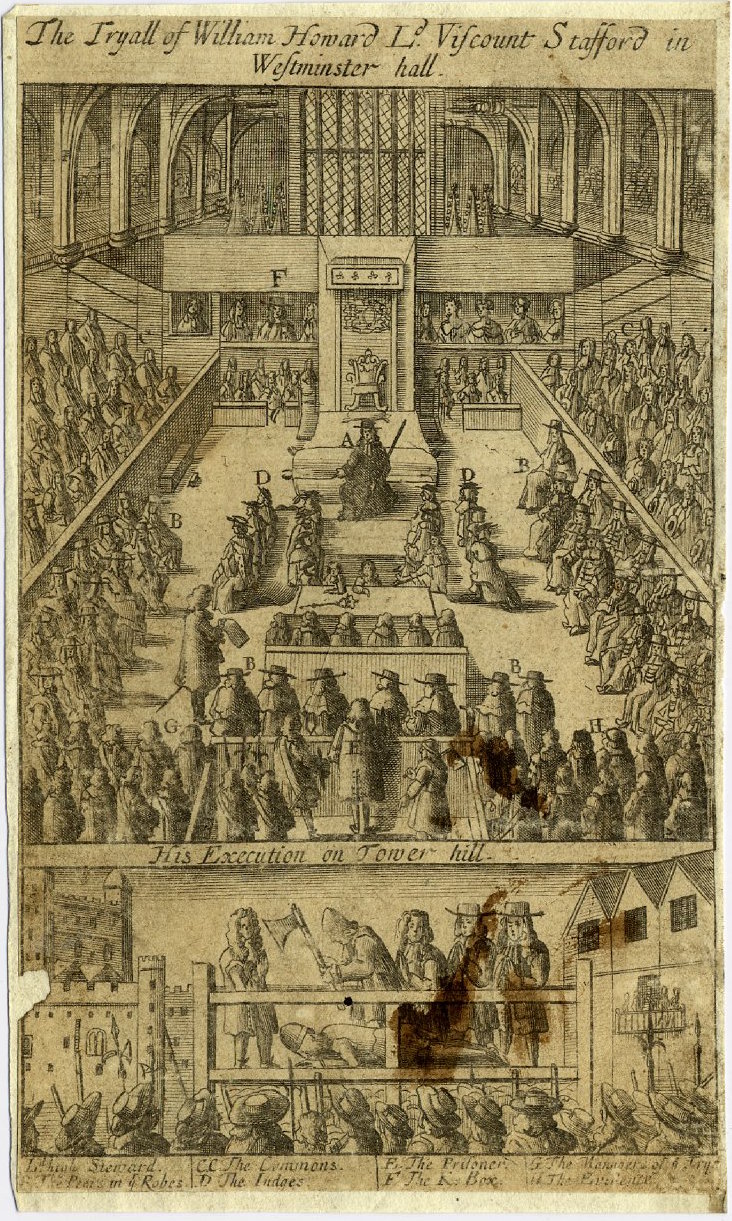
1680: William Howard, Viscount Stafford

(Thanks to Scottish Enlightenment titan David Hume for the guest post on William Howard, 1st Viscount Stafford — a Catholic peer who fell victim to the hysteria of Titus Oates‘s “Popish Plot”. It takes some time to build into the execution itself, since Hume in his History of England narratively locates it in the proto-Whig party’s frustrated parliamentary efforts to exclude from the succession the king’s Roman Catholic brother, the eventual King James II who at this time was the Duke of York. -ed.)

Besides friendship for his brother, and a regard to the right of succession, there were many strong reasons which had determined Charles to persevere in opposing the exclusion. All the royalists and the devotees to the church, that party by which alone monarchy was supported, regarded the right of succession as inviolable; and if abandoned by the king in so capital an article, it was to be feared that they would, in their turn, desert his cause, and deliver him over to the pretensions and usurpations of the country party. The country party, or the whigs, as they were called, if they did not still retain some propensity towards a republic, were at least affected with a violent jealousy of regal power; and it was equally to be dreaded that, being enraged with past opposition, and animated by present success, they would, if they prevailed in this pretension, be willing, as well as able, to reduce the prerogative within very narrow limits.

All menaces, therefore, all promises were again employed against the king’s resolution: he never would be prevailed on to desert his friends, and put himself into the hands of his enemies. And having voluntarily made such important concessions, and tendered, over and over again, such strong limitations, he was well pleased to find them rejected by the obstinacy of the Commons; and hoped that, after the spirit of opposition had spent itself in fruitless violence, the time would come, when he might safely appeal against his Parliament to his people.

So much were the popular leaders determined to carry matters to extremities, that in less than a week after the commencement of the session, a motion was made for bringing in an exclusion bill, and a committee was appointed for that purpose. This bill differed in nothing from the former, but in two articles, which showed still an increase of zeal in the Commons: the bill was to be read to the people twice a year in all the churches of the kingdom, and every one who should support the duke’s title was rendered incapable of receiving a pardon but by act of Parliament.

The debates were carried on with great violence on both sides. The bill was defended by Sir William Jones, who had now resigned his office of attorney-general, by Lord Russel, by Sir Francis Winnington, Sir Harry Capel, Sir William Pulteney, by Colonel Titus, Treby, Hambden, Montague. It was opposed by Sir Leoline Jenkins, secretary of state, Sir John Ernley, chancellor of the exchequer, by Hyde, Seymour, Temple. The arguments transmitted to us may be reduced to the following topics.

In every government, said the exclusionists, there is somewhere an authority absolute and supreme; nor can any determination, how unusual soever, which receives the sanction of the legislature, admit afterwards of dispute or control. The liberty of a constitution, so far from diminishing this absolute power, seems rather to add force to it, and to give it greater influence over the people. The more members of the state concur in any legislative decision, and the more free their voice, the less likelihood is there that any opposition will be made to those measures which receive the final sanction of their authority. In England, the legislative power is lodged in King, Lords, and Commons, which comprehend every order of the community: and there is no pretext for exempting any circumstance of government, not even the succession of the crown, from so full and decisive a jurisdiction. Even express declarations have, in this particular, been made of parliamentary authority: instances have occurred where it has been exerted: and though prudential reasons may justly be alleged why such innovations should not be attempted but on extraordinary occasions, the power and right are for ever vested in the community. But if any occasion can be deemed extraordinary, if any emergence can require unusual expedients, it is the present; when the heir to the crown has renounced the religion of the state, and has zealously embraced a faith totally hostile and incompatible. A prince of that communion can never put trust in a people so prejudiced against him: the people must be equally diffident of such a prince: foreign and destructive alliances will seem to one the only protection of his throne: perpetual jealousy, opposition, faction, even insurrections will be employed by the other as the sole securities for their liberty and religion. Though theological principles, when set in opposition to passions, have often small influence on mankind in general, still less on princes; yet when they become symbols of faction, and marks of party distinctions, they concur with one of the strongest passions in the human frame, and are then capable of carrying men to the greatest extremities. Notwithstanding the better judgment and milder disposition of the king, how much has the influence of the duke already disturbed the tenor of government? how often engaged the nation into meaures totally destructive of their foreign interests and honour, of their domestic repose and tranquillity? The more the absurdity and incredibility of the popish plot are insisted on, the stronger reason it affords for the exclusion of the duke; since the universal belief of it discovers the extreme antipathy of the nation to his religion, and the utter impossibility of ever bringing them to acquiesce peaceably under the dominion of such a sovereign. The prince, finding himself in so perilous a situation, must seek for security by desperate remedies, and by totally subduing the privileges of a nation which had betrayed such hostile dispositions towards himself, and towards every thing which he deems the most sacred. It is in vain to propose limitations and expedients. Whatever share of authority is left in the duke’s hands, will be employed to the destruction of the nation; and even the additional restraints, by discovering the public diffidence and aversion, will serve him as incitements to put himself in a condition entirely superior and independent. And as the laws of England still make resistance treason, and neither do nor can admit of any positive exceptions; what folly to leave the kingdom in so perilous and absurd a situation, where the greatest virtue will be exposed to the most severe proscription, and where the laws can only be saved by expedients, which these same laws have declared the highest crime and enormity.

The court party reasoned in an opposite manner. An authority, they said, wholly absolute and uncontrollable is a mere chimera, and is nowhere to be found in any human institutions. All government is founded on opinion and a sense of duty; and wherever the supreme magistrate, by any law or positive prescription, shocks an opinion regarded as fundamental, and established with a firmness equal to that of his own authority, he subverts the principle by which he himself is established, and can no longer hope for obedience. In European monarchies, the right of succession is justly esteemed a fundamental; and even though the whole legislature be vested in a single person, it would never be permitted him, by an edict, to disinherit his lawful heir, and call a stranger or more distant relation to the throne. Abuses in other parts of government are capable of redress, from more dispassionate inquiry or better information of the sovereign, and till then ought patiently to be endured: but violations of the right of succession draw such terrible consequences after them as are not to be paralleled by any other grievance or inconvenience. Vainly is it pleaded that England is a mixed monarchy; and that a law assented to by King, Lords, and Commons, is enacted by the concurrence of every part of the state: it is plain that there remains a very powerful party, who may indeed be outvoted, but who never will deem a law, subversive of hereditary right, any wise valid or obligatory. Limitations, such as are proposed by the king, give no shock to the constitution, which, in many particulars, is already limited; and they may be so calculated as to serve every purpose sought for by an exclusion. If the ancient barriers against regal authority have been able, during so many ages, to remain impregnable; how much more those additional ones, which, by depriving the monarch of power, tend so far to their own security? The same jealousy too of religion, which has engaged the people to lay these restraints upon the successor, will extremely lessen the number of his partisans, and make it utterly impracticable for him, either by force or artifice, to break the fetters imposed upon him. The king’s age and vigorous state of health promise him a long life: and can it be prudent to tear in pieces the whole state, in order to provide against a contingency which, it is very likely, may never happen? No human schemes can secure the public in all possible imaginable events; and the bill of exclusion itself, however accurately framed, leaves room for obvious and natural suppositions, to which it pretends not to provide any remedy. Should the duke have a son, after the king’s death, must that son, without any default of his own, forfeit his title? or must the Princess of Orange descend from the throne, in order to give place to the lawful successor? But were all these reasons false, it still remains to be considered that, in public deliberations, we seek not the expedient which is best in itself, but the best of such as are practicable. The king willingly consents to limitations, and has already offered some which are of the utmost importance: but he is determined to endure any extremity rather than allow the right of succession to be invaded. Let us beware of that factious violence, which leads to demand more than will be granted; lest we lose the advantage of those beneficial concessions, and leave the nation, on the king’s demise, at the mercy of a zealous prince, irritated with the ill usage which he imagines he has already met with.

In the House of Commons, the reasoning of the exclusionists appeared the more convincing; and the bill passed by a great majority. It was in the House of Peers that the king expected to oppose it with success. The court party was there so prevalent, that it was carried only by a majority of two, to pay so much regard to the bill as even to commit it. When it came to be debated the contest was violent. Shaftesbury, Sunderland, and Essex argued for it; Halifax chiefly conducted the debate against it, and displayed an extent of capacity, and a force of eloquence, which had never been surpassed in that assembly. He was animated, as well by the greatness of the occasion, as by a rivalship with his uncle Shaftesbury; whom, during that day’s debate, he seemed in the judgment of all to have totally eclipsed. The king was present during the whole debate, which was prolonged till eleven at night. The bill was thrown out by a considerable majority. All the bishops, except three, voted against it. Besides the influence of the court over them; the church of England, they imagined, or pretended, was in greater danger from the prevalence of presbyterianism than of popery, which, though favoured by the duke, and even by the king, was extremely repugnant to the genius of the nation.

The Commons discovered much ill humour upon this disappointment. They immediately voted an address for the removal of Halifax from the king’s councils and presence for ever. Though the pretended cause was his advising the late frequent prorogations of Parliament, the real reason was apparently his vigorous opposition to the exclusion bill. When the king applied for money to enable him to maintain Tangiers, which he declared his present revenues totally unable to defend; instead of complying, they voted such an address as was in reality a remonstrance, and one little less violent than that famous remonstrance, which ushered in the civil wars.

All the abuses of government, from the beginning almost of the reign, are there insisted on; the Dutch war, the alliance with France, the prorogations and dissolutions of Parliament; and as all these measures, as well as the damnable and hellish plot, are there ascribed to the machinations of Papists, it was plainly insinuated that the king had, all along, lain under the influence of that party, and was in reality the chief conspirator against the religion and liberties of his people.

Portait of William Howard as a young man by Anthony van Dyck, ~1638-1640. Howard was born in 1614, and beheaded at the age of 66.

The Commons, though they conducted the great business of the exclusion with extreme violence and even imprudence, had yet much reason for the jealousy which gave rise to it: but their vehement prosecution of the popish plot, even after so long an interval, discovers such a spirit, either of credulity or injustice, as admits of no apology. The impeachment of the Catholic lords in the Tower was revived; and as Viscount Stafford, from his age, infirmities, and narrow capacity, was deemed the least capable of defending himself, it was determined to make him the first victim, that his condemnation might pave the way for a sentence against the rest. The chancellor, now created Earl of Nottingham, was appointed high steward for conducting the trial.

Three witnesses were produced against the prisoner; [Titus] Oates [conjurer of the Popish Plot panic -ed.], [Stephen] Dugdale, and [Edward] Turberville.* Oates swore, that he saw Fenwick, the Jesuit, deliver to Stafford a commission signed by De Oliva, general of the Jesuits, appointing him paymaster to the papal army, which was to be levied for the subduing of England: for this ridiculous imposture still maintained its credit with the Commons. Dugdale gave testimony, that the prisoner at Tixal, a seat of Lord Aston‘s, had endeavoured to engage him in the design of murdering the king; and had promised him, besides the honour of being sainted by the church, a reward of five hundred pounds for that service. Turberville deposed, that the prisoner, in his own house at Paris, had made him a like proposal. To offer money for murdering a king, without laying down any scheme by which the assassin may ensure some probability or possibility of escape, is so incredible in itself, and may so easily be maintained by any prostitute evidence, that an accusation of that nature, not accompanied with circumstances, ought very little to be attended to by any court of judicature. But notwithstanding the small hold which the witnesses afforded, the prisoner was able, in many material particulars, to discredit their testimony. It was sworn by Dugdale, that Stafford had assisted in a great consult of the Catholics held at Tixal; but Stafford proved, by undoubted testimony, that at the time assigned he was in Bath, and in that neighbourhood. Turberville had served a noviciate among the Dominicans; but, having deserted the convent, he had enlisted as a trooper in the French army; and being dismissed that service, he now lived in London, abandoned by all his relations, and exposed to great poverty. Stafford proved, by the evidence of his gentleman and his page, that Turberville had never, either at Paris or at London, been seen in his company; and it might justly appear strange that a person, who had so important a secret in his keeping, was so long entirely neglected by him.

The clamour and outrage of the populace during the trial were extreme: great abilities and eloquence were displayed by the managers, Sir William Jones, Sir Francis Winnington, and Serjeant Maynard. Yet did the prisoner, under all these disadvantages, make a better defence than was expected, either by his friends or his enemies: the unequal contest in which he was engaged was a plentiful source of compassion to every mind seasoned with humanity. He represented, that during a course of forty years, from the very commencement of the civil wars, he had, through many dangers, difficulties, and losses, still maintained his loyalty: and was it credible that now, in his old age, easy in his circumstances, but dispirited by infirmities, he would belie the whole course of his life, and engage against his royal master, from whom he had ever received kind treatment, in the most desperate and most bloody of all conspiracies: He remarked the infamy of the witnesses; the contradictions and absurdities of their testimony; the extreme indigence in which they had lived, though engaged, as they pretended, in a conspiracy with kings, princes, and nobles; the credit and opulence to which they were at present raised. With a simplicity and tenderness more persuasive than the greatest oratory, he still made protestations of his innocence, and could not forbear, every moment, expressing the most lively surprise and indignation at the audacious impudence of the witnesses.

It will appear astonishing to us, as it did to Stafford himself, that the Peers, after a solemn trial of six days, should, by a majority of twenty-four voices, give sentence against him. He received, however, with resignation the fatal verdict. God’s holy name be praised! was the only exclamation which he uttered. When the high steward told him, that the Peers would intercede with the king for remitting the more cruel and ignominious parts of the sentence, hanging and quartering, he burst into tears: but he told the Lords that he was moved to this weakness by a sense of their goodness, not by any terror of that fate which he was doomed to suffer.

It is remarkable that, after Charles, as is usual in such cases, had remitted to Stafford the hanging and quartering, the two sheriffs, Bethel and Cornish, indulging their own republican humour, and complying with the prevalent spirit of their party, ever jealous of monarchy, started a doubt with regard to the king’s power of exercising even this small degree of lenity. “Since he cannot pardon the whole,” said they, “how can he have power to remit any part of the sentence?” They proposed the doubt to both Houses: the Peers pronounced it superfluous; and even the Commons, apprehensive lest a question of this nature might make way for Stafford’s escape, gave this singular answer: “This House is content that the sheriffs do execute William, late Viscount Stafford, by severing his head from his body only.” Nothing can be a stronger proof of the fury of the times than that Lord Russel, notwithstanding the virtue and humanity of his character, seconded in the House this barbarous scruple of the sheriffs.

In the interval between the sentence and execution, many efforts were made to shake the resolution of the infirm and aged prisoner, and to bring him to some confession of the treason for which he was condemned. It was even rumoured that he had confessed; and the zealous party-men, who, no doubt, had secretly, notwithstanding their credulity, entertained some doubts with regard to the reality of the popish conspiracy, expressed great triumph on the occasion. But Stafford, when again called before the House of Peers, discovered many schemes, which had been laid by himself and others for procuring a toleration to the Catholics, at least a mitigation of the penal laws enacted against them: and he protested that this was the sole treason of which he had ever been guilty.

Stafford now prepared himself for death with the intrepidity which became his birth and station, and which was the natural result of the innocence and integrity which, during the course of a long life, he had ever maintained: his mind seemed even to collect new force from the violence and oppression under which he laboured.

When going to execution, he called for a cloak to defend him against the rigour of the season: “Perhaps,” said he, “I may shake with cold; but I trust in God, not for fear.” On the scaffold he continued, with reiterated and earnest asseverations, to make protestations of his innocence: all his fervour was exercised on that point: when he mentioned the witnesses, whose perjuries had bereaved him of life, his expressions were full of mildness and of charity. He solemnly disavowed all those immoral principles, which over-zealous Protestants had ascribed, without distinction, to the church of Rome: and he hoped, he said, that the time was now approaching, when the present delusion would be dissipated; and when the force of truth, though late, would engage the whole world to make reparation to his injured honour.

The populace, who had exulted at Stafford’s trial and condemnation, were now melted into tears at the sight of that tender fortitude which shone forth in each feature, and motion, and accent of this aged noble. Their profound silence was only interrupted by sighs and groans. With difficulty they found speech to assent to those protestations of innocence which he frequently repeated: “We believe you, my lord! God bless you, my lord!” These expressions, with a faltering accent, flowed from them. The executioner himself was touched with sympathy. Twice he lifted up the axe, with an intent to strike the fatal blow; and as often felt his resolution to fail him. A deep sigh was heard to accompany his last effort, which laid Stafford for ever at rest. All the spectators seemed to feel the blow. And when the head was held up to them with the usual cry, This is the head of a traitor! no clamour of assent was uttered. Pity, remorse, and astonishment, had taken possession of every heart, and displayed itself in every countenance.


Detail view (click for the full image) of an engraving of the trial and execution of Viscount Stafford. (via the British Museum).

This is the last blood which was shed on account of the popish plot: an incident which, for the credit of the nation, it were better to bury in eternal oblivion; but which it is necessary to perpetuate, as well to maintain the truth of history, as to warn, if possible, their posterity and all mankind ever again to fall into so shameful, so barbarous a delusion.

The execution of Stafford gratified the prejudices of the country party; but it contributed nothing to their power and security: on the contrary, by exciting commiseration, it tended still farther to increase that disbelief of the whole plot, which began now to prevail.

* Channeling Jacques de Molay, Stafford prophesied that Turberville, the perjured witness against him, would not outlive him by so much as a year. Turberville obligingly dropped dead of smallpox late in 1681, after falling out with his former Popish Plot conspirator Titus Oates.

On this day..