1591: Arnold Cosbie, writing his own elegy

The manner of the death and execution of Arnold Cosbie, for murdering the Lord Burke, who was executed at Wanswoorth town's end on the 27 of January 1591. With certain verses written by the said Cosby in the time of his imprisonment, containing matter of great effect, as well touching his life as also his penitencie before his death.

ARNOLD COSBIE’S
ultimum vale to the vain world.

An Elegy written by himself
in the Marshalsea after his condemnation.

Break heart, be mute my sorrows past compare,
Cosbie complain no more, but sit and die,
Tears are no tokens of such dreriment,
As thy true grief pours to the angry heavens,
The heavens offended with thy foul misdeeds,
O great Commander of this glorious round,
The workmanship of thine immortal hand,
Thou that doest ride upon the Cherubins,
And tunest the deeps in dreadful harmony,
Cast down thine eye upon a wretched soul,
And from thy throne of grace great Jacob’s God
Rain mercy on me miserable man,
Fallen into snares of sin and shameful death,
From thee sweet Savior, Savior of the world.
O world, vain world, unconstant, & unkind,
Why hast thou bred me, nursed me, brought me up,
To see this day of sorrow and of shame:
Cosbie complain. Captains and men of war,
With whom I wholime spent my careless days,
Days dated but to this, to end in shame,
Farewell, adieu to you and all the rest
That follow armes, and armes and life adieu,
From armes and life I pass drenched in the pit
Digged by my desperate hands, hands full of blood.
Bleed heart to think what these accursed hands
Have perpetrated, Pardon heaven and earth,
And gentle Lord misled by my amis,
Foully by me sent to this longest home,
O pardon Cosbie’s cruel mind,
His mind enraged, and gentle blood by wrath
And fury tainted and empoisoned.
Why do I kill my doleful dying heart,
With sad rehearsal of this heavy chance.
O death rock me asleep, Father of heaven
That hast sole power to pardon sins of men,
Forgive the faults and folly of my youth,
My youth misspent in waste and wantonness,
And for sweet Jesus sake forgive my soul,
Foully defiled with this above the rest,
And lastly you whose fame I have defiled,
My kin, my Countrymen, friends, and allies,
Pardon, o pardon, such as men to men
Can give, I beg for wronging you in all,
For shaming you in this my wretched end,
The fruitless crop, the meed of my desert,
My bad, my base deserves, sweet Friends forget,
Friends, countrymen, and kinsfolks all forget,
My name, my face, my fact, o blot me out,
Out of the world, put me out of your thoughts,
Or if you think, o think I never was,
Or if you think I was, think that I fell,
Before some fort, some hold in Belgia,
With this suppose beguile your sorrows friends,
Think that I fell before the Canon’s mouth,
Even in mine honors heigth that blessed day,
When in advancement of my name, I left
My countries enemy in his base reuolie:
A wretched man to talk of honors high,
Fallen so basely into the pit of shame,
The pit of death: my God, my God forgive me,
Next to my God, my country pardon me,
Whose honor I have stained and laws infringe,
And thou my sovereign Mistress and my Queen,
Bright star of England’s globe, forgive my fact,
Nor let it touch thy Royal Princely heart,
That Cosbie hath misdone so heinously.
The circle of my time is compassed,
Arrived to the point where it began.
World, country, kin, and friends farewell farewell,
Fly thou my soul to heaven the haven of bliss,
O body bear the scourge of thine amiss.


More atmospheric Elizabethan movable type:

First pamphlet: 1 | 2 | 3 | 4 | 5 | 6 | 7 | 8 | 9

Second pamphlet: 1 | 2 | 3 | 4 | 5 | 6 | 7 | 8 | 9

… and, the source of the poem: 1 | 2 | 3 | 4

On this day..

1318: Sir Gilbert Middleton, son of iniquity

On this date in 1318, for kidnapping and robbing some churchmen, the Northumberland knight Sir Gilbert Middleton was condemned to be “hanged and drawn in the site of the cardinals which he had robbed” — the sentence thought to have been executed immediately.

The mid-1310s were a deep slough for King Edward II:* his political power faltered, his finances sank, and the Scots gave him a thrashing at Bannockburn. So low was Edward’s prestige that a pretender turned up claiming to have been switched at birth with the unsatisfactory king.

A “Poem on the Evil Times of Edward II” from that time enumerates the woes of Britons. It reserves several stanzas for the disreputable knights afoot in the land.

Thus is the ordre of kniht turned up-so-doun,
Also wel can a kniht chide as any skolde of a toun.
Hii sholde ben also hende as any levedi in londe,
And for to speke alle vilanie nel nu no kniht wonde
For shame;
And thus knihtshipe is acloied and waxen al fot-lame.

Knihtshipe is acloied and deolfulliche i-diht;
Kunne a boy nu breke a spere, he shal be mad a kniht.
And thus ben knihtes gadered of unkinde blod,
And envenimeth that ordre that shold be so god
And hende;
Ac o shrewe in a court many man may shende.

The author of this verse would have recognized Gilbert Middleton for sure, but before we come to the unkinde blod, appreciate the dastard’s situation. Post-Bannockburn, Robert the Bruce raided into Northumberland with impunity. Estates in that zone could suffer the pillage or pay the Scots off, but in either event they had no protection from the crown … since King Edward had his hands full in a virtual civil cold war against the powerful Earl of Lancaster.

In this tense situation, Middleton shockingly attacked the king’s cousin Lewis de Beaumont on September 1, 1317 while the latter was en route to be consecrated Bishop of Durham. Seized in the same party were Beaumont’s brother Henry, plus two Italian cardinals they had escorted back as emissaries to hammer out a truce between England and Scotland. (The papacy’s interest here was to redeploy Britain’s armed men to Crusading.)

The reasons for this attack have always been mysterious: the Pope blamed those marauding Scots for putting Middleton up to it, but Lancaster was also an ally of the errant knight as well as the promoter of a candidate for bishop rival to Lewis de Beaumont.

However it was intended to play out, the ambush quickly went pear-shaped. Perhaps raiding and holding for ransom was the sort of elbow one could throw in intra-elite politicking of the 14th century, but the presence of the cardinals changed everything.

Middleton might even have been unaware such august dignitaries were in the party when he first attacked it, and one chronicler reports that his party “at first spared the cardinals and their men, for they were not seeking to injure them” until this clemency started leading Beaumont’s retainers too to assert “themselves to be servants of the cardinals, and neither the cardinals nor others were spared, but all were despoiled.”** Regardless of how they came to do it, the sacrilegious rapine of holy cardinals and their retinue was the shocking crime that would thrust Middleton beyond the pale, either of friendship in his rebellion or of reconciliation afterwards. (Beaumont had not yet been consecrated, so the indignities he suffered were all in a day’s work.)

The Beaumonts became Middleton’s unwilling guests at Mitford Castle.† The cardinals had their effects restored and, after enduring their now-excommunicate captors’ unavailing petition for a suitable penance, were given over to Lancaster; they returned all the way to London under his safe conduct … and as they went they “published a terrible sentence upon their assailant and upon all in any way adhering to them … demand[ing] execution of this sentence through all England.” Before September was out, there was a royal proclamation against Middleton’s “sons of iniquity.”

This rebellion, whatever its dimensions, lasted for a vague span over the autumn and winter months. Sir Gilbert and his too-few friends held some fortifications in Northumberland and Yorkshire; where possible they added more noble types to his collection in Mitford but in spite of the tense situation in England no wider rising materialized.

And living by plunder quickly caught up with Gilbert Middleton.

certain nobles of the countryside … went to him under safe conduct, as if for their [the hostages] deliverance, and after many words and quibblings, a certain price for them being settled, they set free certain ones and left certain ones as hostages until full payment of the money. Thereupon, the day of the final payment arriving, and the appointed time, when the attendants of the same Gilbert were roaming in various places, in order to plunder and pillage, those who ought to have made the payment came to speak with him, saying that they had the money secretly in the town, and asked that free exit and entrance might be granted to them to fetch it. This granted, when they came to the gate of the castle as if to go out, the porters’ throats being cut in a moment, they led in a multitude of armed men hiding outside, who suddenly, rushing with blows upon him [Gilbert], who was thinking of no such thing, bound him tightly with iron chains.

-annals of John de Trokelowe

The captive Middleton was shipped to London and there condemned to “be dragged through the city to the gallows and there be hanged alive, and alive be torn apart and afterwards be beheaded … heart and organs to be burnt beneath the aforesaid gallows, also the body of the same Gilbert be divided into four parts, so that one quarter of his body be sent to Newcastle, another to York, the third to Bristol, and the fourth to Dover, there to remain.”

* Of course, worse times were yet to come.

** Quoted (as are many other period citations) in this useful public domain biography of Middleton. This author’s take was that Lancaster was behind the affair, believing “that it would be popular in the North of England, and would make a signal for a general rebellion throughout the country. The presence of the cardinals ruined the scheme” — and Lancaster himself had the wit and the pull to dissociate himself before it all came down on Middleton’s head.

† Yes, those Mitfords.

On this day..

1894: John Hardy, desperate little man

On this date in 1894, West Virginia hanged before a crowd of 3,000 for a mining camp murder three months before.

Hardy was reportedly already at odds with Thomas Drews, a fellow laborer in the booming Appalachian coal industry, over their mutual pursuit of the same woman when Hardy lost big to Drews in a craps game on October 13, 1893.
While it’s true that twenty-five cents doesn’t really seem all that “big”, this sum could represent a decent slice of a day’s pay in the coal mining game, and that in an industry where downward wage pressure had generated a ferocious national strike only months before. Hardy was profoundly nonplussed to have to fork over the sweat of his brow to a love rival and, with the added incitement of whiskey, shot Drews dead. (Ten more spectators at his hanging wound up in stir themselves for drunk and disorderlies.)

Hardy’s execution has pride of place in Americana as the inspiration for the tune “John Hardy Was A Desperate Little Man”. (Or simply, “John Hardy”; as a folk figure, he has occasionally been confused or conflated with John Henry)

One of the most popular folk ballads in American history, the song has foggy origins but amazing reach: it has been performed, covered, and reinterpreted by a scores of artists including the Carter Family, Lead Belly, Duke Ellington, Woody Guthrie, Pete Seeger, and Bob Dylan with the Grateful Dead.

On this day..

1678: James Mitchell, Covenanter assassin

On this date in 1678, Covenanter radical James Mitchell was hanged at Edinburgh for attempting to murder the Archbishop of St. Andrews.

Mitchell’s intended victim, James Sharp by name, is one of Scottish history’s great villains — tasked as he was to cheat Presbyterians of the religious reform they had spent a generation seeking. After Cromwell had King Charles I beheaded, his heir Charles II was nothing but an exile pretending to the throne his father had been deposed from.

Desperate for allies, he made a reluctant pact with Scottish allies to promulgate Presbyterianism throughout the realm should he regain the kingdom: this meant, in practice, bottom-up church governance as against the top-down authority of bishops characterizing Episcopacy. For a king, this would entail ceding considerable power over religious matters.

Such a promise was more readily given than honored. When Charles II regained the English throne in 1660, he instead restored Episcopacy in the north and everywhere else — selecting our man James Sharp, up until then a Presbyterian minister of the moderate faction, to boss Scotland’s most exalted ecclesiastical post. “The great stain will always remain, that Sharp deserted and probably betrayed a cause which his brethren intrusted to him,” Walter Scott wrote.

From this position, whose very existence was obnoxious to his former friends, our Judas* was Charles’s point man for reintroducing and enforcing all those ecclesiastical prerogatives of the monarchy that the Presbyterians had been so desperate to abolish.

He drove from the church irreconcilable Covenanter ministers — so named for their adherence to the objectives of those discarded covenants. That faction despised Sharp, and he returned the sentiment. On one occasion, he had to call for the militia to disperse an angry mob, only to be told that the militia’s members had joined the mob too. After a Covenanter rising was put down at the Battle of Rullion Green, Sharp okayed the withdrawal of quarter for surrendered foes with the taunt “You were pardoned as soldiers, but you are not acquitted as subjects” — putting his episcopal imprimatur on numerous ensuing hangings.

It was only a matter of time before someone tried to murder him.

On the 11th of July in 1668, James Mitchell — a zealous but unordained freelance preacher and dyed-in-the-wool Covenanter — stepped to a carriage the archbishop was embarking and took a shot at him. Mitchell missed, and pinged one of the prelate’s companions in the wrist, crippling the hand.

Mitchell managed to escape and live for several years with sizable sum on his head and nobody interested in claiming it** before Sharp’s own brother finally captured him in 1674. The proceedings against him are surprisingly protracted considering the famous vindictiveness of his target, and resolved by (as Mitchell said at his hanging) “an extrajudicial confession, and the promise of life given to me thereupon by the chancellor, upon his own and the public faith of the kingdom.” Given his party, he ought not have been surprised that the promise was not kept; as an added bonus, his retraction of the confession — which was the only evidence against him — resulted in his torture by the boot.

In 1679, a different bunch of Covenanters finally succeeded in assassinating the hated Archbishop Sharp.


The Murder of Archbishop Sharpe on Magus Muir near St. Andrews, 1679, by William Allen (c. 1840).

There’s a public domain biography friendly to Sharp (and perforce extremely hostile to the Covenanters) here.

* Cromwell met Sharp — still a Presbyterian minister at that time — in a negotiation during the Protectorate and allegedly rated him “ane Atheist, and of noe principles at all.”

** At one point Mitchell resided in Edinburgh with another man bound for the scaffold, Major Weir

On this day..

1983: Wang Zhong, small-time grifter

On this date in 1983, Wang Zhong, once the Communist Party Secretary and district head of Haifeng county, Guangdong, was executed for corruption.

The first official of his rank to be so punished, Wang did business on a truly paltry scale relative to the titanic graft compassed by China’s latter-day oligarchs: his first booty was a 17″ black-and-white TV in 1979. In the end, between payola extorted and contraband expropriated, Wang sold his life for 69,000 yuan — a little over US $10,000.

The Associated Press translated a Canton newspaper report of Wang’s execution thus:

His crimes were read out and his sentence before more than 17,300 people at a rally at Swatow, 200 miles east of Canton.

Wang then was driven in a truck to an execution ground about 25 minutes away.

Between 600 and 700 bicycles were parked near the execution ground, and some people ran on foot to watch after the truck and its escorts passed by thousands of spectators along the route.

A cold wind blew and a light rain fell as the convoy arrived and a policeman asked Wang if he had any last words. It [was?] said he asked police to tell his children not to follow his examples.

At 2:45, Wang Zhong knelt facing south. The policeman carrying out the execution once again confirmed his identity. Then he picked up an automatic rifle and, ‘peng,’ a bullet pierced Wang Zhong’s heart.

On this day..

1630: Christina Plum, at the stake, in Cologne

On this date in 1630, the city of Cologne burned Christina Plum.

This aptly-named fruit vendor was a real peach. During Cologne’s 1627-1630 witch hunt, Plum in 1629 denounced a bushel of Cologne’s leading citizens for devilry. While threatening established elites with torture and the stake certainly seems downright bananas with benefit of hindsight, the free city had in 1627 burned an influential woman — and possibly Germany’s first female postmaster — named Katharina Henot. Indeed, it was Plum’s contention that such varied characters as the wife of the Burgermeister, the pastor of St. Alban’s Church, and Katharina Henot’s brother had all been keeping regular dates at the late Katharina’s Black Sabbath orgies.

The city was at that moment facing intense pressure by the Archbishop of Cologne Ferdinand of Bavaria — an imperial elector and enthusiastic hammer of witches — to root out Satan’s earthly minions. It was not at all past thinking that Plum’s accusations could have cut a swath through the city’s upper crust.

Instead, they destroyed the credibility of the witch hunts.

After unsuccessfully pressuring Plum to just pipe down and go away, the city had her arrested as a witch. After all, how did she know so much about who was going to the orgies? And, as was almost inevitable in such cases, the consequent interrogation proved sufficiently vigorous to force a confession from the woman’s lips.

In 1631, as the witch fever abated in Cologne, and elsewhere throughout Germany, the Cologne-educated jurist Friedrich Spee published one of the seminal takedowns of witch-hunting, Cautio Criminalis. (Spee himself lost a kinswoman to the Hexenprozesse.)

On this day..

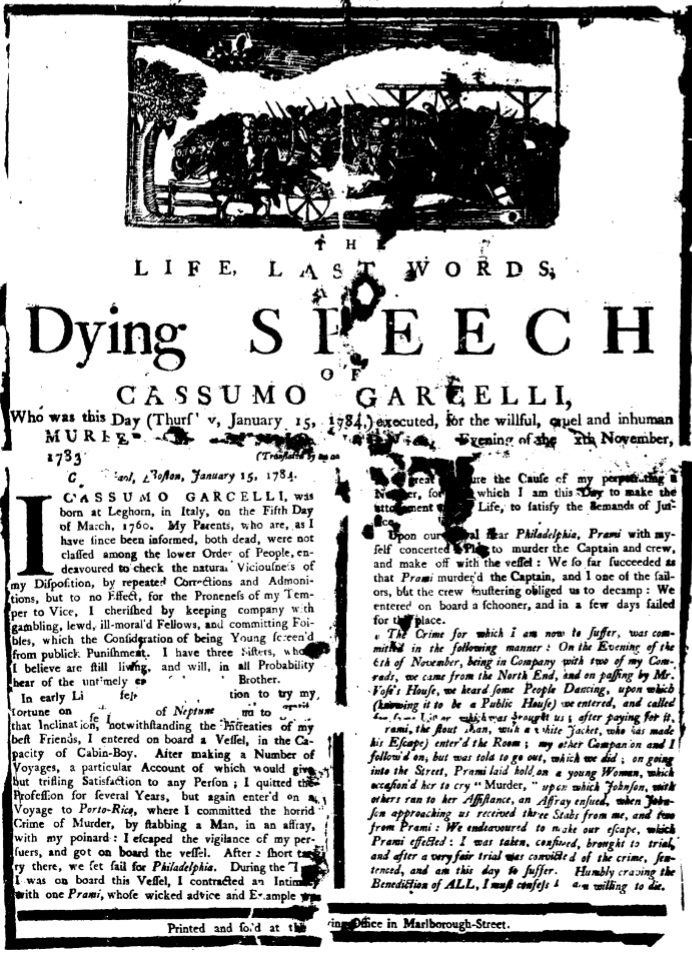
1784: Cassumo Garcelli, a Tuscan sailor on Boston Common

On this date in 1784, for a murder in a bar brawl he had committed with his hard-drinking cronies, Tuscan mariner Cassumo Garcelli was hanged on Boston Common.

To judge by the bog-standard broadsheet purporting to report the condemned man’s gallows’ shade contrition for his youthful vice and wicked examples, piratical Catholic seamen appear to have understood the spectacle of their public execution in a friendless foreign land in a manner quite suspiciously similar to the understanding likely to be held by a New England printer.

In the transcription that follows, I have made a few interpolations, and one outright elision, owing to sections of text obscured by printing faults on the preserved version of this document.


Click on the image to see the full original document.

Who was this Day (Thursday, January 15, 1784) executed, for the willful, cruel and inhuman murder of Mr. John Johnson on the evening of the sixth November, 1783.

I, Cassumo Garcelli, was born at Leghorn, in Italy, on the Fifth Day of March, 1760. My Parents, who are, as I have since been informed, both dead, were not classed among the lower Order of People, endeavoured to check the natural Viciousness of my Disposition, by repeated Corrections and Admonitions, but to no Effect, for the Proneness of my Temper to Vice, I cherished by keeping company with gambling, lewd, ill-moral’d Fellows, and committing Foibles, which the Consideration of being Young screen’d from publick Punishment. I have three Sisters, who I believe are still living, and will, in all Probability, here of the untimely [death of their] Brother.

In early Life […] to try my fortune … notwithstanding the Intreaties of my best Friends, I entered on board a Vessel, in the Capacity of Cabin-Boy. After making a Number of Voyages, a particular Account of which would give but trifling Satisfaction to any Person, I quitted the Profession for several Years, but again enter’d on a Voyage to Porto-Rico, where I committed the horrid Crime of Murder, by stabbing a Man, in an affray, with my poinard: I escaped the vigilance of my persuers, and got on board the vessel. After a short tarry there, we set sail for Philadelphia. During the Time I was on board this Vessel, I contracted an Intimacy with one Prami, whose wicked advice and Example was in a great Measure the Cause of my perpetrating a Number [sic], for [one of?] which I am this Day to make the attonement of my Life, to satisfy the demands of Justice.

Upon our arrival near Philadelphia, Prami with myself concerted a Platt to murder the Captain and crew, and make off with the vessel: We so far succeeded as that Prami murder’d the Captain, and I one of the sailors, but the crew mustering obliged us to decamp: We entered on board a schooner, and in a few days sailed for this place.

The Crime for which I am now to Suffer, was committed in the following manner: On the Evening of the 6th of November, being in Company with two of my Comrads [sic], we came from the North End, and on passing by Mr. Vose’s House, we heard some People Dancing, upon which (knowing it to be a Public House) we entered, and called for some Liquor, which was brought to us, after paying for it.

Vami, the stout man, with a white Jacket, who has made his Escape, enter’d the Room; my other Companion and I follow’d on, but was told to go out, which we did; on going into the Street, Prami laid hold on a young Woman, which occasion’d her to cry “Murder,” upon which Johnson, with others ran to her Assistance, an Affray ensued, when Johnson approaching us received three Stabs from me, and two from Prami: We endeavoured to make our escape, which Prami effected: I was taken, confined, brought to trial, and after a very fair trial was convicted of the crime, sentenced, and am this day to suffer. Humbly craving the Benediction of ALL, I must confess [and am] willing to die.

On this day..

1528: Leonhard Schiemer, Anabaptist pacifist

Forasmuch then as Christ hath suffered for us in the flesh, arm yourselves likewise with the same mind: for he that hath suffered in the flesh hath ceased from sin.

1 Peter 4:1, a verse very dear to this date’s principal*

Anabaptist Leonhard Schiemer was beheaded on this date in 1528 at Rattenberg.

Schiemer abandoned a Franciscan monastery, preferring to set his table with honest labor as a tailor, and to succor his soul with that that new heresy minting martyrs in northern Europe.

In 1527, Schiemer was both a vigorous missionary and an eloquent proponent of the pacificism for which the sect would eventually become known. In Schiemer’s time, before the catastrophe of Münster’s Anabaptist theocracy, this was quite naturally a hot dispute among the persecuted adherents trying to determine how to make their way in a world where they were considered heretical even by the other heretics: turn the other cheek, or come like Christ with a sword?

Schiemer’s answer was for the true Christian to give himself to the ordeal of Christ’s cross.

[The Holy Spirit] teaches no one, however, unless he despaired of all human comforting and wisdom first. He does not comfort or strengthen anyone unless he feels a horror and turns away from all comforting and power of man. This is why the Lord says, “Do not be called masters.” But this master, Christ, does not accept anyone as His pupil or disciple, unless he renounces and hates everything that he has, and follows Him and carries his cross daily. In doing this, one has to trust in the Lord’s comforting and keep still, as the Scriptures say in many passages, particularly in the Psalms, the Prophets, most of all in Isaiah and the Lamentations of Jeremiah.

The strength of all Christians consists in keeping still, by not forsaking the words of the Lord so quickly, by not losing courage so soon, but by being patient, waiting for the comfort of the Holy Spirit, in the midst of the greatest desolation and misery. This is true weakness of which the Scriptures speak, in particular Paul when he says, “For when I am weak I am strong.”

He also says, “For as we share abundantly in Christ’s suffering, so through Christ we share abundantly in comfort too.” That is what Christ means when He says, “A little while and you will see me no more, again a little while and you will see me.” And when the apostles asked Him what He meant by this, He answered, “Truly, truly, I say to you, you will weep and lament, but the world will rejoice; you will be sorrowful, but your sorrow will turn in to joy … Indeed the hour is coming when whoever kills you will think he is offering service to God.

The Threefold Grace

It is often suspected that Schiemer’s execution on January 14 might have inspired the Rattenberg grandee Pilgram Marpeck to convert — for he was dismissed from a post as a mining magistrate on January 28, and thereafter became an influential, itinerant Anabaptist “wandering citizen of heaven” crisscrossing southern Germany.

* According to an essay on Schiemer in The Anabaptists and Contemporary Baptists: Restoring New Testament Christianity.

On this day..

1864: Private Samuel Jones, in retaliation for Private Daniel Bright

The New York Times of January 23, 1864

Gen. Getty:

DEAR SIR: We, the subscribers, request to say that there was found this morning a dead man, and still hanging, in our neighborhood, as the inclosed scrip which was found pinned to his back, will show you by whom it was done. We have made a suitable box and buried him near the place he was found hung. Should his friends wish to get his body, they can get it by applying to any of the subscribers. We trust that you will not attach any blame to any of the citizens of this neighborhood, as we were entirely ignorant of any of the circumstances until we found the body. From all we can learn, he was brought across the Chowan River to this place, and as soon as the men who had him in charge hung him, they went back.

It was signed by ten people of Pasquotank County, North Carolina.

The note they enclosed, retrieved from the hanging body, read:

NOTICE

Here hangs Private Samuel Jones, of Company B, Fifth Ohio regiment, by order of Maj.-Gen. Pickett, in retaliation for Private Daniel Bright, of Company L, Sixty-second Georgia regiment, hung Dec. 18, 1863, by order of Brig.-Gen. Wild.

Bright, a member of the newly-formed 66th North Carolina guerrillas, had been hanged as a spy. Jones had been obtained by casting lots among Union prisoners of war held at the Confederate capital of Richmond, in response to Pickett’s demand for some Yankee to execute tit for tat. (Pickett’s proclivity for retaliatory executions would soon require him to quit the country at the end of the Civil War.)

On this day..

2015: Laila Bint Abdul Muttalib Basim, filmed

Last year on this date, Saudi Arabia’s execution wave consumed a Burmese woman named Laila Bint Abdul Muttalib Basim.

Condemned for the murder and sexual abuse of her seven-year-old stepdaughter, Basim went to her public beheading protesting her innocence and resisting in whatever way she could — which we know, because a cell phone recording of the execution attained worldwide dissemination. In it, the black-shrouded condemned shrieks over and over, “I did not kill! This is unjust!” She denounces her executioners, invokes the Shahada … until her throat is horrifically emptied of its last protest by the blade.

Warning: This is the on-camera death of a human being from just a few meters’ distance, obtained via Liveleak. It’s awful.

Thanks to the outrage this video spawned, a “human rights organization” underwritten by the Saudi government demanded the arrest of the person who recorded the video … which did indeed occur.

On this day..