1660: Jan Quisthout van der Linde condemned to drown in New Amsterdam

On this date in 1660, in the Netherlands’ little settlement on the tip of Manhattan Island, New Amsterdam, Jan Quisthout van der Linde was sentenced “to be taken to the place of execution and there stripped of his arms, his sword to be broken at his feet, and he to be then tied in a sack and cast into the river and drowned until dead.”

We do not have an indication of the date this sentence was carried out, if it were not immediate.

It was an unusual execution for an unnatural crime: Quisthout had been found guilty of sodomizing his servant.

New Amsterdam is here just four years away from its seizure by the English, who rechristened it New York;* dour, peg-legged Calvinist Peter Stuyvesant had been hustling for 13 years to put the tenuous little settlement on some sort of sustainable, defensible footing even as its neighbor English colonies in Massachusetts, Connecticut, and Rhode Island grew to dwarf little Manhattan.

Stuyvesant was a crusty boss.** He’d been crestfallen on arrival to his new assignment to find New Amsterdam a rough-edged melting pot city with livestock roaming the streets, a slurry of languages (and religions), and dockside brawls spilling out of seedy taverns.†


The “Castello Plan” map from 1660 shows the germ of Manhattan’s present-day layout. The defensive wall spanning the island on the right gives us Wall Street.

His horror was practical as well as moral: the little colony, a few hundred souls when he took over and perhaps 1,500 when the English finally deposed him, was in danger on all sides and the cash-strapped West India Company was both slow and miserly in response to Stuyvesant’s desperate pleas for men and material. But the horror was also moral. Stuyvesant enforced a whole slew of unpopular injunctions against drunkenness, fisticuffs, and fouling public streets with refuse, and actually had to be reined in by the West India Company board when he got so overbearing as to try shouldering out Jews and prying into the devotional habits of suspected Quakers.

A paragon of rectitude like Stuyvesant was in no way about to turn a blind eye to casual Atlantic-world buggery.

Even his lax predecessor had come down hard on a previous sodomy case, viewing that sin as an existential threat to their depraved port: “such a man is not worthy to associate with mankind and the crime on account of its heinousness may not be tolerated or suffered, in order that the wrath of God may not descend upon us as it did upon Sodom.”

The crime that we might see here with modern eyes, rape, was in no way foremost to Stuyvesant et al. The boy, an Amsterdam orphan named Hendrick Harmensen, stayed out of the drowning-sack — but he was whipped for same-sex contact and ordered “sent to some other place by the first opportunity” even though that very sentence acknowledged that it was Quisthout who had “committed by force the above crime” on the lad.


View of Dutch Manhattan … and its gallows.

* In honor of the then-Duke of York, the future King James II.

** Try a web search on “Peter Stuyvesant martinet” to see what we mean.

† And slavery.

On this day..

90: Cornelia, Vestal Virgin

How happy is the blameless Vestal’s lot!
The world forgetting, by the world forgot:
Eternal sunshine of the spotless mind!
Each prayer accepted, and each wish resign’d.

Alexander Pope

June 9 in ancient Rome was the festival of the Vesta, the acme of the Vestalia festival extending until June 15.*

We hope this hearth-goddess will accept the homage Pluto‘s emissaries here propose to pay her most famous servants, the Vestal Virgins.

An ancient order of priestesses reaching back to Rome’s mythical founding period, perhaps even rooted in Rome’s matriarchal Etruscan predecessors, the Virgins by the time of the classical era numbered six — selected from among candidate girls aged 6 to 10 who would be whisked away from their families to serve for thirty years.

Vestal Virgins enjoyed great prestige and a number of social prerogatives (they had the power to pardon condemned prisoners, among other things). In exchange, they were tasked with maintaining Rome’s favor with her temperamental gods by tending diligently to the city’s most cherished religious observances.


The remains of the House of the Vestals on the Roman Forum ((cc) image from Milos Kravcik.) Here’s a reconstructed view of what the residence might have looked like in its glory.

From the moment of their selection, Vestal Virgins became a sort of personification of Rome itself — Rome’s civic virtue; Rome’s standing with the gods. Rome and the Vestals, joined by the sacred eternal hearth-flame whose perpetual kindling was the virgins’ chief ceremonial duty, drew succor from one another. Pliny wrote that they “have the power, by uttering a certain prayer, to arrest the flight of runaway slaves, and to rivet them to the spot, provided they have not gone beyond the precincts of the City” — but Rome’s greatness, too, was attributed to the citizenry’s dutiful maintenance of the Vestals through the centuries.

For such an empyreal creature to indulge the fleeting pleasures of the flesh was quite beyond question. Vesta, said Ovid,

was always unable to tolerate men.
What wonder if a virgin delights in virgin servants,
And only allows chaste hands to touch her sacred relics?
Realize that Vesta is nothing but living flame,
And you’ll see that no bodies are born from her.
She’s truly a virgin, who neither accepts seed
Nor yields it, and she loves virgin companions.

But over the centuries, not all of Vesta’s servants kept that same hard line on unchaste hands** — and in so doing risked punishment by an unusual execution of living burial. Even defiled Vestals were inviolate in their persons: their blood could not be shed, and the hands of the common executioner could not touch them. They had to be dispatched without direct violence, by immuring them alive under the earth. (Not so their seducers: getting busy with a Vestal Virgin would cost a man as many strokes of a scourge as required to kill him.)

Back to Ovid:

Now sacred flames you shine brightly under Caesar’s rule:
The fire on the Ilian hearths is there, and will remain,
It won’t be said that under him any priestess disgraced
Her office, nor that she was buried alive in the earth.
So the unchaste die, being entombed in what they
Have violated: since divine Earth and Vesta are one.

We have no specific calendar dates to go with any of these, but the British Museum antiquarian G.H. Noehdon compiled the available information about Vestals’ executions at some length in this public domain text:

a subterraneous chamber or cell of small dimension was formed, into which you descended from above. There were placed in it a couch or bed, a burning lamp, and a few necessaries of life, such as bread, water, milk, and oil. It would have been impious, according to Plutarch, to destroy by hunger, a life that had been consecrated by the most holy rites. The wretched victim, it is to be imagined, chiefly perished by suffocation. For the cell was closely shut, and overlaid with earth, as soon as she was descended.

The whole proceedings were terrific. The delinquent was conveyed to that place of horror in a litter, so fastened up and covered from without, that not even a sound or groan could escape from it. She was thus carried through the market-place, while the people, in fearful silence, made way, and followed speechless, impressed with the awe of this frightful ceremony. No sight, says Plutarch, could be more shocking, nor was there ever a day at Rome more gloomy and sorrowful.


Detail view (click for the full image) of Execution of a Vestal Virgin, by Heinrich Friedrich Fuger.

Per Noehdon, the oldest case on record was of one Pinaria, executed for impurity under Tarquin the Elder. A Vestal named Minucia suffered the same fate in the 4th century BCE; two more, Opimia and Floronia, were condemned in the 3rd century, though one committed suicide in preference to immurement. Dionysius of Halicarnassus attributes a plague to the incontinence of the Vestal Urbenia, and its abatement to her punishment. Cassius Dio credits no fewer than three Vestals with execution for unchastity in 114 BCE — but one can hardly fail to note that this is a period of deepening class tension in Rome in the aftermath of the Gracchi. One wonders if carnal indulgences were merely a pretext to purge Aemilia, Licinia, and Marcia for the wrong factional alignment.

Probably the best-attested and best-known Vestal Virgin executed was Cornelia, the Virgo Maxima (chief Vestal) entombed by order of the notorious tyrant Domitian. (Domitian had also executed three other Vestals some years prior.) Pliny the Younger recorded her going to her death effecting (as did her purported lover) a persuasive mien of indignant innocence.

Domitian generally raged most furiously where his evidence failed him most hopelessly. That emperor had determined that Cornelia, chief of the Vestal Virgins, should be buried alive, from an extravagant notion that exemplary severities of this kind conferred lustre upon his reign.

Accordingly, by virtue of his office as supreme pontiff, or, rather, in the exercise of a tyrant’s cruelty, a despot’s lawlessness, he convened the sacred college, not in the pontifical court where they usually assemble, but at his villa near Alba; and there, with a guilt no less heinous than that which he professed to be punishing, he condemned her, when she was not present to defend herself, on the charge of incest, while he himself had been guilty, not only of debauching his own brother’s daughter, but was also accessory to her death: for that lady, being a widow, in order to conceal her shame, endeavoured to procure an abortion, and by that means lost her life.

However, the priests were directed to see the sentence immediately executed upon Cornelia. As they were leading her to the place of execution, she called upon Vesta, and the rest of the gods, to attest her innocence; and, amongst other exclamations, frequently cried out, “Is it possible that Caesar can think me polluted, under the influence of whose sacred functions he has conquered and triumphed?” Whether she said this in flattery or derision; whether it proceeded from a consciousness of her innocence, or contempt of the emperor, is uncertain; but she continued exclaiming in this manner, til she came to the place of execution, to which she was led, whether innocent or guilty I cannot say, at all events with every appearance and demonstration of innocence. As she was being lowered down into the subterranean vault, her robe happening to catch upon something in the descent, she turned round and disengaged it, when, the executioner offering his assistance, she drew herself back with horror, refusing to be so much as touched by him, as though it were a defilement to her pure and unspotted chastity: still preserving the appearance of sanctity up to the last moment; and, among all the other instances of her modesty, “She took great care to fall with decency.”

Celer likewise, a Roman knight, who was accused of an intrigue with her, while they were scourging him with rods in the Forum, persisted in exclaiming, “What have I done? — I have done nothing.”

The Vestal Virgins were finally suppressed (and their eternal flame quenched) by the Christian emperor Theodosius, in 394.†

A few years later, Rome was sacked for the first time in 800 years.

* There are mixed accounts as to whether June 9 or June 7 was the first day of the Vestalia, but the 9th was unquestionably the most important.

** Legend has it that Rome’s founders, Romulus and Remus, were sons of a Vestal Virgin, Rhea Silvia: again, this tradition could well be the refracted memory of Etruscan priestesses, or princesses, or both. The man who was to kill these unholy offspring instead took pity on them and cast them adrift on the Tiber — and that’s how they ended up being famously suckled by wolves.

† Eliminating pagan holdovers was a great sport in this period for Rome’s now-Christian emperors. Theodosius also ended the Olympic Games; his son Honorius got rid of gladiatorial combat.

On this day..

1536: Anne Boleyn’s supposed lovers

Beware, trust not in the vanity of the world, and especially in the flattering of the court … if I had followed God’s word in deed as I did read it and set it forth to my power, I had not come to this.

-From the last statement of George Boleyn

This was the execution date in 1536 of Anne Boleyn‘s co-accused, the undercard to the deposed queen’s beheading.

It was the accusation of adultery that furnished Anne’s downfall; some adulterers were perforce required. These were William Brereton, Henry Norris, Sir Francis Weston, Mark Smeaton … and the ex-queen’s own brother, George Boleyn.

They had just days prior been subjected to a trial whose outcome was a foregone conclusion. All pleaded their innocence save Smeaton, a commoner court musician who could not withstand torture and “admitted” fooling around with Queen Anne.*

Along with Smeaton, three gentlemen-doomed plucked from the Tudor court’s shadowy recesses — joined to the legendary queen at the chopping-block, if not very probably in her bed.

  • Norris, the Groom of the Stool
  • Weston, a Gentleman of the Privy Chamber
  • Brereton, a Groom of the Privy Chamber

“Everyone was moved at their misfortune, especially at the case of Weston, who was young and of old lineage and high accomplishments,” one contemporary recorded of the fearful pall cast upon King Henry’s court by the purge. “But no one dared plead for him, except his mother, who, oppressed with grief, petitioned the King, and his wife, who offered rents and goods for his deliverance.”

The most egregious charge, naturally, did not concern these men. To put the fallen queen beyond the reach of sympathy it was alleged that she

following daily her frail and carnal lust … procured and incited her own natural brother, Geo. Boleyn, lord Rocheford, gentleman of the privy chamber, to violate her, alluring him with her tongue in the said George’s mouth, and the said George’s tongue in hers, and also with kisses, presents, and jewels; whereby he, despising the commands of God, and all human laws, violated and carnally knew the said Queen, his own sister, at Westminster; which he also did on divers other days before and after at the same place, sometimes by his own procurement and sometimes by the Queen’s.

This outrageous smear on the extremely specious grounds that big brother “had been once found a long time with her, and with certain other little follies,” invited as much skepticism among the Boleyns’ contemporaries as it does for posterity. Even after Anne had been condemned for adultery and incest in her stage-managed trial, George — the last of the bunch to face the tribunal — fought his corner so vigorously “that several of those present wagered 10 to 1 that he would be acquitted, especially as no witnesses were produced against either him or her, as it is usual to do, particularly when the accused denies the charge.”

A foolish bet, but perhaps one placed from a position of willful hope. If a peer of the realm could be condemned a traitor for hanging out with his sister, then no Henrician nobleman could hope to sleep securely.

Little could their dread fathom the bloody years to come. Many who saw the Boleyns’ heads drop would in time have cause to make of their gambling winnings a purse to tip their own executioners.

Thomas Cromwell, who engineered the Boleyn faction’s fall, outlived it by barely four years. The Earl of Surrey, who sat in judgment on this occasion, lost his head in 1547; his father the Duke of Norfolk,** who was the presiding judge, only avoided execution because Henry VIII died hours before Norfolk was to go to the block. George Boleyn’s wife, Lady Rochford, is supposed to have provided evidence against him; she was later swept up in the fall of Catherine Howard and beheaded for her trouble on that occasion.

But those were tragedies for later days.

In the spring of 1536, from his window in the Tower, the poet Thomas Wyatt witnessed this date’s executions: the young Anne’s last lover before the king descended on her, Wyatt too had been initially implicated in debauching the queen and he was fortunate not to be among their number. (Wyatt’s son would not be as lucky.) The shaken Wyatt wrote his fellow courtiers’ heartbreaking eulogy, and perhaps that of his era too, in his verse reflection on that terrible fall from fortune. (Via)

V. Innocentia
Veritas Viat Fides
Circumdederunt
me inimici mei

by Sir Thomas Wyatt, the Elder

Who list his wealth and ease retain,
Himself let him unknown contain.
Press not too fast in at that gate
Where the return stands by disdain,
For sure, circa Regna tonat.†

The high mountains are blasted oft
When the low valley is mild and soft.
Fortune with Health stands at debate.
The fall is grievous from aloft.
And sure, circa Regna tonat.

These bloody days have broken my heart.
My lust, my youth did them depart,
And blind desire of estate.
Who hastes to climb seeks to revert.
Of truth, circa Regna tonat.

The bell tower showed me such sight
That in my head sticks day and night.
There did I learn out of a grate,
For all favour, glory, or might,
That yet circa Regna tonat.

By proof, I say, there did I learn:
Wit helpeth not defence too yerne,
Of innocency to plead or prate.
Bear low, therefore, give God the stern,
For sure, circa Regna tonat.

* In the Tower awaiting execution, Anne would voice worry for Smeaton’s soul when she learned that he had failed to retract this confession at the block. But Smeaton and all the men were beheaded in preference to a sentence of drawing and quartering, and had reason to be cautious about their comportment on the scaffold lest crueler torments be reinstated for them.

** Norfolk was Anne Boleyn’s uncle.

Circa Regna tonat: “Around the throne it thunders”, from Seneca’s Phaedra.

On this day..

1543: Jakob Karrer, Vesalius subject

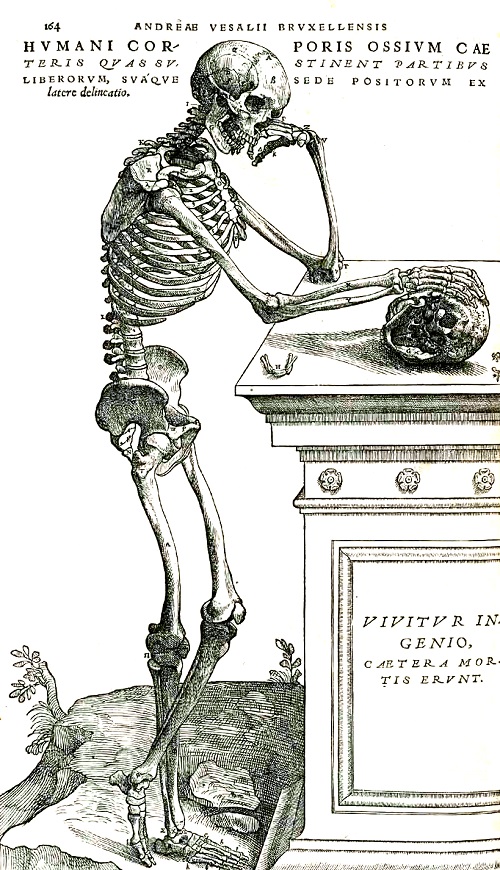
osing his head on May 12, 1543 made Jakob Karrer von Gebweiler’s name in the annals of art and and medicine.

The remains of the Basel felon — who attacked his wife with a knife when she discovered his bigamous marriage — were turned over after execution to Andreas Vesalius.

That brilliant Flemish doctor was in the midst of a proper Renaissance leveling up of medicine, lifting it past the centuries-long thrall of ancient Greek physician Galen.

Human dissection was essential to Vesalius’s project, as it was alike to many other medical men and to artists too. In his career, Vesalius’s cunning scalpel stripped numerous cadavers for students and urban grandees. With Karrer, Vesalius performed a public dissection, articulating Karrer’s skeleton.

Gifted to the university there, the skeleton was restored in 1985 and can be seen to this day at the Institute of Anatomy in Basel, Switzerland — one of the very earliest still-preserved articulated skeletons.

Why is it a Basel criminal who enjoys this distinction?


From Wikipedia’s library of De Humani illustrations.

Because in 1543, Vesalius was in that city* to work with printer Johannes Oporinus, even then publishing the physician’s magnum opus De Humani Corporis Fabrica. Vesalius personally transported to Oporinus the famously gorgeous and detailed woodcuts of Titian’s pupil Joannes Stephanus Calcarensis that made De Humani a smash hit in Vesalius’s own time and one of the most treasured artifacts of Renaissance scholarship.

* There’s still a street named for Vesalius in Basel.

On this day..

1726: Three molly-house sodomites

Nine men and one notorious women died at Tyburn on this date in 1726 at a more than usually raucous execution-day.

“At the Place of Execution, Map got himself loose, threw himself out of the Halter, and jump’d 3 or 4 Yards from the Cart, upon the Heads of the numerous Crowd of People, but the Officers following after him, wounded him with their Pikes, and the Executioner and some others soon brought him back again,” the Ordinary’s account remarked. “Vigous got himself free of the Halter also, which was immediately observ’d: Gillingham was the more desirous of Prayers, having the Night before taken Poyson, and conscious of his Guilt.”

And that’s just what was happening under the nooses.

Out in the audience,

Just before the Execution, a Scaffold that had been built near Tyburn, and had about 150 People upon it, fell down. A Snuff Box Maker in Castle-Street, and a Gentleman then not known, were, as ’tis believed, mortally Wounded; and about 12 other Men and Women, Maimed and Wounded in a most cruel Manner: Some having their Legs, others their Arms, &c. broke.

Some part of the Scaffold being left standing, the Mob gathered upon it again in Numbers; and in about Half an Hour more, that also fell down, and several were hurt. Soon after another Scaffold broke down, with about 100 Persons upon it; but the People that were damaged by it, being immediately carried off on Mens Backs, and in Coaches, we must defer the Particulars of that Mischief … (Daily Journal, May 10, 1726)

We will leave for a future May 9th the notorious fate of the woman, Catherine Hayes, and focus for this post on the fate of the notorious men: sodomites Gabriel Lawrence, William Griffin, and Thomas Wright.

A mere three months before, this trio had been among dozens of men rounded up in a raid on London’s thriving “molly house”.

These establishments catered to what we might anachronistically call the gay scene of Georgian London — or the molly scene, if you like, from the slang term for effeminate, cross-dressing, or homosexual men encompassing a panoply of alternate sexual identities and preferences. What these behaviors “among Christians not to be named” had in common, of course, was the opprobrium of the surrounding world.

Rictor Norton, who keeps the voluminous Homosexuality in Eighteenth-Century Enland site and wrote a book about Mother Clap’s Molly House, records a 1726 letter to the editor demanding an exemplary punishment to check the misuse of genitalia.

It being too notorious, that there are vile Clubs of Miscreants in and about this City, who meet to Practise and Propagate the detestable Sin of Sodomy, a Crime which drew down the flaming Vengeance of God upon the City of Sodom, in a Day when they had not that Light which we are bless’d with now, ’tis humbly propos’d that the following Method may not only destroy the Practice, but blot out the Names of the monstrous Wretches from under Heaven, viz. when any are Detected, Prosecuted and Convicted, that after Sentence Pronounc’d, the Common Hangman tie him Hand and Foot before the Judge’s Face in open Court, that a Skilful Surgeon be provided immediately to take out his Testicles, and that then the Hangman sear up his Scrotum with an hot Iron, as in Cases of burning in the Hand.

Old Blighty was never favored with courtroom scrotum-searings, but connoisseurs of same-sex love “must risque our necks for” it well into the next century.

But what pleasures welcomed the man who was ready to wager his life! An informant reported from that same Mother Clap’s that he

found between 40 and 50 Men making Love to one another, as they call’d it. Sometimes they would sit on one another’s Laps, kissing in a lewd Manner, and using their Hands indecently. Then they would get up, Dance and make Curtsies, and mimick the voices of Women. O, Fie, Sir! – Pray, Sir. – Dear Sir. Lord, how can you serve me so? – I swear I’ll cry out. – You’re a wicked Devil. – And you’re a bold Face. – Eh ye little dear Toad! Come, buss! – Then they’d hug, and play, and toy, and go out by Couples into another Room on the same Floor, to be marry’d, as they call’d it.

Several such informers were stalking the city’s molly-houses in the 1720s, goaded (or forced) by both police and private bluenoses. One of the resulting court records notes that “[t]he discovering of the Molly Houses, was chiefly owing to a Quarrel betwixt Mark Partridge and – Harrington: For upon this Quarrel Partridge to be revenged on Harrington, had blab’d something of the Secret, and afterwards gave a large Information of a great many others.”

Many lives hung on this lover’s spat. Mother Clap’s was raided in February 1726, but it was just the most famous of a whole series that forced into public awareness “a new, distinct molly ‘sodomite’ identity.”

The saving grace for the twoscore arrestees at Mother Clap’s was that even in Bloody Code England, a fairly high bar was required to execute for same-sex sodomy: penetratio, that is res in re (“thing in thing”)* — often quite difficult to prove.** As nobody had actually been caught in flagrante delicto, most of those initially arrested were simply released un-charged.

But the informants raise their scaly heads once more here: as they were themselves habitues of the molly circuit, they could provide firsthand eyewitness testimony about the acts of buggery several men had committed with them.

Five men were put on trial for their lives in April on the strength of accusations made by informants Mark Partridge, Thomas Newton, and Edward Courtney. The cases are described in some detail at Norton’s site: Gabriel Lawrence and William Griffin, both 43-year-old married men, were Mother Clap regulars who implausibly claimed to have no idea it was a molly house. (The place was a coffee shop/tavern.) Griffin actually lived there. Both these men were easily condemned but refused to the end to admit their proclivities to the Newgate Ordinary, and insisted that they had been framed.

Thomas Wright, seller of ale, had gone so far to set up his own molly house where he both slept with Newton, and procured Newton for his other customers. Wright, who “inclin’d to the Anabaptist-Way,” also said that Newton had perjured himself; nevertheless, he “could not deny his following this abominable Courses, only he refus’d to make particular Confessions.”

A third informant keyed two additional capital trials that didn’t end at Tyburn. George Kedger (Keger) and George Whittle (Whytle) both mounted much stronger defenses casting much greater doubt on the circumstances of their entrapment.

Charged with taking Courtney into his bed, Kedger contended that he had in fact resisted Courtney’s advances until the latter threatened to “swear my Life away”. Kedger was condemned, but pardoned. Whittle did still better by forcing his accuser to admit that he was a convict three times over and insinuating that rumors about his buggery were started by a disgruntled lodger. With a parade of character witnesses at his back, Whittle was acquitted outright.

* This was also the standard for same-sex rape; we’ve seen in these pages a man’s life hang on a question of just the tip.

** Attempted buggery — a charge which could result from making a sexual advance on another man that he rejected, or as a judicial punt when same-sex activity was afoot but no penetration could be proven — might land one a fine and a trip to the pillory. This was no mean sentence; the pillory could be quite a dangerous (sometimes lethal) ordeal for homosexuals or for anyone else.

Mother Clap herself, whose molly house we have referred to throughout this post, was also pilloried, not executed. Her eventual fate is not known; a marker in Holborn notes the former site of her famous establishment.

On this day..

1779: James Hackman, sandwich wrecker

On this date in 1779, Londoners crowded Tyburn to witness the hanging of James Hackman for a sensational high-society murder.

Just twelve days before his date with the hemp, Hackman had walked up to Martha Ray at the Royal Opera and shot her in the head with a single-shot pistol. Then, he turned a second weapon on himself in a vain attempt to commit suicide.

The reader is not mistaken to detect here the mania of unrequited passion. Several years before the young Hackman was a handsome lieutenant introduced to Martha Ray’s social circle. She was a successful soprano on the London stage and though unmarried lived with the Earl of Sandwich as his wife in all but the illustrious name.


(cc image) from Molly Elliott.

Yes, this is the very Earl of Sandwich who pioneered the eating of things stuck between bread slices.* Sandwich — John Montagu to his parents — had other interests besides the munchies; he was the capable First Lord of the Admiralty throughout the 1770s. (As a result, Captain Cook, whose seafaring explorations were occurring at that time, kept naming islands for the Earl of Sandwich).

Domestic life for the Earl and his legal Countess — not “Earless”; that’s a different thing — wasn’t quite as satisfying. Dorothy Montagu, going gradually insane, separated from Sandwich. The lord plucked 17-year-old commoner Martha Ray — a quarter-century Sandwich’s junior — in 1759 and she lived as his mistress from there on out.*

Despite their age difference and never-formalized status they had a comfortable arrangement; Ray bore Sandwich five children** and the two appeared in public as a couple. The Earl sponsored Martha Ray’s opera career and education.
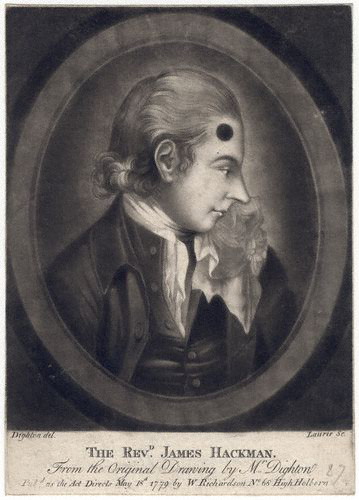
James Hackman met the Earl’s mistress around 1775 and the two formed an intimacy. Just how intimate they might have been has never been firmly established but is clear that as time passed the infatuation increasingly ran in only one direction. Hackman sold his commission in the 68th Regiment of Foot to become a Church of England deacon, perhaps angling by this expedient to woo Martha Ray away from Sandwich to a wholly respectable union.

She understandably demurred on this “opportunity” — leading the greenhorn Reverend to his blackguard act.

Hackman’s pointless waste of Martha Ray’s life and his own plucked his contemporaries’ sentimental heartstrings like nothing else. “All ranks of people … pitied the murderer’s fate,” remarks the Newgate Calendar. One newspaper report of the death sentence noted that “all present were greatly affected” at Hackman’s agitations “and however we may detest the crime, a tear of pity will fall from every humane eye on the fate of the unhappy criminal.” (General Advertiser and Morning Intelligencer, Apr. 17, 1779)

James Boswell was fascinated by the crime; he attended the trial and spilled many public and private words on its subject.

Boswell empathized with Hackman: in a report of the trial for the St. James’s Chronicle (Apr. 15-17, 1779) he opined that the “natural Effect of disappointed Love, however, shocking it may appear, is to excite the most horrid Resentment against his Object, at least to make us prefer the Destruction of our Mistress, to seeing her possessed by a Rival.” Not that Boswell condoned the murder, but “I would say to all that are conscious that their Passions are violent, Think ye that htis unfortunate Gentleman’s general Character is … worse than yours? No, it is not.”

While Human Justice is to be satisfied, let us consider that his Crime was neither premeditated‡ Cruelty, nor base Greediness. He is therefore an Object neither of Abhorrence nor of Contempt … Let us unite our fervent Prayers to the Throne of Heaven, that this our Brother may obtain Forgiveness through Jesus Christ, and be admitted in another State of Being to everlasting Happiness.

The kinship so many Londoners felt for this homicidal stalker moved print copy high and low, before Martha’s body had gone quite cold. Its most notable product was the 1780 Love and Madness, an epistolary novel of tragic passion presented via the (fictitious) letters exchanged by the supposed lovers. So heavily did this understanding of events by Hackman’s contemporaries color its subsequent remembrance that Love and Madness is also the title or subtitle of two 21st century nonfiction considerations of the affair. (1, 2 | Review of both)

Hackman for his part carried off the requisite public posture of resigned tragic nobility in the few days before he satisfied human justice. The General Evening Post, April 17-20 1779 described the execution:

This unfortunate gentleman received the sacrament in the morning with all the fervency and devotion of a sincere repenting criminal: — he repeated that affecting acknowledgment of his guilt, which on his trial drew tears from the audience, and seemed in a state of composure, unruffled with the idea of punishment, which, he said, was no more than he deserved.

At nine o’clock he came into the press-yard, where a great crowd of persons assembled to gratify their curiosity. That all might have an equal share of the sight, a lane was formed by the multitude on each side, through which Mr. Hackman passed, dressed in black, leaning on the arm of his friend the Rev. Mr. Porter, whose hand he squeezed as he muttered the solemn invocation to Heaven, not to forsake a sinner of so enormous a degree, in the trying hour of death.

Mr. Hackman was conveyed from Newgate in a mourning coach, attended by the Rev. Mr. Porter Mr. Villette, the ordinary of Newgate, and Mr. Leapingwell, a Sheriff’s officer.

He reached Tyburn about a quarter before eleven o’clock. When he arrived at the fatal tree, a cart lined with black was under the gallows ready to receive him. Mr. Porter and Mr. Villette ascended it by a pair of steps, and he followed them unsupported. As soon as he had got into it he walked forward, and fell on his knees, (a position seldom used by persons in his circumstances at Tyburn, as they always pray standing) and the Clergymen did the like, one on each side of him, where they remained praying for about fifteen minutes, then got up, when the rope was put about his neck, and tied to the gallows.

In this manner he remained praying between the two Divines for ten minutes more, when the Rev. Mr. Porter embraced him, and Mr. Villette took his leave, and both left the cart. The convict[‘]s cap being pulled over his face, he told the executioner to leave him to himself for a few minutes, and he would drop his handkerchief as a signal when he was ready, which he did after a few minutes pause, and was thereupon launched into eternity.

His whole behaviour was manly, but not bold: his mind seemed to be quite calm, from a firm belief in the mercies of his Saviour.

He wore not hat, not any bandage on his face where he gave himself the wound, that the public curiosity might not be interrupted in looking at him; saying, “that he wished to be made a public spectacle of, and hoped his death might be of service to mankind.”

He was no ways convulsed, nor was their [sic] any motion of the body that tended to shew it experienced any pain. Nothing more was to be seen than what proceeded from the jerk on quitting the cart.

The mob was more numerous than on any other occasion since the death of Dr. Dodd. It was expected Mr. Hackman would suffer at Covent-garden, and preparations were made by some speculating carpenters, who met with a mortifying disappointment.

After hanging the usual time, his body was put into a hearse, and taken to Surgeons-hall in the Old Bailey, where it was prepared for the inspection of the public.

Mr. Harkman expressed a wish to his friends, that the ceremony of anatomizing his body might be dispensed with; and that his corpse might be treated in the same manner as that of Lord Ferrers.

Mr. Hackman intimated to a particular friend, that if his remains could be deposited near those of Miss Ray he should feel inexpressible happiness in the hour of death.

A man who was standing near a dray in Oxford-street to see Mr. Hackman pass, was thrown down under one of the horses by the crowd; the horse being frightened, stamped on the man, and beat out his brains.

* Allegedly so that the Earl wouldn’t have to leave his beloved gambling table to dine.

** There is a wonderful bon mot that has enlivened compendia of anecdotes through the years, consisting of more or less the following exchange:

First speaker: You will either die on the gallows or of some social disease.

Second speaker: That depends upon whether I embrace your principles or your mistress.

Though it’s been variously attributed, it appears that the retort was originally delivered by the comic Samuel Foote to Lord Sandwich — about Martha Ray.

† Notable among the five children of Sandwich and Martha Ray: jurist Basil Montagu.

Sandwich’s wife also bore him a legitimate son, who eventually succeeded to the father’s Earldom; the title still exists today.

‡ Hackman had to be talked off simply pleading guilty but in the end he hung his trial hopes on arguing that he intended to kill himself, in Martha’s presence, and was overwhelmed by a momentary “phrensy”. A letter in his pocket meant to be delivered posthumously to his brother-in-law supported this claim; the fact that he brought two guns to meet her rebutted it.

Trial judge William Blackstone pointed out to Hackman’s jurors that the composure of the accused before and after the crime did not suggest a madman and that accepting Hackman’s claim of only an instant’s insanity could present a very slippery slope indeed for future murder prosecutions.

On this day..

1830: George Cudmore, posthumous book-binding

George Cudmore was on March 25, 1830 executed at Devon County Gaol, the present-day site of Exeter Prison.

Wanting to run off with his mistress, Cudmore slipped his wife a lethal dose of the 19th century’s prolific domestic assassin, arsenic. But suspecting the foul play, the surgeon opened Grace Cudmore’s belly and found the incriminating powder. At trial, Cudmore was convicted of the murder while the mistress, Sarah Dunn, was acquitted — somewhat to her own surprise.

The man’s strange last request was for Dunn to witness his hanging — grandly justified as a means to scare straight his ex-lover’s amoral libido. (Dunn already had four children out of wedlock at this point.) Exeter’s Western Times (March 27, 1830) reported that the ghastly sight of her Cudmore’s strangling on the rope “sunk [Dunn] down, and violent hysterics deprived her for awhile, of any further consciousness.”

More strange by far than the man’s late turn to righteousness was the disposal of his remains.

Condemned to the post-mortem terror of dissection, part of Cudmore’s skin was flayed, tanned, and eventually used to cover a book — an 1852 edition of The Poetical Works of John Milton.


Did I request thee, Maker, from my clay
To mould me man? Did I solicit thee
From darkness to promote me?

Paradise Lost

On this day..

1899: Cordelia Poirier and Samuel Parslow

On this date in 1899, Cordelia Poirier was hanged in Ste. Scholastique, Quebec with her lover Samuel Parslow.*

Cordelia Viau by her maiden name, the femme fatale in this transaction found that in her marriage to one Isidore Poirier she was much the sturdier spirit.
“She was a masterful woman,” this old public-domain text on insurance crimes muses, “and Poirier seems to have been a man of very common mould. He was not great or strong enough to make his wife admire or respect him, yet was too obstinate to yield to her domination.”

Cordelia soon turned this gap in magnetism to good effect on Mr. Parslow, a local carpenter, to the considerable scandal of their village, Saint-Canut.

An intolerable domestic situation drove Isidore Poirier to the bottle, and Cordelia Poirier to the insurance underwriters — from whom she obtained two separate $1,000 policies on the life of her spouse. Much to the discredit of her agents (and, one must suspect, to the commission wage model), the wife’s blunt inquiries as to whether a death by assassination woud void the policies were met with simple affirmations rather than a summons to the constable.

Sure enough, Isidore Poirier suffered just such a death on November 21, 1897: after vespers (Cordelia was an organist at the church), she and Parslow barged in on the intoxicated Isidore at his home and Parslow slashed him to death with a butcher knife. The body was discovered the next day, and it wasn’t hard to put means to motive and clap the adulterers in gaol.

Having perhaps not thought this venture through, Samuel Parslow and Cordelia Poirier promptly began informing on one another in hopes of avoiding the rope. Their confessions would only cinch one another’s fates. By the time of trial, Parslow had to feebly accuse Mrs. Poirier of hypnotizing him.**

Her cynical domestic crime and vampish reputation earned her an extreme level of disapprobation: her behavior obviously inverted and betrayed the model of domestic virtue whose penumbra of sentimentality has often been counted on to save female murderers from the gallows. Cordelia Poirier was actively hated.

“The crowd inside the jail jeered [Cordelia Poirier],” it was reported — “but even then her nerve did not desert her, and at the suggestion of the executioner she turned and faced the Jeerers, and stood erect and prayed to the last.”

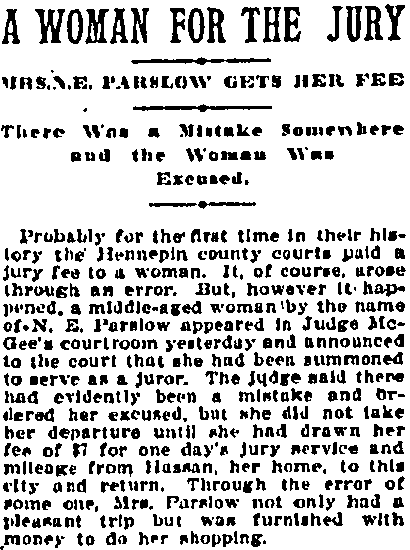
* Thanks to the wonders of database searches, research for this post also revealed a completely different legal drama off the same era related to a competely different Parslow. This story is from the Feb. 4, 1898 Minneapolis Journal.

** All reports do paint Cordelia Poirier as the stronger will in her adulterous relationship, as well as her marital one, and the instigator of the murder.

On this day..

1848: Harriet Parker, crime of passion

(Thanks to Meaghan Good of the Charley Project for the guest post. -ed.)

On this date in 1848, Harriet Parker was publicly hanged in front of the Debtors’ Door at Newgate for the murder of her lover’s two young children.

The sad story is described in Nicola Sly’s In Hot Blood: A Casebook of Historic British Crimes of Passion.

Harriet was a widow. Her partner, Robert Henry Blake, was legally married to another woman, but they were separated and he lived with Harriet and two of his children by his wife: Amina, age seven, and Robert Jr., age five.

Despite residing at Cupid’s Court in London, their relationship was far from blissful. Robert was an inveterate womanizer who openly flaunted his affairs. It all came to a head on New Years’ Eve, 1847, when Robert told Harriet he was going to the theater without her. He’d made plans with a friend, Stephen Hewlett, and she wasn’t invited.

Harriet was furious and suspected, rightly, that Robert was actually going to be with another woman. She followed him as he left their home and tagged along behind him wherever he went, telling him he’d better get used to it because she would be with him all night.

Robert did meet up with his friend Stephen and complained of Harriet’s jealousy. “If I was to kiss that post,” he said, “she would be jealous of it.” Eventually he was able to give Harriet the slip, though, and went immediately to a prostitute’s house, where he stayed the night.

Harriet, meanwhile, angrily searched for her errant lover for hours, saying darkly that Robert would regret his actions for the rest of his life.

“I will do something that he shall repent and will die in Newgate,” she told Stephen Hewlett. She added, “I have something very black in mind … You will hear of me before you see me.”

He didn’t take her seriously. He should have.

A few hours after midnight on New Years’ Day, witnesses saw Harriet walking the city streets with little Amina, still asking people if they’d seen Robert. The next time anyone saw her was at 4:00 a.m. She was alone, and knocked frantically at her neighbor’s door. The neighbor opened the bedroom window and looked out, and asked what on earth was wrong.

“Oh, Mrs. Moore, I have done it,” Harriet said. She added that Blake had “met a little strumpet” and left her last night, and hadn’t come home. “A pretty spectacle is there for him when he does come home,” she added. “I shall go and deliver myself up to a policeman.”

Her neighbor asked why and she replied, “I have murdered the two children.”

That got Mrs. Moore’s attention and she sent her husband to find a police officer. Harriet herself went looking and found one, and asked to be arrested, but she didn’t disclose the reason until they were on the way to the station house. Finally she unburdened her secret:

I have murdered the children to revenge their father. They were innocent — through my vindictiveness I have done the deed.

A look in at the Blake/Parker house showed Harriet was telling the truth: Amina and Robert Jr. were lying in bed, quite dead. They had been smothered and their bodies were still warm. Harriet’s clothes were stiff with dried blood, but it wasn’t the children’s; it was her own blood, from a beating Blake had given her a few days before.

Harriet had to be persuaded not to plead guilty to her crimes from the outset. At her trial, which was presided over by two judges, her defense was that of provocation. Her attorney argued that Robert’s horrible treatment of her had driven her out of her mind and she was not a “responsible agent” at the time of the murders.

The jury was out for only ten minutes before returning with a verdict of guilty of willful murder. The automatic sentence was death, but the jurors included a strong recommendation of mercy because of the provocation Harriet had received. (Even after the murders Robert had boasted of all the women he’d seduced during the time he lived with Harriet.)

Judge Baron didn’t agree with the jury, pointing out that “the children gave her no provocation at all.”

Nevertheless, he promised to pass the recommendation on to the Home Secretary. When the two judges passed their sentence on the convicted woman, they emphasized that she had no right to take her feelings about Blake out on two “unoffending children” who were “in a sweet, innocent sleep.”

Harriet cried out, before being lead from court, “God forgive you, Robert. You have brought me to this.”

The Home Secretary did receive the jury’s recommendation of mercy, but didn’t act on it. The widespread perception was that if Harriet had murdered her louse of a partner rather than his children, she would gotten off with a lesser verdict of manslaughter. But the deaths of two small children, killed for the actions of their father, could not be countenanced.

Harriet spent her last days dictating letters to people. In one of several letters sent to Blake, she wrote, “Awful as my fate is, I would rather die than live again the wretched life I have done for the last twelve months.” She sent him a Bible and a pair of cuffs she’d knitted, and advised him to return to his wife and forsake drinking, bad company and other women.

The crowd of persons assembled to witness the awful scene was immense, and far exceeded in number those present at any execution of late — their conduct, also, we regret to add, was worse than usual, the yells and hootings which prevailed for some time previous to the culprit making her appearance being perfectly dreadful.

London Times, February 22, 1848

Mrs. Moore visited her in her cell and found her surprisingly at ease. “I have received more kindness in Newgate than ever since I left my mother’s home,” Harriet told her former neighbor.

Harriet was hanged by one of Britain’s most famous executioners, William Calcraft — although it was never the tidiness of his executions that he was famous for. Calcraft didn’t handle Harriet all that well, either: according to one account, Harriet’s “muscular contortions and violent motion of the hands and arms … were truly dreadful” as she choked to death. Her frame was so slight that the fall didn’t break her neck.

On this day..

1679: Robert Foulkes, adulterous minister

From the Newgate Calendar:

This unhappy gentleman was a divine of the Church of England, and had been very much esteemed for his learning and abilities. Few men were more capable of shining in a church, or had a greater share of that sacred eloquence so requisite in a preacher. He was minister of Stanton-Lacy, in the county of Salop, where he was exceedingly followed and admired till his crimes came to be known, and where he might have been beloved till death in a natural way had taken him hence, and then universally lamented, if his heart had been as well furnished with grace as his head was with knowledge and his tongue with expressions.

A young gentlewoman of a considerable fortune, who had been left an infant by her parents, was committed to his care by her executors, as to a man who, they trusted, would not only deal justly by her, but also instruct her betimes in the principles of religion, and her several duties as a Christian. But, alas! how weak is human nature, and how soon are we tempted aside from the ways of piety! Mr. Foulkes, instead of answering the purpose of the young woman’s friends, was soon smitten with her charms, and took an opportunity of discovering a criminal passion for her, though he had at that time a virtuous wife and two children living. The young lady too easily consented to gratify his lust, and they continued their conversation together till she became pregnant.

All the means he could think of to procure abortion were now tried, and they all proved ineffectual; so that they must be both exposed to scandal, unless she could be removed to some convenient place, remote from the eyes of the world, and from the jealousies of Mrs. Foulkes, where she might be delivered of her burden, which was not yet perceived. A plausible excuse for his going up to London was soon formed, and for his taking Miss along with him, who at that time was under twenty years of age. When they arrived in town they took a lodging in York Buildings in the Strand, where she lay in, and where (shocking to think of!) the child was privately murdered, to prevent the infamy that might follow.

But divine vengeance would not suffer this horrible deed to remain long concealed, for before Mr. Foulkes went out of town the girl was examined upon the suspicion of some women, when she confessed the whole, and charged Mr. Foulkes with the murder, who was thereupon apprehended and committed to Newgate; in a short time after which he was condemned at the sessions house in the Old Bailey, upon the evidence of the young woman. On the 31st of January, 1679, he was executed at Tyburn.

On this day..