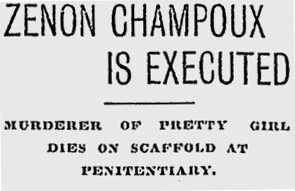
On this date in 1904, the state of Washington carried out its first execution under the auspices of a new law requiring that hangings be held in that state’s penitentiary in Walla Walla.*
Its subject was French-Canadian laborer Zenon Champoux, and his crime was as flamboyant as his moniker: publicly planting a knife in the forehead of a dance hall girl who did not return his affections.
The first man executed under the auspices of the Evergreen State, we admit, is a milestone that’s a bit on the smaller side.
But we think his name stands out admirably in the annals, especially paired with a characterization like the Seattle Star gave him: French degenerate.
“Zenon Champoux, French Degenerate” — it’s the scoundrel who’s rogering your girl, or else the branding on his designer condoms. On this date in 1904, it was just the guy at the end of his rope.
* Previously, hangings had been conducted by counties, in public. Laws removing them to the auspices of the state and behind the walls of a prison were in vogue at the time.
Washington went on to abolish the death penalty in 1913, only to reinstate it again in 1919.
On this date fifty years ago, death row author and celebrity Caryl Chessman choked to death in San Quentin Prison’s gas chamber while the phone outside rang, too late, with his stay.
During his abnormally protracted* (for the times) 12 years fighting death, Chessman became the poster child for the anti-capital punishment cause and the most recognizable face on death row.
He was condemned as the “Red Light Bandit,” a Los Angeles criminal who would waylay cars in lovers’ lanes with police-like flashing red lights, then rob and, for some female victims, rape them. A career felon, Chessman denied his guilt to his death (he insisted that his signed confession was beaten out of him by the LAPD, which would not exactly have been out of character).
The prickly Chessman — “not generally regarded as a pleasant or socially minded fellow,” he conceded about himself — unwisely represented himself at trial, where the confession plus eyewitness testimony of Bandit victims were enough to convict him.
Not, however, of murder.
Instead, Chessman drew two death sentences under one of the country’s several draconian “Little Lindbergh” anti-kidnapping statutes, on the intriguing jurisprudential theory that the Red Light Bandit’s having dragged a rape victim several feet from her car constituted “kidnapping.”**
This astonishingly expansive reading only became more controversial when California repealed the kidnapping law in question in the 1950s. But the repeal was not retroactive.
That left Chessman to fight his sentence with a terrifyingly iron willpower, fending off eight execution dates in the process. The last of them came in February 1960, an 11th-hour reprieve as had been several others, when a two-month stay was granted ostensibly to protect the traveling President Eisenhower from some act of vengeful local retaliation from one of Chessman’s legions of international supporters.
A cat, I am told, has nine lives. If that is true, I know how a cat feels when, under the most hair-raising conditions, it has been obliged to expend the first eight of those lives in a chamber-of-horrors battle for survival, and the Grim Reaper gets it into his head that it will be great sport to try to bag the ninth. All pussy can do is spit. Homo sapiens can write books.
-Caryl Chessman
So Chessman wrote.
Fiction and nonfiction books, numerous articles — copping to a criminal life but insistently denying his involvement in the crimes that would doom him. For a time, prison officials seized his work and forbade his writing, and Chessman resorted to sacrificing his sleep to write illicitly by night and encode his work in putative “legal documents”. Bandit or not, the man had an indomitable spirit, and it won him worldwide attention and support.
Books by and about Caryl Chessman
And bandit or not, the Grim Reaper had a mind to take that ninth life.
One might have thought that for such a lightning-rod anti-death penalty case, the election of anti-death penalty Gov. Edmund “Pat” Brown in 1958 would spell good news.
According to Hamm, Pat Brown claimed he would have been “impeached” if he had granted clemency to his uppity prisoner, leaving Chessman and his lefty backers† expediently triangulated by a Democratic governor. It’s a timeless story.
With executive clemency off the table, Chessman’s lawyer Rosalie Ashler was scrambling on the morning of the 10 a.m. execution to interest a judge in an appeal claiming that one Charles Terranova was the actual Red Light Bandit. The judge took his time reading the brief, and by the time his secretary placed a call to the death house (legend says, after once misdialing it), the cyanide pellets had already dropped.
I thought Chessman must be dead but no, there was another agonizing period during which he choked on the gas. And again. And then again. There was a long period, another deep gasp. At the fourth such straining, Chessman’s head lolled in a half circle, coming forward so that he faced downward with his chin almost touching his chest. This must be the end. But the dying went on.
A deep gasp, his head came up for an instant, dropped forward again. After two or three deep breaths, which seemed something like sobs, a trembling set up throughout the body. Along the line of his broad shoulders, down the arms to his fingers, I could see the tremor run.
Then I saw his pale face grow suddenly paler, though I had not thought that it could be after his 12 years in prison. A little saliva came from his lips, spotted the white shirt that a condemned man wears for his last appearance. Even more color drained from his face and the furrows in his head smoothed out a little. And I knew he was dead.
Chessman would persist as a cultural touchstone for the issue of capital punishment for a generation.
Jim Minor, “Death Row” (1960)
Ronnie Hawkins, “The Ballad of Caryl Chessman” (1960)
Merle Haggard, “Sing Me Back Home” (1968)
(Though this tune about watching men taken to the gas chamber doesn’t explicitly reference Caryl Chessman, it was inspired by Haggard’s own prison stint where he met Chessman and experienced a “scared straight” moment.)
Neil Diamond, “Done Too Soon” (1970)
The Hates, “Do the Caryl Chessman” (1980)
In view of Chessman’s onetime celebrity, he’s an oddly forgotten character today: too strange an individual for easy approachability; too ethically indeterminate for convenient demagoguery; not sufficiently emblematic of any larger cause or community that would tend to his memory. His non-murder death sentence and method of execution seem anachronistic, no longer relevant.
Chessman surely was an avatar of the end to capital punishment that unfolded in the 1960s and 1970s, but as it went with his own case, so it went with his legacy: the simultaneous right-wing backlash ultimately rewrote the story. After all, the “liberal” governor too chicken to spare Chessman would go on to lose his office to Ronald Reagan.
Our day’s protagonist might have had a different place in the national consciousness, in stories with the phrase “as late as 1960,” had that interregnum of “abolition” Chessman presaged not turned out to be a false start.
I am not guilty. I am sure a future generation will listen.
-Caryl Chessman
* While 12 years between sentence and execution wouldn’t raise an eyebrow today (especially in California), Chessman at the time was thought to have set a record for the longest stint on death row in U.S. history.
** The legal weirdness didn’t stop with the kidnapping law. The official court reporter in Chessman’s case actually died with his trial transcription still in semi-legible shorthand. It was partially reconstructed (by a relative of prosecuting attorney J. Miller Leavy, who also won the death sentence against Barbara “I Want to Live!” Graham), but portions that could not be read were ballparked by the recollections of … prosecutor Leavy.
Appeals courts, of course, frequently have recourse to the original trial record to make various legal determinations; the evidentiary gap left by this second-hand-abridged-by-the-DA transcript was frequently protested by Chessman’s camp on appeal.
† They weren’t exclusively leftists. William Buckley and Billy Graham both supported clemency for Chessman. Nor were they all political: the directors of the schlocky cult horror flick The Hypnotic Eye crassly pitched the headline-grabbing condemned con on a hypnotism promotional stunt, and ended up themselves being drawn into the case and believing Chessman was innocent.
On this date in 1901, a two-bit outlaw from a vanishing frontier made his reservations for hell.
Tom Ketchum — who had become known as “Black Jack” when misidentified with another hombre he resembled — was the last man to hang in America for attempting to rob a train. Given the way the authorities in Clayton, N.M., conducted the job, that’s probably for the best.
He was finally caught attempting a dangerous one-man train robbery, when a conductor (taking part in his third stickup, and tired of being on the wrong end of the gunbarrel) got the drop on Ketchum and winged him with a shotgun. Too weakened by his injury to escape, Ketchum surrendered himself to the law, and his wounded arm to the surgeons.
The un-amputated remainder belonged to Clayton, N.M. — New Mexico Territory, that is, which was not yet a state at this time, but was keen on making an example to stanch the tide of train robberies.
(Formally, the charge that hung Ketchum was “felonious assault upon a railway train”; he was the only person executed for this offense before the Supreme Court decided that a hanging crime needed more victims than just an iron horse. This jurisprudential advance might not have done Black Jack very much good anyway, since neighboring Arizona had also put in an extradition request for murder.)
When the body dropped through the trap the half-inch rope severed the head as cleanly as if a knife had cut it. The body pitched forward with blood spurting from the headless trunk. The head remained in the black sack and flew down into the pit.
SOME MEN GROANED.
Some men groaned and others turned away, unable to endure the sight. For a few seconds the body was allowed to lie there half-doubled up on its right side, with the blood issuing in an intermittent stream from the severed neck as the heart kept on with its mechanical beating. Then with cries of consternation the officers rushed down from the scaffold and lifted the body from the ground. It was only then apparent exactly what happened.
The drop of the body was seven feet and the noose was made so it slipped easily. Ketchum was a heavy man, and the weight of the body, with the easy-running noose, caused the rope to cut the head cleanly off. Dr. Slack pronounced life extinct a little over five minutes from the time the body dropped through the trap. It is stated too much of a drop was given for so heavy a man.
The newspaper account above cites much more forgettable scaffold-talk from Ketchum, but we can’t help but find charm (and obviously, black humor) in his alleged last words,
I’ll be in hell before you start breakfast, boys! Let her rip!
Fictional? If so, they’re more like what Ketchum’s last words ought to be. Although let St. Peter‘s ledger reflect that Ketchum was a decent enough chap to post a letter to President McKinley on the morning of his own execution copping to several robberies for which other people were imprisoned.
Initially buried — naturally — at Clayton’s Boot Hill, this infernal denizen’s grave can now be found (and more than a century on, tourists and admirers do find it) at Clayton Memorial Cemetery.
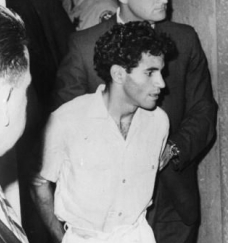
The aggrieved Palestinian was not marked by fate to suffer that last extremity of the law, however; instead, his sentence was commuted to life imprisonment when all existing death penalty statutes were invalidated in 1972.*
As a result, Sirhan Sirhan remains alive as of this writing, serving that sentence in the Golden State’s Pleasant Valley State Prison. He’ll be next up for parole in 2011.
(In a parole appeal back in 1982 — he’s been on a bit of a losing streak — the convicted assassin had the chutzpah to complain that “if Robert Kennedy were alive today, I believe he would not countenance singling me out for this kind of treatment.”)
Although the guy was seen in a crowded room pulling the trigger (onlookers tackled him) and he subsequently confessed to the deed, there has long been a conspiratorial counternarrative suggesting that other shooters were there, too. It’s pretty hard to say that the guy who emptied his chamber in front of dozens of witnesses wasn’t involved, but there are versions of this where he’s a Manchurian Candidate-style hypnotized patsy.
Politics: much more interesting in the 1960s.
Precisely because that is so, this particular man’s crime attracts retrospective interest for what followed: the charismatic Democratic frontrunner from Camelot cut down; the sinister Richard Nixon arising in his place to bomb Cambodia, burgle Watergate, and create the Environmental Protection Agency. Sirhan Sirhan “assassinated modern U.S. history.”
Sirhan Sirhan himself has contributed to the trippy theorizing about his case by being all over the map on it. At one point, he attempted to plead guilty and draw the death penalty; the trial judge forced him to go through with a defense. Subsequently, as noted, he’s whinged for an early release. He’s claimed to have had no memory of the attack, which certainly isn’t what he said after he got arrested.
Ultimately, the most self-evident explanation has always been the first one that he offered: “I did it for my country.”
Kennedy was a strong advocate of that policy, and his death happened to coincide with the anniversary of war.
Maybe that’s just what they want you to think. But it has to be allowed that the cause in question has claimed more lives than just RFK’s.
* People v. Anderson, decided by the California Supreme Court. Later that same year, the U.S. Supreme Court would issue Furman v. Georgia, which would have had the same effect for Sirhan Sirhan.
This date in 1965 saw the end of the road (and the end of the rope) for Dick Hickock and Perry Smith, the drifters who slaughtered the Clutter family in Holcomb, Kansas, and inspired Truman Capote’s magnum opus In Cold Blood.
Hickock (left) and Smith.
These ex-cons — Smith, the smart Korean War veteran; Hickock, the fallen high school jock turned small-time hood — got a tip from a fellow jailbird that Herbert Clutter’s farm had a well-stocked safe.
On November 15, 1959, they raided the farm, tied up and shotgunned the family of four, and made off with … 40 bucks. Alas: no safe.
The horrific, out-of-nowhere brutality of the crime — “apparently the work of a psychopathic killer” — made national headlines and drew Manhattanite Truman Capote out to small town Kansas (along with novelist Harper Lee, whom Capote used to gain the confidence of locals).
The killers were caught on the lam in Nevada, and as the case unfolded,* Capote’s sympathy for Smith unlocked a spellbinding book that put this day’s murderers in the literary canon.
I really admired Mr. Clutter, right up until the moment I slit his throat.”
– Perry Smith
(Perry Smith was first protrayed on celluloid by actor Robert Blake, who would one day stand trial himself for arranging the 2001 murder of his wife. Blake was acquitted.)
On this date in 1782, Captain Joshua Huddy of the revolutionary New Jersey patriot militia was summarily (and extrajudicially) hanged on the New Jersey coast by the British Tories.
Huddy was a troublesome rascal in civilian life, a regular denizen of courts in his native Salem, Mass., and (upon transplant in 1778) Monmouth County, N.J.
Tory British Loyalists found him troublesome in the bare-knuckled revolutionary conflict in Monmouth, “often engaged in raids and revenge executions, which continued even after the war’s end.”
Huddy mounted various guerrilla raids in the area from 1779; his Loyalist opposite number actually captured him in 1780, but Huddy was freed by his comrades before he could be taken to the British.
Not so lucky this time.
On March 24, 1782, Loyalists overwhelmed Huddy’s fort at Toms River, N.J..
This was, de facto if not de jure, within the compass of those raids occurring after the war’s end, since at five months after Yorktown, the American Revolution was settled in all but name.
Huddy figured to be exchanged for Loyalist prisoners, but word came that a Monmouth County Tory named Philip White had been killed.
The last English royal governor of New Jersey, William Franklin,* ordered Huddy’s execution in retaliation-slash-punishment without any form of court-martial. (It seems the Loyalist position was that Huddy had himself been involved in White’s death; the Patriots insisted that Huddy was already in British hands when White was killed.)
We the refugees, having with grief long beheld the cruel murders of our brethern, and finding nothing but such measures daily carrying into execution — we, therefore, determine not to suffer without taking vengeance for the numerous cruelties; and thus begin, and, I say, may those lose their liberty who do not follow on, and have made use of Captain Huddy as the first object to present to your view; and further determine to hang man for man while there is a refugee existing. Up goes Huddy for Philip White.
(Two other prisoners taken with Huddy were exchanged, and had the story to tell — including Huddy’s remark that he would “dye innocent and in a good cause.”)
This, of course, caused quite a hue and cry for vengeance on the Patriot side.
George Washington demanded Huddy’s executioner for a bit of tit-for-tat, but although the British repudiated the lawless hanging, they refused to give Washington his man. Richard Lippencott (or Lippincott) instead got a British trial in New York, skated on an only-following-orders defense, and subsequently retired to Canada to live to the ripe old age of 81.
The frustrated proto-Americans resorted to selecting a captured Yorktown officer by lot for a reprisal execution.
Since Asgill turned out to be a charismatic, youthful officer of unblemished honor, nobody felt good about the situation; even Huddy’s widow asked for Asgill’s life to be spared. (Though that might also be because Huddy stiffed her in the will he scribbled out moments before death, written on the head of the barrel they used to hang him.)
Eventually, pressure from the Revolution’s French patrons — the hostage had a Huguenot mother — helped Asgill avoid hanging.**
Returned to the British, Asgill went on to become a very prominent general.
Memorial for Joshua Huddy at Huddy Park in Highlands, N.J. Image (c) Sheena Chi and used with permission.
* Son of American patriotic luminary Benjamin Franklin. This is why you don’t talk politics with family.
** Upon his release from American custody, Asgill traveled to France to thank personally his royal saviors. Louis XVI and Marie Antoinette could hardly have imagined that they would one day soon stand in Huddy’s shoes.
On this date in 1984, Elmo Patrick Sonnier was electrocuted in Louisiana’s Angola Prison for abducting and murdering two teens in St. Martin Parish.*
Elmo and his brother Eddie posed as police officers and handcuffed two high schoolers parked at a local makeout point. Then they raped the girl, and shot both of them dead.
Eddie managed, as he said, to “give it back” on the grounds that Patrick was the one who did the shooting.
Once Eddie was clear of the death penalty, he tried to cop to the shooting after all, in order to save his little brother.
The appellate life of this case involved unedifying revisions of the “who shot whom” story. Ultimately, Eddie’s later claim to have been the triggerman, though quite possibly true, is not likely to win very much sympathy for his brother. It didn’t help him in the courts, either.
Just the 17th person executed since reinstatement of the death penalty, Sonnier learned that his longshot bid for clemency had been denied straight from the man who denied it — colorful, corrupt Louisiana Gov. Edwin Edwards, who personally phoned Sonnier to give him the bad news.
Little did Sonnier know that he had equally famous company meeting him in his cell.
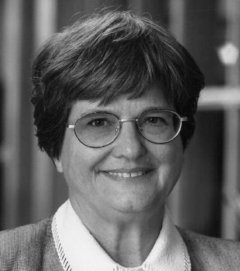
Sonnier was the first condemned inmate to receive the spiritual ministration of Sister Helen Prejean.
The then-obscure Louisiana nun would later write the bestseller Dead Man Walking about her experiences with Sonnier and a second death row prisoner, Robert Lee Willie. Prejean remains among the most well-known death penalty opponents in the world today.
While the book Dead Man Walking treats Sonnier and Willie in a nonfiction vein, the film adaptation (review) amalgamated those people into a single character, the fictional “Matthew Poncelet”. It’s apparent from the flashbacks in Dead Man Walking‘s execution scene, however, that Sonnier is the predominant influence on “Poncelet”.
Dead Man Walking is an interesting movie. Though its principals were all vocal death penalty opponents, the film itself is much better art than propaganda. Arguably, the doomed criminal attains a sort of personal redemption — finally admitting responsibility for a crime he had denied for much of the film; seeking the forgiveness of his victims’ surviving family — only because the death penalty awaits him.
Susan Sarandon won an Oscar for Best Actress for her turn as Sister Helen. Note that while Sonnier was in fact put to death in the electric chair (as was Robert Lee Willie), director Tim Robbins opted to portray a lethal injection because, as Helen Prejean herself put it,
we don’t want to give people the moral out whereby people could say ‘oh well, we used to do electrocution but that’s too barbaric so now we are humane and inject them’
* The murder that led to this date’s execution took place in the same area where Willie Francis survived a trip to the electric chair: the very chair that killed Patrick Sonnier.
Skirmishes in the frontierlands at length triggered a Texan reprisal-slash-plundering expedition.
The officially independent Somervell Expedition of volunteer Texan militiamen captured a couple of Mexican towns, then disbanded to go home. Those members of it optimistic about their chances for more raiding set off for Ciudad Mier* — the Mier Expedition.
The Mier Expedition was a flop, and the irate Mexican President Santa Anna ordered the entire band shot to make an example. Anglo diplomatic wrangling got him to go down to shooting one tenth of the band.
Well, you’ve gotta pick that tenth somehow.
The Black Bean Lottery
So on this day, 176 potentially condemned men were made to draw a bean from a pot containing 159 white ones and 17 fatal black ones.
For the lucky 159, there was no rush quite like winning your life from a legume, as this survivors’ account describes:
I knew then that I was safe, and the revulsion of feeling was so great and rapid that I can compare it to nothing except the sudden lifting of an immense weight from off one’s shoulders. I felt as light as a feather.
The 17 for whom the cosmos had ordained frijoles negros took a quick leave of their companions, and were shot in two batches. (Here is a thorough discussion of the entire affair.)
It was a typically dicey death by musketry, with lots of people requiring multiple volleys. One of the 17, one James Shepherd, even survived the execution altogether by playing dead. (He fled during the night, but was later recaptured and [successfully] re-shot.)
The most hated man (by the Mexicans), Ewen Cameron, pulled white, but Santa Anna thought better of letting him draw air and had him separately executed a month later. The rest of the lottery’s “winners” languished in prisons and work camps for more than a year of continued Texas-Mexico hostility, until they were amnestied and released in September 1844 — many destined to renew hostilities in the imminent Mexican-American War.
That survivor quoted above, William “Bigfoot” Wallace, was one of those re-enlistees. His colorful career with the Texas Rangers earned him a minor star in the firmament of Americana; he appears in Larry McMurty’s Lonesome Dove prequel Dead Man’s Walk … only in that version, he gets cinematically black-beaned at the big moment, as in this clip from the miniseries of the same title.
* The town is latterly famous as a key transit point for arms smuggling to Fidel Castro to supply the Cuban Revolution.
Jackson was described as standing erect and playing the part of an actor. Walling trembled with his eyes downcast. At that point, Jackson was again asked if he had anything to say. An eyewitness said, “Jackson hesitated fully two moments before he replied. Before he spoke, Walling turned expectantly evidently believing Jackson would speak the words that would save his life, even while he stood on the brink of death. Walling had half turned around and he stood in that position with an appealing expression on his face, while Jackson without looking at him, upturned his eyes and replied, ‘I have only this to say, that I am not guilty of the crime for which I am now compelled to pay the penalty of my life.”
Walling was then asked if he had any comments. He said, “Nothing, only that you are taking the life of an innocent man and I will call upon God to witness the truth of what I say.”
At 11:40am the trapdoors opened and Jackson and Walling were hanged.(Source)
Jackson and Walling had been convicted the previous year in separate trials — each defendant accusing the other — for the murder of Pearl Bryan, a naive Greencastle, Ind. farmgirl who had gone in search of an illegal abortion and turned up headless.
The notoriously grisly case — the decapitated body was only laboriously identified by tracing a manufacturers’ mark on her shoes back to her hometown — precipitated a nationwide media frenzy, ordinarily an ephemeral phenomenon.
But for the last public hanging in Campbell County, the crime beat couldn’t even scratch the surface of the weirdness.
Poor Pearl Bryan’s head, you see, was never found, and the culprits adamantly refused to divulge its whereabouts, prompting rumors of satanic ritual.
This occult connection (and the unsettled nature of a case with a head still at large) attracted paranormal associations.
Bobby Mackey’s Music World, a Wilder, Ky., honky-tonk, that opened more than 80 years after Pearl Bryan’s murder, is reputed to be haunted by her spirit and those of the men hanged for her death. (The actual connection of this building/site to Pearl Bryan or her killers is speculative at best, but to judge by the stories they tell about it, Bobby Mackey’s seems to be a spectral Grand Central Station. Don’t take it from me: a “ghost counselor” and the “President of the United States Psychotronic Association” both vouch for its spooky bona fides!)
On this date in 1985, Texas executed serial killer Stephen Morin for murdering and robbing Carrie Marie Scott in 1981 — one of at least three, and up to thirty, of his victims, most of whom were (unlike Scott) abducted for rape and kindred brutalizing.
Just the sixth person executed in Texas under its modern death penalty regime, Morin was an IV drug addict.
Death chamber technicians required 40-plus minutes to bore through the resultant scar tissue well enough to poison Morin. He’s been a bullet point on the anti-lethal injection brief ever since. (Oddly, Morin’s execution is not on this list of recent botches.)
But Morin’s most prominent afterlife is a very different object lesson: not medical ethics, but spiritual warfare.
It seems the last woman he kidnapped, Margy Mayfield, survived the encounter by converting the desperate fugitive to evangelical Christianity; this story is still stocked and sold by Focus on the Family. This is Mayfield’s own account of their meeting.

 During his abnormally protracted* (for the times) 12 years fighting death,
 I thought Chessman must be dead but no, there was another agonizing period during which he choked on the gas. And again. And then again. There was a long period, another deep gasp. At the fourth such straining, Chessman’s head lolled in a half circle, coming forward so that he faced downward with his chin almost touching his chest. This must be the end. But the dying went on.


 The aggrieved Palestinian was not marked by fate to suffer that last extremity of the law, however; instead, his sentence was commuted to life imprisonment when all existing death penalty statutes were invalidated in 1972.*


 Jackson was described as standing erect and playing the part of an actor. Walling trembled with his eyes downcast. At that point, Jackson was again asked if he had anything to say. An eyewitness said, “Jackson hesitated fully two moments before he replied. Before he spoke, Walling turned expectantly evidently believing Jackson would speak the words that would save his life, even while he stood on the brink of death. Walling had half turned around and he stood in that position with an appealing expression on his face, while Jackson without looking at him, upturned his eyes and replied, ‘I have only this to say, that I am not guilty of the crime for which I am now compelled to pay the penalty of my life.”
 Just the sixth person executed in Texas under its modern death penalty regime, Morin was an IV drug addict.
