1961: William Morgan, the Americano

On this date in 1961, American William Morgan — once an anti-Batista rebel — was shot in Havana’s La Cabana fortress for counter-revolutionary activity against the Castro government.
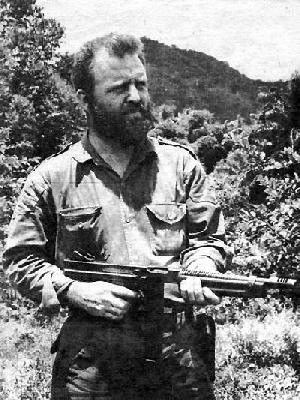
The high school dropout and army washout went to Cuba around late 1957 or early 1958.

He’d had an unsettled life, this Morgan. He’d been a convict, a circus sideshow, a wanderer. But he was about to make his name.

This strange gringo soon to be nicknamed “El Americano” walked into the Escambray Mountains and joined a group of anti-Batista rebels that was unaffiliated with Castro’s 26th of July Movement. Morgan won the respect of Cubans for his courage and his evidently un-mercenary commitment to the cause.

Fatally for him, that cause was a constitutional-democracy take on opposing the Batista dictatorship.

Morgan was stridently anti-Communist and not shy about saying so.

“There isn’t anyone in Cuba who doesn’t know where I stand-Fidel, Raul, or anyone. I am anticommunist. I don’t like them.”

That attitude would put him on a collision course with the only other foreigner to hold a comandante rank among the anti-Batista guerrillas: Argentinian Ernesto “Che” Guevara.

Those two men’s columns nearly exchanged shots when Guevara was dispatched by Castro to reach an understanding with Morgan. Morgan and Guevara came to terms that day — there was a revolution to be won, after all — but animosity would remain between these two impassioned freedom-fighters whose visions of freedom could never be reconciled.

They personify the competing choices before post-Batista Cuba, in those first years when Cuba kept to a tenuous hold on non-alignment.

Morgan supported that revolution; he even made the headlines for dramatically foiling a Dominican-backed plot to topple Castro in 1959.

But it was Guevara who was the future. More radical July 26th members won senior spots in the new administration, while outsiders like Morgan got assignments like frog-farming. Geopolitical events saw Cuba sliding into the Soviet camp.

Disenchanted, Morgan started plotting for real.* It didn’t work.

He was caught in late 1960, held incommunicado for a period, then tried, convicted and condemned two days before his execution (along with fellow-traveler and -plotter Jesus Carreras Zayas (Spanish link)) after nightfall March 11, 1961.

Morgan’s execution was carried out by a fellow Yanqui, Herman Marks — himself destined to run afoul of the Castro regime down the road. (Marks fled back to the U.S.) The sympathetic account of el Americano‘s death is quite the flowery affair, with the Cubans kneecapping Morgan when he defiantly refuses to kneel.

Castro himself is sometimes said to be present, the shadowy observer issuing the fatal commands to which Morgan will not bow, like the insouciant silhouette of Stalin behind a screen at trials where his former henchmen were purged.

A poetic touch, though one would think a head of state might have more pressing business than personally orchestrating executions: and indeed, it seems that Fidel actually spent that evening at a diplomatic reception with Soviet and Chinese ambassadors. Two months later, Castro officially declared Cuba a socialist state.

And as with Morgan, so with many of his brethren-in-arms from the Escambray Mountains. It took Havana the better part of the 1960s to suppress anti-communist “bandits” in Morgan’s old stomping-grounds — Cuba’s (successful) War Against the Bandits.

* There’s more skullduggery in Morgan’s shadowy life than this post has space for, but theories exist that the Dominican plot he “foiled” was actually one he had been an earnest participant in before it was sniffed out by Cuban security, with the war hero Morgan forced to betray it.

On this day..

1951: The Lonely Hearts killers, tortured by love

“Who would give a law to lovers? Love is unto itself a higher law. ”

Boethius

On this date in 1951, the made-for-tabloids killer couple Raymond Fernandez and Martha Beck were electrocuted at New York’s Sing Sing prison for murder.

He was a toupeed middle-aged lothario with a knack for conning personal ad denizens. She was a lovelorn obese single mother* with a serious dark side. Together — through a chance meeting through the personals — they became the Lonely Hearts Killers.

Martha Beck started off as just another of Raymond Fernandez’s targets: charm them, promise engagement or undergo a faux-wedding, and then rob them. He’d pulled this off a few times before; he might have even killed at least one of them.

But something clicked when he met Martha.

Or rather, Martha made it click.

Fernandez did the love ’em and leave ’em routine with Martha, whom he soon realized was penniless. But their passionate hotel rendezvous had been spied by the local bluenoses, who promptly got Martha fired for her indiscretions. She showed up unannounced at Fernandez’s door, and pushed her way right into his life.

Ere long, they were cohabiting — lurid media accounts would later savor their “abnormal sexual practices” and their, er, lifestyle relationship. She caused near-riots among the crush of spectators at their circus trial when she got into specifics of freaky stuff like voodoo fetish play.

“A request from Mr. Fernandez to me is a command,” Martha testified. Since this was so — though the power dynamic between them really seems to have run in the other direction — she willingly joined in Mr. Fernandez’s scam, posing as his “sister” when he went to meet and charm his next mark.

Once such assets as could be had were signed over, the pigeon was disposed of: often, they’d just make the “honeymoon” so unbearable that the target got the picture and left, so humiliated she wouldn’t dare come forward with the story.

And sometimes — nobody seems to know exactly how many times — Raymond and Martha killed together.

Martha (whose own sob story of ostracism and childhood neglect is really quite sad) supplied much of the vengeful energy that impelled the murders. One of their victims was a woman Beck attacked in a jealous rage when Fernandez actually slept with her. (The “sister” would often impose on the sleeping arrangements to obstruct consummation.)

The Lonely Hearts Killers’ crime spree is thoroughly covered elsewhere. It carried them to Michigan, a non-death penalty state where they were arrested. There, they confessed in a ploy to draw a local sentence and avoid execution.

Michigan instead extradited them to New York to stand trial in a sweltering courtroom and on every Gotham newspaper’s daily headlines for the murder of a Long Island widow. That confession given in Michigan helped seal their fate in New York.

Though separated from one another on death row (but they kept up the treacly correspondence), Martha and Raymond were joined in death.

On International Women’s Day of 1951, both were executed in New York’s electric chair, along with two unconnected, run-of-the-mill murderers.

My story is a love story. But only those tortured by love can know what I mean … in the history of the world, how many crimes have been attributed to love?

-Martha Beck

Given the newspaper ink spilled over these two, it’s no surprise that they’ve inspired plenty of subsequent writers and directors. The Honeymoon Killers (review) is a creepy 1970 classic, with a couple of latter-day imitators.

* She abandoned her two kids to the Salvation Army when she hitched her wagon to Fernandez.

On this day..

1955: Gerald Albert Gallego, like father like son

On this date in 1955, murderer Gerald Albert Gallego became the first client of Mississippi’s new gas chamber.*

It was a botched job, though that didn’t stop Mississippi from retaining the gas chamber into the 1990s.

Gallego coughed, choked, and wheezed on a less than lethal cloud of cyanide poisoning. Finally, after some forty-five minutes while officials feverishly worked to correct the problem, the repairs were completed and Gallego quickly died. An additional step was then added to the required testing of the chamber prior to an execution: an animal, usually a rabbit, would be placed in a cage in the chamber chair and cyanide gas was released to make sure the mixture was sufficiently lethal.

Gallego killed a cop, then engineered a prison break out of death row by giving a guard a faceful of acid and a fatal beating.

But if you think he was bad, get a load of his son.

The younger Gerald Gallego drew two gas chamber sentences of his own, in California and Nevada, for a far more diabolical crime spree (though he ultimately died in prison, not at the hands of an executioner).

The son’s story is the subject of The Sex Slave Murders: The Horrifying True Story of America’s First Husband-and-Wife Serial Killers, whose author gave an interview to indefatigable true-crime blogger Laura James here.

Despite the familial resemblance in lawbreaking, the father and son never met in this life.

According to The Sex Slave Murders, a prison conversion gave Gallego pere a care for his next life, and on his last walk this day to the gas chamber, he handed the Mississippi sheriff a note that read in part,

Sheriff, if at any time you should have young men in your jail, please tell them that I was once like them, and should they continue, there is no reward but hardships and grief for their parents.

* Mississippi’s gas chamber replaced the electric chair.

On this day..

1922: Henri Landru, French Bluebeard

“Widower with two children, aged 43, with comfortable income, serious and moving in good society, desires to meet widow with a view to matrimony.”

The personal ads sections of the Parisian papers were the stalking-grounds of French Bluebeard Henri Désiré Landru, guillotined in Versailles this date in 1922.

A former soldier himself, Landru trawled the Craigslists of World War I for their ample population of ample war widows.

His M.O.: enchant one into letting him get his hands on her huge … fortune.

(No, really. Her fortune.)

Then, kill her and incinerate the body in his kitchen stove.

Repeat x10 (plus one teenage son of one the widows), and you’ve got yourself your basic Bluebeard.

Landru’s story inspired the 1947 Charlie Chaplain flick Monsieur Verdoux.

And that’s not the only thing of Landru’s that made it to Hollywood. His severed dome is on exhibit at the Museum of Death.

On this day..

1865: John Yates Beall, well-connected Confederate

On this date in 1865, Confederate John Yates Beall was hanged at Governors Island, New York, as a spy and saboteur.

This Virginian was knocked out of regular service through injuries early in the Civil War, but proceeded to a privateering career harassing Union shipping.

The pinpricks inflicted by Beall’s couple of ships was hardly calamitous for the North, but what he lacked in resources he made up in persistence.

Captured and exchanged midway through the war, he returned to his swashbuckling ways. But sneaking into New York from Canada in a bid to free rebel prisoners, Beall was caught again trying to derail trains — and secretly condemned by a military tribunal.

When the news of his impending execution got out, six Senators and 85 other members of Congress* appealed for leniency.

Despite Lincoln’s reputation for clemency, he did not grant it in this case.

“For days before the execution,” it was said, “the President closed the doors of the executive palace against all suppliants, male or female, and his ears against all appeals, whether with the tongue of men or angels in behalf of the unfortunate prisoner. From the first Mr. Lincoln had responded to all applications for his interposition — ‘Gen. Dix may dispose of the case as he pleases — I will not interfere.’ Gen. Dix on his part replied, ‘All now rests with the President — as far as my action rests there is not a gleam of hope.’ Thus they stood as the pillars of the gallows, on which Beall’s fate was suspended and between them he died.” (Source)

Here’s the capture-trial-and-execution portions of a homemade documentary on Beall (also check the preceding parts 1, 2, and 3)

There’s a strange tradition that the hanged man was a personal friend of John Wilkes Booth, and that the actor’s assassination of Honest Abe seven weeks after Beall’s hanging was partly motivated by personal revenge.

* One of Beall’s clemency supporters was future assassinated U.S. President James Garfield.

On this day..

1951: Charlie Gifford, politician-killer

On this date in 1951, Charlie Gifford was electrocuted in Florida’s Raiford Prison for murder.

The murder victim was popular young Florida legislator/war hero Charles Schuh, whose promising political career ended abruptly on April 24, 1950, when the 71-year-old Gifford strode into his St. Petersburg offices and shot him dead over some head-scratching private grievance relating to Schuh’s legal practice. (Schuh represented Gifford’s ex-wife in a divorce proceeding.)

An insanity defense didn’t fly, though Gifford’s purchase on reality seems to have been … hit and miss. The septuagenarian perp didn’t seem to mind the death sentence.

The murdered legislator’s son, Charles E. Schuh, grew up into a political career of his own, eventually becoming mayor of St. Petersburg. Charles E. Schuh’s recent passing brought out this fascinating story by a former reporter who witnessed Gifford’s execution.

The electric chair was in the center, but the controls were behind a glass-enclosed area. I was repelled by the sight of “Old Sparky,” the electric chair. I was even more horrified to see that the executioner, a local electrician, wore a black hood reminiscent of the Inquisition. …

Today I am a decade older than Gifford was then, but to a 22-year-old reporter he seemed to be just a frail old man with a shaved head.

On this day..

1906: William Williams, the last hanged in Minnesota

On this date in 1906, Minnesota hanged a Cornish immigrant for the murder of his homosexual lover … and hanged him so clumsily that it never hanged again.

William Williams shot Johnny Keller dead after Keller’s mother intervened in the teenagers’ relationship. A series of mooning-slash-menacing letters failed to win back affections. “I want you to believe that I love you now as much as I ever did,” Williams wrote. “Keep your promise to me this time, old boy, as it is your last chance,” he wrote, later.

When the man with the redundant name went to die in the dead of night at a St. Paul prison, it seems that there’d been a slight miscalculation. When dropped through the trap, Williams’s “feet touched the ground by reason of the fact that his neck stretched four and one-half inches and the rope nearly eight inches.”

Consequently, three deputies on the scaffold hoisted the rope up to get him airborne, where he strangled to death over the span of a ghastly quarter-hour.

Slowly the minutes dragged.

The surgeon, watch in hand, held his fingers on Williams’ pulse as he scanned the dial of his watch.

Five minutes passed.

There was a slight rustle, low murmurs among the spectators and then silence.

Another five minutes dragged by.

Would this man never die?

Fainter and fainter grew the pulsations of the doomed heart as it labored to maintain its function.

The dead man’s suspended body moved with a gentle swaying.

The deputies wiped their perspiring brows with their handkerchiefs.

Members of the crowd shifted from one foot to another.

There were few murmurs, which died at once.

Eleven, twelve, thirteen minutes.

The heart was beating now with spasmodic movement, fainter and fainter.

Fourteen minutes—only a surgeon’s fingers could detect the flow of blood now.

Fourteen and a half minutes.

‘He is dead,’ said Surgeon Moore.

The end has come.

And the end had come.

Two things happened in consequence of this sensational press narrative.

First: the news entities who promulgated these descriptions were themselves prosecuted under a law sponsored by anti-death penalty Republican legislator John Day Smith to make executions as secretive as possible. The St. Paul Pioneer Press, St. Paul Dispatch and St. Paul Daily News each caught fines of 25 bones or clams or whatever you call them.

Second: those illicit descriptions out in the public eye triggered efforts (eventually successful in 1911) to abolish the death penalty full stop in the Land of 10,000 Lakes.

There’s a great roundup of the Williams case here, and a pdf from the Minnesota Historical Society about the background and consequences of the John Day Smith law, themselves quite topical for this blog.

Smith’s law was adopted as a half-measure when death penalty abolition couldn’t pass in 1889, as a bit of moral hygiene against the unseemly spectacle of public execution. The measure pioneered the familiar 20th century routine of conducting executions after midnight behind prison walls. Newspapermen derisively called it the “midnight assassination” law — but it was taken up by many other states over the succeeding years as public executions went extinct.

As for Smith himself … there’s a rumor of a ghost story, and (given a tragic love story, a sensational crime, a capital punishment milestone, and a queer identity) the palpable fact of a play.

On this day..

1910: George Reynolds and John Williams

At 6:30 this morning a century ago, two black men were hanged in Kansas City, Mo., for raping a white violinist less than seven weeks before.

There was really only one way this case was going to end.

The assault was of such a nature that intense feeling was aroused. Threats of lynching frequently were heard …

Prisoners in the County Jail raised bedlam when the verdict became known. They had previously threatened to lynch the negroes in the exercise room of the jail.

That’s from the Los Angeles Times blog’s roundup of its A.P. coverage from the Show-Me state a century ago — which further reveals George Reynolds and John Williams enjoyed a five-minute jury deliberation, and this vituperative sentence from the judge:

“They don’t even deserve to be classed with the murderer who must pay the penalty for his crime with his life,” continued Judge Latshaw.* “It would be an insult to these men, who had at least a spark of manhood in their hardened souls, to have such brutes as these put in their class. I don’t care to desecrate the day by ordering these two brutes hanged on the legal hanging day.”

(The regular hanging day — Friday — was safely un-desecrated; Reynolds and Williams hanged on a Tuesday.)

Reynolds fainted at the gallows. “Cowardly Brute,” the LA Times headlined it, also mentioning that he’d been starving himself for a week in a desperate bid to cheat the hangman. He maintained his innocence at the last.

* Judge Latshaw presided over a number of high-profile Missouri trials … often acquittals.

On this day..

1885: George Gibson and Wayne Powers

As of today, Scott County, Va., has gone 125 years since its last hanging — the execution in Estillville* of George Gibson and Wayne Powers for the drunken murder of a comrade.

Wayne Powers and Jonas Powers (brothers), and George Gibson and William Gibson (no relation), were on the road to West Virginia looking for opportunity and all that jazz, when the last-named William Gibson was slain by his traveling companions.

The crime was either one of minute pecuniary interest (the three survivors divided up the few dollars William had on him, and the clothes off his back), or just some inane drunken midnight quarrel between men who all happened to be well-armed.

At any rate, the inebriated killers “spent nearly the entire night trying to burn the body with a fire made of fence rails, and were thus discovered.”

Though all three were condemned, Jonas Powers was reprieved as not actually involved in the killing; both his brother and George Gibson used their scaffold time to insist upon his innocence. He was not ultimately executed.

His less fortunate companions did not neglect to blame Demon Rum for their woes, and took their leave of this earth doing their little bit to speed the day of a ruinous social policy.

O! may the cup of intoxicating drink never touch their lips, for it was this that has brought a fate so terrible upon their father. Society would do well to banish liquor forever from its midst. I, who have been decoyed to my ruin by it, might with some show of just reproach turn upon that people whose laws license this most deadly and dangerous of all agents, and say, ‘shake not thy glory locks at me.’”

The hanging itself was technically private, but the doomed men were trotted out on a stand outside the jail yard to address three thousand onlookers, and many of the public climbed trees to watch the gallows proceedings over the walls.

* Estillville is today known as Gate City. If the name rings a bell, it might be for its recent foray into the electoral fraud headlines.

On this day..

1996: William Flamer, Alito’d

On this date in 1996, William Flamer was executed for murder in Delaware.

He’s a forgettable criminal who, with an accomplice executed 19 months before, robbed and stabbed to death Flamer’s elderly aunt and uncle.

He has his small footnote in modern American death penalty jurisprudence in a case decided by then-circuit court judge Samuel Alito, which was — er — exhumed when President George W. Bush elevated Alito to the Supreme Court.

The matter was, to all but the initiated, a fairly picayune legal issue: if the jury that imposed his sentence used an aggravating factor subsequently found to be unconstitutional, could the sentence stand with the multiple other, constitutional aggravating factors it also used?

Little compelling as the issue might sound to all but the already converted, this sort of salami-slicing goes on justices’ daily bread to make up the great hero sandwich of jurisprudence. Mmm-mmm.

Anyway, the State of the Union head-shaker held — as Flamer’s presence in this blog would suggest — against the appellant.

Pdf examinations of Flamer v. Delaware (and other Alito death penalty legal opinions) prepared around the justice’s confirmation hearing are available from the Congressional Research Service and from the Criminal Justice Legal Foundation, the latter a pro-death penalty source.

(This decision also affected fellow Delaware death row inmate Billy Bailey, whom we have just met as the last man hanged in that state. Flamer could have had that distinction for himself; he chose lethal injection instead, and died four days after Bailey hanged.)

On this day..