1863: William Griffith, for the Marais des Cygnes massacre

One of the signal outrages of Bleeding Kansas was avenged with a hanging on this date in 1863.

“Bleeding Kansas” was the guerrilla war over slavery in the late 1850s that presaged the conflagration about to consume the Republic; here on the frontier, pro- and anti-slavery partisans traded atrocities in their respective campaigns to secure Kansas’s imminent entry to the Union as either a slave or a free state. The stakes, had America continued her antebellum course, were vital Congressional votes on which the continuance of the peculiar institution might one day hang.

The naked brutality of the conflict shocked its contemporaries; as one particularly notorious example, the sons of abolitionist crusader John Brown executed pro-slavery captives with broadswords.

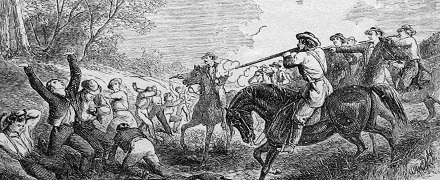
The Marais des Cygnes massacre was one of the last major horrors of that conflict: a party of 30 or so pro-slavery men led by Charles Hamilton seized 11 Free-Staters. They were mostly people who knew Hamilton personally, and seem to have gone along without resistance not anticipating what he had in store for them.

But Hamilton had told his men that on this campaign, “we are coming up there to kill snakes, and will treat all we find there as snakes.” (Source)

Much to their chagrin, these “snakes” were driven into a narrow ravine and lined up before Hamilton’s men’s guns. The volleys they delivered before fleeing back over the porous border into equally restive Missouri “only” killed five of their hostages: the other six survived by playing dead.


(Via)

Five years later, one of those survivors, William Hairgrove, supplied the identification that damned William Griffith — whose claim that he only helped capture the Marais des Cygnes victims, and didn’t help shoot them was an especially lame offering at the height of the Civil War.

According to Legal Executions in Nebraska, Kansas and Oklahoma Including the Indian Territory: A Comprehensive History, Griffith paid the forfeit for his role in the massacre “in a wood west of [Mound City, Mo.] on the opposite bank of Little Sugar Creek” before a crowd of thousands. There,

[a] little after noon Griffith was conveyed to the wood where he stepped onto the wooden platform a few inches above the ground. His wrists, knees and ankles were bound and the noose was adjusted. The black cap was pulled over his face at 1:07 p.m., and in but a moment William Hairgrove, one of the survivors of the massacre, cut the restraining rope with a hatchet; the four hundred pound weight dropped, jerking Griffith upward. The body rebounded and hung motionless while the attending physicians monitored his vital signs, and in twenty-five minutes they pronounced him dead.

Today, the site of the massacre is a U.S. National Historic Landmark. Quaker abolitionist poet John Greenleaf Whittier also memorialized the blood that was shed there in a poem titled “Le Marais du Cygne”:

A blush as of roses
Where rose never grew!
Great drops on the bunch-grass,
But not of the dew!
A taint in the sweet air
For wild bees to shun!
A stain that shall never
Bleach out in the sun!

Back, steed of the prairies!
Sweet song-bird, fly back!
Wheel hither, bald vulture!
Gray wolf, call thy pack!
The foul human vultures
Have feasted and fled;
The wolves of the Border
Have crept from the dead.

From the hearths of their cabins,
The fields of their corn,
Unwarned and unweaponed,
The victims were torn,—
By the whirlwind of murder
Swooped up and swept on
To the low, reedy fen-lands,
The Marsh of the Swan.

With a vain plea for mercy
No stout knee was crooked;
In the mouths of the rifles
Right manly they looked.
How paled the May sunshine,
O Marais du Cygne!
On death for the strong life,
On red grass for green!

In the homes of their rearing,
Yet warm with their lives,
Ye wait the dead only,
Poor children and wives!
Put out the red forge-fire,
The smith shall not come;
Unyoke the brown oxen,
The ploughman lies dumb.

Wind slow from the Swan’s Marsh,
O dreary death-train,
With pressed lips as bloodless
As lips of the slain!
Kiss down the young eyelids,
Smooth down the gray hairs;
Let tears quench the curses
That burn through your prayers.

Strong man of the prairies,
Mourn bitter and wild!
Wail, desolate woman!
Weep, fatherless child!
But the grain of God springs up
From ashes beneath,
And the crown of his harvest
Is life out of death.

Not in vain on the dial
The shade moves along,
To point the great contrasts
Of right and of wrong:
Free homes and free altars,
Free prairie and flood,—
The reeds of the Swan’s Marsh,
Whose bloom is of blood!

On the lintels of Kansas
That blood shall not dry;
Henceforth the Bad Angel
Shall harmless go by;
Henceforth to the sunset,
Unchecked on her way,
Shall Liberty follow
The march of the day.

On this day..

1859: Thomas Ferguson, but not on a Sunday

The first judicial execution of a white man* in the history of the Utah Territory took place on this date in 1859.

One Thomas Ferguson earned the distinction by getting roaring drunk and shooting dead the shopkeeper who employed and boarded him. Allegedly, Alexander Carpenter’s provocation had been to accuse Ferguson of being party to the unknown burglars who had lately raided his Salt Lake City shop, which obviously got way under Ferguson’s skin.

This was frontier America, being newly-settled by Brigham Young‘s upstart Latter-Day Saints sect, though not only by them. The capital’s population was perhaps 14,000 — the kind of place where dubious refugees could wash up from parts unknown, trusting their fortunes to their native wit and Colt’s Manufacturing Company.

“Crime has run riot in this city since the assassination of McNeill and Sergeant Pike” a hostile, non-Mormon correspondent wrote to the San Francisco Bulletin (letter dated Oct. 5, 1859, and published Oct. 27).

Till lately, no one has been arrested. Ferguson, a “Gentile,” murdered Carpenter, a Mormon, and for such an outrage “this people” will permit the sentence of death to be carried into effect; but the murderers of McNeill, of Pike, of Drown, of Arnold — the first two “Gentiles,” the last “apostates” — run at large to hold the community in terror and carry out other sentences.* An apostate committed suicide a few nights since by shooting himself twice in the back of the head!

Carpenter murdered his partner named Turner near Fort Laramie, Nebraska, brought their goods to this city, where, he said, (and convinced his associates,) he was tried and acquitted. Tried and acquitted in Utah for murder in Nebraska!

Both men were New Yorkers — and per a less strident observer writing to the New York Herald (datelined Oct. 7; published Nov. 7) neither of the two was Mormon. They had been allured to the West by the usual siren songs: wealth, fortune, fame. As young men do, these may have pictured themselves forever getting the drop on their enemies and never the other way around … and always with a dashing jailbreak at the ready if it came to that.

Unfortunately for Ferguson, he wasn’t the only Old West stock character in this tableau; a hanging-judge of dubious character named Charles Sinclair officiated the trial, so deep into his cups that he initially set Ferguson’s execution date for a Sunday. (It was changed to a Friday.) Ferguson himself gave the judge a right scorching from his scaffold rostrum on his way off this mortal coil:

I was tried by the statutes of Utah Territory, which give a man the privilege of being shot, beheaded or hanged. But was it given to me? No, it was not. All Judge Sinclair wanted was to sentence some one to be hanged, then he was willing to leave the Territory; and he had too much whiskey in his head to know the day he sentenced me to be executed on, and would not have known, if it had not been for the people of Utah laughing at him … A nice Judge to send to any country! (Source)

* The Espy file credits earlier executions of Native Americans, two Goshutes named Longhair and Antelope who hanged for slaying two whites during settler bush wars. (I would not venture to assert the judicial propriety, even by antebellum standards, of these proceedings.) And of course, Ferguson’s distinction excludes extrajudicial killings like the Mountain Meadows Massacre.

** The unpunished killings the correspondent names in this piece took place in the immediate aftermath of the 1857-1858 war between Mormon settlers in Utah and the federal government asserting its jurisdiction — a period when Brigham Young’s martial law had just been rescinded. Utah Gentiles inclined to read these incidents as emblematic of a lawless atmosphere in which reluctance to prosecute gave Mormons virtual impunity in their conduct towards the rest of the population.

On this day..

1773: Four convict labor escapees in Maryland

We owe this date’s post, as with a number of others on this site, to Anthony Vaver, proprietor of the superb (albeit recently dormant) Early American Crime blog.

Vaver wrote the book on pre-Revolutionary War convict transportation to the Americas, and we were directed to the men featured today in a post Vaver ran on one of the most common resistance strategies — running away.

Being shipped out of Britain to the American colonies where they faced years of involuntary labor and the prospect of being bought and sold like slaves, convicts could hardly fail to ponder the advantages of escape.

Many did more than ponder: colonial newspapers are rife with adverts for absconded convict laborers, whose descriptions of the fugitives also make for a rich source on the everyday accoutrements of the 18th century working class. Pictured here are a very few arbitrarily chosen samples of the genre:

Such self-liberation did not always entail slipping away in an unsupervised moment: more direct means were occasionally employed, a fantasy that many surely entertained counterpoised by the threat of violent state reprisal. The four men who hanged together at Frederick, Maryland, made bold to put the dream into bloody actuality.

These men had been purchased by a merchant specializing in the convict labor trade — part of “a parcel of convicts” as the New York Gazetteer matter-of-factly described it (Aug. 5, 1773) which Archibald Moffman obtained “in order to dispose of them again to advantage.”

Instead it was Moffman who was disposed of. As Moffman and his nonplussed workingman retinue traveled through Maryland,

about two or three miles on the other side of Frederick-Town, one of the servants told his master that he was too much fatigued to go any further; they therefore all rested themselves on an old tree by the side of the main road. After some time, Moffman told them they must proceed on their journey, but they refused and immediately threw him backwards over the tree, dragged him about five steps into the woods, and then cut his throat from ear to ear; took his pocket book and then went over the mountain, calling at every tavern on the road.

But while the proximity of wilderness and the mutability of identity in the 18th century potentially facilitated escape, the colonies’ sparse habitation also made it harder to disappear into the obscurity of plain sight. Maryland was one of the most populous of the New World jurisdictions with barely 200,000 souls in 1770. It wasn’t that everybody knew everybody, but at such scales one could only go so long without engaging by chance the recognition of some acquaintance or busybody.

Seen in this light, the decision of our murderous fellows to call at every tavern on the road looks a mightily ill-considered course of action for men who ought to have felt the scourge of desperation at their backs. At one of these watering-holes, someone who had noticed these convict laborers on the road recently as they accompanied the yet-unkilled Moffman now ran into them sans oversight, and made inquiries — justifiably skeptical of the “parcel’s” story that their owner was following a few leisurely clicks behind. Failing to find Moffman on his way down the road, he sent up an alarm and the cutthroat tipplers were soon detained. Confession, conviction, and execution all followed within a matter of weeks.

The newspaper stories about this quartet do not so much as mention their names.

On this day..

1866: Frank Ferris, a Portuguese ax murderer in New York

New York Times, Oct. 19, 1866:

FRANK FERRIS, the unfortunate man who is condemned to be executed to-day for the murder of his wife, has been positively refused a further respite by GOV. FENTON. No efforts have been spared by the Portuguese Minister, or Mr. Kintzing, his counsel, to secure a commutation of sentence to imprisonment for life. Both these gentlemen have personally importuned the Governor, but without avail, as he yesterday declared, for the last time, that he could see no reason for clemency in this case.

The murder of which FERRIS was convicted was committed on the night of the 9th of September, 1964, and seems to have been as deliberate as it was horrible. After having announced his purpose, he went to the room occupied by his wife, and after breaking in the door with an ax, beat her brains out with the same instrument. He was arrested by the side of his victim, with the murderous weapon in his hand.

He was formally indicted, tried, and, on conviction, sentenced to be hanged in April last. The case was appealed, and after a review of the proceedings he was resentenced. A respite was granted form the 17th of August until to-day, when the execution will take place.

FERRIS has been a very troublesome prisoner during his incarceration, his querulous and jealous disposition occasioning the keepers much trouble. He found fault with everybody and everything that came near him — the physicians, the keepers, his counsel, his friends, his food and his accommodation, and even so late as yesterday, repeated to our reporter the long list of fictitious grievances which have troubled his mind so much. His nature seemed to be devoid of gratitude, and for all the favors gratuitously heaped upon him by the representatives of his country, his counsel and the prison officials, he has had no word of thanks, but rather of censure.

Although he has been carefully examined by experts in reference to his sanity, and pronounced a responsible person, there are certain points upon which his perverseness would seem to amount to insanity. He says that he has forgiven all his enemies and is prepared to die, yet speaks with great bitterness regarding some of the witnesses who testified against him, and persons who have been of service to him since his arrest.

Twice since his sentence was pronounced he has been deprived of the means of self-destruction. Once he made a great fuss because he had no looking glass. One was furnished him, and shortly afterward a quantity of strychnine was found concealed between the glass and the frame. Subsequently an apple was found in his cell stuck full of matches. Matches had been furnished him for lighting his pipe, and he had stuck the ends of these, which contained the phosphorous and brimstone, into an apple, doubtless intending, when a sufficient supply of the poison was obtained, to eat the apple.

FERRIS had been attended constantly of late by Fathers DURANQUET and MCKENNA, who have endeavored to prepare him for his fate. While he talks fairly upon religious subjects, it is evident from the manner in which he converses upon other subjects, that his thoughts are “of the world worldly.” He appears in good health, is strong and vigorous, and says he will walk manfully to his death. He did contemplate making a speech under the scaffold, but at the instance of his spiritual advisers has relinquished the idea.

All the preparations for the execution are completed. The gallows — on which GONZALES and PELLICIER were hung last Friday — was erected yesterday, and the usual preliminaries arranged. During the erection of the gallows, FERRIS was removed from the condemned end of the first floor of the prison to one in the second corridor, where the sound of the carpenter’s hammer could not reach his ears. The execution will take place around 10 o’clock to-day.


New York Times, Oct. 20, 1866:

FRANK FERRIS, alias FRANCISCO FERREIRA, was executed yesterday morning at the Tombs for the murder of his wife, MARY FERRIS, on the night of Sept. 9, 1864. The murderer was a Portuguese, 36 years of age, and was a sea-faring man. His victim was an Irish woman, the mother of three children, two of them by a former husband. FERRIS was an intemperate man, of violent temper, and often had severe quarrels with his wife. Instead of contributing to the support of his wife and children, FERRIS squandered in drink the money earned by his wife by washing and ironing. He enlisted as a private soldier in a Massachusetts regiment early in 186, but after a few months’ service was discharged for disability. He returned to New York, resuming his old habits, and his wife refused to live with him. He became jealous, and in his drunken frenzy frequently threatened to take her life. Unfortunately those threats were not heeded, and the brutal murder was committed.

THE MURDER.

MARY FERRIS, the wife of FRANK FERRIS, occupied the top floor of the tenement-house, No. 31 James-street. She was living with her children apart from her husband. She is spoken of by some as a hard-working, industrious, patient woman. Others alleged, and her husband among their number, that she was a prostitute and a disorderly character. No evidence of this kind, however, was adduced at the trial, but a good character was given her.

Her husband had been striving to insinuate himself into her lodgings for weeks, and on her refusal to live with him, had beaten her repeatedly. But a short time before the murder he had assaulted her with an ax, and inflicted such wounds upon her that her life was despaired of. At the instance of her friends she procured the arrest of her husband, and on her complaint he was sentenced to the Penitentiary.

Upon the expiration of his sentence, FERRIS returned to New-York and commenced a search for his wife, but for two or three days he was unable to find her. He finally traced her to her lodgings, and on the 9th of September he called there. MRS. FERRIS was not in and he went away. He had been drinking freely, and while in the house where his wife lived he made terrible threats against her. At one place where he called on that afternoon to inquire for her, he knelt in the middle of the room and said: “I swear by the Virgin Mary and Jesus Christ that I will kill her before 9 o’clock to-night …”

He also swore that he would kill himself.

When asked what would become of his children, he replied that they could go on the island. He was observed during the day sharpening a knife on the curbstone in front of the house in which his wife lived. When MRS. FERRIS returned from her work she was informed of the threats made by her husband, and, yielding to the entreaties of her friends, she removed her children and some of her things to the room of a neighbor on a lower floor of the building, where she gave the children supper and put them to bed, intending to remain there with them.

About 8 o’clock in the evening, FERRIS, armed with a heavy, dull ax, went to his wife’s room, and finding the door fastened broke it in with the ax. Disappointed at not finding his wife within, he commenced destroying the furniture. MRS. FERRIS hearing the noise, and hoping to save her furniture, rushed up to her room despite the warnings of her friends. She found the door shut, and a few words were exchanged by her on one side of the door and him on the other. The door then opened, and the woman passed into the room. A moment later she appeared at the window, screaming “Murder, watch!”

UNDER THE GALLOWS.

Yesterday morning about 200 persons gathered within the walls of the prison to witness the execution. Capt. JOURDAN, of the Sixth precinct, was in attendance with a force of 150 policemen, for the purpose of preserving order within and without the prison. The clergymen were saying the last prayers in company with the prisoner in his cell as the spectators were assembling. Sheriff KELLY was with him also most of the morning, and superintended his dressing for the scaffold. The fatal cord was adjusted about his neck, and the black cap was fitted to his head by Mr. GEORGE ISAACS, upon whom the duty of executioner devolves.

FERRIS then bade good bye to all present, and everything being in readiness the solemn procession moved toward the gallows, FERRIS walking between Sheriff KELLY and Mr. ISAACS, preceded by the clergymen. As they emerged from the cell the condemned man began singing, in a clear and distinct voice, a Portuguese hymn, usually sung by his countrymen when the holy sacrament is being given to a dying man. He continued singing as he walked through the line of spectators, concluding the hymn as he took his place beneath the gallows.

In his hand he carried an ebony crucifix, and as he ceased singing he kissed this several times. He then knelt down between the priests, the Sheriff and his assistants kneeling also, and the last prayers were said. He then rose to his feet, and on being asked if he wished to say anything, he replied that he did. In a clear voice, but in scarcely intelligible English, he spoke as follows:

HIS LAST WORDS.

My Dear Gentlemen: I am going to die, and I am innocent of the crime for which I suffer. I do not mean I did not do it, but, though my hand is guilty, my heart is innocent. But for Father DURANQUET and the good Sisters of Mercy, I would have had more to say, and give an account of some people. Good bye, my dear brothers — Amen.

He then thanked Sheriff KELLY for his kindness to him, and resumed his position under the rope. Mr. ISAACS then pulled the black cap over his face, adjusted the rope which was around his neck to that dangling from the beam and all was ready. The Sheriff, with his handkerchief, gave the signal, and with the fall of the heavy weights behind the screen, the body of FRANK FERRIS was drawn into the air. There were a few spasmodic twitchings of the limbs, a convulsive clutching of the hands, and then all was quiet. It was just 9 o’clock and 50 minutes when the weights fell, and in fifteen minutes pulsation had ceased. The body was partially lowered and examined by several physicians, and a few minutes later was taken down and deposited in a plain coffin.

BURIAL.

The body of FERRIS is to be buried in Calvary Cemetery, the Portuguese Consul having made arrangements to that effect, and defraying the expenses of burial.

THE CHILDREN.

The orphan children of FRANK FERRIS and his murdered wife have been cared for by the Catholic charitable institutions of the City. The Sisters of Mercy have taken the two girls, and the Brothers of Mercy the little crippled boy. The injury to this child was received after the incarceration of the father, and while in the care of Mrs. FERRIS’ sister. The father manifested much affection for the boy, and not till recently, if ever, forgave his sister-in-law for her carelessness in permitting the child to fall out of a window.

On this day..

1862: Ten Confederate hostages in the Palmyra Massacre

On this date in 1862, Union Gen. John McNeil had ten Confederate soldiers shot in what history has recorded as the Palmyra Massacre.

The Slave Power’s northern salient, Missouri was surrounded to the east, north, and west by free soil — which made it an antebellum flashpoint since the days of the Missouri Compromise.*

In the 1850s, the Missouri conflict spilled into neighboring Kansas as the enemy sides of the slavery question fought to determine whether Kansas would enter the Union as slave state or free. The Missouri borderlands of Bleeding Kansas was where the radical abolitionist martyr John Brown made his name, commanding free state militia in a guerrilla war that presaged the coming clash of North and South.

By the time we lay our scene in 1862, John Brown has exited courtesy of Virginia’s gallows, and the dragon’s teeth sown in Missouri and Kansas and everywhere else had sprung to horrible life. Missouri’s own civil war pitted neighbor against neighbor throughout the state in a bushwhacking conflict that extended locally for many years after Appomattox.**

The nastiness of the years to come is aptly suggested by this date’s events.

Like neighboring Kentucky, Missouri was a border state with a Union government, albeit one contested by a rival Confederate government. From the standpoint of the North, all Confederate activity there was behind its lines and the perpetrators therefore potentially subject to treatment (up to and including execution) as spies, saboteurs, and the like.†

Joseph Chrisman Porter, a Confederate officer, was one such possible client of this here site, tapped as he was for recruiting and raiding operations in northeast Missouri. His Union adversary Gen. John McNeil saw Porter as basically a terrorist. In August of 1862, Porter’s aide Frisby McCullough fell into McNeil’s hands: the Union general had McCullough shot.

On September 12, Porter raided the town of Palmyra, where McNeil held a number of Confederate prisoners. In the course of the raid, he kidnapped Andrew Allsman, a 60-year-old Palmyra resident. “It was said of him that he was able to inform the military authorities of certain movements of the enemy, and that he gave definitive information as to the homes and whereabouts of many men of Confederate leanings,” in the words of this pro-Confederate 1902 pamphlet on the incident. “Naturally, this placed him in disfavor with the Southern sympathizers and those who were fighting in that cause.”

What happened next — though it was not known to the Union at the time — was that Allsman was shot. The pamphlet just cited attempts to obfuscate this event into the fog of war and not really Porter’s fault. The bare fact is that his raiders had gone out of their way to seize an aged non-combatant and then summarily executed him.

Not knowing Allsman’s fate, McNeil responded with an ultimatum to his opposite number.

Palmyra, Mo., Oct. 8, 1862.

To Joseph C. Porter.

Sir: — Andrew Allsman, an aged citizen of Palmyra and a non-combatant, having been carried away from his home by a band of persons unlawfully arraigned against the peace and good order of the State of Missouri, and which band was under your control, this is to notify you that, unless Andrew Allsman is returned unharmed to his family within ten days from date, ten men, who have belonged to your band, and unlawfully sworn by you to carry arms against the government of the United States, and who are now in custody, will be shot as a meet reward for their crimes, amongst which is the illegal restraining of said Allsman of his liberty, and if not returned, of presumptively aiding in his murder. Your prompt attention to this will save much suffering.

Yours, etc.,

W.R. Strachan
Provost Marshal General Northeast District of Missouri
By order of Brigadier General commanding McNeil’s column

The Confederates, of course, could not produce Allsman.

So, on the evening of Oct. 17, five rebel prisoners in the Palmyra stockade plus five more held in Hannibal were informed that they would be shot the next afternoon, in ruthless enforcement of the threat.

The men who died this date in 1862 by a volley of musketry at the Palmyra fairgrounds were:

  • Captain Thomas Sidenor
  • William T. Baker
  • Thomas Humston
  • Morgan Bixler
  • John McPheeters
  • Hiram Smith
  • Herbert Hudson
  • John Wade
  • Marion Lair
  • Eleazer Lake

Their names adorn the base of a monument erected in Palmyra in 1907 commemorating the so-called “Palmyra Massacre”. The state of Missouri as a digital archive of original documents relating to the affair available here.

* Missouri was where the slave Dred Scott lived; his owner taking him to the neighboring free state of Illinois and thence points north occasioned the notorious Supreme Court case that bears his name.

** Frank and Jesse James were Confederate partisans for William Quantrill in the Missouri war; they segued directly into their more celebrated career in outlawry right after the war ended — robbing banks whilst settling scores with pro-Union men for the rest of the 1860s, before branching out to other points on the frontier.

† The Union might obviously have chosen to treat the entire Confederacy as a treasonable enterprise rather than a legitimate enemy belligerent. As a historical matter, it did not take this perspective.

On this day..

1872: John Barclay

On this date in 1872, John Barclay hanged in Ohio for murder — and was almost reanimated for science.

Barclay was a late-twenties knockabout of the area whom the Cincinnati Enquirer judged “does not look the diabolical murderer he is charged to be.” (“except his eyes”: from the May 23, 1872 edition, as are the subsequent quotes in this section)

Charles Garner, his victim, was a livestock merchant who specialized in supplying the Columbus butchers. On November 28, 1871, Garner headed out of Columbus rich with cash from a successful business trip. Barclay knew both Garner and the butcher with whom he was transacting business, one J.B. Rusk, and had hung about with them during the day — even holding open the bank door as Garner entered to cash Rusk’s check.

In the evening, hearing that Garner was about to depart, Barclay ducked into a nearby general store, inquired about buying a hatchet, and not being able to find a suitable one, settled for buying a yellow-handled hammer instead. Then he apparently hopped on the back of Garner’s wagon just as it set out, where a great heap of merchandise obscured him from the driver’s view.

Four miles out of town, at a bridge over Alum Creek, Barclay presented himself to his unknowing chauffeur and bludgeoned him with the hammer, “crushing in the skull so that the brain was exposed” — then fled on foot, having relieved the victim of several hundred dollars. The mortally wounded Garner somehow managed to drive the wagon to a house two miles further down the road, where he died five days later. A surgeon who attended him later testified that “brain, matter and blood [were] issuing from head and nose … a portion of forehead was an open wound; a portion of the brain was broken in and a portion lost.” Barclay would eventually confess the crime.


A most unusual postscript was appended to the execution of the hanging sentence.

Barclay willed his body to the benefit of the Starling Medical College in town, and there a local high school teacher named Thomas Corwin Mendenhall subjected it to the Frankensteinish jolts of a galvanic battery.

The dream, of course, was to reanimate the corpse altogether — although a history mused that the Supreme Court judges who also took enough interest to attend the experiment “might have to pass upon the uncanny question of Barclay’s legal status as a living person who had already suffered the death penalty.”*

Barclay hanged at 11:49 a.m.; by 12:23 p.m., his flesh was on the table under Mendenhall’s probes. Notwithstanding the dispatch of the scientists they did not accomplish his resuscitation, although the Cincinnati Commercial (Oct. 5, 1872) reported some ghoulish simulations of life:

The first test was on the spine. This caused the eyes to open, the left hand to become elevated, and the fingers to move, as if grasping for something. The hand finally fell, resting on the breast. The battery was then applied to the nerves on the face and neck, which caused the muscles of the face to move as in life. The test was next applied to the phrenic nerve of the left arm, and afterward to the sciatic nerve.

The next year, Mendenhall was hired as a physics instructor by the new Ohio Agricultural and Mechanical College in Columbus: while he would go on to a varied and widely-traveled career in the sciences, Mendenhall has the distinction of being the very first faculty member at the institution known today as Ohio State University, and the namesake of its Mendenhall Laboratory building. (Starling Medical College, site of the galvanic experiments, would also be absorbed into OSU’s college of medicine.)

* It ain’t like they’d be the only ones to ever confront that difficulty.

On this day..

1850: Henry Leander Foote, sex crazed

On this date in 1850, Henry Leander Foote was hanged in Connecticut.

Foote was an educated man who used his time languishing in jail — there was nearly a full year between his conviction and his execution — to bestow upon the world an autobiographical narrative of his peregrinations, which the reader can peruse in its entirety at the bottom of this post. Affected with wanderlust, he struck out from home as a teenager and began a rambling career that would take him all over America.

One of his first stops was the bustling and burgeoning metropolis that will become the hub of his narrative and, as Foote conceived it, the source of his ruin — New York city. There he was introduced to the city’s vast sexual marketplace.

At the end of two or three weeks, I found myself in the city of New York. What a place for a stranger, a young man of seventeen or eighteen years of age to visit alone, without any guardian to conduct him or advise him, and warn him against evil company! I had no acquaintances except three or four young men, whom I met on board the boat, who were also from Connecticut. They were in company, all belonging to one town, and then invited me to stop at the same public house with them. I had been informed that one of them was the son of a minister of the gospel, consequently I concluded that the company was good and safe to be with. But I found, to my astonishment, that this young man was the ring leader, the rudest and wildest of the crowd. The first night I was led to the Theater, from there to the brothel, and from there to the gambling house and drinking saloon. Here we must be fashionable and have a game of cards and a bottle or two of champane. [sic] … We played and drank till sometime past midnight, when we concluded it was time to retire.

Foote is coy here and suggests that his virginal young self repelled the subsequent invitation to a brothel. Whether or not this is so, he soon became by furtive subsequent visits whose purpose he was careful to conceal from his family an intimate of the city’s many whores.

These youthsome frolics are only foreshadowing for the excuses that Foote would be obliged to make many years later in the pall of the gallows. He spent the 1830s and 1840s bouncing around the growing republic — upstate New York, westward to Cleveland and St. Louis, south to Charleston where he married but lost his wife within a year to childbirth. (The son died, too.) After that, he enlisted in the cavalry and fought in the Seminole Wars.

Foote does not give us much of his sexual adventures on these trips, but between the lines it appears that the concupiscient fornicator and the New England prude ever travel side by side with him. He ships to Rio de Janeiro and does not fail to notice that “the dress of most of the women was not much better than none, being merely a short gown, all open in the neck and breast, and reaching only half way to the knee, fastened round the waist with a belt. They would make any civilized man blush from head to foot, but they were not at all particular as to what position they happened to be in.” Nevertheless, he affects shock when “a mixed-blood, half Spanish and half Indian publican” offers him a girl for the night. (According to Foote, he did not take the girl.)

As for the army, well, it “is a most dangerous and destructive place to the morals of young men. It is a school of intemperance, profanity, licentiousness, obscene language, filthy communications, and all kinds of vile and lewd company” thanks to the degrading example of officers who “when at home, or where they are known, always assume the character of gentlemen, and presume to walk in respectable society, unite with the ‘upper ten,’ and [associate] with virtuous females, who, if they knew their true character, would turn from them with disgust.”

By 1849 we find the peripatetic Foote back in his native hamlet of Northford, Connecticut, 37 years old and again, or still, preoccupying himself with the diversions of the Tenderloin. To the best of my knowledge he is the subject of no biography save his own, and since we find that the diverse sojourns of the previous 20 years have ultimately changed neither his conduct nor even his locale, we might be excused for speculating how many adventures were contrived by the author’s hand.

Wherever it was that he had been, he was becoming a worldly denizen of the bagnio.

A few months before the murder, I spent one week in the city of crime and pollution, viz., New York. As usual on former occasions, I spent my evenings and nights in a theater, gambling house, or brothel. Also on a former visit I had attended an exhibition of nudes, or model artists, as they are termed. But at this time the company had gone to New Orleans; a few of them, however, remained in New York, with one of which I had the misfortune to become acquainted. She was an arrogant prostitute, residing in a house of the higher class. I found her at the Bowery Theater; she enticed me, and I consented to accompany her home. As we entered her room she locked the door, laid aside her upper garments, and invited me to take a glass of wine with her. She poured out two glasses, and took a phial from the drawer of her toilet, drew the cork, and pretended to drop some of the contents in her glass of wine, but not a drop did she let fall. She said it was Cream of the Valley, it would give the wine a delightful flavor, and then made a motion to drop some into my glass. But I was too wide awake for her. I knew it was some drug that might upset my ideas, so I told her to save her cream, I did not need any cream of that sort. She looked at me, and said, “you are not so green as you pretend. I gues syou understand a game or two.” I replied, “I understand enough to know the nature of your cream.” And said I, “what was your object in giving it to me?” “O,” she replied, “I was only going to give you a drop or two, to make you feel keen.” She was very proud of her perfect symmetry of form, and proceeded to make a model artist of herself again, that she might give me a clear view of her model, and also of the extra manoeuvres which she had learned in the model artist plays.

After passing the night with his model artist’s “extra manoeuvres,” Foote pinched the potion for himself thinking to deploy it for his own benefit. He first called on a prostitute who had previously robbed him, engaged her charms for the night, and administered the drug to her, thereby having leisure to rob back the lost funds (“with interest,” Foote admits) as well as to leave behind a taunting note. He also found that she, too, possessed a dose of this potent Cream of the Valley, and duly replenished his supply.

Our dissolute principal was much given to exploiting his moment of notoriety for moral grandstanding, and we again should treat his account with caution.* Another author who visited Foote and published his observations in a pamphlet titled Death Cell Scenes, Or, Notes, Sketches and Momorandums of the Last Sixteen Days and Last Night of Henry Leander Foote is by no means hostile to his subject but often notices his unbecoming worldly preoccupations when he ought to be attending his imminent death with due gravity: he “showed a singular disposition to make money even at the hazard of his soul” by cranking out paintings to sell to the gawkers come to gape at him through the prison-bars and on one occasion arrives only to be brushed off as Foote is “in the height of glory and ambition, vending pamphlets and pictures to persons surrounding his cell with as much gusto as though he had to live twenty years or more!”

He was a doomed man with a keen sense of his audience; Foote even took the trouble to pre-order his own inscribed marble tombstone. (The stone can still be seen at Northford Old Cemetery in New Haven.)

He had a gift for rationalizing and segmenting his hypocrisies, surely honed by his years alternating Puritan piety with opportunistic harlotry. At the end when it could no longer be denied, he surfaced the contradiction by way of attenuating his own guilt.

“By this and other means, the hags who keep brothels contrive to get many of their recruits,” Foote wrote of the drugs like Cream of the Valley — subtly conflating his own loss of self-control with white slavery. “And if an inexperienced young man allows himself to visit their houses once, perhaps for mere curiosity, when he is not aware of any danger, they will bewitch him in some way that will induce him to come again; and so he will continue to go until his ruin is completed. Beware, young man, and shun all such places! Once in, you insensibly lose self-command. It is not easy to resist such temptations when once poisoned. These female Satans use the very arts of old Satan himself, and some that he does not use. Once in their power, you are not your own keeper.”

Not your own keeper — even as he admits and bewails his own crime, Foote wants to convey to posterity the notion of a Jekyll-and-Hyde: that there is a Foote distinct from the murderer.

Back at Northford, “my thoughts were continually revolving upon the obscene views which I had witnessed in New York, particularly upon the model artist female … I seemed to have a bewitching anxiety to see the same again, or to see something of the same kind, and this base desire I could not overcome. A curiosity to see and examine some female in the same state of nudity was constantly haunting my mind.”

Although he’s taken the care to secret the prostitutes’ powerful draught in his trunk, it is not quite he who addresses himself to the “bewitching anxiety”: he gets drunk, and then “Satan himself was certainly busy with me, driving me on to ruin with all his power … [using] me as an instrument for the destruction of innocent life.” At length, “Satan” suggests him his young cousin Emily as the object to satisfy his base desire. Foote intercepted her on the way to school and, he said, lured her into the woods to snack on some tomatoes which he had dosed with the sleeping potion after which, you know, stuff happened. For a guy who carried out a premeditated plan to incapacitate and molest his underage kin, he sure expected to be given a lot of latitude.**

But with shame! shame! do I write it, I now proceeded to examine her person, which inflamed my baser passion to an unmanageable degree; and after my eyes were satisfied, I violated and robbed her of her virgin purity. She gave no signs of feeling except to draw one deep sigh. My brutish passion was now satisfied. I meditated upon what I had done, the criminal nature of the awfully wicked deed, the meanness of the act itself, and the base stratagem which I had employed to gratify my shameful curiosity. In the first place I had no intention of doing any thing more than to satisfy my eyes; but this created a passion so strong as to overrule all better feelings, honor, and decency. I stood over the wreck of beauty, innocence, and purity, and sincerely wished I had never seen the city of New York, or any of its bewitching female satans … my head was wild, and my heart felt as if it had turned into a great stone. I would have given half of the town had I possessed it, if I could have undone what I had done that morning. But that was impossible.

And having come this far, Foote realized if he should allow her to revive and be on her way, her story would send him to prison. “As if I almost heard an audible voice,” “something” suggested to him that he murder her. Foote floridly describes himself alternately resisting and impelled to the idea until “I acceeded [sic] to the horrible proposal, and Satan used me as an insensible instrument for his nefarious, bloody, and soul-destroying purpose.” Then Satan used him to slash Emily’s neck through the windpipe.

It’s a bit difficult to disentangle the actual or purported sequence of steps to the next murder; Foote writes of it as if he was hurled into despair by his crime and only paused from his intention of suicide to murder his mother when he reflected that the incestuous rape-murder imputed him might destroy her after he was gone. We get a somewhat different picture from the period’s newspaper accounts which suggest that he was no suspect at all when Emily first turned up missing and coolly played it as if shocked, before getting drunk and bashing mom’s head with a hammer. If you liked his story about how Satan made him rape Emily, you’ll love this.

I drank several times during the forepart of the afternoon, and about three o’clock I went to get another drunk, but the jug was missing — my mother had hid it, and it was not to be found by me. This enraged me … if she had let the liquor alone, it is possible, and not improbable, that I would have drank so much as to render me incapable of making any attempt upon her life; and thereby she might have escaped entirely. But she was often very unwise in provoking me, especially when I had liquor in my head. It was a wrong way to deal with me, to take liquor from me to prevent my drinking, for I was generally sure to go and get a larger quantity and drink so much the more. But she has many times done it, and thereby caused me to behave much worse than I should otherwise have done. Late years my mother has been very petulant towards me; whether I had been drinking or not, it seemed to be about the same. This I attributed to trouble, and the influence of opium, which induced her to pack the faults of others upon me, charge me with things of which I was entirely innocent, and find fault with me when I was not in the least to blame; and to complain of things which I knew were right.

Foote insists that he tells us all this not “for the purpose of defending or screening myself from any blame” from the matricide he committed for mom’s own benefit. Just wanted to contribute to the historical record. And then he has the chutzpah to accuse a neighbor who came running to the battered woman’s shrieks of being a big old pussy for backing away and yelling for help when threatened with the bloody hammer. This is a man who required a more forceful minister, a good psychiatrist, or a better P.R. team. Even to the last, the killer’s self-awareness only amounted to his own narcissism.

“The last act of Foote in his cell,” writes the hanged man’s companion in Death Cell Scenes, “was to make use of a quantity of mus on his hair, six cents worth of which he had ordered the night previous, besides ‘two pleasant Spanish cigars.'”

* As pertains the potion specifically, Foote cites (and perhaps may be suspected of borrowing from) the story of temperance moralizer John Bartholomew Gough, who disappeared in New York for a week in 1845 and was discovered in a whorehouse, floating in an opiate daze.

** There was a witness who heard a scream, presumably by Emily. Foote’s account essentially renders the attack “non-violent” (he says, as if to complete his travesty of Eden, that at one point she shrieked when she caught sight of a snake). It really is entirely possible that he simply perpetrated an uncomplicated wilderness rape and subsequently concocted every other convenient detail. (“No intention of doing any thing more than to satisfy my eyes” indeed.)

On this day..

1891: Ed Leeper and James Powell

The Ballad of Leeper and Powell

Come all my friends and near relations;
Come and listen unto me.
I will sing about two men,
About two men that’s to be hung.

‘Twas on the eighteenth night of December,
In eighteen hundred ninety-five,*
‘Twas the night they did the murder
For which they had to give their lives.

One says, “Father and dear mother,
Won’t you both remember me,
When I’m dead and gone forever,
And my face no more you’ll see?”

“We were held long in this prison —
No one came to go our bail** —
God will aid and assist us
Now to break the Gatesville jail.”

And when started from that prison
And the guards surrounded them —
“I must die and I’m not guilty,”†
‘Twas the answer Jim made then.

Ed was tall and fair complected;
Jim was low and very neat.
They were pale and very silent,
And their lips did seem to meet.

One says, “Lord, oh, do have mercy
On those who swore my life away.”
They tied their wrists and their ankles,
Placed black caps upon their heads.

The trapdoor fell and left them hanging,
Between the earth and the sky.
It was for a dreadful murder
These two men were made to die.

They’s cut down, placed in their coffins,
Delivered over to their friends,
Who were there for that purpose,
To receive them at their end.

Come all young men, now take warning;
Live, oh, live a sober life.

* The crime(s) for which Leeper and Powell hanged actually occurred on the evening of December 17, in 1889. Two armed outlaws waylaid some farmers returning to the country after they sold their cotton in Gatesville; a J.T. Mathis was mortally wounded in the resulting firefights, lingering until December 18 before he finally succumbed. (Another man named W.H.H. Harvey was wounded, but survived.)

** Actually, Ed Leeper’s mother was a prosperous Tennessee matron who spent liberally on her son’s defense; the men’s appeals, even challenging the legality of the entire Texas penal code, went all the way to the U.S. Supreme Court — quite unusual for the time. But it is correct that they did not have bail: the enormity of the crime, and the fear of inviting a lynch mob, saw them behind bars and under heavy guard from the time of their arrest hours after the robbery.

This is not to say that Mrs. Leeper’s efforts were wholly without effect:

Newspaper article describing the death of a prosecuting attorney who was injured returning by train from Austin 'on the Leeper and Powell business'.
From the Dallas Morning News, September 30, 1891.

† Since the attack took place under cover of darkness, nobody could positively identify the assailants. Leeper and Powell, well-known local ruffians, were suspected at once and the suspicion appeared circumstantially supported.

Both men did continue to assert their innocence on the scaffold: “I die innocent and I die game for the crime of some one else,” in Powell’s words. (Dallas Morning News, September 30, 1891)

On this day..

1965: Kenneth Roraback and Rocky Versace, Vietnam War POWs

According to a UPI wire story from Saigon which ran in American newspapers beginning Monday, September 27,

The Viet Cong said they executed two American prisoners Sunday … Although the broadcast did not say so, the executions apparently were in retaliation for the deaths Thursday of three anti-American demonstrators. The demonstrators were convicted by a military tribunal of engaging in terrorist activities and put before a firing squad in a soccer stadium at Da Nang.

An earlier execution of a Viet Cong terrorist by the government June 24 brought an announcement from the Communists that they had executed Sgt. Harold G. Bennet[t], a captive from Arkansas.

The two men shot on September 26 — whose names are garbled in the initial news report, since “the names were received phonetically” — were Sgt. Kenneth Mills Roraback and Capt. Humbert Roque “Rocky” Versace.

In 2002, Versace would be posthumously awarded the Congressional Medal of Honor — the first Vietnam War soldier so decorated on grounds of unwavering defiance as a POW.

On this day..

1794: Edmund Fortis, in the hands of God

On this date in 1794, Edmund Fortis was hanged in Dresden, Maine* — at the time still a part of the Commonwealth of Massachusetts.

Fortis was born a slave in Virginia but escaped and slipped into the wage economy by hiring out as a seaman on a ship bound from Alexandria, Va., to England. According to his dying confession he was a habitual petty thief; by the time he had made his way to Maine, “my life was dreadful — Drinking, stealing and gaming.”

Fortis admitted to, and even pleaded guilty to, the rape-murder of a young girl named Pamela Tilton whom he saw by chance and waylaid on a country road on May 18. This confession “the evidence of credible witnesses on oath … abundantly confirmed.” That’s from the sentencing oration of Justice Robert Treat Paine, via The Oracle of the Day (Portsmouth, N.H.), July 26, 1794, which continues with flourishes of hellfire —

This sentence, when executed, will remove you from this world, where you have proved yourself so unworthy an inhabitant, to a state of existence where you must reap the fruits of your past life; where you must appear before the awful tribunal of that holy Being, who cannot be deceived and who will not be mocked, and who will judge you for this and all the other sins in your life …

you have cast off the fear of God from your eyes, and all restraint of reverence to him from your thoughts, words, and actions, till your unbridled lust and malicious disposition had arrived to full ripeness, and urged you to the commission of crimes, at your own relation of which, nature revolts and the human heart is rent with agony. To what a pitch of brutal lust must you have arrived, that a person of your nation, your age, having a wife and children in the neighborhood, should so inhumanly assault and violate the chastity of that young girl in spight of her intreaties and remonstrances, and then with all the savage cruelty of a ruffian and an assassin, deaf to those cries and supplications which would have melted any heart but one lost to every humane feeling, you barbarously strangled to death the inoffensive victim of your lustful crime; thus in a short space of time destroying life, the first right of all mankind, and chastity, the second right of woman.

… repent and live … so, although your aggravated crimes must bring you to an untimely and disgraceful death, yet that you may escape that weeping, wailing and gnashing of teeth, that destruction from the face of the Lord, that bitterness of misery which cannot be discribed nor conceived, which will be inflicted on all the enemies of the holy Governour of the Universe, and that your soul may be happy forever in the heavenly world.

But Fortis did not need much convincing of his soul’s peril.

The bulk of his confession is taken up describing the transformative apparition of God’s grace as he awaited arraignment in prison — the appearance of which is precisely what induced him to plead guilty to the charge, lest he “lie against God.”

I could not rest, there was no comfort or peace for me: I tho’t no person was so bad as I, my whole life filled with sin, stealing, lying, whoring and drinking, and now murder. At length I got up, and endeavoured to pray, but my heart was hard as a stone, and it seemed bound up; still I thought I would keep praying to the Lord whether he had mercy on me or not.

On Saturday morning it seemed as if I had more desire to pray and plead with God than before; and in the afternoon it seemed as if my heart was in some degree melted, and there was some hope. I heard something like a voice, saying “verily, verily give him a new heart,” and it seemed as if a man was in me working downward, and clearing or cleaning my heart. I thought I could breathe out my heart to God, and could see a light shining from heaven, brighter than snow, and in the light it seemed as though a great many angels were singing, which drowned my groans and prayers; and I cried O Lord! and looked up, and I saw in a corner of the prison something red like fire, and thought it was the Devil. I found I had another feeling, and I cried to the Lord. I now felt relieved; but was doubtful whether it could be true that the Lord had mercy on me, and wanted to see the light again.

On Lord’s day morning I felt more contented; but could hardly believe what I saw, and felt. I looked out of the grates, and all things looked strange, as if in another place; the birds seemed to come near the Goal and sing. Putting myself in the same place where I first saw the light, I prayed, and said, O Lord, for thy dear Son Jesus’ sake, who died for sinners, have mercy on me! And immediately the same angels began to sing again; and I believed in the Lord, and loved every body. I felt cool and calm; all the dread and fear which I had suffered were gone.

When I was brought to the bar, a gentleman spoke to me, and advised me to plead not guilty: Oh! I thought he wanted me to lie against God; and I considered how dreadful it was for a man that could read to give such advice. When the indictment was read, and the judge asked me whether I was guilty or not guilty, I felt very calm, and answered, guilty. And when I was brought the next day to hear my sentence, I felt perfectly resigned and thankful to the court, God knows their sentence was just. I now wait for the last stroke of death. I can trust my soul in the hands of the Lord, and am willing to do, or suffer any thing God shall lay upon me; and if he should cast me off, it will be right for I deserve it.

However wondrous this gallows-foot conversion was for Edmund Fortis, it augured ill for some other residents of the Commonwealth.

A Henry McCausling (or McCaslane), whose own minister also tended to Fortis, took from this example the prospect of using the murder-repentance two-step as a back door into heaven.

It appears that M’Causling has lately become deluded in matters of religion. For some time he has principally associated himself with a party of baptists, living on a plantation back off Pittston, headed by one Stinson, and two or three others. In one of his paroxisms of religious insanity, he burnt an elegant church in the town of Pittston. He says that Stinson told him, that his brother Edmund Fortis, who was lately executed for the murder of Pamela Tilton, was certainly gone to heaven, and that the road to Heaven was marked with blood. M’Causling thought, that as Fortis had gone to heaven, he should go there too, provided he was to use the same means. (Boston Gazette and Weekly Republican Journal, Nov. 17, 1794)

Consequently, McCausling stalked a Mrs. Warren** “in a dark night, through woods and over rivers which were almost impassable by day” until he finally came upon her at her sick mother’s house, tending to her, and thereupon

he flung her back with his left hand, and with his right, drew a knife from his pocket, where he had concealed it, and instantly cut her throat, without her being able to say more than this — “M’Causling, are you going to murder me!” He immediately fled, but was soon arrested and committed to gaol, where he must remain for the sentence which awaits him.

Like his predecessor, McCausling also pleaded guilty to his crime; the court judging him quite mad, he was balked of his objective in this world at least: how he has fared in the next we dare not guess.

* The Pownalborough Court House, which doubled as a jail, can still be seen today. It’s where Fortis spent his last days, although he was not tried in that building.

** From the press accounts I have seen, she is identified only as “the wife of a Mr. Pelton Warren.”

On this day..