1889: Thomas Brown, Fargo-Moorhead outlaw

At 4 a.m. on this date in 1889, Clay County, Minnesota hosted its only execution.

This affair began, as such things do, when “a bunch of drunken hoboes got into a fight near Hillsboro, ND” in the autumn of 1888. One of them was killed, and a farmer who saw it happen identified Brown as the suspect. What little is known of Brown* indicates that he was a hardened outlaw; he broke out of prison in Wisconsin, and did time in the Dakota territories, too. While awaiting his fate he would solve a frontier sporting mystery by admitting that he murdered the tramp who had killed bareknuckles pugilist George Fulljames.

So police had their eyes peeled for Brown 40 miles down the way in the border settlement of Fargo-Moorhead. (Fargo is on the North Dakota side of the river, Moorhead on the Minnesota side.)

One night in October, an off-duty Fargo cop spotted Brown a few blocks into the Minnesota side of town, and alerted Moorhead policeman John Thompson. But Brown had noticed them, noticing him, and drew on the Moorhead officer. While Brown was demanding to know what the two had spoken about, another Moorhead policeman approached.

This Patrolman Peter Poull’s appearance set off the gunplay: Brown wheeled and felled Poull with a shot through the heart, but the distraction allowed Patrolman Thompson to draw and wound he fleeing desperado. Brown was captured, his revolver empty, collapsed on the train tracks with shots through his shoulder and leg. It was only because the quick-thinking Clay County sheriff whisked Brown out of jail under cover of darkness by forcing a night train to Minneapolis to make an unscheduled stop that a lynching was averted.

“Unless I get a change of venue I guess I shall have to swing,” Brown observed, with preternatural coolness.

He did not get a change of venue.

Brown’s execution was one of the first (to state it more exactly: it was the second) to occur under the state’s new “midnight assassination” law, which not only shamefacedly stashed hangings behind prison walls under cover of darkness, but also prohibited newspapers from publishing the particulars of the event.

Those lingeringly detailed descriptions — of the hardihood of the dead man and the conduct of the onlookers and the ceremony upon the gallows and whether the victim confessed and if he died fast or died hard — have been a staple of print media practically since its birth, and certainly an indispensable font for these grim annals. But the legislature had been persuaded that their circulation constituted a moral degradation to the consumers who eagerly read them. This directive was at best unevenly complied with: a number of newspapers did publish such accounts, and they were not punished for it. And of course the law did not reach across the Dakota border at all, so the Fargo Argus was able to insinuate an editor into the death chamber, who later described the killer’s last moments thus:

When the spectators reached the gallows, Brown was standing on the drop, on either side being a priest, all engaged in half audible prayer … Sheriff Jensen then tied Brown’s feet, and adjusted the noose about his neck, the knot being behind his right ear … In a weak and trembling** voice, almost inaudible he bade the jailor, Sheriff and priests goodbye, shaking hands with them and wishing them well. He then turned to the spectators, half smiled and nodded a farewell. The black cap was then pulled over his head and fastened under the chin, he with the priests praying meanwhile.

The drop fell at exactly 4:30 o’clock and the murderer of Officer Poull was launched into eternity. Brown’s neck was broken by the fall … In twelve and a half minutes his pulse ceased to beat, and in fifteen his heart had ceased action.

* Even to the end he refused to reveal his real identity or background, so as not to shame his family.

** Other published accounts speak of the hanged man’s unusual nerve. Between the moralizing interests of the interlocutors and the circulation of bogus information facilitated by the midnight assassination law, we here profess agnosticism as to Brown’s actual behavior.

On this day..

1851: Aaron Stookey, clemency denied

State of New York, Executive Department
Albany, Sept. 4, 1851.

To Thomas Carnley, Esq., Sheriff of the City and County of New York

Sir: — I have carefully considered the application for a commutation of the sentence of death pronounced upon Aaron B. Stookey, to be executed on the 19th inst., for the murder of Zeddy Moore.

I have weighed the evidence with an anxious desire to give him the benefit of every circumstance which tends to extenuate his guilt; but after a mature deliberation I am clearly of opinion that his conviction was merited, and that the ends of public justice require the execution of the sentence.

The facts disclosed on his trial were sufficient beyond all doubt, to constitute the crime of wilful murder. It is contended that most of the material witnesses for the prosecution were persons of infamous character and unworthy credit. Making all due allowance for this objection, the proof of his guilt is so complete and overwhelming as to preclude any doubt, and in fact no material fact alleged by any of the witnesses have been called in question by the convict or his friends.

It appears that Stookey met his unfortunate victim casually in one of the public streets of your city. He was armed with deadly weapons, which he usually carried about his person. Upon provocation which, if not wholly imaginary, was too trivial to justify even momentary resentment, and apparently with no other motive than the indulgence of wanton and brutal passion, after first instigating his comrade to commit violence upon Moore, he declared his own intention to kill him and instantly stabbed him to the heart.

To palliate the enormity of this offence, it has been alleged that Stookey was laboring under temporary alteration of intellect, and was morally incapable of an intentional and deliberate crime. [i.e., he was drunk on rum -ed.] Several affidavits have been placed before me intended to sustain this hypothesis. Deeming it my duty to obtain satisfactory evidence on so material a point before coming to a final decision, I have caused an investigation to be made of all the facts bearing upon the question of insanity, and the result proves that there are no sufficient grounds for such an assumption.

It is shown that Stookey, for some years past, had led a life of dissipation and debauchery, that his moral nature was depraved, and his mental faculties impaired, by a long course of vicious indulgence; and in this general degradation of character consists the only reason that has been adduced for doubting that he was conscious of evil, and still retained those powers of moral perception which are given to discern between virtue and crime. All the usual phenomena of insanity and lunacy are wanting. There was nothing in his conduct to indicate that destitution of reason which absolves men from moral and legal responsibility.

My sympathies have been deeply moved by the earnest appeals made in behalf of your prisoner by his worthy relatives and friends. The petitions presented to me bear the names of many influential and respected citizens, whose opinions deserve the highest deference and regard. It is a painful office to be compelled to resist these urgent and affecting solicitations. But all must remember it is the voice of the law which condemns the murderer to death. This penalty, the most dreadful which human power can inflict, is imposed not in a spirit of retaliation or of vengeance, but from conviction of its necessity, for the protection of society and the security of mankind. The severity of the law in this respect has its source in the sacred regard for human life which pervades all civilized communities.

It proclaims in advance, to all whose evil passions may prompt to deeds of blood and vengeance, the impressive warning, that whosoever shall take the life of his fellow being shall thereby forfeit his own. This stern mandate is conceived not in cruelty but in humanity; in compassion for the innocent rather than a willingness to destroy the guilty; it originates in the obligation which society owes to all its members to protect them from unlawful violence, and its true aim is to prevent both crimes and punishments by restraining those who can only be deterred from the worst of offences by the most terrible penalties.

I am aware that serious differences of opinion exist among enlightened legislators in respect to the justice and tendency of a penal code which forfeits the life of the offender in case of murder. It does not come within my province to discuss this principle in the discharge of my executive duties. The law as it stands must be my guide, so long as it remains in force. It is among the first and highest of my obligations to see that it is faithfully executed.

The penalty which the State has prescribed, as a punishment for the crime of wilful murder, must be enforced in all cases where the offence is established by clear and sufficient proofs. This responsibility, weighty and difficult at all times, derives unusual force from the alarming increase of crime in some portions of our State, and especially in your city. The destruction of life by criminal violence has become an event of almost daily occurrence. My reflections upon this subject have produced a firm conviction that this deplorable evil is to be checked, and the lives of our peaceful citizens effectually shielded from danger only by an efficient, faithful and unswerving execution of the law. The peace and safety of society are too sacred to be hazarded by the indulgence of those generous sympathies which the fate of the convict is so well calculated to excite. The demands of justice, and an enlightened regard for the public security, must prevail over the pleadings of compassion.

It remains for you to discharge the most trying duty of your office as I now do mine.

Very respectfully,

Washington Hunt

P.S. — I intended to have remarked that Stookey’s crime may be traced directly to the habit he had adopted of carrying a dangerous weapon concealed about his person. His fate should be a warning to all who indulge in this reprehensible practice. It cannot be too strongly impressed upon their minds that persons who choose to carry concealed arms, will be held to a rigid responsibility for the use they may make of them, and for all consequences that may ensue.

(Clemency denial and execution order as printed in the New York Spectator, September 11, 1851.)

On this day..

1879: Pocket, on the Hallettsville hanging tree

On this date in 1879, a half-blooded Native American named Pocket died in Hallettsville on an oak tree.

The son of a French Canadian father and a Blackfoot Sioux mother, Pocket had been befriended by a cattleman named Lou Allen. They met by chance in the early 1870s; Pocket was a half-caste child, maybe not even into adolescence, with broken English, doing odd jobs to scrape by.

Of Pocket we have only glimpses of the moments where he comes into the view of white men. His rancher-friend took him until “becoming tired of civilized life, and pining for the freedom of his native wilds,” Pocket vanished on a horse that Mr. Allen willingly gave him. (The quote comes from the Galveston Weekly News of September 18, 1879; it’s also the source for the other quotes in this post.)

That was in 1874. For the next several years Pocket’s activities are mostly unknown, save for the few times he popped back into Mr. Allen’s life — once to bum a suit of clothes; another time when they met by accident in Wichita, Pocket destitute after gambling everything away; and finally when Pocket reappeared in Lavaca County only to be refused aid by his benefactor in a possible gesture of tough love. Pocket found work on a nearby farm instead.

On Valentine’s Day 1878, Pocket was seen in the county seat of Hallettsville getting roaring drunk on whiskey. He left town for the countryside carrying another bottle and proceeded to stop at several farms to accost their residents.

At the Smith house, he barged in, stole a pistol, and forced his way into the family dinner. He stumbled into the home of a former slave named Frank Edwards, ripped up bed clothes, and started swinging an axe around until Edwards punched out the unwanted visitor.

Fuming, Pocket proceeded to yet another farm, the Petersons, where he contrived to get the family hunting rifle by representing the presence of a drove of turkeys nearby. A young Brit named Leonard Hyde worked for the Petersons, and he went along with Pocket “to see the fun.” As ominously as this reads, Hyde had no reason to suspect trouble; the Galveston Weekly News would note that Hyde and Pocket “were both under twenty-one years of age, friendly with one another up to the last moment, and both strangers in the land which has given to each of them a grave.” Two kids out on a turkey-shooting lark.

Hyde trotted along on foot after Pockett, and soon another of Hyde’s friends joined the supposed hunting foray. Suddenly, their intoxicated leader stopped and cursed Hyde for following him — then shot him dead through the forehead with his pistol. The killer’s mind was obviously disordered and impulsive, but it’s possible that Hyde died in place of Frank Edwards, or if not Edwards then whomever Pocket might have crossed paths with next that night.

Now with blood on his hands, Pocket did not pause to revenge any other slights but galloped off into the wilderness. He was eventually captured in Bosque County.


(Source, which also preserves a sad letter from Hyde’s father written in March 1878 upon learning of his son’s murder.)

Perhaps three thousand souls turned out to see a repentant Pocket die in Hallettsville on September 12, 1879 — “every road entering this town became alive with people of all ages, sexes and colors, without regard to previous condition, coming to witness the first legal execution in this county.” Pocket had spent his last weeks in religious devotion and struck those who saw him as a profoundly changed man.

The great hanging-tree can still be seen today, shading a picnic-table in City Park, next to the Hallettsville Golf Association clubhouse.

On this day..

1990: Charles Coleman, the first lethal injection in Oklahoma

Despite our occasional predilection for the odd “literally executed today” post, this macabre chronicle has never really aspired to focus on our subject matter’s breaking-news beat.

Nonetheless, the landscape of the death penalty has evolved noticeably in the years since we launched on Halloween 2007. Executions are down in China, but up in Saudi Arabia and Iran; India has ended a long death penalty hiatus; Pakistan began, sustained, and dramatically repudiated a death penalty moratorium.

And in the United States, the prevailing execution method, lethal injection, has fallen under a barrage of legal and political challenges.

Like the guillotine, the electric chair, the gas chamber, and weirder contraptions, the prick of the needle had once been sold as a Solomonic compromise between the executioner and his critics: you still get to kill a guy, but now he doesn’t feel a thing. This time we really mean it!

Lethal injection got some run in the Nazi T-4 euthanasia program but was first approved for regular judicial executions by Oklahoma in 1977, and first used by Texas in 1982. Where gas and electricity transferred industrial technology to the death chamber, with great metal chairs and huge switches like Dr. Frankenstein’s lab, injection analogized medicine: silent and light, and so sterile that the technicians would hygienically swab the skin before they pushed in the death-dealing needle.

Most of all it was sterile for the viewers, who had occasionally been subjected under the other processes to nauseating botches: men who were supposed to be dying instantly instead thrashing wildly away, catching fire, gushing blood, or requiring jolt after jolt to finish off. The electric chair surely owes its iconic cultural position in part to its reputation for spectacular failures.

When capital punishment got its 1970s reboot, it only seemed natural to think about cleaning up the how along with the why. Nearly everyone now had the experience of anaesthetic; it was natural to think that you could just put a man down like the family dog and not have any mess to clean up afterwards.

“Being a former farmer and horse raiser, I know what it’s like to try to eliminate an injured horse by shooting him,” future president Ronald Reagan had said in proposing the technology while he was still governor of California in 1973. “Now you call the veterinarian and the vet gives it a shot and the horse goes to sleep. That’s it.”

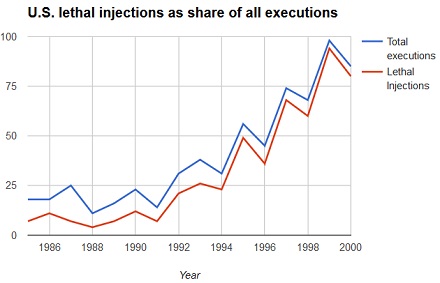
As executions surged in the 1990s, lethal injection was thoroughly displacing America’s previous humane technologies to become the overwhelmingly predominant method.


Data via the Death Penalty Information Center’s executions database.

And the state of Oklahoma, which had been first with a lethal injection law back in ’77, finally started rolling out gurneys — when it put murder Charles Troy Coleman to death with the needle on September 10, 1990. It was Oklahoma’s first execution in 24 years.*

It was Oklahoma’s medical examiner Jay Chapman who had formulated the three-drug cocktail that for a long time comprised the definitive lethal injection protocol: the short-acting barbiturate sodium thiopental, followed by the paralytic drug pancuronium bromide, capped with potassium chloride to stop the heart. Why three drugs, Human Rights Watch later asked him? “Why not?” Chapman was not a pharmacologist and had little expertise with the drugs in question.

Nevertheless, his process “could not be construed as cruel and unusual punishment since it is merely the extreme of procedures done daily around the world for surgical procedures,” Chapman insisted when he proposed it. “It’s simply an extreme form of anesthesia.”

Extreme anaesthesia. Was it really?

Even at Coleman’s death, observers saw it differently.

“I saw him choke and gasp and struggle for air,” said Joe Ward, an investigator in the public defender’s office. “It looked like he was choking to death. He looked over … and mouthed the words, ‘I love you.’ Then he looked straight back up and started choking.” Reporter Art Cox, by contrast, viewed it as “a very easy death … a very cold death, very antiseptic.”

Oklahoma has executed well over 100 people since Charles Coleman but if anything the uncertainty about that “easy” and “antiseptic” death has only grown — in the Sooner state and elsewhere.

And the question has become quite urgent during the lifetime of this blog as political pressure on manufacturers has dried up the supply of sodium thiopental, forcing the many states using lethal injection to scramble for a variety of new drug sequences that are basically being invented on the fly and sussed out with live experimentation on the next death row prisoner in the queue.

Oklahoma’s version was to switch from sodium thiopental to pentobarbital; in January 2014, a man being executed with pentobarbital exclaimed, “I feel my whole body burning.”. Months later, the manufacturer of that drug also cut off the supply, unwilling to be party to the executions it facilitated.

So Oklahoma switched to a third anaesthetic, midazolam, a drug whose execution debut took place in Florida in 2013. The state has also tried to shield its suppliers from anti-death penalty campaigners with a secrecy law.

Proceeding on a mad catch-as-can basis, Oklahoma proceeded to horribly botch its midazolam executions, throwing its new procedure right back to the courts. Just this past June, a divided U.S. Supreme Court narrowly approved the continued use of its midazolam cocktail, which a dissenting justice savaged as “the chemical equivalent of being burned alive.”

It’s a story still being written before our eyes — a long quarter-century after Charles Coleman premiered Oklahoma’s modern era of executions on this date in 1990.

* The last previous execution in Oklahoma was that of James French in 1966.

On this day..

1902: John C. Best

From the Boston Morning Journal, Sept. 9, 1902.

BEST COOL TO THE END

Bailey’s Murderer Executed Just After Midnight.


Assisted the Guards and Uttered Never a Word.


Dreadful Current Did Work Swiftly and Surely.

John C. Best was put to death by electricity this morning at Charlestown State Prison at 12.22 o’clock, paying the supreme penalty of the law for the murder of George E. Bailey of Saugus on Oct. 8, 1900. He maintained the air of coolness, and even indifference, which has marked his conduct since his arrest, to the the [sic] last. He walked to the chair unassisted and without even being held by the guards in attendance; sat down composedly, as one would waiting for a train at a station; assisted the guards even in the operations of confining his hands and legs, and awaited the shock of the current in perfect composure.

He had no word to say at the end, uttered no groan, and was pronounced dead by the attending physicians at 12.27. The witnesses were Dr. Joseph F. McLaughlin, prison physician; Dr. Robert A. Blood, Surgeon General of the State; Dr. George Stedman, Associate Medical Examiner of the District; Deputy Sheriff William Cronin, the presence of whom is prescribed by the Statutes; Rev. I. Murray Mellish of Salem, attending to the spiritual wants of the prisoner, and a representative of the press.

The Crime of Best.

The crime for which Best was executed was the murder of George E. Bailey, the caretaker of Breakheart Farm, Saugus. The murder took place in October, 1900, and Best was condemned by the Superior Court sitting at Salem June 14, 1901.

In the early part of October, 1900, Bailey was missed. Best was employed on the farm, and his replies as to the whereabouts of Bailey gave the impression that the missing man had gone to Maine. Inquiry failed to locate him, and until the morning of Oct. 17 nothing definite was known of his whereabouts.

On that morning the dismembered body of a man was found in Floating Bridge Pond, the mutilated torso encased in a sack. Later the arms, legs and head were found and the body was identified as that of George E. Bailey.

Suspicion pointed toward Best, and he was arrested Oct. 18, the day after the gruesome find at the pond. He appeared in the Lynn Police Court Oct. 20, and was remanded to Salem Jail, pending the hearing, which was held Nov. 8.

Judge Berry of the Lynn Police Court after a prolonged hearing, found “probable cause,” and Best was sent to jail to await the action of the Grand Jury which, on Jan. 25 following, indicted him for murder.

In Superior Court.

Best was arraigned in the Superior Court Jan. 30, and entered a plea of not guilty. The trial began March 18, and continued until March 29, when a verdict of murder in the first degree was rendered. The prosecution was conducted by Attorney General Knowlton, District Attorney Peters and his assistant, Roland H. Sherman. Best was represented by James H. Sisk and N. D. A. Clark of Lynn.

The day after the verdict was returned, counsel for Best filed exceptions and offered a motion for a new trial. Oct. 18 counsel conferred with Presiding Justices Sherman and Fox, and on Nov. 23 the exceptions were approved and allowed to go to the Supreme Court.

A hearing was given in the Supreme Court Jan. 6, 1902, and on Feb. 27, a rescript overruling the exceptions was filed. March 29 other exceptions were taken to a denial of amotion for a new trial, and the Supreme Court heard the arguments on May 19.

On June 3, in a rescript, the Court said:

After the exceptions in this case were disposed of a motion for a new trial was made upon the ground that one of the jurors was deaf. Evidence was put in on the subject before the Judges who had taken part in the trial, a portion of the evidence being an examination of the juror himself. The motion was denied, the Judges stating that they were satisfied that the juror heard substantially all the evidence. The argument addressed to us is a pure argument of fact as to what the proper finding would have been, a question with which we have nothing to do, and upon which the Judges considered not merely the testimony reported but what they saw at the time, as it was proper that they should. Assuming every proposition of law that could be urged in favor of the defendant, there is no ground for an exception.

After the first motion had been overruled another motion was made that the hearing be reopened and the defendant be allowed to introduce further evidence, cumulative in character, being the testimony of a doctor who had been consulted by the juror a little more than three months before the trial. The Judges refused this motion on the ground that the doctor’s statement did not change their opinion. The defendant’s counsel again attempted to save an exception. Apart from what else might be said, the same answer may be made to this as to the other exception. It is perfectly plain that the defendant had no ground for bringing his case here a second time. Exceptions overruled.

Counsel’s Great Fight.

All that could be done by devoted counsel to save Best from death sentence has been done, save an appeal to the Governor for a commutation of the final decree of the Court this forenoon, and it is understood that this will be made.

Of late Best has had frequent conferences with his spiritual adviser, Rev. Isaac M. Mellish of Salem. He steadfastly maintained his innocence of the crime.*

* In a last letter to his parents that later hit the presses, Best maintained his innocence: “One thing I would like to impress on the mind of you, my father and mother, is that it is not God’s will that I lose this life that he has given me, but through the vengeance and ignorance of men … I am not afraid to die, but I would like to live. I don’t compare myself to Christ, our Savior, but my condemnation is on the same line as His, and I will meet death as calmly as he did. If these lines, my dear father and mother, will give you any comfort, I am well paid for writing them.”

This excerpt is from The Evening Times (Pawtucket, R.I.), Sept. 20, 1902 — which also reported that Best felt out the prison physicians as to the prospect of their attempting a post-electric chair reanimation experiment. (The doctors turned him down.)

On this day..

1732: Pompey, poisoner of James Madison’s grandfather

On this date in 1732, a Virginia slave entered American presidential lore at the end of a noose.

The Madisons were “planters, and among the respectable though not the most opulent class”* resident in Virginia from the 1650s or so — and would in time bequeath the new American Republic its fourth president, James Madison.

We are concerned for today’s post with President Madison’s paternal grandfather, Ambrose Madison. Alas, concern will not necessarily translate to elucidation, for most of the Madison family’s records and correspondence were destroyed in the 19th century: the first Madison generations are shadowy historical figures. Ann Miller has pieced together the fragments in the short book “The Short Life and Strange Death of Ambrose Madison”, published by the Orange County (Va.) Historical Society, and that is the primary source for this post.**

Ambrose Madison was a local grandee of King and Queen County, with landholdings elsewhere in Virginia; it was Ambrose Martin who in the 1720s acquired (via his father-in-law, a land surveyor) the Orange County grounds that would become the great Madison estate Montpelier.

In 1732, Madison moved his family to the Montpelier property. By that time, he controlled 10,000 acres in present-day Orange and Greene Counties, and was gobbling up land elsewhere — like the new frontier of westward settlement, the Piedmont.

And of course, Madison owned human beings, too. The inventory of his estate from 1732 lists 29 black slaves by their first (sole) names: ten adult men, five women, and 14 children.

In the summer of 1732, Ambrose Madison took ill and started wasting away towards death. The fact was apparent to Madison and those around him; the last weeks of his life were taken up in settling affairs. (He made out a will on July 31.)

Shortly before Madison’s death on August 27, two of his slaves — a man named Turk and a woman named Dido — along with another slave, Pompey, property of a neighboring plantation, were arrested on suspicion of having poisoned Madison. No record survives to indicate how or why they would have done so.

If grievances can only be guessed-at, they are not difficult to guess. At the same time, for aught we know the trio might have been falsely accused: there had never been a murder in the vicinity, but Madison’s death came just months after a gang of slaves committed a series of armed robberies and shot at three white people.† As we have seen from later and better-documented slave resistance, southern whites were prone to great paranoia where the prospect of servile rebellion was concerned. And as Madison was a healthy fellow in his mid-thirties, attributing his unexpected death to poison was a natural move.‡

As Miller notes,

It is likely that Ambrose Madison’s case sent ripples of fear — even panic — through the region … the court [appeared] eager to have a quick trial (and, perhaps, to make quick examples of those found guilty and hopefully deter any other slave rebellions).

All three slaves were convicted together on September 6 of “feloniously Conspiring the Death” of Ambrose Madison. Pompey hanged the next day — after he’d been appraised (at £30) to compensate his owner for the destruction of property. Turk and Dido were only found to be “concerned in the said felony but not in such a degree as to be punished by death but … by Whipping.” They suffered 29 lashes apiece “on their bare backs at the Common Whipping post, and thereafter to be discharged”.

We must deny the fact, that slaves are considered merely as property, and in no respect whatever as persons. The true state of the case is, that they partake of both these qualities: being considered by our laws, in some respects, as persons, and in other respects as property … Let the compromising expedient of the Constitution be mutually adopted, which regards them as inhabitants, but as debased by servitude below the equal level of free inhabitants, which regards the slave as divested of two fifths of the man.

-(Future President) James Madison awkwardly defending the three-fifths compromise in the Federalist #54

Madison’s principal heir was his only son, James — a nine-year-old boy at the time of the events in this post.

The family brush with slave revolt did not deter this future Col. Madison from resuming (once he came of age) the family trade in land acquisition. He had 108 slaves of his own by the time that he died in 1801.

Col. Madison’s more famous son, the U.S. “founding father” and eventual president also named James, had slaves in the White House but was deeply conflicted about the horrid institution.

“He talked more on the subject of slavery than on any other, acknowledging without limitation or hesitation all the evils with which it has ever been charged,” a slavery abolitionist who visited Madison (post-presidency) reported of the evening’s tete-a-tete. “Mr. Madison spoke strongly of the helplessness of all countries cursed with a servile population, in a conflict with a people wholly free.” Madison eventually came to support the fantastical solution of resettling U.S. slaves to an African colony; still, beset by debts, he never quite saw his way to manumitting his own slaves — not even in his will.

Whether the fate befalling his grandfather ever entered into President Madison’s considerations on the subject is left to posterity’s imagination; the documents surviving in his hand never mention anything about grandpa Ambrose.

* Per James Madison, Sr., Ambrose Madison’s son and the U.S. president’s father.

** Since the primary sources available are so scarce, there seems to be little that can be said with confidence of Ambrose Madison’s personality. Miller suspects him a skinflint, on the basis of a merchant’s exasperated correspondence: “I am sorry to find you complain of the cost of the Goods I sent you” … and the same man again two years later: “have Ship’d the Goods you ordered … I don’t expect that you’ll like the Cotton, you order the Cheapest.”

† A slave named Jack, owned by Mildred Howell, was hanged on May 2, 1732 for this affair. The fate of his seven compatriots history passes over in silence.

‡ Miller notes in an appendix several other trials of slaves for poisoning in 18th century Virginia, including some that resulted in acquittal — possibly militating against the railroading hypothesis.

On this day..

1807: Jenkin Ratford, Chesapeake-Leopard affair casualty

On this date in 1807, the British navy hanged Jenkin Ratford from the yardarm of the HMS Halifax off the coast of Maryland — an incident destined to become a rallying cry for the United States in the ill-fated War of 1812.

The U.S. at this moment was an upstart young country and naturally enough chafed at the lordly interpositions of her recent mother country. Great Britain had the navy, however, so the Americans could chafe all they liked. In the words of the tune that had emerged in the 18th century with Britain’s globe-straddling sea power

Rule, Britannia! Rule the waves
Britons never will be slaves.

The Britons who got to do the grunt work of wave-ruling might disagree.

Seaman in the Royal Navy, and that huge navy needed many seamen, was a harrowingly brutal position often filled by press gangs empowered to grab anyone not able to produce immediate evidence of exemption and have them by next morning swabbing the nearest frigate on a ration of wormy hardtack. Desertion was correspondingly popular and more radical resorts not unheard-of; the mutiny on the Bounty had occurred in 1789; two other mutinies much more alarmingly proximate to Old Blighty took place in 1797.

Britain’s willingness to extend impressment to stopping American ships and seizing crew members who couldn’t produce American identity papers made a great affront to the young Republic — an insulting reminder of its third-rate* place among the nations. Years before while American colonists were kicking redcoat ass in the Revolution, they had dreamt among other things of correcting America’s aggravating dependence on the British fleet. “No country on the globe is so happily situated, or so internally capable of raising a fleet as America. Tar, timber, iron, and cordage are her natural produce,” wrote Thomas Paine in Common Sense. “Ship building is America’s greatest pride, and in which she will, in time, excel the whole world.”

Congress got a start on that project with a 1794 naval act creating the original six frigates of the U.S. Navy. The USS Constitution is the most famous of these; one of her five sisters, the Chesapeake, will figure in the action of this date’s post.

In 1806, two French ships, the Cybelle and the Patriot, struggled into Maryland’s Chesapeake Bay for repairs after being crippled by a storm at sea — stalked by British ships that blockaded the mouth of the Chesapeake to trap them there.

The proximity of American soil proved an irresistible inducement for at least four sailors on the British ships to desert. Three of them — William Ware, Daniel Martin and John Strachan — were American victims of British impressment. The fourth, our man Jenkins Ratford, was a Limey. They then enlisted in the American Navy.

Great Britain’s demands for their return met with steady refusal on the American side. Knowing that the deserters had been posted to the Chesapeake, which was then outfitting for deployment to the Mediterranean, British ships in the vicinity of the North American coast were ordered to stop the Chesapeake on sight to recover the absconders.

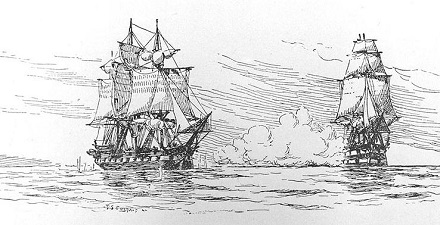
This the HMS Leopard did do on June 22, 1807, and with a singular lack of subtlety: the Leopard battered the Chesapeake with broadsides. Shocked and unprepared, the Americans couldn’t even fire back before striking colors and yielding to a humiliating British search that hauled off Ware, Martin, Strachan and Ratford.


The HMS Leopard (easily recognizable since it’s the only ship firing!) vs. the USS Chesapeake.

While these unfortunates were sailed off to Halifax, Nova Scotia** for their trial, outrage spread on American shores — immediately advised of the incident since the Chesapeake† had had to limp directly back to Norfolk, Va., for repairs. Outrage at the British, but also outrage at the captain who failed to so much as resist the attack (he was court-martialed, and suspended from command for five years), and outrage for the national honor. Some, more vengeful than sensible, wanted immmediate hostilities with Great Britain. “Never since the battle of Lexington have I seen this country in such a state of exasperation as at present, and even that did not produce such unanimity,” U.S President Thomas Jefferson wrote to his friend, the French emigre Dupont de Nemours.‡

Ratford, the only actual British citizen among the shanghaied sailormen, was the only one executed. The Americans “merely” got prison sentences.

At the political level, President Jefferson had a thorny problem. The British could in no way be induced to meet the American demand to end impressment, for simultaneous with the scandal Napoleon was finalizing victories that would knock Britain’s continental allies out of an altogether more urgent war. No derogation of security interests could be entertained, and so for America, no diplomatic satisfaction could be forthcoming.

Instead of war, Jefferson responded by convincing Congress to enact an embargo on trade with Europe. It proved to be a counterproductive policy that damaged the U.S. far more than the European export markets it had intended to punish.

The U.S. and U.K. would come to blows soon enough, and if the War of 1812 was hardly fought because of the Chesapeake-Leopard affair, that incident was certainly among the contributing grievances.

Injuries more directly attributable were not hard to come by, however. When James Barron, the suspended former commander of the Chesapeake, sought reinstatement to the navy, early American naval hero Stephen Decatur opposed him with vehemence sufficient to induce Barron to challenge Decatur to a duel. Decatur was slain in the fight, shockingly pinching out one of America’s leading military figures at the age of 41.

The Chesapeake herself fared little better. The ship was captured by the British in the ill-fated War of 1812, and recommissioned into the hated Royal Navy. Sold off for scrap in 1819, its timbers were repurposed for a long-lived (and now historic) Hampshire watermill — the Chesapeake Mill.

* See what I did there.

** Halifax the city is where they were tried; the HMS Halifax, which was Ratford’s ship prior to desertion, is where Ratford was executed. It’s Halifaxes all the way down.

Thanks to this incident, the very name “USS Chesapeake” became so blackened in American naval history that it has barely been touched for any vessel since.

‡ Father of the DuPont who founded the DuPont chemical company and made that family perpetual American plutocrats down to the present day.

On this day..

1864: William Howe, deserter

From the Philadelphia Daily Age, Aug. 30, 1864.


In view of the coming draft the Government has found it necessary to hang a man.

The victim selected was a poor man, with a wife and children living in Perkiomen township, Montgomery county. He was a small farmer, with six acres, and engaged occasionally in the manufacture of tobacco and cigars. He lived in a Democratic county and township, where trouble was possible as to the draft, and certain at the election.

He was a man of good character, and ordinarily of gentle disposition. His dying words were: “I commend my wife and little ones to the charity of the world, and I ask pardon of those I may have injured and hope they will forgive me and pray for my soul.”

He was a brave man, had proved it on the battle-field, and as the press report says he told his counsel, “he faced the last music like a soldier.”

Such, in brief, was William H. Howe, of Montgomery county, who, on Friday last, was hanged at Fort Mifflin, where, one of the “loyal” newspapers of this city remarks, “the proceedings were conducted most harmoniously.”


Fort Mifflin as it appeared in 1870. William Howe was the only prisoner ever known to have been executed there.

But this is not all: the Government, in selecting this victim and making this example, was determined to show the Democrats of Montgomery county, that no antecedent merits or services could soften its heart or mitigate its doom of vengeance.

Howe was one of those unfortunate men who, excited by prevalent enthusiasm, and imagining that the authorities would protect their soldiers, enlisted two years ago in a Pennsylvania volunteer regiment. He entered the service in August, 1862, just before Antietam — when Pope‘s army was defeated, and Washington was threatened, and Mr. Lincoln frightened out of his wits.

Howe was one of those of whom Mr. Seward wrote to Mr. Dayton: “Our new levies are coming in in great numbers and in high spirits.” He went through the whole campaign at Fredericksburg, being

one of the five men who came off the field with the colors of his regiment! He exchanged his musket for an Enfield rifle, and again went upon the field with our skirmishers, and remained there all night till next day. He escaped by swimming the Rappahannock river.

Such were his merits, who was ignominiously hanged last Friday.

Now, a word as to his delinquencies. We again quote the loyal reports:

At the time he left the regiment he was suffering from inflammation of the bowels, and the regimental hospital being burned down, and having neither surgeons nor medicines, he, with some twenty others, determined to look out for themselves for treatment and reported themselves to the hospitals at Washington. Afterwards he and Augustus Beiting, a member of his company, returned to their homes.

For some two months afterwards Howe was confined to his bed.

This, we presume, was called “desertion.”

Two poor fellows, wasted by the most agonizing of diseases, with no hospital roof to cover them, and, mark this! gentle reader, who hear of champagne dinners and tableaux in our suburban hospitals, “having neither surgeons nor medicines,” wander back to their homes, and lay their wearied limbs and throbbing temples on the humble bed in Perkiomen. This was the initiate crime, though not the one for which he died. Let us see what that was, for we have no wish to do injustice to the executioners. We do not at all agree with the Press, which says “that having once given the facts, a further statement is superfluous.”

The scene of the crime was his home in Montgomery county.

That county has a Perkiomen township, and a Chiltern township, not many miles apart. Little over a year ago, in the latter township, a poor but most respectable white man, Mrs. Butler’s gardener, walking quietly on a public road, was shot down like a dog by a negro soldier, and died in agony.

For this dark deed of blood, the penalty was a mild conviction for manslaughter, — which it as much resembled as it did arson or burglary, — a sentence for a few years, and, if we mistake not, a pardon.

The negro ruffian, unlike poor Howe, had never done a deed of valor, or probably fired a musket till he pulled the trigger at the wayfarer on the Chiltern lanes. He was one of the League pets — a Chestnut street darling, and had a claim on the sympathy and mercy of those who judge always gently a negro’s fault.

Not so William H. Howe, the white Perkiomen soldier.

His deed of wrong was this: About midnight of the 21st June, 1863, he was awakened from a deep sleep — till then the sleep of innocence — by an alarm supposed to be given by the companion who had accompanied him home, that the Provost Marshal was coming to arrest him.

The first impulse was incredulity. The next, to try to escape. The last, resistance.

The words Provost Marshal, associated in a soldier’s mind with thoughts of severity, and cruelty, and sternness, have an awful sound by day or night. Those who think all Provost Marshals resemble the effeminate fribbles who superintend the draft in our streets, can form no idea of the real spectre.

Howe seized his musket, probably the one he brought in triumph from the bloody field of Fredericksburg, and fired it in the darkness, killing the enrolling officer.

The negro’s deliberate homicide is manslaughter. The white man’s rash or passionate misadventure is capital murder.

“I never,” said Howe on the scaffold, “sought the life of the man I killed. I never wished it, and I feel God will pardon me for taking it as I did.”

This, then, is the deed for which this poor fellow was condemned and died — and for which, in view of the draft, no mercy was found in the hearts of Joseph Holt and Abraham Lincoln.

Of the trial by some unknown, irresponsible military court, of which the prisoner’s prosecutor was the President, we do not care to speak. We think of it as history does of the judges who, a hundred years ago, sent to his bloody grave, according to the forms of martial law, a gallant English sailor, whom the hard-hearted monarch of that day refused to pardon, but executed “to encourage the others.” It is a sad record altogether.

And then the feeble attempt at a habeas corpus in the Federal Court, and the citation of Wolfe Tone‘s case, with its suggestive hint at suicide! The whole thing seems like a hideous mockery.

The Judge’s idea that Howe, like Tone, had waived the writ by appearing before the court martial, seems a little odd, but we do not presume to criticise judicial action, and we are very sure the Judge must have been reluctant to deny relief to a Montgomery county man, one of his former constituents. The writ, however, was refused, and last Friday, the white man was hanged, and the enrolling officer was avenged.

Howe died like a brave man. He parted with his wife and three little children with deep emotion, and then his work was done.

He was taken in an ambulance by a back way from the Penitentiary, now, it seems, used as a military prison, to the river and thence in a boat to Fort Mifflin.

“Neither guard nor prisoner,” says the North American, “uttered one word during the run down to the Fort.” There was quite a crowd to welcome him.

“The steamer Don Juan,” says the Press, “was chartered for the purpose and took down the members of the Press club.”

“The gallows,” kindly loaned by the Inspectors of the County Prison, says the same paper, “was the one on which the Scupinskis, Arthur Spring and Maddocks were hanged.” In other words, the brave Fredericksburg soldier — the Perkiomen volunteer — was ostentatiously disgraced by being put on a level in this respect with mean, mercenary murderers — and Howe died without a murmur or complaint, keeping his word that “he would face the music like a soldier.” And thus the hideous narrative concludes: “The body was taken down and placed in charge of Mr. Black, the Government undertaker, who had it embalmed yesterday afternoon and sent to Howe’s widow.”

And it will be carried to his home — and the embalmer, proud of his skill, will take off the coffin lid, and the widow and the three little children will look at the swollen and blackened features of him they loved so well, and they will think of the pride with which he used to tell, and the interest with which they used to listen to the tale of his rescuing the regimental flag at Fredericksburg — and the neighbors will come and look, and in many a lacerated and agonized heart the question will be asked, “why was there no mercy for him?”

The Fishing Creek Confederacy details Civil War draft resistance in a different Democratic region of Pennsylvania.

To us the whole thing seems simply horrible; and badly as we think of it, doubly atrocious will have been the deed, if the reason given for this execution be the true one. The Press, which may certainly be considered the organ of the Administration here, thus accounts for the severity in this case:

The deceased exhibited great bravery at the first battle of Fredericksburg, and after several color bearers had been shot down, he seized the standard and bore it through the heat of the contest. These were noble traits, which he is yet entitled to. It is very evident that he did not intend to kill Mr. Bartlett, but society at that time, in that part of Pennsylvania, was tainted with Copperheadism, and it may be well supposed that the draft resisting, dark lantern conspirators had the effect to instil in the mind of Howe some of the poison for which their victim was hung instead of themselves.

According to this, this brave soldier was hanged because he lived in a Democratic region. The negro of the Chiltern Hills was spared because Government bankers, and Abolition lecturers and shoddy contractors there do congregate, and the township gives a Republican majority.

The patience of the people of Pennsylvania really seems inexhaustible; and all we can hope to do is to help to make up the awful record of atrocity for the long deferred, but inevitable day of retribution.

On this day..

1851: Samuel Whittaker and Robert McKenzie lynched in San Francisco

On this date in 1851 — mere hours after a similar exercise of summary justice took place in Sacramento — the San Francisco Vigilance Committee strung up two accused crooks.

This was the throes of the California Gold Rush — and San Francisco was its epicenter.

San Francisco entered the gold rush an unassuming port of perhaps a thousand souls … but she exited it as one of the American West’s leading cities.

It made an unruly adolescence for the boom town as penniless treasure-hunters poured in from every quarter of the globe. “Turbulent, gold-hungry men,” wrote Herbert Asbury in his The Barbary Coast: An Informal History of the San Francisco Underworld “transformed the once peaceful hamlet of San Francisco into a bawdy, bustling bedlam of mud-holes and shanties.” Suddenly, San Francisco had a huge crime problem — not to mention the conflagrations* that repeatedly devastated the fast-growing tangle of tinderworks shacks.


San Francisco in 1850

In an effort to sustain some measure of order, a number of the city’s respectable citizens banded together to create a famous or infamous Vigilance Committee.

Sworn in their published constitution of June 9, 1851 “to do and perform every lawful act for the maintenance of law and order,” the Committee declared itself “determined that no thief, burglar, incendiary or assassin shall escape punishment, either by the quibbles of the law, the insecurity of prisons, the carelessness or corruption o the Police, or a laxity of those who pretend to administer justice.”

Two days later, they proved their chops by hanging on no authority but their own emigre from Australia named John Jenkins for stealing a safe. A month later, James Stuart, also late of Sydney, was lynched at the Vigilance Committee’s hands, too.

Detail view (click for full image) of Whittaker and McKenzie’s lynching.

Though not the first Vigilance Committee hangings, Samuel Whittaker and Robert McKenzie might be the best-known.

Like their predecessors, Whittaker and McKenzie had arrived from Australia** — which had aptly bequeathed to gold rush San Francisco a criminal colony of its own in the form of a network known as the Sydney Ducks. Scrambling to save his own neck, Stuart had informed on a number of these confederates.

Whittaker and McKenzie were arrested based on Stuart’s information, as the Vigilance Committee tried to smash up the Ducks. Though extrajudicial, the Committee’s investigations were at least as meticulous as one might expect from the law at this moment in time, and the minutes of its witness interviews can be read here.

In the end, the two were basically convicted not so much for any individual crime as for their lengthy careers of robbery, often violent — for “divers offences, whereby the safety of Lives and property have been endangered” (as read the executive report on Whittaker) that rendered each “a hardened offender, and dangerous to this community … it would be unsafe to hand him over to the Authorities or mete out to him a less Penalty than Death” (as read the report on McKenzie).

Such an arrangement of juridical powers, exercised in lieu of “unsafe” Authorities, can scarcely persist long-term. Here, the governor of California, John McDougall determined to intervene in order that the fracturing of the Australians’ vertebrae would also vindicate the majesty of the law.

McDougal arrived to San Francisco and secured a writ to seize the suspects from the Vigilance Committee’s hands, tucking them away in the county jail.

Although in principle this orderly and lawful prosecution of malefactors was exactly what the Committee wanted to see happen, Gov. McDougal’s intervention when they were on the brink of consummating their own process left everyone with a frustrating sensation of justice interruptus.

And so that next Sunday — August 24, 1851 — when prisoners were removed from their cells to a chapel for the salvation of their souls and the jail’s guard detail was reduced by the proportion of gendarmes attending services of their own, a party of 36 Vigilance Committee men barged into the jail, overpowered all concerned, and seized their prey.

“Never before was San Francisco so excited,” editorialized the Steamer Alta California (Sept. 1, 1851).

Through every street, in all directions, the hurrying crowd of humanity rushed with the utmost precipitation — no one knew whither, no one knew for what. The bell of the Vigilance Committee had sounded its alarum note — and instantly the streets were living, swaying masses of human beings — uncertainty and conflicting fears and hopes ruled the hour … with a sweep like the rushing of a torrent of lava they bend their course towards the Rooms of the Vigilance Committee. Almost instantly California street, Battery street, and all their approaches, are filled with one dense mass of human beings. From lip to lip the news flies that the two criminals, Mackenzie and Whittaker, have been taken by force from the jail, by an armed posse of the Vigilance Committee. On the eager and excited multitude press toward the Rooms. On, on, on — the crowd becomes denser and broader. Wonder is stamped on every face — a solemn, almost awful silence pervades the thousands who are anxiously gazing up at the building, when quickly the doors are opened — a moment of preparation — and the numberless multitude holds its breath as the two malefactors are seen suspended by the neck — a struggle or two, a spasmodic heaving of the chest — and each spectator feels a thrill of terror coursing his veins as he involuntarily utters — dead, dead, dead!

Yes, they were dead! The two men — Whittaker and Mackenzie — who were taken from the hands of the Vigilance Committee a few nights since, by virtue of a write of habeas corpus, had been torn from the ail by force, in the middle of the day, and at the risk of life, hurried to the Committee rooms, and executed without scarcely a moment’s preparation. It is a most terrible tragedy! Well, indeed, might one exclaim, “I have supped full with horrors!”

Such are the terrible effects of misrule — these are the fruits of maladministered laws — these the results of official corruption, neglect and malfeasance. Well may the patriotic and the good turn in sadness and grief from the contemplation of such horrors. The timid may shrink from beholding them — the quiet desire an end to them; but neither fear, regret, nor desire will accomplish our security. It must go abroad over the land that this community possesses the power and the will to protect itself against every species of wrong, and that it is resolved to do it at all hazards.

Whilst we regret that the Vigilance Committee have by this act, been brought into direct collision with the constituted authorities, we cannot but approve their course in executing the two criminals. This condition of affairs was not sought by the committee; it was rather forced upon them by the action of the authorities. True, the authorities acted rightly in rescuing the men; but the course they took has proved to be unnecessary and injudicious. No one doubts the guilt of the men executed, and no one believes but that they deserved the punishment they received. The Vigilance Committee felt this, and believing that the public welfare would be promoted by the act, they had resolved to execute Whittaker and Mackenzie. But the officers of the law, with unusual adroitness, prevented the decision from being carried into effect. The Vigilance Committee have now redeemed their honor, and carried out their original determination, by recapturing the prisoners and executing them. The line of division between the legitimate civil power and the Vigilance Committee is therefore plain, broad and unmistakable.

And what is to result? We see nothing disheartening or dispiriting in the prospect. On the contrary, we think we perceive that settled determination on the part of the body politic to have justice done, which is to be the great lever of our salvation. When crime is convinced, as it must now be, that nothing is capable of preserving it from speedy and avenging punishment — when the abandoned feel, as they will now feel, that there is no safety for them here — when all bad men shall understand, as they may now understand, that their unworthy acts will surely be visited with condign reward — then will the country rise above its tribulations and its sorrows.

But this is a dreadful storm! If we did not know the ship, the crew and the passengers, we might despair of our reaching port. As it is, we speak confidently. We feel that there is gloom around us, but there is nothing to alarm the honest and patriotic. The guilty may, and ought to, flee before the gale of popular indignation; but it is through such trials that our voyage is ultimately to become a prosperous and fortunate one. Through the watches of the night of darkness which now surrounds us, there is a gentle voice whispering “Be firm, be calm, be just, and the welcome daylight will soon come!”

The Vigilance Committee disbanded itself a few weeks later. Its last act in 1851† was to prevent the lynching of a sea captain by sailors angered at his brutality, an expression of class solidarity in the definition and punishment of crime as timeless as America herself. (Source)

* These fires were widely feared to be the product of arson motivated by the opportunity to loot. This is likely a reversal of cause and effect. One inclines here to reckon with Tolstoy that cities have a natural tendency to kindling fire, and those fires are liable to blaze out of control in inverse proportion to the city’s administrative faculties.

The late San Francisco police officer and amateur historian Kevin Mullen puts together an argument here that merchants opportunistically torching excess stock to sustain gold rush price gouging was also a contributing factor.

** Both men were born in England; many of the Sydney Ducks hailed originally from the British Isles.

† Like Batman, the Vigilance Committee later emerged from retirement to fight crime again, in 1856.

On this day..

1899: Armstead Taylor and John Alfred Brown, horribly

From the Wilkes-Barre (Pa.) Times, Aug. 18, 1899:

ROCKVILLE, Md., Aug. 18 — Armstead Taylor and John Alfred Brown, negroes, were hanged here this morning for the murder of Mr. and Mrs. Rosenstein at Slidelle in March last.

The drop fell at 10:15[?]. The hanging was a horrible botch. the knot did not slip but the drop was long enough. The men writhed, groaned and uttered inarticualate [sic] sounds for nearly ten minutes.

The murders for which they were convicted and sentenced to be hanged were committed at Slidelle, a little station two miles north of Boyds, Md. on March 13 last.

Louis Rosenstein, the postmaster of the hamlet[,] lived with his aged parents in the rear of the post office. They were said to have plenty of money. Early one morning they were attacked and the man’s skull was crushed and the woman’s head pounded with some blunt instrument.

The store was ransacked and a little over $3,000, a pair of shoes and several articles were taken.

Louis Rosenstein died the day after of his injuries and Mrs. Rosenstein lingered until May when she succumbed in a hospital at Baltimore.

Taylor went to Washington and soon attracted attention by spending money in a lavish manner in Georgetown. Suspicious neighbors gave the police the information that led to his capture.

Before Taylor was arrested, however, Sergeant Fritz Bassau of the Washington police force gave up his life. Taylor shot him down as he was climbing the stairs to arrest him, where he was concealed in the house at Georgetown. He also shot Officer Gowon in the hand.

Taylor was taken back to Montgomery county, but did not stand trial for injuring the policemen. His trial was begun at Frederick on July [?] and Brown’s a week later. Both were convicted and sentenced to be hanged August 18.

Strong efforts were made to have Brown respited, it being believed by many that he was only an accessory after the fact.

The men mounted the scaffold at 10:15. They were both calm and exhibited nerve. As they were placed on the door the sheriff asked if they had anything to say. Taylor made a rambling statement in an almost inaudible voice. He appeared weak and swayed upon his feet. He said:

Gentlemen, I done both the killings myself. My Uncle Brown is not guilty. I am the guilty man, but I expect to go to heaven.

Brown refused to make any statement beyond that he had forgiven his enemies and had found salvation.

The deputies then adjusted the rope, before placing the black caps on their heads. Both men smiled and Brown said good-bye to some friends in the crowd who spoke to him.

Sheriff Thompson tok [sic] a board about six feet in length, walked over to the side of the scaffold, reached down and inserted the end of a plank in the wire ring and sprung the trap.

The bodies fell through simultaneously and began to writhe and sway in a horrible manner. Taylor seemed to be conscious and appeared to be trying to speak.

The priests pronounced it the most horrible execution they had ever seen.

On this day..