1915: Leo Frank lynched

One hundred years ago today, Leo M. Frank was lynched to an oak tree at Marietta — one of the most notorious mob murders in American history.

Methodically extracted hours before from the Midgeville State Penitentiary by an Ocean’s Eleven-style team of coordinated professionals, Frank’s murder was as shocking in 1915 as it reads in retrospect.

The well-heeled Jewish Yankee was factory superintendent at the National Pencil Company in Atlanta when a 13-year-old girl in his employ was discovered in the factory’s basement — throttled and apparently raped. That was in 1913; for the ensuing two years, the prosecution of Mary Phagan’s boss as her murderer would play out in sensational press coverage.

Frank is today widely thought innocent of the crime, although the Georgia Board of Pardons and Paroles has balked at issuing an unconditional pardon since so little of the original evidence survives. (A 1986 pardon came down “without attempting to address the question of guilt or innocence” in recognition of the slanted trial and the failure to protect Frank from lynchers.) But this was much more than a courtroom drama; the Frank affair crackles with the social tensions of early 20th century America. Industry and labor; integration; sexual violation; sectional politics; race and class and power.

Populist Party politician Thomas E. Watson, whose magazines made a dishonorable intervention by openly agitating for (and then celebrating) Frank’s lynching, captures the Zeitgeist for us as he fulminates against the nationwide campaign to grant the convicted murderer a new trial: “Frank belongs to the Jewish aristocracy, and it was determined by the rich Jews that no aristocrat of their race should die for the death of a working-class Gentile.” Frank came to enjoy (if that’s the right word) the editorial support of most of the country’s major papers, but the meddling of northern publishers, and of fellow Jews in solidarity,* arguably led Georgians to circle wagons in response. Present-day Muslims called upon to disavow every bad act by every other Muslim would surely recognize this no-win position.

But then we must also add that Watson himself, a lawyer, had been approached by Frank’s defense team hoping to enlist his bombast to defend their man at trial. The white supremacist demagogue would have been perfect for the job, for the legal battle pitted the credibility of a black janitor named Jim Conley against that of Frank.

Here amid the nadir of American race relations Frank’s team made its own ugly and unsuccessful pitch for racial solidarity with his neighbors. When formulaically asked by the court that had convicted him for any statement to mitigate the impending sentence, Frank replied that

my execution will make the advent of a new era in Georgia, where a good name and stainless honor count for naught against the word of a vile criminal; where the testimony of Southern white women of unimpeachable character is branded as false by the prosecution, disregarded by the jury and the perjured vaporings of a black brute alone accepted as the whole truth.

This violent collision of two vulnerable minorities each with the keen sense that one or the other of them was being outfitted for WASP America’s nooses makes for riveting and sometimes bizarre reading. Newspapers could hardly fail to note that the all-white jury (Leo Frank’s defense team struck all the blacks) had, as Frank complained, privileged the account of just the sort of “black brute” that Southern courts were accustomed to scorn, or railroad. Thus we have the NAACP organ The Crisis taking umbrage that “Atlanta tried to lynch a Negro for the alleged murder of a young white girl” but “a white degenerate has now been indicted for the crime.” It was likewise reasoned by some that since Conley was a young black man with a criminal record who was a potential suspect in the Deep South in the murderous sexual assault of a little white girl, “the mere fact that Conley did not long ago make his exit from this terrestrial sphere, via a chariot of fire is convincing proof that he, at least, is not the man who committed the deed.”** (New York Age, Oct. 29, 1914.)

In the end it was a zero-sum game between Jim Conley and Leo Frank: one of them was the murderer; each accused the other. Their respective desperate interests permeated to their respective communities. After Frank’s lynching, hundreds of Jews left Georgia; many who remained took pains to downplay their Jewishness.

By whatever circumstance police zeroed on Frank and the white community’s passion followed — tunnel vision that would eventually manifest itself in a circus courtroom atmosphere where the prosecuting attorney was cheered and defense witnesses hooted at and the ultimate outcome more demanded than anticipated. The judge feared that an acquittal would result in the summary lynching of not only Frank but his defenders.


Mary Phagan was killed on Confederate Memorial Day, the “holiday” this ballad alludes to.

Unusually for the time, appeals on the case reached the U.S. Supreme Court which declined to intervene — although two justices filed a dissent citing the egregious trial atmosphere.

Mob law does not become due process of law by securing the assent of a terrorized jury …

This is not a matter for polite presumptions; we must look facts in the face. Any judge who has sat with juries knows that in spite of forms they are extremely likely to be impregnated by the environing atmosphere … we think the presumption overwhelming that the jury responded to the passions of the mob …

lynch law [is] as little valid when practiced by a regularly drawn jury as when administered by one elected by a mob intent on death.

But that mob would still have its say. On the eve of Frank’s scheduled June 22, 1915 hanging, outgoing governor John Slaton commuted the sentence.

“Feeling as I do about this case, I would be a murderer if I allowed this man to hang,” the governor said. “It may mean that I must live in obscurity the rest of my days, but I would rather be plowing in a field than feel for the rest of my days that I had this man’s blood on my hands.”†

Frank was spirited away to the penitentiary under cover of darkness; it was hoped that the remote and reinforced edifice would deter any reprisal. It turned out that the furies who hunted Franks could not be dissuaded by mere inconvenience: a committee calling itself the Knights of Mary Phagan formed with the open object of organizing the intended mob vengeance — and indeed it was almost superseded in July of that year by a fellow-prisoner who slashed Frank’s throat as he slept.

Frank survived that murder attempt only to await the next one. Who knows what fancies frequented him in those weeks when he ducked from the shadow of the gallows to that of the lynching-tree, object of pity or hatred. He had time on the last day to savor his impending fate when the Knights methodically cut their way into the penitentiary — snipping the phone wires and disabling the vehicles — and marched their man out with nary a shot fired. Then, a convoy of automobiles “sped” (at 18 miles per hour) all the way back to a prepared execution-site at Marietta. The drive took seven or eight hours over unpaved country lanes, and for every moment of it Frank surely knew how it would end.
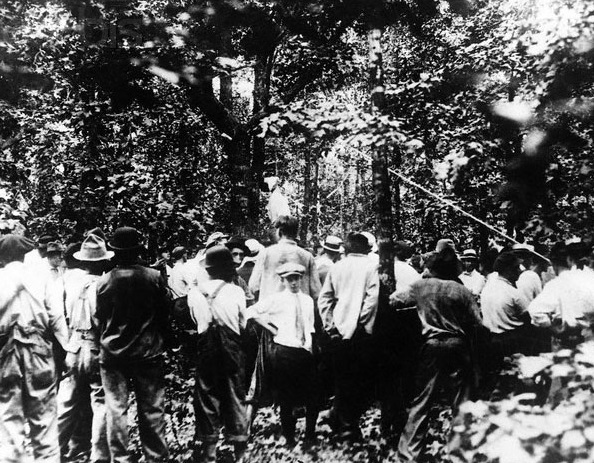
* Frank was a chapter president of the Jewish fraternal organization B’nai B’rith; the Anti-Defamation League of B’nai B’rith was founded in 1913 as a direct outgrowth of the Frank campaign.

As a contrasting response, the American Jewish Committee declined to participate in the Frank campaign for fear of lending counterproductive credence to charges such as those voiced by the New York Sun (Oct. 12, 1913):

The anti-Semitic feeling was the natural result of the belief that the Jews had banded to free Frank, innocent or guilty. The supposed solidarity of the Jews for Frank, even if he was guilty, caused a Gentile solidarity against him.

** Maurianne Davis’s Strangers and Neighbors: Relations between Blacks and Jews in the United States has a trove of interesting editorial comment from Frank’s contemporaries in the black press, and the Jewish press. Conley was actually the confessed accessory, and served a year in prison for it: he said that he complied with Frank’s order to hide the body for fear that his “white” boss could easily get Conley lynched for the crime. Conley also wrote (under Frank’s directive, he said) the preposterous “murder notes” found with the body that purported to be Mary Phagan’s dying indictment of Newt Lee, the African-American night watchman.

† The allusion to political suicide suggests Slaton’s mind was on the precedent of Illinois Gov. John Altgeld, whose career was destroyed by pardoning some of the Haymarket anarchists. If so, Slaton was quite correct; he actually had to flee Georgia altogether and could not return to the state for more than a decade.

On this day..

2000: Brian Roberson, “Y’all kiss my black ass”

(Thanks to Robert Elder of Last Words of the Executed — the blog, and the book — for the guest post. Fans of this here site are highly likely to enjoy following Elder’s own pithy, almanac-style collection of last words on the scaffold. -ed.)

“To all of the racist white folks in America that hate black folks and to all of the black folks in America that hate themselves: in the infamous words of my famous legendary brother, Nat Turner, ‘Y’all kiss my black ass.’ Let’s do it.”

—Brian Roberson, convicted of murder, lethal injection, Texas.
Executed August 9, 2000

Roberson was convicted in the stabbing death of James Boots, seventy-nine, and his wife, Lillian, seventy-five, who lived across the street from him in Dallas. Roberson was African-American and his victims were Caucasian. Amnesty International issued a memo before the execution urging action and “expressing concern at the prosecutor’s systematic exclusion of African-Americans from the trial jury.” Roberson claimed he was “juiced up” on PCP and liquor during the crime. His last words were alternately recorded as “You ain’t got what you want.”

Later that same year, Roberson’s twin brother, Bruce, was arrested for allegedly threatening then President-elect George W. Bush. In a New York Times article, officers reported that Bruce wanted “to take him down.” The piece continued: “Mr. Roberson told them that Mr. Bush ‘stole the election and he’s not going to get away with it.'” Bush had been governor at the time of Brian’s execution.

On this day..

1990: Sam Cayhall in Grisham’s “The Chamber”

In John Grisham’s The Chamber, it is on August 8, 1990 that the titular enclosure receives its victim in a cloud of lethal gas.

In The Chamber, Sam Cayhall, a Ku Klux Klansman who had long avoided conviction for bombing a Jewish civil rights lawyer in 1967, has at last been condemned in Mississippi twenty years later.

The action centers around the futile and increasingly hopeless efforts of Cayhall’s grandson Adam Hall to save the old man working pro bono for a Chicago law firm.

Adam comes to learn that his grandfather has a long and bloody Klan history, even killing children. (We also find that the missing link in this generational drama, Adam’s father, committed suicide after Sam was sent to death row.)

But Sam is in no way a good guy: still an unreconstructed racist, he refuses to inform on any ex-confederates. As grandpa wends his way towards his date with the executioner, Adam’s torrent of judicial appeals go nowhere and the politically sensitive nature of the case makes executive clemency a non-starter. (When The Chamber was published in 1994, the death penalty was at an acme of popularity.) This is to be expected, of course; as Chekhov might observe, you can’t call the book The Chamber if someone isn’t going to go sit in said chamber by the end.

This bestseller was made into a 1996 film starring Gene Hackman as the grizzled Klansman. (In the film version’s execution scene, the date is changed to April 13, 1996.)

There’s an excerpt of the novel available on Grisham’s site here.

On this day..

2008: Jose Medellin, precedent

On this date in 2008, Mexican national Jose Medellin was executed by Texas, pleasurably sticking its thumb in the eye of the International Court of Justice.

U.S. state and local officials have often displayed the ugly-American tendency to view binding treaty obligations as a Washington thing of no moment to the likes of a Harris County prosecutor. So when Medellin was arrested for the 1993 rape-murder of two teenage girls in a Houston park, the idea of putting him right in touch with Mexican diplomats to assist his defense was, we may safely suppose, the very farthest thing from anyone’s mind.

Yet under the Vienna Convention, that is exactly what ought to have occurred. The idea is that consular officials can help a fellow on foreign soil to understand his unfamiliar legal circumstances and assist with any measures for his defense — and by common reciprocity, every state is enabled to look after the interests of its nationals abroad.

A widespread failure to do this, in death cases and others, has involved the United States in a number of international spats over the years.

Jose Medellin was among more than 50 Mexican prisoners named in one of the most noteworthy of these: the Avena case, a suit by Mexico* against the United States in the International Court of Justice.

In its March 31, 2004 Avena decision, the ICJ found that U.S. authorities had “breached the obligations incumbent upon” them by failing in these instances to advise the Mexican nationals it arrested of their Vienna Convention rights, and of failing in almost all those cases likewise to advise Mexican representatives that a Mexican citizen had been taken into custody.

“The appropriate reparation in this case,” the 15-judge panel directed, “consists in the obligation of the United States of America to provide, by means of its own choosing, review and reconsideration of the convictions and sentences of the Mexican nationals.”

If you think the Lone Star State’s duly constituted authorities jumped right on that “obligation,” you must be new around here.

Several years before, the United Nations Special Rapporteur on Extrajudicial, Summary or Arbitrary Executions visited the United States and filed a report complaining “that there is a generalized perception that human rights are a prerogative of international affairs, and not a domestic issue.”

“Domestic laws appear de facto to prevail over international law, even if they could contradict the international obligations of the United States,” the Special Rapporteur noted.

Texas, famed for not being messed with, took a dim view indeed to being bossed about from The Hague. Indeed, the very concept of foreign law and international courts is a gleefully-thrashed political pinata among that state’s predominant conservative electorate.

U.S. President George W. Bush — a former Texas governor who in his day had no time at all for appeals based on consular notification snafus — in this instance appealed to Texas to enact the ICJ’s proposed review.† In fact, he asserted the authority to order Texas to do so.

Texas scoffed.

“The World Court has no standing in Texas and Texas is not bound by a ruling or edict from a foreign court,” a spokesman of Gov. Rick Perry retorted.

This notion that America’s federalist governance structure could insulate each of her constituent jurisdictions from treaty obligations undertaken by the nation as a whole naturally seems preposterous from the outside. But in the U.S., this dispute between Washington and Austin was resolved by the Supreme Court — and the vehicle for doing so was an appeal lodged by our man, Medellin v. Texas.

The question at stake in Medellin was whether the treaty obligation was binding domestic law on its own — or if, by contrast, such a treaty required American legislative bodies to enact corresponding domestic statutes before it could be enforced. The high court ruled for the latter interpretation, effectively striking down Avena since there was zero chance of either Texas or the U.S. Congress enacting such a statute.

Medellin, the decision, spelled the end for Medellin, the man — and, at least for now, the end of any prospect of effectual intervention in American death penalty cases by international tribunals.

* Mexico, which no longer has the death penalty itself, has the heavy preponderance of foreign nationals on United States death rows at any given time.

** The Texas Attorney General’s press release announcing Medellin’s execution included a detailed appellate history of the case which pointedly excluded anything that happened in the ICJ.

† The Bush administration did take one effective step to avoid a similarly embarrassing situation in the future: it withdrew the U.S. from the consular notification convention.

On this day..

1701: Esther Rodgers, repentant

O my dear Friends — Take Warning by me. Here I come to Dy, and if God be not Merciful to my Soul, I shall be undone to all Eternity — If I do not turn by Repentance. I Bless God, I have found more Comfort in Prison, than ever before. O Turn to God now. O how hard it is to Repent; If you go on in Sin, God may give you up to a hard Heart. Oh! Turn whilst the Day of Grace lasts.

These, shouted to a crowd of thousands, were the last uttered by repentant sex worker and infanticide Esther Rodgers at her hanging in Ipswich, Mass., on this date in 1701. Esther Rodgers’s life story and jailhouse conversion in New England are richly explored by author and sometime Executed Today guest blogger Anthony Vaver on his site, Early American Crime. Take a look here.

On this day..

1676: Matoonas, a Nipmuc shot on Boston Common

On this date in 1676, an indigenous Nipmuc named Matoonas was marched into Boston, condemned by a summary judicial proceeding, and immediately shot on Boston Common.

Though he was a so-called “Jesus Indian” — a converted Christian — Matoonas had become a principal adversary of the European colonists once long-building tensions exploded into King Philip’s War.

To the communal grievances that made up this war, Matoonas brought a very personal injury: back in 1671, his son Nehemiah had been accused by English colonists of murder and executed on that basis. And not just executed, but his rotting head set up on a pike at the gallows, to really rub it in.

Matoonas bided his time, but when the opportunity to fight back arrived he joined King Philip (Metacomet) with gusto. On July 14, 1675, Nipmuc warriors under his command raided the town of Mendon, Massachusetts, leaving five dead — the very first Anglo casualties of the war.

“A dark cloud of anxiety and fear now settled down upon the place,” a bicentennial a Rev. Carlton Staples recalled in a bicentennial address on Mendon’s history 1867. “With tears and lamentations they tenderly gathered the bodies of the slain and laid them away in some pleasant spot, we know not where. The houses and farms remote from this central point were abandoned, and the people fled to other places, or gathered here to save their flocks and growing crops. All sense of security was gone. They only dared to go abroad in companies. While some worked in the fields and gardens, others watched for the lurking foe.” A few months later, the settlers had to abandon Mendon altogether, and the Nipmuc burned the ghost town to the ground.

But the tide of the war soon turned against the natives, and Matoonas would find that he had his own lurking foe.

Sagamore John comes in, brings Mattoonus and his sonne prisoner. Mattoonus shot to death the same day by John’s men.

diary of Samuel Sewall

A mysterious Nipmuc leader known as Sagamore John (“Sagamore” designates a sachem or chief) betrayed Matoonas in exchange for a pardon from the Massachusetts colony, marching Matoonas and his son right into Boston on the 27th of July.

After an improvised tribunal set down the inevitable punishment, Matoonas was lashed to a tree on Boston Common. Sagamore John performed the execution himself — although whether he volunteered or “volunteered” is not quite clear. The late Nipmuc raider’s head, too, was set on a pole — just opposite Nehemiah’s.


Memorial to Sagamore John in Medford, Mass. (cc) image from David Bruce.

On this day..

1934: Not Walter Lett, To Kill a Mockingbird inspiration

July 20, 1934 was the third and last of Walter Lett’s scheduled execution dates for raping a white woman in Monroeville, Alabama.

A thirty-something ex-convict, Lett’s protestations of innocence stood little chance against the word of a white woman named Naomi Lowery, herself a penniless drifter.

Lett was almost lynched but despite his certain condemnation there was something wrong about this case — something discomfiting even for Monroeville’s worthies. We have seen elsewhere in these pages that a rape accusation was a powerful weapon on the ambiguous fringes of the color line. Just three years before this story, nine black teens had been accused of a rape on an Alabama train, and the legal odyssey of these Scottsboro Boys would dominate headlines during the Depression.

“It may have been that [Lett] and Lowery were lovers, or that she was involved with another Negro man,” one author put it. “If a white woman became pregnant under those circumstances, it was not uncommon for her to claim rape, or accuse someone other than her lover.”

Records of this trial seem to have gone missing, but Lett’s claims had enough weight (and Lowery’s had little enough) to induce Monroeville’s elders to petition Gov. Benjamin Miller* against carrying out the electrocution. Miller reprieved Lett ahead of May 11 and June 20 execution dates: “I am of the opinion and conviction that there is much doubt as to the man being guilty,” Miller told the Montgomery Advertiser. Gov. Miller was so sure that Lett didn’t do it that before the man went to the chair on July 20, Miller decided instead to let him spend the rest of his life in prison for the thing he didn’t do.

We don’t have Walter Lett’s side of this story because the strain of his position drove him mad; when the sentence was commuted, he was transported from death row directly to a mental hospital, where he died of tuberculosis in 1937.

In his stead, we have a different voice: a Monroeville schoolgirl at the time of Lett’s trial named Harper Lee** would later channel the case’s undertones of racial injustice for her legendary (and, until recently, only) novel, To Kill a Mockingbird.

In one of the famously retiring Lee’s few public comments on the book, she cited the Lett case as her model for the book’s fictional, and manifestly unjust, rape trial.

Lee’s father, A.C. Lee was the editor-publisher of the Monroeville Journal at the time of l’affaire Lett. But as a young lawyer, before Harper’s birth, Lee himself had once defended in court two men who wound up being hanged. An idealized† version of this man is the clear foundation for the defense attorney Atticus Finch in Lee’s book.

Charles Shields, whose 2006 biography of Harper Lee is quoted above on the indeterminate reason for the rape allegation, writes that the author “had a free hand to retell this macabre episode in her father’s life, which he always referred to in vague terms, no doubt because of the pain it caused him. (He never accepted another criminal case.) This time, under his daughter’s sensitive hand, A. C. Lee, in the character of Atticus Finch, could be made to argue in defense of Walter Lett, and his virtues as a humane, fair minded man would be honored.”

* Miller was an anti-Ku Klux Klan politician, a fact of possible relevance to his actions.

** Harper Lee’s childhood friend was Truman Capote, future author of In Cold Blood. (Lee traveled to Kansas with Capote and helped him research the murder case in question.) Alabama’s legislature has recognized Monroeville as the state’s literary capital.

† According to Shields, the real A.C. Lee was more of a gentleman, establishment segregationist: more like the warts-and-all Atticus Finch of Lee’s Go Set a Watchman than the saintly character played by Gregory Peck. In 1952-53, A.C. Lee helped to force out the pastor of the local First Methodist church over controversial pro-integration remarks from the pulpit. Rev. Ray Whatley’s post-Monroeville assignment took him to Montgomery, where he was president of a chapter of the Alabama Council on Human Relations while the young Rev. Martin Luther King was vice-president. Whatley was forced out of his Montgomery congregation, too: called “a liar, a communist, and a few other things” (Whatley’s words) for supporting the Montgomery Bus Boycott. They tried to reassign him to tiny Linden, Alabama, but townspeople there immediately rejected him and many stopped paying church tithes until he was shipped onward to Mobile.

See When the Church Bell Rang Racist by Donald Collins, who notes that Whatley’s anathema had a chilling effect on other white Methodist clergy — now clearly given to understand that there would be “a great price to be paid if a minister chose to speak out for racial justice.”

On this day..

1936: Earl Gardner

(Thanks to Meaghan Good of the Charley Project for the guest post. -ed.)

On this date in 1936, Earl Gardner, a “pint-sized” Apache Indian from the San Carlos Reservation in Arizona, hanged for the murders of his wife, Nancy, and baby son, Edward. Gardner had, for no apparent reason, axed them both to death the previous December.

This wasn’t his first time, either; in the 1920s he’d served seven years in prison for stabbing another man to death.

He tried to plead guilty to Nancy and Edward’s murders, but the judge refused to let him in spite of Gardner’s preference that the government should “take a good rope and get it over with.” Better to “die like an Apache” than die a little every day in prison, he said. With his heart never in his own defense, it’s no surprise he was convicted; appeals filed by his attorney proceeded against Gardner’s wishes, and without success.

R. Michael Wilson records in Legal Executions After Statehood in Arizona, Colorado, Nevada and Utah: A Comprehensive Registry:

Finding a gallows was difficult as the state of Arizona was using the gas chamber exclusively for executions, so U.S. Marshal Ben J. McKinney improvised a gallows using an old rock crusher from the Coolidge Dam project. The crusher had been abandoned within a deep gorge on the Indian reservation. A rope was strung from a crossbeam and a hole cut in the floor for the trapdoor. After there were rumors of an Indian uprising McKinney deputized a force of men and armed them to prevent any interference, and they guarded the gallows for days before the execution date.

As he stood on the contraption’s trapdoor before forty-two witnesses, Gardner was asked if he had anything to say. “Well, I’ll be glad to get it over with,” was all he could come up with. It took longer to get it over with than anyone could have anticipated. A witness recalled:

Earl went to the gallows without apparent concern and died a ghastly death. I was crouched in a corner of the crusher on a pile of gravel and damn near went through the trap after him. Earl’s shoulder struck the side of the trap and broke his fall. He hung at the end of the rope gasping … until Maricopa County Sheriff Lon Jordan, a giant of a man, stepped down through the trap and put his weight on Earl’s shoulder to tighten the noose and shut off his breathing.

When the trap sprung at 5:06 a.m., the noose slipped around to the front of Gardner’s throat, causing him to fall off-center and hit the side of the opening. His head snapped backwards but his neck didn’t break and he thrashed around for over half an hour. It wasn’t until 5:39 that his heart ceased to beat.

Earl Gardner’s death was the last legal hanging in Arizona.

On this day..

1890: Edward Gallagher, “none of your damned business!”

On this date in 1890, thrashing in panicked resistance, Edward Gallagher hanged in Vancouver, Wash.

Louis Mar, an aged and solitary farmer who was known to carry large sums of cash on him, had been found in November 1889 shot dead outside his home — which had also been ransacked but to little effect. (Thousands of dollars were discovered tucked into the house’s nooks and crannies that the assailant(s) had overlooked.) A discarded scrap of a newspaper proved to match the edition Gallagher himself was carrying when detained lurking around the Mar place a few days later.

1890 was the year that America’s the western frontier officially closed, but the grueling life in its Cascade Mountain vestiges in the 1880s had taken a toll on the Chicago-born murderer. The Portland Oregonian (July 6, 1890) noted that he “is 24 years old, but looks to be over 30.” On top of that, he nearly burned to death awaiting trial in jail when Vancouver’s courthouse went up in flames in February of 1890.

Gallagher might very well have been non compos mentis, and it is not a mark in favor of his sanity that he elected to defend himself by agreeing that he pulled the trigger, but arguing that it had been done in self-defense … while on Mar’s land … and prior to burgling Mar’s house … with a mystery accomplice whom he refused to name.

As much as the circumstances implied a cold-blooded killing, Gallagher’s erratic behavior, disjointed nonsense story of the crime, and inexplicable confidence in his pardon all struck many observers as the mark of a genuinely unbalanced man.

“Gallagher does not seem to comprehend his fate,” the Oregonian puzzled. “One would be in a quandary to decide whether he was insane or lacked brains to comprehend the enormity of his crime.”

He maintained that incomprehension all the way to the gallows platform. As a fascinating 2013 retrospective in the Vancouver Columbian described it,

didn’t believe he would die that day — despite the bloodthirsty crowd before him, the $225 spent on his execution, the lawmen flanking his left and right.

Instead, with a “slickly idiotic smile,” he apologized to the audience for his appearance and promised he would do better next time. He said “the soldiers” would save him.

Reality struck when his hands were bound. For three maniacal minutes, Gallagher swung his arms and kicked violently, knocking over the sheriff and his helpers. Seven men finally subdued him.

The death warrant was read, a black hood pulled over Gallagher’s head and the noose tightened. Sheriff [M.J.] Fleming, who was paid $50 for the deed, gave the condemned man one more chance to confess to killing and robbing Lewis Marr, an old farmer found dead on his land in the Lower Cascades area of Skamania County.

“Did you kill that man, or did you not? Now, answer,” the sheriff said, according to newspaper accounts.

From beneath the black hood, Gallagher sneered his last words: “None of your damned business.”

His egregious death was witnessed by 200 official ticket-holding invitees, but the wooden stockade nominally enclosing the gallows was easily peered through or over … so another 500 people outside the stockade also peeped on the de facto public execution.

On this day..

1911: Daniel “Nealy” Duncan, posthumous pardon candidate

On this date in 1911, still professing his innocence, Daniel “Nealy” Duncan hanged in the county jail at Charleston, South Carolina.

“Short, thick set and very black,”* Duncan was, at length, arrested for the murder of a King Street tailor named Max Lubelsky. Poor Mr. Lubelsky had been discovered on June 21, 1910 as he lay dying of a fractured skull — the bloody cudgel rudely enhanced with a nail abandoned beside its victim was the only clue, besides someone in the neighborhood who thought they noticed “a negro, dressed in a blue suit, wearing a derby hat”** who left the store around the time of the midday attack. The attacker’s purpose was robbery.

With very little to go on, police “rounded up a number of characters” and, the papers forthrightly reported, gave these black men “the ‘third degree'”: that is, tortured them.

Granting that we find ourselves at this moment at the nadir of race relations in the Jim Crow south, these officers conceived themselves acting in good faith, torture and all. They were not utterly indiscriminate; several of the beaten-up suspects were able to produce an alibi and were duly released with their newly acquired welts. But in the absence of a witness (or knuckle-assisted self-incrimination) they had little to work with.

And so the assailant remained a mystery.

There matters still stood on July 8 when the widow Mrs. Lubelsky came racing out of her late husband’s store with blood streaming down her own face, crying murder at the top of her lungs.

To take up the narration reported in the next day’s edition of The State,

Just then a negro emerged and two men, Isaac Goodman and Moses Needle, who were passing, gave chase of the negro. He was caught a few blocks distant and promptly turned over to Police Officer Stanley and Detective Levy, who had also taken up the chase. Protesting his innocence and declaring that another negro had attempted to kill the woman, Daniels was taken to the station house amidst great excitement and the patrol wagon did not roll off any too soon from the excited neighborhood …

The State has given us an incriminating narration, but if we begin from our suspect’s denial it is not too difficult to conceive the scene otherwise — a bystander swept into the chaos as the panicked Mrs. Lubelsky barges out of her shop, the sudden attention of a crowd which the newsman gives us to understand was wound up enough for a lynching. You’d run, too.

The traumatized Mrs. Lubelsky insisted that it was Duncan who attacked her; this is one of the few pieces of palpable evidence we have in the case, though eyewitness error is a frequent factor in wrongful convictions. She would have glimpsed her assailant for a moment, dashed out of the store in a panic, then a fleeing man was chased down and hauled back to her — perfect cues for her memory to fix this man with all sincerity as the picture of her assailant.

And whatever the cliche about criminals returning to the scenes of their crimes, few are bold enough to repeat a literally identical attack days apart. It was basically just by analogy that the July 8 assault was held to place Duncan at the scene of the murder 17 days before; the vague description of the blue-suited man who might or might not have had anything to do with the murder could have fit Duncan or numerous other people. A local black man said that Duncan had been in the area on the day Max Lubelsky was killed, which would scarcely rise to the level of circumstantial even were one to discount the possible confirmation bias (or police pressure) introduced by Duncan’s arrest.

One would like to think (forlorn hope!) that a jury in 2015 would demand better than this to stretch a man’s neck … but in Charleston in 1910, it was enough to surpass reasonable doubt.†


The State, Oct. 8, 1910.

Duncan’s insistence on innocence was passed down in his own family and in the Mother Emanuel African Methodist Episcopal Church whose congregation the hanged man once belonged to. In these halls, he is widely understood to have been an innocent man and this conclusion has not wanted for latter-day advocates.‡

The case surfaced to the broader public recently, with a push around the centennial of Duncan’s hanging to have him posthumously exonerated. The measure failed on a 3-3 vote in 19112011.

Left: Dead Weight, a historical novel based on the Duncan case; right: Charleston’s Trial, a nonfiction account.

Duncan was the last person hanged in Charleston, but not the last in South Carolina; there was a double execution in December of 1911 before the Palmetto state adopted electrocution beginning in 1912.

* The State (Columbia, S.C.), June 11, 1911.

** The State, June 22, 1911.

† The supernaturally inclined took notice from the August 1911 hurricane that devastated Charleston as a portend of Duncan’s innocence — and nicknamed it “the Duncan storm”.

‡ 2010-2011 media accounts indicated that the victim’s descendants did not share such confidence in Duncan’s innocence.

On this day..