1873: A day in the death penalty around the U.S., courtesy of the New York Herald

Dispatches to the New York Herald from 1873 give us today’s post: a little portrait of public hangings in Reconstruction Dixie.

Isham Belton O’Neill, 32 at his death, hanged in Atlanta on this date in 1873; the Herald reported it in the next day’s edition.

O’Neill grew up on a farm outside Atlanta but was taken to the city by service in the Confederate army.

Postwar, he started a short-lived painting business with a fellow veteran, John Little: short-lived, because within a few months the courts were sorting out the partnership’s dissolution. Little, evidently, felt hard done by their rulings and “met O’Neill on the street several times after the snit, and even visited him at his shop, always urging him to let him have a sash, which he claimed to be his own property.”

On September 5th, 1871, they bumped into each other again by accident and after a few pleasantriles, Little started in on the sash again. “You got it be swearing a damned lie,” he insisted.

The testimony is that O’Neill then struck him in the face, and [Little] seized O’Neill first by the collar and then by his hands, which he endeavored to hold firmly; but O’Neill, by turning and exerting himself, wrenched his right hand from Little’s grasp, put it behind him and drew from under his coat a large Bowie Knife and quickly stabbed Little in the abdomen, the knife penetrating six inches deep, making a surface cut of two inches long, the sides of which were jagged, as if the sharp, two-edged knife, after having been plunged in, had been twisted round and drawn out.

Enough about the sash, okay?

O’Neill was a respectable fellow in the community (apart from the unpleasantness), and he stuck to a shaky “self-defense” story long enough that he might have started to believe it himself. So even though Little gurgled his last that night with five feet of bowel hanging out of the jagged fissure O’Neill had carved, the killer felt inordinately confident of an executive reprieve.

O’Neill even eschewed the opportunity to escape during a general jailbreak in February 1872, obediently remaining in his spot even with the cell door popped wide open in front of him. Several fellow prisoners successfully absconded on this occasion and avoided recapture.

O’Neill only received word of the governor’s final rejection of his petition at 1 in the morning on the date of his hanging, when “he was awakened out of a sound sleep to receive it.”

Up to that moment he had been confident in the belief that his life would be spared by the Governor, and had refused to listen to the advice of his counsel and spiritual advisers to prepare for death. When he was told that the last hope was gone he felt very bad and was convinced. For the first time he seemed to realize the awful situation, broke down and gave way to piercing cries and lamentations — “Oh! is it all over with me? My God! it is terrible. Does the Governor refuse even a respite? O merciful God, is there no other chance!” and he ended with long heartrending, choking sobs.

We turn now to the Herald‘s June 17 report of a public execution from Lebanon, Virginia.

A steady, sharp stroke of a hatchet, a rope is cut, the crash of a falling drop follows, another rope is stretched to its utmost tension, there is a rebound and the body of Archie Johnson, a negro, is swinging in the air, a solemn warning to an immense multitude of spectators that “he that sheddeth man’s blood by man shall his blood be shed.”

Archie Johnson, “a copper-colored negro, about twenty-eight years of age” with a countenance “regular and well cut for a negro” was the former slave of a local Russell County gentleman.

Upon liberation, the correspondent charges, he “began a career of dissipation and vice,” driving away a wife with his wantonness before he “totally abandoned himself to all that was degraded, vicious and criminal.” At last, he murdered a man named Hunt.

This story is particularly intriguing for the writer’s detailed — often editorializing — reportage of the hanging details.

Not only all Russell county were on the grounds, but from Washington, Scott and other surrounding counties many thousands came to behold the death struggles of a condemned felon. The number of females in the vast throng was somewhat astonishing, and their complexions were as varied as the costumes they wore. Some were as black as a traditional ace of spaces, others as fair as the whitest lily, while the intermediate embraced every imaginable shade between the two. A large number of these came on horseback, their long, dark riding skirts forming a happy contrast with the innumerable bright and gaudy colors worn by the pedestrians. As to horses, all the available racks, trees and fences in town were thickly lined with them, and then it seemed that the surrounding woods were densely picketed with them. The prevailing costumes of the men were blue and gray jeans. The valleys, the knobs, the peaks and plains, the huts and houses, seemed to have poured themselves out to-day, all actuated by the same common, morbid curiosity, and it can safely be said that scarcely a score of them were solemnly impressed by the terrible scene they witnessed. The number present was estimated at six thousand people.

Turning from sociology to engineering, our observer sketches the construction of the lethal apparatus:

THE SCAFFOLD

was a very ordinary, rude affair, consisting of the usual two main uprights, a narrow platform in the rear, in front of which was the drop, supported by a rope. This ran through the crossbeam near the centre, and was secured to a peg driven in one of the uprights, about four feet from the ground. It allowed of a fall of six feet, and was in all respects as thorough and effective as a majority of the clumsy, murderous machines* generally used in such instances in the South. The structure was situated in the old field to the north of the town and about half a mile distant from the jail.

As for Johnson himself, he signed off on a written confession blaming for his downfall those usual suspects: liquor, cards, loose women. Then he puffed a nonchalant cigar as he rode on his coffin to the gallows, “neatly and tastefully attired in a suit of entire black cloth, black cap, with gloves and gaiters”; he sat on a chair beside his noose for two different sermons (Methodist and Baptist), then a hymn which Johnson “joined with great spirit and religious zeal,” asked one last cigar which he puffed happily for ten minutes in which “his coolness just at this time excited the wonder of many and the admiration of more,” and finally at 2:24 p.m. — 48 minutes after he arrived at the gallows — submitted to his fate.


There was a third U.S. hanging on June 13, 1873: Joseph Duncan, in a public execution at Paris, Ky., for murder. All I have been able to learn in particular of Duncan’s hanging was that his first rope broke, necessitating the ol’ do-over.

* Presumably the Yankee’s judgment of the gallows here is informed by New York’s having “progressed” to upward-jerking hangings.

On this day..

1886: Tabby Banks and Tom Honesty, for election rejection

This date in 1886 gives us the double execution of two men named Banks and Honesty — words we don’t hear in the same sentence every day, amirite?


Baltimore Sun, June 5, 1886: the source of all newspaper quotes in this post.

That’s Tabby Banks and Tom Honesty, to be exact, “two full-grown and powerful negroes” who to nobody’s satisfaction denied all the way to the gallows that they had murdered a white 18-year-old, Joseph McFaul, outside the (still-extant) Taylor Hotel on November 14, 1884. The sources I have located do not explicate any beef specifically known to have existed between these individuals; they do, however, situate the conflict squarely within America’s political environment in that electoral year. It is not only in passing that we have noted the parties’ racial identities.

Days before McFaul died, former hangman Grover Cleveland was elected President — the first Democrat to win the office since before the Civil War.

It might be better to say that Cleveland was the first Democrat to hold the office. The tossup 1876 presidential election was more-or-less won by New York Democrat Samuel Tilden, but he was bilked of the prize in an electoral college bargain that exchanged another Republican presidency for the end of Reconstruction.

In the 1870s and 1880s, northern whites were steadily coming around towards Southern whites’ distaste for the ongoing rigor necessary to enforce the putative equality of ex-slaves with their former masters.

Recognizing that such lethargy among white elites in effect amounted to abandoning the field to the violent reassertion of white supremacy, blacks were deeply apprehensive about 1884. Some even feared that chattel slavery might be restored outright. For all the growing indifference of the Republicans, the potential election of the Democrat Cleveland, T. Thomas Fortune wrote during the campaign, “would be a cold afternoon for this country and especially for the Negro and the laboring classes.” (Via)

This is presumably why McFaul, a Democrat taking part in a celebratory parade for Cleveland’s election, would have been hateful to Banks and Honesty. According to the Baltimore Sun, those latter two had previously “traversed the [march] route, threatening to kill some democrat.” Later, McFaul chanced to nominate himself their target by stepping into an alley, where the two churls “immediately attacked him.” Some passing Samaritan saw what was happening and managed to pull McFaul out of the alley and onto the street; still, his assailants did not disdain to press the assault in public view and clobbered the young man with a rock.

Everyone parted and went their separate ways, but young McFaul was a dead man walking. His skull fractured by the stone, he died that night in his sleep.

President Cleveland, of course, did not restore slavery. He took little interest in the situation of black Americans and did nothing to check the onset of Jim Crow, but in this he was not so different from his Republican contemporaries. Nobody among the nation’s white elite had a belly for the fight any longer.

Frederick Douglass had to concede in a Washington, D.C. speech of 1886 that “as far as the colored people of the country are concerned, their condition seems no better and not much worse than under previous administrations.”

Lynch law, violence, and murder have gone on about the same as formerly, and without the least show of Federal interference or popular rebuke. The Constitution has been openly violated with the usual impunity, and the colored vote has been as completely nullified, suppressed, and scouted as if the fifteenth amendment formed no part of the Constitution, and as if every colored citizen of the South had been struck dead by lightning or blown to atoms by dynamite. There have also been the usual number of outrages committed against the civil rights of colored citizens on highways and by-ways, by land and by water, and the courts of the country, under the decision of the Supreme Court of the United States, have shown the same disposition to punish the innocent and shield the guilty, as during the presidency of Mr. Arthur.

On this day..

1806: Polly Barclay, accessory in the murder of her husband

On May 30, 1806, Polly Barclay of Wilkes County, Georgia was “taken by a proper officer to a gallows previously to be erected in or near the town of Washington, and then and there on the day aforesaid, between the hours of ten o’clock in the forenoon and two o’clock in the afternoon … hung by the neck until you are dead.”

And may God have mercy on her soul.

The purported triggerman, Polly’s brother, had been acquitted of murdering Polly’s husband; then, said assassin turned right around and testified against his sister — who was duly condemned for hiring him. (They do say that Justice is blind.)

But don’t take Executed Today‘s word for it. For this sordid all-in-the-family homicide, we’re pleased to recommend a visit to the annals of Washington, Ga., we gladly defer to genealogist and historian Stephanie Lincecum‘s Peachy Past post.

On this day..

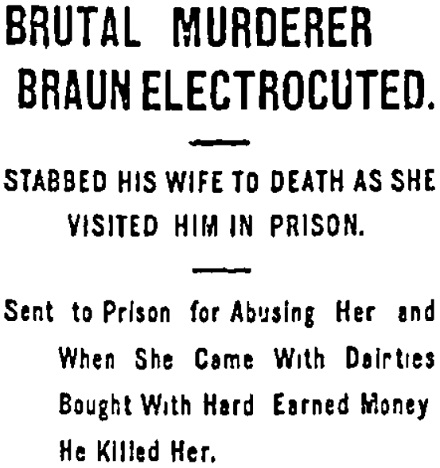
1899: Adrian Braun, who murdered his wife in Sing Sing


Wilkes-Barre Times, May 29, 1899.

On this date in 1899, Adrian Braun was electrcuted at Sing Sing.

Braun was a hulking German cigar-maker with a reputation for habitually thrashing his wife. Authorities got involved when he bashed a neighbor who intervened in a beating so hard that it fractured the man’s skull.

In August 1897, Braun caught a two-year sentence for assault. With her batterer put away, Kate Braun now had to shift for herself; struggling to make ends meet as a washer-woman, she had to give up two of her five children to the St. Joseph’s Roman Catholic Orphan Asylum. Still, she scraped together enough money to buy her incarcerated husband some sweets on a prison visit.

Mr. Braun was at work peeling potatoes in the prison kitchen when he was summoned for the arrival of his spouse in March 1898. After using up their visiting time on a conversation that appeared entirely mutually affectionate, the two were about to part when Adrian Braun suddenly whipped out the potato-knife he had recently been employing and daggered the poor woman’s throat — with lethal effect.

Braun never explained his shocking crime and pursued only a half-hearted insanity defense at his ensuing trial.

“No man was ever executed at the prison who had less sympathy than was felt for Braun,” the Wilkes-Barre Times reported on the day of the man’s execution.

On this day..

1912: Rev. Clarence Richeson, minister, madman, and murderer

Minutes after midnight this date in 1912, a desexed preacher’s troubled concupiscence was at last abated by the Massachusetts mercy seat.

Some demon ruled Clarence Virgil Thompson Richeson‘s wayward footsteps through this life, and ere its last immolation saw Richeson alternate a serial pattern of abstinent betrothals with bouts of increasingly severe mental instability.

“Clarence had become deranged,” wrote one of the several theological seminaries he attended to his father, explaining why he couldn’t be kept.

Derangement for Clarence Richeson ranged from the merely embarrassing (wet dreams, three or four times a week) to the positively poltergeistian (bouts of raving, delirious lunacy). These foibles proved no obstacle to the charismatic Richeson’s repeated engagement — six or more young women by my count succumbed to his court — although he would later confess that these relationships, never consummated in matrimony, were almost never consummated in bed either. Richeson claimed to have remained a virgin until age 28, and then for most of the succeeding six years as well, even though a book of that period describes him as a “tall, handsome giant with the classic face of a Gibson hero.” On at least one occasion he besought a doctor to castrate him as he feared he could not keep his self-control around women.

Richeson’s strange proclivities kept interrupting the cursus honorum of Baptist pastorships that comprised his professional life: he had to resign from a church in Kansas City in 1904 after proposing to three different women, and a gig in El Paso was cut short when he fell into a spell of paranoid delusion.

1908 finds him a minister once again, now in Hyannis, Mass., and celebrating the birthday of 17-year-old Avis Linnell with an engagement ring. His “spells” or “fits” of madness were continuing as well, and numerous associates would later produce affidavits testifying to his violent outbursts. A doctor (who only quelled Rev. Richeson this night by morphine) recalled one incident:

I was called to see him at the residence of Mrs. Hallet, with whom he was boarding, and when I arrived I found there were with him two or three men whom I knew to be members of his church; he was acting violently and they were trying to control and quiet him both by words and by attempting to restrain him by physical force. He appeared at times to be partly conscious; then he would go into a state whereby he lost consciousness and was practically unconscious, apparently had no knowledge of what he was doing or saying. During this period of time he talked irrationally, raved incoherently, and physically manifested an abnormal degree of strength.

Parishioners decent enough to stand with their preacher would eventually find these private afflictions played out in lurid public detail. That was after Avis Linnell turned up dead at the Boston YWCA where she boarded while studing at the New England Conservatory of Music. It was 17 days before her scheduled Halloween, 1911 marriage to Clarence Richeson, and Miss Linnell was pregnant.

At first ruled a suicide, the case caught the eye of the Boston Post, whose swarm of reporters soon found a pharmacist who had sold Richeson cyanide days before the death of his betrothed. Richeson’s clemency petitions would eventually focus on his unbalanced mental state, but poison, of course, suggests the calculation of the pastor and not the outbursts of the madman within. (We’re getting ahead of ourselves, but doctors arguing for mercy also viewed Richeson as a prime research subject, whose maintenance behind bars could help to avert dangerous mental illnesses in others in the future.)

Matters went very quickly from this point.

Richeson resigned from his pastorship and, while lying in jail under indictment, slashed himself with a sharp piece of tin. Not his wrists, but his manhood — an attempted emasculation that was near enough successful that the physician responding to his shrieks was obliged to complete it in order to close up the wound. Richeson would later insist that he “shall think to my dying day that two men came in and did it” — apparitions of his mind’s creation.

The dying day was quick in coming. Two weeks after his self-mutilation, on January 5, 1912, Richeson withdrew his pretrial not guilty plea and simply copped to the murder. The death sentence was mandatory, but the plea also prevented any opportunity for a jury to rule on whether the killer’s instability lessened his criminal culpability. It was the opinion of some psychiatrists and not a few laymen that it was not simply a matter of Richeson’s state slipping between lucidity and delirium, but that his deterioration over the years had delivered him into a state of permanent derangement. Even Avis Linnell’s mother forgave her daughter’s killer “this dreadful thing” because “it is my belief he went to the electric chair an insane man and that he has been mentally irresponsible for some time past.”

On Sunday, May 19, a day and a half before he became the 14th client of the Massachusetts electric chair, Rev. Richeson conducted his last service — not in the prison chapel (against regulations) but from his own cell. “This is Sunday my last on earth,” he reflected. “If I had lived a righteous life I should today be delivering a sermon from the pulpit of my church in Cambridge instead of being caged here awaiting a felon’s death.”

It had not been so long ago in those environs that any execution would be a prayerful service, condemned together with the congregation. Matters by now were disposed of behind prison bars, but the electrocution of a clergyman was far too rich a theme not to fill New England’s actual pulpits that same day with topical exhortations; indeed, since the Richeson case made national headlines, these were preached all over. (The Olympia, Wash., Daily Recorder of May 20 notes a Presbyterian baccalaureate address that Sunday touching on Richeson as a cautionary example; the Grand Rapids, Mich. Evening Press of May 27 had a preacher at the Calvary Baptist Church declaiming against Richeson’s execution as an instance of anti-clerical prejudice.)

With the witnesses all gathered in the death chamber and just as the last straps were being adjusted the Rev. Herbert S. Johnson stepped forward and asked Richeson the following questions which he answered in a clear voice:

“Would you like to confess Christ as your Savior before these witnesses?”

“I do confess Christ as my Savior.”

“Have you the peace of God in your heart in this hour?”

“I have the peace of God in this hour.”

“Does Christ give you the strength you need in this hour?”

“Christ gives me the strength I need.”

“Do you repent of your sins?”

“I do.”

“Have you the peace of God in your heart?”

“God will take care of my soul and I pray for all.”

“Are you willing to die for Jesus’ sake?”

“I am willing to die.”

Just as he uttered the word “die,” Warden Bridges tapped the stone floor with his gold headed black cane which had been used so many times as a signal to the executioner who switched on the electric current and at 12:17 Drs. McLaughlin, McGrath and Butler pronounced Richeson legally dead. The penalty exacted by the laws of Massachusetts had been paid and all hope of studying this abnormal man for the purpose of aborting criminal tendencies in others of his kind was wiped out in a few seconds.

On this day..

1865: Not Lambdin P. Milligan, ex parte man

This date in 1865 was the originally scheduled hanging of Indiana pro-slavery gadfly Lambdin P. Milligan — a sentence respited two days prior by President Andrew Johnson, and then subsequently commuted, for which reason Milligan survived to attach his surname to a landmark Supreme Court decision the following year.

During the Civil War, the state of Kentucky was a borderlands claimed by, and viciously fought over, by both North and South. “I hope to have God on my side, but I must have Kentucky,” Abraham Lincoln wrote in 1861.

Kentucky’s northern neighbor, the Union breadbasket Indiana, had little fighting and no hint of Confederate power — but it was a hotbed of so-called “Copperheads”, northern Democrats who opposed Lincoln’s willingness to prosecute the civil war. So fraught was the Hoosier political situation that in 1862, Indiana’s Republican governor refused to call the Democrat-dominated legislature for fear that it might vote a secession bill or attempt to withdraw Indiana from the war.

The inevitable existence of northern domestic opposition to the war came joined at the hip to impossible statecraft conundrums. Just how much wartime dissent and/or resistance could be countenanced — as a legal matter, and a practical one? President Lincoln would not have received an A+ from the American Civil Liberties Union; he suspended the writ of habeas corpus in the Union and resorted to military tribunals and martial law in some places.

Our man Milligan was one of these Copperhead Indiana Democrats born to test Washington’s elasticity. He was an exponent of the Knights of the Golden Circle,* a pro-slavery secret society whose name denoted their aspiration to the antebellum filibusters‘ dream of a human-bondage empire to ring the Caribbean basin.

An attorney,** Milligan briefly became the toast of Democrats nationwide (whatever was left of the nation) for his robust defense of Clement Vallandigham when the former Congressman was prosecuted under the anti-Copperhead General Order 38.

At this point, Milligan was very well-known in what was then called the Northwest, and he was a major political player in Indiana — a pivotal state in the 1864 election.

But according to federal spies who tailed him in 1863-64, his interests in governance ran to more illicit grants of state power. Milligan was arrested in October 1864 as a principal in what was dubbed the “Northwestern Conspiracy”: a plot to mobilize the antiwar factions in that part of the country. This was no mere matter of pamphleteering; the “visionary and desperate” scheme aimed to prolong the hopes of the now-fading South by instigating an armed uprising in the Northwest that would relieve Union pressure on Dixie and perhaps turn the tide of the war.

Milligan was among several of the conspirators swept up in arrests in the following weeks, then tried by military tribunal for treason and sedition. It’s hard to argue that the plot was anything but.

But why a military court? This is the question in Milligan’s great legacy to posterity, the Supreme Court ruling Ex Parte Milligan.†

Milligan himself was not a soldier, and had not been in a war zone. He was a civilian, and Indiana’s regular civilian courts had never ceased to function. The question at stake in Milligan’s appeal to the Supreme Court was whether there was any legitimate recourse to a military tribunal under such conditions — well behind the lines, as it were.

On the morning of March 5, 1866, 34-year-old Republican U.S. Representative James Garfield — the future president whose assassin would command contentious caselaw all his own — strode into the U.S. Supreme Court to eloquently argue Milligan’s side.

“Such a doctrine,” Garfield intoned of the civilian courts’ being intentionally bypassed on national security grounds, “is too monstrous to be tolerated for a moment; and I trust and believe that … it will receive its just and final condemnation. Your decision will mark an era in American history. the just and final settlement of this great question will take a high place among the great achievements which have immortalized this decade. It will establish forever this truth, of inestimable value to us and to mankind, that a republic can wield the vast enginery of war without breaking down the safeguards of liberty; can suppress insurrection, and put down rebellion, however formidable, without destroying the bulwarks of law; can, by the might of its armed millions, preserve and defend both nationality and liberty … if the protection of the law shall, by your decision, be extended over every acre of our peaceful territory, you will have rendered the great decision of the century.

The high court found for Milligan unanimously, establishing as a constitutional bedrock Garfield’s proffered principle that civilian courts must try civilians wherever those courts are open, and ordered Milligan’s release. Although re-indicted by a civilian grand jury, Milligan was not re-prosecuted; he resumed his law practice and died near Fort Wayne, Indiana on December 21, 1899.

* Also known as the Sons of Liberty, a callback to revolutionary patriots.

** Milligan studied law in Ohio, his native soil; his class of nine also included Edwin M. Stanton — Lincoln’s War Secretary during the events of this post. Milligan himself reflected that “I should have probably been hung” but for his fortuitous ancient friendship with Stanton.

† Court precedents with names like Furman v. Georgia are most familiar to us, signifying two disputing parties; by contrast, the phrase ex parte (by/for the party) theoretically indicates a decision issued on behalf of the named party, without need of any opposing party’s intervention. (Ex parte Quirin is another notable death penalty case using this terminology.)

While the ex parte locution was once a common one for habeas corpus appeals, such cases were in practice almost invariably contested by some organ of the state — as Milligan’s was.

On this day..

1746: Three Catholic servants

All stories from issues of the Maryland Gazette, datelined Annapolis. (via) Though not explicit in any of these stories, the attack by Catholic servants upon their master while the Jacobite rising was still afoot must have been read by Maryland’s grandees as more menacing than your everyday domestic crime.


Tuesday, April 22, 1746

The following Particulars of the murder of Richard Waters, in Kent Co., on the 5th inst., having been transmitted to us, are here inserted:

About two months ago Hector Grant, a Highland Papist, and James Horney, an Irish one, both Servants to Mr. Waters, communicated to a West Co. convict woman (servant to Mr. Waters, and of the same communion with the other two), and an orphan apprentice girl, their intention to murder their Master; to which the women agreeing, they all swore on a Bible not to make any discovery.

Having been several Times disappointed in their Design to way-lay him on the Road, in order to perpetrate their Villainy, it happened that on Saturday the 5th Instant, Mr. Waters being at a Muster, and having drank too freely; he was conducted home by two of his Neighbours, who had put him to Bed, and left him about an Hour within the Night: When the Woman, having put his two Children to Bed with him, persuaded the Orphan Girl to go over with her to a Neighbour’s.

In the meantime the two Men murder’d the poor Man, overcome with Liquor and Sleep, by giving him a desperate Blow on the Head with an Axe; after which they dragg’d him out of Bed upon the Floor, repeating their Blows, tho’ any one of them would have proved mortal: The Children sleeping sound all the While; it is thought prevented their undergoing the same Fate; tho’ the Highlander proposed setting the House on fire, and burning the Children therein.

The Girls returning, found the Fellows rejoicing in their Villany, who then put the Deceased’s Cloaths on him, and throwing his Body across a Horse carried it to a Branch about half a Mile from the House, and there buried it; They afterwards burnt the bloody Sheets, clean’d away the Blood, and the next Morning gave out, that their Master set out for Annapolis by Day-break. Nobody had any Suspicion of what had been transacted ’til about the Middle of the Week, when one of the Deceased’s Shoes and Buckles were found; and their carousing, buying Rum, and idling about, and the Horse’s being seen at home, gave the Neigbours reason to suspect the Matter; whereupon the Men were apprehended, and a bloody Shirt found, but no further Discovery made ’til Sunday; when the Orphan Girl, after she had at a solemn Examination denied she knew anything of the Fact, privately confess’d that she had been sworn to the Secresy: On being told that her Oath, being extorted by the Fellows, could not be binding, she related all she knew of it.

The same Evening, the Irishman, finding the Girl had made a Discovery, confess’d every Circumstance told; as also where the body was buried, and where he had concealed his Master’s Watch, Ring, Clasps, &c. which were all accordingly found. The two Men and the Woman, were brought in, by the Coroner’s Inquest, guilty of Wilful Murder.

The Highlander received the Sacrament at Mass, the Sunday before this tragic scene was executed; and, notwithstanding his most obstinate denial of knowing anything of the fact, appears to have been the first proposer and principal actor in this tragedy.


Tuesday, May 6, 1746

Friday last was held, at Chester in Kenty County, a Special Court of Oyer and Terminer, for trying the Murderers of Richard Waters; when the two Men and the Woman were found guilty of the Indictment, and received Sentence of Death; Grant and Horney are to hang’d and the Woman (Esther Anderson is to be burnt.)


Tuesday, May 20, 1746

On Friday last, Hector Grant, James Horney, and Esther Anderson, were Executed at Chester in Kent County, pursuant to their Sentence, for the Murder of their late Master. The Men were Hang’d, the Woman Burn’d. They died penitent, acknowleging their Crimes, and the Justice of their Punishment.

On this day..

1945: George Green, Jr.

(Thanks to Meaghan Good of the Charley Project for the guest post. -ed.)

On this date in 1945, in Le Mans, France, Pvt. George Green Jr. of the 998th Quartermaster Salvage Collecting Company was hanged for the murder of his corporal the previous year.

Green was married, with one child.

The story of Corporal Tommie Lee Garrett’s senseless death began with a urine can. The soldiers of the platoon used a can at night rather than venture out into the open to answer nature’s call, and at 7:30 a.m. on November 18, 1944, Green knocked the can over accidentally. Corporal Garrett grabbed him by the shirt collar and told him to clean up the mess.*

Green stewed over what happened for the next hour and was heard to mutter darkly that he was “going to get” someone. At 8:30, as everyone was at a salvage dump sorting clothes, Green calmly raised his M1 carbine and fired it at Garrett’s chest from twelve feet away. The corporal was struck in the heart and died within minutes.

The incident was totally uncharacteristic of Green. He had a reputation as a good, efficient soldier who didn’t cause trouble. His supervisor from his civilian job (he’d been a janitor at a factory in Texarkana, Texas) submitted a sworn statement as to his good character. He had one prior court-martial for being drunk and disorderly but no other convictions in either military or civilian life.

Nevertheless, there were no mitigating circumstances in the case: Green had shot his victim in cold blood, without provocation, while he was stone cold sober. Even though he claimed he hadn’t intended to kill Corporal Garrett, there could only be one punishment.

In his final statement before he was hanged, Green said, “A person has no fear of death if he is right with God. Death is an honor. Jesus died for a crime he did not commit. I really did a crime, a bad crime.”

He’s buried at the American Military Cemetery at Oise-Aisne, along with the poet Joyce Kilmer and Eddie Slovik, the last American soldier ever executed for desertion.

* We’ve seen overturned urine cans lead to the gallows before.

On this day..

1803: Peter Stout

Peter Stout hanged on this date at the courthouse of Monmouth, New Jersey for axing 14-year-old Thomas Williams to death when the youth, “the unhappy victim of my barbarity, had given me some abusive language.”

Moved to remorse by a post-arrest religious conversion, Stout pleaded guilty knowing it would incur a sure death sentence and admitted all. Oddly, he successfully prevailed upon the sheriff to leave his hands unbound for the hanging — promising with more confidence than a man might be thought to have in his strangulation spasms that he would not lay them upon the rope.

And according to the pamphlet here attached, Stout did fulfill this stoic pledge: “the shock [of the drop] was so great that he raised his right hand within two or three inches of the rope, as though to seize it, but apparently recollecting himself, took it down … closed it with the other, and thus left this world, it is hoped, for a better.”

On this day..

1885: Mose Caton, beastly husband

On this date in 1885, a vast concourse crowded into Morganfield, Ky. for the satisfaction of seeing the hated Mose Caton hang.

Caton was a Union County, Ky., farmer and cooper who married a widow to secure some land. And he seems like a catch! “Mose Caton seemed to be of the opinion that he had absolute power over the lives of his family,” this contemporaneous chronicler recorded. “The ethics of most people at the present day would prompt them to interfere if his treatment of his family should be practiced toward ordinary domestic animals.”

The poor widow Hester took to her new hubby’s thrashings like the Stanford prison experiment inmates and soon became a beaten, broken soul. Out in the boondocks, Caton had a free hand.

Disheveled and too frightened to speak, she ate in the corner, sat on a box separate from the rest of the family, slept on a filthy feather bed and absorbed any humiliation Mose cared to inflict on her … up to and including actually having Mose move his mistress right into the house, and having the mistress physically whip the wife. When Mose built a new house he gave the abused Hester the loft, into which household fire-boxes (rather than fireplaces) emptied their smoke. The woman lived in hell itself.

But she didn’t live there very long.

She died on Sunday, February 22.

As neighbors helped the next day to dress the body for burial, they saw written in the bruised flesh the terrible treatment Hester had endured … including a dreadful abrasion about the neck that looked for all the world like the mark of a cord about her neck.

Though the corpse was buried, reports of its condition soon led to its disinterment — bruised, oozing blood, visibly murdered.

“Mose Caton’s face was the most notable feature of the man. It might well be styled Mongolian in its principal characteristics. The rather scant chin whisker and mustache was the first requisite to this effect. Then the prominent cheek-bones; eyebrows, highest at the outside ends; and a deep sinister wrinkle, starting at the sides of the nostrils, and dropping down past the mustache, heightened the effect. His eyes, more yellow than grey, were not capable of shame, and yet they were not firm and steadfast. He could keep his eyes upon your face, but he could not look steadily into your eyes. His eyes would wander to your forehead, chin, cheeks, back to your eyes, and then away again all over your face.

“His forehead was high, but rather narrow, and retreated from the eyebrows back. The hair was black and slightly tinged with grey. He parted his hair on both sides, and a lock fell down the center of his forehead, not unlike the one commonly seen in the pictures of old Father Time. The ends of the rather long hair was tucked under like Secretary Lamar wears his hair. His clothing was of ordinary woolen goods. He wore a white shirt, and a celluloid turn down collar that was too small for him. He supplemented its length with a red ribbon, which ran through the front button-hole of his shirt collar and tied the ends of his celluloid collar together with the loose ends of the ribbon.” (Source)

“Have him at all hazards,” someone said, voicing the shocked sentiment of all present.

A posse of 25 somewhat fearful men — for Caton had a forbiddingly malevolent public reputation quite apart from the treatment of his spouse — was formed to arrest the tyrannical husband, along with the mistress and the boys. The Catons battened down the hatches and started firing. Their daughter Annie absorbed a breast- and bowel-ful of buckshot in the crossfire, a mortal injury. Only when the posse threatened to burn the house down did the besieged clan give up.

Even then, their trip to the lockup “was interrupted many times by bands of men on foot, emerging from the cypress forests in the icy wilderness, and demanding that the prisoners should be hung then and there.”

Authorities managed to keep the lynching sentiment at bay, but only just. Outraged locals were understood to stand ready to take matters into their own hands at any hint of excess delicacy or dawdling on the part of the judiciary. There were even rumors that an artillery piece had been procured to make certain matters should the need arise to assault the jail, and that the courthouse audience itself had several ropes in hand should it be called upon to issue its summary verdict.

When the jury announced that this would not be necessary, the onlookers bayed in bloodthirsty satisfaction at the sentence. Caton had scarcely a month yet to live, and this was not enough time to dissipate the hatred he had earned of his neighbors: there was an intent to hang Caton privately, but thousands of people pouring into Morganfield, Ky., made it clearly understood that they would riot and pull down the barrier if they were balked of their sight.

On this day..