1829: Richard Johnson and Catharine Cashiere, the last public hangings in New York City

New York Evening Post, Nov. 21, 1828

[O]n his return from Rochester, [Richard] Johnson brought with him a little girl, apparently about three years old.

This child he declared to be his by Mrs. [Ursula] Newman, and repeatedly demanded of her to acknowledge it, which she as often refused to do.

On Thursday afternoon he came into the dining room, the windows of which are in the rear of the house, and having locked the door by which he entered, and put the key in his pocket, again made the above mentioned demand. Another female was in the room, and heard the conversation which took place between them.

Mrs. Newman, perceiving that Johnson was more than usually excited, said to him “Good God, Johnson what are you going to do.” He replied “I am going to shew you that I am a man, you have imposed upon me too long.”

Mrs. Newman then called to the other female to open the door, which she could not do as Johnson had the key in his pocket.

Becoming frightened at his violence, Mrs. Newman opened one of the windows and sprang into the yard — from that went into a small room in the rear of the stair-case.

He followed her, threatening that if she did not acknowledge the child he would shoot her, and shortly after he discharged the pistol at her. She had the child hanging upon her left arm, in such a manner that Johnson could not take a fatal aim without wounding the child. He put one hand to the child, moved it out of the way, and with the other, clapping the pistol to her breast, discharged it.

Finding that the wound was not fatal, he ran up stairs, loaded the pistol again with several slugs, and returned.

At the first discharge a number of persons had rushed into the house; but on his returning, and declaring his intention of taking her life, and that if one shot did not do the work another should, they all took to flight.

The family however remained.

Johnson then made several attempts to take aim at Mrs. Newman, but was prevented by the resolution of her daughter, a girl of about eighteen years of age, who repeatedly thrust aside the pistol and prevented him.

After several attempts he discharged the pistol, but the daughter in pushing the weapon aside prevented the shot from taking the fatal effect intended, and the slugs were lodged in her mother’s arm.

The pistol burst in the discharge, shattering Johnson’s right hand and wounding the hand of the girl considerably. Since this tragical affair the daughter has not left her mother’s bedside, but has continued ever since to watch over her and to pay her every possible attention, notwithstanding the painful wound she has received. [she died that Saturday, two days after being shot -ed.]

At noon today Mrs. Newman was still alive, and in perfect possession of her senses, tho’ in extreme pain. The physicians think there is little hope of her recovery. The fatal wound was inflicted by the first discharge of the pistol. The ball passed through her body and lodged in the back, near the spine.

New York Evening Post, Feb. 7, 1829

Murder. — Susannah Anthony, a colored woman, was killed last night at about seven o’clock by Catharine Cashiere. The deceased gave a card party at the corner of Centre and Anthony street, at which there were 30 or 40 persons, all colored, and mostly penitentiary birds.

During the evening an agreement was made between Maria Collet and Catharine Cashiere, that they would have a quarrel with the deceased. They went into the room where she was and began some loud and abusive language, the deceased endeavoured to prevail on them to go away, and put her hands gently upon Cashiere to enforce her request, the latter thereupon drew a jack-knife, cut off deceased neck-handkerchief, & made two stabs at her.

The first wounded her hand with which she attempted to defend herself, and the second entered the chest and penetrated the heart. The blood spouted from the wound against the opposite wall, and the wounded woman fell and instantly expired. The murdress was secured and lodged in Bridewell.

A Coroner’s Inquest was held this morning at the house where the horrible deed was committed, and the verdict of the jury was, that the deceased came to her death by the wound of a knife, inflicted by the hand of Catharine Cashiere.


Hampshire Gazette, March 25, 1829

About half past ten, Richard Johnson and Catherine Cashiere were borught over from the Bridewell and placed near the fire place in the N.W. part of the room.

Johnson was immediately surrounded by several officers, with whom he appeared to converse in the most unrestrained manner. He seemed broken, but not contrite in spirit; and while anguish of mind was apparent, it was not seemingly of that character which is the beginning of true repentance.

The woman, however, was just the reverse in her deportment and appearance, and as soon as she was brought into court, she appeared considerably distressed and wept with great apparent emotion. But her tears were dried before the court came in; and she listened to her sentence with perfect composure though with due solemnity. She is a good looking young woman, with but a shade of the olive complexion, dark lustrous eyes, and rather an agreeable expression of countenance.

The sentence of Johnson was pronounced first. — On the usual question being put, “If he had any thing to say why sentence of death should not be pronounced according to law?” he addressed the Court as follows:

If your Honors please — I am asked, “what I have to say, why judgment of death should not be pronounced upon me?”

To this, I reply, to the judgment of the law, nothing.

A jury of my country has pronounced me Guilty; and there remains no discretion with the court, but to pronounce upon me the sentence of the law. But to the judgment of the world, I have much to say. I have been convicted of a crime, the bare recital of which causes humanity to shudder; — and it is a duty I owe to myself, while living, and to my memory when dead, that the circumstances of my offence should be fully explained.

Before entering into this detail, I must take this public opportunity, in the name of that Omniscient and All Merciful Being, who will hereafter pronounce His judgment, alike upon my judges and myself, of disclaiming any knowledge of the transaction of that fatal 20th of November.

I do not mean to impugn the decision of the jury; — the movements of the mind were beyond their power to penetrate; and hard as is my fate, I humbly bow to their verdict.

I cannot here enter fully into the details of my intimacy with the unfortunate cause of my own present awful situation. Duped and betrayed as I have been, into sorrow, despair, and lastly involuntary crime, I am unwilling, while living, to indulge in unavailing reproaches.

In life the deceased was the object of my tenderest affection, — an affection that her own unkind conduct seemed but to inflame, and that, baffled in its honorable purposes — expelled reason from her throne — and in its absence, led to the commission of the offence for which I am now to satisfy the offended community, by my own life.

Was I conscious of any moral guilt, at this result I should not repine. Accustomed throughout my life to respect the law, I have not now to learn that the blood of the murdered is alike a propitiatory sacrifice to the laws of God and man.

Convicted of the legal crime, I know my fate. For the moral offence, I have to answer to my conscience and my God; and that innate monitor tells me, that I stand before this Court and this community a legal, but not a moral murderer.

To my counsel, who have so ably, though vainly managed my defence, I tender my warmest thanks.

Of the Court I have but one request to make — that the period allowed me, to prepare for my impending fate, may be, as long as the law will permit.

His manner was firm and collected; his articulation deliberate and distinct; and he delivered himself with a studied oratorical air.

His Honor Judge Irving then pronounced his sentence as follows:

Richard Johnson, you have been found guilty by a jury of your country, of one of the greatest crimes a human being can perpetrate.

Instigated by evil passions, you have suddenly and with premeditated violence taken the life of a fellow being. Ursula Newman, the victim of your unbridled passions, was but shortly before the commission of this offence, the object of your strong attachment.

Yet that attachment not being based upon virtuous affection, has enkindled those furious passions, which have plunged you into guilt and have terminated in your destruction.

You stand a melancholy proof how speedy can be the transition from one licentious passion to another, and that vice is so all-absorbing in its nature that he who gives himself to its indulgence will eventually be led on to deeds of the greatest depravity.

The object for several years of your improper pursuit has at last perished by your hand. She has been hurried by you out of existence, without time allowed to her for preparation. Her children, some of whom are of very tender years, and who were entirely dependent upon her, have been deprived by you of their earthly support, and are now cast upon the world orphans and destitute.

I mention not these painful circumstances to harass your feelings, deeply as I trust they must be afflicted by these consequences of your crime. I dwell upon them for a better purpose. I would awaken your mind to a scene of its situation, with the hope of leading you to contrition. It is one of the most consoling principles of our religion, that however great are our offences, forgiveness will await the contrite, and that our Maker is as merciful as he is just.

The character which was testified of you on your trial, was that of being industrious in your habits, upright in your dealings, and kind in your general deportment — that you had been brought up to a reputable business, and which you was [sic] diligently pursuing for a livelihood. Young in life, had you only kept a vigilant guard upon your conduct, you had every think [sic] to hope.

The indulgence in one vice has blasted these expectations — has hurried you into the commission of an enormous crime, and has left you miserable and desolate.

While we pity you, public justice requires that you be held up an example and a warning to others. We would enjoin you not to be misled by the hope of escaping the fate which must so soon await you. The yielding to such hope, will only beguile your mind from that serious reflection which your present situation most solemnly requires.

What is left to you of life, is too short to be passed otherwise than in humble preparation for your future state. Let your thoughts be anxiously devoted to your religious duties; and while every thing is failing you here, let your reliance in penitence and humility of soul, be placed upon Him, who, in the deepest extremity, is able to console and to sustain you.

The sentence of the Court is, that you, Richard Johnson, be taken hence to the prison from which you last came, and from thence on Thursday, the seventh day of May next, to the place of execution, and there there, between the hours of seven in the forenoon and twelve at noon, you be hung by the neck till you are dead. May God prepare you for that awful event, and have mercy on your sou.

Catharine Cashiere, the colored girl, was then requested to stand up, and the Clerk put the usual question. She replied faintly, that she had nothing to say. The sentence of the court was then pronounced by Judge Edwards, as follows:

Catharine Cashiere — As you have been already informed, you are now arraigned at this bar for the purpose of receiving sentence of death.

Upon this solemn occasion it is proper that something should be said in vindication of the justice of the country, and with a view to awaken you to a realizing sense of your situation.

After a patient investigation of your case — after being zealously and ably defended by your counsel, a jury of your country have found you guilty of the crime of murder. In the circumstances attending the transaction, I can discover nothing to palliate your offence.

It is true that you were in a state of intoxication, but this in the eye of the law is no excuse. A contrary doctrine would be tantamoun to a letter of license to drunkards to depredate upon society with impunity.

Susan Anthony now lies in her cold and silent grave, bereft of life and all its enjoyments by your hands; and you must soon follow her to the silent mansions of the dead. By the laws of our country, by the laws of all countries, civilized as well as barbarous, the crime of murder is punished with death. As life is precious above all things, it is the bounden duty of those to whom is committed the safety of society, to take the most effectual measures for its protection.

Your situation is indeed an awful one.

At the early age of twenty-one, your existence will be brought to a sudden and violent end, a victim to the violated justice of the country. With earth and all its enjoyments, your connexion will soon cease forever, and you must go away, with all your imperfections upon your head, into the presence of your Maker.

Let me beseech you to devote the small remnant of your existence in preparing for this change.

Remember, and never let it be absent from your thoughts, that as you are indebted to him for your existence and all you have enjoyed here, so you must look to him for all you can hope for hereafter.

Before I proceed to sentence the prisoner, I conceive it to be my duty to address some remarks to this numerous audience, which most forcibly pressed themselves upon my attention during and since her trial.

Upon a former occasion, I expressed, from this bench, my sentiments upon the subject of the deplorable consequences attendant upon the facilities afforded in this city, for the vending of ardent spirits.

We were then called upon to sentence seven young men to the state prison, for killing one of our fellow citizens in a wanton and unprovoked manner, in the public streets. It appeared that prior to sallying out they had each been helped to seven or eight glasses of spirituous liquors by one of our licensed retailers; and that the crime was committed under the influence of the delirium necessarily consequent thereon.

During the present court we have been called to pass upon two cases of homicide, in one of which, both the prisoner and the deceased were at the time the offence was alledged to have been committed, in a state of beastly intoxication. And in the other, the case of the miserable being who is now arraigned at this bar, it was also proved by one of our licensed retailers, that he sold her on the night of the murder three or four glasses, although at the time she came into the store, she was so intoxicated that she staggered.

Thus prepared, in a state of mind thus phrenzied, this crime was committed.

If, as we are taught to believe, it is a crime to tempt as well as to be tempted, how can those hope to escape moral retribution, who hold forth lures to intemperance and by assisting to overthrow the reason of the vicious prepare them for the work of iniquity?

It is undeniably true, that a very large proportion of the crimes which are committed, are traceable either directly or indirectly to the influence of spirituous liquors; and I will add, that the poverty and wretchedness which prevails in society are to be ascribed more to this than all other causes united.

These facts are matters of notoriety, and yet the evil continues, spreading and extending a baneful influence.

In probing the sources of this evil we are met with the appaling fact that there [are] at this moment three thousand persons in this city, who are licensed to retail spirituous liquors. Licensed to pursue a calling the direct tendency and necesary consequences of which, is to ruin the health and deprave the morals of thousands of our fellow beings.

While such facilities are afforded for depraving morals and dethroning reason, is it matter of surprise, that “blood stained murder” stalks abroad among us. If the power of applying a correction was not in the hands of the people, if the government under which we live was independent of any superior to the will of the people, “if an enemy had done this thing,” there might be some excuse for us.

But as all power is either mediately or immediately derived from them, and is in their hands, as it is but necessary for them to will that a correction should be applied, and it will be done, how can we stand acuqitted in neglecting to apply a remedy.

In our ardent and headlong career through this world, in the pursuit of property or honor, let us pause for a moment to consider the cause of suffering humanity; let us devise the most judicious measures for the correction of this evil, and by a firm, united and determined concert of action, carry those measures into effect.

It is the cause of public justice, of public morals, and of suffering humanity, which demands our aid. Vain are all the expectations which are formed, of its being in the power of the ministers of justice to restrain the workers of iniquity — to stay the hand of violence, until this evil is corrected. Fifty are corrupted by ardent spirits, to where one is corrected by the law.

I will now proceed to the discharge of the last and most painful duty of the court.

Catharine Cashiere — Listen to your sentence. It is, that you be taken hence to the prison whence you last came, and that you be taken from thence on Thursday the seventh day of May next to the place of execution, and that between the hours of seven in the morning and twelve at noon of that day you be there hanged by the neck until you are dead. And may God have mercy on your soul.

There was no visible increase of emotion on the part of either of the prisoners, either during the time the Judges were speaking, or at the close of the concluding and awful sentence.


Both prisoners appealed to Enos Throop, the then-interim governor weeks after Martin Van Buren had resigned the post to serve in the cabinet of the newly-inaugurated President Andrew Jackson. Gov. Throop rejected both in separate letters directed to the sheriff imploring the prisoners’ jailers not to burden Johnson or Cashiere with any fanciful hopes of reprieve.

Executive Department
Albany, April 25, 1829

Sir, — I have received a petition for pardon, in behalf of Richard Johnson, in your custody, under sentence of death for murder, and have bestowed upon the case that attention which the importance and painful interest of the subject demand.

The killing was in the presence of witnesses, and the manner in which it was perpetrated is not a matter of doubt or dispute. It was done deliberately. The pistol was put in order and prepared for the occasion; it was twice discharged; and its contents were, each time, lodged in the body of the deceased.

The tragic deed was the result of a previous misunderstanding between the parties, of several days continuance; and the proximate cause, a personal struggle, commenced with angry feelings, and carried on with a sufficient interval before its fatal termination to accomplish the death of the miserable victim of his violence.

During several preceding days he exhibited those appearances of gloom, abstraction of mind, and depression of spirits, which indicate a bosom deeply agitated with violent passion, and a mind occupied with absorbing subjects.

It is urged in his favor, that his mind was deranged when the deed was done, — and that he had before sustained a good character, and was of an amiable and benevolent disposition.

The question of insanity was a matter in issue on the trial; and the jury, after hearing all the testimony, decided against him. — I see nothing in the evidence to induce me to doubt the correctness of their verdict in that respect.

His supposed amiable character, while it is evidence, in a doubtful case, to be duly weighed by the jury in pronouncing upon the intent, and appeals to our sympathy, does not afford a sufficient reason for arresting the course of Justice. It is in proof, however, upon this point, that he had lived in a licentious intercourse with this woman for several years, and their intimacy has, in the ordinary process of vice, terminated in the highest misdeeds.

The laws have pronounced his doom, and declared him a fit object of exemplary punishment; and I do not feel justified in interposing the Executive arm to defeat their politic ends.

I must therefore request you, to communicate to the wretched convict my decision, without delay, that he may prepare himself to meet his fate, and make his peace with his offended God.

I am respectfully, your’s [sic], &c.
E.T. Throop

Executive Department
Albany, May 4th, 1829

Sir — My attention has been recently called to the case of Catharine Cashiere, a coloured woman in your custody, under the sentence of death for the murder of Susan Anthony, also a colored woman.

On receiving a report of the trial from the presiding Judge, accompanied by affidavits, I at a former day attentively examined the case: but the respectability of the petition, which has been forwarded to me, through the praise worthy exertions of humane persons, in behalf of a friendless individual, has induced me to re-examine the case, and look, with scrupulous care, at the conclusion to which my mind has arrived.

All punishments are prescribed by the wisdom of our lawgives, for purposes of public good, and should not be dispensed with for light causes. It is a maxim drawn from experience, and sanctioned by sound reason, that laws restrain crime, not by the severity of their enactments, but by the certainty of their being enforced.

It was not intended by the framers of the Constitution to erect in the Executive a tribunal which shall arbitrarily dispense with those judgments of our courts, which are pronounced in strict conformity to the design of wise and prudent laws; but one which shall discreetly exercise its powers to favor the designs of the Legislature in tempering undesigned severities with the administration of justice.

With these views I have examined the case of Catharine Cashiere.

The facts as reported shew: That the convict came to the house of the deceased by invitation, and soon began to use indecent and profane language. She was requested by the deceased to go out, and did so. She returned again in a few minutes, resumed her ill conduct, and was again mildly requested to go out. — She refused to go, and used language shewing her determination not to go.

The deceased then gently laid her hand upon her, when the convict made three attempts to stab her with a knife, which she drew from under her apron. The two first attempts were ineffectual, but the last was made with much force and preparation, and the knife reached the heart of her victim.

It further appears that while she was absent from the room after the commencement of the affray, she was seen in a grocery kept in another part of the same house, with a knife in her hand. Whether she procured the knife then, or had it before, is not in proof, but the testimony affords good reason to believe that she there opened it and hid it under her apron, and returned to the room for the purpose of renewing the quarrel, and contemplating the dreadful catastrophe which ensued. — Here was positive proof of malice propense.

Although the design of murder was conceived after the quarrel was begun, yet the wrong was altogether on the part of the convict, and the interval of absence from the room was sufficient and was employed in deliberately contriving the execution of the bloody deed.

Independent of the common law doctrines of murder, stabbing is so odious that special statutory provisions exist, declaring designed stabbing which produced death to be murder without proof of malice.

It is declared by statute, “that if any person or persons shall stab or thrust any person or persons that hath not then any weapon drawn, or that hath not then first stricken, the party who shall so stab or thrust so as the person so stabbed or thrust shall thereof die within the space of six months then next following, although it cannot be proved that the same was done of malice aforethought, every such unlawful killing shall be adjudged, taken and deemed wilful murder.” Her case comes directly within this statute.

It is urged that she was insane, and that she was intoxicated. Drunkenness afford no excuse for crime. If it should, every species of crime, from arson and murder down to the smallest larcenies, would be perpetrated under that pretence. The facts in regard to her drinking were before the jury.

It is said that when she is intoxicated she is deranged: that is the natural effect of intoxication: but the law says, with great justice, that voluntary derangement shall not excuse crime.

Affidavits are presented to shew that when she was a child she received a hurt in her head which impaired the strength of her mind, and that when she is intoxicated she exhibits insanity which is supposed to result from the hurt in her head, and that the fact of the hurt was not proved on the trial. It is not satisfactorily proved that she ever manifested symptoms of insanity, except when she was under the influence of liquor.

Her conduct during the quarrel, from its commencement until its fatal termination, shews no evidence of insanity, nor that prostration of mind by liquor which totally extinguishes reason; but, on the contrary, it evinced a capacity to plan and execute her projects of revenge.

I therefore feel it a duty which I owe to the state, the execution of whose laws are entrusted to me, to deny the pardon solicited. You will therefore make known to the miserable culprit my determination, so that if she has cherished any hope from Executive clemency, she may dismiss it, and prepare her mind to appear before that high tribunal where there is no error in judgment and from which there is no appeal.

Your obedient servant,
E.T. Throop


Baltimore Patriot, May 9, 1829

From the New York Post of Thursday.

EXECUTIONS. — Richard Johnson and Catherine Cashiere, under sentence of death for murder, were this forenoon executed on Blackwell’s Island.

They were taken from the Bridewell a little after 8 o’clock, and conveyed to the gallows, accompanied by the Sheriff and a troop of horse, and followed by an assemblage of several thousands of men, women and boys, eager to witness the dying struggles of two of their fellow beings.

Early in the morning Broadway, opposite the Bridewell, was blocked up with spectators, so much so as to make it difficult for carriages to pass: and for a short time before the procession moved every avenue leading to the prison was completely closed.

We hope it will be the last time a similar opportunity will be afforded to gratify the idle curiosity of the populace of this large city. The revised laws provide that after the year 1829, all executions for capital crimes shall be performed in the yard of the prison where the convict is confined, in the presence of the proper officers.

We have just learned that the poor unfortunate wretches were turned off between 10 and 11 o’clock, from a gallows erected for the purpose on Blackwell’s Island, and that a great part of the procession were disappointed in witnessing the spectacle, not being able to procure boats to convey them across the river to the Island; and this perhaps was a fortunate circumstance, for we have heard that one of the few boats which were put in requisition, with twelve persons in it, was upset and before assistance could be rendered several were drowned.


It was indeed the last public hanging in New York City.

On this day..

1955: Johnson William Caldwell

(Thanks to Robert Elder of Last Words of the Executed — the blog, and the book — for the guest post. This post originally appeared on the Last Words blog. Fans of this here site are highly likely to enjoy following Elder’s own pithy, almanac-style collection of last words on the scaffold. -ed.)

“I’ve lived a rough life, but I wonder if God has a place for people like me?”

— Johnson William Caldwell, convicted of murder, gas chamber, California.
Executed May 6, 1955

After serving time in the Texas State Prison for embezzlement, Caldwell found his way to California, where he met Lilly Pearl Storts. Three days and one drunken party later, they were married. When Caldwell asked for an informal loan one night, Storts refused. The next morning he returned home, hit her with an iron pipe, and strangled her to death with two belts. When stopped by an officer in Arkansas, he surprised the lawman by saying: “I’m the man you want for the murder of my wife.”

On this day..

2013: Steven T. Smith

(Thanks to Meaghan Good of the Charley Project for the guest post. -ed.)

At 10:29 a.m. on this date in 2013, 46-year-old Steven T. Smith was executed in Lucasville, Ohio for the 1998 murder of his girlfriend’s daughter, Autumn Breeze Carter.


Killer and victim.

The Ohio Parole Board called him “the worst of the worst” and concluded, “It is hard to fathom a crime more repulsive or reprehensible in character.”

No wonder: Smith had literally raped six-month-old Autumn to death.

Summing up the case in January 2002, the Ohio Supreme Court wrote,

We find nothing about the nature and circumstances of the offense to be mitigating. For ten to thirty minutes, Smith brutally raped and murdered Autumn Carter while her mother was asleep in the apartment. The violent nature of the attack was demonstrated by the fact that Autumn’s hair was ripped out, her vagina and anus were seriously damaged, she was suffocated by the weight of Smith on her small body, and she suffered subarachnoid and retinal hemorrhages. The crime is nothing less than a horrific, senseless murder committed against a small, defenseless baby.

Little Autumn died on the night of September 29, 1998. Her mother, nineteen-year-old Kesha Frye, woke up at 3:30 a.m. to discover a naked and extremely drunk Smith placing the baby’s naked body on the bed. Autumn’s tiny pink sleeper was found under the living room coffee table, clumps of her hair were on top of the coffee table, and shreds of her diaper were scattered around the room. The rest of the diaper was in a trash can outside.

According to court documents, paramedics summoned by Frye’s frantic 911 call

observed injuries on [Autumn’s] head and bruising around her eyes. They began CPR, and Autumn was transported to the hospital. The emergency room doctor testified that upon her arrival, Autumn had no pulse and had suffered a retinal hemorrhage. In addition to her visible bruising, the physician also stated that Autumn had bruising around her rectum and that the opening of her vagina was ten times the normal size for a baby her age…

They spent an hour trying to revive her, but it was too late.

Smith denied knowing anything about it: “I didn’t do anything. I’m not sick like that.”

He would keep up his denial for the next fourteen and a half years.

The cause of death was determined to be compression asphyxia and blunt force trauma to the head. Medical experts would testify that Smith could have suffocated the child by accident about three to five minutes into the assault, which may have lasted up to half an hour. The prosecution, however, contended he had deliberately beaten Autumn to death.

(During the trial, the coroner used a baby CPR doll to demonstrate how Autumn was injured. The doll’s head and one its legs actually came off in the process. One is reminded of the “Brides in the Bath” case where, when they were demonstrating how the defendant might have drowned his victim, they nearly killed their model.)

Five witnesses testified on Smith’s behalf during the sentencing phase of his trial. Relatives stated he’d started drinking at age nine or ten and struggled with an alcohol problem his whole life. His biological father was absent and his first stepfather was a violent substance abuser, but his second stepfather was a “decent guy” and his grandmother was also a positive influence early in his life.

A clinicial psychologist who tested him placed his IQ in the low-average range and could find nothing wrong with him mentally other than alcoholism and chronic, mild depression. A corrections officer testified Smith rarely broke the rules in jail and was always respectful of the guards. Prior to his arrest for Autumn’s murder, Smith’s only criminal convictions had been for DUI.

The month before his death, when he appealed to the parole board for clemency, Steve Smith finally admitted his crime. He said he hadn’t meant to kill Autumn and offered the lame excuse that he was too drunk to realize what he was doing. His attorneys called it “a horrible accident.”

That Steve Smith was very, very drunk that night was never in doubt. Eight hours after the attack his blood alcohol level tested at .123, well above the legal limit. The police found ten beer cans in the trash bin with Autumn’s diaper. An expert who testified for the defense believed Smith’s blood alcohol level was somewhere between .36 and .60 at the time of Autumn’s murder — enough to kill most people, but Smith had developed a tolerance.

Smith’s last meal consisted of fried fish, pizza, chocolate ice cream and soda. He declined to make a final statement. He only stared at his daughter behind the glass. She and her cousin wept after Smith was pronounced dead; Autumn’s family cheered.

The various people involved in the case had different reactions to Smith’s execution.

Kesha Frye: “I’m glad he’s dead, and I hope he burns in hell.”

Patrick Hicks, Autumn’s grandfather: “Because of him, Autumn never had a chance to take her first step, she never had her first birthday or a first day at school. It’s just unfortunate that this man gets to die a peaceful death after the torture he put Autumn through.”

Brittney Smith, Steve’s 21-year-old daughter: “I know my dad’s innocent. I do not believe he did this, and you know, he raised all my cousins, my sister before I was even born, and he never did anything [sexual].”

Steve’s attorney: “He was well-behaved and sober while in prison, causing no problems in the institution and living each day with the guilt and grief caused by his alcohol-fueled crime. While some may trumpet his execution as appropriate revenge for his crime, Ohio is no safer having executed Steven Smith than had he lived the remained of his natural life in prison.”

Maybe so. But Ohio probably felt better for it.

On this day..

1864: Thomas Dawson, manhood sealed

(Thanks to Robert Elder of Last Words of the Executed — the blog, and the book — for the guest post. This post originally appeared on the Last Words blog here. Fans of this here site are highly likely to enjoy following Elder’s own pithy, almanac-style collection of last words on the scaffold. -ed.)

“You may break my neck, but you won’t break the seal of manhood.”

-Thomas R. Dawson, convicted of desertion and rape, hanging, Virginia.
Executed April 25, 1864

An Englishman who had served in the Crimean War, Dawson was already the recipient of both the Victoria Cross and the Cross of Honor. [but see this post’s comments -ed.] He had been serving in Company H, Twentieth Massachusetts Infantry, when he was convicted. “He was an excellent soldier,” according to the infantry record, “intelligent and obedient.” On the gallows, a misjudgment of rope length caused Dawson to hit the ground standing when he fell through the trapdoor.

Panicking, the executioner grabbed the end of the rope “and jerked the prisoner upwards until death slowly came.”

On this day..

1897: William Haas and William Wiley

(Thanks to Meaghan Good of the Charley Project for the guest post. -ed.)

On this date in 1897, criminals William Haas and William Wiley became the first two people to be executed in Ohio’s electric chair. Haas had actually been scheduled to die earlier that month, but the chair had a damaged electrical coil and his execution was postponed so the coil could be replaced.


William Wiley (left) and William Haas.

Haas, an illiterate farm worker, had had murdered Mrs. William Brady, his employer’s wife, the previous summer in Cincinnati. He raped her, slit her throat after she threatened to tell her husband, and set the house on fire to cover his tracks. Some berry pickers nearby saw the fire, though, and put it out before it could cause any real damage. Haas found himself arrested that very same day. He was only seventeen years old.

Thirty-eight-year­-old Wiley, a tailor who was also from Cincinnati, had shot his wife to death in a drunken, jealous rage, “seemingly possessed by the devil himself.” After the murder he hid in a closet and was injured in the ensuing fight with police officers as they attempted to arrest him.

The prison officials made Haas and Wiley flip a coin to determine which would die first, and Haas “won.” He was electrocuted at 12:27 a.m.

Just after his body was removed from the chair, Wiley was brought in. A Sacramento Daily Union article summarized the results:

An examination of the bodies after they had been removed to the prison morgue did not disclose even the slightest abrasion or irritation of the skin at the points of contact, and the physicians and experts pronounced the executions as perfect as it was possible to make them.

On this day..

1715: Thomas Nairne, Charles Town Indian agent

The generations-long conquest of indigenous peoples in North America might look from posterity like a historical ienvitability, but the 1715-1718 Yamasee War was perhaps “as close to wiping out the European colonists as ever [they] came during the colonial period.” (Gary Nash, quoted by William Ramsey in “‘Something Cloudy in Their Looks’: The Origins of the Yamasee War Reconsidered”, Journal of American History, June 2003. This post draws heavily from Ramsey’s article, which is the source of any quote not otherwise attributed.) In it, not only the Yamasee but a vast coalition of peoples throughout what is today the United States Southeast nearly swept the British out of South Carolina.

And it started three hundred years ago today with some executions.

British South Carolina had extensive trading contacts with the native peoples in their environs — acquiring deerskins and Indian slaves for the plantation colony — and said trading had too often been a flashpoint between alien cultures. South Carolina’s annals record a number of instances of natives crudely abused by Anglo merchants, including women whose bodies were next to sacrosanct for the matrilineal Yamasee, and traders aggressively taking slaves even from friendly tribes. Many years later a Lower Creek man would recall that “we lived as brothers for some time till the traders began to use us very ill and wanted to enslave us which occasioned a war.”

It has never been entirely clear just why and how such individual abuses, even as a pattern, triggered in 1715 something as drastic as military action; our source William Ramsey suspects that they only hint at much wider-ranging economic pressures of the Atlantic economy, which entangled native peoples in debt and warped traditional lifeways towards producing ever more deerskins for export, obtained at ever poorer prices from ever more belligerent merchants.

Just as trade relations were at their most antagonistic, the colonial capital Charles Town fell down on the diplomatic side of the job. (This is, again, per Ramsey.)

The colony had created in 1707 an office of Indian Agent.

Intended to manage the complications of its sometimes-delicate cross-cultural trade and police the traders, the post instead became a locus of bitter competition between two men: Thomas Nairne and John Wright. (There’s a 1710 account of South Carolina in Nairne’s hand available here.) These two men, South Carolina’s most expert Indian diplomats and the only two men ever to hold the Indian agent office, had by the 1713-1715 period become consumed with their internal rivalry. Wright, a trader who thought Nairne too accommodating of the natives generally and unduly meddlesome with Wright’s own commerce specifically, bombarded the latter with lawsuits; Nairne eventually had to stay in Charles Town almost permanently to protect his own affairs. The colony’s diplomatic voice fell silent — which meant that rapacious traders squeezing mounting debts on their spring rounds in 1715 were that voice.

In annoyance, one tribe returned an ultimatum to Charles Town: “upon the first Afront from any of the Traders they would down with them and soe goe on with itt.” (See The Southern Frontier, 1670-1732)

That warning got the colony’s attention.

The Indian Agent rivals Wright and Nairne were dispatched together to meet with the Yamasees at Pocotaligo and smooth things over. But just as these men stood at loggerheads professionally, they were noted for quite distinct policies towards the Indians: Nairne was the friendly hand, the man who sympathized with natives. Wright was the asshole. If their joint presence was intended to be a good cop-bad cop act, they carried it off as clumsily as their mutual antipathy might suggest.

In a famous meeting on the night of April 14, Nairne, Wright, and a number of traders seemingly reassured the Yamasees over a feast that their grievances would be redressed, and went to sleep satisfied that matters were well in hand.

It was not so for the Yamasees, who held council that night after the Europeans were tucked away. An unknown Indian leader who signed himself “the Huspaw King” would later dictate a letter to a hostage charging that at the April 14 meeting

Mr. Wright said that the white men would come and fetch [illegible] the Yamasees in one night and that they would hang four of the head men and take all the rest of them for slaves, and that he would send them all off the country, for he said that the men of the Yamasees were like women, and shew’d his hands one to the other, and what he said vex’d the great warrier’s, and this made them begin the war.

We don’t know if this was on-message for the delegation — a glimpse of the iron fist that Nairne’s politesse was to glove — or delivered privately in Wright’s going campaign to undermine his opposite number. What we do know is that the Yamasees had seen both these men in authority over colonial-Indian trade over the past several years: on the night of April 14-15, they had to decide between mixed messages. Could they count on Nairne’s reassurances of comity? Or should they believe, as Wright intimated, the increasingly obnoxious inroads of traders presaged the outright destruction of their people?

April 15th was Good Friday. And the Europeans awoke to their Calvary.

The Yamasees’ decision about the intentions of their European counterparts was far from internally unanimous — but it was instantly effected.

“The next morning at dawn their terrible war-whoop was heard and a great multitude was seen whose faces and several other parts of their bodies were painted with red and black streaks, resembling devils come out of Hell,” a plantation owner later wrote to London. Most of the Europeans were killed on the spot, Wright apparently among them. A couple of them escaped.

And for Thomas Nairne, a stake in the center of the little village awaited, with an agonizing torture-execution said to have required three days before Nairne mercifully expired on April 17th.

The red indicates War, and the black represents the death without mercy which their enemies must expect.

They threw themselves first upon the Agents and on Mr. Wright, seized their houses and effects, fired on everybody without distinction, and put to death, with torture, in the most cruel manner in the world, those who escaped the fire of their weapons. Amongst those who were there, Captain Burage (who is now in this town, and from whom I derive what I have just said) escaped by swimming across a river; but he was wounded at the same time by two bullets, one of which pierced his neck and came out of his mouth, and the other pierced his back and is lodged in his chest, without touching a vital spot. …

Another Indian Trader (the only one who escaped out of a large number) saved his life by crawling into a marsh, where he kept himself hid near the town. He heard, during the whole day, an almost continual fire, and cries and grievous groans. He often raised his head in his hiding-place, and heard and saw unheard-of things done; for the Indians burned the men, and made them die in torture. They treated the women in the most shameful manner in the world. And when these poor wretches cried O Lord! O my God! they danced and repeated the same words mocking them. Modesty forbids me to tell you in what manner they treated the women: modesty demands that I should draw a veil over this subject.

This man who had witnessed so many cruelties, stripped himself naked so as completely to resemble the Indians; and in this state, made his escape by night, crossing the town without being perceived, he heard many people talking there, and saw several candles in each house; and having avoided the sentries, God granted that he should arrive here safe and sound.

Mr. Jean Wright, with whom I had struck up a close friendship, and Mr. Nairne have been overwhelmed in this disaster. I do not know if Mr. Wright was burnt piece-meal, or not: but it is said that the criminals loaded Mr. Nairne with a great number of pieces of wood, to which they set fire, and burnt him in this manner so that he suffered horrible torture, during several days, before he was allowed to die.

On this day..

1945: Pvt. Benjamin Hopper

(Thanks to Meaghan Good of the Charley Project for the guest post. -ed.)

On this day in 1945, mere weeks before Germany’s surrender, U.S. Private Benjamin F. Hopper of the 3170th Quartermaster Service Company was judicially hanged for murder.

“The case was straightforward,” notes French L. MacLean in his book The Fifth Field: The Story of the 96 American Soldiers Sentenced to Death and Executed in Europe and North Africa in World War II. He describes it as “an excellent example of stupid situations that soldiers could get themselves into, if they had been drinking and did not consider the consequences of their actions.”

Quite so.

On the night of the crime, Hopper and four other soldiers were hanging out in a cafe in the town of Welkenraedt, Belgium, just outside of Liege. Just after midnight, Hopper got into an argument with one of his companions, Private Randolph Jackson Jr.

The two men argued frequently and the other three in the group were used to it, and didn’t take them seriously when they started threatening to shoot each other. Finally Private Jackson handed Hopper his gun, presumably daring him to shoot. Hopper shot him dead, then told the witnesses, “You didn’t see nothing.”

At his court-martial, he did not testify and there was no defense. Hopper protested about this later, saying he didn’t get a fair trial: “My Defense Counsel said he was going to tell them. Told me to stay silent. So, he got up and told them I wasn’t guilty. He didn’t say much else.”

Unlike many military men sentenced to death during World War II, Hopper showed remorse for what he had done. Still he asked for leniency and penned a letter to General Eisenhower beginning:

Gen. Eisenhower

Dear Sir, I was tried for mudder and the court find me guilty and sences me to be hong Sir. And Sir I am asking you to please Sir look in to this mader close Sir for me because I have made a great mucstake Sir and wont you give me another chanch in the armey.

Hopper’s IQ tested at 50, putting him in the moderately mentally retarded range, and a psychiatrist who evaluated him stated he had a mental age of about nine, “bordering on mental deficiency.” Someone with that degree of mental disability would not be permitted to be executed today.

Some people argued that the death sentence should be commuted to life in prison, citing Hopper’s intellectual impairment and the lack of premeditation. Weighing against that was his prior recorded offenses of going AWOL and being in Liege without an official pass. The Brigadier General who reviewed the case recommended that the death sentence stand, and Eisenhower agreed.

Hopper died on a clear, warm morning in Le Mans, France. At 11:00 a.m., his hands and ankles were bound and he said his last words to the chaplain: “Father, I would like you to write to my mother.” The trap sprung at 11:01 and Hopper was pronounced dead at 11:24.

On this day..

1879: John Phair

On this date in 1879, a circuitous four-year journey to the gibbet — quite Odyssean by 1870s standards — concluded when John P. Phair was hanged in St. Albans, Vt., still protesting his innocence.

Phair was convicted on circumstantial evidence of the murder of his former companion, Ann Freese: that circumstance was his pawning the late widow’s watch in Boston.
Though police had the exact serial number of the timepiece, Phair staunchly insisted that the man who sold it was not he — damning the Jewish pawnbrokers who identified him as the seller:

Their business is that of pawnbroking — a life of fraud. Their race bears the curse of God, because they crucified his Son eighteen centuries ago … They don’t regard an oath administered in the Christian form.

That salty quote is courtesy of the case file in the excellent historical crime blog Murder by Gaslight, which tracks the strange subsequent progress of John Phair to the gallows in 1877.

On that occasion, two years nearly to the day before his eventual execution, Phair had been due to die — but his supporters had also roused considerable skepticism on the justice of the sentence. For instance, the murderer had apparently covered his tracks by torching the place, and Freese’s remains were discovered badly burnt after the fire was put out. But this fire was detected at 7 a.m., three hours after the departure of the train Phair would have taken to Boston. And Phair produced a quasi-alibi in the form a train passenger who tentatively corroborated Phair’s claim to have merely switched trains in Boston without stopping long enough to fence a watch. So …

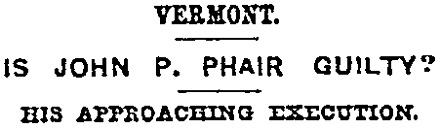
Is John P. Phair Guilty?
Boston Evening Journal, April 4, 1877

Wherever the judicial system proposes to situate the threshold for conviction and condemnation, some subset of messy real-life cases will always smudge the brightest of lines. Phair’s contemporaries simply could not satisfy themselves that they really had the right man. But neither were they convinced of Phair’s repeated denials. In the absence of moral certainty, legal process takes the reins. A dramatic eleventh-hour reprieve from the governor saved Phair in 1877. But as Murder by Gaslight notes:

The problem for Phair now was that by Vermont law he could not ask for a new trial if more than two years had passed since the original verdict. The governor granted him another reprieve until the first Friday of April, 1879 while the legislature debated changing the law.

Phair won this battle — the legislature empowered judges to refer such a case to the Supreme Court — but lost the war. In February 1879, Vermont’s high court considered, and then quickly rejected, Phair’s appeal. Past this point, exertions for the condemned man became the longest of shots, but this is not to say that they did not continue. The man’s exhaustive last-ditch efforts, some by his own hand and some mounted by his friends, have a whiff of the familiar present-day spectacle to them. (The Cleveland Plain Dealer sarcastically titled its after-action report “Hanged At Last”)

Phair won a six-day reprieve from a scheduled April 4 execution; on the eve of the hanging, two judges were taking Phair’s last appeal for a fresh trial; and on the morning of the execution the state’s governor was obliged to reject Phair’s supporters’ plea for a delay to allow the legislature to intervene yet again. (Phair didn’t even know this last one was occurring.)

The man himself was reported calm in the last hours, even as he persisted with his denials. Guilty or not, he finally fell through the long-awaited gallows trap murmuring “Lord, remember me!” at 2:11 p.m. on this date in 1879.

On this day..

1859: Baltimore’s Plug Uglies

This date in 1859 saw the joint hanging of youths from a notorious Baltimore gang, and in honor of the occasion thousands upon thousands of curiosity-seekers packed Charm City from “all parts of the State, the District of Columbia, Virginia and Pennsylvania, and even New York city and Buffalo” to throng the hills and high points overlooking the Baltimore City Jail, where a fine view could be had of the nominally private gallows.

“The housetops, windows, trees and all other places from whence a more enlarged view could be obtained, were crowded with human beings,” reported the Baltimore Sun (Apr. 9, 1859). “A sea of faces met the eye far and near — men, women and children — old age and infancy — white and black — swelled up the vast multitude, drawn to witness the horrible spectacle.”

The doomed quartet were four men named Henry Gambrill, Marion Crop, Peter Corrie, and John Cryphus. Cryphus was a black man condemned for a knife murder committed under the name John Stephens, and he vainly protested all the way to the gallows that Stephens was not he.

The other three who hanged with him — our principal focus today — were entirely unconnected to him. Gambrill, Crop, and Corrie were all stalwarts of the “Plug Uglies”, who were at once a street gang and a political goon squad, involved (with several similar entities) in a number of election day poll riots in the 1850s. Baltimore was at this point America’s third-largest city, having boomed to 200,000 souls rather faster than its civic institutions could cope.

The city veered near to mob rule (for which it earned the sobriquet “Mobtown”): rival gangs of toughs like the Plug Uglies regularly fought deadly street battles involving hundreds of participants — especially around municipal elections which they shamelessly rigged with armed bullying and prodigious vote-stuffing.* The anti-Know Nothing mayoral candidate in 1858 simply conceded the election rather than invite “loss of life and the general disorder of the city.”


Plug Ugly ruffians boss a ward. (Via)

Affiliated with the nativist, anti-Catholic “Know-Nothing” movement,** the Plug Uglies’ nickname underscores the brutal tenor of their times:

[Baltimore’s gangs] carried pugnacious and frequently obscene banners and often brandished weapons. The awl was seen as a workingman’s weapon, and many were made and handed out at rallies. They were used to “plug” Democrats “ugly” and to prevent them from voting. (Source)

Not long before that peacekeeping 1858 mayoral concession, alliterative policemen Benjamin Benton and Robert Rigdon had arrested a Plug Ugly crony for disorderly conduct, when Henry Gambrill raced up to the grappling trio and shot Officer Benton in the head.

Officer Rigdon, who knew Gambrill well, testified against the goon in the resulting murder trial. So incensed were Gambrill’s pals that they contrived to assassinate Officer Rigdon in revenge: covered by a lookout, Marion Crop in the dark of night shot Rigdon through a window as the cop stood at his mantelpiece chatting with his wife. Both Crop and the lookout, Peter Corrie, were chased down and condemned for first degree murder at separate, and sensational, trials in January 1859.

Despite the power of the Know-Nothings, this outrage proved to fall well outside the range of the Plug Uglies’ impunity. If they could do this, then what institutional pillar of the city would remain standing?

No small sentiment went abroad to skip the assassins’ trials and proceed directly to the hanging — perhaps a problematic means by which to stave off anarchy. In a more promising vein, the affair catalyzed some long-sought political reform measures from the legislature to rein in political violence. And on a chilly, overcast morning in April, Marion Crop stood on the gallows and belted out a hymn for the nation’s gawkers, joined with varying enthusiasms by the other three doomed men.

Former friends, we now must leave you
All our earthly hopes are o’er
But in heaven we hope to greet you
There to meet to part no more.

When a few more moments wasted
And this dying scene is o’er
When this last dread grief we’ve tasted
We shall rise to fall no more.

Fast our sun of life’s declining
Soon it will set in endless night
But our hopes pure and reviving
Rise to fairer worlds of light.

Cease this mourning, trembling, sighing,
Death shall burst this sudden gloom
Then our spirits fluttering, flying
Shall be borne beyond the tomb.

Corrie and Crop were buried privately. Gambrill enjoyed a solem public funeral with a procession of a hundred or so carriages through the center of town. An estimated eight to ten thousand Know-Nothing sympathizers attended it.

* Full marks for period color to the gangs of that time, which included the Rip Raps, Black Snakes, Blood Tub, Regulators, Rough Skins, Double Pumps, and Calithumpians. The successful Plug Uglies, who spread to other cities than Baltimore, were the ones destined to give their name to the language as a synonym for a an urban rowdy. (It’s also the name of some bars.)

** Shortly after the events in this post, Baltimore would be distinguished by a massive, and deadly, riot against a column of federal troops being dispatched to Virginia in the immediate aftermath of Fort Sumter. Since the Battle of Fort Sumter itself had not resulted in any combat fatalities, it was this riot that laid in the ground the first bodies of America’s bloody Civil War.

† While the Know-Nothings’ national impact was limited, they essentially took over Maryland’s political apparatus in the 1850s and made it the party bastion. Know-Nothing nominee (and former U.S. President) Millard Fillmore carried only one state in the 1856 presidential election won by James Buchanan: Maryland.

On this day..

1895: William Lake

On this date in 1895, William Lake died in the electric chair for soiling Albion, N.Y., with a most gory crime of passion.

The farmhand Lake nursed a very one-sided crush on a servant in the household of farmer Joseph Van Camp, 18-year-old Emma Hunt. One October night in 1894, the farmer called on a neighbor, leaving the two alone in the kitchen.

He returned an hour later to find Emma Hunt slaughtered as if by a demon. Her throat was slashed ear to ear and cross-shaped slashes to her abdomen had nearly disemboweled her. Nearby lay a bloody hammer that had caved in her skull. Lake was nowhere to be found, but he only dodged the sheriff’s posses for a few days before an officer caught him hiding in a barn.

It turned out upon Lake’s ready confession that this crime of passion was also one of calculation. Emma, said Lake, “bothered me and hectored me” in disdaining his affections, and “I made up my mind I would kill her.” (New York Herald, Oct. 22, 1894)

While the family ate supper on that horrible night, William Lake wrote out a confession to the murder he was going to commit once left alone, and packed a satchel with which to flee. (He forgot the satchel when the time came.) Lake’s written confession attributed a lifelong bitterness to his illegitimate birth.

He did not attempt to mitigate the crime in any way and welcomed a death sentence that was conducted within seven weeks of his conviction.

On this day..