1878: Joseph LaPage, murderer of Josie Langmaid

Joseph LaPage died on a gallows at Concord, N.H. on this date in 1878 for the horrific murder of Josie Langmaid more than two years before.

The 17-year-old Josie’s disappearance one October morn while walking to her classes at the Pembroke Academy shocked the town of Pembroke and the adjoining village of Suncook. Late that night, frantic search parties found Josie’s body by torchlight in a cluster of trees just off Academy Road — ravaged, mutilated, and headless. (The head turned up the next morning, half a mile away.)

The horror of her murder so shook* Pembroke that it put up a memorial obelisk that still stands today — right near the turn into present-day Three Rivers School. Additional inscriptions on the macabre monument direct the viewer to a little stone pillar 90 feet north at the exact spot her body was recovered … and yet another one 82 rods on where her head was recovered.

“As I pull out of the driveway of the school, leaving my daughter behind, the monument is a visible reminder of how quickly our lives can change,” one commenter mused in a detailed post on the excellent true-crime blog Murder By Gaslight.

All of New England thrilled to the horrific crime, in consequence of which — after a week’s worth of panicky arrests of random tramps and the town’s only African-American — it soon became known that an itinerant French woodcutter named Joseph LaPage who had been suspected of a similar slaying previously in St. Alban’s, Vermont, just so happened to be in the area.

And upon arrest, he was found to have a boot whose bloodied heel appeared to match the shape of a violent gouge found on Langmaid’s severed head.

This is not reliable forensic evidence in the modern sense. But evidence began to exclude nearly every other person who had fallen under early suspicion, and the circumstances implicating Joseph LaPage soon stood out damningly.

Perhaps the most powerful was a history of savage violence against women.

LaPage (born outside Montreal as Joseph Paget) had come to live in the United States by escaping over the Canadian border after raping his sister-in-law, Julianne Rousse. He had escaped the St. Alban’s prosecution in part thanks to alibis provided by his sons, who now recanted their testimony. LaPage was known to abuse his wife, and was thought to have outraged his own daughter.

And it was found that in Pembroke, LaPage had been making unnervingly personal inquiries after the habits of his employer’s pretty young daughter — a Pembroke Academy student herself who customarily walked to school along Academy Road with Josie Langmaid. She might have been LaPage’s intended target, but on the fateful morning she chanced to catch a carriage ride instead.

Though LaPage fought his sentence for two years and even won an appeal overturning the first verdict against him, he was condemned a second time. He confessed on the eve of his hanging to both Langmaid’s murder, and that of Marietta Ball in St. Alban’s — complete with hand-drawn maps for both crimes indicating how he had gone about committing them, and where he had disposed of the remains.

However, because LaPage was not forthcoming with such a confession at the point of trial, and because evidence such as Julianne Rousse’s rape testimony and the suspicions against him from St. Alban’s was excluded as irrelevant, it had been necessary to develop the strongest possible evidentiary case in the Langmaid murder without depending overmuch on the accused’s brutish reputation.

To that end, the LaPage prosecutions also became a bit of a minor forensics laboratory: there had been bloodstains found on some of his clothes, but of course, this could be blood from butchering an animal or from injuring himself in the course of woodcutting, or anything else.

Could one say more than that in the 1870s? A significant subplot of LaPage’s trials consisted of scientists expert in “blood microscopy” explaining their tests on Langmaid’s and LaPage’s clothing, and in particular their suggestion of a tentative match between some of the samples based on restoring with a simulated serum the dried corpuscules to something resembling their living state and examining the dimensions of the corpuscules. The blood on Josie Langmaid’s clothes “resembled in every respect that found upon the clothing of LaPage,” one doctor testified. (St. Albans (Vt.) Messenger — which newspaper heavily reported the course of LaPage’s trial, for obvious reasons — January 10, 1876.)

LaPage’s defense naturally attempted to repel such evidence by arguing against the method of “restoring” corpuscules, against the reliability of their post-mortem characteristics, and against the dependability of the alleged matches between samples. LaPage’s last-minute confession led the St. Alban’s Messenger (March 22, 1878) to exult that

[i]t must be exceedingly gratifying to Drs. Richardson, Treadwell and Chase, to have this confirmation by voluntary confession of the revelations of crime by the microscope. It will no longer do for flippant attorneys to scout** the revelations which modern science gives, at the hands of intelligent, patient, skillful and thoughtful manipulators in microscopy and photography; and the conviction and punishment of such a monster as LaPage, largely by the testimony of blood experts secures another triumph for modern science.

* In addition to the obelisk, a “Suncook Town Tragedy Ballad” (lyrics here) preserves the terrible tale.

** “To scout” has a little-used meaning of “to scorn; dismiss”. This meaning has a completely different etymology from the more usual meaning of searching or reconnoitering.

On this day..

1686: James Morgan, a Warning to you all

From Cotton Mather’s Magnalia Christi Americana: Or the Ecclesiastical History of New England from 1620 – 1698:


On March 11, 1686, was Executed at Easton, one James Morgan, for an Horrible Murther. A Man, finding it necessary to come into his House, he swore he would run a Spit into his Bowels; and he was as bad as his Word.

He was a passionate Fellow; and now, after his Condemnation, he much bewail’d his having been given to Cursing in his Passions.

The Reverend Person, who preach’d unto a great Assembly, on the Day of this poor Man’s Execution, did in the midst of his Sermon, take occasion to read a Paper which he had receiv’d from the Malefactor then present in the Assembly. It was as followeth.

I, James Morgan, being condemn’d to die, must needs own, to the Glory of God, that He is Righteous, and that I have by my Sins provok’d him to destroy me before my time. I have been a great Sinner, guilty of Sabbath-breaking, of Lying, and of Uncleanness; but there are especially two Sins whereby I have offended the Great God: one is that Sin of Drunkenness, which has caused me to commit many other Sins; for when in Drink, I have been often guilty of Cursing and Swearing, and Quarrelling, and striking others. But the Sin, which lies most heavy upon my Conscience, is That I have despised the Word of God, and many a time refused to hear it preach’d. For these things I believe God has left me to that, which has brought me to a shameful and miserable Death. I do therefore beseech and warn all Persons, young Men especially, to take heed of these Sins, lest they provoke the Lord to do to them as he has justly done by me. And, for the further Peace of my own Conscience, I think my self oblig’d to add this unto my foregoing Confession, That I own the Sentence which the Honour’d Court has pass’d upon me, to be Exceeding Just: inasmuch as (though I had no former Grudge and Malice against the man whom I have kill’d, yet) my Passion at the time of the Fact, was so outragious, as that it hurried me on to the doing of that which makes me now justly proceeded against as murderer.

After the Sermon, a Minister, at his Desire, went unto the Place of Execution with him. And of what passed by the way, there was a Copy taken, which here ensueth.


The entire interview — as reported by Cotton Mather, the “reverend person” who attended the doomed soul — is here.

“Secure the Welfare of your Soul,” Mather implored Morgan on the morning of the latter’s hanging, “and this (now) pinion’d, hang’d, vile Body of yours will shortly be rais’d unto Glory, Glory for evermore.”

The terrors of the sentence had already worked the clergyman’s part before Mather himself turned up. Whatever Morgan’s conduct day by day in life, he had grown up in the same universe of New England Puritans as Mather, and breathed the same ideology. We find him not so much assenting to his minister’s exhortations, as soliciting them, almost leading the conversation at some points.

Sir, as for the Pain that my Body must presently feel, I matter it not: I know what Pain is; but what shall I do for my poor Soul? I’m terrified with the Wrath of God: This, this terrifies me, Hell terrifies me: I should not mind my Death, if it were not for that.

Mather runs with this for a while, perhaps a little too far — “those exquisite amazing Torments … such as never have an End. As many Sands as could lie between this Earth and the Stars in Heaven, would not be near so many as the Ages, the endless Ages of these Torments.”

Morgan steers his confessor towards solutions with a leading question.

But is there not Mercy for me in Christ?

(Two things to bear in mind: first, Morgan at “I think about thirty” years old would have been the elder figure in this conversation with 23-year-old Cotton Mather; second, this is Mather’s own account of Mather’s private conversation, as composed in a self-consciously literary “dialogue” form for the purposes of publication.)

This conversation hones by mutual consent of the speakers on the classics of the condemned cell: drinking, Sabbath-breaking, and bad company as the root sins that watered the gallows-tree, mitigated by the redemptive opportunity to turn one’s own public strangulation into a pedagogic moment for the gawkers.

Morgan was right on board. (They didn’t all come so easy.)

Mather records his charge’s last speech, made from the hanging-ladder before he is turned off.

I Pray God that I may be a Warning to you all, and that I may be the last that ever shall suffer after this manner. In the fear of God I warn you to have a care of taking the Lord’s Name in vain. Mind, and have a care of that Sin of Drunkenness: For that Sin leads to all manner of Sins and Wickedness: (mind, and have a care of breaking the sixth Commandment, where it is said, Thou shalt do no Murther) for when a Man is in Drink, he is ready to commit all manner of Sin, till he fill up the Cup of the Wrath of God, as I have done by committing that Sin of Murder.

I beg of God, as I am a dying Man, and to appear before the Lord within a few Minutes, that you may take notice of what I say to you. Have a care of Drunkenness, and ill Company, and mind all good Instruction; and don’t turn your Back upon the Word of God, as I have done. When I have been at Meeting, I have gone out of the Meeting-house to commit Sin, and to please the Lust of my Flesh. Don’t make a mock at any poor Object of Pity; but bless God that he has not left you as he has justly done me, to commit that horrid Sin of Murder.

Another thing that I have to say to you, is, to have a care of that House where that Wickedness was committed, and where I have been partly ruin’d by. But here I am, and know not what will become of my poor Soul, which is within a few moments of Eternity. I have murder’d a poor Man, who had but little time to repent, and I know not what is become of his poor Soul. O that I may make use of this Opportunity that I have! O, that I may make Improvement of this little, little time, before I go hence and be no more. O, let all mind what I am saying now I am going out of this World. O, take Warning by me, and beg of God to keep you from this Sin, which has been my Ruine.

O Lord, receive my Spirit: I come unto thee, O Lord, I come unto thee, O Lord, I come, I come, I come.

On this day..

1865: Amy Spain, liberation anticipation

This date in 1865, just weeks before the final collapse of the Confederacy, a slave named Amy was hanged on a sycamore tree before the courthouse of Darlingon, S.C., for anticipating her liberty a little too exuberantly.

Mopping up after his march to the sea, Union Gen. William T. Sherman proceeded to South Carolina. After occuping the capital, Columbia, Sherman’s army made a northerly progression towards North Carolina.

In early March, Union Cavalry appeared in Darlington. Our 17-year-old principal, the domestic of a local lawyer named A.C. Spain,* exulted at this arrival.

“Bless the Lord, the Yankees have come!” Harper’s Weekly** would later report her to have exclaimed.

The long night of darkness which had bound her in slavery was about to break away. It was impossible to repress the exuberance of her feelings; and although powerless to aid the advancing deliverers of her caste, or to injure her oppressors, the simple expression of satisfaction at the event sealed her doom.

But the Union men were not long for the town. It was just a scout party; constrained by strategic objectives, and hindered by swollen early-spring rivers, the main body of Union forces passed Darlington by.

Anticipating an occupation that was not about to occur, Amy recklessly declared herself free and took some of the Spain household’s possessions — the fruit of her own involuntary labor. Whatever her exact actions in those days, they were frightfully punished — over the objection of A.C. Spain himself, who reportedly served as her advocate at the rebel military trial that condemned her.

Her persecutors will pass away and be forgotten, but Amy Spain’s name is now hallowed among the Africans, who, emancipated and free, dare, with the starry folds of the flag of the free floating over them, speak her name with holy reverence.

-Harper’s Weekly

* Spain was also a Confederate commissioner to Arkansas at the start of the Civil War, in which capacity he successfully urged Arkansas into the rebel camp.

** Septemer 30, 1865.

On this day..

2001: Willie ‘Ervin’ Fisher, traveling man

(Thanks to John S. Carbone of Alienists Compendium. Dr. Carbone is also the Director of Mental Health Services and Chief of Forensic Psychiatry for the North Carolina prison system.)

On this date in 2001, Willie ‘Ervin’ Fisher, aged 39, was put to death by lethal injection at North Carolina’s Central Prison in Raleigh.

His was a forgettable if lamentable crime were it not for the changes to the state’s administrative code that his passing — nay, his post-mortem travels — effected.

Fisher at first invoked that time-tested excuse of addling by drugs and alcohol as exculpation for the slaying of April 2nd 1992.

He admitted from the time of arrest to the murder of Angela Johnson, his on-again, off-again girlfriend, during a domestic altercation that was witnessed by many as it spilled outside to a parking lot for its finale by knife and broken broomstick.

Interestingly, Fisher had no prior felony arrests, and when he was deemed able to have formed the specific intent necessary for first-degree murder, that other time-tested excuse — ineffective counsel — was raised with equal futility. Throughout, however, prison officials described him as a ‘model prisoner’ on death row, one who received nary a single disciplinary charge in the decade he was incarcerated. And though he later abandoned the pretense of chemical sway and accepted full personal responsibility in a videotaped appeal for clemency to the governor, his pleas fell on deaf ears.

Fisher gave a brief last statement on the evening of his demise, and was pronounced dead after 9:00 p.m. His earthly remains were then transported across town to the medical examiners’ office.

But that wasn’t the end of the story.

The decedent’s sister, Sally Fisher, was at that time the deputy registrar of vital records for the Forsyth County (NC) Health Department, and as such was familiar with then-existing rules pertaining to the handling and transportation of dead bodies. Ms Fisher later recounted that “I just got up that [next] morning and said, ‘we might as well [bring] Ervin home’…. I just wanted to be close to him for a while.”

So Ms Fisher, her sister, and her niece piled in the latter’s SUV and drove to Raleigh at 6:00 a.m. on the 10th to claim the corpse. At first, the medical examiner balked at releasing the body thusly, but Ms. Fisher was versed in statute and code, and after a number of frantic phone calls for guidance, the ME had no choice but to turn Fisher’s remains over to his family.

Then, with the help of an employee of the ME’s office, the four struggled to wedge Fisher’s by-then-stiff corpus into the back of the SUV. Fisher had to be placed recumbent as he wouldn’t sit up straight. Ms. Fisher and her sister got in the back seat and talked with the departed while the niece drove the 100 miles west on Interstate 40 to Winston-Salem and the family residence.

Though it was only early March, Fisher’s family turned on the air conditioning inside the SUV — to the highest setting.

En route, they stopped at least once for sodas and to make phone calls to family and friends to let them know that Fisher was headed home, and that everyone should come to visit upon his arrival. There was a brief and impromptu reunion of sorts held in the front yard when the travelers reached the family’s residence. This was followed by a meandering drive around town to visit old haunts (pun fully intended) before eventually reaching the funeral parlor.

Word traveled fast, and it wasn’t many hours before a local television station in Winston-Salem had called the warden at Central Prison for comment regarding the inmate of whom he had overseen the execution mere hours before who was nevertheless now cruising out west with crowds forming to wave at him.

Some said that the family fetched Fisher to save expenses. The Department of Correction, though, was authorized to provide up to $300 to indigents for burial costs if a letter were received from a funeral home … and no such letter had been received. Ms. Fisher herself later said that money had nothing to do with the decision. “To me, it was … closure. For ten years, I was talking to him through glass and couldn’t touch him. That was my brother. He was the baby…. Bringing him back home helped me out.”

And in what may be Ervin Fisher’s lasting legacy, it is now mandated by amended state administrative code that only a hearse from a licensed funeral home can take possession of the dead at the medical examiner’s office.

On this day..

1782: The Gnadenhutten Massacre

You recall the time when the Jesus Indians of the Delawares lived near the Americans, and had confidence in their promises of friendship, and thought they were secure, yet the Americans murdered all the men, women, and children, even as they prayed to Jesus?

Tecumseh, to William Henry Harrison in 1810

This date in 1782 marks one of the more appalling single atrocities in the United States’s long destruction of indigenous Native Americans — the Gnadenhutten Massacre.

This incident during the American Revolution took place in the Ohio River basin, a vast and fertile flashpoint whose part in not only the revolution but the antecedent French and Indian War perhaps entitles it to claim the midwifery of the coming American empire.

After victory in the French and Indian War, the British closed the area west of the Appalachian mountains to European settlement. This proclamation:

  • Made good a wartime pact Britain had made to secure the support of the Iroquois, Lenape (Delaware) and Shawnee tribes; and
  • Trailed facts on the ground the moment it was issued.

European settlements and land claims already existed in the supposed Indian Reserve, and land-hungry settlers did not let the supposed frontier deter them from advancing new ones. Confrontations between these arriving claimants and the native inhabitants not infrequently came to atrocious resolutions.

By 1768, a new treaty pushed the line further west, effectively ceding to the colonists everything south of the Ohio River — present-day Kentucky and West Virginia.*


Map of the disputed area: the frontier moved from the yellow line along the Applachians to the orange line along the Ohio.

Ohio Country, the remaining territory in dark green shading north of the Ohio River, lay at the time of the American Revolution between the British garrison at Fort Detroit and colonial outposts along the nascent United States’s western marches, such as Fort Pitt (Pittsburgh).

The Lenape Indians in Ohio Country had a difficult calculation to make as to which side (if any) and how to support during the British-American fighting. The question split the Lenape internally.

In this cauldron, a strange morsel: Lenape who were Moravian** Christian converts had established a little missionary village. “Gnadenhutten” literally means “huts of grace”.

As one might imagine, Gnadenhutten and its sister settlements of pacifistic, Christian Lenape stood in a terribly ambiguous position in the brutal irregular war going on around them. Their fellow Lenape distrusted them because they were Christians; their fellow Christians, because they were Lenape.

Suspected by the British of being friendly enough with the American colonists to pass intelligence to their eventual murderers, these converts were in 1781 forced out of Gnadenhutten by British-allied Lenape to a new settlement aptly named “Captive Town”.

Starving there in the ensuing winter, the Moravians dispatched nearly 100 of their number back to Gnadenhutten to retrieve food abandoned at that settlement.

The Moravians were still at their village when a raiding party of Pennsylvanians descended on the town. Under no authority but the militiamen’s own festering grievances from the ongoing dirty war, the Pennsylvanians rounded up the Delaware and heartlessly declared their deaths.

Here were Indians who would pay for the violence Indians had done. And they were the best kind: the kind who didn’t fight back.

After spending a night praying and preparing for the end, the Moravian Lenape were systematically butchered on the morning of March 8† with mallet blows and scalpings.

Depending on your source, there were either 90 or 96 scalps to take that morning – women, men, and children in nearly equal proportions. At least one young boy survived the death squad and reported the massacre. Nor were all the militia themselves at peace with their deed.

one Nathan Rollins & brother had had a father & uncle killed took the lead in murdering the Indians, & Williamson was opposed to it; & Nathan Rollins had tomahawked nineteen of the poor Moravians, & after it was over he sat down & cried, & said it was no satisfaction for the loss of his father & uncle after all. — So related Holmes Jr. who was there — who was out on both Moravian campaigns, & Crawford’s. (Source)

Ah, Crawford’s campaign.

Later in 1782, another expedition of frontiersmen under Col. William Crawford set out “to destroy with fire and sword” a different Lenape settlement in Ohio. Instead, the Lenape met and routed the expedition, taking Crawford prisoner. He and the other captives from that misadventure would be burned to death, in part to avenge Gnadenhutten.

This, and whatever like tit for tat could be exacted in the field, was all the justice the Lenape could ever hope to have for the hecatomb of Gnadenhutten. American authorities declined to prosecute or sanction any members of the militia.


“Here triumphed in death ninety Christian Indians March 8, 1782”: inscription at the base of a memorial obelisk in Gnadenhutten. (cc) image from Mike Drabik.

* This might have been a nice solution, except that said treaty was made by the Iroquois — and only the Iroquois. For the Shawnee who actually lived and hunted in this cessation, this was two outside powers bartering their land. They didn’t mean to give it up on the say-so of the Iroquois. Another nasty frontier war followed, and even when that was won by Virginian militia, dissatisfied Shawnee continued targeting settlements in Kentucky; it’s partly for this reason that the Declaration of Independence slates King George III with having “endeavoured to bring on the inhabitants of our frontiers, the merciless Indian Savages whose known rule of warfare, is an undistinguished destruction of all ages, sexes and conditions.”

For more on the long and tragic Shawnee struggle in this period, see “‘We Have Always Been the Frontier’: The American Revolution in Shawnee Country” by Colin G. Calloway in American Indian Quarterly, Vol. 16, No. 1 (Winter 1992).

** The Moravian Church‘s name harkens to its Czech origins. It’s a successor to the reform tradition of Jan Hus.

† There are a few cites out there for the day before or the day after March 8.

On this day..

1868: Joseph Eisele, honest, kind-hearted triple murderer

On this date in 1868, several thousand folk braved knee-deep mud to converge on Parkersburg, West Virginia for the last public hanging in Wood County.

Joseph Eisele was a German immigrant who worked at a furniture shop. He had, he would admit, manifested a predilection for crime from his childhood in Germany, on account of which he’d begun going by “John Schafer” once he pulled up stakes for America.

“Joseph Eisele is five feet nine inches high, stoutly built, somewhat round shouldered, and weighs one hundred and seventy pounds,” ran the introduction to Joseph Eisele’s own confessional pamphlet about Joseph Eisele.* “He is thirty-four years of age, with a complexion quite fair and florid, his light brown hair is worn short, and his beard shaved clean, except a light moustache, which gracefully shades a slightly sensual, though well shaped mouth, his nose is straight, well cut and proportioned, his gray eyes are somewhat deep set, and of a mingled expression of sadness and timidity, not in keeping with the open, genial brow, square jaw, strong chin, and other features of his manly and prepossessing countenance.”

It’s a description aiming to suggest a physiognomy of queer contrasts, mirroring the cold-blooded series of crimes committed by a seemingly conscientious and thoughtful man.

Even while “prowling around nightly with his terrible hatchet in his pocket, seeking more victims, he was sustaining a character for industry, frugality, temperance, honesty, kind-hearted liberality, and all the house-hold and domestic virtues, together with a dignity, modesty and intelligence rare among men in his walk of life,” a correspondent mused to the Cincinnati Enquirer.

Eisele murdered three men, Joseph Lilienthal, Aloys Ulrich, and Rudolph Tsutor, and robbed them, and did so with a carelessness for his own safety that would astonish once it became public. Lilienthal he killed in daylight behind an occupied boarding house. Ulrich’s distinctive possessions were sold off with little attempt to disguise them. Tsutor Eisele slew at his home at 10 in the morning, miraculously without being observed coming or going. Then the killer paid out his debts that same day.

Since it looks like Sherlock Holmes wouldn’t be on this case, it would be up to Eisele’s prey to help themselves.

Finally in early January 1868, Eisele clobbered a creditor across the neck in an attempt to take his fourth victim. John White fought back with “almost superhuman strength and courage” as his attacker later put it admiringly. The melee careened out into the street where finally, finally, Eisele was detected in his crime. He managed to flee the scene as bystanders came running, but was arrested shortly after.

At this point, the dignity, modesty, and intelligence stuff resurfaced.

Eisele’s trial began at 2 p.m. on January 20, and so ready was the defendant to expiate his guilt that the verdict was in the books before dinner. In a prepared statement that a translator read from Eisele’s native German (which also begged his adoptive countrymen not to think ill of Germans), Eisele foreswore any defense.

I want no witness and no defense, and can not really give any reason for my misdeeds, except that the evil spirit led me into temptation, and I could not resist it. I am willing to sacrifice my blood and life for my crimes, and hope the Almighty God will forgive me, and after death receive me into his kingdom. I therefore beg the people present for their forgiveness. I have no enmity towards any one in the world, and acknowledge that I deserve all that may befall me and am ready to bear it all with patience.**

There’s apparently some sentiment to mark the spot of the historic hanging in Parkersburg.

* As of this writing, Eisele’s book is available on Amazon! The quotes from it source to the Cincinnati Daily Enquirer, March 11, 1868.

** Cincinnati Daily Gazette, Jan. 27, 1868.

On this day..

1837: The slave Julius, property of John and Rebecca Matthews

(Thanks to Meaghan Good of the Charley Project for the guest post. -ed.)

On this date in 1837, a slave named Julius, property of John and Rebecca Matthews, was hanged for the attempted murder of his mistress. He was 20 years old. The story of his crime is told in detail in Lewis L. Laska’s Legal Executions in Tennessee: A Comprehensive Registry, 1782-2009.

Julius was the Matthews family’s only slave and was apparently mentally disabled; Rebecca said he had “but half sense” and John said he “had just sense enough to be a good negro.”

Both John and Rebecca emphasized that Julius was docile, obedient and apparently quite attached to his owners, who had three small children. They were baffled when he brutally assault Rebecca and tried to kill her.

On the day of the attack, John was absent. Julius went out corn-shucking with Littlebury Fallin and his uncle William Fallin, both of them white men. He came home at 6:00 p.m., drunk, did some household chores and made a large fire in the fireplace.

At 7:00, Rebecca heard some whistles outside the house and asked Julius what was going on. He said he didn’t know. He went outside and returned with an ax, saying he would use it to defend Rebecca if they were attacked. Rebecca locked the doors and windows, then sat at her spinning wheel for awhile.

When she bent over to pick something up, Julius grabbed her by the throat and said he was going to kill her, take all the money in the house and run away to a free state. He tried to throw her into the fireplace, saying he’d made the fire to burn her body.

There followed a fierce struggle and Rebecca put up a good fight. She was able to wrestle the ax away from her attacker, unlock the door and run outside. Julius tried to brain her with a large rock but he dropped it when she grabbed his arm. He then tried to stab her with a pocketknife but wound up accidentally cutting his own throat instead. Rebecca wrapped her hands around his neck and choked him until she felt him lapse into unconsciousness.

Then she grabbed her youngest daughter, age three, and legged it for a neighbor’s house. As she ran she noticed Littlebury and William Fallin right behind her.

In the state of Tennessee, even a slave was entitled to a lawyer at a criminal trial. John Matthews refused to appoint counsel for Julius, so the state appointed two lawyers to defend him. (One of them, Alfred O. P. Nicholson, would later serve two terms in the Senate and, after that, on the Tennessee Supreme Court.)

Julius expressed great remorse for his crime, saying he would never have done it sober and he wished Rebecca had killed him. At his trial, he confessed everything and implicated the Fallins, saying that they’d gotten him drunk during the corn-shucking and urged him to rob and kill his mistress.

William, who lived in Kentucky, promised to help him get to a free state. The whistles, Julius explained, had been signals from the Fallins that they were outside the cabin waiting for him to kill Rebecca.

Littlebury testified and denied everything. William did not testify. Neither man ever faced charges for their alleged role in the crime.

The jury convicted Julius after deliberating overnight, but they recommended mercy on account of his youth, his prior good character and the suspicion that he had been lead astray by others. Nevertheless, the sentence was death.

As Julius was awaiting his execution date, help came from an unlikely source: John Matthews, his owner and the husband of the victim. He wrote to the governor, Newton Cannon, asking that the errant slave be pardoned so Matthews could sell him. He listed the following reasons:

  1. The negro is shown to have had a most excellent character.
  2. He was quite young.
  3. He was proved to have but a very limited portion of intellect.
  4. He was shown to be in liquor and the circumstances raised a strong presumption that he was induced by white men to drink for the very purpose of being instigated to commit the murder.
  5. The circumstances rendered it certain that he was instigated by white men, and with his already-impaired sense, and in liquor, that he was almost a passive instrument in their hands.
  6. He was the only slave of his master.

That last might have been the nub of it. Matthews emphasized that if Julius were hanged and his owners got no compensation — and the state of Tennessee never compensated an executed slave’s owner for the economic loss — the family would suffer greatly. This created an odd confluence of interest between the condemned slave and the one-slave family whose matron he had attempted.

John Matthews expressed confidence that Julius “was not himself when he did the act” and added that it seemed unreasonable “to take away a life when no murder had been committed.”

Going against Matthews’s letter was a petition from the citizens of Maury County, asking that justice take its course and Julius be executed. Julius had had a fair trial, the petition said. Sparing his life and merely selling him on would not only endanger public safety but would also set a bad example for other slaves: “For what is to restrain the slave from imbuing his hands on his masters’ blood, with whom he is incensed, if he had good reason to believe that his punishment, if caught, is to only be a change of masters, and a chance that the may be for the better?”

The governor ignored John Matthews’s plea and upheld the rule of law: Julius was hanged at 2:30 p.m. on March 1, and his master was not reimbursed. On the scaffold, the young slave “confessed his guilt, and deplored his error; spoke of his mistress with much tenderness and warned the colored persons present to remember his fate.”

On this day..

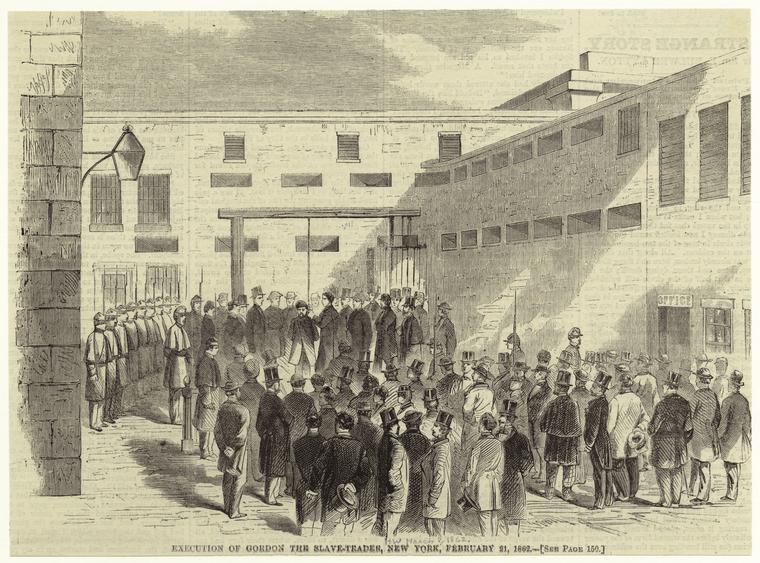
1862: Nathaniel Gordon, slave trader

On this date in 1862, the American commercial shipper Nathaniel Gordon was hanged at the Tombs for slave trading.

Importing slaves to the U.S. had been nominally illegal for over half a century, but had never been strongly enforced. In 1820, slaving (regardless of destination) had even been defined as piracy, a capital crime.

Importation of kidnapped Africans into the United States did significantly abate during this period, and that was just fine with U.S. slaveowners ever paranoid of servile rebellion.

But a voracious demand for conscript labor persisted elsewhere whatever the legal situation. About 3 million slaves arrived to Brazil and Cuba, the principal slave shipment destinations, between 1790 and 1860 — even though the traffic was formally illicit for most of this time.

Great Britain was endeavoring to strangle the Atlantic slave trade, but the diplomatic weight she had to throw around Europe didn’t play in the U.S. Washington’s adamant refusal to permit the Royal Navy to board and search U.S.-flagged ships made the stars and stripes the banner of choice for human traffickers profitably plying the African coast. “As late as 1859 there were seven slavers regularly fitted out in New York, and many more in all the larger ports,” one history avers.

Hanging crime? No slave-runner had ever gone to the gallows as a “pirate” — not until Nathaniel Gordon.

The U.S. Navy did mount its own anti-slaving patrols, but the odd seizure of human cargo was more in the line of costs of doing business than a legal terror for merchants.

So Gordon, son of triangle trade port Portland, Maine and a veteran of several known slaving runs, didn’t necessarily think much of it on August 8, 1860, when the Mohican brought Gordon’s ship to bear 50 miles from the Congo with 897 naked Africans stuffed in the hold, bound for Havana. Half of his slaves were children.

“The stench from the hold was fearful, and the filth and dirt upon their persons indescribably offensive,” Harpers reported.

Gordon chilled in very loose confinement in the Tombs, even enjoying family leave furloughs as he readied for the customary slap on the wrist.

But with Abraham Lincoln’s election in 1860, Gordon was promoted to demonstration case.

After a hung jury in June 1861, the feds won a conviction and death sentence on those long-unused piracy laws in November 1861.

Many New Yorkers were shocked at the prospect of such draconian punishment.

Abraham Lincoln found himself besieged by appeals public and private against the unprecedented judgment. “For more than forty years the statute under which he has been convicted has been a dead letter, because the moral sense of the community revolted at the penalty of death imposed on an act when done between Africa and Cuba which the law sanctioned between Maryland and Carolina,” Gordon’s counsel Judge Gilbert Dean wrote in an open letter to the President* — an argument that could hardly be more poorly calibrated to impress in 1862.

Despite Lincoln’s famous proclivity for the humanitarian pardon, he stood absolutely firm on the precedent Gordon’s hanging would set — especially in the midst of a bloody civil war driven by the very legal sanction Dean had cited so approvingly. As Lincoln wrote on February 4, 1862,

I think I would personally prefer to let this man live in confinement and let him meditate on his deeds, yet in the name of justice and the majesty of law, there ought to be one case, at least one specific instance, of a professional slave-trader, a Northern white man, given the exact penalty of death because of the incalculable number of deaths he and his kind inflicted upon black men amid the horror of the sea-voyage from Africa.

Gordon’s hanging was the one case — the only one ever.

* New York Times, Feb. 21, 1862.

On this day..

1878: J.W. Rover, sulfurous

Reno, Nevada had its only hanging on this date in 1878, and it’s never since been certain whether it was the right man they hung.

J.W. Rover, Frank McWorthy, and Isaac Sharp(e) had come from Oakland to work a sulfur claim in present-day Pershing County (then Humboldt County).

Sharp ended up dead, his body horribly mutilated and its dismembered parts scattered to different burial holes.

A mental health counselor I know is fond of saying of the family dysfunctions he has handled that who is crazy depends upon who gets to the phone first. It turns out that sometimes murder does, too.

McWorthy rode in to Winnemucca and swore out a complaint accusing Rover of the murder. Rover would spend the next three years vigorously but never quite successfully insisting that McWorthy was the one who killed Sharp.

Rover was convicted of murder in July 1875, but because the verdict didn’t mention degree of murder, the case had to be retried. In April 1876, Rover was convicted again, of first-degree murder, thank you very much. But the Nevada Supreme Court overturned that verdict, too, and granted Rover a change of venue to Reno’s Washoe County, where Rover was convicted for a third time in June 1877.

In all these proceedings, Rover never wavered from his claim of innocence, calling God to witness at trial after trial that it was his associate and accuser McWorthy who was the guilty party and wanted to frame up Rover to get his hands on that lucrative sulfur deposit.

Having failed three times over in court, Rover’s lawyers turned as the hanging approached to Section 458, a remote provision of the criminal code permitting a special jury to be impaneled “if after judgment of death there be good reason to suppose that the defendant has become insane.”

Three years and all those hearings on, Rover’s fate would finally rest in the hands of twelve new jurors impaneled on the very eve of his hanging. While Rover passed his final night in the Reno jail, his sanity jury met in a courtroom in an upper-story room.

Rover’s lawyers and the District Attorney made their arguments to the jury until midnight that night, then adjourned, and then re-assembled at 7:30 on the morning of the scheduled execution. Rover couldn’t sleep a wink, passing the night rambling emotionally with reporters — at one point breaking down as he read them a letter from his sister.

“As he lay there he formed an object at once of pity and interest,” one scribe wrote for the newspaper of nearby silver mining boomtown Virginia City.*

He was reclining upon a rude bed covered by a coarse blanket. His pillow had no case, and his hair was unkempt and rough-looking. His beard had the appearance of being about one month’s growth. The cell was narrow, and was lighted by the feeble rays of a tallow candle held by a Deputy Sheriff.

Once or twice, he would furtively ask the reporters’ estimation of his chances with the proceedings upstairs. The reporters didn’t know. The jury didn’t either.

That morning, as crowds besieged the courthouse seeking one of the 200 visitors’ permits for the “private” execution, the jury huddled inside it making its final deliberations over four long hours. At last, at noon, it came down seven votes for sane, five for insane.**

Seventy minutes after that vote, Rover was escorted to the gallows supported by two men and a stiff drink of whiskey. This was nearly a two-hour theater in its own right: after a 20-minute recitation of the death warrant, Rover spoke for 50-plus minutes, continuing to insist upon his innocence:

I am so prostrated by this long prosecution that I am unable to say what I want to say …

Gentlemen, McWorthy has got away, but if I had my liberty the face of the world would not be large enough to hide him. I would search him out and bring him to justice, and if the law could not reach him I would find a strong arm of justice that would reach him …

I must be hung; you will be sorry for it some day, but what good will that do me when I am dead and gone? Good-by. My heart is with you.

By the end, Rover could barely hold up. He took a drink of water. “Oh, gentlemen, I cannot realize that I am to be hung!” he cried as his limbs were pinioned at last, and had to be supported lest he swoon. The Catholic priest finally had to settle him down from his last babbling.

“Not guilty,” he insisted one last time. Then to the sheriff: “Go on and do your duty.”


Rumors of Rover’s innocence persisted for years after his hanging, not excluding claims that his ghost was on the haunt.†

In 1899, a newspaper reported that “It afterward developed that Rover was innocent of the crime for which he suffered. McWorthy died a few years ago in Arizona, and on his deathbed confessed that he was the murderer of Sharp.”

McWorthy might or might not have been the guilty party. But that story was not accurate — McWorthy was still alive at the time in Oakland, California.

* The newspaper in question was the Territorial Enterprise, notable for employing the young Mark Twain in the early 1860s. Indeed, it was here that the writer Samuel Clemens first employed that nom de plume. Ten years before Rover’s hanging, Clemens/Twain actually witnessed and wrote about a public hanging in Virginia City.

** Not as close as it sounds: Rover needed a unanimous verdict.

† The present-day Washoe County Courthouse, not built until many years after Rover’s hanging, allegedly has a haunted jail whose spook might be Rover.

On this day..

1815: Eight deserters by order of Andrew Jackson

(Thanks to Meaghan Good of the Charley Project for the guest post. -ed.)

On this day in 1815, eight young men condemned for desertion during the War of 1812 were executed by firing squad in Nashville, Tennessee.

They were brought out to be shot one by one, as there weren’t enough people available to form a firing squad large enough for the group of them.

Desertion was rife during this inglorious conflict, according to Wikipedia:

The desertion rate for American soldiers in the War of 1812 was 12.7%, according to available service records. Desertion was especially common in 1814, when enlistment bonuses were increased from $16 to $124, inducing many men to desert one unit and enlist in another to get two bonuses.

We’re not sure how well these eight got paid off in life … only that they collected their last check in lead.

  1. Nathaniel Chester, age unknown, a member of the Corp of Artillery.
  2. Benjamin Harris, 38, a private in the 44th Regiment. Born in Virginia and raised in New Orleans, Louisiana, he enlisted on March 26, 1814 and deserted on July 1.
  3. John Jones, 33, a private in the 2nd Rifle Regiment. He’d enlisted for a five-year stint on July 25, 1814 in Farquier, Virginia. The date he deserted has not been recorded.
  4. Jacob King, 20, a private in the 1st U.S. Artillery. He was born in Pennsylvania and enlisted on March 28, 1814 for five years. He deserted on July 12.
  5. James McBride, 21, a native of Virginia. Records about his military service are unclear: some reports are that he enlisted on April 20, 1813, and other accounts give the date as July 22, 1814. It’s possible he deserted twice; this was a common practice, as noted above.
  6. William Myers, 19, a private from Georgia. He enlisted on March 27, 1814; it’s unknown when he deserted.
  7. Drury Puckett, 36, a member of the 2nd Infantry. (Almost certainly the son and namesake of this Drury Puckett.) Like Harris and McBride, he was from Virginia and he had enlisted there for five years on September 24, 1814. The record says he deserted on December 31, but this is surely in error, because by then he had already been sentenced to die.
  8. John Young, age unknown, from Winchester, Virginia. He enlisted on October 3, 1814 and deserted after a mere five days.

General (and future President) Andrew Jackson affirmed their sentences on January 28, pardoning five others at the same time. This was twenty days after Jackson fought the Battle of New Orleans, the final major conflict in the war. This day’s event was the largest mass execution in Tennessee history.

On this day..