1827: Isaac Desha pardoned by Gov. Joseph Desha

On this day in Kentucky in 1827, a plainly guilty murderer who was on to his third trial received an unconditional pardon. His name was Isaac Desha and his father, Joseph, was the state governor.

The murder was committed in 1824. Isaac Desha had separated from his wife, who was reportedly “terrified” of him, and was staying in Richard Dogget’s roadside tavern/inn on the border of Fleming County. On November 2 of that year, Francis Baker showed up and checked himself into the inn. A newspaperman from Mississippi, he was en route to New Jersey where he planned to get married. He was well-dressed and had a lot of luggage with him.

Baker wanted to visit a local man whom Desha also happened to know, and Desha volunteered to take him there. The two men set off together, Desha riding his bay horse and Baker on a gray mare, carrying two saddlebags.

They never arrived at their mutual acquaintance’s home.

Two hours later, a neighbor named Milton Ball noticed a gray mare, with saddle and bridle but no rider, wandering aimlessly on the highway. He caught it and was trying to find the owner when he encountered another riderless horse. This one he recognized as Desha’s. It had a saddle but no bridle.

Milton Ball got his brother, who took the horse to Desha’s residence. No one was home and he left it there.

As Ball was still trying to identify the gray horse’s owner, he came upon Isaac Desha walking down the road carrying two saddlebags. Desha identified the mare as his own property and took it from Ball, and they parted ways.

Awhile later, Francis Baker’s saddlebags were found empty and abandoned. The man never returned to the inn. The locals put two and two together and looked warily at Desha, but there was no hard evidence of foul play and he was the governor’s son, after all, so they said nothing.

That hard evidence turned up within a week, in the form of Francis Baker’s brutalized corpse — partially stripped, and hidden behind a fallen tree only yards from where Desha had been seen carrying the saddlebags. He’d been beaten with some blunt object and his throat was slit, and he had unusual stab wounds that were “four-square” shaped.

Fragments of a horse bridle and a whip were recovered from the scene; Desha owned a horse whip with a heavy handle that could have inflicted the injuries that killed Baker. Desha also owned a dagger that, it turned out, precisely matched the oddly shaped stab holes in Baker’s shirt.

The circumstantial evidence continued to pile up: the mare Desha had claimed as his own turned out to be Baker’s horse, and he also had Baker’s gold watch and the clothing and money that had been packed in Baker’s saddlebags. Desha claimed he’d randomly encountered two unknown men who’d sold the horse to him, and that he didn’t recognize it as stolen property, even though he’d been riding with Francis Baker only hours beforehand.

As for the watch, money and clothes, Desha didn’t even try to account for those.

He was arrested, and tried for murder in January 1825. The case was sensational and they had to move the trial elsewhere because the court determined Desha couldn’t get a fair trial locally. His father hired the finest defense attorney that there was, but the jury took only an hour to convict and recommended a death sentence.

Desha’s attorneys immediately appealed the verdict and sentence. One of the issues was that the sheriff had stayed with the jury during their deliberations, something Desha’s defense said was improper. The sheriff had presumably watched over the jury because a number of them got anonymous notes threatening to burn them in effigy if they voted to convict.

(Not threats to burn the jurors, mind. Threats to burn their effigies.)

The appeals court judge, one George “Peg Leg” Shannon, agreed with the defense and overturned the verdict. The fact that he was good friends with Desha’s father the governor had nothing to do with it, he said, and the outrage among the citizenry and angry editorials in the newspapers would never make him admit otherwise.

Desha got his second trial in September 1825 and got convicted and sentenced to death again. Once again the case was overturned on appeal, this time because the prosecution had not proved Francis Baker’s murder took place in Fleming County like the indictment said.

The local papers called the trial a “farce” and ranted about corruption within the judiciary. The Winchester Gazette editorialized, “It would seem that justice has either bade adieu to Kentucky, or that her judges are the most corrupt and desperate men living.”

But there was nothing to be done about it: Desha would have to be tried a third time. He was, in February 1826, well over a year after the murder, and the third jury convicted him too.

Desha despaired over his third conviction and attempted suicide in July of that year, slitting his throat in his cell. He very nearly succeeded, and the surgeon who brought him back from the brink had to put in a silver tube to reinforce his severed windpipe. For the rest of his life he could speak only in a whisper. The tube needed to be removed regularly for cleaning, and every time this happened Desha endured a terrible feeling of suffocation.

whereas the whole of the evidence against the said Isaac B. Desha being circumstantial, and from much of it being irreconcileable, I have no doubt of his being innocent of the foul charge; therefore is an object worthy of executive clemency.

Now, know ye, that in consideration of the premises, and by virtue of the power vested in me by the constitution, I have thought proper, and do hereby grant to the said Isaac B. Desha a full and free pardon for the supposed offence, as alleged against him in the bill of indictment …

Given under my hand at Frankfort, on the 18th day of June, A.D. 1827, and in the 36th year of the Commonwealth.

By the Governor.
Jos. DESHA.

Desha’s murder conviction was once more under appeal, but his suicide attempt had left him in such poor health that a sympathetic doctor signed an order saying keeping him in jail was endangering his life. He was released on bond pending the outcome of his appeal.

In March 1827, his lawyers tried to get the murder case dismissed on procedural grounds. Request denied. In June they filed for dismissal again, because the court had failed to seat a full panel of impartial jurors. (Desha used all his juror challenges to help keep the count down.)

Request denied again, and what’s worse, the court decided Isaac Desha’s health had improved enough that he could withstand the rigors of jail. He was remanded into custody.

Governor Desha still had one last card up his sleeve, and it was a trump. On June 18, the same day Isaac was ordered back behind bars, his father rose in court and issued him an unconditional pardon on the spot.

Joseph Desha committed political suicide when he pardoned his son. Isaac’s crime, and the obvious favors afforded him by the justice system, severely damaged the governor’s reputation.

Contrary to popular belief, Joseph didn’t resign after pardoning his son. He quietly finished out his term, retired to his farm and never entered politics again. He died in 1842.

As for Isaac Desha, there’s a legend that he moved to Honduras or Hawaii and has descendants still living there. In fact, although he did head west after his release from jail, he never made it further than Texas.

Like a lot of pioneers, he surely hoped he could put his former troubles behind him. But Isaac Desha carried trouble with him: in Texas, he allegedly robbed and killed a fellow traveler in a crime remarkably similar to Francis Parker’s murder. He was charged with murder yet again and this time he didn’t have an influential father to protect him.

Desha escaped the death penalty one last time, though, by dying of a fever on August 13, 1828, the day before his murder trial was supposed to start. He was twenty-six.

On this day..

1920: Triple lynching in Duluth, Minnesota

On this date in 1920, a white mob perhaps 10,000 strong swarmed into the Duluth, Minn. jail and extracted three young African-American circus workers accused of gang-raping a white woman. Elias Clayton, Elmer Jackson and Isaac McGhie stood an immediate drumhead trial, then were lynched in the heart of Duluth as they vainly protested their innocence.

The self-congratulatory posed photograph of mob members with the bodies was made into a horrifying postcard, a frequent practice in lynch law America.


“What this looks like is the kind of photo you would see at a hunting lodge, where the guys had been out shooting bear, and they came back and they said, ‘We got three.’ You can see people on tip-toe. They’ve crowded into this shot. These are not people who are ashamed to be seen here. This is, ‘I want to be in this picture.'”

Michael Fedo, author of The Lynchings in Duluth

Nineteen-year-old Irene Tusker and her boyfriend James Sullivan had attended the one-day circus the evening before. What transpired that night remains unknown to this day: Irene eventually took the streetcar home without incident. Hours later, James Sullivan’s father claimed that the couple had been held at gunpoint by black carnies as Irene was gang-raped.

By the evening of the 15th, a vengeful mob had surrounded the police station/local lockup. Officers were ordered not to use deadly force against the townsfolk, so the battle to push into the premises was waged with brickbats against firehoses, and eventually with ineffectual pleas to let the law take its course.*

The incident drew nationwide reaction — usually condemnation (with a couple of exceptions). Occurring as it did in one of the continental states’ northernmost towns, it also underscored lynching as a nationwide problem rather than “merely” a southern one.

“Duluth has disgraced herself and has, by reason of her geographical position, disgraced the north,” the Cleveland Plain Dealer editorialized (June 17, 1920) — just one of innumerable newspaper editorials in the days following the Duluth outrage. “A city that has no more backbone than to submit to the rule of riot cannot be held blameless. But it will be surprising if Duluth and the state of Minnesota do not take steps to punish the murderers. The method of procedure was so deliberate and so brazenly open that identification and conviction of the ringleaders should be an easy matter.”

Brace for a surprise: according to the Minnesota Historical Society’s excellent site on the Duluth lynchings, only three whites served prison time (a shade over one year apiece) for rioting. Nobody was ever convicted for murdering Clayton, Jackson, or McGhie.

One black man, Max Mason, caught a long prison sentence for the supposed rape. He was paroled after five years on condition that he leave Minnesota for good.

“I was just short of nineteen the night that the bodies of McGhie, Jackson, and Clayton swung from a light pole in Duluth. I read the stories in the newspapers and put them down feeling sick, scared, and angry all at the same time. This was Minnesota, not Mississippi, but every Negro in the John Robinson Show had been suspect in the eyes of the police and guilty in the eyes of the mob … I found myself thinking of black people as a very vulnerable us — and white people as an unpredictable, violent them.”

-Minnesota-raised Roy Wilkins, the eventual director of the NAACP, in his autobiography (via)

The great-grandson of one of the lynch mob’s members wrote this book about the hangings’ legacy

The lynching was practically written out of the official state history most white children consumed at school in the middle part of the 20th century,** though the nine-year-old Lithuanian Jewish boy Abram Zimmerman who lived nearby the execution site later told his son all about it. Young Robert Allen Zimmerman tapped his father’s lynching stories under his subsequent nom de troubadour of Bob Dylan, and the Duluth atrocity is alluded to in Dylan’s “Desolation Row”.†

Latter-day Duluth has, to its credit, tried to manage something a little bit more overt.

In 2003, a monument commemorating Duluth’s moment of infamy was dedicated opposite the place where the young men were strung up and photographed. Minnesota Public Radio produced a series on the lynching during the construction of this monument which is still available online.


All images (cc) ArtStuffMatters. The photographer has a thoughtful recent blog post on the [dearth of] public lynch memorials in the United States.

* The law in Minnesota had no death penalty on the books, and still has none today.

** To be fair to the state, its immediate response did include passing anti-lynching legislation in 1921.

† “They’re selling postcards of the hanging/They’re painting the passports brown/The beauty parlor is filled with sailors/The circus is in town.”

On this day..

1897: Choka Ebin, by his own relatives

(Thanks to Meaghan Good of the Charley Project for the guest post. -ed.)

On this day in 1897, Choka Ebin (Eben), a full-blooded Creek Indian, was executed in Perry, Oklahoma for the murder of Laura Anthony. He’d killed her just three weeks before, on May 23, and was arrested that same day. The law required Ebin’s own tribe to try and sentence him, and his own nearest kin to perform the execution — a precaution against the execution initiating a blood feud.

Ebin remained free between his conviction and his execution. He was supposed to die on June 4, but sent word that he was too sick to ride to town, and got a ten-day reprieve. On June 14 he dutifully appeared and turned himself in to the authorities.

He was placed on his knees on a chair, and his father and brother, Riley and Palko, took positions twelve paces back and fired their Winchester rifles.

The bullets hit the target dead center: shot in the heart, Ebin died within seconds. Riley and Palko then put his body in a coffin and took it home to bury. (Here’s a short contemporary newspaper blurb in a pdf)

On this day..

1863: John P. Wood, of the Army of the Potomac

This dispatch to the New York Herald was published on June 16, 1863.

Mr. W. Young’s Letter.
Near Beallton Station, Va., June 14, 1863.

THE DESERTER J.P. WOOD.

John P. Wood, of Company F, Nineteenth Indiana, who had deserted once or twice before, again deserted on the 28th of May, and was subsequently arrsted at Aquia Creek, tried by court martial, and sentenced to be shot on Friday last.

Wood was about nineteen years old, quite intelligent, and when arrested was dressed in rebel uniform and represented himself as belonging to the Nineteenth Tennessee.

He alleged that he deserted because he had come to the conclusion that the war was not right, and he could not therefore go into action. He admitted that when he volunteered his views were somewhat different, and that he enlisted because he did not wish to see the Union dissolved.

He regarded his sentence as just, and expressed the belief that his execution for desertion would be of more service to the army than he could render it in any other manner.

THE EXECUTION, AND THE EFFECT UPON THE ARMY.

As this is the first instance of an execution for desertion in the Army of the Potomac, it created considerable sensation.

The sentence was executed upon the prisoner on Friday, near Berea church. About two P.M., near Berea church, the corps was halted. The First brigade was ordered out, with the balance of the division to which the prisoner belonged, the First brigade in advance.

Two ambulances, in the first of which was seated the prisoner, and the other containing his coffin, at the head of the division, advanced about half a mile, when the division was drawn up, occupying three sides of an oblong parallelogram. On the fourth side were placed the coffin, the criminal and the guard. The men were selected to do the firing, and received their muskets from the guard properly loaded.

HIS LAST MOMENTS.

A clergyman —- was with the prisoner, who displayed no emotion. General Wadsworth then went to the men who were to perform the duty of execution, and spoke to them in regard to the disagreeable nature of the duty to be performed — the shooting of a comrade — and urged them, as a matter of humanity, to take good aim.

The General then returned to the right, Colonel Morrow to the left. The guard was then withdrawn, and the Provost Marshall, Lieutenant Rogers, took the prisoner to the coffin, upon which he was seated, his eyes blindfolded, his hands tied behind him, his knees tied together and his breast bared.

All having retired, except the executions and the Provost Marshal, the order to take aim was given. Before the order to fire was given two pieces were discharged, but without effect.

At the order to fire, the remainder of the men — ten in number — fired. The prisoner fell backward, and the Provost Marshal went up to him. He struggled for an instant, and then all was over.

An additional detail from the Pioneer corps were called up and began to dig the grave, and the division marched off in perfect order, much impressed by the solemn scene which they had witnessed.

On this day..

1835: Captain Pedro Gilbert and the Spanish Pirates

On this date in 1835, four Spanish pirates — it was supposed to be more — were put to death at Boston.

Their captain, the Catalan Pedro Gilbert, was chief among them in death as he was in life. Three years previous, he had commanded the buccaneer schooner with the deceptively cuddly name Panda out of Havana. It’s for Gilbert that “Gilbert’s Bar” is named, a historic sandbar off Stuart, Florida where the man reputedly liked to lure ships aground.*

Gilbert and his crew of forty or so souls — Spaniards, Portuguese, South Americans, half-castes, and at least one west African — waylaid the Salem, Mass. brig Mexican.

After hours ransacking the ship, relieving it of $20,000 in silver, the raiders locked the crew of their prize below decks and put the Mexican to the torch. After the Panda departed, those imprisoned unfortunates managed to break out of the death trap in time to control the blaze and return to port.

The incident thereby reported, the Panda would in due time be cornered off the African coast and sunk by a British ship. A dozen of the salty brigands fished out of the sea were eventually extradited to the U.S. for an eventful fourteen-day trial.


One of the crew of the Mexican, called upon to identify a member of the pirate crew who tried to drown him in a burning ship, strikes the accused corsair.

A defense lawyer laboring mightily in a half-lost cause managed to procure not-guilty verdicts for five of the crew on grounds of superior orders. The cabin boy (15 at the time of the raid) and the aforementioned west African were among these men spared.

The four who hanged today — Pedro Gilbert, Juan Montenegro, Manuel Castillo, and Angel Garcia — were meant to have been seven. Two of the seven received stays of execution; we’ll return to them in a moment.

The other man in the condemned party, Manuel Boyga, cheated his executioner, kind of, by exploiting a guard’s momentary inattentiveness to slash open his own carotid artery with a sharp bit of tin. He bled out too quickly for his executioners to “help” him, but because this efficient (near-?)suicide occurred immediately before the hanging, Boyga’s unconscious form was still borne in a chair to the scaffold and hung along with his four quick mates, just to make sure. Boyga might well have been dead already; if not, the hanging only hastened his demise by moments.

As to the other two: the ship’s carpenter Francisco Ruiz, it was thought, might have been crazy. But the Spanish-speaking physicians who eventually examined him would pronounce his ravings a simulation; he was accordingly hanged in a follow-up execution on September 12, 1835.

The last man was Bernardo de Soto, the first mate and the owner of the Panda.

De Soto’s pretty black-eyed wife back home caught wind of her man’s fate and made the Atlantic crossing to comfort her husband in prison … and to prostrate herself before the U.S. president Andrew Jackson who had the final say for clemency in this federal case. Duly smitten by this pleasing romantic flourish, Jackson did better than merely sparing de Soto’s life: he gave the condemned pirate a free pardon on July 6, 1835.

* Gilbert’s Bar today has the last remaining “House of Refuge”, once one of several standing 19th century encampments built to shelter any wayfarer who shipwrecked in the vicinity.

On this day..

1866: Anton Probst, “I only wanted the money”

(Thanks to Meaghan Good of the Charley Project for the guest post. -ed.)

On this date in 1866, mass murderer Anton Probst (sometimes called “Antoine”) was hanged in Philadelphia, Pennsylvania. He made national headlines in its time, but today he is forgotten except among serious students of violent crime.

Probst was a native of Germany, the son of a carpenter. He later claimed he had a normal childhood and “never did anything wrong” until after he had left his home country.

He moved to the United States in 1863, in the middle of the Civil War, and became a professional “bounty jumper”: he would join up with a Union Army regiment, collect the $300 enlistment bonus, desert as soon as he could, then enlist with another regiment and start the cycle over again. He made a tidy living for himself this way until 1865, when he accidentally shot his thumb off and was discharged from the military for good.

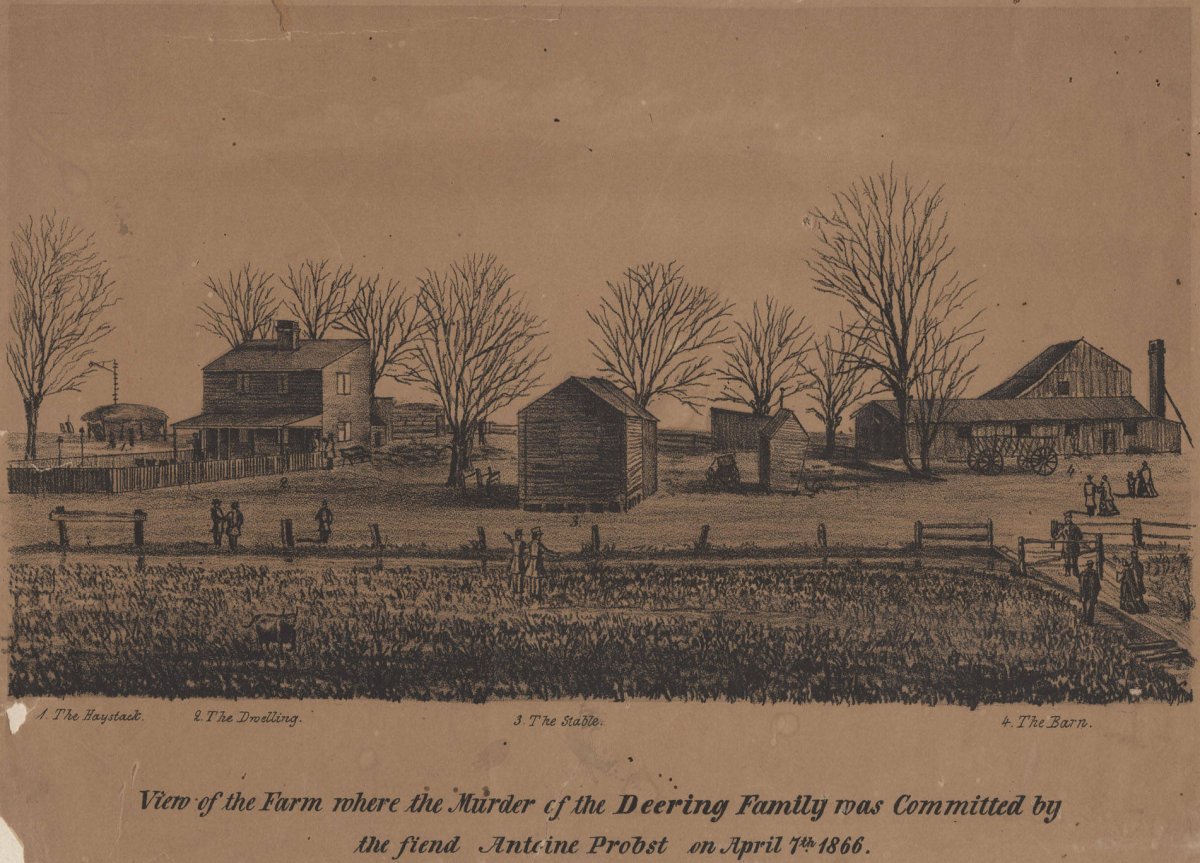
Probst squandered his enlistment bounties on liquor and and rapidly fell into post-discharge penury. This was why, in the fall of 1865, he hired himself out as a farmhand to Christopher Deering, an Irish immigrant who lived in a rural part of Philadelphia with his wife and five children.

Deering offered Probst a salary of $15 a month plus room and board. Probst quit after only a few weeks, though, not being accustomed to honest labor.

He soon fell ill and, without a source of income, wound up in the workhouse. In dire straits, he returned to the Deering farm on February 2, 1866 and begged for his job back. And, although Probst’s behavior from before had given Christopher’s wife the creeps, the farmer took pity on him and re-hired old Thumbless.

Things went well for the next two months. But unbeknownst to his employer, Probst had thought of another way to get money.

Christopher’s nearest neighbor, Abraham Everett, lived a quarter of a mile away. Everett subscribed to several local weekly newspapers and, every weekend, Christopher would send his son to borrow the previous week’s editions.

One Saturday, the boy never showed up.

Nor did he arrive on Sunday.

Or for the next several days after.

By Wednesday, Everett was getting worried and decided to go to the Deering place and see if they were all right. He found the farm deserted and the horses inside the barn, nearly dead of thirst and starvation. After giving food and water to the distressed animals, he went and looked through the window into the Deering family’s house and saw it had been ransacked.

Seriously alarmed now, Everett forced the window open and climbed inside, and found every room in the house in a state of disarray. In the bedrooms, the beds had been torn and flipped upside down, dresser drawers had been rifled through and clothes were scattered everywhere. There was not a soul to be seen.

At this point, Abraham Everett went off to get help, summoning another neighbor and then the police. Inside the barn they found something Everett had missed while he was helping the horses: Christopher Deering’s body, partially covered in hay, alongside the body of a cousin visiting from New Jersey.

“His head,” crime historian Harold Schechter reports in his book Psycho USA: Famous American Killers You Never Heard Of, “was crushed to pieces, almost to powdered bone, and his throat was cut … from ear to ear.” Christopher’s cousin had similar injuries. A search of the barn turned up the bodies of Christopher’s wife, Julia, and four of the couple’s five children, stacked in the corncrib.

All of them had their throats cut and their skulls bashed in.

The only survivor in the family was the oldest child, ten-year-old William Deering, who had been staying with his grandparents at the time of the murders. And so the family line did not die out: according to this Philadelphia Inquirer article, William has 60 descendants.

The murder weapons were lying around bloodstained and in plain sight on the property: a hammer, a small hatchet and a full-sized ax. Hours later, the police found the last body hidden in a haystack a few hundred yards from the barn: seventeen-year-old Cornelius Carey, one of the Deerings’ farmhands.

The other farmhand was missing and, under the circumstances, had to be viewed as the prime suspect in this massacre. Nobody knew much about him, but the neighbors recalled that missing right thumb, spoke poor English with an accent, and was called something like “Anthony.”

Fortunately, he would not prove hard to find. “It might be supposed,” Harold Schechter says,

that a man who had methodically slaughtered eight people, including three prepubescent children and a fourteen-month-old infant, would lose no time in putting as much distance between himself and the crime scene as possible. For all his low cunning, however, Anton Probst was incapable of prudent calculation. Indeed, from all available evidence, he thought of nothing beyond the gratification of his immediate physical needs.

Hours after the murders, Probst was no further away than a house of ill repute on Front Street in Philadelphia, where he spent the night with a $3 prostitute. For the next few days he hung around his favorite bars drinking, making occasional excursions to pawn items he’d stolen from the Deering farm. He was in no hurry to leave.

Only the day after Probst’s grisly crimes were discovered, a police officer named James Dorsey spotted him strolling around near Market Street. Something about his bearing, and the way his hat was pulled low over his eyes, made the lawman suspicious. He walked up to him and noticed the stranger’s right thumb was missing.

Dorsey pulled Probst’s hat off to have a look at his face and said, “Good evening.” Probst mumbled a reply and Dorsey, noting the accent, said, “You’re a Dutchman?”

“No,” Probst answered. “Me a Frenchman.”

“You are, are you? Take a walk with me.” Dorsey grabbed the murderer’s arm and hauled him off to the nearest station house. There the police searched him and determined he was wearing Christopher Deering’s clothes, and carrying the farmer’s snuffbox and pistol. Probst had left Elizabeth Dolan’s carpetbag at a tavern earlier that day; it contained a number of small items, including cheap children’s toys, all of which were from the Deering farm.

The police had to transfer Probst from the Philadelphia City Jail to Moyamensing State Prison for his own safety, after a would-be lynch mob stormed the jail. Probst claimed he had only killed Cornelius Carey and tried to blame the other murders on an imaginary accomplice; at his trial (which began on April 25, less than three weeks after the murders) his lawyers argued that the case against him was strictly circumstantial and not proved beyond a reasonable doubt. But the trial’s outcome was clear from the beginning. The jury deliberated for only twenty minutes before convicting.

Death row agreed with Probst; he seemed at ease and actually gained twelve pounds in the five weeks between his trial and execution. On the morning of May 7, exactly one month after the murders, he finally confessed that his accomplice didn’t exist and he’d acted alone. He was “quiet, undemonstrative, cool and unembarrassed” as he told his story, “without the least trace of shame or remorse.”

You can read it all here in his very own words, or below, in mine. At first his intention had just been to rob the family of everything they had, then flee. But he found himself unable to accomplish this because there were always too many people around.

About a week before the murders, it occurred to Probst that perhaps murder might be necessary to facilitate the robbery. At first he thought he could just kill Christopher Deering, but as he mulled the matter over he decided the rest of the household would have to die as well.

First to go was Cornelius Carey as they were working together in the field. Then Probst went into the barn and lured the others in one by one, killing them as they each came inside: eight-year-old John Deering, then the mother, Julia, then the rest of the children: six-year-old Thomas, then four-year-old Annie, and finally the baby, Emma. Probst estimated that it all took about half an hour.

Christopher Deering was off picking up that visiting cousin from the ferry, and they didn’t arrive back at the farm until the afternoon. Probst was waiting for them. While the guest Elizabeth Dolan went into the house, Probst told Christopher one of the animals was sick and he had to go inside the barn. There he killed him like the others, then called Miss Dolan to the stable. She was the last one to die.

If we are to believe the killer’s account, the victims all died quickly and quietly, and did not suffer. None of them, he said, so much as cried out after the first blow.

Once finished, Probst tore the house upside down looking for things to steal, washed, shaved, changed out of his bloody clothes and put on some of Christopher’s, and had himself a snack of bread and butter. At sunset he headed off to town.

Schechter records:

When asked by Chief Franklin why on earth he had perpetrated such an atrocity, Probst gave a little shrug. “I only wanted the money,” he said. “I killed the boy Cornelius first so that he could not tell on me. I killed the two oldest children so they would not afterwards identify me. I killed the two youngest as I did not wish to leave them in the house alone without someone to care for them. I had no ill feeling to anyone in the family. They always treated me well.”

Probst submitted meekly to his execution, which went off without a hitch. The public understandably rejoiced at his death and the New York Times, in its report of how Probst “shuffled off his mortal and disreputable coil,” called him “the greatest criminal of the nineteenth century.”

Probst was permitted to write to his family in Germany. He told them of “the terrible fate which has befallen me,” admitted to the eight slayings, and blamed his bad behavior on his experiences in the Union Army, where he “heard nothing but cursing and swearing, and soon became a sharer in every wickedness.”

Whatever, Anton.

After his death, Probst’s body was handed over to the physicians at Jefferson Medical College, who subjected it to a series of bizarre experiments with electricity. When they finished with their fun they performed an autopsy. Probst’s brain turned out to be unusually small, almost a full pound lighter than average. What, if anything, this has to do with his apparent psychopathy is anyone’s guess. His head and arm were later displayed in the Jefferson Medical College museum.

On this day..

1884: Charles Henry, iced in the Arctic

On this date in 1884, U.S. Army Private Charles B. Henry of the Lady Franklin Bay Expedition (LFBE) was summarily executed in the distant northern reaches* of present-day Nunavut.


It’s waaaaaay up there. Click to view larger map, but don’t expect details.

The “Greely expedition” — so called after its commander, Adolphus Greely — was dispatched from Washington in the enthusiasm of the First International Polar Year. This was a multinational collaborative to gather scientific data about the globe’s frigid polar reaches; technically, this first IPY spanned 1882 to 1883, but the ill-starred Greely mission set out in 1881.

The LFBE was headed for a narrow icebound inlet named for a woman who lost her explorer husband on an Arctic voyage. That bay juts like a dead tree limb out of the Robeson Channel into the remote northern wildernesses of Ellesmere Island.

The mission laid down for the 25 men of the Lady Franklin Bay Expedition in 1881 was to establish a weather station, and to collect astronomical and geomagnetic data.

But long before the starving remnants of that crew put Private Henry to sudden death, they had supplanted that noble endeavor with the classic objective of polar adventure: mere survival.

Matters started promisingly enough: the ship that ferried these men to their ordeal dropped them without incident at a natural harbor in Lady Franklin Bay, where the intrepid men built Fort Conger — a sturdy frame house 65′ x 21′ x 14′. They would spend the next two years making scientific measurements, exploring, and awaiting planned resupply ships in the summers.

Ice-choked waters, however, do not open reliably to this location. The resupply missions in both 1882 and 1883 failed — and left the mission with a life-or-death choice.

Per prearranged contingency, the supply ships, should they not be able to reach Camp Conger, were to drop their provisions at a backup location. Much against his men’s will, Greely gave up Camp Conger to chase this hypothetical cache. Camp Conger was more difficult for any future ships to reach but was secure, warm enough, and blessed with seal-hunting enough to keep the team in good health.

Camp Sabine was reached only after a terrifying and near-fatal float down the coast in an ice floe (!) and it proved when they reached it a much less congenial spot for wilderness survival. The resupply missions that hadn’t reached Camp Conger had failed so thoroughly that only a very small drop had even made it to Camp Sabine. Conditions prevented the party from returning to Camp Conger or from crossing the water to another inhabited Arctic station: instead, they wintered in the mouth of hell; seal-hunting here was not favorable, and most days they were only able to supplement their dwindling cache of life-giving calories with a few shrimp and scraps of lichen peeled off the frozen rocks.

Not only ravenous hunger afflicted the party, but scurvy too, and still worse a morale collapse among party members who regarded Lieutenant Greely’s leadership very lightly. Huddled in a makeshift stone hut, three years gone from hearth and home, bored and helpless and stretching out less-than-subsistence rations as far as possible and farther, nerves began to fray … and party members began to succumb to conditions.

Charles Buck Henry did not wear well on this desperate party.

“Henry” was actually the new alias of a German immigrant formerly known as Charles Henry Buck. Buck had served time for embezzling whiskey money from a frontier cavalry company, then escaped and slew a Chinese man in a Deadwood, S.D. brawl. Henry stole from the expedition’s small store of food: he was not the only one, but he was perhaps the baldest thief and the one with the fewest redeeming features that would balance this behavior. He’d been confined in March to his sleeping bag as the closest thing to punishment that Greely could visit on him. Still, Henry stole more. Resentful comrades ostracized him, while silently sizing up the discomfiting likelihood that the hulking German would be odds-on to kill any man among them in a fair scrap.

This day, Greely finally caught him stealing once too often.

Notwithstanding promises given by Pvt C.B. Henry yesterday [to stop stealing] he has since as acknowledged to me tampered with seal thongs if not other food … This pertinacity and audacity is the destruction of this party if not at once ended. Pvt Henry will be Shot today all care being taken to prevent his injuring any one as his physical strength is greater than that of any two men. Decide the manner of death by two ball and one blank cartridge. This order is imperative & absolutely necessary for any chance of life.

A.W. Greely
1 Lt. 5 Cav. ASO & Asst
Cmdg. L.F.B. Expd

That order Greely issued to his able assistant, Sgt. David L. Brainard. Brainard proceeded to gather two other men who contrived to “execute” Henry by a stratagem of approaching Henry armed, but casual, and distracting the unrestrained condemned man long enough to get the drop on him. They shot him dead just as Henry recognized his danger and started to lunge for a nearby axe — an incredibly chancy engagement that could easily have turned the whole expedition into a hyperboreal edition of “The Most Dangerous Game” had the mountainous Henry avoided or survived that gunshot.

Instead, his body with its fatal bullet wound was discovered by accident when the Greely party was at long last rescued later that June, and returned along with just seven** (barely) living souls out of the 25 who set sail in 1881. Those fortunate survivors — the relief mission’s commander reported them “crying like children, hugging each other, frantic with joy”† as their rescue vessel pulled into view — would be forever defined by their participation in the LFBE: toasted for their survival story while also dogged by dark rumors of cannibalism.

According to polar and maritime historian Glenn Stein, FRGS, who spent several years researching this jaw-dropping case,‡ they also closely husbanded the story of their one-time mate’s execution. Mr. Stein is also U.S. Liaison a present-day polar journey, the South 2014 Expedition, and he was gracious enough to speak with Executed Today about the LFBE’s execution.


ET: The Lady Franklin Bay Expedition was a U.S. expedition launched as part of the first International Polar Year. Could you situate the LFBE in the context of polar expeditions at this time?

GS: In the years following the 1875-76 British Arctic Expedition, it was suggested that nations should stop competing for geographical discoveries and instead dispatch a series of coordinated expeditions dedicated to scientific research. Eleven nations took part in the first International Polar Year (IPY) 1882-83, and the United States contributed two components to its first participation in an international scientific effort. In 1881, it was decided that the U.S. Army Signal Corps would establish one scientific station 500 miles from the North Pole, at Lady Franklin Bay, Grinnell Land. The other station was at Point Barrow, Alaska.

The executed man in this instance is Charles Henry, formerly known as Charles Buck. This man had a pretty disreputable history. How was he able to get on this expedition? – And, how did he become the Chicago Times correspondent for this journey? Did he actually file any stories?

Buck enlisted in the Fifth Cavalry under the alias Charles B. Henry, and wrote to Lieutenant Greely from Fort Sidney, Nebraska, in April 1881, volunteering for the expedition. Henry had the strong recommendation of his company commander, Captain George T. Price, to back him up. Greely and Price were friends, so Greely leaned toward taking Henry (who repeatedly telegraphed Greely with reminders of his availability). Another story is that Henry joined from Fort Sidney when one of the original expedition members deserted just before it was to leave. However, as far as I’m aware, there was only one desertion from the LFBE, and that person was replaced by Private Roderick R. Schneider, First Artillery.

Supposedly, since Henry was the only volunteer from the Fifth Cavalry, with a strong recommendation from post commander Lieutenant Colonel Compton, Greely decided to take him.

According to A.L. Todd’s Abandoned (1961), before joining the expedition back East, Henry “got permission to stop off in Chicago to visit relatives, and managed to make an arrangement with the Chicago Times to act as that paper’s special correspondent with the Lady Franklin Bay Expedition.” In his Ghosts of Cape Sabine, Len Guttridge (2000) made references to Henry’s newspaper articles: “One or two eventually published in the Chicago Times attested to an effective if florid command of the English language.”

This expedition lasted three years, 1881-1884, and it came to a considerable amount of grief. Could you sketch out what happened to the LFBE, and how it found itself in such a perilous situation in its last months?

By the end of August 1881, a frame house was constructed at Lady Franklin Bay and named Fort Conger. Over the next two years scientific data was collected and sledging parties were sent out, discovering many new geographic features, and setting north, east, and west “farthest” records. Because of the mismanagement of resupply expeditions from the United States, expedition members initiated a planned retreat by boat to Cape Sabine in August 1883 — but the journey turned into a nightmare. The party eventually ended up at Cape Sabine, where the men constructed a stone house for the winter, with an upturned boat for a roof. It was christened Camp Clay. Throughout the following months, the men’s spirits and energy dwindled, and constant hunger was now their companion. Worse, food was being stolen from the commissary storehouse. More than once, angry accusations flew back and forth within the party. The daily ration for each type of food was measured out to hundredths of an ounce.

The first death occurred on Jan. 18, 1884, when Sergeant William H. Cross died of starvation. In spite of the privations, only one man died that winter, even though scurvy was also present. In the spring Death returned with a vengeance.

So by the end, there’s a party near to starvation, just scraping by on a starvation diet. Naturally there’s a temptation for people to steal from the camp rations.

Henry wasn’t the only person to have stolen, but it seems from your description like he was the most distinctly resented by the rest of the party. Why was that?

During his time at Fort Conger, Henry was the originator of many profane remarks, misdeeds, and lies, so Greely and others had learned not to trust him.

Until the publication of my article, “An Arctic Execution,” LFBE historians consistently wrote that no one on the expedition knew of Henry’s criminal history as a forger, thief and accused murderer. However, I discovered within Sergeant Brainard’s unpublished daily notes that he definitely knew of Henry’s past — so who else knew as well? In consequence, although others also stole food, Henry would have been treated with less tolerance.

The specific details of the execution, and the variations on the story that are given later, are quite fascinating. The execution was ordered by the camp commander, but Henry was not confined and had no idea what was coming, because the shooting party could have been in some danger as well. Given the rough and ready circumstances, why then, does the execution party go to such elaborate ends to anonymize the shooter? There’s the “three guns, two balls” order, and then they can’t comply with that since there’s only one usable rifle, so they swear an oath among themselves never to tell.

Firing squad duty obviously preys upon the conscious and subconscious mind. It’s possible that passing the rifle around and swearing an oath replaced the anonymity provided by the “three guns, two balls” order. Keep in mind that, if the three men survived their Arctic ordeal, their participation could impact them for the rest of their lives — in and out of the Army.

This was particularly true of Sergeant Brainard, who was promised a commission by Greely. Decades after the execution, Brainard declared that “no matter what the provocation, the family of a man doesn’t want to think of him as an executioner.”

As a factual matter, it was either Brainard or Francis Long who pulled the trigger, since Frederick distracted Henry and lured Henry into the trap.


Charles Henry (left), and his two potential executioners: David Brainard (center) and Francis Long (right).

What’s left of Henry is buried in New York. If you really wanted to find out what happened, you would have to exhume the remains. Henry’s sister, Dora Buck, did request the exhumation and autopsy of his body, but these were never allowed to take place. Officially, as my article notes, Henry’s remains were buried with full military honors. What we are left with today are cemetery records, which state that Charles Henry “Died of Starvation.”

And you think Brainard carefully managed the way the dangerous execution story got out.

Brainard is like a historian’s dream. Not only was he there, not only was he a very intelligent individual — but he made a record of many things, keeping daily notes that go from start to finish.

I hand-copied each page, three years of field notes, and I referenced these in my article. Those notes represent his impressions at the time they were written, not edited versions. One crucial thing Brainard recorded about Henry was that he “is a born thief as his 7th Cavalry name will show — a perfect fiend.” That’s significant, because it doesn’t appear in Brainard’s published writings. Why omit that piece of information? There’s one reason: Brainard knew beforehand that Henry was a criminal, and if it was known Brainard possessed this information, then he may appear prejudicial regarding the decision to shoot Henry.

It starts to add up, because who had control of the expedition members’ journals on the passage home? Brainard.

Who wrote up an incomplete journal on the way home — and then, many months later, turned in writings covering several more months — but ending in March 1884? Brainard.

I’ve examined the three volumes of his original journal. Everything was very carefully written, and Brainard made sure the story he wanted told got into these journals.

And what transpired afterward?

Sgt. Brainard had been promised a commission by Greely for his leadership on the LFBE. That’s a huge deal — to get commissioned from the ranks for gallant and meritorious service, and not even in wartime, but peacetime. At that time, and for many years thereafter, he was the only living officer of the Army, active or retired, holding a commission awarded for specific distinguished services. I believe Brainard was a “good guy” and a stand-up guy, but at the same time, would he really chance ruining his opportunity to get that commission? The whole execution business could have made things really difficult for him.

When they evacuated Fort Conger, and later on were literally floating south on a piece of ice, there was almost a mutiny. The mutineers went to Brainard, saying Greely had to be relieved of command, that he was going to get everyone killed. But Brainard wouldn’t go along with it — in part, he probably realized it would destroy his future.

You have to start looking at these motivations; and it’s not an entirely unsympathetic view, because people in these positions had jobs to do.

It took a lot of pushing to get Brainard’s commission to Second Lieutenant approved, and this didn’t happen until October 1886. In 1917, when he was near the end of his career, he was actually appointed Brigadier General. Brainard went from buck private to Brigadier General!

After the LFBE’s rescue later in 1884, how was the matter of the execution handled? I’m reading between the lines here, but it seems to me that, while it was not a secret, it was also downplayed as a public matter in the immediate aftermath — Henry buried with full military honors, that sort of thing. As it emerged more publicly thereafter, was there ever any controversy or a significant sentiment that Greely had handled the situation improperly? Was there ever a question about the legality of his order?

Greely made a verbal report regarding the execution to his departmental superiors several days before Henry’s burial. He then wrote to Adjutant General of the Army R.C. Drum in August 1884, to report Henry’s execution and request that a court of inquiry be ordered or a court martial convened regarding the matter. Drum responded in November 1884 that after examining the expedition’s records, “the Secretary of War entertains no doubt of the necessity, and the entire propriety of your action in ordering the execution of Private Henry, under the circumstances and in the manner set forth in your report.”

It was understood that any military officer operating in the field possesses a fair degree of discretion in carrying out orders, and Greely had Henry executed in order to preserve lives.

Newspaper articles certainly featured Henry’s execution, but stories of cannibalism (including the condition of Henry’s remains) and the political scandal related to the mishandling of the attempted relief of Greely prior to his rescue were much more high profile stories.

You have a professional interest in polar exploration, and obviously starvation risks are endemic to these situations when matters go awry. Have you encountered any similar instances of a polar party executing one of its members for the sake of maintaining discipline?

A somewhat similar execution scenario, also an attempt to preserve the lives of starving men, had played out during Sir John Franklin’s 1819-22 Arctic Land Expedition. A detachment of four men from the expedition, including Surgeon John Richardson, discovered that their comrade, Midshipman Robert Hood, had been murdered by an Iroquois voyageur named Michel Teroahauté (also known as Ferohaite).

Under the circumstances, Richardson shot Michel to save their own lives.

How did you come to find out about this story and why did you decide to research it in such depth? Over a century on from the events themselves, what does the fate of Charles Henry have to tell us today?

I can trace back my knowledge of the execution to at least September 1988, when I bought a copy of The Polar Passion, by Farley Mowat (1967). Several years later, I acquired a large collection of items once belonging to General Brainard, which included most of his medals and orders, photographs, books, and a bone knife he brought back from the Arctic. Brainard is a fascinating historical figure and human being (I like to call him the quintessential American), and I spent a good deal of time researching and writing about his life. In the process I discovered there were many contradictory details about the execution.

On July 13, 2005, I was sitting at an outside bar in Jamaica, when it dawned on me that if I dug deep enough, I just might be able to figure out what really happened during the execution of Private Henry.

So, I began jotting down notes on three 4″ x 5″ pieces of paper — “1. Primary Question: Who was the shooter?” Of the three men involved, the evidence dictates the trigger man must have been either Brainard or Long — but in the absence of conclusive evidence we’ll probably never know which one. And I ultimately decided that’s okay, because it’s the way the three wretched souls wanted it to be on that fateful summer day in 1884, and I needed to respect their wishes.

The events during the Lady Franklin Bay Expedition, especially Charles Henry’s fate, are reminders of how crises bring out the best — and worst — in human nature. At various times in our lives we’re all confronted with personal crises: how we deal with them is what counts. Writing “An Arctic Execution” forced me to stretch my mind beyond what I thought were its limits to attempt to understand defining moments in the lives of human beings who were at the brink of oblivion.

A few books about the Greely expedition

* This expedition established a “farthest north” record: it was for the next several years the most northerly latitude that any explorer could document ever attaining.

** One of the seven retrieved by the Thetis, Sgt. Joseph Elison, was at death’s door. Wasted to 78 pounds and stricken with frostbite and gangrene that required his rescuers to amputate both hands and both legs, Elison died at sea — leaving just six survivors of the Lady Franklin Bay Expedition who would ever again set foot on American soil.

San Francisco Bulletin, July 18, 1884, quoting Winfield Scott Schley — later famous as a Spanish-American War hero.

‡ Glenn M. Stein, “An Arctic Execution: Private Charles B. Henry of the United States Lady Franklin Bay Expedition 1881-84,” Arctic, Vol. 64, No. 4 (December 2011). Read it here (pdf).

On this day..

1810: Leatherlips, tomahawked

On this date in 1810, Ohio’s Wyandot (aka Huron) tribe executed Leatherlips by tomahawk.

This evocative name,* and his proper Wyandot name of Chief Shateyaronyah, appears among the signatories of the Treaty of Greenville — a pact secured after military action ceding Ohio to white settlers. It’s just an early installment of the rolling continental conquest with its familiar Hobson’s choice for natives: resist or accommodate?

Leatherlips was a leader of the accommodationist strand, advocating peacable relations with neighboring whites.

And in a few years, this would become a very big problem for the leader of the resistance camp — Tecumseh. This soon-to-be-renowned Shawnee would shortly raise a broad confederation up in arms against whites.

To do this, Tecumseh felt it necessary to eliminate the go-along, get-along types.

On June 1, 1810, six Wyandot warriors showed up at the historic Black Horse Tavern, a regular Leatherlips haunt at the Sells Settlement. This germ of present-day Dublin, Ohio, was the Scioto River property of the settler John Sells,** a friend of Leatherlips.

Sells heard about this unsettling visit the next morning, and immediately set out on horseback to find the party. He came upon them in a lodge, with Leatherlips bound, being tried for witchcraft — a charge that was all the vogue after the recent death of a Lenape chief who was thought to have been enspelled. Leatherlips was pushing 80 years of age.

Sells’s attempts to save the elderly Wyandot’s life were in vain. That afternoon, Leatherlips painted his face, sang a war chant, and knelt by his own grave, where one of the braves slew him by tomahawking his head. The Wyandot warriors allegedly drew the Sells party’s attention to Leatherlips’s sweating face as he died, viewing this phenomenon as an indicium of guilt.


Monument to Leatherlips in Dublin, Ohio. (cc) image from future15pic. The monument marks the spot of Leatherlips’s execution, but its plaque attributing the execution date of June 1 appears to me to be mistaken.

* As much as it sounds like the poor guy needed some lip balm, “Leatherlips” was actually a nickname conferred (by whites) for his trustworthiness … as in, any promise that passes his lips is strong as leather, just like RUN-DMC.

** Today, there’s a John Sells Middle School in Dublin in this pioneer’s honor. Leatherlips, for his part, has his name on a street.

On this day..

1793: Ezra Mead, “in one of these fits of insanity”

The July 13, 1793 Wyndham (Conn.) Herald quotes the last dying words of Ezra Mead, hanged May 31 at Poughkeepsie, N.Y.

I, Ezra Mead, aged forty years, was born at Stamford in the State of Connecticut, of honest and credible parents, with whom I lived until I was about ten years of age; when I was bound as an apprentice to learn the Cooper’s trade. After having served the time of my apprenticeship, I went to Fish Kill and married my wife Catherine Rogers; since which time I have been in several parts of the World working at my trade, in order to get something in an honest way by my industry for the support of my wife and children, who resided in the town of Fish Kill. Having returned to my family, I resided with them, but being afflicted by a certain neighbor of mine, in words and actions, was driven by turns to drinking to excess; and in one of these fits of insanity, I committed the crime for which I suffer. But I declare to the world, that I was not willfully guilty of the crime aforesaid; at that present moment I might have suspected he had injured me, but not being master of my reason, have been guilty of what I never intended to have done, as appeared in the course of my trial. And I do further declare that I never have been guilty of any other crime deserving such punishment, as has been represented or reported by many evil minded persons since my imprisonment. And that I forgive all mankind, and hope the Lord and they will forgive me, and that they will take warning by my untimely end. Farewell. Ezra Mead.

On this day..

1868: Joseph Brown, for arson, murder, and money

On this date in 1868, Joseph Brown hanged in Hudson, N.Y..

He and his wife Josephine had recently moved to the hamlet of Canaan just this side of the Massachusetts border. With them was a twelve-year-old daughter.

On the night of December 5, 1867, they left little Angie in their basement rental and called on neighbors for the evening — and the house went up in flames. Neighbors rushing to the emergency had to force their way through the doors to extinguish the blaze, and discovered the Angie’s scorched remains amid several bushels of suspiciously flammable rubbish. Some neighbors thought the Browns had not hurried to the scene as they ought, and found their expressions of grief unconvincing.

These dubious circumstances could hardly help but lift an eyebrow, but in the end there was little for it and a coroner ruled the death accidental, perhaps caused by the unattended child attempting to fill a lighted kerosene lamp.

However, the fate of “poor little Angie” took on a decidedly more sinister cast when the Browns turned around and filed for a $5,000 life insurance benefit on Angie’s bones — a short-term, three-month policy due to expire in two weeks. A suspiciously dead child was one thing, but now there was money at stake. Travelers Insurance — the present-day corporate conglomerate then in its infancy, carving out its titular niche with innovative policies insuring against once-dangerous rail travel — put some real investigative muscle into the situation before it paid up.

The facts as developed by Travelers made a damning circumstantial case against the couple that was soon taken over by the criminal authorities: “a reflected glow of guilt,” in the summing-up of the state’s attorney who prosecuted Joseph.

Angie turned out not to be the couple’s own child at all, but a loaner from a woman in their hometown of Dayton, Ohio. She had given permission for her daughter to accompany the couple on a trip to Connecticut. (A weird arrangement in which the child was to call them “mother” and “father”, but one made innocently by the victim’s natural mother so far as anyone could determine.)

En route, Joe and Jo insured the life of this child who was not their own. And by the time they got to Canaan, Joseph had indiscreetly negotiated to purchase some property, intimating an ability in no way justified by his pre-fire resources to pay several thousand dollars cash on the nail.

To cinch Joseph’s conviction, physicians hired by Travelers testified that Angie had not inhaled smoke … meaning that she was dead before the fire started at all.

“I have told the insurance company that I would give them the policy if they would let me go,” a desperate Joseph at one point said in a police interview. He should have thought of that sooner.

But he was, as he said on the scaffold, “not an accomplished man” and he could only complain confusedly about minor points of the trial he considered prejudicial while maintaining a general insistence upon his innocence that persuaded nobody.

At the time of this hanging, Josephine Brown still lay in the Columbia County jail awaiting her turn at the bar in the same affair. But despite the sense among many participants in the case that it was she who instigated her cloddish husband to the lucrative homicide, the prosecution couldn’t assemble a satisfactory case and dropped charges later that year.

On this day..