1647: Alse Young, the first witchcraft execution in New England

On this date in 1647, the state of Connecticut carried out the first recorded execution of a witch in the American colonies.

A good half-century before the more renowned Salem witch trials, Alse Young — about whom little is recorded safe her infernal affiliations — hanged at Windsor for her devilry.

She was the first of several in Connecticut to suffer that penalty over the generation to come.

And though we’d be happy to blather on about it, we think you’ll find that Tim Abbott’s peripatetic Walking the Berkshires blog — still a font of compelling and original content in its sixth year on the beat — has Alse Young (and early Connecticut witchery) covered.

On this day..

1911: Laura and Lawrence Nelson lynched

A century ago today* Laura Nelson and her son Lawrence were lynched outside Okemah, Oklahoma.

“Two weeks ago,” mused the May 26, 1911 Tulsa World “Deputy Sheriff George H. Loney went to the Nelson home in search of some stolen meat. He found it and started to make an arrest when he was shot and killed. Both the Nelson woman and her son at first claimed to have fired the fatal shot, but it was later admitted that it was the son who fired it.”

So Laura found her way into the annals of lynched women by that most quintessentially maternal act: attempting to protect her child.

The bodies were posted partway down the road to a nearby all-black township — one little incendiary signpost en route to Oklahoma’s coming racial explosion.

As is typical in lynchings, the perpetrators remained permanently wink-wink “unknown”; indeed, the resulting investigation contributed some outstanding exemplars of racist patronizing — like the investigating judge’s charge to his grand jury of “the duty devolv[ing] upon us of a superior race and of greater intelligence to protect this weaker race from unjustifiable and lawless attacks.”

Thanks?

At least that compared favorably on the sympathy scale to the state’s governor, who slated the NAACP for stoking mob violence when the latter pressed for more vigorous anti-lynching action.

If your organization would interest itself to the extent of seeing that such outrages as this [i.e., the appointment of black federal officials in the state] are not perpetrated against our people, there would be fewer lynchings in the South than at this time, and you can do a great deal more to aid the Negro by seeing that other people of our section of the country are considered in these matters than you can issuing abusive statements against this country when a crime of this kind is committed.

Actually, a tweak here and there and that paragraph could go right into a present-day stump speech. The past, as they say, is not even past.


View Larger Map
The site of the lynching: present-day Route 56 where it crosses the North Canadian River west of Okemah.

One face in the crowd — his exact role in the lynching seems to be unknown — was a local real estate hustler by the name of Charley Guthrie.

This blustery conservative southern Democrat would, the next year, name his third child for the Confederate-friendly academic Woodrow Wilson, who was then making a run for the White House that would see the U.S. to the nadir of its race relations.

Young Woodrow Wilson Guthrie — you know him as Woody — grew up with some different principles from dad; the counterculture folk troubadour was sufficiently haunted by his father’s proximity to this horrific exercise of mob justice to expiate it in song.

* Many web sites give the date as May 23, but the primary sources are unequivocal; the correct date is May 25.

On this day..

2007: Christopher Newton

After Christopher Newton’s death in Lucasville, Ohio by lethal injection on this day in 2007, his attorney read a prepared last statement that apologized for the murder of a fellow inmate: “If I could take it back, I would.”

But the evidence of the “bizarre” execution says Newton was right where he wanted to be.

From the time the obese career criminal (pdf) garroted his cellmate in 2001,* he cooperated with investigators only to the extent that cooperation would grease the wheels of that so-called machinery of death. The entire thing was engineered to get Newton his last parole.

It still took him over five years to land on a gurney, but if you think that’s inefficient, get a load of the execution itself.

For going on two hours, the injection team poked and prodded at Newton’s veins in vain, trying to squeeze a lethal shunt into its gargantuan subject.

“We have told the team to take their time,” read a sign that a prison spokesperson held up in the hush-hush viewing chamber an hour into this discomfiting procedure. “His size is creating a problem.”

Minutes later, the 19-stone condemned man got a bathroom break during his own execution.

So far as anyone could see, the delay was anything but agony for Newton, who was generally observed smiling, laughing, and chatting it up with the prison personnel who were struggling to kill him. Finally, they managed to do it — an achievement which Ohio has latterly demonstrated is by no means a given.

* And allegedly drank some of Jason Brewer’s blood to boot, though this claim proceeding from a man who was intentionally pursuing a death sentence merits skepticism.

On this day..

1673: Thomas Cornell, on spectral evidence

(Thanks to Meaghan Good of the Charley Project for the guest post. -ed.)

On this day in 1673, alleged mother-slayer and arsonist Thomas Cornell was hanged in Portsmouth in the colony of Rhode Island.

The death of his elderly mother, Rebecca, and the subsequent homicide investigation have got to be one of the strangest murder stories in American colonial history.

The Cornells were a respectable and prosperous Quaker family, the ancestors of the man who founded Cornell University. (Their descendants also included Lizzie Borden of the “forty whacks” fame, but that’s another story.)

Rebecca, a 73-year-old widow, was the legal owner of the family’s hundred-acre spread by Narragansett Bay. Her oldest son, Thomas, and his wife and six children lived there with her, along with one lodger and one male servant, a Narragansett Indian named Wickopash.

Crowded as the house was, Rebecca had the master bedroom all to herself. It was well known that Rebecca and Thomas didn’t get along. For some time, both parties had been complaining bitterly about each other to anyone who would listen. Thomas resented the fact that, at 46, he was still financially dependent on his mother, who had made generous gifts from her late husband’s estate to her other children but not to him. Rebecca, for her part, said Thomas was “a Terror to her” and that she was neglected and had to fetch her own firewood.

None of her complaints were taken seriously until after her mysterious death, which is chronicled in Elaine Forman Crane’s 2002 book Killed Strangely: The Death of Rebecca Cornell.

Rebecca died on the evening of February 8, 1673.

That night, she refused to join the family for dinner because she didn’t like what was being served. After the meal was over, her grandson came to her room to check on her and found her charred body lying on the floor by the fireplace, burnt “to a cole.” She was recognizable only by her shoes.

Her death was originally ruled “an unhappie accident.”

It could have been spontaneous human combustion, but a more likely explanation is that embers from the fireplace or from the pipe Rebecca smoked landed on her dress.


An alleged victim of spontaneous human combustion.

No one heard her scream, no one smelled smoke, and somehow the fire didn’t spread to the rest of the house. No one seems to have suspected foul play at that time.

Two nights later, however, Rebecca’s younger brother, John Briggs, received a spiritual visitation from his sister as she slept. “See how I was burned with fire,” she said. He inferred that someone had intentionally burned her.

Briggs didn’t report his experience for a week, but when he did his account was taken seriously by the superstitious colonials. Rebecca’s body was exhumed and given a thorough inspection, and this time a wound was found on her upper abdomen. The authorities decided she had been stabbed by something like “the iron spyndell of a spinning whelle.” No murder weapon was ever produced, however.

Thomas quickly became the prime suspect: he was the last person to see Rebecca alive, and the whole town knew of the enmity between them. After Rebecca’s death, Thomas and his wife Sarah reportedly made some incredibly crass remarks; Sarah said her mother-in-law’s demise was “a wonderfull thing,” and Thomas said that his mother had always liked a good fire, and “God had answered her ends, for now shee had it.”

This hearsay was presented as evidence at Thomas’s trial, along with John Briggs’s dream.

Thomas was convicted and, although many of the townspeople had doubts about the verdict and death sentence, he chose not to appeal. He was hung before a crowd of over one thousand people.

Did Thomas Cornell murder his mother?

Certainly he wasn’t the only one who had the opportunity to do so; the house was full of people that night. In fact, a year after Thomas’s death, the servant Wickopash was tried as an accomplice to the murder. Nothing is known about the case against him, but he was acquitted.

In 1675, Rebecca’s son William tried to make a case against Thomas’s wife for the murder, but he failed to produce any witnesses or evidence against her.

Was this even a murder at all?

The fire, as noted above, could have been accidental; as for the “suspicious wound” the authorities found after they dug up the body, Rebecca could have stabbed herself in her struggles after her dress caught fire, or perhaps those who performed the exhumation saw only what they expected to see.

And there is yet a third possibility: prior to her death, Rebecca told her daughter she had contemplated suicide on several occasions, but her religious beliefs prohibited such action.

One final note: Thomas’s wife, Sarah, was pregnant at the time of his execution and later gave birth to a daughter.

She named the baby Innocent.

On this day..

2001: Terrance Anthony James, snitch-killer

On this date in 2001, Terrance Anthony James suffered lethal injection in Oklahoma for the vicious murder of a suspected jailhouse snitch.

Awaiting trial in 1983 for theft of government property, James became convinced that a fellow-inmate was responsible for his arrest, and proceeded to strangle Mark Allen Berry with a wire.

Usually, in death penalty cases, it’s the jailhouse snitch who does the killing.

On this day..

1691: Jacob Leisler, “a Walloon who has sett at the head of the Rable”

On this date in 1691, Jacob Leisler was executed in New York, a New World casualty of the Glorious Revolution back in the mother country.

In an era when transatlantic communication moved at the speed of a galleon, the 1688 overthrow of England’s Stuart monarchy initiated an agonizing period of political uncertainty in Albion’s far-flung American provinces.

And to the question of who was really in charge were appended the many local political issues of the colonies — religious, economic, political.

One of the empire’s dominant fault political fault lines in the foregoing years had been the succession to follow England’s last Catholic monarch, James II. For Calvinists whose dynastic champion was the House of Orange, the marriage of their guy William III to James’s daughter raised the prospect of an eventual claim on the English throne. Those hopes seemed dashed when James fathered a son, to the elation of Catholics who now aspired to a lasting Catholic line.

When word reached New York, still a majority-Dutch city thanks to its original mother country, of the ascent of that their countryman William III and England’s Protestant establishment had forcibly disinherited the infant prince and his dad, it did not take long for local Dutch factions to run off the former King James’s plenipotentiaries. (An irony, since New York was named for that very same now-deposed King James: he’d been the Duke of York when it was seized for the Dutch in the 1660s.)

That ex-monarch’s brief reign had seen the establishment of a much-resented Dominion of New England, welding together everything from New Jersey to Maine into a super-colony whose high-handed boss was arrested by a Boston mob. (He sailed for England.) That gentleman’s lieutenant, in New York, likewise absconded as his own authority crumbled … a sort of American Glorious Revolution shadowing the one across the pond.

The Frankfurt-born Leisler was a colonial mercantile magnate, one of the 17th century’s wealthiest New Yorkers, notable for his Orangist sympathies and Calvinist religious inclination. It was to this important private citizen (who was also a militia captain) that de facto executive power fell in the New York colony — and it was indeed the New York colony specifically, since the reassertion of local prerogatives and pre-1685 administrative units had been one of the immediate consequences of the shakeout in America.
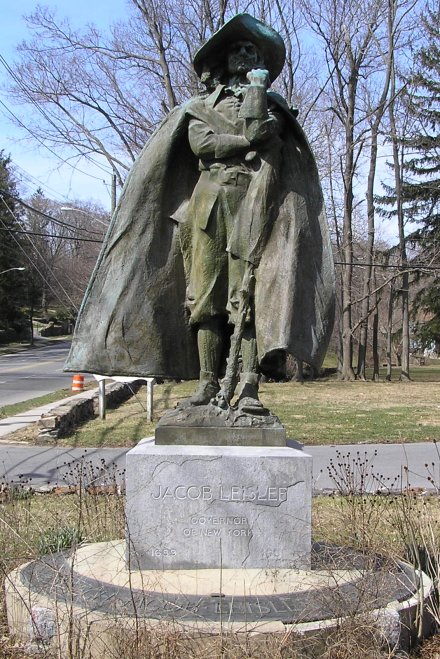

Statue of Jacob Leisler in New Rochelle, N.Y. — which Leisler helped create as a settlement for refugee Huguenots.

And once in the saddle, the Dutch Calvinist Leisler essentially ran a populist administration against the colonial oligarchy, which replied by vilifying him as a “usurper” and “rebel”.

Internal politics in New York and its neighbors during those months make fascinating reading.* Quakers and Catholics aligned against Protestants. Albany aligned against New York, until Leisler brought the former to heel. Clergy chose up sides. Leisler summoned a sort of proto-continental congress of colonial representatives (all the way to the West Indies) to hash out their situation.

And what was that situation? There had been a revolution, after all, and there was no agreed-upon representative of the royal authority present in New York. An assembly of militia leaders had asked Leisler to assume leadership, so was he really outside his rights to treat as his the London dispatches addressed to “such as, for the time being, take care for preserving the public peace and administering the law in New York”?

It’s a moment whose ferment of democratic energy can be read to presage the next century’s (proper) revolution.

Yet it was also not a revolution in the Cromwellian, world-turned-upside-down sense. For the English polity, and certainly for the conduct it preferred in its frontier possessions, continuity was the order of the day. Even in England herself, William and Mary were more than pleased to govern with Tories who could see their way to releasing their fealty to the Stuarts.

There was an empire to run, after all.

From that standpoint, Leisler’s anti-oligarchical policies and fractious disputes with other colonial elites were a bad business. There’s no sense in letting France make inroads because your governors are bickering over predestination or some such.

So formally, the realm’s new rulers continued all non-Catholic personnel in their posts. With the Dominion governors ejected, it was just a matter of dispatching fresh executives to take over. It’s just that this process required months … during which Leisler was managing New York the way he figured it ought to be managed, and his enemies were consequently painting him as a rebel.

Leisler pronounced himself, this whole time, anxious to submit his authority to the new governor upon the production of proper credentials. If he was surprised that the new monarchs tendered appointees of the very same factions recently expelled,** Leisler showed it only in his exactitude for procedure: because of a logistical cock-up, an aide to the new colonial governor arrived first, and when Leisler refused to hand over his fort without the royal warrant, a tense standoff ensued. It was resolved when the real governor, Henry Sloughter of ominous name, finally showed up.

Sloughter had his “predecessor” immediately arrested, along with others of his circle and harshly tried for treason and murder by a court stacked with anti-Leisler political enemies.†

Ultimately Leisler was condemned to die along with his secretary and son-in-law Jacob Milborne, but even Sloughter was loath to enforce the sentence. The story goes that Leisler’s most implacable foes had to get Sloughter drunk to put his signature on the death-warrant. (Sloughter died a couple of months later himself, for maximum operatic effect.)

On Saturday morning, May 16, 1691, the largest crowd ever gathered in New York City stood, rain soaked and weeping, all eyes fixed as a limp body was cut from the gallows and placed on the block. With a clean blow, the executioner’s ax cut off the head of the “halfe dead” Jacob Leisler — loyal lieutenant governor or rebel tyrant, depending on one’s point of view. Amid the “shrieks of the people,” fainting women (some “taken in labour”), and tumultuous jostling for “pieces of his garments” and strands of his hair, as “for a martyr,” the newly arrived and unfortunately named royal governor, Henry Sloughter, worried that his decision to execute Leisler might not, after all, end the “diseases and troubles of this Government.” Indeed, for years afterward New Yorkers bitterly divided over Leisler and the 1689 uprising that, in the wake of England’s Glorious Revolution, had led to his assumption of power in the provincial government.

-David Voorhees, who elsewhere contends that these divisions “continue to inform American politics to the present day.”*

A few years later, a more Leisler-friendly Parliament restored the dead man’s estate to his heirs, a sort of implicit admission that the whole head-chopping thing might have been a bit much.

This character figures to bear more historical consideration than he has heretofore enjoyed; further to that end, there’s a Jacob Leisler Papers Project devoted to marshaling at New York University the primary documents connected with Leisler.

* See, for instance, David Voorhees in “‘to assert our Right before it be quite lost’: The Leisler Rebellion in the Delaware River Valley” in Pennsylvania History, Winter 1997 — and, Voorhees again in “The ‘fervent Zeale’ of Jacob Leisler,” The William and Mary Quarterly, July 1994.

** Literally so: Francis Nicholson, whom Leisler ousted from New York, tried to get himself appointed governor; he was instead sent to Virginia and continued in royal service in the colonies for decades to come.

† e.g., Joseph Dudley, one of Leisler’s judges, whose penchant for authoritarian justice has been noted elsewhere in these pages.

On this day..

1744: Jan, of Johonnes Van Houten

From the Proceedings of the New Jersey Historical Society, only one small instance of the “terrible example” in store for the Garden State’s “large body of slaves to be kept in subjection.”

May 10, 1744 — The negro man “Jan,” of Johonnes Van Houten, was tried “for poysoning and attempting to do the same to several blacks at the township of Bergen; to wit, the negro man of Arent Toers, named Lowis, and has some time past poysoned two wenches of Garret Ross, of the same precinct, and attempted several more.” Convicted and sentenced to be hanged May 11, between 10 and 12, at Bergen; “at the suitablest place, where Peter Marselis and Michel Vreeland shall think proper.”


Was it the slave trade that capitalized the Van Houten cracker empire?

On this day..

1951: Willie McGee

As of today, it is sixty years since the Laurel, Mississippi execution of Willie McGee for rape — a lightning rod for controversy over race, crime, and justice in one of the Cold War’s principal antagonists.

McGee died silent in the state’s portable electric chair, rigged up in the very courtroom of his trial, right in front of the box from whence his all-white jury had retired two and a half minutes before convicting him. Fifty or so observers were there with him — plus those of the hundreds of local residents milling around outside intrepid enough to scale a tree for an illicit view through the courthouse windows.*

(Given the setting, some sources call this a “public execution,” which is not technically correct. This courtroom tableau was actually a standard deployment for the mobile electric chair.)

But McGee’s own silence hardly muted global outrage: for years, appeals for McGee’s life had deluged Mississippi and the White House from Europe, the Soviet Union, and what was quaintly known as “Red China.”

Oh, yes. The Reds.

Willie McGee’s case popped out of backwoods obscurity when he got from the pinko Civil Rights Congress a leftist young attorney — future U.S. Congresswoman Bella Abzug.

Once it got out there, it became the Free Mumia case of the nascent civil rights movement and the nascent Cold War. Its appeal to communist countries and cadres only raised the hackles of American establishment types. This was a Negro raping a white housewife literally and metaphorically.


Author Jessica Mitford (The American Way of Death) campaigning to save Willie McGee’s life. William Faulkner, Albert Einstein, and Josephine Baker also publicly supported McGee.

Whether there actually was a literal rape is the enduring mystery — the enduring Rorschach blot — of the McGee case. The accused himself remained silent on the matter for years; eventually, he claimed that the two were having a consensual but forbidden interracial affair and that he had been brutalized into a confession.

McGee’s defenders believed that the “victim” herself initiated the affair, and

threatened to cry rape if he refused her flirtatious advances … McGee reluctantly went [along] with Hawkins, fearing the tragic consequences of turning her away. “People who don’t know the South don’t know what would have happened to Willie if he told her no,” [Willie’s wife] Rosalee told a friend. “Down South you tell a woman like that no, and she’ll cry rape anyway. So what else could Willie do?”

At the Dark End of the Street: Black Women, Rape, and Resistance

(In this version, the manipulative Hawkins executed the threat when her husband — who later witnessed McGee’s electrocution — found out. McGee’s cited reason for changing his story was the very plausible fear of lynching.)

A Laurel African-American who was then a child remembers being taken by his family to view the body, and impress upon him the lesson of its electrical burns: “Don’t mess with white girls.”

McGee’s persecutors considered all that miscegenation stuff so much subversive rubbish, a “revolting insinuation,” in the words of the Mississippi Supreme Court.**

And if at its apex the controversy generated more heat than light, its historical fade to embers has not sufficed to resolve the factual questions.

McGee has benefited from a recent rediscovery — one that indicates such memories of the McGee case as persevere in Laurel still divide starkly along racial lines.

Explore this case and its many resonances (without the Perry Mason big reveal) in Alex Heard’s 2010 The Eyes of Willie McGee (review); and, in a spellbinding NPR series on “My Grandfather’s Execution” by Bridgette McGee-Robinson, which is exactly what it sounds like. (Direct links to several Radio Diaries mp3 episodes can be found from the RSS feed here.)

Both were facilitated by a recording of execution-night radio news coverage fortuitously preserved by a young Hattiesburg reporter.

Book Cover

* New York Times, May 8, 1951.

** McGee did at least win two retrials in Mississippi; federal courts gave him short shrift, with anti-civil rights judge Sidney Mize — later memorable for fighting the legal rearguard against integrating Ole Miss — lecturing Abzug in a last-ditch appeal that McGee’s “guilt is plain” and that “courts ought to rise up and defend themselves.” (Source)

Taken as an obvious given: “actually guilty” or not, a defendant executed for rape in the American South is certainly a black man with a white accuser.

On this day..

1830: The slave Jerry, the last American execution by burning?

On this date in 1830,* a slave named Jerry was executed in Abbeville, South Carolina … by burning to death.

The slave was the property of a Miss Elizabeth McQuerns, a schoolteacher who hired him out — in which capacity he raped the wife of his subcontracted master.

This case is treated in an April 1990 piece for The South Carolina Historical Magazine by Lowry Ware, titled “The Burning of Jerry: The Last Slave Execution by Fire in South Carolina?” But in addition to being the last execution by fire in South Carolina, it might well be the last in the United States. (The quotes below are all via Ware.)

“Judicial,” for slaves, was of course something less than a robust vindication of the defendant’s rights — and burning sentences imposed in colonial and antebellum America were almost universally used against black slaves. One pictures a context not unlike that of extrajudicial burnings to follow in the decades yet to come.

According to a copy of the trial transcript McQuerns later filed for compensation (the original trial record is lost, Ware says),

the Court acquainted [Jerry] that they were to proceed immediately upon trial and would hear his answer to the charge against him and whatever witnesses he had to produce in his behalf as well as against him.

The witness produced to support the charge against the prisoner was heard and examined and there being no witness in behalf of the prisoner, the court after mature consideration of the case found the prisoner guilty … [and was condemned to] be sent to the Gaol of the said District and there remain until the first day of May next and then be brought back to an old field above West Donald still house, and there burnt to death between the hours of twelve and two o’clock.

But previous to awarding and ordering said sentence to be executed appraised and valued said Negro slave man named Jerry at four hundred dollars and direct the sum of ____ to be paid to Elizabeth McQuerns the owner of said Negro and the remainder of the sum of ____ dollars to ____ agreeably to the Act of Assembly made and provided.

Such a dramatically anachronistic sentence surely made its impression.

As remembered, decades later, by a minister named Samuel Leard who witnessed the execution as a teenager,

thousands of men, women and children, both white and colored, assembled together in an old field not far from the residence of Mr. Donald to witness the execution of a beastly criminal by burning alive at the stake. The crime cannot with propriety be named — the name and the memory of the criminal ought to be consigned to eternal oblivion. But there sat the prisoner, the waiting impatient crowd, the immense pile of pitch pine logs and kindling wood scattered around, the sheriff and his posse, the temporary platform for the preacher … for it was determined that the fiendish criminal should hear his own funeral sermon pronounced … As the poor doomed man ascended the pile, he began to pray audibly and this was kept up continuously during the process of chaining him to the stake, and until the mounting flames deprived him of a wretched life. This was the last execution by fire ever seen in South Carolina.

Abbeville Press & Banner, July 2, 1879

In 1833, the Palmetto State humanely legislated that “that “on the conviction of a slave, or a free person of color, for a capital offence, the punishment shall be by hanging, and not otherwise.”

* The scanty documentation remaining of this case leaves the date less than completely ironclad, but the one issued in sentence attested in this piece will have to do.

On this day..

1843: Ewen Cameron, black bean leftover

On this date in 1843, a Mexican firing squad disposed of Texan commander Ewen Cameron.

A Scottish immigrant, Cameron arrived in Texas just as it broke free of Mexico. His reputation for martial prowess on the frontier earned him a newsman’s tribute as “the Bruce of the West.”

High praise indeed: but his end would better resemble Wallace.

Cameron hitched on to the ill-fated Mier Expedition plundering raid over the border.

He was among the men forced to participate in the Black Bean Lottery wherein 176 Texan prisoners picked beans from a pot to determine who would live and who would die. Cameron picked a white bean, saving his life … but only briefly.*

The verdict refused by Fortune was reinstated by the hands of men.

Abrasive characters like the Bruce are not so well appreciated across their respective frontiers, and Cameron had built some ill-will in the Mexican army with his intrepidity the previous year.

The officer thereby embarrassed, Antonio Canales, was loath to let this reviled prisoner escape his clutches, and urgently petitioned Santa Anna to dispose of him.

This was duly done at Perote Prison, where the other lottery survivors languished for months or years along with other captives of various Mexican-Texan skirmishes.

Cameron County, Texas (the state’s southernmost) is named for Ewen.

* According to this account, the Mexicans loaded the fatal black beans onto the top layers in an effort to get the officers (who drew first) to pick them. Cameron was wise to the scheme, and foiled it by thrusting his hand all the way into the pot.

On this day..