1961: Four for the assassination of Rafael Trujillo

Fifty years ago today, four men were shot for the ajusticiamiento — “execution” — of longtime Dominican Republic dictator Rafael Trujillo.

El Jefe had run his half of Hispaniola for more than thirty years, mirroring his contemporary Stalin for creepy personality cult — giant signs reading “God and Trujillo”; the capital city renamed after him — and dictatorial ruthlessness. Except, of course, that Trujillo was violently anti-communist. He’s the very man for whom U.S. Secretary of State Cordell Hull coined the memorable (and endlessly recyclable) quip, “He may be a son-of-a-bitch, but he is our son-of-a-bitch.” The guy could even get away with disappearing people from New York City.

The Mario Vargas Llosa novel Feast of the Goat revolves around the Trujillo assassination.

But by the last decade of Trujillo’s reign, Dominicans were increasingly tired of his being their son-of-a-bitch.

An abortive 1959 invasion by Dominican exiles was defeated militarily but helped spawn the dissident 14th of June movement — which naturally met with state repression, most emblematically the 1960 murder of the Mirabal sisters. World opinion turned against Trujillo, and even Washington, chastened by the recent Cuban Revolution, feared that their son-of-a-bitch was becoming counterproductive.

So the CIA had actually collaborated with the plot against him hatched among other Dominican elites, providing guns, money, and its all-important blessing. “From a purely practical standpoint, it will be best for us … if the Dominicans put an end to Trujillo before he leaves this island,” the spy agency’s local station chief reported to his superiors late in 1960,

If I were a Dominican, which thank heaven I am not, I would favor destroying Trujillo as being the first necessary step in the salvation of my country and I would regard this, in fact, as my Christian duty. If you recall Dracula, you will remember it was necessary to drive a stake through his heart to prevent a continuation of his crimes. I believe sudden death would be more humane than the solution of the Nuncio who once told me he thought he should pray that Trujillo would have a long and lingering illness.

On May 30, 1961 (Spanish link), Trujillo’s car was ambushed on Avenida George Washington outside “Ciudad Trujillo” by members of his own armed forces, and riddled with gunfire. When the bullets stopped flying, Rafael Trujillo’s body was a bloody heap on the asphalt. Today, the spot is marked by a memorial plaque — commemorating not Trujillo, but the men who killed him.

That did for the dictator, but the larger aspiration of regime change experienced a little blowback.

Rather than a new dawn of liberalism and human rights, Trujillo’s son Ramfis seized power and vengefully went after his father’s killers. The Dominican Republic became prey thereafter to that familiar cycle of military coups and unstable juntas, leading a few years later to outright American occupation.

But before Trujillo fils was pushed out of the job, he had six of the assassins hunted down: two were killed resisting capture, and the other four put to death by firing squad on this date — their remains allegedly thrown to the sharks (pdf) after their executions.

There’s a BBC interview from spring 2011 with a surviving co-conspirator, Gen. Antonio Imbert, here.

On this day..

1802: Jacques Maurepas and his entire family

On this date in 1802, a Haitian general, his family, and his men, were butchered by French forces fighting to retain control of Saint-Domingue.

Haing recently mastered the French Revolution, Napoleon Bonaparte — ever one for keeping it in the family — late in 1801 dispatched his brother-in-law* and brother-in-arms Leclerc to suppress the Haitian Revolution.

Over the course of 1802, Leclerc made headway towards accomplishing just that, as much with carrots as with sticks.

Maurepas was one of the Haitian commanders tasked by Toussaint L’Ouverture with defending Saint-Domingue, in his case, Port-de-Paix. Faced with a French landing, Maurepas burned the town to the ground and withdrew for an effective guerrilla resistance in the mountains.

But he eventually came to terms with the French, as did other Haitian officers, L’Ouverture included — reintegrating forces back with the French on the understanding that all that liberte, egalite, fraternite stuff would at least extend as far as not reintroducing slavery.

The French had other plans for their lucrative once-and-future colony, and when the Haitians caught wind of them, trouble resumed — now under the leadership (since the French had sagely deported L’Ouverture) of Jean-Jacques Dessalines.**

Leclerc had the, er, “fortune” of succumbing to yellow fever shortly after Dessalines’ promising revolt got underway; he was succeeded by the brutal Rochambeau, who threw away the carrots and relied on naked violence to control the island. (Again, not uncharacteristic of Napoleonic conquests.)

Maurepas had not actually gone over to Dessalines, but the fact that he was a black Haitian general was reason enough for his white French superior officer to arrest him preventively. Immediately upon assuming command, Rochambeau made an example of Maurepas.

The sea off the Cape was chosen to be the theatre of an execution, unparalleled in what is called civilized life. For fear that Maurepas, who had gained distinction under Toussaint L’Ouverture, after having embraced the side of France, should join the insurgents, Leclerc had written to him to come by sea, with his family and his troop, to take the command of the Cape, which he destined for him as a reward for his services. No sooner had he arrived than he and his soldiers were seized and disarmed. Rochambeau ordered preparations to be made for a barbarous punishment in order to put the negro general to death, with his troop, consisting of 400 blacks. It was also put in deliberation whether death should be inflicted on his children, in order to prevent them from rising up to avenge their father.

After having been bound to the mast of a vessel, Maurepas was frightfully insulted. His wife, his children, and his soldiers were brought to be drowned under his eyes. The executioners were astounded when they beheld a father fix his dying eyes by turns on his children, his wife, and his companions in arms, undergoing a violent death; while they, on their part, turned their eyes away from a father, a husband, a general, whose countenance was disfigured by the tortures he was enduring. After being made to contemplate each other’s sufferings, they were all tossed into the ocean. They died without complaining in a manner worthy the champions of liberty. With a reversal of the order of nature, the father died last; he also suffered most.

Thus died Maurepas, whose character was a compound of frankness and severity. Thrice had he repulsed the French at the gorge of Trois-Rivières; he had at once the glory and the misfortune to go over to the French with victorious arms. The elevation of his soul equalled his valor. He preserved a tender feeling for the master whose slave he had been; he caused funeral honors to be paid to that master, and when his grave had been negligently prepared, he threw off his upper garment in order to perform the pious office properly. Among men of his own blood he was a powerful chief. A spirit of order and justice prevailed in his life. His riches, which were considerable, were given up to pillage. It would almost seem as if so much excellence were subjected to so much ignominy, expressly to show that while black men are capable of any virtue, white men are capable of any crime. Certainly, my narrative is replete with instances which, beyond a question, prove that moral as well as mental excellence is independent of the varieties of color.

This brutal punishment, preceded by vile perfidy, filled the camps of the insurgents with horror. That horror was augmented when Rochambeau, at the Cape, put to death five hundred prisoners. On the place of execution, and under the eyes of the victims, they dug a large hole for their grave, so that the poor wretches may be said to have been present at their own funeral.

Far from cowing the rebels into submission, this savagery fired more ferocious resistance from men, women, and children who now perceived that their race subjected them to wholesale and arbitrary cruelty that no display of loyalty could overcome.

A terrible retribution was determined upon. Dessalines erected 500 gibbets, and hanged half a regiment of French that he had captured by a bold countermarch. A war of extermination followed, and in December, 1803, aided by an English squadron, the French were compelled to evacuate the island.

January 1, 1804 is Haiti’s Independence Day.

* By way of marriage to Napoleon’s sister Pauline. Pauline enjoyed the Saint-Domingue adventure more than did her spouse; she sported with lovers and balked at returning to France. “Here,” she noted, “I reign like Josephine; I hold first place.”

This character is the subject of a recent biography.

** After expelling the French and becoming the first ruler of independent Haiti, Dessalines took a page from Napoleon’s own playbook and crowned himself Emperor.

On this day..

1842: Stephen Brennan, desperate bushranger

From the 1908 History of the Australian Bushrangers:

Stephen Brennan was sent to the island for bushranging. He was tried there and found guilty of the murder of another convict. There had been no quarrel between the two men, who were as friendly as circumstances permitted under the rigid discipline, nevertheless Brennan suddenly struck Patrick Lynch a blow with a stone-breaker’s hammer, and then stabbed him with a knife. The murder was committed avowedly so that the perpetrator might be hung, and thus escape the harsh treatment he was subjected to, and it is not improbable that it was committed with the consent of the victim, for although there is no evidence of this in this case, it is well known that men had actually drawn lots in Norfolk Island, to decide which should murder the other and get hung for the crime.

This is a very compelling parable, but as a factual matter we’re not sure the basis of the word “avowedly” here; be that mutual lot-drawing trend as it may, the reporting accessible from the National Library of Australia archives suggests that Brennan mounted a vigorous defense, and continued to claim to the foot of the gallows that the homicide was strictly self-defense.

Incidents of “suicide by hangman” had been known among the prison population under the island’s rigorous recent commandant, Joseph Anderson.

But in the early 1840s, the once notoriously draconian penal colony was being run by noted reformer Alexander Maconochie, who relaxed prison discipline with mixed results. (Rougher varieties of discipline would be reimposed thereafter, contributing to the prison riot that resulted in the hanging of bushranger Jackey Jackey.)

On this day..

2003: Two Palestinian collaborators

On this date in 2003, Samer Ufi and Mohamed Faraj (some sources give the latter’s name as Suleiman) were publicly shot by masked al-Aqsa gunmen in the West Bank town of Tulkarem (or Tulkarm) for Israeli collaboration.

A videotape of the two admitting to supplying Israel information which led to militants’ assassination was played in the camp on the eve of their shooting. The dead men’s families contended that they had been tortured into the confession.

Tulkarem in 2003 was a place easy to feel under siege.

Recently prosperous, the fertile district close upon the Israeli border was suffering the effects of the ongoing Palestinian rising.

Tulkarem was in the process of being riven by Israel’s “apartheid wall”splintering communities and devastating a recently prosperous economy.

Isabel Kershner reports in Barrier: The Seam of the Israeli-Palestinian Conflict:

Some eighteen to twenty-two thousand Palestinian laborers from the Tulkarm district used to go and work in Israel every day. Now they are prevented by the security barrier that went up during 2003 … an eight-meter-high concrete wall complete with round gray watchtowers, built to prevent Palestinian snipers from shooting at passing cars on the Trans-Israel Highway that skirts Tulkarm to the west. Additional stretches of fence hermetically seal the surrounding villages off from Israel, as well as from some of their agricultural land.

Meanwhile, as elsewhere in the West Bank and Gaza, a a fast-growing list of assassinations struck militants in the community.

We don’t know in these parts whether the executed men truly were informers, but Israel is known to obtain many such targets by way of informers — often reluctant Palestinians it blackmails or bribes. Accused informers are regularly executed in the Palestinian territories.

“For myself, if I were Palestinian, I would hate them to death,” an Israeli intelligence advisor told the BBC of the collaborators recruited by Tel Aviv. “He is a traitor — I need him — but he’s a traitor”.

Part of the Themed Set: Illegitimate Power.

On this day..

1941: Forty-eight French hostages

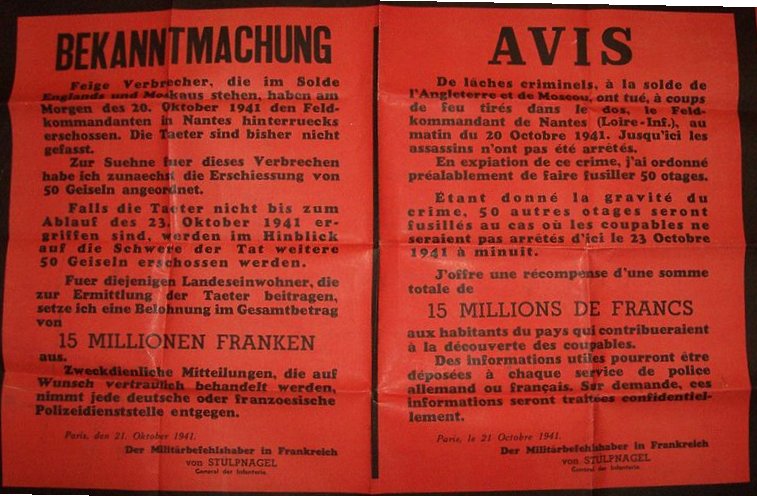
On “a beautiful autumn day” this date in 1941, four dozen French leftists were executed by that country’s occupiers as punishment for the murder of a German officer.

On October 20, 1941 — sixteen months into the German occupation — a pair of Communist commandos assassinated the Feldkommandant of Nantes, Lt. Col. Karl Hotz (French link).

News of this crime went straight to Adolf Hitler himself, who personally ordered a fearful reprisal.

The list of the executed hostages as published Oct. 23 in L’oeuvre

Accordingly, the collaborationist Petain government was induced to select 50 persons from among the ranks of detained German political prisoners. Pierre Pucheu, who would later be executed himself,* intentionally selected Communist types in an effort to confine the retaliation to fellow-travelers.

On this date, those 50 — well, 48, but who’s counting?; the numbering can get dodgy in these mass-execution scenarios — were put to death at three different locations: five at Fort Mont-Valerien; sixteen at Nantes; and most notoriously, 27 internees of Choisel (French link) at Chateaubriant.**

In three different batches of nine, the 27 reds and trade unionists were fusilladed into the ranks of Gallic martyrdom. They remain among the most emblematic French martyrs of the occupation; there’s a cours des 50-Otages named for them in Nantes, and various streets that bear individual victims’ names — such as Rue Jean-Pierre Timbaud in Paris. (Timbaud was a Communist steelworker.)


Monument to the martyrs of Chateaubriant. Image (c) Renaud Camus and used with permission.

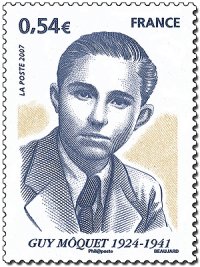
The youngest, 17-year-old Guy Moquet (you can find his name on the Paris Metro) was the son of an exiled Communist parliamentarian (French link).

He made headlines in 2009 when current French President Nicolas Sarkozy had added to the educational curriculum the reading of Moquet’s brave-but-sad last letter to his family: the decision drew some rather mean-tempered fire because of Moquet’s political persuasion. In the end, the text bore a fairly universal reading that could play inoffensively to posterity — like its postscript injunction,

“You who remain, be worthy of the 27 of us who are going to die!”

There’s a thorough roundup of the Oct. 22 executions (including poetic tribute) here.

* Vindicating Winston Churchill’s prophecy to the Times upon receiving news that “These cold-blooded executions of inocent people will only recoil upon the savages who order and execute them.” (Oct. 25, 1941, as cited in the The Churchill War Papers, vol. 3)

** Fifty more were supposed to be executed if the assassins weren’t promptly turned in, but that second batch never took place. (There was, however, a different batch of 50 executed on October 24 in retaliation for a different political assassination. Maybe they just all ran together.)

Part of the Themed Set: Illegitimate Power.

On this day..

1803: Thomas Russell, the man from God knows where

On this date in 1803, Irish revolutionary Thomas Russell was hanged at Ireland’s Downpatrick Gaol.

Russell was such a republican original gangster that as a young junior officer in the British army in the late 1780s, he refused to eat sugar because it was the product of the empire’s slave plantations. (Hardly a bygone issue.) And while his own family was Anglican, Russell was also a staunch supporter of the then-radical (to Anglicans) position of Catholic equality.

For Russell, this personal stuff was all most intently political. And his politics in no way ended with the dumbwaiter.

After leaving the army, he fell in with Irish separatists and in 1795 co-founded the United Irishmen movement, along with a lot of other guys who would wind up in these executioners’ annals. He joined Henry Joy McCracken, Wolfe Tone, and Samuel Neilson in a convocation of Celtic martyrs atop Belfast’s Cave Hill to pledge one another “never to desist in our effort until we had subverted the authority of England over our country and asserted her independence.”

Subversion was Russell’s game for the remaining years of his life; his Letter to the People of Ireland unveils a Tom Paine-like vision of a revolutionary world — a world that the ancien regime would remain violently vigilant against in the wake of the recent French example. Like many of the most dazzling egalitarian dreams of that insurrectionary moment at the end of the 18th century, it’s still never been realized.

Great pains have been taken to prevent the mass of mankind from interfering in political pursuits; force, and argument, and wit, and ridicule, and invective, have been used by the governing party, and with such success, that any of the lower, or even middle rank of society who engage in politics, have been, and are, considered not only as ridiculous but in some degree culpable … Those insolent enslavers of the human race, who wish to fetter the minds as well as the body, exclaim to the poor, ‘mind your looms, and your spades and ploughs; have you not the means of subsistence; can you not earn your bread … leave the government to wiser heads and to people who understand it, and interfere no more!’

-Russell, Letter to the People of Ireland

Russell actually spent most of his final decade imprisoned without trial while tragic Irish insurrections came and went. England finally released him to Hamburg in 1802, and as might be expected, Russell was so itchy by then to get back in the scrap that he immediately broke his parole to return to Ireland for the next available rising.

And as also might be expected, he showed more haste than discrimination in his project. Hey, he did vow “never to desist.”

He joined up with Robert Emmet‘s rebellion — another doomed patriot; Russell was his designated organizer of the north — but found little success canvassing for potential rebels and took the field on July 23, 1803 in a gesture of little more than hopeless romanticism. His band fell apart and fled without a shot fired.


Memorial plaque in Downpatrick commemorating Russell’s execution. (cc) image from Ardfern.

The British did what the British always did and hunted down the Irish rebel, while the Irish did what the Irish always did and stuffed his remains in a ballad.* It’s called “The Man from God Knows Where” — and God knows, two centuries later, where that man has gone.

Whiles I said “Please God” to his dying hope
And “Amen” to his dying prayer,
That the Wrong would cease and the Right prevail.
For the man that they hanged at Downpatrick Jail
Was the Man from God-knows-where!

Peter Linebaugh, author of the indispensable scaffold social history The London Hanged, surveyed Russell’s life and times on the occasion of his 200th death-day here

* Russell tried his own hand at verse, and some Jacobin lines in his hand helped to hang him, e.g.

Proud Bishops next we will translate
Among priest-crafted martyrs;
The guillotine on Peers shall wait,
And Knights we’ll hang in garters;
These Despots long have trod us down,
And Judges are their engines;
These wretched minions of a crown
Demand a people’s vengeance.

Part of the Themed Set: Illegitimate Power.

On this day..

2009: Four Tibetans

On this date in 2009, China executed four Tibetans widely considered political prisoners.

The previous year, widespread unrest over Chinese control had shaken the country, most notably riots in the capital, Lhasa that targeted Chinese persons and shops.

(There’s a BBC page preserving a good deal of the original coverage here.)

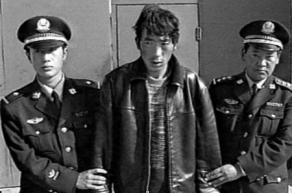
Loyak, one of those executed Oct. 20, 2009.

The two most prominent prisoners — in fact, the only two confirmed in some of the first media reports — were Lhasa residents Lobsang Gyaltsen and Loyak. A court spokesperson said both had been “given death penalties had committed extremely serious crimes and have to be executed to assuage the people’s anger.”

Specifically, both had been convicted of torching shops during the Lhasa riots, which arsons both led to deaths.

The other two executed, a woman named Penki (also for arson) and an unnamed man, received less comment, although they might have been executed despite having been condemned only to a “suspended” death sentence, which for China is generally no death sentence at all.

Executions in Tibet turn out to be relatively rare; these were the first known Tibetan executions since early 2003. Widely condemned abroad, this date’s events were barely or not at all reported internally by Chinese state media.

Part of the Themed Set: Illegitimate Power.

On this day..

1964: Nguyen Van Troi, Viet Cong urban guerrilla

On this date in 1964, South Vietnam executed a 17-year-old Communist for a plot to assassinate American Secretary of Defense Robert McNamara.

The young electrical worker and Viet Cong urban guerrilla Nguyen Van Troi was nabbed in the spring of 1963 trying to off both McNamara, famous for the megatonnage he would bestow on Southeast Asia, and U.S. ambassador Henry Cabot Lodge, Jr.

(Later, when the South Vietnamese client president whose guests these men ostensibly were was being shot in an armored personnel carrier with the Americans’ blessing, Ngo Dinh Diem might have had cause to wish this youth’s inhospitable gesture had not been undone by his men. Lodge was a particularly vocal advocate in the Kennedy administration for overthrowing Diem.)

For the months leading up to his public shooting, he became an international cause celebre; North Vietnam would later milk his martyrdom with a postage stamp, an award, and numerous public streets.

The international reach of his case was underscored when a Venezuelan revolutionary cell kidnapped an American officer shortly before Troi’s execution, and threatened to shoot him in retaliation. (They didn’t.)

Against this, South Vietnam counterposed the unedifying spectacle of a 17-year-old patriot put to death, energetically declaiming at the stake while cameras rolled,

It is the Americans who have committed aggression on our country, it is they who have been killing our people with planes and bombs…. I have never acted against the will of my people. It is against the Americans that I have taken action.

Naturally, he became a worldwide leftist martyr. There’s an Estadio Nguyen Van Troi in Cuba; American actor Troy Garity, son of Jane Fonda from her “Hanoi Jane” days, is also named for Nguyen Van Troi.

Robert McNamara, meanwhile, had many, many years yet to live, and many, many more Vietnamese deaths to burden his conscience.Troi’s widow wrote a 1965 book about him, out of print but still available on the used book market.

On this day..

1864: Ranger A.C. Willis, parabolically

On this date in 1864, Confederate ranger A.C. Willis — whose Christian name is given as Albert or Absalom — was captured in Rappahannock County, Virginia and summarily, spectacularly hanged.

The context was the increasingly dirty war in Virginia against Confederate guerrilla John Mosby, whose rangers were severely hampering Union operations in Virginia. The northern army had resorted to less than genteel expedients with the previous month’s summary execution of a half-dozen (actual or suspected) Mosby’s Rangers.

On this date, they did it again.

According to Custer and the Front Royal Executions of 1864:

[Col. William] Powell’s men had first tied the rope they used to hang Willis with to the top of a young sapling, which was then bent nearly double. When it was released, it shot Willis skyward in an abrupt, strangled flight. Powell was jubilant about the execution he had ordered. Powell stated in his report: “I wish it distinctly understood by the Rebel authorities that if two to one is not sufficient I will increase it to 22 to one, and leave the consequences in the hands of my Government.”

We don’t have a picture of this jubilation-worthy execution, but we’ll make do with the picture in our heads.

On this day..

1354: Cola di Rienzi, last of the Roman Tribunes

On this date in 1354, Cola di Rienzi (or Rienzo) was slain by a miserly Roman mob — rather a lynching than an execution, but by any name the tragic end to one of history’s most amazing political careers.*

“Almost the only man,” in the estimation of his admiring biographer Edward Bulwer-Lytton,** “who ever rose from the rank of a citizen to a power equal to that of monarchs without a single act of violence or treachery.”

So magnetic was that era’s revival of classical learning that young Rienzi’s plebeian parents found a way on an innkeeper’s wages to immerse the boy in Cicero, Seneca, and the rest. As Gibbon put it, “the gift of a liberal education, which they painfully bestowed, was the cause of his glory and untimely end.” (Surely this is an object lesson for present-day families contemplating the daunting cost of university education.)

And the oratorical gifts he thereby developed found ready exercise lamenting Rome’s medieval degradation.


This View of the Campo Vaccino actually dates to 1636, but you get the idea. “Campo Vaccino”: that’s “cow pasture,” also known (to you, me, and Julius Caesar) as the Roman Forum.

Rome had bled away the grandeur of its imperial past without recovering the liberty of its populace. A haughty and dissolute aristocracy tyrannized the brackish city: a brawl between rival factions took Rienzi’s own brother’s life, with no prospect of justice.


Rienzi vows to obtain justice for his murdered brother, depicted in a pre-Raphaelite painting by the young William Holman Hunt.

Added to this civic humiliation (though only fortuitous for Rienzi’s political opportunity), the papacy itself had decamped for its captivity in Avignon.

What to do?

How about — overthrow the bastards?

Astonishingly, for Rienzi, to dare was to do: on Pentecost in 1347, he rallied a Roman mob and proclaimed the Republic re-established — taking for himself the ancient honorific of Tribune and the real power of an autocrat. The nobility routed in disarray, or else submitted to the sudden new authority.

For the balance of the year, Rienzi’s word was law in Rome, and as a messianic, popular dictator he cleared woods of bandits, imposed the death penalty for (all) murderers, and beat the aristocracy’s re-invasion with a citizen militia. He audaciously began to resume the primacy of the caput mundi: as “Tribune”, Rienzi summoned delegations from the other Italian cities, and presumed to arbitrate the disputes of neighboring kingdoms. Audacity veered into delirium as he pressed demands on the likes of the Holy Roman Emperor. He acquired a taste for fine wine and good clothes.

“Never perhaps has the energy and effect of a single mind been more remarkably felt than in the sudden, though transient, reformation of Rome by the tribune Rienzi,” Gibbon marveled. “A den of robbers was converted to the discipline of a camp or convent: patient to hear, swift to redress, inexorable to punish, his tribunal was always accessible to the poor and stranger; nor could birth, or dignity, or the immunities of the church, protect the offender or his accomplices.”

The great humanist Petrarch, Rienzi’s contemporary, was smitten by the unfolding revolution.

But almost as soon as Rienzi’s republic began, the man fell: another invasion found the Roman in the street deaf to the alarm bells, and Rienzi fled.

“He was a dreamer rather than a man of action,” is the charge of the Catholic encyclopedia; excitable, injudicious, spendthrift, and prey to the “Asiatic” emoluments of his station.

This career alone would merit a remembrance, but Rienzi had a second act.


Richard Wagner’s first hit opera — though hard to come by in the wild nowadays — was Rienzi, der Letzte der Tribunen (synopsis), from a libretto based on Bulwer-Lytton’s homage.

After a long spell in exile, he was captured by the Holy Roman Emperor and transferred to the papacy, where he remained comfortably imprisoned for a couple of years. When the pontiff’s hat changed heads to Innocent VI, the latter freed the illustrious ex-Tribune and dispatched him back to Rome under the title of Senator — intending him a catspaw to re-assert the supremacy the papacy had abandoned by moving away.

Within weeks of arrival in 1354, Rienzi again made himself master of the city.

And within months thereafter, he had fallen again — to his death.

He is charged in this last term with severity (the execution of a high-born freebooter, Fra Monreale, in particular), with avarice and abuse of power and once more with political incompetence.

Gibbon claims that Rienzi “contracted the habits of intemperance and cruelty: adversity had chilled his enthusiasm, without fortifying his reason or virtue; and that youthful hope, that lively assurance, which is the pledge of success, was now succeeded by the cold impotence of distrust and despair.” We incline to prefer Bulwer-Lytton’s more generous estimation of a man who with no resource save his own brilliance twice recovered to his low-born person the tattered remnants of the purple and dared against a thousand mighty antagonists to lift it on the standard of the Gracchi. Flaws, and they fatal, he possessed in abundance: but greatness even more.

At any rate, all the scolds upon Rienzi’s imperfections were so much froth in 1354. He certainly did not succumb to the greater virtue of the polis, but merely to its shortsighted refusal to bear a levy:

it was from a gabelle on wine and salt that he fell. To preserve Rome from the tyrants it was necessary to maintain an armed force; to pay the force a tax was necessary; the tax was imposed — and the multitude joined with the tyrants, and their cry was, “Perish the traitor who has made the gabelle!” This was their only charge — this the only crime that their passions and their fury could cite against him.

Rienzi’s eloquence, so often his decisive weapon, failed to move the shortsighted mob that besieged him, and he was hauled to a platform in the Capitol where public executions had been performed at his behest. “A whole hour, without voice or motion, he stood amidst the multitude half naked and half dead: their rage was hushed into curiosity and wonder: the last feelings of reverence and compassion yet struggled in his favour; and they might have prevailed, if a bold assassin had not plunged a dagger in his breast.” (Gibbon)

If this amazing character’s contradictions seem difficult to reconcile and his actions sometimes perplexing, Bulwer-Lytton argues in Rienzi’s defense that we must view him as a complex man ultimately fired not by political ambition but by religious zealotry. One thinks of Savonarola, the prim monk who mastered Florence and perished in flames, save for the essential detail: Rienzi’s loss “was bitterly regretted … for centuries afterwards, whenever that wretched and degenerate populace dreamed of glory or sighed for justice, they recalled the bright vision of their own victim, and deplored the fate of Cola di Rienzi.”


Statue of Rienzi in Rome. (cc) image from ZeroOne.

* And surely in keeping with the time-honored way for Roman chiefs to fall.

** We’ve encountered Bulwer-Lytton glancingly in these pages; his novel Zanoni climaxes with the beheading of its fictional title character in one of the last carts of the French Revolution’s Terror, and he wrote a novel (savaged by Thackeray) about executed intellectual Eugene Aram. The “biography” in question for this piece is actually a work of historical fiction, Rienzi, Last of the Roman Tribunes; the quoted sections are from Bulwer-Lytton’s (non-fiction) afterword.

On this day..