Despite a lack of military experience, Haapalainen had momentary command of the Red Guards in that brief but bloody struggle. The Reds lost, necessitating Haapalainen’s escape by motorboat to St. Petersburg in May 1918.
There he settled in for a couple of decades’ middle-management service to the revolution: writing, teaching, paper-pushing.
The almost inevitable end came with stunning speed in the autumn of 1937. Arrested exactly one month before his execution, Haapalainen denied the charges of counterrevolutionary activity under NKVD torture.
Denial, confession … it all amounted to the same thing. Eleven other Finns (Finnish link) got it with Haapalainen at the very same time: Saimi Virtanen, Väinö Turunen, Urho Pitkälahti, Armas Raasu, Anselm Mäkelin, Mikko Lehmus, Toivo Rantanen, Aino Forsten, Väinö Savander, Rauno Koivistoinen, Eskil Kyllänen, Anton Uotinen.
The next year, Eero Haapalainen’s son Toivo, an engineer, was also purged. Father and son were both rehabilitated in the Krushchev era.
Over the course of 1802, Leclerc made headway towards accomplishing just that, as much with carrots as with sticks.
Maurepas was one of the Haitian commanders tasked by Toussaint L’Ouverture with defending Saint-Domingue, in his case, Port-de-Paix. Faced with a French landing, Maurepas burned the town to the ground and withdrew for an effective guerrilla resistance in the mountains.
But he eventually came to terms with the French, as did other Haitian officers, L’Ouverture included — reintegrating forces back with the French on the understanding that all that liberte, egalite, fraternite stuff would at least extend as far as not reintroducing slavery.
The French had other plans for their lucrative once-and-future colony, and when the Haitians caught wind of them, trouble resumed — now under the leadership (since the French had sagely deported L’Ouverture) of Jean-Jacques Dessalines.**
Leclerc had the, er, “fortune” of succumbing to yellow fever shortly after Dessalines’ promising revolt got underway; he was succeeded by the brutal Rochambeau, who threw away the carrots and relied on naked violence to control the island. (Again, not uncharacteristic of Napoleonic conquests.)
Maurepas had not actually gone over to Dessalines, but the fact that he was a black Haitian general was reason enough for his white French superior officer to arrest him preventively. Immediately upon assuming command, Rochambeau made an example of Maurepas.
The sea off the Cape was chosen to be the theatre of an execution, unparalleled in what is called civilized life. For fear that Maurepas, who had gained distinction under Toussaint L’Ouverture, after having embraced the side of France, should join the insurgents, Leclerc had written to him to come by sea, with his family and his troop, to take the command of the Cape, which he destined for him as a reward for his services. No sooner had he arrived than he and his soldiers were seized and disarmed. Rochambeau ordered preparations to be made for a barbarous punishment in order to put the negro general to death, with his troop, consisting of 400 blacks. It was also put in deliberation whether death should be inflicted on his children, in order to prevent them from rising up to avenge their father.
After having been bound to the mast of a vessel, Maurepas was frightfully insulted. His wife, his children, and his soldiers were brought to be drowned under his eyes. The executioners were astounded when they beheld a father fix his dying eyes by turns on his children, his wife, and his companions in arms, undergoing a violent death; while they, on their part, turned their eyes away from a father, a husband, a general, whose countenance was disfigured by the tortures he was enduring. After being made to contemplate each other’s sufferings, they were all tossed into the ocean. They died without complaining in a manner worthy the champions of liberty. With a reversal of the order of nature, the father died last; he also suffered most.
Thus died Maurepas, whose character was a compound of frankness and severity. Thrice had he repulsed the French at the gorge of Trois-Rivières; he had at once the glory and the misfortune to go over to the French with victorious arms. The elevation of his soul equalled his valor. He preserved a tender feeling for the master whose slave he had been; he caused funeral honors to be paid to that master, and when his grave had been negligently prepared, he threw off his upper garment in order to perform the pious office properly. Among men of his own blood he was a powerful chief. A spirit of order and justice prevailed in his life. His riches, which were considerable, were given up to pillage. It would almost seem as if so much excellence were subjected to so much ignominy, expressly to show that while black men are capable of any virtue, white men are capable of any crime. Certainly, my narrative is replete with instances which, beyond a question, prove that moral as well as mental excellence is independent of the varieties of color.
This brutal punishment, preceded by vile perfidy, filled the camps of the insurgents with horror. That horror was augmented when Rochambeau, at the Cape, put to death five hundred prisoners. On the place of execution, and under the eyes of the victims, they dug a large hole for their grave, so that the poor wretches may be said to have been present at their own funeral.
Far from cowing the rebels into submission, this savagery fired more ferocious resistance from men, women, and children who now perceived that their race subjected them to wholesale and arbitrary cruelty that no display of loyalty could overcome.
A terrible retribution was determined upon. Dessalines erected 500 gibbets, and hanged half a regiment of French that he had captured by a bold countermarch. A war of extermination followed, and in December, 1803, aided by an English squadron, the French were compelled to evacuate the island.
January 1, 1804 is Haiti’s Independence Day.
* By way of marriage to Napoleon’s sister Pauline. Pauline enjoyed the Saint-Domingue adventure more than did her spouse; she sported with lovers and balked at returning to France. “Here,” she noted, “I reign like Josephine; I hold first place.”
This character is the subject of a recent biography.
** After expelling the French and becoming the first ruler of independent Haiti, Dessalines took a page from Napoleon’s own playbook and crowned himself Emperor.
On this date in 1960, South Africa conducted a mass execution of 15 miscellaneous criminals (14 black, one white) in Pretoria Prison.
The headline attraction was one of the 14 blacks: Phineas Tshitaundzi, the “panga man” or any number of related headline-worthy nicknames — the panga slasher, the panga maniac. (“Panga man” can also just be any old fellow with a panga, like an agricultural worker.)
A panga is a machete, and Phineas Tshitaundzi wielded this intimidating instrument during a 1950s spree terrorizing white lovers’ lanes around Johannesburg. “He would assault the men and rape the women — to whom, it was said, he then gave bus fare home,” wrote Jean and John Comaroff in Law and Disorder in the Postcolony.* “There could hardly have been a more intense figuration of the dark, erotically charged menace that stalked the cities in the white imagination.”
The assaults were non-fatal — panga man was the only one of the 14 blacks hanged this day not on the hook for murder — but the many survivors whose affairs were on the illicit side had injuries to cope with beyond those inflicted by the blade.
Tshitaundzi was finally caught as a result of fencing some of the proceeds of his crimes, whereupon it transpired that the terrifying perpetrator had been so difficult to capture because he’d been working as a mild-mannered 40-year-old “tea boy” at police headquarters itself, a position that allowed him to stay wise to various attempts to ensnare him.
It was this date in 1978 that Saleh, here just months on the job after a predecessor was assassinated, finished taking his demonstrative vengeance against a bushel of soldiers alleged to have been planning to overhrow him. New York Times, Nov. 6, 1978:
Vengeance is swift in the lands at the southern tip of the Red Sea. On Oct. 26, 17 persons convicted of attempting a coup against Somali President Mohammed Siad Barre last April were publicly executed by firing squad in Mogadishu. The 17 were said to have sought to overthrow President Barre because of his handling of the so-called Ogaden war with Ethiopia which led to a rupture in Somalia’s alliance with the Soviet Union and ended with Somalia forces retreating ignominiously from the Ethiopian province they had tried to annex. In a similar vein, after an abortive coup in North Yemen against President Ali Abdullah Saleh’s pro-Egyptian and pro-Western regime last month, the firing squads were busy. Soon after the attempted coup was crushed, nine army officers were executed. Yesterday, 12 more men were shot. Four of the accused were reported to have confessed at their trials that they had received money and arms from radical Libya.
On “a beautiful autumn day” this date in 1941, four dozen French leftists were executed by that country’s occupiers as punishment for the murder of a German officer.
On October 20, 1941 — sixteen months into the German occupation — a pair of Communist commandos assassinated the Feldkommandant of Nantes, Lt. Col. Karl Hotz (French link).
News of this crime went straight to Adolf Hitler himself, who personally ordered a fearful reprisal.
The list of the executed hostages as published Oct. 23 in L’oeuvre
Accordingly, the collaborationist Petain government was induced to select 50 persons from among the ranks of detained German political prisoners. Pierre Pucheu, who would later be executed himself,* intentionally selected Communist types in an effort to confine the retaliation to fellow-travelers.
On this date, those 50 — well, 48, but who’s counting?; the numbering can get dodgy in these mass-execution scenarios — were put to death at three different locations: five at Fort Mont-Valerien; sixteen at Nantes; and most notoriously, 27 internees of Choisel (French link) at Chateaubriant.**
In three different batches of nine, the 27 reds and trade unionists were fusilladed into the ranks of Gallic martyrdom. They remain among the most emblematic French martyrs of the occupation; there’s a cours des 50-Otages named for them in Nantes, and various streets that bear individual victims’ names — such as Rue Jean-Pierre Timbaud in Paris. (Timbaud was a Communist steelworker.)
Monument to the martyrs of Chateaubriant. Image (c) Renaud Camus and used with permission.
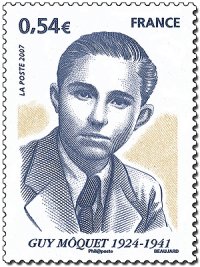
He made headlines in 2009 when current French President Nicolas Sarkozy had added to the educational curriculum the reading of Moquet’s brave-but-sad last letter to his family: the decision drew some rather mean-tempered fire because of Moquet’s political persuasion. In the end, the text bore a fairly universal reading that could play inoffensively to posterity — like its postscript injunction,
“You who remain, be worthy of the 27 of us who are going to die!”
There’s a thorough roundup of the Oct. 22 executions (including poetic tribute) here.
* Vindicating Winston Churchill’s prophecy to the Times upon receiving news that “These cold-blooded executions of inocent people will only recoil upon the savages who order and execute them.” (Oct. 25, 1941, as cited in the The Churchill War Papers, vol. 3)
** Fifty more were supposed to be executed if the assassins weren’t promptly turned in, but that second batch never took place. (There was, however, a different batch of 50 executed on October 24 in retaliation for a different political assassination. Maybe they just all ran together.)
Fourteen early-morning executions in Chile on this date in 1973 heralded the end of one of the Augusto Pinochet dictatorship’s most notorious human rights abuses: the Caravan of Death.
For this “caravan” picture not camel-borne spice traders but a helicoptering death squad. In the bloody aftermath of Pinochet’s September 11, 1973 coup against the elected socialist government, the new strongman’s buddy Gen. Sergio Arellano Stark took this evil-omened chopper on a south-to-north tour from prison to prison beginning September 30 — leaving its wares behind at each stop, in the form of spent shells and murdered men.
Arellano and Pinochet were all hugs hours before the caravan departed.
The intended consumer of this murderous spectacle, according to the human rights organization Memoria y Justicia, was as much the military itself as it was the political opposition. “One of the reasons,” said one officer at Arellano’s very first stop,
was to set a drastic precedent in order to terrorize the presumed willingness of the Chilean people to fight back. But without a doubt, it was also intended to instill fear and terror among the commanders. To prevent any military personnel, down to lowest ranking officers, from taking a false step: this could happen to you!
And indeed, several officers were also sacked along the way, a couple even imprisoned and tortured. Their lenient treatment of presumed subversives constituted “failure to fulfill military duties”: one can readily imagine the impression made upon junior officers in Pinochet’s armed forces.
Said subversives had it worst of all, of course.
These were people already in prison, many having voluntarily turned themselves in upon request after the coup; they were drug out of cells in the dark of night and machine-gunned, or worse. Close to 100 defenseless political detainees died this way over a three-week span.
The Caravan reached Antofagasta on October 18, where Gen. Arellano was received by the zone chief Gen. Joaquin Lagos.
Arellano’s unit did its dirty work overnight: the names of its 14 victims on this date’s early hours are recorded here. One was an 18-year-old student, one a 66-year-old “maritime worker”. Several were figures in local government.
Lagos was horrified the next morning when he discovered what his guests had been up to — and he immediately gave Pinochet his resignation.
I felt hurt, powerless and angry [Lagos later said] that a criminal action of this nature that had been committed in my jurisdictional zone and behind my back.
Lagos had the juice to make this sort of gesture without winding up in prison himself: indeed, he gave Pinochet his resignation (and the reason) personally.
Though Lagos has said that Pinochet seemed much more concerned about his (Lagos’s) attitude towards the atrocity than the atrocity itself, he (Lagos) also remembers Pinochet placing a call to Gen. Arellano and, not reaching him, leaving his nomadic deputy a message “not to do anything more.” The Caravan did stop on Oct. 22: maybe, Lagos’s resignation did the trick, at least to the extent one can attribute any cause to the cessation. This outcome will always rate a bullet point on the brief against the “superior orders” defense.
Relatively speaking, these unfortunates are only one puddle of blood among seas from the Pinochet years. Still, the Caravan of Death in particular was (and still is) a focus of the indictments handed down against him after the return of civilian government, thanks in no small part to Gen. Lagos’s willingness to go on the record about it — and as a result, many of the legal maneuvers around Pinochet in the last years of his life, both in Europe and Chile, concerned this horrible affair.
Pinochet finally died in December 2006 while under house arrest for two specific Caravan of Death murders. While alive, however, his legal team predictably attempted to blame local commanders for the Caravan’s atrocities; in response to this gambit, Lagos went public on television with his version (which human rights organizations also tend to credit) — along with horrifying descriptions (Spanish link) of the death squad’s activites that left him too “ashamed” to return the victims’ remains to their loved ones.
They were torn apart. They were no longer human bodies. I wanted to at least put the bodies back together again, to leave them more decent, but you couldn’t.
They cut eyes out with daggers. They broke their jaws and legs
They shot them to pieces, first the legs, then the sexual organs, then the heart, all with machine guns.
From an entire album that Dark Order devoted to the Pinochet dictatorship.
On this date in 1915, a quintet of African Americans died in South Carolina’s electric chair during a 70-minute span.
Joe Malloy was put to death for killing two white men four years before; the other four executed on this date were convicted together of murdering 73-year-old Confederate veteran John Q. Lewis. They were John Crosby, Nelse Brice, and — our principal concern today — Thomas and Meeks Griffin.
In this case, and even though public opinion was predictably inflamed at the aged veteran, the Griffins weren’t lynched: indeed, prominent white people in the community, such as the mayor and the sheriff, rose to the Griffins’ defense to the extent of signing a petition for executive clemency. They didn’t believe then that the thief whose accusation condemned the brothers was credible.
More than likely they suspected Lewis’s 22-year-old black mistress, Anna Davis, and/or her husband — and undoubtedly, they would have known exactly why this scandalous angle was not pursued in court.
Still, South Carolina’s governor reckoned that they’d had their day in court, the victims deserved closure, and whatever other equivalents of the familiar modern-day rationales one might care to name.
Almost surely, this distant injustice would be lost to time were it not for the Griffins’ famous great-nephew, the radio host Tom Joyner.
Joyner only recently discovered (via Henry Louis Gates Jr.‘s research for a PBS documentary*) his kinship with these executed men; his grandmother had moved away to Florida to bury the family tragedy.
But the broadcaster exhumed it with gusto, and, two years ago, was able to secure a posthumous pardon from South Carolina based on the weakness of the original case. It’s thought to be the first official posthumous pardon the state has granted to any executed persons.
But we do want to extend the Palmetto State the credit due to all its sons whose signatures graced the disregarded clemency petition way back when. More than that: The State editorialized, confusedly but forcefully, against the manifest racial discrepancies in capital sentencing on the occasion of this quintuple-execution. (Oct. 1, 1915) These questions, ever present, are more sincerely grappled with in this column than we can manage today.
* You can watch the big reveal when a flabbergasted Joyner first hears about his ancestors: it’s quite a moment.
I have ever had the single aim of justice in view … ‘Do equal and exact justice,’ is my motto, and I have often said to the grand jury, ‘Permit no innocent man to be punished, but let no guilty man escape.’
On this date in 1875, the most famous — or infamous, depending on your perspective — “hanging judge” of the American West dropped the trap on his noosing career with his first six hangings at Fort Smith, Arkansas.
Isaac Parker, around the time he arrived at Fort Smith
No problem: his co-partisan president, Ulysses S. Grant, appointed Parker to a federal judgeship in neighboring Arkansas. It’s upon that renowned tenure that the man’s reputation, uh, hangs.
This expanse of land, the final destination of the Trail of Tears, had once been preserved for tribes forcibly “removed” from eastern North America.
But by the post-Civil War years, the frontier was sweeping past on iron wheels … and as long as Indian Territory remained (mostly) protected from white settlement, it remained a sparsely-populated refuge for outlaws.
Pandemonium in the Territory was only exacerbated by the Fort Smith court’s reputation for corruption and inefficiency; the office was open for Parker’s appointment because his predecessor had resigned to avoid impeachment.
Judge Isaac Parker came to clean up the place.
Fort Smith was an unusual portfolio for a federal judge. While most of Parker’s colleagues were confined to the tedium of interstate civil litigation, Parker was the court of first call for many regular criminal cases in the Indian Territory which in other jurisdictions would have been a state matter. He estimated in 1885 Congressional testimony that seven-eighths of his caseload came from Indian Territory.*
And in those cases he quickly established himself a reputation for severity.
“I never hanged a man,” Parker said of himself later in life. “The law hanged him. I was only its instrument.”
But make yourself the law’s instrument to the tune of 79 hangings, and folks are bound to sit up and take notice.
“they nearly hung me for stealin’ a horse
in Fort Smith Arkansas.
Judge Parker said guilty and the gavel came down
just like a cannon shot …”
At his court’s very first sitting in May 1875, Parker death-sentenced a murderer — Daniel Evans, who came straight from frontier central casting and had murdered a man for his boots.
As that year unfolded, he added enough condemned men to the bowels of the miserable jail nicknamed “Hell on the Border” — for an eight-strong hanging date to christen September.
One of the eight had his sentence commuted due to youth.
One was shot trying to escape.
And the other six were the debut crop for the mass-occupancy gallows that Parker ordered constructed at Fort Smith. (Its capacity was a full dozen.)
The clientele was six unconnected murderers, committing various atrocities for various motives and aptly embodying the region’s ethnic diversity.
Evans, white
James Moore, white
Samuel Fooy, quarter Cherokee
Smoker Mankiller, Cherokee
Edmond Campbell, black
John Whittington, white
And the audience? Five thousand or so reportedly on hand in Fort Smith this date, plus a national media audience … and posterity deep into the second century since this sturdy magistrate donned his first black cap and set about putting chaos into order with a rope in his hand.
New York Tmes, September 4, 1875.
Whatever one might have to say about his methods, Parker presents a magnetic personality, a figure so truly of his own time and place that he obligingly died just weeks after his court was finally relieved of its Oklahoman jurisdiction in 1896. He’d never hang around to jolt our anachronism meter by weighing in on trench warfare or cubism.
Parker is undoubtedly a more layered figure than his “hanging judge” reputation would suggest, and even his life’s project to bring his unruly jurisdiction to heel was more complicated than just being a hardass. (He had a significant administrative challenge to manage his chronically underfunded court, and he needed to foster the sense of communal reciprocity and legal integrity that would encourage fellow-citizens to turn up for jury duty and witness testimony that make the law’s everyday business possible.) The judge was famous for the long hours he kept, and capital cases were never more than a tiny fraction of his work.
Parker was notorious (slash-beloved, again depending on perspective) for his prosecution-friendly courtrooms, but even the tough sentences he handed down came in his mind from a place of tough love. He wrote late in life that
not one of [those he suffered to long prison terms for violent crimes], no matter how depraved, had entirely lost that better part of human nature …
The object of punishment is to revive, that in some cases, almost extinct spark, to lift the man up, to stamp out his bad nature and wicked disposition, that his better and God given traits may assert themselves.*
Still, whether you prefer him as the stern avatar of law on an outlaw plain or bloodthirsty yahoo, Parker’s ready amenability to latter-day Hollywood tropes will surely maintain his popularity in the cultural rookery of wild west cutouts.
Among numerous other reference points, the novel True Grit, and the 1969 and 2010 films based on it, use Judge Parker’s Fort Smith as the heroine’s embarkation point — with her dangerous journey carrying her into the untamed Indian Territory on his doorstep.
Pat Hingle’s “Judge Fenton” (from “Fort Grant”) in the Clint Eastwood western Hang ‘Em High also shows an unmistakable debt to the Judge Parker persona.
A few books about Judge Parker
Spare a thought, too, for the man operating the ropes and levers this date.
George Maledon, named Fort Smith’s official hangman just a couple of years before Isaac Parker’s appointment, would enforce the Hanging Judge’s hanging sentences into the 1890s: 60-plus executions in all, plus five other escaping prisoners he gunned down, all in a day’s work for an Arkansas lawman.
Maledon has a sad coda to this story, which wasn’t so upbeat to begin with.
The year after the veteran hangman hung up his hood and opened a grocery store, Maledon’s daughter was murdered. The bereaved father’s friend Judge Parker, still on the bench at that time, condemned the killer to die in a case we’ll suggest might have warranted a recusal by present-day standards. Nevertheless, a successful appeal balked Maledon’s successor of the malefactor, and the disgusted ex-executioner got his species of payback by taking the accoutrement of his late profession on the road as a traveling act.
There, under the billing of “the Prince of Hangmen,” Maledon lectured and exhibited old hanging ropes and pictures of the outlaws they had choked.
People of all classes flocked to the show grounds, crowded about the lecturer and filled the tent, viewing the gruesome relics and listening to the old hangman’s recital of soul-stirring events as he pointed out the…instruments of his vocation. (Source)
* See Mary Stolerg, “Politician, Populist, Reformer: A Reesamination of ‘Hanging Judge’ Isaac C. Parker”, The Arkansas Historical Quarterly, Spring 1988
Tourism is pretty essential to the Roman economy, and for as long as there have been dumb foreigners come to gawk, the Caput Mundi has supplied robbers alert to relieve them of their opes mundi.
And as it happens, that’s been for quite a long time. They don’t call it the Eternal City for nothing.
Ponte Sant’Angelo. (Hanged corpses not included.) The bridge was built by Emperor Hadrian in the early second century. (cc) image from Jimmy Harris.
On this date in 1500, a gang of 18 brigands were all hanged (Italian link) along Rome’s Ponte Sant’Angelo for their activities preying on traveling pilgrims.
One of those executed was an orderly at the nearby Ospedale S. Spirito, whose particular specialty was casing the infirmaries for weakened patients
The Partisans were Tito’s Communist guerrilla movement against the Nazi occupation and while they were up against it at this early date, they would in due time wind up on the winning side and help birth the postwar government.
Their legacy remains in every European sports page as the namesake of the Belgrade sports association Partizan founded immediately after the war. It’s the umbrella entity for the frequent Serbian football and basketball champions as well as a variety of other sports. (Current world tennis no. 1 Novak Djokovic played for Partizan, for instance.)

 Haapalainen (English Wikipedia entry | Finnish) was a prominent socialist, trade unionist, and journalist when World War I tipped Finland into civil war.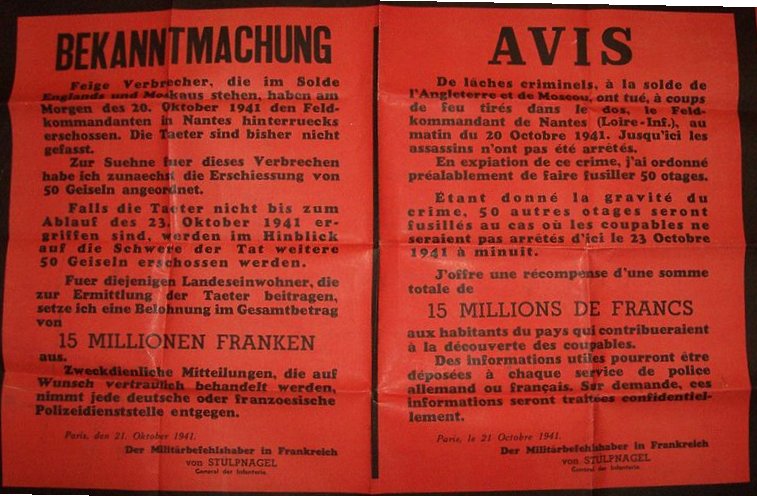


 The youngest, 17-year-old