1677: Five witches at the Gallowgreen of Paisley

On this date in 1677, Janet Mathie, Bessie Weir, Margaret Jackson, John Stewart, and Marjory Craig were hanged for having bewitched a Sir George Maxwell of Pollok.

These unfortunates were “sacrificed on the altar of popular superstition”, in the words of a later broadside — one element of that superstition being the belief in the superordinary insight of the deaf-dumb.

God hath taken away the tongue and ear of the dumb, and hath given them a rich gift of knowledge in the room of it; and by this would teach all of us his goodness to his creatures, and that we should study humility and sobriety of mind.

This is a culture working with some embarrassingly primitive forensics to begin with.

So, when the Pollok lord started ailing, the indications by “a young deaf and dumb girl, of unknown origin,” to the effect that a local family was doing him mischief by stabbing a wax effigy, well, that was enough to open a case. When they found a wax effigy right where the girl pointed, “The prosecution wanted no stronger proof.”

So they got the 14-year-old daughter (she was spared execution this date) to confess, and tortured her brother into agreeing that the devil appeared as a cloven-hooved Negro, and our unnamed detective-girl miraculously found not one, not two, but three different effigies all attributed to the diabolical voodoo parties to cinch the condemnation.

It’s rather embarrassing what tripe did then and can still now pass for persuasive indicia of guilt among parties already committed to convicting someone. Like show trial victims, even the condemned were swept into the act of auto-denunciation — one final tenuous strand to link an outcast to her community, even from the stake. At least, some of them were.

John and Annabel exhorted their mother to confess, reminding her of all the meetings which she had had with the devil in her own house, and that “a summer’s day would not be sufficient to relate what passages had been between the devil and her.” But Jennet Mathie was a stern, brave, high-hearted Scotch woman, and would not seal her sorrow with a lie. “Nothing could prevail with her obdured and hardened heart,” so she and all, save young Annabel, were burnt; and when she was bound to the stake, the spectators saw after a while a black, pitchy ball foam out of her mouth, which, after the fire was kindled, grew to the size of a walnut, and flew out into sparks like squibs. This was the devil leaving her. As for Bessie Weir … the devil left her when she was executed, in the form of a raven; for so he owned and dishonoured his chosen ones.

“The dumbe girl, Jennet Douglas, now speaks well, and knows Latine, which she never learned, and discovers things past!” says Sinclair. But she still followed her old trade. She had mesmeric visions, and was evidently a “sensitive;” and some of the people believed in her, as inspired and divine, and some came, perhaps mockingly, to test her. (From E.L. Linton)

Sometimes, at least, these malevolent professional accusers get their comeuppance.

The dumb girl herself was afterwards carried before the great council at Edinburgh, imprisoned, scourged through the town, and then banished to “some forraigne Plantation,” whence she reappears no more to vex her generation. God forgive her! She has passed long years ago to her account, and may her guilty soul be saved, and all its burning blood-stains cleansed and assoilzed!

On this day..

1912: Thomas Jennings, fingerprinted

One hundred years ago today, Thomas Jennings was ushered the scaffold … while Thomas Jennings’s fingerprints ushered in a new age of policework (pdf).

Hegemonic authority had been on a long march towards a forensic regime that could affix an oft-ephemeral identity to the profoundly corporeal body.

In the late 19th and early 20th century, investigative techniques and jurisprudence marched double time to keep pace with new techniques — from photography to the unwieldy system of Bertillonage.

A variety of American institutions — the U.S. Army, a number of prison systems — had begun systematically cataloging their respective inmates’ fingerprints in the preceding years, but it was in the Jennings case that the system really earned its whorls. It was the first U.S. murder case pinned on fingerprint evidence.

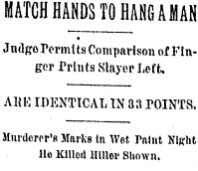
In September 1910, a Chicago homeowner in the present-day Beverly neighborhood surprised an intruder, and was shot dead. (pdf) In the course of the fight or the flight, the prowler splooshed his left hand into some wet paint on a railing.

Thomas Jennings, a paroled burglar, was arrested near the scene, and his fingerprints shown to match those left in the grieving Hiller household. A prosecution expert even gave a courtroom demonstration of dusting for prints.

This was as novel to judges as to jurymen, and given the dearth of other positive evidence against Jennings, the Illinois Supreme Court was called upon to deliberate upon the humble dactylogram. In the summer of 20111911, it stopped Jennings’ hanging just hours before it was to take place.

But its final word in December 20111911 only fitted the homebreaker’s noose.

We are disposed to hold from the evidence of the four witnesses who testified, and from the writings we have referred to on this subject, that there is a scientific basis for the system of fingerprint identification, and that the courts cannot refuse to take judicial cognizance of it …

Such evidence may or may not be of independent strength, but it is admissible, with other proof, as tending to make out a case. If inferences as to the identity of persons based on voice, the appearance or age are admissible, Why does not this record justify the admission of this fingerprint testimony under common law rules of evidence.

Courtrooms all around the world soon agreed, and within a generation the awesome investigative power of the fingerprint had fugitives going so far as to slice or burn off those incriminating little pads of flesh — the crime scene gold standard until the advent of DNA testing.

Jennings was hanged this date in a state-record five-man batch (the others, Ewald and Frank Shiblawski, Philip Sommerling, and Thomas Schultz, had all committed an unrelated murder together).

On this day..

1537: “Silken Thomas” FitzGerald, Earl of Kildare

On this date in 1537, an Irish lord and his five uncles were hanged and beheaded at Tyburn for revolting against Henry VIII: the last act in an entire cycle of executions.

The Rumored Execution

Thomas FitzGerald‘s father, the king’s Lord-Deputy of Ireland, had been summoned to London to answer the complaints of his rivals and there committed to the Tower.

Said rivals then cunningly circulated reports that dad had been beheaded, inducing the hot-headed (and finely-appareled) heir Thomas to renounce his allegiance and rebel with a dramatic retinue of 140 silk-bedizened gentlemen.

The Summary Execution

The Earl of Kildare hadn’t really been executed at all: he just died of shock and grief upon reading the reports of what his son had got up to in his absence.

Stuff like, besieging Dublin Castle where he hunted down the fleeing Archbishop (a longtime enemy of the Kildares) and had him instantly put to death.

(This might have been more pardonable had he at least managed to take Dublin Castle.)

The Maynooth Pardon
(Euphemism for Execution)

Instead, Silken Tom holed up in Maynooth Castle where he soon found himself on the receiving end of a siege.


Maynooth Castle in its present, romantically ruined state. (cc) image from Bart Busschots.

Thomas and his silk went off to find some allies to relieve it, hoping to play a Catholic-resentment card against Henry VIII’s rift with Rome.

But the local response was desultory and while the new Earl of Kildare was busy beating the bushes, the English took the castle — issuing to its garrison the “Maynooth Pardon”, the ironical sobriquet for executing most of the lot.

Silken Thomas’s Execution

His rebellion having been all downhill since the big silken resignation, Thomas was eventually induced by promises of safekeeping to surrender himself to the royal mercy.

But said mercy was not forthcoming, and he endured a year-plus locked up in something less than his trademark finery — “I have had neither hosen, doublet, nor shoes, nor shirt but one; nor any other garment but a single frieze gown … so I have gone wolward, and barefoot and barelegged,” he complained in a letter — until, attainted by the Irish Parliament, he was executed with his kinsmen.

Although the Kildare title disappeared for a time, Thomas FitzGerald’s young but hunted half-brother escaped to the continent, bounced all over Europe for a decade, picked up an education, fought the Turks, and returned to receive his family’s peerage re-granted so he could practice alchemy in his castle as “the Wizard Earl”.

When next in Kildare Town, stand a drink or two for these hearty bygone Geraldines at the Silken Thomas pub.

On this day..

1951: The first four of the Martinsville seven

On this date in 1951, the first of two batches comprising the “Martinsville Seven” — black, all — went to the Virginia electric chair for gang-raping a white woman. (The remainder were executed on Feb. 5)


Newspaper scan (click for larger image) via Mr. Beaverhousen (cc).

Somewhat forgotten today, the Martinsville Seven were in their day the locus of radical activism against Jim Crow in the South — very much like Willie McGee, who was put to death in Louisiana later that same year.

In fact, this case generated a bit of a legal milestone: a month before the executions began, the U.S. Supreme Court declined an appeal seeking relief on the then-novel grounds of equal protection — rather than due process.

The argument was that the Old Dominion’s superficially race-neutral rape statute was anything but; that argument was buttressed by data showing that Virginia had executed 45 black men for raping white women from 1908 to 1950, but never once in that period executed any white man for raping a black woman. (The high court only declined to take the appeal; it wouldn’t get around to explicitly ruling equal protection claims based on racial patterns out of bounds until 1987’s McCleskey v. Kemp.)

This seems to be the debut use for this gambit, bound to become an increasingly powerful one both in and out of the courtroom during the civil rights movement.

And it was available — and necessary — here because the Martinsville Seven basically looked guilty as sin. Their confessions and the victim’s accusation and the testimony of a young eyewitness said that, drink-addled, they had opportunistically grabbed a white Jehovah’s Witness housewife when she was proselytizing on the wrong side of the tracks.

Eric Rise, author of The Martinsville Seven: Race, Rape, and Capital Punishment, noted in a scholarly article,*

certain striking characteristics distinguished the proceedings from classic “legal lynchings.” The evidence presented at trial clearly proved that nonconsensual sexual intercourse with the victim had taken place. All seven defendants admitted their presence at the scene, and although some of the men may not have actually consummated the act … The prosecution emphasized the preservation of community stability, not the protection of southern womanly virtues, as the dominant concern of Martinsville’s white citizens. Most significant, the trial judge made a concerted effort to mute the racial overtones of the trials. Although white juries decided each case, blacks appeared in every jury pool. Race-baiting by prosecutors and witnesses, notably evident at Scottsboro and other similar trials, was absent from the Martinsville proceedings. By diligently adhering to procedural requirements, the court attempted to try the case “as though both parties were members of the same race.”**

The standard playbook for fighting a “legal lynching” case was leveraging outrage over a plausibly innocent convict and an outrageous kangaroo court.†

Paradoxically, by taking these elements out of the mix (relatively speaking), the Martinsville Seven perfectly isolated the extreme harshness of the penalty and the structural discrimination under which it was imposed. The NAACP took up the case on appeal strictly for its discriminatory characteristics, steering for its part completely clear of any “actual innocence” argument.

These challenges posed discomfiting questions that jurists shrank away from. The Virginia Supreme Court, in denying an equal protection application, fretted that actual legal relief could mean that “no Negroes could be executed unless a certain number of white people” were, too. Timeless.

Though a later U.S. Supreme Court would completely overturn death-sentencing for rape, based in part on its overwhelming racial slant, justices have generally avoided meddling to redress broad statistical patterns rather than identifiable process violations specific to particular cases.

Those questions of substantive — rather than merely procedural — equality in the justice system remain potently unresolved, still part of Americans’ lived experience of the law from death row to the drug war to driving while black. As if to underscore the point in this instance, just two days prior to the first Martinsville executions, the Wall Street bankster acting as American proconsul in conquered Germany pardoned imprisoned Nazi industrialist Alfried Krupp, and restored him to the fortune he had amassed working Jewish slaves to death during the war. It was a very particular quality of mercy the U.S. showed the world in those days. (The Martinsville case was known, and protested, worldwide.)

Carol Steiker (she used to clerk for liberal Justice Thurgood Marshall, who as an NAACP lawyer worked on the Martinsville case) argues‡ that the Martinsville Seven’s legacy is linked to their later obscurity, for “[t]heir attempt to present statistical proof of discrimination in capital sentencing represents a ‘road not taken'” — neither in 1951, nor since.

The road taken instead had Joe Henry Hampton, 22, Howard Hairston, 21, Booker Millner, 22 and Frank Hairston, 19 electrocuted one by one this morning in 1951. Their three co-accused, John Clabon Taylor, 24, James Luther Hairston, 23, and Francis DeSales Grayson, 40, followed them on February 5.

* “Race, Rape, and Radicalism: The Case of the Martinsville Seven, 1949-1951” in The Journal of Southern History, Aug., 1992.

** This quote an actual trial admonishment of the judge, Kennon Whittle.

† Graded on a curve: this is still Jim Crow Virginia. Six trials were wrapped up at warp speed in 11 days, with a total of 72 jurors — each one white. The implied comparison is something along the lines of, all seven tried together in the course of an afternoon, with a good ol’ boy defense attorney mailing it in.

‡ Review of Rise’s book titled “Remembering Race, Rape, and Capital Punishment” in the Virginia Law Review, Apr., 1997

On this day..

1971: Ousmane Balde, Barry III, Magassouba Moriba, Loffo Camara, Keita Kara Soufiana, and many others in Conakry

On this date in 1971, at least four former members of Guinea’s government were publicly hanged for supposed complicity in the previous year’s Portuguese invasion from neighboring Guinea-Bissau.*

The coup-threatened government of Sekou Toure was trying to send a message:

It did not scruple to make examples of men and women in very high places. Ousmane Balde (or Baldet) was Guinea’s former Finance Minister, Magassouba Moriba an Interior Minister, Barry III (also known as Ibrahima Barry; the link is French) the former Secretary of State. Keita Kara Soufiana had been Chief of Police. Loffo Camara was a National Assembly member.

Besides the quality of its reprisal victims, Conakry went in for quantity, too. Somewhere close to 100 death sentences were handed down with the barest of legal pretense, and the majority of them actually carried out on and around this date.

Personally arranging the grisly tableau for our hanged ex-ministers was a captain, Diarra Traore, who would one day help to overthrow the Guinean government, become Prime Minister … and wind up executed himself for his trouble.

* Guinea-Bissau was at that time still a Portuguese possession, known as Portuguese Guinea.

On this day..

1999: Recak Massacre

(Thanks to Meaghan Good of the Charley Project for the guest post. -ed.)

On this day in 1999, Serbian militants killed approximately 40 to 45 Kosovo Albanians near the village of Reçak in Kosovo. The victims allegedly included a twelve-year-old boy and at least one woman.

Depending on who you listened to, it was either a massacre against innocent civilians, or a military action against guerillas.

The New Kosova Report, adopting the former point of view, summarizes in a 2008 article:

In the early morning of 15 January, 1999, forces from Serbian Interior Ministry (MUP) and Yugoslav Army (VJ) moved into the village with tanks and began to shoot at houses sheltering civilians. After ransacking all the houses, they gathered 28 Albanian men and boys and ordered them to head towards a hill outside the village for questioning. There they were sprayed with machine guns and 23 of them died. Only five survived by pretending they were dead. Another 22 people were shot and/or decapitated at different places in the village. Some in a ravine behind the village, while others in front of their houses.

A local villager named Shefqet Avida gave photographer and BBC Radio reporter Melanie Friend an account which was later quoted in Friend’s book No Place Like Home: Echoes from Kosovo.

Policemen — Serbs — were hiding here, expecting them. I heard the Serbs saying, “Anyone under fifteen years old, don’t touch, but upwards of sixteen or seventeen years old, just kill them …” The people, when they were captured here, were made to stay in line, and every one of them was shot, and after that with a … very nice knife … they took eyes from the faces and hearts from the chest, and the Serbs later said, “That’s not true, we didn’t do that,” the mice, they’d eaten them. […]

Serbian police were shooting until four or five in the afternoon. When the observers arrived in the morning, we went with them to see the place where the people were murdered. Three of us stayed here all night to guard the bodies. […] Thirteen members of my family were killed there.

The Serbs denied having murdered civilians and claimed all those killed were all Kosovo Liberation Army fighters, shot during a skirmish with Serbian forces. To this day, many maintain the entire thing was staged, a hoax set up by the KLA in order to get support for their side.

Trying to sort the matter out, the European Union dispatched forensic experts to the scene from Finland. Helena Ranta, one of the experts, concluded that “There were no indications of the people being other than unarmed civilians.” When her opinion was broadcast in a press release, many mistook it for being the opinion of the entire group of scientists.

The Finns’ official report, however, has never been released. Dr. Ranta, a forensic dentist, later accused officials from the Ministry for Foreign Affairs of pressuring her to go against the Serbs.

Yugoslav and Belarusian scientists also examined the bodies and said they believed all the dead were KLA combatants. In response, critics blasted them for using allegedly out-of-date and unscientific testing methods.

News of the killings made headlines all over the world and incited NATO to finally get involved in the war. A couple of years later, Yugoslav dictator Slobodan Miloševic was brought up on war crimes charges; ordering the Reçak killings was one of them. It was later removed from the indictment for lack of evidence, however. (Miloševic died before his trial was concluded.)

In 2001, a Kosovo Serb police officer was sentenced to fifteen years in prison for participating in the killings. Outside observers, including the United Nations and Amnesty International, criticized the trial proceedings, accusing the Kosovo war crimes tribunal of ethnic bias and politically motivated decision-making. As of this writing, no one else has been called to account for what happened in Reçak.

On this day..

1638: Four Frenchmen in effigy

We have touched in the past on the odd practice of executing effigies of criminals, a custom for which France had a particular penchant.

On this date in 1638, mannequins of Andre Armand, Gabriel Bonnaud, Sebastien Mareschal, and Simon Armand were “hanged” for murder.

As described in this French text, proceedings were delayed when, the previous November, the wife and mother-in-law of one of the absconded offenders appealed the sentence in their own inimitable way: by vandalizing the mannequins.

Thanks to Sonechka for deciphering the archaic French.

On this day..

1666: Nine Covenanters in Ayr and Edinburgh

That prospectively apocalyptic year of 1666 saw the onset of the Scottish Covenanters‘ mass martyr-making under the English gallows.

Three dozen or so were put to death in the aftermath of the Battle of Rullion Green. Among them, nine men — seven in Ayr, two in Edinburgh — paid with their necks on this date.

The Covenanter tragedy stretches back to the first English Civil War, when English parliamentarians enlisted the aid of Scottish Presbyterians by agreeing to a covenant guaranteeing presbyterian church governance in Scotland and England. Essentially, that meant representative ecclesiastical authority, rather than top-down power from the king, via bishops.

The Presbyterians took this covenant very seriously indeed.

This expedient political arrangement flew apart post-hostilities, especially when the Presbyterians’ parliamentary faction got on the wrong side of Cromwell‘s New Model Army.* “Pride’s Purge”, the de facto army coup d’etat which made possible the execution of Charles I, essentially consisted of kicking out of Parliament the Presbyterian types who were ready to strike a deal with the king at the army’s expense and then governing with the remainder.

This made Presbyterians, for whom reformed church governance was the issue, amenable to inroads from the royalist camp. As soon as Charles I lost his head, the un-purged Presbyterian Scottish Parliament recognized Charles II … on condition that he get on board.

Charles was not exactly an enthusiastic partner.


A political cartoon shows Scottish Presbyterians literally holding King Charles II’s nose to the grindstone.

Nevertheless, Charles II did sign on the dotted line as the price for a Scottish throne and a play at restoration … but the army stomped that, too. An exasperated Cromwell asked of these quarrelsome Scots with their presbyter hangup,

“I beseech you, in the bowels of Christ, think it possible you may be mistaken!”

Mistaken or not, the beaten Presbyterians were optimistic — it’s a ridiculous optimism, in retrospect — that the post-Cromwell Restoration of the exiled monarch would finally Presbyterianize the island. But in 1660, it was Charles wielding the grindstone.

Much to his former allies’ chagrin, Charles rolled back the previous years’ church reforms, booted dissenting clerics, and cemented episcopacy.

The Presbyterian frustration here is understandable; they twice came out on the winning side in the civil war carrying signed pledges from the victors, and were twice balked of their prize. And the balked prize was only God’s work on earth.

In November 1666, a thousand aggrieved Covenanters marched towards Edinburgh in the pitiful and improvised Pentland Rising, which was violently stopped at Rullion Green.

Mass executions of prisoners followed throughout December and into January. (Others not executed were transported to the colonies.)

On this particular date, John Ross and John Shields died in Edinburgh.

The remaining seven executed this date in Ayr are notable in part because they ought to have been eight.


Memorial stone for the Covenanters executed in Ayr on December 27, 1666. Image (c) Stephen Wagstaff and used with permission.

Ayr’s public executioner fled rather than put godly Scotsmen to death. A Highlander named William Sutherland, who served the same office, was retrieved from nearby Irvine, but he too refused even when threatened with torture.**

The beneficiary of these principled refusals, in body if not in soul, was Cornelius Anderson, one of the eight doomed to die in Ayr who was finally prevailed upon to take the job of hanging his fellows in exchange for his life. Faltering spirit fortified with too much brandy, Anderson clumsily dispatched this group; later, since the obdurate Irvine hangman had been sacked, he had to do the same to two more Covenanters there.

Guilt-ridden and reviled, Anderson actually might have been the most miserable man on the scaffold. He came to a miserable end.

His conscience troubling him, he went to Ireland, where he was no better; nobody would either give him work or lodging. He built a little house in some common place near Dublin, where he and it and all were burnt to ashes. (Source)

* Specifically, they wanted to disband said army, and do so without coughing up its back pay.

** Sutherland’s torture included the summoning of a firing squad ostensibly to execute him if he failed to perform the executions. He called that bluff and was not executed, thereby depriving this site of a rare and precious “Executioner executed for failing to execute” entry.

On this day..

1793: 213 or so Lyonnaise

Upon learning of the recent Republican capture of Toulon from the British and anti-revolutionary allies — a military achievement authored by a 24-year-old artillerist by the name of Napoleon Bonaparte — Joseph Fouche dispatched the following missive from the city where he his iron-fisted occupation was earning the epithet “Executioner of Lyon(s)”

Despite showing himself a ferocious Jacobin during the Terror, the Machiavellian Fouche helped author Robespierre‘s downfall and later became ennobled as the Duke of Otranto under Bonaparte. Needled by the Corsican about having voted for Louis XVI’s execution, Otranto aptly riposted, “Yes, sire; and that is the first service I had the honour of rendering your majesty!”

Joseph Fouche to Collot d’Herbois
22nd December 1793

And we likewise, my friend, have contributed to the surrender of Toulon, by spreading terror amongst the traitors who had entered the town, and by exposing to their view the dead bodies of thousands of their accomplices.

The war will be at an end if we know how to profit by this memorable victory; let us show ourselves terrible, that we may not fear becoming weak or cruel; let us annihilate in our anger, and at one single blow, every conspirator, every traitor, that we may not feel the pain, the long torture of punishing them as Kings would do.

Let us follow the example of nature in the exercise of justice. Let us be avenged as a nation, let us strike as quick as lightning, and let even the ashes of our enemies disappear from the land of liberty.

Let the perfidious and ferocious English be assailed from every quarter; let the whole republic turn into a volcano, and pour forth the devouring lava upon them: may the infamous island that produced those monsters, who no longer belong to the human species, be hurled for ever in the waves.

Farewell, my friend: tears of joy gush from my eyes, and overflow my heart. The courier is setting off. I shall write to you by the post.

FOUCHE

P.S. We have but one means of celebrating our victory. We shall this evening send 213 rebels to the place of execution: our loaded cannons are ready to salute them.

(Translation primarily as rendered in the London Times, July 18, 1815)

Whether this horrifying last bit of revolutionary braggadocio was in fact effected does not seem to be quite clear. This book claims that Fouche had 192 executed that day for the amusement of a party of Jacobins and prostitutes, which has the suspicious whiff of propaganda about it.

Hubert Cole, in Fouche: The Unprincipled Patriot reckons it “only” 67, with Fouche routinely inflating his atrocity figures a la military body counts for the benefit of ardent revolutionaries in Paris.

The use of cannon loaded with anti-personnel grapeshot — condemned tied together in pairs and then indiscriminately blasted; troops on hand to finish off survivors with bayonets — was an innovation in death-dealing technology that the National Convention did not appreciate, and Fouche was obliged to return to the more decorous methods of regular firing squads and that newfangled beheading machine.

* Not to be confused with Nazi torturer Klaus Barbie, the Butcher of Lyon. We hope the good people of Lyon will not require too many more synonymous sobriquets.

On this day..

1938: Corneliu Codreanu, Romanian fascist martyr

“In place of the weak and beaten man who bends with every breeze, a man who is all too common in politics and other fields, we must create for this nation a man who does not bend, who is inflexible.”

-Corneliu Codreanu

On this date in 1938, 14 political prisoners of the Romanian Legionary movement were extrajudicially executed — including Corneliu Codreanu, one of the Romanian right’s leading spirits.

The son of a Bukovina schoolteacher in what was then Austria-Hungary, Codreanu came to political maturity in the interwar heyday of Greater Romania. It was a moment of national aspiration — the Romanian state had never before grown so large — but it was abutted by the great threats of Germany and Russia, and haunted by nationalism, economic crisis, shaken political authority, and all the other spooks conjured by the first World War.

For Codreanu as for many at that time it was the stage for a blood-and-soil death struggle against Communist agitators and sinister Jewish financiers.

But his vision was an intensely positive one as well: a valiant new Romania founded by a courageous new man, honorable and true to the virtues of the nation’s noble peasant stock. “We shall create,” Codreanu declared, “a spiritual atmosphere, a moral atmosphere, in which the heroic man may be born and on which he can thrive.”

Codreanu’s vehicle for stamping out these heroic countrymen was the Legion of the Archangel Michael* which our principal founded in 1927. Named for God’s ass-kickingest enforcer, this movement/militia was not above creating its spiritual atmosphere with political assassinations by adherents widely noted for a willingness to die for the cause.

Later known as the Iron Guard, the Legion, in the view of German historian Ernst Nolte, “plainly appears to be the most interesting and the most complex fascist movement, because like geological formations of superimposed layers it presents at once both prefascist and radically fascist characteristics.” (Qutoed here.)

As his Legion’s name suggested, Codreanu was intently religious — virtually a mystic, and a messianic Romanian Orthodox Christianity was essential to his new Romania. His movement took root in a peasant society, not an industrial state with a revolutionary working class to crush or co-opt. Rather, it organized in opposition to a mediocre king and a feckless, heavily non-Romanian oligarchy which maintained its enervating grip on the nation with “endless appeals to the Fatherland which it does not love, to God in whom it does not believe, to the Church where it never sets foot, to the Army which it sends to war with empty hands.”*

And also to the police, which clapped Codreanu and his confederates in prison after the revolutionaries declined the elite incumbents’ offer of political collaboration.

In 1938, Codreanu was hit with a long prison sentence for sedition. Uncowed, the Legion grew ever more overtly aggressive when Nazi Germany successfully dismembered Czechoslovakia; Berlin made the Legions plainly aware that it saw their movement as Romania’s future, German-allied government. Futilely maneuvering for his own scope of action, Carol attempted to decapitate the Iron Guard by having its imprisoned leadership “shot while trying to escape” on this date.

This did not turn out to help the king. Codreanu’s movement traded stripe for stripe with its foes; within two years, Carol had been forced to abdicate and the Iron Guard helped govern (albeit with tension) a fascist state.

The contemporary Romanian right aggressively reclaimed Capitanul, “the Captain”, after the fall of communism. Codreanu is now revered among not only among Romanian nationalists but in fascism’s wider populist Strasserite tradition. (Gregor Strasser, who liked the socialist part of national socialism too much for Hitler’s taste, was among those murdered on Nazi Germany’s Night of the Long Knives.)

* Eugen Weber in Varieties of Fascism, quoted by Anthony James Joes in “Fascism: The Past and the Future,” Comparative Political Studies, April 1974

On this day..