1991: Barrios Altos massacre

(Thanks to Michael Baney for the guest post. -ed.)

On this date in 1991, a Peruvian death squad showed up at the wrong party, and altered its country’s history.

In 1980 the Communist Party of Peru, better known as the Shining Path, launched its “People’s War,” which was never actually supported by the majority of Peruvians. Latin America had had its share of Marxist revolts, but this one was different from the others. There was nothing romantic about the revolutionaries, who wore plain clothes rather than uniforms, attacked the civilian population rather than invest significant capital to win them over to the Shining Path cause, and rose up in an effort to overthrow a democracy rather than a dictatorship.

The Shining Path was based mainly in Andean villages, but once they began to take serious losses in their own territory, they made a concerted effort to accelerate the war by pushing into the capital city, Lima. Both the Shining Path and the Peruvian military were committing deplorable human rights violations by the time Alberto Fujimori was elected president in 1990, although the vast majority of the violence had been confined to the hinterlands of the country up until then.

With Fujimori’s election, more urban-based death squad activities began. Perhaps the most famous was the November 3, 1991 massacre in the Barrios Altos neighborhood of Lima, a poor barrio only a few minutes’ drive away from the Congress and the Presidential Palace.

The murders are described in great detail in this old US government document (pdf) once classified as secret, but since declassified thanks to the efforts of expert Tamara Feinstein of the National Security Archive.

This date’s incident occurred when members of Grupo Colina (English Wikipedia entry | Spanish), a death squad that was part of the Army Intelligence Service, believed that they had identified a group of Shining Path militants having a pollada, which is a traditional fundraiser in Peru where a party is held so that chicken and beer can be sold to the neighbors. (Here’s a description, in Spanish)

A Grupo Colina squad drove to the building where this terrorist pollada was supposed to be taking place, lined the partygoers up, and extrajudicially executed them with submachine guns with silencers that the army had provided the group for the operation. Then the leader of the group, Santiago Martin Rivas, shot a young child who came running over to the body of his father. The troops got back into their vehicles, turned on their sirens to appear like they were the police in an effort to shift blame over the killings, and got drunk at the beach to celebrate.

Almost immediately it became clear that the death squad members had completely screwed up their hit.

The people who had been murdered were indeed having a pollada … not to fund the Shining Path’s Maoist agrarian war, but to fix the pipes in their building

And it transpired that that fateful night of Nov. 3, there was a different pollada being held on a different floor in the very same building. The participants of that other party fled the building, never to return. There were reports that upon searching the rooms of those who fled, police uncovered many issues of El Dario, the Shining Path newspaper.

If Grupo Colina indeed crashed the wrong party, then it not only slaughtered a bunch of innocent people — it helpfully tipped the Shining Path to the fact that the army was onto them.

In any event, the executions became a media spectacle and the police had to at least go through the motions of investigating them. At first, the government suggested that the murders might have been actually carried out by the Shining Path, and as evidence of this theory they showed that one of the people who had been killed was previously a member of a Ronda, which is a peasant patrol group that fought against cattle rustling and, in some cases, the Shining Path. But it later turned out that the man had been a member of the Rondas many years before and hundred of miles away from the killings, and it seemed extremely improbable that the Shining Path would even bother to target him.

By December 4, 1991, the US embassy in Lima was informing the Secretary of State that the Peruvian government lacked the political will to investigate the murders, and had lied about whether or not the guns used in the extrajudicial executions were equipped with silencers in “an apparently deliberate attempt to obfuscate the situation.”

The Congress created a committee to investigate the crimes, which was a real threat to the Fujimori government because the Fujimoristas did not have a majority in Congress.

This ceased to be a problem on April 5, 1992, when Fujimori suspended the Congress, permanently disbanded the Senate, and fired a good number of the judges in the country, all in total violation of the Constitution. That ended the investigation.

Under pressure from the international community, a new Congress stacked with Fujimoristas was convened to write a new Constitution, and the investigation of the Barrios Altos killing nominally restarted. When the Congress called Nicolas Hermoza Rios de Bari, the Chairman of the Joint Command of the Armed Forces to testify, he took the oppotunity to remind the Congress that the military would never tolerate being “insulted.” When hearings continued, Hermoza Rios held an impromptu tank parade directly in front of the Congress. The few brave Congressmen and women who actually desired to expose the truth about the killings got the message loud and clear: the case would never go anywhere as long as Fujimori remained president.

When it finally looked like the perpetrators might be punished, for example, Fujimori rammed a law through the Congress that provided a general amnesty to everyone who had violated human rights “in defense of the fatherland.” When a judge ruled the amnesty law unconstitutional, Fujimori’s Congress stripped the power of judicial review from the courts in cases of amnesty laws.

In a very real sense, the Peruvian government had legalized illegality. Fujimori created a system in which there was no way to punish — or even investigate — murder so long as someone, somewhere considered the crime to have been committed for patriotic reasons.

All that changed in 2000, however, when Fujimori’s government collapsed amid scandal.

An opposition figure who vowed to create a Truth and Reconciliation Commission was sworn in as into office, and Peru reaffirmed its commitment to the American Convention on Human Rights. In 2001, in a groundbreaking decision, the Inter-American Court of Human Rights ruled in its Barrios Altos case that countries cannot issue an amnesty for “serious human rights violations.” The amnesty was thrown out and Grupo Colina members were arrested.

In 2007, Alberto Fujimori was extradited from Chile, where he had traveled, to Peru. In 2009, the Peruvian courts convicted Fujimori of a number of human rights abuses, including ordering the Barrios Altos murders. Just last month, justice was finally served when the members of Grupo Colina were convicted of murder, kidnapping, forced disappearance, and conspiracy, and were given various sentences ranging up to 25 years of prison. After 19 years, the Peruvian government has finally acknowledged that the extrajudicial executions that took place during that country’s cold war were crimes that must not go unpunished.

On this day..

1635: Francisco de Nava, precipitating a church-state conflict

[S]trife* [between Manila archbishop Hernando Guerrero and the Spanish governor Don Sebastián Hurtado de Corcuera] being greatly inflamed … became entangled with one of the most memorable disputes that have occurred in the islands — a necessary occasion for the sharpest encounter between the two jurisdictions, and one from which Don Fray Hernando Guerrero could not excuse himself, as it concerned the most sacred part of the ecclesiastical immunity. That was a matter in which the archbishop could not neglect to sally out with all his might, in order to comply with the obligation of a true prelate. The case was as follows: There was an artilleryman in Manila, named Francisco de Nava, who had a female slave with whom he had illicit communication, as came to the ears of the archbishop. The archbishop ordered him to remove from himself this occasion [for sin] by selling the slave-girl to another person; and had the latter placed, for that purpose, in the house of a lady who was related to Doña María de Francia, who became fond of her and arranged to buy her from the artilleryman. The latter was so beside himself over the loss of the said slave that he refused to sell her at any price, saying that he wished, on the contrary, to marry her. But Doña María de Francia so arranged matters that the slave was sold, and came into her possession with very slight effort. The artilleryman, grieved and regretful for what had happened, almost became mad, and, it having been given out that he was mad, certain violence was shown him; and on one occasion he had received a sound beating at the house of Doña María de Francia, because he had gone there to request that they should give him the slave, as he had resolved to make her his wife.

Aggrieved and rendered desperate in this way, he saw the girl pass one day in a carriage with Doña María de Francia. Going to her he asked her whether she knew him, who was her master. The slave answered him with some independence, whereupon he, blind with anger, drew his dagger in the middle of the street and killed her by stabbing her, before anyone could prevent it. All the people, both those in the carriage and those in the street, ran tumultuously [after him]; but the artilleryman escaped them all, and took refuge in the church of our convent in Manila. The governor heard of what had happened, and ordered Don Pedro de Corcuera, his nephew (who was then sargento-mayor of the camp), to take the artilleryman from the church, saying that he could not avail himself of the sanctuary of the church, as he had committed a treacherous act — although it was only a homicide, and the settlement of this question did not concern the governor. However, his action arose mainly from the anger that he felt that what had happened was in the presence of his nephew, Don Pedro de Corcuera — who, also being angered at what concerned his wife, made use of his commission with less prudence than he ought to exercise in executing such orders from his superiors. He caused the church and convent to be surrounded; and, going inside, examined everything, not excepting even the sacristy; and it is even said that he declared that, if he found the artilleryman there, he would take him out a prisoner. But not having been able to find him then, Don Pedro left the church and convent surrounded by a double guard. The governor added to that that he would not allow the religious to enter or leave, until he had hold of the refugee. The latter was finally found, and taken from the sacristy, and surrendered to the commander of artillery, in order that he might proceed with the trial as his competent judge; and he, either carried away by flattery, or in obedience to the commands of the governor, proceeded so hastily that in a very short time he condemned the artilleryman to death.

The archbishop’s provisor, Don Pedro Monroy,** bore himself on this occasion with the prudence that was fitting, and proceeded against the commander of artillery, requesting him to deliver his prisoner and return him to the church. Having been informed that the commander of artillery was a mere instrument, and that all his actions were according to the impulses of the governor, he sent three lay priests to the palace to intimate to the latter that the judge should deliver the refugee to him. The priests entered, without anyone hindering them; and finding that the governor had already retired, as it was then an advanced hour of the night, they started to withdraw in order to return next morning; but the soldiers of the guard would not permit them to leave, saying that such was the order of the governor.

The sentence against the artilleryman having been given — which it is said that the governor sent ready made out to the judge, to sign — they proceeded to execute it,† notwithstanding that the provisor proceeded to threaten censures, and to impose an interdict and suspension from religious functions [cessatio de divinis]. The governor ordered a gallows to be erected in front of the very church of St. Augustine, and the criminal was hanged thereon — to the contempt of the ecclesiastical immunity, for the [proper] place assigned for such punishments was very distant from there. The governor, seeing that the sentence was already executed, and that he had now obtained the chief object of his desire, wrote to the archbishop, requesting him to have the censures removed and the interdict raised, and the churches opened on the day of the nativity of our Lady. The archbishop, recognizing the duplicity of the governor, refused to answer that letter without first consulting the orders; and, after consulting with some of them, decided that he would not raise the interdict, since there was less inconvenience in having it imposed [even] on so festive a day, than there would be in his yielding on an occasion so inimical to the ecclesiastical immunity. However, the requests of the Recollect fathers of our father St. Augustine, who had charge of the advocacy of the nativity, had so much influence that the archbishop ordered the interdict to be removed, and it was done.


Manila’s historic St. Augustine church. (cc) image from Jun Acullador

The commander of artillery was condemned to some pecuniary fines, from which he appealed to the judge of appeals, who was the bishop of Camarines. The ecclesiastical judge refusing to admit the appeal, he threatened the royal aid of fuerza; and this question having been examined in the royal Audiencia (which at that time consisted of but the governor and only one auditor, Don Marcos Zapata), it was declared in his favor, and the appeal went to the bishop of Camarines. The latter — namely, Don Francisco Zamudio, of the order of our father St. Augustine, and a son of the province of Méjico — declared the commander of artillery to be free from the sentence given by the ecclesiastical judge. The trial of the commander of artillery had its second hearing. On that account there did not fail to result certain charges against the governor, such as his having ordered the secular priests to be detained in the guard-house; his declaration that he could not be excommunicated by anyone except the pope; and that if an order were given to him to arrest the pontiff, he would arrest him, and even drag him along by one foot (which he was proved to have said by several persons). The governor freed himself from all these charges by excuses in a manifesto which he published; but as it is not a part of my duty to examine their adequacy, I shall not do so. I shall refer the reader to the reply made to him by a learned ecclesiastic of the university of Méjico; for there is no liberty in Filipinas to enable any one to complain, or to speak his mind against what the government manipulates

The Philippine Islands, 1493-1898 — Volume 25 of 55

* “The underlying reason for this public dissension was racial,” says this source.

The rivalry between Spaniards born in the peninsula and those born in the colonies, the creoles or americanos, affected not only the clergy but also the lay population. The Augustinians, and the Hospitaller Orders of San Juan de Ojos, San Hipolito and Guadalupe, whose members were creoles, were opposed by the Carmelites and the apostolic colleges in that country. “While legally they [both factions] were on complete equality,” writes Dr. Domingo Abella, Philippine ecclesiastical historian, “class distinctions were apparently encouraged as much as possible by the Spanish colonial policy, because the principle of divide et impera of every aristocratic system was the leading idea for the permanent subjection of the colonies.”

The rivalry reached such an extent that in 1627 the Dominican Order in Mexico refused to admit creoles into its ranks, an act which the Spanish king disapproved. In the Philippines the situation had not openly reached that extreme. The insular hierarchy managed to keep the number of creoles, mestizos and indios who were embracing the religious life down to a minimum. But the racial discrimination rankled among those born in the colonies. Archbishop Guerrero and Bishop Zamudio were both Augustinians, but the former was a peninsular, while the latter was a creole, and this was probably the reason for their taking opposite sides.

** Later exiled to Formosa.

† A letter quoted elsewhere in the same text confirms “the execution of the sentence on the night of Thursday, September six”

On this day..

1799: Thomas Nash, after rendition to the British

On this date in 1799, Thomas Nash was hanged in Jamaica for the bloody mutiny on the HMS Hermione.


Before there was Hermione Granger, there was the HMS Hermione. Painting by Thomas Whitcombe.

The Admiralty’s most notorious mutiny this side of the Bounty was actually a far bloodier affair. Dig the description from one of the conspirators who later turned state’s evidence.

“The captain,” said he, “was very severe with the men, who were all good seamen, and they were determined to either run the ship on shore and desert, or else take her by force. This had been in their minds for months before it happened. At last,” said he, “on a dark night, when the young lieutenant had the watch, our minds were made up. A party went to the cabin-door, knocked down the sentry, and entered it. The captain was in his cot, and he was soon overpowered. We threw him out of the cabin-window. Another party threw the officer of the watch over the larboard quarter, but he, being young and active, caught hold of the hammock-stanchion, when one of the men cut his hands off, and he soon dropped astern. The first lieutenant had been ill and keeping his cot, but on hearing the noise, he came up the hatchway in his shirt, when one of the carpenter’s crew cut him down with an axe, and he was sent overboard with several others.”

(There’s a fine audio lecture about this mutiny in the context of maritime class violence at the Bristol Radical History Group, which reminds that in a context where most of a ship’s manpower was marshaled with the violence of involuntary conscription, mutiny bids were a regular feature of Old Blighty’s maritime empire. London Times archives are available from 1785, and searches on the word “mutiny” in those early years reveal dozens of episodes — and those were just the reported ones.)

After making sharkmeat of that tyrannical captain, 27-year-old Hugh Pigot, the Hermione mutineers got drunk, and then delivered the frigate to the Spanish.

A Royal Navy vessel aptly named the Surprise* was able to surprise the wayward warship and cut her out of the Venezuelan harbor Puerto Cabello. The Hermione was then aptly renamed the Retaliation (and later, Retribution). Then, the British put the ominous word into action with a global manhunt for the mutineers.

Nearly thirty men ultimately hanged for the affair, though that meant that most of those involved escaped the noose.

And Executed Today never** deals with the lucky ones.

Mind if I do a Jay?

And so we come at last to our day’s protagonist, one of the Hermione mutineers who was at length recognized in the breakaway former British colonies now constituting themselves the United States of America.

Upon catching this intelligence, British envoys demanded the extradition of this character — who now claimed to be an American citizen by the name of “Jonathan Robbins” — under the terms of the recent and controversial Jay Treaty. After several months under lock and key without any American charge against him, Robbins/Nash eventually had a habeas corpus hearing before Judge Thomas Bee, who decided† that this “American citizen” was no such thing. With an okay from the Adams administration, Bee had the man delivered to the crown.

Nash was immediately shipped down to the British colony of Jamaica, put on trial on Aug. 15 (he had no defense), and hanged on Aug. 19.

Little could the Waterford-born seaman imagine the legacy he bequeathed his fake-adopted country.

I know my rights, man

The Nash extradition became a political firestorm in the U.S., with anti-British Jeffersonian Democratic-Republicans decrying the Federalist administration’s handling of the case. For the infant republic, formulating juridical precedent on the fly, this played as a separation-of-powers issue: was it within the president’s power to fulfill the treaty unilaterally, absent executing legislation passed by Congress? Was it within a judge’s purview to approve an extradition request without the constitutionally assured right to trial by jury?

Sounding eerily contemporary, New York Rep. Robert Livingston denounced a system whereby “a citizen of the United States might be dragged from his country, his connections and his friends, and subjected to the judgment of an unrelenting military tribunal.” Less measured, a Philadelphia Aurora headline announced: “BRITISH INFLUENCE threatens destruction of these United States!” (Source of both quotes)

Though it was surely not decisive, this issue provided great fodder in the 1800 elections swept by the Democratic-Republicans and standard-bearer Thomas Jefferson. Jefferson’s home state of

Virginia, the stronghold of inimical feeling to Great Britain … passed a law forbidding under heavy punishment a magistrate to be instrumental in extraditing any person out of the state. Thus desertions from British ships in a Virginian port became a regular event. Captains of British vessels sailing to United States ports in no long time would meet their men strolling in the streets, furnished with naturalization papers, who set them at defiance, for their arrest was impossible.

“This passage of history,” the otherwise hostile-to-Nash source is obliged to concede, “tells unfavourably on the character of the treatment of British seamen … the Discipline was harsh and oppressive, one of pure repression. The consideration of others, enforced by benevolence and duty, was often regarded as weakness.”

Hard to imagine why anyone would want to mutiny! It calls to mind, at the end of this passion play as at its start, the words supposed to have been hurled at the Hermione‘s doomed Captain Pigot as he pled with his assailants for mercy: “You’ve shown no mercy yourself and therefore deserve none.”

A real reactionary

Despite the electoral slam dunk, the real last word on the case ultimately belonged to the administration’s defenders.

Among these rose in Congress a first-term — for he would only serve a single such term — member of the House of Representatives also from the Old Dominion, John Marshall.

Just months later, Marshall would be one of outgoing President Adams’s “midnight judges” appointed to the federal courts: in Marshall’s case, to the U.S. Supreme Court, where his epochal 34-year term as Chief Justice would shape the future evolution of American jurisprudence.

Rising on March 7, 1800, in defense of President Adams’s conduct in the Nash case, Representative Marshall gave a preview of the strong federalist perspective that would define his time on the bench. (Read it in full here.)

The President is the sole organ of the nation in its external relations, and its sole representative with foreign nations … He possesses the whole Executive power. He holds and directs the force of the nation. Of consequence, any act to be performed by the force of the nation is to be performed through him.

This passage was exhumed from Congressional archives for citation in a 1936 Supreme Court case on federal supremacy, and has proceeded thence into a go-to bullet point for every latter-day defender of any arbitrary executive authority.

Of consequence (as Marshall might put it), Marshall’s speech about Nash gets an approving reference in Bush administration lawyer — and possible future extradition subject?John Yoo‘s September 25, 2001 memorandum on “The President’s Constitutional Authority to Conduct Military Operations Against Terrorists and Nations Supporting Them”.

Supreme Court Justice Clarence Thomas, too, quotes this phrase in his Hamdi v. Rumsfeld dissent, further to the doctrine that a man consigned to a presidential oubliette has no recourse to the courts; Justice John Harlan used it (with the rather grandiosely exaggerated qualifier that “from that time, shortly after the founding of the Nation, to this, there has been no substantial challenge to this description”) in his dissent in the Pentagon Papers case to claim that Richard Nixon could prevent the New York Times and Washington Post from publishing the embarrassing classified history of the Vietnam War.‡

So in this imperial age, Thomas Nash is more with us than ever he was. Who knows but what noxious monarchical theories are even now being buttressed with footnotes resolving to the vindictive execution of that obscure mariner two centuries past?

* The Surprise features prominently in novelist Patrick O’Brian‘s beloved Aubrey-Maturin series of nautical adventure novels, the most widely recognized of which is Master and Commander.

Given the vessel’s centrality in this popular series, there’s a book all about the colorful history of the Surprise. In reality, the Surprise — actually a captured French ship herself — was sold out of the service in 1802, prior to the notional 1805 setting of both the cinematic Master and Commander: The Far Side of the World and the book in the series when Jack Aubrey first commands her.

** … hardly ever.

† Rightly, it’s generally presumed; “Robbins” is alleged (albeit by his self-interested executioners) to have confessed to being Nash before his execution. This entry garners the Wrongful Execution tag on the basis of its contested American jurisprudence.

‡ The limited aim of Marshall’s speech in context, and its subsequent (mis)appropriation, is the subject of an interesting and accessible-to-laypersons law review article here. (pdf) This tome gets a bit more into the weeds on the way the separation of powers operated practically as the Nash case unfolded in Judge Bee’s court.

On this day..

1998: David Wilson

Just after dawn this date in 1998, David Wilson was hanged for murdering a security guard in St. Kitts and Nevis.

Wilson was only the second person executed by the tiny Caribbean nation since it achieved independence in 1983, and he would be the last hanged there until 2008.

The execution of this run-of-the-mill criminal attracted particular attention as a hempen protest against death penalty skeptics on the bench of the British Privy Council. Especially in the 1990s (and since) the exercise by this high court of the commonwealth of an excessively persnickety supervision of Caribbean death sentences attracted regional backlash against colonial meddling for hampering local response to violent crime. (See also the contemporaneous Trinidad and Tobago case of Dole Chadee.)

Wilson was controversially hanged before he submitted his appeal to the Privy Council.

In a bid to shore up national sovereignty, Caribbean countries were even then hammering out a Caribbean Court of Justice to replace these distant and unaccountable magistrates. However, official adoption of the CCJ has been halting.

On this day..

1943: Eight from the Krasnodar Trials

On July 18, 1943, eight Soviet citizens who were among 11 tried for collaboration with the recently expelled German occupiers were hanged before tens of thousands in the main square Krasnodar.

The proceedings from July 14-17 were the first major, open war crimes tribunals of World War II … which, of course, was still ongoing at this point.

But the previous winter, the Soviet Union had turned the tide by winning the Battle of Stalingrad, which victory presaged the liberation of the nearby north Caucasus city where we lay our scene.

The Russians proceeded to put the murderous Nazi occupation on trial, but did so not by trying Germans or their allies — but by trying eleven Soviet citizens for collaboration. Indeed, until the end of the war, thousands of Russians were prosecuted for crimes of collaboration, but only a relative handful of Germans for actually authoring those crimes.

These eleven were mostly* men who had served the Sonderkommando 10a (part of Einsatzgruppe D) in “guarding Gestapo buildings that held arrested Soviet citizens, executing arrests, going on military searches and expeditions against the partisans and peaceful Soviet citizens, [and] exterminating Soviet citizens by hanging, mass shootings, and use of poison gases.”

That “Soviet citizen” stuff, technically accurate, soft-pedaled the Einsatzgruppe‘s predictable primary target: local Jewry.

Sonderkommando 10a arrived in the town of Krasnodar when it fell to the Germans on August 12, 1942. On August 21 and 22, all the Jews were ordered to report for transfer to a certain neighborhood in the city. They were taken to the Pervomaisk woods, where they were shot. Many of the city’s Jews did not obey the order, but they, too, were eventually caught and shot. According to a Soviet committee of inquiry report, the number of civilians — women, old people, and children — murdered in Krasnodar was in excess of 13,000. Almost all were Jews. (Source)

This in a city that was occupied for only six months.

Under any description of the victims, these depredations were plenty to condemn collaborators with even the vaguest of associations. Only a few of the men had specific acts charged against them; evidence establishing frightful Nazi atrocities in the region (not hard to find) plus confessions to having worked for the Nazis (not hard to wring out) forged a sufficient evidentiary chain without getting lost in the weeds of such minutiae as: was the collaboration really voluntary? did these collaborators themselves actually carry out war crimes? was that confession actually reliable? (good luck with that one.)

In this military tribunal, the public prosecutor had a free hand for grandstanding, the defense had almost no scope of action, and (the USSR being an old hand at the show trial game) the accused knew their own part to play with craven self-denunciations and pleas for the “mercy” of being sent to the most dangerous part of the front. This made great headlines in Pravda and Izvestia (and update memos straight to the Kremlin) about Nazi bestiality,** and great copy with inquisitorial slam dunks like,

Today Soviet law will mete out justice to the traitors, fascist hirelings, and boot-lickers now in the prisoners’ dock. Tomorrow the court of history, the court of freedom-loving nations of the world, will pronounce its inexorable verdict on the bloodthirsty rulers of Hitlerite Germany and all its associates — on the enemies of mankind who have plunged the world into the welter of the present war. Not one of them will escape stern retribution! Blood for blood, death for death!

All were convicted; three drew long prison sentences and eight hanging, and since the tribunal permitted no appeal, those sentences were executed the day after the court finished its business.

The period quotes, and much of the information about this otherwise somewhat inaccessible trial, comes from Ilya Bourtman’s 2008 article for Holocaust and Genocide Studies, “‘Blood for Blood, Death for Death’: The Soviet Military Tribunal in Krasnodar, 1943.”


It may have been a first, but one need hardly add that it was hardly the last such prosecution.

Several others war crimes show trials took place in other Soviet cities over the next few months, and these would obviously continue after the war.

Long, long after the war.

* The one exception was a 60-year-old former kulak who had illicitly escaped the deportation prescribed for this class in the 1930s. His “collaboration” consisted of having been a doorman whom a German soldier asked a question of.

** e.g., “Death to Hitler’s Butchers and Their Vile Accomplices”

On this day..

1704: John Quelch, pirate

On this date in 1704, John Quelch was hanged on a Boston wharf for piracy.

Quelch had re-appeared in New England less than a year after hastily absconding with a new privateering vessel while the owners tried to sort out the captain’s sickness.

(The captain suspected his crew were up to no good, but the mutineers locked him in his cabin and set sail before the investors could act on the information. The ill captain died at sea and was pitched overboard — in what order, no one can say.)

The privateer Charles had been tricked out and licensed to raid French shipping off Newfoundland, but the avaricious mutineers saw much better buccaneering prospects preying on the gold-laden Portuguese possessions in South America.

One small problem: Portugal had formed an alliance with England.

So when the Charles re-appeared, heavy with the sort of mineral wealth not to be found in North America, authorities could not fail to notice that its crew

Have lately Imported a considerable Quantity of Gold dust, and some Bar and coin’d Gold, which they are Violently Suspected to have gotten & obtained by Felony and Piracy, from some of Her Majesties Friends and Allies …*

This all looks very neat on the legal docket (and it certainly did to the jury-less Admiralty court, the first time this instrument had been used outside of England), except that pirates and piracy were far more integrated into the fabric of the colonial frontiers than their desperado reputation might suggest. Pirates shifted in and out of their outlaw careers; even the strictly law-abiding colonists traded knowingly with these freebooters. Certainly some momentary mutual convenience between London and Lisbon for reasons of continental politics was very far from most colonists’ scope of care.

John Quelch seems to be among those operating in the grey economy, and in this case bringing “gold and silver to specie-starved colonial economies.”**

Hunger for hard currency in an environment of wartime depreciation of various sketchy paper notes helps explain why Quelch’s trial raised hackles in New England. Here were men who had by dint of enterprise and adventure plucked nearly 1,000 pounds of gold from faraway Brazil and hauled it back home to New England, honestly paid out the shares to the crew and gone to settle up with the privateering syndicate’s financiers.

And the high-handed English governor Joseph Dudley responded by clapping them in irons and trying them for their lives, using a dubiously legal and heretofore unprecedent drumhead military tribunal at which Dudley himself presided while his son† prosecuted.

It’s a nice setup for winning convictions, which is exactly what happened.

In the process, Dudley blew through a good portion of the pirates’ confiscated booty, making it rain for “Stephen North, who kept the Star Tavern in which the trial was held, for entertainment of the Commissioners during the sitting of the Court of Admiralty” and that sort of thing. If a later denunciation circulated by Cotton Mather is to be believed, the Dudleys did not scruple to wet their own beaks, either.

There have been odd Collusions with the Pyrates of Quelch’s Company, of which one instance is, That there was extorted the sum of about Thirty Pounds from some of the crew for liberty to walk at certain times in the prison yard. And this liberty having been allowed for two or three days unto them, they, were again confined to their former wretched circumstances.

(The rest of the cash went neither to the privateer’s investors nor back to the aggrieved Portuguese, but was shipped to English mints under the capable administration of Isaac Newton.)

Little wonder at the unrepentant Quelch’s parting shot on this date.

Sarcastically interrupting one of his five fellow-sufferers’ bog-standard scaffold injunction against running with a bad crowd, Quelch urged the throng of onlookers to better “take care how they brought Money into New-England, to be Hanged for it!”

Their bodies remained gibbeted in the harbor.

In Quelch’s Gold: Piracy, Greed, and Betrayal in Colonial New England, Clifford Beal argues that Quelch’s trial marked the onset of an official crackdown on pirates that would drive these formerly semi-legitimate operators further underground and therefore into greater violence. He even suggests, at a bit more of a stretch, that Quelch’s case presaged the colonial resistance to the mother country’s political and economic dictates that would later blossom into the American Revolution.

As for the gold, much of it was not recovered in 1704. Legends to the effect that it remains stashed on New Hampshire’s Star Island continue to attract treasure hunters.

* From the proclamation of Quelch and his crew‘s arrest, quoted in Pirates of the New England Coast, 1630-1730.

** Villains of All Nations: Atlantic Pirates in the Golden Age, by Marcus Rediker.

† That son, Paul Dudley, later endowed a still-extant lecture series at Harvard University — the oldest endowed lectureship, even though (or rather because) the donor’s intention that it be directed “for the purpose of detecting and convicting and exposing the Idolatry of the Romish church” was eventually neglected.

On this day..

1948: The condemned from the Doctors’ Trial

On this date in 1948, seven SS men were hanged at Germany’s Landsberg Prison, condemned for war crimes and crimes against humanity in the so-called Doctors Trial.

Four of the hanged were doctors; three were non-physicians who assisted them. Their trial (which included 16 others, variously acquitted or sentenced to prison terms) by an American military tribunal was a conscious attempt to establish criminal responsibility among the medical profession.

As prosecutor Telford Taylor* said in his opening statement.

To kill, to maim, and to torture is criminal under all modern systems of law. These defendants did not kill in hot blood, nor for personal enrichment. Some of them may be sadists who killed and tortured for sport, but they are not all perverts. They are not ignorant men. Most of them are trained physicians and some of them are distinguished scientists. Yet these defendants, all of whom were fully able to comprehend the nature of their acts, and most of whom were exceptionally qualified to form a moral and professional judgment in this respect, are responsible for wholesale murder and unspeakably cruel tortures.

It is our deep obligation to all peoples of the world to show why and how these things happened. It is incumbent upon us to set forth with conspicuous clarity the ideas and motives which moved these defendants to treat their fellow men as less than beasts.

One of several war crimes trials after the big Nuremberg Tribunal (and held in the same courtroom), the Doctors Trial dealt with the Third Reich’s Frankenstein lab of medical experimentation.

Some of this was combat-related. How long can a downed pilot survive in the North Sea? Throw a POW into freezing water and find out.

Some was more conventional medical advancement, shorn of any ethical sense. How can we treat malaria? Inject some untermenschen and start testing.

And some of it was straight from the Nazis’ racial purification theology: euthanizing the disabled, castrating and murdering Jews and Gypsies, that sort of thing. It’s all a rich tapestry.

The doctors hanged this date included

  • Karl Brandt, Hitler’s personal physician and the co-director of the Aktion T4 euthanasia program**
  • SS hygienist Joachim Mrugowsky, for experiments with concentration camp prisoners
  • SS surgeon and German Red Cross head Karl Gebhart, who enjoyed experimenting with operations on unanaesthetized prisoners
  • Waldemar Hoven, chief doctor at Buchenwald

They kept company with three others who didn’t see the “patients” but pushed around the paper for those who did.

Many of this day’s scaffold clientele died unrepentant; Karl Brandt harangued at such length that the hood was put over his head mid-sentence to move proceedings along.

Landsberg Prison was a fitting site for their expiation. As the New York Times reported (June 3, 1948)

The men died on two black gallows erected in the courtyard of the prison where Hitler wrote “Mein Kampf” while confined after his 1923 Munich putsch.

* In 1970, Telford wrote Nuremberg and Vietnam: An American Tragedy, arguing that American officials had committed war crimes in Vietnam because “we failed ourselves to learn the lessons we undertook to teach at Nuremberg.”

Telford died in 1998, so his commentary on the accountability-free torture of the modern war machine is unavailable.

** Karl Brandt was actually condemned to death by a Nazi court in the closing days of the war and only narrowly avoided execution. His crime? Moving his family out of Berlin so that they could surrender to the Americans instead of the Russians.

On this day..

1797: Gracchus Babeuf, for the Conspiracy of Equals

If the “revolutionary extremist” exists at all as an identifiable type, he exists in purest incarnation in Gracchus Babeuf. No revolutionary better fits the description “narrowminded to the point of genius”; few have defined their heaven more clearly or crusaded so fanatically, ascetically, so religiously to bring it to earth.

Gracchus Babeuf: The First Revolutionary Communist

On this date in 1797, Francois-Noel Babeuf lost his head for the Conspiracy of Equals — the last Jacobin upheaval of the French Revolution, or the first Communist upheaval of post-Revolution modernity.

Francois-Noel — he styled himself “Gracchus” after the populist Roman tribunes — was a young man of Desmoulins‘ generation but from a considerably more hardscrabble background. Like the starry-eyed Dantonist scribbler, Babeuf discovered himself a brilliant journalist and pamphleteer with the onset of the Revolution; he did several prison stints during various revolutionary phases of the early 1790s for his too-radical-for-school opinions.

He did another in 1795 under the French Directory for his firebreathing rag Le Tribun du Peuple, which was particularly unfashionable stuff during the post-Robespierre Thermidorian regime.

Nothing daunted, Babeuf emerged from prison the leading apostle of the Parisian proletariat which had by then been decisively separated from power.

The order of the day was class consolidation with the spoils of the aristocracy apportioned among a new oligarchy of wealth. As France rushed headlong towards Bonaparte and Bourbon restoration, Babeuf was the man left to rally “the party which desires the reign of pure equality.”

The French Revolution was nothing but a precursor of another revolution, one that will be bigger, more solemn, and which will be the last.

The people marched over the bodies of kings and priests who were in league against it: it will do the same to the new tyrants, the new political Tartuffes seated in the place of the old.

Manifesto of the Equals, 1796

One can see why later revolutionaries — Marx included; Babeuf makes a cameo in the Communist Manifesto — would adopt this sort of thing as a harbinger of the next century’s revolutions.

And if the Directory had known who Nicholas II would be, it would have had no intention of going the way of his family.

Instead, it shut him down in February, 1796: Napoleon Bonaparte personally carried out the operation, just days before he wed Josephine.


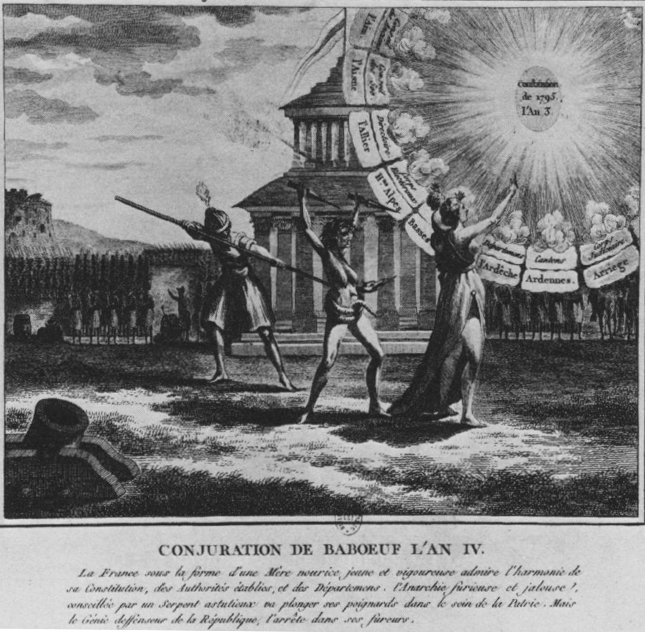
The Babeuf Conspiracy. Anonymous French print.

Babeuf’s party comes down to us as a “conspiracy,” under which word the state would charge him and which his follower Philippe Buonarroti would later rebrand the “Conspiracy of Equals”. It was not so much a grassy-knoll type of conspiracy as it was an underground organization.

When its adherents placarded Paris with the seditious “Analysis of the Doctrine of Babeuf” as the city endured a potentially dangerous economic crisis in April 1796, the government was put to a test of its strength.

It passed.

Having infiltrated Babeuf’s network, it arrested the principals on the eve of the Conspiracy’s intended insurrection. They were hailed out of Paris (a safeguard against sympathetic risings) to the commune of Vendome and there put on trial.* Babeuf and his associate Augustin Alexandre Darthe were condemned to death on May 26th and guillotined the very next day.

The last gasp of the French Revolution dropped with their heads into the basket.

Revolutionary Babeuvism, however, had scarcely just begun.

I don’t know what will become of the republicans, their families, and even the babies still at their mothers’ breasts, in the midst of the royalist fury that the counter-revolution will bring. O my friends! How heart-rending these thoughts are in my final moments! … To die for the fatherland, to leave a family, children, a beloved wife, all would be bearable if at the end of this I didn’t see liberty lost and all that belongs to sincere republicans wrapped in a horrible proscription.

-Babeuf’s last letter to his family

* The trial of Babeuf was itself a jurisprudential milestone: it was the first French trial to be transcribed verbatim.

What might look today like a nifty little advance for efficient judicature was bitterly controversial in 1797. The French Revolution had overturned an ancien regime practice of professional magistrates accepting legal testimony by written deposition and deciding matters behind closed doors. The liberte, egalite, fraternite way would instead demand that testimony be given live in the courtroom where citizen jurors could weigh its credibility.

Babeuf’s lawyer, Pierre-Francois Real, protested against the court stenographers, arguing that “The law insists that the system of written depositions not be restored in any way. That system will undoubtedly return if any means are used to save testimony given orally.”

There’s a fascinating disquisition on the curious and contradictory development of this issue and the way it “violates … common assumptions about the advance of textuality in the West” during the French Revolution in Laura Mason, “The ‘Bosom of Proof’: Criminal Justice and the Renewal of Oral Culture during the French Revolution” The Journal of Modern History, March 2004.

On this day..

1997: Bruce Edwin Callins, in the machinery of death

On this date in 1997, Bruce Edwin Callins was executed in Texas — part of the torrid pace of executions unleashed in Texas in the late 1990s.

This small-timer would hardly rate a notice, but for the fact that Supreme Court Justice Harry Blackmun had chosen this otherwise forgettable murderer’s appeal to announce, in 1994, his belief that the death penalty was irreperably unconstitutional — probably the most famous comment on the death penalty to issue from the bench since capital punishment was reinstated with Blackmun’s concurrence in Gregg v. Georgia.

From this day forward, I no longer shall tinker with the machinery of death.

You’ll see the quote on anti-death penalty placards and apparel from now ’til kingdom come.

But there’s a bit more to it than what fits on a bumper sticker, and Blackmun’s reasoning is worth excerpting at greater length:

Within days, or perhaps hours, the memory of Callins will begin to fade. The wheels of justice will churn again, and somewhere another jury or another judge will have the unenviable task of determining whether some human being is to live or die. We hope, of course, that the defendant whose life is at risk will be represented by competent counsel — someone who is inspired by the awareness that a less-than-vigorous defense truly could have fatal consequences for the defendant. We hope that the attorney will investigate all aspects of the case, follow all evidentiary and procedural rules, and appear before a judge who is still committed to the protection of defendants’ rights — even now, as the prospect of meaningful judicial oversight has diminished. In the same vein, we hope that the prosecution, in urging the penalty of death, will have exercised its discretion wisely, free from bias, prejudice, or political motive, and will be humbled, rather than emboldened, by the awesome authority conferred by the State.

But even if we can feel confident that these actors will fulfill their roles to the best of their human ability, our collective conscience will remain uneasy. Twenty years have passed since this Court declared that the death penalty must be imposed fairly, and with reasonable consistency, or not at all, see Furman v. Georgia, 408 U.S. 238 (1972), and, despite the effort of the States and courts to devise legal formulas and procedural rules to meet this daunting challenge, the death penalty remains fraught with arbitrariness, discrimination, caprice, and mistake. This is not to say that the problems with the death penalty today are identical to those that were present 20 years ago. Rather, the problems that were pursued down one hole with procedural rules and verbal formulas have come to the surface somewhere else, just as virulent and pernicious as they were in their original form. Experience has taught us that the constitutional goal of eliminating arbitrariness and discrimination from the administration of death, see Furman v. Georgia, supra, can never be achieved without compromising an equally essential component of fundamental fairness – individualized sentencing. See Lockett v. Ohio, 438 U.S. 586 (1978).

It is tempting, when faced with conflicting constitutional commands, to sacrifice one for the other or to assume that an acceptable balance between them already has been struck. In the context of the death penalty, however, such jurisprudential maneuvers are wholly inappropriate. The death penalty must be imposed “fairly, and with reasonable consistency, or not at all.” Eddings v. Oklahoma, 455 U.S. 104, 112 (1982).

To be fair, a capital sentencing scheme must treat each person convicted of a capital offense with that “degree of respect due the uniqueness of the individual.” Lockett v. Ohio, 438 U.S. at 605 (plurality opinion). That means affording the sentencer the power and discretion to grant mercy in a particular case, and providing avenues for the consideration of any and all relevant mitigating evidence that would justify a sentence less than death. Reasonable consistency, on the other hand, requires that the death penalty be inflicted evenhandedly, in accordance with reason and objective standards, rather than by whim, caprice, or prejudice. Finally, because human error is inevitable, and because our criminal justice system is less than perfect, searching appellate review of death sentences and their underlying convictions is a prerequisite to a constitutional death penalty scheme.

On their face, these goals of individual fairness, reasonable consistency, and absence of error appear to be attainable: courts are in the very business of erecting procedural devices from which fair, equitable, and reliable outcomes are presumed to flow. Yet, in the death penalty area, this Court, in my view, has engaged in a futile effort to balance these constitutional demands, and now is retreating not only from the Furman promise of consistency and rationality, but from the requirement of individualized sentencing as well. Having virtually conceded that both fairness and rationality cannot be achieved in the administration of the death penalty, see McCleskey v. Kemp, 481 U.S. 279, 313 , n. 37 (1987), the Court has chosen to deregulate the entire enterprise, replacing, it would seem, substantive constitutional requirements with mere aesthetics, and abdicating its statutorily and constitutionally imposed duty to provide meaningful judicial oversight to the administration of death by the States.

From this day forward, I no longer shall tinker with the machinery of death. For more than 20 years, I have endeavored — indeed, I have struggled — along with a majority of this Court, to develop procedural and substantive rules that would lend more than the mere appearance of fairness to the death penalty endeavor. Rather than continue to coddle the Court’s delusion that the desired level of fairness has been achieved and the need for regulation eviscerated, I feel morally and intellectually obligated simply to concede that the death penalty experiment has failed. It is virtually self-evident to me now that no combination of procedural rules or substantive regulations ever can save the death penalty from its inherent constitutional deficiencies. The basic question — does the system accurately and consistently determine which defendants “deserve” to die? — cannot be answered in the affirmative.

Antonin Scalia, never one to let pass an opinion he could just as easily scorn, issued his retort in a concurrence with the 8-1 opinion to execute Callins:

Convictions in opposition to the death penalty are often passionate and deeply held. That would be no excuse for reading them into a Constitution that does not contain them, even if they represented the convictions of a majority of Americans. Much less is there any excuse for using that course to thrust a minority’s views upon the people.

Justice Blackmun begins his statement by describing with poignancy the death of a convicted murderer by lethal injection. He chooses, as the case in which to make that statement, one of the less brutal of the murders that regularly come before us, the murder of a man ripped by a bullet suddenly and unexpectedly, with no opportunity to prepare himself and his affairs, and left to bleed to death on the floor of a tavern.* The death-by-injection which Justice Blackmun describes looks pretty desirable next to that. It looks even better next to some of the other cases currently before us, which Justice Blackmun did not select as the vehicle for his announcement that the death penalty is always unconstitutional, for example, the case of the 11-year-old girl raped by four men and then killed by stuffing her panties down her throat. How enviable a quiet death by lethal injection compared with that!

Scalia’s mention of the “case of the 11-year-old girl” isn’t about Callins at all. The monster Scalia refers to here as obviously execution-worthy for his incendiary crime is Henry Lee McCollum … who in 2014 would be exonerated by DNA evidence after some 30 years on death row.

* Specifically, Callins wasted the patron of a strip bar who was insufficiently prompt at giving up his wallet. The $3 he took from the dying man’s pockets wouldn’t even have been enough to make it rain.

On this day..

1879: Three botches in three states

America’s weird love-affair with Frankenstein execution technology has been an occasional theme on this blog, but the fact is that the old-school execution methods these ghastly machines replaced were unpleasantly hit-and-miss.

On this date in 1879, three different U.S. states produced botched executions, each blurbed this New York Times article. (pdf)


One is attracted most readily to the firing-squad execution of murderer Wallace Wilkerson in Utah.

Wilkerson appealed the constitutionality of this method of execution, and in 1879’s Wilkerson v. Utah, the U.S. Supreme Court held that “the punishment of shooting as a mode of executing the death penalty for the crime of murder in the first degree is not” cruel and unusual punishment.

This legal precedent has actually been cited* by the present-day Supreme Court in rejecting legal challenges to lethal injection. Which is ironic, because a couple of months after the high court issued Wilkerson v. Utah, Wilkerson suffered a very cruel execution indeed.

The doomed man talked the officials conducting his execution into allowing him to die without being strapped down. With the resultant range of motion, Wilkerson at the last breath before the fusillade hit him drew his shoulders up as he braced for the impact — and pulled the white target pinned to his shirt above his heart.

The volley didn’t kill him — it just knocked him out of his chair to the ground, screaming “Oh, my God! My God! They have missed!”

He bled to death in 27 minutes, prompting the tongue-in-cheek observation by the Ogden Junction that “the French guillotine never fails.”


Meanwhile, on the very same day in Missouri …

ST. LOUIS, Mo., May 16.–A special dispatch from Booneville, Mo., says: “John I. West, who murdered a tramp last October, was to-day hanged at the Old Fair Ground near this city. When the trap was sprung, at 11:41 A.M., the rope broke, and the culprit fell to the ground on his back, but was too weak to rise. His groans and the gurgling sounds of strangulation were terrible to hear. He was picked up and speedily raised to the trap again, and, while being held by four or five men, was dropped a second time. This time he swung, and in 11 minutes was pronounced dead.

After reaching the platform of the gallows, West spoke nearly half an hour to the crowd present, reiterating his confession of the murder of Shinn, reviewing his past life, and appealing to young men and women to take his fate as a warning. There were about 8,000 people present, among whom was the father of West, who had come from Chapin, Ill.

(There’s a great deal more about West’s crime in the Times article, but it’s pretty dull reading for all the column-inches. He was a tramp who committed a semi-random murder, seemingly activating all the crime-freakout circuits so familiar to cable news programmers.)


Hillsboro, North Carolina, held a first-ever triple hanging — of the “Chapel Hill burglars”. As you might guess, these gentlemen burgled, and said burgling occurred in Chapel Hill. It was for housebreaking, not murder, that they were condemned, with the help of a confederate who turned state’s-evidence against them as soon as the lot was arrested.

Each of the culprits proclaimed his innocence to the last moment. [Lewis] Carlton spoke for an hour, and said his salvation was sure. The parting between [Henry] Andrews and his sister on the scaffold was most affecting, and moved the crowd of witnesses to tears. All the doomed men bore themselves firmly, and showed no signs of wavering. The hanging took place at 2:30 P.M., and was very badly conducted. The ropes around the necks of [Henry Alphonso] Davis and Carlton were too long, and their feet rested on the ground. They were raised up and the ropes retied, causing death by strangulation.

(According to this “history of the University of North Carolina” page, one of the burglars’ victims was writer Cornelia Phillips Spencer. Famous as the woman who rang the bell re-opening UNC in 1875, her role in closing the university in the first place in 1870 and her retrograde racial politics have recently been in Tar Heel news. The linked article suggests that her brush with the Chapel Hill burglars might have given Spencer an appreciation for the Ku Klux Klan’s version of order. After all, a white supremacist vigilante is just a liberal who’s been burgled.)

The St. Louis Globe-Democrat of May 17, 1879 adds of our men’s exit (in an addendum to a report primarily about the aforementioned West) that

[t]he execution was romantic in the extreme. Just as the doomed men ascended the platform a murky cloud, which had been drifting around, hung over the crowd and the instrument of death. Alfonso Davis began to speak, and as he opened his mouth the thunder began to peal, and the rain came down in torrents. Not a man, woman or child in the vast crowd moved or seemed to be aware that the rain was falling, so wrapped up in the death scene were they. At times the cloud threw such a dense shadow over the scene that it seemed as though night had enveloped the place. Then the lightning, vivid and intense, lit up the field of blood and cast forward, in bold and statuesque relief, the figures of the doomed and their executor as he stood like an artilleryman, lanyard in hand, ready to send the signal of death forward … the souls of three burglars went out and beyond, forked lightning illuminating their way and the wildest of thunder pealing their requiem.


The Bayou State redeemed this black day for the executioner’s craft by the uneventful hanging one Robert Cheney (black, of course) “for ravishing Amelia Voight in June, 1878.”

All told, four states killed six men on May 16, 1879, but only two of them died “cleanly.”

* The author of the New York Times opinion piece cited here, Gilbert King, has guest-blogged on this site:

On this day..