1960: Caryl Chessman

On this date fifty years ago, death row author and celebrity Caryl Chessman choked to death in San Quentin Prison’s gas chamber while the phone outside rang, too late, with his stay.

During his abnormally protracted* (for the times) 12 years fighting death, Chessman became the poster child for the anti-capital punishment cause and the most recognizable face on death row.

He was condemned as the “Red Light Bandit,” a Los Angeles criminal who would waylay cars in lovers’ lanes with police-like flashing red lights, then rob and, for some female victims, rape them. A career felon, Chessman denied his guilt to his death (he insisted that his signed confession was beaten out of him by the LAPD, which would not exactly have been out of character).

The prickly Chessman — “not generally regarded as a pleasant or socially minded fellow,” he conceded about himself — unwisely represented himself at trial, where the confession plus eyewitness testimony of Bandit victims were enough to convict him.

Not, however, of murder.

Instead, Chessman drew two death sentences under one of the country’s several draconian “Little Lindbergh” anti-kidnapping statutes, on the intriguing jurisprudential theory that the Red Light Bandit’s having dragged a rape victim several feet from her car constituted “kidnapping.”**

This astonishingly expansive reading only became more controversial when California repealed the kidnapping law in question in the 1950s. But the repeal was not retroactive.

That left Chessman to fight his sentence with a terrifyingly iron willpower, fending off eight execution dates in the process. The last of them came in February 1960, an 11th-hour reprieve as had been several others, when a two-month stay was granted ostensibly to protect the traveling President Eisenhower from some act of vengeful local retaliation from one of Chessman’s legions of international supporters.

A cat, I am told, has nine lives. If that is true, I know how a cat feels when, under the most hair-raising conditions, it has been obliged to expend the first eight of those lives in a chamber-of-horrors battle for survival, and the Grim Reaper gets it into his head that it will be great sport to try to bag the ninth. All pussy can do is spit. Homo sapiens can write books.

-Caryl Chessman

So Chessman wrote.

Fiction and nonfiction books, numerous articles — copping to a criminal life but insistently denying his involvement in the crimes that would doom him. For a time, prison officials seized his work and forbade his writing, and Chessman resorted to sacrificing his sleep to write illicitly by night and encode his work in putative “legal documents”. Bandit or not, the man had an indomitable spirit, and it won him worldwide attention and support.

Books by and about Caryl Chessman

And bandit or not, the Grim Reaper had a mind to take that ninth life.

One might have thought that for such a lightning-rod anti-death penalty case, the election of anti-death penalty Gov. Edmund “Pat” Brown in 1958 would spell good news.

But “public opinion mobilized against Chessman,” writes Theodore Hamm in Rebel and a Cause: Caryl Chessman and the Politics of the Death Penalty in Postwar California, 1948-1974. That mobilization “marked the beginning of a larger popular backlash by the New Right against an essentially technocratic campaign to eliminate capital punishment in California.”

According to Hamm, Pat Brown claimed he would have been “impeached” if he had granted clemency to his uppity prisoner, leaving Chessman and his lefty backers† expediently triangulated by a Democratic governor. It’s a timeless story.

With executive clemency off the table, Chessman’s lawyer Rosalie Ashler was scrambling on the morning of the 10 a.m. execution to interest a judge in an appeal claiming that one Charles Terranova was the actual Red Light Bandit. The judge took his time reading the brief, and by the time his secretary placed a call to the death house (legend says, after once misdialing it), the cyanide pellets had already dropped.

Too late.

Which didn’t mean that Chessman was already dead — not by a long shot.

A reporter described what was transpiring inside the state’s killing chamber while Law and Ma Bell transacted their tardy business outside.

I thought Chessman must be dead but no, there was another agonizing period during which he choked on the gas. And again. And then again. There was a long period, another deep gasp. At the fourth such straining, Chessman’s head lolled in a half circle, coming forward so that he faced downward with his chin almost touching his chest. This must be the end. But the dying went on.

A deep gasp, his head came up for an instant, dropped forward again. After two or three deep breaths, which seemed something like sobs, a trembling set up throughout the body. Along the line of his broad shoulders, down the arms to his fingers, I could see the tremor run.

Then I saw his pale face grow suddenly paler, though I had not thought that it could be after his 12 years in prison. A little saliva came from his lips, spotted the white shirt that a condemned man wears for his last appearance. Even more color drained from his face and the furrows in his head smoothed out a little. And I knew he was dead.

Chessman would persist as a cultural touchstone for the issue of capital punishment for a generation.

Jim Minor, “Death Row” (1960)

Ronnie Hawkins, “The Ballad of Caryl Chessman” (1960)

Merle Haggard, “Sing Me Back Home” (1968)

(Though this tune about watching men taken to the gas chamber doesn’t explicitly reference Caryl Chessman, it was inspired by Haggard’s own prison stint where he met Chessman and experienced a “scared straight” moment.)

Neil Diamond, “Done Too Soon” (1970)

The Hates, “Do the Caryl Chessman” (1980)

In view of Chessman’s onetime celebrity, he’s an oddly forgotten character today: too strange an individual for easy approachability; too ethically indeterminate for convenient demagoguery; not sufficiently emblematic of any larger cause or community that would tend to his memory. His non-murder death sentence and method of execution seem anachronistic, no longer relevant.

Chessman surely was an avatar of the end to capital punishment that unfolded in the 1960s and 1970s, but as it went with his own case, so it went with his legacy: the simultaneous right-wing backlash ultimately rewrote the story. After all, the “liberal” governor too chicken to spare Chessman would go on to lose his office to Ronald Reagan.

Our day’s protagonist might have had a different place in the national consciousness, in stories with the phrase “as late as 1960,” had that interregnum of “abolition” Chessman presaged not turned out to be a false start.

I am not guilty. I am sure a future generation will listen.

-Caryl Chessman

* While 12 years between sentence and execution wouldn’t raise an eyebrow today (especially in California), Chessman at the time was thought to have set a record for the longest stint on death row in U.S. history.

** The legal weirdness didn’t stop with the kidnapping law. The official court reporter in Chessman’s case actually died with his trial transcription still in semi-legible shorthand. It was partially reconstructed (by a relative of prosecuting attorney J. Miller Leavy, who also won the death sentence against Barbara “I Want to Live!” Graham), but portions that could not be read were ballparked by the recollections of … prosecutor Leavy.

Appeals courts, of course, frequently have recourse to the original trial record to make various legal determinations; the evidentiary gap left by this second-hand-abridged-by-the-DA transcript was frequently protested by Chessman’s camp on appeal.

A cache of primary records from the case and its many appeals is lodged at this FBI Freedom of Information Act page.

† They weren’t exclusively leftists. William Buckley and Billy Graham both supported clemency for Chessman. Nor were they all political: the directors of the schlocky cult horror flick The Hypnotic Eye crassly pitched the headline-grabbing condemned con on a hypnotism promotional stunt, and ended up themselves being drawn into the case and believing Chessman was innocent.

On this day..

1901: “Black Jack” Tom Ketchum, who was left in three pieces

On this date in 1901, a two-bit outlaw from a vanishing frontier made his reservations for hell.

Tom Ketchum — who had become known as “Black Jack” when misidentified with another hombre he resembled — was the last man to hang in America for attempting to rob a train. Given the way the authorities in Clayton, N.M., conducted the job, that’s probably for the best.

This Texas-born outlaw enjoyed a colorful career in the 1890s Southwest plundering trains, killing folk, and other distinctively American pastimes. His name attaches to the [in]famous Hole in the Wall Gang.

He was finally caught attempting a dangerous one-man train robbery, when a conductor (taking part in his third stickup, and tired of being on the wrong end of the gunbarrel) got the drop on Ketchum and winged him with a shotgun. Too weakened by his injury to escape, Ketchum surrendered himself to the law, and his wounded arm to the surgeons.

The un-amputated remainder belonged to Clayton, N.M. — New Mexico Territory, that is, which was not yet a state at this time, but was keen on making an example to stanch the tide of train robberies.

(Formally, the charge that hung Ketchum was “felonious assault upon a railway train”; he was the only person executed for this offense before the Supreme Court decided that a hanging crime needed more victims than just an iron horse. This jurisprudential advance might not have done Black Jack very much good anyway, since neighboring Arizona had also put in an extradition request for murder.)

So far, so good.

Then, they actually dropped him.

When the body dropped through the trap the half-inch rope severed the head as cleanly as if a knife had cut it. The body pitched forward with blood spurting from the headless trunk. The head remained in the black sack and flew down into the pit.

SOME MEN GROANED.

Some men groaned and others turned away, unable to endure the sight. For a few seconds the body was allowed to lie there half-doubled up on its right side, with the blood issuing in an intermittent stream from the severed neck as the heart kept on with its mechanical beating. Then with cries of consternation the officers rushed down from the scaffold and lifted the body from the ground. It was only then apparent exactly what happened.

The drop of the body was seven feet and the noose was made so it slipped easily. Ketchum was a heavy man, and the weight of the body, with the easy-running noose, caused the rope to cut the head cleanly off. Dr. Slack pronounced life extinct a little over five minutes from the time the body dropped through the trap. It is stated too much of a drop was given for so heavy a man.

Just so we’re clear: a seven-foot drop is much, much too far for a man of Ketchum’s 190-plus pounds. Maybe they were distracted by rumors of an escape attempt.

The newspaper account above cites much more forgettable scaffold-talk from Ketchum, but we can’t help but find charm (and obviously, black humor) in his alleged last words,

I’ll be in hell before you start breakfast, boys! Let her rip!

Fictional? If so, they’re more like what Ketchum’s last words ought to be. Although let St. Peter‘s ledger reflect that Ketchum was a decent enough chap to post a letter to President McKinley on the morning of his own execution copping to several robberies for which other people were imprisoned.

Initially buried — naturally — at Clayton’s Boot Hill, this infernal denizen’s grave can now be found (and more than a century on, tourists and admirers do find it) at Clayton Memorial Cemetery.

On this day..

1757: Admiral John Byng

Every Person in the Fleet, who through Cowardice, Negligence, or Disaffection, shall in Time of Action withdraw or keep, or not come into the Fight or Engagement, or shall not to do his utmost to take or destroy every Ship which it shall be his Duty to engage, and to assist and relieve all and every of his Majesty’s Ships, or those of his Allies, which it shall be his Duty to assist and relieve, every such Person so offending, and being convicted thereof the Sentence of a Court-martial, shall suffer Death.

British Articles of War (1749)

On this date in 1757, English Admiral John Byng was shot to death by musketry on the quarterdeck of the HMS Monarque for failing to “do his utmost” to defend Minorca against the French.
The first and last man of that rank executed by the Royal Navy, Byng was one of 15 (!) children of an ennobled admiral. He’d been 40 years at sea himself, a competent, forgettable senior officer unburdened by genius.

The 1750s found him in service of a listless British Empire sliding towards war with France.

London had her eye mostly on the North American conflict already underway … but that conflagration was about to jump the pond.

In 1756, the Brits belatedly realized the French were about to grab the Mediterranean island/naval base of Minorca (Menorca) from them, and dispatched a too-little, too-late expedition under Admiral Byng.

By the time he got there, the French already had Minorca in hand, save the last, besieged garrison. Byng attempted to land reinforcements for the garrison — without enthusiasm, since he perceived the inadequacy of his force — and was repelled in an inconclusive naval engagement.

The loss of Minorca raised the curtain on the Seven Years War: the first “world war,” in Winston Churchill’s reckoning, in which European alliances would duke it out for continent and colonies.

But it dropped the curtain on the ill-starred Admiral Byng.

Popular outrage at the military setback had the Duke of Newcastle‘s government scrambling to find a scapegoat, and the commander on the scene fit the bill exactly.

A gloating French account of the engagement — “the English had the advantage of the wind, but still seemed unwilling to fight” — reached Albion’s shores ahead of the admiral’s dispatch; when the latter arrived, it was publicly leaked in unflatteringly redacted form that generally made Byng look like a big fraidy-cat.

Having been thus attainted in the court of public opinion, the admiral was hailed before a court martial and convicted of not doing enough to relieve the English garrison and generally not fighting a very good fight.

Only one penalty was prescribed for this offense: death.

“The officers who composed this tribunal” themselves had such misgivings about shooting an officer for an on-the-scene tactical miscalculation “unanimously subscribed a letter to the board of admiralty [reading] ‘for our own consciences sake, as well as in justice to the prisoner, we pray your lordships, in the most earnest manner, to recommend him to his majesty’s clemency.'”

But Hanoverian George II had no upside in getting involved. He faced complaints enough wringing the revenue out of Englanders to defend a hereditary German electorate of no consequence to British security; what sense could there be in antagonizing the irritated masses by going to bat for the official fall guy in the realm’s scandalous military reversal?

On the day fixed for his execution [relates the Newgate Calendar] the boats belonging to the squadron at Spithead being manned and armed, containing their captains and officers, with a detachment of marines, attended this solemnity in the harbour, which was also crowded with an infinite number of other boats and vessels filled with spectators. About noon, the Admiral having taken leave of a clergyman, and two friends who accompanied him, walked out of the great cabin to the quarter-deck, where two files of marines were ready to execute the sentence. He advanced with a firm deliberate step, a composed and resolute countenance, and resolved to suffer with his face uncovered, until his friends, representing that his looks would possibly intimidate the soldiers, and prevent their taking aim properly, he submitted to their request, threw his hat on the deck, kneeled on a cushion, tied one white handkerchief over his eyes, and dropped the other as a signal for his executioners, who fired a volley so decisive, that five balls passed through his body, and he dropped down dead in an instant. The time in which this tragedy was acted, from his walking out of the cabin to his being deposited in the coffin, did not exceed three minutes.


The execution of John Byng, from the British National Maritime Museum.

Thus fell, to the astonishment of all Europe, Admiral John Byng; who, whatever his errors and indiscretions might have been, was at least rashly condemned, meanly given up, and cruelly sacrificed to vile political intrigues.

A school of thought does exist that the empire reaped from its rash, mean, and cruel example a generation of aggressive captains and commodores — or, as Voltaire put it shortly afterwards in Candide, “it is thought good to kill an admiral from time to time to encourage the others.” (“pour encourager les autres”)

Whatever the morale effects, the British soon rallied from their early setbacks in the Seven Years’ War and emerged from the conflict undisputed masters of North America and India.

And they even got Minorca back, too.

On this day..

1842: Maketu Wharetotara, New Zealand’s first execution

On this date in 1842, New Zealand carried out its first official execution: the hanging of Maori teen Maketu Wharetotara for murdering five people.

The son of a Nga Puhi chief named Ruhe, Maketu took employment as a farmhand for a white household.

An ill-tempered white servant evidently offended him sufficiently to split the bugger’s skull with an axe … and since Maketu wasn’t the type to leave a job half-done, he went ahead and murdered the rest of the household, too.

European settlers, still a minority, initially worried that this outburst might herald the onset of a general native rising. The police magistrate even refused to apprehend the criminal, who had fled back to his people, for fear of triggering conflict.

But internal Maori politics would not let the boy off so lightly.

One of the household members he had murdered was a mixed-race granddaughter of another important Nga Puhi chief, which raised the specter of intertribal strife.

To pre-empt a possible bloodbath, Ruhe turned his own son over to the Europeans.

By British law, it was a pretty cut-and-dried case with a pretty predictable outcome which became, for the crown, a precedent establishing its authority over incidents of interracial violence.

(Maketu Wharetotara — baptized “Wiremu Kingi” by an Anglican minister on the morning of his execution — obtained his milestone status because another Maori minor who had previously been condemned to death died of dysentery before they could noose him.)

On this day..

1623: Amboyna Massacre

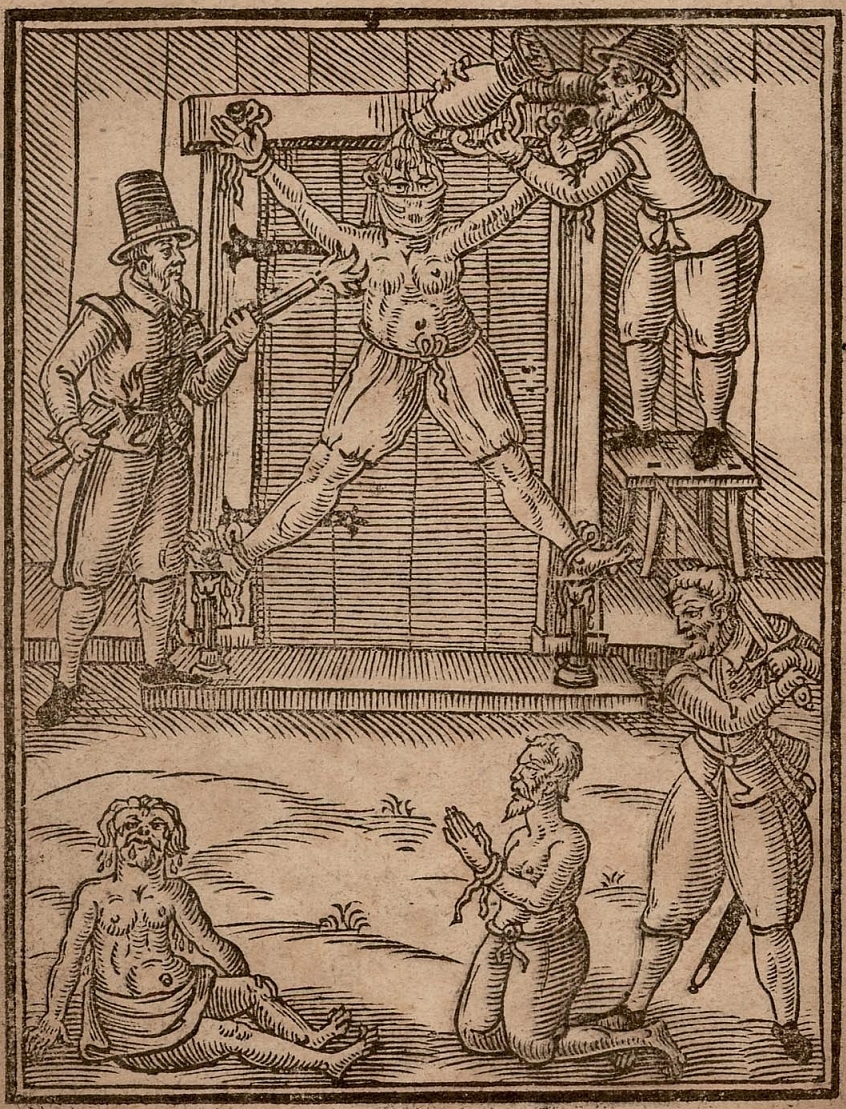
On February 27,* 1623, the Dutch East India Company beheaded twenty who had been waterboarded into confessing to a terrorist plot.

English prisoner suffering “waterboarding” faux-drowning torture, published under the name “A true relation of the unjust, cruell, and barbarous proceedings against the English at Amboyna in the East-Indies 1624”.

The torturers “poured the water softly upon his head until the cloth [wrapping his head] was full, up to the mouth and nostrils, and somewhat higher, so that he could not draw breath but he must suck in all the water.” More nasty description.

(cc) Image from Flickr | BiblioOdyssey

Posh Spice

As in modern times, this scenario originated with resource competition in the Muslim world … in this case, competition for spice, in Indonesia.

European colonialism had pitted the Dutch East India Company against its British counterpart on the archipelago, both scrabbling after the lucrative trade in cloves and pepper, with garnishes of nutmeg, cinnamon, mace, and ginger.

The two rival powers had, as we lay our story, recently come to a tense truce, dividing the commerce between them — and swapping mutual accusations of violating that pact. The arrangement basically gave the Dutch a bigger slice of the pie, so we’ll find them when the cloves hit the fan having the balance of power on their side.

Terrorists

We’re going to oversimplify to set the scene.

On Ambon Island, one of the very “Spice Islands” (i.e., the Moluccas) — at the Dutch-controlled fortification of a trading post also shared by the English — the Dutch merchant-governor Herman van Speult heard that a Japanese mercenary had asked about the Dutch fortifications.

The security-conscious van Speult ordered that unfortunate soldier interrogated under torture.

As tends to happen when the interrogators in such a case are convinced of a ticking time bomb situation, the torture uncovered a ticking time bomb situation.

The mercenary got the Dutch to stop burning and drowning him by “revealing” a highly implausible** English plot to seize the Dutch fort, with 20 guys or so and no prospect of imminent outside aid. Wouldn’t you know it: when the supposed confederates named by the mercenary were similarly tortured, they too admitted the plot. Van Speult’s English opposite number, Gabriel Towerson, was one of them.

The Amboyna Massacre followed anon, with Towerson and nine other British East India Company employees beheaded, along with nine Japanese mercenaries and one Portuguese. (The latter ten worked for the Dutch East India Company, not the British. A fifth column!)

They went to their deaths protesting their innocence, and many smuggled out written recantations to that same effect: “tortured … with that extream Torment of Fire and water, that Flesh and Blood could not endure it, and we take it upon our Salvation, that they have put us to Death Guiltless.”

Anger in the English Street

That last quote comes from Karen Chance, “The Amboyna Massacre in English Politics, 1624-1632,” in Albion: A Quarterly Journal Concerned with British Studies (Winter 1998).

As the title of that piece suggests, the Amboyna Massacre outraged Towerson’s countrymen and -women once word finally made it back to the mothership. (In addition to the torture/wrongful execution dimension, the legal authority of the Dutch trading concern to impose judicial punishment on their English counterparts was questionable at best.)

English demands for satisfaction against the perpetrators continued to complicate Dutch-English relations into the reign of Charles I and beyond. Even Oliver Cromwell required, as the price of peace for the First Anglo-Dutch War in the 1650s, punishment of any surviving offenders. (Which was apparently nobody at all.)

And still later, the burgeoning British Empire’s propaganda arm reached for the Amboyna narrative to justify seizing New Amsterdam on the grounds that the Dutch had attempted to spring a massacre on English settlers — “their Amboyna treacherous Cruelty extended itself from the East to the West Indies, and pursued thus the straight channel of Dutch blood”.

As for the trade-jockeying: the Netherlands’ commanding position in Indonesia ultimately squeezed the English out.** But don’t fret for Old Blighty: she turned attention to gobbling up India, and made a lot more bank than did the Dutch spice racket.

* February 27 was the date according to the Julian calendar in use at this time by the British. By the Gregorian calendar the Dutch were using, the massacre took place on March 9.

** For more on both the fanciful nature of the supposed plot, and the economics of the East Indies trade as it unfolded in the 17th century, see D.K. Bassett, “The ‘Amboyna Massacre’ of 1623”, Journal of Southeast Asian History, September 1960.

On this day..

1388: Nicholas Brembre, Mayor of London

One day after Nicholas Brembre’s treason trial was interrupted for the sudden capture and summary execution of his political ally Robert Tresilian, the former Mayor of London was back in the dock of the Merciless Parliament this day to receive (and immediately suffer) the Lords’ judgment that he be hanged.

Like Robert Tresilian, Brembre had backed the young Richard II’s bid to throw off the influence of a circle of advisors during the dangerous 1380s.

Brembre spent the early part of the decade bursting his ample coffers with a plum customs-collection gig (in which capacity he employed Geoffrey Chaucer), with a couple of stints as London mayor mixed in.

He earned a reputation for corruption and election-rigging (“on the day of the election … Sir Nicholas and others of his faction ordered to the Guildhall of London certain persons, ‘foreigns’ and others in great numbers, who were armed, to make the election”).

A wiser fellow than myself once said, sometimes you eat the bear and sometimes the bear, well, he eats you.

A rough customer to the last, Brembre tried (pdf) to mount a defense by right of single combat. It was not taken up.

He was drawn from the Tower through the city on a hurdle to Tyburn, resting at furlong intervals he gave great penance, beseeching mercy from God and men against whom he had sinned in past times, and many commiserating prayed for him. And when the noose was put on him so that he might be hanged, the son of Northampton* asked him whether the aforesaid things done elsewhere to his father by Brembre were legally done. For Northampton was formerly a mayor of the city of London, a richer and more powerful citizen among all those who were in the city, and through certain ones, associates who were death-bearing plagues, namely Brembre, Tresilian and others, was enormously vexed by certain nefarious conspiracies and confederacies then condemned to death, and with all his goods stripped hardly escaped alive. And concerning those things Brembre confessed that neither piously nor justly but with a violent heart for the sake of destroying Northampton he had infelicitously committed those things. And seeking forgiveness, hanging by the rope, he died when his throat was cut. Behold how good and pleasant it is to be raised up to honors! It seems to me better to carry out business at home among paupers than be thus lordly among kings, and at the end climb the ladder among thieves; since it is more a matter of onerousness than honor to assume the name of honor. You who are reading, look down to regard him, and you might be able to consider by their ends how their works receive results. For in every work be mindful of the end. (Source)

Richard II subsequently outmaneuvered the foes whose ascendance in 1388 forced Brembre’s execution; in 1399, the attainder was posthumously reversed … just before his royal patron Richard II was overthrown by Henry IV.

* “Northampton” here refers to former London Mayor John of Northampton, not to be confused with the ennobled Earl of Northampton — which latter title was actually held at this time by Henry Bolingbroke, the future King Henry IV and a member of the anti-Ricardian Lords Appellant party that engineered Brembre’s downfall. (Got all that?)

Part of the Daily Double: The Merciless Parliament.

On this day..

1603: Not Tommaso Campanella

The wise were forced to live as the mad were accustomed, in order to shun death, such that the greatest lunatic now possesses the royal burdens. The wise now lived alone with their wisdom, behind closed doors, applauding only in public the others’ mad and twisted caprices.

-Tommaso Campanella

On this date in 1603, freaky-deaky Dominican philosopher Tommaso Campanella drew a life sentence — avoiding execution by dint of a painfully convincing performance of insanity.

Campanella had some problematically heterodox notions about the sun (namely, that it was going to consume the earth) and everything under it, and had had a recent scrape with the Inquisition.

What really got him in trouble was trucking with a Calabrian conspiracy to overthrow Spanish domination, apparently a product of the monk’s millenarian anticipation of a sort of proto-communist revolution.

Campanella was a strange guy, but this was quite a far-out plot.

As Joan Kelly-Gadol writes in this fine tome,

This took place, let it be noted, after he had written two works advocating a Papal monarchy for Italy and the world and two works promoting the interests of the Spanish Empire also in Italy and throughout the world.

Past performance is no guarantee of future returns. Once the conspiracy was betrayed,

Campanella was imprisoned … in the Castel Nuovo, one of the principal fortresses in which the Spaniards maintained a military garrison. He was arraigned before the civil tribunal for rebellion and before the ecclesiastical tribunal for heresy. His “examination” which began in January 1600 was gruesome. He claimed innocence in his first interrogation before the civil tribunal, was thrown into a dungeon, actually a cleft in the bedrock of the Castle, to remain there for seven days. Then followed torture. He “confessed,” admitting that he preached about the coming political upheaval but denying that he was part of a conspiracy to bring it about …

His desperation at this point can be gauged by the fact that by April of 1600 he began to feign madness. The ecclesiastical action against him began now, and he persisted in this attitude of insanity through three interrogations, including an hour of torture … On the fourth and fifth of June 1601, he was subjected to the cruel torture of “the vigil” to test whether his insanity was genuine. This was the usual torture of the rope, suspending the body of the victim by his tied hands over a blade which cut into his flesh whenever he yielded to the strain of holding himself in the air; but the vigil refined this cruelty by continuing it for forty hours. Campanella endured the ordeal without breaking.

And it wasn’t just a feat of toughness to beat the torturer at his own game, impressive as it is on those terms alone: Campanella pulled off a genius gambit exploiting the Inquisition’s own legal machinery to duck the separate capital charges he faced in civil and ecclesiastical court.

Joseph Scalzo’s “Campanella, Foucault, and Madness in Late-Sixteenth Century Italy”,* an academic paper that reads like a thriller, narrates Campanella’s “dangerous competition” with his persecutors.

In fine: on Easter Sunday 1600,** as he was approaching conviction and condemnation in his state trial for treason, Campanella began his insanity ploy, successfully forcing a delay in that case and initiating his separate church trial for heresy.

Then, by remaining stubbornly committed to what most of his examiners believed was a charade, Campanella won … by forcing them to inflict that juridically determinative 40-hour “vigil” torture.

the jurisprudence of the time accorded torture so much force, such as to annul all other proofs and “to purge circumstantial evidence”; if the torture had been vigorous and unusual. The accused came, all the more to avail himself of the result obtained, according to the scholarship of the criminologists most in vogue. Thus, Campanella had judicially to be regarded as insane, although everyone was persuaded that he probably simulated insanity. The consequence, in the tribunal of the Holy Office, was not indifferent: He was a “relapsed heretic,” and even if repentant, he would have been disgraced and consigned to the secular court of justice, which would have executed him; being mad, he could no longer suffer condemnation, and in the circumstance in which he might already have been condemned, he would have been spared the death penalty, to reason and repent.

(this is Scalzo’s quotation of Luigi Amabile, an Italian who wrote the book on Campanella; I have been unable to find the Amabile original online.)

Home free.

Having reached this judicial safe haven, Campanella soon — in fact, according to the man who tortured him, literally on the walk from the vigil back to his cell — resumed a recognizable rationality.

He’d languish in prison until 1626 (a few years after he got out, he had to flee to France), but he made the most of it. Campanella wrote his magnum opus, the utopian City of the Sun, while awaiting his sentence in 1602. A number of other works on a wide array of subjects — science, philosophy, theology, political governance (he returned to giving the Spanish empire supportive advice), a vigorous defense of Galileo — were also composed during his 27 years under lock and key.

Campanella’s visionary anticipation of radical egalitarianism would, like Thomas More‘s, help shape the utopian literary genre. But Campanella’s take, while still a theocratic one, lent itself to distinctly more subversive interpretation.†

For example, this Brezhnev-era Soviet essay‡ (unearthed and translated by Executed Today friend and sometime guest-blogger Sonechka) decants the Dominican’s heretical notions into Marxist orthodoxy.

How many times were the communists denounced by their enemies for this “commonality of wives”! Scientific communism, certainly, is not responsible for the figments of a monk like Campanella. But it is instructive to penetrate his logic. It is not commodification or dehumanization that hides behind Campanella’s “commonality of wives”. The women of the “City of Sun” have the same rights as men … The “commonality of women” is equivalent to the “commonality of men” on the basis of mutual equality. That is why, though [we are] decisively rejecting this type of family-free communism, it is necessary to consider who stands on the higher moral grounds — Campanella’s woman, alien to deceit and pretense, or a false bourgeois woman, whose lot in life is adultery and legalized prostitution.

Ultimately, this wild man not only got the high moral ground: he got to die in bed. Once in a while, we get a happy(ish) ending.

So although it actually has nothing to do with Tommaso, “La Campanella”“Little Bell”, a Paganini violin concerto — allows us here at this blog (in common with our day’s hero) an atypically soothing* denouement.

* Joseph Scalzo, “Campanella, Foucault, and Madness in Late-Sixteenth Century Italy”, The Sixteenth Century Journal, Vol. 21, No. 3 (Autumn, 1990)

** Campanella’s Easter 1600 madness was initiated only a few weeks after fellow intellectual omnivore Giordano Bruno was burned for heresy up the road in Rome. Strictly coincidence.

† Since so much of Campanella’s work was produced while the author was under duress — fighting capital charges, applying for clemency and release — it remains disputable just which parts of it can be taken to represent his real beliefs.

‡ L. Vorob’ev. “Utopija i dejstvitelnost”. (“Utopia and Reality”) in Utopicheskij roman XVI-XVII vekov (Utopian Novel of XVI-XVII century); Series “Biblioteka vsemirnoj literatury”, Khudozhestevnnaja literature, Moscow, 1971, p. 19.

On this day..

1777: Rev. Benjamin Russen, child rapist

On this date in 1777, crying out “Stand clear! Look to yourselves! I am the first hypocrite in Sion!”, a clerical schoolmaster was hanged at Tyburn for raping one of his charges.

Ann (or Anne) Mayne testified that the reverend had raped her when she was 9 and 10 years old (the girl was only 10 at the time of the trial). Russen ducked similar charges leveled by three other girls. Rachael Davis, for instance,

said, he lay upon her; but she did not declare, that he entered her body: I told the parties, that no one need be bound over, for it did not appear capital, as she did not say her body was entered.

Result: acquittal. (I’m sure you’ll feel good about entrusting your Bethnal-Green charity school child to Rev. Russen after that.)

Three acquittals out of four ain’t bad.

But it only took one conviction to hang him.

The Old Bailey Online record of Russen’s trial is full of dickering over penetration degrees, and of course, hymen breakage (or lack thereof).

According to this Treatise of the Pleas of the Crown,* the judge in the Mayne case

left it to the jury whether any penetration were proved; for if there were any, however small, the rape was complete in law. The jury found him guilty, and he received judgment of death. But before the time of execution, the matter being much discussed, the learned Judge reported the case to the other judges for their opinions, whether his direction were proper. And upon a conference it was unanimously agreed … that the direction of the Judge was perfectly right. They held, that in such cases the least degree of penetration is sufficient, though it may not be attended with the deprivation of the marks of virginity. It was therefore properly left to the jury by the Judge, and accordingly the prisoner was executed.

* Part of Edward Hyde East’s project in this Treatise is to argue against a standard still used in some jurisdictions that ejaculation was required to constitute a rape. See Passion and Power: Sexuality in History.

On this day..

1945: Anton Dostler, gone commando

On December 1, 1945, German General Anton Dostler was shot by the American military at Aversa, Italy, for war crimes.

Gen. Dostler readied for execution, from the U.S. National Archives. Click for larger image, or click here for the post-execution photo.

Specifically, General Dostler was condemned for having ordered the summary execution of American saboteurs who had been taken behind enemy lines.* Dostler was the first German general tried by an American military commission, and the first put to death for war crimes.

And his sentence did not sit well with all.

There had been a group of German saboteurs captured in the United States during the war who had themselves been executed (after becoming the subject of Supreme Court landmark Ex parte Quirin). Here, a mirroring act on the German side brought a death sentence for its (supposed) author.

Dostler’s scenario therefore raised interesting questions of war crimes law, jurisdiction … and politics.

The essential legal difference between the German saboteurs and the OSS men shot at La Spezia was that the latter were found to have been taken in uniform. If uniformed, they were entitled to prisoner of war status; if not, then a summary execution might have been (however repugnant) permissible.

It seems to be generally agreed, and even conceded by Dostler’s defense, that the saboteurs were indeed in uniform, though the notes of the trial are rather vague on the point; there’s an intriguing indication that the defense disputed the notion that the captive saboteurs’ uniform had the necessary “fixed distinctive sign recognizable at a distance.” (Time said that “they wore no insignia, had turned their field jackets inside out.”)

In a do-over, Dostler’s defense might have dug very deep into what met the Geneva Convention’s definition of a uniform.**

For the Germans, however, the saboteurs’ fate was decided by Hitler’s notorious Commando Order, inflicting immediate death on any enemy personnel (uniformed or not) captured behind German lines.†

Understandably, then, Dostler’s counsel seems to have been much more interested in pursuing the “superior orders” defense, and did so with gusto: in this early landmark trial, it was an as-yet untested strategem even though the Allied Powers had decided as a matter of policy not to protect potential war criminals on that basis. Not only was the Führerbefehl at work in general, but Dostler had kicked this specific decision upstairs to the office of Gen. Albert Kesselring, which had insisted upon the executions (to the point of directly phoning the fortress which held the Americans to ask why they weren’t dead yet).

Dostler defense attorney Col. Claudius Wolfe appeared to strike a chord with the tribunal’s career military officers in his closing summation, impressing upon them the danger to military order or to their own persons of establishing a precedent that subordinates can be held accountable for illegal orders from above.‡

We won the war this time, but no one knows who will win the next time. We might lose and then you gentlemen might find yourselves sitting where this man is now sitting…

If we find this man guilty because of political pressure or because he lost the war and is in our power, we might as well not have won the war. (New York Times, Oct. 12, 1945)

But a more immediate precedent was at stake: the many imminent war crimes trials including the Nuremberg proceedings. Many of those would never get off the ground if a “superior orders” plea could work for someone as high-ranking as a general — or if the first war crimes trial out of the gate resulted in an acquittal.

A son of one of Dostler’s defense team makes a hotly-stated case for the general here; some factual errors (e.g., the “Roosevelt administration”) detract from the piece, but his recollection of the backstage machinations as related by his father are fascinating if true.

Video of Dostler’s execution is available, in its original silent cut.

* A description of the attempted operation, with helpful maps, is here (pdf). Coincidental — but perhaps informative for the Third Reich’s decision-making apparatus — was the fact that the La Spezia saboteurs were captured on March 24, 1944, the very same date as a reprisal mass execution in Rome for a partisan attack the day before that had claimed 33 Germans.

** Here (pdf) is a review of the current legal terrain around the “uniform” issue, significantly shaped by World War II. Executive summary: commanders should give awfully wide latitude to hostiles wearing less-than-standard uniform unless said hostiles are clearly using their wardrobe as a ploy to get the drop on your guys.

† Actually, the text of the Commando order directed that enemy “commandos” should without quarter “be exterminated to the last man, either in combat or in pursuit” (a “no quarter” order being illegal itself, but not relevant here); but, that those who somehow managed to be captured should be handed over to the SS. German officers seem to have understood, probably accurately, that the high command simply wanted them dead and wasn’t fussy about distinguishing the circumstances. Dostler’s guys (per the Oct. 13, 1945 London Times) contended that Hitler’s citation in the Führerbefehl of Allied atrocities made the German policy in reality a Geneva Convention-legal reprisal order.

‡ A German officer down the chain of command, Alexander zu Dohna-Schlobitten, actually refused to sign the execution order for the Americans because — yes — the order violated the Geneva Conventions. The Wehrmacht sacked him, but did not prosecute him, for his scruples.

Part of the Daily Double: Lesser War Criminals.

On this day..

1945: Heinz Eck, U-Boat commander

On this date in 1945, Heinz-Wilhelm Eck and two of his former subordinates on the Unterseeboot U-852 were shot in Hamburg for killing the survivors of a sunk target.


The defendants in the U-852 trial. From left to right: Eck, August Hoffmann, Walter Weisspfennig, Hans Lenz, Wolfgang Schwender. The leftmost three were executed.

On March 13, 1944, in the South Atlantic en route to the Indian Ocean, U-852 torpedoed the Greek-flagged Peleus.

The submarine commander Eck feared the steamer’s debris would be observed by a passing airplane, and give enough information to Allied reconnaissance to enable it to find his ship. He therefore surfaced and attempted to have the debris field eliminated by machine-gunning and grenading it into the watery deep.

This seems a rather curious expedient, but evidently it was a common one.

U-Boat ace Adalbert Schnee was called (German link) to testify that blasting away at ship wreckage actually was an effective practice. But on prosecution’s cross-examination, Schnee was deftly trapped — lest he incriminate himself in a potential war crime — into disavowing (pdf) the killing of survivors who happened to be clinging to that debris.*

Q. What would you have done if you had been in Eck’s position?

A. I would under all circumstances have tried my best to save lives, as that is a measure which was taken by all U-boat commanders; but when I hear of this case, then I can only explain it as this, that Captain Eck, through the terrific experience he had been through, lost his nerve.

Q. Does that mean that you would not have done what Captain Eck did if you had kept your nerve?

A. I would not have done it.

Survivors of torpedo attacks usually had problems enough without the sub crew taking pains to attack them. Eck claimed that he worried that the survivors’ rafts might have communications equipment that would call out the sub-hunters tout de suite, but a standing German directive forbade U-boat captains assisting their prey.

No attempt of any kind should be made at rescuing members of ships sunk, and this includes picking up persons in the water and putting them in lifeboats, righting capsized lifeboats and handing over food and water. Rescue runs counter to the rudimentary demands of warfare for the destruction of enemy ships and crews … Be harsh, having in mind that the enemy takes no regard of women and children in his bombing attacks of German cities.

An unpleasant reality of sub warfare, as depicted in the classic submarine film Das Boot:

But in this case, some of the Peleus crew managed to survive the mop-up operation, and then the open ocean, long enough to tell their tale.

The British military tribunal sentenced Eck to death, his plea of “operational necessity” (i.e., “I had to shoot the survivors to sink the debris to save my ship”) rejected; also condemned were the ship’s doctor Walter Weisspfennig, who wasn’t supposed to be involved in gunplay at all, and August Hoffmann. Both of them had taken the “only following [Eck’s] orders” line.

Hans Lenz, who had opposed Eck’s order but ultimately complied with it, drew a life sentence. Wolfgang Schwender, who seems to have shot generally at debris but not (he said) at human beings, and then got bumped off his gun by the reluctant Lenz, got off the easiest at 15 years.

Despite the predictable “victor’s justice” dynamic — American and British sub personnel, and even Japanese I-boat officers, evidently skated on similar conduct — Eck was the only U-boat commander in World War II to draw a war crimes conviction. That was surely due in part to the overwhelming majority of them having simply failed to survive the perilous undersea campaign long enough to see the inside of a war crimes court.

* Part of the past-is-prologue contest for this case was the World War I sinking of the Llandovery Castle by a German submarine, which had then proceeded to hunt down the lifeboats. It resulted in (non-death penalty) war crimes convictions for some of the U-boat officers involved. The existence of this precedent helped to defeat the “superior orders” defense of the junior officers, since they could be held to have known that Eck’s command was illegal.

Part of the Daily Double: Lesser War Criminals.

On this day..