1781: The slaves of the Zong, for the insurance

Beginning this day in 1781, the captain of the slave ship Zong began throwing his cargo overboard in a still-notorious case combining the horrors of the Middle Passage with the cruel rapacity of capital.

The Liverpool-based ship was en route from Africa to Jamaica, there to exchange its human chattel for New World produce bound for the European market.

Characteristically for slave ships, it was inhumanly packed: more economical for a slaver to overcrowd its captives and write off the ones who died than to maximize slaves’ chances of survival. And on this particular ship, malnutrition and disease claimed more than 60 slaves (as well as seven crew members).


Underwater sculpture off Grenada commemorating slaves thrown overboard during the Middle Passage.

With many more in danger of expiring, Captain Luke Collingwood reasoned that the cargo would be a loss if it succumbed, but that shippers’ insurance would reimburse the firm “when slaves are killed, or thrown into thrown into the sea in order to quell an insurrection.” Over a three-day span beginning Nov. 29, 1781, Collingwood had 133 still-living but sick slaves cast overboard;* “the last ten victims sprang disdainfully from the grasp of their executioners, and leaped into the sea triumphantly embracing death.” (Source)

This gave the ship’s owners — the good captain himself was not among them — the chance to attempt an insurance scam.

This historical-philosophical book (review, a pdf) analyzes the Zong affair as the emblematic “inauguration of a long twentieth century underwritten by the development of an Atlantic cycle of capital accumulation.”

When the Zong landed having lost in total more than half of its original 440 slaves (and Collingwood himself, that fastidious servant of his shareholders), its owners did indeed attempt to recoup the many who had been intentionally killed. Smelling fraud, the insurer refused to pay.

There followed the signal case of Gregson v. Gilbert, a dry insurance trial that also became a beacon of the slave system’s blood-chilling jurisprudential logic.

After a jury sided with the claimant shippers against the insurers, the matter hit a wide public on appeal before Lord Chief Justice Mansfield when abolitionist activists Granville Sharp and Olaudah Equiano seized upon its conscience-shocking quality.

While Sharp and Equiano agitated unavailingly for a homicide investigation, the insurer — which was itself in the very same business of human bondage as the shipper — self-righteously posed “as counsel for millions of mankind, and the cause of humanity in general.” (Source) Its interests, after all, would be served by the least possible indemnity for slaves murdered in passage.

Solicitor-General John Lee — “the learned advocate for Liverpool iniquity,” in Sharp’s estimation — successfully insisted upon limiting the case to its commercial considerations.

What is this claim that human people have been thrown overboard? This is a case of chattels or goods. Blacks are goods and property; it is madness to accuse these well serving honourable men of murder. They acted out of necessity and in the most appropriate manner for the cause. The late Captain Collingwood acted in the interest of his ship to protect the safety of his crew. To question the judgment of an experienced, well-travelled captain held in the highest regard is one of folly, especially when talking of slaves. The case is the same as if horses had been thrown overboard. (Quoted here; Wikipedia has it “as if wood had been thrown overboard.”)

Lord Mansfield agreed, “(though it shocks one very much) that the case of slaves was the same as … horses,” and simply found with the insurers that no liability attached them since the killings were voluntary rather than necessary.

Nobody was ever prosecuted.


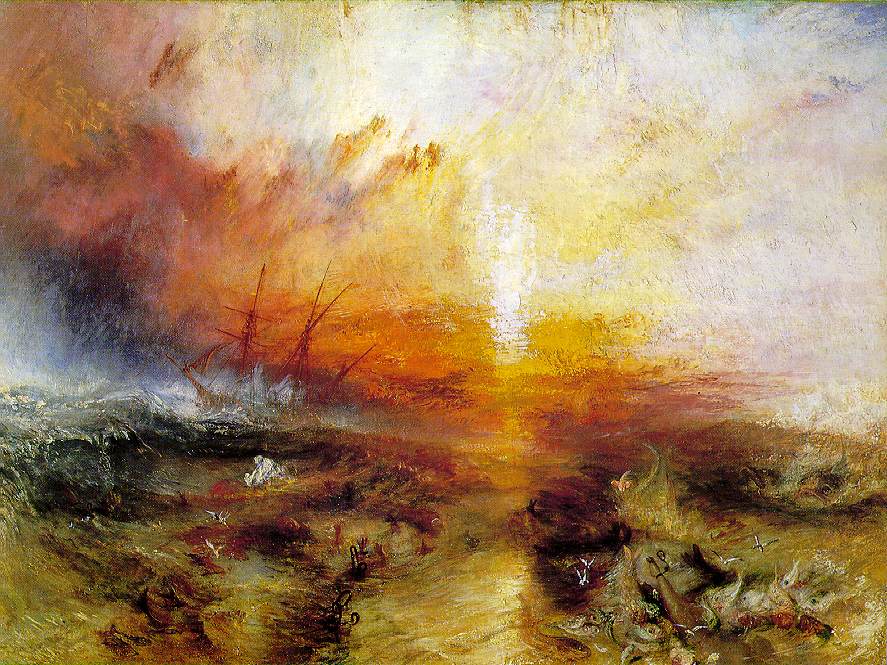
The disturbing 1840 Turner seascape “Slavers throwing overboard the Dead and Dying – Typon [sic] coming on”, also known simply as “The Slave Ship”, is widely thought to have been inspired by the Zong episode. The allusion would have been well-known to his contemporaries.

* One of the 133 survived by climbing back aboard the ship.

On this day..

1871: Louis Rossel, Théophile Ferré, and Sergeant Bourgeois, Communards

On this date in 1871, three very disparate men of the recently quashed Paris Commune were shot together at Satory.


Louis Rossel (top) and Theophile Ferre. The mysterious Bourgeois will have to be imagined.

Louis Rossel (French Wikipedia link | English) got the press — the public sighs, the clemency campaign, the big show by Adolphe Thiers of considering mercy. “Rossel,” French scribbler Jules Barthelemy-Saint-Hilaire wrote, “is a man whose hand we grasp even when we shoot him.”

Rossel, to the elites of the Third Republic, was one of them. (Here’s a very sympathetic extended biography via Google books.)

The highest-ranking officer (a colonel) to serve the Commune, a writer of books and thinker of thoughts, the fuzzily lefty Rossel had gone to Paris to serve “the people” when France’s capitulation during the Franco-Prussian War put the capital at the mercy of the Germans.

Rossel was briefly Minister of War for the Commune, but he broke with its leadership’s fire-eating ways and then hung about the city while events played out around him. For his adherents, he was the loyal patriot who had renounced the rebellion. For the rebels … pretty much the same (Rossel resigned/was forced from power three weeks before the Commune fell).

But for the brass, the youngster’s March resignation letter abandoning the Thiers government for the Parisian masses was a little more dangerous than your garden-variety liberalism.

Having learned … that two parties are struggling for mastery of the country, I do not hesitate in joining the side which has not concluded peace [with the Germans], and which has not included in its ranks generals guilty of capitulation. (Source)

Without doubt, Theophile Ferre (French Wikipedia link | English) was a true believer, a radical agitator from way back. Ferre was part of the Commune leadership, and directly involved in the execution of hostages during its desperate last week.*

As such, his sympathy from the bourgeois public was zero, and his prospects of commutation were even worse than that. Ferre took his solace from his faith in the cause.

Joining these two in a sort of literary triad was one “Sergeant Bourgeois” (seriously), a straight-from-central-casting grunt “condemned to death for having struck one of his officers, and for having afterwards taken part in the Commune.”** His role in the story is to be the virtuous avatar of The People, understood to have died in a manner confirming the interlocutor’s take on the Commune, whatever that take might be.

Thus, Lissagaray (French link), eloquently reviling that milquetoast fop Rossel:

For twelve weeks death remained suspended above the heads of the condemned. At last, on the 28th November, at six o’clock in the morning, they were told that they must die. Ferré jumped out of bed without showing the slightest emotion, declined the visit of the chaplain, wrote to ask the military tribunals for the release of his father [also imprisoned -ed.], and to his sister that she should have him buried so that his friends would be able to find him again. Rossel, rather surprised at first, afterwards conversed with his clergyman. He wrote a letter demanding that his death should not be avenged — a very useless precaution — and addressed a few thanks to Jesus Christ. For comrade in death they had a sergeant of the 45th line, Bourgeois, who had gone over to the Commune, and who showed the same calm as Ferré. Rossel was indignant when they put on the handcuffs; Ferré and Bourgeois disdained to protest.

The day was hardly dawning; it was bitterly cold. Before the Butte of Satory 5,000 men under arms surrounded three white stakes, each one guarded by twelve executioners. Colonel Merlin commanded, thus uniting the three functions of conqueror, judge, and hangman.

Some curious lookers-on, officers and journalists, composed the whole public.

At seven o’clock the carts of the condemned appeared; the drums beat a salute, the trumpets sounded. The prisoners descended, escorted by gendarmes. Rossel, on passing before a group of officers, saluted them. The brave Bourgeois, looking on at the whole drama with an indifferent air, leant against the middle stake. Ferré came last, dressed in black and smoking a cigar, not a muscle of his face moving. With a firm and even step he walked up and leant against the third stake.

Rossel, attended by his lawyer and his clergyman, asked to be allowed to command the fire. Merlin refused. Rossel wished to shake hands with him, in order to do homage to his sentence. This was refused. During these negotiations Ferré and Bourgeois remained motionless, silent. In order to put a stop to Rossel’s effusions an officer was obliged to tell him that he was prolonging the torture of the two others. At last they blindfolded him. Ferré pushed back the bandage, and, fixing his eyeglass, looked the soldiers straight in the face.

The sentence read, the adjutants lowered their sabres, the guns were discharged. Rossel and Bourgeois fell back. Ferré remained standing; he was only hit in the side. He was again fired at and fell. A soldier placing his chassepôt at his ear blew out his brains.

By unsurprising contrast, the New York Times reporter found Rossel’s act more convincing than Ferre’s.

Throughout this trying morning ROSSEL was calm and resigned to his fate, and all of his remarks are manly and touching …

It was a cold, dark, November morning, a heavy fog obscuring everything at 6 &frac12, and the street lamps were still lighted. During this time FERRE had dressed himself with unusual care, putting pommade upon his hair, and spending a long time in brushing his clothes … BOURGEOIS rose jauntily from his bed, made his ablutions like a soldier, then listened to the consolation of the priest. After this he lighted a cigar, and went out jauntily, with light military tread, and with his kepi cocked upon one ear. He was cool, but there was no bravado about him, while FERRE seemed to be constantly searching for effect …

ROSSEL … stood calmly before the platoon awaiting the signal to fire.

Meantime Bourgeois had marched gaily to his post, saluting the troops as he passed, and in a business-like way threw down his cigar, threw open his coat, and stood in an easy position, awaiting the word. FERRE was a poseur to the last. A number of times he changed his position, looking at his legs and then at the few spectators, but no position seemed to satisfy him. He then cast a rapid glance toward BOURGEOIS, and immediately struck the soldier’s attitude.

Seeing these archetypes reduced to corpses, the London Times‘ correspondent could hardly resist.

As I cast a last look at them, I could not but feel how different was the spirit which had animated each at the last moment. Rossel had died commending his soul to God; Borugeois had gone through the form of confession, and died probably in the ignorance of a superstitious soldier, while Ferre died, caring as little for his own life as he had for those of others … a Materialist.

* Ferre is supposed to have personally announced the death sentence to Archbishop Georges Darboy, the marquee martyr to the Commune.

** London Times, Nov. 30, 1871.

On this day..

1944: Georges Suarez, collaborationist editor

On this date in 1944, the restored French Republic shot the editor of the collaborationist newspaper Aujourd’hui (Today).

Suarez‘s (linked page in French) writings (French again) had endorsed the German occupation and called for steps even beyond what the Germans were prepared to take: the wholesale taking of Anglo hostages as proof against Allied bombing raids, for instance.

His trial and execution were the first of many suffered by pro-Vichy writers and journalists condemned by the vengeful free French courts for their part in the Nazi occupation, especially in the first months after liberation. The public intellectuals of the wartime government were, as a matter of fact, in the dock faster than the government itself.

Alice Kaplan, writing of the more infamous collaborationist writer Robert Brasillach who would follow Suarez’ footsteps in a few weeks, observes:

Writers were easy to try. Their files, crumbling now, are rather thin: clippings of their articles from the collaborationist press, underlined in red and blue ink with an occasional commentary; a report by the prefecture of police outlining their political affiliations and behavior during the Occupation; a list of witnesses called by the defense and the prosecution; interviews of the accused, before the trial, going over the charges against him; letters from friends — and enemies — sent to the judge before the trial. It was easier to organize a case against a journalist than a case against a common-law criminal or a financial collaborator. The bulk of the evidence was in newspaper clippings, quickly compiled.

“Treason is a matter of dates,” Suarez’ lawyer averred, channeling Talleyrand. But at this early date of freedom, not six months after Omaha Beach had been wrenched from German hands, there was much less sympathy for the philosophic vagaries of history than some subsequent writers would enjoy — and there was a good deal of indictable behavior:

Whether they faced the charge of treason or of national indignity, the writers were accused of having espoused numerous elements of Nazi ideology: anti-communism; anti-Semitism; support for the releve (the system designed to send French workers to Germany in exchange for French POWs); support for the Milice (Vichy’s police force); support for the German and French troops fighting the Soviets on the Eastern front; attacks against de Gaulle and the Resistance; participation in collaborationist organizations; trips to Germany during the Occupation, in particular to the International Writers’ Congress at Weimar in 1941.

Philip Watts, Allegories of the Purge

In addition to its noteworthy history in the postwar purge of journalists, Kaplan reports that Suarez’s trial may also have been the first in French history for which women were eligible to serve as jurors — although none of the women in the jury pool were ultimately seated, and the milestone seems not to have been widely noticed even at the time.

The execution itself was badly botched: Suarez is said to have survived both the initial fusillade and a second barrage from the firing squad before a third round finished him off.

On this day..

1924: Ali Reshti and Sayyid Husain, to placate America

On this date in 1924, diplomatic maneuvering, oil patch politics, and a dead American consul put two Iranian teenagers in front of a firing squad.

Largely forgotten today, the affair which prompted their execution helped Cossack commander Reza Khan‘s ongoing consolidation of power, culminating in another year’s time with his conquest of the Persian throne itself.

By the summer of 1924, he was by title Prime Minister and his domestic opponents could read the writing on the wall: he had made a premature bid for formal executive authority in 1923 only to be rebuffed.* At the same time, he was engaged in the perilous oil game with an attempt to use American companies to break a British oil monopoly.

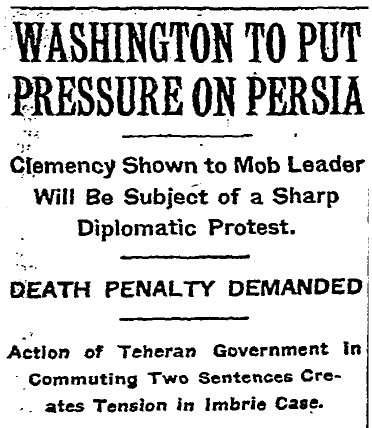
On July 18, 1924, American Vice Consul Maj. Robert Imbrie and his civilian countryman Melvin Seymour were attacked by a Tehran mob while photographing a well which had become a Moslem devotional site for purported miraculous healings. Imbrie was beaten to death; Seymour was lucky to survive … and it soon emerged that soldiers from the nearby barracks had not only failed to protect the Americans but actually taken part in the assault.

Iran’s emerging strongman lost no time in making the most of it.

The event gave [Reza Khan] … the excuse for declaring martial law and a censorship of the Press … Numerous arrests have been made, chiefly of political opponents of the Prime Minister. (British military attache Col. W.A.K. Fraser)

It’s like Lenin said, you look for the person who will benefit and, uh, you know, uh, you know, you’ll, uh, you know what I’m trying to say …

Assuming one discerns some measure of design in the Imbrie murder, and the convenient outburst of anti-Baha’i paranoia that sparked the fatal incident, one can go a couple of different directions at this point.

  1. That the Prime Minister’s foes, allied with British oil interests (the British angle was so widely believed in Iran at the time that press censorship forbade the incendiary charge), were firing up the rowdies in an attempt to shake his power. This 1924 American cable makes that case:

    “It had the earmarks from the beginning of an artificially inspired movement, of which the organized powers of evil were quick to take advantage in order to create disorder for the Government … Reza Khan found himself faced with a situation before which he was powerless. The fanaticism of the crowd was so incited by the continuous preaching of the Mullahs that any act on his part would have been interpreted as treason to Islam and prima facie evidence that he was a Bahai; hence his unfortunate orders to the military and the police not to intervene under any circumstances in religious demonstrations and under no circumstances to fire.”

  2. That Pahlavi’s own agents fomented the disorder. According to Michael Zirinsky‘s review of the case, another American official speculated that Reza Khan himself hoped a foreigner would die “so that he could declare martial law and check the power of the Mullahs.”

Which, in the event, is exactly what happened.

The U.S. made a great show of demanding exemplary justice, and it had the leverage to do so: Iran (how times change!) wanted American support and American oil exploitation.

Three were condemned to death for their parts in the riot, and after the first, a young soldier named Morteza said to have incited the mob, was shot on Oct. 2, the government announced leniency for the other two.

Not good enough.


“When you are dealing with a government like Persia … if you ask them to execute a Moslem for the death of a Christian … if they do it, you accomplish more for the prestige of your country than if they paid a million.” -a young Allen Dulles, in 1926 testimony to the U.S. House of Representatives.

At American insistence, those other two were recalled to death after all: 17-year-old mullah Sayyid Husain (various alternate transliterations – e.g., Seyid Hussein), who was supposed to have raised the riot-triggering “Baha’i well-poisoner” accusation in the first place, and 14-year-old camel driver Ali Reshti.

Zirinsky once again:

With the ending of the Iran-U.S. dispute by the execution of Ali and Husain on November 2, 1924, Reza was free to leave the capital city. He had support from the foreign legations, he had secured financing for the army, he had reestablished discipline in the Cossack Brigade, and by executing Sayyid Husain — a mullah — he had demonstrated his domination over the clergy … in the course of the next months’ campaign, he completed the unification of Iran and ensured that his government would get all the [Anglo-Persian Oil Company] royalties…

While the Imbrie affair was not the only critical event of Reza’s seizure of total power in Iran, it came at a critical moment in his rise … he used the murder to his best advantage.

And they all lived happily ever after.

* The future Shah’s future rival Mohammed Mossadegh was among the Iranian Majlis members who blocked Reza Khan’s attempt to rule Iran as a republic in 1923.

** “Blood, Power, and Hypocrisy: The Murder of Robert Imbrie and American Relations with Pahlavi Iran, 1924,” International Journal of Middle East Studies, vol. 18, no. 3 (Aug. 1986). Zirinsky quotes an American diplomat who believed Reza Khan was actually intentionally trying to create a situation where a foreigner would be killed, to give him a pretext for bringing his nation to heel with foreign support.

On this day..

1789: The murderers of the baker Francois

On this date in 1789, two working stiffs literally became stiffs for a noteworthy bread riot during the French Revolution’s early days.

Ah, 1789.

It was the best of times, it was the worst of times … it was the season of Light, it was the season of Darkness; it was the spring of hope, it was the winter of despair. And we know how all that ends.

Just three months after the Bastille was stormed, France was merely pregnant with its coming Terrors. The Revolution was in its “moderate stage”.

Some moderation.


“Events of the 22nd of October, 1789: The hanging of a man named Francois, a baker”. Despite the title, sources (like this French-language study in the Annales historiques de la Revolution francaise, overwhelmingly date the baker’s murder to the 21st.

The tumbrils may not have been running (actually, the Revolution’s iconic execution device had not yet even been created), but the “October Days” had enough to scare you, especially if you were a sensible constitutionalist type like the Marquis de Lafayette.*

Like a mob dragging the King back to Paris from Versailles, with the heads of his royal guards on pikestaffs.

A drought had created a calamitous bread shortage, which in turn helped stir the Revolutionary pot. The mob that invaded Louis XVI‘s palace a couple of weeks before had celebrated his return to Paris singing “We Have the Baker, the Baker’s Wife, and the Baker’s Son. We Shall Have Bread.” When the king’s presence failed to ease the shortage, fresh disturbances followed.

On October 21, 1789,** the baker Denis Francois became the unfortunate focus of one such, when a famished woman spuriously denounced him a monopolist. A frenzied crowd lynched the hapless boulanger before he could get a word in edgewise.

This event occasioned the Constituent Assembly to pass a martial law decree, permitting a municipality to signal martial law by raising a red flag, whereupon anyone failing to disperse made him- or herself liable to summary military execution.

According to Lafayette (cited in Revolutionary Justice in Paris: 1789-1790):

During the disturbance stirred up against the baker Francois, another one broke out in the Faubourg Saint-Antoine, the object of which was to unite with the Faubourg Saint-Marcel for purposes of reducing the price of bread, and for getting into the convents under the pretext of taking the muskets stored there. The National Guard, in breaking up these seditions, arrested the assassin of the baker [a dock porter named Blin] and the principal instigator of the faubourg [i.e., the Faubourg Saint-Antoine, namely a laborer named Michel Adrien†]. Both were judged and hanged the next day.

* We meet Lafayette here as captain of the National Guard; in a few years, the progress of the Revolution that he struggled to contain and direct will make him persona non grata in his country.

** Six Thousand Years of Bread: Its Holy and Unholy History gives the date as Oct. 20, though it’s not clear upon what authority. Archibald Alison placed it on the 19th. Whenever the murder of Francois occurred, the martial law decree’s passage on the 21st appears to be firmly dependable, which would mean the supposed malefactors’ deaths on this date should be as well.

† Revolutionary propagandist Camille Desmoulins later seized on the very skimpily justified Adrien execution — he “was judged and hanged in twenty-four hours for circulating a seditious flyer, although he didn’t know how to read” — to contrast with the outsized tenderheartedness shown for aristocrats who have “different weights on the scales of justice.” (Revolutionary Justice in Paris: 1789-1790)

On this day..

1865: Mexican Republican officers, under the Black Decree

On this date in 1865, two Republican generals, four colonels, and various other officers captured earlier in the month were executed on the authority of Mexico’s notorious Bando Negro — the “Black Decree.”

Halfway into his ill-fated three-year reign as “Emperor,” Maximilian I was in a bad way against Mexican president-turned-guerrilla Benito Juarez.

On October 3, 1865, he authorized summary execution for captured Republicans … and for anyone else who ran afoul of a nearby military official without having speedy proof of his or her political bona fides.

All individuals forming a part of armed bands or bodies existing without legal authority, whether or not proclaiming a political pretext, whatever the number of those forming such band, or its organization, character, and denomination, shall be judged militarily by the courts martial. If found guilty, even though only of the fact of belonging to an armed band, they shall be condemned to capital punishment, and the sentence shall be executed within twenty-four hours.*

In signing the Black Decree, said Mexican essayist Carlos Fuentes, Maximilian “signed his own death warrant.”

But more immediately, of course, he signed a lot of other people’s death warrants.

Republican General José María Arteaga Magallanes (Spanish link), a man of famous chivalry (once, recovering the body of the Belgian Foreign Minister’s son, he returned the boy’s watch home to dad), and fellow General Carlos Salazar Ruiz (Spanish again) were the biggest fish; they and the others are honored today as the Martyrs of Uruapan. (Spanish yet again)


The square in Uruapan where this day’s victims were shot … now known as Plaza Mártires.

* The excerpted text is Article I of the Black Decree, whose entire (taken from here) follows:

THE BANDO NEGRO (BLACK DECREE) PROCLAMATION
OF EMPEROR MAXIMILIAN, OCTOBER 3, 1865

MEXICANS: The cause sustained by D. Benito Juarez with so much valor and constancy had already succumbed, not only before the national will, but before the very law invoked by him in support of his claims. To-day this cause, having degenerated into a faction, is abandoned by the fact of the removal of its leaders from the country’s territory.

The national government has long been indulgent, and has lavished its clemency in order that men led astray or ignorant of the true condition of things might still unite with the majority of the nation and return to the path of duty. The desired result has been obtained. Men of honor have rallied around the flag and have accepted the just and liberal principles which guide its policy. Disorder is now only kept up by a few leaders swayed by their unpatriotic passions, by demoralized individuals unable to rise to the height of political principle, and by an unruly soldiery such as ever remains the last and sad vestige of civil wars.

Henceforth the struggle must be between the honorable men of the nation and bands of brigands and evil-doers. The time for indulgence has gone by: it would only encourage the despotism of bands of incendiaries, of thieves, of highwaymen, and of murderers of old men and defenseless women.

The government, strong in its power, will henceforth be inflexible in meting ont punishment when the laws of civilization, humanity, or morality demand it.

Mexico, October 2, 1865.

Maximilian, Emperor Of Mexico : Our Council of Ministers and our Council of State having been heard, we decree:

Article I. All individuals forming a part of armed bands or bodies existing without legal authority, whether or not proclaiming a political pretext, whatever the number of those forming such band, or its organization, character, and denomination, shall be judged militarily by the courts martial. If found guilty, even though only of the fact of belonging to an armed band, they shall be condemned to capital punishment, and the sentence shall be executed within twenty-four hours.

Article II. Those who, forming part of the bands mentioned in the above article, shall have been taken prisoners in combat shall be judged by the officer commanding the force into the power of which they have fallen. It shall become the duty of said officer within the twenty-four hours following to institute an inquest, hearing the accused in his own behalf. Upon this inquest a report shall be drawn and sentence shall be passed. The pain of death shall be pronounced against offenders even if only found guilty of belonging to an armed band. The chief shall have the sentence carried into execution within twenty-four hours,—being careful to secure to the condemned spiritual aid,—after which he will address the report to the Minister of War.

Article III. Sentence of death shall not be imposed upon those who, although forming part of a band, can prove that they were coerced into its ranks, or upon those who, without belonging to a band, are accidentally found there.

Article IV. If from the inquest mentioned in Article II facts should appear calculated to induce the chief to believe that the accused has been enrolled by force, or that, although forming part of the band, he was there accidentally, he shall abstain from pronouncing a sentence, and will consign the prisoner, with the corresponding report, to the court martial, to be judged in accordance with Article I.

Article V. There shall be judged and sentenced under the terms of Article I of the present law:

I. All individuals who voluntarily have procured money or any other succor to guerrilleros.

II. Those who have given them advice, news, or counsel.

III. Those who voluntarily and with knowledge of the position of said guerrilleros have sold them or procured for them arms, horses, ammunition, provisions, or any other materials of war.

Article VI. There shall be judged and sentenced in accordance with Article I:

I. Those who have entertained with guerrilleros relations constituting the fact of connivance.

II. Those who of their own free will and knowingly have given them shelter in their houses or on their estate.

III. Those who have spread orally or in writing false or alarming news calculated to disturb order, or who have made any demonstration against the public peace.

IV. The owners or agents of rural property who have not at once given notice to the nearest authority of the passage of a band upon their estate.

The persons included in the first and second sections of this article shall be liable to an imprisonment of from six months to two years, or from one to three years’ hard labor, according to the gravity of the offense.

Those who, placed in the second category, are connected with the individual concealed by them by ties of relationship, whether as parents, consorts, or brothers, shall not be liable to the penalty above prescribed, but they shall be subject to surveillance by the authorities during such time as may be prescribed by the court martial.

Those included in the third category shall be sentenced to a fine of from twenty-five to one thousand piasters or to one year’s imprisonment, according to the gravity of the offense.

Article VII. When the authorities have not given notice to their immediate superior of the passage of an armed force in their locality, the superior authority shall inflict a fine of from two hundred to two thousand piasters or from three months’ to two years’ imprisonment.

Article VIII. Every inhabitant who, having knowledge of the passage of an armed band in a village or of its approach, has not notified the authorities shall be liable to a fine of from five to five hundred piasters.

Article IX. All inhabitants between the ages of eighteen and fifty-five years of age not physically incapacitated shall, when the locality inhabited by them is threatened by a band, take part in the defense of the place, under penalty of a fine of from five to two hundred piasters or of from fifteen days’ to four months’ imprisonment. If the authorities deem it proper to punish the village for nonresistance, they may impose a fine of from two hundred to two thousand piasters, which shall be payable by all those who have not taken part in the defense.

Article X. The owners or agents of country property who, being able to defend themselves, have not kept guerrillas and other evil-doers away from their estates or have not notified the nearest military authority of their presence, or who have received the tired or wounded horses of the guerrillas without advising the said authority, shall be punished by said authority by a fine of from one hundred to two thousand piasters, according to the gravity of the offense. In cases of extreme gravity they shall be arrested and brought before the court martial, to be judged in conformity with the rules laid down by the present law. The fine shall be paid to the principal administrator of the revenue of the district where the estate is situated. The provisions of the first part of the present article are applicable to the populations.

Article XI. All authorities, whether political, military, or municipal, who have not acted in accordance with the provisions of the present law against those who are suspected of or recognized as being guilty of the offenses with which it deals, shall be liable to a fine of from fifty to one thousand piasters; and when the omission implies acquaintance with the guilty, the delinquent shall be brought before the court martial, who shall judge him and inflict a penalty in proportion to the offense.

Article XTT. Plagiarios [kidnappers] shall be judged and sentenced under the provisions of Article I of the present law, without regard to the circumstances under which the abduction shall have been committed.

Article XIII. Sentence of death passed upon those guilty of the offenses enumerated by the present law shall be executed in the time fixed, and the benefit of appeal for mercy shall be refused to the condemned. When the accused has not been condemned to death, and is a stranger, the government, after he shall have undergone punishment, may make use with regard to him of its right to expel from its territory pernicious strangers.

i Kidnappers. The Minister of Foreign Affairs, intrusted with the Department

Article XIV. Amnesty is proclaimed in favor of all who, having belonged or still belonging to armed bands and having committed no other offense, shall present themselves to the authorities before the 15th of next November. The authorities shall take possession of the arms of those so surrendering themselves.

Akticle XV. The government reserves unto itself the right to fix the time when the provisions of the present law shall cease to be enforced. Each of our ministers is bound, as far as his department is concerned, to enforce the present law and to issue such orders as will secure its strict observance.

Issued in the Palace of Mexico, October 3, 1865.

Maximilian.

On this day..

1672: Thomas Rood, the only incest execution in America

On this date in 1672, Thomas Rood (or Rhood, or Roode, or even Rude) achieved in Norwich, Conn., the distinction of being the only person executed in the future United States of America for incest.

The native of Glastonbury, England got in a bad way for, in the words of the indictment,

not haveing the feare of God before thine eyes thou hast committed that abominable sin of incest haveing carnall copulation with Sarah Rhood thy reputed daughter for which according to the law of God & the law of this colony thou deservest to dye …

Actually, the laws of the colony said nothing about incest, requiring the Hartford Court of Assistants to ask around the local clergy whether this sort of thing should be a hanging offense.

Hey, what do you think they’re going to say? Antonin Scalia would call this originalism.

Thomas Rhood thou art to goe from here to the place from whence thou camest & in due time to be carryed from thence to the place of execution & there to be hanged by the neck till thou art dead & then cut down & buried.

Of course, it takes two to make the beast with two backs; daughter/lover Sarah was in some fear for her neck as well, until the court took

notice of a great appearance of force layd up upon her spirit by her father overaweing & Tiranical abuse of his parentall authority besides his bodily striveings which not onely at first brought her into the snare but allso in after yeilding to his Temptation.

Having seemingly found her to be a rape victim, the court extended leniency.

[T]he sentence of the court is that shee be severly whipt on the naked body once at Hartford & once at Norwich that others may heare & fear & do no more such abominable wickednesse.

17th century texts from this pdf on a site selling an 820-page genealogy of the Rood lineage in America … to which the randy old man contributed to the tune of at least nine children.

On this day..

1946: The Nuremberg Trial War Criminals

Victor’s justice was never better served than this date in 1946, when the brass of Third Reich hung for crimes against humanity during the late World War II.

[audio:http://www.stelzriede.com/ms/mus/nuremexe.mp3]

(From this page of original period audio files.)

The landmark legal proceeding* is covered well enough in many other sources for this humble venue to break new ground.

Apart from trailblazing international law, the trial was notable for the gut-punching film of German atrocities; this relatively novel piece of evidence is available for perusal thanks to the magic of the Internet. Caution: Strong stuff. An hour’s worth of Nazi atrocities.The climactic hangings in the predawn hours this day in Nuremberg were conducted by an American hangman who used the American standard drop rather than the British table calibrated for efficacious neck-snapping. As a result, at least some hangings were botched strangulation jobs, a circumstance which has occasionally attracted charges of intentional barbarism.

Media eyewitness Kingsbury Smith’s taut report of the night’s executions (well worth the full read) described just such an ugly end for propagandist Julius Streicher.

At that instant the trap opened with a loud bang. He went down kicking. When the rope snapped taut with the body swinging wildly, groans could be heard from within the concealed interior of the scaffold. Finally, the hangman, who had descended from the gallows platform, lifted the black canvas curtain and went inside. Something happened that put a stop to the groans and brought the rope to a standstill. After it was over I was not in the mood to ask what he did, but I assume that he grabbed the swinging body of and pulled down on it. We were all of the opinion that Streicher had strangled.

There were in all 12 condemned to death at Nuremberg; all hanged this day except Martin Bormann (condemned in absentia; it was only years later that his death during the Nazi regime’s 1945 Gotterdammerung was established) and Hermann Goering (who cheated the executioner with a cyanide capsule two hours before hanging). The ten to die this day were:

* Its resultant Nuremberg Principles comprise a lofty articulation of principles whose actual application, as Noam Chomsky has observed, would have meant that “every post-war American president would have been hanged.”

On this day..

2007: Michael Richard, whose time ran out

Two years ago today, the U.S. Supreme Court unexpectedly accepted a case, Baze v. Rees, challenging the constitutionality of lethal injection — the supposedly humane execution method that seemed less and less so.

Texas inmate Michael Richard, condemned for raping and murdering Marguerite Dixon in 1986, was slated to die that very evening, also by lethal injection.

As Richard’s Texas Defender Service lawyers scrambled to prepare a last-minute legal challenge based on the pending Supreme Court case — for how could Texas carry out a procedure whose constitutionality was in question? — they tripped over an unexpected stretch of red tape that ultimately claimed their client’s life:

The Texas Court of Criminal Appeals closed at 5 p.m. on the day of the scheduled 6 p.m. execution, and refused to accept an appeal filed a few minutes after 5.

Or more specifically, Judge Sharon Keller refused to accept the appeal, for which she came under immediate fire — and launched campaigns like the website SharonKiller.com.

This bizarre situation, complicated by the fact that the Lone Star State did not have written rules for handling last-minute appeals (it does now), has a thicket of procedural detail best appreciated by lawyers.

But it caught worldwide attention as an illustration of Texas’s cavalier approach to its numerous death penalty cases.

Keller, who has what you might say is an inordinate regard for “finality” (and for prosecutors), has herself been forced to defend her conduct in hearings of the State Commission on Judicial Conduct. Those hearings could result in her removal from the bench over this incident; a decision is expected soon. (Update: She skated.)

Though it was not completely clear for a few more weeks, it was in fact true that the pending Baze decision suspended the death penalty in the United States. As a result, Michael Richard — whose execution would have been stayed had the appeal entered the judicial system — was the last American put to death until May of 2008.

On this day..

1685: Dame Alice Lisle, first victim of the Bloody Assizes

On this date in 1685, an infamous judicial bloodbath claimed its first and most controversial victim.

Dame Alice (or Alicia) Lisle (or Lyle) was beheaded in Winchester for harboring fugitives from the Battle of Sedgemoor, where pretender and fellow execution-fodder Monmouth was defeated.


Alice Lisle Concealing Fugitives, by Edward Matthew Ward. Detailed views here.

The aged woman had evidently taken in the fugitives John Hickes and Richard Nelthorpe as a humanitarian gesture when they happened to show up at her door; despite her late husband’s part in the regicide of Charles I, Alice Lisle doesn’t seem to have been the political type.

So the fact that Lisle was charged with treason was a national (indeed, transatlantic) controversy … and the fact that she was the first of the thousand-plus rebel prisoners tried set the tone for the legal circuit this month that became remembered as the Bloody Assizes.

In an attainder later reversed under William and Mary, Lisle was convicted and condemned to burn (the sentence was commuted to beheading) by notorious hanging judge Lord Jeffreys.

Macaulay describes this infamous landmark case.

If Lady Alice knew her guests to have been concerned in the insurrection, she was undoubtedly guilty of what in strictness is a capital crime … [t]he feeling which makes the most loyal subject shrink from the thought of giving up to a shameful death the rebel who, vanquished, hunted down, and in mortal agony, begs for a morsel of bread and a cup of water, may be a weakness: but it is surely a weakness very nearly allied to virtue … no English ruler who has been thus baffled, the savage and implacable James [II] alone excepted, has had the barbarity even to think of putting a lady to a cruel and shameful death for so venial and amiable a transgression.

Odious as the law was, it was strained for the purpose of destroying Alice Lisle … [T]he witnesses prevaricated. The jury, consisting of the principal gentlemen of Hampshire, shrank from the thought of sending a fellow creature to the stake for conduct which seemed deserving rather of praise than of blame. Jeffreys was beside himself with fury … He stormed, cursed, and swore in language which no wellbred man would have used at a race or a cockfight …

The jury retired, and remained long in consultation. The judge grew impatient. He could not conceive, he said, how, in so plain a case, they should even have left the box. He sent a messenger to tell them that, if they did not instantly return, he would adjourn the court and lock them up all night. Thus put to the torture, they came, but came to say that they doubted whether the charge had been made out. Jeffreys expostulated with them vehemently, and, after another consultation, they gave a reluctant verdict of Guilty.

Lisle was the only victim of the Assizes at Winchester, but her death would preview the wholesale slaughters to follow.

Jeffreys reached Dorchester the next day and his pitiless tribunal began its work of sentencing hundreds to the various modes of English execution, or else to convict transportation — a fate more lucrative for the crown, but little less terrible to its victims.

“More than three hundred prisoners were to be tried,” Macaulay noted. “The work seemed heavy; but Jeffreys had a contrivance for making it light. He let it be understood that the only chance of obtaining pardon or respite was to plead guilty.”

For all that, the Assizes greatly injured the Stuart cause, precisely because of indiscriminately butchering the likes of Alice Lisle.

Judge Jeffreys’ reputation as a vicious, politically-motivated jurist landed him in the Tower of London by 1689, when he, er, injudiciously stuck around after James II fled the country; reportedly, Jeffreys was lucky to make it to the Tower under guard from the mob that wanted to tear him apart.

Though posterity has the luxury of on-the-one-hand, on-the-other-hand assessment, he remains a villain to most accounts … like the vengeful verse to his memory that prefaces this Victorian text on the Assizes.

To Tyburn thee let carrion Horses draw,
In jolting Cart, without so much as straw;
Jaded, may they lye down i’ th’ road, and tyr’d,
And (worse than one fair hanging, twice bemir’d)
May’st thou be maul’d with Pulchers Sexton’s Sermon,
‘Till thou roar out for Hemp-sake, Drive on Car-man.
Pelted and Curst i’ th’ road by every one,
E’ne to be hang’d may’st thou the Gauntlet run.
Not one good Woman who in Conscience can
Cry out,–‘Tis pitty,–Troth, a proper Man.
Stupid and dull, may’st thou rub off like Hone,
Without an open, or a smother’d groan;
May the Knot miss the place, and fitted be
To plague and torture, not deliver thee;
Be half a day in Dying thus, and then
Revive like Savage, to be hang’d agen.
In Pity now thou shalt no longer Live,
For when thus satisfy’d, I can forgive.

Yikes. Jeffreys actually succumbed to a kidney disease a few months into his captivity. Close enough.

On this day..