1726: Mary Standford, shunning convict transportation

(Thanks to Anthony Vaver of Early American Crime for the guest entry, reposted from a fascinating entry in his series on convict transportation. Vaver is the author of Bound With An Iron Chain: The Untold Story of How the British Transported 50,000 Convicts to Colonial America. -ed.)

Mary Standford was convicted of privately stealing a shagreen pocket book, a silk handkerchief, and 4 guineas from William Smith on July 11, 1726. After her conviction, she strongly rejected transportation to the American colonies as an alternative to execution.

Early Years

Standford was raised just outside of London by good parents who sent her to school and educated her in the principles of Christian values. Standford, however, showed more interest in the “Company of Young Men,” so she was sent to London to become a servant, where she lost several positions due to her behavior. In her last position she was seduced by a footman, which subsequently forced her into prostitution.

Standford quickly fell in company with Mary Rawlins, “a Woman of notorious ill fame,” and the two of them walked the streets between Temple Bar and Ludgate-Hill looking to empty the pockets, one way or another, of gullible men. Later, they had considerable success targeting sailors who, after returning from their voyages, had money to spend for their favors. Standford eventually married a man with the last name of Herbert, but after a year and a half she left him or, by her account, he abandoned her. Soon afterward, she had a child out of wedlock from another man, who was a servant.

Standford’s Arrest

With two mouths to feed, Standford set out to practice prostitution on her own, and it was then that she was arrested for theft. William Smith, who brought her to trial and was surprisingly frank in his testimony, related that he was walking along Shoe Lane after one o’clock in the morning when he was approached by Standford, who offered him to “take a Lodging with her.” He spent 2 or 3 three hours with her, all the while ordering drinks to be brought up from downstairs. He soon realized that he was missing money, and when he confronted Standford about it, she bolted from the room.

A constable caught Standford running away from Smith in the street. He picked up one of Smith’s guineas after Standford had dropped it, and he found another in her hand and two in her mouth. He also discovered Smith’s handkerchief and pocket book on her. In his testimony, the constable called Smith a “Country Man” and described him as very drunk at the time.

Standford’s version of the event was quite different. She claimed that Smith was drunk when she met him, and that he forced himself up to her room. There, he placed the four guineas one by one in her bosom and then threw her onto the bed. In the struggle, she speculated that his pocket book must have fallen out of his pocket, and when she discovered it after he left, she ran after him to return it. Not believing her story, the jury found her guilty, and she was sentenced to death.

A Rejection and a Defense of Transportation

After receiving her sentence, Standford’s friends pleaded with her to ask for a pardon in exchange for transportation. Standford refused, “declaring that she had rather die, not only the most Ignominious, but the most cruel Death that could be invented at home, rather than be sent Abroad to slave for her Living.”

The author of the Lives of the Most Remarkable Criminals was baffled by Standford’s position and presents a lengthy defense of the institution of convict transportation:

such strange Apprehensions enter into the Heads of these unhappy Creatures, and hinder them from taking the Advantage of the only possibility they have left of tasting Happiness on this side the Grave, and as this Aversion to the Plantations has so bad Effects, especially in making the Convicts desirous of escaping from the Vessel, or of flying out of the Country whither they were sent, almost before they have seen it. I am surpriz’d that no Care has been taken to print a particular and authentick Account, of the Manner in which they are treated in those Places; I know it may be suggested that the Terrour of such Usage as they are represented to meet with there, has often a good Effect in diverting them from such Facts as they know must bring them to Transportation, yet . . . if instead of magnifying the Miseries of their pretended Slavery, or rather of inventing Stories that make a very easy service, pass on these unhappy Creatures for the severest Bondage. The Convicts were to be told the true state of the Case, and were put in Mind that instead of suffering Death, the Lenity of our Constitution, permitted them to be removed into another Climate, no way inferiour to that in which they were born, where they were to perform no harder tasks, than those who work honestly for their Bread in England do, and this not under Persons of another Nation, who might treat them with less Humanity upon that Account, but to their Countrymen, who are no less English for their living in the New, than if they dwelt in Old England, People famous for their Humanity, Justice and Piety, and amongst whom they are sure of meeting with no variation of Manners, Customs, &c. unless in respect of the Progress of their Vices which are at present, and may they long remain so, far less numerous there than in their Mother-Land. I say if Pains were taken to instill into these unhappy Persons such Notions . . ., they might probably conceive justly of that Clemency which is extended towards them, and instead of shunning Transportation, flying from the Countries where they are landed, as soon as they have set their Foot in them, or neglecting Opportunities they might have on their first coming there, be brought to serve their Masters faithfully, to endure the Time of their Service chearfully, and settle afterwards in the best Manner they are able, so as to pass the Close of their Life in an honest, easy, and reputable Manner; whereas now it too often happens, that their last End is worse than their first, because those who return from Transportation being sure of Death if apprehended, are led thereby to behave themselves worse and more cruelly than any Malefactors whatsoever (Vol. III, pp. 287-289).

The author’s cheery account of life as an indentured servant in the American colonies certainly makes transportation sound like a compelling alternative to execution. The reality of life overseas under such conditions, though, does not match this picture, and some criminals valued their liberty over enforced servitude, even if it meant their own death.

Execution

In his account of her execution, James Guthrie, the minister at Newgate Prison, described Standford as “grosly Ignorant of any thing that is good.” He went on to say that “she was neither ingenious nor full in her Confessions, but appeared obstinate and self-conceited.” Standford continued to maintain her innocence in the affair with Smith, and she appeared indifferent about the fate of her child, expressing to Guthrie the hope that the parish would take care of it. Guthrie claimed, however, that “she acknowledg’d herself among the chief of Sinners.”

Mary Standford was executed on Wednesday, August 3, 1726 at Tyburn. She was 36 years old. Executed alongside her were 3 other criminals. Thomas Smith and Edward Reynolds were both sentenced to die for highway robbery. John Claxton, alias Johnson, was put death for returning twice from transportation before his 7-year sentence had run out.

Resources for this article:

On this day..

1600: The Pappenheimer Family

On this date in 1600, Bavarians thronged to a half-mile-long procession in Munich for the horrific execution of the Pappenheimer family.

They were marginal, itinerant types: the father, Paulus Pappenheimer, cleaned privies (“Pappenheimer” would remain as Nuremberg slang for a garbageman into the 20th century, according to Robert Butts); the mother, Anna, was the daughter of a gravedigger. They wandered, begged, did odd jobs. They were Lutherans in a Catholic duchy.

So they were vulnerable to their extreme turn of bad luck. Fresh to the throne of Bavaria, young Catholic zealot Duke Maximilian I wanted a crackdown on the infernal arts, and when others accused the Pappenheimers of witchcraft, they found they had become the stars of a show trial.

Tortured into a spectacular litany of confessions, Anne Llewellyn Barstow, records,

they were stripped so that their flesh could be torn off by red-hot pincers. Then Anna’s breasts were cut off. The bloody breasts were forced into her mouth and then into the mouths of her two grown sons … a hideous parody of her role as mother and nurse …

Church bells pealed to celebrate this triumph of Christianity over Satan; the crowd sang hymns; vendors hawked pamphlets describing the sins of the victims.

Meanwhile, Anna’s chest cavity bled. As the carts lurched along, the injured prisoners were in agony. Nonetheless, they were forced at one point to get down from the carts and kneel before a cross, to confess their sins. Then they were offered wine to drink, a strangely humane act in the midst of this barbaric ritual.*

One can hope that between the wine and loss of blood, the Pappenheimers were losing consciousness. They had not been granted the “privilege” of being strangled before being burned, but in keeping with the extreme brutality of these proceedings, they would be forced to endure the very flames.

Further torments awaited Paulus. A heavy iron wheel was dropped on his arms until the bones snapped … [then] Paulus was impaled on a stick driven up through his anus …

The four Pappenheimers were then tied to the stakes, the brushwood pyres were set aflame, and they were burned to death. Their eleven-year-old son was forced to watch the dying agonies of his parents and brothers. We know that Anna was still alive when the flames leapt up around her, for Hansel cried out, “My mother is squirming!” The boy was executed months later.

Ouch.


The Pappenheimers’ appalling end, famous in its own time, hit modern bestseller lists with Michael Kunze‘s work of popular history, Highroad to the Stake: A Tale of Witchcraft (Review).

Dr. Kunze was good enough to share his thoughts on the Pappenheimers’ milieu with Executed Today.

You present the Pappenheimers as a sort of “show trial” case; what makes a witchcraft show trial a compelling need for a German duke at the end of the 16th century? Why do you think witch persecution arises so especially in this period especially?

Towards the end of the 16th century the Middle Ages had been overcome. People no longer believed in a God taking care of every little thing in their lives. The world was no longer regarded a safe home, guarded by the Father in heaven. Religion had been replaced by reason. The kings, princes and dukes took over direct responsibility for their countries and citizens. They started to build modern states, rationally organized und fully controlled.

The main problem was that full control was difficult to achieve. The streets were in very bad condition, the countryside far stretched, the woods were dark, the villages far away. All kinds of crimes were committed, and when the police arrived the robbers, thieves and murderers had long disappeared. In time without photographs or identity papers it was difficult to trace them. The slow flow of information was also a problem.

That’s why the authorities tried to abhor criminals by show trials and spectacular executions. A witch trial was ideal, because people believed that all mischief and evil was induced by the devil. All criminals were more or less suspected of a deal with the devil.

What’s the biggest challenge we have in our time to re-imagining the world that witch prosecutors and “witches” lived in, or the biggest difference in mindset?

People in the 16th century were absolutely convinced that the devil was a real force trying to use humans to work against God’s intentions. They believed in a huge battle between good and evil, and those who changed sides and helped the devil were regarded as traitors committing High Treason.

At the same time the modern idea that everything that happens has an explainable cause made the authorities suspect the devil’s work behind every thunderstorm, not to mention deadly accidents. People were not more stupid than we are. It was the mixture of medieval superstitions and modern rationalization that led to the witch trials.

How did contemporaries of the Pappenheimers and Duke Maximilian think about this event?

It was indeed a monstrous case and quite an event at the time. The contemporaries did not doubt that 1) the Pappenheimer family had been instruments of the devil, and 2) that the brutal punishment had saved their souls. Duke Maximilian certainly regarded the execution as a means to stabilize safety in his country.

In researching the interrogations and trials in these cases, where did you get the sense that we still revert to “witch trial logic” in some modern cases? If so, when does it arise?

It’s obvious that we still interpret laws based on our beliefs and point of views. The judges involved in the witch trials thought they “knew” for certain that the devil can talk to people and make deals with them. They also believed that torture brings the truth to light. Isn’t today’s deal bargaining also a form of torture? After all the authorities tell the defendant that he will be severely punished if he does not confess. That’s what I call a forced confession. Yet it is done around the world.

Obviously, this execution is utterly horrific in its particulars. How typical would this sexualized theater — slicing off Anna Pappenheimer’s breasts, impaling Paulus Pappenheimer — have been for a witchcraft case at that time and place? How would this have been understood by witnesses, as opposed to “merely” burning or breaking on the wheel?

The point was to abhor by cruelty. People should see what horrors the criminals had to endure and tell it to everyone for years to come.

* Or, perchance, the wine was offered to revive them and protract their tortures.

On this day..

1706: Dona Beatriz Kimpa Vita, the Kongolese Saint Anthony

On July 2, 1706, Kimpa Vita, a Congolese noblewoman also known by her baptismal name Dona Beatriz, was burned as a witch in Evululu.

This remarkable woman claimed to be a medium for the spirit of Saint Anthony of Padua, a popular saint in the Catholicized Kingdom of Kongo, and attracted a mass movement in the midst of civil war and social breakdown in the proud Kongo state.

Executed Today is pleased to mark this occasion with an interview with Boston University Prof. John K. Thornton, author of The Kongolese Saint Anthony: Dona Beatriz Kimpa Vita and the Antonian Movement, 1684-1706.


This is a very unfamiliar story to most, as you point out in The Kongolese Saint Anthony. So let’s begin with some orientation — the Kingdom of Kongo is in the midst of a ruinous civil war. Why?

The civil war in Kongo was basically a dynastic affair, that is, a battle between branches of the royal family for control over the throne. Kongo had a very highly centralized political structure, the king and his council had a lot of power not only over who held high office, but also who got what income, because a lot of income derived from holding office. So controlling the kingship and its related patronage was very important.

This story is very complicated, I try to lay it out as simply as possible in Chapter II of my book. To make matters short, by D Beatiz’ day it had two branches duking it out — the Kimpanzu and the Kinlaza, with Pedro IV, conveniently descended from both these families, as a sort of conciliatory figure.

And it’s a highly Catholic country. How did that come to be?

Pretty remarkable story.

Actually I think it’s the only real missionary victory that the Catholic church had in the early modern period. By that I mean that they spread the faith to a completely independent country and not just by conquest.

Officially, it was a series of miracles that both Catholic priests and Kongo elites witnessed in 1491 that led Nzinga a Nkuwu, the king of Kongo to become a Christian and be baptized on May 3, 1491 (my birthday is May 3, 1949 which I have taken to be a sort of sign that I should be studying Kongo).

However, it was Nzinga a Nkuwu’s son Afonso (ruled 1509-1542) that really established the church. Afonso provided for the funding of the church, created schools for teaching literacy and Christian religion for the nobility, had children educated in Portugal and returned to the country, and working with his own educated people and Portuguese priests also figured out how to blend the two traditions into a religion that was acceptable in the country. It’s no wonder the Church called him the “Apostle of Congo”.

The kings who followed elaborated and extended what Afonso started, especially by creating a network of schools all over the country. By and large Rome and Portugal collaborated and blessed the project, so the Pope allowed Afonso’s son Henrique to be the first Sub-Saharan African bishop in 1518, and assigned him to extend the church in Kongo (Henrique died in 1531). In 1596 the Pope made Kongo’s capital city the seat of the Bishop of Congo and Angola.

The Church grew again in the late sixteenth century when a series of kings named Alvaro (I and II, father and son, in particular) went a lot farther than Afonso had in Europeanizing Kongo. They gave the nobles titles of nobility in European fashion (Counts, Dukes and Marquis), the brought in relics from Europe (bones of martyrs, for example), established an embassy in Rome, renamed the capital city as Sao Salvador, and so on. The Kongolese ambassador to Rome, Antonio Manuel, who died in 1608 and is honored in a wing in the church of Santa Maria Maggiore in Rome, left personal papers when he died now found in the Vatican archives. They show the sort of culture a person educated entirely in Kongo could show, in addition to a fascinating array of Kongolese administrative documents — the only ones we have. He also studied Carmelite mysticism, and had correspondence from many different people all over Europe. He was clearly at home among elite Europeans and was regarded by those who met him as a cultured individual in a period when extra-Europeans were not always seen that way.

The Jesuits established a college in Kongo in 1624 and it provided advanced education along European lines until it was close just about the time that Beatriz was active. Kongo had a library, in fact, though no trace of it exists any more, found on the second floor of the Jesuit college.

So in short, the answer is that the political elite of the country decided in the sixteenth century to make their country a Catholic one, and they took vigorous steps to make it happen.

They put teachers out all through the country, visiting priests from Europe constantly met these teachers in the rural areas, they were usually literate and possessed a good deal of knowledge of European culture, some had even lived in Europe. These schoolmasters were the soul of the church; they instructed the people (using a catechism in their own language after 1624), prepared them for the sacraments and led weekly prayers at places of worship, usually large wooden crosses erected at key points all around the country.

So there’s a religious penetration that on the face of it might seem to be a religion of colonization, of foreign domination. But that’s clearly not the way most Kongolese thought about it.

It was never a religion of conquest, and for that reason, the Kongos managed to make it their own without feeling they were abandoning or being forced to give up something. In the sixteenth and seventeenth centuries foreign visitors often commented on how proud the Kongos were, of their country, their language, their food and the like, thinking that they were the best people in the world. “Congo arrogance” was a common epithet that the Portuguese who built the colony of Angola on Kongo’s southern border used to describe them.

And it’s still very true today. I go to Angola quite a bit and have been to Mbanza Kongo twice. You can feel and hear that pride even now. During the colonial period (roughly 1885 to 1975 in that area) the Portuguese tried very hard to replace indigenous languages with Portuguese and to erase African culture in a systematic way, especially after 1926. But the Kongos simply refused to be erased: they continued their language secretly, kept their special foods and taught their children that they were still the best. It worked.

Today in Angola, you see in so many places that Portuguese is the language of daily life — even street kids shout at each other in Portuguese in Luanda and the land east all the way to Malange. But in Mbanza Kongo and elsewhere in the north, the language of daily life is Kikongo, the ancient language of the country. Their pride has been a problem for Kongo, too. In 1992 a lot of them were massacred in Luanda, partially for political reasons that are very complicated, but also I think because other Angolans resent this pride. But enough on that.

Anyway, the Kongolese were proud to be not just Christians but Catholics. The Portuguese tried to invade Kongo from Angola several times, first in 1622, then again in 1657, and finally in 1670. Each time they were decisively defeated. On the other hand, the Kongos were also unable to invade Angola, as they were repelled there also, first in 1580 and again in 1665 (when the famous Battle of Mbwila was fought on the border between the two domains of Angola and Kongo).

This led to great hostility between Kongo and Portugal and especially its governors of Angola. Portuguese were massacred in the wake of the 1622 invasion and after the Battle of Mbwila in 1665, and by the 1670s they had been effectively forced to leave the country, trading their only with Africa servants called pombeiros who represented their interests. (Priests were an exception).

Yet this history didn’t impact on the way Kongos saw themselves as Catholics. King Garcia II (1641-1661) famously wrote a letter in which he proudly stated that they obeyed the Pope, vicar of Christ on earth, even though the Portuguese, whom they hated, had introduced them to the religion. Indeed, the only thing that we see in the correspondence of Kongolese kings that they do say good about Portugal was that it introduced them to the religion.

The idea of a Catholic Kongo was reinforced when Kongo made an alliance with the Dutch. This took place in 1622 in the aftermath of the failed Portuguese invasion. Pedro II, the king, sent a letter to the Dutch States General proposing an alliance in which the Dutch would send a fleet to attack Angola by sea, and Kongo would send an army by land. The first attempt to do this in 1624 failed, in part because the Portuguese went out of their way to conciliate Kongo, but the second attempt, in 1641, succeeded and for a time the Kongo-Dutch alliance (joined by the formidable Queen Njinga of Ndongo-Matamba who was also at war with Portugal) nearly drove the Portuguese out of Angola.

The Dutch hoped to use this opportunity to also convert Kongo to the Calvinism of the Dutch Reformed Church and they even had special literature designed to convert Catholics who spoke Portuguese to Calvinism. But Garcia II would have none of it, and had the books burned (it was the seventeenth century after all), and forced the ministers to leave. He wrote a letter to the Dutch Estates General protesting the attempt and in it he made the statement I summarized in the paragraph above.

Kongo tried to make contact with Dutch speaking Catholic countries in the aftermath of the third failed Portuguese invasion in 1670. It seemed like a good compromise though the Dutch never did come back to Angola to fight, and the Catholic parts weren’t part of the Dutch program.

So, that’s background — now, who is Dona Beatriz Kimpa Vita?

She was the daughter of a noble Kongo family from the region right around Kibangu, a flat-topped mountain that lays some distance east of the capital of Mbanza Kongo (on a clear day you can see that mountain from Mbanza Kongo).

She seems to have had spiritual gifts even as a youth, and had dreams of playing with angels and visions and the like. Not surprisingly, she turned to religious pursuits, becoming a nganga Marinda, a spiritual person whose role the Catholic missionaries did not like, but was widely accepted in the Kongo as legitimate. She was probably too spiritual and independent to be married, since she had two failed marriages by the time she began her prophecy.

Her movement combines both a religious renewal and a national restoration. Should one think of her as a religious person whose cause happened to have political implications, or someone who’s very intentionally trying to alter the balance of power? Is it even right to separate the secular and the religious dimensions?

I think Beatriz was trying to end war as much as anything else. This was at the height of the slave trade: thousands of people were being exported annually to Brazil, to the Spanish Indies, to Suriname, and some even to South Carolina.

The slave trade was one of the byproducts of war (along with death and destruction), and because slavery was lucrative, it helped to continue the wars in a vicious cycle. As Beatriz understood it, the solution was to end the civil war and restore the kingdom. None of the pretenders to the throne seemed able to do that.

She thought that he had sent Saint Anthony do to that, and he had come to earth and chose to be incarnate in her. It harmonized with Kongos’ belief that they were God’s chosen people (he had created Kongo himself, sending his angels to create the rest of the world), and he would intervene to set things right.

And who exactly are her followers?

Beatriz had followers from all ranks and walks of life. Pedro IV had her burned, but his own wife Hipolyta became a devotee. Pedro was intrigued by her message himself. A number of the top contenders also were either tempted or became her followers. The most notable of her followers was Pedro Constantinho da Silva, one of Pedro’s generals who saw allying with her as a chance to become king. Along with the political guys was a great mass of peasants, who really hoped for a better time and thought that Beatriz’ movement could restore the kingdom.

It was the politics of her movement that got her in trouble. Once Beatriz threw herself in with Pedro Constantinho she was doomed because the other contenders became her enemies. It was Pedro IV who managed to capture her, and he had her burned as a heretic and witch. Before she went over to Pedro Constantinho, Pedro IV had been very interested in her mission and protected her.

Dona Beatriz? Kimpa Vita?
What’s In A Name?

Kongos in those days usually had at least two names.

The first one was a zina dia santu (Saint’s name), given as a Portuguese name though often pronounced as in Kikongo and always incorporating “Dom” or “Dona” as part of the name. So someone named Joao would be called Ndozau, and someone named Miguel would be Ndomigel.

Their second name was a Kikongo name, like Mpanzu, Nkuwu, Vita, Nzinga and so on. As far as I can tell people got both names from their parents when they were born, and they probably started using the zina dia santu even before baptism. If people had two Kikongo second names, the second one was the father’s first name, sort of like the Scandanavian system where a Johan’s child is named Johansson.

Beatiz’ second names mean “scheme” or “plan” (Kimpa), and “war” (Vita). It might be because she was born in a war and this was added, or it might just be her father’s first Kikongo name. King Antonio I had Vita as an element in his name; some people use this as evidence she was descended from this king who was killed in the Battle of Mbwila in 1665. I think such a fact would have been noted at the time and I doubt it.

Nowadays, people in Angola and DRC tend to look down on the zina dia santu, which they view (wrongly, I believe) as a remnant of the colonial past. Many Angolans believe that somehow the Portuguese organized all that Christian stuff in Kongo and the local people resisted or rejected it.

I think the reason for this is twofold: first, because that’s what the Portuguese claimed during the colonial period, that they really more or less created the Kingdom of Kongo, which is totally untrue. A second reason is because most Angolans with any nationalist feeling don’t like to be identified with Portugal and so look to a non-Portuguese past. Hence, D Beatriz is rather militantly known as “Kimpa Vita” in Angola and one does not often hear her Christian name, though of course people know it.

-J.K.T.

Dona Beatriz rejects or alters a number of religious practices we might think of as essentially Catholic, like the iconography of the cross, but she’s not doing it in the name of rejecting Catholicism — she’s doing it in the name of Saint Anthony of Padua. Was there simply a pent-up need for renegotiating the way the faith worked for Kongolese? If so, did it happen in some other way after she was executed?

I think she was concerned that Christianity was too European, and one of the things she chided the missionaries about was that they did not represent any black saints.

She had direct revelation from God on her side, she died every Friday and spent each weekend in Heaven conferring with the Heavenly Father about the affairs of Kongo and so what she got there was pretty much undeniable. From these sessions in Heaven she learned the stories about Jesus being born in Nsundi, baptized in Sao Salvador and Mary being a slave of a Kongo marquis. There was probably a lot more richness to these stories that our accounts tell us.

Kongos were pretty sure, I think, that God was an African and their pride also gradually placed stories in Africa, so in this way Beatriz was confirming what people believed or wanted to believe. After her death, we find a lot of art objects, particularly crucifixes, in which Jesus is shown as an African (his features are African) and is wearing a cloth with a specifically Kongo design. Cecile Froment has recently competed a wonderful Ph.D. thesis at Harvard on this art which I think will really demonstrate how much the Church in Kongo incorporated Kongo concepts. I don’t know if Beatriz’ movement inspired this art directly, but her movement and the art together represent what many people were thinking.

An aside here. From Afonso’s time onward, there was a desire to make an independent Kongo church under its own bishop and with its own clergy. They had the educational resources to support this, so they felt they should. Alvaro II entertained ideas that he could control such a church, that the king was “vicar of his kingdom” and could appoint clergy at will. This wasn’t canonical and the church didn’t support it, even going to far as to try some of those who advised him on this through the Inquisition. But even when Kongo got its own bishop in 1596, the kings of Portugal managed to get control of appointment and put Portuguese in there.

This was the cause of endless conflicts between the kings and the bishops, particularly because of the hostility between Portugal and Kongo over Angola. Finally, a compromise was worked out. While the bishop ended up residing in Angola, and he refused to ordain many Kongolese, the priestly needs of Kongo were to be met by missionaries, who weren’t really there to spread the faith (it had already spread) but to perform the sacraments that an ordained priest could. Because Portugal didn’t want Kongolese clergy, and Kongo didn’t want Portuguese clergy, the compromise was to chose Italian clergy who were from neutral states (mostly Florence, but others as well). These priests came from the Capuchin order, a strongly Counter-Reformationist order that wanted to purge Kongo’s Catholicism of its local elements in the name of purifying the faith. That didn’t go so well, and the struggle over just how Kongo the church could be was waged along these lines.

Beatriz came into this struggle on the Kongo side. While not denying the Capuchins their place as priests, she contended with them over the theological questions. She lost this round, mostly for political reasons and not theological ones. Maybe the African Jesus of Froment’s thesis was the theological victory of Beatriz or at least her followers.

She occupies the ruined former capital. What’s the significance here? Had she remained unmolested, what trajectory might her movement have been on?

I think that messianic religious leaders like her in a politically charged environment don’t have much chance unless they are very astute or their supporters are strong. Of course occupying the capital was vital. It had been abandoned in 1678 and was in ruins, yet it was the very symbol of Kongo. The kings were all buried there, the cathedral was there. Holding the city was in effect restoring the kingdom and presumably ending the civil war.

She could only have remained in power if she had stayed with Pedro Constantinho and if his forces had been enough to protect her and to fend off the inevitable attacks that the other two primary contenders, Joao II of Bula and Pedro IV of Kibangu, would mount. Pedro ended up beating both of these two, first Pedro Constantinho in 1709 and then Joao. So with Pedro Constantinho as patron she could not have survived.

She also made the political mistake, which we can only put down to overconfidence or naivete, of going back home to her parents who lived in Pedro IV’s domain to have her baby. Having the baby also upset her, and made her feel guilty since as a saint she should not have done this.

But let’s be a bit speculative and say that Pedro IV didn’t capture her, or he decided to follow her and put distance between himself and the Catholic clergy who were obviously opposed to her. What might have happened? Perhaps he would have re-founded the church in Kongo with a new relationship to Rome, and decided to have Kimpa Vita and some sort of apostolic succession from her ordain priests and bishops. These would clearly have been drawn from the schoolmasters who ran the church in Kongo anyway. A good number of them did become Antonioans and they would have created a new church. It would have had some of its own new traditions, like the stories that Beatriz told about Jesus’ birth in Nsundi and baptism in Mbanza Kongo, or the descent of kings and the like. These might have been written since the chruch was literate and perhaps formed a new scripture. And perhaps they might have found, in time a way to reconcile this with Rome, but maybe not. It would have been an independent church as we see all over Africa now.

What exactly leads to her execution? Cui bono?

Her execution was done following her capture as described above. She was tried in a civil not an ecclesiastic court under Kongo and not church law. Kongo law prescribed punishment for witchcraft and heresy and those were the charges against her.

We don’t know what happened in her trial since the record has not survived (my dream is to find it, since there probably was one once, and who knows, it might have been sent to the Inquisition in Portugal or Angola). But all we know is what the Italian priests, Bernardo da Gallo and Lorenzo da Lucca told us, and they were not invited to the trial (fine by them; they didn’t want to be too closely associated with the results). They questioned her about her beliefs, and da Gallo’s account of that inquiry is our basis for knowing what she believed. But they could do no more on that end than hear the result. They were happy for it since that’s what they wanted too.

Her movement isn’t destroyed by her execution. What happens over the next 2 1/2 years before the Battle of Sao Salvador? And what happens after that battle: What was Dona Beatriz’ immediate legacy? Was she remembered, was her name invoked? What became of her followers?

We know the movement remained very strong in Mbanza Kongo after her death, and that Antonian prayers were shouted out by the defenders of the city in 1709. But there is not documentary mention of them further after that. But don’t read too much into this, since the documentary record becomes very, very quiet after 1710 or so — we just don’t have any details about it from any source. In fact, until I discovered a kinglist written in 1758 (I think by a Kongo) we weren’t sure how long the reigns of the kings were for the next fifty years or even what order they ruled in. It is possible that the movement survived even there.

We also know that the movement had very strong bases in the southwest part of Kongo, in lands belonging the the Kimpanzu faction that had been headed by Suzanna de Nobrega. This faction was not involved in the war in 1709 and thus would not have suffered the inevitable persecution that took place in Mbanza Kongo.

But Manuel II, the king who followed Pedro IV after his death in 1718, came from that faction and region. He had abandoned the Antonians to join Pedro, and perhaps he also suppressed the movement back home. We have a couple of letter from him, written early in his reign and dealing with ecclesiastical matters, but the question of Antonians doesn’t come up in them.

After my book was published, Simon Bockie, a librarian at Berkeley and an excellent ethnographer of Kongo (he’s a Kongo himself) wrote a critical review. He claimed that I had not made use of abundant oral traditions that he had heard in his youth about Kimpa Vita in writing my book and thus I had written an account based on only the testimony of her enemies.*

I had searched published sources in French, Portuguese and Kikongo for traditions that I could relate to Beatriz when I did my research, and I did make as much use of these as I could when I wrote. But at the time I had not been able to do research in Mbanza Kongo and so had to let that aspect go. When my wife, Linda Heywood and I went to Mbanza Kongo in 2002, we specifically asked about traditions concerning Kimpa Vita (as she is usually called today) and were taken to a man who claimed to be the local expert on her. He asked us if we wanted to hear the tradition in French, Portuguese or Kikongo (Mbanza Kongo is very near the border of the Democratic Republic of the Congo and probably half the population is trilingual). We said Kikongo, which he proclaimed to be the right answer. He then went into a half-hour or maybe forty-five-minute discourse on the question. He had some interesting things to say. First, I noticed that he gave dates in his account, but he stated them in French. Likewise, he mentioned the names of the missionaries and the Christian names of Kongo kings in French also. I thought this was strange and concluded that he had received a “fed back” tradition, meaning that he had combined what he might have known from oral sources, such as his parents or elders, with written sources that drew on the movement which was described in French at least as early as 1953.

I might have easily concluded that both his traditions and those Bockie heard as a youth were simply feed back stories made to surround an event known only from modern historical reconstruction. You can hear such a tradition and have no idea that it is of modern creation, since you might not know its sources and even the one telling you might have heard rather than read it. Personal elaboration around a few set facts is a common point of oral tradition, and thus explaining things one receives from tradition or even from books can be expanded this way.

But having said that I was very intrigued by other elements in the story which were purely Kikongo. The most important was the very significant role played in the story I heard in Mbanza Kongo by Beatriz’s mother (ngudi andi Kimpa Vita), to the point where much of the inspiration of the movement was in fact from the mother, and moreoever, the mother continued the movement after her daugher’s death.

The traditionalist went on to link modern religious movements through the descent of this mother. Was it possible that the movement did live on? I can’t say. I do know that several independent churches claim Kimpa Vita as their founder, or claim to be heirs to her message, most notably some branches of the Kimbanguist church (founded in the 1920s by a prophet named Simon Kibangu) and the Bundu dia Kongo, a rapidly growing church founded by Mwanda Nsemi in the 1960s. It could be true, or it could be simply propaganda of these movements, also fed back into tradition.

Was it unusual that this movement was led/instigated by a woman? Or would that not have been consequential to her followers and opponents?

The movement was led by Saint Anthony; D Beatriz was only his earthly form. Why he chose a woman is harder to say.

Did it make a difference that he did? Probably. Beatriz realized that the woman/man thing was a problem. When Pedro’s soldiers arrested her they challenged her, asking how Saint Anthony, who was a man, could have a baby. Her only answer was that she didn’t know, only that it had come from Heaven. She certainly was attentive to women; for example, she could make the barren bear children, and women were among her close followers.

I don’t think, though, that we should read too much into the sex issue. There were also a number of very powerful women in Kongo at her time: Queen Ana Afonso de Leao all but ruled the southeast, and Queen Suzanna de Nobrega ruled the southwest. Although Joao II ruled Lemba, everyone knew that his sister, Elena was the real ruler of that territory. There were provisions in Kongo law allowing women who reached a certain political level to have male concubines and treat them more or less as men treated female concubines.

Finally I confess that I didn’t do as much as I wanted to or could about the question of women and females in Kongo life when I wrote the book, and sacrificed some analytical asides in the interests of narrative. I tried to remedy this ever so slightly in an dense and technical article I published in the Journal of African History, called “Elite women in the Kingdom of Kongo”, not for the faint-hearted, that addressed the question of female power. I had also addressed female power in the life of Queen Njinga, who ruled in the Kimbundu speaking area south of Kongo, in another article some twenty years ago, and I hope to write more about women in the future.

Has there been a reclamation or rediscovery of her in the postcolonial period? How does Dona Beatriz/Kimpa Vita read in Angola now?

As long ago as 1996 there was an official decision to erect a statue to her somewhere in the country. There is an image of her, drawn by Bernardo da Gallo from life, on the cover of my book, so it wouldn’t be hard to do. This would be the “book” D Beatriz Kimpa Vita, with the full apparatus of scholarship, as opposed to the “tradition” Kimpa Vita, supported by the oral traditions and independent churches. It will be interesting to see how these two versions, my book, and Kongo pride run into each other.

* Canadian Journal of African Studies, Vol. 32, No. 3 (1998), pp. 645-647, in which Bockie writes,

As a child growing up in the Lower Congo listening to tales from our oral history, I heard many times about the exploits of Kimpa Vita, who was still remembered after 250 years as a major cultural heroine … It was something of a shock to find that Thornton has chosen to present his account almost exclusively through the eyes of her enemies and killers … there remains no convincing Kongo voice or presence in this book.

On this day..

1947: Willie Francis, this time successfully

(Thanks to Gilbert King, author of The Execution of Willie Francis (book site), for the guest post, the second of two. Read the first here.)

On May 9, 1947, Willie Francis was executed in the same electric chair that he had walked away from a year and a week earlier, when a drunken prison guard and trustee bungled the wiring. Willie’s story had made front-page headlines around the country as the United States Supreme Court grappled with questions about what the State of Louisiana was permitted to do with regard to double jeopardy and cruel and unusual punishments.

One of the things that drew me to this story as I was working on my book, The Execution of Willie Francis, was the shroud of secrecy that surrounded the Willie Francis case.

Willie was accused and convicted of killing 53-year-old Andrew Thomas, a Cajun pharmacist who was something of a mystery to the people in the small town of St. Martinville, Louisiana. Thomas’ brother Claude was the town’s chief of police, and Willie was convicted by twelve Cajun jurors and sentenced to death by a Cajun judge. His court-appointed attorneys neither called nor cross examined any witnesses, and did not even make a case in defense of their 16-year-old client.

The prosecution based its entire case on a confession obtained while Willie was in police custody without the aid of a lawyer. In this confession, Willie wrote, “it was a secret about me and him,” which was never explained. It was obvious to me that there was more to Willie’s story than the version presented in trial and to the public.

In my research, I came across a photograph taken on the evening Willie had survived his own execution. He’d been brought back to his cell, and the sheriff allowed reporters and a photographer to visit with Willie, where he told them that death tasted “like peanut butter” and looked a lot “like shines in a rooster’s tail.” The photographer asked for a few pictures, and Willie, holding his dog-eared Bible, stood in front of a dull pink wall. The flash fired.

This picture was never used by any of the newspapers. There was a lot of glare on the wall, and the photographer had gotten a much better one of Willie smiling — the picture that ended up on the front page of many newspapers the next day. But there was some writing on the wall image that was barely legible. I scanned it onto my computer and ran it through Photoshop, adding contrast and burning and dodging until the words could be read. The handwriting matched Willie’s.


Detail of the enhanced photograph. Click for the full image.

Not surprisingly, the sheriff had testified under oath that Willie had confessed to killing Andrew Thomas in writing on the wall of his cell a month before he was scheduled to die in the chair. But the Sheriff had also taken Willie’s words out of context, reading only select portions of the writing, and mischaracterizing others. In fact, Willie Francis, just as he had when he wrote in his confession that “it was a secret about me and him,” alluded to something different than the robbery-turned killing prosecutors accused him of. Willie wrote, “Practically I killed Andrew by accident. It will happen once in a life time”

Only two people know the truth about that fateful confrontation at the house of the Cajun bachelor and the black teenager who once worked for him. Both are dead, and the official story does not ring true. Willie Francis never denied killing Andrew Thomas. But he disputed the prosecution’s accusation that he was trying to rob the pharmacist. “I wasn’t after money,” Willie insisted to a reporter before he went to the chair a second time. Yet he would never elaborate, and took whatever “secret” there was between him and Thomas to his grave.

On this day..

1861: Paula Angel … but why?

Thanks to Laura James for the guest post, which originally appeared on her outstanding blog CLEWS Nov. 9, 2005. Laura’s first book, The Love Pirate and the Bandit’s Son, hits the shelves on May 5.

It’s not clear today how old she was — nineteen, maybe, or twenty-six, or twenty-seven — the reports all differ. It’s not even clear what her true name was: Paula Angel by most accounts, but she was also called Pablita Martin. But the most pressing questions, still unanswered nearly 150 years after her execution, are why she was hanged in the first place and how the sheriff managed to bungle the job so badly.

Paula Angel was the first and last woman ever executed in New Mexico (while it was yet a territory). Her crime: she stabbed her married lover, Juan Miguel Martin, to death when he tried to end their affair. Her execution was on April 26, 1861, in San Miguel, now Las Vegas.

Anyone familiar with historical crimes and trials, particularly those involving women, will marvel at such an outcome. A capital conviction for stabbing a lover, a crime passionel? That’s certainly not the outcome one would expect for that era (or this era, for that matter; today we’d label it second-degree murder at worst).

One explanation for Miss Angel’s hanging is that the newspapermen never got the story. Decades later, the wire services circulated very brief accounts of her trial and execution under headlines such as “The Story The Newspapers Missed.” So she may well have lacked the greatest champion anyone facing a murder charge can have: public opinion — the verdict of the greater jury. Throughout the nineteenth century, there was a universal revulsion for the execution of women, no matter what their crime, and judges and juries were anxious to find a reason to acquit a woman.

But the authorities in New Mexico Territory were eager to see her hanged. The accounts that survive today report that the jailer taunted her every day leading up to her execution — “I’m going to hang you until you’re dead, dead, dead,”* is the quote attributed to the sheriff.

What was her social status? Was she a prostitute? Was she a violent menace to the community? Had she committed other terrible acts? Was she unrepentant? Did she sullenly testify at her trial and put in a poor appearance on her own behalf? Most importantly, was she ugly? The accounts available today don’t say.

When it came time to launch Angel into eternity, the sheriff did not build a gallows. He selected a sturdy cottonwood tree outside of town. Paula Angel was driven there on a wagon, forced to ride on her own coffin to the site of her execution, which was witnessed by ranchers and townsmen. The sheriff fixed the rope to the tree, garlanded her with hemp, and then resumed his seat on the wagon and hawed the horses. But he’d made an error. He forgot to tie her hands behind her.

Paula Angel managed to get her fingers underneath the rope in a last pitiful effort to save her own neck, and she struggled on the end of the rope. It must have been an awful sight to see. The crowds surely voiced loud complaints. The sheriff was forced to put the wagon beneath her a second time, to cut her down, retie the rope amid the jeers and catcalls, properly secure her hands and feet, and to repeat the process. She did not survive her second hanging.

And there hasn’t been one woman executed in New Mexico since. Rarely has any woman from that state even faced the possibility, though a few years ago Linda Henning nearly became the second woman executed there — and she certainly deserved it. Fans of Court TV will recognize the name, since Court TV has rebroadcasted Henning’s bizarre trial more than once. She was tried for the cooly planned and bloody murder of Girly Chew Hossencofft, the estranged wife of her boyfriend, in one of the weirdest trials of the century. But the jury rejected the death penalty. The reason Henning agreed to involve herself in the murder of a woman she had not even met: Henning was convinced that Girly Chew was a reptilian alien queen from another galaxy.

You read that right: an alien queen from another galaxy. You can’t make this stuff up.

***

Recommended reading: Death on the Gallows : The Story of Legal Hangings in New Mexico, 1847-1923 by West Gilbreath (High Lonesome Books, 2002).

For the stories of the men executed in New Mexico see the excellent compilation by Mark Allan of the Angelo State University Library. [Note: link updated from Laura’s original post. -ed.]

For more on the Hossencofft case see the website of author Mark Horner.

* [Shades of Billy the Kid. Maybe it was something lawmen said to lend it that Wild West atmosphere. -ed.]

[Former New Mexico state historian Robert Torrez unpacks the Paula Angel story and reprints a corrido (folk ballad), “La Homicida Pablita” written by her cousin in Myth of the Hanging Tree. -ed.]

On this day..

1877: John D. Lee, for the Mountain Meadows Massacre

On this date in 1877, Mormon leader John D. Lee was shot at the site of (and for the crime of instigating) the Mountain Meadows Massacre 20 years before.

As the only person ever prosecuted for this dreadful affair, which saw 120 California-bound settlers slaughtered by a Mormon militia, Lee “was allowed … to carry to his grave Mormondom’s guilt for this horrible and barbaric act.” (Jan Shipps)

On this anniversary of Lee’s death, Executed Today interviews author Judith Freeman, whose historical novel Red Water tells Lee’s story through the eyes of three of his 19 wives.

You grew up Mormon — what brought you to this story? I gather that it wasn’t exactly daily discourse in your youth.

I found a copy of Juanita Brooks‘ book The Mountain Meadows Massacre in a used bookstore in Port Townsend, Washington, read it and was captivated by this story.

Growing up in northern Utah, I’d only heard vague, shadowy references to the massacre. It was the dirty little secret buried in the Mormon past — except for those people in Southern Utah who lived with that story as part of every generation’s experience and shame. I felt I had to write a novel about it, in part to try and understand this question: How do you get basically good people, like those Mormon settlers, to commit such evil?

You paint a picture of John Lee through the eyes of three of his wives. What kind of man was he — and how representative of the Mormon hierarchy would that be?

I think Lee was first and foremost a brilliant pioneer and survivalist and also a big blowhard, the kind of guy who would talk your head off — affable and a bit boring when it came to promoting his own virtues and experiences. He was self-aggrandizing, he’d do anything to make a buck, he had problems with the truth. He was a suck-up to Brigham Young who became his substitute father and then betrayed him.

He wasn’t entirely trustworthy because he put his own interests before all else. He could also be incredibly generous and kind, helpful to others. He wanted people to like him though they often didn’t, and he had an ingratiating quality. He was an orphan, with an orphan’s life-long neediness. In many ways I think he was good to his wives and cared deeply about his family — all sixty something kids and 19 wives. He was an amazingly talented man, skilled at many trades and businesses.

Was he representative of the Mormon Hierarchy? I don’t know. In some ways yes but I sense he was more sycophantic than some, and had a more amusing character than others, but what they all had in common was an absolute deference to church authority. I think I might have enjoyed meeting John D. Lee, he might have been more lively and fun than Brigham Young who strikes me as a misogynist and a brittle, cold man.

What about the women — three very different characters. What’s the sense you got of life for these women as pioneers, living in a polygamous family? How did they relate to one another, and how did the massacre and the execution of John Lee change their situation?

The women were also amazingly inventive as pioneers, strong, tough, formidable women though how can you generalize about 19 different personalities? Some liked each other and some couldn’t stand each other and the good thing was that Lee was a small industry and many of his wives had their own farms so they weren’t required to live on top of each other. He understood the “kitchen thing” when it comes to women, and said he wanted every one of his wives to have her own stove. The Lee family/families were devastated by his execution. His families were left penniless and destroyed, treated very cruelly, the women dispersed and shunned, the children shamed, and this shame was carried for generations.

To what extent is polygamy in the back story of the Mountain Meadows Massacre? What, for that matter, was the massacre really “about” in your judgment?

Polygamy had a small role to play in the massacre. The practice of polygamy, outlawed by the United States, was a part of what disturbed Washington and caused the federal government to send troops to Utah, which scared the Mormon populace into committing violent acts. One must remember that they had been the victims of violence and massacre, and fear turned in their minds.

What the massacre was really about, in my judgment, was the struggle for power in Utah. Would Brigham Young and the Mormon hierarchy control the territory and be masters of their own destiny, or would the federal government impose control of the “fiefdom”? The massacre came out of the idea the Indians could be made to carry out an attack and then the government would be forced to realize that if the Mormons were not allowed to control the territory and “their” natives, terrible things could happen. But the whole thing got out of control and took on a terrible life of its own.

A large party of Mormons, painted and tricked out as Indians, overtook the train of emigrant wagons some three hundred miles south of Salt Lake City, and made an attack. But the emigrants threw up earthworks, made fortresses of their wagons and defended themselves gallantly and successfully for five days! Your Missouri or Arkansas gentleman is not much afraid of the sort of scurvy apologies for “Indians” which the southern part of Utah affords. He would stand up and fight five hundred of them.

At the end of the five days the Mormons tried military strategy. They retired to the upper end of the “Meadows,” resumed civilized apparel, washed off their paint, and then, heavily armed, drove down in wagons to the beleaguered emigrants, bearing a flag of truce! When the emigrants saw white men coming they threw down their guns and welcomed them with cheer after cheer! And, all unconscious of the poetry of it, no doubt, they lifted a little child aloft, dressed in white, in answer to the flag of truce!

The leaders of the timely white “deliverers” were President Haight and Bishop John D. Lee, of the Mormon Church. Mr. Cradlebaugh, who served a term as a Federal Judge in Utah and afterward was sent to Congress from Nevada, tells in a speech delivered in Congress how these leaders next proceeded:

They professed to be on good terms with the Indians, and represented them as being very mad. They also proposed to intercede and settle the matter with the Indians. After several hours parley they, having (apparently) visited the Indians, gave the ultimatum of the savages; which was, that the emigrants should march out of their camp, leaving everything behind them, even their guns. It was promised by the Mormon bishops that they would bring a force and guard the emigrants back to the settlements. The terms were agreed to, the emigrants being desirous of saving the lives of their families. The Mormons retired, and subsequently appeared with thirty or forty armed men. The emigrants were marched out, the women and children in front and the men behind, the Mormon guard being in the rear. When they had marched in this way about a mile, at a given signal the slaughter commenced. The men were almost all shot down at the first fire from the guard. Two only escaped, who fled to the desert, and were followed one hundred and fifty miles before they were overtaken and slaughtered. The women and children ran on, two or three hundred yards further, when they were overtaken and with the aid of the Indians they were slaughtered. Seventeen individuals only, of all the emigrant party, were spared, and they were little children, the eldest of them being only seven years old. Thus, on the 10th day of September, 1857, was consummated one of the most cruel, cowardly and bloody murders known in our history.

–Mark Twain, Roughing It

John Lee: murderer, scapegoat, or both? How did he come to be prosecuted at all, and how to be the only one prosecuted?

John D. Lee was both murderer and scapegoat. He was bold and careless enough to hang around the area after the massacre, and to prosper from his various businesses and appear almost indifferent to what had happened — perhaps he thought he had the protection of the church authorities who continued to insist the Indians had committed this atrocity. A lot of others who’d participated in the massacre left the area, driven out by fear and shame. But Lee hung on.

John D. Lee, seated beside his coffin just before his execution.

How he was thrown to the wolves by the church authorities is a long story, as is the story of his two trials. He was the easiest person to scapegoat. He took the bullet for his church, and I think the authorities felt that they could put the affair behind them once he was dead, and they did for a very long time, until brave little Juanita Brooks wrote her book in the 1950s and was the first to tell the truth: the Mormons did it.

Does the Mormon church have some unfinished reckoning here? If so — why, after all these years?

Who cares what I think? But in my opinion, of course they do. They need to stop saying it was a “local” affair, carried out by some “local” renegade fanatics in southern Utah. The whole situation that led to the massacre was put into motion by people high up in the church, but I doubt very much they’ll ever go there and admit that. Too many lawyers, too much money, too impossible to admit culpability of prophets, seers, revelators.

Finally, I just want to say that after writing Red Water and thinking about this massacre for the five years it took to research and write the book, this is what I came to believe about how you get good people to do bad things.

You need to get three things going: First, you have to make people afraid and use that fear to manipulate them (think of 9/11). Second, you need get people to obey some greater force or consciousness other than their own — the Mormons had a principle of Perfect Obedience where you were required to subject yourself to the authority of the priesthood and church elders, but this idea could as well be inculcated in the concept of patriotism, or military duty. The point is, you subdue your own conscience in favor of deferment to an outside force. Third, you make people think their system is better than the other guy’s, that you’re doing God’s will, that your sense of right is greater than theirs. If you can make people think they are doing God’s will, you can get them to do anything. Get these three things going, and you can get good people to commit great evil.

On this day..

1699: William Chaloner, Isaac Newton’s prey

(Thanks to Thomas Levenson of the Inverse Square Blog. Prof. Levenson is head of the Graduate Program in Science Writing at MIT, and author of the forthcoming Newton and the Counterfeiter.)

Early in the morning of March 22, 1699, William Chaloner raged.

Chaloner, a convicted coiner, refused the Newgate Jail Chaplain’s plea to show proper penitence, shouting with “more Passion than Piety,” of his wronged state and unmerited destination (according to his anonymous biographer in the one surviving account of his life). In time, he calmed sufficiently to accept the sacrament, and so proceeded to the execution convoy to be borne from Newgate to the hanging tree at Tyburn (now Marble Arch, just to the west of the old City of London).

There Chaloner’s fury mounted again, and he shouted to the crowd, drawn as always to the spectacle of public hanging days, that “he was murder’d … under pretence of Law.” He mounted the ladder to the top of Tyburn’s gibbet. He prayed, and then pulled the hood over his eyes without aid. When the moment came, the executioner’s men pulled the ladder out of the way and Chaloner dangled, twitching and jumping (the “hangman’s dance”) as long as it took –- minutes, at least — for life to choke out of him. Richer men often paid the hangman to pull on their legs to speed death. Not the destitute Chaloner. He had to choke till he drooped, to the greater amusement of the crowd.

The investigator who had sent Chaloner to the noose was not present; or at least nowhere in his copious notes and letters did he admit to curiosity about the fate of a man whose pursuit occupied him for almost three years. The Warden of His Majesty’s Mint had more pressing duties to perform, and so Isaac Newton allowed the date of Chaloner’s death to pass unmarked.

Isaac Newton? That Newton?


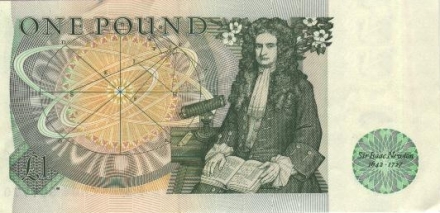
Appropriately, Newton himself wound up on the currency.

The accidents of place and time that brought the man who was recognized in his own day as the greatest mind of the age into conflict with Chaloner, an uncommonly gifted common criminal have fascinated me since I first learned of them through reading Chaloner’s last, piteous letter to the implacable Newton, written days before the hanging. In it Chaloner begged, writing “O dear S[i]r nobody can save me but you O God my God I shall be murderd unless you save me.”

What I wanted to answer was the obvious question: how and why did Isaac Newton come to pass judgment on the life of any other man? I had always thought of him as the nearly cloistered scholar of Trinity College, Cambridge, his home for more than thirty years. It was there he performed the experiments and the calculations that led him, in 1687, to write his masterwork, Philosophiae naturalis principia mathematica the Mathematical Principles of Natural Philosophy — better known simply as the Principia -– as well as pursuing his decades-long program of alchemical research.

So how, I wondered, did he end up in London, wallowing in the muck with the capital’s criminal underground?

Not to put too fine a point on it, finding out has turned into a book Newton and the Counterfeiter, published by Houghton Mifflin Harcourt and scheduled for release on June 4. But, to anticipate that longer story, here is the gist: Newton, after Principia found himself an international celebrity, and, as one of Cambridge University’s representatives to the Convention Parliament of 1689 that legitimized William of Orange‘s seizure of the English throne from the deposed Stuart King James II, he had nearly a year to enjoy the acclaim of London and Europe’s thinking and political elites before returning to the quiet of Cambridge, then a small town of about 5,000 inhabitants. It was an intellectual backwater too, especially compared to the big city in which he encountered figures like Robert Boyle, John Locke, Robert Hooke (whom he despised), Samuel Pepys (whom he did not) and so on. So he started, with Locke’s help, to seek a patronage appointment that would allow him to live comfortably in London. It took six years to find the right one, but ultimately he was offered the Warden’s post at the Mint. That job was supposed to be a sinecure, a nearly no-show position that would pay him a very comfortable wage.

And so it would have turned out were it not for the terribly debased state of England’s silver coinage, which had deteriorated to about half its legal weight for a whole host of reasons. So Newton arrived at a time when (a) the Mint was attempting to recall and recoin the entire stock of silver money for the entire country –- all the smaller units of money essential to everyday transactions –- and (b) coining, counterfeiting, was flourishing as enterprising men and women set out to get rich by filling in the gaps in the money supply with coins that never felt the stamp of an official Mint die. As Warden, it became Newton’s duty to see that legal money was produced fast and fairly, and to pursue all those who set up on their own.

Of those who did none were more technically skilled or ambitious than William Chaloner. His is a fascinating story, told at much greater length in my book, in which you see the currents of rapid economic change, class and ambition all converge within this one, barely remembered life. He was born desperate poor, a weaver’s son in Lincolnshire. He ran from his first apprenticeship to London, where he started out at the very bottom of the criminal ladder, hawking porn on street corners. He rose rapidly, first with his clearly impressive gift of gab, and then, after falling in with someone who knew how to gild surfaces, as the central figure in a series of ever grander schemes to counterfeit gold and silver money. He had sidelines as an informer, betraying conspiracies that he would himself set up, but his central gift and fascination was in the creation of fakes. Ultimately, he was one of the first to recognize the power of paper, and he started to counterfeit a variety of the early experiments with paper money and bank instruments.

In this sense Chaloner’s career –- and Newton’s urgent pursuit of him –- offer a window into the birth of the modern idea of money, of finance. And one of the things that fascinated me about this case is the degree to which this old story tracks some of our immediate problems. England’s and Europe’s economies were in rapid revolution in the late seventeenth century. The old idea of money as a chunk of metal with a pretty picture on it could no longer come close to accommodating the kind of enterprises governments and individuals wanted to undertake, from war to the funding of global webs of trade. And so people came up with all kinds of different ways of trying to represent value and exchange and even the idea of the changing worth of an investment over time. And the people making these experiments did not fully understand the implications of each expedient they tried. The last piece of paper Chaloner counterfeited was called a Malt Lottery Ticket, and it was at once simply paper money, a bond, and a gamble. Traders attempted to value these kinds of things in embryonic financial markets -– which would in a couple of decades blow up in a financial collapse that possess some striking similarities to our current predicament. Newton himself would lose a considerable fortune in that collapse, a sum worth a couple of million pounds, maybe more, in 21st century money.

It was that sense of precariousness that made the pursuit of counterfeiters so urgent in the midst of the late 17th century; England’s money supply was genuinely at risk, and no one had a good grasp of what it would take to make both the daily experience of small transactions and the high finance of war and trade go smoothly. So anyone threatening either or both levels of money was public enemy number one.

Of those who tried their hand at currency crime, Chaloner was the most accomplished, and notorious. By his own admission he counterfeited on the order of 30,000 pounds worth of currency over a seven- or eight-year career, an enormous fortune for the day. His big mistake, though, was to challenge Newton directly, accusing him in public of incompetence or fraud in his management of the recoinage of silver money between 1696 and 1698. He laid that charge both in testimony to Parliament and in a pamphlet he had printed for public distribution, and the scandal could genuinely have wounded Newton, were it not for the influence of his friends in power in Parliament at the moment.

It was enough, certainly, to propel Newton into an extraordinary investigation, an exercise of what may be seen as true non-fiction scientific detection. He set up a net of agents and informers throughout the worst neighborhoods and pubs in London, tracking any instance of coining he could find, interrogating suspects at the Tower or in jail, trying to build a web of connections around Chaloner. That story is contained within a collection of several hundred depositions and summaries of interrogations, all signed by Newton, that have survived, largely unexamined until now. Those records show that it took Newton almost two years in all, but aided in the end by listeners whose lives he held at his disposal inside Chaloner’s cell at Newgate, he managed to collect a sufficient weight of testimony to ensure that he could convict a prisoner clever enough to have escaped several previous attempts at prosecution.

The trial itself was something of a sham. Chaloner had feared being charged on the Malt Lottery Ticket forgery, (as we know from the accounts in Newton’s files of informers in the cells) but Newton actually presented evidence of a coining spree that almost certainly did not take place as described. Among other confounding facts, Chaloner was supposed to have made six different denominations of both silver and gold coins in a single day, which would have involved an enormous confusion of tools and materials that ran counter to basic counterfeiting practice.

No matter: the sheer volume of precise detail that Newton’s witnesses were able (or convinced) to provide produced a conviction within a very short time –- the whole trial took no more than an hour or so on March 3, 1699. There was a truncated appeal process -– really just a request for clemency from the crown, which was denied, and Chaloner’s sentence came down.

Formally, he had been found guilty of high treason, an assault upon the crown in the form of the king’s likeness and authority represented on the face of England’s coins. The punishment for high treason was essentially that suffered by William Wallace of Braveheart fame: to be strangled to the point of death, to be disemboweled whilst still living, to be beheaded and then quartered. By the date of Chaloner’s execution, the punishment had eased this far: convicted coiners were drawn to the place of execution on a rough sledge, subject to all the filth and abuse London’s open-sewered streets possessed; then hung until dead, and then, on rare occasions, to suffer post-mortem dismemberment. Chaloner himself was not, so far as any records revealed, actually cut into pieces. (As a gesture to public decency, women convicted of coining or other capital crimes were not supposed to be hung, lest their twitching at rope’s-end seem lewd. So they were burnt instead – though by the eighteenth century it was common to strangle them to death before lighting the pyre. Mercy, after the fashion of the times.)

Levenson lectures on his book at the MIT Writer’s Series.

One last note in a post gone much too long: Newton was involved in a number of counterfeiting investigations, and by some reckonings at least two dozen people went to their deaths as a result. Some historians, notably Frank Manuel, have speculated that Newton pursued this work with implausible eagerness, out of a kind of frustrated blood lust born of his abandoned and unhappy childhood.

This seems to me to be nonsense. The specific historical context matters here: Newton did not author the bloody code, nor did he send everyone he could to the gallows. Rather, the record of his depositions shows him to be simply a relentless practical man doing his job. He used little fish to catch big fish, and at least some of those low on the ladder received their escape from the gibbet. What you can see here, surprisingly, is the birth of a modern idea of a civil service. The Warden -– even Isaac Newton — was simply a man in a job doing the functions of that job, which included organizing the investigation and prosecution of counterfeiters.

What’s striking, of course, is that this civil servant, this bureaucrat, happened to possess the greatest scientific mind in history. And that’s the real sting in this tale. There is a connection between Newton’s pursuit of counterfeiters and his attempts to understand nature. He did employ the same resources of concentration and logical organization in his criminal investigations that he did when he tackled any problem. But more than the commonality of work habits, there is, I think this link: Newton can be seen as many people: the mathematician, the theoretical physicist, the empirical experimentalist, the alchemical mystic, the heretically devout religious thinker –- and the government functionary too.

And yet he was, of course, a single man, one with many interests, but ultimately with a consistent ambition, to reduce to order the complexity of any problem which was posed to him. Newton did not expect as Warden to have to chase crooks; when he found out that was part of the job he wrote a rather whiny letter to the Treasury to see if he could wriggle out of the duty. When he found he could not, he responded as he always had to the job at hand.

As one consequence, on this day three hundred and ten years ago, William Chaloner died.

On this day..

1542: Kathryn Howard, the rose without a thorn

(Thanks to Lara Eakins of the TudorHistory.org Blog for the guest post. -ed.)

On this date in 1542, Henry VIII’s fifth queen, Kathryn Howard, was beheaded in the Tower of London for high treason. She was the second of Henry’s queens to face this fate, the other being Kathryn’s first cousin Anne Boleyn.

This Hans Holbein miniature is generally thought to be Kathryn Howard, though the identification is uncertain. From the TudorHistory.org blog Kathryn Howard gallery.

Kathryn Howard* was born sometime between 1518 and 1524 to Lord Edmund Howard (a younger brother of Thomas Howard, 3rd Duke of Norfolk) and his wife Joyce Culpepper. Joyce died while Kathryn was young and her father took a post in Calais, leaving Kathryn in the charge of her step-grandmother, Agnes Tilney the Dowager Duchess of Norfolk. The Duchess oversaw Kathryn’s education, but apparently didn’t keep as close an eye on other aspects of the girl’s life.

Kathryn’s first physical relationship that we know of occurred in around 1536 with her music teacher Henry Manox. In her later confession she told of “the fair and flattering persuasions of Mannock, being but a young girl, suffered him at sundry times to handle and touch the secret parts of my body…”. In late 1538, Kathryn began a sexual relationship with Francis Dereham, which was to become part of her downfall as Queen.

The next year, 1539, Kathryn took a position at court, becoming a maid of honor for Henry’s soon-to-be fourth Queen, Anne of Cleves. The Dowager Duchess of Norfolk later recalled that Henry first took notice of Kathryn at Greenwich in December of 1539 during the preparations for Anne’s arrival. Henry was famously disappointed by his new foreign bride and by early July 1540 the marriage was annulled. During the short marriage to Anne of Cleves, Henry had already begun to send gifts to Kathryn and took her as his fifth Queen on July 28th at Oatlands Palace.

Henry was 49 years old and Kathryn was no older than 22 (and more likely around 19). For all that can be said against this match, the vivacious young girl brought back some of Henry’s zest for life. The King lavished gifts on his young wife and called her his ‘rose without a thorn’ and the ‘very jewel of womanhood’.

Thomas Culpepper, a distant relation of Kathryn’s through her mother, sought favor from the Queen in early 1541 which was probably when their secret meetings began. Their rendezvous were aided by Kathryn’s lady of the privy chamber, Jane Boleyn, sister-in-law to the late Queen Anne Boleyn through Jane’s marriage to Anne’s brother George.** Also at this time, Francis Dereham returned to England from Ireland and gained a position in Kathryn’s household, possibly arranged to keep his silence about their earlier relationship.

During the summer of 1541, Henry and his young queen went on progress to the north of England and returned to Hampton Court on October 29. Just a few days later everything would begin to unravel. On November 2, Archbishop Cranmer sent a letter to the King telling him of his wife’s previous lovers. Henry seemed reluctant to believe the charges at first, but upon the questioning of Dereham and Manox –- who confirmed the allegations –- Henry left Kathryn at Hampton Court and returned to London. He never saw her again.

During the interrogations of the men, Francis Dereham said that Thomas Culpepper had replaced him in the Queen’s affections. Kathryn was presented with these new allegations and admitted to secret meetings with Culpepper (as well as the relationships with Manox and Dereham before her marriage), but denied that a sexual relationship had existed between them. Culpepper was imprisoned in the Tower of London and Kathryn was moved to the former abbey at Syon and deprived of her queenship.

Dereham and Culpepper were found guilty of treason on December 1 and were executed on December 10. Dereham was hanged, disemboweled, beheaded and quartered at Tyburn. Culpepper fared better, owing to his status, and was only beheaded. The former queen and her lady Jane Boleyn never faced a trial for their actions but instead had acts of attainder passed against them. On February 10, 1542, the ladies entered the Tower of London to await their executions.

Kathryn was told on the 12th that her execution would be the next morning and according to Imperial Ambassador Chapuys, she rehearsed the execution for several hours and even requested that the block be brought to her so she would know how to place her head. A merchant named Ottwell Johnson was an eyewitness to the execution on the morning of the 13th and wrote in a letter to his brother that Kathryn and Jane both “made the most godly and Christian end” and that Kathryn, in her scaffold speech, said that her punishment was worthy and just. (The letter is among period correspondence printed in this public-domain book.)

Kathryn’s head was struck from her body with one stoke of the axe, as was Jane’s, a merciful outcome compared to other ladies who shared their fate, such as Margaret Pole and Mary Queen of Scots. Kathryn and Jane were both quickly buried in the Chapel of St. Peter ad Vincula in the Tower precincts, joining Henry’s other beheaded queen, Anne Boleyn and Jane’s husband, George.

[flv:https://www.executedtoday.com/video/Lynne_Frederick_as_Katherine_Howard.flv 440 330]

* Or Catherine Howard, or Katherine Howard, or Katheryn Howard. Spelling at the time, even of proper names, was fluid.

** Jane Boleyn, Lady Rochford, is popularly supposed to have supplied the explosive incest allegation against her husband, George Boleyn, and his sister Anne Boleyn. Being subsequently hoisted on her own petard in the game of courtly purging, she tends to get short shrift in the sympathy department — though the fact is that we really don’t know much about her.

On this day..

1945: Private Eddie Slovik, the last American shot for desertion

On January 31, 1945, Private Edward Donald “Eddie” Slovik became a curious outlier of World War II: he was executed by firing squad by the U.S. Army for desertion. He is the only person to have been so punished for that crime since the Civil War.

Pvt Slovik was, by all accounts, quiet and helpful, by no means a coward, and more than willing to aid in the effort of World War II, traits which would have put him among a large class of that war’s veterans. Unfortunately, he was also immobilized by shelling. Equally unfortunately, he knew it, and he decided to do something about it.

Slovik and a friend, Pvt John F. Tankey, first separated from their detachment under artillery fire in late August 1944, shortly after being shipped to France. The pair hooked up with a Canadian unit and spent six weeks pitching in. Having recused themselves from the hard shelling others were experiencing on the front line, they opted to rejoin their regular U.S. unit: Slovik and Tankey sent a letter to their commanding officer explaining their absence and returned on Oct. 7.

But the front lines were not a place for Pvt Slovik.

After his assignment to the rifle unit, which would face imminent danger during shelling, Slovik asked to be placed in the rear guard, indicating he was too scared to remain in front. His request was refused. He then reportedly asked whether leaving the unit again would be considered desertion, was told it would be, and opted for the seemingly safer route of, well, deserting. One day later, Slovik was back at a U.S. camp, this time turning himself in to the camp cook. He had drafted a letter explaining his actions and indicating that he knowingly deserted, permanently recording his guilt on paper.

It’s not clear whether Pvt Slovik was acting on principles or out of an understanding of the U.S. military judicial system. He was by no means the only soldier without affinity for the conditions of war, particularly on the allied side. During the war, thousands of soldiers were tried and convicted in military courts for desertion, but up to then, all had received only time in the brig. What is clear is that Slovik was repeatedly offered opportunities to return to the line, and he equally repeatedly refused.

The case was adjudicated on Nov 11 by nine staff officers of the 28th Division, none of whom had yet been in battle. One of those judges, Benedict B. Kimmelman, wrote a stark and intriguing account of his role in the story of Pvt Slovik, capturing the scene thusly:

Five witnesses were heard. The cross-examinations were perfunctory. The defense made no closing argument. The court recessed for ten minutes, resumed, and retired almost immediately afterward. Three ballots were taken in closed court, the verdicts unanimously guilty on all counts. In open court once more, the president announced the verdict and the sentence: to be dishonorably discharged, to forfeit all pay and allowances due, and to be shot to death with musketry. The trial had begun at 10:00 A.M.; it was over at 11:40 A.M.

As with all court martial cases, Slovik’s was sent to a judge advocate for review. His criminal record, including everything from destruction of property to public intoxication to embezzlement, did not endear him to the reviewer. More importantly, though, the advocate felt Slovik could be made an example:

He has directly challenged the authority of the government, and future discipline depends upon a resolute reply to this challenge. If the death penalty is ever to be imposed for desertion, it should be imposed in this case, not as a punitive measure nor as retribution, but to maintain that discipline upon which alone an army can succeed against the enemy.

Strangely, Pvt Slovik was the only person who would be exemplified this way.

Though the military tried 21,000 desertion cases and passed down 49 death sentences for desertion during the war, it carried out only Slovik’s. And in the war’s final battles, with Germany collapsing, his execution seemed like a surreal throwback. As Kimmelman notes, hundreds if not thousands of soldiers were strictly guilty of dereliction of duty and desertion in the waning days of 1944.

They’re not shooting me for deserting the United Stated Army — thousands of guys have done that. They’re shooting me for bread I stole when I was 12 years old. (Source)

Three weeks after his conviction and three weeks before the Battle of the Bulge, Slovik’s execution order was confirmed by the 28th Division’s commander, Major General Norman “Dutch” Cota. Cota was disturbed by Slovik’s forthrightness in confessing to the desertion, and, as a front line commander who had sustained severe casualty rates in the Battle of Hurtgen Forest, had no sympathy for the crime.

After an appeal to the deaf ears of Dwight Eisenhower shortly before the sentence was to be carried out, Slovik was out of options. He was taken to the courtyard of an estate near the village of Sainte-Marie-aux-Mines and shot by 11 Army marksmen* at 10 a.m. By 10:04, as they were reloading, he was declared dead. His body was interred at a French cemetery, and after decades of lobbying the U.S. government, his remains were returned to Michigan in 1987.

Because he was dishonorably discharged, Slovik was not entitled to a pension, and his wife, Antoinette, stopped receiving payments. Curiously, though the Army managed to communicate this to her, they omitted the bit about the execution. She found out in 1953 from William Bradford Huie.

Huie was a journalist who took immediate interest in Slovik’s story, popularizing it with his book The Execution of Private Slovik, which was released in 1954. Twenty years later, the book and title were requisitioned for a well-received TV movie starring Martin Sheen.

Perhaps more interesting than this film was its never-produced predecessor, which is entitled to a place in the history of the Hollywood Blacklist. Frank Sinatra acquired rights to The Execution of Private Slovik and in 1960 announced that he would produce it as his directorial debut — with the script of this inherently political story to be written by “Hollywood Ten” blacklistee Albert Maltz. Maltz and other blackballed writers had continued working pseudonymously during the anti-Communist blacklist, but Sinatra’s openly announcing an intent to hire and credit Maltz constituted a significant crack in the wall — even though commercial and political heat eventually forced Sinatra to abandon the project. This event has treatment in a recommended episode of the magnificent cinema-history podcast You Must Remember This.

* The firing squad included 12 marksmen, but one was given a blank. Despite their skill, the 11 remaining shooters did not manage to kill him instantaneously.

On this day..

2001: Larry Keith Robison

(Thanks to Kristin Houlé of the Texas Coalition to Abolish the Death Penalty for the guest post, adapted from her Mental Illness and the Death Penalty Resource Guide (pdf link). Kristin blogs at Prevention Not Punishment. -ed.)

A mentally ill man who had been refused treatment because his condition had not yet turned him violent suffered lethal injection in Texas eight years ago today for finally turning violent.

Larry Robison was diagnosed with paranoid schizophrenia at the age of 21, three years before the murders for which he was sentenced to die. He began hearing voices and acting strangely as a teenager, claiming to have secret paranormal mental powers and the ability to read people’s minds and move objects from a distance. He joined the Army but was discharged after only a year.

Robison’s parents sought help and warned mental health authorities of their son’s erratic and increasingly aggressive behavior, but were told that the state could offer no resources unless he turned violent. He was shuffled in and out of mental hospitals, admitted after aggressive behavior and released after a period of medicated passivity. He received no regular, ongoing treatment. Robison was not covered by his parents’ insurance, nor did he have his own.

Robison claimed that voices in his head, which came through the clocks in his room, spewed out warnings about Old Testament prophecies of the Apocalypse and told him to murder, behead, and mutilate his roommate, Bruce Gardner. Robison then went next door and murdered four of his neighbors. When authorities arrested him, he told them that he had committed the murders in order to “find God.”

The four prosecutors developing the case against Larry Robison recognized his past history of mental illness and were willing to accept an insanity plea in exchange for life in a mental institution. The Tarrant County district attorney overruled them, however, and ordered them to seek a death sentence. In the courtroom, most evidence of Robison’s mental illness was ruled inadmissible, so the jury heard little of it. None of the three doctors who had diagnosed Robison before the crime as suffering from paranoid schizophrenia were called to testify at his trial. The jury rejected his plea of not guilty by reason of insanity.

Once in prison, evidence of Robison’s mental illness continued to accumulate. The Texas Court of Criminal Appeals stayed his execution at one point, doubtful as to whether or not he was competent to be executed. When asked what the execution would be like, Robison replied that he felt like “a little kid at Christmas time waiting for Santa Claus to come.” Eventually, he demanded that his lawyers cease filing appeals based on his mental illness, but only if the state agreed to execute him on the night of a full moon. Despite protests from mental health organizations and concerned citizens throughout the world, the state complied.

Larry Robison’s case drew attention largely as a result of the tireless efforts of his own family, taking a public profile unusual for the family of the condemned. CBS News’ 48 Hours profiled the Robisons shortly before Larry’s execution. They continue to maintain a website, larryrobison.org; mother Lois Robison remains a vocal critic of executing the mentally ill, and delivered this address to a Murder Victims’ Families for Human Rights conference last fall.

On this day..