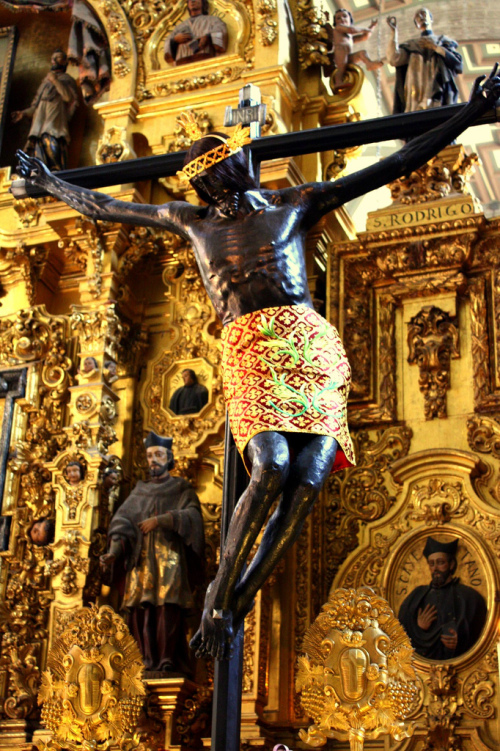
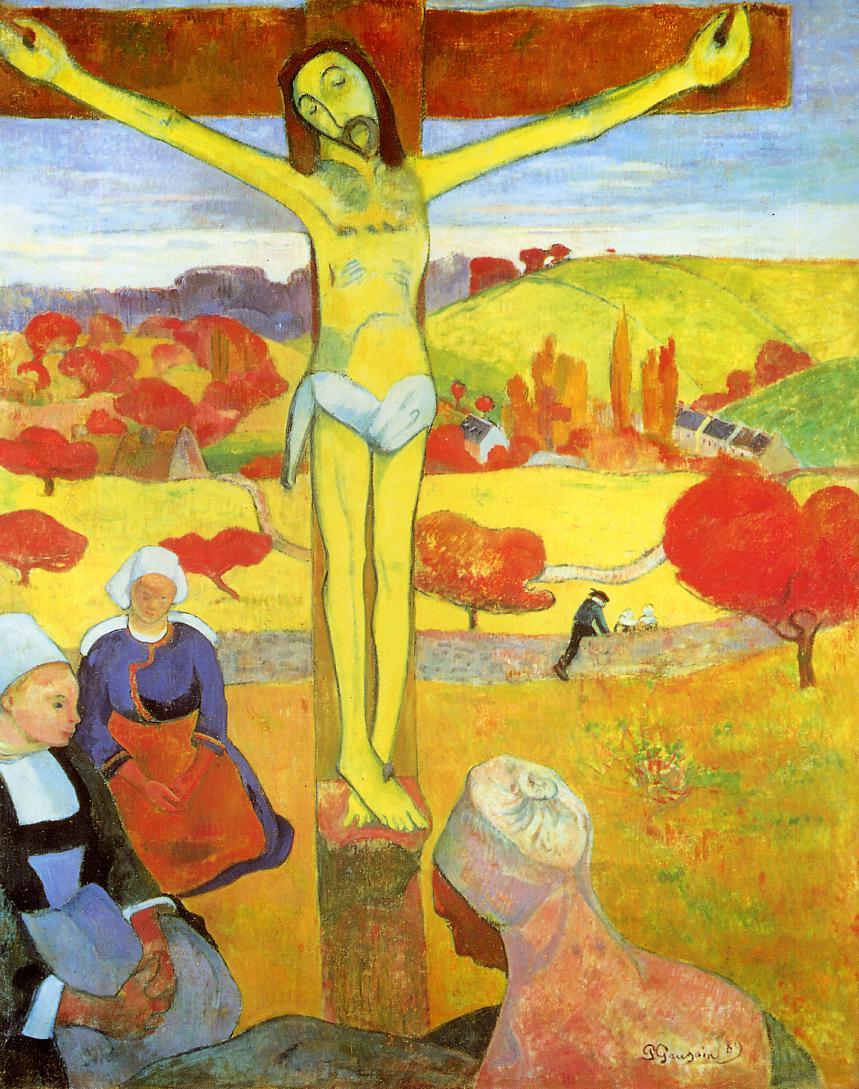
Jesus of Nazareth, King of the Jews

Images of the Crucifixion


(Thanks to Jeffrey Fisher [jeffreyfisher at me.com] for the guest post.)

On Good Friday every year,* Christians around the world commemorate the death by crucifixion of Jesus of Nazareth, rabbi, prophet, Son of God, Son of Man, messiah, and all-around trouble-maker.

The truth is that very little is known of Jesus’ life and teachings from verifiable accounts, but this has not stopped generation after generation of Christians from telling his story, beginning with Jesus’ semi-official biographers, the evangelists of the New Testament. Almost everything we know about the life and teachings of the physical human being Jesus are in those writings, which do not portray him always in compatible ways, and which are almost entirely unconfirmed by any external source. The Roman historian Tacitus mentions (with disdain if not disgust) Jesus’ cult following, as does the Jewish historian and philosopher Josephus, but neither gives us anything to work with as historians (or, for that matter, as theologians). For the record, Suetonius and Pliny also talk about Christians, but these piecemeal sources tell us much more about Roman perceptions of Christians than about Christ and his teachings, or even necessarily Christian beliefs and practices.

What, then, can we reasonably say about Jesus?

It is almost impossible to find universal agreement around anything more than a few basics, including most importantly Jesus’ crucifixion. The Gospels narrate it; Paul the Apostle (who never met Jesus in the flesh, as it were) hangs his theology on it, together with the equally important resurrection; and no contemporary sources (Christian or otherwise) dispute it.

But it’s when we ask why Jesus was crucified that things start to get interesting.

What did he do? The two men he is traditionally said to have been crucified with are commonly understood to be “robbers,” but that they were common criminals is highly unlikely. Crucifixion is a horrible death designed to make a very public statement about the crucified, the sort of thing you use on gladiator-slave rebels like Spartacus, not on pickpockets and roustabouts. The Greek term used for these two men (lestai) is consistent with the description of the released Barabbas as one who had participated in rebellious activities, whose “criminality” was related to his revolutionary business. Moreover, the name “Barabbas” means literally “son of the father,” a purely symbolic and surely entirely fictional name, and that the people choose to have him released indicates their affinity for him as a thorn in the side of the Romans. He is thus contrasted with Jesus, the other son of the father, the peaceful (apocalyptic) revolutionary.

So Jesus would have been crucified as a political criminal, a rebel. This would make sense of accounts of his having been identified by the Romans as “Iesus Nazarenus Rex Iudaeorum”: “Jesus of Nazareth, King of the Jews.” Anyone claiming to be king (and “son of God” was a Jewish way of talking about the king of Israel recorded clearly in Psalm 2), would, if taken seriously, be understood as challenging Roman authority.

Insofar as Jesus seems to have been deliberately poking the Romans’ local running dogs, the Sadducees and the Temple priests, his seizure and termination were surely inevitable. If his teaching is as opposed to violence and unconcerned with “politics” as it seems to have been, it’s hard to believe the Romans would have noticed him without some prodding, this coming not from the “crowd,” but from the leadership (who in Mark and Matthew incite the crowd). Indeed, the priests and scribes look for ways to arrest him when the crowds are not around, because they fear a riot.

If we take the Gospel of Mark at all seriously, Jesus was preaching a new kingdom of God, an apocalyptic redemption of the people of the earth by God’s direct intervention (and with Jesus as the sacrificial pesach lamb). If we take the Gospel of Luke seriously, Jesus spoke in a classic prophetic mode, calling people — Jew and Gentile both — to care for the oppressed of the earth, the poor and the hungry and the helpless. Both Jesuses called for people to be better to each other, to love each other, and indeed to love each other when love was, according to common sense, the foolish thing.

Why would this get you executed?

Well, in itself, it wouldn’t. But the Gospel of Mark tells us of Jesus speaking with a man who realizes that all the animal sacrifices in the world don’t amount to a hill of beans (in that crazy world). When love counts more than sacrifice, we are undermining the Temple. When we go into the Temple, start knocking things over, and say it’s become about robbing the poor and not about loving God and one’s neighbor, we are undermining the Temple. And to undermine the Temple’s authority is also to undermine Rome’s authority, and Rome’s cash flow.

Jesus, like the Essenes he may or may not have associated with, was a purist.

The Temple was full of collaborators and exploiters, the kind seen before in the history of Israel (and berated by prophets like Isaiah and Amos), the kind hated also by the Dead Sea community of apocalyptic purists awaiting a final showdown between God and evil (i.e., the Roman Empire and their local potentates, the Temple authorities).

Jesus, like other Jewish prophets before him, thought that Judaism was about something. That it was somehow about justice and not just about following rules or waiting around for things to get better: that it was about our making the world a better place, and not just making our own lives better.

Start talking that way and get people on your side, and you’re fairly likely to get killed, even twenty centuries later.

* Though the actual date (even the year) of the execution marked by the movable feast of Good Friday is fundamentally unknowable, there are some present-day astronomer types who’d like to sell you April 3, 33 A.D.

On this day..

1771: Green Tea Hag, the beginning of Dutch Learning

The typical turning-point execution features an illustrious protagonist upon the scaffold: a royal dethroned, a politician overthrown, a revolutionary laid low.

On this day in 1771, an obscure woman executed for everyday crimes launched a new era in Japan.

The Kyoto resident, nicknamed “Aochababa” — roughly translated as the Green Tea Hag — sparked a scientific revolution that would span decades, push Japan into its own Age of Reason called Dutch Learning, and keep an island nation astride goings-on from thousands of miles away in spite of isolationist practices.

The Tokugawa Shogunate, which ruled Japan from the early 1600s through the mid-1800s, was widely regarded as anti-Western for closing down trade with several European nations.

Concerned with what it saw as colonial aspirations in the Americas, the Shogunate clamped down on Catholic missionaries from Spain and Portugal. Starting in the 1630s, the island nation officially enacted the Seclusion Laws, which effectively allowed trade only with China, Korea, and the Netherlands; contact with the last was only legitimated through the Dutch trading outpost in Dejima, an isolated island with strictly controlled access.* Because of these limitations, Japan became a repository of non-Christian Dutch paraphernalia.**

The execution of Aochababa itself is practically forgotten: she was hanged in Kyoto’s Kozukappara (the present day Arakawa ward) in Meiwa 8, the second year of a 15-year drought gripping Japan. Her crime is unknown, and her execution would have been as un-noteworthy as dozens of others that year had her body not been secured for science.

However, under the reign of (though little due to) Shogun Tokugawa Ieharu, Dutch influence was increasing dramatically in Japan.

As a result, Aochababa’s corpse was brought to a medical facility, where Sugita Genpaku, Maeno Ryotaku, Nakagawa Jun’an, Toyo Yamawaki, and others performed and viewed an autopsy. Their medical training was Chinese; their medical texts were a mixture of Chinese and Dutch; as Genpaku reports in his later book Rangaku Kotohajime:†

Ryotaku opened the book and explained according to what he had learned in Nagasaki the various organs such as the lung called “long” in Dutch, the heart called “hart,” the stomach called “maag” and the spleen called “milt.” They looked so different from the pictures in the Chinese anatomical books that many of us felt rather dubious of their truths before we should actually observe the real organs.

…

Comparing the things we saw with the pictures in the Dutch book Ryotaku and I had with us, we were amazed at their perfect agreement. There was no such divisions either as the six lobes and two auricles of the lungs or the three left lobes and two right lobes of the liver mentioned in old medical books. Also, the positions and the forms of the intestines and the stomach were very different from the traditional descriptions.

…

After the dissection was over, we were tempted to examine the forms of the bones too, and picked up some of the sun bleached bones scattered around the ground. We found that they were nothing like those described in the old books, but were exactly as represented in the Dutch book. We were completely amazed.

In short, their medical results matched those of the Dutch and flew in the face of a millennium of Chinese anatomical teachings.

Genpaku was intrigued. As he tells it (40-some years after the fact), Ryotaku, Jun’an, and he immediately laid down a plan to translate the Dutch text into Japanese.

The process was a slog. Lacking a dictionary or translator for anatomical studies, the team — bolstered by the Shogun physician Katsuragawa Hoshu — was forced to reverse-engineer the Dutch language using a short phrase book, occasional contacts with the Dutch themselves, and a host of educated guesses based on the anatomical features they were attempting to describe. In addition to the problems of simple translations — turning a language with definite and indefinite articles into one with no such concept — many anatomical features had never been named in Japanese before; Genpaku and his collaborators invented dozens of words just to get by. A brief history is given here.

Finally, in 1774, Kaitai Shinsho — The New Book of Anatomy — based mostly on the Dutch book Ontleedkundige Tafelen (itself a translation from German), was published, the first translation of a Western text into Japanese. The book was four volumes (three of text, one of illustrations) and scribed in a Chinese-based writing style known as Kanbun.‡


An image (more can be seen here) from the 1774 Japanese anatomy treatise.

Topical historical literature, recommendation via Reddit.

The translation was the first in a long line of texts that the Japanese would eventually use to quietly capture the technology of the West.§

Genpaku was at the forefront of Dutch Learning, and his second masterwork, Rangaku Kotohajime (“Beginnings of Dutch Learning”), published in 1815, provides a thorough description of the events which led to these advances in science and medicine in Japan.

It would be 80 years before the United States Navy forced its way into Japanese harbors and used gunship diplomacy to end Japan’s seclusion. During that time, the Japanese reproduced everything from telescopes to automata to steam engines using borrowed texts and dissection of imported goods. Dutch Learning kept Japan abreast scientific advancements even while it maintained its isolation.

The enduring legacy of Dutch Learning was the late-19th century Meiji Restoration, wherein a Japan now officially opened swiftly modernized efficiently enough to trounce Russia in the Russo-Japanese War at the end of the century.

A fairly complete description of the evolution of Japan under Dutch Learning is given in Wakabayashi’s Modern Japanese Thought and De Bray et al‘s Sources of Japanese Tradition (Vol 2).

Today, many of the Dutch words imported to describe new objects, anatomical and otherwise, remain in the Japanese language as a testament to Dutch Learning. Sugita Genpaku is also the namesake of a modern-day attempt to translate texts to Japanese. And Toyo Yamawaki, through his help with dissections of the era, prompted an interesting ritual of memorializing cadaver donors in medical schools. For physical specimens, a museum with sections devoted to Dutch Learning can also be visited at Nakatsu.

* The Dutch were allowed to stay because they weren’t Catholic. The Shogun also enacted laws forbidding missionaries and Christian prosteletyzing, as well as officially outlawing the practice of Christianity; however, an underground group of Christians remained in the country.

** Initially, all foreign texts were outlawed. However, beginning with Shogun Tokugawa Yoshimune, Dutch texts were allowed into the country, generating a new wave of books that were, for several decades, largely illegible to their owners. To go with the anti-Christian theme, however, the Japanese authorities continued to blot out all Christian references.

† Translation by Ryozo Matsumoto, available here.

‡ Kanbun is a mapping of Chinese ideograms and writing style into Japanese-comprehensible language using classic symbolic meanings (a standardized shape to represent a tree) and sound equivalents (using the same standard shape to represent the the sound of the word “tree” rather than its meaning), as well as sentence structure and purpose markings. Using this style, direct Chinese-to-Japense translation is possible, but the onus is on the author to properly annotate the text.

§ Strangely, there is as yet no Dutch-Japanese dictionary in print.

On this day..

1554: Lady Jane Grey, the Nine Days’ Queen

February 12 is the anniversary of Lady Jane Grey‘s beheading at the Tower of London. The Protestant teenager was the designated successor of sickly boy-king Edward VI, but popular and aristocratic support went for Mary Tudor in a landslide.

The Nine Days’ Queen landed in the Tower and copped to a treason charge on a tenuous deal for mercy (not applicable to her sponsors and allies, many of whom went to the block). But a January 1554 Protestant rebellion that had Protestant restoration as part of its programme made it a dangerous indulgence for Mary to keep her cousin’s neck attached to its shoulders.

On this auspicious anniversary, Executed Today is pleased to welcome Jane Grey expert J. Stephan Edwards, Ph.D. Dr. Edwards runs the Some Grey Matter site, and is working on a forthcoming book about our day’s famous beheadee.

ET: The conventional wisdom on Jane Grey is that she was basically destroyed by the machinations of the men around her. Is that a misapprehension? Was she more involved in events than she’s given credit for? Can one take seriously the notion that she didn’t want to be queen?

JSE: Having spent almost ten years researching the life of Lady Jane Grey Dudley and her very brief reign as Queen of England in July 1553, I am confident that she was not directly involved in the plans to make her Edward VI’s successor to the throne. At the same time, however, I am completely convinced that she was well aware of those plans at least six weeks before she actually became queen. And it is beyond question that she knew of the plan at least a week before her accession. Thus the standard mythology that portrays Jane as utterly unaware and totally innocent until the last possible second is just that … a myth.

I am similarly convinced that Jane accepted the crown after offering little more than perfunctory resistance. The crown offered a degree of personal independence that would otherwise have been unavailable to her. It also offered power. Despite Victorian-era storytelling to the contrary, Jane Grey Dudley was very much a product of her own age, and that was an age of widespread personal ambition, of duty to both family and God to advance one’s self and one’s family. It would have been a deep betrayal of her family and of social norms actually to refuse such an exalted position.

In the act of accepting, she is recorded to have asked God for some sign that she should refuse, paused for a moment, and receiving no such sign, she accepted. Further, Jane was apparently an adherent to the Calvinist doctrine of predestination, the idea that all things, including our daily lives, are preordained and known to God, and as humans we are powerless to alter God’s plan. Having prayed to God for a sign that she should refuse the crown and receiving none was no doubt to her an indication that her God’s preordained plan was for her to be Queen of England. She therefore accepted without offering further resistance of any kind.

Further, there is ample evidence to show that Jane fully embraced her new status. She signed dozens, perhaps hundreds, of documents with her own hand rather than relying on a privy secretary to sign in her stead (common practice in the reigns of Henry VIII and Edward VI before her). This indicates active and positive involvement in affairs. And on more than one occasion, she countermanded the orders of her council, imposing her own will upon them, again evidence of an intent to rule.

Was she “destroyed by the machinations of the men around her”? I think perhaps there is a better way to phrase it. Jane Grey Dudley lived in an era when women were second class citizens with few legal rights and virtually barred from public affairs. Yet the circumstances of July 1553 mandated that a woman must assume the throne, however much that contradicted 400 years of established English practice. If anything, Jane Grey Dudley was a pawn in a political chess game in which the players, all male, searched desperately for a male king, yet all they had at hand were potential queens. The male players at the chess board were simply struggling with the pieces they had available and trying to make the best of an unfamiliar and even frightening situation. They failed, and Queen Jane was one of the unfortunate pieces swept from the board.

Jane is obviously a romantic figure — small r, big R — in part because she didn’t ever have the chance to start doing the un-romantic things that rulers have to do. How has her image changed over the years? What about her would most surprise people today?

Actually, Jane did “do some of the unromantic things that rulers have to do.” She sat in daily on meetings of the Privy Council. She helped to plan military maneuvers against her cousin, the future Queen Mary … maneuvers intended to bring about the latter’s death. She sent thousands of men off to die in battle. The nine short days of the reign of Queen Jane were packed with unromantic and burdensome activity unfamiliar to a woman of not quite eighteen years of age.

If anything, the years have served to erase much of that non-romantic material and replaced it with the image of an obedient girl-child secluded in study or prayer, uninvolved in the affairs of the world. Indeed, one biographer writing in the 19th century referred to her existence as one of “splendid isolation.”

Yet she was anything but isolated. The historical evidence makes it clear that she was socially active, participating in many of the public celebrations held by her kingly cousin’s court. She traveled a great deal, visiting with relatives and friends of the family scattered across the entire realm. And she had a love of music that was intense enough to give her tutor concern that she was becoming too distracted from her intellectual studies. The picture that has emerged from my own research is of a girl who was quite “normal” for those of her social and economic status in that era, with the possible exception of a gift for languages.

Had Jane, in fact, ruled, how different might events in England been? (and elsewhere, since this was also a key period of imperial competition?)

I am not myself a huge fan of “counterfactual history,” of speculating about “what might have been.” But since a lot of people do ask this question, I will say this: Had Jane remained queen, and had Mary remained on the political periphery (or been executed), it seems to me that the British Isles would be a very different place today. Just in basic political terms, Elizabeth also would likely not have become queen, so the great Elizabethan “Golden Age” would never have happened. Also, Jane would likely have had children, so there would not have been any need to reach outside the realm in 1603 to find an heir. James VI of Scotland would never have become James I of England, and Scotland may have remained forever a separate kingdom and nation. Without a King James of England, there would not have been a Charles I of England, and thus perhaps no religious civil wars in the mid 17th century. Carried still further, James II would never have become king, and no Act of Settlement would have been necessary. The Hanoverians would never have succeeded to the English throne … no George III and perhaps no American revolution. Certainly no Queen Victoria. And the current queen would instead be a German housewife.

All of this would likely have left England as a relatively small nation. It probably would never have become “Great Britain,” either geo-politically or symbolically. It might well have remained a minor actor on the international political stage. The great “British Empire” and the modern Commonwealth might never have existed.

Religiously, England might also have been very different. The more radical strain of evangelical reformism (later called “Puritanism”) espoused by Edward VI and Jane may well have prevailed. The moderate Elizabethan religious settlement of the 1560s likely would not have happened. Thus the Church of England might have looked today more like a Presbyterian or Lutheran church, both doctrinally and physically. Anglicanism today would have been based on simple preaching, with most ritual and liturgy pared down to a bare minimum. No vestments, no decorated churches, and perhaps no bishops and archbishops. All of that would, in turn, have had a huge impact on English culture, art, literature, etc.

In short, had Jane reigned long, the world would be a very different place today, in ways that we probably cannot even begin to imagine.

How did Jane herself change over the course of her experiences in proximity to power, and then as the queen, and then in the Tower?

This is a very difficult question to answer, if not an impossible one, because we have so very little evidence about Jane herself, her character, and her personality. We know next to nothing of her innermost thoughts and attitudes during this period, especially the period during her imprisonment in the Tower. The one thing that we can perhaps say is that religion became Jane’s chief comfort during the last six months of her life, and she clung to her faith with tenacity. The evidence suggests that she was accepting of her death in the belief that she was serving her God and her faith. In fact, she seems to have carried out the activities of her last days with great care and deliberateness so as to leave a carefully constructed final impression on others. She wrote a judiciously worded letter to her sister and penned a brief note to her father, almost certainly conscious that both would be published after her death. She engaged in a semi-public theological debate with Queen Mary’s own Roman Catholic chaplain and hand signed a transcript of that debate in order to authenticate her words. And lastly, she delivered an ambiguously worded speech from the execution scaffold that declared herself simultaneously innocent and guilty. Jane was a relatively unknown private figure when she became queen, and a very public one by the time she died, well aware that she would soon be known across Europe. That transformation from private to public figure must surely have changed her profoundly, in ways we can only guess.

As a researcher, how do you deal with the sketchy documentary trail on Lady Jane?

Historians and researchers deal every day with people and groups of people for whom few written records or other evidence exists. To compensate, many modern historians take pieces of evidence from here and bits of data from there and compile them, then use that compilation to construct snapshots of groups rather than of individuals. For example, we can reconstruct from written records the amount of charity that was dispensed in certain specific regions (e.g., a single parish in London). From that amount, we can gain some idea of how extensive poverty may have been in that region. And from the list of names and ages of those to whom charity was dispensed, we can deduce what percentage of the poor were male or female, young or old … even if we know nothing more than their names and ages.

With Jane, I have reversed the process. Historians have done a great deal of work to describe aristocratic young women in England in the sixteenth century … their education, their religious beliefs and practices, their domestic lives, etc. If that group composite picture is valid, we should also be able to say that if a certain person is a member of that group of young female aristocrats, she is likely to have had similar characteristics. Thus I have proposed that in the absence of any written evidence to the contrary, Jane was probably very much like her social and economic peers in many ways. She was different only in those ways for which we have clear evidence, such as her proficiency in as many as five to seven languages.

How was her execution carried out? Was it typical for its time, place, and circumstances?

Dying was an active process in the Tudor era. It was something a person did, not something that happened to a person. Those facing death were expected to carry out certain predetermined actions and to behave in certain specific ways as demonstrations that they were destined to go to heaven. Dying was to be done with dignity, with a measure of planning (if the death was anticipated far enough in advance), and with particular tasks to be performed by the dying before they took their leave of the earthly world and moved on to the spiritual world. A large body of literature and advice books on how to die, or “the art of dying” (ars moriendi in Latin), emerged during the period. Jane Grey Dudley played her part so well that she was held up as an example to all in later years of “how to die well.”

The condemned were always afforded the opportunity to prepare themselves spiritually, with the method of preparation dependent upon the form of religion then in place. Jane was executed after Roman Catholicism had been re-instituted in England, so she was given the opportunity to confess to a Catholic priest, to be absolved, and to take final communion. Holding firm to her Protestant beliefs that confession was a private matter between penitent and God alone and not necessitating a priest’s hearing, that absolution was given only by God and not mediated by priests, and that the Roman Catholic Mass was erroneous, she instead engaged in a public theological debate with John de Feckenham. During this debate, Jane professed her faith to a sizable audience, outlining its central tenets, an action that itself served as a kind of “Protestant confession” without directly involving a priest in the process.

She then wrote letters to her sister and father bidding them farewell and offering spiritual counsel to them as well. She probably wrote letters to others, especially her mother, but they have not survived. Taking leave of the world and offering consolation to those to be left behind was part of the ars moriendi. Jane’s letter to her sister, in particular, was reproduced repeatedly over the next century as a near-perfect example of how to bid farewell to loved ones. [Available here, the last of several Jane Grey letters reproduced in this public-domain book.]

On the morning of the execution, she would have dressed appropriately in a simple gown of somber color, usually gray or black (certainly not the angelically virginal white depicted in Paul Delaroche’s famous histrionic painting of her execution). Many carried some type of religious text with them to the place of execution, often a Missal or Book of Hours (for Catholics) or a New Testament or copies of the Four Gospels (for Protestants). Jane carried a book of prayers copied from the works of St Jerome, St Ambrose, and St Austin, each a father of the early Christian church of the fourth century (Tudor-era Protestants recognized the value of the writings of these men though they denied their status as saints and intercessors in heaven). That morning, she carefully inscribed the book to her jailer in preparation for presenting it to him in her last moments. Small gifts to jailers, and even to executioners, were considered signs of humility and Christian forgiveness.

Jane was to be executed within the relatively private walls of the Tower of London rather than in the full glare of the crowds outside the walls on Tower Hill. Executions were large public spectacles that often drew huge audiences, so a private execution was considered a great favor to the condemned.

There was no permanent execution scaffold within the Tower. Scaffolds were built specifically for each execution, then immediately dismantled. The eye-witness accounts indicate that the scaffold for Jane’s execution was built against the wall of the central White Tower, at its northwest corner … the corner closest to the Chapel of St Peter-ad-Vincula. Since Jane was housed in the upper storey of the Gentleman Gaoler’s (Jailer’s) quarters, which still stands today, she would have seen the scaffold being built just a few yards across Tower Green. She would also have had a very short walk from her quarters to the scaffold, though she would have been in full view of the many permanent residents, workers, and official visitors within the Tower that busy Monday morning. She is said by eyewitnesses to have made the walk with great dignity and without any outward signs of distress.

Jane was accompanied to the scaffold by at least two of her ladies-in-waiting and by John de Feckenham, her debate opponent of the previous days. Feckenham served two purposes. Firstly, he was available should Jane wish to convert to Roman Catholicism in her final moments, and to offer whatever spiritual comfort he could should she chose not to convert. No Protestant preacher or pastor was allowed. Secondly, Feckenham served as the personal representative of Queen Mary, ready to witness the proceedings and to recount them to his mistress.

Upon reaching the scaffold, Jane, like all those condemned to die, was allowed to make a final speech. Such speeches were customarily written and memorized in advance with great care, as it was common practice for the witnesses present to write down the dying person’s last words. Scaffold speeches were often published within days of the execution and circulated widely, sometimes as political propaganda, sometimes as educational tools or warnings to others, and sometimes simply as “news of the day.” Jane would have been well aware of this practice, and her final speech, as it was published barely more than a month later, reflects a careful choice of words. She stated that she was guilty of having broken the law by accepting the crown, but that she was innocent of having sought it. She acknowledged the justice of her execution, as all condemned were expected to do. Protestations of innocence at the moment of execution were paradoxically considered signs of guilt, of lack of humility, and transgressions of God’s will.

Jane also asked those in the small audience to pray for her soul “while yet I live.” Her choice of words reflected her disagreement with the Catholic practice of saying masses for the dead. She then kneeled and asked the audience to recite along with her as she spoke the words of Psalm 51, the Miserere, which begins, “Have mercy upon me, O God.”

Those of noble or royal status who were convicted of treason were often beheaded, whereas men of lower birth were hung, drawn and quartered and women of lower birth were often burned at the stake (considered more “humane” for the “weaker sex” than hanging, drawing and quartering). The monarch’s consent was required for beheading, but it was seldom withheld. Thus Mary consented to Jane being executed by beheading with an axe. Therefore, following her recitation of Psalm 51, Jane stood again to make final preparations to meet the axe. She handed her gloves and handkerchief to one of her ladies, and gave her small prayer-book to Thomas Bridges, the brother of the Lieutenant of the Tower. The prayerbook has survived and is sometimes displayed as part of the permanent “Treasures of the Library” exhibition at the British Library in London.

After her attendants assisted her to loosen the neck of her gown, the executioner knelt in the customary request for forgiveness from the condemned. The executioner then asked her to stand upon the straw spread around the block to soak up the blood. As she began to kneel, she asked the executioner whether he would take her by surprise and strike before she was ready. Assured that he would not, she tied a cloth around her head to block her eyesight. Then, in one of the most poignant of scenes, she felt blindly for the block, and not finding it because of the cloth over her eyes, she asked, “What shall I do? Where is it?” It was against custom to assist the condemned to find the block, lest the person offering aid be accused of having an unjust part in a death. However, someone -– usually reported as Feckenham –- apparently did reach down and guide her hands to the block. (This instant is the scene depicted in Delaroche’s near-life-sized painting, though most of the details of that painting are quite inaccurate.)

Detail view of Hippolyte (Paul) Delaroche’s The Execution of Lady Jane Grey. (Click for full-size image.)

The UK National Gallery on Feb. 24 opens an exhibition on this work titled “Painting History: Delaroche and Lady Jane Grey”.

According to the gallery’s advance publicity, “For the first time, Painting History examines this iconic masterpiece in the context of Delaroche’s great historical paintings, particularly the poignant scenes from English history which made his reputation. The exhibition features seven major international loans of paintings by Delaroche including The Princes in the Tower, 1830 and Young Christian Martyr, 1854–5 (both Louvre) and Strafford on his way to Execution, 1835 (private collection). Displayed alongside are Delaroche’s expressive preparatory drawings for Lady Jane and a selection of comparative paintings and prints by his contemporaries, including Eugène Lami, Claude Jacquand and François-Marius Granet.”

The guy sure had a thing for executions. If this blog had a patron artist, it would be Paul Delaroche.

Finally finding the block, she laid her neck upon it and repeated Jesus’s words on the cross, “Lord, into thy hands I commend my spirit.” At those words, the executioner swung his axe and she was dead.

There is a previously unchallenged tradition that Lady Jane Grey Dudley was buried in the Chapel of St Peter-ad-Vincula (St Peter-in-Chains) within the Tower, supposedly beneath the floor just in front of the left-hand side of the altar. A plaque to that effect was placed there in the 1870s, and the modern tour guides of the Tower usually regale tourists with heavily embellished stories of the events.

My own research, however, suggests that Jane may have been buried outside the Tower. Several circumstances of the day support my conclusion. First, the chapel had been restored to service in the Roman Catholic faith by mid-February 1554. The Roman Catholic Church explicitly prohibits the burial of heretics in consecrated ground, and Jane was considered a heretic by that Church. Additionally, there is a contemporary account that tells of the bodies of Jane and her husband Guildford, who was executed the same day on Tower Hill, lying in a cart outside the chapel for several hours. The reason for the delay is given as a need to seek special permission to bury them within. None of the eyewitness accounts of the day go on to speak of the burial itself. Whether this is because none of those eyewitnesses saw the burial take place or because it was considered by them to be not worth the mentioning is unclear. However, Jane’s father Henry Grey was executed on Tower Hill two weeks later for his part in a rebellion in late January 1554, and he is reported to have been buried in the Church of Holy Trinity Minories just yards from Tower Hill. That church was a former abbey of the Order of St Clare that had been closed by Henry VIII during the Dissolution of the 1530s. Henry Grey had purchased the former abbey, together with its church, from the crown in the 1540s. During renovation work in 1851, a workman discovered a carefully preserved severed head that was later identified as the head of Henry Grey. It therefore seems probable that Henry Grey was indeed buried inside Holy Trinity Minories, one of his own properties conveniently nearest the place of his execution. It is equally possible that his daughter Jane Grey Dudley and his son-in-law Guildford Dudley were buried at Holy Trinity just days before Henry.

Holy Trinity was closed as a place of worship in 1899 and merged with the nearby Church of St Botolph’s-without-Aldgate. Henry Grey’s preserved head is now kept in a secret location somewhere on the grounds of St Botolph’s, but the remains of the Church of Holy Trinity Minories were destroyed during the London Blitz of 1940. All that remains is a small public garden in Tower Hill Terrace over the road from the north outer curtain wall of the Tower, a mere 150 yards from the site of Jane’s execution.

On this day..

1799: Dun Mikiel Xerri, Maltese patriot

(Thanks to Jonathan Shipley of A Writer’s Desk for the guest post. -ed.)

That Napoleon Bonaparte, he simply can’t leave well enough alone.

He already conquered Malta. Most of the Maltese were even okay with it. But then he started disassembling the Maltese nobility and restricting the church. This displeased Dun Mikiel Xerri, and it was on this date in 1799 that Xerri was shot dead for spearheading a Maltese revolt against the French.

Born on September 29, 1737 in Zebbug, Malta, Xerri studied as a young man at various universities throughout Europe. Learned, he becme a Roman Catholic priest and dabbled in both philosophy and mathematics, living warmly under the rule of The Knights of St. John. Then, Napoleon came.

It was 1798 and Napoleon’s fleet was traveling to Egypt on expedition. Napoleon asked for safe harbor on Malta to resupply his ships. The Maltese refused him water and so Napoleon ordered a division of troops up to Valletta, the Maltese capital city. Ferdinand von Hompesch au Bolheim, the 71st Grand Master of the Order of St. John, thought again on his stance on the water issue but Napoleon was already beginning to be entrenched in Maltese life, looting the Order’s assets and administering control. Not wanting to fight fellow Christians (the French), Hompesch did little to quell the influx of French soldiers. In fact, he quickly signed a treaty handing over sovereignty of the Island of Malta to the French Republic.

This initially pleased some Maltese, tired of Knight rule, but the honeymoon didn’t last long.

Xerri, and many others, believed a revolt was the only way to regain people’s rights due to the fact that the rights of Maltese nobility were figuratively stripped, and the treasures of the Maltese church literally so.

Outraged Maltese rose against the French garrison headquartered in Notabile. Outraged Maltese formed a National Assembly. Outraged Maltese raised open rebellion on the islands.

The French retreated to the fortified cities around the harbor where their ships were anchored. The Maltese, in arms, implored the Kingdom of the Two Sicilies (run by King Ferdinand I) and Great Britain (then under the rule of King George III).

It was to no avail. During the blockades, hundreds of people, Maltese and French alike, died from starvation and deprivation. Desperate, within the fortress, Xerri the patriot and others decided to attack French forces in Valletta and Cottonera. The plot, however, was discovered by the French and before it could be executed, 49 people were arrested for the plotted insurrection, Xerri among them.

The archbishop of Malta, Vincenzo Labini, met with Xerri and Xerri’s companions the morning of January 17, 1799. Prayers were offered, quiet words of salvation exchanged. Xerri was taken from Fort Saint Elmo to the Palace Square. French troops awaited him. Xerri, moments from death, gave a silver watch to the official on duty. He asked to be shot through the heart. “May God have pity on us!” he shouted with the others. “Long live Malta!” He was then shot dead, taken away, and buried near the Church of Saint Publius in Floriana.

Malta did not gain its independence until September 21, 1964.

On this day..

104 B.C.E.: Jugurtha

(Thanks to Daily Kos diarist “emperorhadrian” for licensing this guest post, originally published on that site June 24, 2007. -ed.)

The Jugurthine War was a key war in the final century of the Roman Republic.

Like the Americans in Iraq, Rome assumed that their war against Jugurtha, King of Numidia (a nation in north Africa), would be a cakewalk. They believed that Numidia was a nation of savages with a bizarre religion. They assumed that their own “shock and awe” attacks by the superior legions would decapitate and destroy the “evil doer” Jugurtha. They believed that in order to liberate the Numidians of their primitive ways, they had to impose the civilized will of the Roman state on this backward nation. Rome never expected that the Numidians would wage an insurgent war against their Roman occupiers. This war ended up dragging on for almost a decade. And in the end, it showed the depravity of the ruling party (the ultra-conservative republican Optimate party), which was sending the Roman Republic on its way to tyranny, empire and ruin.

In 148 BC, the King of Numidia, Masinissa, died. The Roman proconsul, Publius Cornelius Scipio Aemilianus, had been given authority by Masinissa to divide Masinissa’s estate. He divided it between Masinissa’s three sons, Micipsa, Gulussa, and Mastarnable. Soon after, Gulussa and Mastarnable died, leaving Micipsa as the sole King of Numidia. Around the year 134 BC, Micipsa sent Jugurtha (who was Masinissa’s grandson, but the son of another Numidian) to Spain with Scipio Aemilianius. Scipio was fighting the Celtiberians, who lived in a part of what is now Spain. Jugurtha was able to raise an army to help Scipio. Because of the valor of Jugurtha and his army at the Siege of Numantia, Scipio was able to win his war against the Celtiberians.

While fighting for Rome, Jugurtha worked alongside his future enemy, Gaius Marius. Jugurtha not only learned the superior Roman style of fighting, but he also learned of Rome’s weakness for money and thus bribery. Jugurtha described Rome as “urbem venalem et mature perituram, si emptorem invenerit” (“a city for sale and doomed to quick destruction, if it should ever find a buyer”). When Jugurtha returned to Numidia, Micipsa adopted Jugurtha, and decided to include Jugurtha in his will.

After the fall of Numantia, Jugurtha returned home with a letter from Scipio addressed to his uncle; in it, the commander praised Jugurtha’s exploits and congratulated Micipsa for having “a kinsman worthy of yourself, and of his grandfather Masinissa” (Sallust Iug. 9). On this recommendation the king formally adopted Jugurtha and made him co-heir with his own children

In 118, Micipsa died. He left his kingdom to Jugurtha and his two natural sons, Hiempsal and Adherbal. Shortly after Micipsa’s death, Jugurtha had Hiempsal killed. Adherbal fled to Rome. The Roman Senate sent a commission to Numidia to make peace. Jugurtha bribed the Romans on the commission, and thus the commission gave the better regions of the kingdom to Jugurtha.

In 113 BC, Jugurtha took his army and cornered Adherbal in his capital city of Citra. According to Sallust, Adherbal had the support of the people, but Jugurtha had the support of the best soldiers. A Roman Commission was sent to Numidia to forge a new peace. Jugurtha then bribed the Romans on this commission. The Romans thus allowed Jugurtha to storm Citra, and slaughter Adherbal and his supporters. Because Jugurtha slaughtered a number of Italian business people (including Roman Equites, or “Knights“), the Roman senate declared war on Jugurtha.

The Roman Senate sent an army under the command of the consul Lucius Calpurnius Bestia to fight Jugurtha. Bestia decisively defeated Jugurtha. But Jugurtha bribed Bestia, and thus was given unusually favorable terms. The Roman Senate viewed the favorable terms with suspicion, so it summoned Jugurtha to Rome. When Jugurtha arrived in Rome, he bribed two Tribunes, who thus prevented him from testifying. While in Rome, Jugurtha attempted to have his cousin and rival Massiva assassinated. Because of this, he was expelled from the city and returned to Numidia.

In 110 BC, the Roman Senate sent the praetor Aulus Postumus Albinus (who was the cousin of a consul for that year) to defeat Jugurtha. Because Jugurtha bribed key Romans involved in Albinus’ army (who then betrayed Albinus), Albinus was defeated.

The Roman Senate then sent the consul Quintus Caecilius Metellus to fight Jugurtha. At the Battle of the Muthul, a young Roman officer named Gaius Marius helped to reorganize Metellus’ legions, which then defeated Jugurtha. But Jugurtha was defeated because he forced his army to retreat before it could suffer heavy losses. The Romans did suffer their own heavy losses. Jugurtha disbanded his army, and had his soliders mount an insurgency to fight the Roman occupiers.

Marius returned to Rome. Dissatisfied with the slow pace of the war under Metellus, the Roman Military Assembly (one of the two Roman legislative assemblies, similar to the US Senate) appointed Marius consul (the Military Assembly, not the senate, appointed consuls). The Roman consuls had similar powers as the US President. The consulship was the highest constitutional office, and the consuls had imperium powers, which allowed them to command armies and conduct wars. The senate didn’t want Marius to be consul, because at this time it was dominated by an ultra-conservative republican party of aristocratic elites known as the Optimates. Marius belonged to the party that opposed the Optimates, the Populares. Partly because the senate didn’t like Marius, and partly because of the increasing difficulty Rome was having in recruiting armies, Marius was forced to raise his own army.

The capture of Jugurtha, from this French history of the Jugurthine War.

Marius took his army to Numidia to fight Jugurtha. But while Marius had been raising his army, Jugurtha allied with his father-in-law, Bocchus, the King of Mauretania. Marius defeated Jugurtha and Bocchus in several key battles. But much like with the American occupation in Iraq, Jugurtha’s strategy of insurgency warfare against the occupiers rendered all conventional victories irrelevant. Marius was playing a game of whack-a-mole. No matter how many times the Numidians were defeated, Jugurtha’s insurgents would regroup and keep fighting. It became clear that because of this, Rome could not defeat Jugurtha.

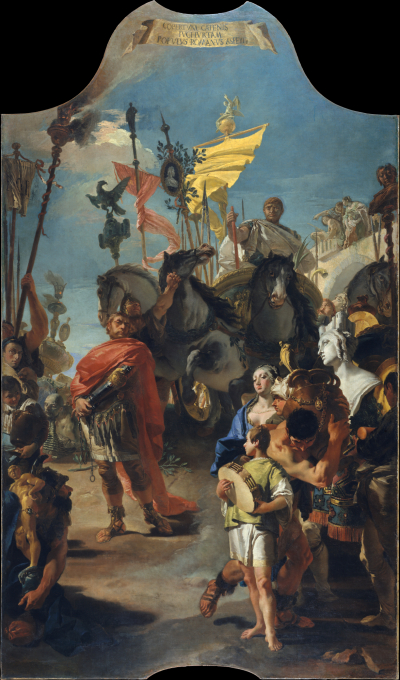
Marius sent his young Quaestor, Lucius Cornelius Sulla, to Bocchus. Sulla bribed Bocchus, and told him that Bocchus would be given a part of Numidia if he would betray Jugurtha. Bocchus then decided to give Jugurtha to Sulla. Sulla took Jugurtha to Rome, where Jugurtha was strangled in the Tullianum in Rome after marching in Marius’ January 1, 104 B.C. Triumph.


The Triumph of Marius (1729) by Giovanni Battista Tiepolo. The inscription in Latin reads “The Roman people behold Jugurtha laden with chains”.

The Jugurthine War was over. But in the process, several problems were exposed that would cause Rome serious pain in the future. Republicans in this country love to tell us that money in politics is harmless free speech. But as we saw in the Roman Republic during the Jugurthine War, money can be very corrupting. Rome almost lost the war because of money in politics, and the susceptibility of public officials to bribery.

In addition, this war saw the rise of two Romans who would play a key role in the events that directly preceded the fall of the Roman Republic. The first Roman made famous through this war was Gaius Marius. Gaius Marius would later hold the Roman Consulship an unconstitutional 7 times in 21 years (constitutionally, a Roman had to wait 10 years before being reelected consul).

The second Roman made famous through this war was Lucius Cornelius Sulla. Sulla and Marius would fight an unconstitutional civil war with each other several years after this war had ended. Sulla would illegally march his troops on Rome, and unconstitutionally legalize the mass killing of Marius’ supporters. Marius’ supporters in the senate would unconstitutionally prevent Sulla from fighting a war during one of Sulla’s consulships. Sulla would eventually seize absolute power for himself. Sulla would be the first Roman to be Dictator in almost 150 years. He would also be the first Roman in history to hold the dictatorship without the traditional six month term limit.

As dictator, Sulla would illegally change the Roman constitution to make himself and his party (the ultra-conservative republican Optimates) even more powerful. And most importantly, Sulla would set the example (of civil war on Romans, and then the seizing of absolute power) that the future tyrant Gaius Julius Caesar would follow.

In the end, the actions taken by key players in the war against Jugurtha would be repeated in the final destruction of the Roman Republic. The future triumvir Pompey would unconstitutionally hold multiple consulships in a short period of time. Crassus, another future triumvir, would illegally bribe politicians to get his way. And the future tyrant Julius Caesar would bribe, unconstitutionally hold the consulship, and become dictator for life (as Sulla had done). It was Caesar’s actions in this regard, as well as the similar actions of his adopted son and heir, Gaius Octavius (later Gaius Julius Caesar Octavianus, the Emperor Augustus) that would once and for all destroy the Roman Republic, and create the Roman Empire.

1. When when, and whenever death closes our eyelids,
2. Moving naked over Acheron
3. Upon the one raft, victor and conquered together,
4. Marius and Jugurtha together,
5. one tangle of shadows.

6. Caesar plots against India,
7. Tigris and Euphrates shall, from now on, flow at his bidding,
8. Tibet shall be full of Roman policemen,
9. And the Parthians shall get used to our statuary
10. and acquire a Roman religion;

11. One raft on the veiled flood of Acheron,
12. Marius and Jagurtha together.
13. Nor at my funeral either will there be any long trail,
14. bearing ancestral lares and images;
15. No trumpets filled with my emptiness,
16. Nor shall it be on an Atalic bed;
17. The perfumed cloths shall be absent.
18. A small plebeian procession.
19. Enough, enough and in plenty
20. There will be three books at my obsequies
21. Which I take, my not unworthy gift, to Persephone.

From Homage to Sextus Propertius, Canto VI by Ezra Pound

On this day..

1899: Hilda Blake, poorhouse orphan

On this date in 1899, domestic servant Hilda Blake was hanged in Brandon, Manitoba for murdering the mistress of the house.

Book CoverThe only woman ever executed in Manitoba is the subject of Walk Towards the Gallows: The Tragedy of Hilda Blake, Hanged 1899 (U.S. Amazon link | Canadian), which charts her course from an English poorhouse to death on the Canadian frontier.

(A Norwich newspaper recently profiled its long-lost pauper daughter here and here.)

On the occasion of the 110th anniversary of Hilda’s hanging, Executed Today was able to sit down with Tom Mitchell, co-author (with his Brandon University colleague Reinhold Kramer) of Walk Towards the Gallows.

Here’s an excerpt from that book. And here are some reviews:

ET: How did you run across Hilda Blake?

TM: It’s a very simple story, really. The province of Manitoba tore an old jail down, and handed the property to the department of health for a senior citizens’ center. So, construction began, and an old jail guard named Bill Ryan showed up on the site and confronted the building superintendent and said, this is holy ground, and it is immoral for you to be constructing anything on this site without removing the human remains.

Hilda and two other victims of capital punishment were on the site, and the guard knew what was there. This made front-page news.

I was doing labor history at the time, so the possibility of finding out a lot of detail about domestic servants was compelling. And it turned out she was sort of a magnet for legal proceedings. When I went to find her court pocket, I found there were actually five court pockets.

As an orphan, she ran away from [her previous placement with] the Stewarts and took up residence with a family headed by a widow homesteader Mary Rex, A legal struggle ensued over who should have Hilda, and in the course of that, Hilda had to make a statement about who she was and where she wanted to be. When we read the letter, it’s clearly not Hilda’s voice, it’s somebody else writing for her. You’re almost always dealing with Hilda second-hand.

There is no other domestic servant probably in the British Empire for whom as much documentation exists, and it’s basically because of Hilda’s notoriety in the murder and these court cases previous. And of course you can track her right back to the British census and the records of the poorhouse and her old neighbourhood and community of Chedgrave, Norfolk England.

The only straightforward account Hilda gives is “My Downfall,” [see below -ed.] and if you read that, you get a pretty good sense of her sensibility. And if you read the press accounts of what she read in jail, you say, right, we’re dealing with a 21-year-old woman for whom literature -– Victorian novels — often times provided her with life strategies and notions of how a woman should conduct herself. Of course Victorian sensation novels were also filled with women who used guns for various ends.

Why was this isolated domestic crime such a big deal?

Western Canada in the 19th century was a frontier, and often times the leading edge of civilization in this frontier were white women and the sort of ideals and morality associated with white women — domestic environment, civility, gender relationships, social class and status involving men and women in terms of how they ought to account for themselves and so on.

So when you have an attack on this sort of basic notion of the social order that people are trying to build, the response is more visceral and more trenchant than it might have been in a more settled community. Here, it was almost akin to the Riel Rebellion: the lower orders are rising against us; every middle-class wife probably looked at her husband and said, “I hope you’re not misbehaving with the help, because we could have a problem.”

So what can we in the 21st century say about how British orphans shipped to Canada for domestic servitude experienced the world? And, of course, about how Hilda specifically experienced it?

Hilda was quite literary in her own way, and she obviously read and developed strategies for life from literature. She seemed to take her role models from literature, and we argue that in part that she can be understood through the books that she read, like Jane Eyre.

My colleague, Reinhold Kramer, whose contribution to Walk Towards the Gallows cannot be overstated, is an English professor. He developed this feature of the biography as well as other fundamental themes of the book.

My continuing frustration with the book is that nobody will see it as labor history. Everybody wants to see it as whodunit or something — but that’s okay; it’s been used for a lot of different courses, some on women, some on crime, some on women and the world of work.

How widespread and significant is this phenomenon of the domestic servant?

From 1870 to about 1930, there were something in the order of about 70 or so thousand children shipped from poorhouses (which were created by the 1830s poor law).

The whole idea of adoption is a 20th century thing. If you were a poor kid, an orphan, in the 19th century, you didn’t get adopted, you were put in a poorhouse and shipped off to Australia, Canada. On the western frontier of Canada, the labor of these children was a valuable commodity.

The British government recently apologized to the descendants of these children for the fact that they were sent out, often with sort of gratuitous statements from the organizations that sent them that they would follow them up. For many of them, it was tragic, and for Hilda and Mary Lane it was more than tragic.

As an economic sector, how important was this domestic service trade to Canada at the turn of the century?

Typically these were young women, and not all of them would be living within the residence of their employer, but most of them would be. The vast majority were young British women — Irish, English, what-not — and it was for women in the paid labor force, this was the main occupation. Young women coming off the farm or young immigrant women, this was one step above prostitution.

So, you could be a sex worker, or you could be a domestic worker. You didn’t get into this if there were options, and many young women would choose options that paid less, just to have social freedom.

So what would be a typical life path for a girl like Hilda?

The premise with Hilda was that she would work as a domestic servant and eventually marry, but the difficulty was that you always carried this badge of your social station.

You had basically no place to meet men in private, and the amount of time off you had was perhaps an afternoon per week. The possibility of you having some kind of independent social life was very very unlikely, so you were a captive of your place in the world of work.

For Hilda, she must have realized that her only escape was in moving up within this small world that she resided in. She kissed Mary Lane before she shot her, and I think was saying, this is nothing personal but it’s my only chance of moving up in the world.

You do a lot with how Hilda Blake played as a political issue, and the symbolism invoked by the press in handling her execution. Frankly, a lot of it seems very contemporary: “villains were bad because they were bad,” crime is “a platform upon which to preach the value of bourgeois order”. How did this crime work as a cultural narrative?

The big issue for Canada in the late 1890s was the quality of immigrant coming to Canada, because it was clear that if the West was going to develop, the country needed hundreds of thousands of people.

Clifford Sifton, who happened to be the MP for Brandon was the Minister for Immigration, and he was bringing Count Leo Tolstoy’s Doukhobors from Russia, Ukrainians from Austro-Hungary, and so on, and he considered these good-quality immigrants because they were agrarian, they could survive. He was being attacked bitterly by people whose ideas of adequate immigrants were shaped by Social Darwinism.

The other problem was that working class immigrants, paupers especially, from Britain were viewed as being marginally adequate because of their questionable morality. The notion of gender at the time was that women were, just by their nature, moral creatures, and if they weren’t, then she was more atavistic than even criminal men — they were moral imbeciles, they were dangerous.

When Hilda Blake murdered Mary Lane, it just happened that a federal election was in the offing, and the main issue that the Conservative party was going to use to try to defeat the Liberals and Clifford Sifton in his own district was immigration, so if the federal government didn’t execute Hilda Blake, they would be handing them an issue to run on.

The Melita Enterprise condemned Hilda early on with the line “we don’t want the Hilda Blakes of the world, they carry blood with the taint of Cain,” which is a great line I wanted to use for the title of our book.

So the federal government faced this dilemma, and our argument was that virtually all women who faced the death penalty had had their sentences commuted, but in the case of Blake, her social background made it impossible.

The one powerful person she had in her corner was the Governor General Lord Minto. The thing that made him susceptible in some senses to understanding the case was his own sense of guilt for the affair he was carrying on with a young woman in Ottawa. That wasn’t a secret; she was nicknamed “Minto’s Folly.”

How about the victim, Mary Lane?

Here was a woman who was murdered by someone she had taken in, been friends with, gunned down in the parlor of her own home. She was a very-well respected person in the community, she was an Anglican, and reportedly sympathetic to women in Hilda’s situation in life.

It’s amazing that Robert Lane manages to avoid coming in even for any kind of censure or public embarrassment.

There was nothing, not in terms of any juridical sense; apparently he wasn’t even interviewed.

The theory of the crime in domestic murders was always the love triangle: if the man of the house got gunned down, the hired man had better look out; in this case, when the woman got gunned down, it was a bit confusing about who would have done this. Ultimately Hilda confessed and protected Lane, but what protected him even more was his middle-class status within that community and the notion that men of that ilk were moral creatures who couldn’t possibly have connived to have had their wives gunned down. If he’d been a working class guy whose morals would have been more suspect, he probably would have been hanged with Hilda.

I think the authorities also couldn’t have been unaware of the implications: if they hanged Lane, his four kids would be orphans.

How widespread were these sexual relationships — or sexual exploitation — between masters of the house and domestics?

Domestic servants should have received danger pay, because they were victimized so often. Most of the women set up in these Magdalene Houses, these houses for single women who were pregnant, were domestic servants.

We talk about the amendments to the criminal code in the late 19th century, and there were some protections put in for women, but Charles Tupper, a Conservative, opposed these because he said they would arm domestic servants with terrific power to blackmail their employers. So the largest class of women in the paid economy were left outside the protection of the code, and any domestic servant who claimed that their employer impregnated them would face a court that would use every possible mechanism to get at their immorality.

It was almost akin to a feudal relationship within the home.

Why did Hilda plead guilty and ask for the maximum punishment?

This was, I think, Hilda’s sense of how a proper woman would behave. You have to think of Hilda growing up as an orphan, with no strong role models. So a lot of I think how she thought of herself and how she should behave came out of what she read.

Reviewers of the book weren’t always satisfied with that.

Sure. You write that “writing a history that did not ignore Blake’s subjectivity required a historical ‘reading’ of a wide range of sources,” and you build some ambitious speculative history on that basis. What kind of reception did that get?

Some reviewers saw that treatment as sort of postmodern, that we were satisfying ourselves with kind of a literary account of Hilda without too seriously thinking about the things we couldn’t talk about because we didn’t have the evidence.

We didn’t go that way without first being made aware by Hilda of her own great interest in novels and coon songs — the sort of Victorian era rap music; it’s a lower-class music, a sort of Victorian blues … you can see how Hilda would have identified.

We felt it was quite reasonable to argue as we did that often times her life strategies were rooted in Victorian novels.

Is there any sort of lasting public memory of these events, or were you resuscitating a completely cold case?

The Lane family still resents any discussion of this case. They still reside in Brandon, and it’s still a very live matter for them.

One descendant from outside Brandon called me after the book published and told me it wasn’t at all the version he had heard growing up. The story he’d been told is that Mary died when she was standing out in her front yard and she was hit by a bolt of lightning.

By the same token, after Hilda accused a tramp of the shooting, all the itinerant foreign born men in town making their way from one job to another were rounded up. There’s another family we found that who had a story in the family that grandpa had almost been hanged when “the maid fell in love with the master and murdered the mistress.”

It’s really fascinating how these echoes of the past persist through family oral tradition. These are the skeletons in the closet, and they show up in different guises.

In Brandon once a year, a local dramatic society go to the cemetery in Brandon and represent various well-known figures in the graveyard, and the public is invited to go and ask them questions about their lives. After the one year where Robert Lane was represented by one of the actors, his descendents objected and said that it was a serious incursion into their family privacy.

How about Hilda? Has she been portrayed?

Hilda hasn’t been represented because she’s not in the cemetery; she’s still under the senior citizens’ building. The superintendent told me he got a backhoe and an undertaker one Saturday and went exploring for human remains, and they couldn’t find any. So the building project went ahead and Hilda is now under the northeast corner of the Rideau Park Personal Care Home. Not exactly what the poorhouse guardians had promised Hilda’s older sister when they sought her permission to send Hilda and her brother Tommy to Canada in 1889.

Tom Mitchell and Reinhold Kramer are also co-authors of the forthcoming When the State Trembled: How A.J. Andrews & the Citizens Broke the Winnipeg General Strike.


“My Downfall”
by Hilda Blake

(From Walk Towards the Gallows, as published on the Western Sun, Dec. 14 1899)

One I was innocent, lighthearted and gay,
And sang while I worked through all the long day;
A stranger to sorrow, not a care had I,
A laugh on my lip, but never a sigh.

But one day the devil, in the form of a man,
Came smiling towards me; said he “You can
Know more, if you’ll take them,
Of joy and pleasure,” I heard him say,
“Than e’er you have dreamed of; I’ll show you the way.”

I followed the tempter, along the smooth track,
I’d gone a long distance, ‘fore e’er I looked back,
Or thought of returning —
When I turned, the way back seemed so lonely and dreary,
E’er I’d gone many steps I grew footsore and weary,
That down by the roadside, to rest and to weep,
My strength was exhausted, I soon fell asleep.

I awakened refreshed, my exhaustion all gone,
Saw the phantom of Pleasure, still beckoning me on;
Then I made up my mind
To leave Prudence behind,
And pursue my perilous way.

As I journeyed along my heart lost its song,
For the path grew stony and dark;
Each step that I took tore the flesh off my feet,
And the track was a blood-stained mark.

I looked at the tempter, in his eye was a gleam;
I saw he was standing beside a dark stream;
He cried, “Come along, take a few steps more
And your struggle is ended, your journey is o’er.”

As I stood on the brink of that river,
My heart grew faint and sick;
What I saw only made me shiver —
I thought Fortune had played me a trick.

“As I look across I see only the dead,
Neither joy, nor pleasure,” to Satan, I said:
“But pleasures there are, though hidden from view,
They only wait to be claimed by you.”

I thought as he spoke, he moved his hand
And I saw I was standing on sinking sand.
As I leaped across, a frantic yell
Reached my ear
When too late, I saw I had leaped into hell;
I tried to go back, but an awful wall
Loomed up, and separated me from all
My youth and innocence.

Forsaken by friendship, kith, and kin
I lie in my lonely cell;
It seems but a dream that I’ve crossed that dark stream
And descended from heaven to hell.

You hypocrites, pleading religion,
You inquisitive seekers of fame,
Ready now with your good advice
When I’ve drunk of the sorrow and shame;
You gave me no timely warning,
You held out no helping hand, —
Why didn’t you see me sinking
As I stepped on this treacherous sand?

Oh Friend of all Friends who rules earth and sea,
Look down with a pitying eye upon me;
Thou’ll forgive my transgressions, says the book that is best —
Come ye that are weary, and I’ll give you the rest.

On this day..

2009: Khristian Oliver, Bible basher

(Thanks to John Temple, author of The Last Lawyer: The Fight to Save Death Row Inmates and journalism professor at West Virginia University, for the guest post. -ed.)

Barring a last-minute stay of execution, Khristian Oliver will be put to death late this afternoon.

(Update: Khristian Oliver has indeed been executed as scheduled. His likeness lives on in an altarpiece made by his father, an artist.)

In 1998, Oliver, now 32, shot and killed a man whose home he was burglarizing. Oliver’s guilt isn’t being questioned. The argument his attorneys and supporters are using to stave off his upcoming execution has to do with how the jurors in his case handled his sentencing.

An Oct. 15 story in The Guardian described the scene in the jury room this way:

A clutch of jurors huddled in the corner with one reading aloud from the Book of Numbers: “The murderer shall surely be put to death” and “The revenger of blood himself shall slay the murderer.”

Another juror highlighted passages which she showed to a fellow juror: “And if he smite him with an instrument of iron, the murderer shall surely be put to death.” (Apparently one of the same passages, Numbers 35:16, in fuller context.)

Juries debating this most difficult decision often reach for Biblical guidance, and there are no shortage of verses that relate to capital punishment, including the famous “eye for an eye” passage(s). Courts have ruled this improper, not because the Bible is a religious document, but because it is extrinsic evidence, meaning it was not properly introduced as evidence.

The same issue arose in the central case in my new book, The Last Lawyer: The Fight to Save Death Row Inmates.

To write the book, I shadowed a North Carolina legal team for four and a half years as they fought to overturn the death sentence of a man named Bo Jones. The attorneys crisscrossed the back roads of North Carolina to track down and interview most of the jurors from the trial, two of whom chased them off their property. In the end, the attorneys found one woman who claimed that a Baptist minister on the jury had brought a Bible into the room and quoted passages from it.

In the end, this claim didn’t help Bo Jones. A federal appeals judge threw it out, saying his lawyers hadn’t proved that the Bible-quoting had influenced the jury’s verdict. But Jones’s attorneys had plenty of other arguments up their sleeves, while Oliver’s supporters seem to be putting most of their emphasis on the Bible argument.

It remains to be seen whether this will bewas not enough to spare his life.

Update: Prolific death penalty defense attorney David R. Dow (author of Autobiography of an Execution) on his client, Khristian Oliver.


On this day..

1666: Robert Hubert for the Great Fire of London

On this date in 1666, a hapless French watchmaker was hanged at Tyburn for starting the Great Fire of London — his obstinate confession in the face of all other evidence making him the convenient fall guy for an accidental cataclysm.

Of Robert Hubert Lord Clarendon would write,

though the Chief Justice told the King, ‘that all his discourse was so disjointed that he did not believe him guilty;’ nor was there one man who prosecuted or accused him: yet upon his own confession … the jury found him guilty, and he was executed accordingly. And though no man could imagine any reason why a man should so desperately throw away his life, which he might have saved, though he had been guilty, since he was only accused upon his own confession; yet neither the judges, nor any present at the trial, did believe him guilty, but that he was a poor distracted wretch weary of his life, and chose to part with it this way. Certain it is, that upon the strictest examination that could be afterwards made by the King’s command, and then by the diligence of Parliament, that upon the jealousy and rumour made a Committee, who were very diligent and solicitous to make that discovery, there was never any probable evidence, (that poor creature’s only excepted,) that there was any other cause of that woeful Fire, than the displeasure of God Almighty.

Executed Today is pleased to interview Meriel Jeater, curator of the “London’s Burning” exhibit now on display at the Museum of London, on what the Great Fire wrought.


More Great Fire images, including a map of the destroyed area, here.

Was London lucky to have the Great Fire?

Yes, I suppose so. Lots of people have sort of argued that London missed an opportunity to make more changes, but they just didn’t have the money to do them at the time.

There were a lot of improvements made. They widened the streets. The city was rebuilt in brick instead of wood, although that rule was in place from before 1666. The regulations were restated and extra ones were added in; a lot of people think that it was because of the Great Fire that people started building in brick, but that regulation already existed from earlier in the 17th century.

You’ve got acres and acres and acres of land that have been reduced to rubble during the Great Fire, and en masse, all these new buildings are going up. But yes, it made life more healthy & more pleasant in the city. You had pavement put in for the first time. All these little things you wouldn’t think of, like the houses had to have gassers for the first time, as opposed to just spouts that would spray water on you if you walked down the street. The Great Fire gave people the opportunity to get rid of all those inconveniences.

And they were able to do other things, like the slope down to the River Thames was quite steep, and they were able because of all the rubble to ease the slope.

How did it reshape London? What might have been different about the subsequent life of the city if it had never occurred?

Within days of the fire going out, various architects like Christopher Wren were supplying architectural plans to rebuild London, perhaps around an American grid plan, or European-looking piazzas.

What they really wanted to do was get people moving back into London and rebuilding their houses as quickly as possible, so they kept the medieval street plan and instituted new regulations, like the streets had to be widened, and they could no longer build the houses hanging into the street. The size of the house you could build was proportional to the size of the street you were on, so if you lived on a main boulevard instead of a small lane

Where’s the best place in London to catch a glimpse of that world, as it looked then?

It’s kind of a hidden thing because of course we were bombed in the Second World War, but there are places, like behind St. Paul’s Cathedral, in Amen Court.

So who is Robert Hubert?

He’s a French watchmaker from Rouen, and he was seized in Essex apparently attempting to flee the country. There were various other foreign people who were seized as well, but Hubert confessed to starting the fire.

But his evidence* was very conflicting; he kept changing his mind of what he’d done. He said he’d been part of 23 conspirators and put a fireball through the window of the bakery where the fire started. The baker himself said there wasn’t a window there.

The jury really thought that Robert Hubert was mad, but he was so insistent that he’d done it.

The following year, they discovered that he hadn’t actually arrived in London until two days after the fire started.

Lucky for the baker! He didn’t end up catching any blame for burning down the city?

Hubert was a very convenient scapegoat, and Thomas Farynor** of the bakery was incredibly relieved. Right from the start, Farynor had said “I put my oven out that night, it can’t possibly be me, it must be arson.”

I’ve had a little look at the records of Pudding Lane to see whether he rebuilt his house, and he did.

One of the interesting resources on your site deals with the going fear of “Catholic incendiarism” (pdf), and the use of the Great Fire as a touchstone for the succession conflicts of the 1680’s. Would it have been conventional wisdom by that time, a generation or so after the event, that the Great Fire was a Catholic plot?

It becomes all caught up in the contemporary politics of the time, so it’s really got nothing to do with the fire. It’s people not liking James II for being a Catholic. It’s the fictional Popish Plot, completely fabricated. It’s probably not a coincidence that at the height of the Popish plot that they put up the plaque on the side of the bakery saying that the Fire came from “the malicious hearts of barbarous Papists.”†

Given the combustible material all about, why wasn’t something like the Great Fire a more regular occurrence?

There were six serious fires in the 17th century before the Great Fire happened; one of them was a great explosion of gunpowder.

Fires were sort of a common hazard. The thing about the Great Fire was that there was sort of a whole load of circumstances. There was a drought, so it was dry; there were storm winds coming in from the east, so it blew the fire on faster than it would have; it started at 1 o’clock in the morning, so people were in bed. I think the problem is that it’s all these circumstances combining together. Maybe if it happened at 3 o’clock on Monday when it was raining, it wouldn’t have gone beyond the block.

Logistically, how did the society and the state handle the mass homelessness and unemployment that followed? Where did all these people live right after the fire, and how smoothly were they reintegrated?

People were camping out in the fields outside of London; others were moving into areas that were unburnt but having to pay hugely inflated rents. Some people had to move into other towns. There was evidence that people were still living in shantytown tented accommodations up to eight years after the fire, because there’s another rebuilding regulation in the 1670s that addresses that.

In the first year after the fire, only 150 houses are rebuilt; the rebuilding happens over 10 years, though some houses took up to 30 years. Some people were in very desperate circumstances, so formerly very wealthy people who had lived off their rents might now be working as servants. People coped, a lot of times in reduced circumstances from what they were used to.

There was a particular man you can read about in Samuel Pepys’ diary, and he threw himself into a pond in an attempt to commit suicide because he was so indebted.‡

As curator of an exhibit, what do you hope visitors take away from London’s Burning?

One thing that I really wanted people to understand as they go around the exhibition is the effect on people. You learn about it at school, but you don’t really focus on how people cope and how they rebuild.

There’s also a lot of urban myths about the Great Fire, like the ‘fact’ that the fire is supposed to have ended the Great Plague, which is not the case (pdf); those are things we wanted to dispel.


* There’s some original documentation from the examination of Hubert and others after the Fire here.

** Also spelled Thomas Farriner — or Faryner, or Farryner.

Christopher Wren’s monument to the Great Fire of London.

† An inscription on the base of the Great Fire monument itself (only chiseled out in 1830), once read:

This pillar was set up in perpetual remembrance of the most dreadful burning of this protestant city, begun and carried on by the treachery and malice of the popish faction, in the beginning of September, in the year of our Lord, 1666, in order to the carrying on their horrid plot for extirpating the protestant religion, and old English liberty, and introducing popery and slavery. (Source)

Alexander Pope savaged this civic pamphleteering with the couplet,

Where London’s column, pointing at the skies,
Like a tall bully, lifts the head and lies.

Poets and elites might think what they like, but Lord Clarendon recorded a popular anti-foreigner freakout as England reached

a universal conclusion, that this Fire came not by chance … the wicked authors … were concluded to be all the Dutch and all the French in the town, though they had inhabited the same places above twenty years. All of that kind, or, if they were strangers, of what nation soever, were laid hold of; and after all the ill usage that can consist in words, and some blows and kicks, they were thrown into prison. And shortly after, the same conclusion comprehended all the Roman Catholics, who were in the same predicament of guilt and danger … In the mean time, even they [the King’s Privy Councilors], or any other person, thought it not safe to declare ‘that they believed that the Fire came by accident, or that it was not a plot of the Dutch and the French and Papists, to burn the City;’ which was so generally believed, and in the best company, that he who said the contrary was suspected for a conspirator, or at best a favourer of them. (Source)

‡ Pepys’ diary, January 21, 1668.

the story is that it seems on Thursday last he went sober and quiet out of doors in the morning to Islington, and behind one of the inns, the White Lion, did fling himself into a pond, was spied by a poor woman and got out by some people binding up hay in a barn there, and set on his head and got to life, and known by a woman coming that way; and so his wife and friends sent for. He confessed his doing the thing, being led by the Devil; and do declare his reason to be, his trouble that he found in having forgot to serve God as he ought, since he come to this new employment: and I believe that, and the sense of his great loss by the fire, did bring him to it, and so everybody concludes.

Although the man survived the drowning, he caught his death from the attempt and died in bed; Pepys intervened to see that the desperate suicide’s remaining estate would not be confiscated from his widow for his “self-murder.”

On this day..

1415: Bardolph, Hal’s friend

On this date in 1415, on the eve of the Battle of Agincourt, the young English King Henry V approved the execution of his onetime boon companion Bardolph in William Shakespeare’s Henry V.

The fictional Bardolph had been the ruddy-nosed friend of Henry’s in the Henry IV plays (Part 1, Part 2), where the hard-drinking, rabble-rousing young prince is a disappointment to the father who fears his heir will never merit the throne.

By Henry V, the boy has become the ruler, and launched an audacious incursion into France during the Hundred Years’ War.

Hal’s willingness to own the rough decisions of statecraft — in this case having his friend put to death further to his win-French-hearts-and-minds policy — is part of his coming of age as Henry V.

Whether that means Hal’s maturation into regal dignity or the corruption of his humanity by power is up to the reader.

KING

How now Fluellen, cam’st thou from the Bridge?

FLUELLEN

I, so please your Maiestie: The Duke of Exeter
ha’s very gallantly maintain’d the Pridge; the French is
gone off, looke you, and there is gallant and most praue
passages: marry, th’ athuersarie was haue possession of
the Pridge, but he is enforced to retyre, and the Duke of
Exeter is Master of the Pridge: I can tell your Maiestie,
the Duke is a praue man

KING

What men haue you lost, Fluellen?

FLUELLEN

The perdition of th’ athuersarie hath beene very
great, reasonnable great: marry for my part, I thinke the
Duke hath lost neuer a man, but one that is like to be executed
for robbing a Church, one Bardolph, if your Maiestie
know the man: his face is all bubukles and whelkes,
and knobs, and flames a fire, and his lippes blowes at his
nose, and it is like a coale of fire, sometimes plew, and
sometimes red, but his nose is executed, and his fire’s
out

KING

Wee would haue all such offendors so cut off:
and we giue expresse charge, that in our Marches through
the Countrey, there be nothing compell’d from the Villages;
nothing taken, but pay’d for: none of the French
vpbrayded or abused in disdainefull Language; for when
Leuitie and Crueltie play for a Kingdome, the gentler
Gamester is the soonest winner.

This is Laurence Olivier’s 1944 version of the scene, with the commoner Bardolph well off-camera:

… and Kenneth Branagh’s more pathos-laden 1989 interpretation, with the king wavering a moment as he locks eyes with his doomed subject, and flashing back to bygone scenes of conviviality before delivering his troop the stern lesson of his friend’s strangling:

Although Bardolph himself and his prior relationship with his sovereign are fiction, the action of the scene actually proceeds from reality. Shakespeare has (as is his wont) cribbed Holinshed, who relates that Henry’s army was under strict orders not to pillage the countryside, and observed that discipline to a man —

except one, which was, that a souldiour tooke a pix out of a church, for which he was apprehended, and the king not once remooved [i.e., he halted] till the box was restored, and the offendor strangled. The people of the countries thereabout, hearing of such zeale in him, to the maintenance of justice, ministered to his armie victuals, and other necessaries, although by open proclamation so to doo they were prohibited.*

* As quoted in the very apt 1992 “Shakespeare’s Henry the Fifth and the Law of War” by Theodor Meron, American Journal of International Law, vol. 86, no. 1.

Part of the Daily Double: Agincourt.

On this day..

1283: Dafydd ap Gruffydd, Prince of Wales

(Thanks to Jonathan Shipley of A Writer’s Desk for the guest post. -ed.)

Do not cross King Edward I.

If you cross “Longshanks,” as the regal man was called, you’re in for some serious pain. And then, eventually, you’ll die, like Dafydd ap Gruffydd did this day in 1283.

It is Dafydd, a Prince of Wales, who became the first prominent person in recorded history to have been hanged, drawn and quartered.

Yes, Dafydd’s death was particularly gruesome. Having fought alongside King Edward against Dafydd’s own brother and then returning to his brother’s side attacking King Edward’s Englishmen at Hawarden Castle, made the king rather peeved.

The English conquest of Wales: end of an era.

When Longshanks got the better of him, Dafydd was dragged through the streets of Shrewsbury attached to a horse’s tail. He was then hanged, but not enough to kill him, just enough to make it awfully uncomfortable.

More uncomfortable was the emasculation.

Perhaps more uncomfortable than being emasculated was when Dafydd was disemboweled and his entrails burned before his eyes.

Then they cut off his head, which must have been a relief.

Then they cut off his limbs.

Then they parboiled his head for later viewing.

(William Wallace met the same fate from the same king a couple of decades later.)

It wasn’t always so gruesome for Dafydd ap Gruffydd, the well-to-do Welshman. Things were going quite well there for a time -– as good as a bloody power struggle with your brother can be. Prince of Gwynedd, son of Gruffudd ap Llywelyn, grandson of the mightly Llweyln the Great, Dafydd ap Gruffydd was born in 1238 under the English King Henry III. In his teens, that wily rebel, Dafydd joined one brother (Owain Goch ap Gruffydd) to challenge another brother (Llywelyn ap Gruffydd) for power. Llwelyn won at the Battle of Bryn Derwin. In 1263 Dafydd tried again, joining King Henry against his brother. In 1274 he tried once again. This time with the new king, “Longshanks.”

Things were great. Dafydd was favored by the king. He married Lady Elizabeth Ferrers, daughter of the 5th Earl of Derby. He enjoyed a manor in Norfolk, before exchanging it for another in Northampton. Indeed, it was high society living for the Welshman.

But Wales wanted independence from England. In the spring of 1282 Dafydd, with his brother (the one he tried to defeat many times before, Llywelyn) attacked an English castle. Foolish. Compelled to help his brother yet not being prepared for all-out war, Dafydd crossed the king and the king, angered, pursued him with a vengeance. Troops marched out. Fortifications (Caernarfon Castle, Conwy Castle, Harlech Castle, etc.) were thrown up to squash any thoughts of any further Welsh rebellion, and seed the future Welsh tourist industry.

Come December of 1282, Llywelyn, Dafydd’s dear brother, was lured into a trap and killed. Dafydd became prince, for a brief and stressful span, what the pursuit of the Enligh army, and a king behind it all still fuming over being backstabbed by a Welshman.

Whenever the English caught up with him, he escaped. In April he went north to Dolbadarn Castle. In May he moved to Garth Celyn. Then to a bog. It was by Bera Mountain, in said bog, that Dafydd and his younger brother Owain were captured on June 22, 1284. Dafydd’s wife was taken prisoner, as were their seven daughters, and one niece. About a week later Edward proclaimed the last of the ‘treacherous lineage’ were now his. Dafydd’s fate was then discussed by parliament.

He was condemned to death, the first person known to have been tried and executed for what, from that time onwards, would be described as high treason against the King. And treasonous blokes don’t get off very easily when it comes to a peaceful execution. No, his entrails were burned before him for “his sacrilege in committing his crimes in the week of Christ’s passion.” His body was chopped up “for plotting the king’s death.” A gentlemen by the name of Geoffrey carried out the execution of the last native Prince of Wales. His payment? 20 shillings.

On this day..