1877: Jack McCall, Wild Bill’s murderer

On this date in 1877, Jack McCall was hanged in Yankton, South Dakota, for the murder of Wild Bill Hickok.

It was the most notorious crime in the old west: the legendary gunfighter and lawman shot from behind playing poker in the gold rush town Deadwood, S.D. on August 2, 1876.

McCall‘s grievance against Wild Bill remains unclear, which seems no less than properly atmospheric. One version has him losing at cards to Hickok the night before the murder, then humiliated to accept Hickok’s charity for his evening meal. Since Deadwood sprang up on Lakota Sioux land in defiance of treaty obligations and thus was an outlaw settlement without legal oversight, McCall might also have been engaged by another party to eliminate the town’s de facto source of law further to some private profit.

That speculation gains some circumstantial support from the surprising proceedings the following day. An impromptu “miner’s court” acquitted McCall — the defendant claimed to have been avenging the murder of a brother who does not seem to have ever existed at all — of a murder they plainly knew he committed. This obliging verdict prompted a newspaper to remark,

Should it ever be our misfortune to kill a man … we would simply ask that our trial may take place in some of the mining camps of these hills.

McCall made for Wyoming, but couldn’t resist boasting of his famous crime, which was known to have graduated into a fair gunfight in his retelling. The times and the lands were unsettled enough that with an ounce of discretion he might have vanished. Instead, his loose lips got him nabbed by a federal marshal and extradited back to South Dakota — where he learned that the miner’s court verdict of an illicit settlement didn’t count as a legal acquittal for purposes of double jeopardy.

His hanging this morning — with the pertinent last words, “draw it tighter, Marshal” — was the first legal execution in South Dakota.

Like the reason for his one memorable act, McCall was an obscure character; his background was uncertain even when he lived. It was only through his victim that he left an imprint: he certainly elevated the legend of Hickok, whose cinematic demise also bequeathed to the arcane poker argot the term “dead man’s hand” — a pair of aces and a pair of eights (or more specifically, the black aces and black eights; the fifth card is uncertain) — after the last hand of cards Wild Bill ever held.

The dead man’s hand. Image used with permission.

On this day..

1606: Guy Fawkes and other Gunpowder Plot conspirators

On this date in 1606, Guy Fawkes, “the only man to ever enter parliament with honorable intentions,” was hanged, drawn and quartered in London with three conspirators for attempting to blow up the Houses of Parliament … and the government with it.

Fawkes, a soldier, was part of the Gunpowder Plot, a Catholic attempt to assassinate the new king James I when it became clear the House of Stuart would continue its Tudor predecessors’ intolerance of the Roman church.

The conspiracy was crowded, so it was something of a miracle the secret kept for over a year while the plotters filled a rented room under the House of Lords with 36 barrels of gunpowder and waited for parliament to open. The explosion would have slain not only James, but numerous officials of the government; the conspirators’ “then what?” plan seems a little vague, but with a modern recreation confirming that the gunpowder packed under Westminster was sufficient to blow the place to smithereens, it’s safe to say something dramatic would have ensued. That “something” might easily have been a savage crackdown against Catholics.

All that remains safely in the domain of the speculative — because as the date approached, one of the conspirators felt moved to warn a Catholic Lord in writing not to attend the opening.

My lord out of the love i beare to some of youere frends i have a care of youer preseruasion therefor i would advise youe as youe tender youre life to devise some excuse to shift of youre attendance at this parliament for god and man hath concurred to punishe the wickedness of this time and think not slightly of this advertisement but retire youre self into youre contri where youe may expect the event in safti for thoughe there be no appearance of any stir yet i saye they shall receive a terrible blowe this parliament and yet they shall not see who hurts them this councel is not to be condemned because it may do youe good and can do youe no harme for the dangere is passed as soon as youe have burnt the letter and i hope god will give youe the grace to maketh good use of it to whose holy protection i commend youe.

Subtle.

Fawkes was not the leader of the conspiracy, but his wartime siege experience made him an important participant in an operation similar to undermining a castle. The affair became remembered to history under his name because he was the one caught when, once the incriminating letter was turned over to the government, yeoman guards searched the cellars.

Fawkes was tortured by express permission of the king for his conspirators’ identities, but held his tongue; those conspirators, however, went ahead with the desperate uprising that was supposed to follow the explosion, and within days they had been apprehended or killed.

Four lesser conspirators were hanged, drawn and quartered on January 30; the remainder suffered that dreadful fate today. Fawkes himself, however, managed to avoid the worst of it by leaping from the scaffold when he was strung up to be half-hung — so he was dead of a broken neck when disemboweled.

The fortuitous abortion of this stupendous act of terrorism (if we can call it “terrorism”) made November 5 Guy Fawkes Night on the English calendar, still a day of fireworks and bonfires in many of the Commonwealth countries.

Remember, remember the Fifth of November,
The Gunpowder Treason and Plot,
I know of no reason
Why Gunpowder Treason
Should ever be forgot.
Guy Fawkes, Guy Fawkes, t’was his intent
To blow up King and Parli’ment.
Three-score barrels of powder below
To prove old England’s overthrow;
By God’s providence he was catch’d
With a dark lantern and burning match.
Holloa boys, holloa boys, let the bells ring.
Holloa boys, holloa boys, God save the King!

The opening lines of this 17th century poem celebrating the king’s miraculous deliverance introduce the 2006 film V for Vendetta

… in which Fawkes’ subversive persona is pitted against a theocratic dictatorship in the dystopian near future. It’s notable for a forthright celebration, in a mass-market film, of the liberatory power of terrorism.

Today’s well-known victim also left a less obvious but more ubiquitous cultural artifact. The practice of marking Guy Fawkes Night with effigies of the traitor — “Guys” — caused the word to enter the general lexicon as slang for a strangely-dressed man, eventually coming to mean any man (or, arguably, any person regardless of gender) at all.

The House of Commons has a fact sheet (.pdf) on the affair.

Part of the Themed Set: The English Reformation.

On this day..

1853: Nicholas Saul and William Howlett, teenage New York gangsters

On this date in 1853, two chiefs of the New York street gang Daybreak Boys were hanged at “the Tombs” jail in Manhattan.

It was a yeasty era in the Big Apple, burgeoning with immigrants into one of the great urban centers of the world. The city’s stupefying growth — it would triple in size during this generation — fertilized a thousand niches, neighborhoods and enclaves, all the boroughs’ glorious mess.

Not for the last time in the city’s history, organized crime* flourished, too:

Gangs were sometimes necessary as a support system for the new immigrants, who were otherwise powerless. Soon, the gangs were the undisputed rulers of their districts, and the politicians soon began to call upon them for assistance. Before long, an election day in New York City meant sinister looking men armed with clubs hovering around the polling places ensuring that people voted for the “right” candidate.

Other gangs operated independently of the political machines and served only themselves and answered to no one. They were found mostly along the waterfront of the Fourth Ward, and were likened to bloodthirsty pirates who plundered vessels in the harbor, killing anyone who got in their way.

The Daybreak Boys was one such gang. Operating out of Pete Williams’ gin mill at the intersection of James and Water Sts., an area known as Slaughterhouse Point, the Daybreakers were the terror of the East River in the early 1850s. Between 1850 and 1852, they were credited (blamed?) for the loss of $100,000 in property and at least 20 murders. The origin of their name is uncertain, though that they were known to operate on the East River sometimes into the early morning is a theory. The phonetic spelling of “b’hoy” soon became a badge of honor for men in the area, for a man was not truly considered part of the “in” crowd if he were not “one of the b’hoys.”

It was an era Martin Scorsese depicted in Gangs of New York:

The Prohibition-era book that gave title and inspiration to that film is the go-to source on the Daybreak Boys, among many other contemporaneous criminal syndicates. Nicholas Saul, hanged in his 20th year, co-founded and led the gang of youthful toughs. Their evolution towards murderous piracy on the Hudson and East Rivers set the backdrop for this day’s drop: they had killed a watchman during an unsuccessful raid on a ship the previous summer, and been cornered and arrested by police.

Local luminaries — including the gangster played by Daniel Day-Lewis in the Gangs clip above — turned out for the occasion to pay the condemned tribute, shaking hands with the young men on their way to the gallows.

The Daybreak Boys would have a few years left in their run yet. A fellow with the estimable nickname of Slobbery Jim inherited leadership — talents that would later serve him as an officer in the Confederate army — and the enterprise didn’t peter out until the depredations of kindred river raiders drove the New York Police Department to establish its Harbor Unit.

* Often colorfully named.

On this day..

1142: Yue Fei, paragon of loyalty

On this date in 1142, the great Chinese general Yue Fei was executed by the Song dynasty he had loyally served.

Loyalty is what Yue Fei is known for, so unbendable that going on nine centuries later it can still work as shorthand for understanding the daily paper.

Yue fought for the Song Dynasty against the neighboring Jin Dynasty. He was a disciplined commander, an honorable and well-studied man — the very Confucian ideal.

The tale about him — the reason he is so well-recalled as a model of patriotism — is that his counterattack after the Jin overran the northern half of the Song realms was so effective that it threatened to repel the invaders. On the cusp of conquering the old northern capital, Kaifeng, he was supposed to have been ordered to lift the siege and return — an order Yue obeyed for the safety of his kingdom, even though it meant fatally confiding himself to his enemy‘s power.

The story’s dramatics are to be doubted; he seems in fact to have been recalled (with other officers) after the battle and duly cashiered into a civilian post months before dying. Much of Yue Fei’s biography is recorded by undependable sources such as a fantastical biography written decades after his death, and a historical novel dating to centuries later. Even his death — whether execution or simple murder, and the means by which it was effected — is not reliably reported.

But his place in the firmament of Chinese heroes is well beyond dispute. Yue Fei was rehabilitated not long after his death, and a shrine built (still on public display to this day) with statues of his persecutors, often abused by visitors, carved kneeling in supplication.

Yue Fei’s mausoleum in Hangzhou.

And just as Yue Fei is a pinnacle of honor and loyalty, those who struck him down remain contemporary emblems of infamy. It is said that the Song minister Qin Hui, pressed for his reasons for ordering Yue’s execution, responded to the effect that “Though it isn’t sure whether there is something that he did to betray the dynasty, maybe there is.” As a result, the phrase maybe there is or it could be true denotes trumped-up charges in Chinese. In a more toothsome vein, the traitors who slew the general are also supposed to have given Chinese cuisine the fried-dough dish youtiao.

Update: The Yue Fei legend gets a skeptical inquiry in view of the political situation on the ground here.

On this day..

Feast Day of St. Catherine of the Wheel

This date annually is the feast of iconic — perhaps mythological — Christian martyr Saint Catherine, said to have been put to death in the 4th century for her faith.

St. Catherine in a 700-year-old stained glass at St. Mary’s Church of Deerhurst. Image courtesy of the Sacred Destinations Travel Guide.

One of the most popular Catholic saints, St. Catherine was reputed to have been a beautiful young maiden of Alexandria — so wise as to convert every pagan scholar sent to dispute her, so devoted as to be mystically betrothed to Christ.

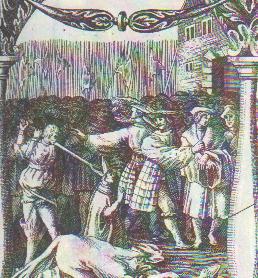
Catherine was condemned by one of the last pagan rulers of Rome to torture on a breaking wheel, which shattered when it touched her — so she was simply beheaded. (The story is related in didactic iconography in this triptych.)

Despite this inauspicious debut, the breaking wheel was Catherine’s iconic attribute, by which her frequent appearances in devotional art can be recognized.

This gruesome instrument of torture was also known as the “Catherine wheel” in medieval Europe, from which English derives the deceptively winsome-sounding name of a firework.

The saint became the patron of those condemned to this horrific death as well as a diverse swath of the wider society: wheelwrights, mechanics, and other laborers who worked with wheels for apparent reasons; teachers, philosophers and scribes for her learning; girls, virgins and young maids for her purity. Single women seeking husbands still offer her supplication:

St. Catherine, St. Catherine, O lend me thine aid
And grant that I never may die an old maid.
A husband, St. Catherine.
A handsome one, St. Catherine.
A rich one, St. Catherine.
A nice one, St. Catherine.
And soon, St. Catherine.

Catholic recountings of the saint’s legend can be read here and here. More St. Catherine’s Day customs are enumerated here.

On this day..

1915: Joe Hill

On this date in 1915, songwriter, poet and labor activist Joe Hill was shot in Utah for the murder of a local butcher.

Even before his execution, the Swedish immigrant was widely thought to have been railroaded for his IWW affiliation.

Though state authorities had little use for the worldwide clemency bid whose backers included U.S. President Woodrow Wilson — powerless to intervene officially, since the execution was a state matter — Hill walked spryly into his martyrdom. The strange post-mortem career of his totemic ashes is the least of the ways Hill lives on.

His dauntless last message to fellow Wobbly Bill Haywood — “Don’t waste any time mourning. Organize.” — is a permanent fixture on pins and placards among every stripe of left activist. The songs he wrote remain in print — and in performance.

And the Depression-era tribute ballad “I Dreamed I Saw Joe Hill Last Night” can seamlessly serenade ripped-from-the-headlines footage, as a Paul Robeson rendition does in these clips of 1998 protests against then-New York City Mayor Rudy Giuliani.

On this day..

1520: Stockholm Bloodbath

On this date in 1520, four days after the Danish King Christian II gained the Swedish throne, nearly 100 prominent supporters of Swedish independence were executed en masse as a civil war’s apparent victors purged their enemies.

The Stockholm Bloodbath followed years of conflict between supporters of the Danish-dominated Kalmar Union and independence advocates under the banner of Sten Sture the Younger. With Sture’s death in battle earlier in 1520, the unionists had gained the upper hand. Stockholm, the last outpost of resistance, had held against four months’ siege before accepting a general amnesty in exchange for capitulation.

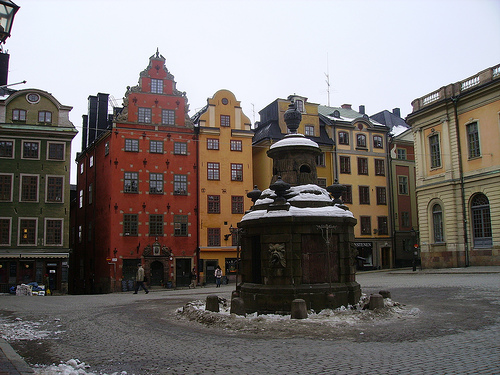
But with the city in hand, Christian — known to Swedish history as “Christian the Tyrant” — had its leaders charged for having deposed during the conflict the pro-union Archbishop Gustav Trolle, construed as an offense against the Church not in the temporal authority’s power to reprieve. Less than 24 hours after this legal maneuver was sprung, public beheadings of prelates, merchants and burgomasters were underway at Stortorget* — and Sture’s remains were exhumed and posthumously burnt at the stake.

Stortorget

It proved a Pyrrhic victory for the Danish party.

Inside of three years, Christian himself had been deposed with multiple lands and factions throughout his realm in open revolt. Gustav Vasa, whose father had been one of the Stockholm Bloodbath’s victims, would not only decisively break Denmark’s hold on Sweden but found the Vasa Dynasty under which Sweden would burgeon into one of Europe’s great powers.

*One Hans Brask survived the purge despite having endorsed the removal of Archbishop Trolle. Brask supposedly placed a note under his seal on this document saying “To this I am forced and compelled.” This cunning device gave the Swedish tongue the word Brasklapp — a secret reservation.

On this day..