1693: Anne Palles, the last witch executed in Denmark

On this date in 1693, fortified with a half-pot of wine provided at public expense, 74-year-old Anne Palles was beheaded and then burned as a sorceress — the last “witch” put to death in Danish history.

Palles got caught up in the usual way: an aged farmer’s wife misfortunate enough to be attached to a couple of incriminating coincidences. Nine-tenths of Denmark’s 1,000 or fewer executed witches were women, two-thirds of them over 50 years old. (Danish-language source.)

Palles was accused (Danish) by a “wise woman” who was herself trying to beat a rap for attempted murder with black magic.

Once that happened, it all started to make sense (more Danish): the sudden death of a woman her husband had once danced with; the poor production of cows passing a place where Palles had pissed.

Clap her in prison and twist her arm a little, and she’ll cop to having “given herself to the Devil, life and soul”, and rolled with an infernal familiar (a black cat: how trite) by the name of “Puus”.

Though you wouldn’t call a thousand executions a drop in the bucket, Denmark never really experienced the witches’ holocaust that occurred in some other European locales. A 1576 law* providing an automatic judicial appeal for sorcery condemnations is often credited for this happy-ish circumstance; in this case, Palles recanted her confession on appeal as torture-induced, and a divided high court in Copenhagen only confirmed the death sentence by an 11-6 vote. (Antonin Scalia writing for the majority.) Even her burning-alive sentence was moderated by the crown to beheading, followed by posthumous burning.

Everyone being a little uncomfortable with the case didn’t ultimately do Anne Palles much good. Another woman, Anne Kruse, had died in prison with her, and was posthumously burned at the stake; the woman who’d made the initial accusations was flogged … and Anne Palles had her head struck from her body and her remains burned to ashes as a witch.

But an era had passed with the cooling of those embers.

Just three years later, an outbreak of witch accusations — the “possessions of Thisted” — rocked northern Jutland. This case boomeranged on its accusers (we’ve seen that elsewhere in Scandinavia), and largely put a stop to witchcraft prosecutions … though the superstition that generated them would persist for quite some time longer.

After 1650 — and thus long before the official day of reckoning for witch-belief during ‘the possession of Thisted’ in 1696-98 — a marked drop in the numbers of witch-trials took place … and the Jutland High Court judges grew more and more sceptical. One of them, the Professor of Mathematics, Villum Lange [Danish bio], wrote to Peder Schumacher (the later Griffenfeldt) in 1670: ‘During the past few days we have had a crowd of women brought before us, accused of sorcery. We have condemned a number of them to the stake; but because they are so foolish and simple-minded we have recommended to the court that the case should first be brought before His Majesty for appeal … One of them confessed to us herself that she had talked with the devil; but whether it was melancholia or some other form of fantasy, or was the honest truth, God alone knows. To me she appeared to be a person in her second childhood.’ No wonder that rumours soon began to circulte that this High Court judge ‘was siding with the sorceresses and saying that no sorceresses existed.’ Towards the close of the century the common people were complaining that the Jutland High Court judges never condemned anyone to the stake any more, and tht was the reason for there being so many sorceresses in Jutland.

But it was only among the educated upper clases [sic] that attitudes were changing. Among ordinary folk the need for witch-trials continued to be felt far into the future, and when the authorities would no longer agree to her this type of case, people several times took the law into their own hands. In 1722 some pesants at Gronning on Salling lynched a witch by burning, and in 1800 the last murder of a witch occurred at Brigsted in the neighbourhood of Vejle.

Gustav Henningsen, “Witchcraft in Denmark”, Folklore, Vol. 93, No. 2 (1982), pp. 131-137

* The first of its kind in Europe. Two other legal ordinances from earlier in the 16th century restricted the use of torture to gain confessions and barred courts from crediting the accusations of other convicted witches, and they also helped constrain outbreaks of widespread persecutions. (Anne Palles’s case looks to have skated pretty close to the line on both of those counts.)

On this day..

1689: John Chiesly, for alimony

Q. Why is divorce so expensive?
A. Because it’s worth it!

This date brings us a cautionary parable of the dangers of wedlock.

John Chiesly (or Chiesley, or Cheisly), an ill-tempered bloke with a wife he’d wished to put aside, had been ordered in arbitration to support her (and their 11-strong brood) to the tune of a £93 annuity.

Chiesly had a counteroffer to this liberal award: he shot dead the magistrate, Sir George Lockhart, the highest-ranking judicial officer in Scotland.* And he did it in broad daylight, making no attempt to fly.

“I have taught the President how to do justice,” Chiesly boasted as he was arrested.

That was on March 31, 1689.

On April 1, he was tried and convicted (torture was authorized “for discovering if ther were any accomplices, advysers, or assisters to him in that horrid and most inhumane act … yet the samen shall be no preparative or warrand to proceed to torture at any tyme hereafter, nor homologatione of what hes bein done at any tyme bypast”).

On April 3, he was drawn to execution at either Drumsheugh or at the Gallowlee, had the offending right hand cut off while still alive, then was hanged in chains with the murder weapon around his neck.

Then his spirit went on to haunt Dalry as “One-Armed Johnny,” until his remains were discovered and properly buried in 1965.

Still.

If you think this guy had relationship issues, consider the fate of his daughter, Rachel.

She inherited dad’s hot temper and took it to her own marriage.

When her husband tried to ditch her, the woman now known as Lady Grange stalked him so relentlessly that Lord Grange kidnapped her, faked her death, and held her secretly imprisoned in the Hebrides for 15 years. (More in this pdf)

Now that is an expensive divorce.

* Chiesly’s murder orphaned George Lockhart, later a notable anti-union politician; George’s brother Philip Lockhart was himself executed for the 1715 anti-Hanoverian Jacobite rising.

On this day..

Jesus of Nazareth, King of the Jews

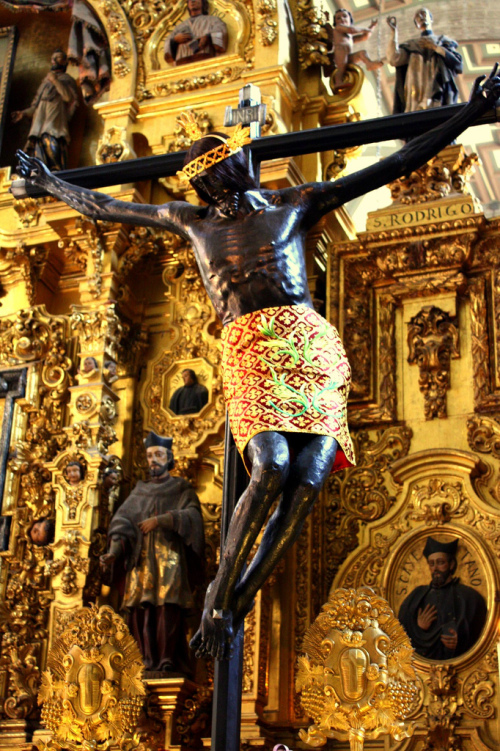
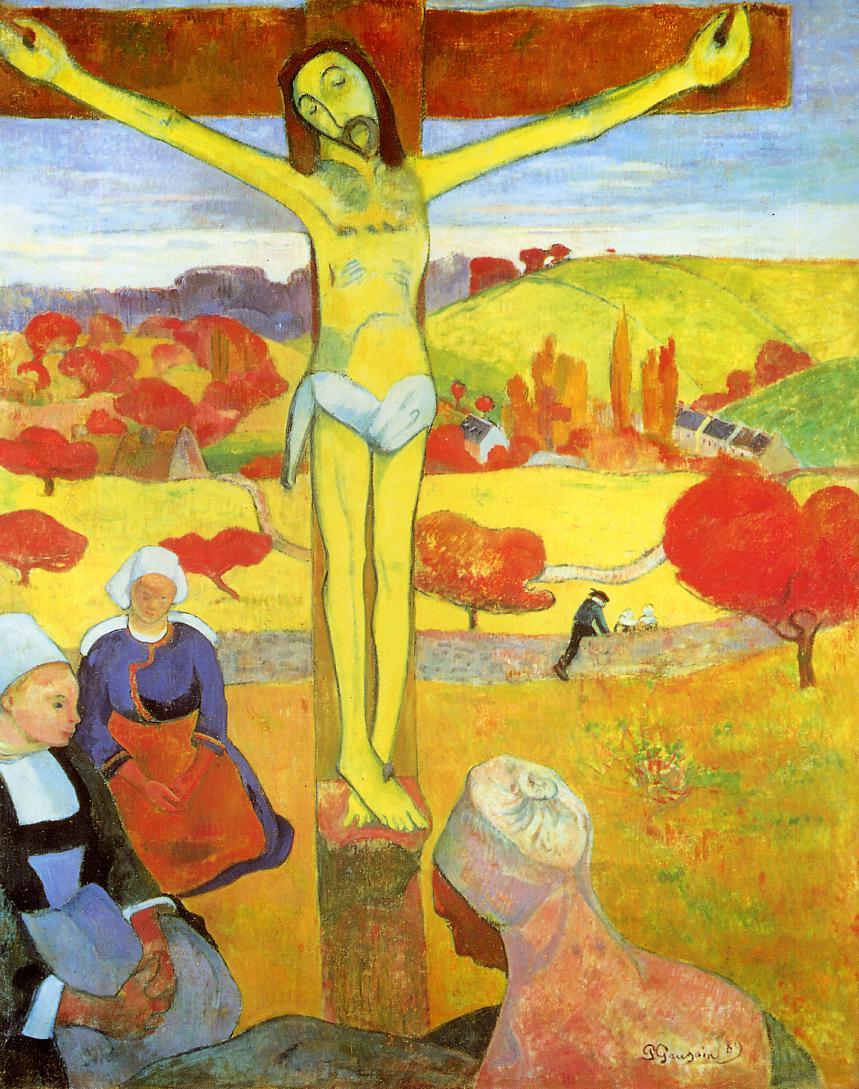
Images of the Crucifixion


(Thanks to Jeffrey Fisher [jeffreyfisher at me.com] for the guest post.)

On Good Friday every year,* Christians around the world commemorate the death by crucifixion of Jesus of Nazareth, rabbi, prophet, Son of God, Son of Man, messiah, and all-around trouble-maker.

The truth is that very little is known of Jesus’ life and teachings from verifiable accounts, but this has not stopped generation after generation of Christians from telling his story, beginning with Jesus’ semi-official biographers, the evangelists of the New Testament. Almost everything we know about the life and teachings of the physical human being Jesus are in those writings, which do not portray him always in compatible ways, and which are almost entirely unconfirmed by any external source. The Roman historian Tacitus mentions (with disdain if not disgust) Jesus’ cult following, as does the Jewish historian and philosopher Josephus, but neither gives us anything to work with as historians (or, for that matter, as theologians). For the record, Suetonius and Pliny also talk about Christians, but these piecemeal sources tell us much more about Roman perceptions of Christians than about Christ and his teachings, or even necessarily Christian beliefs and practices.

What, then, can we reasonably say about Jesus?

It is almost impossible to find universal agreement around anything more than a few basics, including most importantly Jesus’ crucifixion. The Gospels narrate it; Paul the Apostle (who never met Jesus in the flesh, as it were) hangs his theology on it, together with the equally important resurrection; and no contemporary sources (Christian or otherwise) dispute it.

But it’s when we ask why Jesus was crucified that things start to get interesting.

What did he do? The two men he is traditionally said to have been crucified with are commonly understood to be “robbers,” but that they were common criminals is highly unlikely. Crucifixion is a horrible death designed to make a very public statement about the crucified, the sort of thing you use on gladiator-slave rebels like Spartacus, not on pickpockets and roustabouts. The Greek term used for these two men (lestai) is consistent with the description of the released Barabbas as one who had participated in rebellious activities, whose “criminality” was related to his revolutionary business. Moreover, the name “Barabbas” means literally “son of the father,” a purely symbolic and surely entirely fictional name, and that the people choose to have him released indicates their affinity for him as a thorn in the side of the Romans. He is thus contrasted with Jesus, the other son of the father, the peaceful (apocalyptic) revolutionary.

So Jesus would have been crucified as a political criminal, a rebel. This would make sense of accounts of his having been identified by the Romans as “Iesus Nazarenus Rex Iudaeorum”: “Jesus of Nazareth, King of the Jews.” Anyone claiming to be king (and “son of God” was a Jewish way of talking about the king of Israel recorded clearly in Psalm 2), would, if taken seriously, be understood as challenging Roman authority.

Insofar as Jesus seems to have been deliberately poking the Romans’ local running dogs, the Sadducees and the Temple priests, his seizure and termination were surely inevitable. If his teaching is as opposed to violence and unconcerned with “politics” as it seems to have been, it’s hard to believe the Romans would have noticed him without some prodding, this coming not from the “crowd,” but from the leadership (who in Mark and Matthew incite the crowd). Indeed, the priests and scribes look for ways to arrest him when the crowds are not around, because they fear a riot.

If we take the Gospel of Mark at all seriously, Jesus was preaching a new kingdom of God, an apocalyptic redemption of the people of the earth by God’s direct intervention (and with Jesus as the sacrificial pesach lamb). If we take the Gospel of Luke seriously, Jesus spoke in a classic prophetic mode, calling people — Jew and Gentile both — to care for the oppressed of the earth, the poor and the hungry and the helpless. Both Jesuses called for people to be better to each other, to love each other, and indeed to love each other when love was, according to common sense, the foolish thing.

Why would this get you executed?

Well, in itself, it wouldn’t. But the Gospel of Mark tells us of Jesus speaking with a man who realizes that all the animal sacrifices in the world don’t amount to a hill of beans (in that crazy world). When love counts more than sacrifice, we are undermining the Temple. When we go into the Temple, start knocking things over, and say it’s become about robbing the poor and not about loving God and one’s neighbor, we are undermining the Temple. And to undermine the Temple’s authority is also to undermine Rome’s authority, and Rome’s cash flow.

Jesus, like the Essenes he may or may not have associated with, was a purist.

The Temple was full of collaborators and exploiters, the kind seen before in the history of Israel (and berated by prophets like Isaiah and Amos), the kind hated also by the Dead Sea community of apocalyptic purists awaiting a final showdown between God and evil (i.e., the Roman Empire and their local potentates, the Temple authorities).

Jesus, like other Jewish prophets before him, thought that Judaism was about something. That it was somehow about justice and not just about following rules or waiting around for things to get better: that it was about our making the world a better place, and not just making our own lives better.

Start talking that way and get people on your side, and you’re fairly likely to get killed, even twenty centuries later.

* Though the actual date (even the year) of the execution marked by the movable feast of Good Friday is fundamentally unknowable, there are some present-day astronomer types who’d like to sell you April 3, 33 A.D.

On this day..

1856: William Bousfield, Calcraft’d

Until the very end of public hanging in 1868 and thereafter in prisons, hangmen were unreliable executioners…

In nearly every year the grim chronicle of bungled executions and lackadaisical hangmen was extended … [William] Calcraft the hangman simply miscalculated the drops required to effect a speedy death. In office since 1829, Calcraft was ‘a mild-mannered man of simple tastes, much given to angling in the New River, and a devoted rabbit fancier’. Nice to rabbits, he had a casual way with people. He hanged them like dogs, it was said. Another dismal apotheosis was reached in the Newgate execution of William Bousfield in 1856. The night before his execution Bousfield* tried to kill himself in his condemned cell by throwing himself into the fire; next morning [March 31, 1856] he had to be carried to the scaffold swathed in bandages. Calcraft was nervous; he had received a letter threatening his assassination. He pulled the bolt to let the drop fall and disappeared hastily into the prison. Astonishingly, Bousfield drew himself up and lodged his feet on the side of the drop. Pushed off by a turnkey, he again found the side of the drop; and yet again. He was defeated only when Calcraft was summoned back to drag on his legs and ‘the strangulation was completed’. In front of an angry crowd, Bousfield gurgled his way to death as church bells rang to celebrate the end of the Crimean War.

After this debacle, they started pinioning the prisoners’ legs to prevent them getting a foothold on the scaffold, removing any hope of preservation to the inscrutable hand of Providence.

* Charles Dickens scribbled a few rambling thoughts on the subject of Bousfield’s trial.

On this day..

1845: John Tawell, the man in the Kwaker garb

On this date in 1845, John Tawell was publicly hanged in Aylesbury (while broadsheets were hawked beneath the scaffold to the crowd of thousands) for the murder of his mistress — making history as the first criminal apprehended with the use of the telegraph.

Tawell had had an interesting 60-plus years on the planet. He did well as a young banker on the make to avoid the halter for the capital crime of forging banknotes.*

In those sanguinary days of our penal code, this crime, if brought home, would have led to his certain condemntion and ignominious execution as a felon. The particulars of the affair were, however, suppressed as far as possible, on account of the insuperable disinclination of the bankers to be in any way instrumental in taking away human life.**

Clapped in irons and sent to Australia, he waxed wealthy — “by his fortunate, and, it is to be presumed, honest trading,” our wry biography remarks. (As a pharmacist. That’s what we in the biz call “foreshadowing.”)

Tawell returned to England in 1831, got Sarah Hart as a bit on the side (she’d initially been hired to nurse Tawell’s dying wife), and then married a respectable Quaker woman. To conceal the affair — or perhaps because the payola Tawell was obliged to send for the maintenance of his mistress and the kids he begat with her was chewing into his straitened finances — Tawell poisoned Hart on New Year’s Day 1845.

Unfortunately for him, he was noticed leaving the scene of the crime by a neighbor, who found the victim before she had even expired.

Tawell had hopped a slow train for London ahead of apprehension, but it transpired that the station had installed the newfangled telecommunications device, the telegraph, which was requisitioned to dispatch to Paddington station a famous missive.

A murder had just been committed at Salt Hill and the suspected murderer was seen to take a first class ticket to London by the train that left Slough at 7.42pm. He is in the garb of a Kwaker with a brown great coat on which reaches his feet. He is in the last compartment of the second first-class carriage.

(The telegraph didn’t have a “Q”, so they had to improvise a phonetic spelling. k l8r.)

(This landmark police event is not to be confused with the first use of wireless telegraphy to apprehend a criminal — the next century’s very similar philandering-apothecary-on-the-lam case of Dr. Crippen.)

Caught, convicted,† condemned. (And confessed, secretly, to the prison chaplain.) The usual. Botched strangulation hanging. Hardly unusual. Love triangle murder? Downright trite.

But still: Tawell’s strange and variegated life left a strange and variegated legacy. (pdf)

In Australia, the memory of Tawell lingered for many years after his death because considerable legal argument took place about the validity of the Crown’s hndling of his property there. The Governor, Sir William Denison, affixed the Great Seal of the colony to the grant documents on his own initiative, which creted a serious difference between him and his chief minister. Known as the “Great Seal case”, it dragged on for some 16 years before it was resolved. It provided a dramatic epilogue to Tawell’s activities.

John Tawell had pharmacy qualifications of a sort, and he was no better or worse than many of the doctors around Sydney at the time who had received no regular professional instruction. When Tawell ventured into competition with the medical establishment in the colony it was a huge gamble because until 1820 many government doctors saw private patients and had clerks to do their dispensing, usually from hospital stores. He showed that independent pharmacy could thrive away from the medical shadow, but the commercial nature of his success also showed that the founding of independent pharmacy in Australia occurred as a retailing activity rather than as a needed profession.

* As a teen, Tawell was friends with a Quaker linen-draper who was himself ultimately executed for forgery, Joseph Hunton.

** This claim for bankers’ gentility is advanced in the context of the story of a banker who in fact went on to commit murder. Aside from that obvious paradox, it will come as no surprise to any denizen of the post-bailout neoliberal era that bankers proved more than ready to involve themselves in human misery, sufficiently remunerative. If Tawell’s sweetheart plea bargain reveals anything about the financier class, it’s that bankers aren’t keen on precedents for taking away bankers’ lives.

† John Tawell’s trial lawyer, the eminent jurist and politician Sir Fitzroy Kelly, disputed the coroner’s poisoning conclusion by arguing that Sarah Hart might have just eaten too many apple seeds. (Prussic acid, aka hydrogen cyanide, does occur naturally in many fruits.)

This attempted Chewbacca defense earned the barrister the nickname “Apple-pip Kelly”. However, since the cutting-edge technology of the day was only telegraph and not Twitter, the case does not appear to have launched any of Apple-pip Kelly’s progeny into lucratively pointless careers as famous-for-being-famous socialites.

On this day..

2009: Two thieves in Riyadh

Two men were beheaded in Riyadh on this date in 2009 for bizarrely causing a man’s death in an unarmed purse-snatching.

An Interior Ministry statement says Faisal bin Fahd and Bandar bin Abdullah first stole the Chinese man’s laptop bag while he was walking. When the man tried to catch up with them, he fell and died after hitting his head on the pavement.

On this day..

1794: Jacques Hebert and his followers

On this date in 1794, firebrand revolutionary pamphleteer Jacques Hebert and his eponymous party of Convention radicals mounted the scaffold during the Paris Terror.

As a 32-year-old, Hebert started putting out his foul-mouthed blog radical newspaper Le Pere Duchesne in the Revolution’s early months.

In this increasingly vituperative rag, Hebert — incongruously writing in the voice of “Old Man Duchesne” — savaged first the royal couple, and then (after that pair lost their well-coiffed heads) whatever the retrograde element of the unfolding Revolution happened to be on any given day: the constitutional monarchist Lafayette; the bourgeois liberal Girondists. His paper valorized the Parisian working-class sans-culottes, and lustily demanded heads for the satisfaction of their various grievances.

Here, he literally channels Marat:

All of these thoughts trouble my brain, and the memory of Marat follows me without end. Last night I saw him in a dream: his wound was still bleeding, dammit. Upon seeing it I cried. Friend of the people, I shouted, is it you? Yes, good Père Duchesne, it’s Marat who comes from the dead to talk with you, because — dammit — the love of freedom pursues me even beyond the grave. Content to have lost my life for my republic, there only remains to me the regret of not having seen it delivered, before my death, from all the scoundrels who tear away at its breast. Père Duchesne, you must do what I couldn’t do. You closely followed me in the revolution; like me you consecrated you life to the defense of the rights of the people. You speak the language of the Sans Culottes, and your foul mouth, which makes little mistresses faint, sounds beautiful to free men, for free men shouldn’t be sought among the beautiful souls. Your joy and your anger have done more than all the dreams of statesmen. They know this well, the worthless fucks, and that’s why they’ve persecuted you like they did me. Courage, old man; don’t back off when you suffer the same trials as me, don’t be afraid: is there a more beautiful death than mine? But since you’re useful to your fellow citizens, try to avoid the daggers of statesmen. Live a while longer in order to denounce them and to complete, if you can, the task I’d undertaken.

…

Yes, Père Duchesne, you have to go after them hammer and tong, and not take it easy on anyone. When three months ago I proposed planting three hundred nooses on the terrace of the Tuileries in order to hang there the perfidious representatives of the people, some took me for a madman, and others as someone thirsty for blood. But nevertheless, if I’d been believed how much bloodshed would have been avoided! More than a million fewer men would have perished! So when I made that proposition I wasn’t speaking as a bloody monster, on the contrary I spoke as a friend of humanity. The moderates have buried more victims than those that fell before the steel of our enemies. Nothing is more harmful in a revolution than half measures. We have finally arrived at the era when we must pare things right down to the bone. … No more quarter for the defeated party, because, dammit, if the statesmen had the upper hand for one moment there wouldn’t exist a single patriot in six months.*

Late in his run, Hebert was on to venting dissatisfaction with the party of Danton, who had followed the monarchists and the liberals off the starboard of acceptable revolutionary opinion. Sensible centrist Maximilien Robespierre would indeed strike that faction down — just two weeks after he’d purged the radical Hebertist gaggle itself.**

Eleven days after Le Pere Duchesne last hit the streets, its author’s head hit the basket.

His printed editorials (like the one above) often assert a modish conviction in his own coming martyrdom, but as proof against a fatal political reversal, Hebert had trusted overmuch to his power base in the Paris commune. When he was carted out this morning, the mob whom his own paper once played to reveled in old Pere Duchesne’s fall just as readily as it had reveled in his enemies’.

some men carrying long sticks, at the end of which were suspended braziers of burning charcoal, symbolical of the “Charcoal-burners” of the “Pere Duchesne,” thrust them into the face of Hebert, insulting him with the same bitter railleries with which he tormented so many other victims (Alphonse de Lamartine)

Hebert was executed at the Place de la Revolution in a batch of 20 fellow-radicals, among whom we also find the eloquent “orator of mankind,” anticlerical† wordsmith Anacharsis Cloots. (Victor Hugo on his revolutionary leader in Les Miserables: “he had too much of Saint-Just about him, and not enough of Anacharsis Cloots.”)

The original La Pere Duchesne was dead, but just as the hot-selling mag had attracted ripoffs in its original run, the name lived on as a symbol of popular revolutionary menace — to be reclaimed by later generations in print and song.


La chanson du pere duchesne (live at RMZ)

* I know, right? Hebert was such a wild man, he thought ill of slavers.

Everywhere and at all times men of commerce have had neither heart nor soul: their cash-box is their God; they only know how to thieve and deceive; they would shave an egg, they would kidnap their own fathers; they traffic in all things, even human flesh; theirs are the ships which sail to the African coasts to capture negroes whom they then treat as worthless cattle.

** These rival factions linked as fellow-victims of Robespierre’s Terror are neatly symbolized by the spouses of their respective antipathetic scribblers: Jacques Hebert’s wife Marie, and Lucile Duplessis, wife of the Dantonist journalist Camille Desmoulins. Marie and Lucile were guillotined together that April, having forged a friendship while awaiting the chop.

† “The personal enemy of Jesus Christ,” Cloots called himself. He also remarked, “What is man’s chief enemy? Each man is his own.” A lot of enemies, this one had.

On this day..

1803: Thomas Hilliker, teen machine wrecker

On this date in 1803, 19-year-old apprentice Thomas Hilliker (or Helliker, or Heliker, or Hiliker) was hanged on doubtful eyewitness identification for having helped torch Littleton Mill near Semington during an anti-mechanization protest.

The youth’s affecting handwritten last letter, on display at the Trowbridge Museum, was recently selected by the BBC for its “History of the World in 100 Objects” series.

“Remember my last Fate …” Detail view of Thomas’s letter, as seen in the BBC series. (For the full letter: page 1; page 2) Images (c) Trowbridge Museum, and used with permission.

Executed Today is pleased to mark the anniversary of Thomas Hilliker’s hanging with a chat with Trowbridge Museum Curator Clare Lyall.

ET: Can you put in context the significance of burning down a mill in Wiltshire in the early 1800s?

CL: This was part of organized resistance against mechanization that had begun to turn violent. Mills at Warminster and Bedington had already been burned. There was widespread opposition to processes that were perceived as threatening jobs and this was indicated by many employees joining unions despite the union’s illegal status.

Thomas Hilliker was 19 when he died. What do we know about him? What kind of life did he lead?

Thomas was a literate, apprentice shearman. The job of a shearman was highly skilled and involved the cropping of the raised nap of the cloth to ensure that a finely knitted fibre remained. He was only two years into a five-year apprenticeship when he was arrested. We have little evidence about the type of life he led. There was a statement that gave him an alibi for the night of the burning down of Littleton Mill, when one of his friends found him drunk outside a cottage where he had been visiting and took him in there to spend the night in the kitchen. I guess from that we can conclude that like many teenagers he liked on occasion to drink alcohol to excess.

You’re quoted on thisiswiltshire.co.uk as saying that Hilliker “was probably the wrong guy.” Was he wrongfully executed?

There were contradictory statements about whether Hilliker was actually there holding the Mill manager prisoner whilst the Mill was burned. He also had an alibi for that evening and it would have been very unusual for senior union men to have involved a junior member with such a serious event. I think all this casts doubt on his guilt.

What did Thomas have to say to his family in this last letter? What does that tell us about his life?

It was a moving farewell to his parents and siblings with a request for them not to forget him and to stay out of trouble. I don’t think this was an admission of his involvement in the Littleton Mill incident but may refer to his membership of an illegal organization, a union which after what had happened to him might have considered wasn’t worth the risk.

As a curator, how do you present this artifact to visitors? What kind of reactions does it typically draw?

We present the letter in a display case which has a controlled environment and subdued lighting. There is a transcription of his final letter that is displayed on the outside of the case and adjacent to the letter.

Many people are moved by the letter and why he never told who the true culprits were.

On this day..

1897: Scott Jackson and Alonzo Walling, Pearl Bryan’s murderers

On this date in 1897, a remarkable scene unfolded at the double hanging of Scott Jackson and Alonzo Walling in Newport, Ky.

Jackson was described as standing erect and playing the part of an actor. Walling trembled with his eyes downcast. At that point, Jackson was again asked if he had anything to say. An eyewitness said, “Jackson hesitated fully two moments before he replied. Before he spoke, Walling turned expectantly evidently believing Jackson would speak the words that would save his life, even while he stood on the brink of death. Walling had half turned around and he stood in that position with an appealing expression on his face, while Jackson without looking at him, upturned his eyes and replied, ‘I have only this to say, that I am not guilty of the crime for which I am now compelled to pay the penalty of my life.”

Walling was then asked if he had any comments. He said, “Nothing, only that you are taking the life of an innocent man and I will call upon God to witness the truth of what I say.”

At 11:40am the trapdoors opened and Jackson and Walling were hanged.(Source)

Jackson and Walling had been convicted the previous year in separate trials — each defendant accusing the other — for the murder of Pearl Bryan, a naive Greencastle, Ind. farmgirl who had gone in search of an illegal abortion and turned up headless.

The notoriously grisly case — the decapitated body was only laboriously identified by tracing a manufacturers’ mark on her shoes back to her hometown — precipitated a nationwide media frenzy, ordinarily an ephemeral phenomenon.

But this story had more legs than your average whodunit. Years later, tourists were still seeking out Pearl Bryan sites to gawk, and paying local hucksters to eyeball murderabilia.

(As was the style at the time, the Pearl Bryan slaying also contributed a murder ballad recorded by the Library of Congress. Close-enough lyrics here.)

[audio:Ballad_of_Pearl_Bryan.mp3]

But for the last public hanging in Campbell County, the crime beat couldn’t even scratch the surface of the weirdness.

Poor Pearl Bryan’s head, you see, was never found, and the culprits adamantly refused to divulge its whereabouts, prompting rumors of satanic ritual.

This occult connection (and the unsettled nature of a case with a head still at large) attracted paranormal associations.

Bobby Mackey’s Music World, a Wilder, Ky., honky-tonk, that opened more than 80 years after Pearl Bryan’s murder, is reputed to be haunted by her spirit and those of the men hanged for her death. (The actual connection of this building/site to Pearl Bryan or her killers is speculative at best, but to judge by the stories they tell about it, Bobby Mackey’s seems to be a spectral Grand Central Station. Don’t take it from me: a “ghost counselor” and the “President of the United States Psychotronic Association” both vouch for its spooky bona fides!)

On this day..

1314: Jacques de Molay, last Templar Grand Master

On this date in 1314, the last Grand Master of the Knights Templar was burned in Paris.


Illustration of Jacques de Molay and Geoffroi de Charney burning on Paris’s ÃŽle de la Cité.

In a boring materialist history, Jacques de Molay was simply the head of an overrich military order whose crusading raison d’etre had become passe* with the Templars’ expulsion from the Holy Land.

Scores of trumped-up heresy charges did the work of ecclesiastical assassination for this renowned brotherhood originally founded to safeguard pilgrims in the Holy Land. (There’s a fine podcast episode on the Templars’ history here.)

This appears to be some sort of legitimate history. How droll!

Ruthless French King Philip the Fair, who owed the Templar banks a ton of cash, mounted in 1307 a, um, surprise nationalization — with the magnificently coordinated arrest of hundreds of members of the order on Friday, Oct. 13, 1307.**

This was, on the face of it, quite an infringement by the secular power upon the Church, but since Pope Clement V was Philip’s very own sock puppet — to the extent of relocating the papacy to Avignon the better to attend to his master — it was all good. Plus, of course, everyone made out with a big pile of loot.

As the interested parties jockeyed over those confiscated estates, there ensued for the once-powerful, now-proscribed order a years-long saga of torture, burnings (of lower-ranking Templars), salacious Baphomet-worship revelations, juridical maneuvering, and, finally, a compromise life-saving confession which Molay and his associate Geoffroi de Charney dramatically spurned.

The cardinals dallied with their duty until March 1314, when, on a scaffold in front of Notre Dame, Jacques de Molay, Templar Grand Master, Geoffroi de Charney, Master of Normandy, Ilugues de Peraud, Visitor of France, and Godefroi de Gonneville, Master of Aquitaine, were brought forth from the jail in which for nearly seven years they had lain, to receive the sentence agreed upon by the cardinals, in conjunction with the Archbishop of Sens and some other prelates whom they had called in. Considering the offences which the culprits had confessed and confirmed, the penance imposed was in accordance with rule—that of perpetual imprisonment. The affair was supposed to be concluded when, to the dismay of the prelates and wonderment of the assembled crowd, de Molay and Geoffroi de Charney arose. They had been guilty, they said, not of the crimes imputed to them, but of basely betraying their Order to save their own lives. It was pure and holy; the charges were fictitious and the confessions false. Hastily the cardinals delivered them to the Prevot of Paris, and retired to deliberate on this unexpected contingency, but they were saved all trouble. ‘When the news was carried to Philippe he was furious. A short consultation with his council only was required. The canons pronounced that a relapsed heretic was to be burned without a hearing; the facts were notorious and no formal judgment by the papal commission need be waited for. That same day, by sunset, a pile was erected on a small island in the Seine, the Isle des Juifs, near the palace garden. There de Molay and de Charney were slowly burned to death, refusing all offers of pardon for retraction, and bearing their torment with a composure which won for them the reputation of martyrs among the people, who reverently collected their ashes as relics.’

–A History of the Inquisition of the Middle Ages, Vol III

Not bad, but the for a real plot twist, check the Templars’ turn — most famously in Dan Brown’s leaden bestseller The Da Vinci Code, but more entertainingly rendered as nonfiction “speculative history” in Holy Blood, Holy Grail — as mystic guardians of Christological secrets.†

Their most sensational secret: the Holy Grail.

In this reworking, the Cup of Christ is not the San Greal but the Sang Real, God’s own royal bloodline, by way (for some reason) of the French Merovingian dynasty.

The Templars and Jacques de Molay himself, this story goes, are just part of a centuries-long vanguard of Christianity’s mystical underground. Say, is that Jacques on the Shroud of Turin?

Thither this blog dares not venture, but those with the requisite inclination towards the occult will find limitless explorations of the theme for ready sale. All we ask, gentle reader, is that you kindly cut us in on the action by using our handy affiliate links.

In what may be yet another mystical just-so story, Molay is said to have foretold, as the flames consumed him, the deaths of his persecutors.

Pope Clement, Chevalier Guillaume de Nogaret [the prosecuting inquisitor], King Philip! I summon you to the Tribunal of Heaven before the year is out!

The curse worked: none of those gentlemen lived to see 1315. Someone, somewhere, has also attributed every bum turn for the French crown since then to Molay’s anathema. There’s a legend that an onlooker at Louis XVI‘s execution dipped his handkerchief in Citizen Capet’s Sang Real and cried out, “Jacques de Molay, tu es vengé!”

* Other expeditions called “Crusades” did continue after the Templars, but Christendom’s occupation of the Holy Land was toast until Lawrence of Arabia days.

** The date of this action is a possible origin of the whole paraskevidekatriaphobia superstition, but probably not really.

† It is a fact that these guys liked sweeping their crusading conquests for supposed holy relics, like this Roman nail recently unveiled from a Templar fort that was reverentially “handled by a lot of people over a long period of time.”

On this day..