On this date in 1611, the pathetic figure of a former priest — his body shaved to expose Devil’s marks, a noose about his neck — was conveyed to the secular powers to be tortured one last time, then hauled through the streets of Aix-en-Provence and burned to ashes.
Witchsmellers were thick on the ground in pre-Thirty Years’ War France, aselsewhere.
In our scene in the south of France, we find a characteristic entry in this horrible catalogue.
Parish priest and lothario Louis Gaufridi, having seduced a local teenager, found himself in hot water when she contracted the trendy disorder of demonic possession and started raving about the times she went with the cleric to see Black Sabbath.
Not this Black Sabbath.
Other inmates at the convent to which Gaufridi’s paramour had been conveyed were soon in on the act, indicting him for cannibalism, exotic sexual perversions, and — of course — devil-worship.
Gaufridi’s denials were overcome in the usual way, with the support of doctors who filed a report scientifically vouching that the infernal powers had laid their mark upon the subject. The priest soon saw the wisdom in copping to the charges, and not only his torture-adduced confessions (which he vainly attempted to repudiate in court) but the veritable original contract specifying the terms of his demoniacal servitude was produced for magisterial consideration.
I, Louis, a priest, renounce each and every one of the spiritual and corporal gifts which may accrue to me from God, from the Virgin, and from all the saints, and especially from my patron John the Baptist, and the apostles Peter and Paul and St. Francis. And to you, Lucifer, now before me, I give myself and all the good I may accomplish, except the returns from the sacrament in the cases where I may administer it; all of which I sign and attest.
I, Lucifer, bind myself to give you, Louis Gaufridi, priest, the faculty and power of bewitching by blowing with the mouth, all and any of the women and girls you may desire; in proof of which I sign myself Lucifer.
That’s right. He did it all for the nookie.
(That, and to “be esteemed and honored above all the priests of this country.” Thomas Wright, in his omnivorous and freely available chronicle of European witch trials, remarks that these two attributed motives suggest “the reason why Gaufridi was persecuted by the rest of the clergy.” And oh, but the ladykiller — or rather, the reverse — still starred in the fantasies of the possessed years after his death. (French link))
Gaufridi’s execution immediately freed his erstwhile lover from her satanic affliction. Madeleine de la Palud, however, having officially established herself as susceptible to the penetrations of the Evil One, would remain suspect in the eyes of the inquisition for the 60 years remaining of her life. She twice faced witchcraft charges herself.
On this date in 1676, two sisters were beheaded in Stockholm in one of Sweden’s most famous witch trials.
The great Swedish witch hunt of 1668-1676 was at its crescendo, having spread from the provinces to the capital. Here was repeated pattern by now familiar — children accusing adult women of taking them to witches’ sabbaths, and various and sundry infernally-inspired offenses against the civic order.
Brita Zippel (or Britta Sippel) was a natural magnet for accusations. Born well-off but fallen into poverty, and hot-tempered (as we shall see) besides, she had already survived two previous witch trials.
Her sister Anna remained a member of the town’s elite, but her status proved no use to her when suspicion fell on the family. Rumors and accusations snowballed over a period of months — that the sisters kidnapped children; that they committed arson; that both Anna’s wealth and Brita’s poverty proved their diabolical affiliations. That Anna Zippel and her business partner Anna Mansdotter made money selling medicines to the rich and powerful hardly decreased suspicion. The children who drove all this really made the most of the limelight — fainting spells, supernatural tales, the whole nine yards.
While the well-heeled Annas maintained a dignified stoicism during their trial — which only served to condemn them — Brita gave rein to all her furious indignation — which only served to condemn her. Anna Zippel defended herself calmly. Brita threatened witnesses, attacked her sister, and poured invective on her persecutors. Same result.
Their contrast in demeanor continued to the scaffold itself.
Shaking her chains, threatening her confessor with her posthumous vengeance, and cursing her onlookers, Brita required the offices of five men to wrestle her to the block for her beheading. (She went first because of the scene she was making.) Anna Zippel followed quietly, and then (quieter still) Anna Mansdotter, who had managed to commit suicide in prison but whose corpse still suffered the same fate of decapitation and burning.
These first witch-hunt victims in Stockholm were not the last, but they would presage the collapse of an enterprise that had consumed some 200 lives over the preceding eight years. According to Witch Hunts in Europe and America,
[i]n the spring of 1676, the court of appeals in Stockholm began investigating cases directly, rather than simply examining the records local officials forwarded. This resulted in the appointment of yet more royal commissions, but these were completely dominated by skeptical Stockholm officials. Turning the pressure on the accusers, the commissions gained several confessions from child accusers stating that they had made the whole thing up. The witch-hunt quickly collapsed, and four accusers, including a boy of 13, were executed.
Of no direct relevance, our dalliance with Scandinavian witchery offers a pretext to excerpt Benjamin Christiensen‘s freaky (and censored) 1922 silent classic Haxan: Witchcraft Through the Ages.
The 1700s were a time of radical reform, and as the Enlightenment reached the shores of Denmark, it suddenly became possible to be a professed atheist and not lose your head. That is, of course, as long as you didn’t also try to usurp the crown, undermine the aristocracy, and agitate the commoners while you were at it.
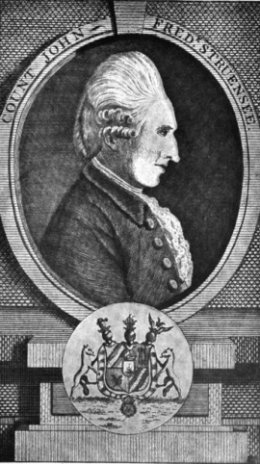
Such was the course that ended the rise of Johann Friedrich Struensee on this date in 1772. His friend and sometime cohort Enevold Brandt (Danish Wikipedia entry) was put on the block on the same day.
Struensee was born in 1738 in present day Germany and educated in Prussia, a doctor by trade and a budding Enlightenment political writer by practice. He seemed an unlikely character to involve himself in the court of King Christian VII of both Denmark and Norway, but Struensee was a vain and social man who managed to befriend the right people at the right time.
The first was Brandt. The second was Count Schack Karl Rantzau. A lawyer and Supreme Court justice, Brandt was a court favorite* and planted Struensee’s name as a capable doctor: young, kind, and competent, he would make a perfect personal physician for a king known for being a bit off: Christian was likely schizophrenic. Rantzau, meanwhile, was Count of the Holy Roman Empire, exiled from Copenhagen some 15 years before he met young Struensee, and eager to get back into politics.
In June 1768, Struensee took a post as the king’s traveling physician in England, and he immediately attached to Christian’s loneliness. The regent was interested in literature, philosophy, and music, and Struensee obliged him with patient regard for his charge, for which he was duly rewarded with access to a social life much more fulfilling than in Prussia. As a traveling physician, though, Struensee’s post had a finite span, and he lobbied hard to become a member of the Danish court.
With some help from others in the king’s court, Struensee managed to retain a permanent post, and his clamber up the nearest cliff to power began.
The young doctor, it seems, had a talent for playing two sides for personal gain. It started with the king, who had immense trust in Struensee and began to confide almost everything. Struensee was tactful with this information, adhering to an early form of patient-doctor privilege that endeared him to Christian. The other side was Queen Mathilde, Princess of Wales, by all accounts a beautiful woman who was not happy in Denmark and even less happy to be married to a mad and deteriorating king.
Mathilde initially disliked Struensee — or, at the very least, was indifferent to his actions. But near the end of 1769, the queen finally admitted Struensee into her chambers, and their relationship took off. He ably gamed Mathilde by convincing her that she was the kingdom’s future; Christian, meanwhile, remained ill, and Struensee remained a steady presence in his life. Come spring, Crown Prince Frederick VI also came under Struensee’s care, and as smallpox ravaged Copenhagen, the doctor pressed for inoculation. The king and queen assented, Frederick survived the epidemic, and Struensee garnered himself an official advisorship. It’s also suspected that, while Struensee and Mathilde watched over Frederick as he recovered from the inoculation,** their love affair began.
With a taste of power, Struensee pressed King Christian VII for cabinet changes — which he got — and was named Privy Councilor before 1770 was out. Now the principal advisor to the king, Struensee was able to advance his Enlightenment agenda, notably freedom of the press, the abolition of torture, limiting the death penalty, changing the rules of appointments, numbering the houses in Copenhagen, lighting the streets, and, perhaps in anticipation, removing penalties against those who produced illegitimate children. He was a bold visionary, but he also intoxicated by his growing power … and his programme obviously gored many an ox.
Struensee ascended still further early in 1771 when the king became practically unfit to rule. He was mentally faltering, and Struensee was all but running the show, and more.
In early July, the queen gave birth to a daughter who was widely assumed to be Struensee’s child. Days later, and just three years after being introduced to King Christian VII, Johann Friedrich Struensee effectively appointed himself Privy Cabinet Minister with dictatorial authority through one of King Christian’s edicts. Struensee’s orders would now have the force of law, and, as Christian’s proclamation noted, “They shall be immediately obeyed.”
Enevold Brandt (top), not to be confused with Brandt, the Big Lebowski lackey (bottom).
Struensee spent the next six months turning the European aristocracy inside-out and foisting an aggressive set of cabinet orders on the Danish people — over 1,000, by some counts. Having ridden on the coattails of a queen and king, he now pushed them aside. He moved the court to Schleswig-Holstein, in Prussia, and pleasingly enjoyed both the prerogatives of aristocracy and a middle class contempt for them.
Struensee was, to say the least, not a favorite abroad;† that he and his friends dominated the king and queen did not sit well with Danish commoners. Even Brandt was becoming disaffected, writing in a letter asking for either a larger salary or a resignation from the court:
No despot ever arrogated such power as yourself, or exercised it in such a way. The King’s pages and domestics tremble at the slightest occurrence: all are seized with terror. They talk, they eat, they drink, but they tremble as they do so. Fear has seized on all who surround the minister, even on the Queen…
But Brandt stayed on, and as 1771 drew to a close, Copenhagen became hostile territory for the royal family and their favorite doctor.
After the season’s first masquarade ball, on 16 January 1772, the Queen Dowager — Christian’s step-mother — Juliana Marie exposed Struensee’s affair and had Struensee, Brandt, the queen,‡ and many other Struensee accomplices arrested, ostensibly by order of the king.
Struensee was charged with lèse-majesté, a crime against the crown, for his affair with the queen; though he initially denied the charges — and though Mathilde did her best to shield him from harm — he was found guilty. Brandt was charged with the same crime for allegedly assaulting the king after being himself threatened with a flogging for impertinence (he even had a nip at Christian’s finger). Brandt’s punishment was the same. Each had his right hand chopped off, then was beheaded, drawn, and quatertered.
The queen, meanwhile, went into exile in France. Juliana Marie effectively ruled the kingdom through her son for over a decade, rolling back many of Struensee’s reforms and reverting power back to the aristocracy. This also turned out to be unpopular (the Danes and Norwegians are fickle people), and Mathilde’s son Frederick VI was able to regain power for his father in 1784, eventually moving to liberal reforms more in line with his erstwhile physician’s ideals.
Struensee’s epic rise and fall have spawned a variety of writings since his death. A memoir appeared just months after his execution which detailed his final months. He was also the subject of the Per Olov Enquist novel The Royal Physician’s Visit, which examines his life from multiple perspectives. Queen Mathilde’s life was put to ballet by Peter Maxwell Davies. And for a more contemporary cultural artifact, there’s the 2012 film A Royal Affair.
* Brandt was a court favorite, but after attempting to destroy the position of another minister, he was briefly expelled from Copenhagen, shortly after Struensee accepted his post.
** These inoculations predated “safe” inoculations by non-fatal, related disease strains such as cowpox. Frederick would have been made ill through the small pox strain Variola Minor, which had a mortality rate of about 1%. By contrast, Variola Major was fatal in about 30% of cases.
† While Struensee seems to have been book smart, his feel for international politics was limited, and his standing abroad would have unraveled had it ever raveled in the first place. He repeatedly upset the Russians, and Mathilde’s relatives were not pleased with him. Had he not been downed by public sentiment, it seems likely he would have fallen victim to one of his many royal detractors abroad.
‡ In a curious twist, Rantzau was the queen’s arrestor, and one of the principal conspirators in the dowager’s plot was a cabinet minister Struensee was responsible for ejecting very early in his career.
It’s not clear today how old she was — nineteen, maybe, or twenty-six, or twenty-seven — the reports all differ. It’s not even clear what her true name was: Paula Angel by most accounts, but she was also called Pablita Martin. But the most pressing questions, still unanswered nearly 150 years after her execution, are why she was hanged in the first place and how the sheriff managed to bungle the job so badly.
Paula Angel was the first and last woman ever executed in New Mexico (while it was yet a territory). Her crime: she stabbed her married lover, Juan Miguel Martin, to death when he tried to end their affair. Her execution was on April 26, 1861, in San Miguel, now Las Vegas.
Anyone familiar with historical crimes and trials, particularly those involving women, will marvel at such an outcome. A capital conviction for stabbing a lover, a crime passionel? That’s certainly not the outcome one would expect for that era (or this era, for that matter; today we’d label it second-degree murder at worst).
One explanation for Miss Angel’s hanging is that the newspapermen never got the story. Decades later, the wire services circulated very brief accounts of her trial and execution under headlines such as “The Story The Newspapers Missed.” So she may well have lacked the greatest champion anyone facing a murder charge can have: public opinion — the verdict of the greater jury. Throughout the nineteenth century, there was a universal revulsion for the execution of women, no matter what their crime, and judges and juries were anxious to find a reason to acquit a woman.
But the authorities in New Mexico Territory were eager to see her hanged. The accounts that survive today report that the jailer taunted her every day leading up to her execution — “I’m going to hang you until you’re dead, dead, dead,”* is the quote attributed to the sheriff.
What was her social status? Was she a prostitute? Was she a violent menace to the community? Had she committed other terrible acts? Was she unrepentant? Did she sullenly testify at her trial and put in a poor appearance on her own behalf? Most importantly, was she ugly? The accounts available today don’t say.
When it came time to launch Angel into eternity, the sheriff did not build a gallows. He selected a sturdy cottonwood tree outside of town. Paula Angel was driven there on a wagon, forced to ride on her own coffin to the site of her execution, which was witnessed by ranchers and townsmen. The sheriff fixed the rope to the tree, garlanded her with hemp, and then resumed his seat on the wagon and hawed the horses. But he’d made an error. He forgot to tie her hands behind her.
Paula Angel managed to get her fingers underneath the rope in a last pitiful effort to save her own neck, and she struggled on the end of the rope. It must have been an awful sight to see. The crowds surely voiced loud complaints. The sheriff was forced to put the wagon beneath her a second time, to cut her down, retie the rope amid the jeers and catcalls, properly secure her hands and feet, and to repeat the process. She did not survive her second hanging.
And there hasn’t been one woman executed in New Mexico since. Rarely has any woman from that state even faced the possibility, though a few years ago Linda Henning nearly became the second woman executed there — and she certainly deserved it. Fans of Court TV will recognize the name, since Court TV has rebroadcasted Henning’s bizarre trial more than once. She was tried for the cooly planned and bloody murder of Girly Chew Hossencofft, the estranged wife of her boyfriend, in one of the weirdest trials of the century. But the jury rejected the death penalty. The reason Henning agreed to involve herself in the murder of a woman she had not even met: Henning was convinced that Girly Chew was a reptilian alien queen from another galaxy.
You read that right: an alien queen from another galaxy. You can’t make this stuff up.
***
Recommended reading: Death on the Gallows : The Story of Legal Hangings in New Mexico, 1847-1923 by West Gilbreath (High Lonesome Books, 2002).
For the stories of the men executed in New Mexico see the excellent compilation by Mark Allan of the Angelo State University Library. [Note: link updated from Laura’s original post. -ed.]
For more on the Hossencofft case see the website of author Mark Horner.
* [Shades of Billy the Kid. Maybe it was something lawmen said to lend it that Wild West atmosphere. -ed.]
[Former New Mexico state historian Robert Torrez unpacks the Paula Angel story and reprints a corrido (folk ballad), “La Homicida Pablita” written by her cousin in Myth of the Hanging Tree. -ed.]
But the silly hats in Parliament wanted much of the potentially dangerous army to demobilize, and do so without settling the small matter of its back pay. Poyer refused to hand over his command and Pembroke Castle to a Parliamentary agent, and sought a better deal from monarchists.**
Only with a painstaking siege was the imposing medieval fortress of Pembroke reduced. Poyer, his superior Rowland Laugharne, and Rice Powell were hauled to London and condemned to death.†
In an interesting twist, it was decided that one example would prove the point as well as three, and to allot the clemencies by chance. When the three refused to draw their own lots, a child was given the job instead, and distributed three slips of paper. Laugharne and Powell read “Life given by God.” Poyer’s was deathly blank.
Mark Twain latched onto the singular role of a child in this deadly lottery, and wrung it for every drop of pathos in a short story, “The Death Disk”.
Unlike the proposed victim of that story, Poyer did not benefit from any last-second Cromwellian pity. His death is related in the zippily titled “The Declaration and Speech of Colonell John Poyer Immediately Before his Execution in Covent-Garden neer Westminster, on Wednesday, being the 25 of this instant April, 1649. With the manner of his deportment, and his Proposals to the people of England.”‡
Having ended his speech, he went to prayers, and immediately rising up again, called the men designed for his execution to him, which were six in number, and giving them the sign when they should give fire, which was by holding up both his hands, they observed his motion, who after some few expressions to his friends about him, prepared an embracement for death, and casting his eyes to Heaven, with both hands lifted up, the Executioners (with their fire locks) did their Office, who at one voley bereav’d him of his life, his corps being taken up, was carryed away in a Coach, and the Souldiery remanded back again to White-Hall.
* A few sources say April 21, but the overwhelming majority concur on the 25th — as do the primary citations available in 17th-century comments on his death (e.g., “he was upon the 25 of this instant Aprill being Wednesday, guarded from White-Hall in a Coach, to the place of execution” in “The Declaration and speech of Colonell John Poyer before his execution…”)
** D.E. Kennedy observes that the divide between Parliament and Royalist was not so bright as might be imagined — and that Cromwell himself was at this time negotiating with the future Charles II as an expedient to get around Charles I.
† The rank and file of Welsh insubordination basically skated, a display of clemency from the Lord Protector that Ireland would not enjoy.
‡ The title promises much more scaffold drama than two and a half forgettable pages deliver — basically, that Poyer died (a) penitent; (b) Anglican; and (c) wishing for peace.
On this date in 1521, the day after winning the decisive battle in the Castilian War of the Communities, royalist forces beheaded its three principal leaders in Villalar.
Even while the Spanish Empire was burgeoning in the New World, its home peninsula remained a house divided.
The Iberian Kingdoms of Aragon and Castile had joined in a personal union with the marriage of Ferdinand and Isabella in the late 15th century.
When the couple passed, it was not a given that their conjoined territory would become, as it did, the germ of a unified Spain.
Instead, the royal power couple’s crazy daughter was kept under lock and key while her infant son grew into the redoubtable Emperor Charles V. To exacerbate the local annoyance, Chas had continent-spanning territories, and ambitions; Spain was not his base, merely one of his provinces. (He’d grown up in Flanders. Ah, dynastic politics.)
The Emperor was only a teenager when his Castilian subjects rose against his levies, and against the paradoxical perception that the first true King of Spain was a foreign ruler.
A riot in Toledo mushroomed into a revolt, and everyone started drawing up sides. (Spanish link) Things went south when the commoner rebels started adopting an unwelcome radicalism (beyond rebelling against the king, that is), enabling the imperial rep (and future pope) Adrian of Utrecht to pull back into the royalist camp rebellious nobles increasingly fearful of expropriation at the hands of the firebrands.
The Execution of the Comuneros of Castile, by Antonio Gisbert. Segovian Juan Bravo allegedly asked to die first, so as not to witness the death of so good a knight as Padilla.
The demise of the “Caballeros Comuneros” pretty much squelched the revolt — although Padilla’s widow Maria Pacheco defended the rebel ground zero of Toledo for several months more.
The comuneros have lived on ever since as a symbol in literature and propaganda, among monarchists (for whom they are a symbol of perfidy), liberals (rather the reverse) and Castilian nationalists. Though “comuneros” was for a period an all-purpose smear against agitators in the Spanish dominions, April 23 (the date of the fateful battle) has been Castile and Leon Day, a public observance, since 1986.
This monolith in the Villalar town plaza commemorates the Comuneros. Image (c) Julio Alvarez, and used with permission.
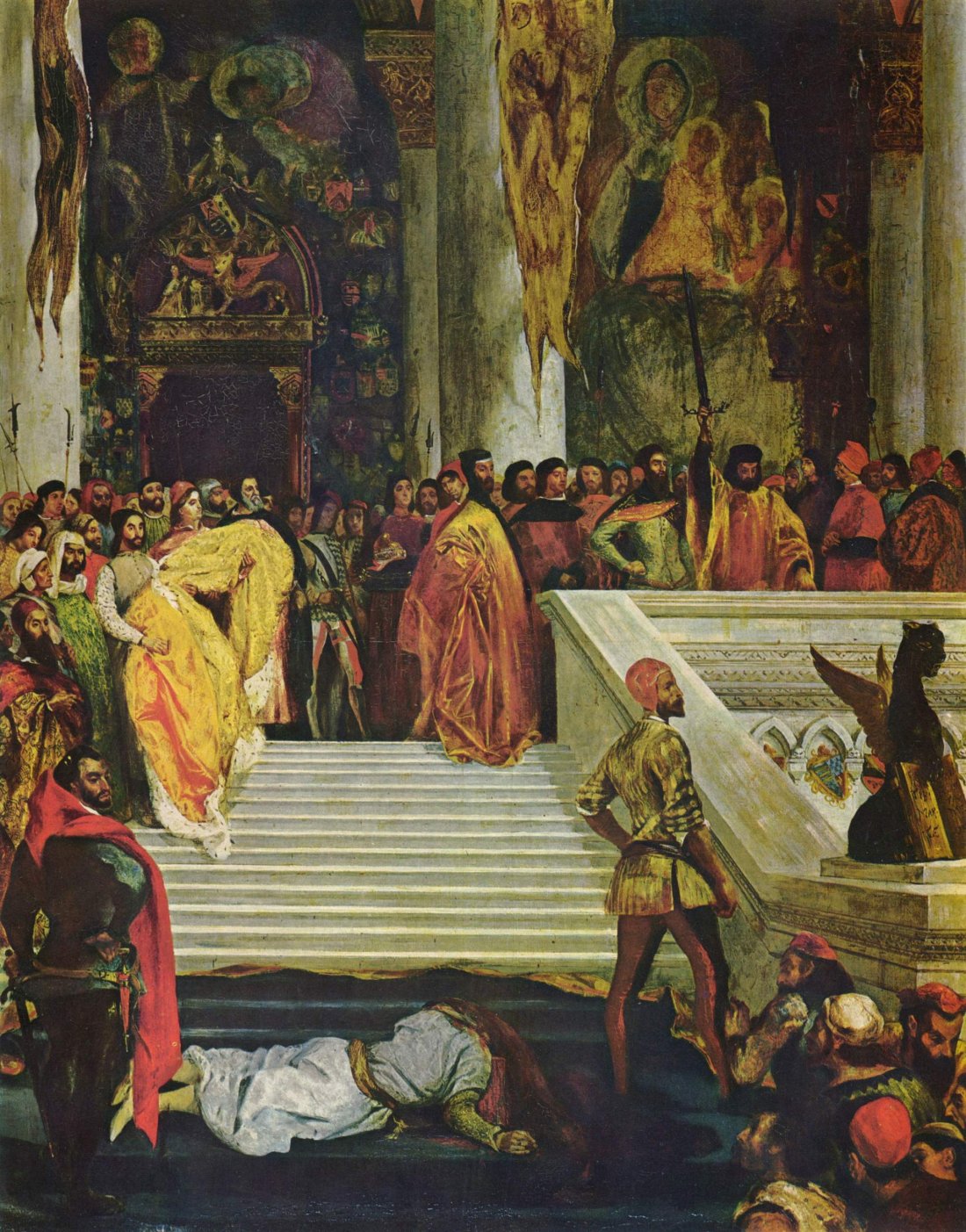
On this date in 1355, Marino Faliero* was escorted to the spot where he had been crowned Doge of Venice scant months before. There, he was ceremoniously relieved of his robes of state … and then his head.
Some fog surrounds the day’s proceedings, product not only of time but of the Doge’s executioners’ damnatio memoriae upon their victim. What was written was circumspect; even Faliero‘s portrait in the great hall of the Doge’s Palace was veiled.
What is known — or at any rate, was admitted by the elderly first citizen — is that the ruler attempted a coup against the overweening power of Venice’s great families.
The putsch was supposed to occur on April 15, with the bell of St. Mark’s Cathedral tolling on a fabricated hue and cry. In the tumult, the Doge’s supporters meant to cut down the nobles who flexed the real political muscle in the maritime republic and consolidate ducal power.
Why?
The salacious version has the old goat in a tiff with a noble, who made fun of his May-December marriage —
Marino Faliero of the beautiful wife,
Others enjoy her while he maintains her
A tribunal of fellow-nobles let the rascal off with a slap on the wrist.
Power being what it is, and princes and nobilities being born for conflict with one another across the centuries in Europe, one may as well discern a straightforward political intent — heightened, perhaps, by the then-dire state of Venice’s naval contest with Genoa.
Downright Byronic under either scenario … and Byron wrote a play about Faliero. The doomed ruler gives throat to quite a magnificent curse upon his city, with all the foresight of Byron’s half-millennium of hindsight:
I perish, but not unavenged; far ages
Float up from the abyss of time to be,
And show these eyes, before they close, the doom
Of this proud city, and I leave my curse
On her and hers for ever! —
…
— She shall be bought
And sold, and be an appanage to those
Who shall despise her! — She shall stoop to be
A province for an empire, petty town
In lieu of capital, with slaves for senates,
Beggars for nobles, panders for a people!
…
Amidst thy many murders, think of mine!
Thou den of drunkards with the blood of princes!
Gehenna of the waters! thou sea Sodom!
Thus I devote thee to the infernal gods!
Thee and thy serpent seed!
[Here the Doge turns, and addresses the executioner.]
Slave, do thine office!
Strike as I struck the foe! Strike as I would
Have struck those tyrants! Strike deep as my curse!
Strike — and but once!
This sort of thing knocking about among litterateurs in the 19th century practically guarantees an opera.
* Or simply “Marin Falier”, in the Venetian dialect.
On this date* in 1881, five members of the Russian terrorist organization Narodnaya Volya were publicly hanged in St. Petersburg, where they had slain the tsar Alexander II a few weeks before.
“The People’s Will” etched in blood its place in the dangerous late 19th century ferment of Russian revolutionaries. In time they would read as the politically immature forerunners of the Bolsheviks, whose turn into terrorism was a political dead end.
But as of this date, they were at the top of their arc.
Every St. Petersburg tourist sees the place Alexander II died: the spot received a picturesque church that is now one of the city’s principal attractions.
On March 13, 1881, Narodnaya Volyaassassinated the former tsar with a suicide bombing on the streets of St. Petersburg. With the death of the monarch who had emancipated the serfs, and was on the very day of his murder tinkering with plans to introduce an Assembly, liberalism arguably lost its weak purchase on Russia’s future.
Their dramatic gesture failed to ignite a social revolution or topple the autocracy, and they would find in Alexander III an implacable foe.
But while this spelled the end for the old man’s five assassins,‡ and even the end of Narodnaya Volya as an effective organization as the 1880’s unfolded, Alexander III’s efficacious repression was a Pyrrhic victory for the Romanov dynasty.
Refusal of Confession (Before Execution), by Ilya Repin, 1879-1885. (Via)
Alexander II’s death in the context of the times and its effect for Russia’s fate receive diverting treatment in a BBC In Our Times broadcast
* April 15 was the date on the Gregorian calendar; per the Julian calendar still in use in Russia at the time, the date was April 3.
** A quick summary of the strains of Russian revolutionary thought of the time here.
† Despite their dramatic tyrannicide, the Nihilists’ letter was angled for the consumption of mainstream post-Enlightenment Europeans. Karl Marx noted its “cunning moderation,” and its call for freedom and civil rights commonplace in more developed countries drew considerable support in the west. The Nihilists even took care to underscore their reasonableness a couple months later by condemning the senseless assassination of American President James Garfield. (See Inside Terrorist Organizations.)
An alarming rumour, meanwhile, … spread throughout the Colonies; a rumour which, whatever of truth or fact, little or none, might be at the foundation, gathering, as it went, size and gloom, and dust of slander, was calculated to make them all feel very unhappy. The report was that a slave insurrection had been discovered, having its centre on the Berbice West Coast, but extending right and left so as to include all the shore from the Corentyne Coast to Mahaica, about eighty miles; that the negroes had chosen a governor and other officers; that it was their intention to murder all the white men, and take possession of all the rest; that some of the Demerara East Coast negroes were leaders in the rebellion, especially Philip, a member of the church on Le Resouvenir; and that instruction of the negroes was to blame.
…
the account which the negroes gave of the matter was, that there had been formed a society in imitation of the Freemasons, they wishing to have, as well as their buckras or masters, a society of that nature; and that the money collected was to support the poor and defray the expense of their dances, &c.; just as it had been formerly very common for them to assume the names of their masters, or of the Governor or Fiscal, and send invitations to friends to supper or a dance, and appoint a captain of their own as president of the feast; sometimes to put feathers in their hats at holiday time and parade the streets. “No one,” as far as Mr. Wray could learn, “had been injured by them, neither was any property destroyed,” yet on 12th April six of the unhappy people apprehended on the West Coast were executed in New Amsterdam as ringleaders, their heads cut off and fixed upon poles on the different estates to which they belonged; one of them white with age, whose master, Mr. Rader, told Mr. Wray that he denied to the last having any bad intentions. Several others were flogged under the gallows, and some were transported.
A proclamation was subsequently issued to the effect that as “the privilege allowed the slaves of the Colony, of publicly or privately dancing on estates and other places at stated periods, had been perverted by them to purposes of the most dangerous nature, all dancing was forbidden until next year, 1815, or the further pleasure of the Court;” … This was followed, late in the year, by another calling upon the colonists to pay their quota of the expenses incurred in crushing the plot and indemnifying the proprietors of the slaves capitally punished … Better still, the law concerning Sunday labour was amended in favour of the slave, forbidding field-work on that day, except in sudden emergencies; and further enactments were issued limiting and regulating the excessive use of the whip, and forbidding the burial of any slave dying suddenly or by suicide, or in consequence of punishment or hurt, without previously acquainting the authorities …
On this date in 1548, the Spanish crown cemented its authority over the territory of the former Incan Empire by beheading its rebellious conquistador authorities.
Gonzalo Pizarro (English Wikipedia entry | Spanish) had served in the force that late elder half-brother Francisco used to destroy the Incas. The poor bloke was always second banana in the conquistador game; when he wasn’t being one-upped by his flesh and blood, he was bailing on the expedition that “discovered” and navigated the Amazon River. (Francisco de Orellana earned those honors instead.)
No, Gonzalo had a more prosaic specialty: killing.
While big bro went off to pacify more territory, Gonzalo along with siblings Hernando and Juan, the Baldwin brothers of New World conquest, chilled in the former Incan capital Cusco and sparked a rebellion in the 1530’s with their iron-fisted rule.
Appointed Governor of Quito in 1541 — he forced the appointment with some exemplary hangings — Gonzalo was just the sort to get a burr in his saddle when the Emperor Charles V promulgated the New Laws requiring slightly less crappy treatment of the natives.
And that was a low bar to clear indeed.
Although the following passage is not particular to Gonzalo Pizarro, gadfly monk Bartolome de las Casasdescribed (perhaps exaggeratedly, but still) the previous Spanish depredations in “Perusia”:
[T]he Spaniards, without the least provocation on their part, as soon as they entred [sic] upon these Territories, did burn at the Stake their most Potent Caciq Ataliba, Prince of the whole Country, after they had extorted from him above Two Millions of Gold, and possessed themselves of his Province, without the least Opposition … As also some few days after, the Ruler of the Province of Quitonia, who was burnt, without any Cause given, or Crime laid to his Charge … and in like manner, burnt the Feet of Alvidis, the greatest of all the Quitonian Lords, and rackt him with other Torments to Extract from him a discovery of Ataliba’s Treasure, whereof as appear’d after, he was totally ignorant …
[T]hese Eyes of mine the Spaniards for no other reason, but only to gratifie their bloody mindedness, cut off the Hands, Noses, and Ears, both of Indians and Indianesses, and that in so many places and parts, that it would be too prolix and tedious to relate them. Nay, I have seen the Spaniards let loose their Dogs upon the Indians to bait and tear them in pieces, and such a Number of Villages burnt by them as cannot well be discover’d: Farther this is a certain Truth, that they snatched Babes from the Mothers Embraces, and taking hold of their Arms threw them away as far as they would from them: (a pretty kind of barr-tossing Recreation.) They committed many other Cruelties, which shook me with Terror at the very sight of them, and would take up too much time in the Relation …
More urgent than “recreation,” Pizarro (and many of the New World’s new landholding elite) were miffed that meddlesome European bleeding hearts types were going to cut into their profit margins.
Pizarro revolted, enlisting the brilliant officer Francisco de Carvajal, a longtime fixture of the Old World battlefield. Now an octogenarian, he had lost neither vigor in command, nor cruelty in conquest. (He played bad cop to Gonzalo’s good cop.) The two killed the guy sent to impose the emperor’s decree.
This uprising forced the next Spanish viceroy to repeal the hated New Laws in order to win political support against Pizarro and Carvajal — a happy outcome for Pizarro’s base, but not for the conquistador himself.
Pedro de la Gasca’s adroit diplomacy caused the entire rebel force to desert before the fight at the “Battle” of Jaquijahuana in Sacsayhuaman.
The two principals were quickly arraigned. Carvajal, at his age, could be wry about being singled out for punishment: “very merciful is the Lord President; for, if the victory had been ours, there would have fallen on this spot nine hundred men.”
Carvajal was hanged and Pizarro beheaded, both of them winding up on pikestaffs at the gates of the city Francisco Pizarro had founded — Lima.
Their partnership — and the arc of Spanish exploits in the New World — is covered in this Google Books freebie.

 Such was the course that ended the rise of




 Gonzalo Pizarro (
