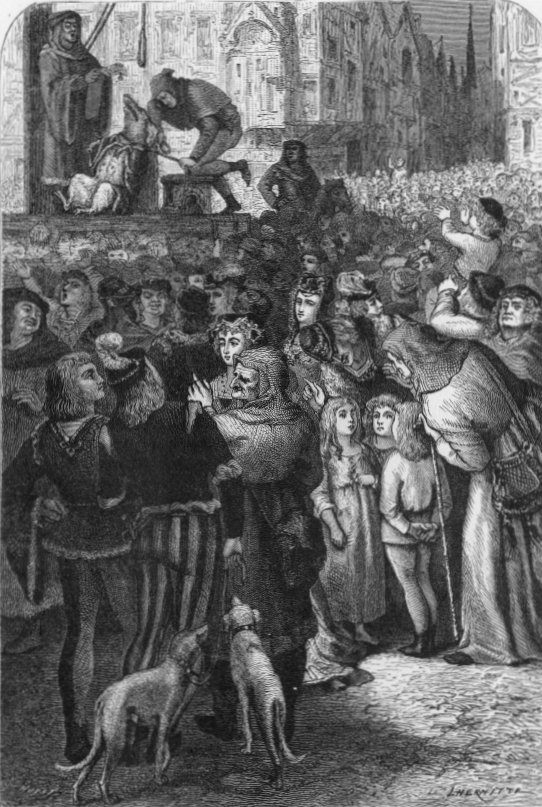
1400: Sir Thomas Blount, “bowels burning before him”

On this date in 1400, Sir Thomas Blount was drawn and quartered at Oxford.

He was a loyalist of the latterly deposed (and soon to be murdered) Richard II. Blount took part in the Epiphany Rising plot against the usurper Henry IV.

The chronicles supply an unusually graphic and detailed description (pdf) of this horrible manner of death. (Paragraph breaks have been added for readability.)

The King [Henry IV] commanded his chamberlain, Sir Thomas Erpingham, to have justice executed upon the lords who were taken prisoners, and to put them all to death, except a young knight whom he had dubbed the Saturday before his coronation, whom the King pardoned for rising in arms against him, on account of his youth and noble lineage.

Sir Thomas Blount and Sir Benet [Shelley] were drawn from Oxford unto the place of execution, a long league or more, and there they were hung; they then cut them down and made them speak, and placed them before a long fire. Then came the executioner with a razor in his hand, and kneeling down before Sir Thomas Blount, who had his hands tied, begged his foregiveness [sic] for putting him to death, for he was obliged to perform his office.

‘Are you he,’ said Sir Thomas, ‘who will deliver me from this world?’

The executioner replied, ‘Yes, my lord; I beg you to pardon me.’

The lord then kissed him and forgave him.

The executioner had with him a small basin and a razor, and kneeling between the fire and the lords, unbuttoned Sir Thomas Blount, and ripped open his stomach and tied the bowels with a piece of whipcord that the breath of the heart might not escape, and cast the bowels into the fire.

As Sir Thomas was thus seated before the fire, his bowels burning before him, Sir Thomas Erpingham said, ‘Now go and seek a master who will cure you.’

Sir Thomas Blount placed his hands together, saying, ‘Te Deum laudamus! Blessed be the hour when I was born, and blessed be this day, for I die this day in the service of my sovereign lord King Richard.’

After he had thus spoken, Sir Thomas Erpingham asked him, ‘Who are the lords, knights, and esquires who are of your accord, and treason?’

To which the good knight replied, suffering as he was, ‘Art thou the traitor Erpingham? Thou art more false than I am or ever was; and thou liest, false knight as thou art; for, by the death which I must suffer, I never spake ill of any knight, lord, or esquire, nor of anybody in the world; but thou utteredst thy false spleen like a false and disloyal traitor; for by thee, and by the false traitor the Earl of Rutland [who ratted out the conspiracy], the noble knighthood of England is destroyed.

‘Cursed be the hour when thou and he were born! I pray to God to pardon my sins: and thou traitor Rutland, and thou false Erpingham, I call you both to answer before the face of Jesus Christ for the great treason that you two have committed against our sovereign lord noble King Richard, and against his noble knighthood.’

The executioner then asked him if he would drink.

‘No,’ he replied, ‘you have taken away wherein to put it, thank God’! and then he begged the executioner to deliver him from this world, for it did him harm to see the traitors.

The executioner kneeled down, and, Sir Thomas having kissed him, the executioner cut off his head and quartered him; and he did the same to the other lords, and parboiled the quarters. And in Oxford castle many other knights and esquires were beheaded.

Thomas Erpingham doesn’t exactly exude charm in this account, going out of his way to bust on a guy having his entrails ripped out. But good guys and bad guys are a matter of perspective: Erpingham’s loyal service to the new dynasty got him a complimentary bit part in Shakespeare’s Henry V (Erpingham fought at Agincourt). Shakespeare’s young King Harry calls him his “Good old Knight”.

On this day..

1386: The Sow of Falaise, seeing justice done

There exists a receipt for January 9, 1386, in which the executioner of Falaise, France, acknowledges payment of ten sous and ten deniers

for his efforts and salary for having dragged and then hanged at the [place of] Justice in Falaise a sow of approximately three years of age who had eaten the face of the child of Jonnet le Macon, who was in his crib & who was approximately three months old, in such a way that the said infant died from [the injuries], and [an additional] ten s. tournoise for a new glove when the Hangman performed the said execution: this receipt is given to Regnaud Rigaut, Vicomte de Falaise; the Hangman declares that he is well satisfied with this sum and that he makes no further claims on the King our Sire and the said Vicomte.

From this tiny kernel of primary documentation — the only primary source that exists — an impressive legend has grown up around the “Sow of Falaise”. It’s been alleged by subsequent interlocuters that the condemned sow was dressed up as a person for execution, that other pigs were made to attend in order to take warning by their swinish sister’s fate, and even that the incident became so famous as to merit depiction in a church fresco.


The supposed fresco has been whitewashed, but Arthur Mangin’s L’Homme et la Bete (1872) took a stab at reconstructing it.

This bizarre scenario can’t help but raise the question for we later observers — just what was the objective in trying and “executing” a farm animal? Did the human supporting cast to this scene not feel itself ridiculous?


Scene from The Hour of the Pig.

Book CoverAccording to Paul Friedland‘s research for his fascinating recent survey of public executions, Seeing Justice Done: The Age of Spectacular Capital Punishment in France, the subsequent embroideries around the Sow of Falaise have no basis in fact. They were simply made up … or rather, they were interpolations of authors who were baffled as we to see a sow hoisted on a gibbet.

“Punishment may be about many things, but in the last instance, we citizens of the modern world have an almost visceral need to believe that it is primarily about one thing: deterrence,” Friedland opines.

“The punishment of a pig for murder violates our modern understanding of the essential purpose of punishment because it punishes an animal, which we ordinarily do not believe to be capable of criminal intent, and because it does not lend itself very well to the principle of exemplary deterrence.” The tale’s evolution in later centuries “allowed an incomprehensible anecdote from the past to fit neatly into the modern paradigm of penal deterrence.”

Well, the past is a foreign country. They do things differently there.

Seeing Justice Done situates that murderous pig within an unfolding saga of penal theory and practice stretching from the Roman Empire to the 20th century. And while Friedland’s study focuses on France in particular, the historical threads he teases out will look familiar much further afield.

We had the pleasure of interviewing Dr. Friedland about his book recently, and we’re pleased to present it here not in our customary Q&A form, but as Executed Today‘s debut podcast. The mediocre sound quality is on me, but Dr. Friedland’s insights are more than worth it. (Unlike your host, Friedland is a podcasting natural; catch him in a July 2012 episode of the New Books In Human Rights podcast.)


Trouble seeing the podcast player? Access the interview on podbean.

Other executions referenced in this podcast: Christ | the brutal 1757 execution of Damiens | Louis XVI and Marie Antoinette | the filmed 1939 execution of Eugen Weidmann | the last execution in France ever | Saddam Hussein‘s filmed hanging

(n.b. the intro/outtro music is Blind Lemon Jefferson‘s “‘Lectric Chair Blues”, a 1928 recording now in the public domain.)

On this day..

1328: Na Prous Boneta, Beguine heresiarch

“Her heart began to marvel that so great a light as the great light that they revealed could be changed so quickly to so great a smoke …”

-Female Beguine quoted by ‘So Great a Light, So Great a Smoke’: The Beguin Heretics of Languedoc

On this date in 1328, the Inquisition relaxed the heretic Na Prous Boneta (or Bonnet) to the secular authorities at Carcassonne for execution.

Na Prous Boneta was part of the great religious movements towards poverty and spiritual rebirth then shaking Europe — the same impulse that drove men like Segarelli and Dolcino to the stake.

In southern France, the first name in this movement so suspect to Catholic orthodoxy was Peter Olivi, a charismatic prophet of egalitarian poverty from the Franciscan order. The Franciscans were the institutional expression of that same renewal movement, but their incorporation into the church had co-opted their once-radical energy. They were divided internally between the ascetic “Spiritual Franciscans” (or Fraticelli) and their brethren grown comfortable with worldly emoluments.*

After Olivi’s (natural) death in Narbonne, France, in 1298, he became an object of popular veneration for the Fraticelli’s lay admirers, among whom the communities of lay Beguin(e) women were especially prominent.**

As we have seen, the Church would soon resolve upon a fearful suppression of the Fraticelli and the Beguines, who came to be closely identified with one another. Scores went to the flames; the Inquisitor Bernard Gui complained that fugitive Beguines (and their Beghard brethren) had the gall to keep up their own calendar of martyrology. (Executed Today fully endorses this practice.)

According to the confession her adversaries would later extract, a mystical vision on Good Friday 1321 in her home town of Montpellier would transport Na Prous Boneta into Beguine leadership — fully aware of the dangers to life and limb.

“Put your heart and mind into the work of the Holy Spirit,” she preached. And “keep your body prepared for martyrdom if it should be necessary.”

And boy, did she have to be prepared.

Prous was all-in on her heretical denunciation of a church that had committed itself to bloody suppression of her sect. She denied the efficacy of the sacraments, said that salvation followed from good deeds even for “Jews and Saracens” and as for the guy in charge just down the way at Avignon …

this present pope, John XXII, is like Caiaphas, who crucified Christ. Moreover, the poor beguins who were burned, and also the burned lepers, were like the innocents beheaded by Herod’s command. Again, just as Herod procured the death of innocent children, thus this Herod, the devil, procured the death of those burned beguins and lepers. Again, she claims that Christ told her the sin of this pope is as great as the sin of Cain.

Though all these confessions were given in 1325, Na Prous Boneta appears to have been kept in prison for three years in an effort to persuade her to change her tune. That Caiaphas-like pope himself took an interest in the case, even ordering (perhaps suggestive of the woman’s following) that her eventual execution take place not in her own city but in Carcassonne.

That execution took place on this date when the visionary, having refused every blandishment to save her soul, caused the inquisitors to declare that

knowing from experience that those who are evil simply get worse by the day when they think they will go unpunished, we, compelled by our office which we are obliged by holy obedience to fulfill diligently, since we neither should nor indeed wish to tolerate any longer such abominations and such dangerous opposition to the entire church and the catholic faith, having obtained counsel concerning the above matters from many religious and secular persons learned in both laws, having God before our eyes and the holy gospels of Jesus Christ placed before us so that our judgment should proceed from God and appear right before God and our eyes should see what is just, on this day, in this place and time assigned by us to hear definitive sentence, sitting as a tribunal, invoking the name of Christ, we pronounce, judge and declare you, Na Prous, to be an impenitent heretic and heresiarch and pertinacious in your obduracy. Since the church can do nothing more with such people, we release you to the secular authorities.

* This conflict is the subject of The Name of the Rose; Olivi’s heir as the Spirituals’ leader, Ubertino of Casale, is a character in that novel.

** One need not stretch too far to see a bit of comeuppance in the emergence of a feminine anti-papal voice at this period; the original movement into all-women beguinages is thought to have been facilitated by the surplus population of unmarried or widowed women created by Europe’s recent enthusiasm for sending young men to die on Crusade.

On this day..

1347: Not the Six Burghers of Calais

On this date in 1347, the city of Calais yielded to an English siege.


The siege of Calais, from Jean de Wavrin‘s Chroniques d’Angleterre. (More images)

Edward III had proceeded to invest Calais directly after the previous year’s staggering win at Crecy. The crippled French leadership could not relieve the city, and after fruitlessly probing for an opening, the relief army marched away at the start of August 1347.

By this time reduced to eating vermin and ordure, the starved city had little choice but to capitulate. According to Froissart’s account, the king declared that “the Calesians have done him so much mischief, and have, by their obstinate defence, cost him so many lives and so much money, that he is mightily enraged.” He wasn’t only sore about the city’s holding out over the preceding year: Calais was notorious as a refuge for English Channel pirates who had long bedeviled the commerce of Edward’s realm.

As a condition for sparing the rest of the town, Edward demanded that six of its leading citizens present themselves to him, “with bare heads and feet, with ropes round their necks, and the keys of the town and castle in their hands.” Edward seems truly to have meant (much against the conscience of his own nobles) to put these men to death “for that the Calesians had done him so much damage, it was proper they should suffer for it.”

This information caused the greatest lamentations and despair [in Calais]; so that the hardest heart would have had compassion on them; even the lord de Vienne wept bitterly.

After a short time, the most wealthy citizen of the town, by name Eustace de St. Pierre, rose up and said: “Gentlemen, both high and low, it would be a very great pity to suffer so many people to die through famine, if any means could be found to prevent it; and it would be highly meritorious in the eyes of our Saviour, if such misery could be averted. I have such faith and trust in finding grace before God, if I die to save my townsmen, that I name myself as first of the six.” When Eustace had done speaking, they all rose up and almost worshipped him: many cast themselves at his feet with tears and groans Another citizen, very rich and respected, rose up and said, he would be the second to his companion, Eustace; his name was John Daire. After him, James Wisant, who was very rich in merchandise and lands, offered himself, as companion to his two cousins; as did Peter Wisant, his brother. Two others then named themselves, which completed the number demanded by the king of England.

Wealthy elites sacrificing themselves for the greater good? The past really is a different country.

These six duly presented themselves, nearly naked and haltered and braced to bear the brunt of Edward’s vengeance. The English king had the executioner summoned … and then, Edward’s (very pregnant) queen Philippa dramatically fell to her knees

and with tears said, “Ah, gentle sir, since I have crossed the sea with great danger to see you, I have never asked you one favour: now, I most humbly ask as a gift, for the sake of the Son of the blessed Mary, and for your love to me, that you will be merciful to these six men.”

The king looked at her for some time in silence, and then said; “Ah, lady, I wish you had been anywhere else than here: you have entreated in such a manner that I cannot refuse you; I therefore give them to you, to do as you please with them.” The queen conducted the six citizens to her apartments, and had the halters taken from round their necks, after which she new clothed them, and served them with a plentiful dinner: she then presented each with six nobles, and had them escorted out of the camp in safety.

Edward still had the last laugh when it came to Calesian carnage.

This nigh-unconquerable foothold on the French coast would persist in English hands for two centuries: the first century spanned the Hundred Years’ War, which England was licensed to protract by dint of (and France would not settle because of) the menacing northern base England won this day. “Each will have to take up his shield,” ran a French verse cited in Barbara Tuchman’s A Distant Mirror: The Calamitous 14th Century, “For we’ll have no peace till they give back Calais.”


The Six Burghers persisted even longer than that.

George Bernard Shaw wrote a one-act play standing the story on its head, in which a henpecked Edward exasperatedly yields to his nagging wife’s merciful caprice, to the open derision of the burghers themselves.

A bit more exalted of spirited is Rodin‘s sculpture group Les Bourgeois de Calais — rendering six emaciated, suffering, and courageous figures.

I have, as it were, threaded them one behind the other, because in the indecision of the last inner combat which ensues, between their devotion to their cause and their fear of dying, each of them is isolated in front of his conscience. They are still questioning themselves to know if they have the strength to accomplish the supreme sacrifice–their soul pushes them onward, but their feet refuse to walk.

They drag themselves along painfully, as much because of the feebleness to which famine has reduced them as because of the terrifying nature of the sacrifice … And certainly, if I have succeeded in showing how much the body, weakened by the most cruel sufferings, still holds on to life, how much power it still has over the spirit that is consumed with bravery, I can congratulate myself on not having remained beneath the noble theme I dealt with.

Rodin

The discriminating connoisseur of Middle English may also enjoy Laurence Minot‘s poetic celebration of the siege of Calais. (Helpful explanatory annotations.)

Part of the Themed Set: Scary Escapes.

On this day..

1301: False Margaret, Norwegian pretender

(Thanks to Meaghan Good of the Charley Project for the guest post. -ed.)

This is the feast date for the early Christian martyr Saint Margaret the Virgin of Antioch (only one of many saints named Margaret).

Margaret might in principle be of interest to this site as the patroness of the falsely accused, and one of the saints who spoke to Joan of Arc, but her star has fallen quite a bit since its medieval heyday on the celestial all-star team; considering the doubtful historicity of this bog-standard Diocletian martyr, the Catholic Church has dropped some of her celebrations.

So instead we’ll turn to a namesake of Margaret’s — well, namesake once removed.

We don’t know the date or even the season in 1301 when the so-called False Margaret and her husband were executed for fraud and treason: he by beheading, and she by burning at the stake.

The pair had made an audacious grab for the Norwegian throne the previous year. The story was told in detail in a nineteenth-century Icelandic history.

The False Margaret (whose true name has been lost to history, as has that of her husband) claimed to be Princess Margaret, known as the Maid of Norway, who was supposed to have died a decade before. How she got the idea to do this is a mystery. It seems unlikely that she came up with the plan on her own, but if she didn’t, then who set her up?

The actual Maid of Norway was the daughter of Eric II of Norway and a mom also named Margaret, this Margaret the daughter of Alexander III of Scotland. Said couple’s marriage treaty specified that if Alexander died without sons, and his daughter had children by Eric, those children would succeed to the throne of Scotland.

This is precisely what happened: Alexander died in 1286 without a legitimate son to succeed him, leaving his kingdom to the three-year-old Norwegian princess.

Technically speaking, the Maid of Norway was Queen of Scots from 1286 until her death. But since she was never crowned and never set foot on Scottish soil, some lists of Scottish monarchs do not include her name. She remained in Norway for the next several years and a selected group of guardians tried to maintain control of the country for her.

On, for the laughter, harps he pressed,
The feast’s right royal quarter; —
But west the ship fared, ever west
With Eric’s little daughter

-From “King Haakon’s Banquet Hall”, by Henrik Ibsen (pdf link)

Eric set about arranging a marriage for his daughter, eventually settling on the future Edward II of England, who was then Prince of Wales. Margaret set off for Scotland in 1290, with the plan that the English wedding would be arranged once she arrived.

Alas, the Maid of Norway never saw Scotland.

In September or October of 1290, en route, she died suddenly somewhere in the vicinity of the Orkney Islands, which were then Norwegian territory. She was only seven years old.

Her death set off a crisis in Scotland as more than a dozen heirs competed for the vacant throne, and this eventually lead to the Wars of Scottish Independence.

But did little Margaret really die?

In 1300, a woman arrived in Bergen, Norway on a German ship, claiming to be the lost princess. She said she had not died but had in fact been “sold” by one of her female attendants and sent to Germany, and had married there. By this time, Eric II had died without male issue and his brother, Haakon V, had become King of Norway.

In spite of the fact that (a) the Maid of Norway’s body had been returned to Norway and was identified by her father and (b) the False Margaret appeared to be about 40 years old when the Maid would have been 17, the False Margaret’s claims drew considerable popular support.

Why? A theory was put forth by the 19th-century Scottish historian John Hill Burton:

The announcement of so portentous an event [meaning the Maid’s death], through indistinct rumors, naturally caused men to talk and doubt. There was none of the solemn detail that might be expected to attend on a royal death, even though less heavily laden with a perplexing future. We are not told of any who were present, of the disease or its progress, of the spot where she died, or the place where she was buried. The time of death is only inferred … The whole affair has left on Scandinavian history a shadow of doubt, in the possibility that the child might have been spirited away by some one of those so deeply interested in her disappearance, and consequently, that it may be an open question whether the royal line of the Alexanders really came to an end…

It should be emphasized that there is no evidence of any conspiracy surrounding the Maid’s death and no evidence of her survival past 1290. Her own father, who had no apparent reason to lie, viewed the body and identified it as his daughter.

But people will talk, and believe what they want, and so the False Margaret found support for her wild story.

Ironically, even if she had been the real Maid of Norway, the False Margaret was not a serious rival to her uncle Haakon; her sex would have prevented her from ruling. But, as the Norwegian historian Peter Andreas Munch noted,

Her pretensions … might, nevertheless, have been extremely distasteful to him, and probably not altogether free from danger in the future, if, as was not at all unlikely, they should be made use of by the party of nobles who were discontented with his absolute government. This party would willingly have thrust him from the throne … but before they could hope to do so they must have a pretender to the crown of the old royal stock to set up opposition to him. [ … ] And for this purpose there would have been none more suitable than Margaret, if she could be conjured from the dead again.

This woman had to be dealt with. There was no getting around it.

Since the False Margaret and her husband were not executed until 1301, a year after their arrival in Norway, it seems likely that there must have been some official investigation into her claims. If so, the records of this have been lost. What seditious nobles might have hoped to gain through her has likewise slipped into a speculative fog. But False Margaret was clearly a matter of highest statecraft at the time: the executions were delayed until King Haakon could personally come to Bergen to see them carried out.

Embarrassingly, the False Margaret’s cause did not die with her. Her supporters actually erected a church to our friend Saint Margaret near the place of her execution. (The church is no longer extant.)

On this day..

1318: John Deydras, aka John of Powderham

(Thanks to Meaghan Good of the Charley Project for the guest post. -ed.)

On some day in June 1318, a cat and a one-eared man called John Deydras or Dydras, also known as John of Powderham, were hung in Oxford for challenging the right of Edward II to rule; indeed, John had claimed he was Edward II himself.

It had all started earlier that year when he walked into the King’s Hall in Oxford and announced before everyone that he was the rightful king of England. It was true that he resembled King Edward’s father, Edward I, except that he was missing an ear.

According to Powderham, when he was a baby and playing in the castle yard, a pig bit his ear off. His nanny, fearing the wrath of his royal parents, substituted him for a changeling. Now he was back and wanted to claim his kingdom. He even offered to fight King Edward in single combat for the right to rule.

Historian Helen Castor records the incident in her book She-Wolves: The Women Who Ruled England Before Elizabeth:

Edward’s first response was to laugh. He welcomed the pretender, the Chronicle of Lanercost records, with a derisive cry of “Welcome, my brother!” But for the queen, struggling to maintain her husband’s dignity (and, with it, her own), and acutely conscious of the threatening consequences of Edward’s failings, jokes did not come so easily. Proud Isabella was “unspeakably annoyed.”

Proud Isabella had a reason for being so displeased, for her husband was nothing like his father, who had been an accomplished soldier and a good king. Indeed, Edward was widely despised not only for his inept leadership but his unseemly relationships with other men.

After his arrest, Deydras confessed that the story had been a lie. He blamed his pet cat, a servant of the devil, for putting him up to it.

Modern readers can only conclude that the man was crazy. Royal pretenders had remarkably short lifespans, and to become one was effectively to commit suicide. (And at the urgings of a cat! Cats are not, after all, noted for their political acumen.)

Deydras’s contemporaries probably also knew he was mad, and Edward wanted to keep him as a court jester, but according to well-established precedent he was hung — and the cat too.

On this day..

1388: Three evil counselors of Richard II

On this date in 1388, James Berners, John Beauchamp, and John Salisbury were convicted by the “Merciless Parliament” of treason, and put to immediate death.

You could say that relations between the branches of government were a bit on the frayed side, since crown and parliament had civil war for political primacy. Parliament won.

It just wasn’t quite one of those all-out, kill-you-when-we’re-done wars to depose the king outright. (That would come later.) “We do not rebel or arm ourselves against the King except in order to instruct him,” one of the rebelling Lord Appellant told His Majesty.

“Instructing” Richard II meant politically isolating him and then mercilessly — hence the resulting parliament’s name — attainting his aides and allies for treason.

So all that spring, young Richard II helplessly “presided” over a parliament where his supporters were condemned on trumped-up charges.

This date was the turn for Sir John Beauchamp of Holt and Sir James Berners (or Barnes), two guys noble enough to suffer “merely” beheading, plus Sir John Salisbury, who was far enough down England’s class hierarchy that he got to endure the full drawing and quartering treatment.


Berners may have been the father of a 15th century prioress and author, Juliana Berners.

This woman wasn’t the type to keep to her cloister and meditate: Berners wrote books on her vigorous pastimes of heraldry, hunting, and hawking. Her Treatise of Fishing with an Angle remains one of the seminal books for the sport of angling.

On this day..

1318: Four Fraticelli friars

[Spiritual Franciscans record] the names of the condemned and the days or calends on which they suffered like martyrs.

-Inquisitor Bernard Gui (the gui from Umberto Eco’s Name of the Rose)

On this date in 1318, four Franciscans — Jean Barrani, Deodat Michel, Guillem Sainton, and Pons Rocha — were burned at the stake in Marseilles.

This illustration of the martyred friars also adorns the cover of the book So Great a Light, So Great a Smoke: The Beguin Heretics of Languedoc … which tells the story of what happened next.

These Fraticelli were part of the great and multi-headed 13th-14th century movement towards spiritual poverty — movements like the Apostolic Brethren, of Fra Dolcino fame.

The worldly wealth of the Church, as Eco’s narrator explains it,

generated movements of men bent on a poorer life, in protest against the corrupt priests … [the Fraticelli] claimed that Christ and the apostles had owned no property, individually or in common; and the Pope condemned this idea as heretical. An amazing position, because there is no evident reason why a pope should consider perverse the notion that Christ was poor.

Distinct from Dolcino et al (who were outside any official institutional order) but mutually sympathetic with their like, the Fraticelli were “Spiritual” Franciscans who rejected the more worldly accoutrement that even their humble order had taken on.

“Hardly a handful [of Franciscans] can be found who will abstain from luxuries, wearing cheap, patched tunics, and going without shoes, like the first brethren and the blessed Francis,” complained the ascetic Ubertino of Casale in 1311. “It seems as if all the spiritual offices of the order were rated at a price.”

In the hands of a more supple pope, this popular energy might have helped the Church, but John XXII — who held his court at Avignon in the care and feeding of the French crown — rejected his predecessors’ attempts at brokering compromises and just cracked down.

“Great is poverty,” said the papal bull ordering an end to the disputation. (Quoted here.) “But greater is blamelessness, and perfect obedience is the greatest good.”

And you have to enforce perfect blamelessness.

It began in the Avignon papacy’s Provencal back yard: southern France, which had felt the papal whip before, had proven very fertile soil for the Fraticelli, with its own similar Beguin movements among the laity.

Soon after Pope John ascended the seat of St. Peter, 25 obdurate Spiritual Franciscans were summoned to Avignon to answer to the Inquisition; 21 of them succumbed to the menacing proceedings and produced their “obedient” recantations, leaving the four stern enough to persevere unto the stake.

Many more, too many to track from the era’s sketchy documentation, followed them in the ensuing years.

The fires kindled at Marseilles were a signal for the extermination of the Spiritualists throughout Provence. We hear of burnings at Narbonne, Montpelier, Toulouse, Lunel, Lodvfere, Carcassonne, Cabestaing, Beziers, Montreal. Mosheim tells us of a band of a hundred and thirteen Spirituals sacrificed at Carcassonne from 1318 to 1350. Wadding tells us that the Franciscan inquisitors alone burned one hundred and fourteen of the zealots in a single year (1323). And Angelo compares the indiscriminate frenzy of the persecutors to the fierceness of rabid dogs and wolves. The works of Olivi were condemned at the Pentecostal chapter of 1319 at Marseilles, and even the bones of many saints who had died uncondemned (though suspected), were cast out of their tombs. The result of the fierce persecutions was to stamp out the Spirituals in Provence.

Beguini combusti or “burned Beguins” (doc link) inspired their synoptic brethren, and strains of the persecuted movement persisted for many years.**

John XXII reaped the hatred of the put-upon Franciscans. According to Bernard McGinn’s study of reputed “papal antichrists”† John was “the pope who bears the distinction of being the most popular candidate for the role of Papal Antichrist in medieval history.”


Image of Pope John XXII as the Antichrist. 15th century image from the Vaticinia de Summis Pontificibus, adapted from a c. 1340 illustration of the apocalyptic pro-Spiritual text as described in The Use and Abuse of Eschatology in the Middle Ages.

* Theologically, it was a dispute over whether Christ and the Apostles owned anything, singly or jointly. Politically, it pitted the Holy See against the Holy Roman Emperor, the classic Guelph-Ghibelline contest. (A few years on, there would be a Spiritual Franciscan appointed as antipope by the emperor.)

** William of Ockham — the Occam’s Razor guy — had to flee to imperial protection because, although not a radical Fraticello, he merely considered well-founded the doctrine that Christ and company didn’t own anything.

† In “Angel Pope and Papal Antichrist”, Church History (Jun., 1978)

On this day..

1312: Pierre Vigier de la Rouselle, Gascon

“It is unjust that that which is rightly judged should result in prejudice to us and bring damage to others …”

-Edward II, letter concerning the Pierre Vigier case

One is like to reckon the phenomenon of the interminable death penalty appeal a modern construct, product of the present day’s moral confusion or juridical inefficiency.

It’s been right about 700 years exactly since Pierre Vigier was hanged in the February-April neighborhood, in the year of our Lord 1312, for his impolitic sentiments on the governance of his native province. This medieval execution went with a very modern-sounding 12 years of indeteminate appeals.

Still, it is true what they say — “The past is a foreign country: they do things differently there.” In this foreign country, Gascony by name, they did the hanging first … and then did the appeals.

Our source here (virtually the only source short of plumbing the archives) is Joseph Kicklighter’s “English Bordeaux in conflict: the execution of Pierre Vigier de la Rousselle and its aftermath, 1312-24” from the Journal of Medieval History, no. 9 (1983).

And the source of all the judicial chaos was the bizarre situation of one king as a rival king’s vassal.

Gascony at this time was a sort of feudal leftover of the Angevin Empire whose Plantagenet descendants were still kings of England. This remaining Plantagenet patrimony* in southwestern France was a going source of conflict between the realms, the most recent of which had been expediently settled by making the English king also Duke of Gascony … and (with respect to Gascony) the French king his liege lord.


Seated French king Philip IV accepts the homage of his “vassal” Edward I.

The territory was worth the “submission”: ducal Gascony’s fertile land gave England a bounty in crops and wine. And the inevitable rivalry over sway in Gascony easily knocked on to the courts. As Barbara Tuchman put it in A Distant Mirror,

[t]he King of France still retained superior sovereignty under the formula of superioritas et resortum, which gave the inhabitants the right of appeal to the ultimate sovereign. Since his decisions were more than likely to go in their favor against their English overlord, and since the citizens, knowing this, exercised the right frequently, the situation was an endless source of conflict.

It was during such a conflict, when the rival factions of the Gascon capital of Bordeaux had the city in virtual anarchy as they jockeyed for power under the nominal lordship of English king Edward II, that the onetime royal castellan Pierre Vigier de la Rouselle apparently dumped on one of the new officials in conversation with a couple of informants.

The municipal government arrested Vigier and had him hanged — quickly, before Vigier’s inevitable attempted appeal to Parlement could save him.

(This all went down just a couple months before Edward II suffered a Gascon humiliation closer to home, when the Gascon nobleman Piers Gaveston, Edward’s dear friend and suspected lover, was executed by rival English lords.)**

Vigier’s aggrieved sons did pursue the appeal (it is they who provide posterity the circumstances of Pierre’s condemnation, so handle the story with care: one latter-day hypothesis is that Vigier was an outright rebel against the new appointees). Inevitably, the French backed their claim, allowing them undercut Edward’s ducal authority.


Productive relationship.

From there, the matter sank into an intractable mire of feudal Europe’s overlapping political authorities and factional rivalries. Parlement decreed some penalties. King Philip remitted some of them as a diplomatic gesture. The sons renewed their complaint. Bordeaux authorities tried to put the matter to bed by persecuting Vigier’s persecutors, only to be slapped down by an indignant King Edward. Persons were seized only to be ordered released, and estates likewise. Just as there was no single unambiguous authority to adjudicate it, there was no single wrongdoer to investigate, no single injury to repair (besides the matter of honor, there was the dead man’s property, and the fact that he was buried in unconsecrated ground), and no single arrangement of interested parties between the Vigier sons on the one side and the Plantagenet king on the other.

Edward seems to have taken particular affront at this imposition on his routine authority, and one must bear in mind that at this stage even the concept of sovereignty as we think of it today was simply not on the map. In some ways, the French appeals policy was pioneering it.

But as the suit bumped up and down or got kicked down the road by a Parlement that was probably enjoying its sport, Edward tried to dispose of it through such expedients as harassing its supporters and attempting to bankrupt the Vigiers. All this, naturally, just got rolled into the messy ol’ case.

Kicklighter:

Only time itself finally ended the appeal … in March 1324, King Charles IV announced the indefinite postponement of all ducal litigation at the Parlement of Paris becase of a mounting Anglo-French crisis which would soon lead to the brief War of Saint-Sardos. But even during the war, the court continued to deal with some aspects of the case; and the appeal was still under judgment when the Anglo-French feudal relationship was resumed with the accession of Edward III to the English throne.† It seems likely … Parlement had dropped the case by the 1330’s … in all probability, the Vigier case had lost the critical importance with which the king-duke and his officials had regarded it for so long. One might, with some justification, wonder why the appeal had ever enjoyed such attention.‡


In 1337, King Philip VI of France attempted to seize Gascony. In response, Edward III declared himself (not without at least some theoretical validity) the rightful King of France. The ensuing hostilities proved to be the opening act of the Hundred Years’ War.

“It was not the dynastic question that brought about the war,” wrote the historian T.F. Tout. “The fundamental difference between the two countries lay in the impossible position of Edward in Gascony.”

* Here’s a lovely free book about the preceding century’s backstory of English rule in Gascony.

** Potentially topical to this digressive connection: Edward’s loyal aide in Bordeaux, a gentleman by the name of Arnaud Caillau, may have been a cousin of Piers Gaveston. Edward certainly had a supportive Gascon faction that his own resentful alleged vassals were frequently keen to harass; maybe the whole Vigier intervention just struck a little too close to home.

† The reader will recall that Edward III’s route to power involved his French mother and her lover invading England and overthrowing Edward II. So there was a good deal of more interesting politics going on around this time than Pierre Vigier’s endless procedural appeal.

‡ Lest we misrepresent Kicklighter, he does go on to attempt to explain this hypothetical wonder as “a certain indication of the limited power of the English in Gascony.” I prefer my own stopping-point.

On this day..

1330: Roger Mortimer, usurper

The prince I rule, the queen do I command,
And with a lowly congé to the ground
The proudest lords salute me as I pass;
I seal, I cancel, I do what I will.
Fear’d am I more than lov’d;—let me be fear’d,
And, when I frown, make all the court look pale.

-Roger Mortimer in Christopher Marlowe’s Edward II

On this date in 1330, Roger Mortimer’s three-year run as de facto ruler of England ended with a rope at Tyburn.

Mortimer was a key figure in the Despenser War — a revolt of nobles against King Edward II and the king’s hated-by-nobles right hand Hugh Despenser.

That war failed and landed Mortimer in the Tower. Then, things really got interesting.

Mortimer escaped his cell in 1323 and fled to France. There he took up with King Edward’s own wife, Queen Isabella, when the latter came to court on some state business.

This was, needless to say, quite a scandalous arrangement — but hey, Isabella had seen royal cuckolding right in her own family before.

So the adulterous lovebirds settled in to canoodle and set about planning some serious homewrecking.

Both Isabella and Mortimer are by every appearance among the most outstanding personalities of their day, and they had ambition to match their considerable personal gifts.

In the autumn of 1326, they invaded England and won a swift victory as those disaffected nobles from the recent wars declared for the usurpers. This time, Hugh Despenser was put to death.

Edward didn’t fare that much better. By the next January, he had been forced to abdicate in favor of his 14-year-old son, which in reality meant ceding power to his ex and her lover. And you thought your divorce settlement was bad.

In the long tradition of rival heads of state being disposed of, Edward II was, well, disposed of: strangled in captivity later that same year (allegedly! there is some doubt as to whether he really died in 1327), and given a state funeral that put Roger Mortimer into a bogus public display of mourning

(Mortimer’s kinsman and historical-fiction-biographer Ian Mortimer thinks Edward actually survived, which is neither here nor there as pertains the fate of Mortimer.)

Once he got to the top of the heap, Mortimer too had rocky aristocratic relationships. He irked the lords of the realm with his tendency to behead them. He lost the First War of Scottish Independence. Oh, and he was a regicide. All this frayed his popularity. (This just in: governance is hard.)

More than that, since he and Isabella ruled in the minority of the titular king, Edward III, they were rearing a wolf to their own destruction — a wolf with a built-in personal grudge about his father’s overthrow and murder. All young Edward needed was a plan to disencumber his fangs.

As is so often the case, the most direct solution proved to be the best. In one of the more dramatic family moments in the English royal annals, Edward joined his close friend and a small band of trusted armed men, and burst in on Mortimer at Nottingham Castle, arresting him while his mother plaintively implored Edward to “have pity on gentle Mortimer.”

But Mortimer got as much mercy as he’d given the late Edward II. A mere six weeks removed from mastery of England, Mortimer was presented bound and gagged for the formality of a condemnation by Parliament on grounds of assuming royal authority. Then he was hustled off to Tyburn dressed pointedly in the same black tunic he had once worn to mourn Edward II. It was the first documented case of a nobleman being hanged at that grim destination.

First Lord. My lord, here is the head of Mortimer.
K. Edw. Third. Go fetch my father’s hearse, where it shall lie;
And bring my funeral robes.
Accursed head,
Could I have rul’d thee then, as I do now,
Thou hadst not hatch’d this monstrous treachery!

-Marlowe’s Edward II

The French could say the same thing of Edward.

We’ve previously recommended Lady Despenser’s Scribery for its coverage of this period; true to form, it has a detailed series on Roger Mortimer: 1, 2, 3, 4

On this day..