1619: Johan van Oldenbarnevelt, laandsadvocaat

On this date in 1619, Dutch stadtholder Maurice of Orange beheaded his political and religious rival, jurist Johan van Oldenbarnevelt.

Both men had in their day been instrumental to winning the independence (de facto, if not yet de jure) that the Low Countries were already enjoying: laandsadvocaat van Oldenbarnevelt as the commanding political personality holding together the potentially fractious provinces in the 1580s and 1590s; stadtholder Maurice as the great general* of those provinces, whose sword-arm in the 1590s and 1600s more or less staked out the borders of the present-day Netherlands.

Thanks to their good offices, the once-desperate Dutch Revolt had triumphed in all but name, and in the 1610s paused to savor the fruits of victory during the Twelve Years’ Truce.**

Increasingly after 1600, the two developed a rivalry that was both personal, and political, and religious — for in their prominence they also became the chief exponents of the neighborhood schism, van Oldenbarnevelt championing the Remonstrants or Arminians (they remonstrated against some Calvinist doctrines) and Maurice upholding the orthodox Counter-Remonstrants or Gomarist side. The conflict was no joke; the States of Holland at van Oldenbarnevelt’s urging went so far as to hire its own mercenary army, knowing that it could not trust the national army commanded by the Counter-Remonstrant William. William secured the support of the States-General to forcibly disband this rival militia in July 1618† — and from that point until his death in 1625, William was the strongman in the Low Countries.

And van Oldenbarnevelt, well — he got the kangaroo court. See?


Detail view (click for the full image) of Satire on the trial of Johan van Oldenbarnevelt, by Cornelis Saftleven (1663). Saftleven liked painting animals.

Tried by a special (dubiously legal) court comprised of enemies, the grizzled pol was condemned to death as a traitor. On May 13, the day he went to the block at the Binnenhof in The Hague, his home province the States of Holland saluted him as “a man of great business, activity, memory and wisdom — yes, extra-ordinary in every respect.”

And it added a passage from Corinthians:

Die staet siet toe dat hij niet en valle

He who stands, let him take care that he does not fall


Detail view (click for the full image) of a 17th century engraving of Johan van Oldenbarnevelt’s beheading.

Van Oldenbarnevelt’s son Reinier, lord of Groeneveld was beheaded in 1623 for conspiring to assassinate Maurice in revenge for his father’s execution.

* Maurice of Orange was recognized in his time as perhaps Europe’s greatest and most innovative commander. His introduction of infantry volley fire and highly disciplined drill regimens revolutionized the battlefield — and made the Dutch very difficult for their Spanish masters to handle.

The Indian Ocean island-nation Mauritius, discovered by Dutch explorers in 1598, was named for him.

** Posterity has the luxury of hindsight knowledge that although war would resume for the Low Countries in 1621, the peace of Westphalia would secure an independent Netherlands. However, already during the Twelve Years’ Truce the place was acting as an independent country, and some other states formally recognized it as such.

† One of van Oldenbarnevelt’s supporters was international law pioneer Hugo Grotius. Grotius was clapped in prison with van Oldenbarnevelt’s fall in 1618; he famously escaped this dungeon in 1621 by hiding in a chest of books and lived out his scribbling days in France.

On this day..

1612: The slave rebels of Mexico City

On this date in 1612, Spanish colonial authorities smashed an alleged plot among Mexico City’s black slaves with a grisly mass execution.*

In Mexico as elsewhere in the Americas, African labor had been imported en masse in the 16th and 17th centuries; David Davidson estimated** that Mexico City had a black population ranging from 20,000 to 50,000. And as elsewhere in the Americas, they frequently resisted: Mexico City slave risings dating back to the 1540s had badly shaken the city, and led the viceroy Luis de Velasco to worry in 1553 that “this land is so full of Negroes and mestizos who exceed the Spaniards in great quantity, and all desire to purchase their liberty with the lives of their masters.”

The most illustrious name of this era was Gaspar Yanga, who was kidnapped into bondage from the Gold Coast, and escaped bondage by leading a large band of fugitive slaves into the highlands of Veracruz and founded an outlaw colony that still bears his name today.

Yanga’s palenque — known in his time as San Lorenzo de los Negros de Cerralvo — had to fend off military action by the Spanish authorities from 1609 until a truce in 1618.

Still, a truce was possible: a refuge like San Lorenzo offered slaves the unwelcome-to-their-masters prospect of escape from the scourge economy, but the real threat to New Spain was that purchasing liberty with lives bit.

As we have seen in the American South, the situation on the ground begat paranoia that makes it nigh impossible for later interlocutors to disentangle fact from fantasy: was there really a phenomenal slave rebellion nipped in the bud? Or just informers and torturers refracting the terrors of those outnumbered Spaniards?

The slaves in this case were said by a Portuguese merchant who overheard them to be readying themselves to exploit Spanish inattention during Holy Week celebrations, and to bloody those days by falling upon their masters and taking possession of the colony. In the inevitable rounds of arrests and torture that ensue, the alleged plot as recorded by the annalist Chimalpahin (Spanish link) sounds suspiciously like a psychosexual projection, for it

involved castrating any surviving Spanish males, making sexual slaves of white women, and gradually “blackening” the latter’s descendants.**

Certainly the punishment blackened Mexico City; our correspondent uses this same word to describe the condition of the gibbeted corpses when they were finally let down from their gallows on the feast of the Holy Cross. Even then, the flesh of the would-be slave kings could not rest: most were beheaded posthumously and mounted on pikes while six others were quartered for display on all the roads entering the capital. This in itself was a small moderation for the public good. Chimalpahin reports that doctors advised the state that “if all the dead were to be quartered and hung up in the main streets to rot, their stench will blow a sickness across the city.”

* Thirty-five is the execution count supplied by Chimalpahin; some sources give 33.

** “Negro Slave Control and Resistance in Colonial Mexico, 1519-1650,” The Hispanic American Historial Review, Aug. 1966.

† Maria Elena Martinez, “The Black Blood of New Spain: Limpieza de Sangre, Racial Violence, and Gendered Power in Early Colonial Mexico,” The William and Mary Quarterly, Jul. 2004.

On this day..

1698: Katharina Sommermeyer, Beierstedt witch

The last witch executed in the Saxon city of Braunschweig — Brunswick, in English — burned on this date in 1698.

Hers was a distinction that was long thought to adhere to the much better-documented Tempel Anneke, who suffered back in 1663. The eventual discovery in city archives of records for at least three later trials — Lucke Behrens in 1671, Elizabeth Lorentz in 1671, and our Katharina Sommermeyer in 1698 — corrected the record.

Unfortunately, only sketchy details are known about any of these women. Sommermeyer, the subject of our date’s small milestone, was a young woman of about 20, hailing from the tiny nearby village of Beierstedt. (Present-day population, according to Wikipedia: 386.)

On this day..

1619: The Witches of Belvoir

The family of the Earl of Rutland enjoyed closure on this date in 1619* when two daughters of a notorious local sorceress were hanged at Lincoln Castle for bewitching the Rutland heirs to death.

Hotheaded enough in his youth to have joined Robert Devereux‘s ridiculous rebellion, Francis Manners had matured into a solid pillar of James I’s court by 1612 when he succeeded to the Earldom upon the passing of his brother.

Taking up his proper residence at the estate’s noble Belvoir Castle, lord and lady Manners had two noble sons and the consequent prospect of a robust progeniture to carry on the Rutland title, father to manful son onward into trackless posterity.

But witchery (as Shakespeare documented) went boldly abroad in those days. To the Rutlands’ grief it set its fell eye against the prosperity of their house.

Belvoir Castle was then “a continuall Pallace of entertainment, and a daily receptacle for all sorts both rich and poore, especially such auncient people as neighboured the same,” noted a pamphlet of the time.** “Amongst whom one Ioane [Joan] Flower, with her Daughters Margaret and Philip were not onely relieved at the first from thence, but quickly entertained as Char-women, and Margaret admitted as a continuall dweller in the Castle, looking both to the poultrey abroad and the wash-house within dores.”

Someone having detected this clan of hags pilfering from His Lordship, the Flower family was soon dismissed: a reckless show of rectitude by parents who would soon have cause to regret it.

Joan Flower, the mother, “was a monstrous malicious woman, full of oathes, curses, and imprecations irreligious … her eyes were fiery and hollow, her speech fell and envious, her demeanour strange and exotic.” Folk who knew her had come to understand — how could they not? — that her curses had the power to bend infernal servants to her spiteful will; her daughters were likewise suspected of necromantic potency all their own.

Together, they were formidable enemies when roused — and they promptly avenged their dismissal by enchanting the Rutland heir Henry, who fell ill and died in September 1613. (The rest of his family got sick on this occasion, too.) Five years later, they enspelled Henry’s younger brother Francis and sent him to an early grave too.

Under such compelling affliction, the family could not long remain ignorant of the Flowers sorceresses’ enmity, and denounced them to authorities. They were arrested around Christmas of 1618.

The mother-witch soon died in prison under God’s own torture, for she

called for Bread and Butter, and wished it might never goe through her if she were guilty of that whereupon shee was examined; so mumbling it in her mouth, never spake more wordes after that, but fell downe and dyed as shee was carryed to Lincolne Gaole, with a horrible excruciation of soule and body.

As though more evidence were needed, both of Joan’s daughters also admitted turning their occult powers against the little heirs, part of a horrific pattern of infernal connivance:

  • that the late mother kept a feline familiar named Rutterkin, and Joan malevolently stroked the cat with a glove stolen from Henry while uttering incantations that the boy might never thrive
  • that similar treatment was meted out using Rutterkin and a glove discarded by Francis
  • that Margaret kept two evil familiars whom she profanely suckled — “the white sucked under her left breast, and the blacke spotted within the inward parts of her secrets”
  • that Philip “heard her mother often curse the Earle and his Lady, and thereupon would boyle feathers and blood together, using many Devillish speeches and strange gestures”
  • that Margaret “saith, That her mother, and shee, and her sister agreed together to bewitch the Earle and his Lady, that they might have no more children”

While the mother was beyond the reach of the law, both daughters were duly condemned for murder on the evidence of their own confessions, and “executed accordingly, about the 11 of March, to the terror of all the beholders, and example of such dissolute and abominable Creatures.”

Even so, their horrid magic outlived them. The Earl and the Duchess were never again able to conceive; their only surviving child was a daughter, Katherine, who would carry the rich inheritance that should have been her brothers’ into a marriage with King James’s favorite.†


“Two sons, both which dyed in their infancy by wicked practise & sorcerye”: Inscription on a Manners family memorial at Bottesford. (cc) image by J. Hannan-Briggs.

* 1618 by the local reckoning, since the new year at this time began on March 25. It’s 1619 as we would see it retrospectively in view of a January 1 calendar rollover.

** The wonderful discoverie of the witchcrafts of Margaret and Phillip Flower, daughters of Ioan Flower neere Bever Castle: executed at Lincolne, March 11, 1618

† Some scurrilous wags of the present day have suggested that said favorite cunningly poisoned off the brothers himself so that he could get his hands on Katherine’s huge tracts of land.

On this day..

1688: James Renwick, to end the Killing Time

Though none of the crowd that thronged Edinburgh’s Grassmarket this day in 1688 could know it, that date’s execution of minister James Renwick would make an end to the Killing Time, the great 1680s persecutions that scattered martyrs’ bones across Highland and Lowland.

Renwick, at any rate, was the last of many Covenanters who submitted to the public executioner; only a few months yet remained when officers in the field were empowered to force an oath of abjuration upon suspected dissidents, on pain of summary death in the field. By year’s end, the absolutist Catholic King James II — with whose brother and predecessor the movement had such a tortured history — fled to exile as the Glorious Revolution brought the Protestant William of Orange to power: royal recognition of Scottish Presbyterianism ensued.*


Monument to Renwick at his native Moniaive. (cc) image by Scott Hill.

The son of a village weaver, Renwick manifested a martyr’s uncommon zeal for the faith early in life and matriculated at the University of Edinburgh. There in 1681 he witnessed the hanging of Covenanter preacher Donald Cargill. Here, muses the hagiography, “the mantle of Elijah fell upon young Elisha.”

After studying — and ordination — abroad in the Netherlands Renwick returned to his native soil in 1683. He managed some five years of secret ministering in hidden homes and conventicles, and all the while the law sought him ever closer. By the time it finally hunted him to ground in 1688, so many of the faith’s august champions had already taken their martyrs’ crowns that at age 25** Renwick was among the biggest game remaining.

How often cowled on ghostly moors by torchlight had the young reverend rehearsed the steadfast refusal he might one day deliver to his persecutors? Had he prayed that the weakness of flesh would not betray his spirit with an unbecoming attachment to his own life? “I cannot own this usurper as the lawful king, seeing both by the word of God such an one is incapable to bear rule, and likewise by the ancient laws of the kingdom which admit none to the crown of Scotland until he swear to defend the Protestant religion, which a man of his profession cannot do,” he declared to his captors when pressed for the formula of abjuration.

Renwick passed this test but little could even he have imagined how speedily would be fulfilled his gallows prayer:

Lord, I die in the faith that Thou wilt not leave Scotland, but that Thou wilt make the blood of Thy witnesses the seed of Thy church, and return again and be glorious in our land. And now, Lord, I am ready.


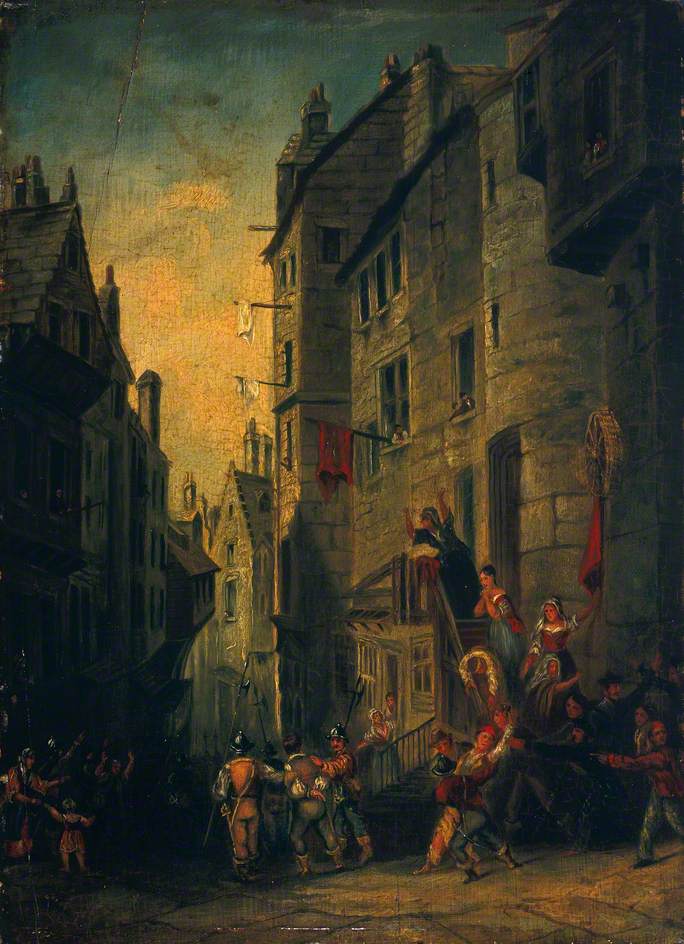
Condemned Covenanters on Their Way to Execution in the West Bow, Edinburgh. Artist unknown. (Source)

James Renwick has enjoyed tender biographical treatment from posterity; see here and here for some longer-form examples.

* While good news for the Presbyterians, this put many an Episcopal and Catholic in a tight spot of their own, setting up decades of bloody tragedy for Jacobite loyalists … but this is a subject for other posts.

** The captain who finally caught Renwick is supposed to have exclaimed at seeing his youth, “Is this the boy Renwick that the nation has been so much troubled with?” The outlaw minister turned 26 two days before his execution.

On this day..

1661: Maeyken de Smet, Olsene witch

On this date in 1661, 62-year-old Maeyken de Smet was strangled and burned in Olsene

Implicated a sorceress by the last “witch” they tortured during the witch trials of Olsene-Dentergem in the early 1660s, Maeyken had little likelihood of resisting her own bout with enhanced interrogation and duly settled upon a vast register of infernally aided mischief plus 23 more humans to accuse.

On the advice of five witchcraft lawyers, Maeyken De Smet was sentenced to burning at the stake and the confiscation of all of her property. Because she had concluded a written contract with the devil, which she had signed with her own blood; had renounced God, Our Lady and all of the saints; had had sex with the devil several times; had attended several meetings of witches and their devils; had bewitched people and cows with a grey powder; and had contaminated flax with flee-beetles and trees with pernicious insects, she was strangled at the stake on a scaffold on the gallows-field and then burnt to ashes. All of her goods were confiscated. The trial had lasted eighteen days and had cost 301 pounds, 8 Schellings and 10 groats. (Six Centuries of Criminal Law: History of Criminal Law in the Southern Netherlands and Belgium)

The hecatomb this situation would seem to portend did not quite come to pass, as many of the other accused mounted vigorous defenses — often successfully exploiting judicial mechanisms to tie up the juggernaut long enough that they could get out of its way. (One even successfully used a hunger strike to avoid execution.) This particular witch hunt fizzled out by the end of 1662.

On this day..

1678: James Mitchell, Covenanter assassin

On this date in 1678, Covenanter radical James Mitchell was hanged at Edinburgh for attempting to murder the Archbishop of St. Andrews.

Mitchell’s intended victim, James Sharp by name, is one of Scottish history’s great villains — tasked as he was to cheat Presbyterians of the religious reform they had spent a generation seeking. After Cromwell had King Charles I beheaded, his heir Charles II was nothing but an exile pretending to the throne his father had been deposed from.

Desperate for allies, he made a reluctant pact with Scottish allies to promulgate Presbyterianism throughout the realm should he regain the kingdom: this meant, in practice, bottom-up church governance as against the top-down authority of bishops characterizing Episcopacy. For a king, this would entail ceding considerable power over religious matters.

Such a promise was more readily given than honored. When Charles II regained the English throne in 1660, he instead restored Episcopacy in the north and everywhere else — selecting our man James Sharp, up until then a Presbyterian minister of the moderate faction, to boss Scotland’s most exalted ecclesiastical post. “The great stain will always remain, that Sharp deserted and probably betrayed a cause which his brethren intrusted to him,” Walter Scott wrote.

From this position, whose very existence was obnoxious to his former friends, our Judas* was Charles’s point man for reintroducing and enforcing all those ecclesiastical prerogatives of the monarchy that the Presbyterians had been so desperate to abolish.

He drove from the church irreconcilable Covenanter ministers — so named for their adherence to the objectives of those discarded covenants. That faction despised Sharp, and he returned the sentiment. On one occasion, he had to call for the militia to disperse an angry mob, only to be told that the militia’s members had joined the mob too. After a Covenanter rising was put down at the Battle of Rullion Green, Sharp okayed the withdrawal of quarter for surrendered foes with the taunt “You were pardoned as soldiers, but you are not acquitted as subjects” — putting his episcopal imprimatur on numerous ensuing hangings.

It was only a matter of time before someone tried to murder him.

On the 11th of July in 1668, James Mitchell — a zealous but unordained freelance preacher and dyed-in-the-wool Covenanter — stepped to a carriage the archbishop was embarking and took a shot at him. Mitchell missed, and pinged one of the prelate’s companions in the wrist, crippling the hand.

Mitchell managed to escape and live for several years with sizable sum on his head and nobody interested in claiming it** before Sharp’s own brother finally captured him in 1674. The proceedings against him are surprisingly protracted considering the famous vindictiveness of his target, and resolved by (as Mitchell said at his hanging) “an extrajudicial confession, and the promise of life given to me thereupon by the chancellor, upon his own and the public faith of the kingdom.” Given his party, he ought not have been surprised that the promise was not kept; as an added bonus, his retraction of the confession — which was the only evidence against him — resulted in his torture by the boot.

In 1679, a different bunch of Covenanters finally succeeded in assassinating the hated Archbishop Sharp.


The Murder of Archbishop Sharpe on Magus Muir near St. Andrews, 1679, by William Allen (c. 1840).

There’s a public domain biography friendly to Sharp (and perforce extremely hostile to the Covenanters) here.

* Cromwell met Sharp — still a Presbyterian minister at that time — in a negotiation during the Protectorate and allegedly rated him “ane Atheist, and of noe principles at all.”

** At one point Mitchell resided in Edinburgh with another man bound for the scaffold, Major Weir

On this day..

1630: Christina Plum, at the stake, in Cologne

On this date in 1630, the city of Cologne burned Christina Plum.

This aptly-named fruit vendor was a real peach. During Cologne’s 1627-1630 witch hunt, Plum in 1629 denounced a bushel of Cologne’s leading citizens for devilry. While threatening established elites with torture and the stake certainly seems downright bananas with benefit of hindsight, the free city had in 1627 burned an influential woman — and possibly Germany’s first female postmaster — named Katharina Henot. Indeed, it was Plum’s contention that such varied characters as the wife of the Burgermeister, the pastor of St. Alban’s Church, and Katharina Henot’s brother had all been keeping regular dates at the late Katharina’s Black Sabbath orgies.

The city was at that moment facing intense pressure by the Archbishop of Cologne Ferdinand of Bavaria — an imperial elector and enthusiastic hammer of witches — to root out Satan’s earthly minions. It was not at all past thinking that Plum’s accusations could have cut a swath through the city’s upper crust.

Instead, they destroyed the credibility of the witch hunts.

After unsuccessfully pressuring Plum to just pipe down and go away, the city had her arrested as a witch. After all, how did she know so much about who was going to the orgies? And, as was almost inevitable in such cases, the consequent interrogation proved sufficiently vigorous to force a confession from the woman’s lips.

In 1631, as the witch fever abated in Cologne, and elsewhere throughout Germany, the Cologne-educated jurist Friedrich Spee published one of the seminal takedowns of witch-hunting, Cautio Criminalis. (Spee himself lost a kinswoman to the Hexenprozesse.)

On this day..

1690: John Bennet, the original Golden Farmer

As we have seen in the past two posts, the character exalted in the Newgate Calendar as William Davis, the Golden Farmer bears scant resemblance to the real-life man named William Davis who went to the Tyburn tree.

But there was a robber with the nickname “Golden Farmer” — it just wasn’t William Davis.

John Bennet, alias John Freeman, was hanged one year and one day after Davis, on December 22, 1690, part of a huge batch consisting of no less than 14 men and women.

John Bennet, far from the winning outlaw of the Newgate Calendar, led a gang responsible for numerous violent home invasion robberies, sometimes working with another criminal famous enough for his own nickname (and his own fabricated adventures), Old Mobb. One victim of the “Golden Farmer” described how he harvested his crop:

the Prisoner, with others, to the number of nine came on the 16th of October 1689 to her House at Grays in Essex, and entring forcibly, pretended, with horrid Oaths and Excerations, That they had the King’s Broad Seal to seize all the Mony, &c. having Vizard Marks on and Pistols in their Hands, and that they drove her Husband and Servants into the Celler, and there set a Guard over them, threathing Death to those that Stirred; and then forc’d this Deponent, with many Threats of Death, and often clapping Pistols to her Breast, to go with them from Room to Room to shew them where the Plate; Money, and Goods of value were; and perceiving a Soldier belonging to the Block-house coming by whilst they were rifling, they fetched him in, under pretence of drinking with some good Fellows, and put him into the Gutter; and so carryed off to the value of 5 or 600 l. in Money, Plate and Jewels.

Though his identity was known, his habit of constantly relocating his residence made him difficult to track. At last, one victim had his wife and sister stake out Bennet’s own wife until they could get a bead on him. At that point, they raised a hue and cry for the watch. Bennet killed a gendarme named Charles Taylor in his flight (this is the crime he hanged for, though many of his thefts would have secured the sentence just as well); with a furious mob now in pursuit, Bennet was finally subdued by a hail of brickbats, but only after shooting someone else, too.

To judge by the length of his entry, the Newgate Ordinary harrowed Bennet ceaselessly, and though the robber “shed many Tears” and “did acknowledg this Crime” he refused to make any more than a generic breast of his outlawry — perhaps to protect those of his confederates who were still at large. Despite the standard threats of hellfire “I could not prevail with him to give any Testimony of his syncere turning to the Lord, to whose all-discerning Eye and determination of his Soul’s State I must leave him,” concluded the exasperated Ordinary.

Bennet was hanged at “Salisbury-court end in Fleetstreet, near the Place where he had committed the Murther” and hanged “without making any Speech or Exhortation.” The other 13 doomed souls were then taken to Tyburn for a more conventional mass execution.

It appears that Bennet’s nickname became carelessly attached to William Davis through a 1714 bestseller with the voluminous title The History of the Lives of the most noted Highwaymen, Footpads, Housebreakers, Shoplifts and Cheats of both Sexes in and about London and other places of Great Britain, for above 50 years last past; wherein their most secret and barbarous Murders and unparalleled Robberies, notorious Thefts and unheard of Cheats are exposed to the Public, by Captain Alexander Smith. Smith, writes Lincoln Faller in Turned to Account: The Forms and Functions of Criminal Biography in Late Seventeenth- and Early Eighteenth-Century England, probably had to have known that Davis was not the Golden Farmer but “cared not at all for historical accuracy and sought (when he felt the need of it) only after its appearance. Happening to have a name and a date at hand, he attached it to some appropriate adventures.” Then, “later writers follow Smith’s version of the Golden Farmer’s life even more slavishly, repeating the same errors, telling (with occasional embroideries) the same fanciful anecdotes about him.” Hence, our Newgate Calendar figure — the distant echo of a real criminal distorted by a succession of fabulists.

* Dick Turpin had a similar criminal profile that ended up being subsumed by his knight-of-the-road reputation to posterity.

Part of the Themed Set: The Creation of a Newgate Calendar legend.

On this day..

1689: William Davis

Yesterday, we posted about “William Davis, the Golden Farmer” — a character in the Newgate Calendar. While the calendar is presented as straight criminal biography, its heavy dollop of authorial moralizing is a clue to scrutinize its characters before accepting their factual veracity.

The “William Davis” of the Newgate Calendar turns out to be a bit of a Frankenstein’s monster stitched together from the remains of various dead men. He appears to have obtained his name and his attributed date of execution — within a small margin of error! — from the December 21, 1689 hanging of a man named William Davis. Far from the dashing highwayman of decades’ distinction that the Newgate Calendar presents, Davis was a run-of-the-mill young ne’er-do-well who was condemned for burgling a house to the tune of £200.

Of this man’s career, we have the Ordinary of Newgate’s hurried summing-up:

William Davis desired all his dear Brethren to take warning by him, left they come to the fame punishment, telling them, That he was but 23 years of Age, and that he had been a Robber for Four years last past, not only in England, but in other Countries; and could not be contented to abide with his Parents at home, (tho’ he lived well) but run into Extravagances, keeping com pany with lewd Women, besides breaking the Sabbath day; and was guilty of all manner of enormous Sin, for which he prayed God to forgive him.

Two other men were hanged on the same occasion: Walter Mooney, for killing a coachman who refused to take them to Spitalfields; and John Peartman, “for Robbing one John Hozey upon the Road between London and Bristoll, of a Gelding Price 12 l. a Hat 3 l. a Hatband value 10 s. a Point Cap value 3 l. a Suit of Linnen for a Child value 40 s. with a Box value 6 d.”

Part of the Themed Set: The Creation of a Newgate Calendar legend.

On this day..