1679: Robert Foulkes, adulterous minister

From the Newgate Calendar:

This unhappy gentleman was a divine of the Church of England, and had been very much esteemed for his learning and abilities. Few men were more capable of shining in a church, or had a greater share of that sacred eloquence so requisite in a preacher. He was minister of Stanton-Lacy, in the county of Salop, where he was exceedingly followed and admired till his crimes came to be known, and where he might have been beloved till death in a natural way had taken him hence, and then universally lamented, if his heart had been as well furnished with grace as his head was with knowledge and his tongue with expressions.

A young gentlewoman of a considerable fortune, who had been left an infant by her parents, was committed to his care by her executors, as to a man who, they trusted, would not only deal justly by her, but also instruct her betimes in the principles of religion, and her several duties as a Christian. But, alas! how weak is human nature, and how soon are we tempted aside from the ways of piety! Mr. Foulkes, instead of answering the purpose of the young woman’s friends, was soon smitten with her charms, and took an opportunity of discovering a criminal passion for her, though he had at that time a virtuous wife and two children living. The young lady too easily consented to gratify his lust, and they continued their conversation together till she became pregnant.

All the means he could think of to procure abortion were now tried, and they all proved ineffectual; so that they must be both exposed to scandal, unless she could be removed to some convenient place, remote from the eyes of the world, and from the jealousies of Mrs. Foulkes, where she might be delivered of her burden, which was not yet perceived. A plausible excuse for his going up to London was soon formed, and for his taking Miss along with him, who at that time was under twenty years of age. When they arrived in town they took a lodging in York Buildings in the Strand, where she lay in, and where (shocking to think of!) the child was privately murdered, to prevent the infamy that might follow.

But divine vengeance would not suffer this horrible deed to remain long concealed, for before Mr. Foulkes went out of town the girl was examined upon the suspicion of some women, when she confessed the whole, and charged Mr. Foulkes with the murder, who was thereupon apprehended and committed to Newgate; in a short time after which he was condemned at the sessions house in the Old Bailey, upon the evidence of the young woman. On the 31st of January, 1679, he was executed at Tyburn.

On this day..

1679: “A number of poor people for the crime of witchcraft”

From the Domestic Annals of Scotland (see here or here):

A commission composed of country gentlemen and advocates sat in the Tolbooth of Borrowstounness to try a number of poor people for the crime of witchcraft. There was Annaple Thomson, who had had a meeting with the devil in the time of her widowhood, before she was married to her last husband, on her coming betwixt Linlithgow and Borrowstounness, when he, ‘in the likeness of ane black man, told you, that you was ane poor puddled body, and had an evil life, and difficulty to win through the world, and promised if you would follow him, and go alongst with him, you should never want, but have ane better life; and about five weeks thereafter the devil appeared to ye when you was going to the coal-hill about seven o’clock in the morning. Having renewed his former tentation, you did condescend thereto, and declared yourself content to follow him and become his servant.’ There were also women called Margaret Pringle, Margaret Hamilton (two of the name), and Bessie Vicker, besides a man called William Craw. ‘Ye and each person of you was at several meetings with the devil in the links of Borrowstounness, and in the house of you Bessie Vicker, and ye did eat and drink with the devil, and with one another, and with witches in her house in the night-time; and the devil and the said William Craw brought the ale which ye drank, extending to about seven gallons, from the house of Elizabeth Hamilton, and you, the said Annaple, had ane other meeting about five weeks ago, when you was going to the coal-hill of Grange, and he invited you to go along with him and drink with him in the Grange-pans.’ Two of the other accused women were said to have in like manner sworn themselves into the devil’s service and become his paramours, one eight years, the other thirty years ago. It was charged against Margaret Pringle, that ‘the devil took you by the right hand, whereby it was for eight years grievously pained, but [he] having touched it of new again, it immediately became hail;’ against Margaret Hamilton — ‘the devil gave you ane five-merk piece of gold, whilk a little after becam ane sklaitt stane.’ And finally, ‘you and ilk ane of you was at ane meeting with the devil and other witches at the cross of Muirstane, above Kinneil, upon the thretteen of October last, where you all danced, and the devil acted the piper.’

These poor people were solemnly tried by the commissioners before an assize of fifty persons, and, notwithstanding that the indictment charges scarcely any hurtful attempts against individuals, the whole were adjudged to be taken four days after to the west end of the town, and there worried at a stake and burnt.

On this day..

1694: James Whitney, highwayman

Dapper highwayman James Whitney was hanged at Smithfield on this date in 1694.

A monument to the allures and the perils of a midlife career change, Whitney threw over a tiresome life as the proprietor of an inn in Cheshunt, Hertfordshire,* purchased with his liquidation the accoutrements of the gentleman thief, and took to the road.

“Captain” Whitney — he had no right to the rank he appropriated for himself — was one of those stickup men who greatly esteemed the pose of honor associated with his new calling. On one occasion, he relieved a gentleman traveler of a large sack of silver on Newmarket Heath, but when his victim pleaded the length of his journey Whitney opened the bag to its former owner with an invitation to take what he would need.

The man plunged his hands in and hauled out as much as they would carry, leading Whitney to remark with a smile, “I thought you would have had more conscience, sir.”

In another fine caper (there are more of them assembled here) Whitney told a man to stand and deliver, only to have the traveler reply that he was about to say the same back to him. The two robbers laughed at their encounter and went their separate ways, but Whitney later chanced to turn up at the same inn as his so-called brother plunderer and overhear him regaling his fellows with the tale of having outwitted a highwayman by pretending to be one of the same profession.

Whitney stalked the man and a companion out of the hostel the next morning and this time robbed them successfully: “You should have kept your secret a little longer, and not have boasted so soon of having outwitted a thief. There is now nothing for you but to deliver or die!” Nobody likes your stories anyway, you blowhard.

True, James Whitney ended his adventure at the gallows: death is the fate of us all. From his day to ours, folk toiling away the ceaseless lonesome days between ashes and ashes have understood the soul’s stirring to exalt their scant mortal hours with deeds of valor and romance and derring-do. And as Whitney himself is said to have remarked to a miser whose lucre he was seizing, “Is it not more generous to take a man’s money from him bravely, than to grind him to death by exacting eight or ten per cent, under cover of serving him?”**

Nobody knows any of James Whitney’s peers in the publican guild, but as Captain Whitney he joined England’s most legendary gentleman outlaw in verse.

When Claude du Val was in Newgate thrown,
He carved his name on the dungeon stone;
Quoth a dubsman, who gazed on the shattered wall,
“You have carved your epitaph, Claude du Val,

Du Val was hanged, and the next who came
On the selfsame stone inscribed his name;
“Aha!” quoth the dubsman, with devilish glee,
Tom Waters, your doom is the triple tree!”

Within that dungeon lay Captain Bew,
Rumbold and Whitney — a jolly crew!
All carved their names on the stone, and all
Share the fate of the brave Du Val!

Full twenty highwaymen blithe and bold,
Rattled their chains in that dungeon old:
Of all that number there ‘scaped not one
Who carved his name on the Newgate Stone.

* The George Inn. A map search does yield a The George in Cheshunt; whether this is actually the same facility where our famous highwayman once earned a lawful keep, I have not been able to establish.

** Parables from this golden age of highwaymen often place in the mouths of outlaws sharp critiques of their targets, who despite putative respectability turn out upon examination to be far more deeply corrupt than the dashing adventurer. See for example Old Mobb.

On this day..

1700: Jamie Macpherson, Highlander

The legendary Highlands freebooter Jamie Macpherson was hanged on this date in 1700 in Banff.

Macpherson is said to be an illegitimate half-Gypsy child with every talent necessary to live larger than life — and if gigantism can be inferred from the size of his enormous alleged sword, that would be extremely large indeed.

Besides his elite SPARQ score, Macpherson was blessed with complementary gifts for making music and sweet sweet love, and plundered livestock and merchandise and maidenheads as he sprang through the vicinities of Banff and Aberdeen. Despite living by his prowess with the sword every source concurs that he never used it to harm anyone that the audience would sympathize with.

But he outraged the local grandees, and at length he was apprehended (as befits his outsized tale) by a fellow with the improbable name “Duff of Braco” — then was duly condemned to hang on market-day (“Forasmeikle as you James McPherson, pannal are found guilty by ane verdict of ane assyse, to be knoun, holden, and repute to be Egiptian and a wagabond” etc.).

In the week before his hanging, Macpherson reportedly composed an air variously described as “Macpherson’s Lament” or “Rant” or “Farewell” which he then performed on the gallows.

In the most picturuesque version, he played his own fiddle in this exit performance, then dramatically smashed the instrument. As Chambers’s Journal observes, it seems hard to accept that the sheriff would have given this veritable Goliath the free use of his hands at such a desperate moment. Indeed, local legend has it that the authorities were so afraid that a reprieve might arrive that upon catching sight of an approaching rider on the horizon, they put the town’s clocks 15 minutes forward.

At any rate, several versions of the Lament/Rant/Farewell survive and one can follow its evolution in this open-source Annals of Banff. Robert Burns’s eventually immortalized the verse with this gloss on it from the late 18th century:

On this day..

1674: Guru Tegh Bahadur

The early religion of Sikhism was led by a succession of 10 Gurus.*

The Mughals executed the ninth of those Gurus on this date in 1674.

Guru Tegh Bahadur (the name means “Hero of the Sword” and was earned in youthful battles against those same Mughals) was acclaimed above 20-odd other aspirants after the previous Guru died saying only that the next guy was in the village of Bakala.

Guru from 1664, he’s noted for founding the holy city of Anandpur Sahib in Punjab. And it was his lot to lead a minority faith during the reign of the Aurangzeb, an emperor notorious to posterity for religious dogmatism.

He’s known best as a persecutor of Hindus: knocking over temples to throw up mosques, forcing conversions, and implementing sharia. But Aurangzeb knew how to get after all kinds.

Considering the going sectarian tension between Hindu and Muslim in the environs, there’s a good deal of touchy historical debate over just how to characterize Aurangzeb’s policies. This site is entirely unqualified to contribute to that conversation but suffice to say it was not an ideal moment to adhere to an alternate faith.

The circumstances of Guru Tegh Bahadur’s capture, and his subsequent execution in Delhi, are similarly obscured by hagiography. Aurangzeb, who spent his reign at virtually continual war, must surely have seen in the Guru’s capital city — which also welcomed Hindu refugees fleeing the Mughals’ abrogation of their rites — a nest of rebellion. Putting its leader to death when he too refused conversion would have been right in character; no less understandable is the Guru’s remembrance as a martyr to religious liberty, and not only the liberty of Sikhs but Hindus, Buddhists, and any other comers.

Tegh Bahadur’s nine-year-old son Gobind Singh succeeded as the tenth and last Guru. It was he who laid down the “Five Ks” — five articles that a faithful Sikh should wear at all times. Thanks to the parlous state of security vis-a-vis the Mughals, one of those items is the Kirpan, a dagger or small sword that continues to vex airline security agents down to the present day.

* Ten human Gurus: the tenth passed succession to the perpetual “Guru Panth” (the entire community of Sikhs) and “Guru Granth Sahib” (a sacred text).

On this day..

1697: Three duty stamp counterfeiters

On this date in 1697, nine men hanged at Tyburn — all for property crimes.

Three were highway robbers. A fourth was a coiner. A fifth was a pickpocket. A sixth was a husbandman who stole a gelding.

The remaining three men, Thomas Houghton, Francis Cook and Francis Salisbury, operated a ring selling vellum paper bearing counterfeit sixpenny impressed duty stamps.

Their offense was against a 1694 levy titled “An act for granting to Their Majesties several duties on Vellum, Parchment and Paper for 10 years, towards carrying on the war against France”. This statute (full text here) imposed taxes of varying amounts for any number of a huge variety of officially-registered business. Routine commercial transactions now almost universally came with a rake for the taxman: “every skin or piece of vellum or parchment, or sheet of paper, upon which shall be ingrossed or written any indenture, lease, or deed-poll” had to be executed with a sixpenny stamp.

As a practical matter, such skins or pieces of vellum or parchment were sold pre-stamped, the stamp to be canceled by the parties in question when they signed on the line which is dotted. And it was this market that Houghton, Cook, and Salisbury exploited.

While counterfeiting the specie could be held to imperil the kingdom so dangerously to rate as treason, this trio’s “counterfeiting” was just everyday white-collar siphoning. By forging a bogus sixpenny stamp and applying it to sheafs of contract-ready vellum that they could sell at market rates, they got the revenue-agent’s cut — not the crown. (The scam is described in their Newgate Calendar entry, which inexplicably gives short shrift to Francis Cook.)

Though the “war against France” named by the stamp bill — the War of the League of Augsburg or the Nine Years’ War — had ended weeks before even the hangings we mark on this date, the lucrative levy long outlasted it. In the following century, England revived this type of tax often, notably in 1712 expanding it to encompass printed publications like newspapers and pamphlets. Hey, just require anything printed on paper to have a royal stamp on it — easy! This habit would eventually create the 1765 Stamp Act so obnoxious to North American colonists in the run-up to the American Revolution.

On this day..

1651: Terence Albert O’Brien, Bishop of Emly

On this date in 1651, three days after the Irish city Limerick surrendered to a withering five-month Parliamentarian siege, the victors hanged Bishop Terence Albert O’Brien on Gallows Green.

Limerick was the southern stronghold of the Catholic and anti-Parliamentarian Confederate Ireland.

It was this polity, which allied itself to English Royalists, that Cromwell assailed in his bloody conquest of Ireland.

Though Cromwell lives forever as an oath in Irish memory, the man himself left Ireland in 1650 to smash an awkward Royalist alliance with Scottish Presbyterians.

That left the Irish campaign in the hands of Cromwell’s capable fellow-general (and by this time, son-in-law) Henry Ireton, and it was Ireton who laid Limerick under a siege at an estimated cost of 5,000 civilians succumbed to starvation and plague.

The Catholic Bishop of Emly, Terence Albert O’Brien, had been trapped in the mixed English-Irish city and encouraged continued resistance to the siege. Ireton advanced him to the very front of the queue for punishment, and had him put to death directly after the city’s capture.

A “Last Speech and Prayer” of the martyr was published in London within a few days, together with a “humble petition” of then-imprisoned (and later executed) pro-Stuart highwayman James Hind.

Good people,

This is a very uncomfortable place, for me to deliver my self unto you; but I beseech you pardon my failings, and the rather, by reason of the sad occasion that hath brought me hither: Indeed, I have been long in my race, and how I have looked unto Jesus the Authour and finisher of my faith, is best known to him; I am now come to the end of my race, which I find to be a death of shame, but the shame must be despised, or there is no coming to the right hand of God; Jesus despised the shame for me upon the Crosse, and God forbid but I should despise the shame for him upon the Gallowes; I am going apace, as you see, towards the Red Sea, and my feet are upon the very brinks of it, an Argument I hope that God is brining me to the Land of promise, for that was the way by which of old he led his people.

But before they came to the Sea, he instituted a passe over for them, a Lamb it was, but it was to be eaten with very sowr herbs, as in the 12. of Exodus. I shall obey and labour to digest the sowr herbs, as well as the Lamb, and I shall remember, that it is the Lord’s passe-over, I shall not think of the herbs, nor be angry with the hands that gathered them, but look up only to him who instituted the one, and governeth the other: For men can have no more power over me, than that which is given them from above; and although I am denyed mercy here on earth, yet I doubt not but to receive it in heaven. I am not in love with this passage through the Red Sea, for I have the weakness and infirmity of flesh and blood in me, and I have prayed as my Saviour taught me, and exampled me; ut transiret calix ista, That this cup might passe away from me; but since it is not, that my will may, his will be done; and I shall most willingly drink of it as deep as he pleases, and enter into this Sea, I and I passe through it, in the way that he shall be pleased to leade me. And yet (good people) it would be remembrad [sic], That when the Servants of God, old Israel, were in this boystrous Sea, and Aaron with them, the Egyptians which persecuted them, and did in a manner drive them into that Sea, were drowned in the same waters while they were in pursuit of them: I know my God whom I serve, is as able to deliver me from this Sea of blood, as he was to deliver the 3 Children from the furnace. Dan. 3. And I most humbly thank my Saviour for it. My resolution is now, as theirs was then; their Resolution was, they would not change their principles, nor worship the Image which the King had set up; nor shall I the imaginations which the people are setting up; neither will I forsake the Temple and Truth of God, to follow the bleating of Jeroboams Calves in Dan and in Bethel.

And I pray God blesse all this people, and open their eyes, that they may see the right way, for if it fall out that the blind lead the blind, doubtless they will fall both into the ditch: For my self I am (and I acknowledge it in all humility), a most grievous sinner, and therefore I cannot doubt but that God hath mercy in store for me a poor penitent, as well as for other sinners; I have upon this sad occasion ransack’d every corner of my heart, & yet I thank God, I have not found any of my sins that are there, any sins now deserving death by any known Law. And I thank God, though the wait [weight] of the sentence lie very hard upon me, yet I am as quiet within, (I thank Christ for it) as I ever was in my life; I shall hasten to go out of this miserable life, for I am not willing to be tedious; and I beseech you, as many as are within hearing, observe me, I was born and baptized in the bosome of the Church of Rome (the ancient and true Church) and in that Profession I have ever since lived, and in the same I now die. As touching my engagement in arms, I did it in two respects. First, for the preservation of my principles and Tenents. And secondly, for the establishing of the King, and the rest of the Royal issue in their just Rights and Priviledges. I will not inlarge my self any further, I have done, I forgive all the world, all and every of these bitter Enemies, or others whatsoever they have been, which have any wayes prosecuted me in this kind; I humbly desire to be forgiven first of God, and then of every man, whether I have offended him or no; if he do but conceive that I have: Lord do thou forgive me, and I beg forgiveness of him, and so I heartily desire you to joyn with me in prayer.

From Hugh Fennin’s “The Last Speech and Prayer of Blessed Terence Albert O’Brien, Bishopp of Emly, 1651,” in Collectanea Hibernica, No. 38 (1996).

Any Limerick Catholics who didn’t share the prelate’s forgiving attitude might have taken some spiteful comfort that the strain of commanding the siege caused Ireton to fall ill with fever. He died on November 26 — barely outliving the bishop whom he had hanged.* After the Stuarts regained the English throne, Ireton was exhumed and posthumously executed alongside the body of Oliver Cromwell.

* Ireton’s death indirectly spared the royalist commander of Limerick’s defeated garrison from an execution his conqueror had intended for him: Ireton’s successor instead sent him to the Tower of London, and he was eventually released to Spanish custody.

On this day..

1621: Rodrigo Calderon, ambitious

On this date in 1621, Spain’s once-powerful Marquis of the Seven Churches fell as far as tragedy can drop a man.

Still to this day a Spanish emblem of the perils of ambition, Rodrigo Calderon hailed from the minor nobility in the rebellious Low Countries breaking away from Hapsburg rule.

Displaced to Spain, Calderon had a meteoric rise as the trusted henchman of the Duke of Lerma — who was himself the trusted (some say over-trusted) favorite of the Spanish King Philip III from the moment the latter came to the throne at age 20 in 1598. It’s not what you know, it’s who you know.

Calderon’s who became perhaps Spain’s most powerful figure, and surely its most resented. By Philip’s own decree, nothing came to the royal quill but through his valido Lerma. Lerma dominated access to Philip and to a great extent, Calderon dominated access to Lerma. Both men prospered accordingly.

Calderon cut an operatic character — he’s one of those characters awaiting a suitably coruscating literary treatment, although Bulwer-Lytton gave it a shot — of zealotry mixed with greed. His family was the aristocratic equivalent of “new money”; his father had not been born to the nobility at all, and Calderon hustled to climb so high as he did. He did not mean to forego the emoluments of office, like the flattering Rubens portrait that illustrates this post.*

Inevitably, such a figure attracted the resentment of other courtiers, and not only courtiers.

Calderon almost fell in 1607 for extracting bribes far in excess of what acceptable corruption permitted. But he had by then the open enmity of the queen herself. It’s testimony to Lerma’s power that his patronage sufficed for Calderon to maintain his station in the face of such a powerful foe.

Queen Margaret died in 1611. The cause was complications from childbirth, but rumors, like this anonymous pamphlet, hinted at other hands in her death.

moved by the outcries of the people and the advice of wise and virtuous persons … felt obliged to confront the ill intentions of those who without doubt have caused her death. Her goal was to serve our Lord by promoting justice in the distribution of favors, appointments of good ministers, and the elimination of bribes, simonies, the sale of offices, and the promotion of unworthy and inept persons.

While not daring such an accusation, a friar preaching Margaret’s funeral sermon directly to Philip made bold that

a king has two wives, the queen and the community … the offspring of the first marrriage should be children. The offspring of the second marriage should be prudent laws, the appointment of good ministers, mercies to those who deserve them, the punishment of criminals, audiences to all your subjects, dedication to affairs of state, and the consolation of the afflicted. To repay God for the abundant offspring from the first marriage Your Majesty has to comply with your duties towards your second wife. (Both quotes via Kingship and Favoritism in the Spain of Philip III.)

Nothing troubled, Calderon had become a marquis by 1614.

But the rumor mill played the long game. Calderon’s patron Lerma was displaced by his son in 1618, leaving his longtime crony vulnerable to the next turn of fortune. That turn was the 1621 death of Philip III himself and the succession of a 16-year-old son, Philip IV.

It is said that when Calderon heard the bells tolling the elder Philip’s passing he remarked, “the king is dead, and I am dead.”

Determined to rein in the perceived decadences of the last era — this period was the peak, and the very start of the decline, of Spain’s wealth and global power — the younger Philip’s Lerma figure the Duke of Olivares had Calderon arrested. Regicide and witchcraft were right there on the charge sheet, but it was the murder of a different man in 1614 allegedly killed to keep him silent about Calderon’s misdeeds that sustained the sentence. A bit more exotic than regular beheading, Calderon had his throat slashed, then was left to bleed out on the scaffold.

As Calderon had come to personify courtly corruption, the new regime anticipated a salutary effect from making an example of him. To their surprise, the pitiless and obviously politically-motivated handling of the fellow — who bore his fate with lauded stoicism — made the late grasping aristocrat the subject of no small sympathy.

Calderon’s mummy, the executioner’s gash through its neck still gruesomely visible, is still preserved in Valladolid. (Link in Spanish, but more importantly, with pictures.)

* Calderon was himself a great collector of art.

On this day..

1660: Francis Hacker and Daniel Axtell, regicides

On this date in 1660, the English soldiers Francis Hacker and Daniel Axtel(l) were executed for their roles in keeping the captured King Charles I, and for eventually seeing that late king to his beheading.

Francis Hacker

No hapless grunt, Hacker was a committed Roundhead even though most of his family stayed loyal to the Stuarts. When captured by the royalists at Leicester, Hacker “was so much prized by the enemy as they offered him the command of a choice regiment of horse to serve the king.”

Hacker disdainfully turned it down.

And as the wheel of fortune turned, the king would become Hacker’s prize. It was Hacker who commanded the detail of 32 halberdiers who marched the deposed monarch into Westminster Hall on January 20, 1649 to begin a weeklong trial — and a whole new historical era of parliamentary ascendancy.

Ten days later, when Charles was led out for beheading outside the Banqueting House, it was Hacker who escorted him. Hacker might have escaped even this much participation with his own life after the restoration of Charles’s son and heir, but it came out that he had even written, with Cromwell, the order to the executioner.

(It was an order that one of his comrades that day had very presciently refused to set his own hand to; come 1660, Hercules Huncks would owe his life to this refusal.)


Detailed view (click for a larger image) of an illustration of the king’s beheading. On the right of the scaffold, character “D” sporting a natty scabbard is Francis Hacker.

It’s a funny little thing to lose your life over, because — narrowly considered — it was nothing but a bit of bureaucracy. Hacker et al had been given from above a commission for the king’s death. On the occasion of the execution they had to convey from their party to the executioner a secondary writ licensing the day’s beheading.

But monarchs asserting divine prerogative certainly do not take such a view of mere paperwork.

“When you come to the Person of the King, what do our Law Books say he is? they call it, Caput Reipublicae, salus Populi, the Leiutenant of God”

The regicides’ judge, delivering sentence

Huncks refusing to set his hand to this death warrant, it was Cromwell himself who personally dashed it off, then handed it to Hacker, who fatally countersigned it, just before the execution proceeded.

Meanwhile, Hacker’s subaltern Daniel Axtell razzed Huncks for chickening out. Axtell, who seemingly would be right at home in the kit of your most hated sports club, was indicted a regicide for his gauche fan behavior during the king’s trial, several times inciting soldiers (on pain of thrashing, per testimony in 1660) to chant for the king’s condemnation, whilst bullying any onlookers who dared to shout for Charles into silence.

Hacker did not bother to mount a defense; the verdicts were foreordained by political settlement.

Axtell argued superior orders, a defense best-known to us for its unsuccessful use by Nazis at Nuremberg but one which actually boasts a long history of failing to impress:

the Parliament, thus constituted, and having made their Generals, he by their Authority did constitute and appoint me to be an Inferior Officer in the Army, serving them in the quarters of the Parliament, and under and within their power; and what I have done, my Lord, it hath been done only as a Souldier, deriving my power from the General, he had his power from the Fountain, to wit, the Lords and Commons; and, my Lord, this being done, as hath been said by several, that I was there, and had command at Westminster-hall; truly, my Lord, if the Parliament command the General, and the General the inferiour Officers, I am bound by my Commission, according to the Laws and Customs of War to be where the Regiment is; I came not thither voluntarily, but by command of the General, who had a Commission (as I said before) from the Parliament. I was no Counsellor, no Contriver, I was no Parliament-man, none of the Judges, none that Sentenced, Signed, none that had any hand in the Execution, onely that which is charged is that I was an Officer in the Army.

Sounding equally modern, the court replied:

You are to obey them in their just commands, all unjust commands are invalid. If our Superiours should command us to undue and irregular things (much more if to the committing of Treason) we are in each Case to make use of our passive not active Obedience.*

The two men were drawn from Newgate to Tyburn this date and hanged.

Axtell was quartered, the customary fate of those regicides who had been put to death all the week preceding. Hacker, however, enjoyed the favor of hanging only, and was delivered and “was, by his Majesties great favour, given entire to his Friends, and buried” — perhaps because so many of Hacker’s family had remained true to Charles.

“If I had a thousand lives, I could lay them all down for the Cause

-Axtell, at his execution

* Axtell’s trial has a good deal of detailed bickering over the superior-orders defense, but the court itself did also take pains to differentiate the things Axtell did as an officer, such as commanding troops (for which Axtell was not charged) — and his going the extra mile and surely beyond his commission to shout for the king’s death.

On this day..

1651: Marubashi Chuya, Keian Uprising conspirator

On this date in 1651, the ronin Marubashi Chuya was crucified for a failed attempt to topple the Tokugawa shogunate.

Allegedly disaffected of the national unification dynasty by having lost his father to battle against it, Marubashi orchestrated, along with a fellow martial arts adept named Yui Shosetsu, a daring plot betrayed only by illness. When shogun Tokugawa Iemitsu died in 1651, leaving power to a 10-year-old heir, the conspirators meant to set fire to Edo (Tokyo) and seize Edo Castle as well as other cities.

But Marubashi came down with a very ill-timed fever and in delirium raved treasonable plot details that got passed along to Tokugawa authorities. The so-called Keian Uprising never made it into execution.


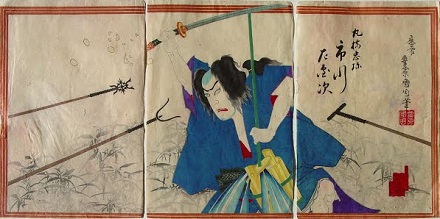
The Keian Uprising inspired many literary interpretations. This 1883 woodblock print depicts actor Ichikawa Sadanji as Marubashi Chûya.

This is more than can be said about the uprisers.

Yui managed to commit seppuku before capture, but Murabashi and a number of the other rebels paid the ultimate price. So too did family members of the rebels.

Marubashi’s is reputed to be the first execution to take place at the Suzugamori execution grounds. The little quarter-acre patch maintained this grim role for the ensuing 220 years, during which time an estimated 100,000 people were put to death there.

That venerable execution grounds was retired in 1871. There’s a memorial marking its onetime site in present-day Tokyo near the junction of Kyu-tokaido Street and Daiichikeihin Avenue.

On this day..