1637: William Schooler and John Williams

(Thanks for the guest post to Robert Wilhelm, author of the Murder By Gaslight historic crime blog, and of the book Murder And Mayhem in Essex County. Executed Today readers are sure to enjoy Wilhelm’s detailed investigations into long-lost historic crime. -ed.)

On September 28, 1637, two men convicted on separate counts of murder in the Puritan colony north of Boston — in what is now Essex County — were executed on the same gallows. The first was William Schooler, convicted a year earlier of killing Mary Scholy on the path to Pascataquack; the second was John Williams convicted of killing John Hoddy near Great Pond in Wenham.


Original (c) image from Murder And Mayhem in Essex County, used with permission.

In the autumn of 1636, an Agawam Indian walking through the Winnacunnet woods, north of the town of Newbury, found the body of a young white woman, lying in a thick swamp about three miles north of the Merrimack river. From the condition of the body, he could tell that the woman had been dead for several months. She lay naked, with her clothing still in a pile not far from the body. The Indian took the news to Newbury, and led the Englishmen to the spot so they could see for themselves.

The woman’s name was Mary Sholy. She was identified more by the circumstance than by appearance, since the flesh had begun to rot. Mary had left Newbury several months earlier, traveling north to her home at the English settlement at Pascataquack. The people of Newbury were also fairly certain who had killed her; they believed she had been ravished and murdered by the man she had hired to guide her journey home, an outsider named William Schooler.

In London, England, William Schooler had been a vintner with intemperate habits. Schooler was, by his own admission, a common adulterer. After wounding a man in a duel he fled to Holland to escape the law; then, leaving his wife behind, he traveled to New England. In 1636 he was living in a shack by the Merrimack River within the limits of Newbury but outside the boundaries of sanctioned Christian behavior.

Mary Sholy, a servant girl, was looking for someone to guide her to Pascataquack, to return to her master. Pascataquack — now Portsmouth, New Hampshire — was a small settlement, about twenty-three miles north of Newbury. It is not known why Mary Sholy had come to Newbury; it is unlikely that her master would have sent her there without providing a guide back. The journey from Newbury to Pascataquack would have been too perilous for a young woman to take alone, first crossing the Merrimack River in a canoe, then following the route to Pascataquack, which was described as little more than a path through the woods. In 1636, even the well-traveled path between Ipswich and Newbury was too narrow for a horse cart. In addition to the possibility of losing her way and becoming hopelessly lost in the woods between the two settlements, there was a very real danger of being attacked by wild animals or hostile Indians.

Seeing an opportunity to make a little money, William Schooler sought out Mary and offered to guide her home for fifteen shillings. He did not tell her that he himself had never made the trip to Pascataquack before. Two days after their departure, William Schooler was back in Newbury alone. When asked why he had returned so soon Schooler replied that he had guided Mary to within two or three miles of Pascataquack, where she stopped, saying she would go no further. Schooler left her there and returned to Newbury.

The people of Newbury remained suspicious and Schooler was questioned by the magistrates in Ipswich. When he returned from the trip he had blood on his hat and a scratch on his nose the “breadth of a small nail.” He explained that the blood was from a pigeon he had killed and the scratch on his nose was from walking into some brambles. He was released, as there was no evidence then that a crime had been committed.

The following year the Pequod tribe took up arms against the English colonists and Schooler was drafted to serve in the militia. He deemed this service to be an oppression and publicly spoke out against it. His outspoken opposition was considered “mutinous and disorderly,” and the governor issued a warrant against him. When he was arrested, Schooler assumed it was about Mary Sholy and began to vehemently defend himself against the charge of her murder. Schooler;s behavior made the magistrates suspicious and, since they now knew Mary Sholy had been murdered, they decided to reopen the case.

Newbury residents who knew him came forward to volunteer information on Schooler’s character. In a Puritan court the character of the accused was as important as the physical evidence against him.

Schooler denied that he murdered Mary Sholy but the jury found him guilty and he was sentenced to hang. The court and the clergy tried desperately to persuade Schooler to confess but he would not. Schooler was contrite, saying he had told many lies to excuse himself, but vehemently denied that he had killed or ravished Mary Sholy. Some ministers argued that the evidence against him was not sufficient to take away his life, but Governor Winthrop denied Scholler a reprieve, saying: “but the court held him worthy of death, in undertaking the charge of a shiftless maid, and leaving her (when he might have done otherwise) in such a place, as he knew she must needs parish, if not preserved by means unknown.”


John Williams was a ship carpenter who had recently come to America from England. In 1637, he was in prison in Boston for theft. Williams and another prisoner, John Hoddy, escaped from the jail and traveled north. They had gone beyond Salem and were on the road to Ipswich, on the east end of the Wenham Great Pond when they had a falling out. The two men had a fight that ended with the death of John Hoddy.

There are two versions of what happened next. In one story John Hoddy’s dog held Williams at bay until the noise drew the attention of enough residents of Wenham to apprehend Williams and take him to jail in Ipswich. The more likely story says that Williams took everything belonging to Hoddy, including his clothes, and buried his body under a pile of stones. Williams proceeded to Ipswich where he was apprehended, after having been recognized as a criminal. Though his clothes were bloody when arrested, he would confess to nothing until a week later, when the body of John Hoddy was found. Cows at a farm near Great Pond smelled the blood and made such a “roaring” that they got the attention of the cow keeper, who on investigation found Hoddy’s naked body under a heap of stones.

Around the same time the justice of the peace in Ipswich learned that both Williams and Hoddy were escaped prisoners. Williams was indicted for the murder of John Hoddy and tried by the Court of Assistants in Boston. Though he confessed to the murder, the court insisted on enforcing Williams’s right to due process, and tried the case before a jury. Williams was, of course, found guilty and sentenced to death.

The double hanging, on September 28, 1637, took place on Boston Common, where all executions in the Massachusetts Bay Colony were held.

Get Murder and Mayhem in Essex County here.

On this day..

1642: Henri Coiffier de Ruze, Marquis of Cinq-Mars

On this date in 1642, with the last words “Mon Dieu! Qu’est-ce que ce monde?”, 22-year-old former royal favorite Cinq-Mars was beheaded at Lyon’s Place des Terreaux.

Henri Coiffier de Ruze (English Wikipedia page | French) had been under Cardinal Richelieu’s protection since the boy’s father died in 1632; in 1639, the Red Eminence introduced the then-19-year-old whippersnapper to Louis XIII as a prospective royal favorite (read: lover).

Though the king did indeed take to the youth, Cinq-Mars, in the age-old custom of sullen teenagers everywhere, soon found the luxurious profligacy of the favorite’s life rather overbalanced by irritation at both of his sickly, aging patrons.

Tart talk to intimates graduated to something more serious after Richelieu rudely put the kibosh on Cinq-Mars’s (unrealistic) designs on a wealthy noblewoman — which was also a bid to parlay his tenuous favorite gig into some lasting power.

Now considering himself personally begrudged of the Cardinal, Cinq-Mars fell into the conspiracies (French link) to depose, assassinate, or otherwise replace him.

Eventually Cinq-Mars would go so far as a real blockbuster (French again): he signed a secret pact with the Spanish king to support a noble revolt in exchange for handing over French possessions, a seditious plan also backed by perennial plotter Gaston d’Orleans, the king’s scheming brother.

Our angry moppet had more than met his match in Richelieu, however: the cardinal’s agents intercepted (more French) the treasonable correspondence and had Cinq-Mars dispatched this date along with his confederate de Thou.


Execution of Cinq-Mars and De Thou in Paris (1642), engraving by Johann Luyken, Paris, Bibliothèque nationale de France (via)

Richelieu himself was already dying as he undid this last conspiracy against him. The cardinal succumbed on December 4, 1642 … with Louis following him into the grave the next May.

While Richelieu’s name is fixed in the firmament of history and literature, Cinq-Mars has to make do as the namesake of a rarely-seen Gounod opera, based on the 1826 historical novel Cinq-Mars by Alfred de Vigny.

On this day..

1628: Milady de Winter, Three Musketeers villainess

Late this night* in 1628 was the fictional execution of The Three Musketeers antagonist Milady de Winter.

Milady de Winter, as the heroine of Agnes Maupre’s revisionist French graphic novel series (Author interview | Another (Both in French)).

This conniving minx bears the fleur-de-lis brand of a teenage crime upon her shoulder — a very naughty beauty-mark indeed — but becomes a secret agent of Cardinal Richelieu. (Richelieu is a point of friction for the Musketeers right from the start.)

This novel — which has long been in the public domain (Text at Gutenberg.org or ClassicReader.com | Free audio book at Librivox.org) — features Milady continually bedeviling the protagonist d’Artagnan. He loves her; she keeps trying to kill him. Pretty typical for these grim annals. (She also used to be Athos’s wife, years ago, until he tried to murder her. Long story.)

To skip to the end of things, Milady is portrayed as having orchestrated at Richelieu’s behest the (actual, historical) assassination of the Musketeers’ buddy the (actual, historical) Duke of Buckingham, which Milady accomplishes by seducing and manipulating his (actual, historical) assassin, John Felton. In reality, Felton was motivated by the stirring Republican sentiment that would soon generate a revolution; in Dumas, he’s a horny dupe who beholds his seductress escaping by sea even as he’s placed under arrest.

Buckingham was (actually, historically) murdered on August 23.

The fictional narrative picks up on August 25, when the escaped Milady writes to Cardinal Richelieu from the safety of Boulogne. Unbeknownst to her, her hours are numbered.

Milady proceeds the next morning to a convent in Bethune where she chances to encounter the mistress of her old foe d’Artagnan … and, by that night, to slay said mistress with poison just ahead of the arrival of the Musketeers.** But the Musketeers are able to track the escaping murderess down by the next evening. There, they subject her to a snap “trial”:

“We wish to judge you according to your crime,” said Athos; “you shall be free to defend yourself. Justify yourself if you can. M. d’Artagnan, it is for you to accuse her first.”

D’Artagnan advanced.

“Before God and before men,” said he, “I accuse this woman of having poisoned Constance Bonacieux, who died yesterday evening.”

He turned towards Porthos and Aramis.

“We bear witness to this,” said the two Musketeers, with one voice.

D’Artagnan continued: “Before God and before men, I accuse this woman of having attempted to poison me, in wine which she sent me from Villeroy, with a forged letter, as if that wine came from my friends. God preserved me, but a man named Brisemont died in my place.”

“We bear witness to this,” said Porthos and Aramis, in the same manner as before.

“Before God and before men, I accuse this woman of having urged me to the murder of the Baron de Wardes; but as no one else can attest the truth of this accusation, I attest it myself. I have done.” And d’Artagnan passed to the other side of the room with Porthos and Aramis.

“Your turn, my Lord,” said Athos.

The baron came forward.

“Before God and before men,” said he, “I accuse this woman of having caused the assassination of the Duke of Buckingham.”

“The Duke of Buckingham assassinated!” cried all present, with one voice.

“Yes,” said the baron, “assassinated. On receiving the warning letter you wrote to me, I had this woman arrested, and gave her in charge to a loyal servant. She corrupted this man; she placed the poniard in his hand; she made him kill the duke. And at this moment, perhaps, Felton is paying with his head for the crime of this fury!”

And so forth.

Then these obviously impartial judges judge her guilty, and have the executioner of Lille — whom they have thoughtfully procured in advance — chop off her head and dump her in a river.

“The executioner may kill, without being on that account an assassin,” said the man in the red cloak [i.e., the executioner himself], rapping upon his immense sword. “This is the last judge; that is all. Nachrichter, as say our neighbors, the Germans.”

Extrajudicial is as extrajudicial does. And in this case, Richelieu is just as happy to be rid of his duplicitous agent and, admiring the protagonist’s moxie, commissions d’Artagnan a lieutenant in the Musketeers. D’Artagnan is the fourth of the titular “three Musketeers”, so this denouement means that he’s finally made it … and he should stand by for duty in sequels continuing to mix-and-match Dumas’s fictional characters with actual, historical events.

Indeed, in the next volume of the series, Twenty Years After, it’s Milady’s vengeful son Mordaunt who acts as Charles I‘s executioner.

This date’s captivating femme fatale has appropriately been portrayed by a ravishing host of silver screen sirens including Lana Turner, Mylene Demongeot, Antonella Lualdi, Faye Dunaway, Rebecca de Mornay, Emmanuelle Beart, and (most recently as of this writing), Milla Jovovich.

* August 27-28, right around midnight. Dumas isn’t specific as to pre- or post-midnight.

** In the novel, it’s Madame de Chevreuse who has arranged this rendezvous of d’Artagnan with his lover — another actual, historical person whom we have met elsewhere in these pages.

On this day..

1700: The Rev. Thomas Hunter, M.A.

We doubt that any interposition of ours can improve the story of this execution as provided in the Newgate Calendar:


Executed on 22nd of August, 1700, near Edinburgh, for the diabolical Murder out of Revenge of the Two Children of Mr Gordon

It is with deep regret that we are compelled to bring before the reader a murderer, in a character which ever should be held most sacred. A crime more premeditated, and more fraught with cruelty, never stained the annals of history. Ambition has often impelled tyrants to shed innocent blood; revenge has stimulated men to kill each other; jealousy with ‘jaundiced eye’ destroys the object of its love; but God forbid that we should ever again have to record the fact of a tutor, a minister of the Gospel, premeditatedly murdering his pupils! — the sons of his benefactor. When we add, that this most miserable sinner expiated his offence in avowing himself an atheist, we arrive, at once, at the very depth of human depravity.

This detestable culprit was born in the county of Fife, in Scotland, and was the son of a rich farmer, who sent him to the University of St Andrews for education. When he had acquired a sufficient share of classical learning he was admitted to the degree of Master of Arts, and began to prosecute his studies in divinity with no small degree of success. Several of the younger clergymen act as tutors to wealthy and distinguished families till a proper period arrives for their entering into orders, which they never do till they obtain a benefice. While in this rank of life they bear the name of chaplains; and in this station Hunter lived about two years in the house of Mr Gordon, a very eminent merchant, and one of the bailies of Edinburgh, which is a rank equal to that of alderman of London.

Mr Gordon’s family consisted of himself, his lady, two sons and a daughter, a young woman who attended Mrs Gordon and her daughter, the malefactor in question, some clerks and menial servants. To the care of Hunter was committed the education of the two sons; and for a considerable time he discharged his duty in a manner highly satisfactory to the parents, who considered him as a youth of superior genius and great goodness of heart. Unfortunately a connection took place between Hunter and the young woman, which soon increased to a criminal degree, and was maintained for a considerable time without the knowledge of the family.

One day, however, when Mr and Mrs Gordon were on a visit, Hunter and his girl met in their chamber as usual; but, having been so incautious as not to make their door fast, the children went into the room and found them in such a situation as could not admit of any doubt of the nature of their intercourse. No suspicion was entertained that these children would mention to their parents what had happened, the eldest boy being not quite ten years of age; but when the children were at supper with their parents they disclosed so much as left no room to doubt of what had passed. Hereupon the female servant was directed to quit the house on the following day; but Hunter was continued in the family, after making a proper apology for the crime of which he had been guilty, attributing it to the thoughtlessness of youth, and promising never to offend in the same way again.

From this period he entertained the most inveterate hatred to all the children, on whom he determined in his own mind to wreak the most diabolical vengeance. Nothing less than murder was his intention; but it was a considerable time after he had formed this horrid plan before he had an opportunity of carrying it into execution.

Whenever it was a fine day he was accustomed to walk in the fields with his pupils for an hour before dinner, and in these excursions the young lady generally attended her brothers. At the period immediately preceding the commission of the fatal act Mr Gordon and his family were at their country retreat, very near Edinburgh; and having received an invitation to dine in that city, he and his lady proposed to go thither about the time that Hunter usually took his noontide walk with the children. Mrs Gordon was very anxious for all the children to accompany them on this visit, but this was strenuously opposed by her husband, who would consent that only the little girl should attend them.

By this circumstance Hunter’s intention of murdering all the three children was frustrated; but he held the resolution of destroying the boys while they were yet in his power. With this view he took them into the fields and sat down as if to repose himself on the grass.

This event took place soon after the middle of the month of August, 1700 and Hunter was preparing his knife to put a period to the lives of the children at the very moment they were busied in catching butterflies and gathering wild flowers. Having sharpened his knife, he called the lads to him, and when he had reprimanded them for acquainting their father and mother to the scene to which they had been witnesses, said that he would immediately put them to death.

Terrified by this threat, the children ran from him; but he immediately followed and brought them back. He then placed his knee on the body of the one while he cut the throat of the other with his penknife, and then treated the second in the same inhuman manner that he had done the first. These horrid murders were committed within half-a-mile of the Castle of Edinburgh; and as the deed was perpetrated in the middle of the day, and in the open fields, it would have been very wonderful indeed if the murderer had not been immediately taken into custody.

At the very time a gentleman was walking on the Castle hill of Edinburgh, who had a tolerably perfect view of what passed. Alarmed by the incident, he called some people, who ran with him to the place where the children were lying dead. Hunter now had advanced towards a river, with a view to drown himself. Those who pursued came up with him just as he reached the brink of the river; and his person being immediately known to them, a messenger was instantly dispatched to Mr and Mrs Gordon, who were at that moment going to dinner with their friend, to inform them of the horrid murder of their sons.

Language is too weak to describe the effects resulting from the communication of this dreadful news; the astonishment of the afflicted father, the agony of the frantic mother, may possibly be conceived, though it cannot be painted.

According to an old Scottish law it was decreed that “if a murderer should be taken with the blood of the murdered person on his clothes, he should be prosecuted in the Sheriff’s Court, and executed within three days after the commission of the fact.” It was not common to execute this sentence with rigour; but this offender’s crime was of so aggravated a nature, that it was not thought proper to remit anything of the utmost severity of the law.

The prisoner was therefore committed to jail and chained down to the floor all night, and on the following day the sheriff issued his precept for the jury to meet; and in consequence of their verdict Hunter was brought to his trial, when he pleaded guilty, and added to the offence he had already committed the horrid crime of declaring that he only lamented not having murdered Mr Gordon’s daughter as well as his sons. The sheriff now passed sentence on the convict, which was to the following purpose: that “on the succeeding day he should be executed on a gibbet, erected for that purpose on the spot where he had committed the murders; but that, previous to his execution, his right hand should be cut off with a hatchet, near the wrist; that then he should be drawn up to the gibbet by a rope, and when he was dead, hung in chains between Edinburgh and Leith, the knife with which he committed the murders being stuck through his hand, which should be advanced over his head and fixed therewith to the top of the gibbet.”

Mr Hunter was executed in strict conformity to the above sentence on the 22nd of August, 1700. But Mr Gordon soon afterwards petitioned the sheriff that the body might be removed to a more distant spot, as its hanging on the side of the highway, through which he frequently passed, tended to re-excite his grief for the occasion that had first given rise to it. This requisition was immediately complied with, and in a few days the body was removed to the skirts of a small village near Edinburgh, named Broughton. It is equally true and horrid to relate, that, at the place of execution, Hunter closed his life with the following shocking declaration: “There is no God — I do not believe there is any or if there is, I hold him in defiance.” Yet this infidel had professed himself to be a minister of the Gospel!

On this day..

1612: The Pendle Witches

You have heard of mother Nottingham, who for her time was pretty well skilled in casting of waters: and after her, Mother Bombye; and there is one Hatfield in Pepper-Alley, hee doth prettie well for a thing that’s lost. There’s another in Coleharbour, that’s skilled in the Planets. Mother Sturton in Goulden-lane, is Fore-speaking: Mother Phillips of the Banke-side is for the weaknesse of the backe: and then there’s a very reverent Matron on Clarkenwell-Green, good at many things: Mistris Mary on the Banke-side is for recting a Figure: and one (what doe you call her) in Westminster, that practiseth the Booke and the Key, and the Sive and the Shears: and all doe well, according to their talent. For myselfe, let he world speake.

-Title character in Thomas Heywood’s The Wise Woman of Hogsdon (1638)

This date marks the 400th anniversary of the Pendle witches‘ hanging — perhaps the most notorious witchcraft execution in English history.

Eight women and two men — Alizon Device, her brother James Device, and their mother Elizabeth Device of the Demdike family; Anne Whittle and her daughter Anne Redferne of the Chattox family; Jane Bulcock and her son John Bulcock; Alice Nutter; Katherine Hewitt; and Isabel Robey* — hanged together this date at Lancaster’s Gallows Hill after being tried over the preceding 48 hours; they, along with a woman named Jennet Preston hanged at York on July 29, comprise the Pendle Witches.

It’s an extraordinarily sad case.

The prosecution of the Pendle witches bubbled out of a witches’ brew of circumstances particular to early-17th century England. There was, to begin with, a new(ish) English king, James I and the guy had a major jones for hunting those early modern supernatural terrorists, witches.** The guy even wrote his own book, Daemonologie, to establish “that such divelish artes have bene and are … [and] what exact trial and severe punishment they merite.” A 1604 law had accordingly broadened the reach of the death penalty for supposed instances of sorcery.

Coming as this did in the aftermath of the Tudor Reformation, the nebulous concept of “witchcraft” was handy as well for clamping down on any excessively Catholic practices that might strike the right authorities as subversive, intransigent, or impious. Lancashire where we lay our scene was just such a Catholic-leaning zone.

Lancashire also had, as almost everywhere in the Isles, its share of “cunning folk” — workers of everyday folk magic whose widely tolerated practices could also be taken by a hostile viewer as Catholic superstition and/or hard-core infernal trafficking.

So, these are the brew’s ingredients. Add wool of bat and tongue of dog, stir vigorously … and serve with a length of hemp.

Curses

The Pendle witches brew started bubbling with a freak incident: a cunning woman named Alizon Device (you’ll recognize her name from the list of the hanged, above) tried to beg some needles from a passing peddler. The latter refusing her, Alizon cursed him, just like you do when you’re cut off in traffic.

Except in this case, the peddler promptly suffered a stroke.

Everyone was spooked at this apparent effusion of transmundane malevolence, nobody more so than Alizon herself. She became the first arrestee, and in the end would go the gallows convinced of her own sorcery.

She also started accusing others of occult involvement, either from a sense of panicked guilt or a blithe ignorance that the new legal regime would be interpreting folk spells as capital crimes. This led her bizarre instance of passing-peddler-popping to become a full-on witch hunt.

Alizon Device came from a whole family, the Demdykes or Demdikes, of cunning-women, and she implicated her own grandmother for having taught her the witchy ways. (Grandma would be spared the ignominy of hanging because she suffered the ignominy of dying in the filthy dungeon.) Alizon also accused a rival family, the Chattoxes, themselves well-known as “witches”, and she also implicated the matriarch of that family, Anne Whittle. The dreadful progress of the ensuing investigation, in which the feuding locals hanged each other with the aid of an ambitious local magistrate, is widely available — thanks to the record one lawyer witness to the proceedings set down in his credulous 1613 chapbook The Wonderfull Discoverie of Witches in the Countie of Lancaster.

Foiled Again

Once these initial arrests were in the books, Alizon’s mother Elizabeth apparently convened a solidarity meeting at a hut with the diabolically menacing name of Malkin† Tower. Dining on stolen mutton, and on Good Friday no less, they may have worked out a plan to liberate the prisoners from Lancaster Castle (at least, the Demdike prisoners). But the magistrate got wind of this confabulation and burst in to arrest those participants, too. As these secondary circles were pulled into the investigation, so too were past years of community gossip about these “witches”, of various folk who had died unexplained and various mishaps that befell people whom the witches didn’t like.

These superstitions seem to have been shared by the witches themselves, at least many of them. The Demdikes and Chattoxes used clay figures, human remains, and little effigies of victims with the intent of hurling evil at their enemies. Causality aside, Alizon Demdike did curse the peddler. “Witches think sometimes that they kill, when they do not, and are therefore as culpable, as if they did,” said their contemporary, pastor John Donne.

To augment the assorted confessions and counter-accusations among the accused, Elizabeth Device’s nine-year-old daughter Jennet Device (little sister of the original peddler-curser Alizon) was summoned up to provide coached testimony against her siblings Alizon and James, against her mother, and against those at the Malkin Tower meeting. Several of these latter would be convicted of non-capital crimes or even acquitted outright, but little Jennet’s testimony doomed her own family.

Although not the first time a child had provided evidence, it was a landmark in normalizing minors’ accusations — jurisprudence advocated by James’s Daemonologie. “Children, women and liars,” the sovereign announced, “can be witnesses over high treason against God.”

These witnesses would cast an evil pall well after Pendle.

In later life, Jennet appears to have been caught up in the same trap, when she was accused of witchcraft by a 10-year-old boy. A judiciary grown more cautious by then did not put her to death … but she (unless it was a different person also named Jennet Device) died in prison.

And the acceptability of this sort of children’s testimony, duly documented for country JP’s in Michael Dalton’s Country Justice, containing the Practice, Duty, and Power of Justices of the Peace, would be the lethal linchpin of the witch trials 80 years later across the Atlantic — in Salem, Massachusetts.

This miserable event has informed any number of artistic productions from the 17th century stage to the present-day Pendle Sculpture Trail. Pendle and Lancashire, as bywords for witch superstitions, now trade handsomely on the unfortunate fame.

Many there have also pushed (thus far unsuccessfully) for an official posthumous pardon of the hanged witches.

And the nearby village of Roughlee even erected a statue in 2012 to the hanged Alice Nutter … a gentlewoman (i.e., of considerably higher class standing than her fellow condemned) whose reason for attending the Malkin Tower meeting remains mysterious.


Alice Nutter statue at Roughlee. Image (c) Burnley & Pendle Ramblers and used with permission.

* Isabel Robey is an outlier case; as of this writing, she’s not even named as one of the Pendle witches on the Wikipedia page as it seems she was not associated directly with the Malkin Tower crowd — merely a bystander who got caught up in the storm of denunciations. She was, however, hanged on Gallows Hill for witchcraft on August 20. There’s a lengthy attempt at reconstructing her story in the face of scant documentation here (pdf).

** All well and good for us moderns to pooh-pooh James’s supernatural obsessions, but the man’s security concerns were very real.

† The BBC documentary has Malkin as slang for “shit”; this page proposes that the word can signify a cat, a bindle, a scarecrow, or “an awkward woman.”

On this day..

1623: Daniel Frank, the first hanging in the USA

On this date in 1623 one Daniel Frank was condemned to hang for theft in the Jamestown colony. It was the first hanging to take place in that part of the British North American colonies that eventually broke away as the United States.

Frank is actually not the very first entry in Watt Espy’s encyclopedic 15,000-plus catalogue of “American” executions — he’s the second. In 1608, George Kendall had been shot for a mutinous plot, also in Jamestown, Virginia. We don’t have a firm date for that event.

But rigorous calendaring, like lenient penal theories, took a back seat in the tiny and tenuous New World colony. Jamestown was the successor to Walter Raleigh‘s failed Roanoke settlement, which disappeared without a trace — and planted in harsh and distant environs, Jamestown had a couple of brushes with the very same fate.


Jamestowne, surrounded by Indian settlements and illustrated wilderness. Excerpt from 1608 map of John Smith (yes, the Pocahontas guy) found here.

Still, this was a delicate balance: Jamestown didn’t have the resources to countenance potential recidivism, but it also didn’t have the resources to go killing productive colonists — or scaring away potential productive colonists. A draconian 1612 Laws Divine, Moral and Martial evidently never sent anyone to the gallows, but was rolled back all the same in 1619 for fear of disaffecting investors.

Sithence we are not to bee a little carefull, and our young Cattell, & Breeders may be cherished, that by the preservation, and increase of them, the Colony heere may receive in due time assured and great benefite … so profitable succeeding a Commodity, as increase of Cattel, Kine, Hogges, Goates, Poultrie &c. must of necessity bee granted …

wee do strictly charge and command, that no man shall dare to kill, or destroy any Bull, Cow, Calfe, Mare, Horse, Colt, Goate, Swine, Cocke, Henne, Chicken, Dogge, Turkie, or any tame Cattel, or Poultry, of what condition soever; whether his owne, or appertaining to another man, without leave from the Generall, upon paine of death.

-The 1612 legal code, topically.

Daniel Frank — “Daniell Francke” to ye olde time Virginians — drew a hanging sentence for stealing and killing a calf belonging to George Yeardley, a major landowner and the former (and future) colonial governor of the Virginia terrtory. Frank, we can assume, was in a state of agonizing hunger when he undertook this desperate act.

Though Mr. Espy’s register of historical executions is an astounding resource, double-checking the dates is a recommended practice. In this case, I believe he’s used a highly fragmentary original record (pdf) and mistakenly ascribed the legal proceedings to the last previous date heading, March 1, 1622. [This would be March 1, 1623 by current reckoning; see footnote here.] This date has been repeated by any number of sources.*

But the narration very clearly states that “the tryall of Danyell Francke and George Clarke vppon Tewsday the fyfth of August 1623” proceeded on the charge of

felonyously steal[ing] and kill[ing] one Calf ye goodes and Chattles of Sr: George Yardley kn[ight] of the woorth and Pryce of three poundes sterling. And after the saide Daniell Francke had killed the said Calfe, Thow the saide George Clarke as Access[orie] to the saide Felony didst help the saide Daniell Fra[nck] to carry the saide Calfe into thy owne house, a[nd] didst helpe to dress eate and spend the same, contrary to the peace of our Sou’ainge Lorde the Ki[ng] his Crowne and Dignitie.

Both men “Receaved sentenc of Death Accordinge to Lawe. Daniell Francke was executed: George Clarke repriued” — either because Clarke was merely an accessory, or as Martha McCartney plausibly speculates, because the gunsmith Clarke was a lot more valuable to the colony than the indentured laborer Francke.

The latter had to make do with his milestone distinction: The first documented hanging in the future US, and the first known execution under normal criminal law.

* My reading of the date is also corroborated (and Espy’s undermined) by a February, 1623 [i.e., 1624] record of the colony’s deaths “since April last.”

On this day..

1691: Jack Collet, sacrilegious burglar

On this date in 1691, Jack Collet was hanged for “sacrilegious burglary.”

This little-known highwayman ditched an apprenticeship with a Cheapside upholsterer to take the road, and carved a niche as the guy what robbed while dressed up as a bishop. (Once having lost his ecclesiastical garb at dice, he re-robed by sticking up a churchman on the road and forcing his victim to dis-.)

“As if he had been determined to live by the Church,” clucks the Newgate calndar, “he was at last apprehended for sacrilege and burglary, in breaking open the vestry of Great St Bartholomew’s, in London, in company with one Christopher Ashley, alias Brown, and stealing from thence the pulpit cloth and all the communion plate.”

For this bid to render un-from God, Caesar rendered Collet unto Tyburn.

On this day..

1680: A Madrid auto de fe

On this date in 1680, the Spanish capital of Madrid celebrated an enormous auto de fe, culminating with 18 executions plus eight people posthumously burned and 22 fugitives “executed” in effigy. (Source of the numbers)

This signal event needed every drop of sunlight from the long summer’s day. Staged for the appearance of the royal family itself, it likewise pulled in every available case from around Spain: the regional cities shipped their apostates and heretics to Madrid to dignify the main event with a suitable quantity of prey.

It began with a morning ceremonial procession of prisoners, nearly a hundred — every source seems to have a slightly different figure — in the traditional Inquisitorial manner. This account comes from an English contemporary, as reprinted in Human Judgment: The Eye of the Beholder. (Note: paragraph breaks added, and ubiquitous capitalization of nouns removed, for better readability.)

A scaffold, fifty feet in length, was erected in the Square, which was raised to the same height with the balcony made for the King to sit in. At the end, and along the whole breadth of the scaffold, at the right of the King’s balcony, an amphitheatre was raised, to which they ascend by twenty-five or thirty steps; and this was appointed for the Council of the Inquisition, and the other Councils of Spain. Above these steps, and under a canopy, the Grand Inquisitor’s rostrum was placed so that he was raised much higher than the King’s balcony. At the left of the scaffold and balcony, a second amphitheatre was erected of the same extent with the former, for the criminals to stand in.

A month after proclamation had been made of the Act of Faith, the ceremony opened with a procession [on June 29], which proceeded from St. Mary’s church in the following order. The march was preceded by an hundred coal merchants, all arm’d with pikes and muskets; these people furnishing the wood with which the criminals are burnt. They were followed by Dominicans, before whom a white cross was carried. Then came the Duke of Medina-Celi, carrying the Standard of the Inquisition. Afterwards was brought forwards a green cross covered with black crepe; which was followed by several grandees and other persons of quality, who were familiars of the Inquisition. The march was clos’d by fifty guards belonging to the Inquisition, clothed with black and white garments and commanded by the Marquis of Povar, hereditary Protector of the Inquisition.

The procession having marched in this order before the palace, proceeded afterwards to the square, where the standard and the green cross were placed on the scaffold, where none but the Dominicans stayed, the rest being retired. These friars spent part of the night in singing of psalms, and several Masses were celebrated on the altar from daybreak to six in the morning. An hour after, the King and Queen of Spain, the Queen-Mother, and all the ladies of quality, appeared in the balconies.

At eight o’clock the procession began, in like manner as the day before, with the company of coal merchants, who placed themselves on the left of the King’s balcony, his guards standing on his right (the rest of the balconies and scaffolds being fill’d by the embassadors, the nobility and gentry).

Afterwards came thirty men, carrying images made in pasteboard, as big as life. Some of these represented those who were dead in prison, whose bones were also brought in trunks, with flames painted round them; and the rest of the figures represented those who having escaped the hands of the Inquisition, were outlaws. These figures were placed at one end of the amphitheatre.

After these there came twelve men and women, with ropes about their necks and torches in their hands, with pasteboard caps three feet high, on which their crimes were written, or represented, in different manners. These were followed by fifty others, having torches also in their hands and cloathed with a yellow sanbenito or great coat without sleeves, with a large St. Andrew’s cross, of a red colour, before and behind.


Detail view (click for the full image) of a Goya painting of Inquisition prisoners in the sambenito.

These were criminals who (this being the first time of their imprisonment) had repented of their crimes; these are usually condemned either to some years imprisonment or to wear the sanbenito, which is looked upon to be the greatest disgrace that can happen to a family. Each of the criminals were led by two familiars of the Inquisition.

Next came twenty more criminals, of both sexes, who had relapsed thrice into their former errors and were condemn’d to the flames. Those who had given some tokens of repentance were to be strangled before they were burnt; but for the rest, for having persisted obstinately in their errors, were to be burnt alive. These wore linen sanbenitos, having devils and flames painted on them, and caps after the same manner: five or six among them, who were more obstinate than the rest, were gagged to prevent their uttering any blasphemous tenets. Such as were condemned to die were surrounded, besides the two familiars, with four or five monks, who were preparing them for death as they went along.

[skipping the seating arrangements … ]

About twelve o’clock they began to read the sentence of the condemned criminals. That of the criminals who died in prison, or were outlaws, was first read. Their figures in pasteboard were carried up into a little scaffold and put into small cages made for that purpose. They then went on to read the sentences to each criminal, who thereupon were put into the said cages one by one in order for all men to know them. The whole ceremony lasted till nine at night; and when they had finished the celebration of the Mass the King withdrew and the criminals who had been condemn’d to be burnt were delivered over to the secular arm, and being mounted upon asses were carried through the gate called Foncaral, and at midnight near this place were all executed.


Francisco Ricci‘s grand painting of the Madrid auto de fe represents events from throughout the day simultaneously. Image from Wikimedia Commons.

As best I can determine, two condemned people bought their lives with last-second conversions, leaving 18 to die for Judaizing … or, in one case, for converting to Islam. It will suffice to say that a very large, very ornate, and very long ceremony unfolded, and that at the end of it the flames consumed a number of people (and even more mannequins) associated with the Abrahamic faith.

“These punishments,” observed a French diplomat who witnessed the proceedings, “do not significantly diminish the number of Jews in Spain and above all in Madrid where, while some are punished with great severity, one sees several others employed in finance, esteemed and respected though known to be of Jewish origin.” Actual eliminationist Jew-hunting was so 1492.

Great as were these astounding spectacles, their day was passing. In fact, this was it — the long, sweltering, tiresomely gaudy day that it passed.

Spain in 1680 was in the grip of plague, famine, and deflation; though there’s value to the state in the distraction of a circus, there’s also the very substantial cost of putting the bloody thing on, especially on such a scale, especially when you’re going to let off most of the victims but not until you sock them away in prison and feed them for months or years until the next auto.

It seems that by the 17th century this end-zone spike of the Inquisition had become quite an encumbrance: procedures required the Inquisition to dispose of certain cases in autos de fe, which, because they had to be put on just so, were increasingly rare, and clogged up gaol cells in the meanwhile. There’s a reason besides spectacle that all the rest of Spain gratefully dumped its religious criminals on Madrid on this date.

The model just wasn’t sustainable.

Over the 1680s, practical pushback reconfigured the venerable ritual into something less burdensome to the public purse. This date’s event was very far from the last auto de fe in Spain, but it’s seen as the last of the classic, public-festival spectaculars evoked by the term. They would, in the future, become (mostly) smaller, (usually) shorter, and (somewhat) less garish affairs conducted not on public plazas but on church grounds, and with most cases of reconciliation simply handled quickly, quietly, and locally.

On this day..

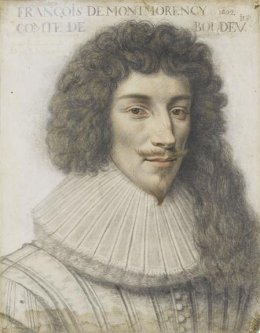
1627: Francois de Montmorency and his second, for dueling

On this date in 1627, the Comte de Bouteville plus his cousin Des Chapelles lost their heads for fighting a duel — ultimately (because of the execution) one of the most notorious duels in French history.

Though this is the duel that everyone knows, Francois de Montmorency-Bouteville (English Wikipedia entry | French) had engaged in 22 such affairs of honor between the tender ages of 15 and 28. Like as not, he was the duellist par excellence in an age where demanding lethal satisfaction was all the rage among devil-may-care aristocratic straplings.

And this, of course, is why he was nominated for condign punishment in Louis XIII’s struggling anti-dueling campaign. One might say he nominated himself.

Dueling, a mano-a-mano vindication of feuds between fops, was an archaic holdover of Burgundian clan violence turned preposterous baroque ritual of conspicuous consociation.

It was also incredibly epidemic in France at this period.

During the reign of Louis’s predecessor Henri IV, 7,000 to 8,000 people are reported to have died in duels, which works out to the suspect rate of one per day for the entire period. Then again, France did have an excess supply of noble progeny whose violent impulses were no longer preoccupied by fratricidal religious warfare.*

Henri IV had tried to ban dueling, even in 1610 executing for lese majeste a couple members of his own guard who defied the ban. Just weeks later, and for no reason connected to dueling, Henri was assassinated. Then-nine-year-old heir Louis XIII was in no position at the time to follow up his father’s policy, and the naughty sport continued to flourish.

“Duels had become so common among the French nobility that the streets of Paris usually served as the field of combat,” according to the Mercure Francois. And as Richard Herr described in his “Honor versus Absolutism: Richelieu’s Fight against Dueling” (The Journal of Modern History, September 1955; this is also the source of all other quotes in this post), they often arose over utterly trivial “slights.”**

Typical was a duel in Lent of 1626 in which Bouteville [i.e., the subject of our post] with two seconds engaged the Comte de Thorigny and his two seconds. The fight was over a dispute between Thorigny and the Marquis de Chalais, who was in prison accused of treason. Bouteville was merely defending the honor of a friend. All six spent the night before the engagement in an inn outside Paris, and in the course of a fairly amicable conversation, they expressed regret that being good friends, they were going to kill each other over another gentleman’s quarrel. But they agreed that they had gone too far to be able to abandon the project without loss of honor. The next day Bouteville killed Thorigny after the latter’s sword broke.

By the 1620s, Louis was old enough to make another run at this intractable elite-on-elite crime wave, and did so with the full encouragement of his famous consigliere Cardinal Richelieu. Depriving the aristocracy of this weird extra-judicial prerogative fit right into the latter’s going campaign to centralize the French state and bring its quarrelsome lords to heel.

What with all those duels he liked to fight, Francois de Montmorency-Bouteville was a great test case. Fighting a public duel in January 1627 — at which his second was slain — made Bouteville a target, and he fled to the Netherlands for safety.

Our fugitive figured he’d send word that a pardon would be appreciated, and everything would blow over like it always did. But Louis was determined to disabuse this type of any privilege to commit public mayhem, and refused to grant Bouteville his absolution.

Honor offended — his default state, to judge by his career — Bouteville vowed angrily to “fight in Paris and in the Place Royale!” This he did on May 12, 1627, slipping back into France for the express purpose of dueling Guy Harcourt, the Marquis de Beuvron. And Bouteville disdained a private fight for the occasion, insisting, as he had declared, on a daytime melee where everyone could see it at the grand new Place Royale (today, Places des Vosges).


At least the setting was operatic. (cc) image from Christophe Alary.

Bouteville and Beuvron fought to a bloodless stalemate and agreed to call it a draw. But Bouteville’s second Des Chapelles mortally wounded Beuvron’s second.

Everyone fled, and while Beuvron made it out of the country, Montmorency and Des Chapelles were nabbed, and condemned to death by the Parlement of Paris for violating Louis’s royal edict against duels.

From the king’s standpoint, this was just about the most egregious possible arrangement of factors.

  • The guy was a serial offender, and he was already a fugitive for his last duel.
  • The fight had produced a fatality.
  • Worst, the whole scene — sneaking back into Paris, fighting openly within the potential view of the sovereign — had been overtly staged to scorn the royal ban.

If Louis intended his decree to mean anything at all, he had to come down hard on this one. “It is a question of cutting the throat of duels or of your majesty’s edicts,” Richelieu summarized.

But as clear-cut as were the case indicia, this was still a hard one for Louis, and even for the usually-ruthless Richelieu. Bouteville was a well-born noble, with powerful friends and family who were also close to the king, and they besieged the royal person with petitions for mercy. A sorrowing but firm Louis had to personally refuse mercy to Bouteville’s tearful wife. “Their loss affects me as much as it does you,” he said. “But my conscience prevents my pardoning them.”

Although the poor wife couldn’t make any headway for clemency, she had the better of Bouteville’s swordsmanship off the field of honor. The doomed duke bequeathed one last rapier thrust to posterity by leaving his widow-to-be pregnant with a posthumous son who eventually generalled French armies to any number of routs of the Dutch in the late 17th century.

And while Richelieu’s memoirs would depict this instance of executive implacability as a decisive turn, Herr argues that it was nothing but a brief interruption. The pernicious hobby was back in all its glory within a couple of years, an evil that even Richelieu could never master. France’s aspired-to absolutism could not reach that ancient and intimate noble right save in the very most exemplary case.

In Dumas’s Three Musketeers, set in 1620s France, D’Artagnan is charged by his father in the opening pages to “[n]ever fear quarrels … Fight on all occasions. Fight the more for duels being forbidden, since consequently there is twice as much courage in fighting.” And indeed, it is by blundering into silly duels (e.g., the “offense” caused by bumping into Porthos while hurrying down the stairs, the latter of whom considers D’Artagnan’s apology discourteously perfunctory) that D’Artagnan becomes the fourth of their cadre … because Richelieu’s men arrive to break up the illegal D’Artagnan-vs.-Musketeer melees, and D’Artagnan joins with his “foes” to defend, all for one and one for all, their privilege as gentlemen to slaughter one another.

The dueling phenomenon faded significantly under Louis XIV, but still not completely: Voltaire almost fought a duel in 1726; the artist Manet dueled a critic in 1870; and YouTube will favor the viewer with a number of 20th century professors and litterateurs settling long-forgotten affairs of honor — like disputes over wartime collaboration after World War II — in ceremonial swordfights. Dueling pistol shooting (at human silhouettes) was even an event at the 1906 Olympics.†

And elsewhere in Germany, Russia, and everywhere Europe touched, duelling persisted with new practitioners into the 19th and even the 20th and even the 21st centuries.

* Also worth noting relative to the casualty numbers: at this time, each side’s seconds also fought in addition to the principals. A move for taking seconds out of the fight eventually prevailed, long before the end (if there has been a real end) of dueling, but in 1627 that time was not yet come.

** Across the Channel at this time, Francis Bacon was making much the same complaint against English duels.

† This event was an “Intercalated Games” falling between the natural 1904 and 1908 Olympiads. It’s an outlier historical experiment during the modern Olympics’ uncertain early years, and though it was officially sanctioned at the time and winners walked away with proper medals, the International Olympic Committee no longer recognizes the Intercalated Games as an official Olympics.

On this day..

1693: Elizabeth Emerson

(Thanks for the guest post to Robert Wilhelm of the Murder By Gaslight historic crime blog, and author of the book Murder And Mayhem in Essex County. Executed Today readers are sure to enjoy Wilhelm’s detailed investigations into long-lost historic crime. -ed.)

The Emersons of Haverhill, Massachusetts, were the kind of family that just could not stay out of trouble. Death was a common feature in the Emerson household; only nine of their fifteen children survived infancy. Michael Emerson’s first child, Hannah, would marry Thomas Duston and, become famous for escaping Indian captivity by murdering and scalping ten of her captors.

The sixth child was a daughter named Elizabeth, born in 1664. Twelve years later, Michael was brought to court “for cruel and excessive beating of his daughter with a flail swingle and for kicking her, and was fined and bound to good behavior.” Corporal punishment was not considered wrong in and of itself, but Michael’s beating of Elizabeth was criminally excessive. There is no way to know why Elizabeth was being punished, but the impression is, that she was a rambunctious, strong-willed child living in a violent household.

Another of Elizabeth’s sisters, Mary Emerson, was married in 1683 to Hugh Mathews of Newbury. Though there is no record of premature offspring, Hugh and Mary were both brought to court and found guilty of fornication before marriage. They were sentenced to be “fined or severely whipped.”

Perhaps with her sister as an example, Elizabeth also engaged in premarital sex. In 1686, Elizabeth Emerson gave birth to an illegitimate daughter she named Dorothy. It is not clear whether Elizabeth was ever punished for this, but court records indicate that Michael Emerson accused a neighbor, Timothy Swan, of being the father. Timothy’s father, Robert Swan, vehemently denied that Timothy was the father because he “… had charged him not to go into that wicked house and his son had obeyed and furthermore his son could not abide the jade.” He further threatened to “carry the case to Boston” if Timothy was formally accused. Michael did not pursue the charges and little Dorothy remained fatherless.

Five years later, with Elizabeth and her daughter still living at her parents’ house, Elizabeth became pregnant again. She somehow managed to keep this a secret from her parents, but the neighbors were suspicious. Sometime during the night of May 7, 1691, Elizabeth, who slept at the foot of the bed where her mother and father slept, gave birth to twins without waking her parents. The twins were either stillborn or murdered by their mother. She hid the bodies in a trunk for three days then sewed them into a sack and buried them in the backyard.

The following Sunday, while her parents were at church, the neighbors who had suspected Elizabeth’s pregnancy, came to the house with a warrant from the magistrates of Haverhill. While the women examined Elizabeth, the men went to the backyard and found the bodies buried in a shallow grave. Elizabeth was arrested for murdering her bastard infants.

Elizabeth maintained that she had kept the pregnancy and birth a secret out of fear. Her mother had been suspicious, but whenever asked about it, Elizabeth denied she was pregnant. Michael claimed he had no idea that Elizabeth was pregnant but this time put the blame on Samuel Ladd, age 42, a married man, nine years older than Elizabeth. Elizabeth also named Samuel Ladd as the father, saying that the “begetting” had taken place at an inn house. She also stated that Ladd was the only man with whom she had ever slept, implying that Dorothy was Ladd’s daughter as well.

Although Samuel Ladd had been previously found guilty of a misdemeanor and fined for an earlier episode involving sexual advances on a younger woman, Ladd was never questioned in Elizabeth Emerson’s case. Elizabeth was already the mother of a bastard child, and Samuel Ladd was the son of an early settler — her story was not believed.

Elizabeth Emerson was sentenced to hang and remanded to the custody of the Boston prison on May 13, 1691. An accompanying letter explained the facts and said that she had been examined for “whore-dom.” By English law, concealment of the death of a bastard child had been punishable by execution. Though this law had been repealed in England, it was still on the books in Massachusetts. It did not matter whether Elizabeth Emerson had murdered her babies or merely concealed their death — she would be hanged.

The hanging was scheduled for 1693. Elizabeth was imprisoned during the height of the Salem witch trials, and though he played an active role in the trials, Reverend Cotton Mather found time to take an interest in her case. Mather worked on her soul and before her execution Elizabeth confessed that “when they were born, I was not unsensible, that at least one of them was alive; but such a Wretch was I, as to use a Murderous Carriage towards them, in the place where I lay, on purpose to dispatch them out of the World.” But Mather believed she had more to confess and held little hope for her salvation.

Elizabeth Emerson was hanged in Boston on June 8, 1693, along with a black indentured servant named Grace. Before the execution Cotton Mather preached a sermon during which he read the following declaration written by Elizabeth:

I am a Miserable Sinner; and I have Justly Provoked the Holy God to leave me unto that Folly of my own Heart, for which I am now Condemned to Dy … I believe, the chief thing that hath, brought me, into my present Condition, is my Disobedience to my Parents: I despised all their Godly Counsils and Reproofs; and I was always an Haughty and Stubborn Spirit. So that now I am become a dreadful Instance of the Curs of God belonging to Disobedient Children.

Get Murder and Mayhem in Essex County here.

On this day..