1662: Potter, bugger

“Of Buggery”

by Cotton Mather (as printed in America Begins: Early American Writings)

On June 6, 1662, at New Haven, there was a most unparalleled wretch (one Potter, by name, about sixty years of age) executed for damnable bestialities, although this wretch had been for now twenty years a member of the church in that place, and kept up among the holy people of God there a reputation for serious Christianity. It seems that the unclean devil which had the possession of this monster had carried all his lusts with so much fury into this one channel of wickedness that there was no notice taken of his being wicked in any other. Hence ’twas that he was devout in worship, gifted in prayer, forward in edifying discourse among the religious, and zealous in reproving the sins of the other people. Everyone counted him a saint, and he enjoyed such a peace in his own mind that in several fits of sickness wherein he seemed “nigh unto death,” he seemed “willing to die”; yea, “death,” he said, “smiled on him.”

Nevertheless, this diabolical creature had lived in most infandous buggeries for no less than fifty years together; and now at the gallows there were killed before his eyes a cow, two heifers, three sheep, and two sows, with all of which he had committed his brutalities. His wife had seen him confounding himself with a bitch ten years before; and he then excused his filthiness as well as he could unto her, but conjured her to keep it secret. He afterwards hanged that bitch himself, and then returned unto his former villainies, until at last his son saw him hideously conversing with a sow. By these means the burning jealousy of the Lord Jesus Christ at length made the churches to know that he had all this while seen the covered filthiness of this hellish hypocrite, and exposed him also to the just judgment of death from the civil court of judicature.

Very remarkable had been the warnings which this hellhound had received from heaven to repent of his impieties. Many years before this he had a daughter who dreamt a dream which caused her in her sleep to cry out most bitterly. And her father than, with much ado, obtaining of her to tell her dream, she told him she dreamt that she was among a great multitude of people to see an execution, and it proved her own father that was to be hanged, at whose turning over she thus cried out. This happened before the time that any of his cursed practices were known unto her.

On this day..

1686: Paskah Rose, Jack Ketch interregnum

On this date in 1686, the English executioner Paskah (or Pascha) Rose was hanged at Tyburn for burglary — by his predecessor and his successor, the famed hangman Jack Ketch.

(c) image from Peter Herring, used with permission. Also see this illustration

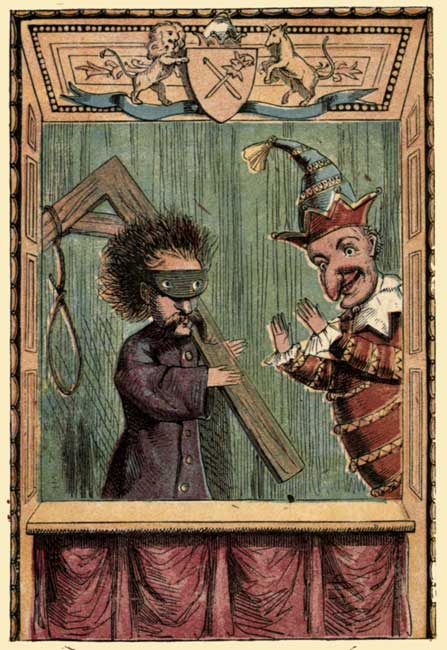
The “Jack Ketch” character from a Punch and Judy puppet show: traditionally, Punch gets the better of their meeting and hangs Jack Ketch.

The Irish immigrant Ketch is the first name in English executioners. Indeed, you can call any of his successors right down to Pierrepoint a “Jack Ketch” and be perfectly understood.

The immediate successor, however, was Ketch’s own assistant — who inherited top billing after Ketch went to jail for “affronting” a sheriff.

Jack Ketch had been trodding the scaffold-boards, hanging, beheading, and drawing-and-quartering for two-plus decades at that point: he’s thought to have been appointed in 1663, and he’d inserted himself into those performances rather more prominently than an executioner ought by botching some of Restoration England’s most high-profile executions.

There’s little reliable information about these early executioners, but it seems Ketch’s reputation for clumsiness had forced him to issue an “Apologie” justifying himself.

But the man unquestionably had longevity in his favor, which is more than Paskah Rose could say.

Within months of becoming the chief London executioner, Rose and another man were chased down in the act of burgling clothes from a house, “the Goods found in Rose’s Breeches.”

Rose and his co-defendant Edward Smith accordingly hanged along with three others at Tyburn this date — by Jack Ketch, now returned from his carceral retirement for one last tour.

Ketch died late that same year of 1686, but has lived on in any number of ballads, doggerels and broadsides immortalizing the name. He was surely aided in this by the less impressive caliber of many who succeeded him: it wasn’t long after Ketch dispatched Pascha Rose that another “Jack Ketch” — an ignoble profession that wouldn’t until centuries hence be drawn from the country’s respectable classes — also met Pascha Rose’s same fate.

There’s a now-public-domain Autobiography of Jack Ketch by 19th century English writer Charles Whitehead.

On this day..

1671: Zrinski and Frankopan, Croatian conspirators

He who dies honorably lives forever.

-Fran Frankopan

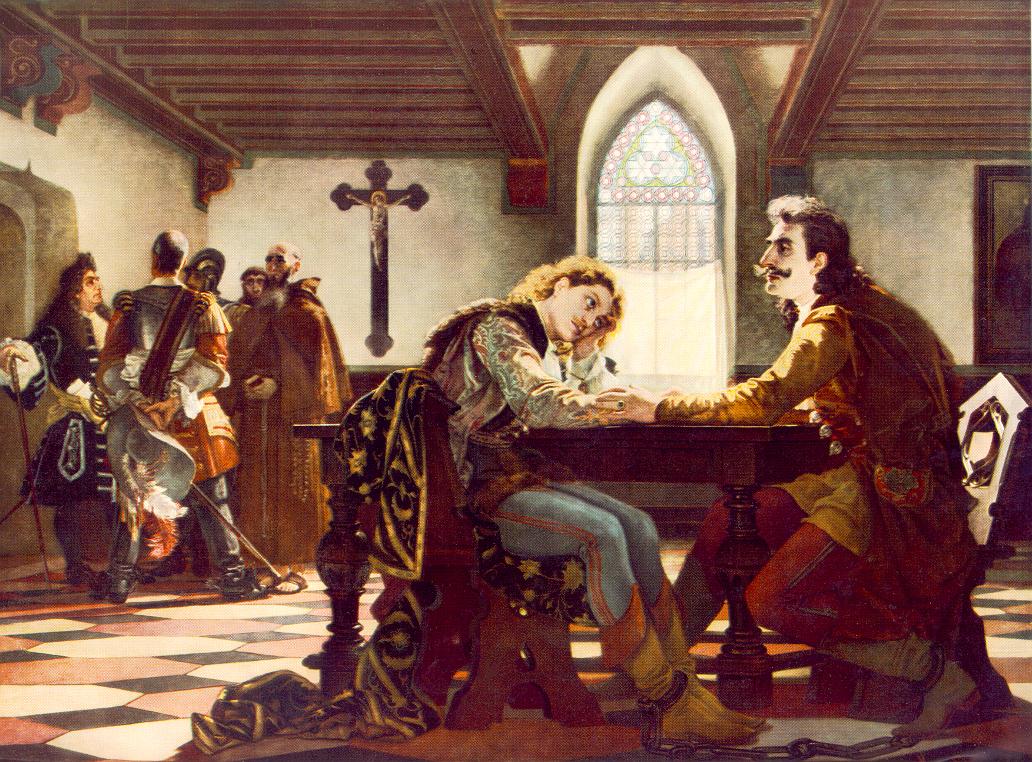
On this date in 1671, Croatian noble Fran Krsto Frankopan and his brother-in-law Petar Zrinski were beheaded by the Austrian empire at Wiener-Neustadt Prison.

The Zrinski-Frankopan Conspiracy — or Magnate Conspiracy — was the product of great powers chess in central Europe … and specifically, of the frustration of these lords in the frontier zone between the Austrian and the Ottoman Empires at being a sacrificial pawn.

Instead, they’d take control of their own destiny and be a self-sacrificial pawn.

Croatia and Hungary had been on the perimeter of Hapsburg authority for generations, and seen the rising Ottomans push well into Europe.

In the latest of innumerable wars, the Austrians had trounced the Ottomans, potentially (so the Croats and Hungarians thought) opening the door for reconquest of lost territory. Croatia in particular had been nibbled away by Ottoman incursions into a “remnant of a remnant.” Emperor Leopold I thought otherwise: he had Great Games to play in western Europe as well and didn’t find this an auspicious moment to go all in in the east.

Rather than following up his victory by trying to run the Turks out of their half of divided Hungary, or out of Transylvania, Leopold just cut an expedient peace on status quo ante terms quite a bit more favorable to Istanbul than the latter’s military position could demand.

The aggrieved nobles started looking around for foreign support to help Hungary break away.

This scheme never came to anything all that palpable, perhaps because the operation’s leading spirit Nikola Zrinski got himself killed by a wild boar on a hunt, and definitely because no other great powers wanted to get involved in the mess.

Zrinski (or Zrinyi) was also a noteworthy Croatian-Hungarian poet, as were the remaining conspirators.

The boar-slain’s younger brother Petar, his wife Katarina, and Katarina’s half-brother Fran Frankopan, also better litterateurs than conspirators, inherited the scheme’s leadership, and its penalty.


Zrinski and Frankopan in the Wiener-Neustadt Prison, by Viktor Madarasz (1864)

Royal vengeance against the plot shattered two mighty noble houses: the Zrinskis were all but destroyed by the seizure of their estates. The Frankopans — an ancient and far-flung family whose Italian Frangipani branch was even then about to yield a pope — were done as major players.

After these executions, anti-Hapsburg sentiment metastasized in Hungary into outright rebellion.

But in what was left of Croatia, the loss of the two largest landholders spelled the end of effective resistance until the era of 19th century romantic nationalism — when our day’s unfortunates were recovered as honored national heroes.

Zrinski and Frankopan are pictured on modern Croatia’s five-kuna bill, and were both reburied in Zagreb Cathedral after World War I finally claimed the Austrian Empire. (They also got memorial plaques in Wiener-Neustadt) Their mutual relation Katarina Zrinski, who avoided execution but was shut up in a convent, was a writer as well, and has ascended to the stars of founding patriotess, seemingly the go-to namesake for most any Croatian women’s civic organization. (Dudes honor the House of Zrinski by slapping the name onto sports clubs.)

On this day..

1662: John Barkstead, Miles Corbet, and John Okey, renditioned regicides

Happy 350th death day to three English regicides renditioned from Holland.

John Barkstead, Miles Corbet and John Okey were all among the 59 judges who signed the death-warrant of King Charles I.

Like everyone else on that parchment, they were in a world of hurt when Oliver Cromwell died and Charles II returned to the throne. And like a great many of those who figured to reap the whirlwind, they sensibly fled the realm.

Had they stayed hunkered down in Germany, they might have died in their beds.

Instead, they trusted a friend … and died half-hanged, emasculated, disemboweled, and chopped to pieces on a scaffold.

It was an ugly sight from start to finish. The capture of these fugitives was a dirty business mixing treachery, diplomatic subterfuge, and dubious legality, all in the service of violent statecraft. Sort of like it was ripped from the Downing Street memo.

The author of it all was the original Downing: Sir George Downing, the namesake of London’s Downing Street, where the British Prime Minister resides.

This guy was coming into the prime of his continent- and polity-spanning career: from Puritan New England, to the West Indies, to a gig in Cromwell’s army during the English Civil War. (It was John Okey himself who hooked Downing up: Downing matriculated with Harvard University’s first graduating class thanks to Okey’s sponsorship, and it was in Okey’s regiment that Downing was retained as chaplain.)

An able diplomat for the Protectorate, Downing was able to communicate his discreet abjuration to the exiled Charles II once the handwriting was on the wall, and he therefore effected a convenient volte-face and went right to work for the new boss … even when it meant hunting down his own friends and patrons. You might say it was the zeal of the converted, but maybe it was better-expressed by Downing’s own pledge to secure the refugees with vigor “as much as if my life lay at stake in the busines.”

Sound policy, considering his history. And he couldn’t have pulled it off with an ounce less.

Officially, the Low Countries had agreed not to give refuge to regicides: in reality, regicides could rest pretty easy there. Pro-immigrant, pro-Protestant,* and jealous of their sovereignty, the Dutch had little desire to enforce such clauses at any level of government; and, thanks to a federal structure, multiple state organs each held effective veto over enforcement. Moreover, a silly legalistic fetish required that fugitivies have warrants sworn out against them — warrants that would cause regicides’ many friends and sympathizers to raise the alarm before the target could be taken, which is exactly what happened when Downing tried to get Edward Dendy arrested in Rotterdam.

Downing cogitated all manner of extra-legal options to black-bag a few of the Protectorate personnel for his Majesty’s pleasure. What he ended up with was cunning, vicious, and just barely legitimate.

Turning one of the regicides’ contacts with threats and bribery, he secured advance warning of Barkstead, Corbet, and Okey’s planned visit to Delft in early March 1662. He then waited until the very day he planned to spring his trap to procure a general arrest warrant (concealing the names of his prey) from the Estates General’s capable leader Johan de Witt, and pounced within hours — using a force of his own men and a little more payola to circumvent the inevitable reluctance of the local bailiffs.

Now that the regicides were in irons, Downing had to double down on duplicitous diplomacy by maneuvering to get them delivered to the English — and that against a growing popular resistance as their capture became known. The Delft aldermen dilated; sympathetic local worthies visited the prisoners in their cells; petitions on the Englishmen’s behalf circulated nationwide. The notion of actually marching these guys out into English hands seemed to promise a riot.

Downing spread more palm grease around, maneuvered to frustrate legal aid for the prisoners, posted his own men to watch the prisoners 24-7, and after several tense days finally made arrangements

in the dead of the night to get a boate into a litle channell which came neare behinde the prison, and at the very first dawning of the day without so much as giving any notice to the seamen I had provided … forthwith to slip them downe the backstaires … and so accordingly we did, and there was not the least notice in the Towne thereof, and before 5 in the morning the boate was without the Porto of Delft, where I delivered them to Mr. Armerer … giving him direction not to put them a shoare in any place, but to go the whole way by water to the Blackamore Frigat at Helverdsluice.

Downing was exultant.

“This is a thing the like thereof hath not been done in this country and which nobody believed was possible to be done,” he gloated in his correspondence. “And there is not a thing that hath happened these many yeares that hath occasioned so much discourse here, saying that they are now no longer a free Countrey, and that no man is now sure here.” De Witt and the Dutch Estates General, having never had any intention to actually deliver a regicide to condign punishment in England, had been embarrassingly played. Ordinary Hollanders were infuriated and ashamed at having been a party to the whole business.

Nobody could dispute the excellence of Downing’s operation. But anybody on either side of the channel who wasn’t a dyed-in-the-wool Royalist was somewhere between discomfited and revolted by it, especially as it was achieved against his own personal benefactor by a guy who had once urged Cromwell to make himself king.

Diarist Samuel Pepys (who witnessed the executions, reporting the victims “very cheerful” on that occasion) recorded the mood of the English burgher upon the news

that Sir G. Downing (like a perfidious rogue, though the action is good and of service to the King, yet he cannot with a good conscience do it) hath taken Okey, Corbet, and Barkestead … all the world takes notice of him for a most ungrateful villaine for his pains. (Pepys’s March 12 and March 17 entries for this year)


See: Ralph C.H. Catterall, “Sir George Downing and the Regicides,” The American Historical Review, Vol. 17, No. 2 (Jan., 1912)

* Dutch affinity for religious dissent and for foreigners was all of a piece with its prosperous mercantile empire. One liberal Englishman (quoted by James Walker in “The English Exiles in Holland during the Reigns of Charles II and James II,” Transactions of the Royal Historical Society, Fourth Series, Vol. 30 (1948)) proposed that “Liberty of Conscience would be a more serious blow to Holland than all the victories yet gained.”

On this day..

1689: William Bew, flatterer

This was the hanging-date in 1689 of William Bew, the less-noted younger brother of a more impressive (but by this time deceased) highwayman “Captain Bew”.

Will, too, took to the road. His thieving career might not have been outstanding, but it did give the Newgate Ordinary occasion to wax smug over the nigh-literary comeuppance young Bew once delivered to feminine vanity.

The following story, which Bew himself used to tell, is of an adventure of Bew with a young lady, whom he overtook on the road, with her footman behind her. He made bold to keep them company a pretty way, talking all along of the lady’s extraordinary beauty, and carrying his compliments to her to an unreasonable height. Madam was not at all displeased with what he said, for she looked upon herself to be every bit as handsome as he made her. However, she seemed to contradict all he told her, and professed with a mighty formal air that she had none of the perfections he mentioned, and was therefore highly obliged to him for his good opinion of a woman who deserved it so little. They went on in this manner, Bew still protesting that she was the most agreeable lady he ever saw, and she declaring that he was the most complaisant gentleman she ever met with. This was the discourse till they came to a convenient place, when Bew took an opportunity to knock the footman off his horse; and then addressing himself to the lady, “Madam,” says he, “I have been a great while disputing with you about the beauty of your person; but you insist so strongly on my being mistaken, that I cannot in good manners contradict you any longer. However, I am not satisfied yet that you have nothing handsome about you, and therefore I must beg leave to examine your pocket, and see what charms are contained there.” Having delivered his speech he made no more ceremony, but thrust his hand into her pocket and pulled out a purse with fifty guineas in it. “These are the charms I mean,” says he; and away he rode, leaving her to meditate a little upon the nature of flattery, which commonly picks the pocket of the person it is most busy about.

On this day..

1652: Joan Peterson, the Witch of Wapping

“Let the sceptical read the ‘Country Justice’ to see what subtle threads were strong enough for a witch-halter!” (Source)

On this date in 1652, Joan Peterson was hanged at Tyburn for witchcraft.

Joan is a long time in the ground, and her dying refusal to be cowed by the officious prelate ordained to badger her into self-incrimination would alone stand her in very worthy stead in these pages. Even the hangman got annoyed when Joan, at the gallows,

was by the Ordinary nine on ten times earnestly pressed to confesse something against the said Mrs. Levingstone: Whereupon the Executioner told the Ordinary, he might be ashamed to trouble a dying woman so much, to which he replyed, he was commanded so to doe, and durst doe no otherwise. And afterwards the said Ordinary still insisting in his discourse, and very often pressing the said Peterson to confesse and discharge her conscience before God and the world; she answered that she had already confessed before the Bench, all she had to confesse; that she had made her peace with God; and therefore desired to dye in quiet, for now she was to appeare before God who presently would Judge her, and that God was witnes, that she dyed Innocently, and was in no wise guilty of what was laid to her charge.

Go, Joan.

This account comes to us from one of the surviving pamphlets (pdf) about her case, a document that, were it produced today, would probably draw a severe sanction under Britain’s nasty libel laws for its scandalous indictment of Joan’s persecutors.

It lays out an unscrupulous conspiracy of local grandees scrabbling after inheritance money, in which the “Witch of Wapping” swung for being the only honest broker in the room. Sure, we can’t prove it. But the rival, anti-Joan pamphlet (also at that same pdf link) has a lot of rot about our woman damningly chattering with a diabolical familiar in the cunning guise of a squirrel.


Satan’s minion. (cc) image from alphakilo2bravo.

According to the pro-Joan pamphleteer, the trouble started when an elderly woman named Lady Powell died, leaving her wealth to a particular relative — the “Mrs. [Anne] Levingstone” mentioned in the excerpt above — and stiffing several others.

These others contrived a scheme to charge Anne Livingston with witchery in order to separate her from her windfall and get their own hands on it. Though witch-hunting never really reached the epidemic dimensions in England that it often achieved on the continent — the English ban on torture helped prevent self-sustaining cycles of forced denunciations — it did have its moments, and the characters in question may have been encouraged by the recent exploits of notorious witch-diviner Matthew Hopkins in preposterous judicial homicide.

But they weren’t targeting Joan Peterson at all. They just wanted to use her to get at Livingston.

When Peterson, a local healer with a knack for fixing migraines, refused a bribe to accuse Livingston of sorcering, the plotters made it an offer she couldn’t refuse (and protected themselves from exposure) by accusing Joan herself.

Our pamphlet presents a riveting and revolting story of the conspirators essentially being one with the local judicial officials — in fact, when it comes to trial, they’re literally Joan Peterson’s judges — but even as they groped her for witches’ teats and the like, they endeavored “to perswade the said Peterson to confess [since] she needed not fear what she confessed, for it was not her life they aimed at, but to have matter whereby to accuse one Mrs. Levingston, who had gotten the said Lady Powels estate, and thereby had undone 36 Persons of the said Ladyes Kindred.”

Playboy parliamentarian (and, recently, regicide) John Danvers* made a rare appearance in the neighborhood to help orchestrate events. Danvers was a sound man to have for an expedient financial racket; he was famous for acquiring his fortune by marrying an older widow. She’d since died, and he’d since squandered it.

Even with the fix in, however, Joan’s ability to produce physician testimony and a written post-mortem ascribing Lady Powell’s death to natural causes — the doctors were impressed she’d managed to make it to age 80 what with the “the Dropsie, the Scurvey, and the yellow Jaundies” — ran that whole case aground.

Considering the incriminating threats and blandishments Joan had heard, however, they just got her on a second, simultaneous indictment — for bewitching one Christopher Wilson, on the grounds that he’d gone to her for a cure, gotten a little better, and then relapsed. If you think modern libel law is harsh, you should see Protectorate malpractice law.

Wilson, one should add, did not make this complaint himself: others were induced to level the charge on his behalf, while the court itself barred most defense testimony with threats to imprison the witnesses as probable witches themselves. (Nevertheless, some did appear for Joan.) Somehow, this was enough for conviction.

Even after her condemnation,

the said confederates and their agents went very often to her promising her a Repreive or Pardon if she would confesse that Mrs. Levingstone had Imployed her to make away the life of the Lady Powell, to which she replyed she could not, because it was altogether false. But one of the said confederates urging her againe to say something against Mrs. Levingstone, she told him he was a rogue, and gave him a blow on the face, which made his nose bleed: Where it is to be noted, that what for love of money they could not tempt her to, they resolved at last for love of her life to force her to, by necessitating her either unjustly to confesse a notorious falsehood against the said Mrs. Levingstone or else to dye without mercy or Repreive, which otherwise was proffered her by the said Confederates, to make her unjust in doing the same.

Go, Joan.

* There’s a street named for him in Chelsea. His family name (though not selected specifically for John Danvers) also adorns the town of Danvers, Massachusetts … which was renamed in the 18th century to help bury its notoriety as Salem Village, an epicenter of the Salem witch trials.

On this day..

1612: Refried Edward Wightman

“Well, it is so often the way, sir, too late one thinks of what one should have said. Sir Thomas More, for instance — burned alive for refusing to recant his Catholicism — must have been kicking himself, as the flames licked higher, that it never occurred to him to say, ‘I recant my Catholicism.'”

-Edmund Blackadder, Ink and Incapability

On this date in 1612, Edward Wightman became the last person burnt for heresy in England.*

The clothier’s religious dissension had macerated in Puritanism — which was bad enough — and decanted into a heady potion of “the wicked heresies of Ebion, Cerinthus, Valentinian, Arius, Macedonius, Simon Magus, Manichees, Photinus, and of the Anabaptists and other arch heretics, and moreover, of other cursed opinions belched by the instinct of Satan.” Sort of a cafeteria heretic.

All this made a delectable smorgasbord when Wightman went on spectacular public trial late in 1611. Yet even this was not so much the direct outcome of a strict anti-heretic policy as of political rearrangements of the moment: essentially the Calvinist Archbishop of Canterbury George Abbott vs. anti-Calvinists like the future Archbishop of Canterbury William Laud. Laud was involved in Wightman’s prosecution.

As these worthies maneuvered for influence, our irrepressible preacher

was batted back and forth like a shuttlecock between the spring and autumn of 1611 … In the first ten weeks of his imprisonment, Wightman was brought before the High Commission four times before being discharged uncondemned in mid-June 1611; after an initial burst of energy and concern, the court appears to have decided to take no immediate action against the accused heretic who remained imprisoned at the king’s pleasure.**

There had not been a person put to death for heresy since 1589. Elizabeth I — she who eschewed “windows into men’s souls” — rarely hunted citizens for doctrinal difference alone. (Catholicism was constructed, rightly or wrongly, as treason: a crime of the state, rather than of the conscience.)

Wightman made himself a target by publicly flaunting his strange beliefs,† and by late in 16121 the anti-Calvinists had control of the process and a perceived opportunity to score political points by prosecuting him. The trial was a cinch, since Wightman made no bones about his dissension.

One is almost so inured to the hagiographic style of the day, martyr unflinchingly thrusting flesh into flame, that one might well forget how very unpleasant burning alive must be.

Wightman, as the heat of the pyre warmed under him on March 9, shrieked out an agonized recantation, or maybe just something of animal pain that the crowd misinterpreted. Infernus interruptus ensued and the stake was actually doused, with the singed near-executee removed to convalesce and formalize his timely abjuration.

But reprieve recovered the recusant’s recalcitrance, and he soon resumed his error, “every day more blasphemous.” So on this date, Wightman

was caried agayne to the stake where feeling the heat of the fier again would have recanted, but for all his crieinge the sheriff tould hyme he showld cosen him no more and comanded faggottes to be sett to him whear roringe he was burned to ashes.

It was not until 1677 that England abolished the death penalty for all religious offenses.

There’s an alleged family connection from Wightman’s descendants to most of the Wightmans and Whitmans in North America. That would include the 19th century U.S. missionary Marcus Whitman, who pioneered the Oregon trail, triggered a notorious Native American massacre against his homestead, and is the namesake of Walla Walla’s Whitman College.

* Not to be confused with the last-ever burnt, which wasn’t until 1789.

** Ian Atherton and David Como, “The Burning of Edward Wightman: Puritanism, Prelacy and the Politics of Heresy in Early Modern England,” English Historical Review, Dec. 2005. Recommended reading for anyone interested in really unpacking Wightman’s world and outlook.

† According to interrogators, Wightman “affirmed my selfe to be that prophet promised in the 18 of Deuteronomie. And that Elyas in the 4th of Malachie promised to be sent before the great and fearfull day of the Lord. And that comfortor in the 16th of John which should convince the world of sinne of righteousnes and of Judgment.”

On this day..

1674: Benjamin Gourd, the last bestiality execution

On this date in 1674, Benjamin Gourd (or Goad) was hanged for bestiality in Puritan Massachusetts.

Six New England colonists (pdf) had died for bestiality up through 1662, but the sentence was falling out of fashion.

Gourd, caught having his way with a mare “at noon day in an open yard” and within sight of the gallows, has the distinction of being the last colonist of the future United States put to death for fauna-philia. And even the jury that sentenced him was noticeably reluctant about dooming the 17-year-old.

Well, preacher Samuel Danforth wasn’t going to have any of this ungodly backsliding on Gourd’s ungodly backsliding.

Danforth’s The Cry of Sodom Enquired Into; Upon Occasion of the Arraignment and Condemnation of Benjamin Goad, for His Prodigious Villany (that’s a pdf of the full spiel; here’s a Cliff Notes version) is regarded as the first published “execution sermon” in American history.

the Earth groans under the burthen of such Wickedness. You pity his Youth and tender years, but I pray pity the holy Law of God, which is shamefully violated; pity the glorious Name of God, which is horribly profaned; pity the Land, which is fearfully polluted and defiled.

We think Corey Robin will recognize Danforth’s indictment of the youth’s “licentious liberty” obtained in defiance of an unnamed Master as the root of all his ruin, and any American with an AM radio dial will recognize the rest.

Being at length, by the good hand of God, brought under the Yoke of Government and Service, (which might have bridled and restrained him from such wickedness) he violently brake away from his Master, and with an high hand boldly and impudently, like a childe of Belial, shook off that Yoke of God, casting reproach and disgrace upon his Master. Having now obtained a licentious liberty, he grew so impudent in his wickedness, as to commit this horrid Villany in the sight of the Sun, and in the open field, even at Noon-day; proclaiming his sin like Sodom. Though he be a Youth in respect of years, yet he is grown old in wickedness, and ripe for Vengeance.

On this day..

1686: A man and a woman broken on the wheel in Hamburg

The New York Times of Dec. 30, 1900 provides this date’s entry, featuring the unusual scene of a woman being broken on the wheel.


In the diary of that remarkable man, Gen. Patrick Gordon, who left Scotland in 1651 a poor, unfriended wanderer, and, when he died, in 1699, had his eyes closed by the affectionate hands of his sorrowing master, the Czar Peter the Great, the following entry is to be found, under date Hamburg, March 22, 1686:

This day, a man and a woman, a burgher of the towne being the womans master, for murthering, were carted from the prisone to the house where the murder was committed; and there before this house, with hotte pinsers, the flesh was torren out of their armes, and from thence were carted to the place of justice without the towne, and there broken and layed on wheeles.


Executions by breaking wheel: early 18th century engraving. (Source: Wikipedia).

On this day..

1644: Mary Latham and James Britton, adulterous lovers

One James Britton, a man ill affected both to our church discipline and civil government, and one Mary Latham, a proper young woman about 18 years of age, whose father was a godly man and had brought her up well, were condemned to die for adultery, upon a law formerly made and published in print.

It was thus occasioned and discovered. This woman, being rejected by a young man whom she had an affection unto, vowed she would marry the next that came to her, and accordingly, against her friends’ minds, she matched with an ancient man who had neither honesty nor ability, and one whom she had no affection unto.

Whereupon, soon after she was married, divers young men solicited her chastity, and drawing her into bad company, and giving her wine and other gifts, easily prevailed with her, and among others this Britton. But God smiting him with a deadly palsy and fearful horror of conscience withal, he could not keep secret, but discovered this, and other the like with other women, and was forced to acknowledge the justice of God in that having often called others fools, etc., for confessing against themselves, he was now forced to do the like. The woman dwelt now in Plymouth patent, and one of the magistrates there, hearing she was detected, etc., sent her to us.

Upon her examination, she confessed he did attempt the fact but did not commit it, and witness was produced that testified (which they both confessed) that in the evening of a day of humiliation through the country for England, etc., a company met at Britton’s and there continued drinking sack, etc., till late in the night, and then Britton and the woman were seen upon the ground together, a little from the house. It was reported also that she did frequently abuse her husband, setting a knife to his breast and threatening to kill him, calling him old rogue and cuckold, and said she would make him wear horns as big as a bull. And yet some of the magistrates thought the evidence not sufficient against her, because there were not two direct witnesses; but the jury cast her, and then she confessed the fact, and accused twelve others, whereof two were married men. Five of these were apprehended and committed, (the rest were gone,) but denying it, and there being no other witness against them than the testimony of a condemned person, there could be no proceeding against them.

The woman proved very penitent, and had deep apprehension of the foulness of her sin, and at length attained to hope of pardon by the blood of Christ, and was willing to die in satisfaction to justice. The man also was very much cast down for his sins, but was loth to die, and petitioned the general court for his life, but they would not grant it, though some of the magistrates spake much for it; and questioned the letter whether adultery was death by God’s law now.* This Britton had been a professor in England, but coming hither he opposed our church government, etc., and grew dissolute, losing both power and profession of godliness.

March 21 [1643/44*]. They were both executed, they both died very penitently, especially the woman, who had some comfortable hope of pardon of her sin, and gave good exhortation to all young maids to be obedient to their parents, and to take heed of evil company, etc.

John Winthrop‘s journals, specifically this volume

While Puritan courts were certainly known to execute for sexual transgressions, Mary and James appear to be the only documented case in the history of [what is now] the United States of an outright execution for adultery.**

The crime and the setting inevitably call to mind Nathaniel Hawthorne’s The Scarlet Letter, and indeed he would likely have known about this case from Winthrop’s journals.

There are, however, even more compelling parallel cases — which, if they do not end on the scaffold, are at least as dramatic from the standpoint of posterity.

The case of the woman branded for adultery first appeared in the records of York, in what is now Maine. Dated 15 October 1651, the entry reads:

We do present George Rogers for, & Mary Batchellor the wife of Mr. Steven Batcheller minister for adultery. It is ordered by ye Court yt George Rogers for his adultery with mis Batcheller shall forthwith have fourty stripes save one upon the bare skine given him: It is ordered yt mis Batcheller for her adultery shall receive 40 stroakes save one at ye First Towne meeting held at Kittery, 6 weekes after her delivery & be branded with the letter A.”

Beside that entry, written in the same hand, is the notation, “Execution Done.” It appears that Charles Edward Banks, in his History of York, Maine (1935), recognized the connection between Hawthorne’s novel and this case, for he refers to Mary Batchellor’s branding in a section titled “The Scarlet Letter.”

… the similarities between Hester Prynne and Mary Batchellor are so outstanding that is is tempting to argue for a direct source. For example, Mary Batchellor’s adultery is the only known case involving a child that can be linked to Hester’s plight. By postponing execution of the sentence until six weeks after Mrs. Batchellor’s delivery, the officials of York obviously considered the health of the unborn child. Hawthorne suggests a similar delay in the novel, for when Hester and Pearl appear in the opening scaffold scene, Pearl is “some three months old”.

It’s rather interesting to notice that in Latham and Britton’s case, even the judges who ultimately sentenced the lovers to die were overtly reluctant about doing so: the subtext of Winthrop’s narrative suggests to this reader that, had the pair not confessed, everyone would have been more than happy to use the “two witnesses” loophole to avoid noosing a concupiscent teenager stuck in a barren marriage. Whatever our caricature of them, Puritan elites too had some sense of proportionality about these things.

Even in Hawthorne, where the protagonist is punished only with public shaming, one of the crowd complains,

“This woman has brought shame upon us all, and ought to die. Is there not law for it? Truly, there is, both in the Scripture and the statute-book. Then let the magistrates, who have made it of no effect, thank themselves if their won wives and daughters go astray.”

And they have, ever since.

Thanks to Laura James of the (alas) dormant true-crime blog CLEWS for bringing this case to our attention.

* 1643/44: England was observing the legal new year on March 25 at this point.

** See the Espy file.

On this day..