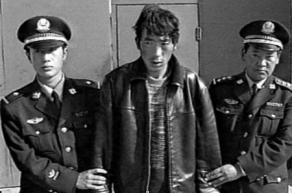
2009: Yang Yanming, hedge fund manager

On this date in 2009, China executed a rogue securities trader for disappearing around $10 million.

The first person executed for securities corruption in China, Yang used his position as a trader for Galaxy Securities to embezzle some 65 million yuan for personal gain.

He never disclosed the money’s whereabouts, presumably taking the secret with him to the grave. (Or to the organ donor market.)

As gangster capitalists go, Yang could hardly be considered exemplary either by scale or by ruthlessness. His peculation undoubtedly harmed many people, but there’s no known whiff of violence about him; he was caught after attempting suicide.

But by the same token, the occasional sacrifice of such middling malefactors potentially helps discharge some of the tension generated by the structural inequality accompanying China’s new oligarchy. What to do in such a world?

“Preserve your moral integrity and don’t set too much store by business results,” Yang told a newspaper prior to his execution. You said it, brother.

On this day..

2010: Shahla Jahed, the footballer’s lover

At 5:00 a.m. this date last year, Shahla Jahed was hanged at Iran’s Evin prison for murdering the wife of Iranian footballer Nasser Mohammadkhani.

An international human rights cause celebre from the time of her 2004 conviction in a sordid televised trial, Jahed was also Mohammadkhani’s wife under a “temporary marriage” arrangement that was secret from his “real” wife Laleh Saharkhizan. So you might say, his mistress.

Both these women’s last day of liberty was the one in 2002 that Saharkhizan turned up knifed to death while Mohammadkhani was in Europe on soccer business. Jahed was arrested immediately, beginning a “taboo-breaking” legal odyssey.

After months of refusing to talk, she confessed to the murder in prison, even re-enacting the crime.

But by the time of her trial — in which an emotional, combative Jahed conducted her own defense — she very plausibly claimed that the confession had been extracted by torture. Here’s a bit of it, from the documentary Red Card (banned in Iran) that can be enjoyed in full on YouTube:

While Jahed herself made for can’t-look-away TV, the appearance of a onetime champion athlete in a feet-of-clay turn has led this affair to be compared to the O.J. Simpson murder case.

Like the Juice, Mohammadkhani was temporarily in some danger of death penalty charges himself; he spent several months in prison. Ultimately, he avoided jeopardy to his neck as a potential accessory or instigator by Jahed’s repudiated I-did-it-myself confession — possibly another reason why Jahed confessed in the first place — but the former striker did endure 74 lashes for the revelation that he and his temporary wife enjoyed chilling out with opium. Strictly verboten in Iran, of course.

And Mohammadkhani’s brush with the law scarred his honor even more than his backside. Beyond the possibility that she took the heat for him, the celebrity athlete potentially in a position to use his pull to save a woman’s life clammed up as her case progressed and deferred to his late wife’s family’s decision whether or not to give Jahed mercy. Reportedly, Mohammadkhani even attended the hanging — where Jahed again sobbed and begged for mercy until one of Saharkhizan’s relatives personally kicked the chair out from under Jahed’s feet.

The case itself had an unusually long lifespan in the judiciary; Jahed had been imprisoned well over eight years by the time she died. In 2008, the gears were even stopped by Ayatollah Hashemi Shahroudi, a figure known in Iran for his support of de-escalating capital punishment generally.

Shahroudi’s ordering a new investigation provided fodder for critics like Amnesty International who considered the trial unfair.

Iranian journalist Fereshteh Ghazi, who as a political prisoner in 2004 briefly shared a cell with our principal, made an even stronger critique.

Even if Shahla had committed the crime, which she didn’t, Shahla and the murdered wife are both victims of a male-dominated society, a system that gives all the rights to men. Shahla, Laleh [the murdered wife], and all other women like them are all victims of flaws in the Iranian judicial system and Iran’s unequal judicial system. Even the person who pulled away the chair today in her execution is a victim of the system.

Apropos of the women-in-the-judicial-system theme, Jahed’s case and even her execution were to some extent overshadowed by the simultaneous headline-grabbing matter of Sakineh Mohammadi Ashtiani, an Azeri woman who was at the time fighting a repugnant sentence of stoning for adultery. By December 2010, Iran had backed off the stoning bit without quite agreeing that Ashtiani wouldn’t be executed in some other way; in January 2011, it remitted Astiani’s death sentence altogether.

On this day..

2003: Two Palestinian collaborators

On this date in 2003, Samer Ufi and Mohamed Faraj (some sources give the latter’s name as Suleiman) were publicly shot by masked al-Aqsa gunmen in the West Bank town of Tulkarem (or Tulkarm) for Israeli collaboration.

A videotape of the two admitting to supplying Israel information which led to militants’ assassination was played in the camp on the eve of their shooting. The dead men’s families contended that they had been tortured into the confession.

Tulkarem in 2003 was a place easy to feel under siege.

Recently prosperous, the fertile district close upon the Israeli border was suffering the effects of the ongoing Palestinian rising.

Tulkarem was in the process of being riven by Israel’s “apartheid wall”splintering communities and devastating a recently prosperous economy.

Isabel Kershner reports in Barrier: The Seam of the Israeli-Palestinian Conflict:

Some eighteen to twenty-two thousand Palestinian laborers from the Tulkarm district used to go and work in Israel every day. Now they are prevented by the security barrier that went up during 2003 … an eight-meter-high concrete wall complete with round gray watchtowers, built to prevent Palestinian snipers from shooting at passing cars on the Trans-Israel Highway that skirts Tulkarm to the west. Additional stretches of fence hermetically seal the surrounding villages off from Israel, as well as from some of their agricultural land.

Meanwhile, as elsewhere in the West Bank and Gaza, a a fast-growing list of assassinations struck militants in the community.

We don’t know in these parts whether the executed men truly were informers, but Israel is known to obtain many such targets by way of informers — often reluctant Palestinians it blackmails or bribes. Accused informers are regularly executed in the Palestinian territories.

“For myself, if I were Palestinian, I would hate them to death,” an Israeli intelligence advisor told the BBC of the collaborators recruited by Tel Aviv. “He is a traitor — I need him — but he’s a traitor”.

Part of the Themed Set: Illegitimate Power.

On this day..

2009: Four Tibetans

On this date in 2009, China executed four Tibetans widely considered political prisoners.

The previous year, widespread unrest over Chinese control had shaken the country, most notably riots in the capital, Lhasa that targeted Chinese persons and shops.

(There’s a BBC page preserving a good deal of the original coverage here.)

Loyak, one of those executed Oct. 20, 2009.

The two most prominent prisoners — in fact, the only two confirmed in some of the first media reports — were Lhasa residents Lobsang Gyaltsen and Loyak. A court spokesperson said both had been “given death penalties had committed extremely serious crimes and have to be executed to assuage the people’s anger.”

Specifically, both had been convicted of torching shops during the Lhasa riots, which arsons both led to deaths.

The other two executed, a woman named Penki (also for arson) and an unnamed man, received less comment, although they might have been executed despite having been condemned only to a “suspended” death sentence, which for China is generally no death sentence at all.

Executions in Tibet turn out to be relatively rare; these were the first known Tibetan executions since early 2003. Widely condemned abroad, this date’s events were barely or not at all reported internally by Chinese state media.

Part of the Themed Set: Illegitimate Power.

On this day..

2011: Troy Davis, doubts aside

The reader is likely aware that as of 7 p.m. this evening, Georgia Diagnostic and Classification State Prison local time, a man named Troy Anthony Davis will die by lethal injection — barring some sort of intervention that by this point would rate just this side of the miraculous.

Since Davis already had one of those, an extraordinary 11th-hour Supreme Court intervention the last time he was up for death, you’d have to guess he’s over quota as it is.

The controversial particulars of this case are too voluminously available for this space to hope to contribute much. As Scott Lemieux observes, the affirmative case for Troy Davis’s innocence is not a slam dunk: but the evidence as it exists, of unreliable eyewitness accounts from a nighttime scene, supplied under police pressure and later largely retracted, could today hardly approach the threshold of guilt beyond reasonable doubt. I don’t know if Troy Davis shot Mark MacPhail, and neither do you. Davis dies for it tonight just the same: all the paperwork is in order.

The “demon of error,” Illinois Gov. George Ryan called it, as he emptied that state’s death row. This unsettling matter demands one play bookmaker with a man’s life. Are you as much as 80% sure? Would that be sure enough? Maybe the uncertainties are unusually large here, but at some level this is the calculus for most criminal adjudications, death or otherwise.

“If a case like this doesn’t result in clemency, which is a discretionary process that calls a halt to an execution based on doubt surrounding the integrity of the verdict, then it suggests that clemency as a traditional fail-safe is not adequate,” criminologist James Acker told the Christian Science Monitor. “The Davis case raises doubts about the discretionary clemency process and ultimately raises doubts about whether the legal system can tolerate this potential error in allowing a person to be executed.”

Clemency as an inadequate, dead-letter procedure (Gov. Ryan aside) is familiar to any observer of the American capital punishment scene; Rick Perry thinks he can disdain it all the way to the presidency.

Perry’s state of Texas has something in common with Georgia: the clemency decisions are not directly in the hands of the governor. It’s an interesting arrangement that helps to scatter responsibility for that weightiest of decisions; every actor in the apparatus is in a position to say, “I alone did not have power of life and death.”

Georgia is one of just five states (not including Texas, where the governor has final say and exercises significant behind-the-scenes power over his advisors) where the clemency process is entirely vested in a committee.* The Georgia Governor is a fellow named Nathan Deal, and his autopen will spill much ink in the hours ahead signing form response letters explaining that he doesn’t have anything to do with pardons or clemencies in his state and thanks for writing.

It wasn’t always this way.

A predecessor of Deal’s in that mansion, one with a promising political career ahead, was bayed out of politics for exercising his prerogative to spare Leo Frank because “I cannot stand the constant companionship of an accusing conscience.” The modern office-seeker typically comes with this accusatory module helpfully un-installed, but one can see how there’d be advantages to removing from the office anything to invite experimentation with self-destructive scruples.

The roots of Georgia’s current system go back to the 1930s, when the notoriously corrupt Eurith Rivers held the governorship and used the solemn power of pardons like merchants in the temple — and every bit as lucratively.

The “pardons racket” continued under Rivers’s successor, until a young reformist captured the office and dramatically rewrote the way Georgia did business.

Among those reforms was the progressive concept of rooting out the pardons racket by removing the authority from the governor’s hands. No pardon power, no embarrassing Marc Rich cases. As Gov. Arnall himself explained,

There were those who used to say facetiously, “If you bring the governor a cow, he’ll get you a pardon for your kinfolks, or if you get him a bale of cotton if you do this, or if you get the right lawyer or if you get the right set-up, you can get pardons, pardons, pardons.” So they had gotten a lot of pardons, and the newspapers were after them day in and day out for granting these pardons.

Pardons, pardons, pardons. You can’t get hold of them for a bale of cotton any longer.

These institutions naturally have a life of their own, and what was forward-looking under Georgia’s 1943 constitution seems anything but to Troy Davis’s supporters this day. In the end, the board is still appointed by governors, and it predictably skews towards prosecutors and police — the latter of whom are out for Davis’s blood since Mark MacPhail wore a badge for his day job. It deliberates behind closed doors, and need not record or account for its considerations.

But this is really the lament against the decision itself more so than the process: individual governors are no more bound to broadcast their decision-making process, although some choose to do so. The rules of the game matter, but whatever they might be, it is humans who apply them — human judgment that makes the choices, whether as the first officers on the scene, as jurors, or as a panel of inscrutable bureaucrats with power over life and death.

* Here’s an example of a similar committee in Nebraska granting a pardon, in the relatively less-fraught circumstance of a man 100 years dead.

Part of the Themed Set: Americana.


Update: After a last-second reprieve that extended into a four-hour execution-night drama, the U.S. Supreme Court denied (pdf) Davis’s last appeal. He was executed at 11:08 p.m.

On this day..

2006: Clarence Hill, former last-minute reprieve beneficiary

Core to the experience of capital punishment is the dramatic last-minute reprieve.

As drama, you can’t do a lot better than a last passport to life delivered seconds ahead of the reaper. Or even seconds after! We’ve seen in these pages the paper of record bemoaning the the very prospect of a late stay as a “refinement of cruelty,” but something tells us that neither party to the transaction will opt to forego it.

This date in 2006 offers the anniversary of the (un-stayed) execution of a man who was making his second visit to the gurney — courtesy of one of those last-gasp reprieves eight months before.

Clarence Hill had murdered a police officer during a botched 1982 bank robbery in Pensacola, Fla.

And when it was time to go, Hill had the rare benefit of experience.

He’d already been all strapped down on January 24 of that same year, with the IV hooked up and ready for someone to drop the plunger, when Supreme Court Justice Anthony Kennedy issued the last-secondest of last second stays.

The purpose of that stay was to allow Hill to pursue an (ultimately unavailing) suit against the constitutionality of Florida’s lethal injection procedures.

Though Hill got no legal traction — literally, the courts declined to act on Hill’s petitions, and then the Supreme Court ruled 5-4 against taking any further action — the whole situation foreshadowed the juridical and procedural dog’s breakfast that lethal injection has become five years hence.

Twelve weeks after Hill’s (“successful”) lethal injection, the Sunshine State badly botched the lethal injection of another man, leading to a yearlong hiatus in American executions while the courts attempted to sort out that lethal injection stuff for real.

It’s doubtful even at this point whether they ever really have.

Part of the Themed Set: Americana.

On this day..

2010: Four in Equatorial Guinea

(Thanks to Meaghan Good of the Charley Project for the guest post. -ed.)

On this date last year, four Equatorial Guinean men were executed immediately after they were convicted of treason in a military court in the tiny African nation’s capital of Malabo.

The defendants, all former military officers, reportedly confessed to attacking the presidential palace in February 2009, supposedly in an attempt to assassinate the president, Teodoro Obiang Nguema Mbasogo.

Fortunately for him, he wasn’t in residence that day.

The attack had originally been blamed on Nigerian militants; in the aftermath, seven Nigerian men were sentenced to prison for their alleged involvement, and dozens of Nigerian expatriates were expelled from the country.

International observers castigated the trials and executions as not meeting international standards of fairness. This is no surprise, seeing as how Equatorial Guinea has one of the worst human rights records in the world.

According to Amnesty International, the four men weren’t even in the country at the time of the attack, having been exiled to Benin some years before. President Obiang’s agents abducted them from Benin in January 2010. Because of the “chilling speed” of the executions, none of the condemned had the opportunity to appeal the verdict and sentences or seek clemency, as Equatorial Guinea’s own law is supposed to provide.

José Abeso Nsue, Manuel Ndong Anseme, Alipio Ndong Asumu and Jacinto Michá Obiang (no apparent relation to his alleged target) were the only Equatorial Guineans known to have faced the death penalty that year.

On this day..

2010: Two Afghan adulterers stoned

On this date last year, the Taliban carried out the public stoning of an adulterous couple who had attempted to elope in northern Afghanistan.

“Even family members were involved,” the New York Times reported, “both in the stoning and in tricking the couple into returning after they had fled.”

as a Taliban mullah prepared to read the judgment of a religious court, the lovers, a 25-year-old man named Khayyam and a 19-year-old woman named Siddiqa, defiantly confessed in public to their relationship. “They said, ‘We love each other no matter what happens,'” [local farmer Nadir] Khan said.

The executions were the latest in a series of cases where the Taliban have imposed their harsh version of Shariah law for social crimes, reminiscent of their behavior during their decade of ruling the country. In recent years, Taliban officials have sought to play down their bloody punishments of the past, as they concentrated on building up popular support.

“We see it as a sign of a new confidence on the part of the Taliban in the application of their rules, like they did in the ’90s,” said Nader Nadery, a senior commissioner on the Afghanistan Independent Human Rights Commission. “We do see it as a trend. They’re showing more strength in recent months, not just in attacks, but including their own way of implementing laws, arbitrary and extrajudicial killings.”

Apparent cell phone video of the execution later surfaced.

Warning: Mature Content. It’s two filmed stonings, after all.

On this day..

2008: Leon David Dorsey, the Blockbuster Killer

On this date in 2008, Leon David Dorsey IV died by lethal injection in Texas.

Dorsey was the “Blockbuster Killer.”

No, not Netflix. Just a small-time hood who robbed a Dallas Blockbuster (back when there was such a thing) of $392, and in the process wasted the two employees minding the till.* Something about it — the familiar ubiquity of video rental joints in the 1990s, maybe — really resonated. The Blockbuster murders were immediately notorious.

Though Dorsey was a suspect in this crime — because he told his girlfriend, and she ratted him out — police concluded that the man in the surveillance tapes was too tall. He wasn’t charged.

Dorsey actually got convicted (non-capitally) of a different murder and the Blockbuster homicides went unsolved — until a cold cases unit dug into the surveillance tapes, decided the telemetry fit Dorsey after all, and went knocking on his cell door. The guy was still foolishly willing to gab about it.

“They’re dead,” he would say dismissively of his victims in a pre-trial interview. “That’s over and done with. I could have came in here and been, ‘Oh, I’m sorry, I’m so bad.’ But I don’t feel like that. That’s not being honest with myself.”

One doesn’t doubt that sentiment is shared by many malefactors great and small, but blithe narcissism is not quite the pose calculated to win a lot of sympathy from a jury when you’re on trial for your life.

Dorsey stayed “honest with himself” on death row to the tune of 95 disciplinary violations, including a stabbing attack on a guard, and he vowed to fight the team that came to take him to the gurney. (Texas officials reported that he didn’t actually fight.)

And two years after the Blockbuster killer got his … so did Blockbuster.

* The Blockbuster Corporation’s outreach to the families of its slain employees was considered a model stroke of public relations (Dallas Morning News, Nov. 2, 1994).

Part of the Themed Set: Branded.

On this day..

2007: Majid and Hossein Kavousifar

On this date in 2007, cousins Majid and Hossein Kavousifar (or Kavoosifar, or Kavoosi-far) were publicly hanged in Tehran for murdering a judge.

The judge in question had been noted for clapping some democracy activists in jail, but the authorities insisted that the case wasn’t political — that Majid admitted targeting Hassan Moghaddas (whose outsized portrait grotesquely decorated the scene) in a personal vendetta, as well as killing a couple of other people in a string of robberies.

The first public executions in the capital in five years, these hangings attracted an ample crowd, amply armed with the ubiquitous digital media equipment that characterizes our age.


Age-appropriate entertainment? A spectator at the hanging.

And while the 24-year-old Hossein died in fright, 28-year-old Majid played to those onlookers in the most insouciant execution pictures you’ll ever want to see.

Warning: Graphic images (and video) follow. (Many more can be searched up around the web.)

… and the inevitable video.

On this day..