1606: Caravaggio murders Ranuccio Tomassoni

This site is occasionally prepared to stray outside its execution-anniversary beat to cover especially fascinating manifestations of the death penalty in history.

So for this date, we observe the anniversary not of a punishment, but of the crime itself: a capital homicide in the capital of the world that changed art forever.

NNDB summarizes Caravaggio as a “temperamental painter,” but a less generous interlocutor might prefer a descriptor like “lowlife.”

Painter, he certainly was.

Caravaggio’s pioneering realism and flair for the dramatic …


Caravaggio’s Judith Beheading Holofernes, 1598-1599. Though the young painter on the make would hardly want for models of public decapitation in 16th century Rome, the gendered intimacy with the act invites consideration of Caravaggio’s likely attendance at the execution of Beatrice Cenci.

… made him a rock star on the canvas.

Though the papacy in its dogmatic counter-reformation aspect may have viewed Caravaggio’s eye-catching chiaroscuro with suspicion, there were scudi enough to burst the coinpurse of a talent who could grace a chapel with awe-inspiring stuff like this:


Caravaggio’s Crucifixion of St. Peter, painted in 1601 for Rome’s Santa Maria del Popolo.

However many souls his stark brushwork won for the Church, Caravaggio’s reverential fare belied the creator’s own distinctly profane pastimes: gambling, boozing, brawling, and whoring around. He needed the intervention of well-placed patrons to duck prosecution on several occasions.

May 29, 1606 finds our “temperamental” antihero encountering a wealthy scoundrel by the handle of Ranuccio Tomassoni and a problem that would outstrip any political pull the artist could muster.

Allegedly, the two met to settle a paltry tennis wager, although this may have been a cover story for a rivalry over a courtesan.*

On whatever pretext, the young hotheads fell into a melee. Caravaggio won … and Tomassoni bled to death from the gash his foe dealt to his femoral artery.**

Caravaggio now had mortal blood on his hands. Homicides were treated very harshly by the authorities. Caravaggio was about to have a price put on his head, and if he were caught, that head would be summarily removed from his body and hung on a public street. Allies of Ranuccio bent on revenge were likely to be after him as well. … Caravaggio, the celebrated Italian painter, was now a notorious wanted killer. (Source)

Condemned an outlaw by Pope Paul V — himself fruit of Rome’s Borghese family, great patrons of art in their own right — Caravaggio fled the Eternal City. His brilliance went with him, perhaps even amplified by the exile.

“The fall from grace was huge,” a curator of late Caravaggio works argued. “It had a profound impact. He started expressing the psychological essence of the stories he is telling.”

The painter and killer had four years left to him — an exile spent sleeping clothed and armed, forever looking over his shoulder. But what his jangled nerves could still spare for the canvas would help launch the baroque artistic epoch and still influences us today.

Flight, fancy, and fortune took Caravaggio to Malta and to Sicily, but the year or so he spent as Naples’ visiting genius would make his artistic legacy: that city’s succeeding generations of painters took enthusiastic inspiration from Caravaggio’s Neapolitan offerings — like a Seven Works of Mercy that must have carried a very personal meaning for the hunted man.

He was reportedly as arrogant and hot-tempered on the run as he had been in Rome, but Caravaggio’s art in exile also traces his desperate attempts to undo the consequences of his bad behavior.

Exploiting his apparent affinity for the sawing off of heads, Caravaggio rendered his own head in a severed state in at least two apparently penitential paintings during this vulnerable period.

This Salome with the Head of John the Baptist was made for the Grand Master of the Knights of Malta after the latter had in 1608 booted Caravaggio from that island refuge:

While David with the Head of Goliath seems to have been created shortly before Caravaggio’s own death for the pope’s art-hounding “Cardinal Nephew” Scipione Borghese, in a bid to earn a pardon. Caravaggio’s self-portrait as the dead man, and Latin inscription “humility kills pride” on the Israelite hero’s sword, suggest an attempt to effect through his creative virtuosity his own execution in effigy.
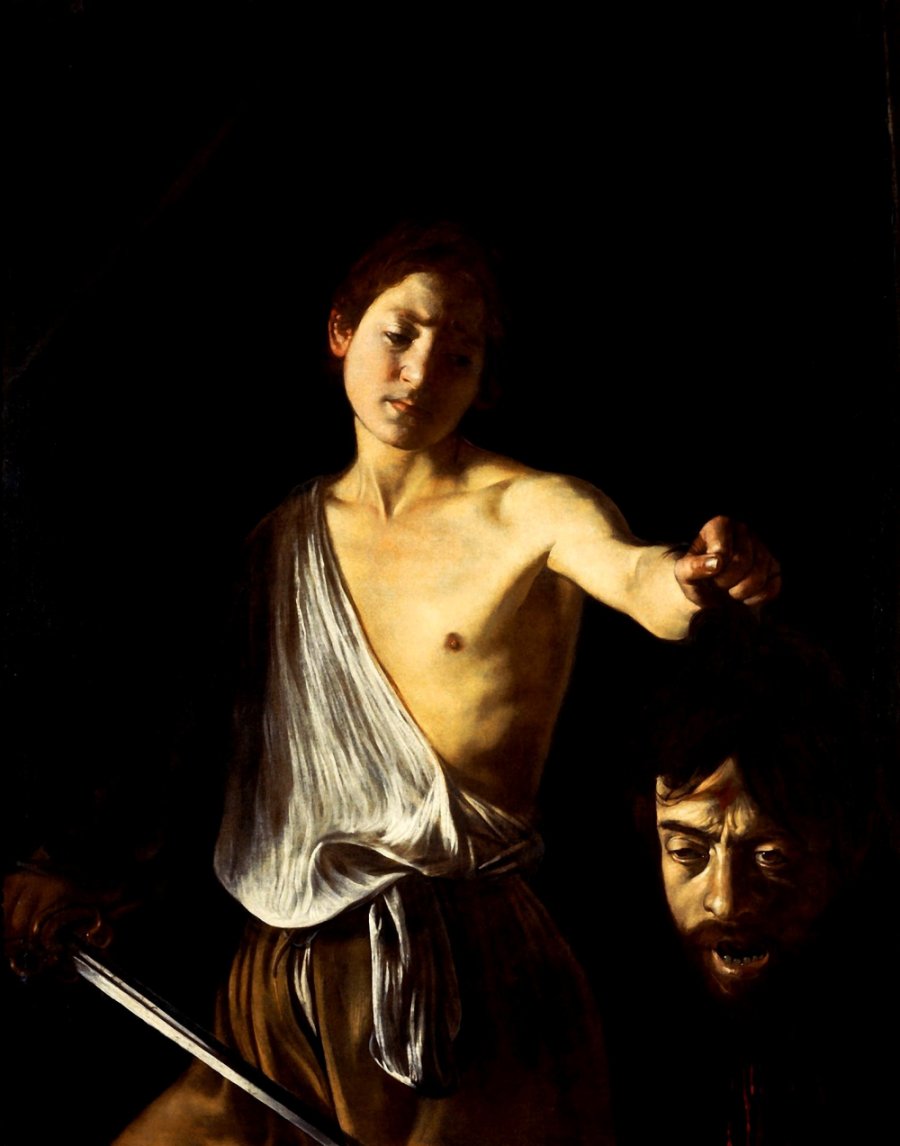
That would be, at any rate, the only execution Caravaggio ultimately had to endure. He died in the summer of 1610 under unclear — and inevitably suspicious — circumstances while attempting to return to Rome.

A few biographical books about Caravaggio …

… and some Caravaggio art books

* Ranuccio Tomassoni was the pimp and lover of a prostitute named Fillide whom Caravaggio had painted years before, and become enamored of. This Fillide was also Caravaggio’s model for Judith in the arresting painting of the Biblical heroine in mid-decapitation above.

** Possibly, if you like the love triangle angle, in a botched attempt to castrate his rival.

On this day..

1441: Corrado Trinci, Lord of Foligno

On this date in 1441, Corrado Trinci was executed in Foligno.

Once the hereditary lord of that venerable town,* Trinci (English Wikipedia page | Italian), had turned tetchy with his Guelph family’s onetime papal patrons and suffered the consequences.

As the proper captain of an Italian city-state in the 15th century, Trinci had taken a few spins around the wheel of fortune in battle with his neighbors. He kicked off his reign in operatically sanguinary style when a neighboring town‘s castellan murdered Trinci’s brothers, suspecting one of them of adultery with his wife. Trinci revenged himself by sacking Nocera Umbra, which still holds a civic relay race (Italian link) commemorating the occasion.

Trinci didn’t fare as well when it came to picking on someone his own size.

For the next generation, Trinci would do the Machiavellian dance characteristic of his time and station — by turns allied with, at war with, or plotting with the papacy, Condottiero Francesco Sforza, the archbishop of Florence, and miscellaneous other peninsular neighbors and rivals. He was down. He was back up. He was beaten. He fought back. Etc.

Trinci pushed the wheel of fortune one turn too far by rebelling (again) against papal authority in the mid-1430s. His march on the Vatican-controlled Duchy of Spoleto was an initial success —

Corrado brought to Foligno four hundred youths of Spoleto, the standard of Spoleto, the chains, the locks from the city gates, the seal, and the clapper from the great bell of the commune.

Durante Dorio, as quoted and translated by Sergio Bertelli

That was in 1436. By 1439, Foligno itself (with Trinci inside it) had capitulated to a papal siege. Spoleto really wanted its clapper back.

Trinci was imprisoned with his family, and after a couple years’ languishing, put to death on this date. While both the English and Italian Wikipedia entries currently assert that he was strangled, the principal source for this gentleman’s biography, the freely-available Istoria della Famiglia Trinci by Durante Dorio, flatly asserts that the washed-up brawler was dispatched by decapitato.

By whatever method Corrado laid down his life, he retired with it not only the fame of his family but its Lordship of Foligno. The title fell extinct: Foligno became part of the Papal States and remain so right up to Italy’s 19th century unification.

* When next in central Italy, be sure to visit the lovely Palazzo Trinci. Corrado commissioned the Ottaviano Nelli frescoes in the chapel.

On this day..

1810: Tommaso Tintori, the first guillotined in Rome

It’s easy enough to accuse the Catholic Church of being behind the times.

But this date two hundred years ago found it in the criminological progressive vanguard (just ask Lord Byron!), conducting Rome’s first beheading by guillotine, that brave new instrument of egalitarian execution.

Okay, granted: it wasn’t the ecclesiastical authorities but the French occupiers who introduced the guillotine, as was their wont.

But when the Papal States were restored a few years later, after the Napoleonic Wars, the vicars of Christ were enlightened enough to keep this efficient device (and its sunk capital cost) around … at least as one option among the restored traditional sentences of hanging, quartering, and the local specialty, mazzolatura.

Biographical details of our milestone criminal are scarce on the ground, but we have his name, date of execution, and crime — omicidio — courtesy of the Italian list kept by the famed executioner Mastro Titta.

Seguono Le Giustizie Eseguite Nel Nuovo Edifizio Per Il Taglio Della Testa Nel Governo Francese.

106. Tommaso Tintori, reo di omicidio, li 28 febbraio 1810.

As one might guess, that “106” means that the prolific Titta had already notched 105 official kills in his 14 years as executioner prior to the guillotine. He would run his career total north of 500.

On this day..

1624: Marco Antonio de Dominis, posthumously

On this date in 1624, the recently-deceased body of unscrupulous Croatian prelate Marco Antonio de Dominis was burned at Rome’s Campo dei Fiori, along with all his manuscripts.

Hypothesizing

As a precocious young man Dominis taught mathematics, rhetoric and philosophy; in 1611, he produced a scientific treatise on the formation of rainbows through light refraction, De radiis visus et lucis. A century later, Isaac Newton would write* in Opticks that

it is now agreed upon, that this Bow is made by Refraction of the Sun’s Light in drops of falling rain. This was understood by some of the Antients, and of late more fully discover’d and explain’d by the famous ANTONIUS DE DOMINIS Archbishop of Spalato.**

More opportune was his advocacy of a moon-induced tide, which idea his contemporary Galileo erroneously scorned.†

Though he makes a “great men of Croatian science” list, the scientific dabblings are not what the man was chiefly known for.

Apostatizing

A caricature of Dominis made an appearance, around the time of the man’s bodily demise, in Thomas Middleton’s play A Game at Chess, as the “fat bishop” who switches sides from black to white and back.

And that’s the man’s legacy, in a nutshell.

Elevated to Bishop of Senj, and then Spalato, he got the Inquisition after him and raised dust for England and the Anglican church in 1616.

They called you great-bellied-Doctour, made fat under Antichrist; and some there were also that sayd, that before you ranne away from the Pope, you got your owne Neece with child, and that feare to be punished for it, made you trudge away with your great load of flesh in such hast.

John Floyd

In Albion the absconded archbishop settled into a fine tenured appointment on the king’s dole to denounce the papists like only a convert can do. As A Game at Chess would indicate, he also earned fame for his avarice and gluttony, and who knows how many other deadly sins.

The rep for opportunism grew when Dominis defected back to Holy Mother Church upon the election of an old intimate as Pope Gregory XV. His well-worn welcome in England as anti-papal vituperator had, too, become complicated by the progress of the proposed Spanish Match to wed Prince Charles to Europe’s leading Catholic monarchy — an ultimately abortive project, but nearing the acme of its fortunes at the time Dominis returned to Italy.

(The Spanish Match is the protracted political and diplomatic dance whose progress A Game at Chess allegorically tells. Dominis arranged his return to the Catholic fold through the Spanish ambassador in England, making the former a fit character for the playwright to project the double-dealing and skullduggery of the rivals’ negotiations.)

Theosophizing

Unfortunately for our unprincipled Renaissance man, Gregory himself yielded up the ghost almost immediately and left the Church in the hands of the aggressive Urban VIII. (Urban is the guy who forced Dominis’s old tidal rival Galileo to retract heliocentrism.)

Dominis — who seems to have been an ecumenical guy, maybe just a fancy way of saying he could accommodate any doctrine amenable to his ambition‡ — was evidently still trafficking with the unorthodox even after he returned, recanted, and renounced. (Renunciation in English | Latin).§

One contemporary reportedly said of Dominis

he was a malecontent knave when he fled from us, a railing knave while he lived with you, and a motley parti-coloured knave now he is come back.

The Inquisition imprisoned Dominis, and his death in Castel Sant’Angelo was not sufficient to end heresy proceedings against such as he left behind.

[H]is body was put into a well-pitched coffin, and that into another greater than it … until such time as the cause of the said Archbishop, still depending, should be determined by the Sacred Congregation; that according to their sentence, whatever justice did require, might be done upon him.

The sentence being framed and ready to be put in execution, the said body was … taken the twentieth of this present month of December, forth from the convent where it was left, and carried to the church of Minerva, and there laid upon a table in an eminent place, together with his picture and a little sack of books which he had printed; and where it stood all the night.

The next morning … the most illustrious and most reverend lods cardinals, supreme inquisitors, with many others … proceeded unto a definitive sentence, which was, to declare him unworthy of the favour of the Holy See apostolic, to deprive him of all his honour, benefit, or dignity, confiscate his goods, and give him over to the secular powers, as de facto they then gave him over, that he and his picture, together with the books he had written, should be burned …

INSCRIPTIO

MARCUS ANTONIUS DE DOMINIS,

LATE ARCHBISHOP OF SPALATRO,

Most impiously bent his style against the Church of God, which had extraordinarily well deserved of him; having wounded her and stabbed her through, he so left her without cure, and wretchedly betook himself to the English altars, that thence the swine might the more securely gruntle against the Pope and Catholics. Returning home again, but no convert, his apostatic spirit he forsook not. He died (and the voice of a penitent man would he had not uttered) impenitent. (Source)

* Dominis is still today sometimes credited as the first to explain both primary and secondary rainbows, in preference to Descartes, who nailed them 20 years later. According to The Rainbow Bridge: Rainbows in Art, Myth, and Science, that gave far too much credit to Dominis for either originality or accuracy, and may have been written intentionally to undercut Descartes. (R.E. Ockenden made the same claim about Newton’s exaggeration in “Marco Antonio de Dominis and His Explanation of the Rainbow” in the not-exactly-current Dec. 1936 Isis).

Maybe Newton explicator and Executed Today guest blogger Thomas Levenson of the Inverse Square blog could refract some light on this.

** Spalato, i.e., Split, the scenic Dalmatian city where the great Roman Emperor Diocletian famously retired to tend his cabbages.

† “Lately,” Galileo sniffed, “a certain prelate has published a little tract wherein he says that the Moon, wandering through the sky, attracts and draws up toward itself a heap of water which goes along following it.” As cited in Understanding the Heavens: Thirty Centuries of Astronomical Ideas from Ancient Thinking to Modern Cosmology.

There’s an interesting treatment of Galileo’s stubborn adherence to a wrong idea about the tides in a history-of-ideas context in “Galileo’s Claim to Fame: The Proof That the Earth Moves from the Evidence of the Tides,” by W. R. J. Shea in The British Journal for the History of Science, Vol. 5, No. 2 (Dec., 1970)

‡ Though he’s frequently read as a mere trimmer, it’s possible to give Dominis a much more sympathetic take. King James VI and I and the Reunion of Christendom argues that

it is difficult to explain his movements on this basis alone. Both in his journey to England and in his journey to Rome he took great risks, and in both cases gave up a reasonably secure position for one much less certain. Hacket, in the late seventeenth century, saw him not only as a place-seeker but as a man obsessed with an idea: “He lived and died with General Councils in his Pate, with Wind-Mills of Union to concord Rome and England, England and Rome, Germany with them both, and all other Sister-Churches with the rest, without asking leave of the Tridentine Council.” … [he] died for an ecumenical ideal which is only now, perhaps, beginning to be understood and appreciated … [and his] move [back to Rome] was the desperate attempt of a lonely, egotistical, and gifted man to find personal and spiritual fulfillment and, at the same time, to help to restore unity and coherence to a Europe being torn apart by religious conflict and war.

§ The Catholic Encyclopedia has Dominis re-relapsing when his pension expired along with Pope Gregory.

On this day..

1749: Antonio Camardella

On this date in 1749, an unrepentant Antonio Camardella was hanged in Rome’s Piazza di Ponte Sant’Angelo (Italian link).

Camardella offed prelate Donato Morgigni for stiffing him in a business arrangement, and repelled all sanctimonious summons to contrition. When a priest mounted the scaffold with him to make one last go of it, verse has it, Camardella insisted on dying impenitent, crying “vendetta!” even as he dropped.

Dannato fu alle forche un delinquente
Per preticidio, detto Camardella.
Un santo fratacchion ch’era assistente
Dichiarollo per anima rubella,
Perche egli morir volle impenitente.
Invano a pentimento ei lo rappella,
Vendetta grida il reo, ne altrui da retta;
Penzolon cade e grida ancor vendetta.

This devil-may-care display of ferocity evidently made an impression on the denizens of a city still ruled by the papacy: they were still talking about it a century later, when Roman sonneteer Giuseppe Gioachino Belli anachronistically situated him on the scaffold with Belli’s own contemporary, renowned executioner Mastro Titta.

This pairing (written in the Roman dialect) of iconic criminal with iconic headsman, observed by our youthful narrator and his father, makes for a vivid scene of coming-of-age in an Eternal City where the Catholic Church extends ritual control over both life and death.

Il giorno che impiccarono Camardella
Io mi ero appena cresimato.
Mi sembra adesso, che il padrino al mercato
mi comprò un pupazzo e una ciambella.
Mio padre prese poi il carrozzino
Ma prima volle godersi l’impiccato:
E mi teneva in alto sollevato
Dicendo: “Guarda la forca quant’è bella!”
Nello stesso istante al condannato mastro Titta
Applicò un calcio nelle terga, e papà a me
Uno schiaffone alla guancia destra.
“Prendi”, mi disse, “e ricordati bene
Che questa stessa fine è destinata
A mille altri che sono migliori di te.”
The day they hanged Camardella
I had just been confirmed.
It seems to me now that my godfather took me to the market
I bought myself a top and a sweet roll.
My father then took the buggy
But first he wanted to enjoy the hanging:
He lifted me up high
Saying, “See how beautiful the gallows!”
Suddenly Mastro Titta struck the condemned
A kick in the rear, my father struck me
A slap to the right cheek.
“Take it,” he said, “and remember well
That this same fate is destined
A thousand others who are better than you.”

On this day..

1817: Three criminals in Rome, as witnessed by Lord Byron

On this date in 1817, the day before he left his Roman holiday for Venice, Lord Byron saw three criminals beheaded at the Piazza del Popolo.

He wrote all about it in his correspondence with John Murray.

The day before I left Rome* I saw three robbers** guillotined. The ceremony — including the masqued priests; the half-naked executioners; the bandaged criminals; the black Christ and his banner; the scaffold; the soldiery; the slow procession, and the quick rattle and heavy fall of the axe; the splash of the blood, and the ghastliness of the exposed heads — is altogether more impressive than the vulgar and ungentlemanly dirty ‘new drop’, and dog-like agony of infliction upon the sufferers of the English sentence. Two of these men behaved calmly enough, but the first of the three died with great terror and reluctance, which was very horrible. He would not lie down; then his neck was too large for the aperture, and the priest was obliged to drown his exclamations by still louder exhortations. The head was off before the eye could trace the blow; but from an attempt to draw back the head, notwithstanding it was held forward by the hair, the first head was cut off close to the ears: the other two were taken off more cleanly. It is better than the oriental way, and (I should think) than the axe of our ancestors. The pain seems little; and yet the effect to the spectator, and the preparation to the criminal, are very striking and chilling. The first turned me quite hot and thirsty, and made me shake so that I could hardly hold the opera-glass (I was close, but determined to see, as one should, see every thing, once, with attention); the second and third (which shows how dreadfully soon things grow indifferent), I am ashamed to say, had no effect on me as a horror, though I would have saved them if I could.

— Venice, May 30, 1817

* The date is not stated directly in Byron’s missive, but his movements are known in some detail — for instance, this timeline.

** According to the notes of executioner Mastro Titta, the three criminals “‘decapitati’ al Popolo, per omicidi e grassazioni” this day were Giovanni Francesco Trani, Felice Rocchi and Felice De Simoni.

On this day..

1600: Giordano Bruno, freethought martyr

On this date in 1600, gadfly philosopher Giordano Bruno was burnt for heresy in Rome’s Campo dei Fiori.

A figure of ridicule in the 17th century, Bruno got this statue at the site of his execution in the 19th — when the world finally began to catch up with him.

A Dominican inductee in his teens, Bruno was cast out of the order for his heterodoxy.

There followed a lifetime seemingly always on the run, with each successive safe harbor turned against his pantheistic principles and abrasive personal manner.

Bruno has been understood with hindsight to have grasped, fleetingly, the world-upending implications of the Copernican system. In “a time when more than 99% of the intellectuals believed that the Earth was the center of the Universe, and a few others, like Copernicus and Galileo, believed that it was the Sun, instead, at the center of the Universe,” Bruno intuited modern cosmology — wherein both earth and sun were merely heavenly bodies among many others, situated in an infinite universe that did not revolve around them.

More than that, he intuited the expanse of philosophical, scientific and spiritual inquiry that would follow from that idea’s comprehensive destruction of the medieval order, centuries ahead of his time.

That little of Bruno’s own scientific work has withstood the test of time, and other scientific contemporaries did not sympathize with him, enables a hostile source like the Catholic Encyclopedia to sniff that

the exaggerations, the limitations, and the positive errors of his scientific system; his intolerance of even those who were working for the reforms to which he was devoted; the false analogies, fantastic allegories, and sophistical reasonings into which his emotional fervour often betrayed him have justified, in the eyes of many, Bayle’s characterization of him as “the knight-errant of philosophy.” His attitude of mind towards religious truth was that of a rationalist. Personally, he failed to feel any of the vital significance of Christianity as a religious system.

These latter traits are precisely the reason for his reclamation by Age of Reason deists.

[audio:http://podcast.cbc.ca/mp3/tapestry_20100425_31274.mp3]

But the sixteenth century had no place for him.

This historical thriller — the first of a series — features Bruno in England, where some think he might have spied for Francis Walsingham.

Bruno fled Italy for Geneva, where he was soon excommunicated by Calvinist authorities, and thence to France, impressing King Henri III before wearing out his welcome. He spent time in England and Lutheran Germany, running afoul of each new host with his radical ideas, his contempt for the dead hand of Aristotelianism, and his decided want of tact.

He returned at last to Italy and these pages, perhaps counting on the Venetians’ historic rivalry with the papacy in accepting a sponsorship in the maritime republic. There the Inquisition clapped him in irons and shipped him to Rome where for unclear reasons he spent six-plus years imprisoned before facing trial as a heretic.

“Perhaps you, my judges, pronounce this sentence against me with greater fear than I receive it.”

Refusing all opportunity to recant, Bruno was led to the stake this morning gagged against any last outrages against St. Peter’s throne, and the friar who recorded Bruno’s unyielding end — famously mythologized in turning away from the proffered crucifix — could hardly have thought he was writing Bruno’s heroic epitaph as a martyr to the spirit of critical inquiry and passionate dissent.

But he insisted till the end always in his damned refractoriness and twisted brain and his mind with a thousand errors; yes, he didn’t give up his stubborness, not even when the court ushers took him away to the Campo de’ Fiori. There his clothes were taken off, he was bound to a stake and burned alive. In all this time he was accompanied by our fraternity, who sang constant litanies, while the comforters tried till the last moment to break his stubborn resistance, till he gave up a miserable and pitiable life.

That end serves as the climax to the forgettable 1973 Italian flick Giordano Bruno.

Sole bird of the sun, thou wandering phoenix!
That measurest thy days as does the world
With lofty summits of Arabia Felix.
Thou art the same thou wast, but I what I was not:
I through the fire of love, unhappy die;
But thee the sun with his warm rays revives;
Thou burn’st in one, and I, in every place;
Eros my fire, while thine Apollo gives.
Predestined is the term of thy long life;
Short span is mine,
And menaced by a thousand ills.
Nor do I know how I have lived, nor how shall live,
Me does blind fate conduct;
But thou wilt come again, again behold thy light.

-From Bruno’s esoteric The Heroic Enthusiasts, available on gutenberg.org

A few recent books about Giordano Bruno

On this day..

1599: Beatrice Cenci and her family, for parricide

On the morning this day in 1599, the Cenci family — mother Lucrezia, son Giacomo, and immortal tragic heartthrob Beatrice — were put to death at Sant’Angelo Bridge for murdering the clan’s tyrannous father.

Francesco Cenci, the victim, was more accustomed to making victims of his own: detested around the Eternal City, he indulged his violent temper and fleshy lusts with the impunity of a wealthy cardinal’s son. By all accounts, he enjoyed pushing around his family, too.

This much is stipulated. What lies beyond is legend.

But the legend is why we’re dallying with Beatrice today, so we might as well begin there: in fear that her father would rape her, it goes, Beatrice tried to turn to the authorities, who let mean old dad walk on account of his connections. Desperate to protect herself from incest, Beatrice and family arrange to batter his gulliver and toss him over a balcony to make it look like suicide.

Slight problem: it didn’t look very much like suicide.

So the family was hauled in and tortured, and eventually Lucrezia and Beatrice (both beheaded) and Giacomo (quartered after suffering the mazzolatura of an incapacitating hammer blow to the head followed by gory lethal knifework by the executioner) all paid the price while the youngest child watched, spared death but condemned to life in the galleys.

(The papacy gobbled up the patricides’ estate, which puts a fine point on the ironically-named Pope Clement VIII‘s law-and-order stance on the appeal for mercy, and his subsequent edicts to quash public comment on the affair.)

Then Beatrice’s body — the part below the neck — contrived to disrobe when fumbled by the brethren taking it away for burial.

You’ve got to admit it’s pretty romantic. Some versions even hold that the responsible executioners died violently themselves within a month, or that a ghostly Beatrice returns to the scene of her demise on this anniversary.

And not a word of Italian fluency will be necessary to catch the gist of this excerpt from this 1969 Lucio Fulci film:

It’s a little too Romantic, as in capital-R.

While the case was a true sensation Rome at the turn of the 17th century, the legend as we know it was heavily constructed in the 19th century … and specifically Percy Bysshe Shelley, who heard the story in Italy* where it had persevered as local folklore. A girl who killed her despot-father, executed by the despotic agents of the Divine Father? You don’t get into the canon without knowing what to do with that kind of material.

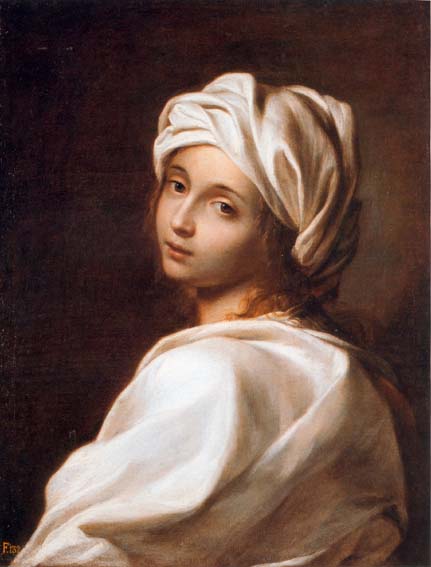
And he had this charming painting of her to boot:

Shelley amped up the menaced-virginal-purity theme, made the bloodshed a lot more demure, and turned it into a long poem, “The Cenci” (available on Google Books, and on Bartleby.com) which in Melville’s description proceeds from putting its protagonist between the “two most horrible crimes possible to civilized humanity — incest and parricide.”

This doesn’t all actually turn out to be well supported: at a minimum, Shelley inflated an incest allegation of doubtful lineage into accomplished fact. Beatrice’s camp did not raise this claim until just before her execution, when it needed a high card for clemency. The loutish victim eventually got his own biographer, who strongly disputed the incest charges. (Francesco also sports his own Italian Wikipedia page.)

From Shelley’s influential quill** into the DNA of western literature: Stendahl tapped the vein, as did Artaud, and risorgimento figure Francesco Domenico Guerrazzi; both Melville and Hawthorne used that painting so captivating to Shelley as plot devices (Dickens loved the painting, too). American sculptor Harriet Hosmer worked Cenci’s complex sensuality in marble.

Remarkable how the tradition in its modern incarnation proceeds root and branch from Shelley’s apprehension of a single painting, and how his reading stamped itself upon the canvas for later observers — like Hawthorne, writing in his journal:

It is the very saddest picture that ever was painted, or conceived; there is an unfathomable depth and sorrow in the eyes; the sense of it comes to you by a sort of intuition. … It is the most profoundly wrought picture in the world; no artist did it, or could do it again. Guido may have held the brush, but he painted better than he knew. I wish, however, it were possible for some spectator, of deep sensibility, to see the picture without knowing anything of the subject or history; for no doubt we bring all our knowledge of the Cenci tragedy to the interpretation of the picture.

He wrote better than he knew: the painting is no longer attributed to Guido Reni, and it’s doubtful whether it’s a portrait of Beatrice at all. One wonders if it would retain its place in Hawthorne’s estimation as a local washer-woman modeling for an allegory.

* Apparently you can still crash at the same place Shelley first got hep to Cenci.

** Kick back with some polysyllabic literary analysis of Shelley’s Cenci stuff.

On this day..

1570: Aonio Paleario, Italian religious reformer

On this date, Antonio della Pagliara was hanged across the Tiber from the Castel Sant’Angelo in Rome for heresy.

The present-day view from the square where Paleario is thought to have been put to death, over the Ponte Sant’Angelo’s span across the Tiber to the Vatican’s imposing citadel.

Better known as Aonio Paleario (English Wikipedia entry | the considerably deeper Italian), the humanist scholar grew into his intellectual career just as Martin Luther’s doctrine was shaking Christendom.

Paleario’s positions were dangerously — and at length, fatally — close to Protestantism. He counted himself a humanist, a great admirer of Erasmus, who from the Low Countries managed to hold his critical positions without running afoul of the Catholic Church.

This would prove an increasingly difficult trick as the century unfolded … especially in the pope’s back yard.

Paleario’s most particular offenses were to take what amounts to the Lutheran side on the primacy of scriptural text over ecclesiastical tradition, and of salvation through Christ alone without the Church’s intermediation. (He also denied Purgatory.)

Since the Italian academic also cottoned to the Protestant-humanist critique of clerical corruption, he pitched Martin Luther and John Calvin on the notion of convening a Christendom-wide ecclesiastical council to reconcile competing sects. He seems to have wanted to reconcile the reformist current of humanism still within the Catholic tradition, and that of those critics who had broken, perhaps not yet irrevocably, with Rome.

The effort ultimately foundered. Instead, the curia-approved Council of Trent formulated a Roman Catholic doctrine that insured the permanent schism with Protestantism.

The Counter-Reformation was on. Still, with contending theologies — and contending polities — afoot in the Italian quiltwork plus his own towering reputation as the greatest orator in Italy, Paleario was able to find protectors and carry on. He taught in Siena, Lucca and Milan for more than three decades, surviving two bouts with the Inquisition before a Rome in crackdown mode finally pinned a heresy rap on him.

By that time, the septuagenarian didn’t much bother to fight it.

If your Eminences have so many credible witnesses against me, there is no need to give yourselves or me any further trouble … Judge, therefore, and condemn Aonio; satisfy my adversaries, and fulfil your office.

The office was fulfilled consuming the old man in flames, but they did extend the favor of hanging him (and apparently exposing the corpse for several days) first.

A book uncertainly attributed to Paleario, Beneficio di Criso (The Benefit of Christ’s Death) is available free at Google Books.

On this day..

1796: Mastro Titta’s first execution of many

A Catholic man with the name Giovanni Battiste (“John the Baptist”) Bugatti could hardly have had a more ironic role in church history than the man who, on this date in 1796, dispatched his first victim as official executioner of the Papal State. Nicholas Gentilucci was hanged for killing a clergyman and his coachman, then robbing two friars while on the lam; Gentilucci’s corpse was subsequently quartered.

Little is known about Gentilucci, but much is known of his then-17-year-old executioner, for Bugatti, who would become known simply as Mastro Titta, turned out to be the most individually prolific taker of life in turn-of-the-19th century Rome.

Bugatti was born in Rome in 1779 and, even while putting criminals of the state to death, lived and worked on the west side of the Tiber River as an umbrella painter. Executions were a side job, and these ghastly deeds were recognized as such by the church, which compensated him a paltry three cents of a Roman lira for each body.

“Minister of Justice”

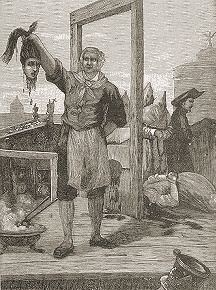
Mastro Titta brandishes an executed woman’s head.

The original Mastro Titta — the titular corruption of the “Minister of Justice” — took responsibility for each of his “patients” (as he called them, and as they were notoriously referred to by others), dutifully noting each of the 516 in his memoir. He stood for 69 years as the primary administrator of the death penalty in papal Rome, killing variously by beheading, hanging, and use of the mallet. Some were charged with murder, others with conspiracy, others with more petty crimes, but all were found guilty by the court of judges chosen by the Church’s bishops and cardinals.

The Minister’s performances were not without an (increasingly practiced) flair, heavy on the religious symbolism. Bugatti’s residence on the west side of the river meant that, when he was to carry out a punishment, he had first to cross the river.

Initially, the executions were carried out in the Piazza del Popolo, but that location was retired in the 1820’s; it’s not clear how consistent the location was after this, but at least one later execution occurred near San Giovanni decollato, home to the group of monks dedicated to comforting the condemned even when the final blow didn’t occur at its doorstep. Regardless of the locale, a spectacle soon arose surrounding that crossing and the parade which followed, as documented by Italian dialect poet G.G. Belli in 1835 (presumably for the execution of Giovanni Orioli di Lugo on July 11 of that year):

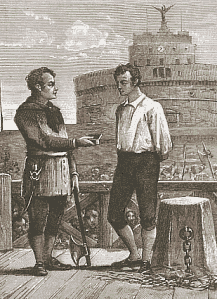
The Dilettante at the Bridge

They approach: Attention: the ceremony is brief.
Behold the condemned, neck bare and stretched.
He is the first man of the opera, the Patient,
The Ace of Spades, lord of the fesitval.

And behold the professor that will soon be
The surgeon acting for the people
For three pence, the community,
He will cure the ills of their pained head!

But not the man on the left: the other, to the right.
He in the second place is the Assistant.
The proceedings wait for Mastro Titta.

Do you want the usual from me, who takes the head?
I who never miss it: I am consistent;
And I know him as well as I know the Pope.

The translation is largely mine, with help on some difficult sections from a well-written and complete description of Mastro Titta’s life and work here and here.

Just a Job

A pinch of snuff before I snuff you?

Bugatti was known for playing the role of executioner in a manner which left no doubt as to his feelings towards the act: it was his job, his service to the Church itself, undisturbed by any personal animus towards the condemned — particularly early in his career.

He often offered snuff to his victims and spoke briefly and quietly with them prior to the execution, likely ploys to ease the victim into his role in the spectacle. Dickens viewed one of Mastro Titta’s beheadings on 8 March 1845*, and, in his Pictures From Italy, he remarked on the callousness of the event.

In keeping with this attitude, most of the entries in Mastro Titta’s memoir are fewer than 20 words. They reflect a man who seeks to distance himself from the crowd’s bloodlust. A selection:

  • Tommaso Tintori, guilty of homicide, 28 February 1810″ (The first using the “new edifice for beheading from the French government” — that is, the guillotine)
  • “Pecorari Angel, of Poli, aged 29. Peasant guilty of premeditated homicide of one woman, condemned to «death as an example» in Poland on 21 January 1847.” (There were a number of prisoners sentenced in other Catholic parts of Europe sent to Rome for Titta’s ministrations.)
  • “Sabbatino Proietti, aged 25, «decapitated» in Rieti for petty theft and highway robbery and murder on 20 August 1853, died converted, executed through administration of justice at the public square at the Bridge.”
  • “Angelo Lisi di Alatri, found guilty of premeditated highway robbery and murder in Frosinone, «dead» on 30 April 1862.”

An Anomalous Man

Bugatti was born just seven years prior to the Grand Duchy of Tuscany becoming the first of the Italian states to abolish the death penalty. There, Leopold II barred torture and punishment of death, a decision heavily influenced by Cesare Beccaria’s On Crimes and Punishments and a desire to distance his nation from Rome.

In the neighboring Papal State, however, the practice continued, the embodiment of the church’s power over its people in matters earthly and spiritual. Executions of the time performed for various reasons, but with a handful of exceptions, they were almost exclusively performed on persons in the lower class. Many relied on the use of torture or testimony from confessionals. Papal executions were carried out until the 1870s and only declared unnecessary (though not banned by the Church) by Pope John Paul II in the 1990s.

A complete discussion of the role of executions in the Catholic Church is too much for this space,** but a man like Bugatti serves usefully to exemplify the absurdity endowed in these killings by the Catholic Church. Where the half-dozen popes who served over Bugatti thought such executions to be necessary for the control of the masses, they had no such ideas about nobles who committed crimes.

The execution itself consisted of a parade with masked priests, banners, scriptural readings, and sermonizing, culminating in the death of the condemned. John L Allen of the National Catholic Reporter described the treatment of these executions in that day as “a liturgy”, and descriptions from writers such as Lord Byron show a scene which could only be described as a mix of Catholic Mass and town festival.

Such ritualized killing came to contrast starkly with the Italian celebration of an anti-death penalty position, and the two stood at odds for over a century. In 1909, the topic was hot enough that a plaque glorifying two Italians executed by Bugatti in 1825 was erected; a dozen years later, its contents were concealed out of deference to Rome until after the Second Vatican Council. The commemorated, Angiolo Targhini and Leonida Montanari (here’s their Italian Wikipedia page), were convicted essentially of riling the people, and they were summarily beheaded; their story was the inspiration for Luigi Magni’s 1969 classic Nell’anno del Signore:

“So ends the long list of Bugatti.”

Mastro Titta was given an official residence, and at the end of his term, he was handsomely rewarded with a pension for his service — 30 scudi per year. His final executions were carried out on 17 August 1864, wearing his traditional red cloak (now on display at the Criminology Museum of Rome): Antonio Olietti of Rome and Domenico Antonio Demartini were beheaded for homicide.

The Minister of Justice was 85, four and some years from the end of his life, and the final line in his memoir reads, “So ends the long list of Bugatti. May that of his successor be shorter.”

Indeed it was.

The final executions in Rome occurred on 24 November 1868 at the hands of Antonio Balducci, Bugatti’s long-time apprentice; the event was marked by Pope Pius IX famously intoning in response to calls for a stay, “I can’t, and I don’t want to.” The last execution in the Papal State was of Agatino Bellomo on 9 July 1870, in Palestrina, shortly before the nascent unified Italy absorbed Rome.

Mastro Titta is still known in Italy,† but, adrift amid a particularly violent period of revolution, his legacy as papal executioner is largely lost to the rest of the world.

* The day’s guillotinee was Giovanni Vagnarelli, 26, from Augustine; he killed Bavarian Anna Cotten and robbed her, and her wife’s statement at confessional was used to convict Vagnarelli. Such confessional convictions were not uncommon, as Bugatti’s own memoir confirms.

** There’s surprisingly little reading out there about this topic, though it would seem ripe for a book or two. Here’s what I can find:

  • “Fear and Loathing in Bologna and Rome: The Papal Police in Perspective”, Steven Hughes, Journal of Social History, 1987.
  • “Capital Punishment: The Curious History of its Privileged Place in Christendom”, James J. Megivern, Proceedings of the American Philosophical Society, 2003.
  • For a discussion of current discourse in Catholic teachings, this is rather interesting: “To Kill or Not to Kill: The Catholic Church and the Problem of the Death Penalty”, lecture by E. Christian Brugger, Asst. Prof. of Ethics, Dept. of Religious Studies, Loyola University, 2001.

† A half dozen kilometers from the bridge that Mastro Titta crossed on his way to carry out Papal justice now stands the Mastro Titta Pub. It is reportedly “tastefully done” and serves mostly Belgian beers.

On this day..